New regs for Wednesday: Nuclear, The Hill, 13 Mar 17
“………..The Nuclear Regulatory Commission (NRC) is drafting new rules for nuclear power reactors that are being decommissioned.
The rules will “provide for an efficient decommissioning process” and “reduce the need for exemptions from existing regulations.”
The public has 90 days to comment.http://thehill.com/regulation/323851-new-regs-for-wednesday-prepaid-cards-nuclear-water
March 15, 2017
Posted by Christina Macpherson |
Legal, USA |
Leave a comment

 This climate lawsuit could change everything. No wonder the Trump administration doesn’t want it going to trial, WP, By Chelsea Harvey March 9 A groundbreaking climate lawsuit, brought against the federal government by 21 children, has been hailed by environmentalists as a bold new strategy to press for climate action in the United States. But the Trump administration, which has pledged to undo Barack Obama’s climate regulations, is doing its best to make sure the case doesn’t get far.
The Trump administration this week filed a motion to overturn a ruling by a federal judge back in November that cleared the lawsuit for trial — and filed a separate motion to delay trial preparation until that appeal is considered.
The lawsuit — the first of its kind — argues the federal government has violated the constitutional right of the 21 plaintiffs to a healthy climate system.
Environmental groups say the case — if it’s successful — could force even a reluctant government to reduce greenhouse gas emissions and take other measures to counter warming.
“It would be huge,” said Pat Gallagher, legal director at the Sierra Club, who is not involved in the case. “It would upend climate litigation, climate law, as we know it.”
[Trump’s proposed climate agency cuts would disarm our coasts in the face of rising seas, scientists say]
The landmark lawsuit was originally filed during the Obama administration. The 21 plaintiffs, now between the ages of 9 and 20, claim the federal government has consistently engaged in activity that promotes fossil fuel production and greenhouse gas emissions, thereby worsening climate change. They argue this violates their constitutional right to life, liberty and property, as well the public trust doctrine, while holds that the government is responsible for the preservation of certain vital resources — in this case, a healthy climate system — for public use.
While legal experts are uncertain as to the lawsuit’s likelihood of success, few have disputed its pioneering nature. Similar cases have been brought on the state level, but this is the first against the federal government in the United States. And in November, the case cleared a major early hurdle when U.S. District Judge Ann Aiken denied motions filed by the Obama administration, as well as the fossil fuel industry, to have the lawsuit dismissed, ordering that it should proceed to trial.
The move allowed the case to join the ranks of climate lawsuits filed in other nations, which could upend the way environmental advocacy is conducted around the world. Just last year, a court in the Netherlands ordered the Dutch government to cut carbon emissions by a quarter within five years. Similar climate-related suits have been brought and won in Austria, Pakistan and South Africa.
Shortly after President Trump’s inauguration, the plaintiffs submitted a request that the Department of Justice preserve all documents that could be relevant to the lawsuit, including information on climate change, energy and emissions, and cease any destruction of such documents that may otherwise occur during the presidential transition. The request came just days after reports began to surface of climate information disappearing from White House and certain federal agency websites.
“We are concerned with the new administration’s immediate maneuver to remove important climate change information from the public domain and, based on recent media reports, we are concerned about how deep the scrubbing effort will go,”Julia Olson, chief legal counsel for the plaintiffs and executive director of the advocacy group Our Children’s Trust, said in a statement at the time. “Destroying evidence is illegal and we just put these new U.S. Defendants and the Industry Defendants on notice that they are barred from doing so.”…….https://www.washingtonpost.com/news/energy-environment/wp/2017/03/09/this-climate-lawsuit-could-change-everything-no-wonder-the-trump-administration-doesnt-want-it-going-to-trial/?tid=ss_tw&utm_term=.14eb9ea766c0
March 11, 2017
Posted by Christina Macpherson |
climate change, Legal, politics, USA |
Leave a comment
 http://www.sanluisobispo.com/news/business/article134769964.html The Associated Press TALLAHASSEE, FLA. 24 Feb 17 The Florida Supreme Court is upholding a lower court ruling that ordered a massive nuclear plant expansion to be redone to meet environmental and other concerns.
Justices in a brief-one page order on Friday rejected an appeal filed by Florida Power & Light.
Last year, the 3rd District Court of Appeal in Miami reversed a 2014 decision by Gov. Rick Scott and the Cabinet to approve construction of two nuclear reactors by FPL at its Turkey Point plant near Homestead. The project, costing up to $18 billion, would add about 2,200 megawatts of electric power or enough to supply 750,000 homes.
A three-judge panel ruled the governor and Cabinet failed to account for environmental regulations meant to protect the Everglades and endangered birds that make their home in the wetlands.
February 25, 2017
Posted by Christina Macpherson |
Legal, USA |
Leave a comment

 Nuclear Deal: Case to stop SA from bankrupting itself begins https://www.dailymaverick.co.za/article/2017-02-22-nuclear-deal-case-to-stop-sa-from-bankrupting-itself-begins/#.WK9qo9KGPGg REBECCA DAVIS SOUTH AFRICA 22 FEB 2017
While Finance Minister Pravin Gordhan was throwing around some big figures in Parliament on Wednesday, an even bigger one was looming over the Western Cape High Court: R1-trillion, the estimated cost of South Africa’s nuclear deal with Russia. The legal challenge mounted by two environmental NGOs to the nuclear deal hit the court this week, with an accompanying bevy of protesters. It has been termed one of the most significant state capture court cases South Africa has yet seen. By REBECCA DAVIS.
“No nukes, no bankrupting SA, no enriching Zuma and Co,” read one sign. “Nuclear costs SA equivalent of 1.2-billion buses!” proclaimed another. On a day when South Africa’s economy was already in the spotlight, the small crowd assembled outside the Western Cape High Court had one particular aspect of its future in mind. “Phantsi secret nuclear deal phantsi!” the protesters chanted.
In the legal ring: two NGOs, Earthlife Africa and the Southern African Faith Communities’ Environment Institute (SAFCEI), squaring up against Energy Minister Tina Joemat-Pettersson’s pursuit of 9,600 megawatts of nuclear power. One media outlet referred to it as a “David vs Goliath battle”. That’s accurate in the sense that the two NGOs behind the legal battle are modestly resourced. But when David took on Goliath, he didn’t have one of the most lethal advocates in the country leading his legal team.
Acting for the NGOs is David Unterhalter, who has appeared in countless of South Africa’s most high-profile legal matters – including representing Deputy President Cyril Ramaphosa at the Marikana Commission. In this case, David is armed and dangerous.
The court challenge will not deal with the question of whether or not nuclear power is the right energy source to meet the country’s needs. Opening the arguments for the applicants on Wednesday, Unterhalter said that his team would show that the inter-governmental nuclear agreement with Russia “fails to comply with what is required constitutionally”.
While the government contends that this kind of international agreement is an instance of “executive action”, and thus beyond the purview of review, the applicants maintain that it is “a fairly straightforward case of administrative action” which should have gone before Parliament for resolution. While the Russian agreement was tabled in Parliament, it was not subject to a debate and a resolution of Parliament, despite the state law adviser’s counsel to Minister Joemat-Pettersson that this was required.
Lawyer Adrian Pole subsequently told journalists that they will also argue that the public should have been granted more of a voice in discussions about South Africa’s energy future.
This point was emphasised by the protesters outside court. Criticising the government for making use of “flawed” processes and failing to carry out public hearings, Earthlife Africa’s Makoma Lekalakala described the nuclear process as “shrouded in secrecy”.
Lekalakala said: “This case was filed in the public interest to hold those in government accountable and prevent secret deals leading to corruption.” She also hit out at the possible environmental damage of a large-scale nuclear programme. South Africa is currently dependent on a fossil fuel economy, Lekalakala said. “With nuclear it becomes much worse – it’s not just a question of pollution, but also of [how to dispose of nuclear] waste.”
South Korean activist Kim Yong-Bock was outside court on Wednesday in solidarity with South African protesters – and bearing an urgent message focusing on nuclear safety. Kim said that the local court case was similar to the ongoing debate in Japan about the constitutionality of nuclear plants.
“The security of life in your country is supposed to be protected by your Constitution,” Kim said, warning that after the 2011 Fukushima nuclear disaster in Japan, wrangling continues as to the liability of the Tokyo Electric Power Company. To the nuclear industry, Kim suggested, “it doesn’t really matter if you die or not”.
Looking around at the South Africans gathered outside the court, Kim said: “You are potential victims.”
The issue of the prohibitive cost of the nuclear build was also prominent among the protesters’ concerns. “There are many ways of providing the electricity we need now and in the future without spending R1-trillion or more,” SACSEI’s Ven Tsondru said. Both sun and wind, she suggested, could generate electricity quicker and cheaper than nuclear energy.
Tsondru explained that the court case’s major function was to force government to share both the reasoning behind, and financial details of, the nuclear deal.
The legal proceedings have already forced the government’s hand in revealing certain aspects of the previously secretive nuclear deal. The original court application was filed in October 2015. From papers revealed to the applicants in 2016, the NGOs said that it appeared that despite denials from the governments of both Russia and South Africa, a binding commitment to buy a fleet of nuclear reactors from Russia had already been signed.
On Wednesday morning, protesters were keeping one eye on Parliament, where Finance Minister Pravin Gordhan was due to deliver his Budget speech that afternoon. Ears would be pricked for reference to the nuclear deal, which President Jacob Zuma did not mention in his State of the Nation Address a fortnight ago.
Earthlife Africa’s Lekalakala told the small crowd outside the Western Cape High Court that they expected the Finance Minister to announce in the Budget that afternoon that “we cannot go ahead with nuclear now”. If he were to give endorsement to the nuclear deal, she said, he would be “undermining you and me”.
As it turned out, Minister Gordhan’s Budget did not mention the nuclear deal at all – unless you count a veiled reference to protecting future generations from today’s debt.
To SAFCEI’S Liz McDaid, this was a positive sign.
“We applaud the Minister of Finance for acting in the public interest and not wasting money on the nuclear deal,” McDaid told the Daily Maverick. “We will continue to monitor government with respect to the nuclear deal. If we are successful with our court case, the decision to procure nuclear will be overturned.”
February 25, 2017
Posted by Christina Macpherson |
Legal, South Africa |
Leave a comment
Antinuclear lobby groups say government’s secrecy is embarrassing
Two groups are asking the high court to declare the alleged nuclear deal with Russia‚ signed by Energy Minister Tina Joemat-Pettersson‚ unlawful, Business Live 22 FEBRUARY 2017 PETRU SAAL The court battle between lobby groups and the government over the alleged R1-trillion proposed nuclear deal with Russia — ostensibly the biggest procurement by the government to date — resumed in Cape Town on Wednesday.
Earthlife Africa Johannesburg and the Southern African Faith Communities’ Environment Institute (Safcei) have taken the Department of Energy to court for procuring this arrangement under a veil of secrecy.
They have asked the court to declare the deal‚ signed by Energy Minister Tina Joemat-Pettersson‚ unlawful and unconstitutional.
Spokesperson for Earthlife Makoma Lekalakala said it was “embarrassing” that they had to turn to the courts because the government refused to divulge details of the deal, which was of great public interest.
“We wondered why the government wanted to build nuclear plants especially after what happened in Hiroshima. Nuclear is also very costly so this deal is on the brink of bankrupting the country‚” Lekalakala said…… Finance Minister Pravin Gordhan made no mention of the deal in his budget speech.https://www.businesslive.co.za/bd/national/2017-02-22-antinuclear-lobby-groups-say-governments-secrecy-is-embarrassing/
February 25, 2017
Posted by Christina Macpherson |
Legal, South Africa |
Leave a comment
Algerians take steps to prosecute France for nuclear tests https://www.middleeastmonitor.com/20170215-algerians-take-steps-to-prosecute-france-for-nuclear-tests/#.WKqZtaGEIJo.facebook
The top human rights organisation in Algeria announced yesterday that it has contacted the UN Human Rights Council regarding France’s refusal to admit to the crimes of its nuclear test programme. The French government carried out 17 nuclear tests in the Algerian desert, causing the death of 42,000 individuals; thousands more were left chronically ill due to being exposed to nuclear radiation.
The details were revealed in a statement by the National Secretary of the Algerian League for the Defence of Human Rights, Houari Kaddour, who is tasked with this issue, during an interview with Anadolu news agency. Kaddour stressed that his organisation “is trying to use all legal means to put the French authorities on trial and prosecute them in all international legal bodies, as well as in the EU, for their crimes.”
Algeria marked the 57th anniversary of the French nuclear tests two days ago. They were carried out between 1960 and 1966; Algeria gained independence from France in 1962. The French authorities still refuse to admit to these crimes and instead have announced that they will pay financial compensation to the victims.
According to Kaddour, his organisation contacted the UN Human Rights council and requested it to look into the crimes. “We also urged the Algerians in Europe to help us find lawyers specialising in international law to file a lawsuit against France in the next three months, before the Office of the High Commissioner on Human Rights in the EU. We also plan to prosecute France in the local courts in Switzerland which specialise in international crimes.”
Kaddour said that his organisation is coordinating with a number of human rights and international bodies in this regard, including all international human rights organisations, international organisations against nuclear testing, and French human rights groups. He noted that the Algerians had submitted over 730,000 compensation cases that were rejected by the compensation committee due to the impossible conditions imposed on the victims. Civilian victims, he added, are not recognised.
The Algerian League for the Defence of Human Rights accused the Algerian authorities of “not putting enough pressure on France to admit to these crimes.”
February 22, 2017
Posted by Christina Macpherson |
France, Legal |
Leave a comment

 Pro-consumer Florida energy bills would expand solar, repeal nuclear fees http://protectingyourpocket.blog.mypalmbeachpost.com/2017/02/21/pro-consumer-florida-energy-bills-would-expand-solar-repeal-nuclear-fees/
A Florida Senate bill filed this week would allow property owners to generate and distribute solar energy to residents and tenants.
Senator José Javier Rodríguez, D-Miami, this week filed a series of energy-related bills aimed at protecting the environment and protecting consumers’ pocket books.
- SB 456, allowing property owners to generate and distribute solar energy to residents and tenants on their own property. The bill is supported by a broad range of groups including business groups, agricultural interests, and consumer advocates.
- SB 974, if passed, would create a mechanism to prevent utilities from passing on to customers the cost of remediating environmental damage the utility caused, offered in response to the water contamination issues at Florida Power & Light’s Turkey Point nuclear power plant in Miami-Dade County.
- SB 976, if passed, would create a progressive rate schedule for utilities customers by requiring utilities to charge residential customers a 25 percent lower rate for the first 500 kilowatt hours consumed, benefitting low-income and fixed-income residents.
- SB 1100, if passed, would repeal advanced nuclear cost recovery in Florida, dubbed the “nuclear tax” since it allow utilities to charge for nuclear power plants that may never be built. FPL wants to build two more nuclear reactors at Turkey Point, but has not been granted a license yet.
“Consumers in Florida continue to subsidize an outdated energy system in Florida that stifles innovation, shuts out competition and hurts our environment — the bills I have filed will address those issues while giving consumers a much-needed break,” Rodriguez said.
February 22, 2017
Posted by Christina Macpherson |
Legal, politics, USA |
Leave a comment
Nuclear power struggle winds up in court, Herald and Review, TONY REID H&R Staff Writer, 19 Feb 17 CLINTON – Smoldering resentment over the new law that saved Clinton Power Station – and its 700 jobs – has now flared into a federal lawsuit.
February 20, 2017
Posted by Christina Macpherson |
Legal, USA |
Leave a comment
Fortunately, there is a bit of good news in his heap of radioactivity. Last November, a settlement was reached between the US Department of Justice, Bechtel Corp. and AECOM (formerly URS) for a whopping $125 million. The civil lawsuit alleged taxpayer funds were mismanaged and that both companies performed shoddy work. The lawsuit also claimed that government funds were illegally used to lobby members of Congress. Brought on by whistleblowers Gary Brunson, Donna Busche, and Walter Tamosaitis (Busche and Tamosaitis’s sagas were highlighted in two Investigative Fund reports I authored for Seattle Weekly in 2011 and 2012), the settlement was one of the largest in DoE history.
No doubt it was a substantial victory for whistleblowers and government accountability, despite the fact that the defendants did not admit guilt. Now, Washington State legislators are pushing HB 1723, a bill that would protect and treat Hanford workers for certain health problems that are a result of the work they’ve done at the facility, such as respiratory problems, heart issues, certain cancers like bone, breast, lung and thyroid, as well as neurological issues.
 Good News and Bad News at Hanford, America’s Most Polluted Site http://www.counterpunch.org/2017/02/09/good-news-and-bad-news-at-hanford-americas-most-polluted-site/FEBRUARY 9, 2017“The people running Hanford need to have a moral compass that directs them in the right way, as human beings, to do the right thing to protect these people,” retired Hanford employee Mike Geffre, who worked at Hanford for 26 years, told KING 5. “They’re trying to save money and save face. They’re standing behind their old position that there’s no problem. That’s absurd. They need to accept the fact that they made mistakes and get over it.”

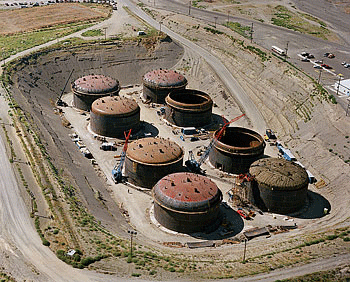
by JOSHUA FRANK It’s a new year and new administration, but the strong radioactive stench is the same out at Hanford in eastern Washington, home of the world’s costliest environmental cleanup. In January, a dozen workers reported smelling a toxic odor outside the site’s tank farms, where nuclear waste is stored underground. From April to December 2016, 70 people were exposed to chemical vapors emanating from the facility — and 2017 is off to the similar start.
Toxic odors at an old nuclear depot? This would be startling news anywhere else. But this is Hanford after all, where taxpayer money freely flows to contractors despite the snail-paced half-life of their work. Twenty years and $19 billion later, Hanford is still a nightmare — likely the most toxic site in the Western Hemisphere. Not one ounce of nuclear waste has ever been treated, and there are no indications Hanford will be nuke free anytime soon. To date, at least 1 million gallons of radioactive waste has leaked and is making its way to the Columbia River. It’s an environmental disaster of epic proportions — a disaster created by our government’s atomic obsession during the Cold War era.
No doubt, Hanford is a wreck in search of a remedy, yet the costs covered by American taxpayers appears to be growing exponentially. At the tail end of 2016, the estimated cost of turning the radioactive gunk into glass rods bumped up a cool $4.5 billion (adding to the ultimate price tag for the remaining Hanford cleanup, which had already reached a whopping $107.7 billion). These sorts of increases are so common they hardly make news anymore.
Donald Trump’s pick for Department of Energy Secretary, Rick Perry, who infamously stated he’d like to do away with the DoE altogether, now admits that Hanford’s one of the most dangerous facilities in the nation. But his commitment to cleaning up the fiscal and nuclear boondoggle remains to be seen. The plant that is to turn the waste into glass rods is set to open in 2023, but it’s a safe bet that won’t be happening. It’s already two decades behind schedule.
Meanwhile, workers on the front lines of the cleanup are often put in situations that are poorly monitored and exceedingly unsafe. Over the past three years KING 5 News in Seattle has tracked dozens of employees who were exposed to chemical vapors at Hanford and found their illnesses to include “toxic encephalopathy (dementia), reactive airway disease, COPD, and painful nerve damage.”
“The people running Hanford need to have a moral compass that directs them in the right way, as human beings, to do the right thing to protect these people,” retired Hanford employee Mike Geffre, who worked at Hanford for 26 years, told KING 5. “They’re trying to save money and save face. They’re standing behind their old position that there’s no problem. That’s absurd. They need to accept the fact that they made mistakes and get over it.”
Fortunately, there is a bit of good news in his heap of radioactivity. Last November, a settlement was reached between the US Department of Justice, Bechtel Corp. and AECOM (formerly URS) for a whopping $125 million. The civil lawsuit alleged taxpayer funds were mismanaged and that both companies performed shoddy work. The lawsuit also claimed that government funds were illegally used to lobby members of Congress. Brought on by whistleblowers Gary Brunson, Donna Busche, and Walter Tamosaitis (Busche and Tamosaitis’s sagas were highlighted in two Investigative Fund reports I authored for Seattle Weekly in 2011 and 2012), the settlement was one of the largest in DoE history.
No doubt it was a substantial victory for whistleblowers and government accountability, despite the fact that the defendants did not admit guilt. Now, Washington State legislators are pushing HB 1723, a bill that would protect and treat Hanford workers for certain health problems that are a result of the work they’ve done at the facility, such as respiratory problems, heart issues, certain cancers like bone, breast, lung and thyroid, as well as neurological issues.
“Currently, many Hanford workers are not receiving necessary medical care because they are put in the impossible situation of being unable to specify the chemicals to which they have been exposed, and in what concentrations, making it difficult for their doctors to connect their disease with their exposures,” Randy Walli, Business Manager for the pipefitters union, Local 598, told King 5.
Compensation for whistleblowers and employees whose health is impacted by their work are steps in the right direction. But Hanford’s contractors and the DoE that oversees them still have much to do to make the increasingly expensive nuclear cleanup at Hanford, safe, effective and transparent.
This piece first appeared at The Investigate Fund.
February 10, 2017
Posted by Christina Macpherson |
Legal, USA, wastes |
Leave a comment
 Seoul Court Orders Gov’t to Close Nuclear Reactor Amid Safety Concerns, Sputnik News, 7 Feb 17 The Seoul Administrative Court ordered the Nuclear Safety and Security Commission (NSSC) to cancel its resolution to extend the operation of a nuclear reactor located about 400 kilometers (250 miles) southeast of Seoul due to the commission’s failure to follow legal regulations.
MOSCOW — The Seoul Administrative Court ruled in favor of a lawsuit filed by a group of local residents to annul the NSSC’s approval of a 10-year extension of the operation of the Wolseong-1 reactor in Gyeongju, which was supposed to be shut down in 2012, the Yonhap news agency reported Tuesday.
The reactor was shut down in 2012 after reaching the end of its 30-year commercial operation period. However, the commission issued a new operation license for another 10 years and restarted the reactor in June 2015 after a total of 946 days offline. In the wake of the 2011 Fukushima nuclear disaster in Japan, the commission’s decision raised safety concerns and resulted in a collective suit filed by 2,167 nearby residents. However, the court recognized only the claims of those living within an 80-kilometer radius of the reactor. The court’s verdict was based on the NSSC’s failure to follow the legal procedures……..https://sputniknews.com/asia/201702071050421931-south-korea-nuclear-reactor/
February 8, 2017
Posted by Christina Macpherson |
Legal, South Korea |
Leave a comment
 Big shift afoot in French nuclear compo law http://www.radionz.co.nz/international/pacific-news/323947/big-shift-afoot-in-french-nuclear-compo-lawThe French joint law commission has decided to remove the term negligible risk from the nuclear compensation law in what is seen as a breakthrough for French Polynesia’s test victims.
The unanimous decision is now to go to the National Assembly and the Senate for approval as Paris is to make good on its promise to loosen the law.
The compensation law, drawn up by Herve Morin when he was the defence minister in 2009, has been widely criticised for being too restrictive because almost all claims have been thrown out.
A month ago, two French lawmakers urged the social affairs minister Marisol Touraine to amend the decree on compensation to ensure that unsuccessful claimants can resubmit their files.
One of the MPs Jean-Patrick Gille said veterans would find it incomprehensible if the earlier rejection of their compensation bids were to be final.
France tested its atomic weapons first in Algeria and then from 1966 to 1996 in the South Pacific in a programme which involved more than 100,000 personnel.
February 8, 2017
Posted by Christina Macpherson |
Legal, OCEANIA, weapons and war |
Leave a comment
 Trust banks preparing to sue Toshiba – report http://www.channelnomics.com/channelnomics-us/news/3003570/trust-banks-preparing-to-sue-toshiba-report Vendor also preparing to sell part of its memory business, Scharon Harding, 30 Jan 17, Toshiba may be hit with lawsuits from Japanese trust banks that could total over 1 billion yen ($8.8 million) over the accounting scandal it endured in 2015, Reuters reports.
According to the report, Mitsubishi UFJ Trust and Banking Corp. said today it is getting ready to sue the Japanese vendor in the name of its clients’ pension funds after revelations the vendor had been exaggerating profits caused share prices to drop.
Reuters added that Sumitomo Mitsui Trust Bank Ltd and Mizuho Trust & Banking Co. are organizing “similar” lawsuits, according to anonymous sources.
News of the potential lawsuits comes three days after Toshiba announced plans to sell parts of its memory business, including its SSD business, by 31 Marcch. The move is an attempt to minimize damage from an upcoming writedown for its U.S. nuclear business that could reach billions, according to CNBC.
Toshiba is already facing a pile of cases in relation to findings that the company’s bookkeeping practices led to the overstating of profits by over 170 billion yen (about $1.4 billion) by 45 institutional investors for 16.7 billion yen ($146 million) and 15 Japanese entities totaling 15.3 billion yen ($134 million), Reuters said.
February 1, 2017
Posted by Christina Macpherson |
business and costs, Japan, Legal |
Leave a comment

Would any judge question a medical expert’s evidence in the way that this judge doubts the evidence of the world’s climate scientists? Then again – they do say that “the law is an ass”
Judge in environmental activist’s trial says climate change is matter of debate
Controversial statements angered environmentalists who insist courts have an obligation to recognize the science about manmade climate change, Guardian, Sam Levin 31 Jan 17, A Washington state judge has sparked outrage for remarks questioning the existence of climate change and the role of humans in global warming.
During the high-profile trial of Ken Ward, a climate activist facing 30 years in prison for shutting down an oil pipeline, Judge Michael E Rickert said: “I don’t know what everybody’s beliefs are on [climate change], but I know that there’s tremendous controversy over the fact whether it even exists. And even if people believe that it does or it doesn’t, the extent of what we’re doing to ourselves and our climate and our planet, there’s great controversy over that.”
The Skagit County judge made the comments on 24 January while addressing Ward’s request to present a “necessity defense” in court, meaning he would argue that the grave threat of climate change justified civil disobedience.
Rickert’s controversial statements, along with his decision to block Ward from arguing that his pipeline protest was necessary to prevent harm to the planet, angered environmentalists who insist that American courts have an obligation to recognize the science and consensus among researchers about man-made climate change.
“I thought it was shocking and deeply worrisome for my case,” said Ward, 60, of Corbett, Oregon, who temporarily shut off the safety valve of the TransMountain pipeline in Skagit County. “We are in the late stages of global collapse, and to have someone who is presumably as knowledgeable and aware as a judge should be blithely dismissing the biggest problem facing the world is chilling.”
Ward, whose trial began on Monday, is part of a group of activists that targeted oil sands pipelines in Washington, Oregon, North Dakota, Montana and Minnesota on 11 October 2016. The coordinated #ShutItDown actions – which have led to a dozen criminal cases and threats of hefty prison sentences against activists and journalists – was aimed at stopping 15% of US crude oil imports for a day.
He later added that with climate change, there’s “great controversy” with “over half of our political leaders”. (Critics have slammed the GOP as the “only major party in the advanced world” to deny climate change)……. https://www.theguardian.com/environment/2017/jan/31/environmental-activist-trial-judge-questions-climate-change-ken-ward
February 1, 2017
Posted by Christina Macpherson |
climate change, Legal, USA |
Leave a comment
 Five anti-Trident protesters found guilty after blockading nuclear bomb factory The group argued they were putting their religious beliefs into action BY blockading the AWE Burghfield The Independent Jon Stone Political Correspondent @joncstone 27 Jan 17, Five anti-Trident protesters have been found guilty of blockading a nuclear weapons manufacturing facility – days after new concerns were raised about the safety of Britain’s Trident nuclear missiles.
The protesters, who barred the entrance to Burghfield Atomic Weapons Establishment in Berkshire in June of last year, were from the Christian group Put Down the Sword / Trident Ploughshares.
Trident mounted nuclear warheads are assembled at Burghfield, which has been the site of repeated demonstrations for a number of years. The MoD said work on the missile system was disrupted by the protests……
The activists’ defence team argued that they were acting in accordance with their religious beliefs, which they said were protected by the Human Rights Act.However district judge Khan said that he did not agree that “that the actions of the defendants were a manifestation of a religious belief” and in any case that “these rights have to yield to the primary right of passing and re-passing the highway” outside the base…….
A joint statement from the defendants said: “We stand by what we said in court: Trident is an illegal and immoral waste of money, a crime against humanity and God.
“The prosecution said we could just have joined in a prayer vigil to the side of the road, instead of lying in it; we said our consciences wouldn’t allow that. We believe prayer is important but sometimes our faith compels us to put our whole bodies in the way of injustice and violence.“The Bible says religious acts are meaningless unless we also stand up for the poor and needy; we are called to bring a just peace with hope for all. We will continue to seek peace, and to take the consequences of doing so. It’s a small price to pay for the chance to challenge an evil like nuclear weapons.”http://www.independent.co.uk/news/uk/politics/trident-burghfield-reading-nuclear-missiles-bomb-factory-base-protests-guilty-a7549261.html
January 28, 2017
Posted by Christina Macpherson |
Legal, opposition to nuclear, Religion and ethics, UK |
Leave a comment
 FPL Wins Battle to Store Radioactive Waste Under Miami’s Drinking Water Aquifer, Miami New Times, BY JERRY IANNELLI JANUARY 16, 2017 Environmental activists have started a petition urging Florida lawmakers to prevent FPL from storing waste underground. South Florida sits atop two gigantic underground stores of water: the Biscayne and Floridan Aquifers. Miamians get most of their drinking water from the upper Biscayne Aquifer, while the government has used the lower portion of the Floridian to dump waste and untreated sewage — despite the fact that multiple studies have warned that waste could one day seep into the drinking water.
According to NRC documents, CASE’s petition was dismissed for being filed “inexcusably late” in FPL’s application process.
“This was thrown out on procedural grounds,” says CASE’s president, Barry J. White. “The science is still there.”
CASE had filed a petition with the U.S. Nuclear Regulatory Commission, but the NRC on Friday threw out CASE’s complaint, saying the environmental group had filed too late in FPL’s approval process.
The fight stems from the energy company’s plan to build two nuclear reactors at the controversial Turkey Point Nuclear Generating Station south of Miami by roughly 2030. The towers might not be operational for a decade or two, but that doesn’t mean the public should stop paying attention to them. FPL is submitting numerous proposals about the project to the government.
As part of that package, FPL told the U.S. Nuclear Regulatory Commission that it plans to store contaminated water used to clean the reactors, as well as radioactive waste (“radwaste”) in the Boulder Zone. In October, the NRC issued a report, stating FPL’s plan would pose “no environmental impacts” to the South Florida environment.
Roughly a month later, on November 28, CASE filed a legal petition demanding that the NRC hold a hearing on FPL’s radioactive waste plan. CASE alleges the government failed to address a host of concerns about the power company’s plan.
“Everything will be put into a supposedly ‘hermetically sealed’ Boulder Zone,” White told New Times in December. “But anybody who lives in South Florida knows nothing below us is hermetically sealed.” Environmentalists say the plan could leak carcinogens such as cesium, strontium 90, and tritium right into the drinking-water aquifers…….. http://www.miaminewtimes.com/news/fpl-wins-battle-to-store-radioactive-waste-under-miamis-drinking-water-aquifer-9059210
January 20, 2017
Posted by Christina Macpherson |
Legal, USA, water |
Leave a comment















 nuclear-news