Energy Post 23rd March 2018,The European Commission has proposed new European legislation that could
put Europe’s distribution system operators in a powerful position to bend
market rules to their own advantage, writes Julie Finkler of NGO
ClientEarth. According to Finkler, this could seriously hamper other market
players, like community energy initiatives, renewable energy producers and
aggregators. She calls on the European Parliament and the Member States to
ensure this will not happen. http://energypost.eu/eu-electricity-distributors-should-not-be-allowed-to-police-themselves/
Mabna Institute Hackers Penetrated Systems Belonging to Hundreds of Universities, Companies, and Other Victims to Steal Research, Academic and Proprietary Data, and Intellectual Property, USA Department of Justice, 23 Mar 18
An Indictment charging Gholamreza Rafatnejad, 38; Ehsan Mohammadi, 37; Abdollah Karima, aka Vahid Karima, 39; Mostafa Sadeghi, 28; Seyed Ali Mirkarimi, 34; Mohammed Reza Sabahi, 26; Roozbeh Sabahi, 24; Abuzar Gohari Moqadam, 37; and Sajjad Tahmasebi, 30, all citizens and residents of Iran, was unsealed today. The defendants were each leaders, contractors, associates, hackers-for-hire or affiliates of the Mabna Institute, an Iran-based company that, since at least 2013, conducted a coordinated campaign of cyber intrusions into computer systems belonging to 144 U.S. universities, 176 universities across 21 foreign countries, 47 domestic and foreign private sector companies, the U.S. Department of Labor, the Federal Energy Regulatory Commission, the State of Hawaii, the State of Indiana, the United Nations, and the United Nations Children’s Fund……..https://www.justice.gov/opa/pr/nine-iranians-charged-conducting-massive-cyber-theft-campaign-behalf-islamic-revolutionary
La Libre 19th March 2018, More than 40 scientists, intellectuals, engineers and artists: “It is time
for the political world to assume Fukushima” (OPINION).It is time for the
political world to take its mistakes and put an end to the nuclear
industry.
This is not only illegitimate, but it is also an extreme threat
to our future. On June 25 last year, 50,000 people joined hands to demand
the closure of the Tihange plant. The number of protesters surprised many.
Also notable was the lack of reaction from the political world as a result
of this extraordinary event.
There are reasons for this apparent lethargy of the leaders of this country, in the face of this popular demonstration,
perhaps starting with a feeling of guilt, which would be quite appropriate.
Indeed, what has prevailed in the implementation of the nuclear industry is
the lack of democratic debate and false state propaganda, that of an energy
that would be unlimited, cheap and safe; as we recalled the commemoration
of the seventh anniversary of Fukushima, the second accident of a nuclear
power station which has no end, after that of Chernobyl in 1986.
More serious still, in 1960, the leaders of 16 European countries, including Belgium, agreed to sign the Paris Convention which was intended to limit the financial liability of the operator in the event of a nuclear accident, no insurance company willing to cover the nuclear risk considered too high.
Without this unique Convention, the nuclear industry could never have developed in Europe.
It is worth mentioning here that a major accident in Tihange would mean the end of life as we know it and, in fact, the end of Wallonia as a region. That the cost of such an accident would amount to
several trillions of euros, without it being possible to quantify the
sanitary and psychological misery into which the Walloons, sentenced,
either to leave their country abandoning all their property – but to go
where, or to live in a contaminated territory for the poorest of them. That
on this amount, the operator, Engie-Electrabel, would have to pay only 1.2
billion, less than its profit of certain years and less than one thousandth
of the cost of the disaster. http://www.lalibre.be/debats/opinions/plus-de-40-scientifiques-intellectuels-ingenieurs-et-artistes-il-est-temps-que-le-monde-politique-assume-fukushima-opinion-5aae9319cd702f0c1a63ffda
https://mainichi.jp/english/articles/20180320/p2g/00m/0dm/023000c(Mainichi Japan) TOKYO (Kyodo) — Some 200 U.S. residents filed a suit against Tokyo Electric Power Company Holdings Inc. and a U.S. firm seeking at least $1 billion to cover medical expenses related to radiation exposure suffered during the 2011 Fukushima nuclear disaster, the utility said Monday.
The lawsuit was filed last Wednesday with U.S. federal courts in the Southern District of California and the District of Columbia by participants in the U.S. forces’ Operation Tomodachi relief effort carried out in the wake of the March 11, 2011, earthquake and tsunami that crippled TEPCO’s Fukushima Daiichi nuclear plant.
Many of the plaintiffs are suing TEPCO and the U.S. company, whose name was withheld by TEPCO, for the second time after a similar suit was rejected by the federal court in California in January.
They are seeking the establishment of a compensation fund of at least $1 billion to cover medical and other costs, the utility said.
The plaintiffs claim that the nuclear accident occurred due to improper design and management of the plant by TEPCO. They are also seeking compensation for physical and psychological damage suffered as a result of the disaster, said the utility.
In Operation Tomodachi, which began two days after the natural disasters, the aircraft carrier Ronald Reagan and other U.S. military resources and personnel were deployed to deliver supplies and undertake relief efforts at the same time as three reactors at the Fukushima Daiichi complex suffered fuel meltdowns.
Court sides with power company over Oma nuclear plant http://www.asahi.com/ajw/articles/AJ201803190056.html, By KAZUKI NUNOTA/ Staff Writer, March 19, 2018 HAKODATE, Hokkaido–A court in northern Japan on March 19 dismissed a lawsuit to halt construction of a nuclear power plant in Aomori Prefecture on grounds there was no realistic possibility of a serious accident occurring.
Electric Power Development Co. (J-Power) is overseeing construction of the Oma nuclear plant in Oma, across the sea from Hakodate.
The facility is undergoing screening by the Nuclear Regulation Authority to ensure it meets new safety standards imposed after the 2011 Fukushima disaster.
Presiding Judge Chikako Asaoka at the Hakodate District Court said in her ruling, “At the moment, it is difficult to readily recognize the tangible danger of a grave accident likely to occur at the plant.”
The lawsuit focused on whether an active seismic fault existed in the seabed near the construction site, the dangers posed by the possibility of volcanic eruptions in the area and concerns about using only mixed-oxide (MOX) fuel, consisting of plutonium and uranium, as nuclear fuel.
The suit was filed in July 2010 by a group of 1,000 or so plaintiffs.
An Albuquerque-based nonprofit that advocates for nuclear disarmament filed a lawsuit this week asking a U.S. District Court judge to order the release of federal documents detailing the costs and risks of plutonium work planned at Los Alamos National Laboratory.
In its lawsuit, filed Wednesday in the federal District Court in Albuquerque, the Los Alamos Study Group accuses the National Nuclear Security Administration of improperly withholding a study that it says should be released upon request under the federal Freedom of Information Act.
While congressional staff members and some lab officials have been briefed on the document, argues the nonprofit — a longtime critic of the lab and the U.S. Department of Energy — the unclassified study has not been released to the public and has not been provided to the group, despite a request made under the public records law more than three months ago.
The National Nuclear Security Administration in November completed the roughly 400-page study comparing the potential costs, time frame and risks of creating a proposed assembly-line factory for plutonium pit production at various Energy Department sites.
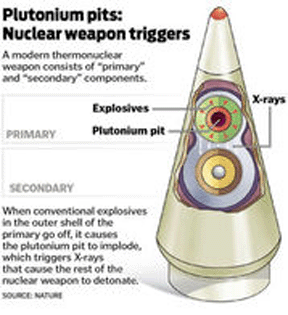
The Los Alamos lab has been producing pits — the grapefruit-size fission triggers that ignite nuclear weapons — on a smaller scale for decades, and New Mexico’s congressional delegation has been pushing to keep that work in the state as the nation’s mission to modernize its nuclear weapons arsenal ramps up.
A summary of the National Nuclear Security Administration’s study, leaked in December, shows that Los Alamos and the Savannah River Site in South Carolina are the final contenders for the pit factory, expected to cost up to $7.5 billion and take 10 to 20 years to complete.
According to the leaked material, which was reviewed by The New Mexican, the work would take longer to complete in Los Alamos and costs would be higher there.
The Los Alamos Study Group also contends the risks of pit production at Los Alamos are significant and should be disclosed to the public.
The nonprofit’s director, Greg Mello, said in a statement Thursday, “We believe [pit production] is proceeding ‘under cover of darkness’ on purely ideological grounds, and not on any defensible managerial basis. … It is a vast waste of resources, though lucrative for a few contractors.”
The organization believes the U.S. already has an excess of pits in its weapons stockpile and that future production would present a grave risk to the public while wasting public funds. The U.S. arsenal contains 23,000 pits, the group says in its suit, at least a third of which its says are viable and would last through 2063.
Los Alamos began producing plutonium pits after the Rocky Flats Plant in Colorado was shut down in the early 1990s, following a federal raid that found the plant rife with environmental contamination and nuclear safety violations.
Residents in the Rocky Flats area spent more than two decades entangled in a lawsuit with the plant’s operators after plutonium was found to have traveled to thousands of homes.
Los Alamos has had its share of nuclear safety violations, as well.
The lab’s plutonium facility, which restarted pit production in 2015 following a yearslong pause over safety concerns, was cited for a series of violations in the last year alone. Several workers were contaminated with radiation in 2017, and a small fire burned one worker. The lab was fined several million dollars for mishandling an out-of-state shipment of plutonium, and federal inspectors raised concerns recently about how the lab manages the toxic metal beryllium.
Nuclear Power Facing a Tsunami of Litigation, Nippon, Shizume Saiji , [2018.03.12]In March 2011, a magnitude-9 earthquake triggered a giant tsunami that crippled the cooling system at the Fukushima Daiichi Nuclear Power Station, leading to a catastrophic accident that continues to reverberate seven years later. Science reporter Shizume Saiji surveys the legal fallout from the meltdown, from claims against the government and the operator to a raft of actions aimed at permanently shutting down the nation’s nuclear power industry………….
Complacency and Opacity
In the wake of the Fukushima accident, NISA (since replaced by the Nuclear Regulation Authority) was faulted for its lack of independence. The agency was under the authority of the Ministry of Economy, Trade, and Industry, which promotes the use of nuclear power, and officials maintain that its regulatory powers were limited. In addition, a closed, inbred environment encouraged unhealthy ties between NISA and the electric power industry. As a consequence, NISA had fallen into the habit of accommodating and supporting the utilities instead of overseeing them. TEPCO, for its part, had developed a deeply rooted culture of denial, habitually concealing information that might supply ammunition to anti-nuclear activists or fuel fears among the local citizenry. The company brushed off the warnings, convincing itself that the danger from a giant tsunami was purely hypothetical.
So far, district courts have reached decisions on three major class-action suits, and in each case they have agreed with the plaintiffs that the state and TEPCO could have foreseen the danger from a major tsunami once the 2002 report on earthquake risks was released. Two of the district courts, Maebashi and Fukushima, found both the state and TEPCO negligent for failing to prevent the meltdowns. The Chiba District Court, on the other hand, dismissed claims against the state on the grounds that the government was focusing on earthquake safety at the time and may not have been able to formulate effective measures in time to protect Fukushima Daiichi against the March 2011 tsunami. With the government and TEPCO girding up to appeal the lower courts’ decisions, the cases could drag on for years……….
Fighting Nuclear Power, One Plant at a Time
On a different but related front, citizens’ groups and other plaintiffs are vigorously pursuing lawsuits and injunctions aimed directly at shutting down nuclear power plants around the country.
Efforts to block nuclear energy development through legal action date all the way back to the 1970s.
………. At present, almost all of Japan’s operable nuclear power plants are in the midst of some kind of litigation. In one case, the plaintiff is a local government: The city of Hakodate in Hokkaidō has filed a lawsuit to block the construction and operation of the Ōma Nuclear Power Station across the Tsugaru Strait in Aomori Prefecture.[Excellent graphs show 38 nuclear reactors suspended, and 3 operating]
Lawyers on a Mission
Lawyers Kawai Hiroyuki and Kaido Yūichi have been key figures in the fight against nuclear power since before the Fukushima accident. In the wake of the disaster, they founded the National Network of Counsels in Cases against Nuclear Power Plants, a group that has been pursuing legal action against nuclear facilities on behalf of citizens and other plaintiffs nationwide.
Kawai and Kaido are also representing the shareholders of TEPCO, who are suing the company’s former executives for an unprecedented ¥5.5 trillion. In addition, as lawyers for the Complainants for the Criminal Prosecution of the Fukushima Nuclear Disaster, the two attorneys are working alongside the prosecuting team in the criminal case against three TEPCO executives, which parallels the civil suit in terms of arguments, evidence, and testimony.
Even so, the trial—which officially opened last June and is expected to continue at least through the coming summer—is expected to attract intense media coverage as witness examinations begin this spring. More than 20 witnesses are scheduled to testify. The case also involves a massive volume of documentary evidence, including records of interviews conducted by the government’s Investigation Committee on the Accident at the Fukushima Nuclear Power Station, along with countless pages of emails, internal memos, meeting minutes, and reports. Will all this information shed new light on the human factors behind the Fukushima accident? The nation will be watching closely.
“The people of New Mexico have been waiting 73 years for acknowledgment of the suffering that people have endured here after radiation they were exposed to during the Trinity Test,” said Tina Cordova of Tularosa Basin Downwinders Consortium.
The Tularosa Basin Downwinders say tens of thousands of residents near the Trinity Site were exposed to radiation during the world’s first atomic bomb test.
Now, they always want to testify in front of Congress.
On the seventh anniversary of the 2011 earthquake, tsunami and Fukushima nuclear accident, our thoughts and deepest sympathies continue to be with the people of Japan.
Every one of the tens of thousands evacuees from the 2011 Fukushima Daiichi triple reactor meltdown has a story to tell.
In our latest radiation survey we had the privilege to hear the experience of Mrs Mizue Kanno. As we entered the exclusion zone of Namie, Ms Kanno told us of the events seven years ago that were to change her life, her family and those of thousands of others.
Mrs Kanno was a social worker in Futaba less than 10 km from the nuclear plant. Eventually she made her way home after the devastating earthquake, and over the next few days thousands of people were evacuated to her home district of Tsushima. Families moved into her home. But soon they were warned by men in gas masks and protective clothing to get out immediately. The radioactive fallout from the nuclear plant, about 32 km away, had deposited high levels of contamination in this mountainous area of Namie.
Mrs Kanno now lives in western Japan, many hundreds of kilometres from her home in Fukushima. While she is a victim of nuclear power, she isn’t passive observer – instead she’s a female activist determined to tell her story. She campaigns across the Kansai region against nuclear power and for renewable energy.
Like thousands of other evacuees, she has joined lawsuits filed against the Tokyo Electric Power Company (TEPCO), and the Japanese government. Already found guiltyin multiple court proceedings of being criminally negligent in failing to take measures to prevent the meltdown, TEPCO and the government can expect many more rulings against them.
Because of the support of Mrs Kanno and her friends and neighbours, Greenpeace has been able to conduct a wide ranging survey inside the exclusion zone of Namie, published in our report, Reflecting in Fukushima.
While our survey report is filled with microsieverts and millisieverts, it’s far more about the lives and the land of Mrs Kanno her family, friends and neighbours.
Measuring thousands of points around homes, forests and farmland, it’s clear that this is an area that should not be opened to the public for many decades. Yet the government opened a main artery, route 114, while we were working in Namie.
One consequence is that people are stopping off and visiting areas high in radiation. At one house, radiation hot spots were over 11 microsieverts per hour (μSv/h) at one meter, and 137μSv/hat 10 centimetres. These levels are thousands of times the background level before the nuclear accident, and mean you’d reach your recommended maximum annual exposure in six days.
Yet, two people were working 10 meters away from the hot spot with no dosimeters or protective clothing. Mrs Kanno and our radiation specialists explained the levels of contamination and why it was necessary to take precautions.
In one zone in Obori, we measured radiation that would expose a decontamination worker to the 1 mSv/y limit in just 10 working days. The whole area is contaminated to varying high levels that will remain a threat into next century. How could the government be thinking of opening this area as early as 2023? More importantly, why?
It’s actually simple and wholly cynical. The Japanese government is desperate to restart nuclear reactors. Today only three are operating. Having areas of Japan closed to human habitation because of radioactive contamination is a very major obstacle to the government’s ambitions to operate 30-35 nuclear reactors. It’s a constant reminder to the people of Japan of the risks and consequences of nuclear power.
Yet, there are signs of positive change. Last month a panel of experts established by the Foreign Minister called for a mass scaling up of renewables, and warned of the risks from depending on coal plants and nuclear power. The voices of Mrs Kanno, the other thousands of Fukushima evacuees and the majority of people in Japan, and their demand for a different energy future, will be heard.
Throughout our time in Namie, as we visited the highly contaminated area of Obori and Tsushima – quiet, remote areas of natural beauty – Mrs Kanno told us about the life and traditions of families who for generations had supported themselves by farming. Now all of them are displaced and scattered across Japan. Yet the government is failing to even acknowledge their rights under domestic and international human rights law.
This week, we will be traveling to Geneva with mothers who are evacuees from Fukushima to the United Nations Human Rights Council session on Japan. The Japanese government has been under pressure to stop its violations of the human rights of Fukushima evacuees. Last week it accepted all recommendations at the UN to respect the human rights of Fukushima citizens. This included the German government recommendation to restore to a maximum annual public exposure of 1 mSv. This global safety standard has been abandoned by the Abe government.
The government’s decision is important, but now they need to be implemented if they are genuine in their commitments to the United Nations. On the 16 March this year, Mrs Kanno and other evacuees and their lawyers will attend the Tokyo high court for a ruling on Fukushima against TEPCO and the Government. One of the evacuee mothers, Akiko Morimatsu, together with Greenpeace, on the same day will speak at the United Nations to challenge the Japanese government to now fully apply the UN recommendations.
While we will be thousands of kilometers apart, we will be with Mrs Kanno on her day in court in Tokyo and she will be with us in Geneva. The Fukushima nuclear disaster has shattered lives but it has also brought us together determined to prevent such a terrible event from ever happening again and to transition Japan to a secure and safe energy future based on renewables.
Kazue Suzuki is an Energy Campaigner at Greenpeace Japan and Shaun Burnie is a Senior Nuclear Specialist at Greenpeace Germany
Areva-Siemens will pay TVO compensation of 450 million euros ($553.73 million), the Finnish company said in a statement.
TVO and Areva-Siemens were claiming billions of euros from each other due to the delays in the Olkiluoto 3 reactor project in southwest Finland. Its start was postponed last year to May 2019 – a decade later than planned.
Guardian 10th March 2018, The US mining industry has asked the supreme court to overturn an Obama-era
rule prohibiting the mining of uranium on public lands adjacent to the
Grand Canyon. The National Mining Association (NMA) and the American
Exploration and Mining Association (AEMA) filed petitions on Friday asking
the court to reverse the 2012 ban on new uranium mining claims on more than
1 million acres of public land surrounding Grand Canyon national park. https://www.theguardian.com/environment/2018/mar/10/grand-canyon-uranium-mining-ban-supreme-court
Lawsuits: Widespread radioactive contamination in north county, The lawsuits seek relocation and financial awards for thousands of people. ksdk.comGrant Bissell, ebruary 22, 2018 ST. LOUIS COUNTY – A pair of lawsuits announced Wednesday claim radioactive contamination could be widespread in north St. Louis County.
The suits seek, among other things, buyouts or relocation and financial awards for thousands of people who live or own businesses near the West Lake Landfill and Coldwater Creek.
One suit was filed in relation to the landfill. The other in relation to the creek.
St. Louis lawyers Ryan Keane of Keane Law and Anthony Gray of Johnson Gray Law lead a team of attorneys filing suit against many companies and agencies that at one time dealt with radioactive waste leftover from the creation of the first atom bomb.
That waste was moved in the 1940’s from a processing facility in downtown St. Louis to a storage site near present-day St. Louis Lambert International Airport.
It was then relocated to a site in Hazelwood where it was stored in the open and contaminated Coldwater Creek. In the 1970’s the waste was illegally dumped at West Lake Landfill.
“It’s already a disaster and it could get much, much worse,” said Keane during a news conference Wednesday.
According to the lawsuits, crews with Massachusetts-based Boston Chemical Data Corporation tested dozens of properties in north county and found high levels of radioactive contamination that can scientifically be tied to the waste in the landfill and the creek.
“The uranium that was extracted and brought into this country has a unique fingerprint because it originated outside the United States,” said Keane.
The firms released maps Wednesday identifying areas of possible contamination.
Carla Miller of Maryland Heights lives within the boundaries identified by the lawsuits. She’s been in her home since 2004 and said she’s always felt safe there. But, with the possibility of radioactive contamination, she’s no longer sure.
“I’m really very concerned especially with people with children who are still growing and developing. That scares me,” said Miller. Missouri Representative Mark Matthiesen (R – District 70) issued a statement Wednesday that read:
There were some serious claims of airborne contamination made in this press conference by attorneys representing families surrounding the Bridgeton/ West Lake Landfill. While I wait to see what scientific information the attorneys are willing to share to support this claim, I continue to push my own legislation, HB 1804 to fund testing by the DNR for radioactivity that may be killing Missouri residents.
Missouri Senator Maria Chappelle-Nadal (D – District 14) released her own statement:
“I am overjoyed at the announcement of two additional lawsuits regarding legacy nuclear waste left from the Manhattan Project. In the last two years, I’ve held one hundred town hall meetings on the subject matter and interviewed nearly one thousand residents. While worked to pass legislation for a home buyout for vulnerable citizens, it failed due to powerful corporate interests seeking to ease financial liability.The HBO documentary (Atomic Homefront) has opened up a new door for St. Louis residents. The EPA preliminary decision has also opened doors for our region. However, I must warn the public, the circumference of contamination is much larger than what the attorneys are outlining in their lawsuit.
In my heart, I want compensation for my constituents to ease their pain. I want a federal “Downwinder” status which will track the health status of residents in the region. There are multiple policy changes we need to adopt immediately.
Austria’s new government, an alliance between Chancellor Sebastian Kurz’s conservatives and the far-right Freedom Party, has pledged to continue Vienna’s decades-long policy of opposing nuclear power.
It said last month that it would file the legal challenge against the expansion of the Paks power plant situated near the border it shares with Hungary.
“We must take up this David-versus-Goliath struggle for the sake of our nature, our environment and our unique countryside,” the minister for sustainability and tourism, Elisabeth Koestinger, said in a statement on Thursday announcing the government had started the case.
“Nuclear energy has no place in Europe. We will not deviate from this line by even a centimeter.”
A spokesman for the EU executive said: “The Commission will defend its decision in Court.”
In March, EU state aid regulators approved Hungary’s plan to build two new reactors at its Paks nuclear site with the help of Russia’s Rosatom, saying Hungarian authorities had agreed to several measures to ensure fair competition.
The two new reactors will double the plant’s nominal capacity of 2,000 megawatts. Hungary aims to start construction on the reactors this year, with the first facility expected due to be completed in 2025.
In most complex cases of this kind, the Luxembourg-based European Court of Justice has found in favor of the Commission.
($1 = 0.7174 pounds)
Reporting by Francois Murphy; Additional reporting by Alissa de Carbonnel in Brussels; Editing by Alison Williams
MKG 20th Feb 2018,Translation into English of the Swedish Environmental Court’s opinion on
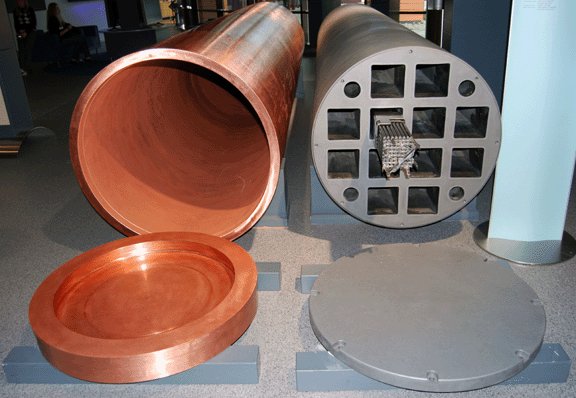
the final repository for spent nuclear fuel – as well as some comments onthe decision and the further process. The court said no to the application because it considered that there were problems with the copper canister that had to be resolved now and not later.
The translation shows the court’s judicial argumentation and why it decided not to accept the regulator
SSM’s opinion that the problems with the integrity of the copper canister were not serious and could likely be solved at a later stage in the decision-making process.
The main difference between the court’s and the regulator’s decision-making was that the court decided to rely on a multitude of scientific sources and information and not only on the material provided by SKB.
Radioactive material came to St. Louis in the 1940s with World War II, when a uranium processing plant was constructed downtown. Years later, in the 1970s, radioactive waste from that site was transported to the West Lake Landfill in the St. Louis County suburb of Bridgeton. That material is still impacting St. Louis today, but residents in the surrounding area may be getting a ray of hope in the form of a legal case.
Recently, the HBO documentary “Atomic Homefront” brought national attention to the long struggle of North St. Louis residents to gain accountability for the effects of radioactive waste dumped at West Lake Landfill and Coldwater Creek. Now, several law firms are joining together to file a class-action lawsuit on behalf of those impacted.
“This is an unacceptable violation of personal rights, property rights, and at its core, the civil rights of all people adversely impacted by this highly contaminated radioactive source,” civil rights attorney Anthony Gray said.
Gray, of Johnson Gray LLC, and class action attorney Ryan Keane of Keane Law LLC hosted a press conference in St. Ann on Feb. 20 to introduce the suit. Their firms, along with several other national firms, are filing two lawsuits against companies they consider to hold responsibility for polluting residential areas.
One of the suits was filed on behalf of residents living around the West Lake Landfill; the other was filed on behalf of those living in the floodplain of Coldwater Creek. Homes and other properties around both sites have tested positive for high levels of radiation.
The Environmental Protection Agency under Scott Pruitt agreed on Feb. 1 to remove the majority of the radioactive material from the West Lake Landfill over a period of five years, but the lawyers in this case said that is not enough.
“Too little has been done over the last several years, and over the last several decades,” Keane said.
“Atomic Homefront,” which focuses on the efforts of citizen activist group Just Moms STL, documents high incidences of rare cancers in the areas around West Lake Landfill and Coldwater Creek and highlights families who want to move away from the area but, due to the plummeting property values of their homes, cannot afford to.
According to Keane, tests done in preparation for the lawsuits showed high levels of radiation within several homes and businesses. He also said an expert will testify that radioactive materials were built into construction sites in Bridgeton, laid underneath the foundations of homes.
Keane said the effects of the radioactivity could become even more widespread if an underground fire that has been burning at the landfill since at least 2010 reaches the radioactive waste. The chemical reactions caused by this, he said, could lead to contaminated rain which would fall on every part of St. Louis.
After the Russian Chernobyl nuclear disaster in 1986, radioactive rains spread the impact across the continent and reached as far away as Wales.
“People should be very upset about this,” Keane said. “They should be fired up about this.”
Defendants in the cases include Republic Services, Cutter Corp and other corporations that have handled waste disposal. The attorneys will seek damages for affected residents that could include compensation, home buyouts and relocation, as well as a cleanup of the sites.
Keane said homeowners in the area will receive a flyer explaining the cases and containing a 1-800 number they can call to learn more.














 nuclear-news