The State. BY TOM BARTON, tbarton@thestate.com, November 14, 2018 COLUMBIA, S.C.
An attorney involved in hiring a consultant to study problems at a failed $9 billion nuclear expansion project Wednesday defended deleting items from that critical report.
Atlanta-based attorney George Wenick testified during Day 10 of S.C. Public Service Commission hearings into the failed effort by SCE&G, a SCANA subsidiary, to build two nuclear reactors in Fairfield County. The commission also is considering SCE&G’s future electric rates and a proposal by Dominion Energy to buy SCE&G’s parent, SCANA.
The report by the San Francisco-based Bechtel Corp., completed in February 2016, showed SCE&G knew the project was troubled long before it collapsed……
SCANA chief executive Jimmy Addison last week testified he never had read the damning Bechtel report and never intends to, calling it “history.” But, he added, he wished it had been disclosed to the Public Service Commission and the public in 2015.
At stake is who will pay for the failed nuclear project — SCE&G’s customers, SCANA’s shareholders or both — and how big the future power bills will be for SCE&G’s roughly 730,000 electric customers.
SCE&G increased the electric rates for its typical residential customer by about $27 a month to pay for the nuclear project before it pulled the plug on the unfinished reactors in July 2017. Subsequently, the PSC cut SCE&G’s nuclear-related rates temporarily.
Wenick’s testimony could also be used in ongoing federal investigations by the U.S. Department of Justice and Securities and Exchange Commission. https://www.thestate.com/news/politics-government/article221641145.html
November 15, 2018
Posted by Christina Macpherson |
Legal, USA |
Leave a comment
Utility consultant: SCE&G ignored ‘stop signs’ about failed nuclear project, Greenville News,Tom Barton, The State Nov. 13, 2018SCE&G ignored numerous warning signs before walking away from a failed $9 billion nuclear expansion project, an industry consultant told the S.C. Public Service Commission on Monday.
“Let me be blunt: You have a utility that bet the farm and lost,” Scott Rubin, an independent utility consultant and attorney from Pennsylvania, testified Monday on behalf of AARP South Carolina. “By the end of this year, customers will have paid $2.2 billion for absolutely nothing — not a single watt of electricity.”
Rubin’s testimony came on the eighth day of PSC hearings into the failed effort by SCE&G, a SCANA subsidiary, to build two nuclear reactors in Fairfield County. The commission also is considering SCE&G’s future electric rates and a proposal by Richmond-based Dominion Energy to buy its parent, Cayce-based SCANA.
At stake is who will pay for that failed project — SCE&G’s customers, SCANA’s shareholders or both — and how big the future power bills will be for SCE&G’s roughly 730,000 electric customers. …..https://www.greenvilleonline.com/story/news/2018/11/13/utility-consultant-sce-g-ignored-stop-signs-nuclear-project/1988385002/
|
|
|
November 15, 2018
Posted by Christina Macpherson |
business and costs, legal, USA |
Leave a comment

 Independent 4th Nov 2018 , The Supreme Court has refused to halt a novel lawsuit filed by young
Americans that attempts to force the federal government to take action on
climate change, turning down a request from the Trump administration to
stop it before trial.
The suit, filed in 2015 by 21 young people who argue
that the failure of government leaders to combat climate change violates
their constitutional right to a clean environment, is before a federal
judge in Oregon. It had been delayed while the Supreme Court considered the
emergency request from the government.
https://www.independent.co.uk/news/world/americas/climate-change-lawsuit-trump-us-young-people-children-supreme-court-allows-julia-olsen-a8616136.html
November 5, 2018
Posted by Christina Macpherson |
climate change, legal, USA |
Leave a comment
 SCANA accountant says CEO put her on medical leave over complaints about nuclear project, Independent Mail, Avery G. Wilks, The State Nov. 2, 2018 COLUMBIA
 — In newly unsealed documents, a former SCANA employee says the utility’s then-chief executive, Kevin Marsh, put her on “special medical leave” after she went to him with concerns about a failing, $9 billion nuclear project.
Carlette Walker, once SCANA’s vice president of Nuclear Finance Administration, also testified that, in 2015, her bosses filed misleading testimony under her name with state regulators about how much the V.C. Summer Nuclear Station expansion project would cost.
Carlette Walker, once SCANA’s vice president of Nuclear Finance Administration, also testified that, in 2015, her bosses filed misleading testimony under her name with state regulators about how much the V.C. Summer Nuclear Station expansion project would cost.
“While I was out, they wrote testimony under my name, and they filed testimony under my name with the (lower cost) number that I had fought against,” Walker said in an April 24 deposition.
Walker’s full sworn statement — parts had been released before with sections blacked out, or redacted — was made public Thursday as the S.C. Public Service Commission began its weeks-long hearing into the nuclear-related power rates of SCE&G, SCANA’s electric subsidiary.
A spokesman for SCE&G said the utility would not comment except during the PSC hearing.
Previously, most of the pages of Walker’s 187-page deposition had been at least partially blacked out at SCE&G’s request. However, PSC hearing officer David Butler ruled Wednesday the entire document should be made public.
The state’s utility watchdog, the Office of Regulatory Staff, plans to use Walker’s deposition as evidence SCE&G misled the PSC — which sets utility rates — in order to keep the project alive, and its revenues and executive bonuses flowing.
In her deposition, Walker said she had projected the cost to finish the floundering project was about $500 million higher than contractors had estimated. But, she said, her SCANA bosses submitted the contractors’ lower numbers — which she considered unrealistic — to regulators in her name while she was out of work on leave, taking care of her sick husband.
Another former SCE&G employee, Ken Browne, said in his deposition the contractor’s cost projections were based upon productivity rates that V.C. Summer construction workers never had attained. Work was going so slowly, the project could have taken far longer — until 2030 — to complete, Browne said.
According to Walker’s deposition, when Browne objected internally to SCE&G using the lower cost submitted to the PSC, under Walker’s name, he was “pretty much cussed out by (SCE&G outside attorney) Mitch Willoughby and put in his place, and so he just shut up.”
In the formerly redacted portions of her deposition, Walker said she went to both then-SCANA CEO Marsh and current CEO Jimmy Addison — then the company’s chief financial officer — with concerns about the nuclear project in the fall of 2015………. https://www.independentmail.com/story/news/2018/11/02/v-c-summer-nuclear-station-fiasco-scana-accountant-put-leave/1856615002/
November 3, 2018
Posted by Christina Macpherson |
Legal, secrets,lies and civil liberties, USA |
Leave a comment
 BFMTV 29th Oct 2018, Buyout of Uramin by Areva: the Paris Court of Appeal orders new
 indictments. In 2007, Areva, then led by Anne Lauvergeon, acquired this Canadian mining company for 1.8 billion euros. A financial fiasco on which justice leads several investigations.
The Paris Court of Appeal ordered further indictments including the former boss of the group.
https://www.bfmtv.com/economie/rachat-d-uramin-par-areva-la-cour-d-appel-de-paris-ordonne-de-nouvelles-mises-en-examen-1555034.html
November 1, 2018
Posted by Christina Macpherson |
France, Legal |
Leave a comment
By: KTVU StaffOCT 25 2018 , SAN FRANCISCO (KTVU) – The United States government has joined the lawsuits against the company hired to clean up radiation at the old Hunters Point Shipyard in San Francisco.
The Department of Justice claims Tetra Tech defrauded the government with its radiation testing of soil and buildings.
The lawsuit against Tetra Tech and others claim radioactive soil left on the property has led to chronic health problems. …….http://www.ktvu.com/news/us-government-joins-hunters-point-shipyard-radiation-lawsuit
October 27, 2018
Posted by Christina Macpherson |
Legal, USA |
Leave a comment
SCE&G regulatory trial: Who will pay for the failed nuclear project? The State, BY FRANK KNAPP JR., October 19,
On Nov. 1, the S.C. Public Service Commission (PSC) will start a hearing that will impact the electric rates of SCE&G customers for decades.
The primary issue to be decided is how much if anything SCE&G customers will be forced to pay for the incurred construction costs of its abandoned nuclear project in Fairfield County.
Essentially, this is a regulatory trial.
SCE&G is being accused of intentionally withholding critical information from the S.C. Office of Regulatory Staff (ORS) and the PSC.
ORS is the state agency that was responsible for analyzing data received from SCE&G for the approval of construction cost increases, construction schedule delays and rate hike requests to pay for construction cost financing. ORS then made recommendations to the PSC for decisions on these matters.
After reviewing more than a million pages of SCE&G-produced documents, ORS concluded that by March 2015, the company knew that it would take several years longer to complete the nuclear project and the cost would be billions higher than it was telling the regulators.
By not providing this information to ORS and the PSC, critics contend that SCE&G enabled itself to obtain undeserved electric rate increases to fund the doomed project.
The principle SCE&G challengers — ORS, Sierra Club and Friends of the Earth — maintain that had ORS and the PSC known what SCE&G knew in March 2015, the regulators might have pulled the plug on the project then, saving the ratepayers billions……….https://www.thestate.com/opinion/op-ed/article220308855.html
October 20, 2018
Posted by Christina Macpherson |
Legal, USA |
Leave a comment
|
Department of Energy halts $17B nuclear facility construction, Construction Dive, Kim SloweyDive Brief:
- A federal appeals court ruled that the Department of Energy can move forward with its plans to stop construction of a $17 billion plutonium and uranium fuel factory at its Savannah River Site in Aiken, South Carolina, The State reported. The latest cost projections have the mixed oxide, or MOX, facility at three times the original budget, and the DOE has made claims previously of a substandard quality of construction.
- According to a letter obtained by The State, the department sent a termination notice to contractor CB&I Areva MOX Services, which was contracted by the DOE’s National Nuclear Security Administration to design, build and maintain the facility. The department reportedly informed the prime contractor that its contract is terminated immediately and that the shutdown of operations — securing existing buildings and the construction site — will now begin. As many as 900 workers could be laid off with 60 days’ notice, but the DOE has indicated that there are other positions at the site that workers could potentially fill.
- Local and state officials promised to fight the closure, but, if their efforts fail, the DOE could build a plant that makes pits for atomic weapons. According to a construction update from CB&I Areva MOX at the beginning of the year, crews had placed more than 90% of structural concrete; installed almost 95% of rebar; constructed 12 of 16 support buildings and installed 106 tons of pipe. ………https://www.constructiondive.com/news/department-of-energy-halts-17b-nuclear-facility-construction/539892/
|
|
October 18, 2018
Posted by Christina Macpherson |
Legal, technology |
Leave a comment
 Two Federal Courts May Have Just Saved The Nuclear Power
  Industry, Forbes https://www.forbes.com/sites/brianpotts/2018/10/15/two-federal-courts-may-have-just-saved-the-nuclear-power-industry/#4802adfa762e, Brian H. Potts
States that want to keep their aging nuclear power fleet from retiring now have a court-approved roadmap for doing so. That’s because two federal courts of appeals last month upheld very similar state laws in Illinois and New York aimed at subsidizing those states’ under-performing and at-risk nuclear power plants.
The current market conditions are, quite literally, killing the nuclear power industry. With natural gas prices low and cheap renewable energy flooding the markets, it’s been virtually impossible for many nuclear power plants to compete.
Some view this as simply the market picking winners and losers. But others see this as a problem. To significantly lower this country’s greenhouse gas emissions, they argue, we’ll need baseload power (i.e., power plants that can run all of the time). And only three current large-scale power sources fit that bill: coal, natural gas, and nuclear. Of those three, only nuclear power can generate energy without carbon dioxide emissions. [ What a lie!!]
Yet in Illinois (and in most other states), nuclear energy does not qualify as a “renewable energy resource,” which means nuclear generation facilities are categorically ineligible to produce and sell renewable energy credits.
That’s why, in response to concerns that two of Exelon Corporations’ nuclear generation facilities were on the brink of closing and that the zero-emission value of nuclear generation was not being recognized, the Illinois legislature passed the Future Energy Jobs Act.
The Act directed the Illinois Power Agency to create a subsidy program requiring generators that use coal or natural gas to buy zero-emissions credits (ZECs) from nuclear power plants connected to the regional grid. The price of each credit was set at $16.50 per megawatt-hour, a number Illinois derived from a federal working group’s calculation of the social cost of carbon emissions. But, to ensure that the new program does not cause power prices to skyrocket, the price of ZECs under the program goes down if average annual energy prices on the market exceed a set cap.
Almost immediately, a group of generation facilities and consumers filed a lawsuit challenging the Illinois law. The group alleged, among other things, that the ZEC program invades the Federal Energy Regulatory Commission’s (FERC) exclusive authority over the wholesale sale of electricity in the interstate markets.
Under the Federal Power Act, FERC has sole jurisdiction over the interstate sale of electricity at wholesale; yet states are authorized to regulate energy production within their borders, including the power plants that produce that energy.
The challengers in the case, called Electric Power Supply Association v. Star, argued that Illinois’ ZEC program went too far because it tied the price of ZECs to future wholesale market prices.
On September 13, 2018, the Seventh Circuit Court of Appeals disagreed. “The zero-emissions credit system can influence the [market] price only indirectly,” according to the Court, because the value of a credit does not depend on the producer’s bid in the market.
Interestingly, at the Seventh Circuit’s request, FERC submitted a brief in the case, which argued that Illinois’ ZECs program was “not preempted” by the Federal Power Act because it does not expressly require generation facilities to participate in the FERC-regulated markets.
Exactly two weeks after the Seventh Circuit issued its decision, the Second Circuit issued a strikingly similar ruling in a case called Coalition for Competitive Electricity v. Zibelman.
Plaintiffs in the Zibelman case, a group of electrical generators and trade groups, also alleged that the Federal Power Act preempts New York’s ZEC program.
That program subsidizes three specific nuclear plants: FitzPatrick, Ginna, and Nine Mile Point, all of which are also owned by Exelon Corporation. Each of the plants under the New York program will obtain an additional $17.48 per megawatt-hour over the program’s first two years, and then the ZEC price every two years thereafter will be reset.
Brushing aside similar arguments from the challengers as the Seventh Circuit did, the Second Circuit Court of Appeals on September 27, 2018 ruled that the ZEC program is not preempted “because Plaintiffs have failed to identify an impermissible ‘tether’ . . . between the ZEC program and wholesale market participation.”
Together, these two decisions won’t just save the specific nuclear power plants at issue. They may give a lifeline to the entire nuclear power industry.
Unless, of course, the U.S. Supreme Court decides to weigh in. https://www.forbes.com/sites/brianpotts/2018/10/15/two-federal-courts-may-have-just-saved-the-nuclear-power-industry/#4802adfa762e
October 16, 2018
Posted by Christina Macpherson |
Legal, USA |
Leave a comment
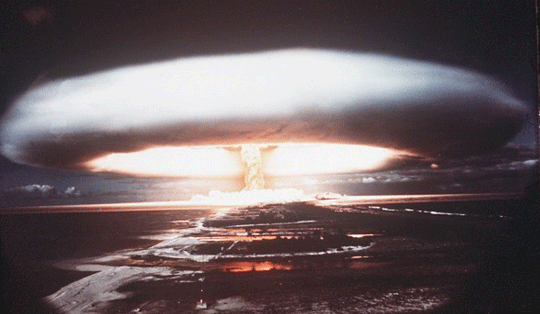
France to defend itself against nuclear tests complaint, France says it will defend itself against allegations of crimes against humanity for its nuclear weapons tests in the South Pacific. The overseas minister, Annick Girardin, made the comment in the senate two days after French Polynesian opposition politician Oscar Temaru told a UN meeting in New York that a complaint had been lodged in the International Criminal Court (ICC).
Ms Girardin said France would defend itself and restate the facts, adding that it accepted its nuclear legacy with serenity……..https://www.radionz.co.nz/international/pacific-news/368543/france-to-defend-itself-against-nuclear-tests-complaint
October 13, 2018
Posted by Christina Macpherson |
France, legal |
Leave a comment
 France sued for ‘crimes against humanity’ over nuclear tests in South Pacific https://www.dw.com/en/france-sued-for-crimes-against-humanity-over-nuclear-tests-in-south-pacific/a-45826054
France is being taken to the International Criminal Court for nuclear weapons tests in French Polynesia. France has long denied responsibility for the impacts of the tests and only recently began compensating civilians. France is being taken to the International Criminal Court (ICC) for carrying out nuclear weapons tests in French Polynesia, a Polynesian opposition leader announced on Tuesday.
Oscar Temaru, the archipelago’s former president and current leader of the Tavini Huiraatira Party, announced the move during a United Nations committee dealing with decolonization.
Temaru accused France of “crimes against humanity” and said that he hopes to hold French presidents accountable for the nuclear tests with the ICC complaint.
“We owe it to all the people who died from the consequences of nuclear colonialism,” he told the UN committee.
Maxime Chan from Te Ora Naho, an association for the protection of the environment in French Polynesia, told the UN that there had been 368 instances of radioactive fallout from the tests and that radioactive waste had also been discharged into the ocean — violating international rules.
Three decades of nuclear tests
The French territory, currently home to 290,000 people, is best known for the popular tourist island of Tahiti, but its atolls of Mururoa and Fangataufa were used for decades for nuclear tests.
France carried out 193 nuclear weapons tests on islands in the archipelago between 1960 and 1996 until French President Jacques Chirac halted the program.
Around 150,000 military and civilian personnel were involved in France’s nuclear tests, with thousands of them later developing serious health problems.
France has long denied responsibility for the detrimental health and environmental impacts of the tests, fearing that it would weaken the country’s nuclear program during the Cold War.
In 2010, France passed a law allowing military veterans and civilians to be compensated if their cancer could be attributed to the nuclear tests. Out of approximately 1,000 people who have filed complaints against France, only 20 have been compensated.
October 11, 2018
Posted by Christina Macpherson |
France, Legal, OCEANIA, weapons and war |
Leave a comment
Plans for jobs-rich but potentially deadly nuclear fuel plant on life support in SC https://www.greenvilleonline.com/story/news/2018/10/10/plans-nuclear-fuel-plant-south-carolina-life-support/1588238002/
Sammy Fretwell, The State Oct. 10, 2018 The federal government won a court victory Tuesday that could lead to the shutdown of a nuclear construction project that is billions of dollars over-budget and years from completion at the Savannah River Site near Aiken.
In an afternoon ruling, the U.S. Fourth Circuit Court of Appeals overturned a lower court ruling that had halted the U.S. Department of Energy’s effort to quit building the mixed oxide fuel factory after a decade of construction. The ruling Tuesday sets aside a June 7 preliminary injunction that had stopped government plans to halt construction.
The decision was a blow to advocates of the plant in South Carolina. Key politicians have pushed to keep building the project — known as MOX — because it will be a jobs provider and a way to get rid of surplus plutonium at the Savannah River Site weapons complex near Aiken. At one point, as many as 2,000 jobs were touted for the project.
S.C. Attorney General Alan Wilson, who sued to force the government to keep building the plant, wasn’t happy with the ruling Tuesday. Wilson says failing to build the plant would mean plutonium, a deadly nuclear material, would be left in South Carolina.
While the ruling Tuesday lifts the injunction, Wilson’s lawsuit has not been decided.
“I’m disappointed in the Fourth Circuit panel’s decision,’’ Wilson said in a statement. “It is inconsistent with governing law and foreshadows the court’s opinion in the case. The state intends to vigorously contest the opinion when it is issued to protect the State’s interests and prevent the Department of Energy from turning the State into the dumping ground for plutonium.’’
Opponents of the plant, which is at least $12 billion over budget, said the court’s decision Tuesday could be the beginning of the end of the project. They say it is a waste of taxpayer money and is a dangerous way to get rid of surplus bomb-grade plutonium when other means are available.
The DOE, after years of pumping up the plant, now says it isn’t worth continuing. The project has been beset with delays and questionable workmanship.
“This is going to allow (the DOE) to start back up with termination,’’ said one of the project’s harshest critics, Tom Clements, who heads Savannah River Site Watch.
The Union of Concerned Scientists, a national environmental group that opposes MOX, issued a late afternoon statement praising the court’s decision.
Critics say a plutonium fuel factory isn’t necessary because there are other ways of disposing of excess weapons grade plutonium. The government has more recently proposed shipping much of the excess plutonium at SRS to a site in New Mexico.
“Using this type of facility to dispose of plutonium that is no longer needed for U.S. nuclear weapons increases the risk that this material could fall into the hands of terrorists,” according to an email from Edwin Lyman, a senior scientist with the Global Security Program at the Union of Concerned Scientists. “Although the order is only a temporary stay, it indicates that the court will likely rule against the South Carolina in favor of the DOE’s plan to terminate the MOX project and pursue a far superior alternative.”
October 11, 2018
Posted by Christina Macpherson |
Legal, technology |
Leave a comment
Google Faces Lawsuit In Belgium For Not Blurring Military Sites And Nuclear Power Plants On Maps, Gizmodo, Matt Novak Sep 29, 2018 Belgium plans to sue Google over the tech giant’s refusal to blur sensitive military sites and nuclear power plants on the company’s various mapping platforms. Military leaders in Belgium have not yet filed a formal complaint but confirmed to Reuters that they intend to sue……
October 5, 2018
Posted by Christina Macpherson |
EUROPE, Legal |
Leave a comment
The United States on Thursday indicted seven Russian intelligence officers for conspiring to hack computers and steal data, including attempts to break into the computer networks of the nuclear power company Westinghouse Electric Co. France 24 4 Oct 18The
Justice Department said one of the
Russian officers performed online reconnaissance and stole log-in credentials of Westinghouse workers, including staff that work at its advanced
nuclear reactordevelopment and new reactor technology units.
Westinghouse, which is located outside of Pittsburgh, provides fuel, services and plant design to customers, including Ukraine.
Three of the seven Russian military officers indicted on Thursday were charged in a separate case brought by Special Counsel Robert Mueller’s office for their role in hacking activities designed to influence the 2016 presidential election……..
In the indictment, prosecutors alleged that one of the Russian officers, Ivan Sergeyevich Yermakov, performed “technical reconnaissance” of the company as early as Nov. 20, 2014, and got access to IP addresses, domains and network ports. The hackers also researched Westinghouse to learn about the company’s employees and their backgrounds in nuclear energy research.
In December, the Justice Department said, Yermakov and his co-conspirators registered a fake domain and website designed to mimic the company’s website and sent phishing emails to at least five employees. Once people clicked on the spoofed domain and provided their log-ins, they were rerouted to the original network.
On other occasions, according to the indictment, the conspirators also sent spearphishing emails to the personal emails of employees at Westinghouse. Two account users clicked on the malicious links.
The indictment does not clearly explain why Westinghouse was targeted or whether the hackers succeeded, and Justice Department officials declined to comment beyond the indictment.
Westinghouse did not immediately respond to a request for comment. https://www.france24.com/en/20181004-us-indicts-russians-hacking-nuclear-company-westinghouse
October 5, 2018
Posted by Christina Macpherson |
legal, Russia, secrets,lies and civil liberties, USA |
Leave a comment







 nuclear-news