International Law is now challenged by the “normalisation” of nuclear weapons

 Amid Nuclear Entanglement, International Law May Well Have to Ban the Weapons Altogether https://thewire.in/law/amid-nuclear-entanglement-international-law-may-well-have-to-ban-the-weapons-altogether
As long as the conventionalisation of nuclear weapons is taking place, no binding treaties will be able to stop the proliferation of or regulate nuclear weapons. Olha Bozhenko, 22/JUN/2018
Nuclear weapons enjoy a separate and unique regime under international law. The majority of states struggle to establish a complete prohibition of nuclear weapons, as in the case of other categories of Weapons of Mass Destruction (WMD). In fact, in its only authoritative pronouncement on the matter, the International Court of Justice (ICJ) stressed ‘the unique characteristics of nuclear weapons, and in particular their destructive capacity’.
Yet in view of some recent developments, to be discussed below, this distinction has been gradually disappearing, with the line between nuclear and conventional weapons becoming blurred. This means that nuclear weapons are not stigmatised as their WMD counterparts, but rather conventionalised.
This piece is an attempt to, first, ascertain the progressing conventionalisation among the current trends related to nuclear weapons and, second, delineate its consequences for the international legal regulation of armaments.
Paths of conventionalisation
Nuclear weapons conventionalisation has been referred to as ‘nuclear entanglement’, which essentially means the merger of nuclear and conventional weapons. Broadly understood, it manifests itself in the following ways.
Increased reliance on non-strategic (tactical) nuclear weapons:
As early as in his Dissenting Opinion to the Nuclear Weapons Advisory Opinion, Mohamed Shahabuddeen, a judge of the ICJ suggested that assuming tactical nuclear weapons could be no more destructive than conventional weapons, they should not be less lawful than the latter. Hence, placing nonstrategic nuclear weapons (NSNW) at the top of ‘conventionalisation agenda’ is not a brand-new idea. Besides, it has recently been emphasised in national strategies.
The most striking example is, of course, the US 2018 Nuclear Posture Review (NPR), which radically departs from its predecessor in mandating the development of a range of nonstrategic low-yield nuclear options. The Trump administration considers this departure necessary as a response to Russia’s substantial reliance on and expansion of non-strategic nuclear arsenal, which considerably outstrips that of the US. At face value, this means that the two most powerful nuclear-weapon states have embarked upon the rapid expansion of their non-strategic nuclear options.
Such an approach depicting NSNW as quite a usable tool to advance military and non-military goals significantly lowers the threshold for the actual use. Such reliance on a limited nuclear strike can well lead to the full-blown nuclear escalation, which the ICJ considered among the possible consequences of using low yield nuclear weapons.
Integration of nuclear and conventional planning and operations:
The integration of nuclear and conventional capabilities also contributes to the conventionalisation. This is ‘nuclear entanglement’ in the original meaning of the term. The integration includes equipping dual use means of delivery with nuclear and non-nuclear warheads, merging nuclear and conventional support facilities, as well as integrating planning and training for both nuclear and non-nuclear forces. China and Russia are said to pursue this strategy whether deliberately or as a matter of historical legacy. Furthermore, US’s NPR specifically mandates ensuring ‘the ability to integrate nuclear and non-nuclear military planning and operations’ to ‘deter limited nuclear escalation and nonnuclear strategic attacks’.
These developments are frowned upon for a number of reasons. They tend to erode the line between nuclear and conventional forces in the most palpable manner. They also increase the risk of adversary’s misinterpretation of the nature of an attack, which can simultaneously target ‘entangled’ capabilities.
Expanding range of scenarios for the use of nuclear weapons:
Much has been said on the expanded range of scenarios where US contemplates first use of nuclear weapons, also in response to non-nuclear threats. Although the US strategy is most widely discussed owing to its considerable departure from the previous pattern, other nuclear-weapon states either preserve deliberate ambiguity with regard to the possible use of nuclear weapons (eg UK and France) or explicitly declare their readiness to balance an adversary’s conventional superiority with a nuclear strike (eg Russia and Pakistan).
Expanding the role of nuclear weapons beyond deterring nuclear threats alludes to an increased rationality and military utility of a nuclear strike. This further undermines the arguments that there exists opinio juris (an opinion of law) prohibiting recourse to nuclear weapons, except for the purposes of deterrence. In view of such developments, it is understandable why the ICJ refused to acknowledge that the non-recourse to nuclear weapons since 1945 had been due to such opinio juris rather than the absence of military necessity.
Nuclear saber rattling:
Finally, never before has it been so common for political leaders to boast of their states’ nuclear capacities. One may recall Vladimir Putin’s threats to deploy nuclear weapons in the course of Crimea crisis and against Baltic states, or his most recent brandishing cutting-edge nuclear technology with animated nukes striking Florida in an address to the parliament. Along the same lines, Donald Trump publicly threatened North Korea with ‘fire and fury’ and even with ‘total destruction’.
Although the ICJ refused to differentiate between nuclear and conventional weapons, when assessing the legality of the threat of nuclear weapons use (para 48), the state practice seems to have accepted a special standard for nuclear threats which is measured against the strategy of deterrence. For instance, UK’s High Court of Justiciary stated that ‘deployment of nuclear weapons in time of peace … is utterly different from the kind of specific ‘threat’ which is equated with actual use’ . Under this approach, states would only cross the line of nuclear deterrence and resort to the threat of using nuclear weapons if such a threat is specific enough, i.e. directed against a specific target.
Considering that the arbitral tribunal went so far as to equate the phrase ‘to face consequences’ to a threat of the use of force in Guyana vs Suriname, it is doubtful that states are still within the safe harbour of deterrence when directing their nuclear threats explicitly and specifically against other states.
Consequences for international law
Driven by analogy with other types of WMD, international law seeks to raise the threshold for using of nuclear weapons (or even contemplating such use) as high as possible. The adoption of the Treaty on the Prohibition of Nuclear Weapons (TPNW) is among the most notable developments to this end. Still, there is an observable tension between the movement towards nuclear weapons ban as enshrined in the TPNW and the trends described above.
International legal instruments like the TPNW are grounded on humanitarian considerations. In this particular case, the TPNW is meant to stigmatise nuclear weapons to the extent of their total abandonment by nuclear-weapon states. Considering that nuclear-weapon states refused to take any part in the ‘ban campaign’ leading to the adoption of the TPNW, it is reasonable to assume that such progressive stigmatisation (which can eventually generate a parallel customary prohibition) is the only way to endow the TPNW with pragmatic force. Analogy may be drawn with other disarmament treaties such as Convention on Anti-Personnel Mines Ban and Convention on Cluster Munitions: they contributed to the establishment of the customary prohibition of respective armaments even without directly binding all states possessing them.
However, when nuclear weapons are postured to be as usable as conventional ones, the normative boundary between the two is not hardened at all. No stigma is likely to appear for weapons possessing which is dictated and justified by strong military utility. As long as the conventionalisation of nuclear weapons is taking place, no binding obligations will probably proceed from the newly established TPNW regime, either as treaty rules or as a crystallising custom.
Along with the TPNW, the Treaty on the Non-Proliferation of Nuclear Weapons (NPT) is to bear a major part in the ramifications. The core obligation of non-proliferation under Article II is likely to be affected, since nuclear weapons, if conventionalised, make their acquisition by non-nuclear-weapon states more conceivable. Additionally, the deployment of tactical nuclear devices makes nuclear weapons more accessible and ‘proliferable’ in the technical sense, spurring their acquisition by non-state actors, particularly, by terrorist groups. This is an alarming possibility considering that the non-proliferation to non-state actors still constitutes a legal gap largely left to Security Council Resolution 1540.
Besides, the conventionalisation of nuclear weapons invites their advancement, which is hardly in line with the (allegedly customary) obligation of nuclear disarmament under Article VI of the NPT. States are not in compliance with their disarmament obligation ‘to achieve a precise result – nuclear disarmament in all its aspects’ when they engage in the ‘vertical proliferation’ (i.e. modernising their nuclear arsenals or expand the range of scenarios to deploy nuclear weapons).
Should the described trends gain traction, their impact will in no way be limited to nuclear weapons regulation, but extend to the whole set of rules on the use of force. In particular, the gradually vanishing line between the threat of use of force and nuclear deterrence will further blur. It is questionable whether teetering on the brink of threats to use nuclear weapons is still justifiable under the concept of nuclear deterrence, which the ICJ was careful to characterise as practice ‘adhered to by states’. Consequently, it is doubtful whether nuclear deterrence should enjoy such leniency with respect to the standard of the threat of use of force.
The jus ad bellum (right to war) requirements for self-defence may also be affected by nuclear entanglement. For instance, it is highly questionable whether a limited strike with tactical nuclear weapons to preclude a massive conventional attack fails to meet the standard of proportionality. Similarly, it is not that clear whether anticipatory nuclear strike against a missile equipped with non-nuclear warhead is unlawful, since a state intercepting such a missile can be misled by its dual-use capacity in view of nuclear entanglement.
The questions of similar nature will arise with respect to jus in bello (laws of war). With the gap between nuclear and conventional weapons narrowing, there is less room to assert that employing nuclear weapons should be contrary to the proportionality principle. Correspondingly, what concerns the lawfulness of belligerent reprisals conducted with the use of nuclear weapons, a pre-defined approach exclusively based on the ‘nuclear element’ is likely to give ground to the qualification irrespective of the type of weapons. To put it bluntly, the ICJ’s reasoning that the legality of the use of nuclear weapons shall be considered on the basis of case-to-case compliance with jus in bello seems to be regaining relevance.
Conclusions
While any radical transformation of the international legal regime governing nuclear weapons is still unlikely, there is definitely room for considering its adequacy for current challenges. In the near future we should be ready to make a choice of either raising the bar on the conventionalisation of nuclear weapons or easing this process. Simply put, international law may find itself in need of deciding whether it is better to ban nuclear weapons altogether rather than to regulate them.
This article originally appeared on Arms Control Law.
Serbian citizens to sue NATO over their cancers due to depleted uranium
 Lawsuits against NATO countries to be filed in fall https://www.b92.net/eng/news/politics.php?yyyy=2018&mm=06&dd=18&nav_id=104422 The first lawsuits are expected to be filed in the fall by Serbian citizens suffering from cancer.SOURCE: BETA
They will sue NATO countries because of the use of depleted uranium during the 1999 bombing of Serbia.
This was announced on Monday President of the Association of Citizens “Depleted Uranium” Sveto Nogo. The lawsuits will be filed individually, he explained.
Speaking at a symposium in the southern town of Nis, dedicated to the consequences of the bombing, Nogo said that there would be no class action lawsuit, but instead those filed by cancer patients and their families.
“NATO countries will be sued for pecuniary and non-pecuniary damages. We will launch lawsuits against five countries, and after the symposium, it will be decided which countries those will be,” Nogo said.
He said that working groups will be formed in the coming months to draft the lawsuits and added that the Serbian Bar Association, the Belgrade Bar Association and “partially” the Nis Bar Association all stand behind “the project.”
“There has been an increasing number of cancer patients, and even babies are being born with cancer. We do not recognize ‘force majeure’, and as intellectuals we have no right to keep silent about it,” Nogo said.
The president of the organizing committee of the symposium, Srdjan Aleksic, said that, as far as the future cases that will be conducted before national courts of NATO member states, the most important point for Serbian citizens is that Italian courts have already confirmed the causality between the use of depleted uranium and soldiers falling ill after staying in the territory that came under attack of such weapons in Kosovo and Metohija.
“The soldiers who had cancer and the families of the deceased have been afforded compensation ranging from 200,000 to 500,000 euros by a court in Italy. We will seek the same compensation for our citizens,” Aleksic said.
According to him, it took five years for the Italians to prove in court the causal relationship between bombardment with depleted uranium and cancer, while Serbia is facilitated by their evidence – “and the first verdict should be reached in two years.”
“We appeal for an agreement and amicable resolution, because if Italian citizens have been paid compensation, I do not see any reason for our citizens not to receive it,” Aleksic pointed out.
Domenico Leggero, a member of the Italian commission looking into the consequences of the use of depleted uranium, also spoke at the event to say that all judgments in Italy have been made in favor of the sick soldiers, while the country’s Ministry of Defense has been declared guilty.
“In Italy there have been over 80 cases. The soldiers have been compensated,” Leggero said. He added that the harmful effect of depleted uranium on human health had been proven in Italy as early as in 1987.
Sergei Baburin, who headed Russian Duma’s assistance to Serbia during the 1990s, said that Serbia has waited a long time to file the lawsuits, but that it was still not too late – “because things should not be left as they are, because we will all be complicit in an injustice.”
Baburin said that many people who defended the country have been convicted of crimes – unlike those who bombarded it.
The two-day symposium in Nis gathered about thirty domestic and international experts, in the fields of law, medicine, engineering, atomic physics and ecology.
MOX nuclear fuel project in deep trouble, but judge rules against suspending its construction

 Judge’s ruling keeps over-budget nuclear project from being shut down, BY SAMMY FRETWELL sfretwell@thestate.com June 07, 2018
A judge on Thursday stopped the federal government from suspending construction of a nuclear fuel factory at the Savannah River Site atomic weapons complex near Aiken.
The ruling by U.S. District Judge Michelle Childs damages federal efforts to walk away from the over-budget and behind-schedule mixed oxide fuel project, which has been on the drawing boards for more than two decades and is currently under construction. The mixed oxide fuel plant would turn excess weapons grade plutonium into fuel for commercial nuclear reactors.
The U.S. Department of Energy has been trying in recent years to suspend the project, saying it is expensive and no longer necessary to dispose of the plutonium. The latest federal plan is to ship excess plutonium, a key ingredient in nuclear bombs, to a New Mexico site for disposal.
Childs’ order temporarily halts the federal shutdown process until arguments can be heard in court over whether to keep the effort going. ……..
Savannah River Site Watch’s Tom Clements, an opponent of the MOX project, said he was disappointed in the judge’s ruling Thursday. Clements says the project isn’t necessary.
“The judge doesn’t understand what deep trouble the project is in,’’ he said, noting that building the MOX project doesn’t necessarily mean South Carolina will get rid of all surplus plutonium at SRS.
The project is about $12 billion over budget and years behind schedule, but employs hundreds of people who would be out of work if the project shuts down, boosters say. It has been touted as a way to provide new missions for SRS.
Federal officials say they won’t forget SRS in shutting down the MOX plant. They have proposed converting it to a factory to make plutonium pits for nuclear weapons. http://www.thestate.com/latest-news/article212778069.html
Court of Appeals rules that lawsuits can go ahead , seeking refunds for ratepayers, regarding V.C. Summer Nuclear Station
SCE&G ratepayers’ lawsuit over failed nuclear project can proceed, S.C. Court of Appeals says, Post and Courier, By Thad Moore tmoore@postandcourier.com Jun 4, 2018
The Federal Energy Regulatory Commission and Department of Justice support Illinois nuclear subsidies
FERC, DOJ support Illinois nuclear subsidies in court filing UTILITY DIVE,31 May 18
Dive Brief:
- The Federal Energy Regulatory Commission and Department of Justice filed a joint legal brief in support of Illinois nuclear subsidies on Tuesday.
- Lawyers for the two agencies wrote the zero emission credits (ZECs) for Illinois nuclear plants do not interfere with FERC’s authority to regulate wholesale power markets, as generators claimed. If the subsidies disrupt market operations, “the solution lies with the Commission, not the courts,” the agencies wrote.
- The legal opinion will likely also apply to a pending court challenge against New York nuclear subsidies, as well as a New Jersey subsidy program enacted last week. The FERC opinion could also make a Supreme Court case over the subsidies less likely, analysts say.
Dive Insight:
The Tuesday amicus brief from FERC and DOJ is a blow for opponents of nuclear subsidies, who hoped the courts would throw out the recent state programs designed to keep uneconomic plants from retiring.
In their brief, filed with the U.S. Court of Appeals for the Seventh Circuit, FERC and DOJ write the Illinois program does not suffer from the “fatal defect” that doomed other state subsidy programs in the courts.
In 2016, the Supreme Court ruled that a Maryland policy to support gas generation interfered with FERC’s authority because it made receipt of a subsidy contingent on wholesale market participation, which FERC regulates.
………Evaluating methods to integrate state energy policies into wholesale markets has been a focus at FERC in recent years — and also a point of contention. In March, the commission approved an ISO-New England plan to change its capacity market auctions to handle subsidized resources, but the 3-2 vote exposed divides between regulators on how to handle future cases.
Those issues are likely to come to a head next month, when FERC is scheduled to rule on two market reform options submitted by the PJM Interconnection — both of which could diminish the market impact of nuclear and renewable energy subsidies.
In the meantime, analysts say the FERC-DOJ brief makes it more likely the nuclear subsidies will be upheld by the courts — not just the Seventh Circuit, but also the U.S. Court of Appeals for the Second Circuit, which is hearing a similar challenge against the New York program……..https://www.utilitydive.com/news/ferc-doj-support-illinois-nuclear-subsidies-in-court-filing/524580/
South Carolina suing the USA govt over closure of MOX fuel reprocessing program
South Carolina sues federal government over end of nuclear fuel program http://www.wrdw.com/content/news/South-Carolina-sues-federal-government-over-end-of-nuclear-fuel-program-483786421.html May 26, 2018 AIKEN, S.C. (AP) — South Carolina is suing the federal government after the Energy Department announced it was stopping construction of a plant to turn plutonium used in nuclear weapons into fuel for nuclear reactors.
South Carolina Attorney General Alan Wilson’s lawsuit filed Friday says Energy Secretary Rick Perry didn’t consult Governor Henry McMaster before ending construction at the Savannah River Site near Aiken.
The lawsuit also says the Energy Department didn’t perform an analysis of how to store the plutonium already at SRS.
Instead of creating mixed oxide fuel, or MOX, the National Nuclear Security Administration suggests SRS make new plutonium pits for nuclear weapons.
Wilson called the decision to end MOX another chapter in the long, tortured history of broken promises by the federal government.
The Energy Department didn’t immediately respond.
USA Department of Veterans Affairs conveniently lost hundreds of claims for children, grandchildren of contaminated veterans
 VA lost or misplaced hundreds of claims for children, grandchildren of contaminated veterans http://www.wfla.com/8-on-your-side/investigations/va-lost-or-misplaced-hundreds-of-claims-for-children-grandchildren-of-contaminated-veterans/1194448265, Steve Andrews May 23, 2018
Missouri legal case – claim that cancer caused by Manhattan Project
 Woman claims Manhattan Project caused her cancer https://stlrecord.com/stories/511423482-woman-claims-manhattan-project-caused-her-cancer, by Amanda Thomas | May 20, 2018, ST. LOUIS – A Florissant woman has filed a lawsuit against a biopharmaceutical company and chemical-producing corporation for alleged negligence related to the disposal of “hazardous, toxic, and radioactive materials” near residential neighborhoods in St. Louis County.
Trial of French activists who entered Cruas nuclear plant to demonstrate vulnerability of spent fuel storage pools
Liberation 17th May 2018 [Machine Translation] At Greenpeace activists’ trial, nuclear safety is no exception. At the trial of 22 activists of Greenpeace, the court tried Thursday to limit the debates to the facts – their intrusion in November in the nuclear site of Cruas-Meysse (Ardèche) – without being able to avoid the question of the safety of the power plants, that the NGO is  questioning.
This action, preceded by a first in Cattenom (Moselle), had the same objective for its authors: to show flaws in the safety of spent fuel storage pools. The hearing was held under high police protection while a rally to support these “whistleblowers” was held all day in front of the courthouse. http://www.liberation.fr/societe/2018/05/17/au-proces-de-militants-greenpeace-la-securite-nucleaire-n-echappe-pas-aux-debats_1650850
Mediapart 18th May 2018 Against Greenpeace, state prosecutes civil disobedience. Sentences of reprieve and imprisonment were required against the twenty-three activists of Greenpeace who illegally entered the Cruas nuclear power plant in November 2017. For the public prosecutor, as for EDF, “it is time it stops. It is no longer possible to tolerate these repeated intrusions . ”
https://www.mediapart.fr/journal/france/180518/contre-greenpeace-l-etat-fait-le-proces-de-la-desobeissance-civile
Nuclear war, nuclear pollution nuclear waste, and climate inaction – crimes against future generations
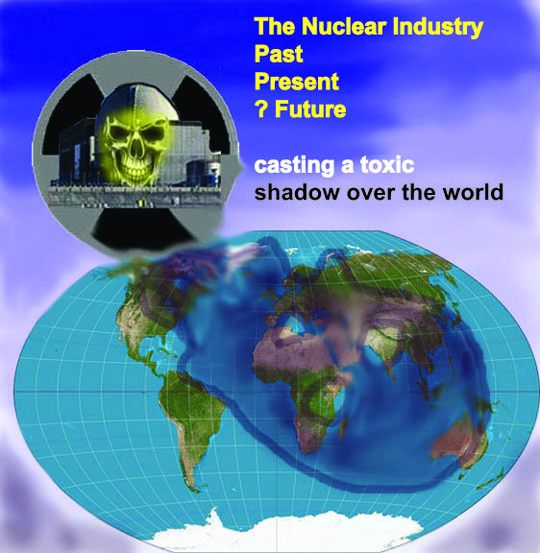
Crimes against future generations https://beyondnuclearinternational.org/2018/05/13/crimes-against-future-generations/ By Andreas Nidecker, Emilie Gaillard, and Alyn Ware
As nuclear tensions increase, dangerous times have raised legally-loaded questions about nuclear weapons. What happens now the U.S. is withdrawing from Iran nuclear deal? Does the president have unfettered power to launch a preemptive nuclear strike on North Korea? What’s the legal status of the Trump administration’s intention, telegraphed in the Nuclear Posture Review, to expand U.S. nuclear capabilities and arsenals when the Nuclear Non-Proliferation Treaty supposedly commits us to cutting and eventually eliminating them?
But there’s an even broader legal dilemma looming over production, testing and threatened use of nuclear weapons: how they affect the human rights of future generations. Those threats to the future are also compounded by nuclear energy, which generates radioactive waste we’re manifestly unable to control, and by destabilizing the climate that has enabled and sustained human civilization.
Can such crimes against the future be legal? How can we respect the human rights of future generations in view of them? International symposia at the University of Basel (Switzerland), University of Caen (France) and Charles University in Prague (Czech Republic) recently grappled with those questions. The Basel conference produced a declaration on human rights and trans-generational crimes resulting from nuclear weapons and nuclear energy.
Protecting future generations from the threat of nuclear weapons was an important consideration in the International Court of Justice’s 1996 affirmation that threat or use of nuclear weapons is generally illegal, given their long-term and indiscriminate impact. But despite the Court’s decision, most nuclear-armed states retain (illegal) policies to use nuclear weapons, including in a first, pre-emptive strike.
In general, current law fails to safeguard the rights of future generations. But that doesn’t make failure defensible, sustainable or in accord with legal principles. Evolution of this area of law is necessary and inevitable.
Some 2000 nuclear weapons were detonated for “testing” since 1945, releasing millions of curies of radiation. This impacted human health globally, and will continue to do so for generations. Most nuclear testing victims live in remote areas like the Pacific islands, the Kazakhstan steppe, or the North African Sahara. They have largely been forgotten; today’s younger generations are unaware of their sacrifice. Yet forgetting is perilous, because today’s youth will be tomorrow’s victims unless the cycle is broken.
There are some legal efforts to break it. For example, the 2017 Treaty on the Prohibition of Nuclear Weapons obligates signatories to provide environmental remediation and assistance for nuclear testing victims. But the provision is unenforceable, because none of the nine nuclear weapons states signed the treaty.
Like nuclear weapons, nuclear energy also poses enduring threats to human health. The Chernobyl explosion caused widespread contamination across the region and the whole European continent. High volumes of radiologically contaminated water from Fukushima continue to leak into the Pacific.
These, too, are crimes against the future. Some lethal isotopes in nuclear waste have half-lives of thousands of years. Waste repositories will need to be guarded for unimaginable time periods, with associated financial, logistical and security implications for future societies, an enormous burden we leave to our descendants.
Like the Treaty on the Prohibition of Nuclear Weapons, the International Covenant on Economic, Social and Cultural Rights (ICESCR) asserts a human right to health, applicable to nuclear contamination. But in practice that right isn’t respected.
For example, Japan ratified the covenant, and the Japanese constitution even defends the trans-generational principle of human rights in articles 11 and 97. But despite those legal principles being articulated, the Japanese media is still prevented from reporting on current events in Fukushima, and medical research on the effects of the meltdown is still restricted. The Japanese government maintains that small amounts of radiation are harmless, so limits for public radiation exposure could be increased from 1 to 20 millisieverts per year, the same as for radiation workers.
That’s unconscionable and untenable, not to mention discriminatory against young women and children who are much more susceptible to radiation exposure than men, with higher risks of cancer and non-cancerous diseases. Radiation exposure may present mutations and diseases in their offspring decades later. That’s why Japan’s handling of the Fukushima nuclear disaster fails to accord with its own constitution as well as the ICESCR.
Failing to combat climate change effectively is also a crime against the future. The chances of meeting the Paris goal of limiting global warming to 2°C are receding since the U.S. withdrew and financial contributions of many signatories remain out of scale with the problem. Greenhouse gas emissions have risen in the two years since the Paris accord. If we stay on this too-little, too-late trajectory, we’ll not only fail to protect human rights, but much of life on Earth.
Can all this be considered legal? Not for long. The dawn of the nuclear age marked the acquisition of unprecedented human power over the Earth and all forms of life, as the Caen symposium pointed out. Many legal experts believe that in this new anthropocene era, a new code of medical and legal ethics is necessary. Trans-generational impacts of nuclear war, nuclear catastrophes and climate change must now be seriously considered, and require a paradigm shift in our legal thinking about the future.
The District Court of the Hague took a step in that direction in 2015 when it affirmed in Urgenda Foundation v. the Dutch State that the government had a responsibility to protect future generations by limiting greenhouse gas emissions. A similar case in the United States brought by young people — Juliana et al v. United States — was granted jurisdiction and is proceeding to consideration of its merits.
There remains a long way to go to adapt the current legal framework to the realities of nuclear threats and climate change. Current laws need better implementation, and new laws need to be established. But those changes are vital to protecting the human rights of future generations.
Emilie Gaillard is an Associate Professor of law and a researcher at the University of Caen Normandy (France). She is a member of the Pôle Risques, Qualité et Environnement Durable at Maison de la recherché et des Sciences de l’Homme (Caen).
Andreas Nidecker MD is a Professor Emeritus of Radiology at the University of Basel, Switzerland. Board member and past president of PSR / IPPNW Switzerland and member of the organizing Committees of the symposium “Human Rights, Future Generations & Crimes in the Nuclear Age.”
Alyn Ware is a member of the World Future Council and consultant for the International Association of Lawyers Against Nuclear Arms.
UK nuclear regulator prosecutes waste firm over worker exposed to radiation
Sellafield faces huge fine over worker’s exposure to radiation Nuclear regulator prosecutes waste firm after injury leaves employee open to exposure https://www.theguardian.com/environment/2018/may/11/sellafield-faces-huge-fine-over-employees-exposure-to-radiation Adam Vaughan, 11 May 18
Britain’s biggest nuclear waste storage and reprocessing site is facing a potential multimillion-pound fine after an employee was exposed to dangerously high levels of radiation.
The nuclear regulator said its investigation had led it to prosecute Cumbria-based Sellafield Ltd, which handles the waste from the UK’s nuclear power stations as well as spent fuel from Japan and the US.
It is the first time in five years that the Office for Nuclear Regulation has prosecuted the company.
Last time, Sellafield was fined £700,000 for sending bags of radioactive waste to a landfill dump instead of a specialist facility.
Now, if the prosecution is successful, the firm is understood to be facing the prospect of a substantial fine, likely to be much larger because an individual was affected.
The case relates to an accident in February 2017, when a site employee was wounded while handling equipment, leaving him open to internal radiation exposure.
He was decontaminated afterwards, but an investigation found the individual may have been exposed to radiation up to three times the annual limit. The regulator is taking the firm to court over offences under the Health and Safety at Work act.
Both Sellafield and the ONR said they were unable to comment further for legal reasons.
The prosecution is due to begin at Workington magistrates court in Cumbria on 20 July.
Sellafield has been state-run since 2016, after MPs raised concerns over how much it was costing taxpayers under private ownership.
The facility is in the process of a major transformation from a reprocessor of nuclear waste, where it turns spent fuel from power stations into uranium that can be used again, to solely focusing on storage.
The site’s Thermal Oxide Reprocessing Plant (Thorp) ceases operations in November this year, and will then be dismantled. Sellafield’s Magnox reprocessing plant, which handles waste from Britain’s early nuclear power stations, is scheduled to close in 2020.
Widening fraud scandal over radioactive contamination clean-up
Former Hunters Point shipyard cleanup workers plead guilty to fraud
First criminal convictions in widening toxic cleanup scandal, Curbed San Francisco , By
Legal discussions over failed nuclear plants – will result in tougher regulations
 Tougher utility regulations advance, as attorneys argue over failed S.C. nuclear project https://www.postandcourier.com/business/tougher-utility-regulations-advance-as-attorneys-argue-over-failed-s/article_872a5b7c-4d5d-11e8-8743-b78c8b42b82a.html, By Andrew Brown abrown@postandcourier.com
2018 Goldman Environmental Prize goes to South African anti nuclear activists
Makoma Lekalakala and Liz McDaid, 2018 Goldman Environmental Prize, South Africa
South African activists awarded Goldman Environmental Prize for fight against nuclear power deal http://www.abc.net.au/news/2018-04-24/two-south-african-women-stopped-international-nuclear-deal/9691528, The World Today By Sally Sara
Two women tooki on the South Afric an government – and won their anti nuclear fight
Makoma Lekalakala and Liz McDaid, 2018 Goldman Environmental Prize, South Africa
South African activists awarded Goldman Environmental Prize for fight against nuclear power deal http://www.abc.net.au/news/2018-04-24/two-south-african-women-stopped-international-nuclear-deal/9691528, The World Today ,By Sally Sara
1 This Month
To see nuclear-related stories in greater depth and intensity – go to https://nuclearinformation.wordpress.com/
29 Jan. Thursday 7-8 p.m. Webinar – World’s Largest Nuclear Station in Port Hope, ON?

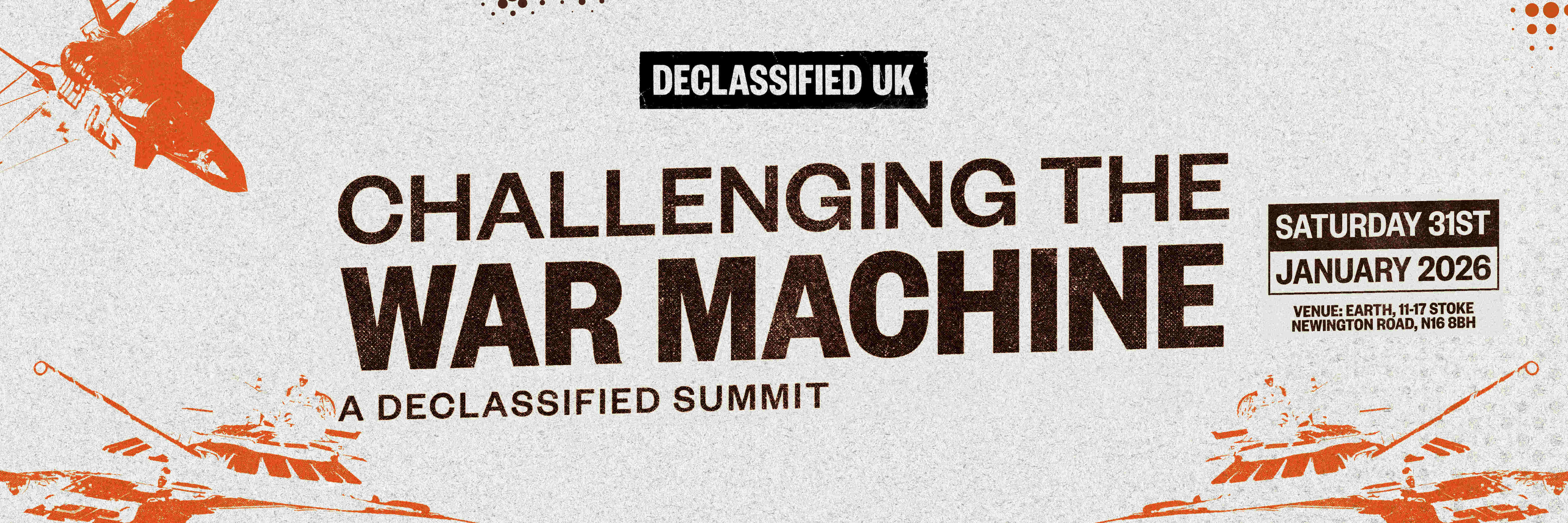
31st January – Challenging the War Machine – a DECLASSIFIED UK SUMMIT

Website of the Week
Now until to February 10, 2026 Radioactive waste storage in France: the debate is finally open! How to participate?
-
Archives
- January 2026 (271)
- December 2025 (358)
- November 2025 (359)
- October 2025 (376)
- September 2025 (258)
- August 2025 (319)
- July 2025 (230)
- June 2025 (348)
- May 2025 (261)
- April 2025 (305)
- March 2025 (319)
- February 2025 (234)
-
Categories
- 1
- 1 NUCLEAR ISSUES
- business and costs
- climate change
- culture and arts
- ENERGY
- environment
- health
- history
- indigenous issues
- Legal
- marketing of nuclear
- media
- opposition to nuclear
- PERSONAL STORIES
- politics
- politics international
- Religion and ethics
- safety
- secrets,lies and civil liberties
- spinbuster
- technology
- Uranium
- wastes
- weapons and war
- Women
- 2 WORLD
- ACTION
- AFRICA
- Atrocities
- AUSTRALIA
- Christina's notes
- Christina's themes
- culture and arts
- Events
- Fuk 2022
- Fuk 2023
- Fukushima 2017
- Fukushima 2018
- fukushima 2019
- Fukushima 2020
- Fukushima 2021
- general
- global warming
- Humour (God we need it)
- Nuclear
- RARE EARTHS
- Reference
- resources – print
- Resources -audiovicual
- Weekly Newsletter
- World
- World Nuclear
- YouTube
-
RSS
Entries RSS
Comments RSS
 nuclear-news