 Lawsuit filed on behalf of nuclear workers https://www.abqjournal.com/1299172/lawsuit-filed-on-behalf-of-nuclear-workers.html, BY SCOTT TURNER / JOURNAL STAFF WRITER April 2nd, 2019 ALBUQUERQUE, N.M. — James Jaramillo and Harold Archuleta are used to having to navigate through government bureaucracy to receive compensation for illnesses they said were caused by radiation exposure during their days as employees at Sandia National Laboratories and Los Alamos National Laboratory.
Both men had to wait years after filing claims for compensation through the Energy Employees Occupational Illness Compensation Program.
Jaramillo, 65, worked at Sandia for 24 years. He found out he had cancer of the small intestine in 1998. He filed for compensation in 2003 but was originally denied. Through changes in the program, he was finally awarded compensation in 2012 for medical care and lost wages since he was forced to retire.
Archuleta, 80, worked 38 years, 35 full time, at Los Alamos, where, he said, he ended up with skin cancer after years of exposure to plutonium. He’s also received compensation, but his wife, Angie, said it wasn’t an easy process.
“Congress put forth this act to help them, but then when it comes to actually paying, they put up all of these barriers,” Angie Archuleta said. “It’s just been very frustrating.”
According to a release by the Department of Labor’s Office of Workers’ Compensation Programs, changes are being made next week to update some of the regulations, with the goal of increasing efficiency and transparency and reducing administrative costs. The rules would align the regulations regarding processing and paying medical bills with the current system Office of Workers’ Compensation Programs uses to pay medical bills, and set out a new process that the office will use for authorizing in-home health care that will enable the office to better provide its beneficiaries with appropriate care, according to the release.
However, a company that provides health care to workers such as Jaramillo and Archuleta says rule changes involving the program could make it harder for nuclear workers to receive compensation and could delay the medical treatment they need.
The company, Professional Case Management, has filed suit in the District Court of Colorado against the Labor Department to keep the changes to the Energy Employees Occupational Illness Compensation Program from taking effect. Professional Case Management Vice President Tim Lerew said the new changes could cause delays of 60 days or more in treatment.
“It’s hard to know how long those delays will be,” Lerew said at a town hall meeting in Albuquerque last week. “We estimate it will be about an additional 60 days. For some people, coming out of the hospital with particular illnesses where doctors want them to have additional care … they don’t have that time to wait.”
Lerew said the new rule changes will also add 36 steps to the process between the patient, the doctor and the Labor Department to get pre-authorization for treatment and services, such as home health care.
“If they have you jump through 36 more hoops, how is a guy supposed to do that?” Jaramillo asked.
The rule changes would require patients to fill out most of the paperwork. In the past, health care providers would fill out the majority of it, Lerew and Jaramillo said.
“If you don’t dot every ‘i’ and cross every ‘t,’ they deny you,” said Jaramillo’s wife, Terry.
“Nurses take all your vitals and with the doctor come up with your plan, and send to the Department of Labor for approval,” James Jaramillo said. “Now, they want the patients to fill out a lot of the paperwork and submit it themselves, and not let medical people get involved with that.”
Lerew said he wondered how a cancer-stricken person in his or her 80s “is successfully going to navigate that process.”
April 4, 2019
Posted by Christina Macpherson |
employment, health, legal, USA |
Leave a comment
ACROnique of Fukushima 26th March 2019 25 people from Fukushima, who resettled in Ehime Province on Shikoku
Island, took legal action for better compensation. They claimed a total of
137.5 million yen (1.1 million euros) with the main argument that this
disaster could have been avoided if preventive measures had been taken to
protect the plant following the re-assessment of the earthquake risks. and
tsunami in 2006.
They believe that the compensation received is
insufficient in view of the harm suffered which has separated families and
cut ties with the community. They claimed 5.5 million yen (€ 44,000) per
person to cover stress, loss of property and relocation.
https://fukushima.eu.org/tepco-et-letat-japonais-condamnes-a-indemniser-des-personnes-deplacees/
April 4, 2019
Posted by Christina Macpherson |
Japan, Legal |
Leave a comment

Dangerous history of pit production https://www.aikenstandard.com/opinion/guest-column-dangerous-history-of-pit-production/article_a22aa6b8-4ab2-11e9-83dc-7b695e05d8a7.html Dr. Rose O. Hayes
Recent comments on the proposed pit production at Savannah River Site warrant a cautionary comment. All is not wonderful news where pit production is concerned. It has a very dirty past. Awareness of that past is paramount to the protection of CSRA public health and safety.
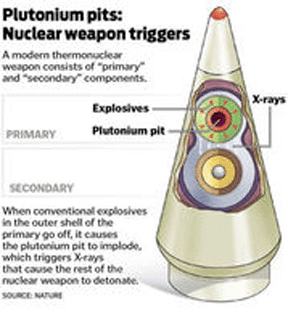
The primary U.S. plant to smelt plutonium, purify it and shape it into “triggers” (pits) for nuclear bombs was Rocky Flats Nuclear Weapons Site. From 1952 to 1989, Rocky Flats manufactured more than 70,000 pits at a cost of nearly $4 million apiece. Each one contained enough breathable plutonium particles to kill every person on earth. Virtually all of the waste produced there remains on-site. As we have learned through the SRS waste storage struggles, there is no place for it to go and no government plan to develop a repository. What’s made at a nuclear processing plant, stays at the nuclear processing plant.
Much went wrong at Rocky Flats due to mismanagement, criminal government indifference and public complacency. It took more than 30 years for the public to become so concerned with the pollution hazards issuing from the plant before the Department of Energy (DOE) was forced to hold a public meeting in 1988 to address the problems. One example: The plant produced one boxcar a week packed with 140 drums of radioactive waste. They were parked on site. Moisture penetration of a drum could have triggered an explosion. Ground water, soil and air pollution were also major hazards. A subsequent DOE study indicated that Rocky Flats was the most dangerous site in the country.
On June 6, 1989 more than 70 FBI and EPA agents raided the plant to begin an official investigation of the contractor and DOE for environmental crimes. The plant manager acknowledged that problems were solved “when DOE wanted to pay for them.” The final FBI/EPA allegations included concealment of environmental contamination, false certification of federal environmental reports, improper storage and disposal of hazardous and radioactive waste, and illegal discharge of pollutants into creeks flowing to drinking water supplies. Another independent study found there was enough lost plutonium in the plant exhaust ducts to create the possibility of an accidental nuclear reaction. According to a later DOE report, about 62 pounds of plutonium was lost in the plant air ducts; enough for seven nuclear bombs.
A grand jury was convened to hear the case on Aug. 1, 1989. The contractor argued in court that it could not fulfill its DOE contract without also violating environmental laws. In order to remediate the damage, on Sept. 28, 1989, EPA added Rocky Flats to its Superfund cleanup list. The grand jury worked until May 1991, then voted to indict the plant contractor, five employees and three individuals working for DOE.
The Department of Justice refused to sign the indictments despite more than 400 environmental violations that occurred during the decades of pit production at the plant. All charges were dropped. A settlement guaranteed the contractor and all indicted individuals immunity. Although the contractor pleaded guilty to criminal violations of the federal hazardous waste law and the Clean Water Act, the fine was only $18.5 million, less than the corporation had collected in bonuses for meeting production quotas that year. The contractor’s annual fee to run the site was estimated at $10 million, with an additional $8.7 million paid from DOE for management and safety excellence.
The contractor was also allowed to sue for reimbursement of $7.9 million from taxpayers for fees and costs related to its case. In addition, the contractor’s plea agreement indemnified it from further claims and all future prosecution, criminal or civil. The trial records are permanently sealed. Further, the contractor argued that everything it did at Rocky Flats was at the behest of DOE and maintained the right to receive future government contracts.
Grand jury members asked to write their own report but the judge refused to read it or release it to the public. Not surprisingly, the report was leaked to the press and printed in a Denver newspaper and Harper’s magazine. In January 1993, a Congressional committee finally issued a report revealing evidence of high-level intervention by Justice Department officials for the purpose of reducing the contractor’s fines.
DOE has estimated that it will take until 2065 to clean up Rocky Flats, at a cost to American taxpayers of more than $40 billion. One DOE official testified to the Senate Armed Services Committee that some weapons plants, like Rocky Flats, may never be cleaned up because we lack the technology to do so at a reasonable cost. Another investigator, testifying before the U.S. Senate’s Governmental Affairs Committee, stated he did not believe it possible to reverse the harm done at Rocky Flats.
Could this history repeat itself at SRS? Without a comprehensive cradle to grave plan with built-in irrevocable government funding and independent oversight, including citizen stakeholder input, SRS could become the next Rocky Flats. How likely is the government to attach such planning and funding to an SRS pit processing campaign? Past experience at SRS includes years of having to do best guess planning under continuing resolution funding and government failures to pass a budget, decades of “temporarily” storing deadly radioactive waste due to the government’s failure to meet off-site disposition commitments, budget reductions, program cancellations (most recently, the MOX project), and more.
Plutonium pit production waste is not just radioactive. It is nuclear waste on steroids. If produced here, it will likely remain in our backyard, along with all the decades old waste at SRS. There is no place for it to go. Looming large as examples of the dangers and difficulties SRS will face in having pit production waste moved off-site are the explosion and prolonged closure at the New Mexico Waste Isolation Pilot Plant (the government’s only operating repository) and the abandonment of the Yucca Mountain project.
Is it the CSRA’s responsibility to take on this mission? Pit production, while bringing jobs to the Aiken/Augusts area, will add to the decades old SRS hazards waiting for DOE remediation. SRS is already part of the DOE nuclear complex cleanup program. That mission, 30 some years old, drags on under the burden of DOE mismanagement and variable federal funding. Estimates are it will take another 70 years to clean up the DOE nuclear complex and cost about $500 billion more. Celebration of plans to add U.S. pit production to SRS is a rush to judgement. Only the usual corporations, living large off gigantic federal awards, stand to benefit.
Dr. Rose O. Hayes is a medical anthropologist who spent her career in public health. She holds a B.S., M.S., M.A., and Ph.D. from SUNY and completed post-doctoral work in skeletal biology at The George Washington University. From 2009 to 2015, she served on the U.S. Department of Energy Site-Specific Advisory Board for the Savannah River plant, chairing its Nuclear Materials Committee.
April 1, 2019
Posted by Christina Macpherson |
- plutonium, history, legal, Reference, safety, USA |
Leave a comment
Denver company sues over changes to nuclear workers’ access to care https://kdvr.com/2019/03/30/denver-company-sues-over-changes-to-nuclear-workers-access-to-care/ MARCH 30, 2019, BY ALEX ROSE DENVER — Janet Cook worked in the lab at Rocky Flats for 17 years and is now dealing with a laundry list of health problems.
“I see doctors two, three times a week, most the time. That’s my job now, going to the doctor,” Cook said. “There’s like 62 diseases that I have. It’s unreal.”
She lost her hearing, part of her vision, had multiple surgeries and strokes, and is now worried about how she is going to pay for it all.
In 2001, the Energy Employees Occupational Illness Compensation Program Act went into effect, allowing compensation for nuclear workers facing certain health issues. Cook has been filing claims through a division of the Department of Labor since that time, but says the process was long, stressful and lacked communication.
Cook reached out to Denver-based Professional Case Management to help with in-home health care. They provide services for nuclear workers and founded the Cold War Patriots, which advocates for workers.
Oftentimes, they didn’t know that the work they were doing was so dangerous and [so] harmful to their health,” said PCM president Greg Austin.
PCM is now suing the federal government over rule changes set to take effect April 9, saying they violate constitutional rights, among other legal issues.
“Under the new rules, there’s a lengthy, roughly 36-step process that involves filling out forms, mailing them back and forth, before that care can start,” Austin said.
“Program that takes years to get compensation, they want us to die before they pay us?” Cook said.
The Problem Solvers reached out to the Department of Labor for comment about why the rule changes were necessary and was referred to OSHA, but have yet to hear back.
Austin says the process could take former workers more than 60 days just to file a claim.
A judge will hear arguments in federal court in Denver on April 4 to determine whether the rule changes should stay or go.
April 1, 2019
Posted by Christina Macpherson |
employment, health, Legal, USA |
Leave a comment
Nuclear test victim ordered to repay compensation, https://www.radionz.co.nz/international/pacific-news/385484/nuclear-test-victim-ordered-to-repay-compensation A victim of the French nuclear tests in the South Pacific has been ordered to repay more than $US60,000 paid out in compensation to her.Florence Bourel is a former secretary of the Atomic Energy Commission, who was sent to the weapons test site at Moruroa over a 12-year period.
 She developed thyroid cancer which in 2002 was recognised as a work-related condition.
The test veterans organisation in France reports that in 2008, a court ordered for her to be compensated but the health insurance successfully appealed the decision.
A reassessment placed her condition below the disability level eligible for compensation, which she says implies that nothing had ever happened to her.
She says out of her pension she has to repay $60,000 and there is no recourse.
She also says her daughters have also been affected and one of her grand-daughters had an operation for a radiation-induced disease.
March 25, 2019
Posted by Christina Macpherson |
France, Legal |
Leave a comment
Japan Times, KYODO YAMAGUCHI 15 Mar 19- A district court on Friday rejected a plea by residents to halt a reactor at the Ikata nuclear power plant in Ehime Prefecture.
The decision by the Iwakuni branch of the Yamaguchi District Court is in line with rulings made by other regional courts and allows the No. 3 reactor to continue operating. The plant is managed by Shikoku Electric Power Co.
Unit No. 3, the sole remaining reactor at the plant, passed the state safety screening process that was revamped in the wake of the 2011 Fukushima nuclear crisis. But concerns remain about its safety, which led residents to turn to the courts to seek an injunction.
Of the more than 30 reactors in Japan, excluding those set to be decommissioned, only a few are in operation.
A previous order forcing a halt in operations was issued by the Hiroshima High Court in December 2017, citing the risk of an eruption at the caldera of Mount Aso about 130 kilometers away. The decision was overturned in September 2018 and the utility company restarted the unit a month later. …….
The plaintiffs pointed out that pyroclastic flows from possible catastrophic eruptions could reach the plant.
They also said the utility underestimated the fact that the reactor sits on the median tectonic line, a massive fault zone, as well as the potential damage from a massive earthquake off the Pacific coast of central and western Japan……. https://www.japantimes.co.jp/news/2019/03/15/national/yamaguchi-court-rejects-residents-call-halt-last-ikata-nuclear-reactor-ehime-prefecture/#.XIwI2SIzbGg
March 16, 2019
Posted by Christina Macpherson |
Japan, Legal |
Leave a comment
Nevada wants plutonium removed from state pending appeal https://www.kolotv.com/content/news/Nevada-wants-plutonium-removed-from-state-pending-appeal-507042751.html, 13 Mar 19,
RENO, Nev. (AP) – Nevada wants a federal appeals court to order the U.S. government to remove weapon-grade plutonium the Department of Energy secretly trucked to a site near Las Vegas until the court decides whether the clandestine move was illegal.
The extraordinary request comes in an increasingly aggressive legal battle over the highly radioactive material the state says poses a danger to Nevadans’ health and safety.
A federal judge in Reno has denied a similar motion for a temporary injunction pending the outcome of an appeal before the 9th Circuit Court of Appeals.
She ruled the matter was moot given the plutonium already had been shipped and DOE says no further shipments are planned.
Nevada’s lawyers said in a new filing late Monday the government can’t be trusted. They say removal of the plutonium is the only way to protect Nevada’s rights.
March 14, 2019
Posted by Christina Macpherson |
legal, USA |
Leave a comment
 Lawyer: Ex-SCANA officials ‘whitewashed,’ lied about defects at failed nuclear plant John Monk, The State Greenville News, March 5, 2019 COLUMBIA
 — SCANA executives deliberately lied to investors about the future of a doomed nuclear construction project, a lawyer representing former SCANA shareholders argued in court Monday.
“The bottom line is they (SCANA executives) lied to everyone, and they did it intentionally,” attorney John Browne told U.S. Judge Margaret Seymour.
The cost was tremendous, said Brown, whose lawsuit argues shareholders lost some $2.7 billion in stock value when the company’s stock price plummeted.
Seymour has a crucial decision to make about Browne’s lawsuit that alleges SCANA executives committed civil fraud that deflated investors’ stock valuations. She will decide whether to allow Browne’s lawsuit to go forward or dismiss it. She gave no hint Monday on how she might rule, or when.
Watching the proceedings Monday at the federal courthouse in Columbia were several attorneys from the U.S. Attorney’s office, which is working with the FBI to investigate criminal fraud allegations against SCANA and some of its former executives……….
During the hearing, Browne referred repeatedly to a document known as the Bechtel Report, which SCANA commissioned in 2015 to evaluate progress on the V.C. Summer nuclear plant under construction.
The Bechtel report, a draft of which was presented to SCANA the fall of 2015, detailed substantial cost overruns, construction delays and shoddy work at the nuclear plant site. But the report was never publicly released or discussed.
The company, which was publicly traded on the New York Stock Exchange, hid its findings from investors, the press and the public, Browne said. …….. https://www.greenvilleonline.com/story/news/2019/03/05/lawyer-says-former-scana-officials-lied-failed-south-carolina-nuclear-plant/3065200002/
March 7, 2019
Posted by Christina Macpherson |
legal, USA |
Leave a comment
Japan gov’t, Fukushima operator told to pay over nuclear disaster https://news.abs-cbn.com/overseas/02/20/19/japan-govt-fukushima-operator-told-to-pay-over-nuclear-disaster, Agence France-Presse, TOKYO- A Japanese court Wednesday awarded nearly $4 million in fresh damages to scores of residents forced to flee their homes after the 2011 Fukushima nuclear meltdown.
The Yokohama district court ordered the government and Tokyo Electric Power Co (TEPCO) to pay 419.6 million yen ($3.8 million) to 152 local residents, a court spokeswoman told AFP.
The verdict was the fifth time the government has been ruled liable for the disaster in eastern Japan, the world’s most serious nuclear accident since Chernobyl in 1986.
Presiding judge Ken Nakadaira said the government and TEPCO “could have avoided the accident if they had taken measures” against the tsunami that sparked the disaster, according to public broadcaster NHK.
In March last year, a court in Kyoto, western Japan, ruled both the government and TEPCO were responsible and ordered them to pay 110 million yen to 110 residents.
However, in a separate case in September 2017 in Chiba near Tokyo, the court ruled that only the operator was liable.
Around 12,000 people who fled after the disaster due to radiation fears have filed various lawsuits against the government and TEPCO.
Cases have revolved around whether the government and TEPCO, both of whom are responsible for disaster prevention measures, could have foreseen the scale of the tsunami and subsequent meltdown.
Dozens of class-action lawsuits have been filed seeking compensation from the government.
Triggered by a 9.1-magnitude earthquake, the tsunami overwhelmed reactor cooling systems, sending three into meltdown and sending radiation over a large area.
February 21, 2019
Posted by Christina Macpherson |
Japan, legal |
Leave a comment
https://www.insurancejournal.com/news/west/2019/02/15/518025.htm
February 15, 2019 The U.S. Justice Department is accusing Lockheed Martin Corp. of using false records and making false statements to bill the Energy Department for tens of millions of dollars in unauthorized profits and fees at the Hanford Nuclear Reservation in Washington.
The federal civil lawsuit was filed last week in U.S. District Court in Eastern Washington.
The Seattle Times says the lawsuit also accuses Lockheed Martin of using federal money to pay millions of dollars in kickbacks.
Hanford is located near Richland, Washington, and for decades made plutonium for nuclear weapons. The site is now involved in a massive cleanup effort that costs more than $2 billion per year.
The lawsuit covers the period from 2010 to 2015.
Lockheed Martin denied the allegations and said it will defend itself vigorously.
February 16, 2019
Posted by Christina Macpherson |
legal, USA |
Leave a comment
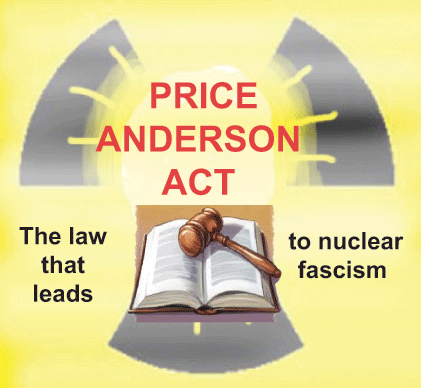
Global Nuclear Liability Insurance And Claims, Mondaq
|
15 February 2019
Article by STA Law Firm
“……….power generation from nuclear reactors pose a more substantial threat of causing major mishaps and accidents which could potentially damage property, cause personal injury, and damage the environment on a magnanimous scale. The potential underlying risk has thrown a significantly challenging question before the political heads of the world – who will be liable for the damage caused by such a nuclear incident? Several nations have addressed the concept of nuclear liability insurance and compensatory claims made by the injured parties through legally binding international conventions or/and national laws which has been analysed in great length in this paper……..
How is nuclear energy liability insurance structured?……….
While structuring insurance for nuclear reactors, the only factor which ought to be considered is the high potential perils associated with installation and operations of nuclear fission and fusion. This drastically differs from the risk associated to that of other industries of global sectors. The fundamentals of any nuclear liability insurance are:
I. Channelling of liability on the operators: The nuclear operators are liable for all damages caused by a nuclear incident notwithstanding fault liability.
II. Trans-border nationality: A nuclear energy disaster affects not only the country in which it is located but the surrounding states as well. Hence, national laws are augmented with international conventions which are needed to defend the cross-border inflictions of such disasters.
III. Limited liability: Limited civil liability concept has been incorporated by the international conventions on the basis which the national laws have been formulated, putting a maximum cap limit on the nuclear operators, beyond which the state will take up the liability.
(Detailed explanation is provided in the latter part of this article)
Due to such high-risk and strict liability, the nuclear operators opt for third-party civil liability insurance which finds its root in either of the two forms:
I. National Insurance Pool:
To cover the potential liability of the nuclear industry, many insurers agreed to pool their resources for the associated high-potential risks. A pool is where a group of insurance companies jointly participate to a fixed percentage in the insurance of a particular risk or class of business. These are created in the circumstances involving risks which, in practicality, cannot be provided by any individual insurer on a stand-alone basis. In most countries, national insurance pools have been formed based on the requirements laid down by the federal laws (based on international conventions), pooling together insurance for the domestic nuclear operators.II. Mutual Insurance Associations: The USA (the Nuclear Electric Insurance Limited) and Europe (the European Mutual Insurance for Nuclear Installations) have insurance associations which deal with the physical damage and liability in the event of a nuclear accident which is set up by the nuclear industry itself.
Principles or fundamentals governing Nuclear Liability Insurance:
In recognition of this exposure caused by nuclear accidents, the international conventions and nuclear liability insurance were formulated in the light of the seven fundamental principles:
I. Strict Liability:
The operator is directly and strictly liable for the damage caused by the nuclear incident. The aggrieved need not prove that the operator was negligent or at fault. Only the link between the damage caused and the nuclear incident needs to be demonstrated. The operator is liable for any damage resulting from a nuclear event at his installation, in principle irrespective of its cause.
II. Channelling liability to the operator (Exclusive liability):
All liability arising from the damage caused by a nuclear accident is channelled to the operator, thereby protecting the rights of the public. The operator is exclusively liable for damage resulting from a nuclear incident. He is held liable to the exclusion of any other person, regardless of who caused the damage. Hence, the damage is charged to the operator himself and not the suppliers. The channeling of liability might seem unfair as it means that the operator could be liable even if a third party were negligent or at fault. The victim of a nuclear incident can only present his claim to the operator of the installation causing damage or his insurer. Furthermore, such exclusive liability brings certainty in insurance claims as the compensation settlements would be quick, and avoids costly and time-consuming claim procedures. Had the situation been otherwise, then insurers would have to hold separate pools or covers for every party involved in the nuclear reactor chain.
III. Limitation of liability in Time:
This is an important concept because the injury caused by a nuclear incident may not manifest for several years. Ergo, a limitation period is intended to help the claimant where the consequences may not reveal for several years; thereby not divulging them of their right to seek damage, and at the same time it protects the rights of the operators and insurers by not exposing them of liability for an indefinite period. For example, in the UK, the Nuclear Installations Act 1965 states that any claim made after 10 years (from the date of occurrence of the nuclear incident) but less than 30 years, will be made directly to the government instead of the insurer or the operator.
IV. Limitation of Liability in Time:
The amount of liability charged to an operator under the principle of strict and exclusive liability is capped to a limit to shelter them from the full risk amount. This concept is introduced to bring a balance or quid pro quo status against the strict and exclusive liability. Beyond the limit, the state covers the liability amount.
V. Insurance or other _nancial security:
Operators are obligated to carry financial security to cover their potential liability amount in the event of a nuclear incident. Usually, insurance pools tend to third-party claims. However, in certain situations, operators take the liability on themselves and cover the same by providing financial security in the form of government guarantees, bank guarantees, letters of credit, mutual fund, operators’ pooling etc.
VI. Jurisdiction:
Jurisdiction over claim actions lies exclusively with the courts of the country where the nuclear incident occurred. The courts of other contracting states will not be competent to hear the claims. Judgements made by the competent court will be recognized and enforced in other contracting countries. This principle is only useful when many states have ratified either the same convention or a bridging convention. Victims may, on first impressions, see it as an advantage to be entitled to sue all possible parties in different courts for nuclear damage. However, it is pertinent in the victims’ best interest to disburse compensation equitably.
VII. Applicable Law:
The applicable law is the national law of the competent court that has jurisdiction. The federal law must also be applied without discrimination on the grounds of nationality, domicile and residence. The applicable law principle helps prevent costly and lengthy arguments about which law applies, especially with regard to the complexities of the national and international rules surrounding the conflict of laws.
International Conventions:
A nuclear accident causing trans-boundary damage has led to the development of international conventions to ensure that victims have a readily available justice system.
I. Paris Convention:
The nuclear industries liability regime was founded in 1960 by the OECD’s Paris Convention. Which requires national legislation to be passed for it to be ratified. Although this convention recognizes strict and exclusive channeling of liability, it specifies certain exceptions, which rebuff the liability of the operator. Following are the exceptions: ………… http://www.mondaq.com/x/781188/Insurance/Global+Nuclear+Liability+Insurance+and+Claims
|
|
|
|
February 16, 2019
Posted by Christina Macpherson |
business and costs, legal |
Leave a comment
 Feds sue Hanford contractor, claiming kickbacks and lies defrauded taxpayers out of millions, Tri City Herald , BY ANNETTE CARY, FEBRUARY 08, 2019 RICHLAND, WA
The Department of Justice filed a civil lawsuit Friday against Hanford contractor Mission Support Alliance, accusing it of defrauding the federal government out of tens of millions of taxpayer dollars.
Also named in the lawsuit are former Mission Support Alliance President Frank Armijo, Lockheed Martin Corp. and Lockheed Martin Services Inc……….
Mission Support Alliance (MSA), now owned by Leidos and Centerra Group, holds a 10-year contract valued at $3.2 billion to provide site-wide services at the Hanford nuclear reservation. Services include security, fire protection, utilities and information technology.
The Justice Department is accusing Mission Support Alliance of using half-truths, omissions, kickbacks and outright lies before its purchase by Leidos to get the Department of Energy to consent to a $232 million subcontract to a company with which it had ownership ties.
Lockheed Martin Corp. was a principal owner of Mission Support Alliance in 2010, when Mission Support Alliance awarded a subcontract for information technology services at Hanford to Lockheed Martin Services Inc.
The lawsuit alleges that from 2010 to 2015 the defendants misrepresented billing rates charged to DOE, the effort estimated to be needed to complete work and the anticipated additional profit for the subcontractor.
“Defendants’ fraud allowed them to obtain grossly inflated and improper additional profit on the subcontract,” the Justice Department said in a news release.
The lawsuit said that estimates of costs for payment rates were inflated in some cases by basing them on far more employees to perform work than Lockheed Martin Services Inc. included in its internal budget.
In some cases DOE was billed by both Mission Support Alliance and Lockheed Martin Services Inc. for the same labor, the lawsuit said.
‘GROSSLY INFLATED PRICING’ CLAIMS
The profit paid for Lockheed Martin Services Inc. work was in addition to money Lockheed Martin Corp. was already earning on the same work through its partial ownership of Mission Support Alliance, according to the Justice Department.
DOE repeatedly made clear that the subcontractor, Lockheed Martin Services Inc., could not earn profit on top of what its owner was already being paid through Mission Support Alliance, the lawsuit said.
Armijo, and Rich Olsen, the Mission Support Alliance chief financial officer, also worked on behalf of Lockheed Martin Corp. and misused their positions at Hanford to help Lockheed Martin Corp. obtain grossly inflated pricing, the Justice Department alleged.
In addition to serving at times as the Mission Support Alliance president, Armijo also was a vice president of Lockheed Martin Corp., the lawsuit said.
HANFORD OFFICIALS ALLEGEDLY PAID KICKBACKS
The Justice Department said some employees, including Armijo, told DOE that the subcontractor’s pricing did not contain any additional profit for the subcontract for the same work on which Lockheed Martin Corp. was already earning profit through its ownership of Mission Support Alliance.
The millions of dollars that Armijo and other employees were paid in cash and stock as part of an incentive program amounted to kickbacks for improperly using their Mission Support Alliance positions to provide favorable treatment for Lockheed Martin Corp., the Justice Department alleges. ………https://www.tri-cityherald.com/news/local/hanford/article226014785.html
February 11, 2019
Posted by Christina Macpherson |
Legal, secrets,lies and civil liberties, USA |
Leave a comment
 https://www.rt.com/usa/451098-hanford-nuclear-lockheed-lawsuit/ 10 Feb, 2019 Contractors involved in a multibillion decontamination effort at the notorious Hanford nuclear site have been accused of defrauding US taxpayers, according to a lawsuit against Mission Support Alliance and Lockheed Martin.
MSA has a 10-year, $3.2 billion contract with the Department of Energy (DOE) to support the decontamination effort at the decommissioned nuclear production complex known as the Hanford Site. Allowed to pick subcontractors for the nation’s largest and most expensive environmental cleanup at its own discretion, MSA abused its authority and awarded “improper favorable treatment” for kickbacks, the Justice Department claimed this week.
The lawsuit alleges that Lockheed Martin Corporation (LMC) and Lockheed Martin Services Inc. (LMSI) paid more than $1 million to executives of MSA – which was conveniently co-owned by another Lockheed subsidiary at the time – in order to secure a $232 million subcontract to provide management and technology support at the Washington state nuclear site from 2010-2016.
The services were provided at “inflated rates” and in some cases the DOE was even billed twice, by both MSA and Lockheed, for the same work. In addition, the suit accuses Jorge Francisco Armijo, who served as both the Vice President of LMC and President of MSA, of abusing his authority for financial gain by his simultaneously held posts.
“Where Congress has allocated money for specific purposes, we will not tolerate unlawful conduct by contractors who seek to enhance their profits at the expense of taxpayers,” said Assistant Attorney General Jody Hunt of the Department of Justice’s Civil Division.
Lockheed immediately denied the allegations of being involved in the corruption scheme, rejecting any notion that the “corporation or its executives engaged in any wrongdoing.” MSA also brushed aside the accusations, claiming that the company “stands behind” their employees.
The 586-square-mile former nuclear research facility was used to produce plutonium for the nuclear bomb in the Manhattan Project. After over four decades of nuclear fuel production, the site was closed down in 1987, requiring an extensive clean-up of solid and liquid wastes left from the weapons production processes.
February 11, 2019
Posted by Christina Macpherson |
Legal, secrets,lies and civil liberties, USA |
Leave a comment
Daily Republic, By SETH TUPPER / Rapid City Journal on Feb 6, 2019 RAPID CITY, S.D. — The U.S. Nuclear Regulatory Commission has decided to uphold a company’s license to mine for uranium near Edgemont, even though a federal judge has declared that the existence of the license without an adequate cultural resources survey is illegal.
The commission’s decision to leave the license in place does not mean mining will immediately begin. Powertech, a subsidiary of Canada-based Azarga Uranium Corp., still needs other permits from local, state and federal agencies. ………
One member of the five-person NRC, Jeff Baran, filed a dissenting opinion. Baran was chagrined that the NRC staff’s practice “has been to issue materials licenses before the completion of contested hearings on environmental matters.” He wrote that the NRC should take the opportunity presented by the Powertech vs. Oglala Sioux Tribe dispute to change that practice.
Otherwise, Baran wrote, the NRC will remain “on course to repeatedly and predictably violate a core requirement of NEPA.”………
February 11, 2019
Posted by Christina Macpherson |
Legal |
Leave a comment





 nuclear-news