Japanese High Court rules against nuclear reactor restart
 Japan court halts nuclear reactor restart citing volcano, earthquake risks, Channel News Asia. 17 Jan 2020
TOKYO: A Japanese nuclear reactor near a fault line must remain shut because of the risk of its being struck by earthquakes and volcanic eruptions, a high court ordered on Friday (Jan 17).
All nuclear power stations were shut down after the 2011 Fukushima nuclear accident following a catastrophic tsunami, and many remain closed.
The Japanese public has turned against atomic power, despite Prime Minister Shinzo Abe insisting the nation needs nuclear plants to power the world’s third-largest economy, and the court decision was a boost for the country’s anti-nuclear movement.
The move by the Hiroshima High Court reversed a lower court decision in March that would have allowed the reactor at the Ikata nuclear plant in western Japan to resume operations.
The plant’s operator, Shikoku Electric Power, wanted to resume work at the reactor, which had been halted for routine inspections, and said it will appeal the high court’s ruling.
The case was originally lodged by residents of a neighbouring region who complained the utility failed to properly evaluate the risks posed by a local volcano and seismic faultlines……… https://www.channelnewsasia.com/news/asia/japan-court-halts-ikata-nuclear-reactor-restart-volcano-quake-12274482
The injustice of the prosecution of Julian Assange
The international witch-hunt of Julian Assange, World Socialist Website, Eric London and Thomas Scripps, 14 January 2020 The prosecution of WikiLeaks founder Julian Assange at London’s Westminster Magistrates Court is a travesty of justice that will forever stain the governments of the United States, the United Kingdom, Australia, Sweden and Ecuador, as well as all the individuals involved.Appearing alongside Assange in court Monday morning, Assange’s attorneys revealed that they had been given only two hours to meet with their client at Belmarsh prison to review what lawyer Gareth Peirce called “volumes” worth of evidence.
Expressing the practiced cynicism of British class justice, District Judge Vanessa Baraitser said this was “not an unreasonable position,” citing a lack of space in the prison interview room. With the bang of her gavel, Baraitser sent Assange back to his dungeon at Belmarsh, where he awaits his February extradition hearing under conditions UN Rapporteur Nils Meltzer has called “torture.”
At this stage in the near decade-long international witch-hunt of Assange, nobody should be surprised by such shameless lawlessness on the part of the world’s most powerful governments. Ever since Swedish, British and American prosecutors conspired in 2010 to issue a warrant for Assange’s arrest in connection with an investigation into bogus sexual misconduct allegations, these “advanced democracies” have trampled on their own laws and traditions, subjecting the journalist to a pseudo-legal process that would have been deemed unfair even by the standards of the Middle Ages.
Monday’s mockery of justice is an escalation of the attack on Assange’s right to counsel. It takes place after the Spanish newspaper El País published a detailed account of how a security firm, UC Global, secretly spied on Assange’s privileged discussions with his lawyers and fed the illegally obtained surveillance to the CIA. UC Global also shared footage from cameras it installed throughout the Ecuadorian Embassy in London, where Assange was forced to seek refuge from 2012 to 2019 to avoid US extradition. El País’ reporting showed that UC Global recorded every word Assange spoke and live-streamed these conversations to the CIA.
o 2019 to avoid US extradition. El País’ reporting showed that UC Global recorded every word Assange spoke and live-streamed these conversations to the CIA.
Despite the support of a criminally compliant media, it is becoming increasingly difficult for the US and British governments to downplay the profoundly anti-democratic precedents they intend to set through the Assange prosecution.
In an opinion article published Monday in the Hill, titled “Will alleged CIA misbehavior set Julian Assange free?” American attorney James Goodale wrote a scathing attack on the CIA’s spying on Assange’s privileged attorney-client communications.
Goodale is among the most prominent and well respected attorneys in the US, best known for representing the New York Times when the newspaper was sued by the Nixon administration for publishing the Pentagon Papers in 1971. The Pentagon Papers were leaked by RAND Corporation analyst Daniel Ellsberg, who has also called for the release of Assange and whistleblower Chelsea Manning.
The Pentagon Papers revealed how the US government for years lied to the public in expanding the Vietnam War, which led to the deaths of 55,000 US soldiers and 3 million Vietnamese people. Their publication triggered an explosion of public anger and fueled anti-war protests.
Goodale wrote: “Can anything be more offensive to a ‘sense of justice’ than an unlimited surveillance, particularly of lawyer-client conversations, livestreamed to the opposing party in a criminal case? The alleged streaming unmasked the strategy of Assange’s lawyers, giving the government an advantage that is impossible to remove. Short of dismissing Assange’s indictment with prejudice, the government will always have an advantage that can never be matched by the defense.”
Goodale explained that “the Daniel Ellsberg case may be instructive.”
Ellsberg, like Assange, was prosecuted under the Espionage Act for leaking documents to the Times and the Washington Post. During the trial, Nixon’s “plumbers” broke into the office of Ellsberg’s psychiatrist and wiretapped his phone. In that case, Judge William Matthew Byrne ruled that the surveillance had “incurably infected the prosecution” and dismissed the charges, setting Ellsberg free.
Goodale wrote that “for similar reasons, the case against Assange should be dismissed.”……https://www.wsws.org/en/articles/2020/01/14/pers-j14.html
UK: legal action against environmental destruction by Sizewell nuclear project
Crowd Justice (accessed) 30th Dec 2019, Together Against Sizewell C (TASC) is an unincorporated citizens’ group
formed to oppose the building of Sizewell C’s twin nuclear reactors and
associated works in Suffolk Coast & Heaths Area of Outstanding Natural
Beauty (AONB) in a legal open, peaceful and fully accountable manner.
TASC has mounted a legal challenge against East Suffolk Council’s decision to
approve the planning application submitted by EDF, the nuclear developer,
to: – chop down 100-year-old Coronation Wood, turn a large area of priority
habitat acidic grassland, known as Pillbox Field, into a 576 space car
park, relocate over 320,000 sq. feet of 7 largely non-essential and
non-operational Sizewell B buildings and an additional 128 car parking
spaces, that will encroach further into the AONB. Most of these
buildings/facilities could be located outside the AONB. The works are
needed to free up land for the construction of Sizewell C as the existing
site is too small and are clearly integral to the wider Sizewell C
development.
https://www.crowdjustice.com/case/save-coronation-wood/
BBC 30th Dec 2019, Campaigners opposing a new nuclear power station are seeking a judicial review over a “premature” decision to allow woodland to be felled. EDF Energy wants to build two reactors next to Sizewell B in Suffolk and in September was told it could chop down Coronation Wood on the site. TogetherAgainst Sizewell C (Tasc) said the area was vital for wildlife. East
Suffolk Council said it would respond to the campaigners’ challenge in due
course.
Ohio’s nuclear legal battles: Supreme Court will hear case filed by Ohioans Against Corporate Bailouts (OACB).
 Kallanish Energy 30th Dec 2019, Legal battles over the Ohio energy law that starts providing subsidies to the state’s two nuclear power plants in 2021, may continue, Kallanish Energy learns.
The Ohio Supreme Court voted 4-0 to hear the case filed by Ohioans Against Corporate Bailouts (OACB). Three justices recused
themselves from the case, citing political campaign conflicts, Energy
Central News reported. OACB maintains it was denied a full 90 days to
gather signatures for a referendum. They want to overturn the law that
subsidizes Ohio’s two nuclear power plants owned by FirstEnergy Solutions
and two coal-fired plants owned by Ohio Valley Electric Corp. The law also
shrinks and eventually eliminates requirements that utilities get a
percentage of their power from renewable energy sources and scraps
utilities’ state-mandated energy efficiency programs.
https://www.kallanishenergy.com/2019/12/30/ohio-supreme-court-will-hear-nuclear-bailout-case/
Ohio court to weigh group’s effort to block nuclear plant rescue
By: Associated Press December 27, 2019 The state Supreme Court has agreed to hear arguments from a group attempting to overturn the roughly $1 billion financial rescue of Ohio’s two nuclear power plants…. (subscribers only) https://journalrecord.com/2019/12/27/ohio-court-to-weigh-groups-effort-to-block-nuclear-plant-rescue/
Israel’s High Court rejects Vanunu’s bid to leave Israel
|
Nuclear whistleblower Vanunu denied permission to leave Israel High court rejects petition from man who revealed country’s nuclear secrets in 1986, Irish Times, Mark Weiss in Jerusalem , 16 Dec 19 Israel’s high court has rejected a petition from Mordechai Vanunu, the man who revealed the country’s nuclear secrets to the world in 1986, to be permitted to leave the country. The justices ruled that based on the material shown them, Mr Vanunu possessed secret and sensitive information that he had not revealed and that if he did, this would be dangerous for state security. They also ruled that they had been persuaded that the nuclear whistleblower wished to reveal his information. At the same time, they urged the state to continue to try to find ways to ease Mr Vanunu’s conditions in Israel. For years Mr Vanunu has demanded that Israel rescind his citizenship and allow him to leave the country. Mr Vanunu, a low-level technician at Israel’s Dimona nuclear plant, first hit the headlines in 1986 when he leaked details with photographs he took surreptitiously to the British Sunday Times. The revelations marked the first concrete proof that Israel had the capacity to manufacture nuclear bombs. Nuclear ambiguity’Israel maintains a policy of “nuclear ambiguity”, neither confirming nor denying foreign reports of its nuclear potential. It has refused to sign the nuclear Non-Proliferation Treaty or to allow international surveillance of its Dimona plant in the southern Negev desert. Partly based on the secrets Mr Vanunu revealed, foreign experts have concluded that Israel is the world’s sixth-largest nuclear power……… In 2004 he completed an 18-year sentence, most of which was spent in solitary confinement. However, strict conditions were attached to his release, including a ban on leaving the country, a ban on entering the Palestinian territories and a ban on meeting foreign journalists. Since his release, Mr Vanunu has twice served jail terms after convictions for parole violations. |
|
|
Legal action regarding defective welds in EPR nuclear reactor
Crilan 16th Dec 2019, On July 20, 2018 and following the “Sortir du nuclear” network and Greenpeace France, CRILAN filed a complaint with the Cherbourg Public Prosecutor concerning defective welds, particularly those relating to
crossings of the containment. This December 16, 2019, following ASN
inspections and in connection with the complaint by Réseau “Sortir du
nuclear” and Greenpeace France, CRILAN files a complaint with the Public
Prosecutor of Paris for serious breaches relating to the qualification of
some equipment installed on the EPR.
These are materials participating in
the safety demonstration: mechanical (pumps, valves) or electrical (relays,
circuit breakers, etc.). This qualification is based in particular on
studies and tests. It must be the subject of documentation and traceability
of reservations and “open” points, which has not always been the case.
As EDF is subject to regulations on basic nuclear installations, violations
committed may be penalized.
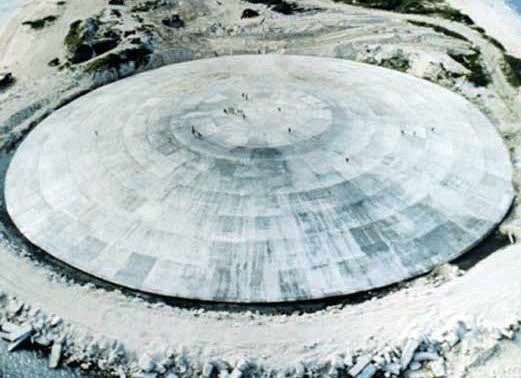
As the Runit nuclear waste dome crumbles, Marshall Islanders want honesty and justice
‘People want justice’: Marshalls’ fury over nuclear information US withheld– https://www.rnz.co.nz/international/programmes/datelinepacific/audio/2018723289/people-want-justice-marshalls-fury-over-nuclear-information-us-withheld From Dateline Pacific, 21 November 2019
|
The caretaker president of the Marshall Islands says it’s unconscionable that the United States kept secret key information about its nuclear tests for decades. New details reveal the US withheld information about the nuclear waste it left behind when the Marshall Islands gained independence, and the extent of the tests it carried out. Now, a dome that contains hundreds of tonnes of nuclear waste is at risk of crumbling into the ocean. But with Washington increasingly jittery about China, the small Pacific country’s finding it might now have some leverage to get something done. TRANSCRIPTEnewetak was once a paradise – a long atoll in the clear blue waters of the north Pacific, white sand and thick green palms. Today, it’s rutted with scars, after the US detonated dozens of nuclear bombs on, in and above it in the 1940s and ’50s. Whole islands were vaporised, deep craters carved into the coral. Jack Ading is a senator from Enewetak. His family was forced to move for the tests, and then allowed to return in the 1980s. “It appears that when we moved back to Enewetak in the 1980s after we were assured by the US government that it was safe. We were actually subjecting ourselves to a risk that we were never warned about.” Government documents reveal that beyond the nuclear blasts, the US also tested biological weapons, including an aerosol bacteria. Jamie Tahana reports. TRANSCRIPTEnewetak was once a paradise – a long atoll in the clear blue waters of the north Pacific, white sand and thick green palms. Today, it’s rutted with scars, after the US detonated dozens of nuclear bombs on, in and above it in the 1940s and ’50s. Whole islands were vaporised, deep craters carved into the coral. Jack Ading is a senator from Enewetak. His family was forced to move for the tests, and then allowed to return in the 1980s. “It appears that when we moved back to Enewetak in the 1980s after we were assured by the US government that it was safe. We were actually subjecting ourselves to a risk that we were never warned about.” Government documents reveal that beyond the nuclear blasts, the US also tested biological weapons, including an aerosol bacteria. But this was kept secret when the people from Enewetak were allowed to return, and other documents show that people were subjected to tests and experiments about the lingering effects of radiation. Last week, the Los Angeles Times also uncovered that the US didn’t tell the Marshallese it had shipped 130 tonnes of soil from its atomic testing grounds in Nevada in 1958 and dumped it at Enewetak. The caretaker president of the Marshall Islands, Hilda Heine, says the new details are disturbing. “To say the least you would have thought that all that information would have been shared with the Enewetak people before they went back to Enewetak. It is unbelievable that such information was held back, and as a result people have gone back and lived there for many years.” The nuclear waste from the era is stored in a pile at the end of the island of Runit, covered in a concrete dome. But a recent study by the Marshall Islands Nuclear Commission found the dome is now at risk of collapsing, and as rising seas erode beneath it, much of that waste is seeping into the lagoon. The commission’s chair, Rhea Moss-Christian, says information about the dome and the testing era was withheld throughout the independence process, while a compact of free association was negotiated in the 1980s. “We signed the compact in 1986 on the understanding that we had all the information we needed to have. It’s pretty hard for us to see this information, to have the level of detail that we now have, and to think that any of those previous agreements could stand.” The Marshall Islands has sought US help to clean up contamination and to shore up the dome, but American officials have declined, saying it’s on Marshallese land and, therefore, is the Marshall Islands’ responsibility. Ms Moss-Christian says that’s ridiculous. “How can it be that this radioactive waste and structure that we didn’t ask for. How can it be that this is ours and ours to deal with?” A Nuclear Claims Tribunal formed by the two countries in 1988 concluded that the US should pay $US2.2 billion in claims and settlements. But documents from both the Nuclear Commission and a 2010 US House inquiry show only $4 million has been paid. Last month, the Marshall Islands parliament – the Nitijela – endorsed a Nuclear Commission strategy which calls for, among other things, full compensation, better healthcare, and environmental protections. The US maintains it is upholding its responsibilities. It says it’s paid nearly a billion dollars, which has gone towards resettlement, rehabilitation and healthcare costs for affected communities, and that it’s funding tests of the water and atmosphere around the Runit dome. But Giff Johnson, the editor of the Marshall Islands journal and an author of books about the nuclear legacy, says that’s not enough. “People want justice for Marshall Islanders. The US government has to step up and address issues that it has addressed for American victims but is ignoring out here.” For the Marshall Islands, a smattering of atolls in the North Pacific – population 53,000 – it might be an opportune time to twist a superpower’s arm. Washington is increasingly nervous about a growing Chinese presence, and the compact of free association – which guarantees relations and funding from the US – expires in three years. Having initially maintained there won’t be a replacement compact, Washington is now keen to open talks for a new one, and has sent a string of high-ranking officials for visits. The caretaker president, Hilda Heine – who a few months ago was invited to the White House to meet President Donald Trump – says that could bode well. “The geopolitical situation in the Pacific is really helpful to the cause of the Marshall Islands. The US is now paying more attention to the Marshall Islands, so our issues around climate change, around our nuclear legacy, I think those will come to the forefront of our discussions going forward with the United States.” Whatever comes from those discussions, the people of Enewetak want more than they’re getting now. |
|
Ohio: the nuclear industry’s violent assault on democracy

Ohio’s GOP secretary of state has now asked the Ohio Supreme Court NOT to provide a federal judge with answers about key procedural questions surrounding the state’s referendum process.
The short-term issue is about a billion-dollar bailout for two nuke reactors and two coal burners.
Long-term it asks whether targeted violence perpetrated by paid thugs will now define our election process. And whether the public referendum will remain a workable part of our democracy.
The battle starts with House Bill 6, the now-infamous billion-dollar nuke bailout approved by the corrupt, gerrymandered Ohio legislature in late July.
HB6 forces all Ohio ratepayers to subsidize two crumbling nukes on Lake Erie, along with two decrepit coal burners, one of them in Indiana. It helps underwrite ten small solar farms, but undercuts much larger subsidies for other wind and solar facilities.
The Perry reactor east of Cleveland, and Davis-Besse near Toledo, are among the world’s most dangerous, decrepit reactors. Both were set to shut because they cannot compete with wind and solar, as well as fracked gas.
But Akron-based FirstEnergy spent millions to “persuade” the legislature to hand them a billion dollars to keep their uncompetitive, uninsured and essentially unregulated reactors on line.
When the bailout passed, a statewide group called Ohioans Against Corporate Bailouts turned in a petition for a repeal referendum on the 2020 ballot. The law allows 90 days for referendum sponsors to gather signatures to get on the ballot. In this case 265,711 would be required.
Ohio’s Attorney General David Yost sat on the request for 19 days, then rejected it. OACB filed a second application, which the AG sat on for another 19 days before approving it.
That left the petitioners just 52 days to gather signatures.
But signature gatherers were immediately attacked with violent threats and bribery offers. In the field, they (and potential signatories) were physically assaulted by “blockers” hired by the nuclear industry. Sworn testimony about these attacks was filmed at a public gathering in Columbus and can be seen here:
https://freepress.org/article/free-press-second-saturday-petition-blockers-threaten-our-democracy
Bailout opponents then went to federal court to ask that the 38 days consumed by the AG be restored to the petition campaign, which came up short at the 90-day deadline. A federal judge asked for guidance from the Ohio Supreme Court and submitted five questions for the Justices to answer.
And here things have leapt to another level. Frank LaRose, the Ohio Secretary of State, has now asked the Ohio Supreme Court NOT to respond to the federal judge’s queries.
In other words: the Republican attorney general killed nearly half the allotted signature gathering time for the repeal of this bailout. A federal judge has asked to hear from the state Supreme Court. And now Ohio’s Republican secretary of state has asked that Court NOT to comply, in a direct attempt to prevent Ohioans from voting on whether they’re to be forced to pay a billion dollar subsidy for two lethal, money losing atomic reactors.
This shocking combination of overt threats, bribery and outright physical violence, combined with judicial stall tactics by elected Ohio officials, breaks new ground in the assault on democracy itself in the American heartland.
The issue cuts to the core of the 2020 election. Donald Trump has met personally with at least one principal lobbyist for FirstEnergy, the prime beneficiary of the bailout. At least one of his associates lobbied at least five legislators in its behalf.
But a statewide referendum for repeal could be catastrophic for the GOP. Polls show more than 60% of Ohioans opposed. That includes much of the normally corporate statewide media. Many big industrial organizations have joined the fossil fuel industry here in fighting it.
If the referendum does get on the 2020 ballot, it will clearly energize a strong progressive voter turnout. Outraged ratepayers could very easily make the difference in a closely divided swing state. So for Trump and his minions, killing a vote on this billion-dollar rip-off is vital.
Their assault must be seen as part of a larger attack on democracy itself. The right to referendum has been established in numerous states for a century or more. That physical violence, choreographed bribery and official legal manipulation would now be used to kill it bodes badly for our future.
From the rise in violent white supremacist bigotry, to unaccountable police murders, to Charlottesville, to the recent attack on Code Pink’s Medea Benjamin to the concerted Republican assault on paper ballots and fair, inclusive voting practices, it’s clear the GOP intends to gut democracy in 2020 and beyond.
This all-out utility and official attack on the referendum process in Ohio has put a billion-dollar price tag on two nukes capable of doing trillions in damage to human health and the eco-systems of the Great Lakes region.
But it also signals a broader war against both democracy and truth, one we must all take very, very seriously.
—————-
Attorney Bob Fitrakis, Ph.D., is publisher of the Columbus Free Press. He’s co-author
Swedish accusations against Assange – always a political motive on behalf of USA
We need to ask ourselves why the focus is not on the crimes perpetrated by those involved in war crimes. Why is an Australian citizen being subjected to US espionage laws even though he was never on US soil? More importantly, why should an Australian citizen have allegiance to the US?
 The Swedish case against Assange was always political, https://www.theage.com.au/national/the-swedish-case-against-assange-was-always-political-20191120-p53cgs.html,By Greg Barns and Alysia Brooks, November 20, 2019 It is almost a decade since Julian Assange woke to discover, on the front page of a Swedish newspaper, that Swedish authorities had decided to pursue him on allegations of sexual misconduct. Immediately, Julian presented himself to the police station to make a statement and clear his name. After speaking with prosecutors, he was told he could leave the country; so he did.
Currently, Assange is held on remand in Belmarsh prison, in conditions that are exacerbating his already fragile health, and impeding his ability to prepare his defence. He is facing unprecedented charges under the US Espionage Act, for allegedly carrying out actions that journalists and publishers engage in as a part of their work. He is facing 175 years – an effective death sentence – for allegedly engaging in journalism.
And let’s not forget the material that was exposed by WikiLeaks. The releases included evidence of war crimes, including torture and unlawful killings, perpetrated during the Iraq and Afghanistan wars, and the Guantanamo files, which demonstrated that the majority of men, and children, were being held and tortured at the prison, even though they were innocent of any crime.
We need to ask ourselves why the focus is not on the crimes perpetrated by those involved in war crimes. Why is an Australian citizen being subjected to US espionage laws even though he was never on US soil? More importantly, why should an Australian citizen have allegiance to the US?
Greg Barns is a barrister and adviser to the Australian Assange Campaign. Dr Alysia Brooks is a human rights and due process advocate.
If Julian Assange is extradited to the United States, journalism will be incarcerated, too
JOHN PILGER: Assange’s case will define the future of free journalism, https://independentaustralia.net/life/life-display/john-pilger-assanges-case-will-define-the-future-of-free-journalism,13324 By John Pilger | 18 November 2019 John Pilger describes the disturbing scene inside a London courtroom last week when the WikiLeaks publisher, Julian Assange, appeared at the start of a landmark extradition case that will define the future of free journalism.
THE WORST MOMENT was one of a number of “worst” moments. I have sat in many courtrooms and seen judges abuse their positions. This judge, Vanessa Baraitser – actually she isn’t a judge at all; she’s a magistrate – shocked all of us who were there.
Her face was a progression of sneers and imperious indifference; she addressed Julian Assange with an arrogance that reminded me of a magistrate presiding over apartheid South Africa’s Race Classification Board. When Julian struggled to speak, he couldn’t get words out, even stumbling over his name and date of birth.
When he spoke truth and when his barrister spoke, Baraister contrived boredom; when the prosecuting barrister spoke, she was attentive. She had nothing to do; it was demonstrably preordained. In the table in front of us were a handful of American officials, whose directions to the prosecutor were carried by his — back and forth this young woman went, delivering instructions.
Having ignored Julian’s barrister’s factual description of how the CIA had run a Spanish security firm that spied on him in the Ecuadorean embassy, she didn’t yawn, but her disinterest was as expressive. She then denied Julian’s lawyers any more time to prepare their case — even though their client was prevented in prison from receiving legal documents and other tools with which to defend himself.
Her knee in the groin was to announce that the next court hearing would be at remote Woolwich, which adjoins Belmarsh Prison and has few seats for the public. This will ensure isolation and be as close to a secret trial as it’s possible to get. Did this happen in the home of the Magna Carta? Yes, but who knew?
Who will then dare to expose anything of importance, let alone the high crimes of the West? Who will dare publish ‘Collateral Murder’? Who will dare tell the public that democracy, such as it is, has been subverted by a corporate authoritarianism from which fascism draws its strength?
Once there were spaces, gaps, boltholes, in mainstream journalism in which mavericks, who are the best journalists, could work. These are long closed now. The hope is the samizdat on the internet, where fine disobedient journalism is still practised.
The greater hope is that a judge or even judges in Britain’s court of appeal, the High Court, will rediscover justice and set him free. In the meantime, it’s our responsibility to fight in ways we know but which now require more than a modicum of Julian Assange’s courage.
Clearwater Appeals Decision On Nuclear Subsidies
|
Clearwater Appeals Decision On Nuclear Subsidies, WAMC,
By ALLISON DUNNE 8 Nov 19, Hudson River Sloop Clearwater and other plaintiffs are appealing a court decision against them. They say they have a case against the New York state Public Service Commission that challenges subsidies for upstate nuclear plants.
Clearwater and its co-petitioners — the Nuclear Information and Resource Service, the Indian Point Safe Energy Coalition and Goshen Green Farms — contend that nuclear subsidies divert ratepayer funds from renewables that could help meet New York’s climate goals, build a clean energy future and create permanent jobs. Clearwater initially sued at the end of 2016. It filed an appeal of the state Supreme Court’s October decision Tuesday.Seth Davis is a Clearwater board member. “First and most importantly, we think that the state’s approach towards subsidizing nuclear plants is just wrong, that they should be totally emphasizing the switch to renewable resources,” Davis says. He has another concern. “This is the Public Service Commission, administrative body, acting with disregard to the requirements of the Administrative Procedure Act and due process of law in effectively deciding that a shift from a $1 billion subsidy, which was laden with problems itself, the shift to a $7.6 billion, an increase of almost $7 billion, that’s billion with a ‘b,’ was not a significant change. And I think it’s really a stretch to find that such a change is not significant,” Davis says. “Why that’s important is that that change of significance would have required opening public comment, greater public participation in the decision-making process.”……. Clearwater supports the first two tiers of the Clean Energy Standard that provide subsidies for new and existing renewable energy. In July, New York Governor Andrew Cuomo signed the Climate Leadership and Community Protection Act, which requires the state to achieve a carbon-free electricity system by 2040 and reduce greenhouse gas emissions 85 percent below 1990 levels by 2050. Cuomo called it the most ambitious and comprehensive climate and clean energy legislation in the country. Davis applauds the legislation. “The state’s moving in the right direction but we just wish all parts of the state were moving in the same way,” Davis says. He says there is a contradiction between state policy and the subsidy…… Clearwater says the subsidies unfairly impact low-income ratepayers and those who opt into 100 percent renewable energy. Clearwater says the subsidies unfairly impact low-income ratepayers and those who opt into 100 percent renewable energy. https://www.wamc.org/post/clearwater-appeals-decision-nuclear-subsidies |
|
The mockery of justice that was Julian Assange’s extradition process
|
Julian Assange’s Extradition Process Is ‘A Charade’, The Real News Network, November 5, 2019
Interview Transcript GREG WILPERT: Julian Assange recently lost a court bid to have his upcoming February 2020 extradition hearing postponed. The hearing about the postponement took place on October 21, and according to observers who were present, he could barely speak in coherent sentences. Reacting to the hearing, UN Human Rights Rapporteur Nils Melzer warned last Friday that Assange continues to show symptoms of psychological torture. Melzer had visited Assange in May when he conducted an extensive review of his physical and psychological condition. In his statement on Friday, Melzer said, “Despite the medical urgency of my first appeal, and the seriousness of the alleged violations, the U.K. has not undertaken any measures of investigation, prevention, and redress required under international law.” In addition to the concerns about Assange’s treatment at Belmarsh Prison outside of London, many have also raised concerns about the impartiality of the proceedings against him. Assange was jailed last April when the Ecuadorian Embassy, where he had been given political asylum, allowed the police to arrest him. He then received a 50-week sentence for having skipped jail in 2012. The Trump Administration has since then requested Assange’s extradition on 17 charges of espionage for which he could receive a 170-year prison sentence in the United States. Joining me now to discuss the latest developments in the case of Julian Assange is John Pilger. He has been observing the Assange case very closely and was present at the October 21 court hearing…… John Pilger – “…..His physical condition has changed dramatically. He’s lost about 15 kilos in weight. To see him in court struggling to say his name, and his date of birth, was really very moving. I’ve seen that when I visited Julian in Belmarsh Prison where he struggles at first, and then collects himself. I’m always impressed by the sheer resilience of the man, because as Melzer says, absolutely nothing has been done to change the conditions imposed on him by the prison regime. Nothing has been done by the British authorities.
This was almost underlined by the contemptuous way that this court hearing recently was conducted by this judge, by this magistrate. There was a sense among all of us who were there that the whole charade, and it seemed a charade, was preordained. You had sitting in front of us, on a long table, four Americans who were from the U.S. Embassy here in London, and one of the prosecution team was scurrying backwards and forwards to get instructions from them. The judge could see this, and she allowed it. It was just absolutely outrageous.
When Julian did try to speak, and to say that basically he was being denied the very tools with which to prepare his case, he was denied the right to call his American lawyer. He was denied the right to have any kind of word process or laptop. He was denied certain documents. As he said, “I’m even denied my own writings,” as he called it. That is, his own notes and manuscripts. This hasn’t changed at all, and of course the effect of that on his morale, to say the least, has been very significant, and that showed in the court.
Greg Wilpert – ” ….district judge, Vanessa Baraitser, and one of the things that she did was completely dismiss Assange’s request for determination whether the extradition proceedings are even legal. That is, he cites according to U.K. law, “Extradition shall not be granted if the offense for which extradition is requested is a political offense”
JOHN PILGER quotes Julian’s lawyer Gareth Peirce – “….under law, it’s not a matter of opinion. They are political. All but one of the charges concocted in Virginia are based on the 1917 Espionage Act, which was a political piece of legislation used to chase off the conscientious objectors during the first World War. It’s political. There is no charge. There is no basis, no foundation, for allowing these extradition proceedings to go forward, and almost perversely the judge seemed to, if not acknowledged that in her contempt for the proceedings. Whenever Julian Assange spoke, she feigned a disinterest, a boredom, and whenever his lawyers spoke, the same thing. Whenever the prosecutor spoke, she was attentive. The theatrics of this hearing were quite remarkable. I’ve never seen anything like it. Then very hurriedly, when Julian Assange’s lawyer requested a delay in when the case actually starts from February, they said, “We’re not going to be ready in February,” and she dismissed that out of hand.Not only that, she said that the extradition case would be held in a court that is in fact adjoining Belmarsh prison. It’s almost part of the prison. It’s a long way out of London.
So you have, if not a secret trial, but a trial in which, or an extradition hearing in which very few seats are available to the public. It’s a very difficult place to get to. So every obstacle has been put in the way of Assange getting a fair hearing. And I can only repeat, this is a publisher and a journalist convicted of nothing, charged with nothing in Britain, whose only crime is journalism. That may sound like a slogan, but it’s true. They want him for exposing the kind of outrageous war crimes, Iraq, Afghanistan, that journalists are supposed to do. “
GREG WILPERT: “…….How do you explain this lack of concern among the media and human rights groups for Assange’s situation?
JOHN PILGER: Because so many human rights groups are deeply political, Amnesty International never made Chelsea Manning a prisoner of conscience. A really disgraceful thing. Chelsea Manning, who was effectively tortured in prison, and they haven’t, as you say, they haven’t elevated Julian’s case. Why? Well, they’re an extension. They’re an extension of an establishment that is now almost systematically coming down on any form of real dissent. In the last five, six years, the last gaps, the last bolt holes, the last spaces in the mainstream media for journalists, from average journalists for the likes Assange, not only Assange, for the likes of people like even myself and others, have closed. The mainstream media, certainly in Britain, always held open those spaces. They’ve closed, and there is generally I would think a fear, right throughout the media, a fear about opposing the state on something like the Assange case. You see the way the whole obsession with Russia has consumed the media with so many nonsensical stories. The hostility, the animosity towards Julian. My own theory is that his work shamed so many journalists. He does what journalists ought to have done, and don’t do any more. He’s done the job of a journalist. That can only explain it. I mean when you take a newspaper like The Guardian, which published originally the WikiLeaks revelations about Iraq and Afghanistan, they turned on Julian Assange in the most vicious way.
They exploited him for one thing. A number of their journalists did extremely well with their books, and Hollywood scripts, and so on, but they turned on him personally. It was one of the most unedifying sights I think I’ve ever seen in journalism. The same thing happened in the New York Times. Again, I can only surmise the reason for that. It’s that he shames them. We have a desert of journalism at the moment. There are a few who still do their jobs; who still stand up against establishment power; who still are not frightened. But there’re so few now, and Julian Assange is totally fearless in that. He knew that he was going to run into a great deal of trouble with the state in Britain, the state in the United States–but he went ahead anyway. That’s a true journalist…… https://therealnews.com/stories/julian-assange-extradition-process-charade
|
|
Judge declines to stop fuel transfer at San Onofre nuclear plant,
Judge declines to stop fuel transfer at San Onofre nuclear plant,
Environmentalists sought interruption following violations by plant owner Edison, San Diego Union Tribune, By JEFF MCDONALD, NOV. 2, 2019
In a ruling Thursday, Judge Timothy B. Taylor said majority plant owner Southern California Edison was in compliance with a 2017 settlement agreement that requires the utility to make “commercially reasonable” efforts to move the waste……..https://www.sandiegouniontribune.com/news/watchdog/story/2019-11-02/judges-declines-to-stop-fuel-transfer-at-san-onofre-nuclear-plant
Legal action on The Marshall Islands’ leaky radioactive nuclear waste dome?
This Concrete Dome Holds A Leaking Toxic Timebomb | Foreign Correspondent
Leaking nuclear waste dome: Marshalls consider legal action https://www.rnz.co.nz/international/pacific-news/402002/leaking-nuclear-waste-dome-marshalls-consider-legal-action
But according to the Marshall Islands Nuclear Commission, more than 99 per cent of the waste has seeped into the atoll’s lagoon.
Commission’s chair Rhea Moss-Christian said the Marshall Islands was exploring legal remedies to obtain compensation from the US government.
“The political environment is always changing. We don’t know what the future brings. But as a nation that is still dealing with the impacts, we can’t afford to sit back and accept that there’s nothing further that can be done.”
The Runit Dome on Enewetak atoll was used to store radioactive materials left over from US nuclear weapons testing during the 1940s and ’50s.
But according to the Marshall Islands Nuclear Commission, more than 99 per cent of the waste has seeped into the atoll’s lagoon.
Commission’s chair Rhea Moss-Christian said the Marshall Islands was exploring legal remedies to obtain compensation from the US government.
“The political environment is always changing. We don’t know what the future brings. But as a nation that is still dealing with the impacts, we can’t afford to sit back and accept that there’s nothing further that can be done.”
The Pacific Islands Forum Chair, Dame Meg Taylor, has called for an independent audit into the Runit Dome. Her UN counterpart, Antonio Guterres, has also raised concerns about the potential radioactive fallout.
The Nuclear Commission is due to start work in November on an impact study of the dome which will take up to three years.
The commission’s report highlighted a number of ongoing impacts of American nuclear weapons testing, including forced migration and high rates of cancer it said had been exacerbated by US refusal of requests for assistance with cancer treatment facilities.
“The absence of cancer care facilities and its link to forced migration are deplorable, and it means that the violence of the testing program continues despite the cessation of weapons testing,” the report said.
It also called for broader support with compensation for victims of nuclear testing, adding that Marshall Islands officials would raise nuclear justice in all official discussions with the US government.
According to the report, a US-funded Nuclear Claims Tribunal ended payments in 2009, leaving more than $US2.2 billion in unpaid compensation.
The Marshall Islands will also request UN agencies conduct its study of radiation levels in nuclear testing sites and their impact on communities.
Establishing a National Nuclear Archive would also be explored, as well as a memorial or monument “commemorate the hundreds of Marshallese who sacrificed their health and homeland for the U.S. nuclear weapons testing program”.
Ms Moss-Christian said the Marshall Islands’ election to the UN Human Rights Council earlier this month provided a new platform for seeking assistance.
“Compensation is definitely a priority for affected communities. There are also other forms of nuclear justice, and some of those areas are where the UN can step in and provide assistance,” she said.
1 This Month


PLEASE OPPOSE HR 8255 AND S.3639 – bills would accelerate satellite deployment, with no environmental review or safeguards – https://ncstd5li.quorum.us/campaign/169331/
To see nuclear-related stories in greater depth and intensity – go to https://nuclearinformation.wordpress.com
-
Archives
- September 2026 (194)
- August 2026 (330)
- July 2026 (355)
- June 2026 (287)
- May 2026 (306)
- April 2026 (356)
- March 2026 (251)
- February 2026 (267)
- January 2026 (308)
- December 2025 (358)
- November 2025 (359)
- October 2025 (375)
-
Categories
- 1
- 1 NUCLEAR ISSUES
- business and costs
- climate change
- culture and arts
- ENERGY
- environment
- health
- history
- indigenous issues
- Legal
- marketing of nuclear
- media
- opposition to nuclear
- PERSONAL STORIES
- politics
- politics international
- Religion and ethics
- safety
- secrets,lies and civil liberties
- spinbuster
- technology
- Uranium
- wastes
- weapons and war
- Women
- 2 WORLD
- ACTION
- AFRICA
- Atrocities
- AUSTRALIA
- Christina's notes
- Christina's themes
- culture and arts
- Events
- Fuk 2022
- Fuk 2023
- Fukushima 2017
- Fukushima 2018
- fukushima 2019
- Fukushima 2020
- Fukushima 2021
- general
- global warming
- Humour (God we need it)
- Nuclear
- RARE EARTHS
- Reference
- resources – print
- Resources -audiovicual
- Weekly Newsletter
- World
- World Nuclear
- YouTube
-
RSS
Entries RSS
Comments RSS
 nuclear-news