$61 Million in refunds for customers in South Carolina’s V.C. Summer Nuclear Station debacle

$61 Million in Refunds for Customers in SC Nuclear Debacle https://www.usnews.com/news/us/articles/2022-05-04/61-million-in-refunds-for-customers-in-sc-nuclear-debacle
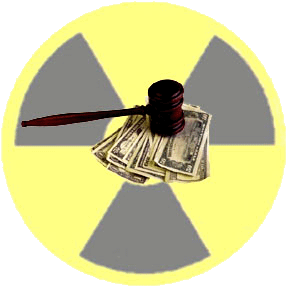
A South Carolina judge has approved a second round of refunds for customers of a utility that poured billions of dollars into two nuclear power plants that never produced a watt of power.
By Associated Press, May 4, 2022, COLUMBIA, S.C. (AP) — A South Carolina judge has approved a second round of refunds for customers of a utility that poured billions of dollars into two nuclear power plants that never produced a watt of power.
About $61 million is being set aside for Dominion Energy South Carolina after the utility sold a number of properties as part of the settlement of a class-action lawsuit by 1.1 million of its customers over the never completed plants at the V.C. Summer Nuclear Station near Columbia
Wednesday’s agreement will split the $61 million based on power use by residential, business and industrial customers during a decade of planning and construction for the nuclear station, media outlets reported.
The checks will be similar in amount to a first round of refunds made in the lawsuit in 2019, which was based on $60 million from Dominion Energy.
The nuclear project was run by South Carolina Electric & Gas. It was bought by Virginia-based Dominion in 2019 after the local utility ran out of money to finish the reactors two years earlier.
Four executives of the utility or the company that was building the reactors have been indicted or have pleaded guilty to criminal charges in the failure.
One remaining question is how will the refunds be issued. The 2019 refunds were all checks, and more than 10% of the money went unclaimed as checks as small as 4 cents weren’t cashed or people who were supposed to get refunds couldn’t be found.
Lawyers suggested power bill credits for amounts under $50 and former South Carolina Chief Justice Jean Toal, who was put in charge of the settlement negotiations, said she would think about it.
Senate Approves Radiation Exposure Compensation Act Extension
https://nativenewsonline.net/health/senate-approves-radiation-exposure-compensation-act-extension, BY KELSEY TURNER MAY 02, 2022, The U.S. Senate on Thursday unanimously approved a two-year extension of an act giving compensation to people who were exposed to radiation from atomic weapons testing and uranium mining. The Radiation Exposure Compensation Act (RECA), which is set to expire in July, provides one-time benefit payments to those who have been diagnosed with cancer or other diseases relating to radiation exposure. The extension now awaits approval by the House.
Since its creation in 1990, RECA has given over $2.4 billion in benefits to more than 38,000 people in Nevada, Utah and other impacted areas. Compensation is available to several groups, including “onsite participants” involved in atmospheric test of an atomic weapon, “downwinders” who were present in certain areas near test sites, and uranium miners, millers and ore transporters who worked with uranium. If passed, the extension would give people more time to apply for compensation.
Navajo Nation President Jonathan Nez applauded the Senate’s approval of the extension, saying it “demonstrates strong bi-partisan support for former uranium miners, downwinders, and many others who have to live with the devastating health effects to this day.”
In March, Nez met with members of both political parties in Washington, D.C., where he voiced the concerns of Navajo people experiencing health impacts due to radioactive contamination and exposure from abandoned uranium mines.
“This is a united effort on behalf of former uranium miners and their families, to secure just compensation and benefits for the health issues and detrimental impacts of uranium mining conducted by the federal government,” Nez said in a Navajo Nation press release. “The RECA bill is an opportunity for Congress to be a part of something historic for the Navajo people, the Navajo Uranium Radiation Victims Committee, and other impacted groups.”
Nez encouraged legislators to work toward a long-term solution that would extend RECA until 2040. A bill sponsored by Idaho Sen. Mike Crapo proposes to expand and extend RECA for another 19 years following the bill’s enactment.
Navajo Nation is pushing for this expansion to include all downwinders, create additional categories of uranium workers and radiation-related illnesses, and increase the minimum compensation received by affected individuals.
South Africa. Fired National Nuclear Regulator board member takes Minister Gwede Mantashe to court
Daily Maverick By Sasha Planting 20 Apr 22,
Peter Becker is seeking declaratory relief that the minister’s decision to discharge him as a board member was unlawful and unconstitutional, and wants an order reviewing and setting aside this decision.
Peter Becker, formerly a member of the board of the National Nuclear Regulator, has served papers on the minister of mineral resources and energy, the National Nuclear Regulator and the chairman of that body to challenge his dismissal in February this year.
Becker is seeking declaratory relief that the minister’s decision to discharge him was unlawful and unconstitutional, and wants an order reviewing and setting aside this decision.
Becker’s initial suspension came in January, just days before the regulator approved the extension of life project for the Koeberg nuclear power station, a decision that should be reviewed, given the delays and safety concerns that have arisen since.
The role of the regulator is not to protect the interests of Koeberg or nuclear power, but to ensure that nuclear activities are conducted safely in South Africa, ultimately in the interests of the public.
Becker was appointed to the board in June 2021 by Minister of Mineral Resources and Energy Gwede Mantashe. He was nominated by civil society organisations, including the Koeberg Alert Alliance, the Southern African Faith Communities’ Environment Institute and the Pelindaba Working Group, to represent communities that may be affected by nuclear activities.
However, on 25 February Mantashe fired Becker, arguing that he was guilty of misconduct and was conflicted. This was because Becker had, in his personal capacity, and before his appointment, expressed critical and challenging views on the use of nuclear energy.
“The minister has fundamentally misunderstood those duties. His decision is vitiated by substantive and procedural irrationality, errors of law and fact and unreasonableness,” Becker responds in the affidavit.
His removal has not come at a good time. Maintenance and replacement work are being carried out at Koeberg, under authorisations granted by the regulator. However, this work is already behind schedule and several safety concerns have been raised.
Moreover, Mantashe has signalled his intention to tender for new nuclear power proposals as soon as possible, possibly before the year is out.
The alleged conflict of interest arose because Becker is concerned about the use of nuclear power in South Africa, is opposed to the building of more reactors at Koeberg and is worried about its lifespan being extended. He has been publicly vocal in this regard. However, as Becker has deposed, these views were well known and were included in his CV before he was appointed to the job. ………………………..
At least one member of the board is actively and vocally pro-nuclear. This is Katse Maphoto, the chief director of nuclear safety and technology in the minister’s department. On several occasions he has indicated his support for nuclear power, saying it should form part of SA’s energy mix.
Thus Becker says, it is inconsistent and irrational to take the position that people who are generally critical of nuclear activity should be disqualified from exercising proper judgment concerning safety issues, while those who are supportive, are not.
The minister has 15 days in which to submit a “record of proceedings” — the documents, evidence, arguments and other information relating to the dismissal — failing which, a court date will be set. https://www.dailymaverick.co.za/article/2022-04-19-fired-national-nuclear-regulator-board-member-takes-minister-gwede-mantashe-to-court/
After Undermining International Criminal Court, US Now Wants It to Charge Russians,
Marjorie Cohn, Truthout, 17 Apr 22
Athough the United States has tried mightily to undermine the International Criminal Court (ICC) since it became operational in 2002, the U.S. government is now pushing for the ICC to prosecute Russian leaders for war crimes in Ukraine. Apparently, Washington thinks the ICC is reliable enough to try Russians but not to bring U.S. or Israeli officials to justice.
On March 15, the Senate unanimously passed S. Res 546, which “encourages member states to petition the ICC or other appropriate international tribunal to take any appropriate steps to investigate war crimes and crimes against humanity committed by the Russian Armed Forces.”
When he introduced the resolution, Sen. Lindsey Graham (R-South Carolina) said, “This is a proper exercise of jurisdiction. This is what the court was created for.” The United States has refused to join the ICC and consistently tries to undercut the court. Yet a unanimous U.S. Senate voted to utilize the ICC in the Ukraine conflict.
Since February 24, when the Russian Federation launched an armed attack against Ukraine, horrific images of destruction have been ubiquitous. The Office of the UN High Commissioner for Human Rights has documented 3,455 civilian casualties, including 1,417 killed and 2,038 injured as of April 3. Most of those casualties have been caused by explosive weapons with a wide impact area, which includes heavy artillery and multiple launch systems as well as air and missile strikes.
On February 28, Karim Khan, chief prosecutor of the International Criminal Court, opened an investigation into the situation in Ukraine. He said that his preliminary examination found a reasonable basis to believe that alleged war crimes and crimes against humanity had been committed in Ukraine. Khan’s formal investigation will “also encompass any new alleged crimes . . . that are committed by any party to the conflict on any part of the territory of Ukraine.”
As I explained in prior Truthout columns, in spite of U.S.-led NATO’s provocation of Russia over the past several years, the Russian invasion of Ukraine constitutes illegal aggression.
Nevertheless, the ICC does not have jurisdiction to prosecute Russian leaders for the crime of aggression.
The ICC’s Rome Statute Prohibits Aggression
In 1946, the International Military Tribunal at Nuremberg called the waging of aggressive war “essentially an evil thing,” adding that, “to initiate a war of aggression . . . is not only an international crime; it is the supreme international crime differing only from other war crimes in that it contains within itself the accumulated evil of the whole.”
U.S. Supreme Court Justice Robert Jackson, chief prosecutor at the Nuremberg Tribunal, called aggressive war “the greatest menace of our times.” Jackson said, “If certain acts in violation of treaties are crimes, they are crimes whether the United States does them or whether Germany does them, and we are not prepared to lay down a rule of criminal conduct against others which we would not be willing to have invoked against us.”
Aggression is prohibited by the ICC’s Rome Statute. Article 8bis defines the crime of aggression as “the planning, preparation, initiation or execution, by a person in a position effectively to exercise control over or to direct the political or military action of a State, of an act of aggression which, by its character, gravity and scale, constitutes a manifest violation of the Charter of the United Nations.”
Adopting the central prohibition of the UN Charter against the use of aggressive force, Article 8bis defines an act of aggression as “the use of armed force by a State against the sovereignty, territorial integrity or political independence of another State, or in any other manner inconsistent with the Charter of the United Nations.” The charter only allows the use of military force in self-defense or with the consent of the Security Council, neither of which happened before Russia invaded Ukraine.
In order to secure a conviction for aggression, the prosecutor of the ICC must prove that a leader who exercised control over the military or political apparatus of a country ordered an armed attack against another country. An armed attack can include bombing or attacking the armed forces of other country. The attack must be a “manifest” violation of the UN Charter in its character, scale and gravity, which includes only the most serious forms of the illegal use of force. For example, a single gunshot would not qualify but George W. Bush’s illegal invasion of Iraq would………………………………………….
When he introduced the resolution, Sen. Lindsey Graham (R-South Carolina) said, “This is a proper exercise of jurisdiction. This is what the court was created for.” The United States has refused to join the ICC and consistently tries to undercut the court. Yet a unanimous U.S. Senate voted to utilize the ICC in the Ukraine conflict.
Since February 24, when the Russian Federation launched an armed attack against Ukraine, horrific images of destruction have been ubiquitous. The Office of the UN High Commissioner for Human Rights has documented 3,455 civilian casualties, including 1,417 killed and 2,038 injured as of April 3. Most of those casualties have been caused by explosive weapons with a wide impact area, which includes heavy artillery and multiple launch systems as well as air and missile strikes.
On February 28, Karim Khan, chief prosecutor of the International Criminal Court, opened an investigation into the situation in Ukraine. He said that his preliminary examination found a reasonable basis to believe that alleged war crimes and crimes against humanity had been committed in Ukraine. Khan’s formal investigation will “also encompass any new alleged crimes . . . that are committed by any party to the conflict on any part of the territory of Ukraine.”
As I explained in prior Truthout columns, in spite of U.S.-led NATO’s provocation of Russia over the past several years, the Russian invasion of Ukraine constitutes illegal aggression.
Nevertheless, the ICC does not have jurisdiction to prosecute Russian leaders for the crime of aggression……………….
“So, the U.S. wants to help the International Criminal Court prosecute Russian war crimes while barring any possibility the ICC could probe U.S. (or Israeli) war crimes,” observed Reed Brody, a commissioner for the International Commission of Jurists, an international human rights nongovernmental organization.
U.S. hypocrisy is no more apparent than in the first “Whereas” clause of the Senate’s unanimous resolution condemning Russia. It says, “Whereas the United States of America is a beacon for the values of freedom, democracy, and human rights across the globe . . .”
One hundred members of the U.S. Senate affirmed that sentiment in spite of the U.S. wars of aggression in Kosovo, Iraq and Afghanistan, and the commission of U.S war crimes. If the senators truly believe that the ICC is dependable enough to prosecute Russian leaders, they should push Biden to send the Rome Statute to them for advice and consent to ratification. What’s good for the Russian goose should also be good for the U.S. gander. https://truthout.org/articles/after-undermining-international-criminal-court-us-wants-it-to-charge-russians/?eType=EmailBlastContent&eId=1f951de0-ce82-4df9-b85e-0a76f6faf974
Ukrainian blogger gets 15 years gaol for saying that Zelensky govt takes orders from other governments
https://www.lindipendente.online/2022/04/05/ucraina-blogger-arrestato-perche-critica-zelensky-rischia-15-anni-di-carcere/?fbclid=IwAR0XFoa_HVePLpr3DYMhXT2PH-d0juJG-3gBHSrVqovgqqc_rCyYB0kA_70 Mike Mapes 15 Apr 22,
Ukrainian blogger Gleb Lyashenko has been sentenced for “betrayal” to 15 years in prison after writing on a post:
“Zelensky was wrong. It has been years that the Russia has been asking us for a reasonable agreement, that is to stay out of the Nato. But there was no change of course. This is why our government takes orders from others, who use us Ukrainians for their purposes. The result was this absurd war. “
Since yesterday Ukraine also has its Assange and Snowden.
“All wars start with lies. But all wars can be stopped by the truth!”
Scientist fired after raising questions about safety at nuclear waste plant
 |
4 Investigates: Scientist fired after raising questions about safety at nuclear waste plant https://www.kob.com/albuquerque-news/4-investigates-scientist-fired-after-raising-questions-about-safety-at-nuclear-waste-plant/6445723/
Brittany Costello, April 14, 2022 CARLSBAD, N.M— There are some things we just leave up to the experts – that includes the science and research that goes into the Waste Isolation Pilot Plant in Carlsbad, New Mexico, the only-of-its-kind facility that stores transuranic radioactive waste from around the country.
What if we told you there are questions about the science of its long-term safety? KOB 4 spoke with a former scientist who said he lost his job after raising the red flag.
There’s an expectation, a reputation that follows the name Sandia National Labs. Its advanced scientific work is something many of us take for granted. Not Dr. Charles Oakes, who is a geochemist who used to work for Sandia National Labs in Carlsbad at the Waste Isolation Pilot Plant, also known as WIPP.
Part of his job was to make sure WIPP, and all of the transuranic radioactive waste stored inside, is safe for years to come.
This is a case where they weren’t, not only were they not doing their job, they were claiming they were doing their job but falsifying all the evidence that went into the claims that they were doing the job,” Dr. Charles Oakes said.
From the outside, there’s not much to see at WIPP. That’s because all the waste is stored more than 2,000 feet below ground.
“WIPP is the only facility of its kind in the world, deep geologic repository for nuclear waste,” said Don Hancock, Director of the Nuclear Waste Program a Southwest Research and Information Center.
Hancock has served as a WIPP watchdog even before the first disposal at the Department of Energy site in 1999.
“Essentially what’s in WIPP are elements that are contaminated from the manufacturing of components in nuclear weapons, particularly the plutonium core, the heart of it,” said Hancock. “That includes machinery that includes gloves, and booties, that includes sludges.”
It might sound complex, but the key to safe storage of radioactive material is simple: accurate, reliable science and research. Regulators at the Environmental Protection Agency demand it.
Sandia National Labs is contracted to do it, at a cost of $18-million a year.
It’s so important that, in order for WIIPP to continue accepting waste, every five years, it has to recertify that its projections show the facility will be safe after it’s filled up and closed down.
Safe from that point and 10,000 years beyond it.
“The most common feared way that the radiation will get to the surface is through the flow of water,” said Dr. Oakes. “There are some aquifers in the rock of the repository. One of the fears is that a well will be drilled through the repository or near to this repository and water may flow through the repository and intersect with a well bore.”
Dr. Oakes said his job was to look at how much of that radioactive material would make it to the surface.
“If you do have radioactive material dissolved in the water, will it react with rocks, minerals along the way, and be removed from the water, in which you removed the threat, or will it carry on its merry way dissolved and get to the surface where it can potentially hurt people and the environment,” he said.
During his time at Sandia National Labs, Dr. Oakes said he discovered inaccuracies that called into question WIPP’s long-term safety, what he believed to data errors.
Oakes said he brought it up to his bosses, the Department of Energy and even the EPA.
After he spoke up, Oakes said Sandia labeled him a problem employee and showed him the door.
Oakes is being represented by attorney Timothy White – and Nick Davis of Davis Law. Their goal is to address much more than what they believe to be retaliatory discharge.
“We’re trying to achieve a certain safety standard here and the information that is being used to allegedly show that we’ve achieved that standard, that we should be recertified to manage the WIPP project, is built on bad science leading to fraud,” said White.
KOB 4 wanted to hear from Sandia National Labs. A spokesperson told us they cannot comment on these accusations because of the pending lawsuit.
There are a number of defendants named in the suit: Honeywell International, National Technology and engineering Solutions of Sandia, LLC, Carol Adkins, and Paul Shoemaker.
Attorneys representing the defendants have responded in court. Documents allege Oakes was fired after multiple “inappropriate interactions with colleagues” but they did not go into detail.
Attorneys are also asking a federal judge to dismiss the case.
As far as all of that expansive data is concerned, officials at the Department of Energy, with the WIPP project, said there are quality assurance procedures in place including several independent reviews.
They said a recertification decision is expected later in April or early May.
South African Anti-nuclear activist taking Energy Minister to court for firing him
Anti-nuclear activist taking Gwede Mantashe to court for firing him
Fin 24, Lameez Omarjee, 13 Apr 22
- Anti-nuclear activist Peter Becker has launched a legal challenge against Energy Minister Gwede Mantashe.
- The minister had axed Becker from the board of the National Nuclear Regulator over an alleged conflict of interest.
Becker is the spokesperson of Koeberg Alert Alliance, a civil society group concerned with the safety of nuclear activity……………….. https://www.news24.com/fin24/economy/anti-nuclear-activist-taking-gwede-mantashe-to-court-for-firing-him-20220413
Ensuring radiation protection: European Commission takes Portugal to Court to guarantee citizens’ protection from ionising radiation-exposure
Ensuring radiation protection: Commission takes Portugal to Court to guarantee citizens’ protection from ionising radiation-exposure risks https://ec.europa.eu/commission/presscorner/detail/en/IP_22_2215
The Commission is taking legal steps to ensure the protection of citizens, workers and patients against the dangers arising from exposure to ionising radiation. Today, the Commission decided to refer Portugal to the Court of Justice of the European Union for failing to fully transpose the EU’s revised Basic Safety Standards Directive (Council Directive 2013/59/Euratom) into national legislation.
Member States were required to transpose the Directive by 6 February 2018. The Commission has been providing continuous support to the Member States to properly transpose the rules. In November 2019, the Commission sent a reasoned opinion to Portugal requesting it to notify to the Commission all of its transposition measures for the Directive. Since then, Portugal has notified additional transposition measures, but has not yet established a national action plan addressing long-term risks from exposures to radon, as required by the Directive. Therefore, the Commission is referring Portugal to the Court of Justice today.
Background
The Euratom Treaty provides the Commission with the legal basis to establish basic safety standards to protect the health of workers and the general public against dangers arising from ionising radiation. Once fully implemented, the Basic Safety Standards Directive will ensure the highest level of radiation protection of workers, patients and the general public across the EU.
The Directive, which was first adopted in 1959, sets out the requirements on emergency preparedness and response in case of radiological emergency, and provides for radiation protection education, training and provision of information to the public, among others. Emergency preparedness and response provisions were strengthened following the Fukushima nuclear accident in Japan in 2011. The latest revision from December 2013 took account of the scientific and technological progress since the 1990s, and consolidated five earlier legal acts into a single piece of legislation.
Campaigners lose legal challenge to stop Hinkley Point C mud being dumped in the Bristol Channel
Campaigners have lost a legal challenge to stop mud from alongside Hinkley
Point C being dumped in the Severn Estuary. The nuclear plant’s
developers, EDF, were using a licensed disposal site near Cardiff but this
led to extensive protests. The campaigners argued a marine licence for the
work was unlawfully amended, without proper scrutiny. But a High Court
judge has this week dismissed their case on all grounds.
EDF dubbed the decision “good news” for thousands of workers at the site. It was
granted permission for the latest mud dumping by England’s Marine
Management Organisation (MMO) in August. The switch from Cardiff to
Portishead, on the English side of the estuary, was challenged by activists
who argued the company should not have been able to vary an existing
licence it had for work at sea.
At a two-day hearing this month, judge Mr
Justice Holgate said he considered the claimant’s approach “to involve
an impermissible gloss” on the relevant legislation and that “there was
nothing unlawful in the MMO’s decision”. An EDF spokesman told
Burnham-On-Sea.com: “The decision is good news for people who care about
the environment and climate change.” “It will enable thousands of
workers to get ahead building a project that will protect the environment
from climate change and provide Britain with reliable low carbon
electricity for decades to come.”
The previous dumping proved
controversial because of fears the mud could be contaminated with nuclear
waste from the Hinkley A and B reactors, which used to be on the site. But
those claims were dismissed by the company, Welsh and English environmental
authorities and the Welsh government as tests showed the sediment was
similar to that found elsewhere in the Bristol Channel.
Burnham-on-sea.com 26th March 2022
No chance of a fair trial for Julian Assange in America

Daniel Ellsberg: “It is outrageous that Biden has continued to pursue Julian Assange’s prosecution”, il Fatto Quotidiano, 23v Mar 22,
”…………………………………………….. Julian Assange was charged with Espionage Act violations. Did you expect that the United States, for the first time in its history, would charge a journalist for publishing truthful information in the public interest?
DANIEL ELLSBERG. The lawyers who were following this at the American Civil Liberties Union (ACLU), were predicting that Donald Trump would prosecute journalists. No president had done that yet, it’s a blatant violation of the First Amendment. It’s obviously unconstitutional, which of course doesn’t slow down Trump, and it is outrageous that Biden has continued to pursue that prosecution. He should have withdrawn the appeal Trump made for extradition of Julian, for prosecution. Biden could just drop it any time, he could do it the next hour. It was very arguably unconstitutional even in my case: I was the first to be indicted under those charges, for leaking, but I had been a former official. I was a source, not a journalist – they don’t regard sources as journalists. You could argue either side in my case, as to whether it was constitutional. In Julian’s [case] there is no argument on the other side: it’s obviously unconstitutional, in America, under our First Amendment. Obama had considered indicting Julian, but had backed off for that very reason, that if they went after Julian on those grounds, they would have no excuse for not going after the New York Times. And they didn’t want to take that on, in part because the New York Times is extremely useful to them, to successive administrations. It basically supports the empire, and doesn’t object to endless amounts of money for so-called defense. It’s a very useful outlet for them, even though it occasionally prints things they would rather not have out.
Why do you think the Biden administration doesn’t drop the case?
ELLSBERG. Biden, when he was vice president, at the very beginning, in 2010, called Julian Assange a high-tech terrorist, which is absurd. He is very much against leaks, and actually all presidents get very angry at leaks that they don’t want out, but they recoil from the prospect of clearly unconstitutional action. Trump didn’t, and Biden should have, but he hasn’t so far. It’s still not too late for him to correct that, but I don’t expect that he will. He shows so much animus toward Julian, that I don’t expect it. I don’t know why entirely, by the way. In general, in foreign policy, he has not shown anything progressive or favorable. In domestic policy, in many ways he has acted better than almost anyone expected, but on foreign policy, there is nothing to be said for him: it’s the same as Obama’s, which was not good, and pretty much the same as Trump’s.
According to Yahoo! News, the CIA tried to poison Julian Assange or kidnap him. If the United States can extradite him, do you expect a fair trial?
ELLSBERG. A fair trial? Oh, there’s no chance for him to have a fair trial, any more than any of the other people charged and convicted under the Espionage Act, or even me. I am the only one who, in a way, ‘got away with it’, in the sense of not being put in prison for life or for a long time by the administration, and that was because of a very unusual set of events, but they’re the same as we’ve learned about Julian. Just as they were considering kidnapping him from the Ecuadorian embassy, possibly killing him, possibly poisoning, but also even considering shoot-outs of various kinds that would get him, I [too] had thirteen men, twelve or thirteen, brought from Miami, CIA assets, one of them at least a CIA agent right at that time, but they had all worked for the CIA in the Bay of Pigs. They were brought up with orders to ‘incapacitate Daniel Ellsberg, totally’. When I asked the prosecutor: ‘What did that mean? Kill me?’, he said: ‘Well, the words were ‘incapacitate you totally’, but you know, those who work for the CIA never use the word ‘kill’. But they were killers, those people had been involved in efforts to assassinate Castro, and even Trujillo. They didn’t [kill me]. Again, I escaped that fate, because at the last moment they thought they were being set up to be caught, so I was lucky, over and over again. None of the other people indicted have been lucky, they all have been convicted essentially, in many cases by plea bargains, because they have been threatened with much greater sentences. Life [sentences] for treason or espionage, and they have accepted smaller charges, but that still kept them in prison for years, in many cases……………
So you think there is no chance at all of a fair trial for Julian Assange…
ELLSBERG. Because under the Espionage Act, the defendant has no chance to tell the Jury why they did what they did, or what they were hoping to achieve, what the benefits to the public were hoped to be and in some cases were realised, and what harm there really was, which was usually nothing, to the national security. That is aside from the fact, as you mentioned, that in his case, as in mine, there were crimes against him: conspiracies to harm him, totally, criminally, as was true in my case. But in my case, when it came out, the case was dropped…………..
in the case of Julian Assange, the revelations that the CIA tried, had plans to kill him didn’t make the judge drop the case…
ELLSBERG. She didn’t really consider them, seriously, which seems shocking. I mean, British law is different from American, in the sense: they don’t have a First Amendment………………… in Britain – their Act is much tougher against free speech and against the press there. So maybe the judge couldn’t take that seriously, being British. But the idea of illegally overhearing a defendant’s discussions with his attorneys, and with his doctors, and everything he said with every visitor – I visited him twice in the Ecuadorian embassy, and I am sure it was recorded – that, obviously, even in Britain [he smiles], or anywhere else, should lead to the dropping of the case, except in a clear-cut police society, let’s say, like East Germany used to be, for example.
……………….. If Julian Assange is extradited and prosecuted in America, I would say, with the mood now, since 9/11, with these last twenty years, he might well be convicted, although he shouldn’t be. The First Amendment would then be eliminated. What that means is: not only sources, but journalists would then have to fear being prosecuted and convicted for doing their job in questioning the government, putting out information the top government doesn’t want. This is a government that we know conducts aggressive wars, criminal aggressive wars, as in Iraq, absolutely, clear-cut aggression, and has very, very little concern for the people of those areas, as they are showing in Afghanistan, right now…………..
In short: it’s a government that needs to be exposed, and it won’t be very much if…if Julian’s case is a real turning point here, then we will essentially have a press like that of Stalin’s Russia.
Extradition looms for Julian Assange, after Supreme Court refuses to hear his appeal.
| |||
Extradition Looms for Assange After UK Supreme Court Refuses to Hear His Appeal, Marjorie Cohn, Truthout, March 16, 2022
The British judicial system has erected still another barrier to Julian Assange’s freedom. On March 14, the U.K. Supreme Court refused to hear Assange’s appeal of the U.K. High Court’s ruling ordering his extradition to the United States. If extradited to the U.S. for trial, Assange will face 17 charges under the Espionage Act and up to 175 years in prison for revealing evidence of U.S. war crimes.
With no explanation of its reasoning, the Supreme Court denied Assange “permission to appeal” the High Court’s decision, saying that Assange’s appeal did not “raise an arguable point of law.” The court remanded the case back to the Westminster Magistrates’ Court, which is the same court that denied the U.S. extradition request on January 4, 2021.
In all likelihood, the magistrates’ court will refer the case to the British Home Office where Home Secretary Priti Patel will review it. Assange’s lawyers then have four weeks to submit materials for Patel’s consideration. If she orders Assange’s extradition — which is highly likely — his lawyers will file a cross-appeal in the High Court asking it to review the issues Assange lost in the magistrates’ court.
If the High Court refuses to review those additional issues, Assange can appeal to the European Court of Human Rights. That could take years. Meanwhile, he languishes in London’s high-security Belmarsh Prison, in fragile mental and physical health. He suffered a mini-stroke as his extradition hearing began. United Nations Special Rapporteur on Torture Nils Melzer wrote in a Twitter post that the “U.K. is literally torturing him to death.”
The Legal Background……………….
Issues Assange Seeks to Raise on Cross-Appeal
In the cross-appeal, Assange’s lawyers will raise the following points:
*The extradition treaty between the U.S. and the U.K. forbids extradition for a political offense and since espionage is a political offense, the court lacked jurisdiction to hear the case;
*Extradition would be oppressive or unjust due to the passage of time;
*The charges against Assange do not satisfy the “dual criminality test” which requires that they constitute criminal offenses in both the U.S. and the U.K.;
*Extradition is barred because the request is based on Assange’s political opinions;
*Extradition is barred because it would violate Assange’s rights to a fair trial and freedom of expression, as well as the prohibition on inhuman and degrading treatment, under the European Convention on Human Rights; and
*The request for extradition is an abuse of process because it is being pursued for a political motive and not in good faith.
Human Rights Organizations Decry Supreme Court’s Refusal to Hear Appeal…………………..
Assange’s Fiancée Says U.S. Wants to Imprison Him for Exposing Its War Crimes
Stella Moris, Assange’s fiancée, says Assange is being persecuted for carrying out a core journalistic mission: telling the truth.
“Whether Julian is extradited or not, which is the same as saying whether he lives or dies, is being decided through a process of legal avoidance,” Moris said. “Avoiding to hear arguments that challenge the UK courts’ deference to unenforceable and caveated claims regarding his treatment made by the United States, the country that plotted to murder him. The country whose atrocities he brought into the public domain. Julian is the key witness, the [principal] indicter, and the cause of enormous embarrassment to successive US governments.”
Moris added, “Julian was just doing his job, which was to publish the truth about wrongdoing. His loyalty is the same as that which all journalists should have: to the public. Not to the spy agencies of a foreign power.”
According to Moris, the United States wants to imprison Assange for 175 years because he “published evidence that the country that is trying to extradite him committed war crimes and covered them up; that it committed gross violations that killed tens of thousands of innocent men, women and children; that it tortured and rendered; that it bombed children, had death squads, and murdered Reuters journalists in cold blood; that it bribed foreign officials and bullied less powerful countries into harming their own citizens, and that it also corrupted allied nations’ judicial inquiries into US wrongdoing.”
Assange and Moris, who have two small children together, have finally received permission to marry. They will be wed later this month in Belmarsh Prison. https://truthout.org/articles/extradition-looms-for-assange-after-uk-supreme-court-refuses-to-hear-his-appeal/?eType=EmailBlastContent&eId=6141299d-bdd4-4062-8b24-47c47f1bdba5
Court rejects bid to suspend nuclear reactors in Takahama
Court rejects bid to suspend nuclear reactors in Takahama https://www.asahi.com/ajw/articles/14569930
By HARUKA ONO/ Staff Writer, March 11, 2022 NAGOYA–The Nagoya District Court on March 10 dismissed a citizens’ request that the government order Kansai Electric Power Co. to halt two reactors at its Takahama nuclear power plant as a safety precaution.
Nine plaintiffs from Fukui, Aichi and three other prefectures filed a lawsuit against the government seeking to suspend the No. 3 and No. 4 reactors at the facility in Takahama, Fukui Prefecture.
They argued that the nuclear power plant’s disaster-prevention countermeasures for dealing with ash from volcanic eruptions are insufficient.
“(The government) did not deviate from its discretion for not having ordered the suspension,” said Presiding Judge Tomohiro Hioki.
After the 2011 triple meltdown at Tokyo Electric Power Co.’s Fukushima No. 1 nuclear power plant, the government’s regulatory authority introduced a new “backfit” provision.
That requires utilities to prepare countermeasures for issues that have emerged after new findings, such as the effects natural disasters can have on their existing nuclear power plants. It also allows the regulator to halt reactors if they do not meet its standards.
This marks the first judicial ruling over the backfit provision.
In June 2019, Japan’s Nuclear Regulation Authority issued backfit orders for seven reactors at three Kansai Electric nuclear power plants, including the No. 3 and No. 4 reactors in Takahama.
The regulator contended that Kansai Electric had not taken sufficient measures against volcanic ash in the event of an eruption at Mount Daisen in Tottori Prefecture.
But it did not order Kansai Electric to halt its reactors on the grounds that there is no imminent risk of eruption.
“Mount Daisen is not categorized as an active volcano, so the NRA’s decision not to order the suspension was not a deviation from or abuse of discretion,” the district court ruling said.
The regulator had decided on its response after it was briefed by Kansai Electric, and did not establish a deadline for completing the countermeasures. On both points, the court ruled that the regulator’s actions were legal.
But on the other hand, the court also accepted some of the arguments made by the plaintiffs.
The presiding judge said that in the current situation, with the anti-volcanic measures not yet completed, the plant “holds realistic possibilities of safety deficiencies” and also “has some risk of receiving significant damage.”
Lies leave the Assange case exposed – this is a political persecution
Lies leave the Assange case exposed – this is a political persecution, https://www.counterfire.org/articles/opinion/22480-lies-leave-the-assange-case-exposed-this-is-a-political-persecution
John Rees on how a false testimony has further confirmed that the Assange case is a political attack against critical journalists
Watching the US government’s case against Julian Assange is like watching a levitation act at the music hall. You can see that the object floats, but you’ve no idea how. If normal gravitational laws applied, the Assange case would have crashed to the ground already.
After all, a leading prosecution witness has admitted lying in his evidence to the court and the defendant and his lawyers have been spied on by the intelligence agency of the government attempting to extradite him. In any other case, the mere facts of these revelations would be enough to halt court proceedings, but the detail makes the case for abandonment of the extradition even more compelling.
The most recent bombshell is that Sigurdur ‘Siggi’ Thordarson has admitted to Icelandic journalists at Stundin that he lied when he gave evidence alleging that Julian Assange had instructed him to hack US government accounts. Thordarson’s evidence is not marginal to the US case: it’s woven all through the prosecution’s argument, and it is specifically referred to by the judge in the Westminster Magistrates’ Court in those parts of her judgement which are hostile to Assange.
Indeed, when the Trump administration realised that their case was weak, they specifically sought out Thordarson in Iceland and reissued their charges against Assange so that it would be, they imagined, strengthened by his evidence. They should have known better.
To say that Thordarson is an unreliable witness is a very considerable understatement. His allegations had been reviewed by the Obama administration and found too problematic to be taken seriously. Trump’s administration re-animated Thordarson in an attempt to breathe life into their flagging case.
Thordason had been a volunteer for WikiLeaks, working to raise funds. He stole some $50,000 from WikiLeaks and he misrepresented himself to the outside world in order to embezzle money. He was also convicted of sexual abuse of children. On both counts, Julian Assange helped put him in jail. His motive for lying once again for the Trump administration is plain: revenge. And his false evidence is meant to bolster a central contention of the US case: that Julian Assange is a hacker, not a journalist.
Quite what has now convinced this serial liar to admit that he invented the material on which the US case so heavily relies we cannot know. But his decision to do so blows a hole through the centre of the case for extradition.
Thordarson admitted to the Stundin investigative team that Assange never asked him to hack anything. In fact, he now says that his previous claim that Assange had instructed or asked him to access computers is false.
Yet this is precisely the evidence on which the US prosecution relies. Indeed, it was so important to them that they tore up their original indictment of Assange on the very eve of the extradition hearing so that they could reissue a second indictment specifically including Thordarson’s evidence – evidence now admitted to be a total fiction.
At this point most cases which had been exposed as relying on perjured testimony would collapse. Not so the Assange case, which is now heading to the Appeal Court where the US will try to overturn the decision of the Magistrates’ Court at the start of this year, which found that the US prison system is so ‘oppressive’ that Assange would be a suicide risk were he committed to it.
It’s not even as if the Thordarson revelations are the first time that evidence has emerged which would normally halt court proceedings in their tracks. It is already a matter of record that Assange and his legal team were spied on by a Spanish security firm reporting to the CIA. The firm, UC Global, were employed by the Ecuadorean embassy to protect Assange when he was granted asylum. They were suborned by the CIA and then supplied them with both audio and video recordings of Assange and his legal team in the embassy. All this has been revealed in an ongoing court case in Spain.
Again, in any normal trial, the revelation that attorney-client privilege had been abused in this way would have been grounds for dismissal. But not in the Assange case. The court seems content to accept the US government’s argument that the CIA would respect departmental boundaries and never tell the Department of Justice any information obtained from the spying operation on Assange. This excuse beggars belief, since the exact function of the CIA is to tell the US government about the threats to national security, as they see it.
And there is the whole core of the problem: the US government under Trump allowed the fiction to develop that the fundamental business of investigative journalism is a threat to national security. Accordingly, Julian Assange became reclassified as a ‘cyber-terrorist’, not a journalist.
In pursuit of this dangerous fantasy, the US government is keeping a multiple award-winning journalist banged-up in a high security jail specifically used for terrorists, in spite of the Magistrates’ Court decision against them.
It’s time that both the US government and the British government brought this embarrassing farce to an end. Every major human rights organisation on the planet has said it is wrong. Journalists’ unions across the globe say its wrong. Parliamentarians in Italy are protesting in their legislature to says its wrong. German MPs are demanding Angela Merkel tells Joe Biden its wrong. Australian MPs are campaigning for Assange’s release in unprecedented numbers. British MPs have been protesting outside Belmarsh because they are not even being allowed a briefing with Assange.
As the Assange case goes to the High Court, we are reaching a critical moment. This is the crucial freedom of the press case of the twenty-first century. If it is lost, the shadow of authoritarian government will be cast longer and darker over the body politic. We should not allow that to happen.
Japan’s Supreme Court rules on damages for people whose lives were disrupted by Fukushima nuclear catastrophe
Japan’s Supreme Court on Friday has ruled that victims of the Fukushima
disaster should be paid compensation for the tragedy. In a first decision
of its kind, the court said that Tokyo Electric Power (Tepco) should should
pay 1.4 billion yen ($12m or about £9.1m) in damages to about 3,700
residents whose lives were upended by the nuclear disaster in 2011. The
damages cover three of more than 30 class-action lawsuits filed against the
company. The compensation will average to about 380,000 yen ($3,290) per
plaintiff, public broadcaster NHK reported.
Independent 4th March 2022
1 This Month



Shut down the radiation-damaged Heysham nuclear reactors now
To see nuclear-related stories in greater depth and intensity – go to https://nuclearinformation.wordpress.com

Say No to NASA’s Reckless Nuclear Reactor on the Moon
Say No to NASA’s Reckless Nuclear Reactor on the Moon
-
Archives
- October 2026 (256)
- September 2026 (339)
- August 2026 (330)
- July 2026 (355)
- June 2026 (287)
- May 2026 (306)
- April 2026 (356)
- March 2026 (251)
- February 2026 (267)
- January 2026 (308)
- December 2025 (358)
- November 2025 (359)
-
Categories
- 1
- 1 NUCLEAR ISSUES
- business and costs
- climate change
- culture and arts
- ENERGY
- environment
- health
- history
- indigenous issues
- Legal
- marketing of nuclear
- media
- opposition to nuclear
- PERSONAL STORIES
- politics
- politics international
- Religion and ethics
- safety
- secrets,lies and civil liberties
- spinbuster
- technology
- Uranium
- wastes
- weapons and war
- Women
- 2 WORLD
- ACTION
- AFRICA
- Atrocities
- AUSTRALIA
- Christina's notes
- Christina's themes
- culture and arts
- Events
- Fuk 2022
- Fuk 2023
- Fukushima 2017
- Fukushima 2018
- fukushima 2019
- Fukushima 2020
- Fukushima 2021
- general
- global warming
- Humour (God we need it)
- Nuclear
- RARE EARTHS
- Reference
- resources – print
- Resources -audiovicual
- Weekly Newsletter
- World
- World Nuclear
- YouTube
-
RSS
Entries RSS
Comments RSS

