Chris Hedges: Craig Murray on the ‘Slow Motion Execution’ of Assange
And I saw, 100% for certain, that the judge came into court with her ruling already typed out before she heard the arguments, and she sat there almost pretending to listen to what the defense was saying for now and what the prosecution was saying for now. Then she simply read out the ruling.
Chris Hedges: She’s like the Queen of Hearts in Alice in Wonderland giving the verdict before she hears the sentence.
SCHEERPOST, September 17, 2023
Julian Assange continues to fight extradition to the United States to face prosecution under the Espionage Act, a growing chorus of voices is rising to demand an end to his persecution. Hounded by US law enforcement and its allies for more than a decade, Assange has been stripped of all personal and civil liberties for the crime of exposing the extent of US atrocities during the War on Terror. In the intervening years, it’s become nakedly apparent that the intent of the US government is not only to silence Assange in particular, but to send a message to whistleblowers and journalists everywhere on the consequences of speaking truth to power. Former British ambassador to Uzbekistan, Craig Murray, who was fired for exposing the CIA’s use of torture in the country, joins The Chris Hedges Report to discuss what Julian Assange’s fight means for all of us.
TRANSCRIPT
Chris Hedges: Craig Murray, the former British ambassador to Uzbekistan, was removed from his post after he made public the widespread use of torture by the Uzbek government and the CIA. He has since become one of Britain’s most important human rights campaigners and a fierce advocate for Julian Assange as well as a supporter of Scottish independence. His coverage of the trial of former Scottish first minister Alex Salman, who was acquitted of sexual assault charges, saw him charged with contempt of court and sentenced to eight months in prison. The very dubious sentence, half of which Craig served, upended most legal norms. He was sentenced, supporters argued, to prevent him from testifying as a witness in the Spanish criminal case against UC global director, David Morales, being prosecuted for installing a surveillance system in the Ecuador embassy when Julian Assange found refuge that was used to record the privileged communications between Julian and his lawyers.
Morales is alleged to have carried out this surveillance on behalf of the CIA. Murray has published some of the most prescient and eloquent reports from Julian’s extradition hearings and was one of a half dozen guests, including myself, invited to Julian and Stella’s wedding in Belmarsh Prison in March 2022. Prison authorities denied entry to Craig, based on what the UK Ministry of Justice said were security concerns, as well as myself from attending the ceremony.
Joining me to discuss what is happening to Julian Assange and the rapid erosion of our most basic democratic rights is Craig Murray.
And to begin, Craig, I read all of your reports from the trial which are at once eloquent and brilliant. It’s the best coverage that we’ve had of the hearings. But I want you to bring us up to date with where we are with the case at this moment.
Craig Murray: Yeah. The legal procedures have been extraordinarily convoluted after the first hearings for the magistrate ruled that Julian couldn’t be extradited, on essentially, health grounds. Due to the conditions in American prisons, the US then appealed against that verdict. The high court accepted the US appeal on extraordinarily dubious grounds based on a diplomatic note giving certain assurances which were conditional and based on Julian’s future behavior. And of course, the US government has a record of breaking such assurances, and also, those assurances could have been given at the time of the initial hearing and weren’t.
Chris Hedges: I don’t think those assurances have any… It was a diplomatic note. It has no legal validity.
Craig Murray: It has no legal validity. It’s not binding in any sense. And as I say, it is in itself conditional. It states that they may change this in the future. It actually says that –
Chris Hedges: Well, based on his behavior.
Craig Murray: – Based on his behavior, which they will be the sole judges of.
Chris Hedges: Of course.
Craig Murray: And which won’t involve any further legal process. They will decide he’s going into a supermax because they don’t like the way he looks at guards or something. It’s utterly meaningless. And so the US, having won that appeal so Julian could be extradited, it was then Julian’s turn to appeal on all the points he had lost at the original extradition. Those include the First Amendment, they include freedom of speech, obviously, and they include the fact that the very extradition treaty under which he’s being extradited states that there shall be no political extradition and this is plainly a very political case and several other important grounds. That appeal was lodged. Nothing then happened for a year. And that appeal is an extraordinary document. You can actually find it on my website, CraigMurray.org.uk.
I’ve published the entire appeal document and it is an amazing document. It’s an incredible piece of legal argument. And some of the things it sets out like the fact that the US key witness for the charges was an Icelandic guy who they paid for his evidence. They paid him for his evidence and he is a convicted pedophile and convicted fraudster. And since he has said he lied in his evidence and he just did it for the money. That’s one example of the things you find. The documentation is not dry legal documentation at all. It’s well worth going and looking through Julian’s appeal. That appeal ran to 150 pages plus supporting documents.
For a year, nothing happened. Then two or three months ago it was dismissed in three pages of double-spaced A4, in which the judge, Judge Swift, said that there were no legal arguments, no coherent legal arguments in this 150 pages and it followed no known form of pleading and it was dismissed completely. And the thing is that the appeal was written by some of the greatest lawyers in the world. It’s supervised and written by Gareth Pierce, who I would say is the greatest living human rights lawyer. Those people have seen the film In the Name of the Father, starring Daniel Day-Lewis…………………………………….
She’s won numerous high-profile cases. She has enormous respect all around the world and this judge, who is nobody, is saying that there’s no validity to her pleadings which follow no known form of pleading. This is quite extraordinary.
Chris Hedges: Am I correct in that he was a barrister, essentially, for the defense ministry? He was served the interests of the UK government and that’s essentially got him his position. Is that correct?
Craig Murray: Exactly. He was the lead barrister for the security services. Well, he was a banister who specialized in working for the security services.
……………………………………………………And I saw, 100% for certain, that the judge came into court with her ruling already typed out before she heard the arguments, and she sat there almost pretending to listen to what the defense was saying for now and what the prosecution was saying for now. Then she simply read out the ruling.
Chris Hedges: She’s like the Queen of Hearts in Alice in Wonderland giving the verdict before she hears the sentence.
……………………………..On the most basic level, the evisceration of attorney-client privilege because UC Global recorded the meetings between Julian and his lawyers, that in a UK court, as in a US court alone, should get the trial invalidated
Craig Murray: In any democracy in the world, if your intelligence services have been recording the client’s attorney consultations, that would get the case thrown out. ………………………….
……………………………………………………………………………………………………………….at times it seemed as though they were deliberately doing things as slowly as possible.
Chris Hedges: Well, this is what Neils Melzer, the special repertoire on torture for the UN, said that he called it, a slow motion execution, were his words.
………………………………..Craig Murray: It was because of my advocacy for and friendship with Julian. That’s why they put me in jail. I was in the cell, my cell was 12 feet by eight feet which is slightly larger than Julian’s cell, and I was kept in solitary confinement for 23 hours a day, sometimes 23.5 hours a day for four months. And that’s extremely difficult. It’s extremely difficult. But I knew when I was leaving, I had an end date. To be in those conditions as Julian has been for years and years and no idea if it will ever stop, no idea if you’ll ever be let out alive, let alone not having an end date, I can’t imagine how psychologically crushing that would be……………………………………………………………………………….
Craig Murray: The immediate thing that will happen is that Julian’s lawyers will try to go to the European Court in Strasbourg –
Chris Hedges: To the European Court of Human Rights.
Craig Murray: – The European Court of Human Rights to submit an appeal and get the extradition stopped, pending an appeal. The worry is that Julian would instantly be extradited and that the government wouldn’t wait to hear from a European Court.
Chris Hedges: Explain to Americans what it is and what jurisdiction it has in the UK, the European Court.
Craig Murray: Yeah, the European Court of Human Rights is not a European Union body. It’s a body of the Council of Europe. It has jurisdiction over the European Convention on Human Rights which guarantees basic human rights and therefore it has legally binding jurisdiction over human rights violations in any member state of the treaty. So it does have a legally binding jurisdiction and is acknowledged as such, normally, by the UK government. They’re very powerful voices within the current conservative government in the UK which wants to exit the convention on human rights. But at present, that’s not the case. The UK is still part of this system. And so the European Court of Human Rights has legally binding authority over the government of the United Kingdom purely on matters that contravene human rights.
Chris Hedges: And if they do extradite him, they’ve essentially nullified that process, the fear is that, of course, the security services would know about the ruling in advance. He’d be on the tarmac and shuttled in, sedated, and put in a diaper and hooded or something and put on a CIA flight to Washington. I want to talk about if that happens. It’s certainly very possible. What we need to do here, and I know part of the reason you’re in the US, is to prepare for that should it take place. You will try and cover the hearings and trial here as you did in the UK but let’s talk about where we go if that event occurs.
Craig Murray: Yeah. The first thing to say is that if that happens, on the day it happens, it will be the biggest news story in the world; It would be a massive news story. So we have to be prepared. We have to know who, from the Assange movement or who from his defense team, who’s going to be the spokesman, who are going to be the spokespeople, who are going to be offered up to all the major news agencies? We have to affect the story on day one. Because if you get behind the story – And we know what their line will be. They’ll put out all these lies about people being killed because of WikiLeaks, about the American insecurity being endangered, we know all the propaganda that they will try to flood the airwaves with – So we need to be ready and ahead of the game to know who our people are, who are going to be offered up to interview, who are going to proactively get onto the media, and not just the alternative media like this media, but onto the so-called mainstream as well, and get out the story…………………………………………………………………………………………………………………………………………………………………
Chris Hedges. ………………….my reading of it is that they don’t care how they look. And part of it is to send a message. It doesn’t matter what nationality you are, it doesn’t matter where you are. WikiLeaks is not a US-based publication, it doesn’t matter where you are. If you expose the information that Julian and WikiLeaks exposed, we’re going to come for you. Isn’t that the message?
Craig Murray: That’s absolutely right. And this, again, it’s amazing they don’t see the dangers in this claim of universal jurisdiction. …………………….
This claim of universal jurisdiction is extraordinary. And what’s even more extraordinary is they’re claiming universal jurisdiction but Julian is under their jurisdiction because he published American Secrets even though he’s not an American and he wasn’t in America. And at the same time, while they claim jurisdiction over him, they’re claiming he has no First Amendment rights because he’s an Australian.
The combination of we have jurisdiction over you, you have all the liabilities that come with that but you have none of the rights that come with that because you’re not one of our citizens, that’s pernicious. It’s so illogical and so vicious. …………………………………………
Chris Hedges: I want to close because there’s been noise out of Australia. The ambassador, Carolyn Kennedy, said that they might consider a plea deal. I have put no credence in it. It’s all smoke but I wondered what you thought.
Craig Murray: Yeah. It’s an attempt to placate Australian public opinion. Public opinion in Australia is extremely strong. Over 80% of Australians want Julian released and allowed to go home to Australia. Blinken came there and made some very hostile and un-diplomatic remarks at a time when Australia was allowing the US to base nuclear weapons on its side. Caroline Kennedy came out… It’s a lie, frankly. There has been no approach from a justice department or from the State Department to doing any plea deal. It’s purely smoke and mirrors to try to distract the Australian public. Caroline Kennedy was lying to the Australian public. That’s pure and simple.…………..
Guam residents inch closer to compensation for US nuclear testing

By Marian Faa, 11 Sept 23, https://www.abc.net.au/pacific/programs/pacificbeat/guam-nuclear-compensation-us-government-testing/102838844
Guam residents are one step closer to being eligible for compensation from the US government if they’ve suffered exposure to nuclear testing.
The US Senate recently endorsed a major expansion to the Radiation Exposure Compensation Act, which would include Guam and New Mexico.
President of the Pacific Association for Radiation Survivors, Robert Celestial, has spent years lobbying for compensation to include Guam.
His campaign started when he was researching de-classified US documents to understand his own exposure to radiation as an army veteran who worked in the Marshall Islands.
Small island nations take high-emitting countries to court to protect the ocean
Countries threatened by rising sea levels are asking a tribunal to decide on responsibility for pollution of the marine environment
In a landmark hearing, small island nations disproportionately affected by
the climate crisis will take on high-emitting countries in a court in
Hamburg, Germany, on 11 September, in what is being seen as the first
climate justice case aimed at protecting the ocean.
During the two-day hearing, the nations – including the Bahamas, Tuvalu, Vanuatu, Antigua and Barbuda among others – will ask the International Tribunal for the Law of
the Sea (Itlos) to determine whether greenhouse gas emissions absorbed by
the marine environment should be considered pollution.
As one of the planet’s greatest carbon sinks, the ocean absorbs 25% of carbon dioxide
emissions, captures 90% of the heat caused by those emissions and produces
half the world’s oxygen.
Most countries have obligations under the legally
binding UN convention on the law of the sea to take measures to prevent,
reduce and control marine pollution. If the case, brought by the Commission
of Small Island States on Climate Change and International Law (Cosis), is
successful, these obligations would include carbon-emission reduction and
protection of marine environments already damaged by CO2 pollution.
Guardian 10th Sept 2023
French nuclear cartel fined €31m
French watchdog issues 31 million euros fine against companies working on
nuclear dismantling. France’s antitrust watchdog on Thursday issued total
fines amounting to 31 million euros ($33.17 million) against six companies
for having engaged in cartel practices linked to the dismantling of a
nuclear site in Marcoule, southern France.
Reuters 7th Sept 2023
Construction Index 11th Sept 2023
https://www.theconstructionindex.co.uk/news/view/french-cartel-fined-31m
Residents file suit to halt wastewater release from Fukushima plant

About 150 residents from prefectures such as Fukushima and Miyagi went to court on Friday to halt the release of treated radioactive water from the crippled Fukushima nuclear plant, making it the first lawsuit of its kind.
In the suit filed with the Fukushima District Court against the central government and plant operator Tokyo Electric Power Company Holdings Inc, the plaintiffs said the water discharge, which started on Aug. 24, threatens citizens’ right to live safely and hinders local fishermen’s businesses.
They are also seeking nullification of nuclear regulators’ approval of facilities installed for the water discharge and a ban to be placed on the release.
An additional lawsuit at the end of October is being planned…………………………………………………………………. https://japantoday.com/category/national/residents-file-suit-to-halt-wastewater-release-from-fukushima-plant
Vinci and Bouygues among six firms fined €31m for bid rigging in nuclear work
KHI By Neil Gerrard08 September 2023
France’s competition watchdog, Autorité de la Concurrence, has fined six companies a total of €31 million for bid rigging relating to tenders for work at a nuclear site in the country.
Nuvia Process (a subsidiary of Vinci Group), ENDEL (formerly and Engie subsidiary), Bouygues Construction Expertises (BCEN), SNEF and SPIE Nucléaire are all subject to the penalties.
The Autorité granted a sixth company, ONET Group, leniency and it has received an exemption from financial penalties.
The fines come after dawn raids at the companies prompted by suspicions of anticompetitive practices when it came to tendering for work at the French Alternative Energies and Atomic Energy Commission’s (CEA) Marcoule nuclear site in the Gard region……………………………………………………………………………………………………
In a statement, the Autorité said, “These practices are among the most serious breaches of competition rules, as they aim to remove the advantages that consumers and the public entity are entitled to expect from a competitive economy, and instead benefit the perpetrators.
“Disrupting the normal course of tendering procedures by hindering the free market pricing process and misleading the public authority as to the reality and extent of competition between tenderers, is detrimental to the sector in which such practices take place, and constitutes a serious breach of economic public policy.”
Nuvia’s penalty amounted to €13.9 million, while Endel received a fine of €11 million and BCEN a fine of €6.2 million.
SNEF and SPIE Nucléaire received lesser fines of €20,000 and €10,000 respectively.
The Autorité said it applied a mark-up to Nuvia, Endel and BCEN as they are all part of conglomerates. It also took into account the “repeated nature” of the offences committed by the Vinci and Bouygues groups. https://www.khl.com/news/vinci-and-bouygues-among-six-firms-fined-31m-for-bid-rigging-in-nuclear-work/8031517.article
Japan’s nuclear-contaminated water discharge should consider hazard accountability and compensation mechanisms

International legal mechanisms, such as the United Nations Convention on the Law of the Sea, grant countries the right to assert their interests, and Japan’s discharge of nuclear-contaminated water has direct and indirect impacts on the global marine environment. Therefore, countries can seek compensation from Japan through international legal mechanisms for environmental restoration and economic compensation.
Chunding Li, Zelei Xing, https://news.cgtn.com/news/2023-09-06/Japan-s-nuclear-wastewater-discharge-should-have-hazard-accountability-1mSm5S2bJsY/index.html
The plan over nuclear-contaminated water discharge from the Fukushima Daiichi nuclear power plant in Japan was launched on August 24, 2023, attracting widespread attention, controversy and condemnation from the international community.
Currently, the Fukushima nuclear power plant generates, per day, approximately 140 tonnes of nuclear-contaminated water, with over 1 million tonnes of accumulated stored radioactive water. According to the plan, the nuclear-contaminated water will undergo treatment before discharge to reduce the concentration of radioactive substances.
However, even after treatment, this nuclear-contaminated water still contains a certain amount of radioactive materials. It is estimated that around 1 million tonnes of nuclear-contaminated water will be released into the sea, being discharged over a period of 30 years, and seeing a daily discharge of approximately 460 tonnes of nuclear-contaminated water.
This poses huge risks to the environment and human health of neighboring countries, not discounting the threat to the development of industries such as agriculture and fisheries. Given the risks involved, countries have the right to demand that Japan assume corresponding compensation responsibilities.
Japan’s nuclear-contaminated water discharge poses potential hazards to human health. The nuclear-contaminated water contains radioactive isotopes, such as cesium, tritium, and strontium, which can enter the food chain of marine ecosystems, affecting the marine ecosystems of surrounding countries directly. When contaminated seafood is consumed, there is a potential risk to human health.
Furthermore, these radioactive substances can spread to distant regions through the influences of climate and oceanic currents, causing long-term impacts on marine ecosystems globally. This can result in the death or migration of marine organisms, biodiversity disruption, and the potential negative impact on the sustainable utilization of fishery resources.
Japan’s nuclear-contaminated water discharge has a negative impact on the development and trade of agriculture and fisheries. Firstly, when contaminated seafood is banned from import or faces consumer scrutiny, it will have a significant impact on the fishing industry of exporting countries. Many countries rely on seafood exports to increase trade revenue and promote economic development. The impacts caused by nuclear-contaminated water will directly threaten the economic interests of these nations, leading to reduced income for fishermen and potentially, even job losses.
Moreover, the discharge of nuclear-contaminated water could also contaminate freshwater resources in neighboring countries, negatively affecting irrigation in farmland and the growth of crops. This poses a threat to the sustainable development of a nation’s agriculture, subsequently impacting the income of farmers and food supplies.
Countries have the right to demand that Japan assumes corresponding compensation responsibilities. Firstly, as the source country of nuclear contamination, Japan should take responsibility for the environmental and human health risks caused by its discharge of nuclear-contaminated water and take measures to mitigate and restore potential damages.
International legal mechanisms, such as the United Nations Convention on the Law of the Sea, grant countries the right to assert their interests, and Japan’s discharge of nuclear-contaminated water has direct and indirect impacts on the global marine environment. Therefore, countries can seek compensation from Japan through international legal mechanisms for environmental restoration and economic compensation.
Secondly, existing international laws should promptly regulate Japan’s actions to ensure that the discharge of nuclear-contaminated water meets international standards and requirements, avoiding irreversible harm to global marine ecosystems and human health.
International cooperation is necessary to seek sustainable development solutions. The international community should enhance supervision and collaboration to collectively address the global challenges posed by the discharge of nuclear-contaminated water and safeguard the sustainable development of human health and the environment.
The discharge of nuclear-contaminated water not only poses significant environmental and health risks within Japan, but also has potential long-term impacts on marine ecosystems of neighboring countries, not excluding the wider global community. Therefore, the international community should strengthen cooperation to jointly formulate and implement relevant policies and standards, to dissuade against nuclear-contaminated water discharge.
In addressing this issue, advancements in science and technology, as well as the principles of equality and cooperation among different countries, should be fully considered. Resolving the global challenges posed by the discharge of nuclear-contaminated water requires joint efforts from all countries, including cooperation in areas such as technological collaboration, information sharing, and exchange of experiences.
Additionally, the international community should also strengthen regulatory oversight and safety controls over nuclear energy, in order to prevent the recurrence of nuclear accidents and pollution.
What’s Behind Talk of a Possible Plea Deal for Assange?

Were Assange to give up his legal battle and voluntarily go to the U.S. it would achieve two things for Washington:
1). remove the chance of a European Court of Human Rights injunction stopping his extradition should the High Court in London reject his last appeal; and
2). it would give the U.S. an opportunity to “change its mind” once Assange was in its clutches inside the Virginia federal courthouse.
Top U.S. officials are speaking at cross purposes when it comes to Julian Assange. What is really going on? asks Joe Lauria.
By Joe Lauria, Consortium News https://consortiumnews.com/2023/09/03/whats-behind-talk-of-a-possible-plea-deal-for-assange/
It was a little more than perplexing. U.S. Secretary of State Antony Blinken, on Australian soil, left no doubt about how his government feels about one of Australia’s most prominent citizens.
“I understand the concerns and views of Australians,” Blinken said in Brisbane on July 31 with the Australian foreign minister at his side. “I think it’s very important that our friends here understand our concerns about this matter.” He went on:

“What our Department of Justice has already said repeatedly, publicly, is this: Mr. Assange was charged with very serious criminal conduct in the United States in connection with his alleged role in one of the largest compromises of classified information in the history of our country. So I say that only because just as we understand sensitivities here, it’s important that our friends understand sensitivities in the United States.”
In other words, when it comes to Julian Assange, the U.S. elite cares little for what Australians have to say. There are more impolite ways to describe Blinken’s response. Upwards of 88 percent of Australians and both parties in the Australian government have told Washington to free the man. And Blinken essentially told them to stuff it. The U.S. won’t drop the case.
A few days before Blinken spoke, Caroline Kennedy, the U.S. ambassador to Australia and daughter of slain President John F. Kennedy, was also dismissive of Australians’ concerns, telling Australian Broadcasting Corporation Radio:
“I met with Parliamentary supporters of Julian Assange and I’ve listened to their concerns and I understand that this has been raised at the highest levels of our government, but it is an ongoing legal case, so the Department of Justice is really in charge but I’m sure that for Julian Assange it means a lot that he has this kind of support but we’re just going to have to wait to see what happens.”
Asked why she met with the parliamentarians at all, she said: “Well, it’s an important issue, it has, as I’ve said, been raised at the highest levels and I wanted to hear directly from them about their concerns to make sure that we all understood where each other was coming from and I thought it was a very useful conversation.”
Asked whether her meeting with the MPs had shifted her thinking on the Assange case, Kennedy said bluntly: “Not really.” She added that her “personal thinking isn’t really relevant here.”
Blowback
Australia has too often behaved as a doormat to the United States, to the point where Australia is threatening its own security by going along with an aggressive U.S. policy towards China, which poses no threat to Australia.
But this time, Blinken got an earful. Prime Minister Anthony Albanese reiterated that he wanted the Assange case to be dropped. Certain members of Parliament brusquely gave it back to Blinken.
Assange was “not the villain … and if the US wasn’t obsessed with revenge it would drop the extradition charge as soon as possible,” Independent MP Andrew Wilkie told The Guardian‘s Australian edition.
“Antony Blinken’s allegation that Julian Assange risked very serious harm to US national security is patent nonsense,” said Wilkie said.
“Mr Blinken would be well aware of the inquiries in both the US and Australia which found that the relevant WikiLeaks disclosures did not result in harm to anyone,” the MP said. “The only deadly behaviour was by US forces … exposed by WikiLeaks, like the Apache crew who gunned down Iraqi civilians and Reuters journalists” in the infamous Collateral Murder video.
As was shown conclusively by defense witnesses in his September 2020 extradition hearing in London, Assange worked assiduously to redact names of U.S. informants before WikiLeaks publications on Iraq and Afghanistan in 2010. U.S. Gen. Robert Carr testified at the court martial of WikiLeaks‘ source, Chelsea Manning, that no one was harmed by the material’s publication.
Instead, Assange faces 175 years in a U.S. dungeon on charges of violating the Espionage Act, not for stealing U.S. classified material, but for the First Amendment-protected publication of it.
Labor MP Julian Hill, also part of the Bring Julian Assange Home Parliamentary Group, told The Guardian he had “a fundamentally different view of the substance of the matter than secretary Blinken expressed. But I appreciate that at least his remarks are candid and direct.”
“In the same vein, I would say back to the United States: at the very least, take Julian Assange’s health issues seriously and go into court in the United Kingdom and get him the hell out of a maximum security prison where he’s at risk of dying without medical care if he has another stroke,” Hill said.
Damage Control
The fierce Australian reaction to both Blinken and Kennedy’s remarks appears to have taken Washington by surprise, given how accustomed to Canberra’s supine behavior the U.S. has become. Just two weeks after Blinken’s remarks, Kennedy tried to soften the blow by muddying Blinken’s clear waters.
She told The Sydney Morning Herald in a front-page interview published on Aug. 14 that the United States was now, despite Blinken’s unequivocal words, suddenly open to a plea agreement that could free Assange, allowing him to serve a shortened sentence for a lesser crime in his home country.
The newspaper said there could be a “David Hicks-style plea bargain,” a so-called Alford Plea, in which Assange would continue to state his innocence while accepting a lesser charge that would allow him to serve additional time in Australia. The four years Assange has already served on remand at London’s maximum security Belmarsh Prison could perhaps be taken into account.
Kennedy said a decision on such a plea deal was up to the U.S. Justice Department. “So it’s not really a diplomatic issue, but I think that there absolutely could be a resolution,” she told the newspaper.
Kennedy acknowledged Blinken’s harsh comments. “But there is a way to resolve it,” she said. “You can read the [newspapers] just like I can.” It is not quite clear what in the newspapers she was reading.
Blinken is Kennedy’s boss. There is little chance she had spoken out of turn. Blinken allowed her to put out the story that the U.S. is interested in a plea bargain with Assange. But why?
First, the harsh reaction in Australia to Blinken’s words probably had something to do with it. If it was up to the U.S. Justice Department alone to handle the prosecution of Assange, as Kennedy says, why was the Secretary of State saying anything about it at all? Blinken appears to have spoken out of turn himself and sent Kennedy out to reel it back in.
Given the growing opposition to the AUKUS alliance in Australia, including within the ruling Labor Party, perhaps Blinken and the rest of the U.S. security establishment is not taking Australia’s support for granted anymore. Blinken stepped in it and had Kennedy try to clean up the mess.
Second, as suspected by many Assange supporters on social media, Kennedy’s words may have been intended as a kind of ploy, perhaps to lure Assange to the United States to give up his fight against extradition in exchange for leniency.
In its article based on Kennedy’s interview, The Sydney Morning Herald spoke to only one international law expert, a Don Rothwell, of Australian National University in Canberra, who said Assange would have to go to the United States to negotiate a plea. In a second interview on Australian television, Rothwell said Assange would also have to drop his extradition fight.
Of course, neither is true. “Usually American courts don’t act unless a defendant is inside that district and shows up to the court,” U.S. constitutional lawyer Bruce Afran told Consortium News. “However, there’s nothing strictly prohibiting it either. And in a given instance, a plea could be taken internationally. I don’t think there’s anything wrong with that. It’s not barred by any laws. If all parties consent to it, then the court has jurisdiction.” But would the U.S. consent to it?
Were Assange to give up his legal battle and voluntarily go to the U.S. it would achieve two things for Washington: 1). remove the chance of a European Court of Human Rights injunction stopping his extradition should the High Court in London reject his last appeal; and 2). it would give the U.S. an opportunity to “change its mind” once Assange was in its clutches inside the Virginia federal courthouse.
“The U.S. sometimes finds ways to get around these agreements,” Afran said. “The better approach would be that he pleads while in the U.K., we resolve the sentence by either an additional sentence of seven months, such as David Hicks had or a year to be served in the U.K. or in Australia or time served.”
Assange’s brother, Gabriel Shipton, told the Herald his brother going to the U.S. was a “non-starter.” He said: “Julian cannot go to the US under any circumstances.” Assange’s father, John Shipton, told the same to Glenn Greenwald last week.
So the U.S. won’t be getting Assange on its soil voluntarily, and perhaps not very soon either. And maybe it wants it that way. Gabriel Shipton added: “Caroline Kennedy wouldn’t be saying these things if they didn’t want a way out. The Americans want this off their plate.”
Third, the U.S. may be trying to prolong Assange’s ordeal for at least another 14 months past the November 2024 U.S. presidential election. As Greenwald told John Shipton, the last thing President Joe Biden would want in the thick of his reelection campaign next year would be a high-profile criminal trial in which he was seen trying to put a publisher away for life for printing embarrassing U.S. state secrets.
But rather than a way out, as Gabriel Shipton called it, the U.S. may have in mind something more like a Great Postponement.
The postponement could come with the High Court of England and Wales continuing to take its time to give Assange his last hearing — for all of 30 minutes — before it rendered its final judgement, months after that, on his extradition. This could be stretched over 14 months. As Assange is a U.S. campaign issue, the High Court could justify its inaction by saying it wanted to avoid interference in the election.
According to Craig Murray, a former British diplomat and close Assange associate, the United States has not, despite Kennedy’s words last month, so far offered any sort of plea deal to Assange’s legal team. Murray told WBAI radio in New York:
“There have been noises made by the U.S. ambassador to Australia saying that a plea deal is possible. And that’s what the Australian Government have been pushing for as a way to solve it. What I can tell you is that there have been no official approaches from the American government indicating any willingness to soften or ameliorate their posihttps://www.youtube.com/watch?v=fnNjwQNV4Gction. The position of the Biden administration still seems to be that they wish to persecute and destroy Julian and lock him up for life for publishing the truth about war crimes …
So there’s no evidence of any sincerity on behalf of the U.S. government in these noises we’ve been hearing. It seems to be to placate public opinion in Australia, which is over 80% in favor of dropping the charges and allowing Julian to go home to his native country…
The American ambassador has made comments about, oh well, a plea deal might be possible, but this is just rubbish. This is just talk in the air. There’s been no kind of approach or indication from the Justice Department or anything like that at all. It’s just not true. It’s a false statement, in order to placate public opinion in Australia.”
Afran said a plea deal can be initiated by the Assange side as well. Assange lawyer Jennifer Robinson said in May for the first time on behalf of his legal team that they were open to discussion of a plea deal, though she said she knew of no crime Assange had committed to plead guilty to.
The U.S. would have many ways to keep prolonging talks on an Assange initiative, if one came, beyond the U.S. election. After the vote, the Justice Department could then receive Assange in Virginia courtesy of the British courts, if this the strategy the U.S. is pursuing.
RADIOACTIVE TSUNAMIS: NUCLEAR TORPEDO DRONES AND THEIR LEGALITY IN WAR
, By Raul (Pete) Pedrozo, Center for International Maritime Security
Introduction
Russia and North Korea are both fielding a novel type of naval weapon – nuclear-armed torpedo drones. These new weapons introduce a variety of strategic and operational challenges that further complicate a worsening threat environment. They also pose critical legal questions about whether their intended concepts of operation are lawful. These weapons have a fearsome potential to weaponize the maritime environment, and precise questions of their legality should be resolved in order to dissuade their proliferation.
North Korea and Russia’s Doomsday Torpedoes
On July 28, North Korea displayed a new nuclear-armed drone torpedo at the 2023 Victory Day Parade in Pyongyang. Although its official classification is unknown, the new weapon is likely a Haeil-class drone torpedo. The nuclear torpedo drone is approximately 52 feet long and 5 feet in diameter, has an estimated range of about 540 nautical miles, and can be fitted with a conventional or nuclear warhead. It could therefore be used against targets in both South Korea and Japan. ……………………………………………..
The nuclear-armed underwater drone can be used to attack coastal naval installations or cities with little or no warning, providing North Korea with a strategic nuclear weapons delivery option that is difficult to detect and defend against.
The Haeil-class drone torpedo is similar to (but smaller than) the Russian Poseidon, an intercontinental, nuclear-powered, nuclear-armed autonomous torpedo that was first revealed by the Russian Navy in 2015. The Poseidon (also known as Kanyon or Status 6) can reportedly operate at speeds of around 70-100 knots and at depths of around 3,300 feet, which means it can outrun and out dive any conventional torpedo……………………………………………………….
These drone torpedoes can be armed with up to a 100-megaton nuclear warhead, but their primary method of destruction is less about directly impacting targets. Instead, they focus on weaponizing the immediate aftereffects of nuclear detonations in the maritime environment. These nuclear torpedo drones are designed to trigger a radioactive tsunami-like ocean swell that destroys coastal cities and renders them uninhabitable, potentially resulting in large-scale displacement and millions of deaths. The legality of this concept of operations deserves closer scrutiny.
Legal Means and Methods of Warfare
Generally, the legal right of the belligerents to adopt means or methods of warfare during an international armed conflict is not unlimited (AP I, art. 35; HR, art. 22; Newport Manual, § 6.1). Specifically, a belligerent does not have the unlimited right to inflict superfluous injury or unnecessary suffering on the opposing belligerent (HR, art. 23; Newport Manual, § 6.1). Weapons law “regulates which weapons and means can lawfully be used during an armed conflict,” and is comprised on both customary international law and treaties (St. Petersburg Declaration; Newport Manual, § 6.2). The customary international law principle of distinction and the prohibition of unnecessary suffering regulate the legality of the means of warfare (Newport Manual, § 6.2). Weapons law is also codified in treaties, such as the Environmental Modification (ENMOD) Convention and Additional Protocol I (AP I) to the 1949 Geneva Conventions.
Damage to the environment is a concern. AP I places restrictions on weapons that “are intended or may be expected to cause widespread, long-term, and severe damage to the natural environment (AP I, art. 35(3); Newport Manual, § 6.3).” AP I further provides that the belligerent shall take care “in warfare to protect the natural environment against widespread, long-term and severe damage,” which includes a prohibition of the “use of methods or means of warfare which are intended or may be expected to cause such damage to the natural environment…” that prejudices the health or survival of the civilian population (AP I, art. 55(1); Newport Manual, § 6.3). The International Committee of the Red Cross interprets “long-term” to include damage over a period of decades (ICRC Commentary to AP I, ¶ 1453(c))……………………………………………………………………………………………………………………………………………………………………………………………………………………….
Conclusion
Armed with multi-megaton nuclear warheads, these torpedo drones will be detonated along an adversary’s coast to create a powerful radioactive tsunami to destroy coastal cities and naval bases. Given that the concept of operations for these new weapons might unlawfully modify and weaponize the natural environment, both the North Korean Haeil and Russian Poseidon torpedo drones are likely unlawful weapons per se under the law of armed conflict.
The unleashing of environmental forces in such a manner is contrary to the law of war and likely violates the ENMOD Convention, which prohibits any method of warfare for changing—through the deliberate manipulation of natural processes—the dynamics, composition, or structure of the Earth (DoD Law of War Manual, §§ 6.10.1-6.10.2; FM 6-27, ¶¶ 2-139, 2-140). ………………………………………………………………………………………..
As parties to AP I and the ENMOD Convention, both North Korea and Russia have legal obligations not to use environmental techniques that are prohibited by the Convention, or to employ means or methods of warfare that can cause widespread, long-term, and severe damage to the natural environment. https://cimsec.org/radioactive-tsunamis-nuclear-torpedo-drones-and-their-legality-in-war/
Top prosecutors back compensation for those sickened by US nuclear weapons testing.
Niagara Gazette, SUSAN MONTOYA BRYAN | Associated Press 4 Sept 23
ALBUQUERQUE, N.M. — New Mexico Attorney General Raúl Torrez and 13 other top prosecutors from around the U.S. are throwing their support behind efforts to compensate people sickened by exposure to radiation during nuclear weapons testing.
The Democratic officials sent a letter Wednesday to congressional leaders, saying “it’s time for the federal government to give back to those who sacrificed so much.”
The letter refers to the estimated half a million people who lived within a 150-mile (240-kilometer) radius of the Trinity Test site in southern New Mexico, where the world’s first atomic bomb was detonated in 1945. It also pointed to thousands of people in Idaho, Colorado, Nevada, Utah, Arizona, Montana and Guam who currently are not eligible under the existing compensation program.
The U.S. Senate voted recently to expand the Radiation Exposure Compensation Act as part of a massive defense spending bill. Supporters are hopeful the U.S. House will include the provisions in its version of the bill, and President Joe Biden has indicated his support.
“We finally have an opportunity to right this historic wrong,” Torrez said in a statement………………………………………………………..
The attorneys general who signed onto Torrez’s letter are from Arizona, Colorado, Connecticut, Delaware, Maryland, Minnesota, Nevada, New York, Pennsylvania, Oregon, Rhode Island, Vermont and the District of Columbia.
The attorneys mentioned the work of a team of researchers who mapped radioactive fallout from nuclear weapons tests in the U.S., starting with the Trinity Test in 1945. The model shows the explosions carried out in New Mexico and Nevada between 1945 and 1962 led to widespread radioactive contamination, with Trinity making a significant contribution to exposure in New Mexico. Fallout reached 46 states as well as parts of Canada and Mexico.
“Without any warning or notification, this one test rained radioactive material across the homes, water, and food of thousands of New Mexicans,” the letter states. “Those communities experienced the same symptoms of heart disease, leukemia, and other cancers as the downwinders in Nevada.”………………………………………….. more https://www.niagara-gazette.com/news/top-prosecutors-back-compensation-for-those-sickened-by-us-nuclear-weapons-testing/article_1458a962-4903-11ee-94c0-7b044542b2ae.html
How a Louisiana appeals ruling could impact nuclear waste storage in New Mexico
That license allows for a facility to store more than 8,680 metric tons of spent fuel, even as New Mexico passed a law banning the storage of high-level nuclear waste in the state just before the license was issued. The ban will not be lifted, according to the state law, until a national repository is built, and New Mexico officials give approval for a waste facility.
Appeals court vacates Texas spent-fuel storage license that may have ripple effects, nuclear watchdogs say
SOURCE New Mexico BY: DANIELLE PROKOP – SEPTEMBER 1, 2023
Last week, a federal appellate court in New Orleans ordered a review and reversed a federal license to operate a proposed spent-fuel facility in Andrews County, Texas, just miles across the border from Eunice, New Mexico.
In the Aug. 25 order, Fifth Circuit Judge James Ho wrote that federal law does not grant the Nuclear Regulatory Commission the authority to license private storage facilities for spent nuclear fuel away from reactors.
“The Commission has no statutory authority to issue the license,” Ho wrote. “The Atomic Energy Act doesn’t authorize the Commission to license a private, away-from-reactor storage facility for spent nuclear fuel. And issuing such a license contradicts Congressional policy expressed in the Nuclear Waste Policy Act.”
This is just the latest in a decades-long debate on what to do with the growing amount of radioactive waste from former and current power plants across the country.
Recently, Texas and New Mexico legislatures passed laws banning storage of nuclear waste – despite previous administrations welcoming the industry – and setting up for a showdown with the federal government, who has authority over the nuclear industry.
The Nuclear Regulatory Commission issued a license to Florida-based company Holtec International for a proposed storage site in southeast New Mexico between Hobbs and Carlsbad.
That license allows for a facility to store more than 8,680 metric tons of spent fuel, even as New Mexico passed a law banning the storage of high-level nuclear waste in the state just before the license was issued. The ban will not be lifted, according to the state law, until a national repository is built, and New Mexico officials give approval for a waste facility………………………………………………………………………………………………………. more https://sourcenm.com/2023/09/01/waste-storage-in-new-mexico/
Federal appeals court blocks plan to ship nuclear waste to West Texas.
Marfa Public Radio | By Travis Bubenik, August 30, 2023 https://www.kut.org/energy-environment/2023-08-30/federal-appeals-court-blocks-plan-to-ship-nuclear-waste-to-west-texas
A federal appeals court last Friday blocked a company’s long simmering plan to ship highly radioactive nuclear waste to West Texas, a ruling that further complicates the country’s search for a long-term home for its growing stockpile of waste from nuclear power plants.
The company, Interim Storage Partners, has for years pursued the idea of using an existing site in Andrews County, on the Texas border with New Mexico, as a long-term home for much of the nation’s “high-level” nuclear waste.
In 2021, the Nuclear Regulatory Commission granted the company a license for the plan, despite a move by state lawmakers that same year to ban the proposal. The State of Texas responded with a lawsuit arguing that the NRC didn’t have authority to issue the license.
On Friday, a three-judge panel of the U.S. Fifth Circuit Court of Appeals agreed with the state, ruling that federal law does not give the commission the power to issue such licenses.
“The Atomic Energy Act doesn’t authorize the Commission to license a private, away-from-reactor storage facility for spent nuclear fuel,” U.S. Circuit Judge James Ho wrote for the majority. “And issuing such a license contradicts Congressional policy expressed in the Nuclear Waste Policy Act.”
“This is an important ruling for Texas against a federal agency attempting to overstep its authority,” said Paige Willey, a spokesperson for Texas Attorney General Ken Paxton.
Texas nuclear waste storage permit invalidated by US appeals court
By Clark Mindock, August 26, 2023, https://www.reuters.com/legal/texas-nuclear-waste-storage-permit-invalidated-by-us-appeals-court-2023-08-26/
Aug 25 (Reuters) – A U.S. appeals court on Friday canceled a license granted by a federal agency to a company to build a temporary nuclear waste storage facility in western Texas, which the Republican-led state has argued would be dangerous to build in one of the nation’s largest oil basins.
A three-judge panel of the New Orleans-based 5th U.S. Circuit Court of Appeals found that the U.S. Nuclear Regulatory Commission lacked the authority under federal law to issue permits for private, temporary nuclear waste storage sites.
The license, which was issued in 2021 to project developer Interim Storage Partners LLC, was challenged by Texas as well as west Texas oil and gas interests that opposed the facility.
U.S. Circuit Judge James Ho, writing for the court, agreed with Texas that the Atomic Energy Act does not give the agency the broad authority “to license a private, away-from-reactor storage facility for spent nuclear fuel.”
Ho, an appointee of Republican President Donald Trump, said a license for that kind of a facility also conflicts with a U.S. law called the Nuclear Waste Policy Act, which prioritizes permanent storage solutions and otherwise allows temporary storage of nuclear waste only at reactors themselves or at federal sites.
Representatives for the NRC, Texas Governor Greg Abbott’s office and the developer did not immediately respond to requests for comment.
Abbott and other state officials had petitioned the court in 2021 to review the order by the agency authorizing Interim Storage Partners to receive and store up to 5,000 metric tons of spent fuel and about 230 metric tons of low-level radioactive waste for 40 years at a planned repository in Andrews County, Texas.
Abbott opposed the plan, saying he would not let Texas become “America’s nuclear waste dumping ground.”
The plan for a temporary facility was devised in order to address a growing nuclear waste problem in the United States. The Andrews County site was chosen after efforts to build a permanent storage facility in Nevada fell apart amid fierce local opposition.
Senate extends nuclear liability-limiting law without public scrutiny. Here’s why we should care.
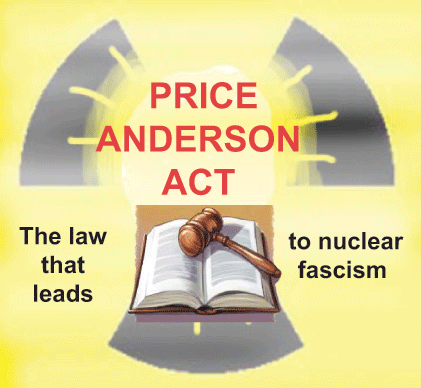
The chief problem with the Price-Anderson Act is the difference in how the law affects the public and the nuclear firms. In view of federal preemption of nuclear licensing, the public has essentially no say in the siting of a nuclear power plant and so must accept the associated accident risk. Nuclear vendors, however, are freed from all liability for offsite consequences of a nuclear accident, and so have nothing to worry about, either financially or legally.
Bulletin, By Victor Gilinsky | August 22, 2023
By Victor Gilinsky | August 22, 202
On the night of July 27, the US Senate passed the National Defense Authorization Act for fiscal year 2024. The Senate-approved bill included a 20-year extension of the Price-Anderson Nuclear Industries Indemnity Act, which provides that if there are any offsite lives and property lost in a severe reactor accident, nuclear industry manufacturers and builders cannot be held liable. The extension of the act also includes another controversial provision—the adequacy of funds provided by the act for compensating victims of a nuclear accident.
The approval last month of this extension came without any public hearings and was introduced in Congress in a rather troubling manner. The extension’s backers, knowing it would face rough sledding in an open hearing, first attached it to the Accelerating Deployment of Versatile, Advanced Nuclear for Clean Energy (ADVANCE) Act of 2023, which was then placed on the Senate legislative calendar on July 10 and added to the “must-pass” National Defense Authorization Act. While it has yet to pass the House, the act bears powerfully on the country’s commitment to nuclear energy, and especially on safety standards for nuclear power plants and therefore should not escape public scrutiny.
The Price-Anderson Act was first approved in 1957, soon after the Atomic Energy Act of 1954 permitted private nuclear energy activity. Firms like General Electric and Westinghouse, among others, told Congress they would not build commercial nuclear power plants—a technology with which there was essentially no experience—if they faced vast liability for possible accidents. To promote rapid investment in nuclear power plants, the government gave the builders and vendors freedom from liability for offsite accidents. It added provisions for public compensation after a catastrophic accident. But both provisions need updating in view of what we have learned in the last 60-odd years.
The act currently provides about $13 billion for post-accident public compensation, with the funds coming over time from a self-insurance scheme funded by the owners of nuclear power plants. But the estimated cost of the 2011 Fukushima accident—several hundred billion dollars—dwarfs the Price-Anderson amount. Yet, there is more. If an accident was to lead to widespread and long-term nuclear plant shutdowns, as occurred in Japan, it isn’t clear the owners would be able to meet their financial obligations. What’s clear is that after a severe nuclear accident, the issue of compensation would land in the lap of Congress.
At a 2014 Nuclear Regulatory Commission hearing on a safety upgrade for the 19 US plants essentially identical to the ones at Fukushima, the staff of the US Nuclear Regulatory Commission (NRC) told the commissioners that a fire in only one of the pools in which nuclear plants store highly radioactive used fuel could release much more radioactivity, conceivably 20 times more, than in the 2011 Fukushima accident. The commissioners at the time dismissed the concern on grounds that such an event was so improbable it failed the NRC’s cost-benefit analysis. But, however remote, the possibility remains.
The chief problem with the Price-Anderson Act is the difference in how the law affects the public and the nuclear firms. In view of federal preemption of nuclear licensing, the public has essentially no say in the siting of a nuclear power plant and so must accept the associated accident risk. Nuclear vendors, however, are freed from all liability for offsite consequences of a nuclear accident, and so have nothing to worry about, either financially or legally.
According to the NRC, calculations using “probabilistic risk assessment” serve as proof that the probability of severe nuclear accidents at US nuclear plants is extremely remote. But large nuclear vendors like General Electric and Westinghouse evidently don’t believe these numbers; otherwise, they would accept liability and would not fear risking their stockholders’ investment. If reactor builders won’t accept paying for the consequences of a possible nuclear accident, why then should members of the public, whose health and communities would be affected?……………………………………………………….
The current exuberance over “advanced” reactors” has some of the same boosterish markings as the earlier AEC episode, with the advocates so sure they are right that they think cutting corners is okay—like dispensing with public hearings on Price-Anderson Act extension.
The Price-Anderson Act extension is part of a larger program that would pull out the stops on granting generous subsidies to private nuclear firms, speeding approvals of nuclear license applications and promoting nuclear reactor exports—all supposedly in the interest of “reestablishing America’s preeminence as the global leader in nuclear energy in the 21st century.”
We need to stop and think as a society before it’s too late. Rather than a hastily and quietly passed 20-year extension, we need first a thorough public examination of the Price-Anderson Act’s fundamental provisions and their effect on nuclear reactor safety and licensing standards. https://thebulletin.org/2023/08/senate-extends-nuclear-liability-limiting-law-without-public-scrutiny-heres-why-we-should-care/?utm_source=Newsletter&utm_medium=Email&utm_campaign=ThursdayNewsletter08242023&utm_content=NuclearRisk_NuclearLiabilityLimiting_08222023
Marshall Islands reacts to US expansion of nuclear compensation
Marianas Variety, By Giff Johnson – For Variety Aug 21, 2023
MAJURO — Within days of United States congressional leaders and executive branch officials telling Marshall Islands leaders there was no more money for nuclear test compensation, the U.S. Senate passed legislation expanding nuclear compensation to more Americans in the U.S. mainland and also living on Guam.
The Senate legislation seeks to expand the Radiation Exposure Compensation Act of 1990. This law currently provides compensation to American Downwinders who lived near the Nevada Test Site, uranium miners, and people who worked at nuclear sites.
The new legislation expands the time period of eligibility for uranium miners from the previous deadline of 1971 to 1990, which means many more workers will be eligible. It also aims to support compensation for people in Guam — who live over a thousand miles away from the Bikini and Enewetak test sites in the Marshall Islands — and other U.S. jurisdictions affected by nuclear testing.
In the Marshall Islands, however, the U.S. definition of those “exposed” is limited to four atolls despite U.S. government studies that show many more islands in the country were exposed to nuclear test fallout. Prior to it running out of compensation funds in the late 2000s, the Nuclear Claims Tribunal compared fallout exposures of American Downwinders and Marshallese. It noted that the highest exposures among American Downwinders were lower than the lowest exposures of Marshallese.
The irony of the U.S. nuclear test compensation disparity is not lost on Marshallese.
“As nuclear test victim ourselves, we support compensation for American victims of nuclear tests, whether they are Downwinders or worked at nuclear test sites or worked in uranium mines,” Marshall Islands Speaker Kenneth Kedi, who represents Rongelap, was quoted Friday in the Marshall Islands Journal. “But the fact that U.S. authorities can tell the Marshall Islands there is ‘no more money’ for nuclear test exposure for people who lived through 67 of the largest US nuclear weapons tests ever conducted while at the same time preparing to expand compensation coverage for Americans is astounding.”
The U.S. government launched its Radiation Exposure Compensation Act in 1990 with a $100 million appropriation from the Congress. Over 30 years later, the U.S. Justice Department has paid out awards amounting to over $2 billion because when additional compensation was needed, the U.S. Congress appropriated more funding.
In contrast, for the Marshall Islands, which was subjected to weapons testing over 90 times the megatonnage of the Nevada nuclear tests, the U.S. provided the Marshall Islands with a $150 million fund as the “full and final” compensation and has refused to respond to Marshall Islands government requests to provide additional compensation in the ensuing 37 years since the first Compact of Free Association went into effect. Despite the fact that the Nuclear Claims Tribunal was an entity created by the first Compact of Association to adjudicate nuclear claims, the Marshall Islands government’s entreaties to the United States for funding to pay the over $3 billion in Tribunal awards have received a cold shoulder.
“We have no issue with people of Guam qualifying for U.S. nuclear compensation,” Kedi commented. “But if the people of Guam, who are 1,400 miles away from Bikini, are eligible for compensation, what about the many Marshallese who lived much closer to the testing who according to the U.S. are not radiation affected?”
The Tribunal award for Rongelap Atoll, which was not paid for lack of funds, is the largest of the Tribunal awards for four U.S.-acknowledged nuclear affected atolls of Bikini, Enewetak, Rongelap and Utrok — in part due to the need to fund cleanup of dozens of islands that remain radioactive from a snowstorm of radioactive fallout from the 1954 Bravo hydrogen bomb explosion at Bikini…………………………………………………….more https://www.mvariety.com/news/marshall-islands-reacts-to-us-expansion-of-nuclear-compensation/article_72b6eb98-3f55-11ee-ac0f-53b4fd3eeff1.html—
1 This Month

Petition to revoke the licensing of the Near Surface Nuclear Disposal Facility (NSDF) at Chalk River. https://www.ourcommons.ca/petitions/en/Petition/Details?Petition=e-7247


of the week – STOP SMALL MODULAR REACTORS IN CANADA
To see nuclear-related stories in greater depth and intensity – go to https://nuclearinformation.wordpress.com
-
Archives
- March 2026 (152)
- February 2026 (268)
- January 2026 (308)
- December 2025 (358)
- November 2025 (359)
- October 2025 (376)
- September 2025 (258)
- August 2025 (319)
- July 2025 (230)
- June 2025 (348)
- May 2025 (261)
- April 2025 (305)
-
Categories
- 1
- 1 NUCLEAR ISSUES
- business and costs
- climate change
- culture and arts
- ENERGY
- environment
- health
- history
- indigenous issues
- Legal
- marketing of nuclear
- media
- opposition to nuclear
- PERSONAL STORIES
- politics
- politics international
- Religion and ethics
- safety
- secrets,lies and civil liberties
- spinbuster
- technology
- Uranium
- wastes
- weapons and war
- Women
- 2 WORLD
- ACTION
- AFRICA
- Atrocities
- AUSTRALIA
- Christina's notes
- Christina's themes
- culture and arts
- Events
- Fuk 2022
- Fuk 2023
- Fukushima 2017
- Fukushima 2018
- fukushima 2019
- Fukushima 2020
- Fukushima 2021
- general
- global warming
- Humour (God we need it)
- Nuclear
- RARE EARTHS
- Reference
- resources – print
- Resources -audiovicual
- Weekly Newsletter
- World
- World Nuclear
- YouTube
-
RSS
Entries RSS
Comments RSS
 nuclear-news