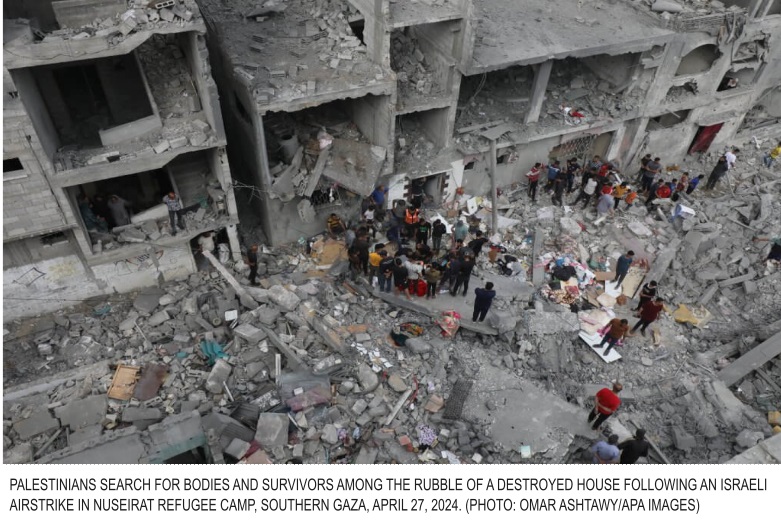
On Friday, the United Nations’ top court ordered Israel to immediately halt its military offensive in Rafah, a city in southern Gaza where over 1.5 million people have sought refuge following monthslong Israeli attacks and mass displacement of Palestinians in the Gaza Strip.
As of May 18, the International Court of Justice (ICJ) cites that over 800,000 people have been displaced from Rafah after new Israeli evacuation orders were issued. A document released by the UN Friday cites the developments in Rafah have led to a “catastrophic humanitarian situation,” and the situation “is now to be characterized as disastrous.”
The document states that the ICJ deems Israel’s measures to purportedly protect civilians in the Gaza Strip, particularly those displaced from Rafah, as insufficient. The Court points to an analysis by Philippe Lazzarini, the Commissioner-General of the United Nations Relief and Works Agency for Palestine Refugees in the Near East (UNRWA), who stated on May 18:
“[t]he areas that people are fleeing to now do not have safe water supplies or sanitation facilities. Al-Mawasi as one example is a sandy 14 square kilometre agricultural land, where people are left out in the open with little to no buildings or roads. It lacks the minimal conditions to provide emergency humanitarian assistance in a safe and dignified manner.”
The ICJ holds no power to enforce the ruling and Al Jazeera reports that Israel is not planning to “respond to the decision of the court, both politically or militarily.”
According to NBC News, “Prime Minister Benjamin Netanyahu was meeting with legal advisors to review the ruling.”
Below [on original] is the document issued by the ICJ:
The current American threats to sanction the ICC could spell the death of International Law. Whatever little hope people had for a just international system will disappear.
“Let me be clear, we reject the ICC’s application for arrest warrants against Israeli leaders,” U.S. President Joe Biden told his audience at a Jewish American Heritage Month event at the White House on Monday.
Biden criticized the request for arrest warrants as creating a “false equivalence” between Israel and Hamas. By making that statement, Biden took a clear stance against the rule of law, under which any party, regardless of any other status, must be dealt with the same way.
He also clarified again, if anyone was still unclear on the point, that the United States rejects accountability for itself and its allies, but holds rigorous standards in that regard for its enemies. Just over a year ago, Biden said that an ICC arrest warrant against Russian President Vladimir Putin was “justified” because he had “clearly committed war crimes.”
The hypocrisy is par for the American course. But Biden is now faced with a dilemma. He and other senior officials in his administration have indicated that they will use more than words in response to the ICC Prosecutor’s request. Some in Congress are essentially calling for all-out war on the Court. But Biden is likely to be reluctant to go that far.
Republicans target the ICC
It had been clear for the past several weeks that the International Criminal Court (ICC) was preparing a case against Israeli leaders, and on Monday, the Chief Prosecutor of the Court, Karim Khan, requested arrest warrants for three Hamas leaders and two Israelis. The Israelis were Israeli Prime Minister Benjamin Netanyahu and Defense Minister Yoav Gallant.
Predictably, both Israeli and American leadership lapsed into hysterics. As usual, Netanyahu immediately labeled the request for the warrants “the new antisemitism.” He also claimed that the Prosecutor “should be worried about his status,” a thinly veiled threat of violence, and that Khan was “turning the ICC into a pariah institution” and was “pouring gasoline on the fires of antisemitism spreading around the world.”
That kind of reaction reflects a profound concern about the charges potentially being brought against him — and it should not be overlooked that his statement did not include a denial of those charges. Netanyahu ran through the entire tired propaganda playbook, yet in doing so, he only highlighted the legitimacy of Khan’s request. But this was far from the beginning of the war on the Court.
Last week, before the warrants had been requested, a group of twelve Republican senators threatened Khan directly in a letter against bringing charges against Netanyahu. The letter was signed by some of the most prominent Republicans in the Senate, including Minority Leader Mitch McConnell, Marco Rubio, Tom Cotton, Ted Cruz, and Tim Scott.
The letter threatened sanctions against the ICC and Khan himself, saying “Target Israel and we will target you.” This is language that should be more characteristic of the Mafia than of government officials, though increasingly, it is hard to tell the difference. It closed by stating flatly, “You’ve been warned.”
‘Today is a victory, but part of the victory only.’
‘Today marks a turning point. We went into court and we sat and heard the United States fumbling through their arguments, trying to paint lipstick on a pig.
‘We are relieved as a family that the courts took the right decision today but how long can this go on for?
WikiLeaks founder Julian Assange‘s five-year battle against extradition to the US for espionage charges continues after he won a last-ditch legal battle to appeal.
‘Well, the judges were not convinced. Everyone can see what is going on here. The United States’ case is offensive.
‘It offends our democratic principles, it offends our right to know, it’s an attack on journalists everywhere.
‘We are relieved as a family that the courts took the right decision today but how long can this go on for? Our eldest son just turned seven.
‘All their memories of their father are in the visiting hall of Belmarsh prison, and as the case goes along, it becomes clearer and clearer to everyone that Julian is in prison for doing good journalism, for exposing corruption, for exposing the violations on innocent people in abusive wars for which there is impunity.
There were gasps of relief from the Australian’s wife and other supporters in the High Court as Dame Victoria Sharp said she and Mr Justice Johnson had decided they were not satisfied with assurances given by US prosecutors.
The judges had last month dismissed most of Assange’s legal arguments but said he would be able to bring an appeal on three grounds unless the US provided ‘satisfactory assurances.’
These were that Assange would be protected by and allowed to rely on the First Amendment, that his trial would not be prejudiced by his nationality and that the death penalty would not be imposed.
Dame Victoria told the court they were not satisfied Assange was guaranteed protection under the First Amendment.
Speaking outside court, Assange’s wife Stella said the judges had made the ‘right decision’, adding: ‘He should be given the Nobel prize and he should walk freely with the sand beneath his feet. He should be able to swim in the sea again. Free Assange.’
Delivering the ruling, Dame Victoria told the court: ‘We have carefully considered the submissions made in writing and orally.
‘First, in respect of the appeal under section 103 of the Extradition Act, we have decided to give leave to appeal on grounds four and five.’
Assange’s lawyer, Edward Fitzgerald KC, said he was satisfied with assurances that if the WikiLeaks founder was extradited and convicted he would not face the death penalty.
But lawyers for the US said that the fact that Assange is accused of illegally obtaining and disseminating confidential defence information means he was not guaranteed protection by the First Amendment regardless of nationality.
In written submissions, he said: ‘The position of the US prosecutor is that no-one, neither US citizens nor foreign citizens, are entitled to rely on the First Amendment in relation to publication of illegally obtained national defence information giving the names of innocent sources to their grave and imminent risk of harm.’
This principle applies to both US and non-US citizens irrespective of their nationality, he added.
The US has provided an assurance that if extradited, Assange ‘will be entitled to the full panoply of due process trial rights, including the right to raise, and seek to rely upon, the first amendment as a defence.’
Assange’s wife, Stella, has previously dismissed this pledge as ‘weasel words.’
The ruling will no doubt increase calls in Assange’s native Australia for the government to intervene on his behalf.
More than a hundred supporters gathered outside the Royal Courts of Justice to wave banners emblazoned with logos including ‘If Assange goes, free speech goes with him.’
Assange declined to attend the hearing but Mrs Assange sat next to his father John Shipton in the well of court 4.
Supporters of Julian Assange cheered as news of the decision to allow his appeal against extradition to the United States filtered out of the courtroom.
Hundreds of people gathered outside the Royal Courts of Justice in London, with many holding signs, flags and banners, while a band is also playing music.
Several speakers addressed crowds on a stage erected adjacent to the court building, with one telling supporters: ‘Today is a victory, but part of the victory only.’
Following the decision, one man with a megaphone said to Assange supporters: ‘We have to do more.’
Among the supporters chanting ‘Free Julian Assange’ were former Labour leader Jeremy Corbyn and Labour MP Apsana Begum.
Kaylaa Sandwell travelled from east London to attend the rally and said: ‘It was obvious from the beginning that they want to silence him and I think he’s a very honest man, and he’s spoken up for us, so we need to really support that.
‘He needs to be freed because he hasn’t done anything wrong.
‘If he doesn’t get freed, we won’t have a free press anymore.’
Speaking outside the Royal Courts of Justice after Julian Assange won a bid to bring an appeal against his extradition to the United States, his wife, Stella Assange, said that judges ‘reached the right decision’ and called on the US to drop the ‘shameful’ case.
She said: ‘Today marks a turning point. We went into court and we sat and heard the United States fumbling through their arguments, trying to paint lipstick on a pig.
‘Well, the judges were not convinced. Everyone can see what is going on here. The United States’ case is offensive.
‘It offends our democratic principles, it offends our right to know, it’s an attack on journalists everywhere.
‘We are relieved as a family that the courts took the right decision today but how long can this go on for? Our eldest son just turned seven.
‘All their memories of their father are in the visiting hall of Belmarsh prison, and as the case goes along, it becomes clearer and clearer to everyone that Julian is in prison for doing good journalism, for exposing corruption, for exposing the violations on innocent people in abusive wars for which there is impunity.
On top of that impunity they have gone after the man who put that impunity onto the public record.
‘The Biden administration should distance itself from this shameful prosecution, it should have done so from day one, but it may be running out of time to do the right thing.
‘Everyone can see what should be done here. Julian must be freed. The case should be abandoned. He should be compensated.
‘He should be given the Nobel prize and he should walk freely with the sand beneath his feet. He should be able to swim in the sea again. Free Assange.’
She continued: ‘The judges reached the right decision. We spent a long time hearing the United States putting lipstick on a pig, but the judges did not buy it.
‘As a family we are relieved, but how long can this go on? The United States should read the situation and drop this case now.’
The 52-year-old was indicted by a US grand jury in 2018 on 17 espionage charges and a charge of unlawful use of a computer, which Assange’s lawyers claim could see him sentenced to 175 years in jail.
American prosecutors allege that the Australian encouraged and helped former US army intelligence analyst Chelsea Manning to steal the cables, which they claim put the lives of covert sources around the globe at risk.
President Joe Biden has faced persistent pressure to drop the case filed by his predecessor Donald Trump.
Assange had previously lived inside the Ecuadorian Embassy in Knightsbridge, west London, for almost seven years until he was eventually dragged out in 2019 when the Ecuadorian government withdrew his asylum.
The High Court in London ruled Monday that Julian Assange can appeal his extradition to the U.S. on the grounds that he is being denied his First Amendment rights.
The High Court in London on Monday granted Julian Assange the right to appeal the order to extradite him to the United States on the grounds that the U.S. did not satisfy the court that it would allow Assange a First Amendment defense in a U.S. court.
“We spent a lot of time listening to the United States putting lipstick on a pig, but the judges didn’t buy it,” Stella Assange told reporters outside the court building. “As a family we are relieved but how long can this go on? The United States should read the situation and drop the case now.”
Assange has been imprisoned in London’s notorious Belmarsh Prison for more than five years on remand pending the outcome of his extradition. He must now spend an untold number of more months in the maximum security prison awaiting the start of his appeal.
In that sense it was a bitter victory for Assange. He gets to stay in prison another year or more, Joe Biden doesn’t have to worry about a journalist showing up in chains in Alexandria, VA during a presidential campaign and of course Assange could lose his appeal and arrive in the U.S. at a more opportune time for Biden.
In another sense, it was a victory for the supremacy of European law when it comes to free speech,
Background to Monday’s Action
The High Court in London on March 26 had ruled that Assange had three grounds to appeal, because 1). his extradition was incompatible with his free speech rights enshrined in the European Convention on Human Rights; 2.) that he might be prejudiced because of his nationality (not being given 1st Amendment protection as a non-American) and 3). because he had inadequate protection against the death penalty. (Without such protection Britain cannot extradite him.).
Rather than proceed with the appeal on those three grounds, the High Court gave the U.S. the chance, fours years after the extradition process began, to promise it would not use the death penalty, and to guarantee his free speech rights.
Because it is an executive branch decision, the U.S. was able to assure the British government that it would not seek the death penalty, and Assange’s lawyers on Monday said they did not contest that. Left unexplained, however, was why the British home office waited four years to seek what is normally a routine assurance in an extradition case.
The free speech issue was more complicated because a decision about Assange asserting a First Amendment defense at trial will be up to a U.S. federal court and not the Department of Justice. Therefore the DOJ could not issue such an assurance on the free speech issue.
That ultimately led the two judges, Justice Jeremy Johnson and Victoria Sharp, to allow Assange to launch a formal appeal of his extradition because of an apparent violation of British extradition law, based on the European Convention on Human Rights, that requires the receiving country to allow an extradited person the right to free speech.
Johnson and Sharp did not buy the convoluted argument of James Lewis KC for the United States, on why the U.S. should get their hands on Assange despite being unable to guarantee his freedom of expression.
Edward Fitzgerald KC, and Mark Summers KC, barristers for Assange, easily picked apart three pieces of Lewis’ somewhat desperate presentation:
pointing out how Lewis had misled the court by saying the U.S. assurance would allow Assange to rely on the First Amendment, when in fact it says he can “seek to rely” on it;
how none of a slew of case law Lewis cited to supposedly bolster his argument actually dealt with a trial, which of course Assange will, if he goes to the U.S.;
that saying Chelsea Manning was not able to invoke First Amendment rights in defense of leaking classified defense information meant Assange shouldn’t either was “nonsense” because Manning was a government whistleblower who had signed non-disclosure agreements and Assange is a publisher.
The judges apparently also rejected a drawn-out, arcane and overly lawyered argument from Lewis about the difference between citizenship and nationality that to most laymen was nearly incomprehensible.
A Watershed Moment
“This was a watershed moment in this very long battle,” said WikiLeaks Editor-in-Chief Kristinn at an event following the hearing. “Today marked the beginning of the end of the persecution. The signaling from the courts here in London was clear to the U.S. government: We don’t believe your guarantees, we don’t believe in your assurances.”
1st Amendment & Espionage Act
The First Amendment is at the core of the unconstitutionality of the Espionage Act, which makes no exception for a journalist to possess and disseminate defense information.
The Assange case could lead to a constitutional challenge of it, said Marjorie Cohn, former president of the National Lawyers’ Guild. That may be one reason the Department of Justice does not want Assange to invoke the First Amendment in court.
The U.S.-U.K. Extradition Act “bars extradition if an individual might be prejudiced due to his nationality and due to the centrality of the First Amendment to his defense,” Cohn told CN Live! last month. “If he’s not permitted to rely on the First Amendment because of his status as a foreign national, he’ll thereby be prejudiced, potentially very greatly prejudiced by reason of his nationality.”
Assange contends that if he’s given First Amendment rights, “the prosecution will be stopped,” Cohn said. “The First Amendment is therefore of central importance to his defense.”
Cohn added: ‘If he has the right to free expression and freedom of speech, then what he did, what he’s accused of doing, would not violate the law.”
Though allowing First Amendment rights at trial would be ultimately a judge’s decision, and not the executive branch’s, Assistant U.S. Attorney Gordon Kromberg, who is prosecuting Assange, has not only not indicated that he wouldn’t file a motion against it in court, but has said explicitly that non-U.S. citizens do not have First Amendment rights in the U.S. for acts committed abroad.
A date has not yet been set for Assange’s appeal to begin.
A British court could give a final decision on whether WikiLeaks’ founder Julian Assange should be extradited to the United States over the mass leak of secret US documents – the culmination of 13 years of legal battles and detentions.
Two judges at the High Court in London are set to rule on Monday on whether the court is satisfied by US assurances that Assange, 52, would not face the death penalty and could rely on the First Amendment right to free speech if he faced a US trial for spying.
Assange’s legal team say he could be on a plane across the Atlantic within 24 hours of the decision, could be released from jail, or his case could yet again be bogged down in months of legal battles.
“I have the sense that anything could happen at this stage,” his wife Stella said during the week.
“Julian could be extradited or he could be freed.”
She said her husband hoped to be in court for the crucial hearing.
WikiLeaks released hundreds of thousands of classified US military documents on Washington’s wars in Afghanistan and Iraq – the largest security breaches of their kind in US military history – along with swathes of diplomatic cables.
In April 2010 it published a classified video showing a 2007 US helicopter attack that killed a dozen people in the Iraqi capital, Baghdad, including two Reuters news staff.
The US authorities want to put the Australian-born Assange on trial over 18 charges, almost all under the Espionage Act, saying his actions with WikiLeaks were reckless, damaged national security and endangered the lives of agents.
His many global supporters call the prosecution a travesty, an assault on journalism and free speech, and revenge for causing embarrassment.
Calls for the case to be dropped have ranged from human rights groups and some media bodies to Australian Prime Minister Anthony Albanese and other political leaders.
Assange was first arrested in Britain in 2010 on a Swedish warrant over sex crime allegations that were later dropped.
Since then he has been variously under house arrest, holed up in Ecuador’s embassy in London for seven years, and held since 2019 in the top-security Belmarsh jail while he waited for a ruling on his extradition.
“Every day since the seventh of December 2010 he has been in one form of detention or another,” said Stella Assange, who was originally part of his legal team and married him in Belmarsh in 2022.
If the High Court rules the extradition can go ahead, Assange’s legal avenues in Britain are exhausted, and his lawyers will immediately turn to the European Court of Human Rights to seek an emergency injunction blocking deportation pending a full hearing by that court into his case at a later date.
On the other hand, if the judges reject the US submissions, Assange will have permission to appeal his extradition case on three grounds, and that might not be heard until 2025.
It is also possible the judges could decide that Monday’s hearing should consider not just whether he can appeal but also the substance of that appeal.
If they find in his favour in those circumstances, he could be released.
Stella Assange said whatever the outcome, she would continue to fight for his liberty.
She plans to follow him to Australia or wherever he is safe if he is freed.
If he is extradited, she said all the psychiatric evidence presented at court had concluded he was at serious risk of suicide.
“We live from day to day, from week to week, from decision to decision,” she told Reuters.
“This is a way that we’ve been living for years and years.
“This is just not a way to live – it’s so cruel.
“And I can’t prepare for his extradition – how could I?
“But if he’s extradited, then I’ll do whatever I can, and our family is going to fight for him until he’s free.”
The Conversation, Erin Cooper-Douglas, Deputy Politics + Society Editor 21 May 24
Late last night, Wikileaks founder Julian Assange had a win in the UK High Court: he can now appeal his extradition order to the United States
Legal efforts to keep Assange from being sent to the US, where he potentially faces a 175-year jail term for publishing sensitive government documents, have been some of the most protracted in recent memory. Just getting complete permission to appeal took three highly publicised hearings.
As Holly Cullen explains, one of the key grounds for appeal is freedom of expression. And that’s what makes yesterday’s decision, and the appeal that will now follow, legally groundbreaking. Never before has a UK court, nor the European Court of Human Rights, decided whether a potential violation of freedom of expression can stop someone from being extradited.
While the decision will please Assange’s team and his many supporters, the extradition threat still looms. If the appeal, which is likely to be held later this year, is unsuccessful, he could still find himself in the US.
All decent Israelis must ask themselves the following questions: Is their country committing war crimes in Gaza? If so, how should they be stopped?
How should the culprits be punished? Who can punish them? Is it reasonable for crimes to go unprosecuted and criminals to be exculpated?
One may, of course, reply in the negative to the first question – Israel is not committing any war crimes in Gaza – thereby rendering the rest of the questions superfluous.
But how can one answer in the negative in the face of the facts and the situation in Gaza:
about 35,000 people killed and another 10,000 missing, about two-thirds of them innocent civilians, according to the Israel Defense Forces;
among the dead are around 13,000 children, nearly 400 medical workers and more than 200 journalists; 70 percent of homes have been destroyed or damaged;
30 percent of children suffer from acute malnutrition;
two people in 10,000 die each day from starvation and disease. (All figures are from the United Nations and international organizations.)
Is it possible that these horrific figures came to be without the commission of war crimes?
There are wars whose cause is just and whose means are criminal; the justice of the war does not justify its crimes. Killing and destruction, starvation and displacement on this scale could not have occurred without the commission of war crimes. Individuals are responsible for them, and they must be brought to justice.
Israeli hasbara, or public diplomacy, does not try to deny the reality in Gaza. It only makes the claim of antisemitism: Why pick on us? What about Sudan and Yemen?
The logic doesn’t hold: A driver who is stopped for speeding won’t get off by arguing that he’s not the only one. The crimes and the criminals remain. Israel will never prosecute anyone for these offenses. It never has, neither for its wars nor its occupation. On a good day, it will prosecute a soldier who stole some Palestinian’s credit card.
But the human sense of justice wants to see criminals brought to justice and prevented from committing crimes in the future. By this logic, we can only hope that the International Criminal Court in The Hague will do its job.
Every Israeli patriot and everyone who cares about the good of the state should wish for this. This is the only way that Israel’s moral standard, according to which it is permitted everything, will change. It is not easy to hope for the arrest of the heads of your state and your army, and even more difficult to admit it publicly, but is there any other way to stop them?
The killing and destruction in Gaza has gotten Israel in way over its head. It is the worst catastrophe the state has ever faced. Someone led it there – no, not antisemitism, but rather its leaders and military officers. If not for them, it wouldn’t have turned so quickly after October 7 from a cherished country that inspired compassion into a pariah state.
Someone must stand trial for this.
Just as many Israelis want Benjamin Netanyahu to be punished for the corruption of which he is accused, so should they wish for him and the perpetrators subordinate to him to be punished for much more serious crimes, the crimes of Gaza.
They cannot be allowed to go unpunished.
Nor is it possible to blame only Hamas, even if it has a part in the crimes.
We are the ones who killed, starved, displaced, and destroyed on such a massive scale. Someone must be brought to justice for this.
Netanyahu is the head, of course. The picture of him imprisoned in The Hague together with the defense minister and the IDF chief of staff is the stuff of nightmares to every Israeli.
And yet, it is probably warranted.
It is highly unlikely, however. The pressure being exerted on the court by Israel and the United States are enormous (and wrong). But scare tactics can be important.
If the officials actually refrain from traveling abroad in the next few years, if they actually live in fear of what may come, we can be sure that in the next war, they’ll think twice before sending the military on campaigns of death and destruction of such insane proportions. We can find a little comfort in that, at least.
INTERNATIONAL DARK SKY ASSOCIATION vs. FCC AND SPACEXOn December 29, 2022, the International Dark-Sky Association (IDA) sued the U.S. Federal Communications Commission over its decision to approve SpaceX’s application for up to 30,000 more low-orbit satellites, in addition to the 12,000 already approved and in process of filling our skies. This is Case No. 22-1337 before the United States Court of Appeals for the District of Columbia Circuit, and has not yet been decided by the court.
American plasma physicist Sierra Solter implored the FCC to “please save our night sky… Please, please, don’t take away my stars. To feel that my place of comfort and calm — a starry sky — is being taken away and given to billionaires is suffocating.”
On December 18, 2023, Ms. Solter published a scientific article detailing her fear for our planet. Each of the 42,000 planned Starlink satellites, she wrote, has a design lifespan of only 5 years, after which it will be de-orbited, burned up in the atmosphere, and replaced. She calculated that this will require 23 satellites per day — each the size of an SUV or truck — to be burned up in the atmosphere forever into the future, leaving an enormous amount of toxic chemicals and metallic dust to accumulate in the air we breathe and in the ionosphere.
This is already happening, she wrote, and should be stopped if we value our lives. “Since the beginning of the space industry, approximately 20,000 tons of material have been demolished during reentry… This is over 100 billion times greater than [the mass of] the Van Allen Belts.” She estimated that if 42,000 Starlink satellites are deployed and regularly demolished — let alone the 1,000,000 satellites planned by other companies and governments — “every second the space industry is adding approximately 2,000 times more conductive material than mass of the Van Allen Belts into the ionosphere.”
“Unlike meteorites, which are small and only contain trace amounts of aluminum, these wrecked spacecraft are huge and consist entirely of aluminum and other exotic, highly conductive materials,” she explained in an April 16, 2024 article in The Guardian.
Much of the metallic dust will settle into the ionosphere where, she says, it could act as a magnetic shield, reducing the magnitude of the Earth’s magnetic field in space. If that happens, the atmosphere itself could eventually be destroyed, because the Earth’s magnetic field — the magnetosphere — is what deflects the solar wind and prevents it from stripping away Earth’s atmosphere, as she told Teresa Pulterova in an interview on Space.com.
Other astronomers involved in the litigation before the FCC and now the Court of Appeals include Meredith Rawls with the Vera C. Rubin Observatory in Chile; Gary Hunt with Action Against Satellite Light Pollution in the UK; Samantha Lawler at the University of Regina in Canada; Graeme Cuffy of Port of Spain, Trinidad and Tobago; Mark Phillips, President of the Astronomical Society of Edinburgh; Roberto Trotta of the Imperial Centre for Inference and Cosmology in London; Carrie Nugent, Associate Professor of Computational Physics and Planetary Science at the Olin College of Engineering in Massachusetts; and Cameron Nelson of Tenzing Startup Consultants in Virginia.
Other issues are also mentioned in the appeal. For example, the burned up aluminum produces aluminum oxide, which destroys ozone and contributes to climate change. So does the water vapor, soot, and nitrogen oxides in rocket exhaust.
Cameron Nelson told the FCC that “Humans, not to mention all other animal and plant life, have not given our consent for SpaceX to send the signals it is proposing into our bodies and irrevocably alter us.”
The BroadBand International Legal Action Network (BBILAN) mentioned “RF/EMF radiation from linked base and earth stations” in comments sent to the FCC. Starlink earth stations, also called Gateways, are far more powerful than the Starlink dishes that people are putting on their homes. The (as of March 2024) 2.6 million Starlink dishes each send one signal up to the moving network of satellites above them. All of this traffic is coordinated in space by thousands of lasers linking the satellites to one another, and on the ground by Gateways, which relay the thousands of signals in a large geographic area to and from the satellites. This is what a Gateway with 5 antennas (“radomes”) looks like:
Some Gateways have up to 40 radomes. Each of those domes weighs 1750 kilograms. Each aims a narrow beam at moving satellites. According to FCC filings by SpaceX, each beam can have an effective radiated power of more than 1,000,000 watts, which it can aim as low as 25 degrees above the horizon. If you are a bird you do not want to fly anywhere near a Starlink Gateway. And if you are a human you do not want to live near one either. When a satellite aims its beam containing thousands of signals at a Gateway, that beam is about 10 miles in diameter by the time it reaches the Earth.
At last count there were 277 Starlink Gateways in operation or under construction in the world: 181 in North America and the Caribbean, 26 in South America, 2 in Africa, 26 in Europe, and 42 in Asia and the Pacific.
The FCC maintains a webpage listing thousands of licenses that it has handed out to hundreds of companies to operate both fixed and mobile satellite earth stations in the United States. Some of these stations are far more powerful than the Starlink Gateways. SES’s earth station at Bristol, Virginia emits up to 1,900,000,000 watts of effective radiated power, and it is allowed to aim it as low as 5 degrees above the horizon. SES’s earth station at Brewster, Washington is allowed to emit almost 1,000,000 watts in the actual direction of the horizon! SES owns O3b mPOWER, which is the satellite system that had its first radomes on board the Diamond Princess cruise ship, the ship that had the famous outbreak of disease blamed on COVID-19 at the beginning of the pandemic.
The International Criminal Court is a dusty jewel, a creation of heat, tension and manufacture in the international community. Various elements have gone into its creation. As with any international institution which draws its legitimacy from nation states and the like, its detractors are many, the invective against it frequent. Some 124 countries have signed the Rome Charter of 1998 that gives the body its authority and jurisdictional force, but no one is foolish enough to think that its reach can ever be anything but tempered by political consideration and self-interest.
Be it issuing a problematic arrest warrant for Russian President Vladimir Putin, attempting to investigate alleged US war crimes in Afghanistan, or busying itself with some nasty examples of African despotism, the scope of the body is potentially extensive. At present, ICC prosecutor Karim Khan is sniffing out the prospect of issuing arrest warrants against senior Israeli officials in the context of the war in Gaza. The sniff, however, has come with a rebuking blast from Israel, joined by various politicians in the United States champing at the bit to take a swipe at the body.
Such attacks have only been emboldened by the American Service-Members’ Protection Act, an instrument from 2002 that prohibits federal, state and local governments from furnishing the ICC with assistance in any way while authorising the US president “to use all means necessary and appropriate to bring about the release” of any “US person” or “allied persons” detained or imprisoned by, on behalf of, or at the request,” of the ICC.
In what is expedient and legally anomalous, Washington has chosen not only to avoid signing the Rome Statute but reject ICC jurisdiction over the Palestinian territories. The ICC begs to differ, noting the acceptance of the court’s jurisdiction on the part of “the Government of Palestine” and its accession to the Rome Statute in January 2015.
In late October 2023, Israel announced that it would not be permitting Khan to enter Israel, signalling its intention to frustrate, as far as possible, his investigative functions. In April this year, Axios revealed that Israeli Prime Minister Benjamin Netanyahu had requested US President Joe Biden to prevent the ICC from issuing arrest warrants against senior Israeli officials. A broader lobbying effort of the US Congress by the Netanyahu government is also taking place.
On May 1, a bipartisan group of US senators held a virtual meeting with members of seniority from the ICC, worried about the prospect that arrest warrants for top Israel might issue from the prosecutorial pipeline. In a threatening letter to Khan from a dozen Republican senators led by Tom Cotton, the promise for retaliation was unequivocal: “Target Israel, and we will target you.” Issuing such warrants would be “illegitimate and lack legal basis, and, if carried out, will result in severe actions against you and your institution.” They would “not only be a threat to Israel’s sovereignty but to the sovereignty of the United States.”
This was hardly novel and was unlikely to have phased Khan or his staff. In June 2020, President Donald Trump implemented an executive orderdirected at the ICC. The order authorised the blocking of assets and imposed family entry bans into the US in response to the court’s efforts to investigate the alleged commission of war crimes in Afghanistan by US personnel. In September that year, pursuant to the executive order, targeted sanctions were imposed on then ICC prosecutor Fatou Bensouda and senior prosecution official Phakiso Mochochoko.
Since 2021, the ICC has been vested in examining alleged war crimes committed by both the Israeli Defense Forces and Palestinian militants stretching back to the 2014 Israel-Hamas war. “Upon the commencement of my mandate in June 2021,” Khan states, “I put in place for the first time a dedicated team to advance the investigation in relation to the Situation in the State of Palestine.” Its mission is to collect, preserve and analyse “information and communications from key stakeholders in relation to relevant incidents.”
-ADVERTISEMENT-
In November 2023, the office of the prosecutor received a referral from South Africa, Bangladesh, Bolivia, Comoros and Djibouti to investigate “the Situation in the State of Palestine.” The referral requests the prosecutor “to vigorously investigate crimes under the jurisdiction of the Court allegedly committed” on various grounds, including, among others, the unlawful appropriation and destruction of private and public properties, the forcible transfer of Palestinians, the unlawful transfer of Israel’s population into Occupied Palestinian Territory and a discriminatory system amounting to apartheid.
The spectacularly brutal Israeli campaign in Gaza following the October 7 attacks by Hamas also enlivened interest in using the ICC’s jurisdiction to investigate allegations of genocide, crimes against humanity and relevant war crimes. But the notable catch, and bound to be threatening to its intended targets, was the request that culprits be found, and perpetrators be outed and held accountable. South Africa, more specifically, requested that the prosecutor “investigate the Situation for the purpose of determining whether one or more specific persons should be charged with the commission of such crimes.”
On May 3, officials from the ICC openly reproached efforts to tamper and modify any opinions on the part of the body regarding its activities. The ICC welcomed, according to Khan, “open communication” with government officials and non-governmental entities, and would only engage in discussions so long as they were “consistent with its mandate under the Rome Statute to act independently and impartially.”
As he continued to explain in his statement, Khan argued “That independence and impartiality are undermined … when individuals threaten to retaliate … should the office, in fulfilment of its mandate, make decisions about investigations or cases falling within its jurisdiction.” He demanded that “all attempts to impede, intimidate or improperly influence its officials cease immediately.”
Netanyahu had previously promised that, under his leadership, “Israel will never accept any attempt by the ICC to undermine its inherent right of self-defense.” He regarded any “threat to seize the soldiers and officials of the Middle East’s only democracy and the world’s only Jewish state” as “outrageous.” Going heavy on the forces of light battling those of darkness – a favourite theme of his – the Israeli PM went on to claim that such actions “would set a dangerous precedent that threatens the soldiers and officials of all democracies fighting savage terrorism and wanton aggression.”
Far from threatening democracies of whatever flavour, the actions of the ICC can serve the opposite purpose, holding individuals in high office accountable for egregious crimes in international law. In doing so, it can contribute, in no small part, to efforts in defeating impunity and rebutting brutal and often callous assertions of self-defence.
But perhaps this is the real reason for using public money in this way is to silence anybody else who might be thinking of exposing the dark secrets inside Sellafield. She is not the only whistleblower.
One aspect of the second recent cost hearing against whistleblower and human resources consultant Alison McDermott by Sellafield and the Nuclear Decommissioning Authority which was not covered is the cost to the public and us the taxpayer.
During the hearing Deshpal Panesar, KC Sellafield’s lawyer from Old Square Chambers, rather pompously told the hearing that the fact Sellafield was claiming £20,000 off Alison was ” to protect the public purse”. He and the Nuclear Commissioning Authority which was also claiming £20,000 made a huge point that her “unreasonable behaviour” by pursing them at a tribunal meant she should pay a penalty.
What is now emerging from Freedom of Information requests is that the cost to bring this action far outweighs the money they will receive even if they are 100 per cent successful.
Both nuclear giants have already spent a huge sum – nearly £700,000 of taxpayer’s money – fighting Alison, whose consultancy was terminated, after her report revealed bullying and fear among staff at the nuclear site in Sellafield.
Now it is known from FOI that both organisations have spent £59,000 between them on preparing the case for the second hearing on top of money they had already spent for the first costs hearing. This doesn’t include the cost of hearing itself which is about another £20,000 considering Sellafield’s lawyers Deshpal Paneser. KC charges £5500 a day for the hearing and Emma Mills, from DLA Piper, who charges £3000 a day . The NDA employed another barrister, Rachel Levene and solicitors Pinsent Mason. Plus there were paralegals at the hearing.
Now one would think that after a High Court judge had ruled that the first costs decision was ” unsafe” and said his view should be taken into account by judge Stuart Robertson, who has heard the second hearing, there would be pause for thought. Both nuclear organisations are also lucky they will not face an appeal. So any sane organisation would decide to leave it there.
Instead we have the economic madness, which no commercial company conducting a risk assessment would follow, of throwing more money at bringing a second case when there is not the slightest chance of getting their money back. Indeed even if they were 100 per cent successful they stand to lose £40,000 and that is by no means certain they will get that. It is only that it is our money from the taxpayer they can throw it around like confetti.
So why are they doing it? The decision must have been endorsed by Euan Hutton, the new chief executive.
Despite previously serving as a Mental Health Champion alongside Ms. McDermott to foster a kinder and more supportive work environment, Mr. Hutton is now relentlessly pursuing costs against her.
In various YouTube videos, Mr. Hutton espouses the importance of treating people with kindness, yet his actions towards Ms. McDermott are anything but. He actually says that “kindness is putting in the time to think about how different people act differently, that’s what kindness is all about” [second video from 20 seconds onwards]. By hounding her for costs related to her whistleblowing for the second time, he has subjected her to immense stress and anguish, betraying the values he once claimed to champion.
Now Sellafield receives £6.7 million daily from taxpayers. Mr. Hutton’s decision to waste these funds on a vindictive legal battle against a whistleblower is an egregious misuse of public money. It is a slap in the face to taxpayers who trust Sellafield to use their contributions responsibly.
The Guardian has reported that the National Audit Office will investigate Sellafield’s substantial expenditure.
Mr. Hutton should be held accountable for his actions, which have caused harm to Ms. McDermott and undermined Sellafield’s commitment to employee wellbeing and to a culture of openness.
But perhaps this is the real reason for using public money in this way is to silence anybody else who might be thinking of exposing the dark secrets inside Sellafield. She is not the only whistleblower.
I approached Sellafield and the NDA about this waste of money but both said
“These issues are still subject to legal proceedings. We cannot comment further at this stage.”
On December 29, 2022, the International Dark-Sky Association (IDA) sued the U.S. Federal Communications Commission over its decision to approve SpaceX’s application for up to 30,000 more low-orbit satellites, in addition to the 12,000 already approved and in process of filling our skies. This is Case No. 22-1337 before the United States Court of Appeals for the District of Columbia Circuit, and has not yet been decided by the court.
American plasma physicist Sierra Solter implored the FCC to “please save our night sky… Please, please, don’t take away my stars. To feel that my place of comfort and calm — a starry sky — is being taken away and given to billionaires is suffocating.”
On December 18, 2023, Ms. Solter published a scientific article detailing her fear for our planet. Each of the 42,000 planned Starlink satellites, she wrote, has a design lifespan of only 5 years, after which it will be de-orbited, burned up in the atmosphere, and replaced. She calculated that this will require 23 satellites per day — each the size of an SUV or truck — to be burned up in the atmosphere forever into the future, leaving an enormous amount of toxic chemicals and metallic dust to accumulate in the air we breathe and in the ionosphere
This is already happening, she wrote, and should be stopped if we value our lives. “Since the beginning of the space industry, approximately 20,000 tons of material have been demolished during reentry… This is over 100 billion times greater than [the mass of] the Van Allen Belts.” She estimated that if 42,000 Starlink satellites are deployed and regularly demolished — let alone the 1,000,000 satellites planned by other companies and governments — “every second the space industry is adding approximately 2,000 times more conductive material than mass of the Van Allen Belts into the ionosphere.”
“Unlike meteorites, which are small and only contain trace amounts of aluminum, these wrecked spacecraft are huge and consist entirely of aluminum and other exotic, highly conductive materials,” she explained in an April 16, 2024 article in The Guardian.
Much of the metallic dust will settle into the ionosphere where, she says, it could act as a magnetic shield, reducing the magnitude of the Earth’s magnetic field in space. If that happens, the atmosphere itself could eventually be destroyed, because the Earth’s magnetic field — the magnetosphere — is what deflects the solar wind and prevents it from stripping away Earth’s atmosphere, as she told Teresa Pulterova in an interview on Space.com.
Other astronomers involved in the litigation before the FCC and now the Court of Appeals include Meredith Rawls with the Vera C. Rubin Observatory in Chile; Gary Hunt with Action Against Satellite Light Pollution in the UK; Samantha Lawler at the University of Regina in Canada; Graeme Cuffy of Port of Spain, Trinidad and Tobago; Mark Phillips, President of the Astronomical Society of Edinburgh; Roberto Trotta of the Imperial Centre for Inference and Cosmology in London; Carrie Nugent, Associate Professor of Computational Physics and Planetary Science at the Olin College of Engineering in Massachusetts; and Cameron Nelson of Tenzing Startup Consultants in Virginia.
Other issues are also mentioned in the appeal. For example, the burned up aluminum produces aluminum oxide, which destroys ozone and contributes to climate change. So does the water vapor, soot, and nitrogen oxides in rocket exhaust.
Cameron Nelson told the FCC that “Humans, not to mention all other animal and plant life, have not given our consent for SpaceX to send the signals it is proposing into our bodies and irrevocably alter us.”
The BroadBand International Legal Action Network (BBILAN) mentioned “RF/EMF radiation from linked base and earth stations” in comments sent to the FCC. Starlink earth stations, also called Gateways, are far more powerful than the Starlink dishes that people are putting on their homes. The (as of March 2024) 2.6 million Starlink dishes each send one signal up to the moving network of satellites above them. All of this traffic is coordinated in space by thousands of lasers linking the satellites to one another, and on the ground by Gateways, which relay the thousands of signals in a large geographic area to and from the satellites. This is what a Gateway with 5 antennas (“radomes”) looks like:
Some Gateways have up to 40 radomes. Each of those domes weighs 1750 kilograms. Each aims a narrow beam at moving satellites. According to FCC filings by SpaceX, each beam can have an effective radiated power of more than 1,000,000 watts, which it can aim as low as 25 degrees above the horizon. If you are a bird you do not want to fly anywhere near a Starlink Gateway. And if you are a human you do not want to live near one either. When a satellite aims its beam containing thousands of signals at a Gateway, that beam is about 10 miles in diameter by the time it reaches the Earth.
Robin is a subscriber who lives in a remote area of Idaho less than 3 miles from the Starlink Gateway in Colburn. She writes about effects on her family and her animals…………………………….Robin knows many people in her area who are similarly affected. She adds that “when we first moved here in 2019 we had A LOT of birds. We now have a silent spring, it’s like a dead zone.
At last count there were 277 Starlink Gateways in operation or under construction in the world: 181 in North America and the Caribbean, 26 in South America, 2 in Africa, 26 in Europe, and 42 in Asia and the Pacific.
The FCC maintains a webpage listing thousands of licenses that it has handed out to hundreds of companies to operate both fixed and mobile satellite earth stations in the United States. Some of these stations are far more powerful than the Starlink Gateways. SES’s earth station at Bristol, Virginia emits up to 1,900,000,000 watts of effective radiated power, and it is allowed to aim it as low as 5 degrees above the horizon. SES’s earth station at Brewster, Washington is allowed to emit almost 1,000,000 watts in the actual direction of the horizon! SES owns O3b mPOWER, which is the satellite system that had its first radomes on board the Diamond Princess cruise ship, the ship that had the famous outbreak of disease blamed on COVID-19 at the beginning of the pandemic
The findings are illustrated by 17 specific, horrific “incidents” and 18 pages of additional incidents. This review of incidents is said to be “supported by both credible media and civil society reporting and statements by Government of Israel officials and IDF uniformed officers.” But the incidents identified are “just the most easily identifiable among a clear pattern of violations of international law, failures to apply civilian harm mitigation best practices, and restrictions on humanitarian assistance,” by Israel and the IDF, often using U.S.-provided arms.
An independent expert report lays out how Israel systematically violated U.S. and International Law in Gaza, concluding that Israel launched indiscriminate and disproportionate attacks on civilian areas due to “extremely relaxed rules of engagement.”
Just days after the Biden administration showered the Israeli military with billions of dollars more in lethal aid, still with no apparent effort to restrict its use on non-military populations and structures, Palestinian solidarity activists were gifted with powerful ammunition to challenge Israel’s genocidal disregard for the International and U.S. laws and norms that protect civilians in war situations.
In a sober but scathing 76-page report, publicly released on April 24, the Independent Task Force on the Application of National Security Memorandum-20 (NSM-20), details “multiple credible incidents constituting violations of international humanitarian law, military best practices, and [improper] restrictions on humanitarian assistance.”
The volunteer and unaffiliated task force of prominent experts — including two recently departed senior State Department officials, legal scholar Noura Erekat, and a former senior “joint terminal attack controller,” Wes Bryant — was rapidly formed after President Biden signed NSM-20 on February 8, 2024. The memorandum tasked the Departments of State and Defense to report to Congress by May 8 on the compliance of Israel (and, nominally, other U.S. allies) with International Humanitarian Law and military best practices, as well as on whether it has impeded humanitarian assistance to Gaza.
Co-chair Noura Erekat said at a briefing that the task force report has two main goals: first, to “inform” State and Defense officials’ review with a selection of well-documented and assessed incidents of misuse of aid, and second, to put pressure on the agencies and the White House to act vigorously to curb the abuses. The pressure will depend on the report’s ability to focus the understanding of the media, the relevant experts, and activists on specific illustrative cases and to clearly explain the legal framework and standards that are supposed to apply.
The panel reported that its
“aggregate analysis of credible reports involving U.S-provided weapons by Israeli forces indicates a context of systematic disregard for fundamental principles of international law, including recurrent attacks launched despite foreseeably disproportionate harm to civilians and civilian objects, wide area attacks without prior warnings in some of the most densely populated residential neighborhoods in the world, direct attacks on civilians…and attacks against civilian objects, including those indispensable for the survival of the civilian population.”
The experts further reported:
“Israeli intelligence sources cited by credible media reports indicate that these patterns of unlawful attacks reflect reliance on an unyielding and unconditioned supply of U.S. weapons, relaxed rules of engagement, application of collective punishment, and the use of artificial intelligence technology to generate thousands of targets (including civilian police and civil defense personnel), at maximum speed and with minimal human oversight.”
The findings are illustrated by 17 specific, horrific “incidents” and 18 pages of additional incidents. This review of incidents is said to be “supported by both credible media and civil society reporting and statements by Government of Israel officials and IDF uniformed officers.” But the incidents identified are “just the most easily identifiable among a clear pattern of violations of international law, failures to apply civilian harm mitigation best practices, and restrictions on humanitarian assistance,” by Israel and the IDF, often using U.S.-provided arms.
Just as important for non-experts is the report’s outline of exactly how the U.S. and international legal systems are supposed to protect civilians from harm — and how they are flouted. Thus, the experts point to three “fundamental rules [that] govern targeting decisions in armed conflict”:
1 Distinguish between civilians and combatants, and between civilian objects and military objectives, with a presumption that persons or objects are protected from attack unless the information available at the time indicates that they are military objectives.
2. Take all feasible “precautions” in planning and conducting attacks to avoid or at least minimize incidental loss of civilian life, injury to civilians, and damage to civilian objects.
3. Respect “proportionality,” i.e., conduct no attacks that are excessive in relation to the concrete and direct military advantage anticipated. The greater the foreseeable harm to civilians and civilian objects, the greater the foreseeable military advantage necessary to justify a particular attack. International humanitarian law (IHL) gives special protection to hospitals, clinics, and ambulances, as well as to humanitarian relief operations, and UN premises.
The report outlines the basics of “civilian harm mitigation practices,” including U.S. Defense Department practices. A key concept is “no-strike entities” (NSEs), which DOD says “may include, but are not limited to, medical, educational, diplomatic, cultural, religious, and historical sites, or other objects that do not, by their nature, location, purpose, or use, effectively contribute to the enemy’s war-fighting or war-sustaining capability.” The task force charges that Israel has “routinely and repeatedly” targeted six fundamental categories of NSEs, plus a broad array of slightly less protected entities.
Proportionality ‘rendered meaningless’
A common excuse the Israelis advance for the death and wounding of civilians is that they are being used by Hamas as “human shields.” The report notes that “taking advantage of the presence of civilians or other protected persons with intent to shield a military objective from attack constitutes a war crime.” However, U.S. military rules “affirm that an attacker shares responsibility for civilian harm with its enemies if it fails to take feasible precautions” to avoid killing shields.
NSM-20 itself spells out that its allies must “facilitate and not arbitrarily deny, restrict, or otherwise impede . . . the transport or delivery of [U.S.] humanitarian assistance and U.S. Government-supported international…humanitarian assistance.”
Outlining the “context” of Israel’s “systematic disregard for IHL,” the report cites “recurrent attacks launched despite foreseeably disproportionate harm to civilians and civilian objects, wide-area attacks without prior warnings in some of the most densely populated residential neighborhoods in the world, direct attacks on civilians or otherwise protected persons…and attacks against civilians objects, including those indispensable for the survival of the civilian population.” A high-ranking former IDF officer is quoted as condemning Israel’s “reckless conduct,” which he says “reflects an absolute assumption that the U.S. will continue to arm and finance it.”
“Extremely relaxed rules of engagement” inconsistent with IHL also explain much of the harm done to civilians. Thus, Chief of Staff of the Israeli Air Force, Omar Tishler, has stated that neighborhoods have been attacked “on a large scale and not in a surgical manner.”
Such attacks are facilitated by an expansion of the concept of “military advantage” in its proportionality assessments to weigh civilian harms against the advantages of “an operation as a whole,” rather than against each individual attack. That move “renders the proportionality rule meaningless,” the report says, as it’s impossible to compare the harms of a single specific attack with all the military advantages allegedly achieved or sought by the whole Gaza operation, which has lasted more than six months.
Similarly, former U.S. Air Force drone controller Bryant noted how Israel blurs the requirement of taking precautions to protect civilians “by employing precautions it knows are ineffective,” such as texting populations whose phones are not functional.
Also “relaxed” is Israel’s use of the term terrorist. Thus, a reserve officer told Ha’aretz, “In practice, a terrorist is anyone the IDF has killed in the areas in which its forces operate.” The extensive, open-ended imposition of “kill zones” is another way to disguise genocide, an Israeli intelligence officer has explained. With a “kill zone” lasting a month or two, “you could stick with an order that anyone approaching should be shot…But we’ve been there for six months, and people have to start coming out; they are trying to survive, and that leads to very serious incidents.”
Lastly, Israel asserts it can block humanitarianaid, if it has “serious reasons for fearing” that relief consignments “will be diverted from their civilian destination or otherwise provide a definite advantage to the enemy’s military efforts” — a position the task force says relies on a “defective rule” from 1949 that was modified in 1977 and superseded by a rule of customary international law. Recent UN Security Council and General Assembly resolutions confirm that Israel “must allow and facilitate rapid and unimpeded humanitarian relief and may not deny such relief based on fears that a small portion of aid may be seized by armed groups.”
In conclusion, the report warns that “the Task Force’s findings raise grave concerns regarding the Administration’s compliance with both U.S. and international law, particularly with respect to security assistance and arms transfers.” It then identifies the laws in question, as well as citing “obligations under customary international law to ensure respect for international humanitarian law and to cooperate to bring serious violations of peremptory norms of general international law to an end through lawful means.”
This month, Israeli police arrested and detained for questioning Professor Nadera Shalhoub-Kevorkian, a leading Palestinian legal academic, over comments made on a podcast weeks earlier. Shalhoub-Kevorkian holds a chair in law at the Hebrew University in Jerusalem and another at Queen Mary University of London.
The police said, “The detainee is suspected of making serious incitement against the State of Israel and for having said statements against Zionism and even claims that Israel is currently committing genocide in the Gaza Strip.” They added that they had found posters and pictures in her home depicting Israel Defense Forces (IDF) soldiers as an occupying army.
Freedom of political expression in relation to the Israeli-Palestinian conflict has always been restricted and there have been widespread detentions of Palestinian citizens of Israel who have publicly criticised the war in Gaza. But this is the first time an academic has been targeted over opposition to Zionism, possession of posters against the occupation and claims of Israeli genocide in Gaza—statements that pose no “security threat,” let alone any “incitement” to violence, terror and racism. Since the attorney general’s office must approve all prosecutions relating to freedom of speech, Shalhoub-Kevorkian’s detention was greenlighted not just by the police but at the very heart of government.
Her detention is part of a broader crackdown on dissent and the targeting of Israel’s critics by Prime Minister Benjamin Netanyahu’s fascistic regime, aimed at intimidating and silencing Israel’s Palestinian citizens who make up 20 percent of the population. Netanyahu’s strategic goal of annexing Palestinian territory illegally occupied since the 1967 Arab-Israeli war and establishing an ethno-religious regime between the River Jordan and the Mediterranean Sea means the “only democracy in the Middle East” eliminating even the tattered, democratic façade of the Israeli state.
The police confiscated books and posters from Shalhoub-Kevorkian’s home and questioned her extensively about her academic work, including articles published years ago, even though academic writing is afforded special legal protections in Israel. In her 60s, she was strip-searched, handcuffed so tightly it caused pain, denied access to food, water and medication for several hours, and held overnight in a cold cell without adequate clothing or blankets, conditions her lawyers described as “terrible” and designed to humiliate. While she was released on bail the next day, after a magistrate and a district court judge both ruled she posed no threat, days later she was summoned for further questioning.
Her lawyer, the director of the human rights organisation Adalah, Hassan Jabareen, said, “This case is unique. This is not only about one professor; it could be a [precedent] for any academic who goes against the consensus in wartime.” As he explained, “They could have asked her to come to the police station for two or three hours to discuss, investigate. To carry out the arrest like that, as if she was a dangerous person, shows the main purpose was to humiliate her. It was illegal, that’s why the magistrates court accepted my argument that she should be released and the district court confirmed it.”
Her arrest follows months of political attacks orchestrated by the Hebrew University, which likes to present itself as a model of liberalism and inclusion, in the run-up to her detention. The rector had called on her to resign in late 2023 after she signed a letter calling for a ceasefire in Gaza and describing Israel’s campaign as genocide, and she was briefly suspended over a podcast in which she discussed the tragic events of October 7 and the subsequent destruction, death, and starvation in Gaza. He had objected to her calling for Zionism to be abolished and casting doubt about some aspects of the October 7 attack, particularly reports of sexual assaults.
More than 100 academics at the Hebrew University published an open letter backing Shalhoub-Kevorkian, criticising the university for not supporting her. They wrote, “Regardless of the content of Nadera’s words, their interpretation and the opinions she expressed, it is clear to everyone that this is a political arrest, the whole purpose of which is to gag mouths and limit freedom of expression. Today it is Nadera who stands on the bench, and tomorrow it is each and every one of us.”…………………………………………………………………….. more https://www.wsws.org/en/articles/2024/04/30/dxoj-a30.html
A former consultant at Sellafield has claimed that metadata in letters used against her in a tribunal hearing by the nuclear facility has been interfered with.
A tribunal has heard that three letters produced by managers at the vast nuclear complex and submitted as evidence in the employment dispute were “fabricated” and “tampered with”.
Alison McDermott lost a whistleblowing claim against the Cumbrian nuclear facility and is now fighting a demand to pay £40,000 costs.
The former Sellafield consultant said the metadata for one of the three letters was “wiped” by legal representatives for Sellafield.
She formally withdrew the allegations in her first employment tribunal claim against the nuclear complex.
The 2021 tribunal judgment determined that the letters were not “fabrications”.
“These letters are not fabrications, as had previously been asserted by the Claimant,” it found.
However, the ex-contractor raised her claims about the letters’ production and of alleged tampering during last week’s tribunal when defending herself from allegations she had acted “unreasonably” in the legal action with Sellafield and a regulatory body.
Sellafield maintains that McDermott’s allegations are “untrue”.
McDermott, a human resources (HR) consultant, signed a two-day-a-week contract with Sellafield worth £1,500 per day and was tasked in 2018 with looking at an employee’s sexual harassment allegations.
But within days of submitting a report that found the HR team was viewed as “broken and dysfunctional” by some staff, her contract was ended.
She has contested cost awards as a litigant-in-person during a one-day hearing in Leeds.
Summarising her arguments, tribunal judge Stuart Robertson said McDermott had suggested that the three letters used against her by Sellafield during the employment case over the termination of her contract were “fabricated and not genuine”.
Deshpal Panesar KC, who represented Sellafield at the tribunal, accused McDermott of “making baseless claims of the most damaging sort – representing an existential threat to the careers of multiple public servants”.
Panesar said McDermott had accused Sellafield and its regulatory body, the Nuclear Decommissioning Authority (NDA), of “illicit conduct, fabrication of evidence and false representations” when making her case.
McDermott sought to challenge cost awards made against her, amounting to £40,000, in a previous tribunal decision.
The employment tribunal claim she brought against Sellafield in 2021 was unsuccessful. But an appeal judge found aspects of her case “troubling” and she was subsequently recognised as a whistleblower under UK employment law.
Robertson, a new tribunal judge, is now considering whether McDermott’s claims and conduct have been “unreasonable”.
McDermott claims she suffered a number of detriments when her contract was terminated. She has since spoken out publicly against Sellafield, branding its workplace culture as “toxic”.
Sellafield and the NDA have contested the claims robustly, initially arguing McDermott’s work was ended for “financial reasons” and later as a result of her “poor” performance.
Suspicious of the letters
The three letters have been a central point of contention in McDermott’s court battle.
The Information Commissioner’s Office ruled in early 2021 that Sellafield had acted unlawfully, having broken data laws and committed security breaches for, among other things, failing to supply McDermott with the letters after she had made a data subject access request.
Sellafield subsequently used the critical letters against McDermott in the employment tribunal case she brought over the termination of her contract.
Iran’s attack on Israel was lawful self-defense carried out in compliance with international humanitarian law.
On April 13, Iran’s aircraft struck two air bases in the Negev desert, where the April 1 attack on Iran’s consulate had been launched. “Iran retaliated against those targets in Israel directly related to the Israeli attack on Iran,”
On April 1, Israel mounted an unprovoked military attack on a building that was part of the Iranian Embassy complex in Damascus, Syria, killing seven of Iran’s senior military advisers and five additional people. The victims included Gen. Mohamad Reza Zahedi, head of Iran’s covert military operations in Lebanon and Syria, and two other senior generals.
Although Israel’s attack violated the United Nations Charter, the UN Security Council refused to condemn it because the United States, the U.K. and France exercised their vetoes on April 4.
Iran considered this attack on its consulate “an act of war,” Trita Parsi wrote at Foreign Policy.
On April 11, the Permanent Mission of the Islamic Republic of Iran to the United Nations stated: “Had the UN Security Council condemned the Zionist regime’s reprehensible act of aggression on our diplomatic premises in Damascus and subsequently brought to justice its perpetrators, the imperative for Iran to punish this rogue regime might have been obviated.”
Then, on April 13, in response to Israel’s attack, Iran fired more than 300 drones and missiles at the Israeli air base from which the April 1 attacks had emanated. Only two of them landed inside Israel and no one was killed; a Bedouin girl was injured. The U.S., U.K., France, Jordan and Israel intercepted the remaining Iranian missiles and drones. A senior U.S. military official said “there’s no significant damage within Israel itself.”
The Iranian mission to the UN wrote in an April 13 letter to the UN secretary-general that Iran’s action was conducted “in the exercise of Iran’s inherent right to self-defense” under Article 51 of the UN Charter “and in response to the Israeli recurring military aggressions, particularly its armed attack” on April 1 “against Iranian diplomatic premises, in the defiance of Article 2(4) of the Charter of the United Nations.”
The April 1 attack was not the first time Israel had attacked key Iranian personnel………………………………………………………………………….
Iran made clear that it seeks to avoid further escalation that could spark a widespread regional war. An April 13 social media post from Iran’s permanent mission to the UN stated, “The matter can be deemed concluded. However, should the Israeli regime make another mistake, Iran’s response will be considerably more severe. It is a conflict between Iran and the rogue Israeli regime, from which the U.S. MUST STAY AWAY!”
At a Security Council meeting on April 14, Iran’s UN Ambassador Saeid Iravani defended the lawfulness of the missile and drone attack on Israel. He noted the hypocrisy of the U.S. and its allies that claim Israel is acting in self-defense as it conducts its genocide of the Palestinian people:………………………………………..
Israel’s Attack on Iranian Consulate Violated the UN Charter and Vienna Conventions
Iran’s April 13 attack on Israel was a lawful exercise of self-defense in response to Israel’s unlawful April 1 attack on the Iranian consulate. The Israeli attack was an illegal act of aggression.
Article 2 (4) of the UN Charter states, “All Members shall refrain in their international relations from the threat or use of force against the territorial integrity or political independence of any state, or in any other manner inconsistent with the Purposes of the United Nations.”
An act of aggression is inconsistent with the purposes of the UN. Article 39 of the Charter says, “The Security Council shall determine the existence of any threat to the peace, breach of the peace, or act of aggression.”
An “‘act of aggression’ means the use of armed force by a State against the sovereignty, territorial integrity or political independence of another State, or in any other manner inconsistent with the Charter of the United Nations,” under the Rome Statute for the International Criminal Court. Aggression includes “the invasion or attack by the armed forces of a State of the territory of another State.”
Moreover, “Consular premises shall be inviolable,” according to Article 31 of the 1963 Vienna Convention on Consular Relations. Article 1 defines consular premises as “the buildings or parts of buildings and the land ancillary thereto, irrespective of ownership, used exclusively for the purposes of the consular post.”
The 1961 Vienna Convention on Diplomatic Relations likewise provides in Article 22.1 that, “The premises of the mission shall be inviolable. The agents of the receiving State may not enter them, except with the consent of the head of the mission.”
During Israel’s bombing of Iran’s consulate in Syria, it targeted and killed very senior Iranian officials. The attack constituted an act of aggression, which triggered Iran’s right to self-defense.
Iran’s April 13 Attack on Israel Constituted Lawful Self-Defense
Article 51 states, “Nothing in the present Charter shall impair the inherent right of individual or collective self-defense if an armed attack occurs against a Member of the United Nations, until the Security Council has taken the measures necessary to maintain international peace and security.”
An armed attack includes not just an attack against the territory of a state, including its airspace and territorial sea, but also attacks directed against its armed forces or embassies abroad.
On April 13, Iran’s aircraft struck two air bases in the Negev desert, where the April 1 attack on Iran’s consulate had been launched. “Iran retaliated against those targets in Israel directly related to the Israeli attack on Iran,” former U.S. weapons inspector Scott Ritter wrote.
Nevertheless, the Security Council has failed to adopt a resolution condemning Israel’s attack on Iran’s consulate, as Iran pointed out in its April 13 letter to the UN secretary-general.
At an April 14 meeting of the Security Council, the Israeli representative declared that Iran is the number one global sponsor of terrorism and the world’s worst human rights violator. It is Israel, however, that has killed nearly 34,000 Palestinians — two-thirds of them women and children — during its campaign of genocide in Gaza that has now entered its seventh month.
Iran’s self-defense action was the natural outcome of Israel’s violations of international law — both on Syrian territory and elsewhere — the representative from the Syrian Arab Republic said at the April 14 council meeting. Israel is trying to cover up its genocide and military failures in Gaza, the Syrian representative added.
Iran’s Attack Satisfied the Principles of Proportionality, Distinction and Precautions……………………………………………………………….
Netanyahu Is Gunning for War With Iran
Israeli Prime Minister Benjamin Netanyahu would like nothing better than to start a war with Iran. Netanyahu considers Iran an “existential threat” to Israel. He persuaded former President Donald Trump to pull out of the Iran nuclear deal, which was working to prevent Iran from developing nuclear weapons.
As the world waits for Israel’s response to the Iranian attack, President Joe Biden said the U.S. would not assist Israel in an offensive military action against Iran but it would give Israel defensive support if Iran attacks Israel. “But the distinction between offensive or defensive support becomes meaningless the second a war breaks out,” wrote Trita Parsi.