Judge declines to stop fuel transfer at San Onofre nuclear plant,
Judge declines to stop fuel transfer at San Onofre nuclear plant,
Environmentalists sought interruption following violations by plant owner Edison, San Diego Union Tribune, By JEFF MCDONALD, NOV. 2, 2019
In a ruling Thursday, Judge Timothy B. Taylor said majority plant owner Southern California Edison was in compliance with a 2017 settlement agreement that requires the utility to make “commercially reasonable” efforts to move the waste……..https://www.sandiegouniontribune.com/news/watchdog/story/2019-11-02/judges-declines-to-stop-fuel-transfer-at-san-onofre-nuclear-plant
Legal action on The Marshall Islands’ leaky radioactive nuclear waste dome?
This Concrete Dome Holds A Leaking Toxic Timebomb | Foreign Correspondent
Leaking nuclear waste dome: Marshalls consider legal action https://www.rnz.co.nz/international/pacific-news/402002/leaking-nuclear-waste-dome-marshalls-consider-legal-action
But according to the Marshall Islands Nuclear Commission, more than 99 per cent of the waste has seeped into the atoll’s lagoon.
Commission’s chair Rhea Moss-Christian said the Marshall Islands was exploring legal remedies to obtain compensation from the US government.
“The political environment is always changing. We don’t know what the future brings. But as a nation that is still dealing with the impacts, we can’t afford to sit back and accept that there’s nothing further that can be done.”
The Runit Dome on Enewetak atoll was used to store radioactive materials left over from US nuclear weapons testing during the 1940s and ’50s.
But according to the Marshall Islands Nuclear Commission, more than 99 per cent of the waste has seeped into the atoll’s lagoon.
Commission’s chair Rhea Moss-Christian said the Marshall Islands was exploring legal remedies to obtain compensation from the US government.
“The political environment is always changing. We don’t know what the future brings. But as a nation that is still dealing with the impacts, we can’t afford to sit back and accept that there’s nothing further that can be done.”
The Pacific Islands Forum Chair, Dame Meg Taylor, has called for an independent audit into the Runit Dome. Her UN counterpart, Antonio Guterres, has also raised concerns about the potential radioactive fallout.
The Nuclear Commission is due to start work in November on an impact study of the dome which will take up to three years.
The commission’s report highlighted a number of ongoing impacts of American nuclear weapons testing, including forced migration and high rates of cancer it said had been exacerbated by US refusal of requests for assistance with cancer treatment facilities.
“The absence of cancer care facilities and its link to forced migration are deplorable, and it means that the violence of the testing program continues despite the cessation of weapons testing,” the report said.
It also called for broader support with compensation for victims of nuclear testing, adding that Marshall Islands officials would raise nuclear justice in all official discussions with the US government.
According to the report, a US-funded Nuclear Claims Tribunal ended payments in 2009, leaving more than $US2.2 billion in unpaid compensation.
The Marshall Islands will also request UN agencies conduct its study of radiation levels in nuclear testing sites and their impact on communities.
Establishing a National Nuclear Archive would also be explored, as well as a memorial or monument “commemorate the hundreds of Marshallese who sacrificed their health and homeland for the U.S. nuclear weapons testing program”.
Ms Moss-Christian said the Marshall Islands’ election to the UN Human Rights Council earlier this month provided a new platform for seeking assistance.
“Compensation is definitely a priority for affected communities. There are also other forms of nuclear justice, and some of those areas are where the UN can step in and provide assistance,” she said.
New legal hearing for opposition to Plant Vogtle nuclear expansion
 Lawsuit challenging decision to finish Plant Vogtle nuclear expansion to get new hearing, https://www.bizjournals.com/atlanta/news/2019/10/30/lawsuit-challenging-decision-to-finish-plant.html By Dave Williams – Staff Writer, Atlanta Business Chronicle Oct 30, 2019, A lawsuit challenging the Georgia Public Service Commission’s (PSC) decision to let Georgia Power Co. finish the long-delayed, over-budget Plant Vogtle nuclear expansion is about to get another airing.The Georgia Court of Appeals issued a ruling late Tuesday sending the case back to Fulton County Superior Court, which had dismissed the suit without considering its merits.
The Southern Environmental Law Center and the Barnes Law Group, headed by former Gov. Roy Barnes, filed suit following the December 2017 PSC vote authorizing Atlanta-based Georgia Power to finish building two additional nuclear reactors at the plant south of Augusta, Ga.
The cost of the project has ballooned from $14 billion when it was approved a decade ago to $25 billion. The work has run into numerous delays caused in part by the bankruptcy of Westinghouse Electric Co., the original prime contractor, forcing the schedule for completion to be put back from 2016 and 2017 to 2021 and 2022.
The lawsuit contends opponents should not have to wait until the project is completed to press their claims that the PSC vote was improper. The Court of Appeals returned the case to Fulton County for the lower court to determine whether the groups that filed the suit have demonstrated delaying their appeal until after the project is finished would not provide an adequate remedy.
“We’re glad to have another day in court to show the commission’s decision to continue Plant Vogtle despite dramatic changes to the cost and schedule and increased risk to customers was rushed and procedurally improper,” said Kurt Ebersbach, senior attorney for the Southern Environmental Law Center. “We will make our case that the only way to undo the enormous harm to customers resulting from that decision is for the superior court to hear this case now.”
Georgia Power, a subsidiary of The Southern Co. (NYSE: SO), issued a statement Wednesday defending the PSC’s decision as “well within its authority” and appropriate under the law.
“The recommendation to move forward with the Vogtle project was thoroughly discussed and evaluated through Georgia’s open and transparent regulatory process,” the statement read. “Georgia Power complied with all rules and laws throughout the proceeding, and we strongly disagree with any claims to the contrary.”
While the PSC allowed the Vogtle expansion to continue in its December 2017 vote, commissioners also ordered Georgia Power to absorb some of the cost overruns.
Restriction of defence arguments in the trial of Catholic peace activists
 Convicted Anti-Nuclear Activists Speak Out: “Pentagon Has Brainwashed People” https://truthout.org/articles/convicted-anti-nuclear-activists-speak-out-pentagon-has-brainwashed-people/?eType=EmailBlastContent&eId=177551ee-b430-44b8-afe2-cbe78a6a6b09 Marjorie Cohn, Truthout, 28 Oct 19,
The seven Catholic peace activists who were convicted on October 24 for their symbolic protest against nuclear weapons at the Kings Bay Naval Base are now facing a two-to-three-month wait to hear their prison sentences. They could face more than 20 years in prison.
“We understand the efficiency of the State is a formidable force, and we ourselves are not surprised with the guilty verdict on all counts,” Hennessy told Truthout. “In a time of withdrawing from nuclear treaties and promoting violence in foreign policy, we are left to wonder what the future may hold for the world.”
Facing a Jury Without Opinions on Nuclear Risks
 The jury that convicted the Kings Bay Plowshares 7 activists was self-avowedly apathetic about the risks posed to humanity by nuclear weapons, and the judge and prosecution worked together to prevent the defendants from sharing information or arguments to raise jurors’ consciousness on the issue.
Sam Husseini, communications director at the Institute for Public Accuracy, a progressive nonprofit organization, attended the three-day trial. “It was a subtly but insidiously controlled courtroom with the judge and prosecution working hand in glove,” Husseini told Truthout. “The defendants were allowed to speak about their religious beliefs and to some degree how they relate to nuclear weapons. But it was all presented as subjective, and expert testimony on international law, and justification and necessity of urgent action were excluded.”
The defendants, who said they were following the command of the biblical prophet Isaiah to “beat swords into plowshares,” were denied the right to present the defenses of necessity, which allows one to commit a crime in order to avoid a greater harm. They were also denied the right to discuss the Religious Freedom Restoration Act, which “ensures that interests in religious freedom are protected.” Thus, they were limited to their own testimony about their subjective motivations for their acts.
“Defendants were allowed to briefly discuss their moral objections to nuclear weapons but were cut off quickly. No outside evidence or testimony was allowed,” defense attorney Bill Quigley told Truthout.
Husseini added: “The manner that the judge allowed the case to be made did not make it clear that the house was indeed on fire — or even that there was a house. The reality of the nuclear weapons, the threat they pose, and certainly their illegality, were not objectively communicated” to the jury.
Speaking with Truthout in an exclusive email interview, defendant Patrick O’Neill shared an anecdote that further highlights the degree to which the jury reflected the widespread ignorance about nuclear risks that exists in the U.S. now.
“When Judge Lisa Wood asked the entire jury pool: ‘Do any of you have a strong opinion about nuclear weapons — pro or con, would you raise your hand?’ Of 73 people, not one raised a hand,” O’Neill told Truthout. “That is an indication that people living in the throes of the nuclear age, at 2 minutes to midnight on the Doomsday Clock, have come to see [weapons of mass destruction] as inconsequential — nuclear weapons on hair-trigger alert 24/7 is now a ‘normal’ part of people’s lives.”
O’Neill added, “The Pentagon has brainwashed people to just trust a government that is imperiling the earth and risking the end of life as we know. That’s why we went to Kings Bay — to hopefully wake people up.”
(2) that she sincerely believed and reasonably acted to prevent imminent harm. The Bulletin of Atomic Scientists says the world is closer to nuclear devastation than ever before. President Trump repeatedly declared that “all options are on the table” and threatened North Korea with “fire and fury like the world has never seen.”
(3) that she reasonably believed her action could help to avoid that harm. “Only by symbolically disarming these nuclear weapons is there any hope for real disarmament.”
(4) that she reasonably believed there were no legal alternatives to breaking the law. “Defendants have each spoken, written, prayed, petitioned, and lobbied for nuclear disarmament and peace for decades. These actions are the only ones left which might make a difference.”
Quigley’s brief cited the 2018 Nuclear Posture Review, which would allow the United States to use nuclear weapons in response to a non-nuclear attack. The Doomsday Clock, maintained by the Bulletin of Atomic Scientists, continues to stand at 2 minutes to midnight. The U.S. refuses to join the majority of the nations of the world in ratifying the Treaty on the Prohibition of Nuclear Weapons. Trump withdrew the U.S. from the Iran nuclear deal, and he may well pull out of the New START Treaty as well, “which would leave nuclear weapons free from all controls” Quigley wrote.
Refusal to Allow Expert Testimony on Illegality of Nuclear Weapons“Tellingly,” Quigley wrote, “the Magistrate granted the Government the right to preclude the jury from hearing evidence about nuclear weapons without never once discussing or even acknowledging the uncontested lethality of nuclear weapons.”
Moreover, the judge denied the defense motion to present the expert testimony of Professor Francis Boyle about the illegality of nuclear weapons under both international and U.S. law.
Refusal to Allow Religious Freedom Restoration Act DefenseThe judge also denied the defense motion to argue that the prosecution violated their rights to religious exercise protected by the Religious Freedom Restoration Act (RFRA). Although the judge concluded that the defendants had established the prima facie elements of a RFRA defense, the government demonstrated a compelling interest in prosecuting the defendants for their actions at Kings Bay, citing the safety of individuals on the base, the security of the assets there, and the smooth operation of the base.
The judge also denied the defense motion to argue that the prosecution violated their rights to religious exercise protected by the Religious Freedom Restoration Act (RFRA). Although the judge concluded that the defendants had established the prima facie elements of a RFRA defense, the government demonstrated a compelling interest in prosecuting the defendants for their actions at Kings Bay, citing the safety of individuals on the base, the security of the assets there, and the smooth operation of the base.
Reactions to the Verdict
The Kings Bay Plowshares 7 are asking people to sign a worldwide petition urgently requesting that the charges against them be dropped.
Peace activist and retired Col. Ann Wright summed up the irony of the prosecution of the Kings Bay Plowshares 7, writing on Facebook, “The US nuclear weapons are so poorly protected that the 7 were able to get into the more secure area! They should be rewarded for pointing out how poorly guarded the weapons are instead of being on trial!!!”
“I don’t see [what I did] that’s the crime,” defendant Liz McAlister said on Democracy Now! “I think the crime is the weapons. The crime is the money spent on the weapons. The crime is the money taken from the real needs in our country and in our world to spend it on these weapons of mass destruction. And we need to stop that. And that’s the message that I want to continue to stand behind.”
Meanwhile, defense attorney Quigley told Truthout that he thinks the verdict will “make convictions easier and defenses harder” in the future.
“If the jury would have heard the facts about the nuclear bombs headquartered at Kings Bay — with 3,800 times the destructive power of Hiroshima and the real possibility of ending all life on the planet — they would probably have come to a different decision about the legality of what these courageous people did,” he said.
Group Opposed to Nuclear Bailout Turns to Courts After Petition Drive Fails
Ohioans Against Corporate Bailouts says they didn’t have enough signatures to qualify for a referendum by the deadline.
The group’s Gene Pierce says their referendum drive has been met with heavy opposition, including ads, mailers, and canvassers who allegedly blocked and harassed signature collectors.
“The bottom line is that the smear campaign and the lies and deceit of the House Bill 6 supporters were successful in confusing Ohioans and discouraging them from signing our petition,” Pierce said.
The anti-nuclear bailout group is still hoping a federal court will extend the deadline to collect signatures based on their arguments that they’ve faced unconstitutional hurdles.
“We’re very disappointed we couldn’t put an immediate stay on the very bad bill from going into effect but we’re hoping that the courts will recognize the constitutional rights that we have,” Pierce said.
Jury finds Catholic anti nuclear activists guilty on all charges
The seven defendants, known together as the Kings Bay Plowshares 7, are Elizabeth McAlister, 79; Jesuit Fr. Stephen Kelly, 70; Martha Hennessy, 64; Patrick O’Neill, 63; Clare Grady, 60; Mark Colville, 58; and Carmen Trotta, 57. Five of the seven — all but Hennessy and McAlister — represented themselves.
Bill Quigley, who represented McAlister and is a law professor at Loyola University New Orleans, said in a statement outside the courthouse that it was an “honor to be with these seven brave, courageous, faithful people.”
“They have told the truth despite the cost. They have taken their actions despite the risks. And they still have more consequences to go in their efforts to try and save all of our lives, and the lives of all of our children and grandchildren, and the lives of everybody around the world,” Quigley said.
The group was arrested in the early morning hours of April 5, 2018, on Kings Bay Naval Base where they broke in to perform a non-violent protest known as a “plowshares action,” taking its name from a verse in the book of Isaiah that says “nations will beat swords into plowshares.” The protest included symbolically hammering on statues of nuclear missiles, pouring human blood around the base and hanging banners with messages denouncing nuclear weapons.
In August 2019, a federal judge denied the activists’ request to dismiss charges under the Religious Freedom Restoration Act
During the trial, O’Neill told the jury that a dramatic protest was necessary to alert the world to the dangers of nuclear weapons.
Evidence presented by the prosecution suggested the protestors did a total of around $30,000 worth of damage to government property.
Following the verdict, the defendants remained positive and continued to pronounce their message of peace as they gathered with friends and family at a press conference outside the courthouse. They thanked their supporters, told stories, sang hymns and even danced around the sidewalk to profess their continued belief in their mission.
“It’s been an incredible experience and it’s not over yet,” said Hennessy. “The efficiency of the state can never be underestimated yet we proceed in humility. The weapons are still there, the treaties are being knocked down one after the next, but we are called to keep trying and we will do this together. We have no other choice.”
Judge Lisa Godbey Wood, who tried the case, ruled Oct. 18 that the defendants would not be allowed to bring in expert witnesses to speak to the dangers of nuclear weapons or the motivations of the defendants.
owever, following the verdict, O’Neill expressed gratitude that he and his co-defendants were able to testify about their beliefs concerning the immorality of nuclear weapons.
“I think collectively we said what needed to be said,” O’Neill said.
With the exception of Kelly — who remains in custody for outstanding charges in another state — all defendants were allowed to leave the courthouse on bond while they await their sentencing hearing.
Multiple defendants, all of whom are white, connected their case to issues with the criminal justice system and mass incarceration.
“The Pentagon has many installations and we just walked out of one of them,” said Colville. “It’s a place where they weaponize the law and they wield it mostly against the poor. … Once in a while people of privilege like us get a taste of it, and when we do, we should hear the word ‘guilty’ as a blessing on us because it gives us an opportunity to stand with people who hear ‘guilty’ all the time, every day.”
After the verdict was announced, Wood told the defendants they have 14 days to file a motion for a new trial, acquittal or any other motion they see fit.
[Jesse Remedios is an NCR Bertelesen intern. His email address is jremedios@ncronline.org.]
Ohio’s Nuclear and Coal Bailout Bill Survives Court Challenge.
|
Ohio’s Nuclear and Coal Bailout Bill Survives Court Challenge. Federal judge says group seeking overturn of pro-nuclear House Bill 6 must seek state Supreme Court relief, raising bar for a 2020 challenge. Greentech Media, JEFF ST. JOHN OCTOBER 24, 2019 An effort to overturn Ohio’s controversial nuclear bailout law via voter referendum suffered a setback this week, after a federal judge denied the group’s request for more time to collect signatures to put it before state voters next year.In a late Wednesday evening decision, U.S. District Judge Edmund A. Sargus, Jr. denied a request from the Ohioans Against Corporate Bailouts group for more time to collect the required 265,774 signatures to prevent House Bill 6 from going into effect while it faces repeal.
Instead, Sargus wrote that the issues raised by the group were under the jurisdiction of the Ohio Supreme Court, which “could afford plaintiffs the remedy they seek — a stay of HB 6 and additional time to circulate their petitions.” HB 6, passed in July by the state’s Republican-controlled legislature and signed into law by Republican Gov. Mike DeWine, is broadly unpopular with the public, according to multiple polls, and has come under withering attack from the Union of Concerned Scientists, the Sierra Club, and other environmental groups. The bill, which went into effect on Tuesday, slashes the state’s existing efficiency and renewable energy mandates, a long-term goal of the Ohio GOP, and redirects the hundreds of millions of dollars a year to support bankrupt utility FirstEnergy Solutions’ nuclear power plants. The surcharges of about 85 cents per month on typical residential customers’ utility bills, meant to raise roughly $1 billion for FirstEnergy’s Davis-Besse and Perry nuclear plants over seven years, won’t go into effect until 2021. “We’re disappointed, but we’re exploring our options with the Ohio Supreme Court,” Gene Pierce, spokesperson for Ohioans Against Corporate Bailouts, told The Toledo Blade. A high-stakes energy policy battle turns nastyOhioans Against Corporate Bailouts has alleged that its signature-gathering efforts were targeted by HB 6 supporters in a dirty-tricks campaign that prevented it from hitting its targeted signature numbers. According to its complaints, these tactics included bribing its signature-takers with cash and plane tickets to join an opposing ballot initiative, and in some cases, allegedly threatening signature-gatherers in public. The Ohio Attorney General’s office is investigating dozens of complaints related to signature-gathering, including activities by pro-HB 6 group Generation Now, which has been accused of hiring “blockers,” or people who will stand in the way of or otherwise interfere with signature-gatherers in public. Earlier this month, Sargus granted the group a temporary order preventing enforcement of a state law that requires some paid signature-gatherers to disclose their identities or face criminal penalties, based on allegations that Generation Now had been approaching signature-takers and their employers to pressure them into quitting…….. Ohio’s bill also eliminates the state’s renewable portfolio standard of 12.5 percent by 2027, passed in 2008, which has been under attack from state Republicans for years. And it eliminates the nearly $200 million per year, collected in surcharges of roughly $1.69 per month on Ohio utility customers, to fund energy-efficiency and demand-reduction programs. These programs have saved Ohio customers $5.1 billion from 2009 to 2017, according to the Midwest Energy Efficiency Alliance. HB 6 also imposes a $2.50-per-month charge on utility customers’ bills to support two coal-fired power plants owned by the Ohio Valley Electric Corp., a consortium of utilities in the state. Opponents of the plan have challenged the subsidies, saying the law’s text inadvertently bars them from participating. https://www.greentechmedia.com/articles/read/ohios-nuclear-and-coal-bailout-bill-survives-court-challenge |
|
|
Kings Bay Plowshares 7 face criminal charges and long jail senetences
|
Taking Next Steps Toward Nuclear Abolition. https://truthout.org/articles/taking-next-steps-toward-nuclear-abolition/, BY Kathy Kelly, Voices for Creative Nonviolence, October 21, 2019 My friend Marianne Goldscheider, who is 87, suffered a broken hip in July, 2018 and then, in June 2019, it happened again. When she broke her hip the first time, she was running, with her son, on a football field. After the second break, when she fell in her kitchen, she was in so much pain that she recalls her only desire as she was placed on a stretcher: “I just wanted ‘the right pill.’” Marianne says her Catholic friends, who live nearby in the New York Catholic Worker community, persuaded her not to give up. They’ve long admired her tenacity, and over the years many have learned from her history as a survivor of the Nazi regime who was forced to flee Germany. Recalling her entry to the United States, Marianne jokes she may have been one of the only displaced persons who arrived in the United States carrying her skis. Yet she also carried deep anxieties, the “angst,” she says, of her generation. She still wonders about German people in the military and the aristocracy who knew where Hitler was headed and, yet, didn’t try to stop him. “When and how,” she wonders, “do human beings get beyond all reasoning?”
Marianne is deeply disturbed by the extraordinary danger of maintaining nuclear weapons arsenals and believes such weapons threaten planetary survival. She worries that, similar to the 1930s, citizens of countries possessing nuclear weapons sleepwalk toward utter disaster. On April 4, 2018, several of Marianne’s close friends from the New York Catholic Worker community became part of the Kings Bay Plowshares 7 by entering the U.S. Navy Nuclear Submarine base in King’s Bay, GA and performing a traditional Plowshares action. Guided by lines from Scripture urging people to “beat their swords into plowshares and their spears into pruning hooks,” they prayed, reflected and then symbolically disarmed the Trident nuclear submarine site. The Kings Bay is home port to six nuclear armed Trident ballistic missile submarines with the combined explosive power of over 1825 Hiroshima bombs. One of the banners they hung read “The Ultimate Logic of Trident is Omnicide.” Referring to this sign, Daniel Ellsberg, who leaked the Pentagon Papers in 1971, said the banner “is exactly right.” In an October 18 endorsement, he called their actions “necessary to avert a much greater evil.” In late September, the Catholic Bishops of Canada, alarmed over the increasing danger nuclear weapons pose, urged the Government of Canada to sign the Treaty on the Prohibition of Nuclear Weapons, adopted at the UN in 2017. The Canadian bishops issued their statement on September 26, the United Nations International Day for the Total Elimination of Nuclear Weapons. In it, they note the Vatican has already signed and ratified the Treaty. “The ashes of World War I and the centenary of its armistice,” wrote Pope Francis, “should teach us that future acts of aggression are not deterred by the law of fear, but rather by the power of calm reason that encourages dialogue and mutual understanding as a means of resolving differences.” The seven defendants, in everyday life, practice nonviolence while serving people who are often the least cared for in our society. Like Marianne, I have known each defendant for close to four decades. They have risked their lives, safety and health in numerous actions of civil disobedience. When imprisoned, they write and speak of the cruel abuse of human beings and the racist, primitive nature of the United States prison-industrial complex. They’ve also chosen to visit or live in war zones, providing witness on behalf of people trapped under bombardment. They live simply, share resources and strive to help build a better world. Nevertheless, beginning Monday, they will face serious criminal charges and potentially harsh sentences for their action at Kings Bay. Marianne anxiously awaits their trial. “Why,” she asks, “isn’t there more coverage?” One of the defendants, Rev. Steve Kelly, SJ, a Jesuit priest, referred to himself in a recent letter as “a tenuous voice in the wilderness.” He further explained that he is among the wilderness of the incarcerated, “two and a quarter million folks comprising the human warehouses in the empire.” Steve has been imprisoned in the Glynn County jail since April 4, 2018. His letter continues:
Late in the afternoon of October 18, Judge Woods issued her long-awaited orders regarding testimony allowed in court. She will not allow testimony about the illegality of nuclear weapons, the necessity of civil disobedience, or individual motivations and personal faith. Fortunately, the many dozens of people filling the Brunswick, GA courtroom on October 21 will help communicate the essential evidence that won’t be shared within the court. In alternative settings, such as over meals, during a Festival of Hope, and as part of a Citizens Tribunal, they’ll discuss and eventually share reasons that motivated our friends to perform the Kings Bay Plowshares 7 action. A recent op-ed in The New York Times suggests the Kings Bay Plowshares 7 message is entering public discourse. The defendants have clarified that the U.S. nuclear weapon arsenal robs resources desperately needed for food, shelter, health care and education. The New York Times notes if we could reach a total nuclear weapons ban, we could save roughly $43 billion each year on weapons, delivery systems and upgrades. “That’s roughly the same amount we’ve allocated in federal hurricane aid for Puerto Rico.” Marianne laments the way in which nuclear weapons are revered as a modern idol deserving of great sacrifice. She is rightfully wary of social and cultural developments that consider such reverence normal. She and I commiserate about recovering from hip fractures, (I’ve been on the mend for the past month), but we both know that Steve Kelly’s invitation deserves our greatest attention. Tiny postcards are the only means of correspondence allowed to or from the Glynn County jail. On one of these, Steve wrote a message to a large gathering in New York celebrating the Kings Bay Plowshares 7 action. “I am encouraged by your presence,” he wrote, “to ask that this small effort of ours not be the last word in nuclear abolition.” |
|
Facing a nasty pro nuclear campaign, Ohio’s anti nuclear group hope for a federal court decision to delay nuclear bailout
Anti-nuclear bailout group fails to make deadline for referendum https://www.cincinnati.com/story/news/politics/elections/2019/10/21/anti-nuclear-bailout-effort-miss-deadline-submit-signatures/4052255002/ Jessie Balmert, Cincinnati Enquirer Oct. 21, 2019 COLUMBUS – Opponents of Ohio’s $1 billion bailout of two nuclear plants say they didn’t gather enough signatures to block the law by the Monday deadline.
Their only hope: a federal court decision that could give them more time to collect signatures.
Ohioans Against Corporate Bailouts spokesman Gene Pierce wouldn’t say how many signatures the group collected, but it wasn’t enough to put the issue before voters in November 2020.
Ballot groups often collect more than the required number in anticipation of some being tossed out because of duplicates, illegible signatures and other problems.
That means House Bill 6 will take effect at midnight. The law imposes a new fee of 85 cents per month for residential customers on Ohioans’ electric bills starting in 2021.
Those fees are expected to raise about $150 million a year for FirstEnergy Solutions’ plants – money the company says it needs to keep the doors open. Another $20 million from those fees will pay for solar energy companies.
The runup to Monday’s deadline has been one of the nastiest campaigns in recent Ohio history. The nuclear plants’ owner, FirstEnergy Solutions, and its allies deployed a variety of tactics to block the referendum from making the ballot ranging from anti-Chinese advertisements to petition signature blockers.
“Nuclear bailout supporters of House Bill 6 have stooped to unprecedented and deceitful depths to stop Ohioans from exercising their constitutional rights to put a bailout question on the ballot for voters to decide,” Pierce said in a news release.
Ohioans Against Corporate Bailouts had to submit at least 265,774 valid signatures from at least 44 of Ohio’s 88 counties to put the bill to a vote next year. The group failed to submit those signatures by Monday’s deadline.
The group has asked a federal court judge for more time to collect signatures because initial steps in the process, such as collecting 1,000 valid signatures and having ballot language approved as accurate, ate into its 90-day window.
A hearing on that request is set for Tuesday afternoon. U.S. District Court Judge Edmund Sargus will make a decision after hearing arguments from both sides.
On Monday, Ohioans for Energy Security submitted signatures to Rep. Jamie Callender, R-Concord Township, calling for a ban on foreign control of the state’s energy grid. Callender said he hopes to put that issue before voters.
“That’s kind of scary that someone who didn’t like America, who didn’t like our way of life could cause a lot of damage and a lot of havoc by randomly shutting down a plant that they had controlling interest in,” Callender said. “It could bring the grid down.”
The operators of Ohio’s electric grid say they are “vigilant” about the grid’s security. The federal government can block projects if foreign investment poses a national security risk.
For example, President Trump has halted two foreign acquisitions, citing national security concerns, since 2017: Lattice Semiconductor Corporation by a Chinese investment firm and telecom company Qualcomm by Singapore-based Broadcom.
Columbus bureau chief Jackie Borchardt contributed reporting.
Despite previous warnings, and findings, court finds Tepco executive not guilty after Fukushima nuclear disaster
Fukushima trial ends in not guilty verdict, but nuclear disaster will haunt Japan for decades to come, By James Griffiths, CNN, September 19, 2019 The only criminal prosecution stemming from the 2011 Fukushima nuclear disaster has ended in not guilty verdicts, in a blow to families displaced by the meltdown, as the fallout promises to haunt northern Japan for decades to come.
CNN’s Yoko Wakatsuki contributed reporting from Tokyo. https://edition.cnn.com/2019/09/19/asia/japan-fukushima-trial-intl-hnk/index.html
Nuclear watchdog groups warn legal action over environmental impact of plutonium pit production
|
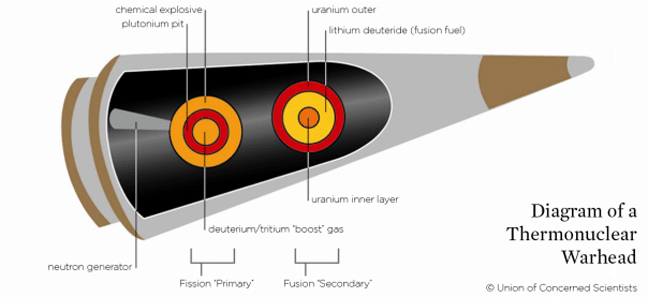
Federal officials have set a deadline of 2030 for ramped-up production of plutonium pits. The work will be split between Los Alamos National Laboratory in northern New Mexico and the Savannah River Site in South Carolina. Lawyers for the Natural Resources Defense Council, Nuclear Watch New Mexico, Savannah River Site Watch and Tri-Valley Communities Against a Radioactive Environment threatened legal action in a letter sent this week to officials. In June, the National Nuclear Security Administration said it would prepare an environmental impact statement on pit-making at Savannah River. A less extensive review was planned for Los Alamos this week .
|
|
Unrepentant, Catholic anti-nuclear activists face gaol for breaking into a nuclear base
|
In April of last year, on the 50th anniversary of the assassination of the Rev. Martin Luther King Jr., a group of seven aging Catholic activists assembled outside the Kings Bay Naval Submarine Base in St. Marys, Ga., and cut a padlock at a maintenance gate. They were in no rush. It was nighttime. No one was around. And they knew from previous actions that stealing their way onto a nuclear weapons facility was actually quite easy. So before cutting the padlock, they stopped to pray and to photograph themselves carrying three banners protesting nuclear arms. They proceeded to the next security fence, assembled for another photo and then, using bolt cutters, cut the fence. At that point, they had broken into a U.S. Navy base that houses six Trident submarines carrying hundreds of nuclear weapons, many of which have up to 30 times the explosive power of the bomb that destroyed the Japanese city of Hiroshima in 1945. The activists split into three groups: One headed to the base’s administrative building, where the members spilled blood on Navy insignia affixed to a wall and spray-painted anti-war slogans on the walkway; another ran to a monument to nuclear warfare to bang the statuary with hammers. The third group went to an area near a set of storage bunkers for nuclear missiles, where the activists prepared to cut the heavily electrified fence with bolt cutters fitted with rubber handles. At that point, roughly an hour after they first entered the base, emergency lights started flashing and they knew they had been caught. The Kings Bay Plowshares 7, as they are known, each faces a possible 25-year prison sentence, charged with three felonies and a misdemeanor. On Aug. 7, they are scheduled to appear in federal court for oral arguments, followed by a trial at a later date. At a time when many faith-based social activists have moved on to other issues — refugees, poverty, abortion and climate change — these Catholic pacifists aim to draw attention to the most ominous threat facing human civilization: nuclear weapons and the danger of global annihilation. “What kind of world are leaving our children?” asked Patrick O’Neill, 63, one of the activists, who runs a Catholic Worker house in Garner, N.C., and is out on bail but wearing an ankle monitor. “Now is a good time to say, ‘Don’t go to sleep. Don’t think these weapons are props.’ We’re on alert 24/7.” Crusading against nuclear weapons has become a lonely battle. For most Christians, like most Americans, it is a distant concern. “Those who do take this seriously are few and far between and wouldn’t represent anything like a mass movement within American Christianity,” said Tyler Wigg-Stevenson, an Anglican priest who formerly led the World Evangelical Alliance’s nuclear weapons task force. “Then you have these incredible saints that believe so strongly they’re willing to do these prophetic acts.” A vision of peace The Kings Bay Plowshares 7 are part of a 39-year-old anti-nuclear movement called Plowshares, inspired by the pacific prediction of the biblical prophet Isaiah that the nations of the world shall “beat their swords into plowshares.” Its activists have made a signature of breaking into nuclear weapons bases to hammer on buildings and military hardware and pour human blood on them. They’ve been at it since 1980, when a group led by the brothers Philip and Daniel Berrigan, both Catholic priests, broke into Building No. 9 at a General Electric weapons plant in King of Prussia, Pa. The Plowshares 8, as they were called, hammered on some missile nose cones and spilled blood on some blueprints. They were found guilty and sentenced to prison. The Berrigans had first come to national attention during the anti-Vietnam protests of the 1960s for burning draft records. But by the 1980s, the era of direct nonviolent action had peaked, replaced by more conventional tactics such as rallies, petitions and media campaigns. Plowshares remained one of the only groups to extend their confrontational but nonviolent tactics into the no-nukes activism. All seven of the Kings Bay defendants are members of the Catholic Worker movement, a collection of about 200 independent houses across the country that feed and house the poor. Among them are the Rev. Stephen Kelly, 70, a Jesuit priest; Elizabeth McAlister, 79, a former nun; and Martha Hennessy, 64, granddaughter of Dorothy Day, who founded the Catholic Worker in 1933 and was an ardent pacifist. The seven spent nearly two years plotting their invasion of the base, planning between rounds of prayer. There was no one event that prompted the group, though some have cited the U.S. withdrawal from the 2015 Iran nuclear weapons treaty and escalating tensions with that country as a factor. More than anything, the group wanted to bring renewed attention to an issue that no longer inspires much public concern: the possibility of a nuclear weapons catastrophe, whether through war, terrorism or human error. The seven set their sights on Kings Bay, about 40 miles north of Jacksonville, Fla., because it houses a quarter of the nation’s nuclear weapons cache and because there had never been a Plowshares action there. “I have no doubt that nuclear weapons will be detonated,” said O’Neill. “I don’t know if it’s going to be by a terrorist or by accident. How do we wake people up?” Several said they had no regrets. All seven had been jailed before and were fully aware they faced yearslong prison sentences this time around, too. “There’s never been a single case in which I’ve been arrested that I’m not proud of what I’ve done or would not defend to this day,” said Carmen Trotta, one of the seven who has participated in numerous civil rights demonstrations. He helps run the St. Joseph Catholic Worker House in New York, one of the original sites established by Day in the area of Manhattan historically known as the Bowery. Facing jail time To these Catholics, church teachings on nuclear weapons are clear: They are morally unacceptable. The group welcomed Pope Francis’ recent statement in which he appeared to say that even possession of nuclear weapons for deterrence purposes was wrong. “Do we really want peace?” Francis tweeted last year. “Then let’s ban all weapons so we don’t have to live in fear of war.” So determined is the group that three of the seven activists — Kelly, McAlister and Mark Colville — declined to accept the conditions of the bail offered them (an ankle monitor and $50,000 bail) and have remained in the Glynn County Detention Center in Brunswick, Ga., since the break-in 15 months ago. That’s not to say they welcome their prison sentence. They have asked for dismissal of the charges because they say nuclear weapons are illegal under U.S. treaty law as well as international law and, using the Religious Freedom Restoration Act, they argue the government must take their assertions of sincere religious exercise seriously. Judges have never imposed maximum sentences against Plowshares activists, and the defendants are praying for the same leniency this time. With the exception of Trotta, who is 56, the others are in their 60s and 70s and dealing with various medical problems. “I’ll be relieved if I get one year,” said Trotta. “Two years is a lot harder. Three years is hard to imagine. Five years is unimaginable. But it’s quite possible. ” Still, they view any prison sentence as a form of witness to what Colville called the “criminal justice industrial complex” and as a way to minister to those confined in it. Prison, Colville wrote in a letter from jail, “provides the incredible daily privilege of walking with Jesus in the person of the prisoner, and of seeing the world the way he did: from the perspective of the bottom.” Prophetic witness or pride?Plowshares actions — there have been about 100 — take planning and volunteer expertise. “You can’t pull it off, just the seven of us,” said O’Neill. Others helped with logistics, too, but the defendants deflected questions about details, careful not to tip off the government to their conspirators. They took equal care in every detail of the action. Hennessy carried a copy of Pentagon-official-turned-peace-activist Daniel Ellsberg’s 2017 book, “The Doomsday Machine: Confessions of a Nuclear War Planner,” in her raincoat pocket. As planned, she left it in the base’s administrative building. O’Neill secured hammers from Christian social activist Shane Claiborne that were made of steel melted down from guns returned through law-enforcement exchange programs. O’Neill used one on the nuclear monument display at the base, which he refers to as a shrine to an idol. Even the words the activists spoke as security forces arrived to arrest them were carefully selected and memorized: “We come in peace. We mean you no harm. We’re American citizens. We are unarmed.” All seven served two months in jail after their arrests April 5, 2018, before the federal courts allowed them the option of bail. Now they turn their sights to the upcoming trial. Magistrate Benjamin Cheesbro of the Southern District Court of Georgia has recommended that the motions to dismiss the charges, including the Religious Freedom Restoration Act argument, be denied. The seven are appealing. O’Neill, who is representing himself, said he doesn’t want an adversarial relationship with Cheesbro. And when he meets U.S. District Court Judge Lisa Godbey Wood before their trial, he’ll tell her what he told Cheesbro: “The way I feel is, there’s a fine line between prophetic witness and pride. If what we have done is prophetic witness, then it’s of God. But if it’s a matter of pride, then this whole act was fraudulent,” he said. “I spent a year and a half with these people prayerfully preparing for this action, and I believe our intention was to serve God.” https://www.sltrib.com/religion/2019/07/10/awaiting-trial-breaking/ |
|

Fraud, money-laundering, convictions of staff at Israel’s Dimona nuclear reactor
The Beersheba District Court has convicted three persons engaged by Israel’s nuclear research agency in Dimona of an NIS 3.2 million fraud scheme, including also money-laundering and breach of trust.
Announced for the first time by the court spokesperson’s office on Wednesday, the convictions and jail sentences of the three were actually handed down in April and earlier, but were under gag order due to the implications for national security.
Unlike a normal case probed by police, the investigation was led by a special division in the Defense Ministry which eventually worked with a special team in the state prosecution – again all due to the extreme sensitivity of all issues related to Dimona.
Israel has never confirmed that it has nuclear weapons, but according to foreign sources, the Dimona reactor has been used to produce between 80-200 nuclear weapons which Israel can deploy by land, sea and air.
Unlike a normal case probed by police, the investigation was led by a special division in the Defense Ministry which eventually worked with a special team in the state prosecution – again all due to the extreme sensitivity of all issues related to Dimona.
Combined, the court fined those companies or seized assets worth NIS 450,000.
A statement by the Justice Ministry said that some of the defendants had appealed the decision to the Supreme Court. …….
USA court deliberates on whether or not global warming violates children’s rights

 US court weighs if climate change violates children’s rights Business Mirror, By The Associated Press, June 10, 2019 PORTLAND, Oregon—In a courtroom packed with environmental activists, federal judges wrestled last week with whether climate change violates the constitutional rights of young people who have sued the US government over the use of fossil fuels.
Sweden’s Uppsala District Court rules against extraditing Assange to Sweden
Sweden’s Uppsala District Court has found in favour of Assange: the court ruled NOT to detain Assange in absentia. The preliminary investigation can proceed without Assange’s extradition to Sweden. This was always the case as Assange has always cooperated with the investigation.
Suzie Dawson on Julian Assange’s mistreatment #FreeAssange
1 This Month
10 March A LIVE WEBINAR THE REAL EFFECTS OF NUCLEAR POWER
What the Industry Isn’t Telling Us
1:00 PM Mountain, 2 pm Central, 3 pm Eastern. Live on the Keepers of the Water Facebook page



18 March Webinar @ 1 PM EST: An Assessment of SMR Projects: The Case of Canada
register for the zoom:
https://us02web.zoom.us/webinar/register/WN_o8BIIOUvQ2ONJR1nta65DQ#/registration


of the week – STOP SMALL MODULAR REACTORS IN CANADA
To see nuclear-related stories in greater depth and intensity – go to https://nuclearinformation.wordpress.com
-
Archives
- March 2026 (109)
- February 2026 (268)
- January 2026 (308)
- December 2025 (358)
- November 2025 (359)
- October 2025 (376)
- September 2025 (258)
- August 2025 (319)
- July 2025 (230)
- June 2025 (348)
- May 2025 (261)
- April 2025 (305)
-
Categories
- 1
- 1 NUCLEAR ISSUES
- business and costs
- climate change
- culture and arts
- ENERGY
- environment
- health
- history
- indigenous issues
- Legal
- marketing of nuclear
- media
- opposition to nuclear
- PERSONAL STORIES
- politics
- politics international
- Religion and ethics
- safety
- secrets,lies and civil liberties
- spinbuster
- technology
- Uranium
- wastes
- weapons and war
- Women
- 2 WORLD
- ACTION
- AFRICA
- Atrocities
- AUSTRALIA
- Christina's notes
- Christina's themes
- culture and arts
- Events
- Fuk 2022
- Fuk 2023
- Fukushima 2017
- Fukushima 2018
- fukushima 2019
- Fukushima 2020
- Fukushima 2021
- general
- global warming
- Humour (God we need it)
- Nuclear
- RARE EARTHS
- Reference
- resources – print
- Resources -audiovicual
- Weekly Newsletter
- World
- World Nuclear
- YouTube
-
RSS
Entries RSS
Comments RSS
 nuclear-news