There’s a scene in the hit movie “Oppenheimer” that has a hidden St. Louis connection.
As J. Robert Oppenheimer gathers his group of Manhattan Project scientists at Los Alamos, New Mexico, he lets them in on a secret. They don’t have enough uranium or plutonium to test a potential atomic bomb, even if they figure out how to create one.
Sitting on the desk in front of him are two glass containers — a large fish bowl and a smaller brandy snifter. One by one, Oppenheimer drops marbles into the glass — plink, plink, plink — marking the growth in processing the deadly elements.
The character doesn’t mention St. Louis in the movie. But the city is where some of that initial uranium was developed. And after World War II, St. Louis became a major source of the uranium processing for missiles during the Cold War arms race.
In the Christopher Nolan-directed movie, the scientists celebrate when the final marble plinks into the glass bowl to show they have enough uranium for their task, much as they celebrate when the bomb test is successful. They celebrate again when the bomb is dropped, first on Hiroshima and then on Nagasaki, killing hundreds of thousands of Japanese civilians and ending the war.
The celebrations are muted, at least for Oppenheimer and many of the scientists, once they realize the impact of what they — and the politicians they serve — have done.
The story reverberates today.
Once every generation, it seems, members of Congress realize all over again that the people of our region — the workers who toiled at Mallinckrodt Chemical Works plants, and the folks who grew up in areas where some of that nuclear waste was buried, such as along Coldwater Creek in north St. Louis County — suffered serious maladies for their role in the war effort.
Three generations of activists — Kay Drey, Denise Brock and the co-founders of Just Moms STL, Dawn Chapman and Karen Nickel — have sounded alarm bells about the damage that the processing of nuclear material and its waste had on people.
Like the story of Oppenheimer, it’s one that has to be told over and over again because the legacy of the Manhattan Project is ongoing. It’s a story of patriotism and death; of moral ambiguity and the pain of unintended consequences.
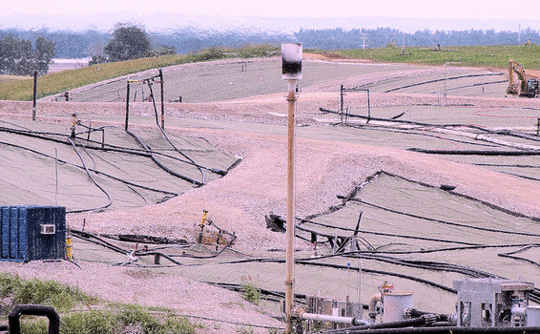
So it was in late May, when I was at the Weldon Spring Interpretive Center for the rededication of a memorial that honors workers who died from maladies related to the processing of nuclear materials. The remodeled museum sits beside a massive pile of gray stone, piled high like so many marbles in a glass jar, protecting future generations from the nuclear waste buried there.
Veterans who attended the memorial were thanked for their service. Family members of the workers waved American flags. But the Rev. Gerry Kleba, a Catholic priest, also reminded folks of the somber reason for the occasion. He recounted the estimated 200,000 deaths in Japan, and the local deaths from various illnesses. He repeated the quote that haunted Oppenheimer and was repeated in the recent movie: “Now I am become death, the destroyer of worlds.”
This month, there was another event at Weldon Spring, this one with the Just Moms STL crowd. Sen. Josh Hawley, a Republican, pushed for a bill — also supported by Rep. Cori Bush, a Democrat — to create a new flow of compensation for St. Louis families who have suffered because of the city’s connection to the nuclear weapons program. The push comes on the heels of recent reporting from The Missouri Independent, The Associated Press, and MuckRock, reinforcing what Drey has argued for more than a generation: the government knew it was poisoning the Earth, and workers and residents, in its rush to build weapons.
Who pays the price?
That’s a question that tortured Oppenheimer. It’s the question before Congress again and a new generation of St. Louisans, learning about the city’s past, buried under a pile of rocks that sits as a monument to the past.
A fragile ceasefire halted the Korean War 70 years ago. With nuclear tensions rising and the environment under threat, it’s time to end it for good.
July 27 marked 70 years since the signing of the armistice that halted — but did not end — the Korean War. Since then, the divided Peninsula has been locked in a perpetual state of war that grows ever more dangerous.
While much attention is paid to North Korea’s nuclear program and aggressive rhetoric, Americans also need to understand how the U.S. government’s actions exacerbate tensions — and why we have a critical role to play in ending this war.
To start, we must remember the central role of the U.S. in the Korean War — and just how destructive the fighting was.
Former Secretary of State Condoleezza Rice has described the war as an example of what a “successful” U.S. war can “achieve.” Other talkingheads have made similarclaims, offering the war as a model for how to proceed in Ukraine. This revisionism is dangerous.
The Korean War killed over 4 million people, more than half of them civilians. From 1950 to 1953, the U.S. dropped 32,000 tons of napalm and 635,000 tons of bombs — more than were dropped in the Pacific theater in World War II. The U.S. military showed “next to no concern for civilian casualties,” historian Bruce Cummings notes, burning 80 percent of North Korea’s cities to the ground.
Even after this mass destruction, the Peninsula is still at war today — with ongoing consequences for Koreans on both sides of the DMZ.
In Hawai’i, leaking jet fuel from Navy storage tanks has contaminated drinking water for thousands of families. And next year, the U.S. will hold the Rim of the Pacific (RIMPAC), the largest annual maritime warfare exercise, in the state. Past exercises killed untold scores of marine life.
To avert nuclear war and protect our environment, Americans must demand an end to the growing U.S. military presence around the world and rein in our nearly $900 billion military budget. Our grassroots peace movement continues to grow, leading to the introduction of the Peace on the Korean Peninsula Act (H.R. 1369), which now has nearly 40 co-sponsors.
To end the Korean War, we need individuals with all skillsets — storytellers, community builders, healers, and more — working in concert. We must educate our communities, fight for change, and together build peace in Korea and across the world.
On July 16, 1979, the worst accidental release of radioactive waste in U.S. history happened at the Church Rock uranium mine and mill site. While the Three Mile Island accident (that same year) is well known, the enormous radioactive spill in New Mexico has been kept quiet. It is the U.S. nuclear accident that almost no one knows about. Just 14 weeks after the Three Mile Island reactor accident, and 34 years to the day after the Trinity atomic test, the small community of Church Rock, New Mexico became the scene of another nuclear tragedy.
The West Lake Landfill contamination was discovered in 1974. It was designated a Superfund site in 1990, and there is still no date certain for when the cleanup will begin.
For kids like Sandy Mitchell, Ted Theis and Janet Johnson, childhood in the North St. Louis County suburbs in the 1960s and ‘70s meant days playing along the banks or splashing in the knee-deep waters of Coldwater Creek.
They caught turtles and tadpoles, jumped into deep stretches of the creek from rope swings and ate mulberries that grew on the banks.
Their families — along with tens of thousands of others — flocked to the burgeoning suburbs and new ranch style homes built in Florissant, Hazelwood and other communities shortly after World War II. When the creek flooded, as it often did, so did their basements. They went to nearby Jana Elementary School and hiked and biked throughout Fort Belle Fontaine Park.
Growing up, they never knew they were surrounded by massive piles of nuclear waste left over from the war.
Generations of children who grew up alongside Coldwater Creek have, in recent decades, faced rare cancers, autoimmune disorders and other mysterious illnesses they have come to believe were the result of exposure to its waters and sediment.
“People in our neighborhood are dropping like flies,” Mitchell said.
The earliest known public reference to Coldwater Creek’s pollution came in 1981, when the U.S. Environmental Protection Agency listed it as one of the most polluted waterways in the U.S.
By 2016, the Centers for Disease Control and Prevention was advising residents to avoid Coldwater Creek entirely. Cleanup of the creek is expected to take until 2038. A federal study found elevated rates of breast, colon, prostate, kidney and bladder cancers as well as leukemia in the area. Childhood brain and nervous system cancer rates are also higher.
“Young families moved into the area,” Johnson said, “and they were never aware of the situation.”
Theis, who grew up just 75 yards from the creek and played in it daily, died in August at the age of 60 from a rare cancer. Mitchell is a breast cancer survivor whose father died from prostate cancer. Johnson’s sister has an inoperable form of glioblastoma and other family members, including her father, daughter and nephew, have had various cancers.
Families who lived near Coldwater Creek were never warned of the radioactive waste. Details about the classified nuclear program in St. Louis were largely kept secret from the public. But a trove of newly-discovered documents reviewed by an ongoing collaboration of news organizations show private companies and the federal government knew radiological contamination was making its way into the creek for years before those findings were made public.
Radioactive waste was known to pose a threat to Coldwater Creek as early as 1949, records show. K-65, a residue from the processing of uranium ore, was stored in deteriorating steel drums or left out in the open near the creek at multiple spots, according to government and company reports.
A health expert who, as part of this project, was recently presented with data from a 1976 test of runoff to the creek concluded it showed dangerous levels of radiation 45 years ago.
Federal agencies knew of the potential human health risks of the creek contamination, the documents show, but repeatedly wrote them off as “slight,” “minimal” or “low-level.” One engineering consultant’s report from the 1970s incorrectly claimed that human contact with the creek was “rare.”
The Missouri Independent, MuckRock and The Associated Press spent months combing through thousands of pages of government records obtained through the Freedom of Information Act and interviewing dozens of people who lived near the contaminated sites, health and radiation experts and officials from government agencies.
Some of the documents, obtained by a nuclear researcher who focuses on the effects of radiation, had been newly declassified in the early 2000s. Others had been previously lost to history, packed away in government archives and not released publicly until now. (Read the documents here and learn more about our methodology here.)
All told, the documents from the now-defunct Atomic Energy Commission; its successors, the U.S. Department of Energy and the Nuclear Regulatory Commission; and the Environmental Protection Agency span the 75-year lifespan of the nuclear saga in St. Louis.
It starts in downtown St. Louis, where uranium was processed, and at the St. Louis airport, where it was stored at the end of the war; a monthslong move of the waste to industrial sites on Latty Avenue in suburban Hazelwood and a quarry in Weldon Spring, next to the Missouri River; an illegal dumping of waste at the West Lake Landfill in Bridgeton in the 1970s by a private company; and the declaration of the landfill as a federal toxic Superfund site in 1990.
Since then, the contaminated sites have been subjected to a seemingly endless cycle of soil, air and water testing, anxious community meetings attended by an ever-growing chorus of angry residents and panic when a subsurface smoldering event, similar to an underground fire, at the Bridgeton landfill threatened the radioactive waste buried nearby. That fire sent noxious and hazardous fumes into surrounding neighborhoods. The company in charge of the Bridgeton landfill now spends millions a year to contain it.
The documents have a familiar cadence: Year after year, decade after decade, government regulators and companies tasked with cleaning up the sites downplayed the risks posed by nuclear waste left near homes, parks and an elementary school. They often chose not to fully investigate the potential harms to public health and the environment around St. Louis………………………………………………………………………………………………………………………………………………
Illegal dumping of radioactive waste
When the Atomic Energy Commission sold the remnant nuclear waste, it anticipated being able to get rid of the more than 100,000 tons of toxic residues without spending any money.
The first company to purchase the waste, Continental Mining and Milling Co. of Chicago, borrowed $2.5 million to buy it in 1966 and then, shortly after, went bankrupt. Continental’s lender, Commercial Discount of Chicago, re-purchased the waste at auction for $800,000 and, after failing to get a bidder at a second auction, sold it to the Cotter Corp. To turn a profit, Cotter would ultimately dry the material and ship it to its uranium mill plant in Cañon City, Colorado………………………………………………………….
Cotter asked the government to bury the waste at Weldon Springs multiple times, in the late 1960s and early 1970s, but were rebuffed each time, meeting minutes show.
So, over a period of 2 ½ months in the summer and fall of 1973, Cotter took the problem into its own hands, without telling government regulators.
The company mixed the radioactive waste with tens of thousands of tons of contaminated soil from the site and illegally dumped it in a free, public landfill called West Lake, under three feet of soil and other garbage……………………………..
The AEC released Cotter from its St. Louis permit without immediate sanctions in 1974, but the company is partially responsible for the cleanup costs at the site.
Cotter’s parent company, General Atomics, did not respond to multiple requests for comment……………………………………………………………….
‘Tip of the iceberg’
In 1999, when Robbin Dailey moved into Spanish Village, a neighborhood of only a few dozen homes with its own park less than a mile from the back side of West Lake Landfill, she had no idea she was living next to a Superfund site.
When the EPA decided initially in 2008 to cap the waste at West Lake and leave it in place, Dailey never heard about the plan. Two years later, in 2010, she was alerted to the radioactive waste when a “subsurface smoldering event” — a type of chemical reaction that consumes landfilled waste like a fire but lacks oxygen — sent a pungent stench into the air around her home.
Dailey and her husband had their house tested and found thorium in the dust at hundreds of times natural levels. They sued the landfill’s owners, Republic Services, as well as the Cotter Corp. and Mallinckrodt.
Dailey said she and the companies had “resolved” their legal issues, but she, like all of the residents in North St. Louis County, was still in the dark about where within the landfill site the waste actually was.
Court records reveal a bevy of lawsuits against the private companies involved, at various times, with the West Lake Landfill. Not only that, but the landfill operators sued Mallinckrodt in an attempt to force the maker of the radioactive waste to pay for part of the cleanup.
Since the late 1970s, federal regulators repeatedly failed to uncover the true extent of contamination at West Lake.
In October 1977, the Nuclear Regulatory Commission used a helicopter to take hour-long passes back and forth over the landfill from an altitude of 200 feet. The goal was to measure gamma radioactivity coming from the site using specialized equipment.
While the effort correctly identified two areas with high levels of radiation, it had serious limitations, experts say. A survey of that type can miss contamination if it’s buried deep underground or if the ground is obstructed by vegetation.
The agency looked at the dates on newspapers above and below the radioactive waste in two areas of the site previously thought to be uncontaminated to approximate when it was dumped, said Chris Jump, the EPA’s lead remedial project manager for the site.
It’s likely been there the whole time.
…………………………… Dawn Chapman, who left her job and co-founded Just Moms STL to advocate for the community around the landfill, said the EPA used to treat her and other activists like their fears were hysterical.
………………
A staffer with the Missouri Department of Natural Resources wrote in 1980 that contamination at the landfill was more severe and widespread than previously thought. In 1986 and 1990, onsite sampling showed possible radiological contamination in the groundwater in areas outside the sections of the landfill thought to be radioactive.
In 1987, the state classified the landfill as a hazardous waste site. The radioactive waste was in direct contact with the groundwater, the agency said in its annual report.
“Based on available information, a health threat exists due to the toxic effects of chemicals and low-level uranium wastes buried at the site and the possibility that off-site migration of these materials might occur,” the agency wrote.
…………………………. The West Lake Landfill contamination was discovered in 1974. It was designated a Superfund site in 1990, and there is still no date certain for when the cleanup will begin.
…………………………………….. Back to the drawing board
EPA’s first plan for the site would not have included moving the radioactive waste at all.
In 2008, the Environmental Protection Agency approved a plan for the landfill’s “primarily responsible parties” — the government and private contractors responsible for the site — to place a cap over the landfill and leave the waste in place.
Following criticism from the surrounding communities, EPA asked the Department of Energy, the Cotter Corp. and the landfill’s owner, Republic Services, to test the site again.
In the meantime, an underground fire brought a new level of scrutiny.
Starting in 2010, the Bridgeton landfill, which sits adjacent to the West Lake Landfill, has been experiencing a subsurface smoldering event.
………………………………………………….. The depth and severity of the new contamination the EPA found is not yet clear. The agency is preparing to release a report that will include the readings, a spokesperson said. A remedial design portion of the project is underway, the last step before the excavation begins.
But EPA doesn’t have a date certain as to when work on the project might start.
Curtis Carey, a spokesperson for the EPA, said despite decades of delays, the agency is planning next steps for the landfill “with a great deal more information because of our purposeful approach than was available 10, 15, 20 years ago.”
The following people contributed reporting, writing, editing, document review, research, interviews, photography, illustrations, analysis and project management. Chris Amico, Dillon Bergin, Kelly Kauffman and Derek Kravitz of MuckRock; Jason Hancock, Allison Kite and Rebecca Rivas of The Missouri Independent; Michael Phillis and Jim Salter of The Associated Press; Sarah Fenske, Theo Welling, Tyler Gross and Evan Sult of the Riverfront Times; EJ Haas, Madelyn Orr, Sydney Poppe, Mark Horvit and Virginia Young of the University of Missouri; Katherine Reed of the Association of Health Care Journalists; Liliana Frankel, Erik Galicia, Laura Gómez, Lauren Hubbard, Sophie Hurwitz and Steve Vockrodt; and Gerry Everding and Carolyn Bower of the original St. Louis Post-Dispatch team that published the seven-part “Legacy of the Bomb” series in 1989.https://www.muckrock.com/news/archives/2023/jul/12/st-louis-landfill-toxic-superfund/
New film spotlights women’s experiences with the Three Mile Island nuclear accident
By Karl Grossman
Radioactive: The Women of Three Mile Island is the title of a newly-released documentary feature film directed, written and produced by award-winning filmmaker Heidi Hutner, a professor of environmental humanities at Stony Brook University, a “flagship” school of the State University of New York.
With greatly compelling facts and interviews, she and her also highly talented production team have put together a masterpiece of a documentary film.
It connects the proverbial dots of the 1979 Three Mile Island nuclear plant disaster—doing so brilliantly.
The documentary has already received many film awards and has had a screening in recent months in New York City—winning the “Audience Award for Best Documentary” at the Dances With Films Festival—and Harrisburg, Pennsylvania; Sarasota, Florida; Dubuque, Iowa; Long Island, New York; First Frame International Film Festival in New York City; the Environmental Film Festival in Washington D.C., and is soon the featured film at Kat Kramer’s #SHEROESForChange Film Festival in Los Angeles and the Cinequest Film Festival in San Jose, California, as well as the Uranium Film Festival in Rio de Janeiro in Brazil. And there will be tours across the U.S.
Resident after resident of the area around Three Mile Island is interviewed and tells of widespread cancer that has ensued in the years that have followed the accident—a cancer rate far beyond what would be normal. Accounts shared in the documentary are heartbreaking.
A whistleblower who had worked at the nuclear plant tells Hutner of the deliberate and comprehensive attempt by General Public Utilities, which owned TMI, to cover up the gravity of the accident and its radioactive releases, especially of cancer-causing Iodine-131 and Xenon 133.
An attorney, Lynne Bernabei, involved in litigation in the wake of the accident, says the Three Mile Island “cover-up was one of the biggest cover-ups in history.” Meanwhile, the U.S. Nuclear Regulatory Commission which is “supposed to protect the public” has then and since been just “interested in is promoting the [nuclear] industry. This is corrupt,” says attorney Joanne Doroshow, now a professor at New York Law School and director of the Center for Justice & Democracy. Many examples of this are presented.
The documentary’s focus on women includes women being far more at risk to the effects of radioactivity than men. Mary Olson, a biologist, founder, and director of the Gender & Radiation Impact Project, says in the film that those setting radiation standards in the U.S. from the onset of nuclear technology in 1942, based impacts on a “25 to 30 years-old” male “defined as Caucasian.” She said, “It has come to be known as the ‘Reference Man.” However, Olson cites research findings that “radiation is 10 times more harmful to young females” and “50 percent more harmful to a “comparable female” than it is to “Reference Man” who is “more resistant” to radioactivity than a woman.
There’s the scientist Dr. Aaron Datesman, who is now pursuing a major chromosomal study regarding the impact of the disaster on the health of people in the area and how people have been harmed despite the denials of the nuclear industry. This study is based on his recent ground-breaking work, “Radiological Shot Noise,” in Nature.
1 The fate of arms has decided. The moment of truth has spoken. The Ukrainian counter-offensive has failed miserably. NATO’s considerable armaments were useless. The battlefield is littered with corpses. All for nothing. The territories that joined the Russian Federation by referendum will remain Russian.
This “checkmate” not only marks the end of Ukraine as we have known it, but of Western domination that had staked its future on its lies. The multipolar world may be born this summer at several international summits. A new way of thinking in which might no longer makes right.
This article was written on June 10. At that time, the only information available came from Russia and allied headquarters. Ukraine had imposed a total embargo on its counter-offensive. We should therefore have waited before publishing this text. However, we felt that if Ukraine had been able to break through Russia’s first line of defense, even if it hadn’t managed to get into the breach, it would have let us know. We are therefore publishing this analysis.
In six days, from June 4 to 10, 2023, the Ukrainian army launched its counter-offensive and suffered a terrible defeat.
During the summer, Russian forces built two defense lines in the part of Novorossia they liberated and in the Donbass. They prevent the passage of all armored vehicles.
Ukrainian forces have chosen a dozen points of attack to retake “enemy-occupied” territory. Their armored vehicles were unable to get through the first line of Russian defenses and piled up in front of it, where they were destroyed one by one by Russian artillery and suicide drones.
At the same time, the Russian army targeted missiles at command centers and arsenals inside Ukrainian territory and destroyed them.
The Ukrainian air defense system was destroyed by hypersonic missiles as soon as it was installed. In its absence, the Ukrainians were unable to carry out the maneuvers planned by Nato.
Russia did not use any of its new weapons, apart from its NATO weapons jamming system and some of its hypersonic missiles.
The border is now a long graveyard of tanks and men. Airports are full of smoking Mig-29 and F-16 wrecks.
The staffs of the United States, the Atlantic Alliance and Ukraine are passing the buck for this historic disaster. Hundreds of thousands of human lives and 500 billion dollars have been wasted for nothing. Western weapons, which shook the world in the 90s, are now worthless compared to the Russian arsenal of today. Strength has changed sides.
Two conclusions can already be drawn:
DO NOT CONFUSE THE UKRAINIAN ARMY WITH THE “INTEGRAL NATIONALISTS”
While there is no longer a Ukrainian army capable of high-intensity warfare, there are still the forces of the “integral nationalists” (sometimes called “Banderists” or “Ukrainian-Nazis”). But they are only trained for low-intensity warfare. Its leaders went to fight in Chechnya in the late 90s on behalf of the CIA and NATO secret services, and sometimes in Syria in the 2020s. They are trained in targeted assassinations, sabotage and civilian massacres. Nothing more.
They succeeded 1. In sabotaging the Russian-German-French-Dutch Nord Stream gas pipeline, plunging Germany and then the European Union into recession on September 26, 2022. 2. In sabotaging the Kerch Strait bridge (known as the “Crimean Bridge”), on October 8, 2022. 3. In attacking the Kremlin with drones, May 3, 2023 4. In using drones to attack the Ivan Kurs, the intelligence vessel defending the Turkish Stream gas pipeline in the Black Sea, on May 26, 2023. 5. In sabotaging the Kakhovka dam to split Novorossia in two, on June 6, 2023. 6. In sabotaging the Togliatti-Odessa ammonia pipeline to destroy the Russian mineral fertilizer industry, on June 7, 2023.
Just as in the two World Wars and the Cold War, they proved their terrorist capabilities, but played no decisive role on the battlefield.
Now more than ever, we need to distinguish between Ukrainians who thought they were defending their people, and the “integral nationalists” [1], who don’t care about their compatriots and have been trying for a century to eradicate Russians and their culture.
THE UKRAINE WE KNEW IS DEAD
Until now, Ukraine has been above all a power of communication. Kiev succeeded in making people believe that the 2014 coup d’état that overthrew a democratically elected president in favor of integral nationalists was a revolution. Likewise, it has managed to make people forget the way it crushed its citizens in the Donbass, refusing to give them access to public services, to pay civil servants’ salaries and pensions to the elderly and, ultimately, bombing its cities. Finally, it succeeded in convincing Westerners that Ukraine was a homogenous country with a single population living a common history.
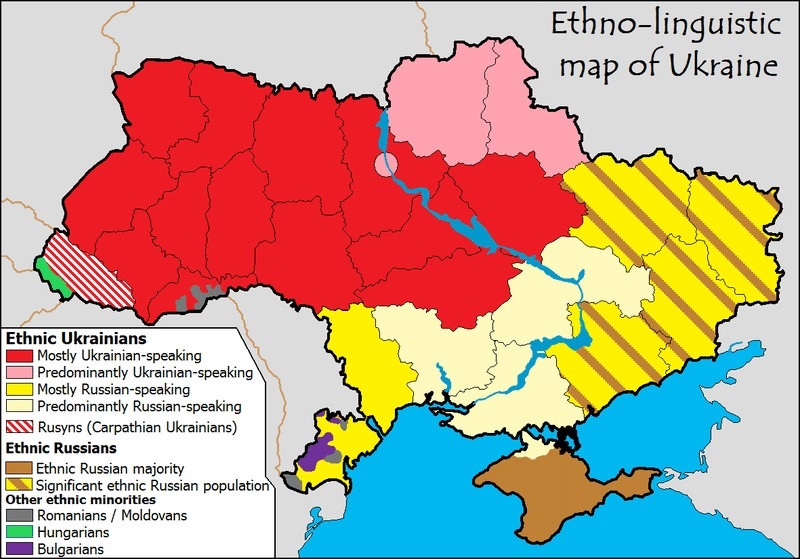
As in most wars, there is also a “civil war” aspect [2]. Today, everyone can see that, contrary to what was claimed, Vladimir Putin’s analysis was not a reconstruction of history, but a factual truth. The people of Donbass are profoundly Russian. The people of Novorossia (including Crimea) are of Russian culture, albeit with a different history (they have never known serfdom). Ukraine has never existed as an independent state in history, apart from one decade, during the periods 1917-22 and 1941-45, and three other decades, since 1991.
During these three experiences, Kiev never stopped purging its people and massacring its citizens when the full nationalists were in power (1917-22 with Simon Petliura, 1941-45 with Stepan Bandera, and 2014-22 with Petro Poroshenko and Volodymyr Zelensky). In total, over the course of a century, the “integral nationalists” – as they call themselves – have murdered more than 3 million of their compatriots.
During the First World War, the people of Novorossia had already risen up around the anarchist Nestor Makhno; during the Second World War, the people of Donbass and Novorossia rose up as Soviets; while this time, they are fighting against the “integral nationalists” in Kiev with Russian forces.
The only way to stop these massacres is to separate the “integral nationalists” from the population of Russian culture they want to kill [3]. Since Nato staged a coup in 2014 and put them in power, there’s no other way but to note the country’s current division and leave them in power in Kiev. It is the Ukrainians, and they alone, who will have to overthrow them.
Current military operations have already done so. The part of the country liberated by the Russians voted in a referendum to join the Federation. However, last year’s Russian advance was halted by President Vladimir Putin as part of negotiations with Ukraine, conducted first in Belarus, then in Turkey. Odessa is still Ukrainian in law, even though it is culturally Russian. Transnistria is still Moldavian, even though it is culturally Russian.
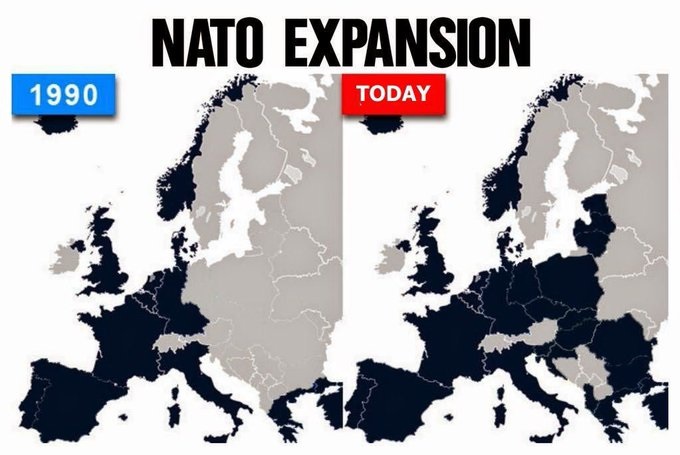
The war is technically over. No offensive can alter the current borders. Admittedly, the fighting may drag on and a peace treaty is a long way off, but the die is cast. There is still a problem in Ukraine and Moldavia: Odessa and Transnistria are still not Russian. Above all, there remains a fundamental problem: in violation of their oral and written commitments, the members of the Atlantic Alliance have stockpiled US weapons on Russia’s borders, jeopardizing its security.
By recognizing that the question of NATO enlargement is at the center of this war, we understand why U.S. weaponry will not end this war. Only diplomatic efforts can do that.
George Orwell wrote in 1984 that “Who controls the past controls the future: who controls the present controls the past.” Governments work relentlessly to distort public perceptions of the past. Regarding the Ukraine War, the Biden administration has repeatedly and falsely claimed that the Ukraine War started with an unprovoked attack by Russia on Ukraine on February 24, 2022. In fact, the war was provoked by the U.S. in ways that leading U.S. diplomats anticipated for decades in the lead-up to the war, meaning that the war could have been avoided and should now be stopped through negotiations.
Recognizing that the war was provoked helps us to understand how to stop it. It doesn’t justify Russia’s invasion. A far better approach for Russia might have been to step up diplomacy with Europe and with the non-Western world to explain and oppose U.S. militarism and unilateralism. In fact, the relentless U.S. push to expand NATO is widely opposed throughout the world, so Russian diplomacy rather than war would likely have been effective.
The Biden team uses the word “unprovoked” incessantly, most recently in Biden’s major speech on the first-year anniversary of the war, in a recent NATO statement, and in the most recent G7 statement. Mainstream media friendly to Biden simply parrot the White House. The New York Times is the lead culprit, describing the invasion as “unprovoked” no fewer than 26 times, in five editorials, 14 opinion columns by NYT writers, and seven guest op-eds!
There were in fact two main U.S. provocations. The first was the U.S. intention to expand NATO to Ukraine and Georgia in order to surround Russia in the Black Sea region by NATO countries (Ukraine, Romania, Bulgaria, Turkey, and Georgia, in counterclockwise order). The second was the U.S. role in installing a Russophobic regime in Ukraine by the violent overthrow of Ukraine’s pro-Russian President, Viktor Yanukovych, in February 2014. The shooting war in Ukraine began with Yanukovych’s overthrow nine years ago, not in February 2022 as the U.S. government, NATO, and the G7 leaders would have us believe.
Biden and his foreign policy team refuse to discuss these roots of the war. To recognize them would undermine the administration in three ways. First, it would expose the fact that the war could have been avoided, or stopped early, sparing Ukraine its current devastation and the U.S. more than $100 billion in outlays to date. Second, it would expose President Biden’s personal role in the war as a participant in the overthrow of Yanukovych, and before that as a staunch backer of the military-industrial complex and very early advocate of NATO enlargement. Third, it would push Biden to the negotiating table, undermining the administration’s continued push for NATO expansion.
The archives show irrefutably that the U.S. and German governments repeatedly promised to Soviet President Mikhail Gorbachev that NATO would not move “one inch eastward” when the Soviet Union disbanded the Warsaw Pact military alliance. Nonetheless, U.S. planning for NATO expansion began early in the 1990s, well before Vladimir Putin was Russia’s president. In 1997, national security expert Zbigniew Brzezinski spelled out the NATO expansion timeline with remarkable precision.
U.S. diplomats and Ukraine’s own leaders knew well that NATO enlargement could lead to war…………………………………………………………………..
Ukraine’s leaders knew clearly that pressing for NATO enlargement to Ukraine would mean war. Former Zelensky advisor Oleksiy Arestovych declared in a 2019 interview “that our price for joining NATO is a big war with Russia.”
During 2010-2013, Yanukovych pushed neutrality, in line with Ukrainian public opinion. The U.S. worked covertly to overthrow Yanukovych, as captured vividly in the tape of then U.S. Assistant Secretary of State Victoria Nuland and U.S. Ambassador Geoffrey Pyatt planning the post-Yanukovych government weeks before the violent overthrow of Yanukovych. Nuland makes clear on the call that she was coordinating closely with then Vice President Biden and his national security advisor Jake Sullivan, the same Biden-Nuland-Sullivan team now at the center of U.S. policy vis-à-vis Ukraine.
…………………………………. Historian Geoffrey Roberts recently wrote: “Could war have been prevented by a Russian-Western deal that halted NATO expansion and neutralised Ukraine in return for solid guarantees of Ukrainian independence and sovereignty? Quite possibly.” In March 2022, Russia and Ukraine reported progress towards a quick negotiated end to the war based on Ukraine’s neutrality. According to Naftali Bennett, former Prime Minister of Israel, who was a mediator, an agreement was close to being reached before the U.S., U.K., and France blocked it.
While the Biden administration declares Russia’s invasion to be unprovoked, Russia pursued diplomatic options in 2021 to avoid war, while Biden rejected diplomacy, insisting that Russia had no say whatsoever on the question of NATO enlargement. And Russia pushed diplomacy in March 2022, while the Biden team again blocked a diplomatic end to the war.
By recognizing that the question of NATO enlargement is at the center of this war, we understand why U.S. weaponry will not end this war. Russia will escalate as necessary to prevent NATO enlargement to Ukraine. The key to peace in Ukraine is through negotiations based on Ukraine’s neutrality and NATO non-enlargement. The Biden administration’s insistence on NATO enlargement to Ukraine has made Ukraine a victim of misconceived and unachievable U.S. military aspirations. It’s time for the provocations to stop, and for negotiations to restore peace to Ukraine. https://www.commondreams.org/opinion/the-war-in-ukraine-was-provoked-and-why-that-matters-if-we-want-peace—
Received 08 Nov 2022, Accepted 17 Apr 2023, Published online: 04 May 2023
ABSTRACT
This commentary looks at how nuclear power has evolved in the last five decades since the Treaty on the Non-Proliferation of Nuclear Weapons entered into force in 1970. Using data on numbers of reactors constructed around the world, we show that the early expectations of a rapid growth of nuclear power plants around the world has not materialized. We also outline the trends in safeguards at nuclear facilities, namely the measures undertaken to prevent the diversion of fissile materials for use in nuclear weapons, and highlight the potential risks due to the rapid growth in the amount of material that could potentially be diverted.
A top-secret atomic bunker has opened to the public in Denmark. Built to withstand a nuclear attack, it’s now an astonishing subterranean museum that sheds light on Cold War paranoia.
Hidden in northern Jutland’s Rold Forest, some 400km north-west of Copenhagen, is the sprawling bunker complex of Koldrigsmuseet REGAN Vest (The Cold War Museum REGAN West). Secretly built in the 1960s at the height of Cold War tensions, this is where the Danish government and even the queen would have been evacuated if nuclear war broke out.
The plan was to run the country from inside this shelter, 60m below ground, and its very existence was kept hushed for decades until it was finally revealed in 2012. After years of preparations, it opened to the public for the first time in February 2023 as a museum. Only 50,000 visitors are permitted annually, and access has been limited to small groups of 10 on 90-minute guided tours that explore 2km of the labyrinthine bunker system. It’s an eye-opening journey into the heart of a Cold War-era time capsule…………………………………………………………………………………………………………………..
The resulting nuclear-proof bunker was a staggering 5,500sq m behemoth, shaped like two large, connected rings, each with an upper and lower floor, and more than 230 rooms that would house around 350 personnel. Mostly these would be ministers and civil servants, part of a slimmed down administration tasked with running the nation’s affairs during the darkest of times, plus a few medical staff, several journalists and a priest……………………………………………. more https://www.bbc.com/travel/article/20230501-regan-vest-inside-denmarks-secret-nuclear-bunker
Survivors of Britain’s Cold War radiation experiments are to have their life stories recorded and stored in the British Library. The £250,000 scheme will lead to a documentary and resources to teach A-level students about the Cold War and the impact the weapons testing programme had on the men who took part in it, and their families.
Dr Chris Hill, one of the academics leading the project, said: “It’s about furthering their story, embedding it deeper in the public consciousness and confronting what is a very problematic part of Britain’s history.”
More than 3,000 radioactive particles have been found at Dalgety Bay.
ALBA Party MP Neale Hanvey has called on the Ministry of Defence to clean-up radiation contamination on the Dalgety Bay shoreline.
In a statement, Hanvey added that “there can be no excuse for inaction”.
Leading a Westminster debate on the issue on Tuesday, the MP for Kirkcaldy and Cowdenbeath – the constituency which includes the West Fife town – listed and condemned what he described as a “historical backlog in remediation”.
Radioactive material was first detected at Dalgety Bay in 1990 and came from WW2 planes, which had aircraft dials coated in radium to help pilots see in the dark.
More than 3,000 radioactive particles, with a half-life of 1,600 years, have been found on the beach and next to Dalgety Bay Sailing Club.
Restrictions were put in place in 2011, with parts of the beach fenced off.
The MoD admitted responsibility for the radioactive pollution in 2014. But plans to tackle the issue have frequently been delayed.
Balfour Beatty took on a £10.5 million contract in 2020 but decontamination work didn’t get under way until May 2021 and hasn’t yet been completed.
Hanvey has repeatedly condemned the Ministry of Defense for continued silence and delays in tackling the issue.
At the debate, Hanvey asked the Minister for Defence Procurement, Alex Chalk, for further clarification as to when the work would be completed, the costs incurred and whether they will be fully covered by the MoD.
Chalk said the cost would be around £15 million. He said that the costs would be be met by the MoD, but added: “I stress that there was absolutely no legal requirement on the Ministry of Defence to do so. However, we decided to take that step.”
Chalk also stressed that many of the delays were unforeseen, including having to “search through many tonnes of sand and soil for minute radioactive particles”.
The AUKUS agreement attempts developments that will shift Australia into a zone that will threaten the existence of Australia itself.
I am not merely thinking of the militarisation of Australia, although that is definitely one likely outcome. I also have in mind our way of life that, while still set in settler-colonial assumptions that give First Nations people no substantial value in Australian society, is relatively relaxed when compared with the way of life of people in the United States. Australia has not experienced the focus upon security that high-powered militarisation associated with nuclear weapons brings. This is the world our leaders are leading us towards.
I want to take up two lines of inquiry into Aukus in this brief article. Firstly AUKUS brings together three Anglo-settled countries – two examples of settler-colonial domination that date back two centuries and more. plus of course the original Anglo-source nation, the United Kingdom. This may seem like an insignificant reference to an aspect of European colonialism that has shaped the whole world for centuries. However, Anglo colonialism has a particular complexion. Here I am drawing in part on the book by James Belich, Replenishing the Earth, about the history of Anglo colonialism. It is well-known these days in anti-colonialism circles that the Anglo slavery pursued in the Caribbean by England was the worst form of slavery, with cruelty on a scale that makes slavery in the United States seem enlightened. Anglo colonialism is typified by relations of difference that deal with colonised peoples with a vengeance. It is noteworthy that Anglo-settled countries like Australia have not at all come to terms with the cultures that pre-existed them. All invading cultures find this difficult, but Anglo-based cultures, as Belich shows, are a special case. It is no coincidence that Adolf Hitler looked with admiration to the United States for its ‘handling’ of its First Nations ‘problem’—a form of extermination of the Native American population—in how to think about the treatment of Jews and Slavs in Europe. Anglo cultures’ commitment to freedom and democracy has a repellent underbelly of racism and cultural suppression, not to mention genocidal elimination.
Significant cultural reform is always difficult but clearly the Anglo-powers have made the decision, at a time when in many respects their backs are up against the wall, to stand and fight—not for their own territory, but against the emergence of China, which was itself on the humiliating receiving end of Anglo colonialism in the nineteenth century. AUKUS in a strong sense is a thumbing of the West’s nose at all the emerging powers in Asia—on racial grounds. They must toe the line.
This is surely a crisis for an Australia seeking in the first half of the twenty-first century to survive in our region. To survive here Australia has to change its spots profoundly. It needs a form of cultural regeneration, in significant combination with Australian First Peoples, to justify its presence outside of the strategies of colonial power. While cultural change is always slow and complex, it is Australia’s only hope of both flourishing and being accepted in this region. It is also crucial because our allies are, in any case falling apart.
While I think the Voice could be the first step towards a significant and substantial change, only a weak version of the Voice, suitable for photo opportunities and feel-good policy, will survive the reassertions of this new Anglo alliance. Australia combines an especially empty form of recognition of First Nations with the arrogance of a superior colonial presence, coloured only a little by multiculturalism, and all this in a region where it has no basic right to exist.
The AUKUS alliance represents an incapacity to flexibly adjust to an emerging situation in which a new world power has emerged, one that will not go away. It is deeply ironic that the United States has fostered this emergence by its global development strategies, just as it fostered its opponents in Afghanistan at an earlier time.
That China is a new superpower is a reality—not that being a superpower is good for China or for us. Like large bureaucracies, superpowers develop self-oriented agendas related to their size, and are not to be trusted. But linking up with the remnants of the old powers to resist emergence means that Australia has resorted to a last gasp Anglo-cultural alliance rather than enter a serious process of rethinking its social composition and its place in the world.
The second line of comment is about nuclear submarines, drawing on a piece that appears in Arena Quarterly, just publishe
I want to take up two lines of inquiry into Aukus in this brief article. Firstly AUKUS brings together three Anglo-settled countries – two examples of settler-colonial domination that date back two centuries and more. plus of course the original Anglo-source nation, the United Kingdom. This may seem like an insignificant reference to an aspect of European colonialism that has shaped the whole world for centuries. However, Anglo colonialism has a particular complexion. Here I am drawing in part on the book by James Belich, Replenishing the Earth, about the history of Anglo colonialism. It is well-known these days in anti-colonialism circles that the Anglo slavery pursued in the Caribbean by England was the worst form of slavery, with cruelty on a scale that makes slavery in the United States seem enlightened. Anglo colonialism is typified by relations of difference that deal with colonised peoples with a vengeance. It is noteworthy that Anglo-settled countries like Australia have not at all come to terms with the cultures that pre-existed them. All invading cultures find this difficult, but Anglo-based cultures, as Belich shows, are a special case. It is no coincidence that Adolf Hitler looked with admiration to the United States for its ‘handling’ of its First Nations ‘problem’—a form of extermination of the Native American population—in how to think about the treatment of Jews and Slavs in Europe. Anglo cultures’ commitment to freedom and democracy has a repellent underbelly of racism and cultural suppression, not to mention genocidal elimination.
Significant cultural reform is always difficult but clearly the Anglo-powers have made the decision, at a time when in many respects their backs are up against the wall, to stand and fight—not for their own territory, but against the emergence of China, which was itself on the humiliating receiving end of Anglo colonialism in the nineteenth century. AUKUS in a strong sense is a thumbing of the West’s nose at all the emerging powers in Asia—on racial grounds. They must toe the line.
This is surely a crisis for an Australia seeking in the first half of the twenty-first century to survive in our region. To survive here Australia has to change its spots profoundly. It needs a form of cultural regeneration, in significant combination with Australian First Peoples, to justify its presence outside of the strategies of colonial power. While cultural change is always slow and complex, it is Australia’s only hope of both flourishing and being accepted in this region. It is also crucial because our allies are, in any case falling apart.
While I think the Voice could be the first step towards a significant and substantial change, only a weak version of the Voice, suitable for photo opportunities and feel-good policy, will survive the reassertions of this new Anglo alliance. Australia combines an especially empty form of recognition of First Nations with the arrogance of a superior colonial presence, coloured only a little by multiculturalism, and all this in a region where it has no basic right to exist.
The AUKUS alliance represents an incapacity to flexibly adjust to an emerging situation in which a new world power has emerged, one that will not go away. It is deeply ironic that the United States has fostered this emergence by its global development strategies, just as it fostered its opponents in Afghanistan at an earlier time.
That China is a new superpower is a reality—not that being a superpower is good for China or for us. Like large bureaucracies, superpowers develop self-oriented agendas related to their size, and are not to be trusted. But linking up with the remnants of the old powers to resist emergence means that Australia has resorted to a last gasp Anglo-cultural alliance rather than enter a serious process of rethinking its social composition and its place in the world.
The second line of comment is about nuclear submarines, drawing on a piece that appears in Arena Quarterly, just published.
The AUKUS strategy seeks to assert massive power, especially surveillance in the Pacific, surrounding China. Nuclear submarines combined with surveillance are the main focus of this attempt to cripple what actually, as I see it, cannot be stopped, in a way similar to Paul Keating’s argument. AUKUS shifts the whole emphasis away from how we protect our independence to what is needed to contain China. For Australia this seems to mean we have to achieve interoperability with US weaponary and systems, with nuclear submarines a key aspect of this. It means Australia must take a first step into adopting nuclear technology, and its consequences. We should not be assured by those who claim that it will be the last step.
Much has been written about the dangers of nuclear power and weapons over the years, to the point where it seems many in the community are now blasé about it—unless radiation waste is to be placed next door to you. Part of what the nuclear industry and its supporters have done is to launch smaller scale tactical nuclear weapons and also small-scale nuclear power plants because both large-scale nuclear weapons and large-scale power plants have unmanageable consequences and poor public acceptance, either because of non-human-scale destruction or ridiculous costs, which only keep escalating.
No one, with the exception of some military strategists, favours nuclear war. The reasons are obvious. The level of destruction of atomic bombs steps beyond our capacity to comprehend: it steps into another realm, a post-human one. Even the seemingly more mundane questions associated with nuclear waste are on another scale because they cannot be effectively disposed. All around the world nuclear waste is piling up around nuclear power stations as well as ‘storage’ of used nuclear submarines components because the waste is not of this world. There is no solution to the waste question. Nuclear waste is killing us on an increasing scale, as exposed by Kate Brown in her book A Manual for Survival. Contrary to the findings of mainstream Western science, she argues that low-level radiation is a mass killer and a general source of ill health As one Russian scientist she quotes puts it: ‘Chronic radiation is a crime’, and chronic radiation is a process that Australia has just signed up for with its nuclear submarines, adding its contribution to the systemic decline of the Earth’s environment, at least one that is suitable for human habitation.
We need to give some focus to this because it is an embarrassment to the nuclear lobby, which they handle and largely get away with by resorting to silence. But nuclear waste is a contradiction that will not go away. All attempts at solutions have failed in every part of the world. This cannot be emphasised enough.
What sort of contradiction is this?
Like nuclear technology, nuclear waste is usually simply regarded as a special category of danger. But its special effects arise out of a social process that is usually ignored. And this is a disaster because that social process is transforming our world in unprecedented ways.
This new world first burst upon us in 1945, with the practical scientific triumph of the atomic bomb. It was not merely novel. It was a consequence of the practical/conceptual reconstructions in the early twentieth century we associate with Albert Einstein and his associates. It was not merely a new theory. It was a combination of abstract academic theory with practical technology in the real world that gave birth to technoscientific society and culture, most importantly through its systematic approach to the transformation of nature. As such, academic theory entered the world of production, as an alternative or supplement to the transformations performed by the working classes, in a way that has expanded exponentially ever since. For better or worse, our world has become increasingly composed socially of the intellectually-trained.
The novelty of nuclear technology is contained within this social approach. Scientific intellectuals now uncover deep levels of the natural world, levels never before encountered by human societies that turn out to be mysterious and unmanageable. Nuclear is not the only example but it is a key one that destroys whatever it touches.
This is the world we are now entering, and doing so with great enthusiasm. It is not only a question of nuclear war. It is just as much one of the levels of security needed when dealing with what we do not know how to control. Nuclear weapons have been ‘controlled’ by such monstrosities as the Cold War and MAD (Mutually Assured Destruction) strategies that give reason a bad name. And low-level radiation has been controlled by denial of any major effects, while the environment of Planet Earth deteriorates. As Brown remarks, ‘Western researchers are discovering, like Soviet scientists before them, that radioactive decay at low doses changes the way cells behave in subtle and life-changing ways’, laying the basis for ‘chronic radiation syndrome’.
AUKUS is a strategy that pursues these outcomes systematically, our leaders planning to leave submarine waste in the desert, once again to be dealt with by First Nations people, now to be permitted by the WA Labor government. Among other things, the crime of chronic radiation poisoning needs to be sheeted home to the powers that be, and in particular now, the Albanese government.
KTXL) — The Sacramento region has a rich history of United States Air Force aviation, but on a Tuesday in 1961 that history turned dark as an aircraft armed with nuclear bombs crashed in Sutter County.
Following World War II the United States Air Force was looking to add a modern bomber to its fleet and in 1955 the B-52 Stratofortress began its military service.
Between 1960 and 1968, the USAF would run Operation Chrome Dome, which would have B-52’s armed with nuclear weapons remain continuously airborne on the border of the Soviet Union.
On March 14, 1961, a B-52F-70-BW armed with two nuclear weapons departed Mather Air Force Base, now Mather Airport, when the cabin pressure in the crew compartment began to fail, according to Department of Defense records.
The crew dropped the plane to 10,000 feet but the increased fuel consumption caused “fuel exhaustion” before an air tanker could refuel the B-52.
The crew bailed out at 10,000 feet, but the commander stayed until 4,000 feet in order for the massive bomber to be steered away from a populated area.
The bomber crashed into Sutter County farmland near the intersection of Moroni Road and Drexler Road, about 17.5 miles southwest of Yuba City.
When the bomber crashed, the two nuclear weapons it was carrying were stripped away from the body of the plane, but their explosives did not detonate. No nuclear contamination was detected either.
This recounting of events by the Department of Defense was challenged years later in a 2013 book written by Retired USAF Lt Col Earl McGill, a B-47 and B-52 pilot during the Cold War.
His book “Jet Age Man: SAC B-47 and B-52 Operations in the Early Cold War” recounts the Strategic Air Commands (SAC) Operation Chrome Dome and the events of March 14, 1961.
“Whatever the cause, SAC crews were briefed on every B-52 accident….we were summoned to the alert shack briefing room where we were told that a B-52 returning from a 24-hour CHROME DOME mission ran out of fuel and dumped four Mk-28’s on Northern California,” McGill writes.
McGill’s recounting of the crash also puts into question how safe the nuclear weapons actually were when the plane went down.
“The safety devices barely worked as designed,” McGill writes. “Apparently three weapons chutes did not fully deploy, which prevented detonation. The one that hung up (in a tree), we were briefed, had ‘rung in’, a term we used to indicate ‘armed’….”
McGill’s book was Nominated as Best Military History Book 2013 by Air Power History, published by the US Air Force Historical Foundation.
Northern California was not the only area of the United States or the world that saw crash landings by B-52’s armed with nuclear bombs.
Operation Chrome Dome would come to an end in 1968 after five B-52 crashes in the United States and abroad.
On February 16, 2022, a full week before Putin sent combat troops into Ukraine, the Ukrainian Army began the heavy bombardment of the area (in east Ukraine) occupied by mainly ethnic Russians. Officials from the Observer Mission of the Organization for Security and Co-operation in Europe (OSCE) were located in the vicinity at the time and kept a record of the shelling as it took place. What the OSCE discovered was that the bombardment dramatically intensified as the week went on until it reached a peak on February 19, when a total of 2,026 artillery strikes were recorded. Keep in mind, the Ukrainian Army was, in fact, shelling civilian areas along the Line of Contact that were occupied by other Ukrainians.
We want to emphasize that the officials from the OSCE were operating in their professional capacity gathering first-hand evidence of shelling in the area. What their data shows is that Ukrainian Forces were bombing and killing their own people.This has all been documented and has not been challenged.
So, the question we must all ask ourselves is this: Is the bombardment and slaughter of one’s own people an ‘act of war’?
We think it is.And if we are right, then we must logically assume that the war began before the Russian invasion (which was launched a full week later) We must also assume that Russia’s alleged “unprovoked aggression” was not unprovoked at all but was the appropriate humanitarian response to the deliberate killing of civilians. In order to argue that the Russian invasion was ‘not provoked’, we would have to say that firing over 4,000 artillery shells into towns and neighborhoods where women and children live, is not a provocation? Who will defend that point of view?
No one, because it’s absurd. The killing of civilians in the Donbas was a clear provocation, a provocation that was aimed at goading Russia into a war. And –as we said earlier– the OSCE had monitors on the ground who provided full documentation of the shelling as it took place, which is as close to ironclad, eyewitness testimony as you’re going to get.
This, of course, is a major break with the “official narrative” which identifies Russia as the perpetrator of hostilities. But, as we’ve shown, that simply isn’t the case. The official narrative is wrong. Even so, it might not surprise you to know that most of the mainstream media completely omitted any coverage of the OSCE’s fact-finding activities in east Ukraine. The one exception to was Reuters that published a deliberately opaque account published on February 18 titled “Russia voices alarm over sharp increase of Donbass shelling”. Here’s an excerpt:
Russian Foreign Minister Sergei Lavrov voiced alarm on Friday over a sharp increase in shelling in eastern Ukraine and accused the OSCE special monitoring mission of glossing over what he said were Ukrainian violations of the peace process….
Washington and its allies have raised fears that the upsurge in violence in the Donbass could form part of a Russian pretext to invade Ukraine. Tensions are already high over a Russian military buildup to the north, east and south of Ukraine.
“We are very concerned by the reports of recent days – yesterday and the day before there was a sharp increase in shelling using weapons that are prohibited under the Minsk agreements,” Lavrov said, referring to peace accords aimed at ending the conflict. “So far we are seeing the special monitoring mission is doing its best to smooth over all questions that point to the blame of Ukraine’s armed forces,” he told a news conference.
Ukraine’s military on Friday denied violating the Minsk peace process and accused Moscow of waging an information war to say that Kyiv was shelling civilians, allegations it said were lies and designed to provoke it.” (Russia voices alarm over sharp increase of Donbass shelling, Reuters)
Notice the clever way that Reuters frames its coverage so that the claims of the Ukrainian military are given as much credibility as the claims of the Russian Foreign Minister. What Reuters fails to point out is that the OSCE’s report verifies Lavrov’s version of events while disproving the claims of the Ukrainians. It is the job of a journalist to make the distinction between fact and fiction but, once again, we see how agenda-driven news is not meant to inform but to mislead.
The point we are trying to make is simple: The war in Ukraine was not launched by a tyrannical Russian leader (Putin) bent on rebuilding the Soviet Empire. That narrative is a fraud that was cobbled together by neocon spin-meisters trying to build public support for a war with Russia. The facts I am presenting here can be identified on a map where the actual explosions took place and were then recorded by officials whose job was to fulfill that very task. Can you see the difference between the two? In one case, the storyline rests on speculation, conjecture and psychobabble; while in the other, the storyline is linked to actual events that took place on the ground and were catalogued by trained professionals in the field. In which version of events do you have more confidence?
Bottom line: Russia did not start the war in Ukraine. That is a fake narrative. The responsibility lies with the Ukrainian Army and their leaders in Kiev.
And here’s something else that is typically excluded in the media’s selective coverage. Before Putin sent his tanks across the border into Ukraine, he invoked United Nations Article 51 which provides a legal justification for military intervention. Of course, the United States has done this numerous times to provide a fig leaf of legitimacy to its numerous military interventions. But, in this case, you can see where the so-called Responsibility To Protect (R2P) could actually be justified, after all, by most estimates, the Ukrainian army has killed over 14,000 ethnic Russians since the US-backed coup 8 years ago. If ever there was a situation in which a defensive military operation could be justified, this was it. But that still doesn’t fully explain why Putin invoked UN Article 51. For that, we turn to former weapons inspector Scott Ritter, who explained it like this:
“Russian President Vladimir Putin, citing Article 51 as his authority, ordered what he called a “special military operation”…. under Article 51, there can be no doubt as to the legitimacy of Russia’s contention that the Russian-speaking population of the Donbass had been subjected to a brutal eight-year-long bombardment that had killed thousands of people.… Moreover, Russia claims to have documentary proof that the Ukrainian Army was preparing for a massive military incursion into the Donbass which was pre-empted by the Russian-led “special military operation.” [OSCE figures show an increase of government shelling of the area in the days before Russia moved in.]
..The bottom line is that Russia has set forth a cognizable claim under the doctrine of anticipatory collective self-defense, devised originally by the U.S. and NATO, as it applies to Article 51 which is predicated on fact, not fiction.
While it might be in vogue for people, organizations, and governments in the West to embrace the knee-jerk conclusion that Russia’s military intervention constitutes a wanton violation of the United Nations Charter and, as such, constitutes an illegal war of aggression, the uncomfortable truth is that, of all the claims made regarding the legality of pre-emption under Article 51 of the United Nations Charter, Russia’s justification for invading Ukraine is on solid legal ground.” (“Russia, Ukraine & the Law of War: Crime of Aggression”, Consortium News)
Here’s a bit more background from an article by foreign policy analyst Danial Kovalik:
“One must begin this discussion by accepting the fact that there was already a war happening in Ukraine for the eight years preceding the Russian military incursion in February 2022. And, this war by the government in Kiev… claimed the lives of around 14,000 people, many of them children, and displaced around 1.5 million more … The government in Kiev, and especially its neo-Nazi battalions, carried out attacks against these peoples … precisely because of their ethnicity. ..
While the UN Charter prohibits unilateral acts of war, it also provides, in Article 51, that “nothing in the present Charter shall impair the inherent right of individual or collective self-defense… ” And this right of self-defense has been interpreted to permit countries to respond, not only to actual armed attacks, but also to the threat of imminent attack.
In light of the above, it is my assessment.. that Russia had a right to act in its own self-defense by intervening in Ukraine, which had become a proxy of the US and NATO for an assault – not only on Russian ethnics within Ukraine – but also upon Russia itself.” (“Why Russia’s intervention in Ukraine is legal under international law”, RT)
So, has anyone in the western media reported on the fact that Putin invoked UN Article 51 before he launched the Special Military Operation?
No, they haven’t, because to do so, would be an admission that Putin’s military operation complies with international law. Instead, the media continues to spread the fiction that ‘Hitler-Putin is trying to rebuild the Soviet empire’, a claim for which there is not a scintilla of evidence. Keep in mind, Putin’s operation does not involve the toppling of a foreign government to install a Moscow-backed stooge, or the arming and training a foreign military that will be used as proxies to fight a geopolitical rival, or the stuffing a country with state-of-the-art weaponry to achieve his own narrow strategic objectives, or perpetrating terrorist acts of industrial sabotage (Nord-Stream 2) to prevent the economic integration of Asia and Europe. No, Putin hasn’t engaged in any of these things. But Washington certainly has, because Washington isn’t constrained by international law. In Washington’s eyes, international law is merely an inconvenience that is dismissively shrugged off whenever unilateral action is required. But Putin is not nearly as cavalier about such matters, in fact, he has a long history of playing by the rules because he believes the rules help to strengthen everyone’s security. And, he’s right; they do.
And that’s why he invoked Article 51 before he sent the troops to help the people in the Donbas. He felt he had a moral obligation to lend them his assistance but wanted his actions to comply with international law. We think he achieved both.
Here’s something else you will never see in the western media. You’ll never see the actual text of Putin’s security demands that were made a full 2 months before the war broke out. And, the reason you won’t see them, is because his demands were legitimate, reasonable and necessary. All Putin wanted was basic assurances that NATO was not planning to put its bases, armies and missile sites on Russia’s border. In other words, he was doing the same thing that all responsible leaders do to defend the safety and security of their own people.
Here are a few critical excerpts from the text of Putin’s proposal to the US and NATO: [on original]………………………….
It doesn’t take a genius to figure out what Putin was worried about. He was worried about NATO expansion and, in particular, the emergence of a hostile military alliance backed by Washington-groomed Nazis occupying territory on his western flank. Was that unreasonable of him? Should he have embraced these US-backed Russophobes and allowed them to place their missiles on his border? Would that have been the prudent thing to do?
So, what can we deduce from Putin’s list of demands?
First, we can deduce that he is not trying to reconstruct the Soviet empire as the MSM relentlessly insists. The list focuses exclusively on security-related demands, nothing else.
Second, it proves that the war could have easily been avoided had Zelensky simply maintained the status quo and formally announced that Ukraine would remain neutral. In fact, Zelensky actually agreed to neutrality in negotiations with Moscow in March, but Washington prevented the Ukrainian president from going through with the deal which means that the Biden administration is largely responsible for the ongoing conflict. (RT published an article today stating clearly that an agreement had been reached between Russia and Ukraine in March but the deal was intentionally scuttled by the US and UK. Washington wanted a war.)
Third, it shows that Putin is a reasonable leader whose demands should have been eagerly accepted. Was it unreasonable of Putin to ask that “The Parties shall refrain from deploying their armed forces and… military alliances.. in the areas where such deployment could be perceived by the other Party as a threat to its national security”? Was it unreasonable for him the ask that “The Parties shall eliminate all existing infrastructure for deployment of nuclear weapons outside their national territories”?
Where exactly are the “unreasonable demands” that Putin supposedly made?
There aren’t any. Putin made no demands that the US wouldn’t have made if ‘the shoe was on the other foot.’
Forth, it proves that the war is not a struggle for Ukrainian liberation or democracy. That’s hogwash. It is a war that is aimed at “weakening” Russia and eventually removing Putin from power. Those are the overriding goals. What that means is that Ukrainian soldiers are not dying for their country, they are dying for an elitist dream to expand NATO, crush Russia, encircle China, and extend US hegemony for another century. Ukraine is merely the battlefield on which the Great Power struggle is being fought.
There are number points we are trying to make in this article:
Who started the war? Answer– Ukraine started the war
Was the Russian invasion a violation of international law? Answer– No, the Russian invasion should be approved under United Nations Article 51
Could the war have been avoided if Ukraine declared neutrality and met Putin’s reasonable demands? Answer– Yes, the war could have been avoided
The last point deals with the Minsk Treaty and how the dishonesty of western leaders is going to effect the final settlement in Ukraine. I am convinced that neither Washington nor the NATO allies have any idea of how severely international relations have been decimated by the Minsk betrayal. In a world where legally binding agreements can be breezily discarded in the name of political expediency, the only way to settle disputes is through brute force. Did anyone in Germany, France or Washington think about this before they acted? (But, first, some background on Minsk.)
The aim of the Minsk agreement was to end the fighting between the Ukrainian army and ethnic Russians in the Donbas region of Ukraine. It was the responsibility of the four participants in the treaty– Germany, France, Russia and Ukraine– to ensure that both sides followed the terms of the deal. But in December, former German Chancellor Angela Merkel said in an interview with a German magazine, that there was never any intention of implementing the deal, instead, the plan was to use the time to make Ukraine stronger in order to prepare for a war with Russia. So, clearly, from the very beginning, the United States intended to provoke a war with Russia.
On September 5, 2014, Germany, France, Ukraine and Russia all signed Minsk, but the treaty failed and the fighting resumed. On February 12, 2015, Minsk 2 was signed, but that failed, as well. Please, watch this short segment on You Tube by Amit Sengupta who gives a brief rundown of Minsk and its implications: (I transcribed the piece myself and any mistakes are mine.) …………………. [Transcription on original]
There’s no way to overstate the importance of the Minsk betrayal or the impact it’s going to have on the final settlement in Ukraine. When trust is lost, nations can only ensure their security through brute force. What that means is that Russia must expand its perimeter as far as is necessary to ensure that it will remain beyond the enemy’s range of fire. (Putin, Lavrov and Medvedev have already indicated that they plan to do just that.) Second, the new perimeter must be permanently fortified with combat troops and lethal weaponry that are kept on hairtrigger alert. When treaties become vehicles for political opportunism, then nations must accept a permanent state of war. This is the world that Merkel, Hollande, Poroshenko and the US created by opting to use ‘the cornerstone of international relations’ (Treaties) to advance their own narrow warmongering objectives.
We just wonder if anyone in Washington realizes whet the fu** they’ve done?







 nuclear-news