What the media forgets to tell you about Israel and Gaza
Ignore the fake news. Israel isn’t defending itself. It’s enforcing its right to continue ethnically cleansing Palestinians
JONATHAN COOK, OCT 16, 2023 https://jonathancook.substack.com/p/what-the-media-forgets-to-tell-you?utm_source=post-email-title&publication_id=476450&post_id=137987299&utm_campaign=email-post-title&isFreemail=true&r=ln98x&utm_medium=email
The missing context for what’s happening in Gaza is that Israel has been working night and day to ethnically cleanse the Palestinian people from their homeland since even before Israel become a state – when it was known as the Zionist movement.
Israel didn’t just cleanse Palestinians in 1948, when it was founded as a Western colonial project, and again under cover of a regional war in 1967. It also worked to ethnically cleanse Palestinians every day between those dates and afterwards. The aim was to move them off their historic lands, and either expel them beyond Israel’s new, expanded borders or concentrate them into small ghettoes inside those borders – as a holding measure until they could be expelled outside the borders.
The ‘settler’ project, as we call it, is a misnomer. It’s really Israel’s ethnic cleansing programme. Israel even has a special word for it in Hebrew: ‘Judaisation’, or making the land Jewish. It is official government policy.
Gaza was the largest of the Palestinian reservations created by Israel’s ethnic cleansing programme, and the most overcrowded. To stop the inhabitants spilling out, Israel built a fence-barrier in the early 1990s to pen them in. Then when policing became too hard from within the prison, Israel pulled back in 2005 to the outer perimeter barrier.
New technology allowed Israel to besiege Gaza remotely by land, sea and air in 2007, limiting the entry of food and vital items like medicine and cement for construction. Automated gun towers shot anyone who came near the fence. The navy patrolled the sea, stopping boats straying more than a kilometre or two off shore. And drones watched 24 hours a day from the sky.
The people of Gaza were sealed in and largely forgotten, except when they lobbed a few rockets over the fence – to international indignation. If they fired too many rockets, Israel bombed them mercilessly and occasionally launched a ground invasion. The rocket threat was increasingly neutralised by a rocket interception system, paid for by the US, called Iron Dome.
Palestinians tried to be more inventive in finding ways to break out of their prison. They built tunnels. But Israel found ways to identify those that ran close to the fence and destroyed them.
Palestinians tried to get attention by protesting en masse at the fence. Israeli snipers were ordered to shoot them in the legs, leading to thousands of amputees.
The ‘deterrence’ seemed to work. Israel could once again sit back and let the Palestinians rot in Gaza. ‘Quiet’ had been restored.
Until, that is, last weekend when Hamas broke out briefly and ran amok, killing civilians and soldiers alike.
So Israel now needs a new policy. It looks like the ethnic cleansing programme is being applied to Gaza anew. The half of the population in the enclave’s north is being herded south, where there are not the resources to cope with them. And even if there were, Israel has cut off food, water and power to everyone in Gaza.
The enclave is quickly becoming a pressure cooker. The pressure is meant to build on Egypt to allow the Palestinians entry into Sinai on ‘humanitarian’ grounds.
Whatever the media are telling you, the ‘conflict’ – that is, Israel’s ethnic cleansing programme – started long before Hamas appeared on the scene. In fact, Hamas emerged very late, as the predictable response to Israel’s violent colonisation project.
And no turning point was reached a week ago. This has all been playing out in slow motion for more than 100 years.
Ignore the fake news. Israel isn’t defending itself. It’s enforcing its right to continue ethnically cleansing Palestinians.
In 1981, Israel Bombed Nuclear Reactor In Iraq. Why It’s Relevant Today
NFTV Edited by Debanish Achom October 11, 2023 , New Delhi:
The Israel-Gaza war has a real risk of spreading into a larger regional war with Lebanon’s Iran-backed Hezbollah group firing missiles into Israel. Israel also launched counterattacks at the Hezbollah amid soaring border tensions. Both Israel and its closest ally the US have warned Hezbollah against opening a second front as Israel battles Hamas in Gaza Strip.
Israel and Iran have been fighting a proxy war. While Iran has been funding Hezbollah and the Palestinian Islamic Jihad and is said to be angling for the “leader” of the Arab world status, Israel has expressed concerns over Iran’s nuclear weapons programme. Israel, along with the US, have been vocal in condemning Iran’s alleged nuclear weapons programme, which they claim can destabilise the entire region.
It is in this context that a June 1981 airstrike by the Israeli Air Force, called “Operation Opera”, on a nuclear reactor in Iraq becomes relevant. Military analysts suspect Israel will not hesitate to carry out a similar strike on Iran if it finds itself cornered from all sides in the event of a full-scale regional war.
For now, there is no indication of an impending offensive by Hezbollah against Israel, despite growing border tensions. Iran, officially at least, has insisted it has no involvement in Hamas’ assault on Israel. While some neighbouring Arab countries — which have been keen to improve relations with Israel — see a chance to play a role as mediator. But the situation is extremely volatile…………………………………………………………………………
https://www.ndtv.com/world-news/operation-opera-daring-1981-airstrike-on-nuclear-reactor-in-focus-as-israel-faces-multi-front-war-4471744#lnmp1y2hntwy9xa1lxe— #nuclear #antinuclear #NuclearFree #NoNukes #NuclearPlants
The Arab-Israeli war 50 years ago brought us close to nuclear Armageddon
WP, By Gordon F. Sander, October 10, 2023
The Israel-Hamas war coincides with the 50th anniversary of the 1973 Arab-Israeli War, also known as the Yom Kippur War. But as the Biden administration scrambles to prevent the fighting from escalating into a broader conflict, it is often forgotten just how close the Yom Kippur War brought the world to nuclear war.
The 1973 war began on the morning of Oct. 6, when Egypt and Syria launched a coordinated surprise attack against Israel, not unlike the attack by Hamas on Israel this weekend……..
The conflict soon became a proxy war between Egypt’s principal backer, the Soviet Union, and Israel’s patron, the United States. Things became so dire that U.S. global forces went to a Defcon 3 alert, the highest state of peacetime readiness, reflecting the risk of nuclear confrontation with the Soviets………………………………………………………………………………………
more https://www.washingtonpost.com/history/2023/10/10/yom-kippur-war-defcon-nuclear/— #nuclear #antinuclear #NuclearFree #NoNukes #NuclearPlants
The case of Yaroslav Hunka, and its echoes in Australia’s history
Jayne Persian 9 Oct 23 https://overland.org.au/2023/10/the-case-of-yaroslav-hunka-and-its-echoes-in-australias-history/?fbclid=IwAR3fq-DqIxk7y61nKGzy77tlYkYp9vU9JaywMHQdzsQEcC6nrbU5dzrIrFk
Dr Jayne Persian is a Senior Lecturer at the University of Southern Queensland and the author of Fascists in Exile: Post-War Displaced Persons in Australia, forthcoming with Routledge Studies in Fascism and the Far Right.
On 22 September, during a visit to the Canadian Parliament by Ukrainian President Volodymyr Zelenskyy, Speaker Anthony Rota publicly introduced ninety-eight-year-old Yaroslav Hunka as a constituent ‘who fought for Ukrainian independence against the Russians’ as part of the First Ukrainian Division during the Second World War. He was ‘a Ukrainian hero, a Canadian hero, and we thank him for all his service.’ Hunka received a standing ovation from all present.
This scene was reported two days later by an antifascist site on Twitter, who pointed out that the First Ukrainian Division was also known as the Waffen-SS Galizien Division. Canadian academic Ivan Katchanovski linked to a veterans’ webpage in which Hunka wrote that he had been a volunteer recruit to the Galizien Division in 1943. Hunka had also uploaded photographs showing him in uniform with the ‘boys’.
The Kremlin immediately reacted, with spokesman Dmitry Peskov arguing that ‘such sloppiness of memory is outrageous.’ Opposition Leader, Pierre Poilevre, described this incident as the worst diplomatic embarrassment in Canada’s history. Rota resigned, and Prime Minister Justin Trudeau was forced to apologise unreservedly.
These embarrassing episodes continue to occur in countries that resettled the post-war displaced persons of Central and Eastern Europe. This mass of around one million people had refused to return to homes that were under Soviet control. As well as concentration camp inmates and forced labourers, these political refugees included soldiers who had fought in German military units, as well as civilian collaborators. Security screening was difficult and there was also some sympathy from the Allied military authorities for veterans on the losing side. Whole cohorts were resettled in Britain, including 8,000 Ukrainian members of the Waffen-SS Galizien Division. Ukrainian nationalist declarations were also treated seriously. While all Ukrainian displaced persons held either Polish or Soviet Union citizenship, they were treated as a separate group quite quickly.
Many of these men should have been charged with war crimes. The German-led Holocaust had relied on the firepower and administrative skill of non-German Central and Eastern Europeans, including Ukrainians. Ukrainian anti-Soviet and anti-Polish nationalists were initially involved in individual and group paramilitary acts, including voluntary local pogroms and/or acts of murder before or beside the German occupation. One of the pogroms, which involved the massacre of 12,000 Jews, was named Aktion Petliura after the Ukrainian nationalist leader Symon Petliura, who had been assassinated by a Ukrainian Jew (this assassination itself framed as retaliation for earlier pogroms) in 1926.
After the initial wave of pogroms, Ukrainians became progressively involved with an institutionalised German genocidal machinery. Ukrainians joined a Ukrainian Auxiliary Police Force (Schutzmannschaft), the German security police (Sicherheitspolizei, SiPo) and the intelligence agency (Sicherheitsdienst des Reichsführers-SS, SD). Others hunted Jews in their forest warden jobs. Local policemen were empowered to kill anyone the Germans defined as enemies of the state, including Jews; indeed, the Germans relied on the dramatically increased numbers of local forces to do the dirty work of the Holocaust, including the shooting of children. Between 1941 and 1944, 1.6 million Jews had been murdered in Ukraine. In 1943, 100,000 of these men volunteered to join the Waffen-SS Galizien Division. In this capacity, they have been accused of murdering Polish civilians.
The United Nations’ International Refugee Organisation resettled the displaced persons in the United States, Australia, Canada, and the United Kingdom. The western world was eager to use the labour of these healthy, white, and stridently anti-communistic young men. Australia resettled 170,700 displaced persons including Poles, ‘Balts’ (Estonians, Latvians and Lithuanians), Yugoslavs, Ukrainians and Hungarians. There was immediate criticism by Jewish groups and sections of the press that the new migrants included war criminals but these were roundly dismissed as Soviet communist propaganda.
Decades later, all four of the main resettlement countries instituted judicial processes against the alleged perpetrators of the Holocaust who were now resident in their countries. In Australia, such men were guaranteed a fair criminal trial: the evidence, for crimes that occurred over forty-five years before, had to include documentary and material evidence and, ideally, eyewitnesses to the alleged individual perpetrator carrying out a war crime. Of course, the nature of the Holocaust was such that very few eyewitnesses to genocide survived in order to testify against individual killers.
After a flawed investigative process, only three men were charged. All three were Ukrainians who had resettled in Adelaide. Ukrainian auxiliary policeman Mikolay Berezowsky was accused of being party to a mass murder of 102 Jewish villagers. Henry Wagner, an ethnic German liaison officer between the German and Ukranian auxiliary police force, was charged with being party to two mass murders, including the shooting of nineteen part-Jewish children. Forest warden Ivan Polyukhovich was accused of hunting and killing Jews under the German occupation, and in taking part in a mass shooting. However, the evidence bar was so high that there were no convictions.
Immediately after the unsuccessful war crimes trials, Ukrainians again attracted attention with an award-winning novel by Helen Demidenko, purporting to be written by a Ukrainian-Australian and based on the life story a member of that community. To the great embarrassment of the Australian literati, Demidenko was soon unmasked as English-Australian Helen Darville, who had attended the Polyukhovich trial with a young man who was noticed to be repeatedly muttering ‘Jews’.
Many responses to Ivan Katchanovski’s tweets shedding light on this unsavoury history — one that Canada and Australia share — claimed that this was not the time to be critiquing Ukraine or Ukrainian nationalists. Ukraine was, of course, invaded by Russia in 2022 and that war is ongoing. Most in the West sympathise with, and support, Ukraine’s fight. And Russia has attempted to smear all Ukrainians with accusations of Nazism, which is simply not true. Dismissing inconvenient histories and the problematic pasts of individual migrants to both Canada and Australia, however, is not useful.
The complicity of the West in assisting perpetrators to escape justice should be acknowledged, and we must be wary of any attempt to normalise fascist views and actions in the public sphere. #Ukraine
Zelensky names battalion after 1930s fascist sympathizer
the Organization of Ukrainian Nationalists (OUN)…….. Konovalets served as its first leader….. The OUN allied itself with Nazi Germany during World War II in the hope of creating a Berlin-backed Ukrainian state.
https://www.rt.com/russia/583894-konovalets-battalion-ukraine-army/ 4 Oct 23
A Ukrainian unit was bestowed with the title ‘Evgeny Konovalets’ to mark a national military holiday.
Kiev has renamed a military unit in honor of Evgeny Konovalets, the fascist sympathizer who led the Ukrainian nationalist insurgency in Poland during the 1920s. The ‘honorary title’ was bestowed by President Vladimir Zelensky last week.
According to a presidential decree published by Zelensky’s office, the 131st reconnaissance battalion of the army was given its new name as part of events connected with the Day of Defenders of Ukraine, which was marked on Sunday.
Konovalets is one of numerous historical figures who have been lionized in modern Ukraine for their roles in fighting for an independent nation state. A Galician-born veteran on the Austro-Hungarian side in World War I, he was peripherally involved in the short-lived secessionist Ukrainian People’s Republic in the late 1910s.
In 1920, Konovalets moved to Czechoslovakia, where he and other Ukrainian nationalists with combat experience founded the Ukrainian Military Organization (UVO), a paramilitary organization that was involved in the armed fight in what is now Western Ukraine.
The insurgency conducted assassination attacks against Polish officials, as well as supposed Ukrainian collaborators who supported Warsaw’s sovereignty over Galicia. The UVO existed until 1929, when it merged with other radical nationalist and fascist groups into the Organization of Ukrainian Nationalists (OUN). Then based in Switzerland, Konovalets served as its first leader.
The UVO’s terrorist activities against Poland were partially financed by Germany’s Abwehr military intelligence. Konovalets maintained contact with various fascist organizations in Europe and personally met Adolf Hitler in the early 1930s. According to papers published later, Konovalets expressed skepticism about the German Nazi leader in private communications with fellow nationalists.
Konovalets was assassinated in Rotterdam in 1938 by a Soviet intelligence agent. The OUN allied itself with Nazi Germany during World War II in the hope of creating a Berlin-backed Ukrainian state.
Kiev’s elevation of controversial figures was further highlighted last month, when Zelensky joined the Canadian parliament in giving a standing ovation to Yaroslav Hunka, a 98-year-old veteran of a Nazi Waffen-SS unit. Parliament Speaker Anthony Rota, who had invited the Ukrainian-Canadian Hunka to the chamber, stepped down from his position last week after taking full responsibility for the incident.
CANADA WELCOMES HITLER’S TOP UKRAINIAN PROPAGANDISTS
SCHEERPOST, By Max Blumenthal / The Grayzone 1 Oct 23 “…………………………………………………………………………………………………………………………………………………….Throughout the Nazi German occupation of Poland, the Ukrainian journalist Michael Chomiak served as one of Hitler’s top propagandists. Based in Krakow, Chomiak edited an antisemitic publication called Krakivs’ki visti (Krakow News), which cheerled the Nazi invasion of the Soviet Union – “The German Army is bringing us our cherished freedom,” the paper proclaimed in 1941 – and glorified Hitler while rallying Ukrainian support for the Waffen-SS Galicia volunteers.
Chomiak spent much of the war living in two spacious Krakow apartments that had been seized from their Jewish owners by the Nazi occupiers. He wrote that he moved numerous pieces of furniture belonging to a certain “Dr. Finkelstein” to another aryanized apartment placed under his control.
In Canada, Chomiak participated in the Ukrainian Canadian Committee (UCC), which incubated hardcore nationalist sentiment among diaspora members while lobbying Ottawa for hardline anti-Soviet policies. On its website, the UCC boasted of receiving direct Canadian government assistance during World War Two: “The final and conclusive impetus for [establishing the UCC] came from the National War Services of Canada which was anxious that young Ukrainians enlist in military services.”
The UCC’s first president Volodymyr Kubijovych, had served as Chomiak’s boss back in Krakow. He also played a part in the establishment of the 14th Grenadier Division of the Waffen-SS Galicia, announcing upon its formation, “This historic day was made possible by the conditions to create a worthy opportunity for the Ukrainians of Galicia, to fight arm in arm with the heroic German soldiers of the army and the Waffen-SS against Bolshevism, your and our deadly enemy.”
FREELAND NURTURES MEDIA CAREER AS UNDERCOVER REGIME CHANGE AGENT IN SOVIET-ERA UKRAINE
Following his death in 1984, Chomiak’s granddaughter, Chrystia Freeland, followed in his footsteps as a reporter for various Ukrainian nationalist publications. She was an early contributor to Kubijovych’s Encyclopedia of Ukraine, which whitewashed the record of Nazi collaborators like Stepan Bandera, referring to him as a “revolutionary.” Next, she took a staff position at the Edmonton-based Ukrainian News, where her grandfather had served as editor.
A 1988 edition of Ukrainian News (below on original) featured an article co-authored by Freeland, followed by an ad for a book called “Fighting for Freedom” which glorified the Ukrainian Waffen-SS Galician division.
During Freeland’s time as an exchange student in Lviv, Ukraine, she laid the foundations for her meteoric rise to journalistic success. From behind cover as a Russian literature major at Harvard University, Freeland collaborated with local regime change activists while feeding anti-Soviet narratives to international media bigwigs.
“Countless ‘tendentious’ news stories about life in the Soviet Union, especially for its non-Russian citizens, had her fingerprints as Ms. Freeland set about making a name for herself in journalistic circles with an eye to her future career prospects,” the Canadian Broadcasting Corporation (CBC) reported.
Citing KGB files, the CBC described Freeland as a de facto intelligence agent: “The student causing so many headaches clearly loathed the Soviet Union, but she knew its laws inside and out – and how to use them to her advantage. She skillfully hid her actions, avoided surveillance (and shared that knowledge with her Ukrainian contacts) and expertly trafficked in ‘misinformation.’”
In 1989, Soviet security agents rescinded Freeland’s visa when they caught her smuggling “a veritable how-to guide for running an election” into the country for Ukrainain nationalist candidates.
She quickly transitioned back to journalism, landing gigs in post-Soviet Moscow for the Financial Times and Economist, and eventually rising to global editor-at-large of Reuters – the UK-based media giant which today functions as a cutout for British intelligence operations against Russia.
CANADA TRAINS, PROTECTS NAZIS IN POST-MAIDAN UKRAINE
When Freeland won a seat as a Liberal member of Canada’s parliament in 2013, she established her most powerful platform yet to agitate for regime change in Russia. Milking her journalistic connections, she published op-eds in top legacy papers like the New York Times urging militant support from Western capitals for Ukraine’s so-called “Revolution of Dignity,” which saw the violent removal of a democratically elected president and his replacement with a nationalist, pro-NATO government in 2014.
In the midst of the coup attempt, a group of neo-Nazi thugs belonging to the C14 organization occupied Kiev’s city council and vandalized the building with Ukrainian nationalist insignia and white supremacist symbols, including a Confederate flag. When riot police chased the fascist hooligans away on February 18, 2014, they took shelter in the Canadian embassy with the apparent consent of the Conservative administration in Ottawa. “Canada was sympathizing with the protesters, at the time, more than the [Ukrainian] government,” a Ukrainian interior ministry official recalled to the Canadian Broadcasting Corporation.
Official Canadian support for neo-Nazi militants in Ukraine intensified after the 2015 election of the Liberal Party’s Justin Trudeau. In November 2017, the Canadian military and US Department of Defense dispatched several officers to Kiev for a multinational training session with Ukraine’s Azov Battalion. (Azov has since deleted the record of the session from its website).
Azov was controlled at the time by Adriy Biletsky, the self-proclaimed “White Leader” who declared, “the historic mission of our nation in this critical moment is to lead the White Races of the world in a final crusade for their survival… A crusade against the Semite-led Untermenschen.”
AS NAZI FAMILY HISTORY SURFACES, FREELAND LIES TO THE PUBLIC
Back in Canada, Freeland’s troubling family history was surfacing for the first time in the media. Weeks after she was appointed in January 2017 as Foreign Minister – a post she predictably exploited to thunder for sanctions on Russia and arms shipments to Ukraine – her grandfather’s role as a Nazi propagandist in occupied Poland became the subject of a raft of reports in the alternative press.
The Trudeau government responded to the factual reports by accusing Russia of waging a campaign of cyber-warfare. “The situation is obviously one where we need to be alert. And that is why the Prime Minister has, among other things, encouraged a complete re-examination of our cyber security systems,” Public Safety Minister Ralph Goodale declared.
Yet few, if any, of the outlets responsible for excavating Chomiak’s history had any connection to Russia’s government. Among the first to expose his collaborationism was Consortium News, an independent, US-based media organization.
For her part, Freeland deployed a spokesperson to lie to the public, flatly denying that “the minister’s grandfather was a Nazi collaborator.”
When Canadian media quoted several Russian diplomats about the allegations, Freeland promptly ordered their deportation, accusing them of exploiting their diplomatic status “to interfere in our democracy.”
By this time, however, her family secrets had tumbled out of the attic and onto the pages of mainstream Canadian media. On March 7, 2017, the Globe and Mail reported on a 1996 article in the Journal of Ukrainian Studies confirming that Freeland’s grandfather had indeed been a Nazi propagandist, and that his writing helped fuel the Jewish genocide. The article was authored by Freeland’s uncle, John-Paul Himka, who thanked his niece in its preface for helping him with “problems and clarifications.”
“Freeland knew for more than two decades that her maternal Ukrainian grandfather was the chief editor of a Nazi newspaper in occupied Poland that vilified Jews during the Second World War,” the Globe and Mail noted.
After being caught on camera this September clapping with unrestrained zeal alongside hundreds of peers for a Ukrainian veteran of Hitler’s SS death squads, Freeland once again invoked her authority to scrub the incident from the record.
Three days after the embarrassing scene, Freeland was back on the floor of parliament, nodding in approval as Liberal House leader Karina Gould introduced a resolution to strike “from the appendix of the House of Commons debates” and from “any House multimedia recording” the recognition made by Speaker Anthony Rota of Yaroslav Hunka.
Thanks to decades of officially supported Holocaust education, the mantra that demands citizens “never forget” has become a guiding light of liberal democracy. In present day Ottawa, however, this simple piece of moral guidance is now treated as a menace which threatens to unravel careers and undermine the war effort in Ukraine.
Monuments to Ukrainian Nazis in Canada

W.O. Munce, https://www.thepostil.com/monuments-to-ukrainian-nazis-in-canada/
Given the fact that Ukraine and Nazis are again making news, it is important to point out that there are indeed commemorative monuments to Ukrainian Nazis in Canada, located where the Ukrainian populations are the greatest. The reasons for such monuments are known to the Ukrainian community alone, but so it is essential to make a record of them here, along with a hint at what those being commemorated did back in the days of World War Two.
“Ukrainian partisans and their allies burned homes, shot or forced back inside those who tried to flee, and used sickles and pitchforks to kill those they captured outside. Churches full of worshipers were burned to the ground. Partisans displayed beheaded, crucified, dismembered, or disemboweled bodies, to encourage remaining Poles to flee… It was this maimed OUN-Bandera, led by Mykola Lebed’ and then Roman Shukhevych, that cleansed the Polish population from Volhynia in 1943” (The Reconstruction of Nations).
The 14th Division of the Ukrainian SS surrounded the village Huta Pieniacka from three sides… The people were gathered in the church or shot in the houses. Those gathered in the church—men, women and children—were taken outside in groups, children killed in front of their parents. Some men and women were shot in the cemetery, others were gathered in barns where they were shot” (British archives).
“One of their major tasks as UPA partisans was the cleansing of the Polish presence from Volhynia. Poles tend to credit the UPA’s success in this operation to natural Ukrainian brutality; it was rather a result of recent experience. People learn to do what they are trained to do, and are good at doing what they have done many times. Ukrainian partisans who mass-murdered Poles in 1943 followed the tactics they learned as collaborators in the Holocaust in 1942: detailed advance planning and site selection; persuasive assurances to local populations prior to actions; sudden encirclements of settlements; and then physical elimination of human beings. Ukrainians learned the techniques of mass murder from Germans. This is why UPA ethnic cleansing was striking in its efficiency, and why Volhynian Poles in 1943 were nearly as helpless as Volhynian Jews in 1942. It is one reason why the campaign against Poles began in Volhynia rather than Galicia, since in Volhynia the Ukrainian police played a greater role in the Final Solution” (The Reconstruction of Nations).
“On that day, early in the morning, soldiers of this division, dressed in white, masking outfits, surrounded the village. The village was cross-fired by artillery. SS-men of the 14th Division of the SS ‘Galizien’ entered the village, shooting the civilians rounded up at a church. The civilians, mostly women and children, were divided and locked in barns that were set on fire. Those who tried to run away were killed. Witnesses interrogated by the prosecutors of the Head Commission described the morbid details of the act. The crime was committed against women, children, and newborn babies” (The Institute of National Remembrance. Commission for the Prosecution of Crimes against the Polish Nation).
Related Articles:
Floating for Peace on the Golden Rule

By Robert C. Koehler, 20 Sept 23, http://commonwonders.com/floating-for-peace-on-the-golden-rule/—
It’s 10 p.m. at Montrose Harbor in Chicago. Kiko and Tamar help me step from the dock into the wobbly rowboat. Kiko rows us out to the Golden Rule and I climb aboard in wonder. Oh my God! This is it – the 30-foot, anti-nuke sailboat with a history going back almost seven decades . . . back to the era of atmospheric nuclear testing and the Cold War at its simmering height.
The Golden Rule: “Floating for sanity in an insane world.”
Well, somebody’s got to do it! The United Nations has tried. In 2017 it passed the Treaty on the Prohibition of Nuclear Weapons, which was finally ratified (by 50 countries) in 2021. Technically, nuclear weapons are now “illegal” – what a joke. The possibility of nuclear war, i.e., Armageddon, is more alive than ever. The Bulletin of the Atomic Scientists’ Doomsday Clock is now set at 90 seconds to midnight.
But the nuclear-armed nations and their allies haven’t given an inch. Their motto remains: Nukes forever (or at least until the end of the world as we know it). This is the case despite an overwhelming global opposition to nukes and “mutually assured destruction.”
Perhaps humanity’s primary – or only – hope is a global reunification from the ground up: the creation of one world, which is not at perpetual war with itself and realizes that power results not from domination but connection: power with others, not over them.
And this, I believe, is where the Golden Rule comes in. Let’s return for a moment to 1958, when hell was still naked and visible: when atmospheric nuclear testing was the order of the day. For the United States, the chosen test site was Bikini Atoll, a coral reef in the Marshall Islands. The inhabitants were relocated and their home destroyed. A total of 67 nuclear tests were conducted, beginning in 1946, with nuclear fallout spreading across the island chain.
A man named Albert Bigelow, unable to shrug off what could be the end of the world, finally felt driven to action, declaring; “How do you reach men when all the horror is in the fact that they feel no horror?” He bought a boat, which was named the Golden Rule, and he and three other Quakers took it upon themselves to sail to the Marhsall Islands and disrupt the testing – you know, with their own lives. As they prepared to do so, they declared their intention to the world.
What happened, however, was that the Golden Rule was stopped by the U.S. Coast Guard before it reached the island chain and the four men were arrested. They were jailed for several months, but the publicity surrounding the event was enormous, igniting outrage. The eventual outcome was the end of atmospheric nuclear testing – step one, you might say, in the process of global nuclear disarmament.
Bigelow eventually sold the Golden Rule and, by 2010, it was just a forgotten fragment of history, sitting derelict in Humboldt Bay, California. One day it sank. Though it was pulled up, the plan was to burn it. This is where Veterans for Peace – aware of the boat’s history – stepped in. The organization purchased and restored the Golden Rule, and it became, once again, a floating force for peace.
The Golden Rule is reborn. And its most recent journey is something called the Great Loop. The boat was transported from Humboldt Bay to Minneapolis, where it set sail down the Mississippi River, captained (for much of the journey) by Kiko Johnston-Kitazawa, a Hawaiian educator, sailor and canoe builder, who responded when Veterans for Peace began seeking a crew and captain.
Kiko described the Great Loop to me thus: “one year, 10,000 miles, a hundred stops.” It went down the Mississippi to the Gulf of Mexico, then sailed around the tip of Florida, went over to Cuba to reconnect with that island (ah, site of the infamous “Cuban Missile Crisis” of 1962), then came back to the U.S. coast. Up to New York, into the Hudson River and the Erie Canal, then across Lake Erie, up the Detroit River and around the Great Lakes. Its final stop was Chicago, which was where I met Kiko and connected with the Golden Rule, at a reception hosted by Nuclear Energy Information Service.
This is a peace journey extraordinaire. Kiko was adamant, when he talked to me, that reaching beyond the community of committed peace activists was a crucial part of their mission – connecting with people regardless of their political viewpoints: simply talking about nuclear weapons and the danger humanity is facing: building, you might say, a movement of ordinary people . . . creating a sane future, one human being at a time.
The Veterans for Peace website describes the Golden Rule’s Great Loop journey thus: “We’ve had great reception from local peace activists, politicians, and people of faith. Brass bands, Raging Grannies, musicians and artists have welcomed us in many towns. . . Media coverage has been outstanding, with frequent interviews on local radio, TV and newspapers. Twenty mayors, city councils and state legislatures welcomed the Golden Rule with proclamations supporting the Treaty on the Prohibition of Nuclear Weapons. Thousands of volunteers helped with events, hosting and crewing the Golden Rule!”
It was when I was talking to Kiko at the NEIS event that he invited me to see the Golden Rule, which was docked just a few miles away. There’s no way I could turn down this invitation, despite my balance issues and untrustworthy joints. We drove to the harbor, then rowed beneath a shimmering moon out to the boat. I was able to climb aboard. They showed me around. I stood on the historic vessel – this floating future of peace – and took in its cramped quarters with reverence and awe.
We’re all on this journey – to transcend war and nukes, to evolve, to create a world at peace with itself.
Scott Ritter: A comprehensive Ukrainian defeat is the only possible outcome of its conflict with Russia

Rt.com 8 Sept 23
Kiev was offered a peace deal long ago, but chose war instead, egged on by its Western backers. Now its fate is sealed
September 2 marked the 78th anniversary of the World War Two surrender ceremony onboard the USS Missouri in Tokyo Bay. This moment formalized Japan’s unconditional capitulation to the United States, and its allies, and marked the end of the conflict. From the Japanese perspective, it had been ongoing since the Marco Polo bridge incident of July 7, 1937, which started the Sino-Japanese War.
There was no negotiation, only a simple surrender ceremony in which Japanese officials signed documents, without conditions.
Because that is what defeat looks like.
History is meant to be studied in a manner that seeks to draw out lessons from the past that might have relevance in the present. As George Santayana, the American philosopher, noted, “Those who cannot remember the past are condemned to repeat it.” The Ukrainian government in Kiev would do well to reflect on both the historical precedent set by Japan’s unconditional surrender, and Santayana’s advice, when considering its current conflict with Russia
First and foremost, Ukraine must reflect honestly about the causes of this conflict, and which side bears the burden of responsibility for the fighting. ‘Denazification’ is a term that the Russian government has used in describing one of its stated goals and objectives. President Vladimir Putin has made numerous references to the odious legacy of Stepan Bandera, the notorious mass murderer and associate of Nazi Germany who is feted by modern-day Ukrainian nationalists as a hero and all but a founding father of their nation.
That present-day Ukraine would see fit to elevate a man such as Bandera to such a level speaks volumes about the rotten foundation of Kiev’s cause, and the dearth of moral fiber in the nation today. The role played by the modern-day adherents of the Nazi collaborator’s hateful nationalist ideology in promulgating the key events that led to the initiation of the military operation by Russia can neither be ignored nor minimized. It was the Banderists, with their long relationship with the CIA and other foreign intelligence services hostile to Moscow, who used violence to oust the former president of Ukraine, Viktor Yanukovich, from office in February 2014.
From the act of illicit politicized violence came the mainstreaming of the forces of ethnic and cultural genocide, manifested in the form of the present-day Banderists, who initiated acts of violence and oppression in eastern Ukraine. This, in turn, triggered the Russian response in Crimea and the actions of the citizens of Donbass, who organized to resist the rampage of the Bandera-affiliated Ukrainian nationalists. The Minsk Accords, and the subsequent betrayal by Kiev and its Western partners of the potential path for peace that these represented, followed.
Ukraine cannot disassociate itself from the role played by the modern-day Banderists in shaping the present reality. In this, Kiev mirrors the militarists of Imperial Japan, whose blind allegiance to the precepts of Bushido, the traditional ‘way of the warrior’ dating back to the Samurai of 17th century Japan, helped push the country into global conflict. Part of Japan’s obligations upon surrender was to purge its society of the influence of the militarists, and to enact a constitution that deplatformed them by making wars of aggression – and the military forces needed to wage them – unconstitutional.
Banderism, in all its manifestations, must be eradicated from Ukrainian society in the same manner that Bushido-inspired militarism was removed from Japan, to include the creation of a new constitution that enshrines this purge as law. Any failure to do so only allows the cancer of Banderism to survive, festering inside the defeated body of post-conflict Ukraine until some future time when it can metastasize once again to bring harm……………………….
As the Western establishment media begins to come to grips with the scope and scale of Ukraine’s eventual military defeat (and, by extension, the reality of a decisive Russian military victory), their political overseers in the US, NATO, and the European Union struggle to define what the endgame will be. Having articulated the Russian-Ukrainian conflict as an existential struggle where the very survival of NATO is on the line, these Western politicians now have the task of shaping public perception in a manner that mitigates any meaningful, sustained political blowback from constituents who have been deceived into tolerating the transfer of billions of dollars from their respective national treasuries, and billions more dollars’ worth of weapons from their respective arsenals, into a lost and disgraced cause.
………………………………….. Russia has been undertaking the successful demilitarization of Ukraine’s armed forces since the initiation of partial mobilization. The equipment Ukraine is provided by the West is similarly being destroyed by Russia at a rate that makes replacement unsustainable. Meanwhile, Russia’s own defense industry has kicked into full gear, supplying a range of modern weapons and ammunition that is more than sufficient.
The harsh reality is that neither Ukraine nor its Western allies can sustain the operational losses in manpower and equipment that the conflict with Russia is inflicting……….. if Kiev persists in extending this conflict until it is physically unable to defend itself, it runs the risk of losing even more territory, including Odessa and Kharkov.
Russia did not enter the conflict with the intent of seizing Ukrainian territory. But in March 2022, Kiev rejected a draft peace agreement (which it had preliminarily approved at first), and this decision to eschew peace in favor of war led to Russia absorbing Donbass, Zaporozhye, and Kherson.
As one of its conditions to even begin negotiating for peace with Moscow, Kiev demanded the return of all former Ukrainian territories currently under Russian control – including Crimea. To achieve such an outcome, however, Ukraine would have to be able to compel compliance by defeating Russia militarily and/or politically. As things stand, this is an impossibility.
What Ukraine and its Western partners do not yet seem to have come to grips with is the fact that Russia’s leadership is in no mood for negotiations for negotiations’ sake. Putin has listed its goals and objectives when it comes to the conflict – denazification, demilitarization, and no NATO membership for Ukraine.
……….The longer Kiev – and its Western partners – drag out this conflict, the greater the harm that will accrue for Ukraine……….. https://www.rt.com/russia/582259-ukraine-unconditional-surrender-nato/
The Connection between Oppenheimer and Gentilly-2: Edward Teller and the H bomb.

Oppenheimer was an obstacle to the H-bomb project,”.. “That’s why they had to discredit him. And Edward Teller [at left] was the one person, more than anyone else in the scientific community, who saw Oppenheimer as an obstacle. Teller had to blacken his reputation in such a way that no one would listen to Oppenheimer any more.
by Brigitte Trahan, Le Nouvelliste, August 11 2023 https://www.lenouvelliste.ca/actualites/actualites-locales/2023/08/11/le-lien-entre-oppenheimer-et-gentilly-2-YRAIC6NADVHA7HELTLOE3LJ6L4/
The release of the film Oppenheimer in cinemas this summer aroused the curiosity of one particular film buff, Montrealer Gordon Edwards, a world-renowned expert on nuclear issues. He’s the man the Canadian and Quebec media want to hear from when it comes to nuclear waste, atomic bombs or power plants like Gentilly-2, which Hydro-Québec is eyeing as a solution to its energy shortage.
For the president of the Canadian Coalition for Nuclear Responsibility, this film was like a trip back in time, because he had the opportunity to confront in person none other than Edward Teller, the father of the hydrogen bomb , during a 45-minute televised debate organized in Toronto in 1974.
Gordon Edwards began to become seriously involved in the anti-nuclear camp when India detonated its first nuclear bomb [in 1974]. The Government of Canada had earlier given India a 20 MW nuclear reactor for research, a reactor identical to the one [first built at Chalk River – a site currently making headlines because of the multi-billion dollar legacy of radioactive wastes there], he says. [India used the plutonium produced by that Canadian reactor as a nuclear explosive in its first atomic bomb.]
Plutonium and politics
“All nuclear reactors produce plutonium. It doesn’t exist in nature. It is the most commonly used explosive in the world’s nuclear arsenal,” he said.
“The first reactors were built for the sole purpose of producing plutonium for bombs. This is the case for [the first reactors at] Chalk River (in Ontario). The idea of turning nuclear energy into electricity came later.” — Gordon Edwards
Despite all the dangers it represents, nuclear energy has continued to develop in the world.
According to Gordon Edwards, one of the main reasons is the manufacture of nuclear bombs. “Nuclear weapons are so powerful. They play a very big role in international politics,” he explains.
A select club
The expert recalls that one of the reasons given repeatedly by Hydro-Québec [correction: by the government of Quebec] for not closing Gentilly-2 was that it wanted to maintain a minimum level of expertise in Quebec in the nuclear field.
According to him, “when you have a nuclear reactor, you belong to the nuclear club and you are invited to international meetings to which you would not otherwise be invited”.
“It gives political prestige to be part of the club of nuclear powers, that is to say people who have access to plutonium. You can rub shoulders with very powerful people, very powerful corporations.” —Gordon Edwards
Blackening the Oppenheimer Name
After viewing the Oppenheimer film, Gordon Edwards had nothing but good words for the production as a whole. However, he regrets that the film “does not state very clearly the real reason why Oppenheimer’s reputation was attacked.
“It almost is portrayed as petty revenge from people like Commissioner Strauss and Edward Teller when in fact it was all H-bomb related. They both wanted, and Teller in particular wanted, to proceed to build a whole arsenal of H-bombs, but Oppenheimer didn’t want that. Instead, Oppenheimer said, the time had come for the world to negotiate an end to nuclear weapons and bring them under international control and thus prevent an endless cycle of arms races.”
“Oppenheimer was an obstacle to the H-bomb project,” explains Mr. Edwards. “That’s why they had to discredit him. And Edward Teller was the one person, more than anyone else in the scientific community, who saw Oppenheimer as an obstacle. Teller had to blacken his reputation in such a way that no one would listen to Oppenheimer any more.
The film suggests that it was done for less important reasons,” he notes. Moreover, “the role played by Teller was greatly understated in the film. In fact, his role was much more significant in nullifying Oppenheimer’s influence,” he says.
Atomic Bombing of Japan Was Not Necessary to End WWII. US Gov’t Documents Admit It
US government documents admit the atomic bombing of Hiroshima and Nagasaki was not necessary to end WWII. Japan was on the verge of surrendering. The nuclear attack was the first strike in Washington’s Cold War on the Soviet Union.
By Ben Norton / Geopolitical Economy Report August 10, 2023 https://scheerpost.com/2023/08/10/atomic-bombing-of-japan-was-not-necessary-to-end-wwii-us-govt-documents-admit-it/
It is very common for Western governments and media outlets to tell the rest of the world to be afraid of North Korea and its nuclear weapons, or to fear the possibility that Iran could one day have nukes.
But the reality is that there is only one country in human history that has used nuclear weapons against a civilian population – and not once, but twice: the United States.
On the 6th and 9th of August, 1945, the US military dropped atomic bombs on the Japanese cities of Hiroshima and Nagasaki. Around 200,000 civilians were killed.
Today, nearly 80 years later, many US government officials, journalists, and educators still claim that Washington had no choice but to nuke Japan, to force it to surrender and thus end World War Two. Some argue that this horrifying atrocity was in fact a noble act, that it saved even more lives that would have been lost in subsequent fighting.
This narrative, although widespread, is utterly false.
US government documents have admitted that Japan was already on the verge of surrendering in 1945, before the nuclear strikes. It was simply not necessary to use the atomic bomb.
The US Department of War (which was renamed the Department of Defense later in the 1940s) conducted an investigation, known as the Strategic Bombing Survey, analyzing its air strikes in World War II.
Published in 1946, the Strategic Bombing Survey stated very clearly, “Japan would have surrendered even if the atomic bombs had not been dropped”:
… it seems clear that, even without the atomic bombing attacks, air supremacy over Japan could have exerted sufficient pressure to bring about unconditional surrender and obviate the need for invasion.
Based on a detailed investigation of all the facts, and supported by the testimony of the surviving Japanese leaders involved, it is the Survey’s opinion that certainly prior to 31 December 1945, and in all probability prior to 1 November 1945, Japan would have surrendered even if the atomic bombs had not been dropped, even if Russia had not entered the war, and even if no invasion had been planned or contemplated
The nuclear strikes on Japan represented a political decision taken by the United States, aimed squarely at the Soviet Union; it was the first strike in the Cold War.
In August 1945, the USSR was preparing to invade Japan to overthrow its ruling fascist regime, which had been allied with Nazi Germany – which the Soviet Red Army had also just defeated in the European theater of the war.
Washington was concerned that, if the Soviets defeated Japanese fascism and liberated Tokyo like they had in Berlin, then Japan’s post-fascist government could become an ally of the Soviet Union and could adopt a socialist government.
The atomic bombs dropped on Hiroshima and Nagasaki, therefore, were not so much aimed at the Japanese fascists as they were aimed at the Soviet communists.
This expressly political decision to use nuclear weapons against Japan was in fact opposed by several top US military officials.
As one of the most famous generals in US military history, Dwight Eisenhower led operations in the European theater of the war and oversaw the subsequent occupation of what was formerly Nazi Germany.
Eisenhower later became president of the United States, following Harry Truman, the US leader who had nuked Japan.
Eisenhower is renowned worldwide for his leadership in the fight against fascism in Europe. But what is little known is that he opposed the US nuclear attacks on Japan.
After leaving the White House, Eisenhower published a memoir titled Mandate for Change. In this 1963 book, the former top general recalled an argument he had in July 1945 with then US Secretary of War Henry Stimson.
Stimson had notified him that Washington was planning to nuke Japan, and Eisenhower criticized the decision, stating that he had “grave misgivings” and was convinced “that Japan was already defeated and that dropping the bomb was completely unnecessary”.
The incident took place in [July] 1945 when Secretary of War Stimson, visiting my headquarters in Germany, informed me that our government was preparing to drop an atomic bomb on Japan. I was one of those who felt that there were a number of cogent reasons to question the wisdom of such an act. … But the Secretary, upon giving me the news of the successful bomb test in New Mexico, and of the plan for using it, asked for my reaction, apparently expecting a vigorous assent.
During his recitation of the relevant facts, I had been conscious of a feeling of depression and so I voiced to him my grave misgivings, first on the basis of my belief that Japan was already defeated and that dropping the bomb was completely unnecessary, and secondly because I thought that our country should avoid shocking world opinion by the use of a weapon whose employment was, I thought, no longer mandatory as a measure to save American lives. It was my belief that Japan was, at that very moment, seeking some way to surrender with a minimum loss of “face”. The Secretary was deeply perturbed by my attitude, almost angrily refuting the reason I gave for my quick conclusions.
These “completely unnecessary” nuclear attacks on Hiroshima and Nagasaki killed some 200,000 civilians. But they had a political goal, aimed at the Soviet Union.
The political reasons behind the atomic bombing of Japan have been publicly acknowledged by the US Department of Energy’s Office of History, which runs a website with educational information about the Manhattan Project, the scientific initiative that developed the bomb.
The US government website conceded that the Truman administration’s decision to nuke Japan was politically motivated, writing:
After President Harry S. Truman received word of the success of the Trinity test, his need for the help of the Soviet Union in the war against Japan was greatly diminished. The Soviet leader, Joseph Stalin, had promised to join the war against Japan by August 15th. Truman and his advisors now were not sure they wanted this help. If use of the atomic bomb made victory possible without an invasion, then accepting Soviet help would only invite them into the discussions regarding the postwar fate of Japan.
Other historians argue that Japan would have surrendered even without the use of the atomic bomb and that in fact Truman and his advisors used the bomb only in an effort to intimidate the Soviet Union.
…
Truman hoped to avoid having to “share” the administration of Japan with the Soviet Union.
Mainstream historians have acknowledged this fact as well.
Ward Wilson, a researcher at the establishment London-based think tank the British American Security Information Council, published an article in Washington’s elite Foreign Policy magazine in 2013 titled “The Bomb Didn’t Beat Japan. Stalin Did”.
“Although the bombs did force an immediate end to the war, Japan’s leaders had wanted to surrender anyway and likely would have done so before the American invasion planned for Nov. 1. Their use was, therefore, unnecessary”, he wrote.
Wilson explained:
If the Japanese were not concerned with city bombing in general or the atomic bombing of Hiroshima in particular, what were they concerned with? The answer is simple: the Soviet Union.
…
Even the most hard-line leaders in Japan’s government knew that the war could not go on. The question was not whether to continue, but how to bring the war to a close under the best terms possible.
One way to gauge whether it was the bombing of Hiroshima or the invasion and declaration of war by the Soviet Union that caused Japan’s surrender is to compare the way in which these two events affected the strategic situation. After Hiroshima was bombed on Aug. 6, both options were still alive. … Bombing Hiroshima did not foreclose either of Japan’s strategic options.
The impact of the Soviet declaration of war and invasion of Manchuria and Sakhalin Island was quite different, however. Once the Soviet Union had declared war, Stalin could no longer act as a mediator — he was now a belligerent. So the diplomatic option was wiped out by the Soviet move. The effect on the military situation was equally dramatic.
When the Russians invaded Manchuria, they sliced through what had once been an elite army and many Russian units only stopped when they ran out of gas.
…
The Soviet invasion invalidated the military’s decisive battle strategy, just as it invalidated the diplomatic strategy. At a single stroke, all of Japan’s options evaporated. The Soviet invasion was strategically decisive — it foreclosed both of Japan’s options — while the bombing of Hiroshima (which foreclosed neither) was not.
Attributing the end of the war to the atomic bomb served Japan’s interests in multiple ways. But it also served U.S. interests. If the Bomb won the war, then the perception of U.S. military power would be enhanced, U.S. diplomatic influence in Asia and around the world would increase.
…
If, on the other hand, the Soviet entry into the war was what caused Japan to surrender, then the Soviets could claim that they were able to do in four days what the United States was unable to do in four years, and the perception of Soviet military power and Soviet diplomatic influence would be enhanced. And once the Cold War was underway, asserting that the Soviet entry had been the decisive factor would have been tantamount to giving aid and comfort to the enemy.
Thus, before World War II was even over, the United States launched a Cold War against its ostensible “ally”, the Soviet Union – and against the potential spread of socialism anywhere around the world.
US spy agencies began recruiting former fascists and Nazi collaborators. US officials freed Class A Japanese war criminals from prison, some of whom went on to lead the government in Tokyo.
Many of these figures were involved in founding the right-wing Liberal Democratic Party (LDP), which has essentially run Japan as a one-party state since 1955 (excluding a mere five years of opposition rule).
A textbook example of this was Nobusuke Kishi, a notorious war criminal who ran the Japanese empire’s Manchukuo puppet regime and oversaw genocidal atrocities in collaboration with the Nazis. He was briefly imprisoned, but later pardoned by US authorities and, with Washington’s support, rose to become prime minister of Japan in the 1950s.
Kishi’s fascist-linked family still commands significant control over Japanese politics. His grandson, Shinzo Abe, was the longest-serving prime minister in the East Asian nation’s history.
Today, it remains important to correct widespread myths about this history, because they have a profound impact on popular culture.
In July 2023, Hollywood released a blockbuster film, “Oppenheimer”, by award-winning director Christopher Nolan. The movie was a huge commercial success, but was also criticized for its politics.
The film humanized the eponymous physicist who directed the Manhattan Project’s Los Alamos laboratory, J. Robert Oppenheimer, commonly known as the “father of the atomic bomb”.
Later in life, Oppenheimer came to regret the role he played in developing the weapon, and he campaigned against nuclear proliferation.
Ironically, Oppenheimer also became a victim of the US government’s McCarthyism, and was persecuted for his links to left-wing groups.
But while the movie was celebrated for depicting Oppenheimer’s complex internal struggles, it was accused of whitewashing the brutality of the US atomic bombings of Hiroshima and Nagasaki.
The Japanese civilians who lost their lives in these totally unnecessary attacks were eerily absent from the film.
By incessantly repeating the falsehood that nuking 200,000 people was the only way to get Japan to surrender, US officials have normalized this erasure of the civilian victims of its unnecessary, politically motivated war crimes.
…
Decades Later, the U.S. Government Called Hiroshima and Nagasaki ‘Nuclear Tests’
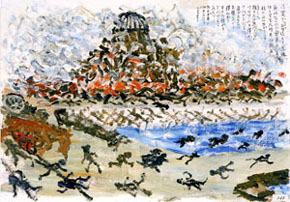
The military was able to test both a uranium-fueled bomb on Hiroshima and a second plutonium bomb on Nagasaki to gauge their effects on big cities.
Today, in some elite circles of Russia and the United States, normalized talk of using “tactical” nuclear weapons has upped the madness ante.
NORMAN SOLOMON, AUG 1, 2023 https://wordpress.com/read/feeds/2663585/posts/4838936867
In 1980, when I asked the press office at the U.S. Department of Energy to send me a listing of nuclear bomb test explosions, the agency mailed me an official booklet with the title “Announced United States Nuclear Tests, July 1945 Through December 1979.” As you’d expect, the Trinity test in New Mexico was at the top of the list. Second on the list was Hiroshima. Third was Nagasaki.
So, 35 years after the atomic bombings of those Japanese cities in August 1945, the Energy Department—the agency in charge of nuclear weaponry—was categorizing them as “tests.”
Later on, the classification changed, apparently in an effort to avert a potential P.R. problem. By 1994, a new edition of the same document explained that the bombings of Hiroshima and Nagasaki “were not ‘tests’ in the sense that they were conducted to prove that the weapon would work as designed…or to advance weapon design, to determine weapons effects, or to verify weapon safety.”
But the atomic bombings of Hiroshima and Nagasaki actually were tests, in more ways than one.
Take it from the Manhattan Project’s director, Gen. Leslie Groves, who recalled: “To enable us to assess accurately the effects of the bomb, the targets should not have been previously damaged by air raids. It was also desirable that the first target be of such size that the damage would be confined within it, so that we could more definitely determine the power of the bomb.”
A physicist with the Manhattan Project, David H. Frisch, remembered that U.S. military strategists were eager “to use the bomb first where its effects would not only be politically effective but also technically measurable.” The military was able to test both a uranium-fueled bomb on Hiroshima and a second plutonium bomb on Nagasaki to gauge their effects on big cities.
For good measure, after the Trinity bomb test in the New Mexico desert used plutonium as its fission source on July 16, 1945, in early August the military was able to test both a uranium-fueled bomb on Hiroshima and a second plutonium bomb on Nagasaki to gauge their effects on big cities.
Why no Hollywood movie on Nagasaki A Bombing?
| Walt Zlotow, West Suburban Peace Coalition Glen Ellyn IL 06 Aug 23 |
But who piloted what plane that dropped the second A Bomb on Nagasaki just 3 days later?
The American Story has largely erased the saga of the Nagasaki mission for good reason. It was a colossal screw up that almost got the pilot court martialed; indeed, nearly detonated Fat Man over the Pacific en route.
Trouble began early on. Paul Tibbetts, fresh from his Hiroshima success, picked his friend Charles Sweeney to pilot the drop plane ‘Bockscar’ instead of its regular pilot Fred Bock. Sweeney was unfamiliar with both combat and the plane. Preparing for takeoff, Sweeney was unable to operate the reserve tank containing 640 gallons of fuel needed to get Bockscar safely back to its Tinian takeoff point. Bock may have had the familiarity with the plane to accomplish that. Regulations required the mission be scrapped so Sweeney and crew exited Bockscar. But Tibbetts overruled them and the mission was on with insufficient fuel.
Three hours in, worse trouble. Fat Man’s red detonation lights began blinking wildly. Chief weaponeer Dick Ashworth frantically searched the blueprints and realized 2 switches had been reversed in the pre flight assembly. Solving that problem, everyone relaxed till Bockscar failed to rendezvous with the second of two back up planes, one for photography and one for instruments. The instrument plane, The Big Stink, was 9,000 feet above Bockscar.
Instead of pushing on to original target Kokura, Sweeney wasted 45 minutes of precious fuel trying to link up. Big Stink pilot Hoppy Hopkins broke radio silence frantically calling Tinian asking “Is Bockscar down?” Mission officials only heard “Bockscar Down” and freaked out believing Bockscar, Fat Man and the 13 member crew were in Davy Jones Locker.
Ashford was frantic that all was lost. As tension mounted between the weaponeer and the pilot, he finally persuaded Sweeney to proceed to primary target Kokura. But a smokescreen put up by Japanese defenders responding to the Hiroshima attack caused Sweeney to go around for a second and third bomb run, wasting more fuel.
More trouble. Flack and approaching Japanese Zeros forced Sweeney to abandon Kokura to flee 100 miles to alternate target Nagasaki.
The drop made, Sweeney made a desperate dive to avoid the mushroom cloud that nearly engulfed them. But his previous delays made the return trip to Tinian impossible. Low on fuel, Sweeney began a treacherous 450 mile flight on dwindling fuel for Okinawa. All aboard Bockscar prepared to ditch. Approaching the Okinawa airfield unable to radio the tower of their emergency, Bockscar had to drop into a forced landing amid numerous other flights without control tower clearance. Bockscar bounced 25 feet in the air landing at 30 MPH over the maximum landing speed, nearly colliding with a row of fuel laden B-24’s. One engine quit on the approach and another upon touchdown. Thinking Bockscar was lost, airport personnel inquired who this strange plane was that descended out of the sky unannounced. ‘We just dropped an atomic bomb’ was the reply.
There were no celebrations for the crew of Bockscar. Officials considered a courts martial for Sweeney for his life and mission threatening delays but considered the embarrassment it would cause and decided against. Why mar the mission-perfect first nuking of civilians by Paul Tibbetts and Enola Gay?
While we’ll never get a Hollywood treatment of the Bockscar A Bomb mission, it would be a lot more exciting than ‘Above and Beyond’. An appropriate title? ‘Nearly Down and Out Over Nagasaki’.
Western Media Has Falsely Presented the Donbas’ Drive For Autonomy as Being Instigated By Moscow

Covert Action Magazine By Ambrose Sylvan, July 13, 2023 [a long, detailed artice, – I recommend that you read the original]
In Reality It Resulted Largely from Kyiv’s Destruction of Eastern Ukraine’s Economy Under Neo-Liberal Economic Policies Pushed by Washington Since the 1990s
The war in Ukraine is commonly seen through one of two lenses. The vision presented by Western, NATO-aligned powers is one of an astro-turfed Donbas separatism created by Moscow to justify the division of Ukraine.
The view of NATO’s critics is that the Donbas republics rebelled against the Euromaidan revolution and the country’s nationalistic, Euro-centric tilt. The reality is that this conflict started much earlier and was merely frozen until the overthrow of the Ukrainian government in 2013.
Political Economy of the Donbas
Global Security outlines the economic situation in Donbas at the time of the dissolution of the USSR……………………………………………………………………………..
The tension between the central government and the Donbas miners was fueled by the increasing difficulty (and cost) of pulling coal from Donbas mines. Other coal-mining regions of the USSR were less costly but the social unrest in Donbas was placated with increasing state subsidies.
Ukrainian independence ended the Donbas struggle against Moscow but created intractable economic problems. The extensive subsidies for Donbas mines were shifted to the less wealthy government in Kyiv, the economic integration of the Soviet Union’s republics was disrupted, and the shift to a market economy was disastrous.
After the break-up of the Union, the political leaders of the Donbas miners would become known as “red directors,” socialists who put the interconnected economic needs of the Donbas and surrounding regions at the heart of their demands to Kyiv.
One of the earliest separatist organizations in Ukraine was the International Movement of Donbas. The Ukrainian news site DEPO, citing Novosti Donbas, describes the origin of the Intermovement as a project of academics at Donetsk University. The group was created as the “International Front for Donbas” at a meeting held on August 31, 1989.
……………………………………………………………………………………………………………………………………………. The Intermovement for Donbas failed to raise support for a renewed USSR, but the separatist movement would grow larger and stronger with every crisis that shook independent Ukraine.
The Shock Year
The act of independence immediately triggered a years-long economic crisis which was the driving force behind Ukraine’s growing separatist and anti-government movements.
………………………………………………………………………………………………………………….Inflation was accelerated by the spike in oil and gas prices as Ukraine lost the preferential rates it had enjoyed in the Soviet Union. Despite warnings from Moscow and the National Bank of Ukraine that the country would have to pay world prices if it exited the “Ruble Zone,” the government decided to drop the ruble as Ukraine’s currency by year-end.
New national borders interrupted the industrial sector, costs soared, demand fell (especially in state-driven industries like defense and science), and production crashed. For the first time in living memory, Ukrainians experienced the terrors of unemployment, price gouging, and starvation in a time of plenty.
…………………………………………………………………………………………………………………………………………………………. Ukraine dropped the ruble on November 12, 1992, and had no stable legal currency to use at markets. Wages were worthless and some workers were paid directly in consumer goods like soap instead of money. The economic problems of the working masses had become many times worse than they had been at the end of the Soviet era.
Demands of Donbas
Naturally there were outbursts of popular rage against the government as people lost their livelihoods………………………………………………………………………………………..
A government commission headed by the Finance Minister (who had authored the disastrous economic reforms) arrived in Donetsk on June 8. The striking miners made their demands clear: a no-confidence referendum on the President and parliament, and stronger regional self-government for Donbas. On June 18 the government agreed to schedule the referendum for September and to double miners’ wages. However this wage increase did little in the face of hyperinflation and the referendum was eventually canceled in favor of early elections.
Regional autonomy had already been a project of the Donetsk Regional Council before the 1993 general strike……………………………………………………………………………………………………………………………….
A “consultative poll” was held in Donetsk and Luhansk oblasts on the same day as the early elections, March 27, 1994. The central government refused to acknowledge it as a legally binding referendum, but the poll results showed that Donbas had a popular mandate to establish an autonomous government.
The poll had four questions: whether the constitution of Ukraine should change from a unitary state to a federal state; whether the Russian language should be constitutionally equal to the Ukrainian language; whether Russian should be an equal language of government and education in Donbas; and whether Ukraine should be a full participant in the post-Soviet Commonwealth of Independent States.
An overwhelming majority of voters said “YES” to all four questions: The federal system received 84% of all valid ballots in Donetsk, and the other three questions received more than 90% of all valid ballots in both regions…………………………………………
Deindustrialization
Tensions between the Donbas miners and the Ukrainian government continued to intensify over economic and political issues, and major labor actions continued through the decade.
………………………………………………………….The government did not follow through and strike action resumed on February 2, 1996, coordinated across Russia and Ukraine from Siberia to Donbas. As many as one million miners and allied workers went on strike in Ukraine.
…………………………………………………………. The central government’s economic warfare against the Donbas has continued unabated for decades………………………………………………………………………………..
Pushed to the Edge
Kyiv’s systematic destruction of the Donbas economy is a much greater driver of separatism than any Russophile nationalism. Sociological surveys conducted in early 2014 show us the most important issues to eastern Ukrainians on the verge of civil war.
Eight southern and eastern oblasts were surveyed by the Kyiv International Institute of Sociology (KIIS) in April 2014. ……………………………………………………………………………………………
KIIS additionally asked about the state structure of Ukraine. Only 10.6% in Donetsk and 12.4% in Luhansk indicated that they would keep the unitary state with its weak oblasts; 41.1% in Donetsk and 34.2% in Luhansk wanted power to be decentralized with oblasts given greater authority; and 38.4% in Donetsk and 41.9% in Luhansk endorsed a federal system with each region having its own state and the national government becoming a federation of these states. There were clear majorities in Donetsk and Luhansk (79.5% and 76.1%) that desired autonomous local governments.
Another survey was carried out by the Donetsk Institute for Social Research and Political Analysis in April 2014. ………………..In total, 79% of respondents wanted Kyiv to have less power and 48% wanted Donetsk to have its own state formation, whether independent or federated with Ukraine or Russia.
Breakaway
The infamous Donbas independence referendums were held just a few weeks after these surveys had been published. Despite accusations of endemic fraud and fabricated results the outcome was not far from what had been described by scientific opinion polls. The ballots asked not for independence but whether the republics should have “self-rule,” which the Donetsk electoral commissioner said could include autonomous or federal status within Ukraine.
When we consider the souring of public opinion on Kyiv’s “Anti-Terrorist Operation” and its civilian casualties, it is not hard to imagine how the 79% that polled in favor of more self-governance could have become 89% voting in favor of Donetsk self-rule.
………………………………………………………………………………………………………. By 2020 the Donetsk Institute’s follow-up survey had found that 45-50% of respondents favored annexation and only 20-25% supported a return to Ukraine; the remaining 25-30% answered that they wanted any resolution that would end the war.
………………………………………………………………………………………. Shut out of power, the Donbas was subjected to decades of ruthless economic policies which suited northern and western Ukraine’s desires to join the European Union. When President Viktor Yanukovych refused to sign the EU Association Agreement, acting in the interests of the south and east, he was ousted by the Euromaidan protests and riots in the capital. The government which replaced Yanukovych’s Party of Regions immediately signed the agreement, took on colossal debts, and adopted catastrophic austerity measures.
This is how Russian separatists, far-right extremists, and paramilitary bandits were able to find support. Their militant actions burst the tension and made secession a real possibility for the first time. Now a decade of war and blockades has deepened the fissure between Donbas and Ukraine and, with the accession of Donetsk and Luhansk to the Russian Federation, this division may become permanent.
- See David Hoffman, “One Million Miners Go on Strike in Russia, Ukraine,” The Washington Post, February 2, 1996, https://www.washingtonpost.com/archive/politics/1996/02/02/1-million-miners-go-on-strike-in-russia-ukraine/191f1387-b970-4c0a-971a-e7a30edf07b6/ ↑ https://covertactionmagazine.com/2023/07/13/western-media-has-falsely-presented-the-donbas-drive-for-autonomy-as-being-instigated-by-moscow/?mc_cid=f5762ce44c&mc_eid=65917fb94b—
1 This Month

of the week – Shut Down Drone Warfare!


Tell the Ukrainian Government to Drop Prosecution of Peace Activist Yurii Sheliazhenko

Petition to revoke the licensing of the Near Surface Nuclear Disposal Facility (NSDF) at Chalk River. https://www.ourcommons.ca/petitions/en/Petition/Details?Petition=e-7247
To see nuclear-related stories in greater depth and intensity – go to https://nuclearinformation.wordpress.com
-
Archives
- April 2026 (44)
- March 2026 (251)
- February 2026 (268)
- January 2026 (308)
- December 2025 (358)
- November 2025 (359)
- October 2025 (376)
- September 2025 (257)
- August 2025 (319)
- July 2025 (230)
- June 2025 (348)
- May 2025 (261)
-
Categories
- 1
- 1 NUCLEAR ISSUES
- business and costs
- climate change
- culture and arts
- ENERGY
- environment
- health
- history
- indigenous issues
- Legal
- marketing of nuclear
- media
- opposition to nuclear
- PERSONAL STORIES
- politics
- politics international
- Religion and ethics
- safety
- secrets,lies and civil liberties
- spinbuster
- technology
- Uranium
- wastes
- weapons and war
- Women
- 2 WORLD
- ACTION
- AFRICA
- Atrocities
- AUSTRALIA
- Christina's notes
- Christina's themes
- culture and arts
- Events
- Fuk 2022
- Fuk 2023
- Fukushima 2017
- Fukushima 2018
- fukushima 2019
- Fukushima 2020
- Fukushima 2021
- general
- global warming
- Humour (God we need it)
- Nuclear
- RARE EARTHS
- Reference
- resources – print
- Resources -audiovicual
- Weekly Newsletter
- World
- World Nuclear
- YouTube
-
RSS
Entries RSS
Comments RSS
 nuclear-news