For 75 Years, NATO Has Been Terrorizing the Globe
Ukraine Breathes New Life into NATO
Most recently, NATO has performed its familiar war-mongering role in Ukraine, where it has trained Ukrainian troops, including members of the neo-Nazi-led Azov Battalion.
The latter began attacking the people of eastern Ukraine after the 2014 U.S.-backed coup that triggered the devastating ongoing conflict.
This conflict was provoked in part by U.S. efforts to extend NATO membership to Ukraine, which CIA Director William Burns had warned was a red line that should not be crossed.[14]
In late March 2022, thanks to peace talks mediated by Turkey, Russia was ready to withdraw from all the territory it had captured if Ukraine agreed to give up any commitment to join NATO or allow NATO military bases or missiles to be stationed on its territory.
The deal was scuttled when British Prime Minister Boris Johnson flew to Kyiv to tell Ukrainian Prime Minister Volodymyr Zelensky that the “collective West” would not support it.
By Jeremy Kuzmarov, July 13, 2024, https://covertactionmagazine.com/2024/07/13/for-75-years-nato-has-been-terrorizing-the-globe/
Will a formidable peace movement ever emerge that can succeed in stopping it?
This past week, the North Atlantic Treaty Organization (NATO) celebrated its 75th anniversary by hosting a summit in Washington, D.C., where its founding treaty was signed.
A declaration issued at the summit made clear NATO’s intent to continuously confront Russia in Ukraine, and to further expand its operations in Southeast Asia and the Middle East.[1]
The Biden administration announced that: a) they are going to start stationing long-range nuclear and other missiles (including hypersonic missiles, that the U.S. doesn’t even have yet) in Germany, within easy striking-distance of Moscow; b) nuclear-capable F-16 fighter jets will be arriving in Ukraine any day now, and will go into service “during the summer”; and that c) Ukraine is on an “irreversible path” to join NATO.
A commemorative documentary featured now on NATO’s website celebrates NATO’s role in facilitating the Western victory in the Cold War and in allegedly ending ethnic cleansing and genocide in the Balkans in the 1990s, curtailing terrorism from Afghanistan after 9/11, and helping to protect the world from Russian aggression.
NATO’s formation in April 1949 is depicted as being vital in preventing the U.S. from having fallen into dreaded isolationism as it had after World War I, and in protecting European security in the face of the Soviet threat.
Colonel Richard Williams, Deputy Director of NATO’s Defense Investment Division, 1997-2011, states that “NATO is the only organization that offers hope that peace can become a real possibility.”
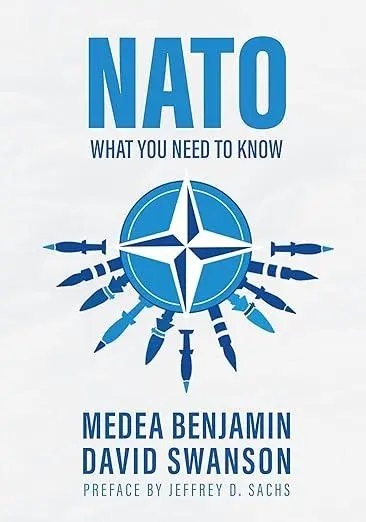
George Orwell would surely be proud of these latter comments in light of NATO’s long record of war-making. The true, venal history is exposed in a short book by peace activists Medea Benjamin and David Swanson, NATO: What You Need to Know, whose publication was timed to encourage protests at the 75th NATO anniversary summit.
Danger to World Peace
In the preface, Columbia University Professor Jeffrey Sachs wrote that “NATO is a clear and present danger to world peace, a war machine run amok that operates beyond the democratic control of the citizenry of the NATO countries.” Sachs continued: “The war machine lines the pockets of the arms contractors at the core of NATO, U.S. companies like Lockheed Martin and Northrop Grumman and Europe’s arms manufacturers…NATO also sucks one nation after another into the vortex of war, instability, displacement, and poverty. During the past 30 years, NATO has fomented a vast arc of violence stretching from Libya to Afghanistan and with many victims in between.”[2]
Benjamin and Swanson emphasize in their introduction that NATO has repeatedly violated the UN Charter outlawing military aggression and the UN’s 1970 Treaty on the Non-Proliferation of Nuclear Weapons and the Treaty on the Prohibition of Nuclear Weapons because of the placement of U.S. nuclear weapons in five European NATO nations.
NATO’s formation in 1949 as a military defense alliance against the Soviet Union was predicated on rampant propaganda that grossly exaggerated the Soviet threat, and on the ouster of peace-oriented politicians such as Henry Wallace, Franklin Roosevelt’s Vice President.
Wallace had proposed a continuation of Roosevelt’s policy of cooperation with the Soviets and was consequently removed in a coup d’état at the Democratic Party convention in Chicago in 1944 and then fired by Harry S. Truman as Commerce Secretary.
Under the direction of Truman’s advisers, including Joe Biden’s political mentor W. Averell Harriman, NATO established private clandestine armies among fascist elements throughout Western Europe who carried out black-flag terrorist activities as part of a strategy to inculcate fear in local populations and to discredit the political left.
In Italy, NATO operatives bombed a Bologna rail station and then planted evidence in the home of a left-wing journalist to make it look like he was the culprit.[3]
Rather than supporting democracy in Western Europe, NATO has a record of empowering reactionary forces. After World War II, it helped destroy popular movements of the left that had led the fight against fascism and were intent on redistributing wealth.
Greece was accepted as a NATO member only after its “ruthless Western-backed government killed or jailed the last of the partisans who had liberated it from the Nazis.”[4]
Turkey’s membership in NATO gave NATO military control of the Bosporus Strait—the only navigational waterway between the Mediterranean and Black Seas and a choke point for the Soviet ports of Odessa and Sevastapol.[5]
Within a decade of joining the Alliance, both Turkey and Greece were toppled in right-wing coups, which did not affect NATO membership. NATO further accepted Portugal as a member when it was ruled by a fascist dictator, Antonio Salazar, who provided the U.S. with a military base in the Azores.
NATO backed Portugal’s brutal suppression of anti-colonial movements in its African colonies (i.e., Angola and Mozambique), supported France’s colonial war in Algeria and the U.S. aggression in Korea, which resulted in the killing of 20% of North Korea’s population.
At an Asian-African conference in Bandung in 1955, Indian Prime Minister Jawaharlal Nehru called NATO “the most powerful protector of colonialism” and said that Morocco, Algeria and Tunisia “would probably have been independent if it had not been for NATO.”[6]
Upholding Unipolar U.S. Power
The U.S. has long been a driving force behind NATO because NATO “provides a vehicle for imposing U.S. leadership over Western nations,” according to Benjamin and Swanson. It has “tied Europe to U.S. military, geopolitical, and economic interests, made Europeans dependent on U.S. military power, and helped fortify U.S. global economic interests.”[7]
After the end of the Cold War, U.S. weapons companies helped lobby for NATO’s expansion. A lobby group called U.S. Committee to Expand NATO was run by the Vice President of Lockheed Martin.[8]
The father of the Cold War containment strategy, George F. Kennan, warned that NATO expansion in the 1990s would be a disastrous folly that would antagonize the Russians and trigger a new Cold War, but to no avail.
Beholden in part to the Polish-American and other Eastern European lobbies alongside the weapons lobbyists, the Clinton administration expanded NATO to three Eastern European countries (Poland, Hungary and Czech Republic)—in violation of a pledge made by the George H.W. Bush administration to the Russians that NATO would not be expanded “one inch to the East.”
George W. Bush followed Clinton by expanding NATO to seven additional countries—Bulgaria, Estonia, Latvia, Lithuania, Romania, Slovakia and Slovenia. Later, NATO was expanded to Montenegro and to Sweden and Finland.
Sowing Methodical Devastation
In 1994, NATO launched its first-ever combat operations in Bosnia, conducting hundreds of air strikes, which contributed to the dismemberment of the former Yugoslavia and transformed Bosnia into what Swanson and Benjamin call a “dysfunctional ward of NATO and the West.”[9]
In 1999, NATO carried out an illegal bombing campaign that dropped 23,000 bombs on Serbia, which killed thousands of civilians. This was followed by the U.S.-NATO invasion and occupation of the Serbian province of Kosovo, resulting in the empowerment of the terrorist Kosovo Liberation Army (KLA), which established Kosovo as a mafia state.
As a spoil of victory, the U.S. acquired the 955-acre Camp Bondsteel in southeastern Kosovo, which became a secret CIA black site for illegal detention and torture. (Europe’s Human Rights Commissioner Álvaro Gil-Robles called Camp Bondsteel a “smaller version of Guantanamo.”[10])
NATO caused more mayhem and bloodshed in the catastrophic 20-year military occupation of Afghanistan. During that time, U.S. and NATO forces dropped 85,000 bombs and missiles and conducted tens of thousands of “kill or capture” night raids, largely targeting innocent civilians, in a futile attempt to destroy the Taliban.
In Iraq, NATO soldiers from Canada, Hungary, Italy, Norway and the Netherlands trained senior military officers who carried out massive human rights crimes in sustaining the illegal U.S. military occupation.[11]
NATO played a further instrumental role in the 2011 regime-change operation targeting Libyan ruler Muammar Gaddafi who had given Libya the fifth-highest GDP per capita in Africa and the highest human development rating there.
Before the start of bombing operations, NATO secretly deployed CIA officers and British, French, Canadian and Qatari Special Forces to organize and lead Libyan jihadist forces intent on toppling the secular nationalist Qaddafi.[12]
NATO took full command of all aspects of the Libyan air war, with warships from 12 NATO countries sent to enforce a critical naval blockade.
Benjamin and Swanson wrote that, “after taking the capital, Tripoli, NATO and its allies cut off food, water, and electricity to the people of Sirte and Bani Walid as they bombarded them for weeks. The combination of aerial, naval, and artillery bombardment, starvation and rebel atrocities on these civilian populations made a final, savage mockery of the UN Security Council’s mandate to protect civilians.”[13]
Ukraine Breathes New Life into NATO
Most recently, NATO has performed its familiar war-mongering role in Ukraine, where it has trained Ukrainian troops, including members of the neo-Nazi-led Azov Battalion.
The latter began attacking the people of eastern Ukraine after the 2014 U.S.-backed coup that triggered the devastating ongoing conflict.
This conflict was provoked in part by U.S. efforts to extend NATO membership to Ukraine, which CIA Director William Burns had warned was a red line that should not be crossed.[14]
In late March 2022, thanks to peace talks mediated by Turkey, Russia was ready to withdraw from all the territory it had captured if Ukraine agreed to give up any commitment to join NATO or allow NATO military bases or missiles to be stationed on its territory. The deal was scuttled when British Prime Minister Boris Johnson flew to Kyiv to tell Ukrainian Prime Minister Volodymyr Zelensky that the “collective West” would not support it.
This ensured that the war would go on—at the cost of the flower of Ukraine’s youth who have been sacrificed in another unwinnable war.
Hope for the Future?
NATO’s dubious role in triggering the ongoing bloodbath in Ukraine is sadly characteristic of a 75-year history of provoking warfare and terrorizing civilians—in the service of U.S. and Western global hegemony.
At the end of their book, Swanson and Benjamin note that people around the world increasingly see the U.S. as the greatest threat to world peace.
Americans themselves remain divided about NATO: 47% want to see the U.S. keep its current commitment, and 28% want to either decrease it or withdraw entirely.
In a reflection of the rising hawkishness of the Democratic Party base and its susceptibility to government propaganda, only 14% of Democrats want no or less participation in NATO compared to 42% of Republicans.[15]
These data, while potentially discouraging, do reflect the fact that a significant percentage of Americans—including many living in the conservative heartland—are weary of foreign military intervention and NATO and represent a significant potential organizing base.
Given the high percentage of support for NATO among liberal Democrats, an urgent task should be for peace activists to embark on a vigorous campaign of public education targeting liberals that focuses on NATO’s horrifying history.
Benjamin and Swanson’s book is a perfect resource for that campaign and should be widely distributed to better inform the U.S. public about the evil ways their tax dollars are being spent.
References…………………………
July 16 – New Mexico anniversaries – of first nuclear weapons test, and of Church Rock radioactive waste disaster
Alicia Inez Guzmán, Investigative Reporter https://mailchi.mp/searchlightnm.org/high-beam-98-6254036?e=a70296a261 10 Jul 24
As far as anniversaries go, July 16 marks not one but two grave events. At 5:30 a.m. on July 16, 1945, J. Robert Oppenheimer led a secret cadre of scientists to detonate the world’s first atomic bomb in the Chihuahuan Desert of south-central New Mexico. The light was so bright that a local blind woman could detect, briefly, the burst of illumination, local newspapers read. That same light was potent enough to bleach brown cows. The unearthly heat, meanwhile, turned sand into glass. But despite what was known about radiation at the time, nobody from the public was evacuated.
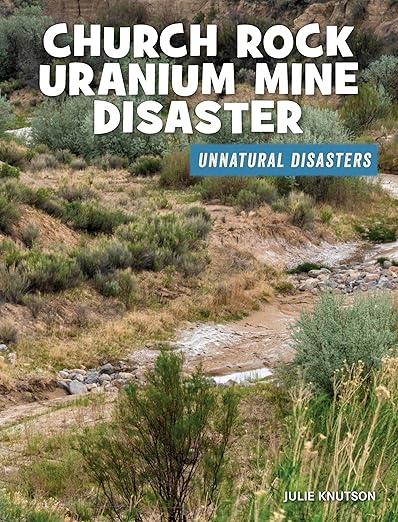
Exactly 34 years later, and at almost exactly the same time, an earthen dam holding uranium mill waste collapsed, unleashing 1,100 tons of solid radioactive waste and 94,000 gallons of tailings into northwestern New Mexico’s Rio Puerco. The Church Rock spill would release three times more radiation into the environment than the nuclear accident at Three Mile Island, most of it into the lands of the Navajo Nation. It was, as the Environmental Protection Agency deemed it, the largest radioactive spill in U.S. history. To my own shock and horror — and I’m certain the shock and horror of countless others — New Mexico’s governor at the time refused to declare the breach a federal emergency. Again, nobody was evacuated.
The two events are indelibly linked, not only by the day and time they share, but also by a kind of hubris unique to the nuclear age. By that, I mean a kind of hubris in which the lives and lands of New Mexicans were, and in many ways continue to be, deliberately disregarded. Thousands of people lived within a 50-mile radius of the Trinity Site. The waste at Church Rock? It flowed past some 1,700 homes.
For me, the date also marks just over one year since I began writing about nuclear affairs in New Mexico, the only “cradle-to-grave-state” in the nation. In that time, I’ve covered safety lapses in the plutonium pit factory at Los Alamos National Laboratory, the school-to-lab pipeline, allegations of fraud, waste and abuse at LANL, a secret autopsy program, legacy plutonium contamination and many other thorny issues.
The dirty history of ‘Nukey Poo’, the reactor that soiled the Antarctic
By Nick O’Malley, July 10, 2024 , https://www.theage.com.au/environment/conservation/the-dirty-history-of-nukey-poo-the-reactor-that-soiled-the-antarctic-20240708-p5jrzd.html
The rekindled nuclear debate in Australia has stirred old memories in some of a little-known chapter of our region’s history, when the US Navy quietly installed what today we might call a small modular reactor at the US Antarctic base on Ross Island.
The machine, nicknamed “Nukey Poo” by the technicians who looked after it, was installed at McMurdo base in 1961, when Antarctic exploration was expanding and nuclear energy had developed a bright futuristic sheen.
Things did not end well.
Back then, as now, Antarctic missions relied upon lifelines with distant homes. Supplies had to be carried long and sometimes dangerous distances. The US kept its Antarctic sites supplied via an ongoing supply mission called Operation Deep Freeze, which was based at the McMurdo Naval Air Facility.
According to an article on the Nukey Poo incident published in 1978 by the Bulletin of the Atomic Scientists – a journal concerned with the potential danger of nuclear technology, founded by Albert Einstein and veterans of the Manhattan Project – while a gallon of diesel cost the US Navy US12¢ back then, by the time the Americans shipped supplies to McMurdo, diesel cost 40¢ a gallon. At South Pole station, diesel was worth $12 a gallon.
But the then US Atomic Energy Commission had a solution to save costs on transporting supplies. What if McMurdo, and other distant US bases, were supplied by small transportable nuclear reactors? Congress agreed and soon the Martin Marietta Corporation won a contract to build them.
In an advertisement in Scientific American, the company boasted in language reminiscent of today’s debate over modular reactors that “because nuclear energy packs great power in little space, it’s extremely useful when you need electricity in remotes spots. It’s portable and gives you power that last for years …” Soon, the company said, nuclear power might be carrying us to outer space and frying our eggs.
A reactor named PM-3A (PM stood for “portable, medium powered”) was shipped out in sea crates and installed at McMurdo – which is within New Zealand-claimed Antarctic territory – over the summer of 1961 and became known on the base as Nukey Poo. Because cement would not cure in the frigid climate, the reactor was not encased in concrete, rather its four major components sat in steel tanks embedded in gravel and wrapped in a lead shield.
Admiral George Dufek described the moment as “a dramatic new era in man’s conquest of the remotest continent”. The US administration was certain the reactor did not violate the Antarctic Treaty’s declaration that “any nuclear explosions in Antarctica and the disposal there of radioactive waste material shall be prohibited”.
Within a year, Nukey Poo caused its first fuss, a hydrogen fire in a containment tank that led to a shutdown and energy shortages. Icebreakers fought to break through and fuel for generators was delivered by helicopter, which burned as much as they delivered over the course of a flight. Over the following years, Nukey Poo proved so unreliable and expensive to maintain that the military gave up hopes of using the technology to displace diesel at other remote locations.
In 1972, the navy began the three-year task of decommissioning the reactor and decontaminating the site. During that process, they discovered corrosion that technicians feared may have caused leaks of irradiated material. No detailed investigation was done. The secretary of the US National Academy of Sciences said the program was ended due to a series of malfunctions and the possibility of leaks, the Bulletin of the Atomic Scientists reported. The New Zealand government declared the decision was economic.
Either way, it was decided not only to remove the reactor, but half the hillside it was built into. Eventually 12,000 tonnes of irradiated gravel and soil was removed on supply ships to be buried in concrete lined pits in the United States.
The young Australian scientist, Dr Howard Dengate, who had run one of the NZ bases, hitched a lift on one those ships, the Schuyler Otis Bland, in 1977. Dengate recalls a grumpy captain who once swore at him for inviting bad luck on the ship by whistling on deck. The captain, Dengate recalled this week, blamed him for “whistling up” the storm that struck the vessel before the Australian disembarked in New Zealand and the ship sailed on to the US.
Though the reactor was little discussed in the wider world, no secret was made on the base of the reactor or its impact. Indeed, Dengate recalled finding an operating manual for the reactor in the American rubbish pits that New Zealanders had developed the habit of fossicking in.
But the story did not end there.
In 2011, an investigation by journalists of News 5 Cleveland found evidence that McMurdo personnel were exposed to long-term radiation, and in 2017 compensation was paid to some American veterans of the base. A year later, New Zealand officials announced that it was possible that New Zealand staff were also affected.
It has since been reported that four New Zealanders had raised claims about their ill health since their time in the Antarctic.
In 2020, the Waitangi Tribunal, a permanent commission in New Zealand to investigate cases against the Crown, launched inquiries. They are not yet complete.
Asked if he was concerned about travelling with the irradiated material, Dengate said he was not. “We were young and dumb and adventurous,” he told this masthead of his time in the Antarctic.
How Israel Became a Nuclear Power
The United States actively works to shield the Israeli nuclear weapons program from criticism as well as public knowledge.
In effect, unwillingness to commit to nuclear nonproliferation has led to nuclear proliferation.
https://antinuclear.net/2024/06/24/keep-up-to-date-on-australias-media-quagmire-on-nuclear-power/
Israel’s nuclear weapons program has been an open secret for over fifty years. Declassified documents and the wider availability of satellite imagery have largely been responsible for revealing the extent of the nation’s nuclear program. So too has the courage of whistleblowers such as Mordechai Vanunu, an Israeli nuclear technician who exposed his country’s covert program and was subsequently drugged and kidnapped by Mossad agents in Italy before being secretly tried and sentenced to eighteen years in prison in 1986.
Yet the United States and other nuclear-armed states, as well as a broad range of bodies responsible for monitoring arms proliferation, continue to maintain a policy of not publicly acknowledging the existence of Israel’s nuclear weapons.
These norms of institutional secrecy are surprisingly powerful and far-reaching. US government employees have been fired for referring to Israeli nuclear weapons. Even Wikipedia’s page on the subject uses circuitous language to refer to their existence. (The page is locked to edits from almost all contributors.) This approach is effective: a 2021 poll suggested that more Americans believed that Iran has nuclear weapons than that Israel does, when the reality is the opposite.
This wall of silence has proven remarkably porous. During the early days of Israel’s war on Gaza, government officials openly entertained the possibility of using nuclear weapons on the battlefield, and figures within the US military think tank circuit have wondered whether Israel’s secrecy is doing it more harm than good.
Conventional wisdom about the strategic importance of possessing nuclear weapons is that there’s no reason to have one if you don’t tell anyone. Intimidation is as much a part of deterrence as use. If no one suspects you can respond to an attack with the overwhelming force of a nuclear counterattack, what’s to make them think twice?
But Hezbollah’s continued assault on northern Israel, which has thus far led to the evacuation of over ninety thousand people, gives lie to the notion that possession of nuclear weapons offers complete protection. In a recent speech, Hassan Nasrallah, Hezbollah’s secretary general, made it clear that if Israel were to cross what it considers to be red lines, there would be no target within the country safe from a retaliatory response. It is therefore not clear that Israel’s nuclear weapons are on their own preventing it from being attacked in a way that threatens its existence. Israel’s relationship with the United States has, however, afforded it a range of impressive offensive and defensive nonnuclear capabilities, backed up by the even larger looming threat of US military involvement, which it is actively using.
Were the US to enforce its own policies consistently, Israel’s status as a state in possession of nuclear weapons would directly threaten its access to aid. The Glenn Amendment to the US Arms Export Control Act explicitly prohibits arms assistance to and mandates sanctions on countries that have, as Israel did in 1979, tested a nuclear weapon after 1977. But the fact that its nuclear weapons program continues to command this kind of bizarre deference illuminates the forces driving nuclear proliferation around the world.
The Forces Behind Proliferation
Scrupulous nonacknowledgment of Israeli nuclear weapons in the present day is part of the United States’ general position of aiding Israeli military endeavors, regardless of the financial or strategic cost. But the reason Israel has nuclear weapons in the first place has less to do with its relationship with the United States and more to do with the geopolitical forces that have driven proliferation since America first dropped the bomb on Japan.
The program that produced Israel’s nuclear weapons is as old as the state itself. As Avner Cohen details in Israel and the Bomb, a nuclear program was discussed by Israel’s leaders practically from the establishment of the Israeli state in 1948. David Ben-Gurion, the country’s first prime minister, took an intense personal interest in nuclear technologies in particular and science and technology as foundations of modern state power in general.Hezbollah’s continued assault on northern Israel gives lie to the notion that possession of nuclear weapons offers complete protection.
Already in 1949, Israel was conducting exploratory research for potential uranium deposits in the Negev, a desert region in the country’s south. When these proved inadequate, it developed techniques for producing usable nuclear material from the relatively poor resources at its disposal, before turning to the United States as the potential source of the raw materials necessary to jump-start a nuclear program.
But in the immediate postwar years, the United States was unwilling to provide the necessary material without guarantees from Israel that the country’s leaders saw as undesirably inhibiting. Israel instead turned to other small countries with nuclear programs at different stages of development: France and Norway, two of only three European countries in the early 1950s operating nuclear reactors.
Israel and France shared a set of geopolitical interests. Both opposed the government of Egyptian president Gamal Abdel Nasser. The French, motivated by neocolonial idealism, took issue with Nasser for nationalizing the Suez Canal, and Israel of course felt threatened by Nasser’s Arab nationalism.
Skepticism about the possibility that the US nuclear umbrella could actually offer security guarantees also motivated nations like France to advance a Gaullist policy of strategic autonomy. This meant encouraging nuclear proliferation where doing so would secure the broader geopolitical interests of declining powers.
Nonproliferation Amid Great-Power Rivalry
In the present, the United States actively works to shield the Israeli nuclear weapons program from criticism as well as public knowledge. As with France’s hostility to a Nasser-led anti-Western order, the Israeli-US alliance is strongly motivated by fear of Iran, or any other anti-American state, developing its own nuclear program. Yet Israel’s nuclear weapons, along with the substantial, long-term support among a certain segment of the US political class for war with Iran, are two very powerful factors driving Iran to develop its own nuclear weapon.
At present, Iran does not have nuclear weapons, though experts believe that it currently maintains the capability to quickly develop them. President Barack Obama’s 2015 Iran nuclear deal limited Iran’s ability to develop a nuclear weapon and imposed a regime of inspections and oversight which provided assurance to other countries that it was not developing nuclear weapons. But Israel opposed the deal on the grounds that it did not go far enough to preclude the possibility that Iran might one day develop a nuclear weapon — a similar kind of all-or-nothing approach to the one that informed the Donald Trump administration’s decision to exit the agreement in 2018.
As Israel’s war on Gaza continues and expands outward into the broader region, it seems it may only be a matter of time before Iran finally does develop a nuclear weapon. After its recent large-scale rocket attacks against Israel, Iran announced that it might reverse its current voluntary commitment to not developing nuclear weapons should Israel retaliate by hitting its nuclear facilities. It goes without saying that this would make the ongoing conflict between Israel and Iran much more dangerous, giving even low-level incidents the potential to escalate to dramatic and destructive new heights.
The United States actively works to shield the Israeli nuclear weapons program from criticism as well as public knowledge.
In effect, unwillingness to commit to nuclear nonproliferation has led to nuclear proliferation. This explains why Saudi Arabia has in recent years betrayed nuclear ambitions. Crown Prince Mohammed bin Salman has stated in US press outlets that Saudi Arabia would develop a nuclear weapon if Iran did so. Yet rather than treating this open disregard for stated US policy as a serious limit on US-Saudi relations, the United States has been pushing for a so-called “normalization” deal between Saudi Arabia and Israel — including a stipulation of a “credible path to a Palestinian state.” Saudi Arabia, in turn, wants the United States to provide it with nuclear technology — ostensibly, of course, for a power program.
The dilemma for America is that whatever interest it does have in nuclear nonproliferation must be balanced against its broader commitment to global hegemony. The latter would be undermined if China, which it now sees as its key competitor, stepped in to provide technical support to fledgling nuclear programs, as it has done with Saudi Arabia. Last year, China sent one of its engineering companies to conduct surveys of the Gulf monarchy’s uranium deposits, although it seems unlikely that these deposits could support a nuclear program of any size.
Nuclear weapons experts have called for safeguards that could prevent the development of a Saudi nuclear weapons program. Yet unlike in the case of Israel’s search for nuclear material, the threat of safeguards doesn’t seem to be a deterrent to the kingdom’s openly stated nuclear ambitions. It sometimes seems that U.S. nuclear weapons policy in 2024 is based on a tacit acceptance of its powerlessness over global nuclear weapons politics. Rather than trying to prevent proliferation, America has been forced to settle for the role of being the primary nuclear patron where it can.
Existential Threats
Israel’s possession of nuclear weapons has been largely irrelevant to the ongoing war in Gaza. The country’s overwhelming conventional capabilities have granted it superiority on the battlefield, at the cost of the lives of tens of thousands of civilians. But possession of nuclear weapons reinforces the worldview that underlies Israel’s political calculations (and to some extent, those of every nuclear-armed country): that its existence is constantly threatened, and it is only rational for it to possess the means of responding to such threats with unlimited force.
It is the states with the most nuclear weapons, Russia and the United States, that most assiduously cling to the logic that weapons of mass destruction are the only safeguard against existential threats. Both have consistently bypassed opportunities to deescalate the very real, immediate risks to human safety and civilization that the continued existence of nuclear weapons poses. In doing so, they’ve set a powerful precedent for every other country in the world to uphold nuclear weapons as the only real guarantor of security.
Without a real commitment to reducing the role of nuclear weapons in global politics by the states that can certainly afford it, this de facto policy encourages nuclear proliferation. Israel’s well-defended status as a nuclear power that need not even announce itself is not an exception, but an example to other states thinking of going nuclear.
Emma Claire Foley is a writer and filmmaker based in New York. Her writing and commentary has appeared in Newsweek, NBC, the Guardian, and elsewhere.
The US, Russia, and Ukraine: 75 Years of Hate Propaganda
Zelensky: The “Winston Churchill of Our Time” (George W. Bush)
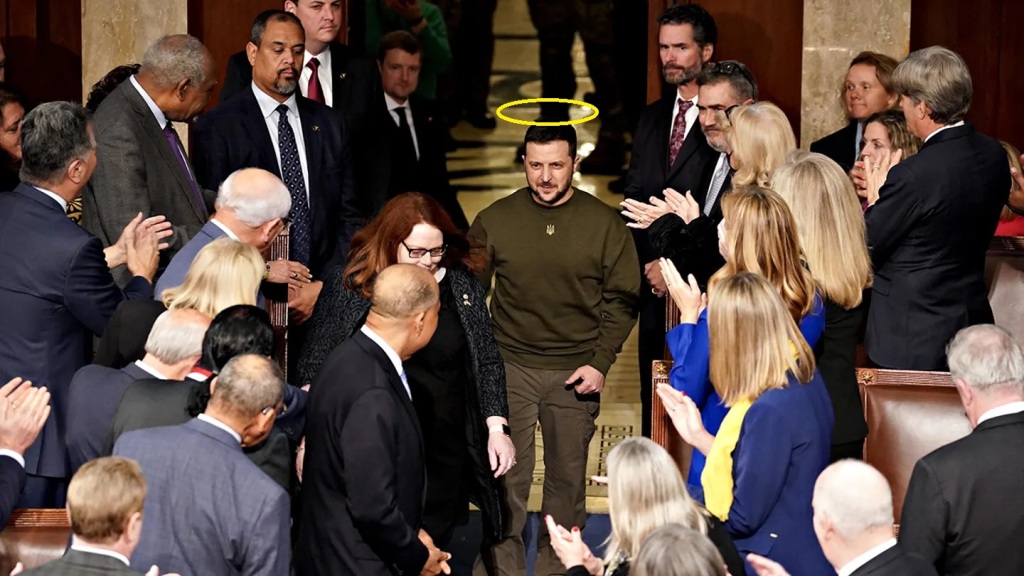
In the Western symphony of propaganda, the hated Putin, the “autocrat,” is contrasted with the heroic Zelensky the “democrat” (Time magazine’s 2022 “person of the year”). But how democratic is Zelensky?
His man-of-the-hour image had help from international friends. Zelensky’s global perception management team is run by a well-connected London-based British firm, The PR Network, that helps him prepare messages for global consumption.
BY GERALD SUSSMAN APRIL 18, 2023, https://www.counterpunch.org/2023/04/18/the-us-russia-and-ukraine-75-years-of-hate-propaganda/
“It is not a matter of what is true that counts, but a matter of what is perceived to be true.”
– Henry Kissinger
“But the most brilliant propagandist technique will yield no success unless one fundamental principle is borne in mind constantly and with unflagging attention. It must confine itself to a few points and repeat them over and over.”
– Adolf Hitler
“We lied, we cheated, we stole. We had entire training courses [on deceiving the public].”
– Mike Pompeo on his time as CIA director
What is state propaganda? It is a disciplined and coordinated discourse using mass persuasion on behalf of state interests. It’s one instrument of what’s called realpolitik – foreign policy designed to advance “national interests,” which in a neoliberal economy like the US means corporate interests. The oligarchs, the billionaire class in the age of neoliberalism, in their unfettered greed have employed both US political parties and their accessories in the media, the intelligence community, and Congress and turned them into a collective ministry of (dis)information and subalterns of empire. Propaganda as a tool in foreign policy commonly relies on hate-laden ideology to mobilize public consensus.
Enemies
A key to successful mass mobilization of the public mind is the enemy construct. One of the key studies on the subject found that the US has had a permanent need for enemies, and when not “readily available, we have created them” (Finlay, Holsti, and Fagen, cited in Murray & Myers, 1989, p. 555). Russia as enemy (Russophobia) works just as well if not better when it’s conceived in demeaning ethnic rather than political economic terms. That’s because hierarchical race and ethnicity ideas are closer to the surface of public prejudice than those focused on, for example, effigies of socialism or communism. In other words, it is easier to orchestrate hatred toward Russia and Putin when there preexists a deep distrust of Russians, their history, and (orthodox religious) culture and its people based on “difference” and a perceived civilizational threat to the West. Under such collective psychological conditioning, this has led to a rejection of Russia membership in the congregation controlled by white European Christian nations.
The US has manufactured innumerable enemies during the course of its existence, and it has had to in order to become a world superpower. Since 1776, there have been only 16 years when the country was not at war. In the pantheon of America’s villains during its 247-year history, one of the most prominent portraits is that of the demonic Vladimir Putin, whose “enemy” status among Americans was pumped up to 70% by March 2022, soon after the start of Russia’s “special operation” in Ukraine.
The “liberal” Democrats are found to be far more inclined to carry out a proxy war against Russia than Republicans and much more supportive of supplying Ukraine with advanced weapons and US troops: tanks (67% to 48%), long-range missiles (60% to 41%), fighter jets (56% to 39%), direct invasion (33% to 22%) (Frankovic and Orth, 2023). Former CIA director and defense secretary under Obama, Leon Panetta bluntly declared, ‘It’s a proxy war with Russia, whether we say so or not” (Bloomberg, 2022).
The massive US “proxy” assault on Russia, more like a full-scale invasion but without its own troops physically on the ground and in the air, is only the latest episode of a hundred-year-old effort to impose Western hegemony over that country. It started with the joint “expedition” that the sanctimonious Woodrow Wilson (“I am going to teach the South American republics to elect good men”) sent to Siberia and northern Russia in a failed attempt, along with mainly European allies, to back the White Russians in the civil war and overthrow the Bolshevik government. Anti-communism was toned down during the Second World War, as it was the Soviet Union, including Ukraine, tactically allied with the US and the British Empire, that bore by far the heaviest burden, suffering 27 million deaths, in defeating the Nazi regime. It’s a sobering reality of historical proportions that is rarely acknowledged in the US. Immediately following the war, the US quickly converted the USSR/Russia from ally to enemy (and their enemies to allies) and worked closely with anti-communist groups in Ukraine and the larger Soviet region in efforts to break apart the Soviet state.
The then newly formed CIA, established in 1947, covertly supervised underground far right organizations in Ukraine, in particular the pro-Nazi Organization of Ukrainian Nationalists (OUN) and the anti-Soviet Ukraine Insurgent Army (UPA), as part of its “psychological warfare activities
Continue readingWhy Won’t the US Help Negotiate a Peaceful End to the War in Ukraine?
In the course of 2014, Putin called repeatedly for a negotiated peace, and this led to the Minsk II Agreement in February 2015 based on autonomy of the Donbas and an end to violence by both sides. Russia did not claim the Donbas as Russian territory, but instead called for autonomy and the protection of ethnic Russians within Ukraine. The UN Security Council endorsed the Minsk II agreement, but the U.S. neocons privately subverted it. Years later, Chancellor Angela Merkel blurted out the truth. The Western side treated the agreement not as a solemn treaty but as a delaying tactic to “give Ukraine time” to build its military strength. In the meantime, around 14,000 people died in the fighting in Donbas between 2014 and 2021.
Jeffrey Sachs, 19 June 24, https://www.commondreams.org/opinion/role-of-us-in-russia-ukraine-
For the fifth time since 2008, Russia has proposed to negotiate with the U.S. over security arrangements, this time in proposals made by President Vladimir Putin on June 14, 2024. Four previous times, the U.S. rejected the offer of negotiations in favor of a neocon strategy to weaken or dismember Russia through war and covert operations. The U.S. neocon tactics have failed disastrously, devastating Ukraine in the process, and endangering the whole world. After all the warmongering, it’s time for Biden to open negotiations for peace with Russia.
Since the end of the Cold War, the U.S. grand strategy has been to weaken Russia. As early as 1992, then Defense Secretary Richard Cheney opined that following the 1991 demise of the Soviet Union, Russia too should be dismembered. Zbigniew Brzezinski opined in 1997 that Russia should be divided into three loosely confederated entities in Russian Europe, Siberia, and the far east. In 1999, the U.S.-led NATO alliance bombed Russia’s ally, Serbia, for 78 days in order to break Serbia apart and install a massive NATO military base in breakaway Kosovo. Leaders of the U.S. military-industrial complex vociferously supported the Chechen war against Russia in the early 2000s.
To secure these U.S. advances against Russia, Washington aggressively pushed NATO enlargement, despite promises to Mikhail Gorbachev and Boris Yeltsin that NATO would not move one inch eastward from Germany. Most tendentiously, the U.S. pushed NATO enlargement to Ukraine and Georgia, with the idea of surrounding Russia’s naval fleet in Sevastopol, Crimea with NATO states: Ukraine, Romania (NATO member 2004), Bulgaria (NATO member 2004), Turkey (NATO member 1952), and Georgia, an idea straight from the playbook of the British Empire in the Crimean War (1853-6).
Brzezinski spelled out a chronology of NATO enlargement in 1997, including NATO membership of Ukraine during 2005-2010. The U.S. in fact proposed NATO membership for Ukraine and Georgia at the 2008 NATO Bucharest Summit. By 2020, NATO had in fact enlarged by 14 countries in Central Europe, Eastern Europe, and the former Soviet Union (Czech Republic, Hungary, and Poland in 1999; Bulgaria, Estonia, Latvia, Lithuania, Romania, Slovakia, and Slovenia in 2004; Albania and Croatia, 2009; Montenegro, 2017; and Northern Macedonia, 2020), while promising future membership to Ukraine and Georgia.
The White House is dead wrong to evade negotiations just because of disagreements with Russia’s proposals. It should put up its own proposals and get down to the business of negotiating an end to the war.
In short, the 30-year U.S. project, hatched originally by Cheney and the neocons, and carried forward consistently since then, has been to weaken or even dismember Russia, surround Russia with NATO forces, and depict Russia as the belligerent power.
It is against this grim backdrop that Russian leaders have repeatedly proposed to negotiate security arrangements with Europe and the U.S. that would provide security for all countries concerned, not just the NATO bloc. Guided by the neocon game plan, the U.S. has refused to negotiate on every occasion, while trying to pin the blame on Russia for the lack of negotiations.
In June 2008, as the U.S. prepared to expand NATO to Ukraine and Georgia, Russian President Dmitry Medvedev proposed a European Security Treaty, calling for collective security and an end to NATO’s unilateralism. Suffice it to say, the U.S. showed no interest whatsoever in Russia’s proposals, and instead proceeded with its long-held plans for NATO enlargement.
The second Russian proposal for negotiations came from Putin following the violent overthrow of Ukraine’s President Viktor Yanukovych in February 2014, with the active complicity if not outright leadership of the U.S. government. I happened to see the U.S. complicity up close, as the post-coup government invited me for urgent economic discussions. When I arrived in Kiev, I was taken to the Maidan, where I was told directly about U.S. funding of the Maidan protest.
The evidence of U.S. complicity in the coup is overwhelming. Assistant Secretary of State Victoria Nuland was caught on a phone line in January 2014 plotting the change of government in Ukraine. Meanwhile, U.S. Senators went personally to Kiev to stir up the protests (akin to Chinese or Russian political leaders coming to DC on January 6, 2021 to rile up the crowds). On February 21, 2014, the Europeans, U.S., and Russia brokered a deal with Yanukovych in which Yanukovich agreed to early elections. Yet the coup leaders reneged on the deal the same day, took over government buildings, threatened more violence, and deposed Yanukovych the next day. The U.S. supported the coup and immediately extended recognition to the new government.
In my view, this was a standard CIA-led covert regime change operation, of which there have been several dozen around the world, including sixty-four episodes between 1947 and 1989 meticulously documented by Professor Lindsey O’Rourke. Covert regime-change operations are of course not really hidden from view, but the U.S. government vociferously denies its role, keeps all documents highly confidential, and systematically gaslights the world:
“Do not believe what you see plainly with your own eyes! The U.S. had nothing to do with this.” Details of the operations eventually emerge, however, through eyewitnesses, whistleblowers, the forced release of documents under the Freedom of Information Act, declassification of papers after years or decades, and memoirs, but all far too late for real accountability.
In any event, the violent coup induced the ethnic-Russia Donbas region of Eastern Ukraine to break from the coup leaders, many of whom were extreme Russophobic nationalists, and some in violent groups with a history of Nazi SS links in the past. Almost immediately, the coup leaders took steps to repress the use of the Russian language even in the Russian-speaking Donbas. In the following months and years, the government in Kiev launched a military campaign to retake the breakaway regions, deploying neo-Nazi paramilitary units and U.S. arms.
In the course of 2014, Putin called repeatedly for a negotiated peace, and this led to the Minsk II Agreement in February 2015 based on autonomy of the Donbas and an end to violence by both sides. Russia did not claim the Donbas as Russian territory, but instead called for autonomy and the protection of ethnic Russians within Ukraine. The UN Security Council endorsed the Minsk II agreement, but the U.S. neocons privately subverted it. Years later, Chancellor Angela Merkel blurted out the truth. The Western side treated the agreement not as a solemn treaty but as a delaying tactic to “give Ukraine time” to build its military strength. In the meantime, around 14,000 people died in the fighting in Donbas between 2014 and 2021.
Following the definitive collapse of the Minsk II agreement, Putin again proposed negotiations with the U.S. in December 2021. By that point, the issues went even beyond NATO enlargement to include fundamental issues of nuclear armaments. Step by step, the U.S. neocons had abandoned nuclear arms control with Russia, with the U.S. unilaterally abandoning the Anti-Ballistic Missile (ABM) Treaty in 2002, placing Aegis missiles in Poland and Romania in 2010 onwards, and walking out of the Intermediate Nuclear Force (INF) Treaty in 2019.
In view of these dire concerns, Putin put on the table on December 15, 2021 a draft “Treaty between the United States of America and the Russian Federation on Security Guarantees.” The most immediate issue on the table (Article 4 of the draft treaty) was the end of the U.S. attempt to expand NATO to Ukraine. I called U.S. National Security Advisor Jake Sullivan at the end of 2021 to try to convince the Biden White House to enter the negotiations. My main advice was to avoid a war in Ukraine by accepting Ukraine’s neutrality, rather than NATO membership, which was a bright red line for Russia.
The White House flatly rejected the advice, claiming remarkably (and obtusely) that NATO’s enlargement to Ukraine was none of Russia’s business! Yet what would the U.S. say if some country in the Western hemisphere decided to host Chinese or Russian bases? Would the White House, State Department, or Congress say, “That’s just fine, that’s a matter of concern only to Russia or China and the host country?” No. The world nearly came to nuclear Armageddon in 1962 when the Soviet Union placed nuclear missiles in Cuba and the U.S. imposed a naval quarantine and threatened war unless the Russians removed the missiles. The U.S. military alliance does not belong in Ukraine any more than the Russian or Chinese military belongs close to the U.S. border.
The fourth offer of Putin to negotiate came in March 2022, when Russia and Ukraine nearly closed a peace deal just weeks after the start of Russia’s special military operation that began on February 24, 2022. Russia, once again, was after one big thing: Ukraine’s neutrality, i.e., no NATO membership and no hosting of U.S. missiles on Russia’s border.
Ukraine’s President Vladimir Zelensky quickly accepted Ukraine’s neutrality, and Ukraine and Russia exchanged papers, with the skillful mediation of the Foreign Ministry of Turkey. Then suddenly, at the end of March, Ukraine abandoned the negotiations.
U.K. Prime Minister Boris Johnson, following in the tradition of British anti-Russian war-mongering dating back to the Crimean War (1853-6), actually flew to Kiev to warn Zelensky against neutrality and the importance of Ukraine defeating Russia on the battlefield. Since that date, Ukraine has lost around 500,000 dead and is on the ropes on the battlefield.
Now we have Russia’s fifth offer of negotiations, explained clearly and cogently by Putin himself in his speech to diplomats at the Russian Foreign Ministry on June 14. Putin laid out Russia’s proposed terms to end the war in Ukraine.
“Ukraine should adopt a neutral, non-aligned status, be nuclear- free, and undergo demilitarization and de-nazification,” Putin said. “These parameters were broadly agreed upon during the Istanbul negotiations in 2022, including specific details on demilitarization such as the agreed numbers of tanks and other military equipment. We reached consensus on all points.
“Certainly, the rights, freedoms, and interests of Russian-speaking citizens in Ukraine must be fully protected,” he continued. “The new territorial realities, including the status of Crimea, Sevastopol, Donetsk and Lugansk people’s republics, Kherson, and Zaporozhye regions as parts of the Russian Federation, should be acknowledged. These foundational principles need to be formalized through fundamental international agreements in the future. Naturally, this entails the removal of all Western sanctions against Russia as well.”
Let me say a few words about negotiating.
Russia’s proposals should now be met at the negotiating table by proposals from the U.S. and Ukraine. The White House is dead wrong to evade negotiations just because of disagreements with Russia’s proposals. It should put up its own proposals and get down to the business of negotiating an end to the war.
There are three core issues for Russia: Ukraine’s neutrality (non-NATO enlargement), Crimea remaining in Russian hands, and boundary changes in Eastern and Southern Ukraine. The first two are almost surely non-negotiable. The end of NATO enlargement is the fundamental casus belli. Crimea is also core for Russia, as Crimea has been home to Russia’s Black Sea fleet since 1783 and is fundamental to Russia’s national security.
The third core issue, the borders of Eastern and Southern Ukraine, will be a key point of negotiations. The U.S. cannot pretend that borders are sacrosanct after NATO bombed Serbia in 1999 to relinquish Kosovo, and after the U.S. pressured Sudan to relinquish South Sudan. Yes, Ukraine’s borders will be redrawn as the result of the 10 years of war, the situation on the battlefield, the choices of the local populations, and tradeoffs made at the negotiating table.
Biden needs to accept that negotiations are not a sign of weakness. As Kennedy put it, “Never negotiate out of fear, but never fear to negotiate.” Ronald Reagan famously described his own negotiating strategy using a Russian proverb, “Trust but verify.”
The neocon approach to Russia, delusional and hubristic from the start, lies in ruins. NATO will never enlarge to Ukraine and Georgia. Russia will not be toppled by a CIA covert operation. Ukraine is being horribly bloodied on the battlefield, often losing 1,000 or more dead and wounded in a single day. The failed neocon game plan brings us closer to nuclear Armageddon.
Yet Biden still refuses to negotiate. Following Putin’s speech, the U.S., NATO, and Ukraine firmly rejected negotiations once again. Biden and his team have still not relinquished the neocon fantasy of defeating Russia and expanding NATO to Ukraine.
The Ukrainian people have been lied to time and again by Zelensky and Biden and other leaders of NATO countries, who told them falsely and repeatedly that Ukraine would prevail on the battlefield and that there were no options to negotiate. Ukraine is now under martial law. The public is given no say about its own slaughter.
For the sake of Ukraine’s very survival, and to avoid nuclear war, the President of the United States has one overriding responsibility today: Negotiate.
From the Hiroshima bomb to Israel’s nuclear weapons, the path leads back to Congo’s uranium
Conspiracies in the Congo Linda Pentz Gunter 16 June 24 https://beyondnuclearinternational.org/2024/06/16/conspiracies-in-the-congo/
It involved the Democratic Republic of Congo (DRC); a Belgian mining company; a fictitious Liberian trading company; a German-named ship — the Scheersberg A; a Spanish crew; a German petrochemical official; an Italian paint company; an Israeli freighter; the Greek island of Crete; a Turkish port; and a confession made in Norway.
If this sounds like the plot for an elaborate work of fiction, it was — it formed the basis of Ken Follett’s 1979 thriller, Triple. But it was also all true. The clandestine operation, which took place in November 1968, smuggled an estimated 200 tonnes of uranium yellowcake out of the DRC, transporting it to Israel. It was orchestrated by Mossad, the Israeli secret intelligence service and came to be known as Operation Plumbat, since the illicit cargo was marked as lead.
The scheme was set in motion when, after the 1967 Arab-Israeli War, France curtailed its weapons supplies to Israel and likely the uranium fuel as well needed for Israel’s Dimona reactor, believed then and still to be at the heart of the country’s nuclear weapons program. The operation concluded with an exchange of ships and cargos on the high seas, the Scheersberg A eventually docking empty in Turkey while the uranium, now aboard an Israeli freighter, made its way to Haifa and eventually to Dimona.
The Plumbat operation was first exposed in April 1977 at a non-proliferation conference in Salzburg, Austria by Paul Leventhal, who went on to found the Nuclear Control Institute in 1981.
Israel officially denies that any of this took place, despite ample documentation and the later confession of one of its Mossad officers after his arrest in Norway. This was yet another bizarre twist in the tale when a Mossad operation in Lillehammer to assassinate one of the 1973 Munich Olympic attackers instead mistakenly took out an innocent Moroccan waiter on his way home from work. One of the agents, in order to prove to Norwegian authorities that he was indeed with Mossad, related the story of Operation Plumbat.
Of course, Israel also officially denies the existence of its nuclear weapons arsenal.
The uranium bound for Israel came from the Shinkolobwe mine in DRC’s Katanga province. The veins of uranium that run through Shinkolobwe bleed everywhere. And so do its victims.
The DRC is the site of the present day genocide that no one talks about. As many as six million people have now died in the ongoing fighting there, mostly over mineral rights. That long and bloody history began in the 1880s when the despotic Belgian king, Leopold II, enslaved and brutalized the country’s population, violence that continued under the subsequent Belgian government that took control in 1908.
The Belgians first began mining uranium at Shinkolobwe in 1921. In 1939, Albert Einstein, by then aware that a nuclear bomb could potentially be built and that Nazi Germany might be pursuing one, alerted President Roosevelt to the need for access to a rich uranium supply. The best such, Einstein said, could be found in what was then known as the Belgian Congo.
Once Nazi Germany had occupied Belgium in 1940, concerns grew that the uranium stockpiled at Shinkolobwe could fall into Hitler’s hands. A plan was quickly developed to ship 1,200 tons of uranium ore to the US where it was first stored on Staten Island and eventually transported to the Manhattan Project’s nuclear bomb factory at Los Alamos in New Mexico.
As recounted in Susan Williams’s non-fiction book, Spies in the Congo, US agents in various guises slipped in and out of the Congo, secretly shepherding the uranium back to the Manhattan Project. A second shipment of 1,000 tons of stockpiled ore soon followed. Wrote Williams, citing Gabrielle Hecht’s book, Being Nuclear, Africans and the Global Uranium Trade: “The miners sorted and packed up the uranium ore by hand and, according to estimates, they could have been exposed to a year’s worth of radiation in about two weeks.”
Seventy percent of the uranium in the Hiroshima atomic bomb came from Shinkolobwe and another ten percent was used in the plutonium bomb dropped on Nagasaki.
However, the colonialist skulduggery didn’t end there. When the DRC gained its independence in June 1960 and Patrice Lumumba became the country’s first democratically elected prime minister, Katanga province abruptly seceded from the country. In an effort to quell the rebellion, Lumumba appealed to the United Nations but was rebuffed. He then turned to the Soviet Union for help, sealing his fate.
The assassination of Lumumba on January 17, 1961 after barely six months in office, appears to have come on direct orders from President Eisenhower, officially out of concerns that Lumumba’s association with the Soviets would create a communist stronghold in the region.
But uranium was also at the heart of the plot and the US may not have acted alone. UK Labour Party peer, David Lea, reported in 2013 that a former MI6 operative, Daphne Park, told him she and MI6 orchestrated the assassination to protect the uranium supply. “Lumumba would have handed over the whole lot to the Russians,” said Park according to Lea.
All of these schemes and intrigues have come about at the price of peace and stability for the Congolese people. Contamination from the radioactive and heavy metals left behind at the mine site continues to poison people and the environment. Other minerals, especially cobalt and copper, have invited further plunder and conflict.
And there could soon be renewed interest in Shinkolobwe’s uranium. “At a time when many nations are engaged in an arms race, stockpiling weapons of mass destruction to prove their ‘strength’, Shinkolobwe mine still risks being seen as an attractive prospect,” wrote young Congolese climate activist, Remy Zahiga in a paper for the Heinrich Böll Stiftung.
Renewed interest may be coming from countries such as France (which inked a deal, thus far unexploited, in 2008) and China, eager to continue and expand their nuclear power programs under the false premise of climate mitigation. China already owns other mines in the DRC. “The existence of hidden entrances and ownership of all surrounding infrastructure would make the Shinkolobwe mine an attractive location should China decide to supplement its current uranium imports,” writes Daniel Allen in his 2024 paper, Uranium Security in the DRC.
And yet, the world looks away.
During an online event hosted by the Peace & Justice Project, an initiative of former UK Labour Party leader, Jeremy Corbyn, and his wife Laura Alvarez, Congo-born London councillor, Michelline Safi-Ngongo, asked with rightful indignation and somewhat rhetorically why the media never talked about the on-going genocide in her country?
The answer was sadly all too obvious, including to her. Black faces. Far away places. Africa, where these things “happen all the time”. Worthy of a shrug, then forgotten. When the West needs uranium or cobalt or copper, workers in the Congo and their families become suddenly expendable.
Linda Pentz Gunter is the international specialist at Beyond Nuclear and writes for and edits Beyond Nuclear International. You can learn more about the Congo’s uranium history in her forthcoming book, Hot Stories. Reflections from a Radioactive World, will be published in autumn 2024. https://beyondnuclearinternational.org/2024/06/16/conspiracies-in-the-congo/
“In Ukraine, a war for memory.”

In defense of what is remembered. At Savur–Mohila hill, Horlivka province. (Guy Mettan.) Report from Donbas, Part 2.
The Floutist, JUN 03, 2024
To destroy the shared past of a people is to go some way toward destroying a people—the coherence and solidity of their identity, their ability to think and act collectively, their collective confidence in themselves, altogether their place in the world.…………………….
Guy Mettan
It is now two years and several months since the Russian military began its intervention in Ukraine. And between Russia and the West, between the Ukrainians in Kiev and the former Ukrainians who have become Russians again, the battle is not just a military struggle. It is also a struggle in defence of memory against those who would obliterate it.
In the West, the 80th anniversary of the D–Day landings on 6 June will be commemorated without the Russians. This is an official if symbolic denial that the victory over Nazi Germany was first and foremost a Soviet victory and that Operation Overlord could not have succeeded without the Red Army’s Operation Bagration in the east, to hold off German tank divisions.
Attempts to erase the past in this manner are not at all new. One finds cases of it throughout history. But in the lands to Europe’s east and the Russian Federation’s west it has greatly intensified since 2014, a decade back, when, some months after the U.S.–cultivated coup in Kiev, the Western powers marked the 70th anniversary of the D–Day landings and refused to invite Russians to the ceremonies held on the Normandy beaches—this while inviting representatives of the former enemy, among them German Chancellor Angela Merkel.
Across Eastern Europe, the Baltic states, and in Ukraine in particular, history is being turned upside down. Historical statues and war memorials honouring those who defeated the Reich in the Second World War are being demolished to erect steles, inscribed stone pillars, that commemorate not the Soviet’s hard-won victory but the victims of the Soviets. These monuments are also intended to mark the glory of the nationalists who fought alongside the Nazis and massacred Jews, such as Stepan Bandera, Yaroslav Stetsko, and Roman Shukhevich.
Every day, monuments are taken down and others erected in their place—on the sly, in the silence of the Western media. We seem to forget, to take but one example of many, that the Treblinka death camp was run by a group of some 20 German SS troops and that the exterminations were carried out by a hundred Ukrainian and Lithuanian guards.
This rewriting of history amounts to a war on the past of a people. And if it is waged not on battlefields but at sites of memory, the outcome of this struggle is comparably important. To destroy the collective memories of a people is to destroy their common identity. In this way it also destroys their understanding of their place in the world and their ability to act effectively—and so their ability to go forward. If you have no past you have no future, it has been said: This is the ultimate objective of those who attack the shared memories of others.
None of this has gone unnoticed by the people of Donbas. And, true to their motto, “Never forget, never forgive,” they are in response redoubling their commemorative faith and monuments to fallen heroes……………………………………………………………………………………………………………………….
It is estimated that 75,000 to 102,000 people were massacred at 4/4–bis from the end of 1941 to September 1943, two or three times as many as at the better documented massacre in 1941 at the ravine in Kiev known as Babi Yar. The entire Jewish community of Donetsk (called Stalino at the time) was thrown into the pit, along with tens of thousands of others. …………………………………………………….
A visit to No. 4/4–bis is all it takes to understand why the people of Donbas rose up against Kiev in April 2014, when the regime that emerged from the U.S.–backed Maidan coup wanted officially to ban their language while sending the heirs of their forebears’ executioners to suppress them. This region has a strong tradition of resistance to any kind of invaders, from German Nazis to west–Ukrainian ultranationalists in Nazi–style uniforms. If No. 4/4–bis is about remembering, it is also about determination.
You can destroy monuments, but not memories.
Seventy kilometres northeast of Donetsk, in the direction of Bakhmut, in the province of Horlivka, the monumental Savur–Mohila cenotaph is another testimony to the battles of the last century. It is erected at the top of the highest hill in the Donbas, on the site of one of the great clashes of the Second World War. That took place in July–August 1943, at the same time as the famous tank battle of Kursk, which was to break the Wehrmacht……………………………………………………………………………….
This battle to preserve memory against its destruction is probably most intense in Lugansk. I’m welcomed there by Anna Soroka, a historian who has been fighting in the republic’s regiments since 2014.
The first monument she shows me commemorates the 67 children killed by Ukrainian militias from the Kraken and Aïdar battalions, both of them neo–Nazi, who tried to take the city in 2014, failed, and then proceeded to shell it until the Russian intervention in 2022. It was built in the middle of a park that serves today as a kindergarten. Several kids were killed there by targeted Ukrainian shelling—targeted, surely, as the surrounding buildings were not hit.
Children are the objects of an unrelenting information war on both sides. The Ukrainians have filed war crimes charges against the Russians, and the International Criminal Court has indicted Vladimir Putin and the head of Russia’s children’s affairs agency, Maria Lvova–Belova, for allegedly kidnapping Ukrainian children. Western propaganda repeats these accusations over and over, in media and in the cinema: A full-length documentary, 20 Days in Mariupol, directed by Mstyslav Chernov, Michelle Mizner, and Raney Aronson–Rath, featured these allegations and has just won this year’s Oscar for best documentary.
Western media reports naturally fail to pass on the point of view of the inhabitants of the Donbas—who say it is the Ukrainians who are taking children hostage. There is, in fact, a volunteer organization in Ukraine called the White Angels, modelled on the infamous Syrian White Helmets, who, as you will recall, were far from the neutral rescue workers they posed as and, in fact, were covertly funded by Western intelligence and acted in behalf of jihadist groups.
These White Angel detachments were formed in February 2022 by a certain Rustam Lukomsky. The Western (or Western-backed) press has mentioned them on several occasions. The Kyiv Independent (24 March 2024), Le Monde (7 February 2023), the BBC (30 January 2024) are among the media that have reported on this group. “Amid the thud of explosions and rattle of gunfire,” a typical report reads, “a special police unit called the White Angels goes door-to-door helping evacuate the town’s remaining civilians.” Lukomsky, whose background remains unclear, is portrayed invariably as a hero of these operations.
For those in Donbas, the White Angels are something very different. The group’s aim, residents here say, is to force parents in front-line areas to separate from their children under the pretext of protecting them. The children are thus isolated and “taken to safety” in the rear, where they are used as a means of blackmail against their families.
These families are in this way torn between two equally unbearable choices: Either they abandon their homes to join their children, or they remain near the front and are forced to collaborate with the Ukrainian army, which invites them to denounce or sabotage the movements of the Russian army………………………………
The second Lugansk monument is located in a wood just outside the city. Like Donetsk’s Mine No. 4/4–bis, it does not appear on our search-engine result pages. And like Donetsk’s Mine No. 4/4–bis, it commemorates the site of the massacre of Lugansk’s Jewish community. About 3,000 mainly Jewish women and children and 8,000 adults of various faiths were executed here by the Nazis during the Wehrmacht’s occupation of the city.
“We can’t understand why, today, Kiev is honouring the descendants of those who killed so many of our people during the Second World War,” Anna Soroka, the historian and soldier, tells me as we tour the site. It has been abandoned to brambles since 1991, when Luhansk Oblast, which was previously part of the USSR, became part of Ukraine following the referendum on independence. The new authorities of the republic decided recently to cut the bushes and to restore it.
A little further along, on the other side of the road, the republic’s authorities have erected a vast memorial honouring the combatants and civilians killed in the 2014–2022 war. Nearly 400 graves are lined up on either side of a walkway that leads from a Rodin-inspired statue near the entrance to a column and a small chapel at the centre of the site.
Anna personally knew most of the people buried here………………………………………………………………..
On our way back into Lugansk we pass a large monument to the Soviet soldiers who liberated the city in 1943. And then, after a few more miles, we come upon a Ukrainian tank decorated with flowers and set on a concrete base beside the freeway: Local inhabitants put it there as a reminder that this tank bombed their homes 10 years ago. Below, there is a field still littered with mines where people are strongly advised against walking.
The last monuments on this mournful tour of the city are perhaps the most emblematic of the tragic fate of Donbas over the last hundred years. These comprise the Hostra Mohyla memorial, which is set on a small hill southeast of the city…………………………………………………………………………….
The largest of these memorials, which crowns the top of the complex, holds the key to the psychology of the region’s inhabitants. I studied it carefully.
It features four giant statues of soldiers, heroes-in-arms of the four wars that mark the collective consciousness of Donbas: There is a bronze fighter from the Civil War of 1917–1921, a Soviet soldier from the Great Patriotic War, a militant from the anti–Kiev resistance of 2014–2018, and, finally, a fighter from the war of liberation of the oblast that began in 2022 and continues to the present day. Again, the past lives on and informs the present.
More erasure: For the Hostra Mohyla site, as for others, there is absolutely no information to be found on Western search engines despite its popularity with the locals. Google and Wikipedia ignore or have banned these sites from their directories. Only the German Stiftung Denkmal für die ermordeten Juden Europas, the Foundation Memorial to the Murdered Jews in Europe, provides any information on the Jewish victims……………………. https://thefloutist.substack.com/p/in-ukraine-a-war-for-memory?utm_source=post-email-title&publication_id=112164&post_id=144941821&utm_campaign=email-post-title&isFreemail=true&r=ln98x&triedRedirect=true&utm_medium=email
In 1939 the Soviet Union ‘planned to send a million troops to stop Hitler if Britain and France agreed pact’
Nick Holdsworth in Moscow, The Telegraph, Sat, 18 Oct 2008 https://www.sott.net/article/491642-Stalin-planned-to-send-a-million-troops-to-stop-Hitler-if-Britain-and-France-agreed-pact
Stalin was ‘prepared to move more than a million Soviet troops to the German border to deter Hitler’s aggression just before the Second World War’
Papers which were kept secret for almost 70 years show that the Soviet Union proposed sending a powerful military force in an effort to entice Britain and France into an anti-Nazi alliance.
Such an agreement could have changed the course of 20th century history, preventing Hitler’s pact with Stalin which gave him free rein to go to war with Germany’s other neighbours.
The offer of a military force to help contain Hitler was made by a senior Soviet military delegation at a Kremlin meeting with senior British and French officers, two weeks before war broke out in 1939.
The new documents, copies of which have been seen by The Sunday Telegraph, show the vast numbers of infantry, artillery and airborne forces which Stalin’s generals said could be dispatched, if Polish objections to the Red Army crossing its territory could first be overcome.
But the British and French side – briefed by their governments to talk, but not authorised to commit to binding deals – did not respond to the Soviet offer, made on August 15, 1939. Instead, Stalin turned to Germany, signing the notorious non-aggression treaty with Hitler barely a week later.
The Molotov-Ribbentrop Pact, named after the foreign secretaries of the two countries, came on August 23 – just a week before Nazi Germany attacked Poland, thereby sparking the outbreak of the war. But it would never have happened if Stalin’s offer of a western alliance had been accepted, according to retired Russian foreign intelligence service Major General Lev Sotskov, who sorted the 700 pages of declassified documents.
“This was the final chance to slay the wolf, even after [British Conservative prime minister Neville] Chamberlain and the French had given up Czechoslovakia to German aggression the previous year in the Munich Agreement,” said Gen Sotskov, 75.
The Soviet offer – made by war minister Marshall Klementi Voroshilov and Red Army chief of general staff Boris Shaposhnikov – would have put up to 120 infantry divisions (each with some 19,000 troops), 16 cavalry divisions, 5,000 heavy artillery pieces, 9,500 tanks and up to 5,500 fighter aircraft and bombers on Germany’s borders in the event of war in the west, declassified minutes of the meeting show.
But Admiral Sir Reginald Drax, who lead the British delegation, told his Soviet counterparts that he authorised only to talk, not to make deals.
“Had the British, French and their European ally Poland, taken this offer seriously then together we could have put some 300 or more divisions into the field on two fronts against Germany – double the number Hitler had at the time,” said Gen Sotskov, who joined the Soviet intelligence service in 1956. “This was a chance to save the world or at least stop the wolf in its tracks.”
When asked what forces Britain itself could deploy in the west against possible Nazi aggression, Admiral Drax said there were just 16 combat ready divisions, leaving the Soviets bewildered by Britain’s lack of preparation for the looming conflict.
The Soviet attempt to secure an anti-Nazi alliance involving the British and the French is well known. But the extent to which Moscow was prepared to go has never before been revealed.
Simon Sebag Montefiore, best selling author of Young Stalin and Stalin: The Court of The Red Tsar, said it was apparent there were details in the declassified documents that were not known to western historians.
“The detail of Stalin’s offer underlines what is known; that the British and French may have lost a colossal opportunity in 1939 to prevent the German aggression which unleashed the Second World War. It shows that Stalin may have been more serious than we realised in offering this alliance.”
Professor Donald Cameron Watt, author of How War Came – widely seen as the definitive account of the last 12 months before war began – said the details were new, but said he was sceptical about the claim that they were spelled out during the meetings.
“There was no mention of this in any of the three contemporaneous diaries, two British and one French – including that of Drax,” he said. “I don’t myself believe the Russians were serious.”
The declassified archives – which cover the period from early 1938 until the outbreak of war in September 1939 – reveal that the Kremlin had known of the unprecedented pressure Britain and France put on Czechoslovakia to appease Hitler by surrendering the ethnic German Sudetenland region in 1938.
“At every stage of the appeasement process, from the earliest top secret meetings between the British and French, we understood exactly and in detail what was going on,” Gen Sotskov said.
“It was clear that appeasement would not stop with Czechoslovakia’s surrender of the Sudetenland and that neither the British nor the French would lift a finger when Hitler dismembered the rest of the country.”
Stalin’s sources, Gen Sotskov says, were Soviet foreign intelligence agents in Europe, but not London. “The documents do not reveal precisely who the agents were, but they were probably in Paris or Rome.”
Shortly before the notorious Munich Agreement of 1938 – in which Neville Chamberlain, the British prime minister, effectively gave Hitler the go-ahead to annexe the Sudetenland – Czechoslovakia’s President Eduard Benes was told in no uncertain terms not to invoke his country’s military treaty with the Soviet Union in the face of further German aggression.
“Chamberlain knew that Czechoslovakia had been given up for lost the day he returned from Munich in September 1938 waving a piece of paper with Hitler’s signature on it,” Gen Sotksov said.
The top secret discussions between the Anglo-French military delegation and the Soviets in August 1939 – five months after the Nazis marched into Czechoslovakia – suggest both desperation and impotence of the western powers in the face of Nazi aggression.
Poland, whose territory the vast Russian army would have had to cross to confront Germany, was firmly against such an alliance. Britain was doubtful about the efficacy of any Soviet forces because only the previous year, Stalin had purged thousands of top Red Army commanders.
The documents will be used by Russian historians to help explain and justify Stalin’s controversial pact with Hitler, which remains infamous as an example of diplomatic expediency.
“It was clear that the Soviet Union stood alone and had to turn to Germany and sign a non-aggression pact to gain some time to prepare ourselves for the conflict that was clearly coming,” said Gen Sotskov.
A desperate attempt by the French on August 21 to revive the talks was rebuffed, as secret Soviet-Nazi talks were already well advanced.
It was only two years later, following Hitler’s Blitzkreig attack on Russia in June 1941, that the alliance with the West which Stalin had sought finally came about – by which time France, Poland and much of the rest of Europe were already under German occupation.
Labour and nuclear weapons: a turbulent ideological history
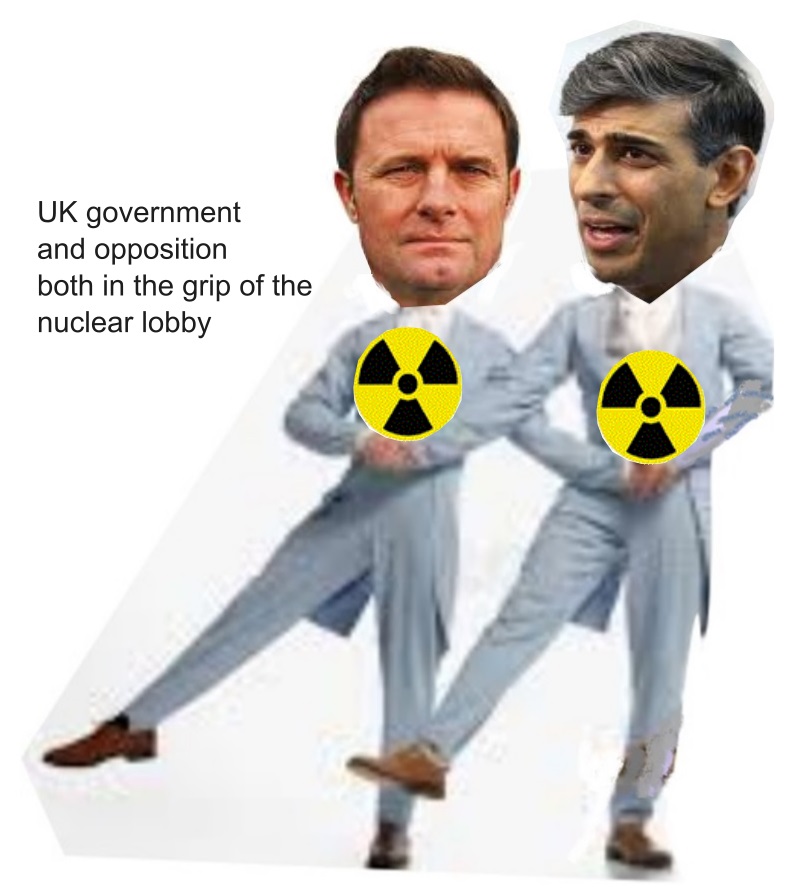
BY CHAS NEWKEY-BURDEN, THE WEEK UK, 15 Apr 24
From the 1940s to Keir Starmer, the party leadership has zigzagged in and out of love with the bomb
“We’ve got to have this thing over here, whatever it costs,” Labour’s then foreign secretary Ernest Bevin reportedly said in the 1940s, and “we’ve got to have the bloody Union Jack on top of it”.
That “thing” was the atomic bomb, but since being acquired by the UK, nuclear weapons have been a “divisive issue” within Labour, said the BBC.
Anti-nuke ‘fixture’
Michael Foot, who became Labour leader in 1980, was a founder member of the Campaign for Nuclear Disarmament (CND) and “a fixture at anti-nuclear demonstrations”, said socialist magazine Tribune.
When Neil Kinnock took over as leader in 1983, the party’s policy, which he supported, was unilateral nuclear disarmament and the removal of all US nuclear weapons and bases from British soil. But this policy was only supported by a minority of the British public, and Labour lost the 1987 general election.
By 1989, Kinnock had convinced the party to drop these policies, but “many” on the Labour left remain “vehemently opposed” to that decision, said the BBC.
Previously ‘unthinkable’
As a young MP, Tony Blair was a member of CND, but he was never strongly in favour of unilateral disarmament, and as party leader, he was on board with the party’s pro-nuclear policy……………………………………………
A ‘nuclear-free world’
Like Foot and Blair, Jeremy Corbyn was also a CND member, rising up to be vice-president of the campaign group before he became party leader in 2015. Corbyn told BBC Radio 4’s “Today” programme that if he became prime minister, he would instruct the UK’s defence chiefs never to use the Trident nuclear weapons system.
“I am opposed to the use of nuclear weapons,” he said. “I am opposed to the holding of nuclear weapons. I want to see a nuclear-free world. I believe it is possible.”……………………
‘Unshakeable’
Corbyn’s successor, Keir Starmer, has moved the party back to a staunchly pro-nuclear policy. In an article in the Daily Mail last week, he said that his commitment to the UK’s nuclear weapons was “unshakeable” and “absolute”……………………
Asked by ITV News if he would be willing to push the nuclear button as PM if Britain were under attack, Starmer said that “deterrence only works if there is a preparedness to use it”. https://theweek.com/defence/labour-nuclear-weapons-history
What’s Inside the President’s Nuclear Football
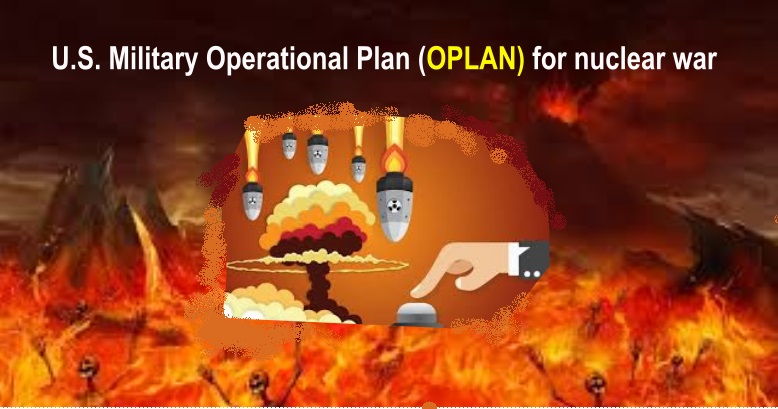
the creation of the Football, the president’s emergency satchel. But what about the nuclear war plans inside? And what about the Black Book? As surprising as this now seems, until 1960, several of the U.S. military branches had their own individual plans for nuclear war. What this meant was that the Army, Navy, and Air Force chiefs each had authority over a uniquely designated stockpile of nuclear weapons—including the delivery systems for those weapons and lists of targets to strike—for them to use at their own discretion in the event of nuclear war. When incoming Secretary of Defense Robert McNamara learned about these multiple, competing nuclear war plans, he ordered them integrated into a single plan. This is how the Single Integrated Operational Plan, or SIOP, got its name.
What began as the Single Integrated Operational Plan is now the Operational Plan, or OPLAN.
The Operation Plan for nuclear war is a colossal and cumbersome set of documents, too large to be carried around in the Football. Parsed down to a more manageable size, the plans become nuclear strike options as delineated in the Black Book.
plan for “mass extermination.” “evil beyond any human project ever,” “the destruction of most cities and people in the northern hemisphere.”
BY ANNIE JACOBSEN, APRIL 11, 2024 https://time.com/6965539/u-s-presidents-nuclear-footb
Jacobsen’s new book is Nuclear War: A Scenario
Nuclear threats have reemerged on the world stage. Frequently, Vladimir Putin warns the West that Russia is ready for nuclear war. “Weapons exits in order to use them,” Putin says. North Korea accuses the U.S. of having, “a sinister intention to provoke a nuclear war.” Entwined with the rising rhetoric, one physical object stands alone—the president’s emergency satchel, also known as the nuclear Football.
This bulging leather briefcase remains with the president at all times, carried by a military aide, and never more than an arm’s length away. It’s an iconic reminder of preeminent power and national mystery. A “nominally secret command-and-control system used to assure presidential control of nuclear use decisions,” historian William Burr says of the Football. Items located inside the president’s emergency satchel confirm his identity and connect him, as commander in chief, to the National Military Command Center, a nuclear bunker located beneath the Pentagon.
Also inside the Football is the Black Book. This cryptic set of documents, parsed down from a much larger operational plan for nuclear war, provides the commander in chief with nuclear launch options should policy dictate the president needs to act. This includes which targets to strike, which delivery systems to use, and the timing of action. “It’s called the Black Book because it involves so much death,” says Dr. Glen McDuff, a nuclear weapons engineer who served as the classified museum historian at Los Alamos National Laboratory in New Mexico.
The Football is with the president at all times. The first publicly-released photograph of the Football is from May 1963, at the Kennedy Family Compound in Hyannis Port, Massachusetts. It can be seen swinging from the military aide’s hand as he walks directly behind the president. The Football accompanied President Regan to the Red Square in Moscow, in 1988. When President George H.W. Bush was photographed out on jog, his military aide—also in running shorts and sneakers—can be seen just a few steps behind, carrying the iconic briefcase in her left hand.
The Football is always within a few feet of the president of the U.S. Once, when President Clinton was visiting Syria, President Hafez al-Assad’s handlers tried to prevent Clinton’s military aide from riding in an elevator with him. “We could not let that happen, and did not let that happen,” former Secret Service director Lewis Merletti says. Merletti was the special agent in charge of President Clinton’s detail at that time. “The Football must always be with the president,” he asserts. “There are no exceptions.” How the Football came to be has long been shrouded in mystery. “Its origins remain highly classified,” journalist Michael Dobbs wrote in Smithsonian Magazine in 2014. And then, just a few months ago, Los Alamos National Laboratory finally declassified the Football’s origin story. It goes like this.
One day in December 1959, a small group of officials from the Joint Committee on Atomic Energy visited a NATO base in Europe to examine joint-custody nuclear bomb protocols. The NATO pilots stationed there flew Republic F84F jets, the first U.S. Air Force fighter-bomber aircraft designed to carry nuclear bombs. Operation Reflex Action was in effect, air crews were trained and ready to strike predetermined targets in the Soviet Union in less than fifteen minutes from the call to nuclear war. One of the men on this visit was Harold Agnew, a Los Alamos scientist with a unique history.
Agnew was one of the three physicists assigned to fly on the Hiroshima bombing mission as a scientific observer. He carried a movie camera with him and took the only existing film footage of the atomic bombing of Hiroshima, as seen from the air. Now, in 1959, Agnew was at Los Alamos overseeing thermonuclear bomb tests; he later became the lab’s director. During the trip to the NATO base, Agnew noticed something that made him wary. “I observed four F84F aircraft . . . sitting on the end of a runway, each was carrying two MK 7 [nuclear] gravity bombs,” he wrote in a document declassified in 2023. What this meant was that “custody of the MK 7s was under the watchful eye of one very young U.S. Army private armed with a M1 rifle with 8 rounds of ammunition.” Agnew told his colleagues: “The only safeguard against unauthorized use of an atomic bomb was this single G.I. surrounded by a large number of foreign troops on foreign territory with thousands of Soviet troops just miles away.”
Back in the U.S., Agnew contacted a project engineer at Sandia Laboratories named Don Cotter and asked “if we could insert an electronic ‘lock’ in the [bomb’s] firing circuit that could prevent just any passerby from arming the MK 7.” Cotter got to work. He put together a demonstration of a device, a lock and coded switch, that functioned as follows: “[a] 3-digit code would be entered, a switch was thrown, the green light extinguished, and the red light illuminated indicating the arming circuit was live.”
Agnew and Cotter went to Washington, D.C., to demonstrate this locking device—first to the Joint Committee on Atomic Energy, then to the president’s top science advisor and finally to the president himself. “We presented it to President Kennedy, who ordered it be done,” Agnew recalled. The military objected. The man in charge of nuclear weapons at the time, General Alfred D. Starbird, opposed the idea. Glen McDuff, who coauthored (with Agnew) the now declassified paper on the subject, summed up the general’s documented concerns. “How is a pilot, U.S. or foreign, somewhere around the world, going to get a code from the President of the United States to arm a nuclear weapon before being overrun by a massively superior number of Soviet troops?” For the U.S. military, the locking device issue opened Pandora’s box. “If gravity bombs were coded,” McDuff explains, “why not all nuclear weapons including missile warheads, atomic demolition munitions, torpedoes, all of them.” The president decided they needed to be.
The answer came in the creation of the Football, the president’s emergency satchel. But what about the nuclear war plans inside? And what about the Black Book? As surprising as this now seems, until 1960, several of the U.S. military branches had their own individual plans for nuclear war. What this meant was that the Army, Navy, and Air Force chiefs each had authority over a uniquely designated stockpile of nuclear weapons—including the delivery systems for those weapons and lists of targets to strike—for them to use at their own discretion in the event of nuclear war. When incoming Secretary of Defense Robert McNamara learned about these multiple, competing nuclear war plans, he ordered them integrated into a single plan. This is how the Single Integrated Operational Plan, or SIOP, got its name.
Starting in December 1960, for the first time in the nuclear age, the SIOP gave the president, not the military, control of America’s nuclear arsenal. This new locking device designed by Agnew and Cotter, called a Permissive Action Link, or PAL, became an integral part of this new system. Only with the invention of the Football would the order to launch nuclear weapons—and the ability to physically arm them—come from the president alone. “This is how the president got the Football,” writes Agnew.
Over the years, the name for the nuclear war plan has changed. What began as the Single Integrated Operational Plan is now the Operational Plan, or OPLAN. For the Nuclear Information Project, in consort with the Federation of American Scientists, project director Hans Kristensen and senior researcher Matt Korda have identified the current Operational Plan as OPLAN 8010-12. It consists of “‘a family of plans’ directed against four identified adversaries: Russia, China, North Korea, and Iran,” the authors write. The Operation Plan for nuclear war is a colossal and cumbersome set of documents, too large to be carried around in the Football. Parsed down to a more manageable size, the plans become nuclear strike options as delineated in the Black Book.
The number of individuals who have written out their first-hand impressions of the SIOP is extremely limited. John Rubel, an avionics expert who served as an assistant secretary of defense under President Kennedy, wrote about the SIOP in his 2008 memoir, Doomsday Delayed. He liked it to a plan for “mass extermination.” Daniel Ellsberg reflected on the SIOP in his 2017 memoir, The Doomsday Machine: Confessions of a Nuclear War Planner. “It depicted evil beyond any human project ever,” Ellsberg wrote. A plan that calls for “the destruction of most cities and people in the northern hemisphere.”
As for the Black Book, few details exist on the public record. In 2015, U.S. Strategic Command battle watch commander Colonel Carolyn Bird shared with CNN previously unreported details. An identical Football resides inside the Stratcom nuclear bunker, viewers learned, locked in a safe beneath Offutt Air Force Base in Nebraska. “The [Black Book inside the] president’s football and our black book are duplicates,” Bird told CNN. “They contain the same information in the same way so that we are talking off the same documents when we are discussing nuclear options.”
In an interview with the History Channel, President Clinton’s former military aide, a colonel named Robert “Buzz” Patterson, likened the Black Book to a “Denny’s breakfast menu.” He made the analogy that choosing retaliatory targets from a predetermined nuclear strike list was as simple as deciding on a combination of food items at a restaurant. “It’s like picking one out of Column A and two out of Column B,” Patterson said.
Dr. Theodore Postol has seen the contents of the Black Book. His thoughts provide unsettling context to Patterson’s observations. From 1982 to 1984 Postol served as the assistant for weapons technology to the chief of naval operations. In this capacity, he worked on technical details regarding submarine launched ballistic missiles, or SLBMs. “Nitty gritty features,” Postol generalizes.
“Seeing the contents of the Black Book,” he recalls, “I was freaked out beyond belief.” Not for reasons he expected; as a weapons technologist Postol was familiar with the mass carnage involved. Instead of being confronted with a succinct summary of these horrifying facts—the targeting of cities, the death tolls in the millions—
Postol found the contents of the Black Book to be an obfuscation of the facts. The nuclear launch plans, he says, “had been sterilized down to military terminology designed to remove you from the reality of what would be happening.” An attempt at sanitizing nuclear war into a seemingly more palatable event. “My first thought,” Postol remembers, was “how would a president understand what these attack options actually mean?” This censoring of grim truths about nuclear war extends to the public as well, Postal contends. “You don’t want your population to know you’re planning genocide.”
What, if any, is the solution to this madness? Between the saber rattling and the secrecy, nuclear matters can present themselves as intractable. And yet, in reporting this story I witnessed a change in attitude from an unlikely source: the Los Alamos National Laboratory, a federal government organization that I’ve covered as a reporter for fifteen years.
“It’s the Oppenheimer effect,” Dr. Glen McDuff told me of this new attitude, “as in Oppenheimer the film.” Ever since the release of Christopher Nolan’s 2023 feature film, “the lab has been inundated with public curiosity about the bomb,” McDuff clarifies. “With requests about nuclear weapons.” And, he says, the lab has done its best to respond. The popularity of the film has renewed dialogue about the existential dangers nuclear weapons pose. And it led to the declassification (at this reporter’s behest) to one of the laboratory’s long-held secrets—the origin story of the Football.
Were the President of the United States to be called upon to open the Football, the situation that would follow would almost certainly spiral out of control. “The world could end in the next couple of hours,” former Stratcom commander General C. Robert Kehler (ret) says of nuclear war.
Nuclear war is the only scenario other than an asteroid strike that could end civilization in a matter hours. The soot from burning cities and forests will blot out the sun and cause a nuclear winter. State-of the art climate modeling predicts five billion humans will die. In the words of Nikita Khrushchev, “the survivors will envy the dead.”
And yet, threats abound. Vladimir Putin insists he is “not bluffing” about the possibility of using weapons of mass destruction. North Korea has test launched more than 100 missiles since January 2022, including nuclear-capable weapons that can hit the U.S. United Nations Secretary General António Guterres warns the world, “Humanity is one misunderstanding, one miscalculation away from nuclear annihilation.” The world balances on the razor’s edge. “This is madness,” Guterres says, “we must reverse course.” Change is possible. Help reverse course. “A nuclear war cannot be won and must never be fought,” President Ronald Reagan and Soviet General Secretary Mikhail Gorbachev cautioned the world in a joint statement in 1985. Conversations between these two leaders led to the reduction in nuclear weapons from an all-time high of 70,481 warheads, to some 12,500 today. Dialogue matters. Join the conversation about nuclear weapons now, while we are all still able to have one.
Einstein’s vision for peace

By Lawrence S. Wittner https://beyondnuclearinternational.org/2024/03/31/einsteins-vision-for-peace/
Aghast at the use of nuclear weapons, he threw himself into efforts to prevent worldwide nuclear annihilation
Although the popular new Netflix film, Einstein and the Bomb, purports to tell the story of the great physicist’s relationship to nuclear weapons, it ignores his vital role in rallying the world against nuclear catastrophe.
Aghast at the use of nuclear weapons in August 1945 to obliterate the cities of Hiroshima and Nagasaki, Einstein threw himself into efforts to prevent worldwide nuclear annihilation. In September, responding to a letter from Robert Hutchins, Chancellor of the University of Chicago, about nuclear weapons, Einstein contended that, “as long as nations demand unrestricted sovereignty, we shall undoubtedly be faced with still bigger wars, fought with bigger and technologically more advanced weapons.” Thus, “the most important task of intellectuals is to make this clear to the general public and to emphasize over and over again the need to establish a well-organized world government.”
Four days later, he made the same point to an interviewer, insisting that “the only salvation for civilization and the human race lies in the creation of a world government, with security of nations founded upon law.”
Determined to prevent nuclear war, Einstein repeatedly hammered away at the need to replace international anarchy with a federation of nations operating under international law. In October 1945, together with other prominent Americans (among them Senator J. William Fulbright, Supreme Court Justice Owen Roberts, and novelist Thomas Mann), Einstein called for a “Federal Constitution of the World.”
That November, he returned to this theme in an interview published in the Atlantic Monthly. “The release of atomic energy has not created a new problem,” he said. “It has merely made more urgent the necessity of solving an existing one. . . . As long as there are sovereign nations possessing great power, war is inevitable.” And war, sooner or later, would become nuclear war.
Given Einstein’s fame and his well-publicized efforts to avert a nuclear holocaust, in May 1946 he became chair of the newly-formed Emergency Committee of Atomic Scientists, a fundraising and policymaking arm for the atomic scientists’ movement. In the Committee’s first fund appeal, Einstein warned that “the unleashed power of the atom has changed everything save our modes of thinking, and thus we drift toward unparalleled catastrophe.”
Even so, despite the fact that Einstein, like most members of the early atomic scientists’ movement, saw world government as the best recipe for survival in the nuclear age, there seemed good reason to consider shorter-range objectives. After all, the Cold War was emerging and nations were beginning to formulate nuclear policies. An early Atomic Scientists of Chicago statement, prepared by Eugene Rabinowitch, editor of the Bulletin of the Atomic Scientists, underscored practical considerations.
“Since world government is unlikely to be achieved within the short time available before the atomic armaments race will lead to an acute danger of armed conflict,” it noted, “the establishment of international controls must be considered as a problem of immediate urgency.” Consequently, the movement increasingly worked in support of specific nuclear arms control and disarmament measures.
In the context of the heightening Cold War, however, taking even limited steps forward proved impossible. The Russian government sharply rejected the Baruch Plan for international control of atomic energy and, instead, developed its own atomic arsenal. In turn, U.S. President Harry Truman, in February 1950, announced his decision to develop a hydrogen bomb―a weapon a thousand times as powerful as its predecessor.
Naturally, the atomic scientists were deeply disturbed by this lurch toward disaster. Appearing on television, Einstein called once more for the creation of a “supra-national” government as the only “way out of the impasse.” Until then, he declared, “annihilation beckons.”
Despite the dashing of his hopes for postwar action to end the nuclear menace, Einstein lent his support over the following years to peace, nuclear disarmament, and world government projects.
The most important of these ventures occurred in 1955, when Bertrand Russell, like Einstein, a proponent of world federation, conceived the idea of issuing a public statement by a small group of the world’s most eminent scientists about the existential peril nuclear weapons brought to modern war. Asked by Russell for his support, Einstein was delighted to sign the statement and did so in one of his last actions before his death that April.
In July, Russell presented the statement to a large meeting in London, packed with representatives of the mass communications media. In the shadow of the Bomb, it read, “we have to learn to think in a new way. . . . Shall we . . . choose death because we cannot forget our quarrels? We appeal as human beings to human beings: Remember your humanity, and forget the rest.”
This Russell-Einstein Manifesto, as it became known, helped trigger a remarkable worldwide uprising against nuclear weapons in the late 1950s and early 1960s, culminating in the world’s first significant nuclear arms control measures. Furthermore, in later years, it inspired legions of activists and world leaders. Among them was the Soviet Union’s Mikhail Gorbachev, whose “new thinking,” modeled on the Manifesto, brought a dramatic end to the Cold War and fostered substantial nuclear disarmament.
The Manifesto thus provided an appropriate conclusion to Einstein’s unremitting campaign to save the world from nuclear destruction.
Lawrence S. Wittner is Professor of History Emeritus at SUNY/Albany and the author of Confronting the Bomb (Stanford University Press).
PATRICK LAWRENCE: Authorized Atrocities

the true rupture lies with those in the West who are sucked into Israel’s utter immorality
Israel’s lawlessness has a history that those in the West share with the apartheid state.
By Patrick Lawrence, Consortium News , 20 Mar 24
It is remarked often enough, including in this space, that Israel’s savagery in its determination to exterminate the Palestinians of Gaza — and we had better brace for what is next on the West Bank of the Jordan — marks a turn for all of humanity.
In its descent into depravity the Zionist state drags the West altogether down with it.
This is true, certainly, but we must put Israel’s criminal conduct, which warrants another Nuremberg trial at this point, in its proper context.
When we do, we find that Israel’s lawlessness has a history, an etymology, and if there is a road to Western salvation it must start with a recognition of a past that those in the West share with the apartheid state.
We can say Israel’s crimes against Gaza’s 2.3 million children, women, and men are unspeakable, in other words, but this would not be right. They are altogether speakable, and it behooves us now to speak of them if we are to grasp where responsibility for this stain upon the human story truly lies.
Pankaj Mishra has just published a thorough and thoroughly remarkable piece on these matters in the London Review of Books.
The Indian author, essayist, and columnist takes up many things in “The Shoah After Gaza,” chiefly the extent to which Zionists have exhausted “the culture of conspicuous Holocaust consumption” — excellent phrase — in defense of a nation that, to quote Primo Levi, “was a mistake in historical terms.”
Here is a passage in Mishra’s piece that is to our present point:
“Israel today is dynamiting the edifice of global norms built after 1945, which has been tottering since the catastrophic and still unpunished war on terror and Vladimir Putin’s revanchist war in Ukraine. The profound rupture we feel today between the past and the present is a rupture in the moral history of the world since the ground zero of 1945 — the history in which the Shoah has been for many years the central event and universal reference.”……………………………………………………………………………….
I confine myself to the postwar decades to allow us to take a good, clear look at that “edifice of global norms” of which Mishra writes.
When we do, we find the West has licensed the Israelis. They bear a pre-authorization by way of many precedents. There is one for more or less every shameful act the Israelis perpetrate against the Palestinian population — this in the West Bank as well as Gaza.
And so we discover — or remind ourselves, depending on how attentive we have been to events — that the post–1945 edifice has looked from the start roughly as it looks now. Israel is at bottom an outcome, not the prime cause of anything.
Insidious Mythology
Certainly the grotesque spectacle of mass murder and wholesale destruction we witness daily has marked a rupture, to stay with Mishra’s term. But to assert that this rupture lies in Israel’s conduct is to sustain an insidious mythology of innocence for the West.
No, the true rupture lies with those in the West who are sucked into Israel’s utter immorality and now come face-to-face with their amoral indifference or, for the best of them, discover the extent of their powerlessness despite their authentic efforts.
As to Israel, I am with Primo Levi as Mishra quotes him. “The Jewish state” had already proven a mistake when he made his much-disputed remark in 1985.
The truth of it has since been demonstrated a hundred times over. Israel has proven a failed experiment, incapable of conducting itself as a legitimate nation-state.
But whose mistake is Israel? It was the West, Britain in the lead, that created Israel by caving to the Zionists at the expense of indigenous Palestinians. This is the reality of power that should weigh most heavily on our shoulders. Israel ‘R’ us.
Britain’s abandonment of the 1920 Mandate brings us to one of the deeper characteristics of our time, our postwar edifice. This is the ever more complete disregard of those in power for the principles, standards and broadly accepted ethics that give form and coherence to a stable civilization and keep its public space clean and well lit.
In our crumbling edifice, everything is done according to its value as an expedient to a desired outcome. This, too, is a kind of depravity. And it is this depravity that produces the depravity we watch as we watch Israel’s effort to destroy an entire people. https://consortiumnews.com/2024/03/20/patrick-lawrence-authorized-atrocities/
The last stammering of Jewish fascism

In Israel, the Jewish democratic opposition organized anti-Zionist demonstrations, which were not very well attended. Speakers emphasized the betrayal of the Prime Minister, who used the shock of October 7 not to save the hostages, but to realize his colonial dream.
Washington then decided to radically change its policy. Until then, it had considered that it could not afford to let Israel lose. It had therefore supported its crime. Now, it could no longer afford to let the Jewish fascists win. It’s important to understand that Washington didn’t change its mind when it saw the suffering of the Gazans, nor because of a sudden outburst of anti-fascism, but because of the threats of the “revisionist Zionists”. Its positions are dictated exclusively by its desire to maintain its domination of the world. It could not contemplate another defeat for its Israeli allies, this time after those in Syria and Ukraine. But it could even less envisage losing to the “revisionist Zionists”.
Victoria Nuland’s dismissal demonstrates the Biden Administration’s desire to clean up its own house, while doing the same for Israel.
https://www.voltairenet.org/article220564.html VOLTAIRE NETWORK | PARIS (FRANCE) | 12 MARCH 2024, by Thierry Meyssan
Anyone acting in good faith understands that murdering 30,000 innocent people has nothing to do with eliminating Hamas. Operation Iron Glaive appears for what it is: a cover to realize the old dream pursued by Jewish fascists from Jabotinsky to Netanyahu: to expel the Arab population from Palestine. From then on, this mass crime, committed for the first time live on television, turned the world’s political chessboard upside down. Feeling threatened, the Jewish supremacists themselves threatened the United States. Anxious to remain masters of the “free world”, the United States is preparing to topple the Jewish supremacists.
The Biden administration watched with bated breath as Israel reacted to the attack by the Palestinian Resistance, including Hamas, known as the “Flood of Al-Aqsa” (October 7). Operation Iron Glaive began with a massive pounding of Gaza City on a scale unprecedented anywhere in the world, including the World Wars. From October 27 onwards, this was followed by ground intervention, looting and the torture of thousands of Gazan civilians. In five months, 37,534 civilians were killed or disappeared, including 13,430 children and 8,900 women, 364 medical personnel and 132 journalists. [1].
At first, Washington reacted by unwaveringly supporting “Israel’s right to defend itself”, threatening to veto any ceasefire request and supplying as many bombs as necessary for the widespread destruction of the Palestinian enclave. It was unthinkable, in its eyes, to suffer yet another defeat, after those in Syria and Ukraine. However, Americans were watching the horrors live on their cell phones. Many high-ranking State Department officials wrote and spoke of their shame at supporting this butchery. Petitions were circulated. Prominent figures, both Jewish and Muslim, resigned.
In the midst of a presidential election campaign, Joe Biden’s team could no longer stain its hands with blood. It therefore began to put pressure on the Israeli war cabinet to negotiate the release of the hostages and conclude a ceasefire. However, Benjamin Netanyahu’s coalition refused, playing on the trauma of its citizens to ensure that peace would only return once Hamas had been eradicated. Washington eventually realized that the events of October 7 were merely a pretext for Jabotinsky’s followers to do what they had always wanted to do: expel the Arabs from Palestine. He became more insistent, stressing that the Palestinians had a right to live, that the colonization of their land was illegal under international law, and that the Israeli-Palestinian question would be resolved by a “two-state solution” (and not by the binational state envisaged by Resolution 181 of 1947).
Revisionist Zionists” (i.e., followers of Jabotinsky [2]) responded by organizing the “Conference for the Victory of Israel” [3] on January 28, 2024. Headlining the event was Rabbi Uzi Sharbaf, sentenced in Israel to life imprisonment for his racist crimes against Arabs, but pardoned by his friends. Sharbaf did not hesitate to proclaim himself heir to the Lehi and Stern groups who fought against the Allies alongside duce Benito Mussolini.
The message was perfectly received in Washington and London: this tiny group intended to impose its will on the Anglo-Saxons and would not hesitate to attack them if they tried to prevent ethnic cleansing.
The White House immediately issued a ban on fundraising and transfers to them [4]. This ban was extended to all Western banks under the Foreign Account Tax Compliance Act (FATCA).
In addition, on February 8, President Joe Biden signed a Memorandum on the conditions of US arms transfers [5]. Israel has until March 25 to guarantee in writing that it will not violate either International Humanitarian Law (but not International Law itself) or Human Rights (in the sense of the US Constitution).
For their part, the parliaments of the Netherlands and the United Kingdom have begun debating the possibility of ceasing arms trading with Israel.
In Israel, the Jewish democratic opposition organized anti-Zionist demonstrations, which were not very well attended. Speakers emphasized the betrayal of the Prime Minister, who used the shock of October 7 not to save the hostages, but to realize his colonial dream.
The “revisionist Zionists” then launched a media offensive against the United Nations Relief and Works Agency for Palestine Refugees in the Near East (UNRWA). Since 1949, this UN agency has been providing education, food, healthcare and social services to 5.8 million stateless Palestinians in Palestine itself, as well as in Jordan, Lebanon and Syria. It has an annual budget of over $1 billion and employs over 30,000 people. Already in 2018, President Donald Trump had questioned the agency’s assistance to Palestinians and suspended US funding for it. His intention was to force the Palestinian factions back to the negotiating table. Five years on, the aim of the “revisionist Zionists” is very different. By attacking UNRWA, they intend to force Jordan, Lebanon and Syria to expel Palestinian refugees too. To this end, they accused 0.04% of its staff of having taken part in Operation Flood of Al-Aqsa, and blocked their bank accounts in Israel. UNRWA Director Philippe Lazzarini of Switzerland immediately suspended the 12 accused employees and ordered an internal investigation.
Of course, he never received the proof the Israelis claimed to have, but one donor after another, led by the United States and the European Union, suspended funding. Within days in Gaza, and weeks in Jordan, Lebanon and Syria, the United Nations aid system collapsed.
Continue readingThe ideology of war in Ukraine and Israel
by Thierry Meyssan, https://www.voltairenet.org/article220527.html 14 Mar 24
The wars in Ukraine and Gaza are more similar than you might think, at least if you know their histories. The Ukrainian war didn’t start with the Russian military operation, but with the massacres in the Donbass, while the Gaza war didn’t start with the Al-Aqsa deluge, but 75 years earlier with the Nakhba. In the long term, those responsible for both wars share the same ideology.
Generally speaking, every war defines who “we” are and who “they” are. “We” are Good, while “they” are Evil.
Western leaders, while declaring that war itself is bad, claim that it is indispensable today in the face of aggression from Russia and Hamas. According to them, Russia, or rather its president Vladimir Putin, dreams of seizing our property and destroying our political system. After invading Ukraine, he will invade Moldavia and the Baltic states, then continue westwards. Hamas, on the other hand, is a hate-filled sect that begins by raping and beheading Jews out of anti-Semitism, and will continue by invading the West in the name of its religion.
It’s worth noting that both Israel and the USA were founded by their armies, the Haganah and the Continental Army. Today, the vast majority of their political leaders have spent their careers in the armed forces or secret services. But they’re not the only ones, since Xi Jinping is a military man and Vladimir Putin is a former member of the Soviet secret service (KGB).
One wonders what feeds the phantasms of the political West and how they prevent us from grasping reality. Russia didn’t invade Ukraine any more than France invaded Rwanda. Moscow and Paris stopped the massacre of Ukrainians in the Donbass and Rwandan Tutsis. Both were driven by their “responsibility to protect” and implemented Security Council resolutions. Palestinians don’t rape and behead anyone for pleasure, even if some of them belong to a secret society that does. They don’t fight the Jews out of anti-Semitism, except for the historic branch of Hamas, but against the apartheid system of which they are victims.
Perhaps the first function of collective blindness is to erase our previous crimes: it was the “democracies” of the United States and members of the European Union who organized the overthrow of Ukraine’s elected president, Viktor Yanukovych, in 2014. It was Germany and France that signed the Minsk Accords to guarantee peace for Ukrainians in Donbass (2015), but never intended to implement them and, according to the confessions of Chancellor Angela Merkel and President François Hollande, used them to arm Ukraine against Russia. This violation of our word and signature constitutes, according to the Nuremberg Tribunal, the gravest of all crimes, that “against peace”.
Similarly, it is the “greatest democracy in the Middle East”, Israel, which has stolen, metre by metre, by occupation and nibbling, most of the Palestinian Territories established by Security Council resolution 181 (1947).
These conflicts are not about resources, but territories. Since 1917, Dmytro Dontsov’s Ukrainian integral nationalists have consistently claimed sovereignty over Nestor Makhno’s anarchist Novorossia and the Bolshevik Donbass and Crimea. Of course, these territories were merged into Soviet Ukraine by Ukrainian Nikita Khrushchev, but Kiev cannot invoke recent history to claim them as its own. Similarly, since 1920, Vladimir Ze’ev Jabotinsky’s revisionist Zionists have claimed sovereignty over the whole of Palestine, and eventually over the Egyptian Sinai, Lebanon, Jordan and Syria – in short, all the territories from the “Nile to the Euphrates”. Of course, the ancient kingdom of Jerusalem consisted of the city and its suburbs, but that doesn’t allow them to evoke history for all these conquests.
It is often said that the age pyramid determines the aggressiveness of states. States with a majority of young people between the ages of 15 and 30 would by nature be inclined to war. But this is neither the case in Ukraine, nor in Israel. What’s more, it’s Palestine, not Israel that the age pyramid could push towards war.
The ideological question is probably the most important. Dmytro Dontsov and his henchman Stepan Bandera glorified the Ukrainian fighters, heirs to the Swedish Vikings, the Varegues, who had to slaughter the “Muscovites” to be able to feast in Valhalla. Today, it’s the “White Führer”, Andriy Biletsky, who has commanded the troops of the Azov Division in Mariupol, the 3rd Assault Brigade in Bakhmut/Artiomovsk and most recently in Avdeyevka/Avdiyevka. Similarly, Benjamin Netanyahu, son of Vladimir Jabotinsky’s private secretary, has not hesitated to compare the Palestinians to the ancient Amalekites. The implication is that they must all be exterminated as Yahweh commands, or else their race will re-emerge against the Hebrews. In the same way, the IDF has systematically destroyed all the universities and schools in the Gaza Strip and massacred 30,000 civilians under the pretext of fighting Hamas.
Dmytro Dontsov formed an alliance with Adolf Hitler as early as 1923, i.e. before he came to power, and became one of the administrators of the Reinhard Heydrich Institute, responsible for carrying out the Final Solution of the Jewish and Gypsy question. Vladimir Jabotinsky, who had formed an alliance with Dontsov in 1922, founded the Betar cadre school in Civitavecchi (Italy) with the help of Duce Benito Mussolini in 1935. He was unable to play a major role in the Second World War, dying in August 1940. There can be no doubt about the adherence of Ukrainian integral nationalists to Nazism and revisionist Zionists to fascism.
Incidentally, we find the territorial logic of fascist and Nazi regimes in the current discourse of Ukrainian President Volodymyr Zelensky and Israeli Prime Minister Benjamin Netanyahu. At the same time, the Russian and Palestinian presidents, Vladimir Putin and Mahmoud Abbas, constantly claim to be defending their peoples.
To find out more about Dmytro Dontsov’s integral nationalism, read:
“Who are the Ukrainian integral nationalists?“, by Thierry Meyssan, Réseau Voltaire, November 15, 2022.
For more on Volodymyr Jabotinsky’s revisionist Zionists read:
“The veil is being torn: the hidden truths of Jabotinsky and Netanyahu“, by Thierry Meyssan, Voltaire Network, January 23, 2024.
and “In Jerusalem, the ’Conference for the Victory of Israel’ threatens London and Washington“, by Thierry Meyssan, Voltaire Network, February 13, 2024.
1 This Month

of the week – Shut Down Drone Warfare!


Tell the Ukrainian Government to Drop Prosecution of Peace Activist Yurii Sheliazhenko

Petition to revoke the licensing of the Near Surface Nuclear Disposal Facility (NSDF) at Chalk River. https://www.ourcommons.ca/petitions/en/Petition/Details?Petition=e-7247
To see nuclear-related stories in greater depth and intensity – go to https://nuclearinformation.wordpress.com
-
Archives
- April 2026 (44)
- March 2026 (251)
- February 2026 (268)
- January 2026 (308)
- December 2025 (358)
- November 2025 (359)
- October 2025 (376)
- September 2025 (257)
- August 2025 (319)
- July 2025 (230)
- June 2025 (348)
- May 2025 (261)
-
Categories
- 1
- 1 NUCLEAR ISSUES
- business and costs
- climate change
- culture and arts
- ENERGY
- environment
- health
- history
- indigenous issues
- Legal
- marketing of nuclear
- media
- opposition to nuclear
- PERSONAL STORIES
- politics
- politics international
- Religion and ethics
- safety
- secrets,lies and civil liberties
- spinbuster
- technology
- Uranium
- wastes
- weapons and war
- Women
- 2 WORLD
- ACTION
- AFRICA
- Atrocities
- AUSTRALIA
- Christina's notes
- Christina's themes
- culture and arts
- Events
- Fuk 2022
- Fuk 2023
- Fukushima 2017
- Fukushima 2018
- fukushima 2019
- Fukushima 2020
- Fukushima 2021
- general
- global warming
- Humour (God we need it)
- Nuclear
- RARE EARTHS
- Reference
- resources – print
- Resources -audiovicual
- Weekly Newsletter
- World
- World Nuclear
- YouTube
-
RSS
Entries RSS
Comments RSS
 nuclear-news