The health impact of nuclear tests in French Polynesia – archive, 1981
there is mounting, though not yet definitive evidence of cancer and brain tumours in the area, especially among the young.
France spent €90,000 countering research into the effects of its Pacific nuclear tests in the 1960s and 70s. Learn how the Guardian reported early accounts of sickness and contamination
Guardian, Compiled by Richard Nelsson, 28 May 25
The health impact of nuclear tests in French Polynesia – archive, 1981
France spent €90,000 countering research into the effects of its Pacific nuclear tests in the 1960s and 70s. Learn how the Guardian reported early accounts of sickness and contamination
Compiled by Richard NelssonWed 28 May 2025
Pacific islanders agitate in the shadow of the bomb
By Christopher Price
17 September 1981
A recent Canard cartoon shows Adam and Eve looking at an H-bomb. “Look, H for Hernu,” (the new Socialist defence minister), says Adam. “Yes and for Horror, Holocaust, Hecatomb and Hiroshima,” adds Eve.
French Socialists have never hitherto allowed the nuclear issue to dominate their politics. If it is beginning to do so now it is partly because keeping their independent nuclear deterrent, which they continue to test underground in Muroroa atoll in French Polynesia, implies continuing colonial domination of the islands of the South Pacific – an issue which is very much alive, both among the Indigenous people of the Pacific and in the rank and file of the Socialist party in France.
The official position – “auto-determination” – as stated by Mr Henri Emmanuelli, the French Colonial minister when he visited France’s Pacific colonies was that he would discuss anything if a democratic majority wanted to. But he also said that recent election results made a referendum on the subject unnecessary.
That none of these three groups of islands (Polynesia, New Caledonia, and Wallis and Futuna) can immediately prove a majority for independence is partly due to strenuous French efforts over the years to stamp on emerging independence movements. More powerful than anything else [influencing the calls for independence] are the pollutant effects of nuclear tests on the human and natural environment. They are now beginning to make themselves felt. Hitherto everything that happens on Mururoa has been officially secret. But Mr Hernu has now a new “frankness” about the tests in an effort to allay anxiety; and immediately after he left the Centre d’Expérimentation du Pacifique issued its first-ever admission of an accident; it was not safe to swim off Mururoa.
In fact, authoritative reports state that there is now a crack 15 to 19 inches wide and over half a mile long in the atoll below sea level; that radioactive leaks into the Pacific have been taking place for many years; that a neighbouring atoll, Fangataufa, has been literally blasted out of the sea.
It is not yet possible to gauge the effect of such leaks, but coupled with the profound disquiet about Japanese plans to use the Pacific as a nuclear waste dumping ground, fears about pollution of fish and other marine life and consequently poisoning of the whole ocean, island populations will undoubtedly put further pressure on the Mitterrand government to reconsider its nuclear testing policy.
“Why don’t they do it in Nice?” was the one constant question put to me by the Polynesians. It echoed “Mururoa and Auvergne”, the most telling of the posters in the campaign which forced the French, eight years ago, to put the tests underground. Now there is a new twist to the story. It’s not just H-bombs the French are exploding inside Mururoa.
It was confirmed by Mr Giscard in June 1980 that France had been undertaking feasibility studies of neutron bombs since 1976, and this week Mr Mauroy, the Socialist prime minister, committed his government to strengthening France’s strategic nuclear arsenal and to the development of the neutron bomb. The knowledge that France is as keen as the US on upping the nuclear option can only add to the disquiet.
On top of this there is mounting, though not yet definitive evidence of cancer and brain tumours in the area, especially among the young. The French authorities counter that there is still less radioactivity in Polynesia than in the Massif Central. Maybe, but the fact that they go to quite extraordinary lengths of security in the treatment of such cases in French hospitals, suggesting a pathological desire to suppress such evidence as exists. One Actuel reporter, Mr Luis González-Mata, who tried to investigate the issue in Polynesia and in France, met continuous hostility.
So far the French government’s response to the political pressure has been to offer that decentralisation of local government to its overseas territories which the towns and cities of France are soon to enjoy. But it will be pressed to go further. The Pacific Forum comprising all independent Pacific countries, decided in Vanuatu in August to send a delegation to Mr Mitterrand demanding to know his intentions.
This is an edited extract. Read the article in full.
Testimonies from the atoll
Mururoa has been the centre of French nuclear tests for decades, largely in secret and often with scant regard for the people who live nearby. For the first time the native workers and their families tell their side of the story.
7 September 1990
Manutahi started work as a welder on Mururoa in 1965 at the age of 32. That was before the tests had started. He worked on the construction of the blockhouses Dindon and Denise.
In 1965 and at the beginning of 1966, we were allowed to eat all the fish in the lagoon but when we returned in 1967, we were forbidden to eat any. ……………………………………………………………………………………………………………………………………………………………………………………………………………https://www.theguardian.com/theguardian/2025/may/28/the-health-impact-of-nuclear-tests-in-french-polynesia-1981
John Hersey
Did you know John Hersey had to circumvent military restrictions just to step foot in post-atomic Hiroshima? The young journalist’s 1946 pilgrimage to the still-smoldering city would become one of the most consequential acts of subterfuge in journalism history – and forever change how the world understood nuclear war.
As American occupation forces tightly controlled access to the decimated city, Hersey navigated checkpoints and bureaucracy with quiet determination. The rubble was still warm when he arrived, the air thick with the scent of charred wood and something more sinister – what survivors called “the atomic smell.” While military reports focused on blast radii and structural damage, Hersey carried no measuring tools. His instruments were a notebook, boundless empathy, and an unshakable belief that history should be recorded in human heartbeats rather than casualty counts.
What he found defied comprehension. A watchmaker’s shop where dozens of timepieces all stopped at 8:15. Shadows of vaporized office workers permanently etched onto concrete walls. A group of schoolgirls whose patterned kimonos had burned into their skin, the fabric’s flower designs now grotesque scars. Hersey moved through this nightmare landscape like a ghost, collecting stories with revolutionary patience. He would sit for hours with survivors in their makeshift lean-tos, letting long silences coax out memories too terrible to voice.
The genius of his approach lay in the ordinary details: a clerk who survived because he’d bent down to tie his shoe; a doctor who mistook the mushroom cloud for “a magnesium flare”; a mother who recognized her drowned child only by the yarn of a handmade sweater. These weren’t the sweeping narratives of generals or politicians – they were fragile human moments that made the unimaginable real.
Hersey’s reporting methods were as radical as his mission. He physically retraced survivors’ steps through the ruins, noting where each had been standing when the world ended. He recorded not just their words but their trembling hands, the way their voices broke decades later describing the taste of radioactive rain. Most astonishingly, he did it all while American soldiers played baseball nearby, their casual normalcy a surreal counterpoint to the surrounding devastation.
The result, of course, was Hiroshima – a work that stripped war reporting of its abstractions and forced readers to confront nuclear destruction one agonizing personal story at a time. But behind its publication lies this extraordinary truth: that one stubborn reporter’s unauthorized pilgrimage gave voice to history’s first atomic survivors when their own government preferred silence. Hersey proved that sometimes the most powerful journalism requires not just bearing witness, but first having the courage to slip past the guards.
80 years on, US still embattled in senseless Cold War with Russia
Walt Zlotow, West Suburban Peace Coalition, Glen Ellyn IL , 7 May 25, https://theaimn.net/80-years-on-us-still-embattled-in-a-cold-war-with-russia/#google_vignette
May 8 marks 80 years since Victory in Europe Day. That victory kicked off the 46 year long Cold War against our great WWII ally Soviet Union (now Russia).
Sadly, the 1991 end of the Soviet Union simply transferred the Cold War into a cool war against Russia which has since gone cold again.
We’ve spent the last 34 years ever expanding the Cold War NATO alliance to Russia’s borders to keep them out of the European political economy and guarantee a yearly trillion dollar defense budget to prop up American capitalism. What good is the world’s largest military if you do not have a monstrous enemy to justify it?
That could have been avoided except for arguably the worst vice presidential pick in American history.
Every American today knows who Harry Truman was but few have a clue about his predecessor. Henry Wallace was a 20th century American visionary shoved out of the vice presidency in 1944, denying him the presidency upon the death of FDR, and changing America and the world for the worse.
Henry Wallace has been largely written out of the American Story told to succeeding generations of Americans by the protectors of the American Super Power Myth.
Born in 1888 to an affluent Iowa Republican farm family, Wallace increased family wealth with his Hi-Bred Corn Company. But the Depression turned Wallace into a zealous champion of the common man, landing him the Secretary of Agriculture post in FDR’s first term. Possibly the most effective New Dealer, Wallace championed the broken American farmer using curtailed production and price supports to ameliorate rampant rural poverty. His unbridled Bernie Sanders like democratic socialism of the 30’s garnered him FDR’s reverence and the 1940 third term vice presidency.
Wallace transformed the vice presidency for the good, long before Dick Cheney transformed it for evil. FDR made him what journalists tabbed the ‘Assistant President’ in his role mobilizing war production during WWII and championing FDR’s vision for a truly peaceful post WWII world working in partnership with critical war ally Russia for a peaceful Europe and ending European colonialism in Asia and Africa.
In 1942 he gave his famous “Common Man” speech, declaring the 20th century must celebrate the common man, not just, as Time publisher Henry Luce postured, the American Century. In 1943, he joined with the black community following the Detroit race riot, arguing “We cannot crush Nazi brutality abroad and condone race riots at home.”
His near FDR like popularity made him a lock for VP again on the ’44 Democratic ticket. But with FDR fading mentally and physically, party leaders saw opportunity to dump him. His peace proclivities threatened their continuation of a war economy to combat their imaginary new Hitler in the form of Joseph Stalin.
They closed the late night convention session on the brink of re nominating Wallace for a second term. That garnered time to make deals with the other candidates to move the pliant Harry Truman from last to first in the final VP tally.
Three months into term four FDR died thrusting Truman into the White House. This set the stage for the Cold War due to Truman’s capitulation to the neo-conservatives of his day such as Jimmy Byrnes and Jimmy Forestall who demanded a fresh enemy to keep the emerging Military-Industrial Complex in business. A Wallace presidency would have sidelined these anti Russian hardliners. The chance for a truly peaceful post WWII world was irrevocably lost.
The post WWII neocons won out over Wallace, but undaunted he launched a 3rd party progressive campaign in 1948 to unseat Truman. McCarthyite red smears and personal attacks on his progressive philosophy doomed him to just 3% of the ’48 vote, ending his career. Also ended was any opportunity for America to retreat from senseless Cold War.
That leaves us to ponder if today’s new Cold War will rage on for another 80 years.
The Anglo-Nazi Global Empire That Almost Was
Polls of European citizens conducted in the immediate aftermath of World War II showed there was little public doubt that the Red Army was primarily responsible for Nazi Germany’s destruction, while Britain and the US were perceived as playing mere walk-on roles.
For example, in 1945, 57% of French citizens believed Moscow “contributed most to the defeat of Germany in 1945” – just 20% named the US, and 12% Britain. By 2015, less than a quarter of respondents recognised the Soviet role, with 54% believing the US to be Nazism’s ultimate vanquisher. Meanwhile, a survey on the 80th anniversary of D-Day in June 2024 found 42% of Britons believed their own country had done more to crush Hitler than all other allies combined.
Kit Klarenberg, May 04, 2025, https://www.kitklarenberg.com/p/the-anglo-nazi-global-empire-that
As VE Day approaches, Western officials, pundits and journalists are widely seeking to exploit the 80th anniversary of Nazism’s defeat for political purposes. European leaders have threatened state attendees of Russia’s grand May 9th victory parade with adverse consequences. Meanwhile, countless sources draw historical comparisons between appeasement of Nazi Germany throughout the 1930s, and the Trump administration’s ongoing efforts to strike a deal with Moscow to end the Ukraine proxy conflict.
As The Atlantic put it in March, “Trump Is Offering Putin Another Munich” – a reference to the September 1938 Munich Agreement, under which Western powers, led by Britain, granted a vast portion of Czechoslovakia to Nazi Germany. Mainstream narratives of appeasement state that this represented the policy’s apotheosis – its final act, which it was believed would permanently sate Adolf Hitler’s expansionist ambitions, but actually made World War II inevitable.
Appeasement is universally accepted today in the West as a well-intentioned but ultimately catastrophically failed and misguided attempt to avoid another global conflict with Germany, for peace’s sake. According to this reading, European governments made certain concessions to Hitler, while turning a blind eye to egregious breaches of the post-World War I Versailles Treaty, such as the Luftwaffe’s creation in February 1935, and Nazi Germany’s military occupation of the Rhineland in May the next year.
In reality though, from Britain’s perspective, the Munich Agreement was intended to be just the start of a wider process that would culminate in “world political partnership” between London and Berlin. Two months prior, the Federation of British Industries (FBI), known today as the Confederation of British Industry, made contact with its Nazi counterpart, Reichsgruppe Industrie (RI). The pair eagerly agreed their respective governments should enter into formal negotiations on Anglo-German economic integration.
Representatives of these organisations met face-to-face in London on November 9th that year. The summit went swimmingly, and a formal conference in Düsseldorf was scheduled for next March. Coincidentally, later that evening in Berlin, Kristallnacht erupted, with Nazi paramilitaries burning and destroying synagogues and Jewish businesses across Germany. The most infamous pogrom in history was no deterrent to continued discussions and meetings between FBI and RI representatives. A month later, they inked a formal agreement on the creation of an international Anglo-Nazi coal cartel.
British officials fully endorsed this burgeoning relationship, believing it would provide a crucial foundation for future alliance with Nazi Germany in other fields. Moreover, it was hoped Berlin’s industrial and technological prowess would reinvigorate Britain’s economy at home and throughout the Empire, which was ever-increasingly lagging behind the ascendant US. In February 1939, representatives of British government and industry made a pilgrimage to Berlin to feast with high-ranking Nazi officials, in advance of the next month’s joint conference.
As FBI representatives prepared to depart for Düsseldorf in March, British cabinet chief Walter Runciman – a fervent advocate of appeasement, and chief architect of Czechoslovakia’s carve up – informed them, “gentlemen, the peace of Europe is in your hands.” In a sick twist, they arrived on March 14th, while Czechoslovakian president Emil Hácha was in Berlin meeting with Hitler. Offered the choice of freely allowing Nazi troops entry into his country, or the Luftwaffe reducing Prague to rubble before all-out invasion, he suffered a heart attack.
After revival, Hácha chose the former option. The Düsseldorf conference commenced the next morning, as Nazi tanks stormed unhindered into rump Czechoslovakia. Against this monstrous backdrop, a 12-point declaration was ironed out by the FBI and RI. It envisaged “a world economic partnership between the business communities” of Berlin and London. That August, FBI representatives secretly met with Herman Göring to anoint the agreement. In the meantime, the British government had via back channels made a formal offer of wide-ranging “cooperation” with Nazi Germany.
‘Political Partnership’
In April 1938, journeyman diplomat Herbert von Dirksen was appointed Nazi Germany’s ambassador to London. A committed National Socialist and rabid antisemite, he also harboured a particularly visceral loathing of Poles, believing them to be subhuman, eagerly supporting Poland’s total erasure. Despite this, due to his English language fluency and aristocratic manners, he charmed British officials and citizens alike, and was widely perceived locally as Nazi Germany’s respectable face.
Even more vitally though, Dirksen – in common with many powerful elements of the British establishment – was convinced that not only could war be avoided, but London and Berlin would instead forge a global economic, military, and political alliance. His 18 months in Britain before the outbreak of World War II were spent working tirelessly to achieve these goals, by establishing and maintaining communication lines between officials and decisionmakers in the two countries, while attempting to broker deals.
Dirksen published an official memoir in 1950, detailing his lengthy diplomatic career. However, far more revealing insights into the period immediately preceding World War II, and behind-the-scenes efforts to achieve enduring detente between Britain and Nazi Germany, are contained in the virtually unknown Dirksen Papers, a two-volume record released by the Soviet Union’s Foreign Languages Publishing House without his consent. They contain private communications sent to and from Dirksen, diary entries, and memos he wrote for himself, never intended for public consumption.
The contents were sourced from a vast trove of documents found by the Red Army after it seized Gröditzberg, a castle owned by Dirksen where he spent most of World War II. Mainstream historians have markedly made no use of the Dirksen Papers. Whether this is due to their bombshell disclosures posing a variety of dire threats to established Western narratives of World War II, and revealing much the British government wishes to remain forever secret, is a matter of speculation.
Read more: The Anglo-Nazi Global Empire That Almost WasImmediately after World War II began, Dirksen “keenly” felt an “obligation” to author a detailed post-mortem on the failure of Britain’s peace overtures to Nazi Germany, and his own. He was particularly compelled to write it as “all important documents” in Berlin’s London embassy had been burned following Britain’s formal declaration of war on September 3rd 1939. Reflecting on his experiences, Dirksen spoke of “the tragic and paramount thing about the rise of the new Anglo-German war”:
“Germany demanded an equal place with Britain as a world power…Britain was in principle prepared to concede. But, whereas Germany demanded immediate, complete and unequivocal satisfaction of her demands, Britain – although she was ready to renounce her Eastern commitments, and…allow Germany a predominant position in East and Southeast Europe, and to discuss genuine world political partnership with Germany – wanted this to be done only by way of negotiation and a gradual revision of British policy.”
‘German Reply’
From London’s perspective, Dirksen lamented, this radical change in the global order “could be effected in a period of months, but not of days or weeks.” Another stumbling block was the British and French making a “guarantee” to defend Poland in the event she was attacked by Nazi Germany, in March 1939. This bellicose stance – along with belligerent speeches from Prime Minister Neville Chamberlain – was at total odds with simultaneous conciliatory approaches such as Düsseldorf, and the private stances and utterances of British officials to their Nazi counterparts.
In any event, it appears London instantly regretted its pledge to defend Poland. Dirksen records in his post-mortem how subsequently, senior British officials told him they sought “an Anglo-German entente” that would “render Britain’s guarantee policy nugatory” and “enable Britain to extricate her from her predicament in regard to Poland,” so Warsaw would “be left to face Germany alone”.
In mid-July 1939, Horace Wilson – an extremely powerful civil servant and Chamberlain’s right hand man – approached Göring’s chief aide Helmuth Wohlthat during a visit to London. Wilson “outlined a program for a comprehensive adjustment of Anglo-German relations” to him, which amounted to a radical overhaul of the two countries’ “political, military and economic arrangements.” This included “a non-aggression pact”, explicitly concerned with shredding Britain’s “guarantee” to Warsaw. Dirksen noted:
“The underlying purpose of this treaty was to make it possible for the British gradually to disembarrass themselves of their commitments toward Poland, on the ground that they had…secured Germany’s renunciation of methods of aggression.”
Elsewhere, “comprehensive” proposals for economic cooperation were outlined, with the promise of “negotiations…to be undertaken on colonial questions, supplies of raw material for Germany, delimitation of industrial markets, international debt problems, and the application of the most favoured nation clause.” In addition, a realignment of “the spheres of interest of the Great Powers” would be up for discussion, opening the door for further Nazi territorial expansion. Dirksen makes clear these grand plans were fully endorsed at the British government’s highest levels:
“The importance of Wilson’s proposals was demonstrated by the fact that Wilson invited Wohlthat to have them confirmed by Chamberlain personally.”
During his stay in London, Wohlthat also had extensive discussions with Overseas Trade Secretary Robert Hudson, who told him “three big regions offered the two nations an immense field for economic activity.” This included the existing British Empire, China and Russia. “Here agreement was possible; as also in other regions,” including the Balkans, where “England had no economic ambitions.” In other words, resource-rich Yugoslavia would be Nazi Germany’s for the taking, under the terms of “world political partnership” with Britain.
Dirksen outlined the contents of Wohlthat’s talks with Hudson and Wilson in a “strictly secret” internal memo, excitedly noting “England alone could not adequately take care of her vast Empire, and it would be quite possible for Germany to be given a rather comprehensive share.” A telegram dispatched to Dirksen from the German Foreign Office on July 31st 1939 recorded Wohlthat had informed Göring of Britain’s secret proposals, who in turn notified Nazi Foreign Minister Joachim von Ribbentrop.
Dirksen noted elsewhere Wohlthat specifically asked the British how such negotiations “might be put on a tangible footing.” Wilson informed him “the decisive thing” was for Hitler to “[make] his willingness known” by officially authorising a senior Nazi official to discuss the “program”. Wilson “furthermore strongly stressed the great value the British government laid upon a German reply” to these offers, and how London “considered that slipping into war was the only alternative.”
‘Authoritarian Regimes’
No “reply” apparently ever came. On September 1st 1939, Nazi Germany invaded Poland, Britain declared war on Germany two days later, and the rest is history – albeit history that is subject to determined obfuscation, constant rewriting, and deliberate distortion. Polls of European citizens conducted in the immediate aftermath of World War II showed there was little public doubt that the Red Army was primarily responsible for Nazi Germany’s destruction, while Britain and the US were perceived as playing mere walk-on roles.
For example, in 1945, 57% of French citizens believed Moscow “contributed most to the defeat of Germany in 1945” – just 20% named the US, and 12% Britain. By 2015, less than a quarter of respondents recognised the Soviet role, with 54% believing the US to be Nazism’s ultimate vanquisher. Meanwhile, a survey on the 80th anniversary of D-Day in June 2024 found 42% of Britons believed their own country had done more to crush Hitler than all other allies combined.
The same poll identified a staggering level of ignorance among British citizens of all ages about World War II more generally, with only two thirds of respondents even able to place D-Day as having occurred during that conflict. The pollsters didn’t gauge public knowledge of Britain’s long-running, concerted attempts to forge a global Empire with Nazi Germany in the War’s leadup, although betting is high that the figure would be approximately zero.
Meanwhile, in 2009 the European Parliament instituted a day of remembrance on August 23rd each year, to “mark the European Day of Remembrance for Victims of All Totalitarian and Authoritarian Regimes”. This is just one of several modern-day initiatives to perversely conflate Communism and Nazism, while transforming Wehrmacht and SS collaborators, Holocaust perpetrators, and fascists in countries liberated by the Red Army into victims, and laying blame for World War II at Russia’s feet, by dent of the Molotov-Ribbentrop pact.
What officials in London proposed to Hitler in 1939 far eclipsed the terms of that controversial agreement, but there will of course be no consideration of this when VE Day is celebrated in Western capitals in 2025. In Britain, the government has “encouraged” the public to host street parties, and attend a march by over 1,300 uniformed soldiers from Parliament Square to Buckingham Palace. It is a bitter irony the procession will start and end at the very places where, eight decades ago, support for Nazi Germany was strongest in the country.
Niagara County New York Radiation Disaster -discovered in 2024
, https://thewaynefocus.blogspot.com/2024/09/niagara-county-new-york-radiation.html?fbclid=IwY2xjawKBMSNleHRuA2FlbQIxMABicmlkETFDTTNHRFd0N0pwdkx2OTA0AR6FccTj8LP8Wpr9m0agp5nEln7TFC3Ld6AcVDU4Y4iWAAUTRe5z2YA7yZTtHQ_aem_xv_Ij8_zSCXoSMWjxV-mbw
Regarding the Niagara County, New York Radioactivity Contamination Disaster Discovered in 2024 as a result of surreptitious shipments of high, medium and low grade radioactive materials from Niagara County, New York to Van Buren Charter Township, Wayne County, Michigan Notes from September 19, 2024
Simplified Timeline of the Van Buren Charter Township Nuclear Waste Disaster Gleaned from newspaper reports, personal interviews, discussion and official remarks
1. Decision is made to create Fusion Atomic Bomb
2 For this timeline a bomb will be manufactured at the Hanford, Washington Nuclear Reservation a. This bomb will ultimately be delivered to Nagasaki for atmospheric explosion .
3. The work commences at the Hanford Reservation creating enormous amounts of radioactive waste. The waste was likely composed of but not limited to : a. Radioactive Soil b. Radioactive Water c. Radioactive Powdered Chemicals d. Radioactive Liquid Chemicals e. Radioactive wood, metal, ceramic, cloth and other radioactive materials
4. The liquid waste was deposited regularly in gigantic storage tanks a. The liquid waste burned through the containing steel and contaminated large areas b. That issue is still being addressed c. The materials are making their way towards the Columbia River
5. The solid waste was collected in many instances into giant piles a. Eventually it was decided to bury most of the solid waste b. The groundwater flow picked up radiation and other toxic chemicals from the buried materials and began their own migration towards the Columbia River c. This contamination is still being dealt with.
6. It was decided either immediately following the end of World War 2 or in the 1950’s that getting rid of the radioactive materials left over from the frenetic activity surrounding the creation of the Nagasaki Atomic Weapon would be a good course of action a A series of steps to neutralize or prepare the material to be buried without it contaminating ground waters, the Earth or the air was put together b. A contract was let out and a contractor selected to deal with the materials c. Either by rapid truck transport, as is happening in the present situation between Lewiston, New York and the Charter Township of Van Buren, Michigan, or train shipments by a presently unknown carrier over a presently unknown route, the materials were taken from the Hanford Nuclear Reservation in Washington State and transported 2,514 miles to a new site in Lewiston, New York d. The material was deposited on the ground in an unknown manner. Indications are that it was an open dump.
7. The contractor began preparations to treat the materials. Indications were that the intent was to reduce overall radioactivity in some manner, but primarily, the work would center on making the materials easier to handle and somewhat inert by suspending them in glass and other materials for burial. a. At some point, apparently a year after the deposition of the materials in Lewiston, NY, the Federal Government abruptly changed the manner in which the work was to be done. Because of the high levels of radioactivity in the materials special buildings had to be erected, special clothing had to be provided to workers, workers could only be exposed to the materials for specific amounts of time and specialized ventilation and atmospheric equipment and filters would need to be installed b. Upon receipt of these new requirements and having completed a brief study of the impact on profits to the enterprise the contractor left. The work was abandoned. c. The radioactive materials that had been transported to Lewiston, NY from the nuclear reservation at Hanford, WA were left to the elements for at least one year, maybe two and possibly longer d. A decision was made at some unspecified time to bury the materials at the place where they were deposited. e. Due to the arrangements of the materials they were either laid out in a large area and then bulldozed into piles or had been deposited in piles initially. They were apparently buried without any sort of underground barrier. f. From a crude visual observation of the present state of the materials it appears they were buried on the surface in gigantic piles. Some have settled into the earth while others appear to have retained their mounding shape.
8. In 2016 after considerable wrangling and the realization that cancers and other dread diseases were spiking in the area and due to action by the Tuscarora nation and approximately 300 employees of the Environmental Protection Agency in New York or whatever organization had been caring for the materials for nearly a century, it was decided, after local public hearings, that the United States Army Corps of Engineers would remove all of the materials to another location.
9. One of the primary driving forces behind moving the materials, along with higher rates of cancer, other diseases, probable birth defects and possible birth mortality, was that the materials were burning their way to the Niagara River.
10. At this point, due to ionization and the natural dispersal of these unnatural elements, an area many times larger than the original point of delivery now existed. The materials had exited the property lines and have contaminated an enormous area around where they had been dropped off. Parallel and Interesting Points of Interest in a Somewhat Linear Timeline of Events in Some Order These may or may not figure in the final Niagara County, New York Contamination Disaster of 2016 :
(1.)A landfill was built abutting the nuclear waste dump in Lewiston, NY. a. The landfill was used for depositing materials from across Niagara County and perhaps elsewhere
(2) A driver for a paving company in Canada rolled his truck over a. The driver was subsequently fired by his brothers b. The driver started his own paving company c. At one point someone said to him, ‘You know, we sure could use someone to carry away all this waste when were done with the work.’ d. The driver began a waste hauling service e. The driver’s waste hauling service was successful and the driver opened or took control of a dump f. The driver became a successful businessman and the dump expanded g. The driver’s company became well known in the area h. The company purchased or controlled several area dumps (landfills) and they expanded
(3) During the course of all this there was a separate issue with the Love Canal and another location where chemicals were deposited in an irresponsible and unprofessional manner leading to health impacts across that area. The Love Canal is also in Niagara County
(4)At this point the timeline is murky and breaks up but these facts occurred : a. Along with the materials being collected and removed from the Lewiston Nuclear Storage Site that are being moved now against common sense there were even more hazardous and radioactive materials moved to Van Buren Charter Township, MI without telling any of the residents. b. It is not clear if the Michigan Governor know this, but certainly, it would have been the business of the State of Michigan Department of the Environment, Great Lakes and Energy to be alerted or informed that the material was on the way. The words ‘alerted’ and ‘informed’ are used loosely here because according the processes of the State of Michigan Department of the Environment, Great Lakes and Energy moving or depositing or releasing into the atmosphere, into the Earth or into the waters of the Great Lakes water system it is a simple manner not only to gain approval but to continue dumping and polluting in amounts of many tens of thousands of tons for a small fee, which may be deferred or excused according to the sentiments of the Michigan Department of the Environment, Great Lakes and Energy employee assigned to the work. c. Niagara County and other agencies, including the Environmental Protection Agency, the United States of Army Corps of Engineers, the New York State department of the environment, local elected officials, state elected officials and possibly federal elected officials became aware of a widespread problem involving radioactivity across Niagara County. d. Many, many miles of State, County and local roads apparently have been paved with radioactive materials. e. The radioactive materials used in the paving were used in various ways, sometimes as a substrate, sometimes as a binder and sometimes included in the surface paving materials. It is likely that in some cases it was used in all three preparations and/or other situations f. Radioactive materials have been encountered in commercial parking lots, residential driveways, aggregate placement under foundations for private homes and at least one large cemetery had been covered in it from a depth of two to more feet. g. In one case a large deposit of radioactive material that was discovered near a large commercial construction project was noted by authorities. They could not determine where it came from. In a wicked denouement, that actually has not been resolved, upon return to the site the material had been removed by unknown persons for unknown reasons. So – they found a large amount of highly radioactive material near to a construction site, recorded the fact, went back at some undetermined time and found that the material was gone. h. Finely grained black sand with very high radioactivity levels was removed from several private residential sites.
(5) The waste disposal company (the dump and landfill operator) took over the collection business of Republic Waste in at least most of the areas in Niagara County, NY, if not all of them.
(6) Republic Waste has a dump located nearby the Niagara Nuclear Site in Lewiston, New York.
(7). The landfill owner died
(8). The company still exists and remains the largest and richest waste handling company in northwestern New York and eastern Ontario.
(9.) A decision was made unbeknownst to the local inhabitants in Michigan, to move the materials that have now placed the Columbia River and the Niagara River in jeopardy of further contamination by radioactive nuclear materials and other toxic waste to bury this material in the watershed of the Huron River and very close to Ford Lake and so, repeat the pattern of mismanagement of the materials and place even more Americans in peril while enriching private corporations. We also seen and are experiencing deflecting the responsibility from poorly run Federal and State organizations and departments ostensibly in place to protect the health and well being of Americans, but, which, instead, have seen to their own diverse interests and need.
(10.) Federal Michigan Elected Representatives point to the State Michigan Elected Representatives as the core to the solution of these co-occurring disasters while State Michigan Elected Representatives point to the Federal Michigan Elected Representatives to solve the problem.
(11. ) New York elected at all levels remain mute and do not remark nor comment on these disasters, the original one being clearly in there area of influence and duty in New York State.
(12.) Both Governor Whitmer of Michigan and Governor Hochul of New have been silent on the issue. We see no comments either supporting the resolution of these two disasters or mitigating the destruction clearly raging in Niagara County, New York nor the current assault on the heavily populated area in southeastern Michigan where this poisonous, dangerous and poorly managed material is being dumped to the peril of individuals, seniors, families, children and businesses in the local area, county and region. Possible Conclusions or Inference, including Possible Actions to take regarding the Niagara County, New York Contamination Disaster so as not to exacerbate the Van Buren Charter Township Waste Disaster now occurring – 1. There seems to be a very dangerous situation that has occurred with the infrastructure in Niagara County, New York. The roads will need to be checked. 2. Wherever the substrate came from that supply line needs to be discontinued. 3. The company that supplied the radioactive material needs to be discovered and their area of activity made known. 4. Was nuclear material to be used for paving also transported to Ontario across national borders without notification or was it imported from Canada into New York where it was used to pave roads, parking lots, cover at least one cemetery and be used for foundation preparations for homes, business and driveways? 5. I feel that an inspection of the garbage trucks and paving trucks in the area would be in order to ensure that they are not contaminated with radioactivity 6. I feel that MICares in Michigan should be alerted to the fact that this material has been passing into our environment for at least the past two to three years if not longer. 7. I feel that medical monitoring for the affected people in Niagara County, New York is in order 8. I feel that a radioactive survey of all the roadways, building sites, homes, commercial sites that have been built in the area since at least the 1960’s should be performed in Niagara County. This should include a review of all cemeteries and any locations that the paving/dump company owner provided services to, whether for profit or charitable purposes – with special attention to churches, elementary schools, high schools, private and public parks, hospitals and other locations. Thank you for your time and attention.
Kingston Fossil Plant and Oakridge Nuclear Facility – an unholy alliance of radioactive pollution,
While no one was killed by the 2008 coal ash spill itself, dozens of workers have died from illnesses that emerged during or after the cleanup. Hundreds of other workers are sick from respiratory, cardiac, neurological, and blood disorders, as well as cancers.
The apparent mixing of fossil fuel and nuclear waste streams underscores the long relationship between the Kingston and Oak Ridge facilities.
Between the 1950s and 1980s, so much cesium-137 and mercury was released into the Clinch from Oak Ridge that the Department of Energy, or DOE, said that the river and its feeder stream “served as pipelines for contaminants.” Yet TVA and its contractors, with the blessing of both state and federal regulators, classified all 4 million tons of material they recovered from the Emory as “non-hazardous.”
A U.S. Environmental Protection Agency analysis confirms that the ash that was left in the river was “found to be commingled with contamination from the Department of Energy (DOE) Oak Ridge Reservation site.
For nearly a century, both Oak Ridge and TVA treated their waste with less care than most families treat household garbage. It was often dumped into unlined, and sometimes unmarked, pits that continue to leak into waterways. For decades, Oak Ridge served as the Southeast’s burial ground for nuclear waste. It was stored within watersheds and floodplains that fed the Clinch River. But exactly where and how this waste was buried has been notoriously hard to track.
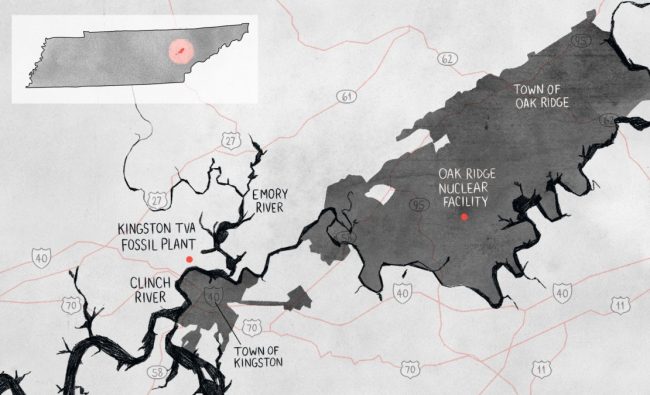
A Legacy of Contamination, How the Kingston coal ash spill unearthed a nuclear nightmare, Grist By Austyn Gaffney on Dec  15, 2020 This story was published in partnership with the Daily Yonder.
In 2009, App Thacker was hired to run a dredge along the Emory River in eastern Tennessee. Picture an industrialized fleet modeled after Huck Finn’s raft: Nicknamed Adelyn, Kylee, and Shirley, the blue, flat-bottomed boats used mechanical arms called cutterheads to dig up riverbeds and siphon the excavated sediment into shoreline canals. The largest dredge, a two-story behemoth called the Sandpiper, had pipes wide enough to swallow a push lawnmower. Smaller dredges like Thacker’s scuttled behind it, scooping up excess muck like fish skimming a whale’s corpse. They all had the same directive: Remove the thick grey sludge that clogged the Emory.
The sludge was coal ash, the waste leftover when coal is burned to generate electricity. Twelve years ago this month, more than a billion gallons of wet ash burst from a holding pond monitored by the region’s major utility, the Tennessee Valley Authority, or TVA. Thacker, a heavy machinery operator with Knoxville’s 917 union, became one of hundreds of people that TVA contractors hired to clean up the spill. For about four years, Thacker spent every afternoon driving 35 miles from his home to arrive in time for his 5 p.m. shift, just as the makeshift overhead lights illuminating the canals of ash flicked on.
Dredging at night was hard work. The pump inside the dredge clogged repeatedly, so Thacker took off his shirt and entered water up to his armpits to remove rocks, tree limbs, tires, and other debris, sometimes in below-freezing temperatures. Soon, ringworm-like sores crested along his arms, interwoven with his fading red and blue tattoos. Thacker’s supervisors gave him a cream for the skin lesions, and he began wearing long black cow-birthing gloves while he unclogged pumps. While Thacker knew that the water was contaminated — that was the point of the dredging — he felt relatively safe. After all, TVA was one of the oldest and most respected employers in the state, with a sterling reputation for worker safety.
Then, one night, the dredging stopped.
Sometime between December 2009 and January 2010, roughly halfway through the final, 500-foot-wide section of the Emory designated for cleanup, operators turned off the pumps that sucked the ash from the river. For a multi-billion dollar remediation project, this order was unprecedented. The dredges had been operating 24/7 in an effort to clean up the disaster area as quickly as possible, removing roughly 3,000 cubic yards of material — almost enough to fill an Olympic-sized swimming pool — each day. But official reports from TVA show that the dredging of the Emory encountered unusually high levels of contamination: Sediment samples showed that mercury levels were three times higher in the river than they were in coal ash from the holding pond that caused the disaster.
Then there was the nuclear waste. Continue reading
On Neo-Nazi Influence in Ukraine

The Azov Battalion, which arose during the coup, became a significant force in the war against the Russian-speaking people of the Donbass, who resisted the coup. Its commander, Andriy Biletsky, infamously said Ukraine’s mission is to “lead the White Races of the world in a final crusade for their survival … against the Semite-led Untermenschen.”
the Azov backer’s television channel had by this time aired the hit TV show Servant of the People (2015-2019), which catapulted Volodymyr Zelensky to fame and ultimately into the presidency under the new Servant of the People Party. The former actor and comedian’s presidential campaign was bankrolled by Kolomoisky, according to multiple reports.
Zelensky was elected president on the promise of ending the Donbass war. About seven months into his term he traveled to the front line in Donbass to tell Ukrainian troops, where Azov is well-represented, to lay down their arms. Instead he was sent packing. The Kyiv Post
A short history of neo-Nazism in Ukraine in response to some who say, “There is no evidence that Nazism has substantial influence in Ukraine.” Joe Lauria reports.
By Joe Lauria, Consortium News, 20 Apr 25
The U.S. relationship with Ukrainian fascists began after the Second World War. During the war, units of the Organization of Ukrainian Nationalists (OUN-B) took part in the Holocaust, killing at least 100,000 Jews and Poles.
Mykola Lebed, a top aide to Stepan Bandera, the leader of the fascist OUN-B, was recruited by the C.I.A. after the war, according to a 2010 study by the U.S. National Archives.
The government study said, “Bandera’s wing (OUN/B) was a militant fascist organization.” Bandera’s closest deputy, Yaroslav Stetsko, said: ““I…fully appreciate the undeniably harmful and hostile role of the Jews, who are helping Moscow to enslave Ukraine…. I therefore support the destruction of the Jews and the expedience of bringing German methods of exterminating Jewry to Ukraine….”
The study says: “At a July 6, 1941, meeting in Lwów, Bandera loyalists determined that Jews ‘have to be treated harshly…. We must finish them off…. Regarding the Jews, we will adopt any methods that lead to their destruction.’”
Lebed himself proposed to “’cleanse the entire revolutionary territory of the Polish population,’ so that a resurgent Polish state would not claim the region as in 1918.” Lebed was the “foreign minister” of a Banderite government in exile, but he later broke with Bandera for acting as a dictator. The U.S. Army Counterintelligence Corps termed Bandera “extremely dangerous” yet said he was “looked upon as the spiritual and national hero of all Ukrainians….”
The C.I.A. was not interested in working with Bandera, pages 81-82 of the report say, but the British MI6 was. “MI6 argued, Bandera’s group was ‘the strongest Ukrainian organization abroad, is deemed competent to train party cadres, [and] build a morally and politically healthy organization….’” An early 1954 MI6 summary noted that, “the operational aspect of this [British] collaboration [with Bandera] was developing satisfactorily. Gradually a more complete control was obtained over infiltration operations …
Britain ended its collaboration with Bandera in 1954. West German intelligence, under former Nazi intelligence chief Reinhard Gehlen, then worked with Bandera, who was eventually assassinated with cyanide dust by the KGB in Munich in 1959.
Instead of Bandera, the C.I.A. was interested in Lebed, despite his fascist background. They set him up in an office in New York City from which he directed sabotage and propaganda operations on the agency’s behalf inside Ukraine against the Soviet Union. The U.S. government study says:
“CIA operations with these Ukrainians began in 1948 under the cryptonym CARTEL, soon changed to AERODYNAMIC. … Lebed relocated to New York and acquired permanent resident status, then U.S. citizenship. It kept him safe from assassination, allowed him to speak to Ukrainian émigré groups, and permitted him to return to the United States after operational trips to Europe. Once in the United States, Lebed was the CIA’s chief contact for AERODYNAMIC. CIA handlers pointed to his ‘cunning character,’ his ‘relations with the Gestapo and … Gestapo training,’ [and] the fact that he was ‘a very ruthless operator.’”
The C.I.A. worked with Lebed on sabotage and pro-Ukrainian nationalist propaganda operations inside Ukraine until Ukraine’s independence in 1991. “Mykola Lebed’s relationship with the CIA lasted the entire length of the Cold War,” the study says. “While most CIA operations involving wartime perpetrators backfired, Lebed’s operations augmented the fundamental instability of the Soviet Union.”
Bandera Revival

The U.S. thus covertly kept Ukrainian fascist ideas alive inside Ukraine until at least Ukrainian independence was achieved. “Mykola Lebed, Bandera’s wartime chief in Ukraine, died in 1998. He is buried in New Jersey, and his papers are located at the Ukrainian Research Institute at Harvard University,” the U.S. National Archives study says.
The successor organization to the OUN-B in the United States did not die with him, however. It had been renamed the Ukrainian Congress Committee of America (UCCA), according to the International Business Times (IBT).
“By the mid-1980s, the Reagan administration was honeycombed with UCCA members. Reagan personally welcomed [Yaroslav] Stetsko, the Banderist leader who oversaw the massacre of 7,000 Jews in Lviv, in the White House in 1983,” IBT reported. “Following the demise of [Viktor] Yanukovich’s regime [in 2014], the UCCA helped organise rallies in cities across the US in support of the EuroMaidan protests,” it reported.
That is a direct link between Maidan and WWII-era Ukrainian fascism.
Despite the U.S. favoring the less extreme Lebed over Bandera, the latter has remained the more inspiring figure in Ukraine.
In 1991, the first year of Ukraine’s independence, the neo-fascist Social National Party, later Svoboda Party, was formed, tracing its provenance directly to Bandera. It had a street named after Bandera in Liviv, and tried to name the city’s airport after him. (Svoboda won 10 percent of the Rada’s seats in 2012 before the coup and before Sen. John McCain and U.S. Assistant Secretary of State Victoria Nuland appeared with Svoboda’s leader the following year.)
In 2010, pro-Western Ukrainian President Viktor Yushchenko declared Bandera a Hero of Ukraine, a status reversed by President Viktor Yanukovych, who was overthrown with the help of Ukrainian neo-Nazis in 2014.
More than 50 monuments, busts and museums commemorating Bandera have been erected in Ukraine, two-thirds of which have been built since 2005, the year the pro-American Yuschenko was elected. A Swiss academic study says:
“On January 13, 2011, the L’vivs’ka Oblast’ Council, meeting at an extraordinary session next to the Bandera monument in L’viv, reacted to the abrogation [skasuvannya] of Viktor Yushchenko’s order about naming Stepan Bandera a ‘Hero of Ukraine’ by affirming that ‘for millions of Ukrainians Bandera was and remains a Ukrainian Hero notwithstanding pitiable and worthless decisions of the courts’ and declaring its intention to rename ‘Stepan Bandera Street’ as ‘Hero of Ukraine Stepan Bandera Street.’”
Torchlit parades behind Bandera’s portrait are common in Ukrainian cities, particularly on Jan. 1, his birthday, including this year.
Mainstream on Neo-Nazis
From the start of the 2013-2014 events in Ukraine, Consortium News founder Robert Parry and other writers began providing the evidence NewsGuard, which bills itself as a news-rating agency, says doesn’t exist. Parry began reporting extensively on the coup and the influential role of Ukraine’s neo-Nazis. At the time, corporate media also reported on the essential part neo-Nazis played in the coup. [See: ROBERT PARRY: Ukraine’s Inconvenient Neo-Nazis]
As The New York Times reported, the neo-Nazi group, Right Sector, had the key role in the violent ouster of Yanukovych. The role of neo-fascist groups in the uprising and its influence on Ukrainian society was well reported by mainstream media outlets at the time.
The BBC, the NYT, the Daily Telegraph and CNN all reported on Right Sector, C14 and other extremists’ role in the overthrow of Yanukovych. The BBC ran this report a week after his ouster:
After the coup a number of ministers in the new government came from neo-fascist parties. NBC News (100 percent NewsGuard rating) reported in March 2014: “Svoboda, which means ‘Freedom,’ was given almost a quarter of the Cabinet positions in the interim government formed after the ouster of President Viktor Yanukovych in February.”
Svoboda’s leader, Tyahnybok, whom McCain and Nuland stood on stage with, once called for the liberation of Ukraine from the “Muscovite-Jewish mafia.” The International Business Times (82.5 percent) reported:
“In 2005 Tyahnybok signed an open letter to then Ukrainian president Viktor Yushchenko urging him to ban all Jewish organisations, including the Anti-Defamation League, which he claimed carried out ‘criminal activities [of] organised Jewry’, ultimately aimed at the genocide of the Ukrainian people.”
Before McCain and Nuland embraced Tyahnybok and his social national party, it was condemned by the European Parliament, which said in 2012:
Continue reading‘We thought it was the end of the world’: How the US dropped four nuclear bombs on Spain in 1966
Myles Burke https://www.bbc.com/culture/article/20250404-how-the-us-dropped-nuclear-bombs-on-spain-in-1966 7 Apr 25
In 1966, the remote Spanish village of Palomares found that the “nuclear age had fallen on them from a clear blue sky”. Two years after the terrifying accident, BBC reporter Chris Brasher went to find what happened when the US lost a hydrogen bomb.
On 7 April 1966, almost 60 years ago this week, a missing nuclear weapon for which the US military had been desperately searching for 80 days was finally found. The warhead, with an explosive power 100 times that of the bomb dropped on Hiroshima, was carefully winched from a depth of 2,850ft (869m) out of the Mediterranean Sea and delicately lowered onto the USS Petrel. Once it was on board, officers painstakingly cut into the thermonuclear device’s casing to disarm it. It was only then that everyone could breathe a sigh of relief – the last of the four hydrogen bombs that the US had accidentally dropped on Spain had been recovered.
“This was not the first accident involving nuclear weapons,” said BBC reporter Chris Brasher when he reported from the scene in 1968. “The Pentagon lists at least nine previous accidents to aircraft carrying hydrogen bombs. But this was the first accident on foreign soil, the first to involve civilians and the first to excite the attention of the world.”
This terrifying situation had come about because of a US operation code-named Chrome Dome. At the beginning of the 1960s, the US had developed a project to deter its Cold War rival, the Soviet Union, from launching a pre-emptive strike. A patrol of nuclear-armed B-52 bombers would continuously criss-cross the skies, primed to attack Moscow at a moment’s notice. But to stay airborne on these long looping routes, the planes needed to refuel while in flight.
On 17 January 1966, one such bomber was flying at a height of 31,000ft (9.5km) over the Almería region of southern Spain, and attempted a routine air-to-air refuelling with a KC-135 tanker plane. “I believe what happened was the bomber was closing at a too-high rate of closure speed and he didn’t stabilise his position,” US Maj Gen Delmar Wilson, the man in charge of dealing with the catastrophic accident, told Brasher, “with the result that they got too close and collided.”
The B-52 bomber’s impact with the refuelling plane tore it open, igniting the jet fuel the KC-135 was carrying and killing all four of the crew onboard. The ensuing explosion also killed two men in the B-52’s tail section. A third managed to eject, but died when his parachute did not open. The other four members of the bomber’s crew successfully bailed out of their burning plane before it broke apart and fell to earth, raining down both flaming aircraft fragments and its lethal thermonuclear cargo onto the remote Spanish village of Palomares.
Everyone kept talking about a ‘broken arrow’. I learnt then that ‘broken arrow’ was the code word for a nuclear accident – Capt Joe Ramirez
The huge fireball was seen a mile away. Thankfully, it did not trigger a nuclear explosion. The bomber’s warheads were not armed and had built-in safeguards to prevent an unintended atomic chain reaction. But the thermonuclear devices did have explosives surrounding their plutonium cores as part of the triggering mechanism. In the event of an accident, the bombs had parachutes attached to them designed to cushion the impact on landing and prevent radioactive contamination. And indeed, one undetonated bomb did land safely in a riverbed and was recovered intact the following day. Unfortunately, two of the plummeting nuclear bombs’ parachutes failed to open.
That morning, Spanish farmer Pedro Alarcón was walking to his house with his grandchildren when one of the nuclear bombs landed in his tomato field and blew apart on impact. “We were blown flat. The children started to cry. I was paralysed with fear. A stone hit me in the stomach, I thought I’d been killed. I lay there feeling like death with the children crying,” he told the BBC in 1968.
Devastation and chaos
The other hydrogen bomb also exploded when it hit the ground near a cemetery. These dual blasts created vast craters and scattered highly toxic, radioactive plutonium dust across several hundred acres. Burning aircraft debris also showered the Spanish village. “I was crying and running about,” a villager called Señora Flores told the BBC in 1968. “My little girl was crying, ‘Mama, Mama, look at our house, it is burning.’ Because of all the smoke I thought what she said must be true. There were a lot of stones and debris falling around us. I thought it would hit us. It was this terrific explosion. We thought it was the end of the world.”
Once the news that the bomber had come down with nuclear weapons aboard reached US military command, a huge operation was launched. At the time of the disaster, Capt Joe Ramirez was an US Air Force lawyer stationed in Madrid. “There were a lot of people talking, there was a lot of excitement in the conference room. Everyone kept talking about a ‘broken arrow’. I learnt then that ‘broken arrow’ was the code word for a nuclear accident,” he told BBC’s Witness History in 2011.
US military personnel were scrambled to the area by helicopter. When Capt Ramirez arrived in Palomares, he immediately saw the devastation and chaos wrought by the accident. Huge pieces of smoking wreckage were strewn all over the area – a large part of the burning B-52 bomber had landed in the school’s yard. “It’s a small village but there were people scrambling in different directions. I could see smouldering debris, I could see some fires.”
Despite the carnage, miraculously no one in the village was killed. “Nearly 100 tonnes of flaming debris had fallen on the village but not even a chicken had died,” said Brasher. A local school teacher and doctor climbed up to the fire-scarred hillside to retrieve the remains of the US airmen who had been killed. “Later still, they sorted the pieces and the limbs into five coffins, an act that was to cause a certain amount of bureaucratic difficulty when the Americans came to claim only four bodies from that hillside,” said Brasher.
Three of the B-52 crew who managed to eject landed in the Mediterranean several miles off the coast and were rescued by local fishing boats within an hour of the accident. The fourth, the B-52 radar-navigator, ejected through the plane’s explosion, which left him badly burned, and was unable to separate himself from his ejection seat. Despite this, he managed to open his parachute and was found alive near the village and taken to hospital.
However, this still left the problem of locating the plane’s deadly nuclear payload. “My main concern was to recover those bombs, that was number-one priority,” Gen Wilson told the BBC in 1968.
One of our nuclear bombs is missing
“The first night, the Guardia Civil [the Spanish national police force] had come to the little bar in Palomares, and that was about the only place that had electricity. And they had reported what they considered to be a bomb, so we immediately despatched some of our people to this riverbed which is not far from the centre of town, and, in fact, it was a bomb, so we placed a guard on that. And then the next morning, at first daylight, we started conducting our search, and I believe it was something in the order of 10am or 11am the following morning, we located two other bombs.”
This accounted for three of the nuclear bombs, but there was still one missing. By the next day, trucks filled with US troops had been sent from nearby bases, with the beach in Palomares becoming a base for some 700 US airmen and scientists urgently trying to contain any radioactive contamination and locate the fourth warhead.
“The first thing that you could see as the search really got underway in earnest was Air Force personnel linking up hand-by-hand and 40 or 50 people in a line. They would have designated search areas. There were some people with Geiger counters who started arriving, and so they started marking off the areas which were contaminated,” said Capt Ramirez in 2011. When US personnel registered an area contaminated with radiation, they would scrape up the first three inches of topsoil and seal it in barrels to be shipped back to the US. Some 1,400 tonnes of irradiated soil ended up being sent to a storage facility in South Carolina.
Both the US and Spain, which at the time was under the brutal rule of Francisco Franco’s military dictatorship, were keen to downplay the devastating accident. Franco was especially worried that radiation fears would hurt Spain’s tourism industry, a major source of revenue for his regime. In an effort to reassure the local population and the wider world that there was no danger, the US Ambassador to Spain, Angier Biddle Duke, would end up taking a swim in the sea off Palomares coast in front of the international press just weeks after the accident.
But despite hundreds of US personnel conducting an intensive and meticulous search of the surrounding area for a week, they still couldn’t find the fourth bomb. Then Capt Ramirez spoke to a local fisherman who had helped rescue some of the surviving airmen who had splashed down in the sea. The fisherman kept apologising to Capt Ramirez for not being able to save one of the US flyers, whom he thought he had witnessed drifting down into the depths.
Capt Ramirez realised that the fisherman could have actually seen the missing nuclear bomb. “All the bodies had been accounted for, I knew that,” he said. The search then quickly shifted to the Mediterranean Sea, with the US Navy mobilising a flotilla of more than 30 ships, including mine-sweepers and submersibles, to scour the seabed. The exploration of miles of ocean floor was both technically complicated and a very slow process, but after weeks of exhaustive searching, a newly developed deep-diving vessel, Alvin, finally located the missing bomb in an underwater trench.
Nearly four months after it was first lost, the warhead was finally made safe and back in US hands. The next day, despite the secrecy with which the US military had surrounding its nuclear arsenal, it took the unusual step of showing the bomb to the world’s press. Ambassador Duke reasoned that unless people saw the bomb for themselves, they would never feel certain that it had actually been recovered.
Event to mark 40th anniversary of mysterious death of Willie McRae
The National 31st March 2025, By James Walker, https://www.thenational.scot/news/25052033.event-mark-40th-anniversary-mysterious-death-willie-mcrae/
AN EVENT is to be held in the Highlands to mark the anniversary of the mysterious death of Willie McRae.
In 1980, McRae – a top lawyer and senior SNP member – made headlines after representing a group opposed to dumping nuclear waste in the Ayrshire hills at a public inquiry.
He won, and the victory proved a major setback in plans for having nuclear waste buried across the UK.
But on the evening of Good Friday, April 5, 1985, McRae set off from his flat in Glasgow’s southside for his holiday cottage close to Dornie in Wester Ross. He never arrived.
Instead, on April 6, his car was found by the side of the road. He was in the front seat with a bullet through his right temple.
On Sunday, April 7, McRae died without ever regaining consciousness.
A post-mortem concluded suicide, but questions have persisted for decades. A gun was not found when the scene was first visited by the police, but was when the scene was searched the following week.
Now, a group of Yessers is looking to hold an event to draw new attention to McRae’s case.
“Forty years has passed since a man was found dying on a Highland road in mysterious circumstances. Not just any man, but a seeker of justice and a thorn in the side of the establishment,” Pete Smith, an event organiser and a member of Yes Highlands and Islands, told The National.
He added: “Willie McRae took a massive secret to his grave and we intend to seek justice for McRae by demanding a public enquiry into the case.”
There are six speakers lined up, including Ron Culley whose book Firebrand examines the McRae case in detail and is also mentioned on the flyer which has been created for the event (above).
A piper and – reportedly – a film crew will also be in attendance.
The organisers also wished to stress that this is not an independence event, although added that the “quest for Scotland’s self governance is of course linked to this killing”.
The event will be held at the Willie McRae Memorial Cairn, on the A87 at the side of Loch Lorne, at 12 noon on April 5.
Attendees will then head to the nearby Invergarry Hotel for speeches – with those wishing to attend asked to register via Eventbrite due to limited space.
Organisers were also keen to highlight that parking is limited near the cairn.
Britain’s worst nuclear disaster: the Windscale fire of 1957
When a routine procedure went wrong in October 1957, a fire broke out at
the Windscale nuclear power station in Cumbria, UK. By the time it was put
out, radiation had been sent across Britain and Europe.
Jonny Wilkes reveals what happened, and why we should be grateful that it wasn’t much
worse. Chernobyl, Three Mile Island, Fukushima: three names that have gone
down in infamy; bywords for the nightmare scenarios that can occur when the
production of nuclear power goes disastrously wrong. Before them all
though, was Windscale.
History Extra 27th March 2025,
https://www.historyextra.com/period/20th-century/atomfall-real-nuclear-windscale-disaster-fire/
The US hypocrisy about Israel’s nuclear weapons must stop

What stands out from the television series is the grip Israel has had over US policy regarding Israel’s nuclear weapons.
a secret federal bulletin that threatens disciplinary actions for any US official who publicly acknowledges Israel’s nuclear weapons.
The existence of these weapons may have started as a deterrent against another Holocaust but has now morphed into an instrument of an aggressive and expansionist Israel.
By Victor Gilinsky, Leonard Weiss | March 21, 2025, https://thebulletin.org/2025/03/the-us-hypocrisy-about-israels-nuclear-weapons-must-stop/?utm_source=ActiveCampaign&utm_medium=email&utm_content=Israel%20s%20nuclear%20weapons&utm_campaign=20250324%20Monday%20Newsletter
An extraordinary three-part series on Israeli television, The Atom and Me, lays out how the country got its nuclear weapons. It takes for granted what anyone who pays attention has known for years. But the series goes well beyond a general discussion about Israel’s nuclear weapons. It shows the country’s single-minded determination to get the bomb no matter what it took, including stealing nuclear explosives and bomb components from the United States and violating a major nuclear arms control treaty to which Israel is a party—and lying about it.
As the Trump administration is in serious discussion about joining Israel in attacks on Iran to stop it from getting nuclear weapons, it is useful to shed illusions about Israel’s modus operandi.
US officials stay mute. A thread running through the three episodes is a continuing conversation, before he died in 2018, with Benjamin Blumberg, the head of Lakam, the Israeli scientific intelligence agency responsible for the nuclear missions that led to the Israeli bomb, some so secret they were kept from the Mossad. (Mossad is the Israeli agency that handles foreign intelligence collection and covert action.) Blumberg was in failing health and agreed to talk so long as the interview was not aired until after his death.
That conversation is mixed with archival material and recent interviews. The significance of the series lies not in showing what was not previously known—although there are details in that category—but in the admissions on Israeli public television, with the approval of the Israeli censors, about events that have been denied by Israel’s supporters in the United States, including the US government.
Several events discussed in the television series deal directly with the United States: the theft in the 1960s of bomb quantities of uranium 235 from the NUMEC facility in Pennsylvania, where the leaders of the Israeli team that spirited Eichmann out of Argentina appeared inexplicably in 1968 with false identities; the illicit purchase of hundreds of high-speed switches (krytrons) for triggering nuclear weapons, and spiriting them out of the country in the 1980s by Israeli spy and arms dealer, and by then Hollywood producer, Arnon Milchan; and, most significantly at this point, Israel’s 1979 nuclear test in the seas off South Africa of what appears to be the initial fission stage for a thermonuclear weapon. The nuclear test violated the 1963 Limited Test Ban Treaty to which Israel is a party.
What stands out from the television series is the grip Israel has had over US policy regarding Israel’s nuclear weapons.
Not since John Kennedy has any US president tried to rein in Israel’s nuclear program. His successor, Lyndon Johnson, did not challenge the Israelis on nuclear issues (and covered up Israel’s attempt during the 1967 six-day war to sink the US spy ship Liberty). Such has been Israel’s political clout in the United States.
No one was ever charged in the disappearance of nuclear material from NUMEC. When the issue of Israel’s involvement arose again in 1976, President Gerald Ford’s attorney general suggested to the president the possibility of charging US officials, presumably in the Atomic Energy Commission, with failing to report a felony. But it was too late. Ford lost the election to Jimmy Carter, who let the matter drop. Milchan was never charged for the filching of krytrons even though he later bragged about his arms dealing and spying for Israel. And Carter—and every US president after him—took no enforcement action in response to the illegal 1979 nuclear test.
The United States’ indulgence of Israeli nuclear weapons has not escaped international attention, and the evident hypocrisy has undermined US nonproliferation policy. The US government’s public position continues to be that it does not know anything about Israeli nuclear weapons, and this will apparently continue until Israel releases the United States’ gag. This policy is allegedly enforced by a secret federal bulletin that threatens disciplinary actions for any US official who publicly acknowledges Israel’s nuclear weapons.
Meanwhile, Israel brags about its nukes. Ironically, the Israelis feel free to allude to their nuclear weapons whenever they find it useful. The best example is Prime Minister Benjamin Netanyahu’s 2016 speech on receipt of the Rahav, the latest submarine supplied by Germany. The Times of Israel, using the standard “according to foreign reports,” described the submarine as “capable of delivering a nuclear payload.” In his speech, Netanyahu said, “Above all else, our submarine fleet acts as a deterrent to our enemies … They need to know that Israel can attack, with great might, anyone who tries to harm it.” How else, other than with nuclear weapons, can a submarine be a deterrent? The submarines’ long-range cruise missiles could not only hit Iran’s capital, Tehran, Israel’s main security concern, they could also hit any European capital.
Those submarine-based cruise missiles—if they exist—might be tipped with thermonuclear warheads, which are also carried on planes and ground-based rockets. Light-weight thermonuclear weapons allow flexibility in delivery, but the two-stage designs are highly sophisticated. The Israelis logically decided that they had to conduct at least one low-yield fission test—even though they had promised not to do this—to be sure their first stage produced the radiation that would initiate the thermonuclear fuel in the second stage.
In the last episode of the Israeli television series, journalist Meir Doron, who has written on Israel’s security secrets, says: “After the nuclear test, for the first time, the heads of the Israeli nuclear program, Blumberg, Shimon Peres, and all the people from the reactor, could sleep soundly at night. They knew that what they’re building works.”

While Israel did not sign the 1970 Nuclear Non-Proliferation Treaty (NPT), it signed and ratified the 1963 Limited Nuclear Test Ban Treaty, which obligates parties not to explode a nuclear device in the atmosphere or oceans. Such a test also triggers a nonproliferation provision of US law, the 1977 Glenn Amendment (Sec.102 (B) to the Arms Export Control Act), that imposes severe sanctions on any country (other than the five approved in the NPT) that explodes a nuclear device after 1977. Upon learning of such an explosion, the president is supposed to impose the wide-ranging sanctions “forthwith.” That, of course, did not happen.
The nuclear explosion’s characteristic two-hump signal was detected by a US satellite on September 22, 1979, and US intelligence agencies were convinced Israel was the culprit. President Carter did not want to risk his ongoing Middle East policy efforts by blaming Israel. The White House asked a group of scientists whether the detected light flash could somehow have been unconnected with a nuclear explosion. The scientists came up with some ideas that gave the president a public out. At the same time, the White House kept classified Navy reports on ocean sound waves from the explosion that supported the satellite data. And Carter wrote in his diary: “We have a growing belief among our scientists that the Israelis did indeed conduct a nuclear test explosion in the ocean near the southern end of Africa.” All this was essentially a cover-up.
The Glenn Amendment allows the president to delay sanctions on national security grounds or waive them entirely with the help of congressional action. The law does not allow the president to ignore it. But that is exactly what all of them have done.
The price of silence. The US government’s silence on Israel’s nuclear weapons has meant silence about them in discussions on Iran’s nuclear program. Public debate is an essential part of US policy development and, in the case of Iran, is hobbled by an inability to have an honest appraisal of the nature and purpose of Israeli nuclear weapons.
The existence of these weapons may have started as a deterrent against another Holocaust but has now morphed into an instrument of an aggressive and expansionist Israel.
The inability to have honest public discussion allows for the pretense by Israel and its supporters that it faces an existential threat from Iran, which is ready to drop a nuclear bomb on Tel Aviv as soon as it gets one. Various aspects of the Iran issue are hidden by an inability to weigh all the elements of policy needed to arrive at an intelligent US policy.
The US government’s silence has also taught the press to avoid the issue. The last time a White House correspondent asked about Israeli nuclear weapons, even then indirectly, was when Helen Thomas asked President Obama in 2009 whether he knew of any nuclear weapons in the Middle East. She got a chilly non-response—Obama said he was not going to speculate.
An exception to the general lack of press interest in the issue is a 2018 New Yorker report by Adam Entous, revealing how US presidents have signed secret letters to the Israelis promising to do nothing to interfere with Israel’s nuclear weapons or acknowledge their existence.
Israel claims this US obligation flows from a “deal” made by Nixon and Golda Meir in their 1969 meeting during the 15 minutes when they were alone. William Quandt, Kissinger’s aide at the time, says in the third episode, “There is no documentary record on the American side to this day. No one else was in the room.” Nor has any Israeli record appeared. Without any record, there can be no enduring obligation.
So why did US presidents go along with the Israeli version of the US obligation, including denying any knowledge about Israeli nuclear weapons, long after it ceased to be in the United States’s interest to do so? Entous reported that when Trump first entered office in 2017 his staff was confronted by Israeli ambassador Ron Dermer (a former American who switched allegiance to Israel). He is said to have acted “like he owned the place,” but it worked. He got his way.
The single-mindedness of the Israeli establishment—that what it thinks is best for Israel overrides all other considerations—is caught at the end of the third television episode. The conversation with Benjamin Blumberg turns to Israel’s more-than-amicable relations with apartheid-era South Africa, from which it got uranium to fuel the Dimona reactor and later permission to conduct the 1979 nuclear test, and to which Israel provided tritium to upgrade South Africa’s nuclear weapons. He is asked, was not South Africa an oppressive racist regime? “All true,” said Blumberg, “but what do I care. I wanted what was best for Israel.” It’s time to realize that what is “best for Israel” is not necessarily good for the United States.
Editor’s note: Victor Gilinsky was a commissioner of the Nuclear Regulatory Commission at the time of the events in question. Leonard Weiss was a long-term aide to Senator Glenn and the author of the first version of the Glenn Amendment. They both appear in the mentioned Israeli TV series.
These Are The Six Times The USA Lost Nuclear Weapons
The US military has had at least 32 “Broken Arrow” incidents.
Tom Hale, Senior Journalist, FL Science 17th Jan 2025, https://www.iflscience.com/these-are-the-six-times-the-usa-lost-nuclear-weapons-77661
Keys, phones, headphones, socks, thermonuclear weapons – some things just always seem to go missing. Believe it or not, there were at least six instances when the US lost atomic bombs or weapons-grade nuclear material during the Cold War.
Not only that, but the US is responsible for at least 32 documented instances of a nuclear weapons accident, known as a “Broken Arrow” in military lingo. These atomic-grade mishaps can involve an accidental launching or detonation, theft, or loss – yep loss – of a nuclear weapon.
February 13, 1950
The first of these unlikely instances occurred in 1950, less than five years after the first atomic bomb was detonated. In a mock nuclear strike against the Soviet Union, a US B-36 bomber en route from Alaska to Texas began to experience engine trouble. An icy landing and stuttering engine meant the landing was going to be near-impossible, so the crew jettisoned the plane’s Mark 4 nuclear bomb over the Pacific. The crew witnessed a flash, a bang, and a sound wave.
The military claims the mock-up bomb was filled with “just” uranium and TNT but no plutonium core, meaning it wasn’t capable of a conventional nuclear explosion. Nevertheless, the uranium and the weapon have reportedly never been recovered.
March 10, 1956
On March 10, a Boeing B-47 Stratojet set off from MacDill Air Force Base Florida for a non-stop flight to Morocco with “two nuclear capsules” onboard. The jet was scheduled for its second mid-flight refueling over the Mediterranean Sea, but it never made contact. No trace of the jet was ever found.
February 5, 1958
In the early hours of February 5, 1958, a B-47 bomber with a 3,400-kilogram (7,500-pound) Mark 15 nuclear bomb on board accidentally collided with an F-86 aircraft during a simulated combat mission. The battered and bruised bomber attempted to land numerous times, but to no avail. Eventually, they made the decision to jettison the bomb into the mouth of the Savannah River near Savannah, Georgia, to make the landing possible. Luckily for them, the plane successfully landed and the bomb did not detonate. However, it has remained “irretrievably lost” to this day.
January 24, 1961
On January 24, 1961, the wing of a B-52 bomber split apart while on an alert mission above Goldsboro, North Carolina. Onboard were two nuclear bombs. One of these successfully deployed its emergency parachute, while the other fell and crashed to the ground. It’s believed the unexploded bomb smashed into farmland around the town, but it has never been recovered. In 2012, North Carolina put up a sign near the supposed crash site to commemorate the incident
December 5, 1965
An A-4E Skyhawk aircraft loaded with a nuclear weapon rolled off the back of an aircraft carrier, USS Ticonderoga, stationed in the Philippine Sea near Japan. The plane, pilot, and nuclear bomb have never been found.
In 1989, the US eventually admitted their bomb was still sitting on the seabed around 128 kilometers (80 miles) from a small Japanese island. Needless to say, the Japanese government and environmental groups were pretty annoyed about it.
Spring, 1968
At some point during the Spring of 1968, the US military lost some kind of nuclear weapon. The Pentagon still keeps information about the incident tightly under wraps. However, some have speculated that the incident refers to the nuclear-powered Scorpion submarine. In May 1968, the attack submarine went missing along with its 99-strong crew in the Atlantic Ocean after being sent on a secret mission to spy on the Soviet Navy. This, however, remains conjecture.
When Carter met Kim – and stopped a nuclear war
Tessa Wong, Asia Digital Reporter, BBC News, 11 Jan 25 https://www.bbc.com/news/articles/cpee202y907o—
Three decades ago, the world was on the brink of a nuclear showdown – until Jimmy Carter showed up in North Korea.
In June 1994, the former US president arrived for talks in Pyongyang with then leader Kim Il-sung. It was unprecedented, marking the first time a former or sitting US president had visited.
But it was also an extraordinary act of personal intervention, one which many believe narrowly averted a war between the US and North Korea that could have cost millions of lives. And it led to a period of greater engagement between Pyongyang and the West.
All this may not have happened if not for a set of diplomatic chess moves by Carter, who died aged 100 on 29 December.
“Kim Il-sung and Bill Clinton were stumbling into a conflict, and Carter leapt into the breach, successfully finding a path for negotiated resolution of the standoff,” North Korean expert John Delury, of Yonsei University, told the BBC.
In early 1994, tensions were running high between Washington and Pyongyang, as officials tried to negotiate an end to North Korea’s nuclear programme.
US intelligence agencies suspected that despite ongoing talks, North Korea may have secretly developed nuclear weapons.
Then, in a startling announcement, North Korea said it had begun withdrawing thousands of fuel rods from its Yongbyon nuclear reactor for reprocessing. This violated an earlier agreement with the US under which such a move required the presence of inspectors from the International Atomic Energy Agency (IAEA) nuclear watchdog.
North Korea also announced it would withdraw from the IAEA.
American suspicion spiked as Washington believed Pyongyang was preparing a weapon, and US officials broke off negotiations. Washington began preparing several retaliatory measures, including initiating UN sanctions and reinforcing troops in South Korea.
In subsequent interviews, US officials revealed they also contemplated dropping a bomb or shooting a missile at Yongbyon – a move which they knew would have likely resulted in war on the Korean peninsula and the destruction of the South’s capital, Seoul.
It was in this febrile atmosphere that Carter made his move.
For years, he had been quietly wooed by Kim Il-sung, who had sent him personal entreaties to visit Pyongyang. In June 1994, upon hearing Washington’s military plans, and following discussions with his contacts in the US government and China – North Korea’s main ally – Carter decided to finally accept Kim’s invitation.
“I think we were on the verge of war,” he told the US public broadcaster PBS years later. “It might very well have been a second Korean War, within which a million people or so could have been killed, and a continuation of the production of nuclear fissile material… if we hadn’t had a war.”
Carter’s visit was marked by skillful diplomatic footwork – and brinkmanship.
First, Carter had to test Kim’s sincerity. He made a series of requests, all of which were agreed to, except the last: Carter wanted to travel to Pyongyang from Seoul across the demilitarised zone (DMZ), a strip of land that acts as a buffer between the two Koreas.
“Their immediate response was that no-one had ever done this for the last 43 years, that even the United Nations secretary-general had to go to Pyongyang through Beijing. And I said, ‘Well, I’m not going, then’,” he said.
A week later, Kim caved.
The next step for Carter was harder – convincing his own government to let him go. Robert Gallucci, the chief US negotiator with North Korea at the time, later said there was “discomfort in almost all quarters” about the US essentially “subcontracting its foreign policy” to a former president.
Carter first sought permission from the State Department, who blanked him. Unfazed, he decided to simply inform then-US president Bill Clinton that he was going, no matter what.
He had an ally in vice-president Al Gore, who intercepted Carter’s communication to Clinton. “[Al Gore] called me on the phone and told me if I would change the wording from “I’ve decided to go” to “I’m strongly inclined to go” that he would try to get permission directly from Clinton… he called me back the next morning and said that I had permission to go.”
The trip was on.
‘Very serious doubts’
On 15 June 1994, Carter crossed over to North Korea, accompanied by his wife Rosalyn, a small group of aides and a TV crew.
Meeting Kim was a moral dilemma for Carter.
“I had despised Kim Il-sung for 50 years. I was in a submarine in the Pacific during the Korean War, and many of my fellow servicemen were killed in that war, which I thought was precipitated unnecessarily by him,” he told PBS.
“And so I had very serious doubts about him. When I arrived, though, he treated me with great deference. He was obviously very grateful that I had come.”
Over several days, the Carters had meetings with Kim, were taken on a sightseeing tour of Pyongyang and went on a cruise on a luxury yacht owned by Kim’s son, Kim Jong-il.
Carter discovered his hunch was right: North Korea not only feared a US military strike on Yongbyon, but was also ready to mobilise.
“I asked [Kim’s advisers] specifically if they had been making plans to go to war. And they responded very specifically, ‘Yes, we were’,” he said.
“North Korea couldn’t accept the condemnation of their country and the embarrassment of their leader and that they would respond.
“And I think this small and self-sacrificial country and the deep religious commitments that you had, in effect, to their revered leader, their Great Leader as they called him, meant that they were willing to make any sacrifice of massive deaths in North Korea in order to preserve their integrity and their honour, which would have been a horrible debacle in my opinion.”
Carter presented a list of demands from Washington as well as his own suggestions. They included resuming negotiations with the US, starting direct peace talks with South Korea, a mutual withdrawal of military forces, and helping the US find remains of US soldiers buried in North Korean territory.
“He agreed to all of them. And so, I found him to be very accommodating,” Carter said. “So far as I know then and now, he was completely truthful with me.”
Crucially, Carter came up with a deal where North Korea would stop its nuclear activity, allow IAEA inspectors back into its reactors, and eventually dismantle Yongbyon’s facilities. In return, the US and its allies would build light-water reactors in North Korea, which could generate nuclear energy but not produce material for weapons.
While enthusiastically embraced by Pyongyang, the deal was met with reluctance from US officials when Carter suggested it in a phone call. He then told them he was going on CNN to announce details of the deal – leaving the Clinton administration little choice but to agree.
Carter would later justify forcing his own government’s hand by saying he had to “consummate a resolution of what I considered to be a very serious crisis”. But it did not go down well back home – officials were unhappy at Carter’s “freelancing” and attempt to “box in” Clinton, according to Mr Gallucci.
Near the end of the trip, they told him to convey a statement to the North Koreans, reiterating Clinton’s public position that the US was continuing to press for UN sanctions. Carter disagreed, according to reports at that time.
Hours later, he got on the boat with Kim, and promptly went off-script. As TV cameras rolled, he told Kim the US had stopped work on drafting UN sanctions – directly contradicting Clinton.
An annoyed White House swiftly disowned Carter. Some openly expressed frustration, painting a picture of a former president going rogue. “Carter is hearing what he wants to hear… he is creating his own reality,” a senior official complained at the time to The Washington Post.
Many in Washington also criticised him for the deal itself, saying the North Koreans had used him.
But Carter’s savvy use of the news media to pressure the Clinton administration worked. By broadcasting his negotiations almost instantaneously, he gave the US government little time to react, and immediately after his trip “it was possible to see an almost hour-by-hour evolution in US policy towards North Korea” where they ratcheted down their tone, wrote CNN reporter Mike Chinoy who covered Carter’s trip.
Though Carter later claimed he had misspoken on the sanctions issue, he also responded with typical stubbornness to the blowback.
“When I got back to Seoul, I was amazed and distressed at the negative reaction that I had from the White House. They urged me not to come to Washington to give a briefing, urged me to go directly to… my home,” he said.
But he went against their wishes.
“I decided that what I had to offer was too important to ignore.”
A final dramatic coda to the episode happened a month later.
On 9 July 1994, on the same day as US and North Korean officials sat down in Geneva to talk, state media flashed a stunning announcement: Kim Il-sung had died of a heart attack.
Carter’s deal was immediately plunged into uncertainty. But negotiators ploughed through, and weeks later hammered out a formal plan known as the Agreed Framework.
Though the agreement broke down in 2003, it was notable for freezing Pyongyang’s nuclear programme for nearly a decade.
‘Carter had guts’
Robert Carlin, a former CIA and US state department official who led delegations in negotiations with North Korea, noted that Carter’s real achievement was in getting the US government to co-operate.
“Carter was, more or less, pushing on an open door in North Korea. It was Washington that was the bigger challenge… if anything, Carter’s intervention helped stop the freight train of US decision-making that was hurtling toward a cliff,” he told the BBC.
Carter’s visit was also significant for opening a path for rapprochement, which led to several trips later, including one in 2009 when he travelled with Clinton to bring home captured US journalists.
He is also credited with paving the way for Donald Trump’s summit with Kim Jong Un – Kim Il-sung’s grandson – in 2018, as “Carter made it imaginable” that a sitting US president could meet with a North Korean leader, Dr Delury said.
That summit failed, and of course, in the long run Carter’s trip did not succeed in removing the spectre of nuclear war, which has only grown – these days North Korea has missiles regarded as capable of hitting the US mainland.
But Carter was lauded for his political gamble. It was in sharp contrast to his time in office, when he was criticised for being too passive on foreign policy, particularly with his handling of the Iran hostage crisis.
His North Korea trip “was a remarkable example of constructive diplomatic intervention by a former leader,” Dr Delury said.
His legacy is not without controversy, given the criticism that he took matters in his own hands. His detractors believe he played a risky and complicated game by, as CNN’s Mike Chinoy put it, “seeking to circumvent what he viewed as a mistaken and dangerous US policy by pulling the elements of a nuclear deal together himself”.
But others believe Carter was the right man for the job at the time.
He had “a very strong will power”, but was also “a man of peace inside and out,” said Han S Park, one of several people who helped Carter broker the 1994 trip.
Though his stubbornness also meant that he “did not get along with a lot of people”, ultimately this combination of attributes meant he was the best person “to prevent another occurrence of a Korean War”, Prof Park said.
More than anything, Carter was convinced he was doing the right thing.
“He didn’t let US government clucking and handwringing stop him,” says Robert Carlin. “Carter had guts.”
1 This Month

of the week – Shut Down Drone Warfare!


Tell the Ukrainian Government to Drop Prosecution of Peace Activist Yurii Sheliazhenko

Petition to revoke the licensing of the Near Surface Nuclear Disposal Facility (NSDF) at Chalk River. https://www.ourcommons.ca/petitions/en/Petition/Details?Petition=e-7247
To see nuclear-related stories in greater depth and intensity – go to https://nuclearinformation.wordpress.com
-
Archives
- April 2026 (44)
- March 2026 (251)
- February 2026 (268)
- January 2026 (308)
- December 2025 (358)
- November 2025 (359)
- October 2025 (376)
- September 2025 (257)
- August 2025 (319)
- July 2025 (230)
- June 2025 (348)
- May 2025 (261)
-
Categories
- 1
- 1 NUCLEAR ISSUES
- business and costs
- climate change
- culture and arts
- ENERGY
- environment
- health
- history
- indigenous issues
- Legal
- marketing of nuclear
- media
- opposition to nuclear
- PERSONAL STORIES
- politics
- politics international
- Religion and ethics
- safety
- secrets,lies and civil liberties
- spinbuster
- technology
- Uranium
- wastes
- weapons and war
- Women
- 2 WORLD
- ACTION
- AFRICA
- Atrocities
- AUSTRALIA
- Christina's notes
- Christina's themes
- culture and arts
- Events
- Fuk 2022
- Fuk 2023
- Fukushima 2017
- Fukushima 2018
- fukushima 2019
- Fukushima 2020
- Fukushima 2021
- general
- global warming
- Humour (God we need it)
- Nuclear
- RARE EARTHS
- Reference
- resources – print
- Resources -audiovicual
- Weekly Newsletter
- World
- World Nuclear
- YouTube
-
RSS
Entries RSS
Comments RSS
 nuclear-news
