America’s official lies about the reasons for atomic bombing of Japanese cities



Regardless of the number of American lives Truman claims to have saved, the vast majority of Americans accept the official story as gospel. The indoctrinating media and sixty-eight years of propagandistic history texts from grammar school through high school did its job well. But, except for the fact of the bombs having been dropped, the official story is a lie. Not merely mistaken, but a lie.
In terms of moral justification, the official story no doubt provides a great deal of comfort to a great many Americans. Unfortunately, all indications are that this moral centerpiece of the official story just isn’t true. The truth, as it turns out, is so barbaric that it’s almost inconceivable..
America’s Nuclear Madness: Terrorism With A Vengeance (Part I) By Robert Quinn“ OpEdNews 8/11/2013 “………..The Official Story
Sixty-eight years ago, August 6, 1945, the United States dropped the first atomic bomb to ever be used in warfare on the civilian population of Hiroshima, Japan. Three days later a second atomic bomb was dropped on the civilian population of Nagasaki, Japan. All toll, nearly a quarter of a million civilian men, woman, children, and babies lost their lives in those blasts. Of those who survived the blasts, many were maimed for life and many more would later die slow, painful deaths due to radiation poisoning and various forms of cancer.
In Hiroshima, a city with a population of 290,000, the initial death count by the end of August 1945 was estimated at 100,000. By the end of 1950 the estimated death toll had risen, according to some estimates, to 200,000. In Nagasaki, a city with a population of 240,000, including 400 prisoners of war, it’s estimated that some 70,000 were killed by the initial blast, with 140,000 dead within the next five years.
The official story at the time was that Hiroshima and Nagasaki were military targets whose destruction was necessary to bring the war to an end. This was a lie. The American public was also told that leaflets were dropped warning the inhabitants of these cities of the impending destruction and that they should leave. This, too, was a lie. The official story tells of President Truman’s decision to go nuclear on Japan as a necessary last resort designed to hasten a Japanese surrender, thereby saving American soldiers the horrors of a ground invasion of the Japanese mainland. As we will see, this, too, was a lie.
The official story claims that dropping the bombs saved the lives of many thousands of American soldiers which otherwise most certainly would have been lost. In October 1945, two months after the bombs were dropped, Truman wrote in his diary: Continue reading
No military need for atomic bombing of Hiroshima and Nagasaki
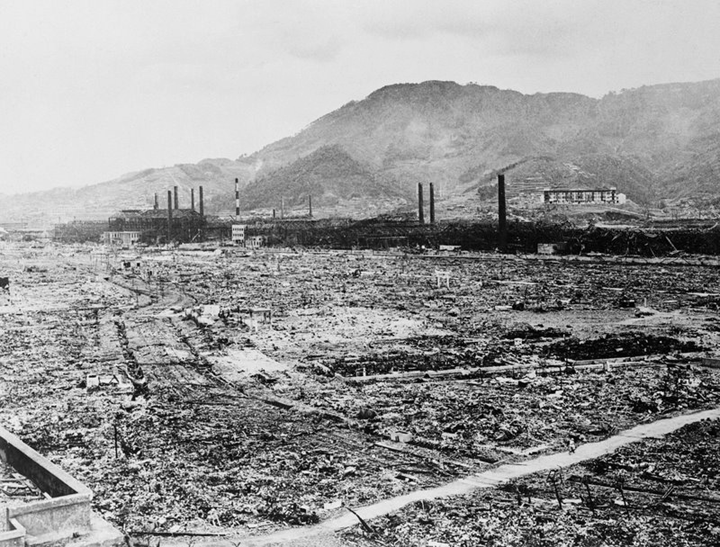 America’s Nuclear Madness: Terrorism With A Vengeance (Part I) By Robert Quinn” OpEdNews 8/11/2013 “………….Japan Had Already Been Defeated Prior To Dropping the Bombs After the war had ended, the U.S. Strategic Bombing Survey (a board consisting of more than 1,000 individuals, both military and civilian), was tasked by U.S. Secretary of War Henry Stimson with the examination and analysis of U.S. involvement in WW II. The Survey concluded in 1946 that “Japan would have surrendered even if the atomic bombs had not been dropped, even if Russia had not entered the war, and even if no invasion had been planned or contemplated.”
But it was not only with the advantage of hindsight that this conclusion was reached. General Eisenhower (Supreme Commander of allied forces in Europe) and General MacArthur (Supreme Commander of the U.S. Army in the Pacific) came to the same conclusion before the bombs were ever dropped. I don’t think there’s any question that both General Eisenhower and General MacArthur would have done whatever was necessary to spare their troops the horrors of a ground invasion. But the fact is that neither of them believed that a ground invasion of mainland Japan was necessary. Continue reading
Yoshito Matsushige, photographer of iconic Hiroshima bombing pictures
the American military confiscated all of the post-bomb prints, just as they seized the Japanese newsreel footage,
 Journalist Took Five Historic Pictures—That Must Never Be Repeated The Nation, Greg Mitchell on August 8, 2013 Yoshito Matsushige, a photographer for the Chugoku Shimbun, took the only pictures in Hiroshima on August 6, 1945, that have surfaced since. It was these five photos Life magazine published on September 29, 1952, hailing them as the “First Pictures—Atom Blasts Through Eyes of Victims,” breaking the long media blackout on graphic images from Hiroshima and Nagasaki.
On August 6, 1945, Matsushige wandered around Hiroshima for ten hours, carrying one of the few cameras that survived the atomic bombing and two rolls of film with twenty-four possible exposures. This was no ordinary photo opportunity. He lined up one gripping shot after another, but he could only push the shutter seven times. Continue reading
Japanese man advocates for Korean hibakusha
 Japanese man stands up for Korean A-bomb victims jdp. AUGUST 8, 2013 by FAITH AQUINO Second-generation A-bomb victim Nobuto Hirano has been helping Korean atomic bomb survivors for almost three decades now. Although the Little Boy and the Fat Man were dropped in Hiroshima and Nagasaki, respectively, there were also thousands of Korean victims of the atomic explosions. Despite criticism from fellow Japanese, Hirano has continued to carry out his advocacy for the hibakusha who also deserve compensation but were neglected….http://japandailypress.com/japanese-man-stands-up-for-korean-a-bomb-victims-0833537/
How they began: the lies about Hiroshima atomic bombing
 from its very first words, the official narrative was built on a lie, or at best a half-truth. Hiroshima did contain an important military base, used as a staging area for Southeast Asia, where perhaps 25,000 troops might be quartered. But the bomb had been aimed not at the “Army base” but at the very center of a city of 350,000, with the vast majority women and children and elderly males.
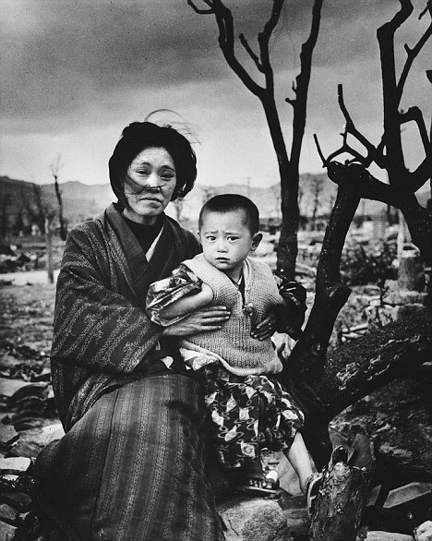 In fact, the two most important reasons Hiroshima had been chosen as our #1 target were: It had been relatively untouched by conventional bombs, meaning its large population was still in place and the bomb’s effects could be fully judged
residential areas bore the brunt of the bomb, with less than 10 percent of the city’s manufacturing, transportation, and storage facilities damaged.
There was something else missing in the Truman announcement: Because the president in his statement failed to mention radiation effects,
68 Years Ago: Truman Opened the Nuclear Era — With a Lie About Hiroshima Greg Mitchell, HUFFINGTON POST, : 08/06/2013 When the shocking news emerged that morning, exactly 68 years ago, it took the form of a routine press release, a little more than one thousand words long……The atmosphere was so casual, many reporters had difficulty grasping the announcement. ….
Those who helped prepare the presidential statement — principally Secretary of War Henry L. Stimson — sensed that the stakes were high, for this marked the unveiling of both the atomic bomb and the official narrative of Hiroshima, which largely persists to this day. It was vital that this event be viewed as consistent with American decency and concern for human life. Continue reading
Discovery of medical records of world’s first nuclear bomb radiation victim
“The records are invaluable as those reporting in detail on changes in her health condition after she was exposed to a fatal level of radiation.”
Medical records of world’s first radiation victim from A-bomb recovered Asahi Shimbun, By YURI OIWA/ Staff Writer, 4 August 13,
Long-lost medical records detailing the sharply deteriorating health of the world’s first recognized radiation sickness patient have been
recovered 68 years after the victim died within weeks of being exposed to the atomic bomb in Hiroshima.
The patient, Midori Naka, a stage actress, died 18 days after she was injured in the nuclear blast on Aug. 6, 1945. She was staying in Hiroshima as part of a traveling theater troupe. After returning to Tokyo a few days later, Naka died while undergoing treatment, which included blood transfusions, at the University of Tokyo Hospital. She was 36.
The discovery came after decades of efforts by researchers to locate her missing records.The hospital kept updates of her condition leading up to her death and the results of her autopsy. But other vital records have been missing until their recent recovery.
Kazuhiko Maekawa, professor emeritus with the University of Tokyo who is expert in treating patients suffering from radiation exposure, hailed the discovery of Naka’s medical records. Continue reading
Nuclear war came so close in 1983
It is frighteningly revealing that, as in the previous Whitehall scenario conducted two years earlier, the war game predicts that NATO would use nuclear weapons first
the Queen never got to make that awe-inspiring and terrible address to her people. Instead, it disappeared into the files, to become a chilling curiosity of our recent history – and also a constant reminder of what could happen.
BigRead: what if nuclear war had happened in Europe in 1983 by: Dominic Sandbrook, Daily Mail August 02, 2013 AS the sun rises over London, it reveals a city scarred and bloodied beyond recognition. It is March 1983, and for days Soviet bombs have rained down on Britain’s capital.
Thousands of houses lie shattered and abandoned. Broken bodies litter the streets. The air hangs heavy with dread.
Downing Street has been obliterated and Buckingham Palace stands smouldering. The Queen, who broadcast so movingly to the nation a few days ago, has not been seen for days.
Despite calls for her to be evacuated to Balmoral, she refused to leave the capital, insisting that like her father George VI during World War II, she would stand shoulder-to-shoulder with the people of London.
QUEEN’S SPEECH: The speech she never had to deliver
But even as Britain burns, a much bigger horror is unfolding far away to the east.
Above the cities of the Soviet Union’s Eastern European satellites, nuclear mushroom clouds are rising. Faced with defeat on the battlefield, the West has fallen back on its last hope: a nuclear attack on the Communist Empire itself.
It sounds like something from a science fiction film. But this terrifying scenario comes from newly-declassified government documents, released earlier this week by the UK’s National Archives agency under the country’s Thirty Year Rule. Continue reading
Atomic bombing of Japanese cities was wrong and unnecessary
In a Newsweek interview, Ike would add: “…the Japanese were ready to surrender and it wasn’t necessary to hit them with that awful thing.”
Countdown to Hiroshima, for July 31, 1945: Top Truman Aide Opposes Use of Bomb Greg Mitchell, HUFFINGTON POST, : 07/31/2013 For the past several days here, and for more to come, I am counting down the days to the atomic bombing of Japan (August 6 and August 9, 1945), marking events from the same day in 1945. I’ve written hundreds of article and three books on the subject: Hiroshima in America (with Robert Jay Lifton), Atomic Cover-Up (on the decades-long suppression of shocking film shot in the atomic cities by the U.S. military) and Hollywood Bomb (the wild story of how an MGM 1947 drama was censored by the military and Truman himself).
Here are previous daily pieces this month in this unique series.
July 31, 1945: The assembly of Little Boy is completed. It is ready for use the next day. But a typhoon approaching Japan will likely prevent launching an attack. Several days might be required for weather to clear.
- In Germany, Admiral William D. Leahy, chief of staff to Truman–and the highest-ranking U.S. military officer during the war–continues to privately express doubts about the bomb, that it may not work and is not needed, in any case. He would later write in his memoirs:
“It is my opinion that the use of this barbarous weapon at Hiroshima and Nagasaki was of no material assistance in our war against Japan. The Japanese were already defeated and ready to surrender because of the effective sea blockade and the successful bombing with conventional weapons.”The lethal possibilities of atomic warfare in the future are frightening. My own feeling was that in being the first to use it, we had adopted an ethical standard common to the barbarians of the Dark Ages. I was not taught to make war in that fashion, and wars cannot be won by destroying women and children.”…………… Continue reading
False arguments on the “necessity” for the atomic bombing of Hiroshima and Nagasaki
Will Media Raise Key Questions About Hiroshima, and Nuclear Legacy, This Year? THE NATION,Greg Mitchell on July 24, 2013 Sixty-eight years ago last week the Nuclear Age began with the first successful test of an atomic weapon at the Trinity site in the New Mexico desert. The test and what surrounded it set the standard for much of what followed in the decades to come: radiation dangers, official secrecy and cover-ups, a nearly endless nuclear arms race, and the triumph of the national security state……
Every summer for the past thirty years I’ve written numerous articles about this and related subjects—because the US media, with the exception of the fiftieth anniversary in 1995, fail to raise new, or even longstanding, questions. I’ve written three books on the subject: Hiroshima in America (with Robert Jay Lifton), Atomic Cover-Up (on the decades-long suppression of shocking film shot in the atomic cities by the US military) and Hollywood Bomb (the wild story of how an MGM 1947 drama was censored by the military and Truman himself).
For now, here’s a kind of summary of the debate of the use of the bomb in August 1945. Continue reading
USA quietly reveals extent of massive nuclear bombing of Marshall Islands
The Fallout from Nuclear Secrecy , Consortium News, July 23, 2013 During the Cold War’s early years, the U.S. government detonated dozens of nuclear explosions on Pacific atolls, spreading nuclear fallout around the globe and making some areas uninhabitable, a grim legacy captured in secret documents finally being shared with the Marshall Islands’ government, reports Beverly Deepe Keever.

More than a half century after U.S. nuclear tests shattered the tranquility of Pacific Ocean atolls — rendering parts of them uninhabitable – the U.S. government has quietly released secret fallout results from 49 Pacific hydrogen-bomb blasts with an explosive force equal to 3,200 Hiroshima-size bombs. Continue reading
Operation Redwing saga: the radioactive pollution of the Marshall Islands
The Fallout from Nuclear Secrecy , Consortium News, July 23, 2013 “……….As the Redwing tests continued, radiation badges were handed out, which Harris described as “small rectangular plastic discs three inches by an inch and a half.” Even with these, Harris wondered about the future impact of the radiation: “Had our genetic code been compromised? Would we get leukemia or some other form of cancer?”
His answer came decades later. Those present at Operations Redwing or Hardtack or for six months afterward who succumb to one of 19 primary cancers are eligible for $75,000 compensation made available by Congress.
At the time of Operation Redwing in 1956, the U.S. government under President Dwight Eisenhower released very little information. This secrecy was politically significant because it kept voters in the dark during the presidential election campaign in which Democratic candidate Adlai Stevenson advocated stopping the H-bomb tests being conducted by the Eisenhower administration.
During the election year, U.S. officials announced only two of the 17 blasts in the Redwing series. This virtual blackout hid from U.S. voters over 77 summertime days during the presidential election campaign Redwing’s 20,820 kilotons of explosive force — or the equivalent of 1,388 Hiroshima-size bombs. That tonnage is the equivalent of 18 Hiroshima-size bombs per day over 77 days.
Seven Redwing tests received no public notice and the remaining eight blasts were disclosed by Japanese scientists in news articles datelined Tokyo. Thus the fastest and most accurate information about U.S. Redwing testing was disclosed from Tokyo by Japanese, an immense irony given that only a decade earlier, U.S. atomic bombs had contributed to Japan’s surrender by destroying two of its cities. Eisenhower handily won re-election.
The more powerful 32 detonations in Operation Hardtack were launched in 1958 as the U.S. and the Soviets raced toward declaring a moratorium on such experiments and the U.S. accelerated testing missile warheads. Washington disclosed only nine of the 32 blasts that produced a total yield of 28,026 kilotons, or the equivalent of 1,868 Hiroshima-size bombs – an average of 35 per week in 1958 or five per day. That was the lowest disclosure rate of any U.S. Pacific testing operation.
Even more ironic than the Japanese disclosures in 1956 were the Soviet ones about the 1958 Hardtack detonations. The Soviets charged that the U.S. had concealed most of the tests being conducted, which even U.S. officials deemed accurate.
In doing so, the Soviets made huge propaganda gains as they announced their initiative of stopping their nuclear testing that year. Surprisingly, New York Times columnist James Reston wrote that “the United States, which pamphleteered its way to independence and elevated advertising and other arts of persuasion into a national cult, should be unable to hold its own in the battle for the headlines of the world.”
Samples made during several Hardtack tests showed that fractions of the radioactive elements of strontium and cesium were dispersed over distances of more than 4,000 miles, according to a report titled “Operation Hardtack: Fallout Measurements by Aircraft and Rocket Sampling” dated 1961 and declassified in 1985. The U.S. gave a newly declassified version of this report to RMI officials.
That 4,000-miles range means the radioactive elements could have descended on San Francisco and other West Coast areas. Both radioactive elements pose serious health problems.
The decades-long delay in receiving a full accounting of these fallout results helps to substantiate the contention of the RMI that its negotiators were denied vital information when they agreed in 1986 with President Ronald Reagan to form an independent nation, thus ending the American administration of the U.N.-sanctioned trust territory established in 1947.
Kept in the dark about the fallout results, the Marshallese agreed to terms so insufficient that a U.S.-financed $150 million nuclear-claims trust fund is now penniless, unable to compensate fully Marshallese for health and property damages presumed to have resulted from the tests. RMI’s appeals to Congress, the U.S. courts and the Bush administration have been turned back and the Obama administration has yet to help them.
Last September, Special Rapporteur Calin Georgescu of the United Nations reported to its Human Rights Council that the U.S. government should:
–Remedy and compensate Marshall Islanders for its nuclear weapons testing that has caused “immediate and lasting effects” on their human rights,
–Open up still-secret information and records regarding the environmental and human health effects of past and current U.S. military use of the islands,
–Grant Marshallese full access to their medical and other records, and
–Consider issuing a presidential acknowledgment and apology to victims adversely affected by the 66 weapons tests it conducted when it administered the Marshall Islands as a U.N. strategic trust territory.
Over the decades, the Marshallese have not been alone in wanting more information about the nuclear tests. In 1954, the Association of State Health Officials voted to ask the federal government to give health officials with security clearances access to classified atomic energy information so as to prevent health hazards.
From 1945 to 1992, the United States carried out 1,054 nuclear tests worldwide. Beverly Deepe Keever is the author of News Zero: The New York Times and The Bomb and the newly released Death Zones and Darling Spies: Seven Years of Vietnam War Reporting. http://consortiumnews.com/2013/07/23/the-fallout-from-nuclear-secrecy/
Hinkley nuclear site’s history of weapons deals with USA

 Hinkley’s hidden history Morning Star UK 21 July 2013 by David Lowry With the coalition government’s decision to back a third nuclear reactor at Hinkley Point on Somerset’s coast and the ongoing debate over Trident replacement, it’s interesting to take a look back at the origins of Britain’s nuclear programme.
When the British nuclear power and weapons programmes were born, a different foreign power, the United States, was intimately involved in the planning.
The first public hint came with an MoD announcement in June 1958 on “the production of plutonium suitable for weapons in the new [nuclear] power stations programme as an insurance against future defence needs” at Britain’s first-generation Magnox reactor (named after the fuel type, magnesium oxide).
A week later in Parliament, Labour’s Roy Mason asked why the government had “decided to modify atomic power stations, primarily planned for peaceful purposes, to produce high-grade plutonium for war weapons.”
He was informed by paymaster general Reginald Maudling: “At the request of the government, the Central Electricity Generating Board has agreed to a small modification in the design of Hinkley Point and of the next two stations in its programme so as to enable plutonium suitable for military purposes to be extracted should the need arise.
“The modifications will not in any way impair the efficiency of the stations. As the initial capital cost and any additional operating costs that may be incurred will be borne by the government, the price of electricity will not be affected……….
the following month, the US and British governments signed a mutual defense – spelt with an “s” even in the official British version, so you can guess where it was authored – co-operation agreement on atomic energy matters.
The agreement was intended to circumvent the draconian restrictions of the 1954 Atomic Energy Act, which sought to retain all nuclear secrets within the US, even though many foreign nationals had worked collaboratively with US counterparts for six or more years on nuclear R&D.
The deal was reached after several months of congressional hearings in Washington DC, but no oversight whatsoever in the British Parliament.
As this formed the basis, within a mere five years, for Britain obtaining the Polaris nuclear WMD system from the US, and some 20-odd years later for Britain to buy US Trident nuclear WMD, the failure of Parliament to at least appraise the security merits of this key bilateral atomic arrangement was unconscionable…….
And so it may be seen that the Britain’s first civil nuclear programme was used as a source of nuclear explosive plutonium for the US military, with Hinkley Point A the prime provider.
The reason there was a swap between Britain and the US of weapons-suitable highly enriched uranium and plutonium was the US had huge surpluses of uranium, but wanted more plutonium than its nuclear production complex at Hanford could deliver, while the British first-generation “commercial” Magnoxes, which were scaled-up plutonium production factories, were perfect for producing military-suitable plutonium as they had online refuelling systems to optimise plutonium over electricity production.
They produced perfect plutonium in surplus, but Britain lacked sufficient highly enriched uranium, so an exchange deal was mutually beneficial.
Two decades later in 1984 Wales national daily the Western Mail reported that the largest Magnox reactor in Britain, at Wylfa on Anglesey, had also been used to provide plutonium for the military.
Plutonium from both reactors went into the British military stockpile of nuclear explosives, and could well still be part of the British Trident warhead stockpile today.
Subsequent research by the Scientists Against Nuclear Arms, published in the prestigious science weekly journal Nature and presented to the Sizewell B and Hinkley C public inquiries in the ’80s, has demonstrated that around 6,700kg of plutonium was shipped to the US under the military exchange agreement, which stipulates explicitly that the material must be used for military purposes by the recipient country.
To put this quantity into context, a nuclear warhead contains around 5kg of plutonium.
Is it any wonder the Atoms for Peace movement began to demand “safeguards” to deter diversion of civilian nuclear plants to military misuse?
After all, the US and Britain knew that such deadly diversion was possible – they had demonstrated it themselves.
The trouble is that safeguards are misleading. They are neither safe, nor do they guard. And what would Iran or North Korea make of this deliberate intermixing of civil and military nuclear programmes by one of the nuclear weapons superpowers – one which leads the criticisms of them for allegedly doing this very thing today. http://www.morningstaronline.co.uk/news/content/view/full/135635
Nuclear weapons insanity: America’s AIR-2 Genie rocket
it was basically a suicide device.
The craziest part about this? In the only live test during Operation Plumbob, the US Air Force put five guys directly under the blast to prove how “safe” it was to use over populated areas. P
And the US government made 3,000 Genies.
The Five Most Insane Nuclear Delivery Systems Jaolpnik MICHAEL BALLABAN, 14 July 13
“…….Earlier this week we looked at the giantSoviet nuclear gun. That thing is definitely batty, what with its giant cannon at one end and what was essentially a tank at the other end turning it into a self-propelled howitzer. The Americans had a crazy nuke gun, too, and for awhile it looked like maybe we’d just stand and shoot atomic cannons at each other.
The thing is though, with both of those artillery pieces the actual physics package was intended to reach at least 15 miles away before the thing actually exploded. And even then, that was waytoo close.
What would happen, then, if you wanted it to explode even closer?
The AIR-2 Genie was a doomsday rocket of absolute desperation.
genie_missile_test
With the Cold War in its deepest freeze but without the benefit of long-range ICBMs, American military planners thought the only way New York, Los Angeles, or Chicago would be bombed would be in massive waves of Soviet bombers. Unfortunately, if 100 of them come at you at once, you may not shoot them all down. And really, only one getting through your defenses is necessary for absolute devastation.
In 1958, when the AIR-2 was introduced, the problem was compounded by the fact that missile guidance systems still weren’t quite up to snuff. Directly hitting all of the bombers coming at you was going to be a near-impossible task. The solution was to launch one, single, solitary missile. That missile, completely unguided, with a nuclear bomb on board, would cause a big enough explosion to hopefully wipe out all the attackers. With a big enough boom, you wouldn’t need a guidance system.
Oh, and the range was only six miles. In case you’re forgetting, most nukes make a bigger boom than that, so it was basically a suicide device.
The craziest part about this? In the only live test during Operation Plumbob, the US Air Force put five guys directly under the blast to prove how “safe” it was to use over populated areas. P
And the US government made 3,000 Genies…….. http://jalopnik.com/the-five-most-insane-nuclear-delivery-systems-768180979
Insane nuclear weapons: nuclear torpedo, and nuking the moon!
 Project A119, conceived before the Apollo landings, was ostensibly created for “science.” There’s no real science purpose to nuking the moon, though, so it’s kind of obvious what it was really about. Also, they intended to blow up the nuke on the Moon’s horizon, for maximum visibility from Earth.
For science.
The Five Most Insane Nuclear Delivery Systems Jaolpnik MICHAEL BALLABAN, 14 July 13 “……The Nuclear Torpedo Quick! Doomsday is upon us! The only way to save our cities is to get rid of all the enemy subs! Both the East and the West made nuclear torpedoes that survived in service into at least the 1970s. That’s not such a bad idea if you really want to sink something, but nukes aren’t something you just want to be using all willy-nilly. As torpedoes had the nasty habit of sometimes escaping from their tubes, this necessitated a two-step process for their use.
The Nuclear Torpedo Declassified U.S. Nuclear Test Film #46
First, the torpedo would be fired, and then a second button would be pushed to detonate it. This meant you would need a wire to connect the original sub and the newly-fired torpedo.
Nothing wrong with that, right? Just get a really long wire. And then you realize how a “really long wire” is still too short for you to get away.
The American Mark 45 torpedo had a really long wire, but even at its longest it was only eight miles in length. Even if you sunk somebody, with an 11 kiloton warhead on board, you were bound to go down to the bottom with them. http://jalopnik.com/the-five-most-insane-nuclear-delivery-systems-768180979
Project A119 Continue reading
Crazy military nuclear plans – the chicken nuke, the backpack nuke
The Five Most Insane Nuclear Delivery Systems Jaolpnik MICHAEL BALLABAN, 14 July 13 “……The Chicken Nuke When Cold War planners were planning out the seemingly inevitable Hot War, they had dreams dancing in their heads of massive waves of Russian soldiers and tanks sweeping across Germany. The British, being plucky, were confident they would lose.
The Royal Armament Research and Development Establishment developed a nuclear land mine that could be detonated either by wire or by an eight-day timer that would completely obliterate the advancing enemy columns. Not such a bad idea if you’re a fan of indiscriminate wastelands.
The only problem was that land mines tend to be buried in the ground, where it can get cold. Cold temperatures would freeze the electronics in the nuke mines, preventing them from doing their intended deadly deed. Clearly, a solution was needed to heat those bad boys up.
Blankets? No, too safe. One of those gel packs you put in your mittens when you ski? How pedestrian. No, this was 1954, and everything needed to go whoosh and phflew, so something high-tech was needed. Oh yes, that’s right.
Chickens.
The idea was to seal the chickens inside the nuclear casing as the Western armies retreated from the German plain. With a supply of food and water inside, the chickens would last for roughly a week, and their body heat would be enough to make sure everything went kaboom as normal.P
Once again, chickens.
Somehow the British actually ordered ten of these things in 1957, but supposedly none were made before the project was cancelled a year later, Let’s just hope there are no chickens buried under Germany.
The Backpack Nuke
Local news likes to whip everyone into a tizzy with tales of terrorists and backpack nukes, but the reason we know it’s a real possibility is because backpack nukes are a real thing. And we would know, because we made them.
The H-912 container for the Mark 54 Special Atomic Demolition Munition (SADM) could be feasibly carried on your back, although it does look a bit bulky. The idea would be for two guys (Navy SEALs or otherwise) to parachute into Soviet territory, set it, and forget it. The second guy would be there essentially just to back the first guy up, though in a pinch it looks like it could be used on a one-man mission.
Though it doesn’t look that big, it could actually destroy the equivalent of a few city blocks.
How fast can you run?… http://jalopnik.com/the-five-most-insane-nuclear-delivery-systems-768180979
1 This Month
Chernobyl: The Lost Tapes – A good documentary on Chernobyl on SBS available On Demand for the next 3 weeks– https://www.sbs.com.au/ondemand/tv-program/chernobyl-the-lost-tapes/2352741955560

of the week–London Campaign for Nuclear Disarmament

Tell the Ukrainian Government to Drop Prosecution of Peace Activist Yurii Sheliazhenko
To see nuclear-related stories in greater depth and intensity – go to https://nuclearinformation.wordpress.com
-
Archives
- April 2026 (114)
- March 2026 (251)
- February 2026 (268)
- January 2026 (308)
- December 2025 (358)
- November 2025 (359)
- October 2025 (376)
- September 2025 (257)
- August 2025 (319)
- July 2025 (230)
- June 2025 (348)
- May 2025 (261)
-
Categories
- 1
- 1 NUCLEAR ISSUES
- business and costs
- climate change
- culture and arts
- ENERGY
- environment
- health
- history
- indigenous issues
- Legal
- marketing of nuclear
- media
- opposition to nuclear
- PERSONAL STORIES
- politics
- politics international
- Religion and ethics
- safety
- secrets,lies and civil liberties
- spinbuster
- technology
- Uranium
- wastes
- weapons and war
- Women
- 2 WORLD
- ACTION
- AFRICA
- Atrocities
- AUSTRALIA
- Christina's notes
- Christina's themes
- culture and arts
- Events
- Fuk 2022
- Fuk 2023
- Fukushima 2017
- Fukushima 2018
- fukushima 2019
- Fukushima 2020
- Fukushima 2021
- general
- global warming
- Humour (God we need it)
- Nuclear
- RARE EARTHS
- Reference
- resources – print
- Resources -audiovicual
- Weekly Newsletter
- World
- World Nuclear
- YouTube
-
RSS
Entries RSS
Comments RSS
 nuclear-news