When a B-52 crashed due to turbulence – carrying 2 nuclear bombs!
the weapons are found. Not entirely safe, but “…relatively intact…” according to the Air Force. It’s a scary sounding moderation to describe radioactive A-bombs lying around in the woods of the Eastern U.S. unattended.
[Read also: On this day in 1968 a B-52 crashed in Greenland with 4 hydrogen bombs]
 The nuclear nightmare of Savage Mountain: when a B-52 crashed due to turbulence. With two nukes, The Aviationist, Jan 15 2015 By Tom Demerly
This is true. And it’s terrifying. It reads like an Ian Fleming or Tom Clancy thriller. But it’s real. Continue reading
How radioactive paint contaminated workers
Pappy’s Undark Girls Ghost Stories 2012 – 2014 by Lost Dutchman Ghost“…….The Radium Luminous Material Corporation used radium from carnotite ore to make luminous paint, which was sold under the brand name ‘Undark‘. The paint was used on military watches and compasses. Plant workers were told the product was safe and encouraged to handle the substance with their hands and mouth. When the girls went to the clubs after work, the paint was blazon on their lips and shone brightly in the darkness. They were very popular, but their looks could kill.
After several workers became ill with radioactive poisoning, plant workers (Grace Fryer and four others) sued for damages. A media sensation surrounded the case of the Undark Girls. It established several legal precedents and triggered the enactment of regulations governing labor safety standards; in addition to the historic reference of ‘provable suffering’.
Several of the plant workers died before the litigation was complete. The company enacted safety procedures and the illness ceased. Even after death, the bodies of the victims were so contaminated that radiation can still be detected at their grave sites, using a Geiger counter…….http://lostdutchmanghosthunters.blogspot.com.au/
The world’s first lump of plutonium – lost and found
How The First Lump Of Plutonium Made On Earth Got Lost http://www.gizmodo.com.au/2015/01/how-the-first-lump-of-plutonium-made-on-earth-got-lost/ SARAH ZHANG, 9 JAN 15, A few years ago, the first lump of plutonium scientists ever made on Earth disappeared from display in Berkeley’s Lawrence Hall of Science. Berkeley physicists think they have finally found it again — thankfullybefore it got thrown out as radioactive waste.
This precious lump of plutonium dates back to 1941. Plutonium doesn’t exist naturally on Earth, except in trace amounts. So to study plutonium, scientists first had to make it. Berkeley physicist Glenn Seaborg got access to a newly built cyclotron, where he and his collaborators bombarded uranium with neutrons. The material then decays into the new element of plutonium.
After a year, they had enough plutonium for the first sample large enough to weigh. It was all of 2.77 micrograms.
Seaborg would go on to win a Nobel Prize for his discovery of plutonium and other transuranium elements. The room where he did his work in Gilman Hall has since become a US National Historic Landmark. That historic sample was converted into plutonium oxide and placed in a glass tube, where it was put on display in Berkeley’s Lawrence Hall of Science.
In the late 2000s, however, Berkeley began to worry about the dangers putting the plutonium on display. The sample was removed and put away — except no one really knew where. Some time later, a box labelled “First sample of Pu weighed” was found at the Berkeley’s Hazardous Material Facility, a waystation for hazardous waste. Thankfully, a knowledgable eye saw it and discerned its historical value.
The label’s claim was promising, but how could we prove that this was actually Seaborg’s sample? With science, of course. The Physics ArXiv Blog explains:
It turns out that plutonium created in a cyclotron is very different from most plutonium, which is created inside nuclear reactors and then separated from spent nuclear fuel. That’s because this stuff always contains another isotope, plutonium-241.
This is a half-life of just over 14 years and decays into americium-241. So samples of plutonium from nuclear reactors, always contain americium-241 in amounts that grow over time. What’s more, Am-241 in turn decays producing gamma rays with an energy of 59 kiloelectron volts.
Eric Norman’s lab at Berkeley’s Department of Nuclear Engineering monitored the sample for gamma rays with an energy of 59 kiloelectron volts. They didn’t find any, meaning the sample was most likely created in a cyclotron like Seaborg’s. In addition, the mass matches up. The evidence all points toward this being the missing plutonium.
Now that Seaborg’s sample has been recovered, there’s talk of putting it back on display in his former office in Gilman Hall — perhaps a more fitting place than the trash bin. [The Physics ArXiv Blog]
USS Calhoun County and the dumping at sea of atomic waste
“Nuclear Waste Dumping Diary.”
Jan. 20 1957: “371 tons atomic waste.”
Feb. 7, 1957: “368 tons atom waste.”
Nov. 13, 1957: “299 (tons) poison gas (and) A.W.”
One of Albernaz’s last entries was on June 12, 1958: “200 tons. Spec. weapons,” or special weapons. That was the day, Albernaz later told his wife, that he helped dispose of an atomic bomb.
none of the men who served on theCalhoun County are eligible for automatic VA benefits for radiation illnesses because they did not participate in underwater or atmospheric atomic tests and related activities, the government says.
Thus, the crewmen do not meet their country’s definition of “Atomic Veteran.”
USS Calhoun County sailors dumped thousands of tons of radioactive waste into ocean, Tampa Bay Times , 20 Dec 2013 William R. Levesque, Times Staff Writer They asked the dying Pasco County man about his Navy service a half-century before. He kept talking about the steel barrels. They haunted him, sea monsters plaguing an old sailor.
“We turned off all the lights,” George Albernaz testified at a 2005 Department of Veterans Affairs hearing, “and … pretend that we were broken down and … we would take these barrels and having only steel-toed shoes … no protection gear, and proceed to roll these barrels into the ocean, 300 barrels at a trip.”

Not all of them sank. A few pushed back against the frothing ocean, bobbing in the waves like a drowning man. Then shots would ring out from a sailor with a rifle at the fantail. And the sea would claim the bullet-riddled drum.
Back inside the ship, Albernaz marked in his diary what the sailors dumped into the Atlantic Ocean. He knew he wasn’t supposed to keep such a record, but it was important to Albernaz that people know he had spoken the truth, even when the truth sounded crazy.
For up to 15 years after World War II, the crew of Albernaz’s ship, the USS Calhoun County, dumped thousands of tons of radioactive waste into the Atlantic Ocean, often without heeding the simplest health precautions, according to Navy documents and Tampa Bay Times interviews with more than 50 former crewmen………. Continue reading
Thatcher government pursued peace activists, ignored threat of nuclear winter
Officials were more interested in monitoring the activities of campaigners opposed to cruise missiles, documents released by the National Archives in Kew reveal.
A confidential file on “Nuclear winter – global atmospheric consequences of nuclear war” shows that civil servants in the department’s emergency planning section, F6, decided they did not need to research the disputed phenomenon.
An internal memo in December 1984 records: “It was agreed with F6 that no assessment of the [nuclear winter] theory would be carried out by the branch and as such our interest is limited to general reading which could not be regarded as following the subject in any depth.”………

Closer attention was paid to anti-nuclear activists. ………
Anti-nuclear groups were under surveillance. “Data is now collected on demonstrations and incidents by anti-nuclear groups at MoD establishments,” the file states.
In the battle for public sympathy, pro-nuclear groups received official help. “Continued government support – both financial and through the provision of nuclear PR material – will be necessary,” one report records. “Co-ordination of [their] activities … is best left, in general, to the groups themselves although periodic advice and encouragement from ministers will continue to be valuable.”
Architectural drawings of DIY nuclear blast-proof shelters were commissioned for the latest edition of the Protect and Survive pamphlets. They suggested householders excavate holes in their living rooms and build “igloo shelters”; the components cost £554 – about £1,500 in today’s money……A separate memorandum was headed: “Spontaneous evacuation of civil population in a future war.”……..
“The guts of the matter is that in a war emergency a task of the police would be to ensure that, as it does in peacetime (eg peak holiday weekends), that the country does not come to a grinding halt through traffic congestion howsoever caused.” http://www.theguardian.com/world/2014/dec/30/home-office-nuclear-winter-threat-scaremongering-war
Underground secret Nazi Nazi nuclear weapons testing site discovered
Secret Nazi nuclear weapons testing bunker unearthed in Austria http://boingboing.net/2014/12/29/secret-nazi-nuclear-weapons-te.html Xeni Jardin , Dec 29, 2014 An underground weapons bunker built by Nazis to test nuclear and chemical weapons has been unearthed in Austria.
It was built using slave labor from the nearby Mauthausen-Gusen concentration camp. Austrian documentary filmmaker Andreas Sulzer noticed a reference to the subterranean site in the diary of an Austrian physicist recruited by the Nazis. The stronghold was located near the town of Sankt Georgen an der Gusen, and not far from the Bergkristall factory where the first operational jet-powered fighter, the Messerschmitt Me 262, was invented. Footage from the previously-unearthed Bergkristall site is below.
From The Independent:
Its exact location was determined using intelligence reports and radiation tests, which revealed higher than normal levels of radioactivity.
Andreas Sulzer, the filmmaker who is leading the exploration, discovered a critical 1944 report by the forerunner to the CIA, from an American spy who noted the existence of a secret weapons programme in the area.
Sulzer told the Sunday Times, “Prisoners from concentration camps across Europe were handpicked for their special skills–physicists, chemists or other experts–to work on this monstrous project and we owe it to the victims to finally open the site and reveal the truth.”
From the International Business Times:
It is believed that an estimated 320,000 inmates died building the labyrinth of concrete tunnels and shafts.
It is believed to be the location of a secret weapons programme, led by SS General Hans Kammler. Kammler is thought to have lived on the site during the war. Rumours continue to surround his death, with some suggesting he was given a new identity by the US government in exchange for details on Nazi weapons research.
The deadly V-2 rocket which struck at London during the final months of the World War II was tested at the complex. It is also thought that scientists experimented with the use of radioactive material and chemical gas.
UK’s Windscale nuclear disaster spread radiation much further than previously thought

 Windscale fallout underestimated Rebecca Morelle Science reporter, BBC News 6 Oct 2007 The radioactive fallout from a nuclear accident that rocked Britain 50 years ago was underestimated, scientists say.
In 1957, a fire at the Windscale nuclear reactor in Cumbria led to a release of radioactive material that spread across the UK and Europe.
But new research claims the incident generated twice as much radioactive material and could have caused more cancers than was previously thought.
The research was published in the journal Atmospheric Environment. Risky act
The Windscale site was home to Britain’s first two nuclear reactors – the Windscale Piles – which were constructed to produce plutonium and other materials for the UK’s nuclear weapons programme.
But the rush to build them when little was known about nuclear reactors led to what was at the time the world’s biggest nuclear disaster, although it was later dwarfed by Chernobyl and Three Mile Island.
On 10 October 1957, a failure to properly control the temperature of the graphite moderator within the Windscale No 1 pile sparked a devastating fire, which caused radioactive contamination to spew into the atmosphere.
The fire was eventually put out by restricting the air flow, and with water – a risky act which could have caused an explosion – but a radioactive cloud was already spreading far and wide.
At the time of the accident the levels and spread of the radioactive materials was estimated, and measures were put in place to limit radioactive contamination. But a new study carried out by John Garland, formerly of the UK Atomic Energy Authority, and Richard Wakeford, a visiting professor at the University of Manchester, suggests the contamination of the environment may have been much higher………http://news.bbc.co.uk/2/hi/science/nature/7030536.stm
Britain’s Windscale nuclear disaster was bad, but could have been much worse
Windscale Piles: Cockcroft’s Follies avoided nuclear disaster By Duncan LeatherdaleBBC News 4 Nov 14 They were labelled a waste of time and money, but in 1957 the bulging tips of two exhaust shafts rising above Sellafield arguably saved much of northern England from becoming a nuclear wasteland. The towers of Windscale Piles have been a landmark for decades but soon the last of these Cold War relics will be gone.
Cumbria’s skyline will change with the removal of the towers – known as Cockcroft’s Follies – but had they not been in place 57 years ago, the entire landscape may have been drastically different.
Until Chernobyl exploded in 1986, the blaze that ravaged the uranium-fuelled reactor at Windscale Pile One in October 1957 was Europe’s most terrible nuclear disaster. It is still the UK’s worst atomic incident.
Without the filters – installed at the last minute by Nobel Prize-winning scientist Sir John Cockcroft – the effects of the radioactive dust blasted into the Cumbrian air would have been much more devastating……….
On October 10, 1957, a fire was discovered in reactor one. Uranium fuel cells had ignited with the blaze reaching 1,300 C (2,380 F) and workers battled to stop the whole facility exploding.
Men wearing radiation suits used scaffolding pipes to try and push the burning fuel rods out of the graphite reactor.
The high radiation levels meant they could only spend a few hours at the reactor, more volunteers were sought from a nearby cinema.
Water failed to put out the blaze and the fire was only extinguished when operators closed off the air in the reactor room.
The blaze burnt for three days and significant amounts of radioactive material, most notably iodine-131, were released and spread across the UK and Europe.
It is estimated about 240 cases of thyroid cancer were caused by the radioactive leak and all milk produced within 310 square miles (800 square km) of the site was destroyed for a month after the fire.
The level of radioactive material which did escape is estimated to be 1,000 times less than at Chernobyl……….
he decision of health chiefs to order the destruction of milk contaminated by radioactive iodine, which has been linked to thyroid cancer, also prevented these cancers.
“They did some quick calculations and ordered the milk produced in a certain area be destroyed,” he said.
“It would have been a courageous decision but, ultimately, proved to be right, as it stopped a lot of children consuming the radioactive iodine.”
After the fire the chimneys were sealed off. Indeed, 15 tonnes of uranium fuel remains inside still………
Cockcroft’s Follies prevented a catastrophe, but the 1957 fire was nevertheless a dark hour for nuclear in the UK……..http://www.bbc.com/news/uk-england-cumbria-29803990
On anniversary of Windscale nuclear accident, UK plans another untested reactor
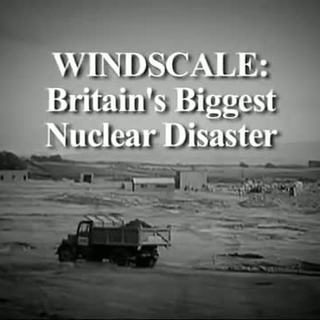 57 years ago today in 1957 :The Windscale Fire, Radiation Free Lakeland, 10 oct 14 ” ……..10th Oct marks 57 years since the worst nuclear accident in the UK. The bravery of those who fought the 1957 blaze was without question and they are remembered with our gratitude for preventing the far greater catastrophe of a full on Lake Counties nuclear sacrifice zone.
Official estimates point to a possibility of 240 additional cancer cases as a result of the Windscale fire. Studies reveal that the impacts of nuclear accident and routine emissions may be far wider reaching than the public is led to believe. One such study in 1995 by Dr John Bound, a former paediatrician at the Victoria Hospital, Blackpool; Brian Francis, of the Centre for Applied Statistics, Lancaster; and Dr Peter Harvey, pathologist at the Royal Lancaster Infirmary found that the Windscale fire
was followed by a surge in cases of Down’s syndrome. Their studies were poo poohed to protect the vested interests of the nuclear establishment.
This pattern has been repeated time and time again. History is now repeating itself with the plan for untried and untested new build near Sellafield.
The ruthless push towards new nuclear build on the beautiful coastline of West Cumbria mirrors the rush to build Windscale in order to produce plutonium for the atomic bomb. While “safety features” like the last minute addition of filters on the Windscale chimney helped mitigate the impact of the inevitable fire, the dangers from nuclear are inherent and accumulative. Nothing it seems is being learnt from history. The same old uranium burning technology is being proposed now for new build. The reactors being proposed are AP1000, a scaled up version of the commercially unattractive AP600. The AP1000 boasts higher efficiency, in other words it burns the uranium harder and longer producing much hotter wastes, reactors under construction now in America and China have cooling towers 600 – 800 ft. high. The other “alternative” is direct cooling with huge sea installations.
Sellafield is dangerous enough and a big enough terrorist target without putting untried, untested nuclear reactors next to it with the possibility of enormous cooling towers the size of New York sky scapers or huge sea installations.
Please remember the Windscale fire on the 10th. Remember the voluntary bravery of the Windscale workers and the involuntary bravery of all those unacknowledged babies, children, men and women who have died, or suffered health consequences as a result of the Windscale accident. The still highly radioactive chimney which stands 350ft tall has also claimed the life of steeplejack Neil Cannon who died after falling from the ongoing ‘decommissioning’. The death toll will continue without end if new build goes ahead. Surely the time has come for Cumbrians to say enough is enough and to join the resistance to new and more dangerous nuclear build.There is a petition here:
https://you.38degrees.org.uk/petitions/stop-moorside-biggest-nuclear-development-in-europe
The Soviet-Cuba nuclear reactor that could have been USA’s nightmare
 http://gizmodo.com/the-abandoned-communist-reactor-that-could-have-killed-1644415889The Abandoned Communist Nuclear Reactor That Could Have Killed Us All (Great pictures) Gizmodo 10 Oct 14
Ashley Feinberg Just 90 miles off the tip of Florida lies a half-baked, abandoned relic of the Cold War-era arms race—what was once going to be a joint Cuban-Soviet nuclear reactor. And thank god it never panned out. Because not only do we now have these incredible shots from photographer Darmon Richter, but every last aspect of this thing would have been a total and utter disaster………the whole project spent nearly a decade in limbo, until finally, in 2000, Fidel Castro told Vladamir Putin that he was done with the two countries’ former joint-dream. Now, the power plant at Juragua was officially little more than a testament to what could have been—which is a very good thing. Because as it turns out, “what could have been” basically entailed wildly dangerous conditions and potentially a whole mess of destruction.
At last – thorough research into cancers caused by world’s first atomic-bomb test
a sadness that still hangs over Tularosa.
“Whole families have died here,”

 Decades After Nuclear Test, U.S. Studies Cancer Fallout http://online.wsj.com/articles/decades-after-nuclear-test-u-s-studies-cancer-fallout-1410802085
Examination Will Probe Radiation Exposure Near 1945 Trinity Blast in New MexicoBy
DAN FROSCH Write to Dan Frosch at dan.frosch@wsj.com Sept. 15, 2014 TULAROSA, N.M.—Nearly 70 years after the U.S. conducted the world’s first atomic-bomb test here in the New Mexico desert, federal researchers are slated to visit the state this month to begin studying whether some residents developed cancer due to the blast.
As part of the long anticipated project, scheduled to start Sept. 25, investigators with the National Cancer Institute will interview people who lived in the state around the time of the 1945 Trinity test and assess the effects of consuming food, milk and water that may have been contaminated by the explosion.
For years, residents of the rural, heavily Hispanic villages near the test site have claimed that a mysterious wave of cancer has swept through this dusty stretch of south-central New Mexico, decimating families and prompting calls for the government to determine whether radiation exposure played a role. Continue reading
Hanford Nuclear Reservation’s dangerous”atomic man” room entered after 38 years
Workers enter dangerous ‘Atomic Man’ room at Hanford Nuclear Reservation http://www.oregonlive.com/pacific-northwest-news/index.ssf/2014/09/workers_enter_dangerous_atomic.html?utm_source=feedburner&utm_medium=twitter&utm_campaign=Feed%3A+oregonlive%2FkRom+%28Oregon+Local+News%29&utm_content=IceRocket+Blog+SearchSPOKANE, Wash. — Workers have entered one of the most dangerous rooms at the Hanford Nuclear Reservation.
The so-called McCluskey Room in the Plutonium Finishing Plant is named after worker Harold McCluskey. He was covered with radioactive material in 1976 when a glove box exploded. McCluskey, who was 64 at the time, lived for 11 more years and died from causes not related to the accident. He became known as the Atomic Man.
Hanford, located near Richland, Washington, for decades made plutonium for nuclear weapons. The site is now engaged in cleaning up the resulting radioactive mess.
Cleaning up the McCluskey Room is expected to take a year. A crew with contractor CH2M HILL Plateau Remediation Co. donned specially designed radiation suits before entering the McCluskey Room earlier this week. One of their first tasks was improving ventilation to better protect workers from airborne contamination as they clean out its equipment.
“This was the first of multiple entries workers will make to clean out processing equipment and get the McCluskey Room ready for demolition along with the rest of the plant,” said Bryan Foley, project director for the Department of Energy. “It has taken a year to prepare for this first entry.”
The room was used to recover americium — a plutonium byproduct — during the Cold War.
McCluskey was working in the room when a chemical reaction caused a glass glove box to explode. He was exposed to the highest dose of radiation from americium ever recorded — 500 times the occupational standard.
Covered with blood, McCluskey was dragged from the room and put into an ambulance headed for the decontamination center. Because he was too hot to handle, he was removed by remote control and transported to a steel-and-concrete isolation tank.
During the next five months, doctors extracted tiny bits of glass and razor-sharp pieces of metal embedded in his skin.
Nurses scrubbed him down three times a day and shaved every inch of his body every day. The radioactive bathwater and thousands of towels became nuclear waste.
McCluskey also received about 600 shots of zinc DTPA, an experimental drug that helped him excrete the radioactive material.
He was placed in isolation in a decontamination facility for five months. Within a year, his body’s radiation count had fallen by about 80 percent and he was allowed to return home.
The nuclear bombing of Nagasaki
The day the bomb fell on Nagasaki BRIAN MCKENNA The Globe and Mail Aug. 07 2014, The atomic bomb destined for the ancient trading port of Nagasaki was called Fat Man. Sister Regina McKenna, my grandfather’s sister, was close enough to ground zero to feel the death wind on her face. She might have preferred another name: Terror. Or, as the Japanese call it: Slaughter.
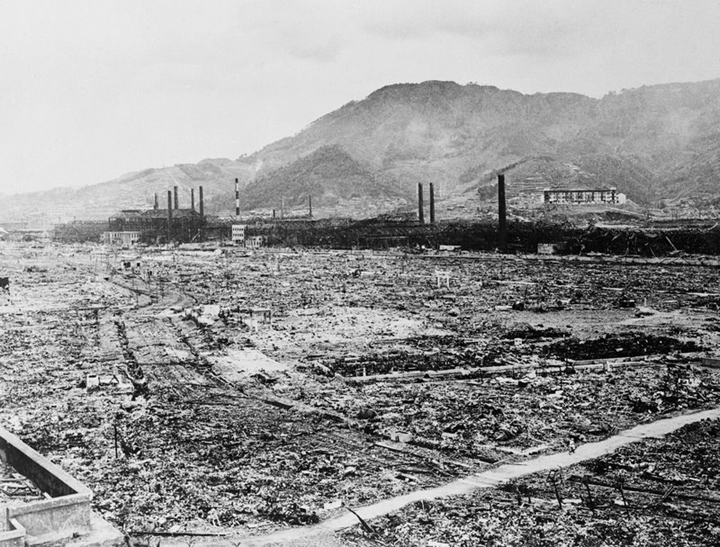
We knew her as Aunt Reggie, a nun with Montreal’s order of the Sacred Heart. She was teaching in Japan when war broke out. She was imprisoned in an internment camp outside Nagasaki.
Boasting some beautiful churches, Nagasaki was home to Japan’s biggest colony of Christians. Thus far, the city had been spared the U.S. Army Air Force campaign of annihilation. Under General Curtis LeMay, armadas of B-29s were systematically bombing Japan “back to the stone age.”………
……….Fat Man was released, flying like an angel of death toward an unsuspecting population. The bomb exploded at 500 metres at precisely 11:02 a.m.
“It seemed as though the sun had burst and I was lost in its midst. I threw myself at once into a clump of young bamboo trees. I was lying on a big bag of grass. My face only felt hot.”
She was spared the worst of the physical blast, shielded by the tall hills encircling Nagasaki. She ran back to the camp. All the windows had imploded. The shattering glass inflicted minor wounds. Downtown Nagasaki was another story.
The city burned for days. Almost all of the churches were destroyed. The survivors wrote of unspeakable suffering, 70,000 dead within 90 days, and everywhere a stench of death and corruption.
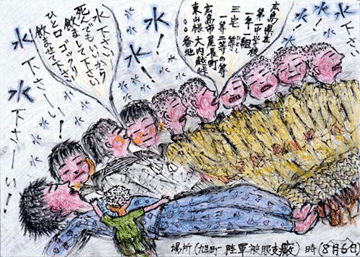 Sister McKenna wrote that the medical system is overwhelmed. “Two-thirds of the population of Nagasaki are dead. The city itself is a mass of ruins. They are still burning the dead. The hospitals having been destroyed, the wounded are not being cared for.”
In 1945, the medical world knew little of radiation poisoning, so her next line resonates. “Some patients apparently recover, then suddenly die from hemorrhages.”
All reporting from Nagasaki was censored.
A Japanese and American film crew rushed to the site. But their footage was suppressed for more than 50 years. When footage finally aired, the impact on public policy (“why two bombs?”) that the nuclear attack should have triggered was diminished by the passage of time.
For Sister McKenna, the imprint of that explosion was like a gigantic X-ray, searing her body and mind for a lifetime. Her fellow teaching sisters said “she was never quite right” after experiencing that cataclysm. And in the end she succumbed to a cancer brought on by radiation poisoning……http://www.theglobeandmail.com/life/facts-and-arguments/the-day-the-bomb-fell-on-nagasaki/article19959476/
Hiroshima Day – time to end the suicidal nuclear age
As the mayor of Hiroshima said last August on the anniversary of the bombings, “Nuclear energy and humankind cannot coexist.” the nuclear age is a suicidal age. We’ve had several near misses Fukushima highlighted the dangers of accidents, and nuclear waste can never be truly safely stored. This Aug. 6th, let us remember the victims of Hiroshima and Nagasaki, and let us finally get out from under the nuclear shadow.  On Hiroshima-Nagasaki anniversary, let’s end the nuclear age http://www.guelphmercury.com/opinion/columns/article/772925–on-hiroshima-nagasaki-anniversary-let-s-end-the-nuclear-age Darryl Lorenzo Wellington Aug 04 2012 On the 67th anniversary of the bombings of Hiroshima and Nagasaki, we need to call an end to the nuclear experiment. At 8:15 a.m. on Aug. 6, 1945, the United States dropped an atomic bomb on Hiroshima, killing around 140,000 people. The death toll included men, women and children who died instantaneously, and thousands who died within months from the lingering radiation sickness. The U.S. attack on Nagasaki three days later took the lives of 75,000 more. To these numbers should be added the plight of the Hibakusha: survivors of the nuclear bombings. The Hibakusha, who suffered lifelong diseases, including cancer, have been unwavering in their demand to ban nuclear weapons. Hiroshima-Nagasaki Memorial Day is an occasion to ponder the destructive capacity of nuclear weapons, as well as the wisdom of all uses of nuclear energy — particularly given the spectre cast by the meltdown of the reactors in Fukushima, Japan, last year. Continue reading
China’s underground nuclear reactors
 The Untold Story of China’s Forgotten Underground Nuclear Reactor, FP BY JEFFREY LEWIS JULY 8, 2014 How social media and a little sleuthing turned up a Mao-era nuclear program. “……despite official secrecy about China’s production of plutonium for nuclear weapons, my colleague Catherine Dill and I discovered an underground nuclear reactor that China attempted to construct near Yichang in Hubei province during the 1960s and 1970s……..
In the early 1960s, China had one plant to make highly enriched uranium near Lanzhou and was completing one nuclear reactor to produce plutonium at Jiuquan. In 1964, China began the “Third Line” effort — a massive construction effort to relocate all of China’s heavy industries, nuclear and otherwise, in the interior of the country. Often these factories, including things as mundane as steel mills, were placed underground to protect them from Soviet or American attack. As you might expect, the disruption of attempting to relocate the country’s heavy industries to underground caverns in the rural interior was a complete and total cluster… well, you know. Wikipedia calls the Third Line “an economic fiasco,” which seems to me to be an example of the wisdom of crowds.
As part of the Third Line effort, China’s nuclear engineers were supposed to build a copy of the first reactor — the one where Cui worked — in an underground cavern being dug near Fuling. But placing a nuclear reactor under a mountain is about as slow and arduous as you might expect. At some point in 1969, with relations between Moscow and Beijing collapsing, Beijing decided it could not wait for the engineers to finish Fuling. The first proposal suggested physically picking up and moving the reactor near Jiuquan somewhere else. Eventually the technical personnel convinced the Chinese leadership this was total madness. So, instead, China started building a temporary replacement above ground, near a place called Guangyuan in Sichuan.
I always wondered how, in the middle of the paranoia associated with the Cultural Revolution, Chinese leaders came to their senses and ditched the underground reactor at Fuling in favor of the above-ground copy at Guangyuan. It turns out they didn’t. Instead of replacing one crazy project with a more sensible one, the Chinese doubled-down on crazy — continuing the reactor project at Fuling, starting a new one at Guangyuan and, we now know, starting the underground reactor at Yichang. … As best we can tell, China never finished the heavy water at Yichang, just as it never finished Fuling or any other number of wildly implausible Third Line projects. Construction at Yichang lumbered on through the 1970s, before being shut down around 1980 or so. At this point, the Chinese government took a number of steps to transition its nuclear industry to civilian power generation, converting and eventually decommissioning the reactor near Jiuquan, as well as giving up on Fuling and Yichang. China would not build a heavy water reactor until it bought CANDU heavy water reactors from Canada, one in 2002 and another in 2003. (CANDU is a portmanteau of “Canada” and “deuterium oxide,” better known as heavy water.) Yichang is just a footnote. A crazy, implausible footnote…….
Of the two plutonium production reactors that China finished, Jiuquan closed in the late 1980s and Guangyuan closed sometime in the 1990s. China never finished the reactors at Fuling or Yichang. China’s surprisingly small stockpile of plutonium isn’t so surprising once we know this historical context. They tried to make more. They just couldn’t…..
There will be more disclosures. Like yet another unfinished secret underground nuclear reactor that I haven’t mentioned. That’s right, there is a third underground nuclear reactor project that we’ve found. …..http://www.foreignpolicy.com/articles/2014/07/08/the_untold_story_of_chinas_forgotten_underground_nuclear_reactor_yichang_827_plant
1 This Month
6 June – WEBINAR- Get Inspired by Protests Against Military Bases!


Cuba Is Not a Failed State – It Is a Besieged State
PETITION: “Global Appeal to Endorse Palestinian Right of Return of Refugees”


of the week– Nuclear Reactor Information Task Force
To see nuclear-related stories in greater depth and intensity – go to https://nuclearinformation.wordpress.com
-
Archives
- June 2026 (34)
- May 2026 (306)
- April 2026 (356)
- March 2026 (251)
- February 2026 (268)
- January 2026 (308)
- December 2025 (358)
- November 2025 (359)
- October 2025 (376)
- September 2025 (257)
- August 2025 (319)
- July 2025 (230)
-
Categories
- 1
- 1 NUCLEAR ISSUES
- business and costs
- climate change
- culture and arts
- ENERGY
- environment
- health
- history
- indigenous issues
- Legal
- marketing of nuclear
- media
- opposition to nuclear
- PERSONAL STORIES
- politics
- politics international
- Religion and ethics
- safety
- secrets,lies and civil liberties
- spinbuster
- technology
- Uranium
- wastes
- weapons and war
- Women
- 2 WORLD
- ACTION
- AFRICA
- Atrocities
- AUSTRALIA
- Christina's notes
- Christina's themes
- culture and arts
- Events
- Fuk 2022
- Fuk 2023
- Fukushima 2017
- Fukushima 2018
- fukushima 2019
- Fukushima 2020
- Fukushima 2021
- general
- global warming
- Humour (God we need it)
- Nuclear
- RARE EARTHS
- Reference
- resources – print
- Resources -audiovicual
- Weekly Newsletter
- World
- World Nuclear
- YouTube
-
RSS
Entries RSS
Comments RSS
 nuclear-news