Hanford Nuclear Reservation’s dangerous”atomic man” room entered after 38 years
Workers enter dangerous ‘Atomic Man’ room at Hanford Nuclear Reservation http://www.oregonlive.com/pacific-northwest-news/index.ssf/2014/09/workers_enter_dangerous_atomic.html?utm_source=feedburner&utm_medium=twitter&utm_campaign=Feed%3A+oregonlive%2FkRom+%28Oregon+Local+News%29&utm_content=IceRocket+Blog+SearchSPOKANE, Wash. — Workers have entered one of the most dangerous rooms at the Hanford Nuclear Reservation.
The so-called McCluskey Room in the Plutonium Finishing Plant is named after worker Harold McCluskey. He was covered with radioactive material in 1976 when a glove box exploded. McCluskey, who was 64 at the time, lived for 11 more years and died from causes not related to the accident. He became known as the Atomic Man.
Hanford, located near Richland, Washington, for decades made plutonium for nuclear weapons. The site is now engaged in cleaning up the resulting radioactive mess.
Cleaning up the McCluskey Room is expected to take a year. A crew with contractor CH2M HILL Plateau Remediation Co. donned specially designed radiation suits before entering the McCluskey Room earlier this week. One of their first tasks was improving ventilation to better protect workers from airborne contamination as they clean out its equipment.
“This was the first of multiple entries workers will make to clean out processing equipment and get the McCluskey Room ready for demolition along with the rest of the plant,” said Bryan Foley, project director for the Department of Energy. “It has taken a year to prepare for this first entry.”
The room was used to recover americium — a plutonium byproduct — during the Cold War.
McCluskey was working in the room when a chemical reaction caused a glass glove box to explode. He was exposed to the highest dose of radiation from americium ever recorded — 500 times the occupational standard.
Covered with blood, McCluskey was dragged from the room and put into an ambulance headed for the decontamination center. Because he was too hot to handle, he was removed by remote control and transported to a steel-and-concrete isolation tank.
During the next five months, doctors extracted tiny bits of glass and razor-sharp pieces of metal embedded in his skin.
Nurses scrubbed him down three times a day and shaved every inch of his body every day. The radioactive bathwater and thousands of towels became nuclear waste.
McCluskey also received about 600 shots of zinc DTPA, an experimental drug that helped him excrete the radioactive material.
He was placed in isolation in a decontamination facility for five months. Within a year, his body’s radiation count had fallen by about 80 percent and he was allowed to return home.
The nuclear bombing of Nagasaki
The day the bomb fell on Nagasaki BRIAN MCKENNA The Globe and Mail Aug. 07 2014, The atomic bomb destined for the ancient trading port of Nagasaki was called Fat Man. Sister Regina McKenna, my grandfather’s sister, was close enough to ground zero to feel the death wind on her face. She might have preferred another name: Terror. Or, as the Japanese call it: Slaughter.
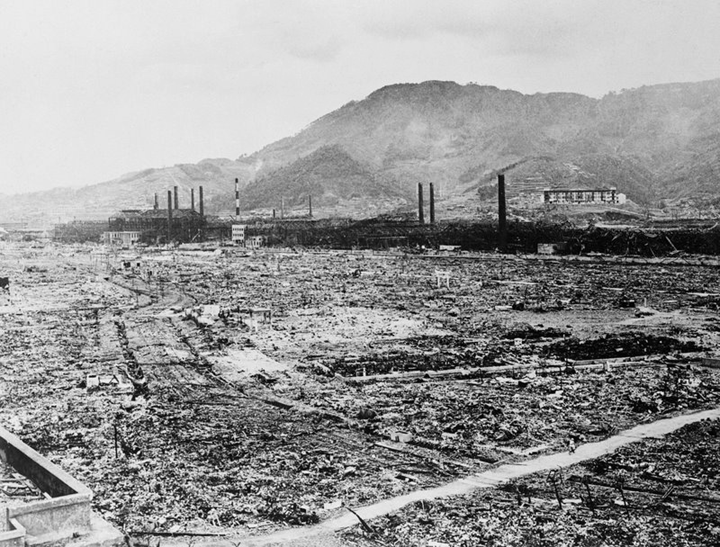
We knew her as Aunt Reggie, a nun with Montreal’s order of the Sacred Heart. She was teaching in Japan when war broke out. She was imprisoned in an internment camp outside Nagasaki.
Boasting some beautiful churches, Nagasaki was home to Japan’s biggest colony of Christians. Thus far, the city had been spared the U.S. Army Air Force campaign of annihilation. Under General Curtis LeMay, armadas of B-29s were systematically bombing Japan “back to the stone age.”………
……….Fat Man was released, flying like an angel of death toward an unsuspecting population. The bomb exploded at 500 metres at precisely 11:02 a.m.
“It seemed as though the sun had burst and I was lost in its midst. I threw myself at once into a clump of young bamboo trees. I was lying on a big bag of grass. My face only felt hot.”
She was spared the worst of the physical blast, shielded by the tall hills encircling Nagasaki. She ran back to the camp. All the windows had imploded. The shattering glass inflicted minor wounds. Downtown Nagasaki was another story.
The city burned for days. Almost all of the churches were destroyed. The survivors wrote of unspeakable suffering, 70,000 dead within 90 days, and everywhere a stench of death and corruption.
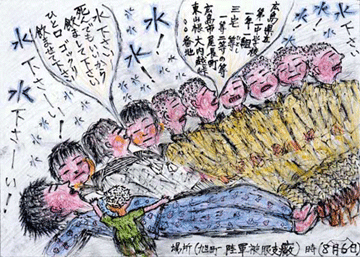 Sister McKenna wrote that the medical system is overwhelmed. “Two-thirds of the population of Nagasaki are dead. The city itself is a mass of ruins. They are still burning the dead. The hospitals having been destroyed, the wounded are not being cared for.”
In 1945, the medical world knew little of radiation poisoning, so her next line resonates. “Some patients apparently recover, then suddenly die from hemorrhages.”
All reporting from Nagasaki was censored.
A Japanese and American film crew rushed to the site. But their footage was suppressed for more than 50 years. When footage finally aired, the impact on public policy (“why two bombs?”) that the nuclear attack should have triggered was diminished by the passage of time.
For Sister McKenna, the imprint of that explosion was like a gigantic X-ray, searing her body and mind for a lifetime. Her fellow teaching sisters said “she was never quite right” after experiencing that cataclysm. And in the end she succumbed to a cancer brought on by radiation poisoning……http://www.theglobeandmail.com/life/facts-and-arguments/the-day-the-bomb-fell-on-nagasaki/article19959476/
Hiroshima Day – time to end the suicidal nuclear age
As the mayor of Hiroshima said last August on the anniversary of the bombings, “Nuclear energy and humankind cannot coexist.” the nuclear age is a suicidal age. We’ve had several near misses Fukushima highlighted the dangers of accidents, and nuclear waste can never be truly safely stored. This Aug. 6th, let us remember the victims of Hiroshima and Nagasaki, and let us finally get out from under the nuclear shadow.  On Hiroshima-Nagasaki anniversary, let’s end the nuclear age http://www.guelphmercury.com/opinion/columns/article/772925–on-hiroshima-nagasaki-anniversary-let-s-end-the-nuclear-age Darryl Lorenzo Wellington Aug 04 2012 On the 67th anniversary of the bombings of Hiroshima and Nagasaki, we need to call an end to the nuclear experiment. At 8:15 a.m. on Aug. 6, 1945, the United States dropped an atomic bomb on Hiroshima, killing around 140,000 people. The death toll included men, women and children who died instantaneously, and thousands who died within months from the lingering radiation sickness. The U.S. attack on Nagasaki three days later took the lives of 75,000 more. To these numbers should be added the plight of the Hibakusha: survivors of the nuclear bombings. The Hibakusha, who suffered lifelong diseases, including cancer, have been unwavering in their demand to ban nuclear weapons. Hiroshima-Nagasaki Memorial Day is an occasion to ponder the destructive capacity of nuclear weapons, as well as the wisdom of all uses of nuclear energy — particularly given the spectre cast by the meltdown of the reactors in Fukushima, Japan, last year. Continue reading
China’s underground nuclear reactors
 The Untold Story of China’s Forgotten Underground Nuclear Reactor, FP BY JEFFREY LEWIS JULY 8, 2014 How social media and a little sleuthing turned up a Mao-era nuclear program. “……despite official secrecy about China’s production of plutonium for nuclear weapons, my colleague Catherine Dill and I discovered an underground nuclear reactor that China attempted to construct near Yichang in Hubei province during the 1960s and 1970s……..
In the early 1960s, China had one plant to make highly enriched uranium near Lanzhou and was completing one nuclear reactor to produce plutonium at Jiuquan. In 1964, China began the “Third Line” effort — a massive construction effort to relocate all of China’s heavy industries, nuclear and otherwise, in the interior of the country. Often these factories, including things as mundane as steel mills, were placed underground to protect them from Soviet or American attack. As you might expect, the disruption of attempting to relocate the country’s heavy industries to underground caverns in the rural interior was a complete and total cluster… well, you know. Wikipedia calls the Third Line “an economic fiasco,” which seems to me to be an example of the wisdom of crowds.
As part of the Third Line effort, China’s nuclear engineers were supposed to build a copy of the first reactor — the one where Cui worked — in an underground cavern being dug near Fuling. But placing a nuclear reactor under a mountain is about as slow and arduous as you might expect. At some point in 1969, with relations between Moscow and Beijing collapsing, Beijing decided it could not wait for the engineers to finish Fuling. The first proposal suggested physically picking up and moving the reactor near Jiuquan somewhere else. Eventually the technical personnel convinced the Chinese leadership this was total madness. So, instead, China started building a temporary replacement above ground, near a place called Guangyuan in Sichuan.
I always wondered how, in the middle of the paranoia associated with the Cultural Revolution, Chinese leaders came to their senses and ditched the underground reactor at Fuling in favor of the above-ground copy at Guangyuan. It turns out they didn’t. Instead of replacing one crazy project with a more sensible one, the Chinese doubled-down on crazy — continuing the reactor project at Fuling, starting a new one at Guangyuan and, we now know, starting the underground reactor at Yichang. … As best we can tell, China never finished the heavy water at Yichang, just as it never finished Fuling or any other number of wildly implausible Third Line projects. Construction at Yichang lumbered on through the 1970s, before being shut down around 1980 or so. At this point, the Chinese government took a number of steps to transition its nuclear industry to civilian power generation, converting and eventually decommissioning the reactor near Jiuquan, as well as giving up on Fuling and Yichang. China would not build a heavy water reactor until it bought CANDU heavy water reactors from Canada, one in 2002 and another in 2003. (CANDU is a portmanteau of “Canada” and “deuterium oxide,” better known as heavy water.) Yichang is just a footnote. A crazy, implausible footnote…….
Of the two plutonium production reactors that China finished, Jiuquan closed in the late 1980s and Guangyuan closed sometime in the 1990s. China never finished the reactors at Fuling or Yichang. China’s surprisingly small stockpile of plutonium isn’t so surprising once we know this historical context. They tried to make more. They just couldn’t…..
There will be more disclosures. Like yet another unfinished secret underground nuclear reactor that I haven’t mentioned. That’s right, there is a third underground nuclear reactor project that we’ve found. …..http://www.foreignpolicy.com/articles/2014/07/08/the_untold_story_of_chinas_forgotten_underground_nuclear_reactor_yichang_827_plant
Historical background to USA-Russia nuclear stand-off
Indications that the U.S. Is Planning a Nuclear Attack Against RussiaBy Eric Zuesse (about the author) OpEdNews Op Eds 6/14/2014 “………Some historical background is necessary here, so that a reader can understand why this is happening — the switch to an objective of actually winning a nuclear war (as opposed to deterring one). One cannot understand what’s happening now in Ukraine without knowing this bigger picture.
(This account is written under the assumption that the reader already knows some of the allegations it contains, but not all of them, and that the reader will click on the link wherever a given allegation requires documentation and support.) I have previously reported about “How and Why the U.S. Has Re-Started the Cold War (The Backstory that Precipitated Ukraine’s Civil War),” and, “Do We Really Need to Re-Start the Cold War?” I pointed out there that we don’t really need to re-start the Cold War, at all, since communism (against which the Cold War was, at least allegedly, fought) clearly lost to capitalism (we actually won the Cold War, and peacefully) but that America’s aristocracy very much does need to re-start a war with Russia — and why it does. (It has to do withmaintaining the dollar as the world’s reserve currency, something that benefits America’s aristocrats enormously.)
Consequently, for example, a recent CNN Poll has found that Americans’ fear of Russia has soared within just the past two years. Our news media present a type of news “reporting” that places Russia’s leader, Vladimir Putin, into a very bad light, even when it’s unjustified by the facts.
The situation now is thus rather similar to that right before World War I, when the aristocracy in America decided that a pretext had to be created for our going to war against Germany. That War had already started in Europe on 28 July 1914, and President Wilson wanted to keep the U.S. out of it, but we ultimately joined it on the side of J.P. Morgan and Company. This was documented in detail in an important 1985 book,Britain, America and the Sinews of War, 1914-1918, which was well summarized in Business History Review, by noting that: “J.P. Morgan & Co. served as Britain’s financial and purchasing agent, and the author makes especially good use of the Morgan Grenfell & Co. papers in London to probe that relationship. Expanding British demand for U.S. dollars to pay for North American imports made the politics of foreign exchange absolutely central to Anglo-American relations. How to manage those politics became the chief preoccupation of Her Majesty’s representatives in the United States,” and most especially of Britain’s financial and purchasing agent in the U.S…………http://www.opednews.com/articles/Indications-that-the-U-S–by-Eric-Zuesse-Nuclear-Weapons_Obama-Administration_PNAC-Neocon-Project-For-A-New-American-C_President-Barack-Obama-POTUS-140614-352.html?show=votes
2005 Nuclear Lobby cons UK government. Nothing has changed

 The nuclear charm offensive New Statesman, by Jonathan Leake 23 May, 2005 We are all being taken in by a carefully planned public relations strategy. Its mission: to push nuclear power
In the plush surroundings of the Army & Navy Club on London’s Pall Mall, Mike Alexander, chief executive of British Energy, was holding court. Assembled before him were more than a hundred leading figures from the UK’s energy industry – all there at the behest of the Energy Industries Club, an industry body that keeps its membership secret.
The point of the event, held just a few weeks ago on 15 March, was to hear a keynote speech, to be delivered by Alexander, with the title “UK Nuclear Energy: fuel of the future?” It was not, however, a purely private affair. Around the room were a selection of top opinion formers: analysts, corporate traders and members of the media. The journalists could not report the event directly – the invitations were based on so-called Chatham House rules, meaning it was for “background use only”. What they were meant to take home was a message: nuclear power is coming back. Alexander’s speech itself was simple. Within the next 20 years, he said, Britain’s nuclear power stations will come to the end of their operating lives. To meet the country’s climate-change targets, they must be replaced with some form of power generation that does not produce the greenhouse gas carbon dioxide. Anywhere else, that line might have prompted some sharp questions. But for Alexander, whose company owns two-thirds of Britain’s nuclear power stations, the audience was an unusually receptive one – and not just because of the fine wines. Continue reading
History of Peace Ships on the oceans
 A Peace Ship’s Challenge to Nukes, Consortium News.com April 10, 2014In the 1950s, as the United States obliterated Pacific islands to test hydrogen bombs, anti-nuclear activists challenged this devastation by trying to sail a ship, The Golden Rule, into the test zone, a protest that helped create political pressure for a nuclear test ban, as Lawrence S. Wittner recalls. By Lawrence S. Wittner
Is there an emotional connection between the oceans and the pursuit of peace? For whatever reason, peace ships have been increasing in number over the past century. Probably the first of these maritime vessels was the notorious Ford Peace Ship of 1915, which stirred up more ridicule than peace during World War I.
Almost 40 years later, another peace ship appeared ― the Lucky Dragon, a Japanese fishing boat showered with radioactive fallout from an enormous U.S. H-bomb explosion on March 1, 1954, in the Marshall Islands. By the time the stricken vessel reached its home port in Japan, the 23 crew members were in advanced stages of radiation poisoning. One of them died.
This “Lucky Dragon incident” set off a vast wave of popular revulsion at nuclear weapons testing, and mass nuclear disarmament organizations were established in Japan and, later, around the world. Thus, the Lucky Dragon became a peace ship, and today is exhibited as such in Tokyo in a Lucky Dragon Museum, built and maintained by Japanese peace activists.
Later voyages forged an even closer link between ocean-going vessels and peace. In 1971, Canadian activists, departing from Vancouver, sailed a rusting fishing trawler, the Phyllis Cormack, toward the Aleutians in an effort to disrupt plans for a U.S. nuclear weapons explosion on Amchitka Island. Although arrested by the U.S. Coast Guard before they could reach the test site, the crew members not only mobilized thousands of supporters, but laid the basis for a new organization, Greenpeace.
Authorized by Greenpeace, another Canadian, David McTaggart, sailed his yacht, the Vega, into the French nuclear testing zone in the Pacific, where the French navy deliberately rammed and crippled this peace ship. In 1973, when McTaggart and the Vega returned with a new crew, French sailors, dispatched by their government, stormed aboard and beat them savagely with truncheons.
During the late 1970s and early 1980s, peace ships multiplied. At major ports in New Zealand and Australia, peace squadrons of sailboats and other small craft blocked the entry of U.S. nuclear warships into the harbors. Also, Greenpeace used the Rainbow Warrior to spark resistance to nuclear testing throughout the Pacific.
Even after 1985, when French secret service agents attached underwater mines to this Greenpeace flagship as it lay in the harbor of Auckland, New Zealand, blowing it up and murdering a Greenpeace photographer in the process, the peace ships kept coming.
Much of this maritime assault upon nuclear testing and nuclear war was inspired by an American peace ship, the Golden Rule. The remarkable story of the Golden Rule began with Albert Bigelow, a retired World War II U.S. naval commander. Appalled by the atomic bombing of Hiroshima, he became a Quaker and, in 1955, working with the American Friends Service Committee, sought to deliver a petition against nuclear testing to the White House……..
Even as test ban negotiations proceeded fitfully, leading to the Partial Test Ban Treaty of 1963 and, ultimately, to the Comprehensive Test Ban Treaty of 1996, the Golden Rule dropped out of sight. Then, in early 2010, the vessel was discovered, wrecked and sunk in northern California’s Humboldt Bay.
Contacted by historians about preserving the Golden Rule for posterity, officials at the Smithsonian Museum proved uninterested. But peace activists recognized the vessel’s significance. Within a short time, local chapters of Veterans for Peace established the Golden Rule Project to restore the battered ketch.
Thanks to volunteer labor and financial contributions from these U.S. veterans and other supporters, the ship has been largely rebuilt, and funds are currently being raised for the final stage of the project. Veterans for Peace hope to take the ship back to sea in 2014 on its new mission: “educating future generations on the importance of the ocean environment, the risks of nuclear technology, and the need for world peace.”
As a result, the Golden Rule will sail again, restored to its role as America’s most important peace ship.
Lawrence Wittner (http://lawrenceswittner.com), syndicated by PeaceVoice, is Professor of History emeritus at SUNY/Albany. His latest book is What’s Going On at UAardvark? (Solidarity Press), a satirical novel about campus life. http://consortiumnews.com/2014/04/10/a-peace-ships-challenge-to-nukes/
The historic peace ship, the Golden Rule, will sail again
 World War II U.S. naval commander. Appalled by the atomic bombing of Hiroshima, he became a Quaker and, in 1955, working with the American Friends Service Committee, sought to deliver a petition against nuclear testing to the White House. Rebuffed by government officials, Bigelow and other pacifists organized a small group, Non-Violent Action Against Nuclear Weapons, to employ nonviolent resistance in the struggle against the Bomb. After the U.S. government announced plans to set off nuclear bomb blasts near Eniwetok in the Marshall Islands―an island chain governed by the United States as a “trust territory” for the native people―Bigelow and other pacifists decided to sail a 30-foot protest vessel, the Golden Rule, into the nuclear testing zone. Explaining their decision, Bigelow declared: “All nuclear explosions are monstrous, evil, unworthy of human beings.”
Uranium the real issue behind the Lockerbie bombing in 1988?
Bernt Carlsson lays down the lawThe man responsible for Namibia under international law, Assistant Secretary-General of the United Nations and UN Commissioner for Namibia, Bernt Carlsson, spoke about these prosecutions.
It was on his way to the signing of the agreement at UN headquarters in New York, that UN Commissioner for Namibia Bernt Carlsson became the highest profile victim of the Pan Am Flight 103 crash at Lockerbie on 21st December 1988.
Following Bernt Carlsson’s untimely death in the Lockerbie bombing, the case against URENCO was inexplicably dropped and no further prosecutions took place of the companies and countries that were in breach of the United Nations Council for Namibia Decree No. 1.
 The Downing of Flight 103 over Lockerbie: It was the Uranium, The Ecologist, Mystery continues to surround the 1988 downing of Panam Flight 103 at Lockerbie. Who did it, how, and why? UN Assistant Secretary-General and Commissioner for Namibia, Bernt Carlsson Died in the Crash By Patrick Haseldine, 7 Jan 14 Patrick Haseldine is a former British diplomat who was dismissed by the then foreign secretary, John Major, in August 1989. He is often referred to as the “Emeritus Professor of Lockerbie Studies”.
After 25 years study of the topic Patrick Haseldine reveals the shocking truth…….
United Nations Assistant Secretary-General and Commissioner for Namibia, Bernt Carlsson, was Lockerbie’s highest profile victim, yet the authorities and the media never mention him. Why?
As comedian Kenneth Williams used to say: “I think the answer lies in the soil.”
More specifically, I believe the answer lies in the processed uranium ore (Yellowcake) that was illegally extracted from Namibia in the period 1976 to 1989. A TV documentary film in March 1980 described succinctly what was going on: Continue reading
Comparing Fukushima nuclear meltdown to the Chernobyl one
Fukushima Meltdowns: A Global Conspiracy of Denial By William Boardman Global Research, Reader Supported News January 05, 2014 “…….Chernobyl 1986 and Fukushima 2011 are not really comparable Chernobyl is the closest precedent to Fukushima, and it’s not very close. Chernobyl at the time of the 1986 electric failure and explosion had four operating reactors and two more under construction. The Chernobyl accident involved one reactor meltdown. Other reactors kept operating for some time after the accident. The rector meltdown was eventually entombed, containing the meltdown and reducing the risk. Until Fukushima, Chernobyl was considered the worst nuclear power accident in history, and it is still far from over (albeit largely contained for the time being). The Chernobyl Exclusion Zone of roughly 1,000 square miles remains one of the most radioactive areas in the world and the clean-up is not even expected to be complete before 2065.
At the time of the March 11, 2011, earthquake and tsunami, the Fukushima plant had six operating reactors. Three of them went into meltdown and a fourth was left with a heavily laden fuel pool teetering a hundred feet above the ground. Two other reactors were undamaged and have been shut down. Radiation levels remain lethal in each of the melted-down reactors, where the meltdowns appear to be held in check by water that is pumped into the reactors to keep them cool. In the process, the water gets irradiated and that which is not collected on site in leaking tanks flows steadily into the Pacific Ocean. Within the first two weeks, Fukushima radiation was comparable to Chernobyl’s and while the levels have gone down, they remain elevated.
The plant’s corporate owner, Tokyo Electric Power Company (TEPCO), in turn effectively owned by the Japanese government after a2012 nationalization, began removing more than 1,500 fuel rod assemblies from the teetering fuel pool in November, a delicate process expected to take a year or more. There are additional fuel pools attached to each of the melted down reactors and a much larger general fuel pool, all of which contain nuclear fuel rod assemblies that are secure only as long as TEPCO continues to cool them. The Fukushima Exclusion Zone, a 12-mile radius around the nuclear plant, is about 500 square miles (much of it ocean); little specific information about the exclusion zone is easily available, but media coverage in the form of disaster tourism is plentiful, including a Google Street View interactive display.
Despite their significant differences as disasters, Chernobyl and Fukushima are both rated at 7 – a “major accident” on the International Nuclear Event Scale designed in 1990 by the International Atomic Energy Agency (IAEA). That is the highest rating on the scale, a reflection of the inherent denial that colors most official nuclear thinking. Designed by nuclear “experts” after Chernobyl, the scale can’t imagine a worse accident than Chernobyl which, for all its intensity, was effectively over as an accident in a relatively short period of time. At Fukushima, by contrast, the initial set of events was less acute than Chernobyl, but almost three years later they continue without any resolution likely soon. Additionally Fukushima has three reactor meltdowns and thousands of precarious fuel rod assemblies in uncertain pools, any of which could produce a new crisis that would put Fukushima clearly off the scale.
And then there’s groundwater. Groundwater was not a problem at Chernobyl. Groundwater is a huge problem at the Fukushima plant that was built at the seashore, on a former riverbed, over an active aquifer. In a short video, nuclear engineer Arnie Gunderson makes clear why groundwater makes Fukushima so hard to clean up, and why radiation levels there will likely remain dangerous for another hundred years……..http://www.globalresearch.ca/fukushima-meltdowns-a-global-conspiracy-of-denial/5363827
Years of secret dumping radioactive trash into the sea,by US navy
Sailors on old warship dumped thousands of tons of radioactive waste for years Tampa Bay Times, William R. Levesque, Times Staff Writer 22 Dec 13 They asked the dying Pasco County man about his Navy service a half-century before. He kept talking about the steel barrels. They haunted him, sea monsters plaguing an old sailor.
“We turned off all the lights,” George Albernaz testified at a 2005 Department of Veterans Affairs hearing, “and … pretend that we were broken down and … we would take these barrels and having only steel-toed shoes … no protection gear, and proceed to roll these barrels into the ocean, 300 barrels at a trip.”
The Atomic Sailors Talk of Dumping Radioactive Waste at Sea
Not all of them sank. A few pushed back against the frothing ocean, bobbing in the waves like a drowning man. Then shots would ring out from a sailor with a rifle at the fantail. And the sea would claim the bullet-riddled drum. Continue reading
Remembering UK’s Windscale Nuclear Disaster
The Windscale Nuclear Disaster, Today I Found Out, MELISSA DECEMBER 18, 2013 On the morning of Friday, October 11, 1957, workers at the nuclear reactor Windscale Pile 1 near Seascale, Cumberland, England, faced a terrible choice: allow a raging fire to burn itself out while it released dangerously high levels of ionizing radiation into the surrounding countryside; or, attempt to extinguish the conflagration with water, an option that could cause a hydrogen explosion (again, releasing dangerous levels of radiation, as well as blowing the workers to bits). Here’s the story of what they did:………
Aftermath
Still keen on getting their hands on the nuclear weapons designs, British leaders covered up the real cause of the accident and blamed it on Windscale’s heroic workers. The deceit was successful, and the U.S. shared its nuclear secrets with the British. Subsequent inquiries, by the BBC and others, have revealed that it was the government’s relaxed safety policies that were ultimately to blame.
Health wise, it was also a disaster. Although not on the scale with Chernobyl, the Windscale release of iodine-131, caesium-137 and xenon-133 are thought to have caused at least 200 cancer cases; it is believed that the numbers would be far higher were it not for the last-minute addition of the filters…….http://www.todayifoundout.com/index.php/2013/12/windscale-nuclear-disaster/
USA’s nuclear missile launch code was unsafe for 20 years!
 Starting World War III with just one finger: The secret U.S. nuclear missile launch code was kept terrifyingly simple for nearly 20 years – and even printed on a checklist – (GOOD PHOTOS) http://www.dailymail.co.uk/news/article-2515598/Launch-code-US-nuclear-weapons-easy-00000000.html By DAILY MAIL REPORTER 29 November 2013 For nearly 20 years, the secret code to authorize launching U.S. nuclear missiles, and starting World War III, was terrifyingly simple and even noted down on a checklist.
From 1962, when John F Kennedy instituted PAL encoding on nuclear weapons, until 1977, the combination to fire the devastating missiles at the height of the Cold War was just 00000000. Continue reading
President John F Kennedy speech on peace June 10 1963
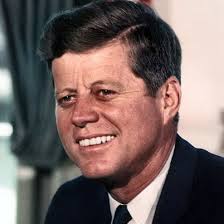 Commencement Address at American University, June 10, 1963 http://www.jfklibrary.org/Asset-Viewer/BWC7I4C9QUmLG9J6I8oy8w.aspx
The Cold War very nearly brought global nuclear catastrophe
“Even though the cold war ended more than 20 years ago, thousands of warheads are still actively deployed by the nuclear-armed states,” “We continue to face unacceptably high risks and will continue to do so until we have taken steps to abolish these exceptionally dangerous weapons.”.
How a war game brought the world to the brink of nuclear disaster Former classified documents show how close the Soviet Union came to launching an attack in 1983 The Guardian, Jamie Doward The Observer, Sunday 3 November 2013 Chilling new evidence that Britain and America came close to provoking the Soviet Union into launching a nuclear attack has emerged in former classified documents written at the height of the cold war.
Cabinet memos and briefing papers released under the Freedom of Information Act reveal that a major war games exercise, Operation Able Art, conducted in November 1983 by the US and its Nato allies was so realistic it made the Russians believe that a nuclear strike on its territory was a real possibility. Continue reading
1 This Month
29 Jan. Thursday 7-8 p.m. Webinar – World’s Largest Nuclear Station in Port Hope, ON?

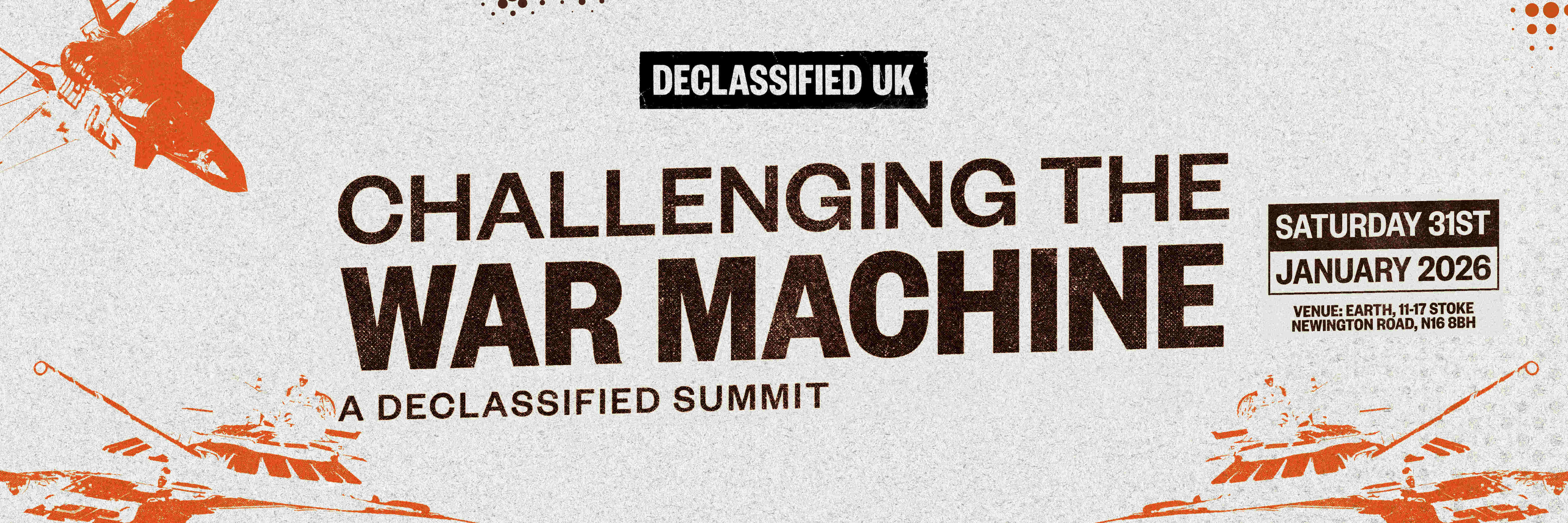
31st January – Challenging the War Machine – a DECLASSIFIED UK SUMMIT



Website of the Week
Now until to February 10, 2026 Radioactive waste storage in France: the debate is finally open! How to participate?
-
Archives
- January 2026 (246)
- December 2025 (358)
- November 2025 (359)
- October 2025 (376)
- September 2025 (258)
- August 2025 (319)
- July 2025 (230)
- June 2025 (348)
- May 2025 (261)
- April 2025 (305)
- March 2025 (319)
- February 2025 (234)
-
Categories
- 1
- 1 NUCLEAR ISSUES
- business and costs
- climate change
- culture and arts
- ENERGY
- environment
- health
- history
- indigenous issues
- Legal
- marketing of nuclear
- media
- opposition to nuclear
- PERSONAL STORIES
- politics
- politics international
- Religion and ethics
- safety
- secrets,lies and civil liberties
- spinbuster
- technology
- Uranium
- wastes
- weapons and war
- Women
- 2 WORLD
- ACTION
- AFRICA
- Atrocities
- AUSTRALIA
- Christina's notes
- Christina's themes
- culture and arts
- Events
- Fuk 2022
- Fuk 2023
- Fukushima 2017
- Fukushima 2018
- fukushima 2019
- Fukushima 2020
- Fukushima 2021
- general
- global warming
- Humour (God we need it)
- Nuclear
- RARE EARTHS
- Reference
- resources – print
- Resources -audiovicual
- Weekly Newsletter
- World
- World Nuclear
- YouTube
-
RSS
Entries RSS
Comments RSS
 nuclear-news