80 years demonizing Russia long enough…time for détente.

In 2019 and 2020 the US withdrew from two critical nuclear treaties with Russia: INF (Intermediate-Range Nuclear Forces) and Open Skies. The third and last, New Start, expires in 4 months with no substantive ongoing negotiations. Why? Because America has abandoned negotiations extending New Start and reinstituting the others during its senseless, failed proxy war to weaken, isolate Russia from the European political economy.
Walt Zlotow, West Suburban Peace Coalition, Glen Ellyn IL , 3 Oct 25,
Last time US and Russia were buddies was 80 years ago at the end of WWII. Russia coughed up over 25 million dead in defeating Nazism in the East. In return for shedding that blood, the US coughed up several billion in military aid that kept the Russian war machine functioning in a Russian economy largely destroyed by Germany.
That friendship was blown up, literally, on August 6, 1945, when the US dropped the first of 2 atomic bombs on Japan. One of several reasons was to inform Russia (than USSR) that as new boss of the world America would brook no interference from a Russia we falsely assumed was bent on expanding communism everywhere on earth.
Had FDR lived there may not have been a Cold War. FDR recognized a prostrate Russia needed a buffer from a third German invasion from the west in the 20th century. He wisely surmised Stalin had no agenda whatsoever to conquer the world. So, he acquiesced in Stalin’s authoritarian control of his neighbors.
Alas, FDR’s death ushered in profoundly inexperienced Harry Truman. Woefully uninformed on foreign affairs, Truman was easy pickings for Russophobes Jimmy Burns, James Forestall, Dean Atchison and others who not only wanted to vanquish communist Russia, but desired a permanent war economy to prevent another Great Depression.
That wasn’t needed as pent-up domestic demand began the fabulous growth of the post WWII middle class. But Truman’s foreign policy handlers convinced him to promulgate the Truman Doctrine in February 1947, opposing communist expansion everywhere on earth even if meant demonizing as ‘communist’ any progressive movement that might make life better for downtrodden peoples.
But Russia never, for a single day between 1945 and the USSR’s implosion 46 years later, represented a serious existential threat to America. That’s because Russia had neither the desire nor the capability to attack America without suffering its utter destruction from an overwhelming American nuclear capability.
Instead, imaginary US obsession with Russia promoting communism in every corner of the earth including America, led to millions of deaths from hot wars such as Korea and Vietnam, and from US support for dictators killing dissidents threatening their regimes in over 20 countries. The million leftists Indonesia’s General Suharto killed with America’s help gave the grisly name to this murderous foreign policy…The Jakarta Method.
So, the Cold War was on till l1991 when the USSR went poof. Time to disband a now obsolete NATO? ‘Ha ha’, said the US national security state. ’We’re just getting started.’ Between 1999 and 2020 NATO expanded from 16 to 30 members, including 2 on Russia’s borders.
Beginning in 2007 Russia, requested, pleaded, begged the US and NATO to cease expansion. A year later the US response was to pledge NATO membership to the one country Russia would never allow in…neighboring and partially Russian cultured Ukraine. It took 14 years for an astonishingly patient Russia to say ‘enough’ and launch its ‘special military operation.’ That will not only prevent Ukraine NATO membership, it will effectively destroy Ukraine as a functioning state. All thanks to deranged anti-Russian US policy.
But America’s clearly lost proxy war against Russia sacrificing Ukraine is not the worst of what should be termed Cold War II. In 2019 and 2020 the US withdrew from two critical nuclear treaties with Russia: INF (Intermediate-Range Nuclear Forces) and Open Skies. The third and last, New Start, expires in 4 months with no substantive ongoing negotiations. Why? Because America has abandoned negotiations extending New Start and reinstituting the others during its senseless, failed proxy war to weaken, isolate Russia from the European political economy. The US has put peoplekind at increased risk of nuclear confrontation due to refusal to negotiate nuclear disarmament.
Eighty years of America’s Russian Derangement Syndrome is 80 years too long. Time to shut down the lost proxy war against Russia by ceasing all aid to Ukraine till they negotiate the war’s end. Time to begin disengagement from European security including NATO. Time to embrace diplomatic relations with Russia to end all sanctions, explore mutually beneficial trade relations, and most importantly, reinstitute and renew nuclear agreements to prevent our collective annihilation rom nuclear war. We can’t wait another 80 years, 80 months, 80 weeks…even another 80 days.
Chris Hedges: Israel’s Assassination of Memory
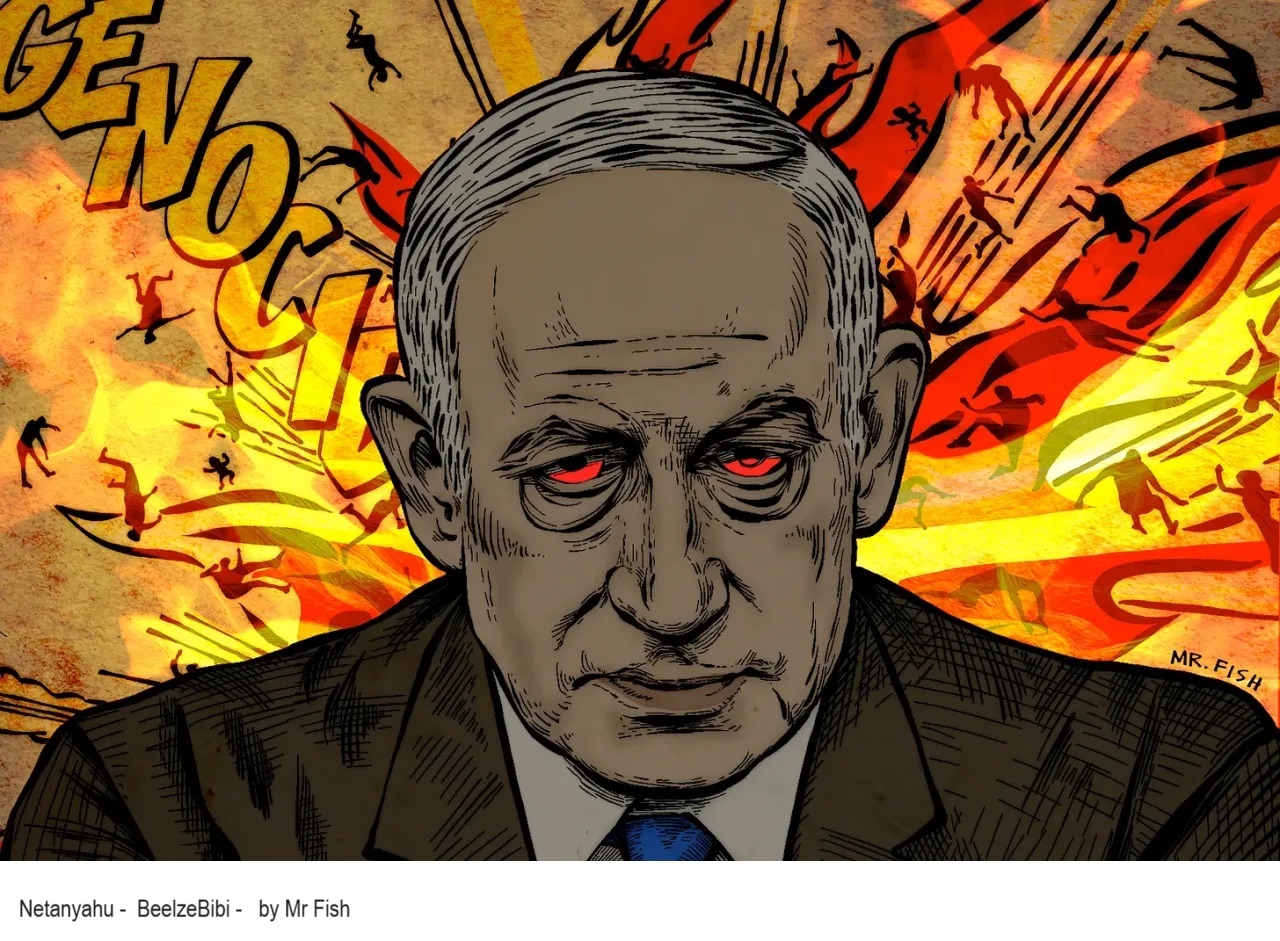
This is Kabuki theater — a way, when the genocide is over, for these Western leaders to insist they stood on the right side of history, even as they armed and funded the genocidal killers, while harassing, silencing or criminalizing those who decried the slaughter.
August 23, 2025, By Chris Hedges ScheerPost, https://scheerpost.com/2025/08/23/chris-hedges-israels-assassination-of-memory/
As Israel ticks off its list of Nazi-like atrocities against the Palestinians, including mass starvation, it prepares for yet another – the demolition of Gaza City, one of the oldest cities on Earth. Heavy engineering equipment and gigantic armored bulldozers are tearing down hundreds of heavily damaged buildings. Cement trucks are churning out concrete to fill tunnels. Israeli tanks and fighter jets pummel neighborhoods to drive Palestinians who remain in the ruins of the city to the south.
It will take months to turn Gaza City into a parking lot. I have no doubt Israel will replicate the efficiency of the Nazi SS Gen. Erich von dem Bach-Zelewski, who oversaw the obliteration of Warsaw. He spent his final years in a prison cell. May history, at least in terms of this footnote, repeat itself.
As Israeli tanks advance, Palestinians are fleeing, with neighborhoods such as Sabra and Tuffah, cleansed of its inhabitants. There is little clean water and Israel plans to cut it off in northern Gaza. Food supplies are scarce or wildly overpriced. A bag of flour costs $22.00 a kilo, or your life. A report published Friday by the Integrated Food Security Phase Classifications (IPC) , the world’s leading authority on food insecurity, for the first time has confirmed a famine in Gaza City. It says more than 500,000 people in Gaza are facing “starvation, destitution and death”, with “catastrophic conditions” projected to expand to Deir al-Balah and Khan Younis next month. Nearly 300 people, including 112 children, have died from starvation.
European leaders, along with Joe Biden and Donald Trump, remind us of the real lesson of the Holocaust. It is not Never Again, but, We Do not Care. They are full partners in the genocide. Some wring their hands and say they are “appalled” or “saddened.” Some decry Israel’s orchestrated starvation. A few say they will declare a Palestinian state.
This is Kabuki theater — a way, when the genocide is over, for these Western leaders to insist they stood on the right side of history, even as they armed and funded the genocidal killers, while harassing, silencing or criminalizing those who decried the slaughter.
Israel speaks of occupying Gaza City. But this is a subterfuge. Gaza is not to be occupied. It is to be destroyed. Erased. Wiped off the face of the earth. There is to be nothing left but tons of debris that will be laboriously carted away. The moonscape, devoid of Palestinians of course, will provide the foundation for new Jewish colonies.
“Gaza will be entirely destroyed, civilians will be sent to…the south to a humanitarian zone without Hamas or terrorism, and from there they will start to leave in great numbers to third countries,” Israel’s Minister of Finance Bezalel Smotrich announced at a conference on increased Jewish settlement in the Israeli-occupied West Bank.
All that was familiar to me when I lived in Gaza no longer exists. My office in the center of Gaza City. The Marna boarding house on Ahmed Abd el Aziz Street, where after a day’s work I would drink tea with the elderly woman who owned it, a refugee from Safad in northern Galilee. The coffee shops I frequented. The small cafes on the beach. Friends and colleagues, with few exceptions, are in exile, dead or, in most cases, have vanished, no doubt buried under mountains of debris. On my last visit to Marna House, I forgot to return the room key. Number 12. It was attached to a large plastic oval with the words “Marna House Gaza” on it. The key sits on my desk.
The imposing Qasr al-Basha fortress in Gaza’s Old City — built by Mamluk Sultan Baibars in the 13th century and known for its relief sculpture of two lions facing each other — is gone. So too is the Barquq Castle, or Qalʿat Barqūqa, a Mamluk-era fortified mosque constructed in 1387-1388, according to an inscription above the entrance gateway. Its ornate Arabic calligraphy by the main gate once read:
“In the name of Allah, the Most Gracious, Most Merciful. The mosques of God shall establish regular prayers, and practice regular charity, and fear none except God.”
The Great Omari Mosque in Gaza City, the ancient Roman cemetery and the Commonwealth War Cemetery — where more than 3,000 British and commonwealth soldiers from World War I and World War II are buried — have been bombed, and destroyed, along with universities, archives, hospitals, mosques, churches, homes and apartment blocks. Anthedon Harbor, which dates to 1100 B.C. and once provided anchorage for Babylonian, Persian, Greek, Roman, Byzantine and Ottoman ships, lies in ruins.
I used to leave my shoes on a rack by the front door of the Great Omari Mosque, the largest and oldest mosque in Gaza, in the Daraj Quarter of the Old City. I washed my hands, face and feet at the common water taps, carrying out the ritual purification before prayer, known as wudhu. Inside the hushed interior with its blue-carpeted floor, the cacophony, noise, dust, fumes and frenetic pace of Gaza melted away.
The razing of Gaza is not only a crime against the Palestinian people. It is a crime against our cultural and historical heritage — an assault on memory. We cannot understand the present, especially when reporting on Palestinians and Israelis, if we do not understand the past.
History is a mortal threat to Israel. It exposes the violent imposition of a European colony in the Arab world. It reveals the ruthless campaign to de-Arabize an Arab country. It underscores the inherent racism towards Arabs, their culture and their traditions. It challenges the myth that, as former Israeli prime minister Ehud Barak said, Zionists created, “a villa in the middle of a jungle.” It mocks the lie that Palestine is exclusively a Jewish homeland. It recalls centuries of Palestinian presence. And it highlights the alien culture of Zionism, implanted on stolen land.
When I covered the genocide in Bosnia, the Serbs blew up mosques, carted away the remains and forbade anyone to speak of the structures they had razed. The goal in Gaza is the same, to wipe out the past and replace it with myth, to mask Israeli crimes, including genocide.
The campaign of erasure banishes intellectual inquiry and stymies the dispassionate examination of history. It celebrates magical thinking. It allows Israelis to pretend the inherent violence that lies at the heart of the Zionist project, going back to the dispossession of Palestinian land in the 1920s and the larger campaigns of ethnic cleansing of Palestinians in 1948 and 1967, does not exist.
The Israeli government bans public commemorations of the Nakba, or catastrophe, a day of mourning for Palestinians who seek to remember the massacres and expulsion of 750,000 Palestinians carried out by Jewish terrorist militias in 1948 for this reason. Palestinians are even prevented from carrying their flag.
This denial of historical truth and historical identity permits Israelis to wallow in eternal victimhood. It sustains a morally blind nostalgia for an invented past. If Israelis confront these lies it threatens an existential crisis. It forces them to rethink who they are. Most prefer the comfort of illusion. The desire to believe is more powerful than the desire to see.
Erasure calcifies a society. It shuts down investigations by academics, journalists, historians, artists and intellectuals who seek to explore and examine the past and the present. Calcified societies wage a constant war against truth. Lies and dissimulation must be constantly renewed. Truth is dangerous. Once it is established it is indestructible.
As long as truth is hidden, as long as those who seek truth are silenced, it is impossible for a society to regenerate and reform itself. The Trump administration is in lock step with Israel. It too seeks to prioritize myth over reality. It too silences those who challenge the lies of the past and the lies of the present.
Calcified societies cannot communicate with anyone outside their incestious circles. They deny verifiable fact, the foundation on which rational dialogue takes place. This understanding lay at the heart of South Africa’s Truth and Reconciliation Commission. Those who carried out the atrocities of the apartheid regime confessed their crimes in exchange for immunity. By doing so they gave the victims and the victimizers a common language, one rooted in historical truth. Only then was healing possible.
Israel is not only destroying Gaza. It is destroying itself.
Setting the record straight on the background to events in Ukraine.


First, both the provinces of Donetsk and Lugansk in the Donbass region voted for independence from Ukraine in 2014 in resistance to a U.S.-backed coup that overthrew the elected president Viktor Yanukovych in February of that year. The independence vote came just eight days after neo-Nazis burned dozens of ethnic Russians alive in Odessa. To crush their bid for independence, the new U.S.-installed Ukrainian government then launched an “anti-terrorist” war against the provinces, with the assistance of the neo-Nazi Azov Battalion, which had taken part in the coup. It is a war that is still going on eight years later, a war that Russia has just entered.
During these eight years, the Ukrainian Armed Forces and Azov have used artillery, snipers and assassination teams to systematically butcher more than 5,000 people (another 8,000 were wounded) — mostly civilians — in the Donetsk Peoples Republic, according to the leader of the DPR, who provided these figures in a press conference recently. In the Luhansk People’s Republic, an additional 2,000 civilians were killed and 3,365 injured. The total number of people killed and wounded in Donbass since 2014 is more than 18,000.
This has received at most superficial coverage by The New York Times; it has not been covered by Western corporate media because it does not fit the official Washington narrative
Ukraine & Nukes After a New York Times reporter grossly distorted what Putin and Zelensky have said and done about nuclear weapons, Steven Starr corrects the record and deplores Western media, in general, for misinforming and leading the entire world in a dangerous direction. https://consortiumnews.com/2022/03/03/ukraine-nukes/ By Steven Starr,
The New York Times recently published an article by David Sanger entitled “Putin spins a conspiracy theory that Ukraine is on a path to produce nuclear weapons.” Unfortunately, it is Sanger who puts so much spin in his reporting that he leaves his readers with a grossly distorted version of the what the presidents of Russia and Ukraine have said and done.
Ukrainian Volodymyr Zelensky’s recent statements at the Munich conference centered around the 1994 Budapest Memorandum, which welcomed Ukraine’s accession to the Nuclear Non-Proliferation Treaty (NPT) in conjunction with Ukraine’s decision to return to Russia the nuclear weapons left on its territory by the Soviet Union.
In other words, the Budapest Memorandum was expressly about Ukraine giving up its nukes and not becoming a nuclear weapon state in the future. Zelensky’s speech at Munich made it clear that Ukraine was moving to repudiate the Budapest Memorandum; Zelensky essentially stated that Ukraine must be made a member of NATO, otherwise it would acquire nuclear weapons.
This is what Zelensky said, with emphasis added:
“I want to believe that the North Atlantic Treaty and Article 5 will be more effective than the Budapest Memorandum.
Ukraine has received security guarantees for abandoning the world’s third nuclear capability [i.e. Ukraine relinquished the Soviet nuclear weapons that had been placed in Ukraine during the Cold War]. We don’t have that weapon. … Therefore, we have something. The right to demand a shift from a policy of appeasement to ensuring security and peace guarantees.
Since 2014, Ukraine has tried three times to convene consultations with the guarantor states of the Budapest Memorandum. Three times without success. . . I am initiating consultations in the framework of the Budapest Memorandum. The Minister of Foreign Affairs was commissioned to convene them. If they do not happen again or their results do not guarantee security for our country, Ukraine will have every right to believe that the Budapest Memorandum is not working and all the package decisions of 1994 are in doubt. . .
I am initiating consultations in the framework of the Budapest Memorandum. The Minister of Foreign Affairs was commissioned to convene them. If they do not happen again or their results do not guarantee security for our country, Ukraine will have every right to believe that the Budapest Memorandum is not working and all the package decisions of 1994 are in doubt.”
Sanger’s Times article implies that it was a “conspiracy theory” that Zelensky was calling for Ukraine to acquire nuclear weapons. Sanger was not ignorant of the meaning of the Budapest Memorandum, rather he chose to deliberately ignore it and misrepresented the facts.
President Vladimir Putin, along with the majority of Russians, could not ignore such a threat for a number of historical reasons that The New York Times and ideologues such as Sanger have also chosen to ignore. It is important to list some of those facts, since most Americans are unaware of them, as they have not been reported in the Western mainstream media. Leaving parts of the story out turns Putin into just a madman bent on conquest without any reason to intervene.
First, both the provinces of Donetsk and Lugansk in the Donbass region voted for independence from Ukraine in 2014 in resistance to a U.S.-backed coup that overthrew the elected president Viktor Yanukovych in February of that year. The independence vote came just eight days after neo-Nazis burned dozens of ethnic Russians alive in Odessa. To crush their bid for independence, the new U.S.-installed Ukrainian government then launched an “anti-terrorist” war against the provinces, with the assistance of the neo-Nazi Azov Battalion, which had taken part in the coup. It is a war that is still going on eight years later, a war that Russia has just entered.
During these eight years, the Ukrainian Armed Forces and Azov have used artillery, snipers and assassination teams to systematically butcher more than 5,000 people (another 8,000 were wounded) — mostly civilians — in the Donetsk Peoples Republic, according to the leader of the DPR, who provided these figures in a press conference recently. In the Luhansk People’s Republic, an additional 2,000 civilians were killed and 3,365 injured. The total number of people killed and wounded in Donbass since 2014 is more than 18,000.
This has received at most superficial coverage by The New York Times; it has not been covered by Western corporate media because it does not fit the official Washington narrative that Ukraine is pursuing an “anti-terrorist operation” in its unrelenting attacks on the people of Donbass. For eight years the war instead has been portrayed as a Russian “invasion,” well before Russia’s current intervention.
Likewise, The New York Times, in its overall coverage, chose not to report that the Ukrainian forces had deployed half of its army, about 125,000 troops, to its border with Donbass by the beginning of 2022.
In other words, acquiring tactical nuclear weapons will be much easier for Ukraine than for some other states I am not going to mention here, which are conducting such research, especially if Kiev receives foreign technological support. We c
The importance of neo-Nazi Right Sektor politicians in the Ukraine government and neo-Nazi militias (such as the Azov Battalion) to the Ukrainian Armed Forces, also goes unreported in the mainstream corporate media. The Azov battalion flies Nazi flags; they have been trained by teams of U.S. military advisers and praised on Facebook these days. In 2014, Azov was incorporated in the Ukrainian National Guard under the direction of the Interior Ministry.
The Nazis killed something on the order of 27 million Soviets/Russians during World War II (the U.S. lost 404,000). Russia has not forgotten and is extremely sensitive to any threats and violence coming from neo-Nazis. Americans generally do not understand what this means to Russians as the United States has never been invaded.
So, when the leader of Ukraine essentially threatens to obtain nuclear weapons, this is most certainly considered to be an existential threat to Russia. That is why Putin focused on this during his speech preceding the Russian invasion of Ukraine. Sanger and The New York Times must discount a Ukrainian nuclear threat; they can get away with doing so because they have systematically omitted news pertaining to this for many years.
Sanger makes a very misleading statement when he writes, “Today Ukraine does not even have the basic infrastructure to produce nuclear fuel.”
Ukraine is not interested in making nuclear fuel — which Ukraine already purchases from the U.S. Ukraine has plenty of plutonium, which is commonly used to make nuclear weapons today; eight years ago Ukraine held more than 50 tons of plutonium in its spent fuel assemblies stored at its many nuclear power plants (probably considerably more today, as the reactors have continued to run and produce spent fuel). Once plutonium is reprocessed/separated from spent nuclear fuel, it becomes weapons usable. Putin noted that Ukraine already has missiles that could carry nuclear warheads, and they certainly have scientists capable of developing reprocessing facilities and building nuclear weapons.
In his Feb. 21 televised address, Putin said Ukraine still has the infrastructure leftover from Soviet days to build a bomb. He said:
“As we know, it has already been stated today that Ukraine intends to create its own nuclear weapons, and this is not just bragging.
Ukraine has the nuclear technologies created back in the Soviet times and delivery vehicles for such weapons, including aircraft, as well as the Soviet-designed Tochka-U precision tactical missiles with a range of over 100 kilometers.
But they can do more; it is only a matter of time. They have had the groundwork for this since the Soviet era.
If Ukraine acquires weapons of mass destruction, the situation in the world and in Europe will drastically change, especially for us, for Russia. We cannot but react to this real danger, all the more so since let me repeat, Ukraine’s Western patrons may help it acquire these weapons to create yet another threat to our country.”
NATO-US Refuse Binding Nuclear Treaties
In his Times piece, Sanger states, “American officials have said repeatedly that they have no plans to place nuclear weapons in Ukraine.”
But the U.S. and NATO have refused to sign legally binding treaties with Russia to this effect. In reality, the U.S. has been making Ukraine a de facto member of NATO, while training and supplying its military forces and conducting joint exercises on Ukrainian territory. Why wouldn’t the U.S. place nuclear weapons in Ukraine — they have already done so at military bases within the borders of five other European members of NATO. This in fact violates the spirit of the NPT, another issue that Sanger avoids when he notes that Russia has demanded that the U.S. remove nuclear weapons from the European NATO-member states.
For years the U.S. proclaimed that the Ballistic Missile Defense (BMD) facilities it was placing in Romania and Poland, on the Russian border, were to protect against an “Iranian threat,” even though Iran had no nuclear weapons or missiles that could reach the U.S. But the dual-use Mark 41 launching systems used in the Aegis Ashore BMD facilities can be used to launch Tomahawk cruise missiles, and will be fitted with SM-6 missiles that, if armed with nuclear warheads, could hit Moscow in five-to-six minutes. Putin explicitly warned journalists about this danger in 2016; Russia included the removal of the U.S. BMD facilities in Romania and Poland in its draft treaties presented to the U.S. and NATO last December.
I wonder if Sanger has ever considered what the U.S. response would be if Russia placed missile launching facilities on the Canadian or Mexican border? Would the U.S. consider that a threat, would it demand that Russia remove them or else the U.S. would use military means to do so?
30 Years Ago
Sanger states that today Russia takes a “starkly different from the tone Moscow was taking 30 years ago, when Russian nuclear scientists were being voluntarily retrained to use their skills for peaceful purposes.”
Russians would reply that 30 years ago NATO had not moved to Russian borders and was not flooding Ukraine with hundreds of tons of weapons and the U.S. had not yet overthrown the government in Kiev to install an anti-Russian regime.
While the Times is still considered the U.S. “paper of record,” during the last few decades it has devolved into the primary mouthpiece for the official narratives coming from Washington.
There is a real danger to the nation when a free press is replaced with corporate media that stifles and censors dissent. Rather than a free press, we now have a Ministry of Propaganda that acts as an echo chamber for the latest diktats from the White House. The systematic creation of false narratives by corporate media, designed to serve the purposes of the federal government, have so misinformed the American public about world events that we find the nation ready to go to war with Russia.
This is suicidal course for not only the U.S. and the EU, but for civilization as a whole, because this would likely end in a nuclear war that will destroy all nations and peoples.
Steven Starr is the former director of the University of Missouri’s Clinical Laboratory Science Program, and former board member of Physicians for Social Responsibility. His articles have been published by the Bulletin of the Atomic Scientists, Federation of American Scientists and the Strategic Arms Reduction website of the Moscow Institute of Physics and Technology. He maintains the Nuclear Famine website.
Vonnegut on Nagasaki: “The most racist, nastiest act by this country, after human slavery”
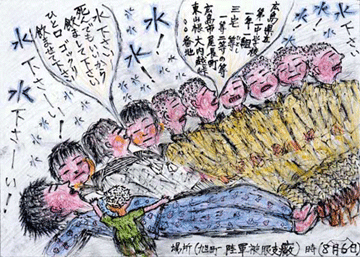
““The rights and wrongs of Hiroshima are debatable,” Telford Taylor, the chief prosecutor at Nuremberg, once said, “but I have never heard a plausible justification of Nagasaki” — which he labeled a war crime.”
Author: John LaForge, August 7, 2014, https://www.peacevoice.info/2014/08/06/vonnegut-on-nagasaki-the-most-racist-nastiest-act-by-this-country-after-human-slavery/
For the full article:
Vonnegut on Nagasaki: “The most racist, nastiest act by this country, after human slavery”
877 Words
“The rights and wrongs of Hiroshima are debatable,” Telford Taylor, the chief prosecutor at Nuremberg, once said, “but I have never heard a plausible justification of Nagasaki” — which he labeled a war crime.
In his 2011 book Atomic Cover-Up, Greg Mitchell says, “If Hiroshima suggests how cheap life had become in the atomic age, Nagasaki shows that it could be judged to have no value whatsoever.” Mitchell notes that the US writer Dwight MacDonald cited in 1945 America’s “decline to barbarism” for dropping “half-understood poisons” on a civilian population. The New York Herald Tribune editorialized there was “no satisfaction in the thought that an American air crew had produced what must without doubt be the greatest simultaneous slaughter in the whole history of mankind.”
Mitchell reports that the novelist Kurt Vonnegut, Jr. — who experienced the firebombing of Dresden first hand and described it in Slaughterhouse Five — said, “The most racist, nastiest act by this country, after human slavery, was the bombing of Nagasaki.”
On Aug. 17, 1945, David Lawrence, the conservative columnist and editor of US News, put it this way: “Last week we destroyed hundreds of thousands of civilians in Japanese cities with the new atomic bomb. …we shall not soon purge ourselves of the feeling of guilt. …we…did not hesitate to employ the most destructive weapon of all times indiscriminately against men, women and children. … Surely we cannot be proud of what we have done. If we state our inner thoughts honestly, we are ashamed of it.”
If shame is the natural response to Hiroshima, how is one to respond to Nagasaki, especially in view of all the declassified government papers on the subject? According to Dr. Joseph Gerson’s With Hiroshima Eye, some 74,000 were killed instantly at Nagasaki, another 75,000 were injured and 120,000 were poisoned.
If Hiroshima was unnecessary, how to justify Nagasaki?
The saving of thousands of US lives is held up as the official justification for the two atomic bombings. Leaving aside the ethical and legal question of slaughtering civilians to protect soldiers, what can be made of the Nagasaki bomb if Hiroshima’s incineration was not necessary?
The most amazingly under-reported statement in this context is that of Truman’s Secretary of State James Byrnes, quoted on the front page of the August 29, 1945 New York Times with the headline, “Japan Beaten Before Atom Bomb, Byrnes Says, Citing Peace Bids.” Byrnes cited what he called “proof that the Japanese knew that they were beaten before the first atomic bomb was dropped on Hiroshima.”
On Sept. 20, 1945, Gen. Curtis LeMay, the famous bombing commander, told a press conference, “The war would have been over in two weeks without the Russians entering and without the atomic bomb. The atomic bomb had nothing to do with the end of the war at all.”
According to Robert Lifton’s and Greg Mitchel’s Hiroshima in America: 50 Years of Denial (1995), only weeks after August 6 and 9, President Truman himself publicly declared that the bomb “did not win the war.”
The US Strategic Bombing Survey, conducted by Paul Nitze less than a year after the atom bombings, concluded that “certainly prior to 31 December 1945, and in all probability prior to 1 November 1945, Japan would have surrendered even if the atomic bombs had not been dropped, even if Russia had not entered the war, and ever if no invasion had been planned or contemplated.”
Likewise, the Intelligence Group of the US War Department’s Military Intelligence Division conducted a study from January to April 1946 and declared that the bombs had not been needed to end the war, according to reports Gar Alperovitz in his massive The Decision to Drop the Atomic Bomb. The IG said it is “almost a certainty that the Japanese would have capitulated upon the entry of Russia into the war.”
Russia did so, Aug. 8, 1945, and as Ward Wilson reports in his Five Myths about Nuclear Weapons, six hours after news of Russia’s invasion of Sakhalin Island reached Tokyo — and before Nagasaki was bombed — the Supreme Council met to discuss unconditional surrender.
Experiments with hell fire?
Nagasaki was attacked with a bomb made of plutonium, named after Pluto, god of the underworld earlier known as Hades, in what some believe to have been a ghastly trial. The most toxic substance known to science, developed for mass destruction, plutonium is so lethal it contaminates everything nearby forever, every isotope a little bit of hell fire.
According to Atomic Cover-Up, Hitoshi Motoshima, mayor of Nagasaki from 1979 to 1995, said, “The reason for Nagasaki was to experiment with the plutonium bomb.” Mitchell notes that “hard evidence to support this ‘experiment’ as the major reason for the bombing remains sketchy.” But according to a wire service report in Newsweek, Aug. 20, 1945, by a journalist traveling with the president aboard the USS Augusta, Truman reportedly announced to his shipmates, “The experiment has been an overwhelming success.”
US investigators visiting Hiroshima Sept. 8, 1945 met with Japan’s leading radiation expert, Professor Masao Tsuzuki. One was given a 1926 paper on Tsuzuki’s famous radiation experiments on rabbits. “Ah, but the Americans, they are wonderful,” Tsuzuki told the group. “It has remained for them to conduct the human experiment!”
~~~~~~~~~~~~~~~
John LaForge is a Co-director of Nukewatch, a nuclear watchdog and environmental justice group in Wisconsin, edits its quarterly newsletter, and writes for PeaceVoice.
Atomic testament: Yoshito Matsushige and the first photos of Hiroshima’s nuclear toll
Bulletin, By David A. Wargowski | August 6, 2025
In the late morning hours of August 6, 1945, a single shutter clicked in Hiroshima and recorded what no camera had ever captured before, and none has again: the immediate, lived aftermath of a city annihilated by nuclear weapons.
Equipped with one camera and two rolls of film, totaling just 24 possible exposures, Yoshito Matsushige, then a 32-year-old photojournalist, ventured toward the city that morning to report for duty. Fires blocked access to his office, so he turned back and reached Miyuki Bridge (about 2,300 meters from ground zero) where he encountered the unfathomable: charred schoolgirls, civilians with melted skin, and a landscape of human agony.
He could barely bring himself to document it. But his five surviving images—the only known photographs of Hiroshima’s destruction on the day of the bombing itself—are among the most harrowing visual records of the nuclear age………………………………………………………………………………. https://thebulletin.org/2025/08/atomic-testament-yoshito-matsushige-and-the-first-photos-of-hiroshimas-nuclear-toll/?utm_source=ActiveCampaign&utm_medium=email&utm_content=The%20first%20photos%20of%20Hiroshima%20s%20nuclear%20toll&utm_campaign=20250804%20Monday%20Newsletter%20%28Copy%29
80 Years of Lies: The US Finally Admits It Knew It Didn’t Need to Bomb Hiroshima and Nagasaki.

Japan was already defeated and dropping the bomb was completely unnecessary…[it was] no longer mandatory as a measure to save American lives. It was my belief that Japan was, at this very moment, seeking a way to surrender with a minimum loss of face.” – Dwight D. Eisenhower, Supreme Allied Commander in Europe and future president
By Alan MacLeod / MintPress News, https://www.mintpressnews.com/hiroshima-nagasaki-us-nuclear-lies/290336/ August 7, 2025
As we commemorate the 80th anniversary of the Hiroshima and Nagasaki atomic bombings, the world is drifting as close to another nuclear confrontation as it has been in decades.
With Israeli and American attacks on Iranian nuclear energy sites, India and Pakistan going to war in May, and escalating violence between Russia and NATO-backed forces in Ukraine, the shadow of another nuclear war looms large over daily life.
Eighty Years Of Lies
The United States remains the only nation to have dropped an atomic bomb in anger. While the dates of August 6 and August 9, 1945, are seared into the popular conscience of all Japanese people, those days hold far less salience in American society.
When discussed at all in the U.S., this dark chapter in human history is usually presented as a necessary evil, or even a day of liberation—an event that saved hundreds of thousands of lives, prevented the need for an invasion of Japan, and ended the Second World War early. This, however, could not be further from the truth.
American generals and war planners agreed that Japan was on the point of collapse, and had, for weeks, been attempting to negotiate a surrender. The decision, then, to incinerate hundreds of thousands of Japanese civilians was one taken to project American power across the world, and to stymie the rise of the Soviet Union.
“It always appeared to us that, atomic bomb or no atomic bomb, the Japanese were already on the verge of collapse,” General Henry Arnold, Commanding General of the U.S. Army Air Forces in 1945, wrote in his 1949 memoirs.
Arnold was far from alone in this assessment. Indeed, Fleet Admiral William Leahy, the Navy’s highest-ranking officer during World War II, bitterly condemned the United States for its decision and compared his own country to the most savage regimes in world history.
As he wrote in 1950:
It is my opinion that the use of this barbarous weapon at Hiroshima and Nagasaki was of no material assistance in our war against Japan. The Japanese were already defeated and ready to surrender. My own feeling was that in being the first to use it, we had adopted an ethical standard common to the barbarians of the Dark Ages.”
By 1945, Japan had been militarily and economically exhausted. Losing key allies Italy in 1943 and Germany by May 1945, and facing the immediate prospect of an all-out Soviet invasion of Japan, the country’s leaders were frantically pursuing peace negotiations. Their only real condition appeared to be that they wished to keep as a figurehead the emperor—a position that, by some accounts, dates back more than 2,600 years.
“I am convinced,” former President Herbert Hoover wrote to his successor, Harry S. Truman, “if you, as President, will make a shortwave broadcast to the people of Japan—tell them they can have their emperor if they surrender, that it will not mean unconditional surrender except for the militarists—you’ll get a peace in Japan—you’ll have both wars over.”
Many of Truman’s closest advisors told him the same thing. “I am absolutely convinced that had we said they could keep the emperor, together with the threat of an atomic bomb, they would have accepted, and we would never have had to drop the bomb,” said John McCloy, Truman’s Assistant Secretary of War.
Nevertheless, Truman initially took an absolutist position, refusing to hear any Japanese negotiating caveats. This stance, according to General Douglas MacArthur, Commander of Allied Forces in the Pacific, actually lengthened the war. “The war might have ended weeks earlier,” he said, “If the United States had agreed, as it later did anyway, to the retention of the institution of the emperor.” Truman, however, dropped two bombs, then reversed his position on the emperor, in order to stop Japanese society from falling apart.
At that point in the war, however, the United States was emerging as the sole global superpower and enjoyed an unprecedented position of influence. The dropping of the atomic bomb on Japan underscored this; it was a power play, intended to strike fear into the hearts of world leaders, especially in the Soviet Union and China.
First Japan, Then The World
Hiroshima and Nagasaki drastically curbed the U.S.S.R.’s ambitions in Japan. Joseph Stalin’s forces had invaded and permanently annexed Sakhalin Island in 1945 and planned to occupy Hokkaido, Japan’s second-largest island. The move likely prevented the island nation from coming under the Soviet sphere of influence.
To this day, Japan remains deeply tied to the U.S., economically, politically, and militarily. There are around 60,000 U.S. troops in Japan, spread across 120 military bases.
Many in Truman’s administration wished to use the atom bomb against the Soviet Union as well. President Truman, however, worried that the destruction of Moscow would lead the Red Army to invade and destroy Western Europe as a response. As such, he decided to wait until the U.S. had enough warheads to completely destroy the U.S.S.R. and its military in one fell swoop.
War planners estimated this figure to be around 400. To that end, Truman ordered the immediate ramping up of production. Such a strike, we now know, would have caused a nuclear winter that would have permanently ended all organized life on Earth.
The decision to destroy Russia was met with stiff opposition among the American scientific community. It is now widely believed that Manhattan Project scientists, including Robert J. Oppenheimer himself, passed nuclear secrets to Moscow in an effort to speed up their nuclear project and develop a deterrent to halt this doomsday scenario. This part of history, however, was left out of the 2023 biopic movie.
By 1949, the U.S.S.R. was able to produce a credible nuclear deterrent before the U.S. had produced sufficient quantities for an all-out attack, thus ending the threat and bringing the world into the era of mutually assured destruction.
“Certainly prior to 31 December 1945, and in all probability prior to 1 November 1945, Japan would have surrendered even if the atomic bombs had not been dropped, even if Russia had not entered the war, and even if no invasion had been planned or contemplated,” concluded a 1946 report from the U.S. Strategic Bombing Survey.
Dwight D. Eisenhower, Supreme Allied Commander in Europe and future president, was of the same opinion, stating that:
Japan was already defeated and dropping the bomb was completely unnecessary…[it was] no longer mandatory as a measure to save American lives. It was my belief that Japan was, at this very moment, seeking a way to surrender with a minimum loss of face.”
Nevertheless, both Truman and Eisenhower publicly toyed with the idea of using nuclear weapons against China to stop the rise of Communism and to defend their client regime in Taiwan. It was only the development of a Chinese warhead in 1964 that led to the end of the danger, and, ultimately, the détente era of good relations between the two powers that lasted until President Obama’s Pivot to Asia.
Ultimately, then, the people of Japan were the collateral damage in a giant U.S. attempt to project its power worldwide. As Brigadier General Carer Clarke, head of U.S. intelligence on Japan wrote, “When we didn’t need to do it, and we knew we didn’t need to do it, and they knew that we knew we didn’t need to do it, we used them [Japanese citizens] as an experiment for two atomic bombs.”
Tiptoeing Closer To Armageddon
The danger of nuclear weapons is far from over. Today, Israel and the United States – two nations with atomic weaponry – attack Iranian nuclear facilities. Yet their continued, hyper-aggressive actions against their foes only suggest to other countries that, unless they too possess weapons of mass destruction, they will not be safe from attack. North Korea, a country with a conventional and nuclear deterrent, faces no such air strikes from the U.S. or its allies. These actions, therefore, will likely result in more nations pursuing nuclear ambitions.
Earlier this year, India and Pakistan (two more nuclear-armed states) came into open conflict thanks to disputes over terrorism and Jammu and Kashmir. Many influential individuals on both sides of the border were demanding their respective sides launch their nukes – a decision that could also spell the end of organized human life. Thankfully, cooler heads prevailed.
Meanwhile, the war in Ukraine continues, with NATO forces urging President Zelensky to up the ante. Earlier this month, President Trump himself reportedly encouraged the Ukrainian leader to use his Western-made weapons to strike Moscow.
It is precisely actions such as these that led the Bulletin of Atomic Scientists to move their famous Doomsday Clock to 89 seconds to midnight, the closest the world has ever been to catastrophe.
“The war in Ukraine, now in its third year, looms over the world; the conflict could become nuclear at any moment because of a rash decision or through accident or miscalculation,” they wrote in their explanation, adding that conflicts in Asia could spiral out of control into a wider war at any point, and that nuclear powers are updating and expanding their arsenals.
The Pentagon, too, is recruiting Elon Musk to help it build what it calls an American Iron Dome. While this move is couched in defensive language, such a system – if successful – would grant the U.S. the ability to launch nuclear attacks anywhere in the world without having to worry about the consequences of a similar response.
Thus, as we look back at the horrors of Hiroshima and Nagasaki 80 years ago, we must understand that not only were they entirely avoidable, but that we are now closer to a catastrophic nuclear confrontation than many people realize.
Hiroshima’s fading legacy: the race to secure survivors’ memories amid a new era of nuclear brinkmanship.

Eighty years on from the destruction of the city, registered survivors of the blast – known as hibakusha – have fallen below 100,000
Justin McCurry in Hiroshima, Tue 5 Aug 2025 , https://www.theguardian.com/world/2025/aug/05/hiroshima-atomic-bomb-80-year-anniversary-survivors
The fires were still burning, and the dead lay where they had fallen, when a 10-year-old Yoshiko Niiyama entered Hiroshima, two days after it was destroyed by an American atomic bomb.
“I remember that the air was filled with smoke and there were bodies everywhere … and it was so hot,” Niiyama says in an interview at her home in the Hiroshima suburbs. “The faces of the survivors were so badly disfigured that I didn’t want to look at them. But I had to.”
Niiyama and her eldest sister had rushed to the city to search for their father, Mitsugi, who worked in a bank located just 1km from the hypocentre. They had been evacuated to a neighbourhood just outside the city, but knew something dreadful had happened in Hiroshima when they saw trucks passing their temporary home carrying badly burned victims.
As Hiroshima prepares to mark 80 years since the city was destroyed in the world’s first nuclear attack, the 90-year-old is one of a small number of hibakusha – survivors of the atomic bombings – still able to recall the horrors they witnessed after their home was reduced to rubble in an instant.
At 8:15am on 6 August, the Enola Gay, a US B-29 bomber, dropped a nuclear bomb on the city. “Little Boy” detonated about 600 metres from the ground, with a force equivalent to 15,000 tonnes of TNT. Between 60,000 and 80,000 people were killed instantly, with the death toll rising to 140,000 by the end of the year as victims succumbed to burns and illnesses caused by acute exposure to radiation.
Three days later, the Americans dropped a plutonium bomb on Nagasaki, killing 74,000. And on 15 August, a demoralised Japan surrendered, bringing an end to the second world war.
Niiyama, one of four sisters, never found her father or his remains, which were likely incinerated along with those of his colleagues. “My father was tall, so for a long time whenever I saw a tall man from behind, I would run up to him thinking it might be him,” she says. “But it never was.”
With the number of people who survived the bombing and witnessed its immediate aftermath dwindling by the year, it is being left to younger people to continue to communicate the horrors inflicted on Hiroshima and Nagasaki.
For decades Niiyama, who is a registered hibakusha, said nothing of the trauma she had suffered as a schoolgirl, not even to members of her own family. “I didn’t want to remember what had happened,” she says. “And many hibakusha stayed quiet as they knew they might face discrimination, like not being able to marry or find a job. There were rumours that children born to hibakusha would be deformed.”
It was only when her granddaughter, Kyoko Niiyama, then a high school student, asked her about her wartime experiences that Niiyama broke her silence.
“When my children are older, they’ll naturally ask about what happened to their grandmother,” says the younger Niiyama, 35, a reporter for a local newspaper and the mother of two young children. “It would be such a shame if I wasn’t able to tell them … that’s why I decided to ask my grandmother about the bomb.”
She is one of a growing number of people in Hiroshima and Nagasaki studying to become “family successors” – a local government initiative that certifies the descendants of first-generation hibakusha to record and pass on the experiences of the only people on earth to have lived through nuclear warfare.
“Now that the anniversary is approaching, I can talk to her again,” Kyoko says. “This is a really precious time for our family.”
‘I don’t want to think about that day’
Last year, survivors of the Hiroshima and Nagasaki attacks won recognition for their campaign to rid the world of nuclear weapons when Nihon Hidankyo – a nationwide network of hibakusha – was awarded the Nobel peace prize.
But survivors face a race against time to ensure that their message lives on in a world that is edging closer to a new age of nuclear brinkmanship.
The world’s nine nuclear states are spending billions of dollars on modernising, and in some cases expanding, their arsenals. The Russian president, Vladimir Putin, has refused to rule out the use of tactical nuclear weapons in his war against Ukraine, and last week a veiled nuclear threat by the country’s former leader, Dmitry Medvedev, prompted Donald Trump – who had earlier compared US strikes on Iran’s nuclear facilities to the Hiroshima and Nagasaki attacks – to claim that he had moved two nuclear submarines closer to the region. North Korea’s development of nuclear weapons continues unchecked.
“The hibakusha have spent their lifetimes courageously telling their stories again and again, essentially reliving their childhood traumas – to make sure the world learns the reality of what nuclear weapons actually do to people and why they must be abolished, so that no one else goes through what they have suffered,” says Melissa Parke, executive director of the International Campaign to Abolish Nuclear Weapons.
“These brave hibakusha deserve to have their decades of campaigning vindicated and to witness the elimination of nuclear weapons in their lifetimes. This would provide some nuclear justice.”
The number of registered survivors of both attacks fell to just below 100,000 this year, according to the health ministry, compared with more than 372,000 in 1981. Their average age is 86. Just one of the 78 people confirmed to have been within 500 metres of the hypocentre of the blast in Hiroshima is still alive – an 89-year-old man.
On the eve of the anniversary, the ministry said it would no longer conduct a survey every 10 years to assess the living conditions and health of hibakusha, saying it wanted to “lessen the burden” on ageing survivors.
Niiyama, who struggles to walk, will watch Wednesday’s ceremony at home and pause to remember her father, whose memory is represented by a teacup he used that was retrieved from the devastation.
“I don’t like the month of August,” she says. “I have nightmares around the anniversary. I don’t want to think about that day, but I can’t forget it. But I’m glad I still remember that I’m a hibakusha.”
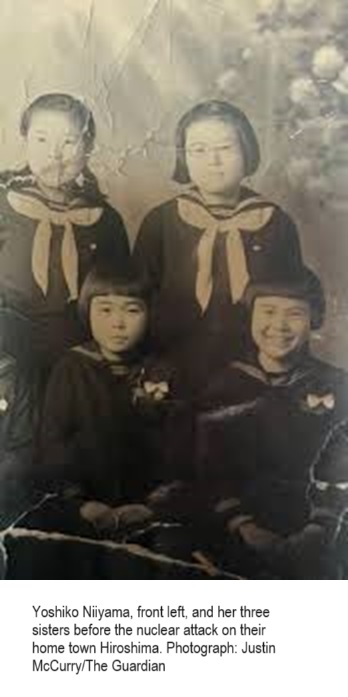
Niiyama, who struggles to walk, will watch Wednesday’s ceremony at home and pause to remember her father, whose memory is represented by a teacup he used that was retrieved from the devastation.
“I don’t like the month of August,” she says. “I have nightmares around the anniversary. I don’t want to think about that day, but I can’t forget it. But I’m glad I still remember that I’m a hibakusha.”
Hiroshima’s history lesson
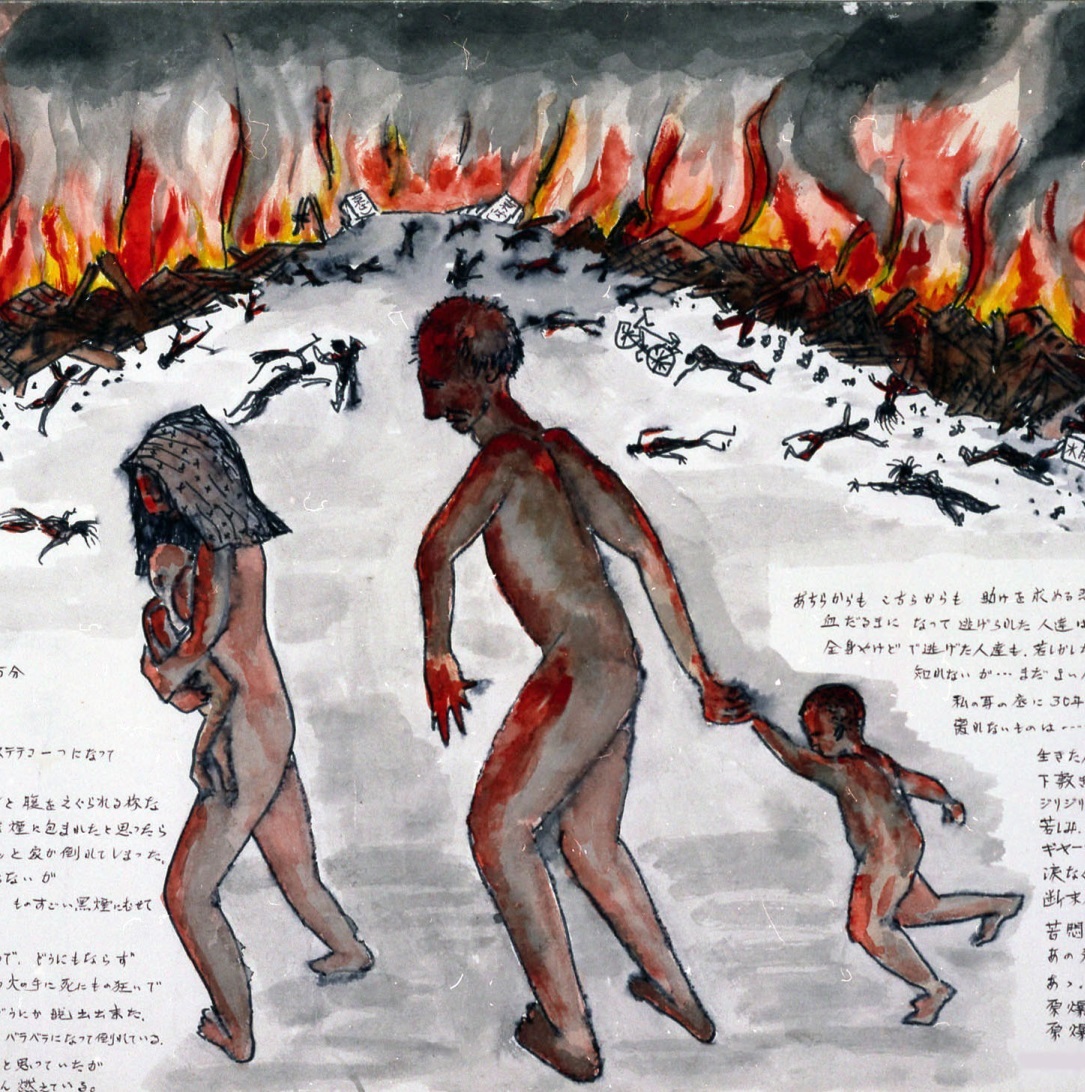
by beyondnuclearinternational, https://beyondnuclearinternational.org/2025/08/03/hiroshimas-history-lesson/
By April 1945, with the Nazi regime in a state of collapse and Japan’s defeat imminent, the threat that served as the original justification for the bomb’s development had all but vanished.
The true target of the first atomic bomb wasn’t, in fact, Tokyo, but Moscow, with the people of Hiroshima and Nagasaki sacrificed on the altar of American global imperial ambition.
Szilard emphasized that the atomic bomb wasn’t just a more powerful weapon but a fundamental transformation in the nature of warfare, an instrument of annihilation.

Oppenheimer explained, “When you see something that is technically sweet, you go ahead and do it and you argue about what to do about it only after you have had your technical success. That is the way it was with the atomic bomb.”
That climate of deference fostered a culture of complicity, where questions of social responsibility were subordinated to uncritical faith in authority.
What Can We Learn From the Birth of the Nuclear Era?
By Eric Ross, Common Dreams
In recent months, nuclear weapons have reemerged in global headlines. Nuclear-armed rivals India and Pakistan approached the brink of a full-scale war, a confrontation that could have become an extinction-level event, with the potential to claim up to 2 billion lives worldwide.
The instability of a global order structured on nuclear apartheid has also come into sharp relief in the context of the recent attacks on Iran by Israel and the United States. That system has entrenched a dangerous double standard, creating perverse incentives for the proliferation of world-destroying weaponry, already possessed by nine countries. Many of those nations use their arsenals to exercise imperial impunity, while non-nuclear states increasingly feel compelled to pursue nuclear weapons in the name of national security and survival.
Meanwhile, the largest nuclear powers show not the slightest signs of responsibility or restraint. The United States, Russia, and China are investing heavily in the “modernization” and expansion of their arsenals, fueling a renewed arms race. And that escalation comes amid growing global instability contributing to a Manichean world of antagonistic armed blocs, reminiscent of the Cold War at its worst.
The nuclear threat endangers not only global peace and security but the very continuity of the human species, not to speak of the simple survival of life on Earth. How, you might wonder, could we ever have arrived at such a precarious situation?
The current crisis coincides with the 80th anniversary of the Trinity Test, the first detonation of an atomic weapon that would soon obliterate the Japanese cities of Hiroshima and Nagasaki and so inaugurate the atomic age. So many years later, it’s worth critically reassessing the decisions that conferred on humanity such a power of self-annihilation. After all, we continue to live with the fallout of the choices made (and not made), including those of the scientists who created the bomb. That history also serves as a reminder that alternative paths were available then and that another world remains possible today.
A Tale of Two Laboratories
In the summer of 1945, scientists and technicians at Los Alamos National Laboratory in New Mexico worked feverishly to complete the construction of the atomic bomb. Meanwhile, their colleagues at the University of Chicago’s Metallurgical Laboratory mounted a final, ultimately unsuccessful effort to prevent its use.
The alarm spreading in Chicago stemmed from a sobering realization. The Manhattan Project that they had joined on the basis of a belief that they were in an existential arms race with Nazi Germany had, by then, revealed itself to be a distinctly one-sided contest. Until then, the specter of a possible German atomic bomb had conferred a sense of urgency and a veneer of moral legitimacy on what many scientists otherwise recognized as a profoundly unethical undertaking.
Prior to the fall of Berlin, Allied intelligence had already begun to cast serious doubt on Germany’s progress toward developing an atomic weapon. By April 1945, with the Nazi regime in a state of collapse and Japan’s defeat imminent, the threat that served as the original justification for the bomb’s development had all but vanished.
No longer represented as a plausible deterrent, the bomb now stood poised to become what Los Alamos Director J. Robert Oppenheimerwould describe shortly after the war as “weapons of terror, of surprise, of aggression… [used] against an essentially defeated enemy.”
For the scientists at Chicago, that new context demanded new thinking. In June 1945, a committee of physicists led by James Franck submitted a report to Secretary of War Henry Stimson warning of the profound political and ethical consequences of employing such a bomb without exhausting all other alternatives. “We believe,” the Franck Report stated, “that the use of nuclear bombs for an early, unannounced attack against Japan [would be] inadvisable.” The report instead proposed a demonstration before international observers, arguing that such a display could serve as a gesture of goodwill and might avert the need to use the bombs altogether.
One of that report’s signatories, Leo Szilard, who had been among the bomb’s earliest advocates, further sought to prevent what he had come to recognize as the catastrophic potential outcome of their creation. With Germany defeated, he felt a personal responsibility for reversing the course he had helped set in motion. Echoing concerns articulated in the Franck Report, he drafted a petition to be circulated among the scientists. While acknowledging that the bomb might offer short-term military and political advantages against Japan, he warned that its deployment would ultimately prove morally indefensible and strategically self-defeating, a position which would also be held by 6 of the 7 U.S. five-star generals and admirals of that moment.
Szilard emphasized that the atomic bomb wasn’t just a more powerful weapon but a fundamental transformation in the nature of warfare, an instrument of annihilation. He already feared Americans might come to regret that their own government had sown the seeds of global destruction by legitimizing the sudden obliteration of Japanese cities, a precedent that would render a heavily industrialized, densely populated country like the United States especially vulnerable.
Moreover, he concluded that using such weapons of unimaginable destructive power without sufficient military justification would severely undermine American credibility in future arms control efforts. He observed that the development of the bomb under conditions of extreme wartime secrecy had created an abjectly anti-democratic situation, one in which the public was denied any opportunity to deliberate on such an irrevocable and consequential decision.
As Eugene Rabinowitch, a co-author of the Franck Report (who would later co-found The Bulletin of Atomic Scientists), would note soon after, the scientists in Chicago were growing increasingly uneasy in the face of escalating secrecy: “Many scientists began to wonder: Against whom was this extreme secrecy directed? What was the sense of keeping our success secret from the Japanese? Would it have helped them to know that we had an atomic bomb ready?”
Rabinowitch concluded that the only “danger” posed by such a disclosure was that the Chicago scientists might be proven right, and Japan might surrender. “Since there was no justifiable reason to hold the bomb secret from the Japanese,” he argued, “many scientists felt that the purpose of deepened secrecy was to keep the knowledge of the bomb… from the American people.”
In other words, officials in Washington were concerned that a successful demonstration might deprive them of the coveted opportunity to use the bomb and assert their newly acquired monopoly (however temporary) on unprecedented power.
The Road to Trinity and the Cult of Oppenheimer
Seventy scientists at Chicago endorsed the Szilard Petition. By then, however, their influence on the project had distinctly diminished. Despite their early contributions, notably the achievement of the first self-sustained nuclear chain reaction in December 1942, the project’s center of gravity had shifted to Los Alamos.
Recognizing this, Szilard sought to circulate the petition among his colleagues there, too, hoping to invoke a shared sense of scientific responsibility and awaken their moral conscience in the critical weeks leading up to the first test of the weapon. Why did that effort fail? Why was there so little dissent, debate, or resistance at Los Alamos given the growing scientific opposition, bordering on revolt, that had emerged in Chicago?
One answer lies in Oppenheimer himself. In popular culture and historical scholarship, his legacy is often framed as that of a tragic figure: the reluctant architect of the atomic age, an idealist drawn into the ethically fraught task of creating a weapon of mass destruction compelled by the perceived exigencies of an existential war.
Yet the myth of him as a Promethean figure who suffered for unleashing the fundamental forces of nature onto a society unprepared to bear responsibility for it obscures the extent of his complicity. Far from being a passive participant, in the final months of the Manhattan Project, he emerged as a willing collaborator in the coordination of the coming atomic bombings of Hiroshima and Nagasaki.
When Oppenheimer and physicist Edward Teller (who would come to be known as “the father of the hydrogen bomb”) received Szilard’s petition, neither shared it. While Oppenheimer offered no response, Teller provided a striking explanation: “The things we are working on are so terrible that no amount of protesting or fiddling with politics will save our souls.” He further rejected the idea that he held any authority to influence the bomb’s use. “You may think it is a crime to continue to work,” he conceded, “but I feel that I should do the wrong thing if I tried to say how to tie the little toe of the ghost to the bottle from which we just helped it escape.”
Teller later claimed to be in “absolute agreement” with the petition, but added that “Szilard asked me to collect signatures… I felt I could not do so without first seeking Oppenheimer’s permission more directly. I did so and Oppenheimer talked me out of it, saying that we as scientists have no business meddling in political pressure of that kind… I am ashamed to say that he managed to talk me out of [it].”
Teller’s explanation was likely self-serving given his later acrimonious rift with Oppenheimer over the hydrogen bomb. Yet further evidence indicates that Oppenheimer actively sought to suppress debate and dissent. Physicist Robert Wilson recalled that upon arriving at Los Alamos in 1943, he raised concerns about the broader implications of their work and the “terrible problems” it might create, particularly given the exclusion of the Soviet Union, then an ally. The Los Alamos director, Wilson remembered, “didn’t want to talk about that sort of thing” and would instead redirect the conversation to technical matters. When Wilson helped organize a meeting to discuss the future trajectory of the project in the wake of Germany’s defeat, Oppenheimer cautioned him against it, warning that “he would get into trouble by calling such a meeting.”
The meeting nonetheless proceeded, with Oppenheimer in attendance, though his presence proved stifling. “He participated very much, dominating the meeting,” Wilson remembered. Oppenheimer pointed to the upcoming San Francisco Conference to establish the United Nations and insisted that political questions would be addressed there by those with greater expertise, implying that scientists had no role to play in such matters and ought to abstain from influencing the applications of their work.
Reflecting on his mindset at the time, Oppenheimer explained, “When you see something that is technically sweet, you go ahead and do it and you argue about what to do about it only after you have had your technical success. That is the way it was with the atomic bomb.” In a similar vein, his oft-quoted remark that “the physicists have known sin” was frequently misinterpreted. He was not referring, he insisted, to the “sin” of the destruction of Hiroshima and Nagasaki, but to pride for “intervening explicitly and heavy-handedly in the course of human history.”
When situated within this broader context of a professed commitment to scientific detachment, Oppenheimer’s behavior becomes more intelligible. In practice, however, his stated ideals stood in stark contrast to his conduct. While he claimed to reject political engagement, he ultimately intervened in precisely such a manner, using his position to advocate forcefully for the bomb’s immediate military use against Japan without prior warning. He emerged as a leading opponent of any prospective demonstration, cautioning that it would undermine the psychological impact of the bomb’s use, which could only be realized through a sudden, unannounced detonation on a relatively untouched, non-military target like the city of Hiroshima. This position stood in sharp contrast to that of the Chicago scientists, of whom only 15% supported using the bomb in such a manner.
That climate of deference fostered a culture of complicity, where questions of social responsibility were subordinated to uncritical faith in authority. Reflecting on that dynamic, physicist Rudolf Peierlsacknowledged, “I knew that Oppenheimer was on a committee and was briefing with the high-ups. I felt there were two things one could rely on: Oppenheimer to put the reasonable ideas across, and that one could trust people. After all, we are not terrorists at heart or anything… Both these statements might now be somewhat optimistic.”
Ultimately, the only member of Los Alamos to register dissent was Joseph Rotblat, who quietly resigned on ethical grounds after learning in November 1944 that there was no active Nazi atomic bomb program. His departure remained a personal act of conscience, however, rather than an effort to initiate a broader moral reckoning within the scientific community.
“Remember Your Humanity”
The legacy of Oppenheimer, a burden we all now carry, lies in his mistaking proximity to power for power itself. Rather than using his influence to restrain the bomb’s use, he exercised what authority he had to facilitate its most catastrophic outcome, entrusting its consequences to political leaders who soon revealed their recklessness. In doing so, he helped lay the groundwork for what President Dwight D. Eisenhower would, in his farewell address to Congress in 1961, warn against as “the disastrous rise of misplaced power.”
Yet we are not doomed. This history should also remind us that the development and use of nuclear weapons was not inevitable. There were those who spoke out and a different path might well have been possible. While we cannot know exactly how events would have unfolded had dissent been amplified rather than suppressed, we can raise our own voices now to demand a safer, saner future. Our collective survival may well depend on it. How much longer a world armed with nuclear weapons can endure remains uncertain. The only viable path forward lies in renewing a commitment to, as Albert Einstein and Bertrand Russell urged, “remember your humanity, and forget the rest.” With ever more nations developing increasingly powerful arsenals, one thing remains clear: As the Doomsday Clock moves ever closer to midnight, there is no time to waste.
Eric Ross is an organizer, educator, researcher, and PhD Candidate in the History Department at the University of Massachusetts Amhers
The Kyshtym disaster: Russia’s hidden nuclear crisis

The Kyshtym disaster in 1957 was the Soviet Union’s biggest nuclear crisis until Chernobyl. So, why did the Soviets keep quiet about the former for decades?
28 July 25, https://www.history.co.uk/articles/kyshtym-disaster-russia-hidden-nuclear-crisis
What would be considered the worst nuclear disaster in history? Many scholars would say Chernobyl, when an explosion at a nuclear power plant in northern Ukraine released dangerous levels of radiation.
This was on 26th April 1986, when Ukraine was still part of the Soviet Union. Was Chernobyl inevitable? Many historians do believe that Soviet authorities failed to learn lessons from an earlier nuclear crisis on their own soil. Below, we at Sky HISTORY look back at the 1957 Kyshtym disaster — and how the Soviets kept it under wraps for decades.
Was there really a nuclear plant in Kyshtym?
The nuclear plant at the heart of the Kyshtym disaster was not actually in the Russian town of that name. Instead, it was in a secretive ‘closed city’ nearby, called Chelyabinsk-40. Today, it is called Ozyorsk. (Both Kyshtym and Ozyorsk are in Russia’s Chelyabinsk Oblast.)
In the 1940s, the Soviets realised that they were trailing the United States in the development of nuclear weapons. To help themselves catch up, they hastily built what is now commonly known as the Mayak nuclear plant.
This facility, which still stands today, was tasked with processing plutonium needed to make nuclear weapons. However, because the plant was assembled in a rush, many safety risks of the project were not considered sufficiently.
The Kyshtym explosion and its immediate aftermath
Before the Kyshtym disaster, it was routine for Mayak workers to deposit radioactive waste into the Techa River. This bode ill (literally) for villagers along the river who used it as a source of drinking water.
So, Mayak staff later decided to store such waste in an underground storage compartment of the plant itself. This space comprised 14 stainless steel containers attached to a concrete base.
However, in the 1950s, the cooling system in one of these tanks started to malfunction. This led the waste in the container to heat up and eventually, on 29th September 1957, explode. The force sent 20 curies of radioactive material flying a kilometre into the air.
The wind blew the radioactive particles over an area of about 20,000 square kilometres inhabited by approximately 270,000 people. This was generally to the northeast, away from Chelyabinsk-40, which lay upwind from the Mayak plant.
How did authorities initially react?
Residents of nearby areas were not initially notified of what had happened. This was largely due to the Soviet Union’s strong culture of secrecy during the Cold War. The national government didn’t want to let slip that Mayak even existed, let alone that a nuclear explosion had happened there.
It was also around the same time that the Soviet Union launched its Sputnik satellite, a big PR coup. Admitting responsibility for what was the world’s biggest nuclear disaster to date would have been more than an inconvenient fly in the ointment.
Still, the Soviets also knew that doing what they could to limit the radioactive contamination would go some way towards keeping everyone in the dark. So, while about 10,000 local residents were evacuated over the next two years, they weren’t told exactly why.
A cover-up lasting for decades
Almost 17,000 hectares of the contaminated area was turned into East Ural Nature Reserve in 1968. Members of the public were barred from entry, which remains the case to this day. Scientists have studied the reserve to monitor the long-term effects of nuclear radiation on its ecology.
The Kyshtym disaster was kept secret from the public until 1976, when Soviet dissident Zhores Medvedev reported about it in New Scientist magazine. However, the Soviet government still did not openly acknowledge the Kyshtym disaster before accidentally revealing it to the United Nations in the late 1980s.
It is estimated that thousands of cancer cases may have resulted from exposure to radiation caused by the nuclear explosion way back in 1957.
How does Kyshtym compare to Chernobyl?
On the International Nuclear and Radiological Event Scale (INES), Kyshtym is classified as Level 6. Chernobyl, an even bigger catastrophe, is ranked just one level higher (Level 7) on the INES. Kyshtym released about 40% as much radioactivity as Chernobyl.
Chernobyl is thought to have affected a larger population, too, as 335,000 people were evacuated in the wake of the 1986 disaster. Also, while Chernobyl quickly claimed 31 lives, none were lost in the immediate aftermath of Kyshtym.
Origins of Israel’s nuclear ambiguity lie in a secret deal forged between Richard Nixon and Golda Meir – podcast
Israel has never officially confirmed or denied having nuclear weapons and has never signed the nuclear non-proliferation treaty. Instead, even as evidence has emerged about its nuclear capabilities, Israel has maintained a policy of nuclear ambiguity.
The origins of this opacity lie in a secret deal forged in a one-on-one meeting between Israeli prime minister, Golda Meir, and the US president, Richard Nixon, at the White House in September 1969.
In this episode of The Conversation Weekly podcast, we speak to Avner Cohen, professor of non-proliferation studies at the Middlebury Institute of International Studies at Monterrey in the US, about that 1969 deal and why it has endured for more than 50 years. Cohen is the author of Israel and the Bomb, considered the definitive work on Israel’s nuclear programme, and has been interrogated by the Israeli state for his research.
Cohen tells us that the understanding between Meir and Nixon meant the US accepted Israel as a special kind of nuclear weapon state. In turn, Israel committed to restraint, not to test nuclear weapons, and not to be the first to introduce them to the region. Neither side has confirmed the existence of a deal, and there are only hints at it in the historical record. Cohen explains:
Once you realise that there is actually a deal, it explains a great deal of the situation. Why the US [is] looking the other way, why the issue is determined to be removed from the diplomatic agenda, and why many other countries, especially in the west, prefer not to see the Israeli nuclear issue.
Listen to the conversation with Avner Cohen on The Conversation Weekly podcast.
80 Years Ago: The First Atomic Explosion, 16 July 1945.

James B. Conant’s Eyewitness Account:
“The Whole Sky Suddenly Full of White Light Like the End of the World”
1,100 Square Miles in New Mexico Exposed to Radioactive Contamination
UCLA Report Suspected “Many Potential Long-Term Insidious Hazards” From Trinity Test Radiation
Washington, D.C., July 16, 2025 – Early in the morning of 16 July 1945, 80 years ago today, the U.S. Manhattan Project staged the first test of a nuclear weapon in the New Mexican desert. It was the first trial of a plutonium implosion weapon—the same weapon type that devastated Nagasaki a few weeks later. The explosion on the ground produced radioactive fallout contaminating over 1,100 square miles of the state, with some debris spreading as far north as Canada. Six weeks after the test, a “swath of fairly high radioactivity on the ground cover[ed] an area of about 100 miles long by 30 miles wide,” according to a Los Alamos Laboratory report published today for first time by the National Security Archive, while “gamma radiation was found in measurable but very low intensities in Santa Fe, Las Vegas, Raton and even in Trinidad, Colorado,” 260 miles from the point of detonation.
To mark the anniversary of this world-historic event, the National Security Archive today published a collection of essential declassified documents on the first atomic bomb test and the radioactive contamination that preoccupied government officials and medical experts during the years that followed. The new posting builds upon an Electronic Briefing Book of documents, photos, and period films published last year by the Archive, fortifying it with a number of significant new records, including:
- memoranda sent to Manhattan Project director Gen. Leslie R. Groves by his Scientific Advisor Richard C. Tolman on the so-called “100-ton test”—the Trinity “dress rehearsal”—and the reasons for holding a test of the implosion device at the Trinity site,
- Manhattan Project Director General Leslie Groves’ phoned-in message on the test minutes after it occurred, reporting that results were “probably … above expectations,”
- reports by Chief of British Mission Sir James Chadwick on the Test, who wrote, “Even now, a week later, I am filled with awe when I look back at this moment. It was a vision from the Book of Revelation,”
- and Harvard University President James B. Conant’s dramatic firsthand account of the test, observing that “the enormity of the light and its length quite stunned me.”
The Trinity Test planners prepared for possible adverse public health effects but did not know how far radioactive debris would spread, and the biological and public health impact of low-level radiation is still a contested issue. But during the years after Trinity, researchers with the Atomic Energy Project at the Medical School of the University of California, Los Angeles (UCLA) collected evidence to help determine whether the fallout produced a health hazard. While the studies drew no firm conclusions, a 1951 report by the Project found that there were “many potential long-term insidious hazards from the present low-level contamination which is the focal point of these studies.” The possibility that such hazards could eventually inspire legal action was concerning to medical experts who also wanted to learn more about the military implications of low levels of radiation contaminating “large land areas,” leading the Atomic Energy Commission to fund a research program at UCLA to determine the scope and impact of the contamination.
The Trinity test took place 80 years ago, but it is not entirely in the past. Researchers at the National Cancer Institute have determined that the test’s fallout contributed to excess numbers of thyroid cancers. To this his day, “down winders” in New Mexico seek federal compensation under the Radiation Exposure and Compensation Act (RECA), which so far has excluded that state, even though 33 of its counties, including tribal areas, experienced levels of radiation exposure that were higher than other U.S. counties covered by the Act.
Israel – Iran: The Confrontation

while the Iranian documents seized by the Mossad did not reveal a military nuclear program, [ 18 ] despite the statements of Benyamin Netanyahu, the neutrality of the Argentine Rafael Grossi, director of the International Atomic Energy Agency (IAEA), has been questioned based on the first Israeli documents seized by the Iranian Ministry of Intelligence. They show that he passed on observations of his organization to Israel, even though Israel is not a member. Among the IAEA governors, Russia, China and Burkina Faso opposed this resolution.
Coincidentally, Rafael Grossi has already been grilled about his strange silence during the Russian special operation in Ukraine: during a speech at the Davos Forum in 2022, he revealed that the Ukrainian regime had stored 30,000 kilos of plutonium and 40,000 kilos of enriched uranium at the Zaporijia plant. After that, nothing more, despite Russian objections.
The day after the publication of the documents seized by Iran, Tel Aviv attacked Iran. This is exactly the same behavior as during the 2006 war against Lebanon…………In reality, it attacked to block investigations by the Lebanese police and judiciary into a vast network of Israeli espionage and terrorism in Lebanon
Thierry Meyssan
Voltairenet.org
Tue, 17 Jun 2025 https://www.sott.net/article/500180-Israel-Iran-The-Confrontation
The confrontation between Israel and Iran does not correspond at all to the image presented by the media. Its roots go back to the time before the Islamic Republic and have nothing to do with the production of a nuclear bomb.The current start of the war is intended to cover up the misdeeds of the Argentine Rafael Grossi, director of the International Atomic Energy Agency.
The time has come: the confrontation between Israel and Persia has begun. Its origins lie not in the Islamic Republic, but in everything that preceded it. This war will continue until one of the opponents is exhausted.
To understand what is happening and avoid falling into one of the two official narratives that obscure the reality of the problem, we need to take a few steps back.
Iran’s Enemies in the 20th Century
All demonstrations in Iran against external enemies end with the inevitable “Death to the United Kingdom, Death to the United States, Death to Israel!” It is a cry that comes from the depths of Persian suffering since World War I.
Although we in the West are not aware of it, Iran was the victim of the largest genocide of the First World War in 1917-1919 [ 1 ] . 6 to 8 million people died of hunger out of a population of 18 to 20 million, i.e. between a quarter and a third of Iranians. Iran, although neutral, was crushed by the British armies, against a background of rivalry with the Bolsheviks and the Ottomans. This horror left a traumatic memory that is still very much present in Iran [ 2 ] For an Iranian there is no doubt that the United Kingdom is the first enemy of his country.
The British, who had colonized Iran with the help of one of his officers, Reza Shah (1925-1941), overthrew him to install his son, Mohammad Reza Pahlavi (1941-1979), in power. Behind these guises, they plundered the country’s oil. In 1951, the Shah appointed Mohammad Mossadegh as prime minister. Mossadegh nationalized oil at the expense of London. What followed was a conflict in which the British attacked viciously and organized a color revolution with the help of the Americans. This was “Operation Ajax” [ 3 ] . The new [Persian] regime was no longer led by London, but by Washington. The American embassy, which installed the telephone system, tapped all the ministers’ lines so that they could listen in live, without their knowledge. This system was discovered during the 1978 revolution. So Iranians have no doubt that the United States is their second enemy.
When Mossadegh was ousted, the British appointed General Fazlollah Zahedi in his place. Zahedi was a Nazi they had imprisoned in Cairo, but London was counting on him to restore “order.” So he set up a secret police force modeled on the Gestapo. He recruited former Nazis to train them, and several hundred “revisionist Zionists” were sent by Yitzhak Shamir (then working for the Mossad) to supervise them [ 4 ] . The horrors of the Savak, the most horrific secret police in the world at the time, can still be seen in the museum dedicated to it in Tehran [ 5 ] . So there is no doubt in the Iranian mindset that Israel is their third enemy.
Israel’s Only Enemy in the 20th Century
Contrary to what the Israeli public believes after 25 years of “revisionist Zionist” propaganda, Iran – neither that of the Shah nor that of the Islamic Republic – has never had the goal of destroying the Jewish population of occupied Palestine. As President Mahmoud Ahmadinejad made clear, the goal was to destroy the State of Israel in the same way that Russia had destroyed the USSR [ 6 ] .
No, the only enemy of the State of Israel is the one that has sabotaged every attempt at peace between Jews and Arabs for 80 years: the United Kingdom. As I have often explained, when the Foreign Office drew up its plan, The Future of Palestine, in 1915, it specified that a Jewish state should be established in Mandatory Palestine, but that it should in no way be able to guarantee its own security.
It was not until two years later that the government of David Lloyd George drew up the Balfour Declaration, which announced the establishment of a Jewish National Home, and the government of Woodrow Wilson committed itself to the establishment of an independent state for the Jews of the Ottoman Empire.
The author of this text, Lord Herbert Samuel, became the British High Commissioner in Palestine. True to himself, he preferred the “revisionist Zionists” of Jabotinsky on the one hand and the anti-Semite Mohammed Amin al-Husseini as Grand Mufti of Jerusalem on the other. He was subsequently appointed Under-Secretary of State for the Home Department in the government of Archibald Sinclair.
This policy continues unabated to this day, with the UK still supporting the “revisionist Zionist” Benjamin Netanyahu on one side and the Muslim Brotherhood, of which Hamas is the Palestinian branch, on the other.
The continuation of the conflict between the “revisionist Zionists” and Iran
Continue readingSecuring the nuclear nation, (Russia)
Cambridge University Press: Kate Brown 20 November 2018, https://www.cambridge.org/core/journals/nationalities-papers/article/abs/securing-the-nuclear-nation/9D92C7AA447CC337F56999FC8C03C4D4
Abstract
In 1946, in the Southern Urals, construction of the Union of Soviet Socialist Republics first plutonium plant fell to the GULAG-Narodnyi Komissariat Vnutrennikh Del (NKVD). The chief officers in charge of the program – Lavrentii Beria, Sergei Kruglov, and Ivan Tkachenko – had been pivotal figures in the deportation and political and ethnic cleansing of territories retaken from Axis forces during WWII.
These men were charged with building a nuclear weapons complex to defend the Soviet Union from the American nuclear monopoly. In part thanks to the criminalization and deportation of ethnic minorities, Gulag territories grew crowded with foreign nationals and ethnic minorities in the postwar years. The NKVD generals were appalled to find that masses of forced laborers employed at the plutonium construction site were members of enemy nations. Beria issued orders to cleanse the ranks of foreign enemies, but construction managers could not spare a single healthy body as they raced to complete their deadlines.
To solve this problem, they created two zones: an interior, affluent zone for plutonium workers made up almost exclusively of Russians; and anterior zones of prisoners, soldiers, ex-cons, and local farmers, many of whom were non-Russian. The selective quality of Soviet “nuclearity” meant that many people who were exposed to the plant’s secret plutonium disasters were ethnic minorities, people whose exposures went unrecorded or under-recorded because of their invisibility and low social value.
The United States and Greenland, Part I: Episodes in Nuclear History 1947-1968
National Security Archive, 4 June 25
Greenland “Green Light”: Danish PM’s Secret Acquiescence Encouraged U.S. Nuclear Deployments
Pentagon Approved Nuclear-Armed B-52 Flights Over Greenland
State Department: U.S. Can Do “Almost Anything, Literally, That We Want to in Greenland”
Danish Officials Worried About Danger of U.S. Nuclear Accidents
Washington, D.C., June 3, 2025 – The Trump administration’s intention to acquire Greenland, including possibly by force, has put a focus on the history of its strategic interest to U.S. policymakers. Today, the National Security Archive publishes the first of a two-part declassified document collection on the U.S. role in Greenland during the middle years of the Cold War, covering the decisions that led to the secret deployment of U.S. nuclear weapons in the Danish territory in 1958 to the 1968 crash of a nuclear-armed B-52 bomber near Thule Air Base that left plutonium-laced debris scattered across miles of Arctic sea ice.[1]
The radioactive mess caused by the accident required a major clean-up and caused a serious controversy in U.S.-Denmark relations. The U.S. had never officially told Denmark that it was flying nuclear weapons over Greenland, although Danish officials suspected it; nor had the U.S. informed the Danes that it had once stored nuclear weapons in Greenland, although in 1957 they had received a tacit “green light” to do so from the Danish prime minister, according to documents included in today’s posting. But both the nuclear-armed overflights of Greenland and the storage of nuclear weapons there were in strong contradiction to Denmark’s declared non-nuclear policy. When the bomber crash exposed the overflights, Denmark tried to resolve the conflict by seeking a U.S. pledge that Greenland would be nuclear free.
This new publication revisits the nuclear and strategic history of the United States and Greenland as it emerged during the late 1940s through the crash in 1968, highlighting key declassified documents from the archival record, FOIA releases, the Digital National Security Archive (DNSA), and other sources. The analysis draws on the work of U.S. and Danish scholars who have written about the B-52 crash and the history of the U.S., Denmark, and Greenland during the Cold War, including revelations in the 1990s that prompted Danish experts to revisit the historical record.[2]
Part I, below, looks at U.S. strategic interests in Greenland in the early Cold War period, including Danish government acquiescence to the storage of nuclear weapons there, U.S. nuclear-armed airborne alert flights over Greenland, and the 1968 B-52 crash. Part II will document the aftermath of the accident, including the clean-up of contaminated ice, the U.S.-Denmark government nuclear policy settlement, and the failed search for lost nuclear weapons parts deep in the waters of North Star Bay.
Background
Greenland has been seen as an important strategic interest to United States defense officials and policymakers since World War II. After the fall of France in June 1940, the Nazis seized Denmark, and the Roosevelt administration feared that Germany would occupy Greenland, threatening Canada and the United States. In response, the U.S. insisted that Greenland was part of the Western Hemisphere and thus a territory that had to be “assimilated to the general hemispheric system of continental defense.” The U.S. began talks with Danish Ambassador Henrik Kauffmann, who was acting on his own authority as “leader of the Free Danes” and in defiance of the German occupiers. On 9 April 1941, Kauffmann signed an extraordinary agreement with Washington giving the United States almost unlimited access to build military facilities in Greenland and would remain valid as long as there were “dangers to the American continent,” after which the two parties could modify or terminate it. By the end of World War II, the U.S. had 17 military facilities in Greenland. After the liberation of Denmark from German rule, the Danish Parliament ratified the Kauffmann-U.S. agreement on 23 May 1945, but it assumed its early termination, with Denmark taking over Greenland’s defense.[3]
In 1946, the Truman administration gave brief consideration to buying Greenland because it continued to see it as important for U.S. security.[4] During 1947, with the U.S. beginning to define the Soviet Union as an adversary, defense officials saw Greenland as an important “primary base,” especially because they were unsure about long-term access to Iceland and the Azores.[5] Thus, maintaining U.S. access was an important concern, as exemplified in an early National Security Council report that U.S. bases in Greenland, along with Iceland and the Azores, were of “extreme importance” for any war “in the next 15 or 20 years.” For their part, Danish authorities had no interest in selling Greenland but sought to restore their nation’s sovereignty there; having joined NATO, they dropped their traditional neutrality approach and were more willing to accept a limited U.S. presence. In late 1949, the U.S. and Denmark opened what became drawn out negotiations over Greenland; during 1950, the U.S. even returned some facilities to Denmark, including Sandrestrom air base. But in late 1950, with Cold War tensions deepening, the Pentagon gave the negotiations greater priority, seeking an agreement that would let the U.S. develop a base at Thule as part of an air strategy designed to reach Soviet targets across the Arctic.[6]
In April 1951, the two countries reached an agreement on the “defense of Greenland” that superseded the 1941 treaty, confirmed Danish sovereignty, and delineated three “defense areas” for use by the United States, with additional areas subject to future negotiations. Under the agreement, each signatory would “take such measures as are necessary or appropriate to carry out expeditiously their respective and joint responsibilities in Greenland, in accordance with NATO plans.” Consistent with that broad guidance, the U.S. would be free to operate its bases as it saw fit, including the movement of “supplies,” and with no restrictions on its access to airspace over Greenland. With this agreement, Washington had achieved its overriding security goals in Greenland. To move the agreement through Parliament, the Danish government emphasized its defensive character, although the negotiators and top officials understood that U.S. objectives went beyond that.[7]
In 1955, a few years after the 1951 agreement, the Joint Chiefs of Staff tried to revive interest in purchasing Greenland to ensure U.S. control over the strategically important territory and without having to rely on an agreement with another government. But the JCS proposal never found traction in high levels of the Eisenhower administration. The State Department saw no point to it, since the United States was already “permitted to do almost anything, literally, that we want to in Greenland.” The 1951 agreement stayed in place for decades. Denmark and the United States finally modified it in 2004, limiting the “defense area” to Thule Air Base and taking “Greenland Home Rule” more fully into account.
Nuclear Issues
When the U.S. negotiated the 1951 agreement, nuclear deployments were not an active consideration in official thinking about a role for U.S. bases for Greenland. Yet by 1957, when U.S. government agencies, including the State Department, became interested in deploying nuclear bombs at Thule, they used the agreement’s open-ended language to justify such actions. According to an August 1957 letter signed by Deputy Under Secretary of State Robert Murphy, the Agreement was “sufficiently broad to permit the use of facilities in Greenland for the introduction and storage of [nuclear] weapons.” The problem was to determine whether Danish leaders would see it that way.
without consulting the Danish Government, Murphy thought it best to seek the advice of the U.S. ambassador, former Nebraska Governor Val Peterson. Peterson recommended bringing the question to Danish authorities and, having received the Department’s approval, in mid-November 1957 he asked Prime Minister Hans Christian Hansen if he wished to be informed about nuclear deployments. By way of reply, Hansen handed Peterson a “vague and indefinite” paper that U.S. and Danish officials interpreted as a virtual “green light” for the deployments. Hansen raised no objections, asked for no information, and tacitly accepted the U.S. government’s loose interpretation of the 1951 agreement. He insisted, however, that the U.S. treat his response as secret because he recognized how dangerous it was for domestic politics, where anti-nuclear sentiment was strong, and for Denmark’s relations with the Soviet Union, which would have strongly objected.[8]
When Prime Minister Hansen tacitly approved the deployment of U.S. nuclear weapons in Greenland, he was initiating what Danish scholar Thorsten Borring Olesen has characterized as a “double standard” nuclear policy. On the one hand, in a May 1957 address, Hansen had stated that the government would not receive nuclear weapons “under the present conditions.” Thus, Denmark abstained from NATO nuclear storage and sharing plans as they developed in the following years. On the other hand, the Danish leadership treated Greenland differently with respect to nuclear weapons even though, as of 1953, it was no longer a colony but a county represented in Parliament. This double standard was not necessarily a preference for Denmark’s leaders but they felt constrained by the need to accommodate U.S. policy goals in Greenland. Thus, by keeping their Greenland policy secret, Hansen and his successors kept relations with Washington on an even keel while avoiding domestic political crises and pressure from the Soviet Union.[9]
In 1958, the Strategic Air Command deployed nuclear weapons in Greenland, the details of which were disclosed in a declassified SAC history requested by Hans Kristensen, then with the Nautilus Institute. According to Kristensen’s research and the Danish study of “Greenland During the Cold War,” during 1958 the U.S. deployed four nuclear weapons in Greenland—two Mark 6 atomic bombs and two MK 36 thermonuclear bombs as well as 15 non-nuclear components. That SAC kept bombs there for less than a year suggests that it did not have a clear reason to continue storing them in Greenland. Nevertheless, the U.S. kept nuclear air defense weapons at Thule: 48 nuclear weapons were available for Nike-Hercules air missiles through mid-1965. There may also have been a deployment of nuclear weapons for Falcon air-to-air missiles through 1965, but their numbers are unknown.[10]
Airborne Alert and the January 1968 Crash
If it had only been an issue of the U.S. storing nuclear weapons on the ground in Greenland for a few years, the matter might have been kept under wraps for years. But the crash of a U.S. Air Force B-52 on 21 January 1968 near Thule Air Base exposed another nuclear secret and caused serious difficulties in U.S.-Denmark relations…………………………………………………………………………………………………………………………………………………
The Documents………………………………………………………………………………………………………………………………………. https://nsarchive.gwu.edu/briefing-book/nuclear-vault/2025-06-03/united-states-and-greenland-part-i-episodes-nuclear-history?eType=EmailBlastContent&eId=1b16b82b-2b4e-4a93-9ceb-91f5cda9b942
The health impact of nuclear tests in French Polynesia – archive, 1981
there is mounting, though not yet definitive evidence of cancer and brain tumours in the area, especially among the young.
France spent €90,000 countering research into the effects of its Pacific nuclear tests in the 1960s and 70s. Learn how the Guardian reported early accounts of sickness and contamination
Guardian, Compiled by Richard Nelsson, 28 May 25
The health impact of nuclear tests in French Polynesia – archive, 1981
France spent €90,000 countering research into the effects of its Pacific nuclear tests in the 1960s and 70s. Learn how the Guardian reported early accounts of sickness and contamination
Compiled by Richard NelssonWed 28 May 2025
Pacific islanders agitate in the shadow of the bomb
By Christopher Price
17 September 1981
A recent Canard cartoon shows Adam and Eve looking at an H-bomb. “Look, H for Hernu,” (the new Socialist defence minister), says Adam. “Yes and for Horror, Holocaust, Hecatomb and Hiroshima,” adds Eve.
French Socialists have never hitherto allowed the nuclear issue to dominate their politics. If it is beginning to do so now it is partly because keeping their independent nuclear deterrent, which they continue to test underground in Muroroa atoll in French Polynesia, implies continuing colonial domination of the islands of the South Pacific – an issue which is very much alive, both among the Indigenous people of the Pacific and in the rank and file of the Socialist party in France.
The official position – “auto-determination” – as stated by Mr Henri Emmanuelli, the French Colonial minister when he visited France’s Pacific colonies was that he would discuss anything if a democratic majority wanted to. But he also said that recent election results made a referendum on the subject unnecessary.
That none of these three groups of islands (Polynesia, New Caledonia, and Wallis and Futuna) can immediately prove a majority for independence is partly due to strenuous French efforts over the years to stamp on emerging independence movements. More powerful than anything else [influencing the calls for independence] are the pollutant effects of nuclear tests on the human and natural environment. They are now beginning to make themselves felt. Hitherto everything that happens on Mururoa has been officially secret. But Mr Hernu has now a new “frankness” about the tests in an effort to allay anxiety; and immediately after he left the Centre d’Expérimentation du Pacifique issued its first-ever admission of an accident; it was not safe to swim off Mururoa.
In fact, authoritative reports state that there is now a crack 15 to 19 inches wide and over half a mile long in the atoll below sea level; that radioactive leaks into the Pacific have been taking place for many years; that a neighbouring atoll, Fangataufa, has been literally blasted out of the sea.
It is not yet possible to gauge the effect of such leaks, but coupled with the profound disquiet about Japanese plans to use the Pacific as a nuclear waste dumping ground, fears about pollution of fish and other marine life and consequently poisoning of the whole ocean, island populations will undoubtedly put further pressure on the Mitterrand government to reconsider its nuclear testing policy.
“Why don’t they do it in Nice?” was the one constant question put to me by the Polynesians. It echoed “Mururoa and Auvergne”, the most telling of the posters in the campaign which forced the French, eight years ago, to put the tests underground. Now there is a new twist to the story. It’s not just H-bombs the French are exploding inside Mururoa.
It was confirmed by Mr Giscard in June 1980 that France had been undertaking feasibility studies of neutron bombs since 1976, and this week Mr Mauroy, the Socialist prime minister, committed his government to strengthening France’s strategic nuclear arsenal and to the development of the neutron bomb. The knowledge that France is as keen as the US on upping the nuclear option can only add to the disquiet.
On top of this there is mounting, though not yet definitive evidence of cancer and brain tumours in the area, especially among the young. The French authorities counter that there is still less radioactivity in Polynesia than in the Massif Central. Maybe, but the fact that they go to quite extraordinary lengths of security in the treatment of such cases in French hospitals, suggesting a pathological desire to suppress such evidence as exists. One Actuel reporter, Mr Luis González-Mata, who tried to investigate the issue in Polynesia and in France, met continuous hostility.
So far the French government’s response to the political pressure has been to offer that decentralisation of local government to its overseas territories which the towns and cities of France are soon to enjoy. But it will be pressed to go further. The Pacific Forum comprising all independent Pacific countries, decided in Vanuatu in August to send a delegation to Mr Mitterrand demanding to know his intentions.
This is an edited extract. Read the article in full.
Testimonies from the atoll
Mururoa has been the centre of French nuclear tests for decades, largely in secret and often with scant regard for the people who live nearby. For the first time the native workers and their families tell their side of the story.
7 September 1990
Manutahi started work as a welder on Mururoa in 1965 at the age of 32. That was before the tests had started. He worked on the construction of the blockhouses Dindon and Denise.
In 1965 and at the beginning of 1966, we were allowed to eat all the fish in the lagoon but when we returned in 1967, we were forbidden to eat any. ……………………………………………………………………………………………………………………………………………………………………………………………………………https://www.theguardian.com/theguardian/2025/may/28/the-health-impact-of-nuclear-tests-in-french-polynesia-1981
1 This Month

of the week – Shut Down Drone Warfare!


Tell the Ukrainian Government to Drop Prosecution of Peace Activist Yurii Sheliazhenko

Petition to revoke the licensing of the Near Surface Nuclear Disposal Facility (NSDF) at Chalk River. https://www.ourcommons.ca/petitions/en/Petition/Details?Petition=e-7247
To see nuclear-related stories in greater depth and intensity – go to https://nuclearinformation.wordpress.com
-
Archives
- April 2026 (19)
- March 2026 (251)
- February 2026 (268)
- January 2026 (308)
- December 2025 (358)
- November 2025 (359)
- October 2025 (376)
- September 2025 (257)
- August 2025 (319)
- July 2025 (230)
- June 2025 (348)
- May 2025 (261)
-
Categories
- 1
- 1 NUCLEAR ISSUES
- business and costs
- climate change
- culture and arts
- ENERGY
- environment
- health
- history
- indigenous issues
- Legal
- marketing of nuclear
- media
- opposition to nuclear
- PERSONAL STORIES
- politics
- politics international
- Religion and ethics
- safety
- secrets,lies and civil liberties
- spinbuster
- technology
- Uranium
- wastes
- weapons and war
- Women
- 2 WORLD
- ACTION
- AFRICA
- Atrocities
- AUSTRALIA
- Christina's notes
- Christina's themes
- culture and arts
- Events
- Fuk 2022
- Fuk 2023
- Fukushima 2017
- Fukushima 2018
- fukushima 2019
- Fukushima 2020
- Fukushima 2021
- general
- global warming
- Humour (God we need it)
- Nuclear
- RARE EARTHS
- Reference
- resources – print
- Resources -audiovicual
- Weekly Newsletter
- World
- World Nuclear
- YouTube
-
RSS
Entries RSS
Comments RSS
 nuclear-news
