Controversy lives on, 10 years after the death of Edward Teller – the “father of the hydrogen bomb”
Edward Teller: the Real-Life Dr. Strangelove https://motherboard.vice.com/en_us/article/zm3wej/edward-teller-the-real-life-dr-strangelove
In this documentary, Motherboard explores the life and legacy of the father of the hydrogen bomb. According to North Korea’s Foreign Minister, Kim Jong-un is considering testing its hydrogen bomb in the Pacific Ocean in response to rising tensions with President Trump. But in order to understand the significance of the hydrogen bomb, you need to understand the people who created it.
In a 2013 video documentary, Motherboard explored the life of Edward Teller: the father of the hydrogen bomb, and the inspiration for Stanley Kubrick’s character Dr. Strangelove.
According to Ralph Moir, Teller’s student and eventual colleague, Teller believed that scientists bear no responsibility for the use of their creations.
“He wanted to make a contribution to mankind, but he’s also very interested in science and anything new,” Moir told Motherboard in 2013. “It was patriotic to have a strong defense. But also, it was fascinating science.”
However, not everyone agreed with Teller. In the 1940s, this gave way to an ethical debate that split the world into two groups: Those who sided with Robert Oppenheimer, creator of the atom bomb, believed that a stronger successor to the atom bomb was dangerous and unnecessary. Those who sided with Teller believed in a benefit to building a weapon so destructive that it exists only in obsolescence.
The scientific community almost entirely sided with Oppenheimer, but President Truman sided with Teller. In 1952, the US successfully detonated the first hydrogen bomb.
Later in his life, Teller would help launch Plowshare, a US experiment for nuclear weapons use in building and construction. Teller also believed the US should invest in geoengineering, nuclear engines for spacecrafts, nuclear testing in space, and nuclear reactors powered by thorium rather than uranium. None of these ideas have yet come to fruition.
It’s been over a decade since his death, but Teller’s name remains controversial.
12 year study on children’s teeth led to stopping of atmospheric nuclear bomb tests
The analysis revealed a spike in strontium-90 levels in children born between 1954 and 1955. This coincided with a period of extensive nuclear testing that started in 1953. Among these children, strontium-90 levels were also found to be higher in those who were bottle-fed compared to those who were breastfed.
This observation further emphasized that the children were absorbing the radioactive element from the environment — picture acres of dairy farms showered with rain that has just passed through kilometers of atmosphere containing radioactive dust.

Experiments explained: Baby Tooth Survey In June 1963, shortly after publishing the first phase of the study, Dr. Eric Reiss, one of the main participating scientists, presented the findings in testimony before the American Senate committee. Two months later, the Partial Test Ban Treaty (PTBT) between the United States, the Soviet Union, and Britain was signed. This agreement prevented countries from performing test detonations of nuclear weapons, except for those conducted underground.
During a second phase of the study, a 50 per cent decline in strontium-90 was seen in children born in 1968, thanks in part to the PTBT that Franklin and her team helped bring about.
Ursula Franklin’s contributions to reforming the regulation of nuclear weapons, Varsity, https://thevarsity.ca/2017/09/25/experiments-explained-baby-tooth-survey/ By Farah Badr,
Not long after, scientists began collecting radioactive baby teeth on American land: the unexpected aftermath of harnessing the unprecedented power of nuclear radiation.
One of those scientists was Ursula Franklin, the first female to receive the University Professor distinction at U of T in 1984. Franklin was an academic, an educator, a prolific writer, a highly vocal and active pacifist and feminist, but also held the lesser known titles of metallurgist, archaeometrist, practicing Quaker, and Holocaust survivor.
It is perhaps the result of her impactful social activism and visionary writings on war, globalism, social justice, and technology that some attention has been drawn away from Franklin’s scientific achievements.
One such accomplishment was a high-profile study that started in 1958. In collaboration with a number of scientists, Franklin investigated the impact of ground nuclear weapon testing, which had begun in the early 1940s in prelude to the attack on Japan at the end of World War II. Radioactive elements, one of which was strontium-90, had been released for the first time into the environment due to this nuclear weapon testing. Strontium-90 chemically resembles the important nutritional element calcium, leading to its incorporation along with calcium into the bones and teeth of developing unborn babies, which continues even after their birth.
Over the course of the 12-year study, the team collected more than 300,000 shed baby teeth, mostly from children in St. Louis, Missouri. The researchers incinerated and pulverized the teeth before extracting and analyzing its composite minerals.
The analysis revealed a spike in strontium-90 levels in children born between 1954 and 1955. This coincided with a period of extensive nuclear testing that started in 1953. Among these children, strontium-90 levels were also found to be higher in those who were bottle-fed compared to those who were breastfed.
This observation further emphasized that the children were absorbing the radioactive element from the environment — picture acres of dairy farms showered with rain that has just passed through kilometers of atmosphere containing radioactive dust.
In June 1963, shortly after publishing the first phase of the study, Dr. Eric Reiss, one of the main participating scientists, presented the findings in testimony before the American Senate committee. Two months later, the Partial Test Ban Treaty (PTBT) between the United States, the Soviet Union, and Britain was signed. This agreement prevented countries from performing test detonations of nuclear weapons, except for those conducted underground.
During a second phase of the study, a 50 per cent decline in strontium-90 was seen in children born in 1968, thanks in part to the PTBT that Franklin and her team helped bring about.
New find points to Hitler’s project towards a nuclear bomb
 Discovery of radioactive metal points to ‘success’ of Nazi atomic bomb programme http://www.independent.co.uk/news/world/europe/radioactive-nazi-atom-bomb-bernd-th-lmann-germany-amateur-treasure-hunter-a7963521.html
Oranienburg was reportedly the location of Adolf Hitler’s secret uranium enrichment facility Fiona Keating An amateur treasure hunter in Germany has stumbled upon what could be radioactive material from a secret research facility dating back to World War II.
64-year-old Bernd Thälmann was exploring the ground in Oranienburg, north-east Germany, with his metal detector when it gave an unusual ‘bleep’.
After bringing the mysterious object home, the pensioner alerted the authorities about his discovery of a shiny lump of metal.
Police discovered the find was radioactive, leading to the evacuation of 15 residents from several houses by emergency services. Specialists in hazmat suits searched Mr Thälmann’s home and removed the suspicious object in a lead-lined container which was then placed inside a protective suitcase.
Mr Thälmann is now being investigated for being in possession of “unauthorised radioactive substances”, according to the Berlin Courier.
German authorities have revealed that the area of Oranienburg was the location of Adolf Hitler’s secret uranium enrichment facility.
The research centre was tasked with enriching uranium oxide imported from South America, to make weapons-grade plutonium. The ultimate aim was to create a Nazi atomic bomb.
According to police, Mr Thälmann was intent on retracing his steps to find more hard evidence of the mysterious Nazi-era site. The amateur archaeologist was proving uncooperative, according to authorities.
A police statement revealed that “the finder refuses to provide information on the exact location.” An investigation was launched, with the radioactive find part of a criminal investigation, according to AFP.
Britain and the United States have long possessed information regarding the Nazi’s plans to make atomic bombs.
The problem of plutonium: justification for its reprocessing is now dead
Forty years later, Japan’s breeder program, the original justification for its reprocessing program, is virtually dead.
Forty years of impasse: The United States, Japan, and the plutonium problem http://www.tandfonline.com/doi/full/10.1080/00963402.2017.1364007 Masafumi Takubo &Frank von Hippel, 23 Aug 2017, Recently, records have been published from the internal discussions in the Carter administration (1977–80) on the feasibility of convincing Japan to halt its plutonium-separation program as the United States was in the process of doing domestically. Japan was deeply committed to its program, however, and President Carter was not willing to escalate to a point where the alliance relationship could be threatened. Forty years later, the economic, environmental, and nonproliferation arguments against Japan’s program have only been strengthened while Japan’s concern about being dependent on imports of uranium appears vastly overblown. Nevertheless, Japan’s example, as the only non-weapon state that still separates plutonium, continues to legitimize the launch of similar programs in other countries, some of which may be interested in obtaining a nuclear weapon option.
Foreign civilian plutonium programs had become a high-level political issue in the United States after India used plutonium, nominally separated to provide startup fuel for a breeder reactor program in its first nuclear weapon test in 1974 (Perkovich 1999). The United States reversed its policy of encouraging the development of plutonium breeder reactors worldwide to avoid an anticipated shortage of uranium. The breeder reactors would convert abundant non-chain-reacting uranium 238 into chain-reacting plutonium and then use the plutonium as fuel, while conventional reactors are fueled primarily by chain-reacting uranium 235, which makes up only 0.7 percent of natural uranium.
The Ford administration (1974–77) blocked France’s plan to sell spent fuel reprocessing plants to South Korea and Pakistan but did not succeed in persuading Japan to abandon its nearly complete Tokai pilot reprocessing plant. Therefore, when the Carter administration took office in January 1977, it inherited the difficult plutonium discussion with Japan.
The earliest document in the newly released trove is a 19-page memo dated 24 January 1977, in which career State Department official Louis Nosenzo briefs the incoming Carter political appointees on the issue.2 His arguments are strikingly similar to those being made some 40 years later by United States and international nongovernmental organizations such as the International Panel on Fissile Materials (IPFM 2015) and by US government officials – most recently, members of the Obama administration.3
These arguments are, in brief, that the separation and use of plutonium as a fuel is not economically competitive with simply storing the spent fuel until its radioactive heat generation has declined and a deep underground repository has been constructed for its final disposal. In this “once-through” fuel cycle, the plutonium remains mixed with the radioactive fission products in the intact spent fuel and therefore is relatively inaccessible for use in weapons.
The earliest document in the newly released trove is a 19-page memo dated 24 January 1977, in which career State Department official Louis Nosenzo briefs the incoming Carter political appointees on the issue.2 His arguments are strikingly similar to those being made some 40 years later by United States and international nongovernmental organizations such as the International Panel on Fissile Materials (IPFM 2015) and by US government officials – most recently, members of the Obama administration.3
These arguments are, in brief, that the separation and use of plutonium as a fuel is not economically competitive with simply storing the spent fuel until its radioactive heat generation has declined and a deep underground repository has been constructed for its final disposal. In this “once-through” fuel cycle, the plutonium remains mixed with the radioactive fission products in the intact spent fuel and therefore is relatively inaccessible for use in weapons.
Presumably with tongue in cheek, he opined that “[s]pace limitations are a real problem only for countries like Luxemburg.” (Luxemburg, about equal in area to St. Louis, Missouri, did not and still does not have a nuclear program.) Subsequently, it was pointed out that the volume of an underground repository for highly radioactive waste is determined not by the volume of the waste but by its heat output; the waste has to be spread out to limit the temperature increase of the surrounding buffer clay and rock (IPFM 2015). Reprocessing waste would contain all the heat-generating fission products in the original spent fuel, and the heat generated by the plutonium in one ton of spent MOX fuel would be about the same as the heat generated by the plutonium in the approximately seven tons of spent low-enriched uranium fuel from which the plutonium used to manufacture the fresh MOX fuel had been recovered.
With regard to the issue of the need for plutonium to provide startup fuel for breeder reactors, Nosenzo noted that “experimental breeders currently utilize uranium [highly enriched in the chain-reacting isotope uranium 235] rather than plutonium for start-up and this will probably also be true of commercial breeder start-up operations.”4
“[T]here is a strong need for a US position paper presenting the above rationale with supporting analysis,” Nosenzo wrote. “This would be of value, for example, with other governments in the nuclear suppliers context and more generally … for use by sympathetic foreign ministries attempting to cope effectively with their ministries of energy, of technology and of economics.”
The last point reflected the reality that the promotion of breeder reactors was central to the plans of powerful trade ministries around the world, including Japan’s Ministry of International Trade and Industry (now the Ministry of Economy, Trade and Industry), and that foreign ministries sometimes use independent analyses to push back against positions of other ministries that seem extreme to them. A few years ago, an official of South Korea’s Foreign Ministry, for example, privately described the Korea Atomic Energy Research Institute, the driving force behind South Korea’s demand for the same “right” to reprocess as Japan, as “our Taliban.”
Japan planned to start operation of its Tokai reprocessing plant later that spring, and it appeared clear to Nosenzo that it would be impossible to prevent the operation of the almost completed plant. Another memo cited Prime Minister Fukuda as publicly calling reprocessing a matter of “life and death” for Japan.5 Japan’s government had committed itself to achieving what Glenn Seaborg, chairman of the US Atomic Energy Commission from 1961–71, had relentlessly promoted as a “plutonium economy,” in which the world would be powered by the element he had codiscovered.
Why would the Fukuda administration have seen the separation and use of plutonium as so critical? We believe that the Prime Minister had been convinced by Japan’s plutonium advocates that the country’s dependence on imported uranium would create an economic vulnerability such as the country had experienced during the 1973 Arab oil embargo, still a recent and painful memory. Indeed, according to a popular view in Japan, further back, in 1941, it was a US embargo on oil exports to Japan that had triggered Japan’s attack on Pearl Harbor. The plutonium advocates argued that breeder reactors would eliminate resource-poor Japan’s vulnerability to a uranium cutoff by turning already imported uranium into a virtually inexhaustible supply of plutonium fuel for its reactors.
During the past 40 years, however, uranium has been abundant, cheap, and available from a variety of countries. Furthermore, as some foreign observers have suggested, if Japan was really concerned about possible disruptions of supply, it could have acquired a 50-year strategic reserve of uranium at a much lower cost than its plutonium program (Leventhal and Dolley 1994). Indeed, because of the low cost of uranium, globally, utilities have accumulated an inventory sufficient for about seven years. Although it took several years for Congress to accept the Carter administration’s proposal to end the US reprocessing and breeder reactor development programs, Congress did support the administration’s effort to discourage plutonium programs abroad. The Nuclear Nonproliferation Act of 1978 required that nuclear cooperation agreements with other countries be renegotiated so that any spent fuel that had either originally been produced in the United States or had been irradiated in a reactor containing components or design information subject to US export controls could not be reprocessed without prior consent from the US government. Internally, however, the administration was divided over whether the United States could force its allies to accept such US control over their nuclear programs.
One of the final memos in the National Security Archives file, written in May 1980, toward the end of the Carter administration by Jerry Oplinger, a staffer on the National Security Council, criticized a proposal by Gerard Smith, President Carter’s ambassador at large for nuclear nonproliferation. Smith proposed that the administration provide blanket advance consent for spent fuel reprocessing in Western Europe and Japan.7 Oplinger characterized Smith’s proposal as “surrender” and argued that, even though the danger of further proliferation in Europe or by Japan was low, their examples could be used by other countries as a justification for launching their own plutonium programs.
The Carter administration did not surrender to the Japanese and the West European reprocessing lobbies but, in 1988, in exchange for added requirements for safeguards and physical protection of plutonium, the Reagan administration signed a renegotiated US–Japan agreement on nuclear cooperation with full, advance, programmatic consent to reprocessing by Japan for 30 years. In the original 1968 agreement, the United States had been given the right to review each Japanese shipment of spent fuel to the British and French reprocessing plants on a case-by-case basis and to make a joint determination on reprocessing in Japan. This right had allowed the United States to question whether Japan needed more separated plutonium. As a result of the 1988 agreement, by the time of the 2011 Fukushima accident, Japan had built up a stock of some 44 tons of separated plutonium, an amount sufficient for more than 5000 Nagasaki-type bombs (Japan Atomic Energy Commission 2012), and the largest amount of MOX fuel it had loaded in a single year (2010) contained about one ton of plutonium (IPFM 2015).
The initial period of the 1988 agreement will expire in 2018, after which either party may terminate it by giving six months written notice. This provides an opportunity for the US government to reraise the issue of reprocessing with Japan.
Unlike the 1968 agreement with Japan, the 1958 US–EURATOM agreement did not have a requirement of prior US consent for reprocessing of European spent fuel in West Europe. The Europeans refused to renegotiate this agreement, and, starting with President Carter, successive US presidents extended the US–EURATOM agreement by executive order year by year (Bulletin of the Atomic Scientists 1994). Finally, in 1995, the Clinton administration negotiated language in a new agreement that the European reprocessors accepted as a commitment to noninterference (Behrens and Donnelly 1996). By that time, the nonnuclear weapon states in Europe – notably Germany and Italy – had lost interest in breeder reactors and the only reprocessing plants listed in the agreement were those of United Kingdom and France. Reprocessing proponents in Japan often say that Japan is the only non-weapon state trusted by the international community to reprocess. In reality, Japan is the only non-weapon state that has not abandoned reprocessing because of its poor economics.
As Oplinger pointed out, Japan played a central role in sustaining large-scale reprocessing in Europe as well as at home. In addition to planning to build their own large reprocessing plant, Japan’s nuclear utilities provided capital, in the form of prepaid reprocessing contracts, for building large new merchant reprocessing plants in France and the United Kingdom. France also played a leading role in promoting reprocessing and in designing Japan’s reprocessing plant.
Oplinger insisted that the planned reprocessing programs in Europe and Japan would produce huge excesses of separated plutonium beyond the requirements of planned breeder programs: “Any one of these three projected plants would more than swamp the projected plutonium needs of all the breeder R&D programs in the world. Three of them would produce a vast surplus … amounting to several hundred tons by the year 2000.”
He attached a graph projecting that by the year 2000, the three plants would produce a surplus of 370 tons of separated plutonium beyond the requirements of breeder research and development. The actual stock of separated civilian plutonium in Europe and Japan in 2000 was huge – using the IAEA’s metric of 8 kilograms per bomb, enough for 20,000 Nagasaki bombs – but about half the amount projected in Oplinger’s memo (IPFM 2015). This was due in part to operating problems with the UK reprocessing plant and delays in the operation of Japan’s large reprocessing plant. On the demand side, breeder use was much less than had been projected, but, in an attempt to deal with the surplus stocks, quite a bit of plutonium was fabricated into MOX and irradiated in Europe’s conventional reactors.
Forty years later, Japan’s breeder program, the original justification for its reprocessing program, is virtually dead. Japan officially abandoned its Monju prototype breeder reactor in 2016 after two decades of failed efforts to restore it to operation after a 1995 leak of its sodium secondary coolant and a resulting fire. Japan’s government now talks of joining France in building a new Advanced Sodium Technological Reactor for Industrial Demonstration (ASTRID) in France, and France’s nuclear establishment has welcomed the idea of Japan sharing the cost.8
The mission for ASTRID-type fast-neutron reactors would be to fission the plutonium and other long-lived transuranic elements in spent low-enriched uranium fuel and MOX fuel, for which Japan will have to build a new reprocessing plant. According to France’s 2006 radioactive waste law, ASTRID was supposed to be commissioned by the end of 2020.9 Its budget has been secured only for the design period extending to 2019, however. In an October 2016 briefing in Tokyo, the manager of the ASTRID program showed the project’s schedule with a “consolidation phase” beginning in 2020 (Devictor 2016). The next day, the official in charge of nuclear issues at France’s embassy in Tokyo stated that ASTRID would not start up before 2033 (Félix 2016). Thus, in 10 years, the schedule had slipped by 13 years. It has been obvious for four decades that breeder reactors and plutonium use as a reactor fuel will be uneconomic. The latest estimate of the total project cost for Japan’s Rokkasho Reprocessing Plant, including construction, operation for 40 years, and decommissioning, is now 13.9 trillion yen ($125 billion), with the construction cost alone reaching 2.95 trillion yen ($27 billion), including 0.75 trillion yen for upgrades due to new safety regulations introduced after the Fukushima accident. The total project cost of the MOX fuel fabrication facility, including some 42 years of operation and decommissioning, is now estimated at 2.3 trillion yen ($21 billion) (Nuclear Reprocessing Organization of Japan 2017
). In the United States, after it became clear in 1977 that reprocessing and breeder reactors made no economic sense and could create a proliferation nightmare, it took only about five years for the government and utilities to agree to abandon both programs, despite the fact that industry had spent about $1.3 billion in 2017 dollars on construction of a reprocessing plant in South Carolina (GAO 1984), and the government had spent $4.2 billion on the Clinch River Demonstration Breeder Reactor project (Peach How could Japan’s government have allowed reprocessing advocates to drive its electric-power utilities to pursue its hugely costly plutonium program over 40 years?
For context, it must be remembered that the United States, a nuclear superpower, has been much more concerned about nuclear proliferation and terrorism than Japan. Tetsuya Endo, a former diplomat involved in the negotiations of the 1988 agreement, depicted the difference in the attitude of the two governments as follows:
Whereas the criterion of the United States, in particular that of the US government … is security (nuclear proliferation is one aspect of it), that of the Japan side is nuclear energy. … [I]t can be summarized as security vs. energy supply and the direction of interests are rather out of alignment. (Endo 2014)As we have seen, in the United States, after India’s 1974 nuclear test, both the Ford and Carter administrations considered the spread of reprocessing a very serious security issue. Indeed, a ship that entered a Japanese port on 16 October 1976 to transport spent fuel to the United Kingdom could not leave for nine days due to the Ford administration’s objections (Ibara 1984
). In Japan, the US concerns about nuclear proliferation and terrorism have been generally considered interference in Japan’s energy policy by a country that possesses one of the worlds’ largest nuclear arsenals. Even the eyes of parliament members opposed to reprocessing, antinuclear weapon activists and the media sometimes got blurred by this nationalistic sentiment.
Nevertheless, reprocessing is enormously costly and the willingness of Japan’s government to force its nuclear utilities to accept the cost requires explanation.
One explanation, offered by the Japan Atomic Energy Commission (JAEC) (Japan Atomic Energy Commission 2005), involves the political challenge of negotiating arrangements for storing spent fuel indefinitely at reactor sites. The government and utilities had promised the host communities and prefectures that spent fuel would be removed from the sites. The reprocessing policy provided destinations – first Europe and the Tokai pilot plant, and then the Rokkasho Reprocessing Plant. The JAEC argued that, since it would take years to negotiate indefinite onsite storage of spent fuel, nuclear power plants with no place to put spent fuel in the meantime would be shut down one after another, which would result in an economic loss even greater than the cost of reprocessing.
Japan’s nuclear utilities have had to increase on-site storage of spent fuel in any case due to delays in the startup of the Rokkasho Reprocessing Plant, which was originally to start commercial operations in 1997. Indeed, the utilities have adopted the dangerous US practice of dense-packing their spent-fuel cooling pools with used fuel assemblies. Storing spent fuel in dry casks, onsite or offsite, cooled by natural convection of air would be much safer (von Hippel and Schoeppner 2016). In the United States, spent fuel is transferred to onsite dry cask storage after the dense-packed pools become completely full. It’s better to make this transfer as soon as the spent fuel gets cool enough. Such a shift to a policy of accelerated dry cask storage would require stronger nuclear safety regulation in both countries (Lyman, Schoeppner, and von Hippel 2017
Second, there is the bureaucratic explanation. The bureaucracy has more power over policy in Japan than in the United States. In Japan, when a new prime minister is elected in the Diet, only the ministers change whereas, in the United States with a two-party system, policy making is shared by Congress and the executive branch to a greater extent, and a new president routinely replaces more than 4000 officials at the top of the bureaucracy.10 (This works both for the better and worse as can be observed in the current US administration.) Also, in Japan, unlike the United States, the bureaucracy is closed. There are virtually no mixed careers, with people working both inside and outside the bureaucracy (Tanaka 2009).
Third, the provision of electric power has been a heavily regulated regional monopoly in Japan. Utilities therefore have been able to pass the extra costs of reprocessing on to consumers without eroding their own profits. This monopoly structure also has given utilities enormous power both locally and nationally, making it possible for them to influence both election results and the policy-making process. Thus, even if the original reprocessing policy was made by bureaucrats, it is now very difficult to change because of this complicated web of influence.
Japan has been gradually shifting toward deregulation, especially since the Fukushima accident, but a law has been passed to protect reprocessing by requiring the utilities to pay in advance, at the time of irradiation, for reprocessing the spent fuel and fabricating the recovered plutonium into MOX fuel (Suzuki and Takubo 2016). The fact that nuclear utilities didn’t fight openly against this law, which will make them pay extra costs in the deregulated market, suggests that they expect the government to come up with a system of spreading the cost to consumers purchasing electricity generated by nonnuclear power producers, for example with a charge for electricity transmission and distribution, which will continue to be regulated.
Plutonium separation programs also persist in France, India, and Russia. China, too, has had a reprocessing policy for decades, although a small industrial reprocessing plant is only at the site-preparation stage and a site has not yet been found for a proposed large reprocessing plant that is to be bought from France. Central bureaucracies have great power in these countries, as they do in Japan. France’s government-owned utility has made clear that, where it has the choice – as it has had in the United Kingdom, whose nuclear power plants it also operates – it will opt out of reprocessing. This is one of the reasons why reprocessing will end in the United Kingdom over the next few years as the preexisting contracts are fulfilled (IPFM 2015
).
A final explanation put forward from time to time for the persistence of reprocessing in Japan is that Japan’s security establishment wants to keep open a nuclear weapon option. There already are about 10 tons of separated plutonium in Japan, however (with an additional 37 tons of Japanese plutonium in France and the United Kingdom), and the design capacity of the Rokkasho Reprocessing Plant to separate eight tons of plutonium, enough to make 1000 nuclear warheads per year, is far greater than Japan could possibly need for a nuclear weapon option. Also, Japan already has a centrifuge enrichment plant much larger than that planned by Iran. Iran’s program precipitated an international crisis because of proliferation concerns. Japan’s plant, like Iran’s, is designed to produce low-enriched uranium for nuclear power plants, but the cascades could be quickly reorganized to produce enough weapon-grade uranium for 10 bombs per year from natural uranium. Japan plans to expand this enrichment capacity more than 10-fold.11 It is therefore hard to imagine that the hugely costly Rokkasho reprocessing project is continuing because security officials are secretly pushing for it.
The idea that Japan is maintaining a nuclear weapon option has negative effects for Japan’s security, however, raising suspicions among its neighbors and legitimizing arguments in South Korea that it should acquire its own nuclear weapon option. It also undermines nuclear disarmament. According to the New York Times, when President Obama considered adopting a no-first-use policy before leaving office, Secretary of State John Kerry “argued that Japan would be unnerved by any diminution of the American nuclear umbrella, and perhaps be tempted to obtain their own weapon” (Sanger and Broad 2016). It’s about time for both the security officials and antinuclear weapon movements to examine this concern more seriously.
Given the terrible economics of reprocessing, its end in Japan and France should only be a matter of time. As the 40-year-long impasse over Japan’s program demonstrates, however, the inevitable can take a very long time, while the costs and dangers continue to accumulate. The world has been fortunate that the stubborn refusals of Japan and France to abandon their failing reprocessing programs have not resulted in a proliferation of plutonium programs, or the theft and use of their plutonium by terrorists. The South Korean election of President Moon Jae-in – who holds antinuclear-power views – may result in a decrease in pressure from Seoul for the “right” to reprocess.
The combined effects of the “invisible hand” of economics and US policy therefore have thus far been remarkably successful in blocking the spread of reprocessing to non-weapon states other than Japan. China’s growing influence in the international nuclear-energy industry and its planned reprocessing program, including the construction of a large French-designed reprocessing plant, could soon, however, pose a new challenge to this nonproliferation success story. Decisions by France and Japan to take their completely failed reprocessing programs off costly government-provided life support might convince China to rethink its policy.
HOW 5 PEOPLE SURVIVED NAGASAKI’S NUCLEAR HELL
 http://www.nationalgeographic.com.au/people/how-5-people-survived-nagasakis-nuclear-hell.aspx Three days after Hiroshima, an American B-29 dropped an atomic bomb on Nagasaki. A new book tells stories of those who lived through horror. on August 9, 1945, an American B-29 dropped an atomic bomb on the Japanese city of Nagasaki, obliterating much of it and killing 74,000 people, mostly civilians. It was only the second time in history an atomic bomb had been used as a weapon. BY SIMON WORRALL 14 SEPTEMBER 2017 In Nagasaki: Life After Nuclear War, Susan Southard follows the lives of five hibakusha (survivors) who escaped the firestorm and through extraordinary courage and resilience went on to live happy, fulfilled lives.
Speaking from her home in Arizona, she talks about the battle for the truth over what happened in Nagasaki; how square dancing helped heal the wounds of war; and why the survivors no longer harbour feelings of animosity towards Americans.
Yours is the first book to tell this story. Why has it taken so long?
One of the reasons is that the bombs were kept top secret. Very few military leaders knew they existed, except for the people who were creating the bombs and those directly overseeing them. After the bombs were dropped, several factors, both in the U.S. and Japan, contributed to people not knowing the effects.
One was direct denial of any radiation effects by key U.S. military leaders like General Leslie Groves, General Thomas Farrell and the U.S. War Department. During the U.S. occupation of Japan, which lasted from 1945 to 1952, General Douglas MacArthur also instituted a strict press code banning “false or destructive criticism” of the Allied powers out of concern that too much anger could put the thousands of U.S. troops in Japan at risk.
General Groves and others promoted the idea that the Japanese were using the effects of the bomb as anti-American propaganda. So, the people of Japan, other than the people in the cities directly affected, didn’t know for years what was happening in their own country. There was medical censorship as well. Physicians working with the survivors weren’t allowed to publish studies or findings of what was happening.
They also didn’t want the decision to use the bombs to be challenged in the U.S., by books like John Hersey’s Hiroshima. So President Truman and the Secretary of War, Henry Stimson, made a concerted effort to publish articles justifying the use of the bombs, excluding any information about what happened to the people beneath the atomic clouds.
The justifications were so airtight that they became the dominant way of perceiving the decision to use the bombs on Japan: that the two bombs ended the war and saved a million American lives.”
What made you want to write this book?
“It has deep roots in my life. In high school, I spent a year as an exchange student in Japan and happened to go on a field trip to the southern island of Kyushu, where I visited the Nagasaki Atomic Bomb Museum. I stood next to my Japanese classmates as the only American and observed the destruction.
But the key event came in 1986, when one of the Nagasaki survivors, Taniguchi Sumiteru, who was 57 years old by then, came to Washington on a speaking tour. I went to hear him speak, then, through a series of unexpected events, his interpreter became unable to complete the last few days of his time in Washington, and I became his interpreter.
In between his presentations we spent hours together. I got to ask him questions and tried to grasp what his experience had been like; it was truly a horrific experience. His entire back had been burned off. From that time on I couldn’t get out of my mind what it would be like to have survived nuclear war.”
Explain the term “hypocenter” and describe the destructive power of the blast in relation to it.
“Contrary to what some of us might imagine, the bomb did not explode on the ground but about one-third of a mile above ground. The purpose was to maximize the blast force and the effect of the heat on the city because the blast and the heat would travel further.
The area directly beneath the blast is called the “hypocenter.” The heat on the ground directly below it was about 5,000 to 7,000 degrees Fahrenheit. For quite a long distance, buildings were pulverized and trees, plants, and animals were blown away or carbonized. It’s an unimaginable level of instantaneous destruction.”
You recount the stories of five survivors. I want to focus on two of them: Do-oh Mineko and Taniguchi. Where were they at the moment of impact and what happened to them?
“Taniguchi was 16 years old at the time. He was delivering mail in the northwestern part of the valley on his bicycle. He was facing away from the blast a little over a mile away. He was thrown off his bicycle and although he didn’t know it at the time, because he was in a daze, his entire back was burned off. He also had severe burns on his arms and legs.
The earth was shaking but he was able to stand up. He gathered the mail he could still see. All the children that had been playing around him were dead. He wandered to a factory and some men carried him to a hillside where they laid him on his stomach. He lay there for two nights, dipping in and out of consciousness, while his grandfather searched for him.
Do-oh was about three-fourths of a mile from the hypocenter, inside a Mitsubishi torpedo factory. The massive steel and concrete Mitsubishi factory collapsed on top of her and thousands of others. Remarkably, she was able to get up. She had a big gash in the back of her neck and was desperate to escape because fires were beginning to flare around her. She had to step over dead bodies to get to an embankment, where her father found her.”
Tanaguchi’s ordeal is of almost biblical proportions. Tell us about his first few years after the bombing.
“There were no hospitals or medical supplies in Nagasaki, so he was taken to a village outside Nagasaki with his grandfather and cared for in a very basic way for three months. He was finally taken to a naval hospital in Omura, 22 miles north of Nagasaki, where he finally began to get proper medical care.
He lay on his stomach in extraordinary agony for three years. As he wasn’t able to lie on his sides or his back, he got incredibly deep bedsores—so deep, that the doctors could see his internal organs, including his heart beating. He was finally released from the hospital on March 20, 1949, when he was 20 years old.”
One of the more bizarre actions taken by the Americans after the bombing was to introduce square dancing. What was that all about?
“It’s so crazy! And quite lovely in the end. It began in Nagasaki. The people assigned to lead the occupation efforts in Nagasaki were very sympathetic toward the suffering of the survivors and tried to find ways to help them. One night, the civilian education officer for the U.S. occupation in Nagasaki, Winfield Niblo, was at a dinner party with Japanese educators.
Afterwards, there was a presentation of Japanese folk dancing. Niblo decided to present some American square dancing to add to the festivities. It caught on nationally to become a post-war American contribution to Japanese life.”
One of the things that shocked me was the extent to which the hibakusha werediscriminated against and mocked by their fellow Japanese. They were even called “tempura face.”
“It was surprising to me as well. The children were made fun of and laughed at. Those who were disfigured, even after the economy recovered a decade later, had trouble getting jobs. Even those who had no physical disfigurement often kept their status as a hibakusha quiet. It made it difficult to get a job and their marriage prospects were almost completely eliminated. Anyone who found out they were hibakusha was afraid of the genetic effects that radiation would have on their children. Many of them married other hibakusha.”
It took many years for the survivors to tell their stories. Why was it so difficult for them to go public and what changed their minds?
“Recovering from nuclear war is a very long process—healthwise, psychologically and economically. Some lost every member of their family and all their friends. The survivors I write about were all in their teen years at the time of the bombing. It was something so extremely painful that they didn’t want to revisit it.
The people who did decide to speak out, including the five survivors I feature in my book, had very personal reasons. One told me that as he held his first granddaughter in his arms, he had a flashback of a baby’s charred body that he had to step over as he was helping in the relief effort. He suddenly realized I have to do something about this, I don’t want my beautiful granddaughter to ever experience what I experienced.
Together, he and other hibakusha are fighting to ensure that Nagasaki will be the last city to be destroyed by an atomic bomb.”
How did the survivors feel towards the United States?
“Each survivor is different. Two I know well had a lot of anger towards the U.S. for dropping the bomb and causing this suffering. Others were so preoccupied with survival and grief and trying to deal with the medical implications that they didn’t think about the Americans too much. They just had to survive. The five I know well no longer feel negatively toward Americans. They accept that it was the governments and militaries of each nation that waged war, not individuals.”
Do-oh’s story has a remarkable happy ending. Tell us about her afterlife in Tokyo.
“Do-oh lost all her hair after the bomb. It didn’t grow back for 10 years, so she remained in her house until she was 25 years old. Her father said she had to learn how to support herself as an adult.
Before the war, she had dreamed of being in fashion so she got a part time job in Nagasaki in a cosmetics shop and was eventually offered a job in Tokyo with that same company. Against her parents’ wishes and cultural norms, she went on her own to Tokyo and began a new life. She worked fiercely and over time rose in the ranks to become a Senior VP of Utena, one of Japan’s leading cosmetics companies. It was unheard of at that time for a woman to have such a high executive position with a corporation.
She then returned to Nagasaki for retirement. She was an artist and poet as well, and she created this beautiful work of art, with green stems and a purple flowering iris. In Japanese writing from the top right, down, she says, “Thank you for a good life.”
How did the time you spent with these survivors change your life, Susan?
“It expanded my appreciation of human courage, resilience and strength. I also learned to appreciate the complexity of political and military actions and decisions, the consequences of those decisions, and how we respond and react to them.
I’ve been changed very profoundly by getting to know these people and being allowed to know the many difficult, intimate moments of their lives, which were split in half by nuclear war.”
Anniversary of radiation-caused death (at 24 years) of Manhattan Project physicist
Paul Waldon, Fight to stop nuclear waste dump in flinders ranges sa, Today the 15th of September is another red letter day in the nuclear arena, with the 72nd anniversary of the death of Haroutune Krikor “Harry” Daglian, physicist with the Manhattan Project.
Harry was NOT the only person working on the project to die from “Acute Radiation Syndrome” but he was the youngest at only 24 years of age. Three members of the big four were to follow Harry to a early grave with cancer deemed to be from the radiation they were subjected to during their time on the Manhattan and other projects.
The contaminated materials left over from the development of the bombs are still having a impact on life and the environment, and will continue to do so for generations. However the deaths and contamination on American soil from the development of the bombs, outnumber Japan’s. RIP Harry. https://www.facebook.com/groups/344452605899556/
Background to the North Korea nuclear crisis – the Cold War that never ended
 The Cold War Never Ended: Historical Roots of the Current North Korea Crisis, Portside, 12 Sept 17 The current conflict is one of the many unintended consequences of the continuing Cold War and the arbitrary division of the Korean peninsula that has lasted to this day. In a military confrontation with the United States, North Korea faces a terrible choice between using its weapons first or losing them in a conventional war against a far superior power.Suzy Kim, American Historical Association
Thompson concluded that the Cold War was an “addiction,” “a habit supported by very powerful material interests in each bloc,” from the military-industrial complex to intelligence and national security agencies, and the politicians they serve. This is no less true here in the United States as it is in North Korea today, where the American threat has been used to justify draconian measures since the Korean War.
North Korea’s threat of turning the United States into a “sea of fire,” while rhetorically inflammatory and unproductive, is based on its historical experience of the Korean War, during which the United States engaged in a literal scorched earth campaign of incendiary bombing that exhausted all targets. Despite American introduction of nuclear weapons into South Korea in 1958 in violation of the 1953 Armistice Agreement, North Korea began developing its own nuclear weapons in earnest only in the 1990s when it could no longer rely on the Soviet nuclear umbrella.
North Korea’s threat of turning the United States into a “sea of fire,” while rhetorically inflammatory and unproductive, is based on its historical experience of the Korean War, during which the United States engaged in a literal scorched earth campaign of incendiary bombing that exhausted all targets. Despite American introduction of nuclear weapons into South Korea in 1958 in violation of the 1953 Armistice Agreement, North Korea began developing its own nuclear weapons in earnest only in the 1990s when it could no longer rely on the Soviet nuclear umbrella…….http://portside.org/2017-09-11/cold-war-never-ended-historical-roots-current-north-korea-crisis
One woman’s story of the horrific Hiroshima nuclear bombing

A Hiroshima survivor’s apocalyptic tale underscores Japanese abhorrence for the Bomb, Straits Times, Ravi Velloor, Associate Editor, 9 Sept 17 “……Mrs Yoshiko Kajimoto, now a sprightly 86, experienced the blast first-hand. She knows something of wars: She had just entered secondary school when the Second Sino-Japanese War broke out and in the sixth grade when the Pacific War, as Japanese call World War II, broke out. And she was in the 9th grade when the bomb arrived.
Middle school kids were mobilised for the war effort. For this reason, she was in a factory making propeller parts, 2.5km from the blast centre when the moment came.
“It was a clear day without the trace of a cloud,” she said, hands and voice steady as she recounted the trauma. “It had been warm since early morning and there were no warnings of an air raid.”
Then, a flash of light.
“The faces of my parents and my grandfather passed before my eyes and I thought I was dead. It was as though Earth had exploded.”
As she had been trained to do, Mrs Kajimoto pressed her fingers to her eyes to prevent them from falling out of their sockets, as the shock wave arrived moments later, meanwhile trying to scramble to safety under the machines.
“My body was lifted up and I passed out of consciousness. When I came to, my friend, stuck under a machine was whimpering: ‘Help me, Mother. Help me, Teacher!’ My shoulders and legs were trapped. I shook my head and the ash fell from my mouth. The flesh had been ripped off my bones. The factory roof had collapsed. I knew I was alive only because of the pain. People had gone insane. In the distance, I heard someone wail: ‘Hiroshima is gone’.”
Mrs Kajimoto tore off her blouse to put a tourniquet on her bleeding friend, and used her school headband to fasten it further. Around her was a scene so ghoulish that it was worse than the worst nightmares.
People had their nails ripped out, faces had puffed up like balloons, lips had turned inside out. A fellow student approached her, one hand holding a nearly torn-off arm. Suddenly, she knelt before her, and slumped to the ground, dead.
Fires raged everywhere. A mother holding a dead baby was spinning around, insanely.
Then, incredibly, the 14-year-old felt fear leave her as she stepped over bodies and on shiny skin as she helped carry friends to nearby Oshiba Park.
Then, the cremations started and a foul smell spread through the city. There were maggots everywhere, including on her own body.
On the third day, she heard her own neighbourhood was safe, and she staggered towards her home, meeting her father along the way. He had gone to the factory and turned over each body as he looked for her. Seeing her, he broke down and extracted a ball of rice he had been carrying in his pocket as a good luck charm.
For the next few weeks, she was bed-ridden, her grandmother removing maggots from her body with chopsticks.
Two months later, a doctor arrived to remove glass shards from her body. A year and a half later, the father died vomiting blood.
“He had probably been affected by the radiation from walking three days in the city,” she said. “Those days there was no concept of radiation, because it is colourless and odourless.”
Mrs Kajimoto herself suffered gastric cancer in later years and had two-thirds of her stomach removed.
Then peace arrived, and so did poverty. She had to provide for three brothers and food was frequently short.
“For the dead it was hell. For the survivors it was hell too.”
Mrs Kajimoto’s husband died 17 years ago, and she has two daughters, eight grandkids and two great grandchildren. Her fortunes have improved but for five decades, she said, she didn’t want to talk about her experience, until a grandson convinced her she must tell her story. That’s how I got to hear of it.
“I do not ask for disarmament, but I demand abolition of nuclear weapons,” she told me. “Nuclear weapons are an absolute evil and cannot exist with human beings. I do not want Hiroshima, or Nagasaki, to be repeated anywhere.”
“Am I concerned over the North Korean situation? Of course, I am. And I believe, that is the sentiment with the young as well. I say that Prime Minister Shinzo Abe should visit North Korea (for talks) even at the risk of his life.”
Is this point of view limited to the few thousands still around who saw the curse of Hiroshima? Not hardly. After a week in Japan, I’d say that there are millions who share the same view.
Japan has all the technology in place to build a nuclear arsenal. From the moment a decision is taken to having ready bombs will probably take a few weeks, no more. But it will be a brave Japanese prime minister who orders those final turns of the screws for Japan’s first atomic bomb. http://www.straitstimes.com/opinion/a-hiroshima-survivors-apocalyptic-tale-underscores-japanese-abhorrence-for-the-bomb
Plutonium scattered over New Mexico – the shameful history of the July 16, 1945, atomic bomb test
 The God-awful mess made in New Mexico, nm politics, 10 Sept 17, “What the diary does not reveal… is the appalling fact that from late 1945 until 1952 Japanese medical researchers were prohibited by U. S. Occupation Authorities from publishing scientific articles on the effects of the atomic bombs.” – John W. Dower
COMMENTARY: It wasn’t the effects of the atomic bombs on Japan that prohibited Japanese medical researchers from publishing on the effects of the atomic bombs. Rather, it was how that information would be seen in New Mexico, which never suspected a lurking killer.
Three weeks before the atomic bombs were dropped on Japan, a concept test was made at New Mexico’s Trinity Site. This was an atomic device equal to what was used on Japan.
There’s no doubt that in Japan people were sickened by the resultant radiation. But there wasn’t that realization in New Mexico, even to this day. In fact, there’s resistance to that notion.
Robert Oppenheimer was the head of the Los Alamos Laboratory that developed the first nuclear weapons. The “Manhattan Project” initially produced three nuclear devices.
The first, a plutonium implosion device, was detonated July 16, 1945 at New Mexico’s Trinity Site. Oppenheimer remarked the explosion brought to mind the words of the Bhagavad Gita: “Now I am become Death, the destroyer of worlds.” I certainly understand that thought.
That plutonium scattered over New Mexico……..One positive for Japan: The scientists saw how the New Mexico ground blast spread so much contamination, and they exploded the next two nuclear bombs at 2,000 feet to get the blunt force trauma on the site but not contaminate it as had happened in New Mexico.
The military sent lots of scientists to Hiroshima and Nagasaki to monitor the radiation but seem to have not done so in New Mexico. Or, perhaps they did and the government authorities realized what a mess they made in New Mexico. Worse, they didn’t want the role of cleaning up this God-awful mess. Curious, eh?
As the decades have passed and the New Mexicans who were sickened by the plutonium passed, the interest in this story has gone from very little to none at all, except among those people effected.
I don’t believe there’s a risk now, but government is supposed to protect the citizens. Our government hasn’t even said they are sorry for the God-awful mess they made and all of the people they sickened. http://nmpolitics.net/index/2017/09/the-god-awful-mess-made-in-new-mexico/
TSAR BOMBA – Most Horrific Man-made Explosion in History
The monster atomic bomb that was too big to use, In 1961, the Soviet Union tested a nuclear bomb so powerful that it would have been too big to use in war. And it had far-reaching effects of a very different kind. By Stephen Dowling, BBC, 16 August 2017, On the morning of 30 October 1961, a Soviet Tu-95 bomber took off from Olenya airfield in the Kola Peninsula in the far north of Russia……nothing the Soviet Union had tested would compare to this.
TSAR BOMBA – Most Horrific Man-made Explosion in History – USSR Hydrogen Bomb
The Tu-95 carried an enormous bomb underneath it, a device too large to fit inside the aircraft’s internal bomb-bay, where such munitions would usually be carried. The bomb was 8m long (26ft), had a diameter of nearly 2.6m (7ft) and weighed more than 27 tonnes. It was, physically, very similar in shape to the ‘Little Boy’ and ‘Fat Man’ bombs which had devastated the Japanese cities of Hiroshima and Nagasaki a decade-and-a-half earlier. The bomb had become known by a myriad of neutral technical designations – Project 27000, Product Code 202, RDS-220, and Kuzinka Mat (Kuzka’s Mother). Now it is better known as Tsar Bomba – the ‘Tsar’s bomb’……
It was more than a metal monstrosity too big to fit inside even the largest aircraft – it was a city destroyer, a weapon of last resort…… In order to give the two planes a chance to survive – and this was calculated as no more than a 50% chance – Tsar Bomba was deployed by a giant parachute weighing nearly a tonne. The bomb would slowly drift down to a predetermined height – 13,000ft (3,940m) – and then detonate. By then, the two bombers would be nearly 50km (30 miles) away. It should be far enough away for them to survive.
The bomb’s mushroom cloud soared to 64km (40 miles) high, with its cap spreading outwards until it stretched nearly 100km (63 miles) from end to end. It must have been, from a very far distance perhaps, an awe-inspiring sight.
On Novaya Zemlya, the effects were catastrophic. In the village of Severny, some 55km (34 miles) from Ground Zero, all houses were completely destroyed (this is the equivalent to Gatwick airport being destroyed by a bomb that had fallen on Central London). In Soviet districts hundreds of miles from the blast zone, damage of all kinds – houses collapsing, roofs falling in, damage to doors, windows shattering – were reported. Radio communications were disrupted for more than an hour.……
Tsar Bomba unleashed almost unbelievable energy – now widely agreed to be in the order of 57 megatons, or 57 million tons of TNT. That is more than 1,500 times that of the Hiroshima and Nagasaki bombs combined, and 10 times more powerful than all the munitions expended during World War Two. Sensors registered the bomb’s blast wave orbiting the Earth not once, not twice, but three times……
One of the architects of this formidable device was a Soviet physicist called Andrei Sakharov – a man who would later become world famous for his attempts to rid the world of the very weapons he had helped create. He was a veteran of the Soviet atomic bomb programme from the very beginning, and had been part of the team that had built some of the USSR’s earliest atom bombs…….
With such immense power, there would be no guarantee that the giant bomb wouldn’t swamp the north of the USSR with a vast cloud of radioactive fallout.
That was of particular concern to Sakharov, says Frank von Hippel, a physicist and head of Public and International Affairs at Princeton University.
“He was really apprehensive about the amount of radioactivity it would create,” he says, “and the genetic effects that could have on future generations
“It was the beginning of his journey from being a bomb designer to becoming a dissident.”…….
The Soviets had built a weapon so powerful that they were unwilling to even test it at its full capacity. And that was only one of the problems with this devastating device.
The Tu-95 bombers built to carry the Soviet Union’s nuclear weapons were designed to carry much lighter weapons. The Tsar Bomba was so big that it couldn’t be placed on a missile, and so heavy that the planes designed to carry it wouldn’t have been able to take them all the way to their targets with enough fuel. And, if the bomb was as powerful as intended, the aircraft would have been on a one-way mission anyway…..
Tsar Bomba had other effects. Such was the concern over the test – which was 20% of the size of every atmospheric test combined before it, von Hippel says – that it hastened the end of atmospheric testing in 1963. Von Hippel says that Sakharov was particularly worried by the amount of radioactive carbon 14 that was being emitted into the atmosphere – an isotope with a particularly long half-life. “This has been partly mitigated by all the fossil fuel carbon in the atmosphere which has diluted it,” he says.
Sakharov worried that a bomb bigger than the one tested would not be repelled by its own blastwave – like Tsar Bomba had been – and would cause global fallout, spreading toxic dirt across the planet.
Sakharov become an ardent supporter of the 1963 Partial Test Ban, and an outspoken critic of nuclear proliferation and, in the late 1960s, anti-missile defences that he feared would spur another nuclear arms race. He became increasingly ostracised by the state, a dissident against oppression who would in 1975 be awarded the Nobel Peace Prize, and referred to as “the conscience of mankind”, says von Hippel.
Tsar Bomba, it seems, may have had fallout of a very different kind. http://www.bbc.com/future/story/20170816-the-monster-atomic-bomb-that-was-too-big-to-use
USA’s nuclear power industry is not sustainable, and critics have known this for a long time
What Is the Future of US Nuclear Power Industry? VOA 15, Aug 17 As America’s nuclear power industry continues to suffer major economic difficulties, some are questioning whether it can – or should – survive.
The latest setback came July 31, when state power companies in South Carolina halted construction of two reactors. After spending about $9 billion, the companies decided that increasing costs and repeated building delays did not make the project worth finishing…..
Industry groups had hoped the South Carolina reactors would mark a new beginning for U.S. nuclear power and show the benefits of the latest technology….o…nly two new nuclear reactors are currently being built in the United States – both of them in Georgia. The reactors were the first large nuclear plants to be started in the United States in more than 30 years. And the future of those reactors is uncertain.
The project – currently about half-finished – has also suffered major cost overruns and delays. For now, the company’s parent, Japan-based Toshiba, has promised to provide at least $3.7 billion to finish the project……
opponents say they’ve been hearing the same arguments in support of nuclear power for decades.
Paul Gunter is a longtime anti-nuclear activist. He co-founded the Clamshell Alliancein 1976. The group was formed to oppose the Seabrook Station nuclear plant in New Hampshire. He and hundreds of other protesters were arrested during non-violent demonstrations against the project. Gunter says his main opposition was that the licensing approval process was corrupt.
“For example, you couldn’t raise the issue of, what are you going to do with all the nuclear waste from Seabrook? And that question was not allowed in the licensing proceeding.”
Seabrook Station was eventually completed at a cost of about $7 billion and began operations in 1990. The Clamshell Alliance helped shape America’s anti-nuclear movement for many years to come.
Another defining moment came after the Three Mile Island plant accident in Pennsylvania in 1979 – the worst nuclear disaster in U.S. history. A series of mechanical and human mistakes sent one of the reactors into a partial meltdown, sending large amounts of radiation into the surrounding area.
Gunter says even before that accident, there were clear signs the nuclear industry would not be economically sustainable. Today, he says neither state utility providers nor large energy companies are willing to put up money for risky nuclear projects.
“So the only way that you can revive nuclear power is going to be through socializing its financing through the rate payer and the taxpayer. But at this point, we’re seeing the rate payer become the irate payer – when you waste billions and billions of dollars and decades on a predictable outcome.”…
Haunting photographs of 1945 Hiroshima and Nagasaki
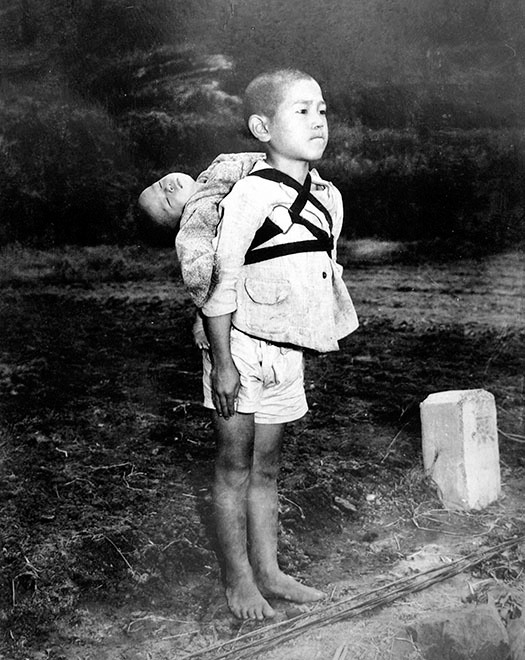 If you’re against war, get this book: The photos will haunt you http://www.asahi.com/ajw/articles/AJ201708100035.html By SONOKO MIYAZAKI/ Staff Writer August 10, 2017 A boy standing at rigid attention with the dead body of his infant brother strapped to his back at a crematorium in Nagasaki is one of searing images of the city’s destruction after the U.S. atomic bombing in 1945.
In a book published Aug. 9, Kimiko Sakai, the widow of Joe O’Donnell, the photographer who snapped the image, tells the story of her husband’s life work through photographs he shot in Japan in the immediate aftermath of the war.
Aug. 9 marked the 72nd anniversary of the bombing as well as the 10th anniversary of O’Donnell’s death at the age of 85.
The 192-page book, titled “Kamisama no Finder: Moto-Beijugun Cameraman no Isan” (God’s finder: the legacy of a former war photographer), was published by the Tokyo-based Word of Life Press Ministries.
After Japan’s surrender, O’Donnell, who was attached to the U.S. Marine Corps, traveled to Hiroshima, Nagasaki and other Japanese cities to document the wartime devastation. He stayed in Japan from September 1945 to March 1946.
He took 300 or so photographs for his private use.
He believed it was wrong to drop the atomic bombs after witnessing the sufferings of the victims.
But O’Donnell didn’t exhibit these pictures for decades because of prevailing U.S. sentiment that the atomic bombings of Hiroshima and Nagasaki hastened the end of World War and saved many American lives.
O’Donnell later decided to exhibit the photographs in the hope they would help advance the anti-war movement.
The catalyst for this was when he gazed on a sculpture evoking Jesus on the cross and engulfed by flames at a church in Kentucky in 1989. The life-size work, titled “Once,” was created for the repose of the tens of thousands of people killed in that atomic bombings, with photos of victims pasted all over the body. O’Donnell was stunned.
After that, O’Donnell until his death held exhibitions of his photos in the United States and Japan to convey the horrors of nuclear war.
The image of the boy at the crematorium stayed with him. O’Donnell recalled that the boy stared motionless as bodies were being burned and he awaited his turn. He also noticed that the boy’s lips were caked with blood because he was biting them so hard, although no blood spilled.
Sakai agreed to a proposal to publish the book after she was contacted by the publisher two years or so ago. Sakai, who lives in Tennessee, said she accepted out of respect for her husband’s commitment to the anti-war cause.
“My husband photographed his subjects as fellow human beings, not as an occupier,” she said in a recent interview with The Asahi Shimbun.
Asked if she had a message for those working to rid the world of nuclear arsenals, she said, “Just ‘not to forget,’ which is important.”
1 This Month

of the week – Shut Down Drone Warfare!


Tell the Ukrainian Government to Drop Prosecution of Peace Activist Yurii Sheliazhenko

Petition to revoke the licensing of the Near Surface Nuclear Disposal Facility (NSDF) at Chalk River. https://www.ourcommons.ca/petitions/en/Petition/Details?Petition=e-7247
To see nuclear-related stories in greater depth and intensity – go to https://nuclearinformation.wordpress.com
-
Archives
- April 2026 (114)
- March 2026 (251)
- February 2026 (268)
- January 2026 (308)
- December 2025 (358)
- November 2025 (359)
- October 2025 (376)
- September 2025 (257)
- August 2025 (319)
- July 2025 (230)
- June 2025 (348)
- May 2025 (261)
-
Categories
- 1
- 1 NUCLEAR ISSUES
- business and costs
- climate change
- culture and arts
- ENERGY
- environment
- health
- history
- indigenous issues
- Legal
- marketing of nuclear
- media
- opposition to nuclear
- PERSONAL STORIES
- politics
- politics international
- Religion and ethics
- safety
- secrets,lies and civil liberties
- spinbuster
- technology
- Uranium
- wastes
- weapons and war
- Women
- 2 WORLD
- ACTION
- AFRICA
- Atrocities
- AUSTRALIA
- Christina's notes
- Christina's themes
- culture and arts
- Events
- Fuk 2022
- Fuk 2023
- Fukushima 2017
- Fukushima 2018
- fukushima 2019
- Fukushima 2020
- Fukushima 2021
- general
- global warming
- Humour (God we need it)
- Nuclear
- RARE EARTHS
- Reference
- resources – print
- Resources -audiovicual
- Weekly Newsletter
- World
- World Nuclear
- YouTube
-
RSS
Entries RSS
Comments RSS
 nuclear-news