Menzies “immediately agreed to the proposal,” without consulting any of his cabinet colleagues or the Australian parliament. Indeed, until weeks before the first test was carried out, only three government ministers knew about it.
The most devastating effects were suffered by two groups: Australian and British soldiers working on the tests themselves, and the Indigenous populations local to Emu Field and the later testing site of Maralinga.
One prominent member of the testing team, Sir Ernest Titterton, later said that if Indigenous people had a problem with the government, they should vote it out, ignoring that Indigenous Australians did not have full political rights until 1967.
an Australian defense ministry report was leaked to the press, warning that large amounts of plutonium left at Maralinga could potentially be a target of terrorists.
those wrongs have not been fully addressed. Health problems stemming from the tests continue for those still living, and while the veracity of Lester and other victims’ stories has been acknowledged, what exactly happened to them remains unclear, the details of the nuclear test still kept top secret.
“To this day we don’t know what Totem I did, those records are still classified by the British,
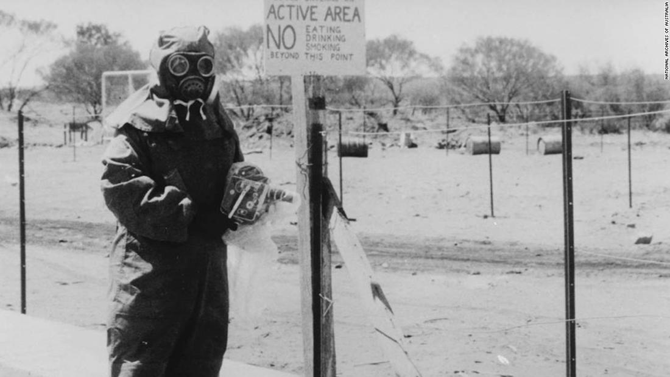
Yami Lester was 12 years old when the black mist came to Walatinna.
Early on the morning of October 15, 1953, Lester heard a “big bang” in the distance. This was followed by a dark, ominous-looking cloud which drifted low over the ground like a slow-moving dust storm, bringing with it an unpleasant smell.
A tiny speck in the vast South Australian outback, the area around Walatinna was regarded as “depressingly inhospitable to Europeans” by early colonizers, few of whom settled there. But Indigenous people had a long history in the region, including Lester’s tribe.
As the dark cloud settled over the Walatinna camp, the tribal elders attempted to ward it off, thinking it was a malevolent spirit. In many ways they were right.
As those exposed to it later told investigators, the black mist caused their eyes to sting and their skin to break out in rashes. Others vomited and suffered from diarrhea.
It took almost three decades until the cause of the mist was acknowledged as the Totem I nuclear bomb test, as Indigenous people had been claiming for years.
That test was one of a number conducted in the 1950s and ’60s, not by the Australian government, but by its former colonial master, the UK. Today, 65 years after the Totem I test, the effects are still being felt in South Australia and beyond.
British bomb
Australia was not the UK’s first choice of nuclear testing site. British scientists had been intimately involved in the Manhattan Project during World War II, and fully expected to be able to follow the US in testing their own nuclear weapon on American soil.
However, after it emerged Soviet spies had infiltrated the US atomic program, Washington passed the McMahon Act, which strictly limited the sharing of nuclear information with other countries and sent London looking for new locations to conduct its first test.
“Ultimately, they settled on Australia, which had many benefits,” said Elizabeth Tynan, author of “ Atomic Thunder: The Maralinga story,” a book about the tests. These includes a sympathetic, compliant government under the recently elected Anglophile Prime Minister Robert Menzies, and wide open spaces in which to carry out the detonations themselves. In September 1950, British leader Clement Attlee sent Menzies a secret message asking whether his government “would be prepared in principle to agree that the first United Kingdom atomic weapon should be tested in Australian territory.”
According to a later Australian Royal Commission investigation, Menzies “immediately agreed to the proposal,” without consulting any of his cabinet colleagues or the Australian parliament. Indeed, until weeks before the first test was carried out, only three government ministers knew about it.
Menzies’ enthusiasm for the British bomb “wasn’t all sycophantism, it wasn’t all sucking up to his colonial masters,” said Tynan, though this was definitely a factor. The Australian leader also saw in the atomic age an advantage for his country, which was one of the few to have large stocks of uranium, a previously largely unwanted material.
The UK’s first atomic bomb was detonated in the waters off the Montebello Islands, a small archipelago in north western Australia, in the early hours of October 3, 1952, officially making London the third member of the nuclear club, after the US and the Soviet Union.
Emu Field
While the Montebello Islands were used for the first test, British planners were never totally happy with the location, and even before the bomb was set off they began looking for a site on the Australian mainland where they could be granted greater secrecy and autonomy.
They settled on a location in the Great Victoria Desert, about 480 kilometers (300 miles) from the nearest town, Woomera, which they named Emu Field.
Plans were soon set in motion for a second test, and on October 15, 1953, the first of the Totem devices was detonated.
Unlike the Montebello test, which went off largely as planned, the 9.1 kiloton Totem I sent a cloud of debris and smoke some 15,000 feet (4,500 meters) into the air, spreading fallout far higher and farther than originally expected.
The Royal Commission later found the test was carried out in inappropriate wind conditions and without proper consideration for people living nearby, examples of the often staggering lack of care taken by British officials overseeing the nuclear program, who frequently ignored or did not bother to seek out vital information about the potential effects of their tests on the host country.
Black mist
The most devastating effects were suffered by two groups: Australian and British soldiers working on the tests themselves, and the Indigenous populations local to Emu Field and the later testing site of Maralinga.
While some concern was paid to their safety during the tests, it was often cursory at best. A single “native patrol officer” given the thankless task of having to try and inform Indigenous residents of the potential dangers had a 100,000 square kilometer (38,610 square mile) region to cover.
Nor did the British much seem to care. One prominent member of the testing team, Sir Ernest Titterton, later said that if Indigenous people had a problem with the government, they should vote it out, ignoring that Indigenous Australians did not have full political rights until 1967.
Another senior official, in a letter to his superiors, complained that W. B. MacDougall, the man with the dubious task of trying to protect the local Indigenous populations, was “placing the affairs of a handful of natives above those of the British Commonwealth of Nations.”
“The harm done to the Aboriginal people is one of the most shameful aspects (of the tests),” Tynan said. “Nowhere in the British records is there a sign of even the slightest concern for the Aboriginal people.”
This lack of concern is likely what led to the situation at Walatinna. Around 40 people were in the camp when the Totem I blast sent clouds of radiated material miles into the sky.
“It rumbled, the ground shook, it was frightening,” Lalli Lennon told investigators. Some time later, a large black cloud passed low over the settlement. Her husband Stan described it as “sort of hazy, like a fog or something.” Lalli and her children developed fevers, headaches, vomiting and diarrhea, and two of them suffered rashes and sore eyes from the smoke.
But just as they had paid little attention to the wellbeing of Indigenous people prior to the test, the British and Australian authorities did not concern themselves with such matters afterwards.
This was reflected by and large by Australian public opinion, which Tynan said was initially “quite jubilant” about the tests, and remained broadly supportive until the 1970s and ’80s, when a host of revelations about the British nuclear program exposed its lackluster safety procedures — even by the standards of the time — and the disdain of those overseeing it for Australian democratic oversight.
Maralinga mess
This shift began when an Australian defense ministry report was leaked to the press, warning that large amounts of plutonium left at Maralinga could potentially be a target of terrorists. This ran contrary to a 1968 report prepared by British official Noah Pearce which assured the Australian government the plutonium had been properly buried and did not present a significant risk.
Indeed, that year the Australians agreed to release the UK from nearly all “liabilities and responsibilities” regarding the tests, in the belief the British had “completed decontamination and debris clearance … to the satisfaction of the Australian government.”
When Canberra finally carried out its own survey of the site, scientists were shocked by what they found.
“They still thought the Pearce Report was accurate until their geiger counter went crazy,” said Tynan, who has interviewed several of the inspectors. “They weren’t wearing protective gear (and) were kicking plutonium soaked rocks with their boots.”
The Royal Commission report said later that there were between “25,000 and 50,000 plutonium- contaminated fragments in the (Maralinga) area, although the number might need to be doubled if missed and buried fragments were included.” Emu Field and the Montebello Islands were also found to be more dangerous than expected.
“In addition to British scientific and military personnel, thousands of Australians were exposed to radiation produced by the tests,” according to a report by the Australian Institute of Criminology. “These included not only those involved in supporting the British testing program, but also Aboriginal people living downwind of the test sites, and other Australians more distant who came into contact with airborne radioactivity.”
Final hearing
The Royal Commission hearings marked the end to any lingering approval of the tests among the Australian public, exposing fully the ongoing harm done to the local environment, Indigenous people, and the soldiers who worked on the tests.
While many disorders are difficult to link directly to the nuclear tests, veterans of the program have complained of numerous cancers, autoimmune diseases, and other ailments — including among their children — which they put down to their lack of protective clothing and other precautions at the time. Last year, the Australian government expanded medical benefits for members of the nuclear testing program, but most are now in their late 80s and one told the ABC the move was “too bloody late.” The harm done to Indigenous people has also been recognized in the decades since the Royal Commission, including by the black mist — which a British official once said investigating would be a “complete waste of money and time.”
In 1993, the British agreed to pay the Australian government and the traditional owners of the Maralinga lands around 46 million AUD ($30 million). The Australian authorities also paid Indigenous Maralinga communities a settlement of 13.5 million AUD ($9 million). “Everyone became friends again after that,” said Tynan, adding that the issue, which had dominated Australian media and public attention for years, slowly slipped away, becoming a “great Australian secret.”
Today, she said she often meets young Australians who are unaware of the tests, and even many people who were alive at the time of the Royal Commission who only have a hazy idea of the issues.
“It was one of those things that, because it was not really written into the history books … just dropped off the radar,” she said, even as veterans and Indigenous people affected by the tests continue to suffer health repercussions and shortened lifespans because of their exposure to radiation.
Yami Lester died on July 21, 2017. He was remembered in parliament by then Prime Minister Malcolm Turnbull as a “man of wonderful intelligence and insight, as an elder of great standing and as a champion of Aboriginal rights and dignity.” “He will be revered for rising from personal tragedy to serve his community and to lead his people to ensure that they were recognized and their wrongs addressed,” Turnbull added.
But as Tynan and others have pointed out, those wrongs have not been fully addressed. Health problems stemming from the tests continue for those still living, and while the veracity of Lester and other victims’ stories has been acknowledged, what exactly happened to them remains unclear, the details of the nuclear test still kept top secret.
“To this day we don’t know what Totem I did, those records are still classified by the British,” Tynan said. “It remains one of the great mysteries.”
|
October 15, 2018
Posted by Christina Macpherson |
AUSTRALIA, history, weapons and war |
Leave a comment
Radiation Free Lakeland 10th Oct 2018 Today folk from Radiation Free Lakeland and Close Capenhurst remembered the 61st anniversary of the Windscale Fire. During 10–11th October, 1957 A
serious fire developed in the core of a nuclear reactor at Windscale Works,
Sellafield, northwest England, which led to the release of significant
quantities of radioactive material into the environment over a wide area
including but not exclusively Cumbria. This release of radioactive
materials including polonium, led to an increase in radiation linked
diseases and conditions from cancers to Downs Syndrome.
https://mariannewildart.wordpress.com/2018/10/10/remembering-windscale-outside-the-gates-where-nuclearmudness-is-made/
October 13, 2018
Posted by Christina Macpherson |
history, UK |
Leave a comment
 U.S. General Considered Nuclear Response in Vietnam War, Cables Show, By David E. Sanger, NYT, Oct. 6, 2018 WASHINGTON — In one of the darkest moments of the Vietnam War, the top American military commander in Saigon activated a plan in 1968 to move nuclear weapons to South Vietnam until he was overruled by President Lyndon B. Johnson, according to recently declassified documents cited in a new history of wartime presidential decisions.
The documents reveal a long-secret set of preparations by the commander, Gen. William C. Westmoreland, to have nuclear weapons at hand should American forces find themselves on the brink of defeat at Khe Sanh, one of the fiercest battles of the war.
With the approval of the American commander in the Pacific, General Westmoreland had put together a secret operation, code-named Fracture Jaw, that included moving nuclear weapons into South Vietnam so that they could be used on short notice against North Vietnamese troops.
Johnson’s national security adviser, Walt W. Rostow, alerted the president in a memorandum on White House stationery.
The president rejected the plan, and ordered a turnaround, according to Tom Johnson, then a young special assistant to the president and note-taker at the meetings on the issue, which were held in the family dining room on the second floor of the White House………..
Had the weapons been used, it would have added to the horrors of one of the most tumultuous and violent years in modern American history. Johnson announced weeks later that he would not run for re-election. The Rev. Dr. Martin Luther King Jr. and Robert F. Kennedy were assassinated shortly thereafter.
The story of how close the United States came to reaching for nuclear weapons in Vietnam, 23 years after the atomic bombings of Hiroshima and Nagasaki forced Japan to surrender, is contained in “Presidents of War,” a coming book by Michael Beschloss, the presidential historian.
……….The incident has echoes for modern times. It was only 14 months ago that President Trump was threatening the use of nuclear weapons against North Korea — which, unlike North Vietnam at the time, possesses its own small nuclear arsenal.
………And before he was dismissed in 1951 by President Harry S. Truman, Gen. Douglas MacArthur explored with his superiors the use of nuclear weapons in the Korean War. Truman had feared that MacArthur’s aggressive strategy would set off a larger war with China, but at one point did move atomic warheads to bases in the Pacific, though not to Korea itself…….
Mr. Beschloss’s book, which will be published on Tuesday by Crown, examines challenges facing presidents from Thomas Jefferson to George W. Bush. https://www.nytimes.com/2018/10/06/world/asia/vietnam-war-nuclear-weapons.html
October 8, 2018
Posted by Christina Macpherson |
history, USA, weapons and war |
Leave a comment

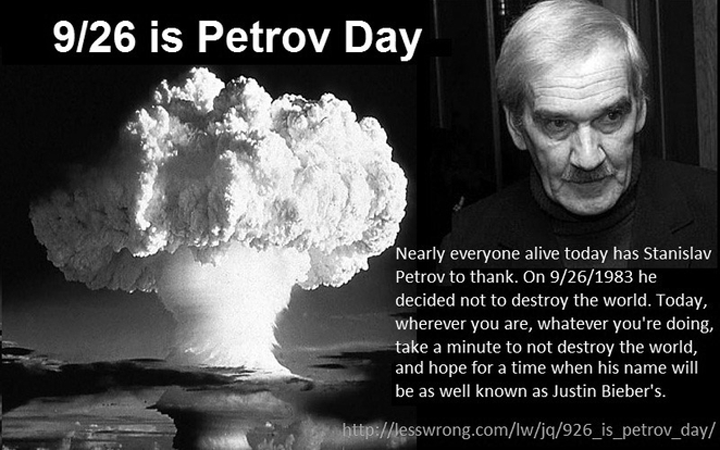
35 years ago today, one man saved us from world-ending nuclear war https://www.vox.com/2018/9/26/17905796/nuclear-war-1983-stanislav-petrov-soviet-union
On September 26, 1983, Stanislav Petrov saved the world. By Dylan Matthews@dylanmattdylan@vox.com Sep 26, 2018 On September 26, 1983, the planet came terrifyingly close to a nuclear holocaust.
The Soviet Union’s missile attack early warning system displayed, in large red letters, the word “LAUNCH”; a computer screen stated to the officer on duty, Soviet Lt. Col. Stanislav Petrov, that it could say with “high reliability” that an American intercontinental ballistic missile (ICBM) had been launched and was headed toward the Soviet Union. First, it was just one missile, but then another, and another, until the system reported that a total of five Minuteman ICBMshad been launched.
“Petrov had to make a decision: Would he report an incoming American strike?” my colleague Max Fisher explained. “If he did, Soviet nuclear doctrine called for a full nuclear retaliation; there would be no time to double-check the warning system, much less seek negotiations with the US.”
Reporting it would have made a certain degree of sense. The Reagan administration had a far more hardline stance against the Soviets than the Carter, Ford, or Nixon administrations before it. Months earlier President Reagan had announced the Strategic Defense Initiative(mockingly dubbed “Star Wars,” a plan to shoot down ballistic missiles before they reached the US), and his administration was in the process of deploying Pershing II nuclear-armed missiles to West Germany and Great Britain, which were capable of striking the Soviet Union. There were reasons for Petrov to think Reagan’s brinkmanship had escalated to an actual nuclear exchange.
But Petrov did not report the incoming strike. He and others on his staff concluded that what they were seeing was a false alarm. And it was; the system mistook the sun’s reflection off clouds for a missile. Petrov prevented a nuclear war between the Soviets, who had 35,804 nuclear warheads in 1983, and the US, which had 23,305.
A 1979 report by Congress’s Office of Technology Assessment estimated that a full-scale Soviet assault on the US would kill 35 to 77 percent of the US population — or between 82 million and 180 million people in 1983. The inevitable US counterstrike would kill 20 to 40 percent of the Soviet population, or between 54 million and 108 million people. The combined death toll there (between 136 million and 288 million) swamps the death toll of any war, genocide, or other violent catastrophe in human history. Proportional to world population, it would be rivaled only by the An Lushan rebellion in eighth-century China and the Mongol conquests of the 13th century.
And it’s likely hundreds of millions more would have died once the conflict disrupted global temperatures and severely hampered agriculture. International Physicians for the Prevention of Nuclear War put the potential death toll from starvation at about 2 billion.
Petrov, almost single-handedly, prevented those deaths.
Preventing the deaths of hundreds of millions, if not billions, of people was a costly decision for Petrov. If he had been wrong, and he somehow survived the American nuclear strike, he likely would’ve been executed for treason. Even though he was right, he was, according to the Washington Post’s David Hoffman, “relentlessly interrogated afterward [and] never rewarded for his decision.”
After the Cold War, Petrov would receive a number of commendations for saving the world. He was honored at the United Nations, received the Dresden Peace Prize, and was profiled in the documentary The Man Who Saved the World. “I was just at the right place at the right time,” he told the filmmakers. He died in May 2017, at the age of 77. Two new books about the Petrov incident and other nuclear close calls in 1983 (related to the NATO exercise Able Archer) came out just this year: Taylor Downing’s 1983 and Marc Ambinder’s The Brink.
Petrov isn’t the only man who’s prevented nuclear war
Petrov was not the only Russian official who’s saved the world. On October 27, 1962, Vasili Arkhipov, a Soviet navy officer, was in a nuclear submarine near Cuba when US naval forces started dropping depth charges (a kind of explosive targeting submarines) on him. Two senior officers on the submarine thought that a nuclear war could’ve already begun and wanted to launch a nuclear torpedo at a US vessel. But all three senior officers had to agree for the missile to fire, and Arkhipov dissented, preventing a nuclear exchange and potentially preventing the end of the world.
Even more recently, on January 25, 1995, Russian early warning radars suggested that an American first strike was incoming. President Boris Yeltsin was alerted and given a suitcase with instructions for launching a nuclear strike at the US. Russian nuclear forces were given an alert to increase combat readiness. Yeltsin eventually declined to launch a counterstrike — which is good, because this was another false alarm. It turns out that Russian early warning systems had picked up a Norwegian-US joint research rocket, launched by scientists studying the northern lights.
But September 26, Stanislav Petrov Day, is as good a time as any to celebrate the ordinary officers who took a stand when it counted to prevent hundreds of millions of deaths. And it’s as good a time as any to remember that as long as the US and Russia retain massive nuclear arsenals, these kinds of close calls will remain possible — and in the future, a false alarm could result in an accidental first strike.
|
|
|
September 28, 2018
Posted by Christina Macpherson |
depleted uranium, history, PERSONAL STORIES, politics international, Reference, Religion and ethics |
Leave a comment
NUCLEAR NAZI How Adolf Hitler’s plan to build an atomic bomb and destroy London was only thwarted when ferry carrying key ingredients sunk https://www.thesun.co.uk/news/7150860/how-adolf-hitler-atomic-bomb-london-only-thwarted-by-ferry-ride/
The discovery shines light on Hitler’s ambitions to become a nuclear power and nuke Britain,By Harvey Solomon-Brady 1st September 2018
ADOLF Hitler’s plans to blow up London with a nuclear bomb very nearly succeeded, a new documentary has revealed.
A Nazi ship with the secret mission of transporting heavy water – an ingredient used for nuclear reactors – has been found by scientists and naval historians in Norway. The 170ft Hydro ferry, which Winston Churchill ordered to be sank in 1944, has been dragged up from the bottom of a 460-ft-deep Norwegian lake near Oslo.
Churchill was unaware of the ship’s purpose but ordered its sinking anyway, a choice that is now believed to have saved Britain’s capital city.
The National Geographic series Drain the Oceans sees teams discover 40 barrels of heavy water when they virtually lifted the vessel.
This quantity of heavy water would have been more than enough to catapult Germany on her way to becoming a nuclear power. Naval historian professor Eric Gove told the Daily Telegraph: “After the war, those involved in the German nuclear programme said that the loss of heavy water was absolutely decisive. It stopped their reactor programme in its tracks.”
Norway became a target of the Allies after it began producing water in 1934, above Lake Tinn at Vemork.
Five years later in 1939 the country began its ‘uranium club’. Otto Hahn and Fritz Strassmann had placed Germany at the head of the pack in the nuclear race after they discovered fission.
Fission is the radioactive decay process where an atom’s nucleus splits into smaller parts.
The scientists needed heavy water in order to control the fission process.
After Hitler invaded Norway in 1940, he ordered his troops to move straight for the nuclear plant in Vemork.
Consequently, Operation Gunnerside was launched in 1943 after Britain feared Hitler would use this substance against his enemies.
Despite blowing up the plant while the Hydro was sunk, the Norwegians did not destroy all the Germany supply of heavy water the Nazis began to move the following year by train and ferry. However, Churchill was already a move ahead.
He and his generals had already ordered their Norway counterparts to attach a bomb to the vessel.
The mission was later documented in The Heroes of Telemark.
Drain the Ocean will appear on National Geographic every week from September 6.
September 3, 2018
Posted by Christina Macpherson |
Germany, history, weapons and war |
Leave a comment
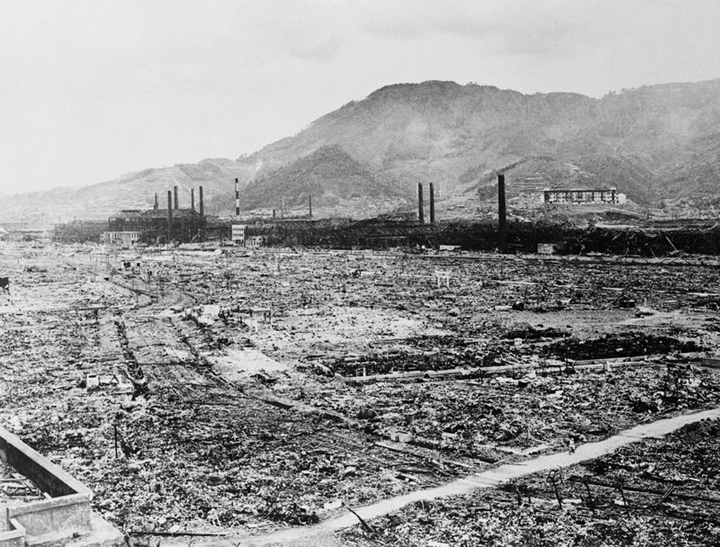
 The Nagasaki bombing mission: excused by “just NOT following orders” http://www.litbyimagination.com/2018/08/the-nagasaki-bombing-mission-excused-by.html The thought process that never happened on August 9, 1945:
“Well, let’s see here. The reserve fuel tank pump was broken before take-off, and we knew it, so we were supposed to call off the mission then. Next, we failed to rendezvous over Yakushima with one of the crucial planes in the mission. At the primary target of Kokura we encountered cloud cover and flak. Now we are so dangerously low on fuel that there’s a good chance we’re going to lose the bomb and our lives by ditching in the Pacific. If we carry out the mission at the secondary target, and survive, there’s a good chance we’ll be court-martialed for not following orders to abort the mission if troubles like these arose. Hmmm. Let’s just spare Nagasaki, get back to base safely, and hope this war is over soon before we have to drop the second bomb.”
Unfortunately, the commanding officers of Bockscar, the plane that dropped the bomb on Nagasaki, were eager to not look like failures after the “success” of the Enola Gay over Hiroshima three days earlier. The full story is told in the article “The harrowing story of the Nagasaki bombing mission“ (Bulletin of Atomic Scientists, August 4, 2015). After encountering the many troubles listed above, the plane went to the secondary target, Nagasaki, and the pilot determined to drop the bomb by radar through the cloud cover, against specific orders to drop it only with a clear view of the target. “Fortunately,” there was an opening in the clouds over the Urakami district, which was not the intended target over the center of the city. They hastily decided to drop the bomb there, then headed toward Okinawa for an emergency landing. They approached Okinawa with empty fuel tanks, expecting they would have to ditch in the ocean and die. The crew was literally willing to die rather than return as “failures” compared to their colleagues who had flown on the Enola Gay. In this regard, they were much like the fictional Major T.J. King Kong in Dr. Strangelove who carried out a suicide mission in order to start WWIII.
August 10, 2018
Posted by Christina Macpherson |
history, Japan, USA, weapons and war |
1 Comment

‘I still hate the glow of the sun’: Hiroshima survivors’ tales, https://au.news.yahoo.com/thewest/a/31704344/i-still-hate-the-glow-of-the-sun-hiroshima-suvivors-tales/ May 26, 2016, Hiroshima (Japan) (AFP) – For survivors of the world’s first nuclear attack, the day America unleashed a terrible bomb over the city of Hiroshima remains seared forever in their minds.
Though their numbers are dwindling and the advancing years are taking a toll, their haunting memories are undimmed by the passage of more than seven decades.
On the occasion of Barack Obama’s offering of a floral tribute on Friday at the cenotaph in Hiroshima Peace Memorial Park — the first ever visit by a sitting US president — some of them share their stories with AFP.
Emiko Okada
Emiko Okada, now 79, was about 2.8 kilometres (1.7 miles) from ground zero and suffered severe injuries in the blast. Her sister was killed.
“All of a sudden a flash of light brightened the sky and I was slammed to the ground. I didn’t know what on earth had happened. There were fires everywhere. We rushed away as the blaze roared toward us.
“The people I saw looked nothing like human beings. Their skin and flesh hung loose. Some children’s eyeballs were popping out of their sockets.
“I still hate to see the glow of the setting sun. It reminds me of that day and brings pain to my heart.
“In the aftermath, many children who had evacuated during the war came back here, orphaned by the bomb. Many gangsters came to Hiroshima from around the country and gave them food and guns.
“President Obama is a person who can influence the world. I hope that this year will be the beginning of knowing what actually happened in Hiroshima and Nagasaki under the mushroom clouds.”
Keiko Ogura
Keiko Ogura, now 78, has devoted her life to keeping alive the memory of the devastating day. Continue reading →
August 4, 2018
Posted by Christina Macpherson |
history, Japan, Reference, weapons and war |
Leave a comment

Mini-storytellers’: Japanese children pass on horror of Nagasaki bombings, As more and more survivors who directly witnessed the nuclear attack die, students are taking on responsibility for telling their stories, Guardian Daniel Hurst in Nagasaki, 2 August 18
The 500 students at Shiroyama Elementary School gather in the assembly hall on the ninth day of every month to sing a song. This is no ordinary school anthem, however.
Dear Children’s Souls deals with the most traumatic chapter in the school’s long history: the moment 1,400 students and 28 staff members died when the United States dropped an atomic bomb on the southern Japanese city of Nagasaki in the closing stages of the second world war.
Nearly 73 years have passed since the bombing of Nagasaki on 9 August 1945 – and Hiroshima three days earlier – but the school feels a special responsibility to keep the memories alive.
“Shiroyama Elementary School is situated closest to the ground zero of the A-bombing compared to other municipal elementary schools in Nagasaki,” explains the softly spoken principal, Hiroaki Takemura, adding that the hypo-centre was just 500m away.
“The feelings for peace are very strong here.”The task is becoming increasingly vital as more and more of the survivors who directly witnessed the events pass away. The ranks of these survivors, known as hibakusha, have halved over the past two decades and their average age is now 82. As they become less mobile, they find it more difficult to travel and give first-hand accounts of the horrors of nuclear war in the hope of preventing any repeat amid growing global tensions. Continue reading →
August 3, 2018
Posted by Christina Macpherson |
history, Japan, weapons and war |
Leave a comment
Remembering A Near Disaster: U.S. Accidently Drops Nuclear Bombs On Itself And Its Allies WUNC91.5, By JAY PRICE 24 May 18
During the Cold War, U.S. planes accidentally dropped nuclear bombs on the east coast, in Europe, and elsewhere. “Dumb luck” prevented a historic catastrophe.
This year marks the 50th anniversary of a decision that ended a perilous chapter of the Cold War.
In 1968, the Pentagon halted a program that kept military bombers in the air, loaded with nuclear weapons to deter a Soviet attack.
The problem was the jets kept having near-catastrophic accidents.
“If you go through some of the archival evidence publicly available, it seems like once a week or so, there was some kind of significant noteworthy accident that was being reported to the Department of Defense or the Atomic Energy Commission or members of Congress,” said Stephen Schwartz, a long-time nuclear weapons analyst.
Schwartz singled out 1958 as a particularly notorious year.
“We’re actually celebrating − celebrating is probably the wrong word − but we’re marking the 60th anniversary of no fewer than eight nuclear weapons accidents this year,” Schwartz said.
Every couple of weeks, Maurice Sanders gets a reminder of one of those 1958 accidents when a car with out-of-state tags parks in front of his house just outside Florence, South Carolina. Strangers pile out and tromp around to the scrub oak forest just behind his back yard to gaze down at an odd tourist attraction.
“It’s the hole from where the bomb had dropped, years ago,” Sanders said. “I think it’s on some kind of map or something.”
The circular pit is as big around as a small house, with a pond of tea-colored water at the bottom. A fading plywood cutout that someone put up − apparently to lure more tourists − is the size and shape of the Mark 6 nuclear bomb that was dropped there by accident.
The core containing the nuclear material was stored separately on the B-47 bomber it fell from, but the high explosives that were used to trigger the nuclear reaction exploded on impact, digging the crater estimated at 35 feet deep. The blast injured six members of a nearby family and damaged their home beyond repair.
Earlier that same year, just one state farther south, a jet fighter collided with a bomber during a training exercise, and the crew jettisoned a bomb into coastal waters near Savannah, Georgia.
Two years later, in 1961, a B-52 bomber flying out of Seymour Johnson Air Force Base near Goldsboro came apart in the sky, and the two armed nuclear bombs it was carrying fell into a farming community northeast of the base. One buried itself so deeply into a tobacco field that some of its parts were never found. The other floated down on a parachute, planting its nose in the ground beside a tree.
The parachute bomb came startlingly close to detonating. A secret government document said three of its four safety mechanisms failed, and only a simple electrical switch prevented catastrophe. It was 260 times more powerful than the bomb dropped on Hiroshima and could have instantly killed thousands of people. The radioactive fallout could have endangered millions more as far north as New York City.
Safety takes back seat to readiness
The military’s name for serious nuclear weapons mishaps is “broken arrow.” The Pentagon has only officially acknowledged 32 broken arrows, but evidence compiled by the government shows there were thousands more accidents involving nuclear weapons, Schwartz said.
“Most of which were not that as serious as the 32 we know about, but some of them were quite bad,” he said.
Schwartz said a wave of serious accidents in the late 1950s through 1968 was partly due to programs that kept the U.S. on a war footing. A few planes were kept aloft 24 hours a day, ready to drop bombs on Russia.
And then there was the sheer number of weapons being made, which created more opportunities for things to go wrong.
Schwartz said by the year after the bomb fell on South Carolina, the U.S. was making almost 20 nuclear weapons a day……..
“Everything associated with nuclear weapons the nuclear weapons delivery system, the command-and-control systems that make sure they go off when they’re supposed to and most importantly that they don’t go off when they’re not supposed to − all of these things are designed, built, operated, and maintained by human beings,” Schwartz said. “And human beings are fallible.”
Overseas accidents bring program’s end
It wasn’t the bombs the U.S. dropped on itself that finally ended the program. Rather, it was two accidents over friendly nations.
In 1966, a B-52 bomber – also flying out of Seymour Johnson – broke apart in the sky near the coast of Spain. One of its bombs dropped into the sea, and three fell on land where conventional explosives scattered radioactive material.
Then, in 1968, the burning-seat-cushion crash spread plutonium and uranium onto sea ice and into the sea off the coast of Greenland……..http://wunc.org/post/remembering-near-disaster-us-accidently-drops-nuclear-bombs-itself-and-its-allies#stream/0
May 25, 2018
Posted by Christina Macpherson |
history, incidents, Reference, USA, weapons and war |
Leave a comment
 How America Jump-Started Iran’s Nuclear Program, History, BY BECKY LITTLE // MAY 9, 2018
For several decades now, the U.S. has sought to deter Iran from developing nuclear weapons. But ironically, the reason Iran has the technology to build these weapons in the first place is because the U.S. gave it to Iran between 1957 and 1979. This nuclear assistance was part of a Cold War strategy known as “Atoms for Peace.”
The strategy’s name comes from Dwight Eisenhower’s “Atoms for Peace” speech, given before the United Nations General Assembly in 1953. In it, he suggested that promoting the non-military use of nuclear technology could discourage countries from using it to create nuclear weapons, or “Atoms for War.”
The speech came only eight years after the invention of the atomic bomb, at a time when the U.S. was anxious to keep these new and frightening weapons from proliferating around the world. Strange as it sounds, President Eisenhower viewed his “Atoms for Peace” strategy partly as a form of arms control.
“He thought that sharing nuclear technology for peaceful purposes would reduce the incentives of countries to want to make nuclear bombs,” says Matthew Fuhrmann, a political science professor at Texas A&M University and author of Atomic Assistance: How “Atoms for Peace” Programs Cause Nuclear Insecurity. ……..
the U.S. provided nuclear assistance to countries it wanted to influence, such as Israel, India, Pakistan, and Iran.
At the time, the U.S. was closely allied with Iran’s Shah, Mohammad Reza Pahlavi. So closely, in fact, that when Iran toppled the Shah’s monarchy and democratically elected a prime minister, the CIA staged a 1953 coup d’état that put the Shah back in power. Part of the reason the U.S. valued Iran as an ally was because of its strategic location bordering the Soviet Union. During the early part of the Cold War, the U.S. set up a base in Iran to monitor Soviet activity.
In this context, the United States’ nuclear cooperation with Iran “was, in part, a means to shore up the relationship between those countries,” Fuhrmann says. The cooperation lasted until 1979, when the the Iranian Revolution ousted the Shah and the U.S. lost the country as an ally.
All of the nuclear technology the U.S. provided Iran during those years was supposed to be for peaceful nuclear development. But the “Atoms for Peace” strategy ended up having some unintended consequences.
“A lot of that infrastructure could also be used to produce plutonium or weapons-grade, highly-enriched uranium, which are the two critical materials you need to make nuclear bombs,” Fuhrmann says. In effect, the U.S. laid the foundations for the Iranian nuclear weapons program.
Iran first became seriously interested in creating nuclear weapons during the 1980s Iran-Iraq War. It tried unsuccessfully to develop them in the late ‘90s and early 2000s. Still, Iranian nuclear development remains an international concern, especially now that Trump has withdrawn the U.S. from the 2015 Iranian nuclear deal, known as the Joint Comprehensive Plan of Action.
In the weeks leading up to Trump’s decision, Israeli Prime Minister Benjamin Netanyahu tried to convince him to exit the deal by arguing that Iran was still pursuing nuclear weapons. Other policy experts and world leaders have rejected this claim, and Fuhrmann says he’s seen no evidence that “Iran has violated the deal, or that Iran has done anything since 2003 … to build nuclear bombs.”
However, now that the U.S. has withdrawn from the nuclear deal, Fuhrmann worries “Iran is going to have incentives to do those things, whereas under the deal, those incentives were greatly reduced.” https://www.history.com/news/iran-nuclear-weapons-eisenhower-atoms-for-peace

May 11, 2018
Posted by Christina Macpherson |
history, Iran, USA |
Leave a comment
The US Has Lost Six Nuclear Weapons. So Where The Hell Are They? http://www.iflscience.com/technology/the-us-has-lost-six-nuclear-weapons-so-where-the-hell-are-they/ Tom Hale, 4 May 18 Keys, phones, headphones, socks, thermonuclear weapons – some things just always seem to go missing. Believe it or not,
the US has lost at least six atomic bombs or weapons-grade nuclear material since the Cold War.
Not only that, but the US is responsible for at least 32 documented instances of a nuclear weapons accident, known as a “Broken Arrow” in military lingo. These atomic-grade mishaps can involve an accidental launching or detonation, theft, or loss – yep loss – of a nuclear weapon.
February 13, 1950
The first of these unlikely instances occurred in 1950, less than five years after the first atomic bomb was detonated. In a mock nuclear strike against the Soviet Union, a US B-36 bomber en route from Alaska to Texas began to experience engine trouble. An icy landing and stuttering engine meant the landing was going to be near-impossible, so the crew jettisoned the plane’s Mark 4 nuclear bomb over the Pacific. The crew witnessed a flash, a bang, and a sound wave.
The military claim the mock-up bomb was filled with “just” uranium and TNT but no plutonium, so it wasn’t capable of a nuclear explosion. Nevertheless, the uranium has never been recovered.
March 10, 1956
On March 10, a Boeing B-47 Stratojet set off from MacDill Air Force Base Florida for a non-stop flight to Morocco with “two nuclear capsules” onboard. The jet was scheduled for its second mid-flight refueling over the Mediterranean Sea, but it never made contact. No trace of the jet or the nuclear material was ever found again.
February 5, 1958
In the early hours of February 5, 1958, a B-47 bomber with a 3,400-kilogram (7,500-pound) Mark 15 nuclear bomb on board accidentally collided with an F-86 aircraft during a simulated combat mission. The battered and bruised bomber attempted to land numerous times, but to no avail. Eventually, they made the decision to jettison the bomb into the mouth of the Savannah River near Savannah, Georgia, to make the landing possible. Luckily for them, the plane successfully landed and the bomb did not detonate. However, it has remained “irretrievably lost” to this day.
January 24, 1961
On January 24, 1961, the wing of a B-52 bomber split apart while on an alert mission above Goldsboro, North Carolina. Onboard were two 24-megaton nuclear bombs. One of these successfully deployed its emergency parachute, while the other fell and crashed to the ground. It’s believed the unexploded bomb smashed into farmland around the town, but it has never been recovered. In 2012, North Carolina put up a sign near the supposed crash site to commemorate the incident.
December 5, 1965
An A-4E Skyhawk aircraft loaded with a nuclear weapon rolled off the back off an aircraft carrier, USS Ticonderoga, stationed in the Philippine Sea near Japan. The plane, pilot, and nuclear bomb have never been found.
In 1989, the US eventually admitted their bomb was still laying in the seabed around 128 kilometers (80 miles) from a small Japanese island. Needless to say, the Japanese government and environmental groups were pretty pissed about it.
?, 1968
At some point during the Spring of 1968, the US military lost some kind of nuclear weapon. The Pentagon still keeps information about the incident tightly under wraps. However, some have speculated that the incident refers to the nuclear-powered Scorpion submarine. In May 1968, the attack submarine went missing along with its 99-strong crew in the Atlantic Ocean after being sent on a secret mission to spy on the Soviet navy. This, however, remains conjecture.
May 5, 2018
Posted by Christina Macpherson |
history, Reference, USA, weapons and war |
Leave a comment

How the Manhattan Project’s Nuclear Suburb Stayed Secret, Oak Ridge, Tennessee, once home to 75,000, went up fast and under the radar. But it was built to last, too. Atlas Obscura , BY JESSICA LEIGH HESTER , MAY 03, 2018 “…… Oak Ridge isn’t like most of the country’s other suburbs. The town was conceived and built by the United States government in the early 1940s as base for uranium and plutonium work, as part of the Manhattan Project. As the nuclear effort marched along, the town grew, too. By 1945, a dense suburb had taken shape, home to roughly 75,000 people. At war’s end, Oak Ridge was the fifth-largest city in the state—and all along, it was supposed to be a secret.
…….. the pace of building there was stunning enough, but doing it all under the radar required a little willful blindness. The town didn’t appear on any official maps, and visitors were screened by guards posted at the entrances. Still, at that scale, it couldn’t be truly clandestine. “People saw stuff, certainly,” Moeller says, but probably chose not to wonder too deeply about what was happening there out of a combination of patriotism and ignorance. Moeller speculates that those who saw workers and supplies streaming into the site may have sensed that asking too many questions would have been un-American. The idea was, “it’s not my business; it’s for the war effort,” he says. “There was a much greater spirit of national unity than we could even fathom now.”
Billboards were installed all over town to remind workers to keep their mouths shut about their work, even though most workers knew very little about the project’s true scope.
Similar “secret cities” were built in other parts of the country, such as Los Alamos, New Mexico, and Hanford, Washington, home to 125,000. Designers of these towns had additional tactics to obscure specifics. In Los Alamos and Hanford, sometimes everyone was given the same mailing address. At Oak Ridge, street addresses were designed to be confusing to outsiders. Bus routes might be called X-10 or K-25 or Y-12, in reference to the factories they led to, while dorms had simple names such as M1, M2, and M3. If you didn’t already know where you were trying to go, none of it would make sense. “There weren’t any signs on buildings, just numbers, codes names, and numbers,” Wilcox recalled. The town was full of such ciphers, and even employees didn’t know how to decode them all. ……https://www.atlasobscura.com/articles/how-to-build-secret-nuclear-city
May 5, 2018
Posted by Christina Macpherson |
history, Reference, secrets,lies and civil liberties, weapons and war |
Leave a comment
Off the map: the secret cities behind the atom bomb In 1943, three ordinary-looking US cities were constructed at record speed – but left off all maps. They had an extraordinary purpose: to create nuclear weapons as part of the Manhattan project, Guardian, by David Smith in Washington , 3 May 18
Something strange happened in the US state of Tennessee in 1943. Thousands of young workers poured into a 59,000-acre site about 25 miles west of Knoxville. Vast quantities of materials followed, never to re-emerge. Houses and other facilities were built with record speed. Yet officially Oak Ridge did not exist during the war and could not be found on any map.
What was going on there? Very few people knew at the time, even among the residents. The answer was that this was the starting block in a race against Adolf Hitler to build the atom bomb.
Oak Ridge was one of three “secret cities” of the Manhattan Project, along with Los Alamos in New Mexico and Hanford/Richland in Washington state.
More than 125,000 scientists, technicians and support staff occupied the three cities by the end of the war. There is a photo of a Santa Claus being frisked at the gates of Oak Ridge and a local newsletter stamped “restricted”. Anyone aged 12 or over had to wear an ID badge. The use of words such as “atomic” or “uranium” was taboo lest it tip off the enemy.
Yet some social aspects were all too familiar: even these planned communities, which tried to offer residents an idyllic lifestyle and would influence postwar urban construction and design in America, replicated the racial segregation of the era.
More than 125,000 scientists, technicians and support staff occupied the three cities by the end of the war. There is a photo of a Santa Claus being frisked at the gates of Oak Ridge and a local newsletter stamped “restricted”. Anyone aged 12 or over had to wear an ID badge. The use of words such as “atomic” or “uranium” was taboo lest it tip off the enemy.
Yet some social aspects were all too familiar: even these planned communities, which tried to offer residents an idyllic lifestyle and would influence postwar urban construction and design in America, replicated the racial segregation of the era.
It was late 1942, less than a year after the US had entered the second world war, when the US Army Corps of Engineers quietly began acquiring vast tracts of land in remote areas of three states. The few residents of these areas were summarily evicted and their houses demolished.
Soon thousands of young workers arrived from far and wide, initially occupying tents and other makeshift shelters within the newly designated military reservations. Shielded from public view by natural barriers and security fences, the workers quickly erected hundreds of buildings, ranging from prefabricated houses to industrial structures of unprecedented scale.
…….. Built from scratch in half a year to produce fuel for atomic bombs, Oak Ridge was initially conceived as a town for 13,000 people but grew to 75,000 by the end of the war, the biggest of the secret cities.
……. When the US dropped the atom bomb on Hiroshima, Japan, in 1945, killing tens of thousands of people to force an end to the war, the city’s secret was out. Many residents celebrated. One local newspaper declared: “Atomic super-bomb, made at Oak Ridge, strikes Japan.” Another said: “Oak Ridge Attacks Japanese … Workers thrill as atomic bomb secret breaks; press and radio stories describe ‘fantastically powerful’ weapon; expected to save many lives.”
Not everyone was jubilant, however. Mary Lowe Michel, a typist in Oak Ridge, is quoted in the exhibition as saying: “The night that the news broke that the bombs had been dropped, there was [sic] joyous occasions in the streets, hugging and kissing and dancing and live music and singing that went on for hours and hours. But it bothered me to know that I, in my very small way, had participated in such a thing, and I sat in my dorm room and cried.”……https://www.theguardian.com/cities/2018/may/03/off-the-map-the-secret-cities-behind-the-atom-bomb-manhattan-project
May 4, 2018
Posted by Christina Macpherson |
history, USA |
Leave a comment
 The U.S. Once Dropped Two Nuclear Bombs on North Carolina by Accident https://www.atlasobscura.com/articles/nuclear-bombs-dropped-on-north-carolinaBy sheer luck, neither detonated., BY SARAH LASKOW , APRIL 26, 2018
IN 1961, AS JOHN F. Kennedy was inaugurated, Cold War tensions were running high, and the military had planes armed with nuclear weapons in the air constantly. These planes were supposed to be ready to respond to a nuclear attack at any moment. If the planes were already in the air, the thinking went, they would survive a nuclear bomb hitting the United States.
But one of the closest calls came when an America B-52 bomber dropped two nuclear bombs on North Carolina.
In January, a jet carrying two 12-foot-long Mark 39 hydrogen bombs met up with a refueling plane, whose pilot noticed a problem. Fuel was leaking from the plane’s right wing. The wing was failing and the plane needed to make an emergency landing, soon. But before it could, its wing broke off, followed by part of the tail. The plane crash-landed, killing three of its crew. (Five other men made it safely out.)
In the plane’s flailing descent, the bomb bays opened, and the two bombs it was carrying fell to the ground.
As it fell, one bomb deployed its parachute: a bad sign, as it meant the bomb was acting as if it had been deployed deliberately. It started flying through the seven-step sequence that would end in detonation. The last step involved a simple safety switch. When a military crew found the bomb, it was nose-up in the dirt, with its parachute caught in the tree, still whole. As the Orange County Register writes, that last switch was still turned to SAFE.
The second bomb had disappeared into a tobacco field. Only “a small dent in the earth,” the Register reports, revealed its location.
It took a week for a crew to dig out the bomb; soon they had to start pumping water out of the site. Though the bomb had not exploded, it had broken up on impact, and the clean-up crew had to search the muddy ground for its parts. When they found that key switch, it had been turned to ARM. To this day, it’s unclear why the bomb did not go off.
The crew didn’t find every part of the bomb, though. The secondary core, made of uranium, never turned up. Today, the site where the bomb fell is safe enough to farm—but the military has made sure, using an easement, that no one will dig or erect a building on that site.
April 27, 2018
Posted by Christina Macpherson |
history, incidents, USA |
Leave a comment
Liquidators at Chernobyl NPP gather in Moscow to commemorate anniversary of Chernobyl nuclear disaster https://www.tvr.by/eng/news/obshchestvo/v_moskve_v_godovshchinu_katastrofy_na_chernobylskoy_aes_sobralis_likvidatory_radiatsionnoy_avarii_/, 26 Apr 18
In Moscow, the liquidators of the nuclear accident at the Chernobyl NPP gathered together to commemorate the anniversary of the disaster.
The meeting took place in a small museum, which has been collecting archive photos and documents of those events for 10 years now. Employees of the Belarusian embassy in Moscow donated photos from the last expedition to the exclusion zone as a gift to the museum.
Over 600,000 people participated in the liquidation of the consequences of the accident. As a result of the accident, a radioactive cloud spread radioactive materials over most of Europe. The most affected territories are those of Ukraine, Belarus, and Russia.
April 27, 2018
Posted by Christina Macpherson |
history, Ukraine |
Leave a comment










 nuclear-news