Ordinary people can beat the nuclear establishment: it’s been done before
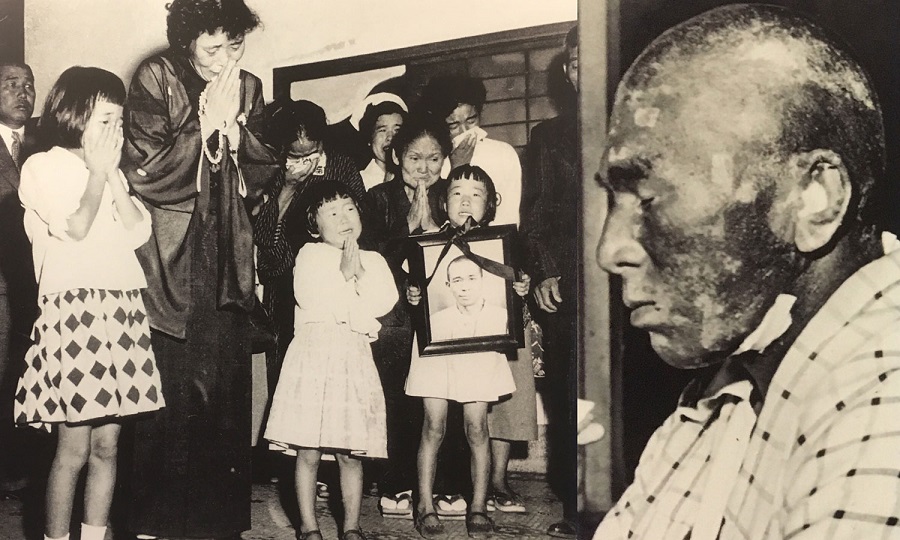
Housewives and Fishmongers Defeat the U.S. Nuclear Establishment https://allthingsnuclear.org/gkulacki/housewives-and-fishmongers-defeat-the-u-s-nuclear-establishment
It was the height of the McCarthy era. The nuclear arms race was just beginning and opposing it was called un-American. But a crew of Japanese fishermen and a small group of Japanese housewives would change the debate. Their signature campaigns set off a chain reaction of global awareness that eventually led the United States to sign an international agreement banning nuclear weapons tests in the atmosphere, under water, and in outer space.
Castle Bravo
On March 1, 1954 the United States tested a nuclear weapon 1,000 times more powerful than the bomb that destroyed Hiroshima. The blast over the Bikini Atoll in the Marshall Islands left a crater on the ocean floor 6,500 feet wide and 250 feet deep. Radioactive debris from the blast rained down over a 7,000 square mile area.
This wasn’t the first U.S. nuclear weapon tested in the Marshall Islands—an impoverished nation of scattered coral atolls close to the equator in the central Pacific Ocean—nor would it be the last. Between 1946 and 1958 the United States conducted 67 explosive nuclear weapons tests there.. The United States took control of the islands from Japan during WWII and administered them as part of a Trust Territory of the Pacific under a mandate from the United Nations until 1986.
It’s hard to imagine a more egregious betrayal of that trust. Several hours after the test—code named Castle Bravo—radioactive debris began falling on the unsuspecting inhabitants of the Rongelap atoll 150 km to the east of the crater. Children ran out to play in the snow-like powder that covered the island. Some ate it. The United States waited two days before evacuating the endangered islanders to a safer atoll more than 650km to the southeast.
Lucky dragon
A Japanese fishing boat called the Daigo Fukuryū Maru—the Lucky Dragon No. 5—got caught in a dirty rain of radioactive fallout from the Castle Bravo test. It pelted the fisherman for hours, stuck to their exposed skin and got into their eyes, noses and mouths. By the time they returned to Japan two weeks later their skin was burned, their hair was falling out, and their gums were bleeding. Six months after returning home, Aikichi Kuboyama, the ship’s radio operator, died from his exposure.
The Japanese media was fascinated and appalled by their story, which was reported around the world. Memories of the horrors of Hiroshima and Nagasaki were revived and amplified. But this time the Japanese public, and people throughout Asia, began to realize the potential danger was not confined to the site of the explosion. They could all become victims of the atomic bomb. Indonesia’s President Suharto put it this way in his opening address to the first ever international conference of the newly independent nations of Africa and Asia in the city of Bandung in April 1955:
“The food that we eat, the water that we drink, yes, even the very air that we breathe can be contaminated by poisons originating from thousands of miles away. And it could be that, even if we ourselves escaped lightly, the unborn generations of our children would bear on their distorted bodies the marks of our failure to control the forces which have been released on the world.”
The Suganami appeal
Japanese fishmongers saw their businesses crippled by widespread public fear of eating “A-bombed tuna.” Five-hundred of them met in Tokyo’s famous Tsukiji Market and decided to launch a signature campaign against atomic and hydrogen bombs. Their efforts inspired the Suganami City Assembly to pass a supportive resolution.
Six months earlier a group of housewives had begun meeting in the newly opened Suganami Community Center to read books and discuss social issues, including the causes of war, with the center’s part-time director, Kaoru Yasui. After the Castle Bravo test, they joined with neighbors to form the Suganami Council and launched an appeal to the people of Japan, and the world, to ban hydrogen bombs.
The housewives, fishmongers and many other groups who collected signatures were not part of an organized movement. They were ordinary people. Within a month, 250,000 had signed. By the end of 1955 it was 20 million. According to some accounts, nearly a third of the population of Japan eventually signed the appeal.
The notoriety of the Japanese campaign, along with increased scientific investigation of the distribution and consequences of radioactive fallout, created global public health concerns and inspired people to press the nuclear weapons states to stop testing. The U.S. Joint Chiefs of Staff and the U.S. nuclear weapons laboratories were strongly opposed to any agreement on testing. But President Eisenhower joined the Soviets in a testing moratorium in 1958 and negotiations on a treaty began in Geneva. This eventually led to the entry into force the Partial Test Ban Treaty in 1963, which banned nuclear testing in the atmosphere as well as underwater and in space.
This year the survivors of the atomic bombings of Hiroshima and Nagasaki 75 years ago have launched an appeal to ban nuclear weapons. You can do your part to advance the process of nuclear disarmament by lending your signature to the cause.
The lingering horror of the nuclear bomb tests at Maralinga, South Australia
|
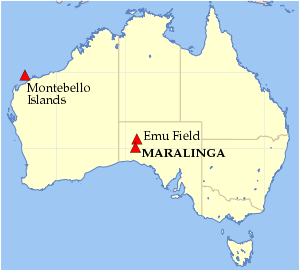
Maralinga is 54 kilometres north-west of Ooldea, in South Australia’s remote Great Victoria Desert. Between 1956 and 1963 the British detonated seven atomic bombs at the site; one was twice the size of the bomb dropped on Hiroshima. There were also the so-called “minor trials” where officials deliberately set fire to or blew up plutonium with TNT — just to see what would happen. One location called “Kuli” is still off-limits today, because it’s been impossible to clean up. I went out to the old bomb sites with a group of Maralinga Tjarutja people, who refer to the land around ground zero as “Mamu Pulka”, Pitjantjatjara for “Big Evil”. “My dad passed away with leukaemia. We don’t know if it was from here, but a lot of the time he worked around here,” says Jeremy Lebois, chairperson of the Maralinga Tjarutja council. Thirty per cent of the British and Australian servicemen exposed to the blasts also died of cancer — though the McClelland royal commission of 1984 was unable to conclude that each case was specifically caused by the tests. It’s not until you stand at ground zero that you fully realise the hideous power of these bombs. Even after more than 60 years, the vegetation is cleared in a perfect circle with a one kilometre radius. “The ground underneath is still sterile, so when the plants get down a certain distance, they die,” explains Robin Matthews, who guided me around the site. The steel and concrete towers used to explode the bombs were instantly vaporised. The red desert sand was melted into green glass that still litters the site. Years ago it would have been dangerous to visit the area, but now the radiation is only three times normal — no more than what you get flying in a plane. The Line of FireAustralia was not the first choice for the British, but they were knocked back by both the US and Canada. Robert Menzies, Australia’s prime minister at the time, said yes to the tests without even taking the decision to cabinet first. David Lowe, chair of contemporary history at Deakin University, thinks Australia was hoping to become a nuclear power itself by sharing British technology, or at least to station British nuclear weapons on Australian soil. “In that period many leaders in the Western world genuinely thought there was a real risk of a third world war, which would be nuclear,” he says. The bombs were tested on the Montebello Islands, at Emu Field and at Maralinga. At Woomera in the South Australian desert, they tested the missiles that could carry them. The Blue Streak rocket was developed and test-fired right across the middle of Australia, from Woomera all the way to the Indian Ocean, just south of Broome. This is known as “The Line of Fire” The Line of Fire from Woomera to Broome is, funnily enough, the same distance from London to Moscow,” Mr Matthews says. Just as the Maralinga Tjarutja people were pushed off their land for the bomb tests, the Yulparitja people were removed from their country in the landing zone south of Broome. Not all the Blue Streak rockets reached the sea. Some crashed into the West Australian desert. The McClelland royal commission showed that the British were cavalier about the weather conditions during the bomb tests and that fallout was carried much further than the 100-mile radius agreed to, reaching Townsville, Brisbane, Sydney and Adelaide. “The cavalier attitude towards Australia’s Indigenous populations was appalling and you’d have to say to some extent that extended towards both British and Australian service people,” Professor Lowe says. There are also questions over whether people at the test sites were deliberately exposed to radiation. “You can’t help but wonder the extent to which there was a deliberate interest in the medical results of radioactive materials entering the body,” Professor Lowe says. “Some of this stuff is still restricted; you can’t get your hands on all materials concerning the testing and it’s quite likely both [British and Australian] governments will try very hard to ensure that never happens.” Project SunshineWe do know that there was a concerted effort to examine the bones of deceased infants to test for levels of Strontium 90 (Sr-90), an isotope that is one of the by-products of nuclear bombs. These tests were part of Project Sunshine, a series of studies initiated in the US in 1953 by the Atomic Energy Commission. They sought to measure how Sr-90 had dispersed around the world by measuring its concentration in the bones of the dead. Young bones were chosen because they were particularly susceptible to accumulating the Sr-90 isotope. Around 1,500 exhumations took place, in both Britain and Australia — often without the knowledge or permission of the parents of the dead. Again, it was hard to prove conclusively that spikes in the levels of Strontium 90 during the test period caused bone cancers around the world. The Maralinga tests occurred during a period that Professor Lowe describes as “atomic utopian thinking”. “Remember at that time Australians were uncovering pretty significant discoveries of uranium and they hoped that this would unleash a vast new capacity for development through the power of the atom,” he says. Some of the schemes were absurdly optimistic. Project Ploughshare grew out of a US program which proposed using atomic explosions for industrial purposes such as canal-building. In 1969 Australia and the US signed a joint feasibility study to create an instant port at Cape Keraudren in the Kimberley using nuclear explosions. The plan was dropped, but it was for economic not environmental or social reasons. The dream (or was it a nightmare?) of sharing nuclear weapons technology with the British was never realised. All Australia got out of the deal was help building the Lucas Heights reactor. The British did two ineffectual clean-ups of Maralinga in the 1960s. The proper clean-up between 1995 and 2000 cost more than $100 million, of which Australia paid $75 million. It has left an artificial mesa in the desert containing 400,000 cubic metres of plutonium contaminated soil. The Maralinga Tjarutja people received only $13 million in compensation for loss of their land, which was finally returned to them in 1984. As we were leaving the radiation zone, the Maralinga Tjarutja people spotted some kangaroos in the distance. Over the years some of the wildlife has started to return. Mr Lebois takes it as a good sign. “Hopefully, hopefully everything will come back,” he says. |
|
Studies on Chernobyl nuclear disaster show that it’s relevant today, and for the future
 DOES CHERNOBYL STILL MATTER? https://www.publicbooks.org/does-chernobyl-still-matter/ 11.22.2019 BY GABRIELLE HECHT Since it first announced electricity “too cheap to meter,” in the 1950s, the nuclear industry has promised bountiful futures powered by a peaceful—and safe—atom. Design principles, the industry claims, limit the chances of core damage to one incident every 50,000 reactor-years of operation. History, however, has delivered a different verdict: together, Three Mile Island, Chernobyl, and the three Fukushima reactors represent five meltdowns in only 100 reactor-years. What lessons do these accidents hold for the future of nuclear power?
Each meltdown has impelled design, operational, and regulatory changes, increasing the cost of nuclear power. Today, says the industry, the technology is safer and more vital than ever. No other source of electricity can offer so much baseload power with so few carbon emissions. But who can make money when a single US Nuclear Regulatory Commission (NRC) inspection costs $360,000?
For the current US administration, the remedy for waning profits lies in cutting inspection hours. In a July 2019 proposal, which drew heavily on nuclear industry recommendations, the NRC also suggested crediting utility self-assessments as “inspections” and discontinuing press releases about problems of “low to moderate safety or security significance.” Translation: fewer inspections, less transparency, and weaker environmental and health oversight at the nation’s nuclear power plants.
The cause, costs, and consequences of the 1986 Chernobyl accident loom large in these battles. Was Chernobyl a fluke, the result of faulty technology and a corrupt political system? Or did it signal a fundamentally flawed technological system, one that would never live up to expectations?
Even simple questions are subject to debate. How long did the disaster last? Who were the victims, and how many were there? What did they experience? Which branches of science help us understand the damage? Whom should we trust? Such questions are tackled, with markedly different results, in Serhii Plokhy’s Chernobyl, Adam Higginbotham’s Midnight in Chernobyl, Kate Brown’s Manual for Survival, and HBO’s Chernobyl (created by Craig Mazin).
Serhii Plokhy’s book and Craig Mazin’s miniseries, both entitled Chernobyl, focus primarily on the accident and its immediate aftermath. Both build on the standard plotline embraced by nuclear advocates.
In this narrative, Soviet love of monumental grandeur—or “gigantomania”—led to the selection and construction of Chernobyl’s RBMK1 design: an enormous 1000-megawatt reactor, powered by low-enriched uranium fuel, moderated by graphite, and cooled by water. The utterly unique RBMK had fundamental design flaws, hidden by corrupt state apparatchiks obsessed with secrecy, prestige, and productivism. Operators made inexcusable errors. The accident was inevitable. But the inevitability, Plokhy and Mazin affirm, was purely Soviet.
Plokhy gives more backstory. The enormous scale of Soviet industrialization put huge strains on supply chains, resulting in shoddy construction. Some of the men in charge had no nuclear background. The pressure to meet production quotas—and the dire consequences of failure—led bureaucrats and engineers to cut corners.
For both Plokhy and Mazin, these conditions at Chernobyl came to a head during a long-delayed safety test. When the moment to launch the test finally arrived, shortly before midnight on April 25, 1986, there was confusion about how to proceed. The plant’s deputy chief engineer, Anatolii Diatlov, who did have extensive nuclear experience, believed he knew better than the woefully incomplete manuals. He pushed operators to violate the poorly written test protocol. (Disappointingly, Mazin’s miniseries portrays Diatlov more as a deranged bully than as someone with meaningful operational knowledge.)
The reactor did not cooperate: its power plummeted, then shot back up. Operators tried to reinsert the control rods. The manual didn’t mention that the RBMK could behave counterintuitively: in other reactor models, inserting control rods would slow down the fission reaction, but in the RBMK—especially under that night’s operating conditions—inserting the rods actually increased the reactivity. Steam pressure and temperature skyrocketed. The reactor exploded, shearing off its 2000-ton lid. Uranium, graphite, and a suite of radionuclides flew out of the core and splattered around the site. The remaining graphite in the core caught fire.
At first, plant managers didn’t believe that the core had actually exploded. In the USSR—as elsewhere—the impossibility of a reactor explosion underwrote visions of atomic bounty. Nor did managers believe the initial radiation readings, which exceeded their dosimeters’ detection limits. Their disbelief exacerbated and prolonged the harm, exposing many more people to much more radiation than they might have otherwise received. Firefighters lacked protection against radiation; the evacuation of the neighboring town of Pripyat was dangerously delayed; May Day parades proceeded as planned. Anxious to blame human operators—instead of faulty technology or (Lenin forbid!) a broken political system—the state put the plant’s three top managers on trial, in June 1987, their guilt predetermined.
Mazin’s miniseries follows a few central characters. Most really existed, though the script takes considerable liberties. The actions of the one made-up character, a Belarusian nuclear physicist, completely defy credibility. But hey, it’s TV. Dramatic convention dictates that viewers must care about the characters to care about the story. Familiar Cold War tropes are on full display: defective design, craven bureaucrats, and a corrupt, secrecy-obsessed political system. A few anonymous heroes also appear: firefighters, divers, miners, and others who risked their lives to limit the damage.
Nuclear advocates—many of whom believe that Chernobyl was a fluke, one whose lessons actually improved the industry’s long-term viability—object to the unrealistically gory hospital scenes portraying acute radiation sickness. But these advocates should feel appeased by the closing frames, which ignore the long-term damage caused by the accident.
Instead, the miniseries skates over post-1987 events in a few quick captions. The managers went to prison, a scientist committed suicide, people were evacuated. Yes, controversy persists over the number of casualties (31? That was the official Soviet number. How about 4,000? That’s the number issued by the Chernobyl Forum, an entity that includes representatives from the World Health Organization, the International Atomic Energy Agency, and other international organizations. As for the 41,000 cancers suggested by a study published in the International Journal of Cancer—that number isn’t even mentioned). But all is under control now, thanks to the new confinement structure that will keep the area “safe” for a hundred years. Mazin himself insists that the show isn’t antinuclear.
Instead, the miniseries skates over post-1987 events in a few quick captions. The managers went to prison, a scientist committed suicide, people were evacuated. Yes, controversy persists over the number of casualties (31? That was the official Soviet number. How about 4,000? That’s the number issued by the Chernobyl Forum, an entity that includes representatives from the World Health Organization, the International Atomic Energy Agency, and other international organizations. As for the 41,000 cancers suggested by a study published in the International Journal of Cancer—that number isn’t even mentioned). But all is under control now, thanks to the new confinement structure that will keep the area “safe” for a hundred years. Mazin himself insists that the show isn’t antinuclear.
Plokhy also addresses the accident’s role in the breakup of the USSR. In 2006, Mikhail Gorbachev famously speculated that “the nuclear meltdown at Chernobyl, even more than my launch of perestroika, was perhaps the real cause of the collapse of the Soviet Union.” Plokhy delivers details. Ukrainian dissidents trained their writerly gaze on Chernobyl, vividly describing the damage. Street demonstrations depicted the accident and its coverup as “embodiments of Moscow’s eco-imperialism.” This vision spread and morphed, animating protests in Belarus—also severely contaminated by the accident—and elsewhere. Chernobyl served as Exhibit A for why the republics should shed the Soviet yoke.
If you’re hoping for clear technical explanations, however, you’ll be disappointed. A stunning error mars the first few pages: Plokhy declares that each RBMK produced 1 million megawatts of electricity. This is off by a factor of 1,000. Typo? No, because he doubles down in the next sentence, affirming that the station produced 29 billion megawatts of electricity in 1985. He gets the orders of magnitude right later on, but these early missteps undermine reader confidence. Muddled technical descriptions and uninformative diagrams add to the confusion.
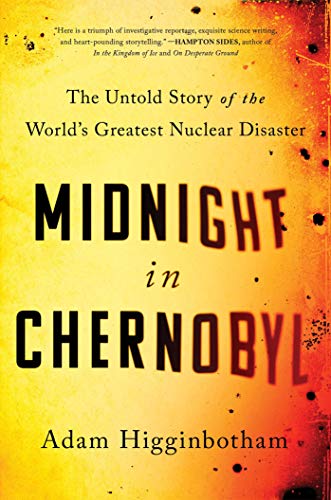 Readers seeking to understand the technology should turn instead to journalist Adam Higginbotham’s Midnight in Chernobyl. He uses global nuclear history to illuminate Soviet efforts to manage the Chernobyl crisis. By comparing the crisis to reactor accidents elsewhere, Higginbotham shows that deep vulnerabilities are widespread. Plokhy’s engineers and managers seem bumbling, verging on incompetent. Higginbotham’s more nuanced portrayal reflects how complex engineering projects of all types necessitate informed improvisation. The three-dimensional world doesn’t faithfully obey manuals. Adjustments are always required.
Higginbotham and Plokhy differ most starkly in their treatment of Soviet reactor choice. In the1960s, technocrats weighed the RBMK design against the VVER,2 the Soviet version of a pressurized light water reactor similar to those sold by Westinghouse and used in the United States. For Plokhy, it’s simple. The VVER was “safe.” The RBMK was not, but its size and cost appealed to Soviet productivism.
Higginbotham, however, wisely relies on Sonja Schmid’s pathbreaking Producing Power: The Pre-Chernobyl History of the Soviet Nuclear Industry (2015) to show that reactor safety isn’t a yes-no proposition. Plutonium-producing reactors similar to the Soviet RBMK (albeit half its size) existed in North America and Western Europe. Like nine of its French cousins, the RBMK could be refueled while continuing to operate. This presented significant advantages: light water reactors had to shut down for refueling, which entailed several weeks of outage. Even the risks presented by RBMK design vulnerabilities seemed manageable. “Nuclear experts elsewhere considered the RBMK design neither technologically novel nor particularly worrisome,” Schmid writes, noting that “what we consider good and safe always depends on context.” In the Soviet context, “selecting the RBMK made very good sense.”
Neither Schmid nor Higginbotham absolves the Soviet technopolitical system. The specific circumstances that led to Chernobyl’s explosions might not recur. But, as sociologist Charles Perrow has been arguing since his 1983 book Normal Accidents, highly complex technological systems create unpredictable situations, which inevitably lead to system failures. The question is not whether an accident of Chernobyl’s gravity can happen elsewhere, but how to prepare for the consequences when it does.
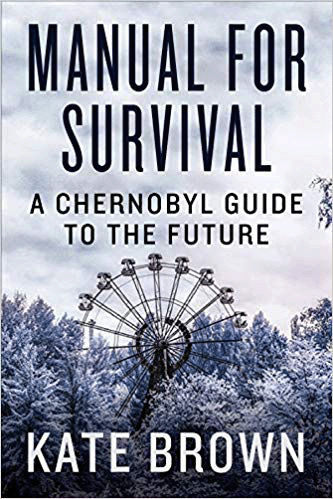 That’s one of the questions Kate Brown considers in Manual for Survival. Offering a wealth of new information and analysis, Brown speeds past the reactor explosion. Instead, she focuses on dozens of previously untold stories about how people coped with their newly radioactive lives.
Brown’s protagonists include women who worked at a wool factory fed by contaminated sheep and butchers ordered to grade meat according to radioactivity. Ukraine, we learn, kept serving as the Soviet breadbasket, despite food radiation levels that exceeded norms. The concentrations of radionuclides were biomagnified by receptive organisms and ecologies, such as mushrooms, wild boar, and the Pripyat Marshes. Defying expectations, some foods, over time, have even become more contaminated.
Brown’s descriptions add historical flesh to arguments first developed by Olga Kuchinskaya, in her 2014 book on Belarus’s Chernobyl experience, The Politics of Invisibility: Public Knowledge about Radiation Health Effects after Chernobyl.
Since the first studies of bomb survivors in Hiroshima and Nagasaki, science on the biological effects of radiation exposure has been subject to controversy. Like all scientific work, these early survivor studies had limitations. Exposure estimates were unreliable.
The largest study began data collection five years after the Hiroshima and Nagasaki blasts, so it didn’t include people who died or moved between 1945 and 1950. Another problem lies in the applicability of these studies. Bomb exposures, such as those in Japan, mostly consist of high, external doses from one big blast. Yet postwar exposures have mainly consisted of low doses, delivered steadily over a long period. They often involve internal exposures—such as inhalation of radioactive particles or consumption of irradiated food—which can be deadlier.
Irrespective of their limitations, however, the findings of these survivor studies have served as the basis for establishing regulatory limits for all types of radiation exposures. Critics argue that extrapolating from the Japan data underestimates low-dose effects: If you’ve already decided that the only possible health effects are the ones you’ve already found, surely you’re missing something? Among other limitations, studies of external gamma radiation exposures cannot illuminate the long-term health effects of inhaling radioactive alpha particles.
Brown injects the work of Dr. Angelina Gus’kova into this story. Gus’kova started treating radiation-induced illnesses in the 1950s, while working at the top-secret Mayak plutonium plant (where the radioactive spills from a 1957 accident continue to contaminate people, land, and water). A neurologist, Gus’kova made observations that extended beyond the narrow cancer focus of most Western practitioners who studied the health effects of radiation exposure. Her patients displayed a wide range of symptoms, which Gus’kova and her colleagues dubbed “chronic radiation syndrome.” Not that they neglected cancer: a 40-year study of 1.5 million people who lived near Mayak found significantly higher cancer and death rates than those reported in Hiroshima and Nagasaki.
The Soviet rubric of “chronic radiation syndrome” did not exist in the West. Yet Gus’kova’s findings did align with those of dissident scientists in the US and the UK. Thomas Mancuso, for example, was pushed out of the US Atomic Energy Commission because he refused to give the Hanford plutonium plant a clean bill of health after finding that workers there sustained high rates of cardiovascular disease, immune system damage, and other illnesses.
Alice Stewart, meanwhile, was shunned by the British establishment after her 1956 research showed that x-raying pregnant women increased the risk of cancer and leukemia in their children by 50 percent. Over the years, these and other scientists whose data challenged the findings of American and European nuclear establishments found themselves sidelined and defunded.
In tandem with perestroika, Chernobyl opened communication between Soviet and Western nuclear experts, engendering what Brown calls an “unholy alliance.” In 1990, the International Atomic Energy Agency (IAEA) sent a mission to Belarus and Ukraine to assess radiation damage. Belarusian scientists reported rising rates of many diseases in contaminated areas. Nevertheless, the IAEA team rejected radiation as a possible cause. Such correlations didn’t appear in Western data.
Instead, the IAEA teams used dose estimates provided by distant Moscow colleagues and ignored local Belarusian and Ukrainian descriptions of people’s actual consumption habits, which included significant amounts of contaminated food and milk. The IAEA assessments neglected the internal exposures resulting from this consumption. Yet these assessments now serve as international reference points. “Underestimating Chernobyl damage,” Brown warns, “has left humans unprepared for the next disaster.”
For some, hope springs eternal. In 2017, Chernobyl’s “New Safe Confinement” finally became operational, after two decades of design and construction. This $1.7 billion structure aims to contain the spread of radioactive rubble while workers inside dismantle the reactor and its crumbling sarcophagus. Ownership was transferred from the builders of the structure to the Ukrainian government in July 2019.
At the transfer ceremony, newly elected Ukrainian President Volodymyr Zelensky announced a tourism development plan for the radioactive exclusion zone, including a “green corridor” through which tourists could travel to gawk at the remains of Soviet hubris. “Until now, Chernobyl was a negative part of Ukraine’s brand,” declared Zelensky, who was nine years old when the reactor exploded. “It’s time to change.” (Zelensky further demonstrated his dedication to “branding” two weeks after this ceremony, when he emphasized his recent stay in a Trump hotel during his now-infamous phone conversation with the US president.)
Change also seems possible to Plokhy, who optimistically predicts that new reactor designs will be “cheaper, safer, and ecologically cleaner.” But Allison Macfarlane, who chaired the US Nuclear Regulatory Commission under Obama, recently noted that these “new” options are actually “repackaged designs from 70 years ago.” They still produce significant quantities of highly radioactive, long-lived waste.
Meanwhile, regulators in France—the world’s most nuclear nation—are taking the opposite approach from the United States’ NRC. Rather than rolling back oversight, France is intensifying inspections of their aging reactor fleet. After four decades of operation, many French reactors have begun to leak and crack. Keeping them operational will cost at least $61 billion. Despite the phenomenal cost, there are many who believe such an investment in the nuclear future is worthwhile.
Brown is far less sanguine about our nuclear future. Predictably, she has been denounced for believing marginal scientists and relying too heavily on anecdotal evidence. She does occasionally go overboard in suggesting conspiracy. Cover-ups clearly occurred on many occasions, but sometimes people were just sticking to their beliefs, trapped by their institutional and disciplinary lenses. Brown’s absence of nuance on this point matters, because the banality of ignorance—its complicity in all forms of knowledge production—can be more dangerous than deliberate lies: more systemic, harder to detect and combat.
Overall, though, Brown is on the right track. Many modes of scientific inquiry aren’t equipped to address our most urgent questions. Clear causal chains are a laboratory ideal. The real world brims with confounding variables. Some scientists studying Chernobyl’s “exclusion zone”—the region officially declared uninhabitable due to contamination—are trying new techniques to grapple with this reality. Tim Mousseau and Anders Møller, for example, collect data on the zone in its ecological entirety, rather than focusing on single organisms. Their findings belie romantic tales of wildlife resurgence (such as the one offered up by a 2011 PBS special on the radioactive wolves of Chernobyl). They too have met resistance.
How, then, can we harness the immense power of scientific analysis while also acknowledging its limitations? The nuclear establishment is quick to lump its opponents together with climate change deniers and anti-vaxxers. Some may deserve that. But much dissident science is well executed. So how do we, the lay public, tell the difference? How can dissent and uncertainty serve, not as a block to action, but as a call?
One way: we can refuse to see Chernobyl and its kin as discrete events of limited duration. Brown, for example, treats Chernobyl as an acceleration of planetary-scale contamination that began with the atomic arms race.
Let’s be clear: the contamination continues. After the triple meltdown at Fukushima, scientists found highly radioactive, cesium-rich microparticles in Tokyo, 150 miles south of the accident site. When inhaled, such particles remain in human lungs, where their decay continues to release radioactivity for decades. Contaminants from future accidents will, in turn, accrete on the radioactive residues of their predecessors.
And, we might add, on the ocean floor. The Russian state-run firm Rosatom recently announced the inauguration of its first floating reactor, towed across the melting Arctic to serve a community in Siberia: yet another manifestation of how climate change favors nuclear development. Rosatom is currently negotiating contracts for reactors (floating and otherwise) in some 30 countries, from Belarus to Bangladesh, Egypt to South Africa.
Threatened, the US nuclear industry sees Russian expansion as “another reason that the United States should maintain global leadership in nuclear technology exports.” And so we hurtle forward: rolling back oversight, acceleration unchecked.
This article was commissioned by Caitlin Zaloom.
As the Runit nuclear waste dome crumbles, Marshall Islanders want honesty and justice
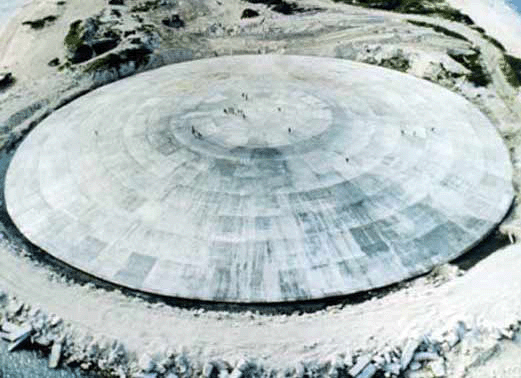
‘People want justice’: Marshalls’ fury over nuclear information US withheld– https://www.rnz.co.nz/international/programmes/datelinepacific/audio/2018723289/people-want-justice-marshalls-fury-over-nuclear-information-us-withheld From Dateline Pacific, 21 November 2019
|
The caretaker president of the Marshall Islands says it’s unconscionable that the United States kept secret key information about its nuclear tests for decades. New details reveal the US withheld information about the nuclear waste it left behind when the Marshall Islands gained independence, and the extent of the tests it carried out. Now, a dome that contains hundreds of tonnes of nuclear waste is at risk of crumbling into the ocean. But with Washington increasingly jittery about China, the small Pacific country’s finding it might now have some leverage to get something done. TRANSCRIPTEnewetak was once a paradise – a long atoll in the clear blue waters of the north Pacific, white sand and thick green palms. Today, it’s rutted with scars, after the US detonated dozens of nuclear bombs on, in and above it in the 1940s and ’50s. Whole islands were vaporised, deep craters carved into the coral. Jack Ading is a senator from Enewetak. His family was forced to move for the tests, and then allowed to return in the 1980s. “It appears that when we moved back to Enewetak in the 1980s after we were assured by the US government that it was safe. We were actually subjecting ourselves to a risk that we were never warned about.” Government documents reveal that beyond the nuclear blasts, the US also tested biological weapons, including an aerosol bacteria. Jamie Tahana reports. TRANSCRIPTEnewetak was once a paradise – a long atoll in the clear blue waters of the north Pacific, white sand and thick green palms. Today, it’s rutted with scars, after the US detonated dozens of nuclear bombs on, in and above it in the 1940s and ’50s. Whole islands were vaporised, deep craters carved into the coral. Jack Ading is a senator from Enewetak. His family was forced to move for the tests, and then allowed to return in the 1980s. “It appears that when we moved back to Enewetak in the 1980s after we were assured by the US government that it was safe. We were actually subjecting ourselves to a risk that we were never warned about.” Government documents reveal that beyond the nuclear blasts, the US also tested biological weapons, including an aerosol bacteria. But this was kept secret when the people from Enewetak were allowed to return, and other documents show that people were subjected to tests and experiments about the lingering effects of radiation. Last week, the Los Angeles Times also uncovered that the US didn’t tell the Marshallese it had shipped 130 tonnes of soil from its atomic testing grounds in Nevada in 1958 and dumped it at Enewetak. The caretaker president of the Marshall Islands, Hilda Heine, says the new details are disturbing. “To say the least you would have thought that all that information would have been shared with the Enewetak people before they went back to Enewetak. It is unbelievable that such information was held back, and as a result people have gone back and lived there for many years.” The nuclear waste from the era is stored in a pile at the end of the island of Runit, covered in a concrete dome. But a recent study by the Marshall Islands Nuclear Commission found the dome is now at risk of collapsing, and as rising seas erode beneath it, much of that waste is seeping into the lagoon. The commission’s chair, Rhea Moss-Christian, says information about the dome and the testing era was withheld throughout the independence process, while a compact of free association was negotiated in the 1980s. “We signed the compact in 1986 on the understanding that we had all the information we needed to have. It’s pretty hard for us to see this information, to have the level of detail that we now have, and to think that any of those previous agreements could stand.” The Marshall Islands has sought US help to clean up contamination and to shore up the dome, but American officials have declined, saying it’s on Marshallese land and, therefore, is the Marshall Islands’ responsibility. Ms Moss-Christian says that’s ridiculous. “How can it be that this radioactive waste and structure that we didn’t ask for. How can it be that this is ours and ours to deal with?” A Nuclear Claims Tribunal formed by the two countries in 1988 concluded that the US should pay $US2.2 billion in claims and settlements. But documents from both the Nuclear Commission and a 2010 US House inquiry show only $4 million has been paid. Last month, the Marshall Islands parliament – the Nitijela – endorsed a Nuclear Commission strategy which calls for, among other things, full compensation, better healthcare, and environmental protections. The US maintains it is upholding its responsibilities. It says it’s paid nearly a billion dollars, which has gone towards resettlement, rehabilitation and healthcare costs for affected communities, and that it’s funding tests of the water and atmosphere around the Runit dome. But Giff Johnson, the editor of the Marshall Islands journal and an author of books about the nuclear legacy, says that’s not enough. “People want justice for Marshall Islanders. The US government has to step up and address issues that it has addressed for American victims but is ignoring out here.” For the Marshall Islands, a smattering of atolls in the North Pacific – population 53,000 – it might be an opportune time to twist a superpower’s arm. Washington is increasingly nervous about a growing Chinese presence, and the compact of free association – which guarantees relations and funding from the US – expires in three years. Having initially maintained there won’t be a replacement compact, Washington is now keen to open talks for a new one, and has sent a string of high-ranking officials for visits. The caretaker president, Hilda Heine – who a few months ago was invited to the White House to meet President Donald Trump – says that could bode well. “The geopolitical situation in the Pacific is really helpful to the cause of the Marshall Islands. The US is now paying more attention to the Marshall Islands, so our issues around climate change, around our nuclear legacy, I think those will come to the forefront of our discussions going forward with the United States.” Whatever comes from those discussions, the people of Enewetak want more than they’re getting now. |
|
Why is the UK government now hiding its nuclear history files?
 Nuclear X-files? Academics baffled as UK govt. pulls docs from national archives https://stockdailydish.com/nuclear-x-files-academics-baffled-as-uk-govt-pulls-docs-from-national-archives/ SDD Contributor on November 22, 2019 Nuclear X-files? Academics baffled as UK govt. pulls docs from national archives Thousands of national archive files on Britain’s atomic and nuclear weapons energy programs have been withdrawn from public view by order of the UK government without any explanation, alarming academics. Nuclear X-files? Academics baffled as UK govt. pulls docs from national archives https://stockdailydish.com/nuclear-x-files-academics-baffled-as-uk-govt-pulls-docs-from-national-archives/ SDD Contributor on November 22, 2019 Nuclear X-files? Academics baffled as UK govt. pulls docs from national archives Thousands of national archive files on Britain’s atomic and nuclear weapons energy programs have been withdrawn from public view by order of the UK government without any explanation, alarming academics.
Researchers reported that the documents, dating from 1939 to the 1980s, were unexpectedly withdrawn by the National Archives last week. The files relate to, among other subjects, the creation of Britain’s first nuclear bombs and the private papers of the Nobel Prize-winning physicist who split the atomic nucleus, Sir John Cockcroft. A spokesperson for the NDA stated that they are “absolutely committed to openness and transparency,” though no reason has been forthcoming, leading to speculation among academics that the files contained previously overlooked sensitive information, which should be withheld from public view. The papers in question are divided into two sections; records of the Atomic Weapons Establishment (AWE) and the records of the United Kingdom Atomic Energy Authority. The AWE documents concern the development of the UK atomic weapons. Bomb tests, feasibility reports and notes on the theoretical physics of nuclear weapons are all included. Jon Agar, a professor of history of science and technology at University College London, spoke of his ‘alarm’ at the situation to the Guardian. “We would like to know what is going on. We would be alarmed as historians that it has been taken out of public view. “These are important records for understanding the nuclear project in the UK. A couple of days ago a PhD student noticed that everything in the catalogue is coming up as temporarily retained. We are scratching our heads. It is all a bit mysterious.” |
|
China’s huge unfinished underground nuclear facility
In the 1960s, at the height of the Cold War and amid rising tension between the Soviet and Chinese governments, the Chinese Communist Party began relocating its military installations inland, away from major targets in the large coastal cities. The 816 Nuclear Reactor was Communist China’s first foray into building its own nuclear reactor capable of producing weapons-grade plutonium without Soviet assistance.
To further protect against a nuclear attack, Premier Zhou Enlai approved a project that called for building the reactor underground, adding an extra layer of complexity to an already difficult engineering process. For the following 18 years, more than 60,000 workers were dispatched to an isolated base in the remote Sichuan mountains, at that time only reachable by boat. The tunnels were dug using only small drills, shovels, and dynamite, and official figures state that at least 100 workers died due to the harsh and dangerous working conditions, although it is suspected that the actual number is much higher.
Due largely to the changing circumstances of the Cold War, the project was abruptly called off in 1984, with construction of the doomed project only 85 percent completed. For 26 years, the site lay mostly abandoned, used for storage and as a fertilizer factory, before opening its doors to Chinese tourists in 2010………https://www.atlasobscura.com/places/816-underground-nuclear-plant
The woman who was first to scientifically show, in 1856, how atmospheric C02 caused global warming
 Climate-science sexism reheated, Canberra Times, Ian Warden 11 Oct 19
One of my favourite obscure journals, The Public Domain Review, in touch with our climate-debating times, has just dusted off Eunice Foote’s paper Circumstances Affecting the Heat of the Sun’s Rays. It was published in the November 1856 American Journal of Art and Science.
“Foote’s seminal experiment was ingeniously homemade. Using four thermometers, two glass cylinders, and an air pump, she isolated the component gases that make up the atmosphere and exposed them to the sun’s rays … Measuring the change in their temperatures, she discovered that carbon dioxide and water vapour absorbed enough heat that this absorption could affect climate.”
“Entirely because she was a woman, Foote was barred from reading the paper describing her findings at the 1856 meeting of the American Association for the Advancement of Science held in Albany, New York. Instead, Professor Joseph Henry of the Smithsonian had the honour of introducing her, announcing that science was ‘of no country and of no sex. The sphere of woman embraces not only the beautiful and the useful, but the true.’ Perhaps this was Henry’s attempt to shield Foote and her findings from sexist criticism .”
It would not surprise if, just as Greta Thunberg is so often accused of only reading speeches written for her by some grown-up Green Svengali (for she is surely too much of a girly flibbertigibbet to really be as knowledgeable and articulate as she pretends) Eunice Foote was suspected of having lots of (unacknowledged by her) cerebral male help with her paper.
Likell thinking Australian atheists/agnostics I am both appalled and fascinated by our prime minister’s extreme religiosity……https://www.canberratimes.com.au/story/6430152/climate-science-sexism-reheated/?cs=14246
Massive Nuclear Explosion similar to Kyrshtym by Mayak Can Happen Happen at Hanford if the site is not Monitored and tanks not taken care of
Lane, 6 Oct 19 Mayak Explosion
Ten Thousand Gallon Tank at Mayak Exploded from Heat Decay. The Heat Deacy was from Strontium 90, Cesium 137, Cobalt 60 and Plutonium Stored in the Underground Tank. The explosion was equivalent to 100 tons of TNT. There are55 million gallons of the same Radionuclide Mix stored at Hanford, in UnderGround Tanks. If they become too concentrated and hot, the same thing will Happen there, contaminating a Great Portion of the Pacific NW USA and southe western Canada.
Medvedev, Zhores A. (4 November 1976). “Two Decades of Dissidence”. New Scientist.
Medvedev, Zhores A. (1980). Nuclear disaster in the Urals translated by George Saunders. 1st Vintage Books ed. New York: Vintage Books. ISBN 978-0-394-74445-2. (c1979)

In 1957 the cooling system in one of the tanks containing about 70–80 tons of liquid radioactive waste failed and was not repaired. The temperature in it started to rise, resulting in evaporation and a chemical explosion of the dried waste, consisting mainly of ammonium nitrate and acetates (see ammonium nitrate/fuel oil bomb). The explosion, on 29 September 1957, estimated to have a force of about 70–100 tons of TNT,[10] threw the 160-ton concrete lid into the air.[8] There were no immediate casualties as a result of the explosion, but it released an estimated 20 MCi (800 PBq) of radioactivity. Most of this contamination settled out near the site of the accident and contributed to the pollution of the Techa River, but a plume containing 2 MCi (80 PBq) of radionuclides spread out over hundreds of kilometers.[11] Previously contaminated areas within the affected area include the Techa river, which had previously received 2.75 MCi (100 PBq) of deliberately dumped waste, and Lake Karachay, which had received 120 MCi (4,000 PBq).[7]
In the next 10 to 11 hours, the radioactive cloud moved towards the north-east, reaching 300–350 km (190–220 mi) from the accident. The fallout of the cloud resulted in a long-term contamination of an area of more than 800 to 20,000 km2 (310 to 7,720 sq mi), depending on what contamination level is considered significant, primarily with caesium-137 and strontium-90.[7] This area is usually referred to as the East-Ural Radioactive Trace EURT
USA lost unexploded nuclear bomb in Japanese waters
However, it was not until 1989 that the Pentagon admitted the loss of a one-megaton hydrogen bomb.
The revelation inspired a diplomatic inquiry from Japan, however, neither the weapon, or the pilot, was ever recovered.The incident, the most serious involving nuclear weapons in the Navy’s history, showed that US warships carried atomic weapons into Japanese ports in violation of policy, according to researchers.
Japanese law banned ships carrying nuclear weapons from sailing in its territorial waters or calling on its ports following the terrible Hiroshima and Nagasaki incidents.
However, the US warship routinely docked in Japan.
William M. Arkin of the liberal Institute for Policy Studies claimed in 1989: “For 24 years, the US Navy has covered up the most politically sensitive accident that has ever taken place.
“The Navy kept the true details of this accident a secret not only because it demonstrates their disregard for the treaty stipulations of foreign governments but because of the questions it raises about nuclear weapons aboard ships in Vietnam.”
The event was highly sensitive, with Japan being the only country to ever be attacked with nuclear weapons at the end of World War 2.
On September 8, 1951, 49 nations drew a line under the devastating event and signed the Treaty of San Francisco – also known as the Treaty of Peace with Japan.
The document officially ended US-led occupation of Japan and marked the start of re-establishing relations with the allied powers.
Meanwhile, In 1965, the US was arguably at the height of tensions with the Soviet Union.
Not only did the accident threaten to spoil already tenuous relations with Japan, but it would have also have given the USSR an excuse to start a nuclear war.
Despite the worrying claims, the US Navy confirmed inn 1989 that the waters were too deep for the weapon to pose a threat.
Worryingly though, it would not be the last of the nuclear gaffes for America. On January 17, 1966, a B-52G USAF bomber collided with a KC-135 tanker during a refuelling mission at 31,000 feet over the Mediterranean Sea.
During the crash, three MK28-type hydrogen bombs headed for land in the small fishing village of Palomares in Almeria, Spain.
Worse still, the explosives in two of the weapons detonated on impact, contaminating the surrounding area of almost one square mile with plutonium.
The fourth sunk off the coast of Spain and was recovered three months later.
How the viewing public was ‘protected’ from seeing what the Hiroshima and Nagasaki nuclear bombing did to people
Hiroshima and Nagasaki on the cutting room floor https://thebulletin.org/2019/08/hiroshima-and-nagasaki-on-the-cutting-room-floor/ By Thomas Gaulkin, August 5, 2019 Seventy-four years after nuclear weapons were first and last used in war, it can be challenging to conceive of the devastation they cause. But even in the immediate months after the atomic bombs were dropped on Hiroshima and Nagasaki in August 1945, news accounts offered a view of ingenuity and destruction that often elided the human cost.
The newsreels below [on original] were mainly screened to audiences in 1946 and 1947 and detail the destructive force of the explosions almost entirely through excited accounts of the structural damage to the cities. There’s occasional mention of the lost city populations and the scientific knowledge to be gained from studying their casualties, but hardly any description of what people actually suffered, let alone personal accounts. It’s instructive to look at and listen to these reports today, and contemplate what is missing.
The 12-minute reel below was produced by the US War Department in 1946. “Tale of Two Cities” makes selective use of film that was confiscated from a Japanese filmmaker, Akira Iwasaki—though you wouldn’t know that from the narration, which boasts that “army cameramen have found and filmed pictorial evidence that tells in twisted steel and stone the effect of death-dealing atomic power.” (Some twenty years later, historian Eric Barnouw obtained more of Iwasaki’s footage and produced a remarkably different narrative that documented the horrible physical impact of the attacks on Hiroshima’s citizens.)
Contrasted with the triumphant tone of the news/propaganda made for 1940s audiences, silence changes everything. Made public only decades later, the two films below —one beginning with footage of wounded victims, the other, a full-color glimpse of survivors picking up the pieces of the ruined city—report what those above do not, without a single word.
Nagasaki And Hiroshima (1945)
Harrowing Accounts from Hiroshima Survivors
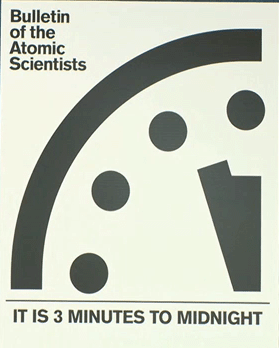
Hiroshima nuclear bombing, and the birth of the Doomsday Clock
 Hiroshima atomic bomb: The US nuclear attack that changed history, Aljazeera, 7 Aug 19, Hiroshima atomic bomb: The US nuclear attack that changed history, Aljazeera, 7 Aug 19,
As Japan marks 74th anniversary of world’s first nuclear bomb attack, we examine the events that shaped history. Japan has marked 74 years since a US atomic bomb attack that razed the city of Hiroshima to the ground at the end of World War II. What happened in Hiroshima?On August 6, 1945, at about 8:15am Japanese time, the US aircraft Enola Gay dropped an untested uranium-235 gun-assembly bomb nicknamed “Little Boy” over Hiroshima. The devastation was unlike anything in the history of warfare, ushering in the era of weapons of mass destruction. Hiroshima was immediately flattened. The resulting explosion killed 70,000 people instantly; by December 1945, the death toll had risen to some 140,000. The radius of total destruction was reportedly 1.6km. “The impact of the bomb was so terrific that practically all living things – human and animal – were literally seared to death by the tremendous heat and pressure set up by the blast,” Tokyo radio said in the aftermath of the explosion, according to a report by The Guardian in August 1945. “All the dead and injured were burned beyond recognition. Those outdoors were burned to death, while those indoors were killed by the indescribable pressure and heat.” But the damage did not end there. The radiation released from the explosion caused further suffering. Thousands more died from their injuries, radiation sickness and cancer in the years that followed, bringing the toll closer to 200,000, according to the Department of Energy’s history of the Manhattan Project. ….. The bombings were as questionable back then as they are today. Six out of seven five-star US generals and admirals at the time felt there was no need to drop the bomb because Japanese surrender was imminent. ……. The power of the atomic bomb would usher a change in geopolitics that still reverberates to this day, with several countries currently vying to acquire this technology.
|
|
The nuclear bombing of Hiroshima -City Lying in Ashes and Rubble
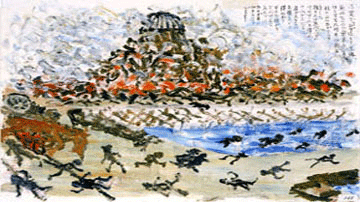
From the Archives, 1945: The terrible fate of Hiroshima, SMH, 56 Aug 19 First published in The Age on August 9, 1945, TERRIBLE FATE OF HIROSHIMA City Lying in Ashes and RubbleTOKIO SAYS IMPACT WAS TERRIFIC Guam – Photographs of Hiroshima taken after the atomic bomb raid reveal a terrible story. The area destroyed in this single volcano lies in ashes and rubble, with here and there a reinforced wall left sadly standing.
A communique issued from the headquarters of General Spaatz announces that four and one-tenth square miles, or 60 per cent., of Hiroshima, which is as large as Brisbane, was wiped out by the bomb.
The announcement is based on reconnaissance photographs, which showed additional damage outside the completely destroyed area.
Answering a question why Hiroshima, rather than Tokio, was chosen as the first target, an army spokesman replied: “Maybe we did not want to risk hitting Government buildings and destroying people who may make the decision to surrender.”
Tokio Radio’s version of the raid said that the impact of the bomb was so terrific that practically all living things, human and animal, were literally seared to death. All the dead and injured were burned beyond recognition.
The broadcast added that the effect of the bomb was widespread. Those out of doors were burned to death, and those indoors were killed by indiscriminate pressure and heat. Houses and buildings were smashed, including emergency medical facilities.
Another broadcast warned the Japanese homeland to brace itself for new atomic bomb attacks. Osaka Radio said since it was presumed that the enemy would continue to use the new bomb the authorities should point out measures to cope with it immediately if this was possible…..
Tokio Radio claims that Hiroshima was an open city, and says authorized bombing was a violation of international law, which forbids belligerents an unlimited choice in the means of destruction. https://www.smh.com.au/world/asia/from-the-archives-1945-the-terrible-fate-of-hiroshima-20190802-p52dd2.html
Cuban Missile Crisis 1962 – how close we came to World War 3
World War 3: How ‘Armageddon Letter’ brought world within minutes of nuclear conflict https://www.express.co.uk/news/world/1153499/world-war-3-cold-war-us-soviet-union-kennedy-khrushchev-cuban-missile-crisis-spt
WORLD WAR 3 would have almost certainly started had it not been for the bold decisions of world leaders on what would come to be known as Black Saturday.
He immediately announced the US would not permit offensive weapons to be delivered and created a blockade in the surrounding waters until the missiles were dismantled and returned to the Soviet Union.
The tense situation then snowballed out of control as the Kremlin traded words with the White House and the prospect of war looked increasingly likely.
“The United States may find it necessary within a very short time in its interest and that of its fellow nations in the Western Hemisphere to take whatever military action may be necessary.”
On October 27 – remembered as Black Saturday by the White House – Khrushchev received a letter from Castro known as the Armageddon Letter, which was interpreted as urging the use of nuclear force in the event of an attack on Cuba.
It read: “I believe the imperialists’ aggressiveness is extremely dangerous and if they actually carry out the brutal act of invading Cuba in violation of international law and morality, that would be the moment to eliminate such danger forever through an act of clear legitimate defence, however harsh and terrible the solution would be.”
Later that day, the US Navy dropped a series of “signalling depth charges” on a Soviet B-59 submarine unaware it was armed with a nuclear-tipped torpedo.
As the submarine was too deep to monitor any radio traffic, the captain, Valentin Grigorievitch Savitsky, decided that a war might have already started and wanted to launch a nuclear torpedo.
The decision to launch these required the agreement of all three officers on board, but one of them – Vasily Arkhipov – objected and so the nuclear launch was narrowly averted.
On the same day, a US Air Force U-2 spy plane was struck by an S-75 Dvina surface-to-air missile launched from Cuba, downing the jet and killing the pilot.
Kennedy had earlier claimed he would order an attack on such sites if fired upon, but he decided not to act unless another attack was made.
It was later learned discovered the move was spearheaded by Raul Castro, brother to the communist leader.
Kennedy finally decided to bring the situation to an end by secretly agreeing to remove all missiles in Turkey and possibly Italy too, in exchange for Khrushchev removing all missiles in Cuba.
However, at this point, Khrushchev knew things the US did not.
First, that the shooting down of the U-2 by a Soviet missile violated direct orders from Moscow, and Cuban antiaircraft fire against other US reconnaissance aircraft also violated direct orders from Khrushchev to Castro.
Second, the Soviets already had 162 nuclear warheads on Cuba that the US did not then believe were there as well as scores of nuclear-tipped subs.
Third, the Soviets and Cubans on the island would almost certainly have responded to an invasion by using those nuclear weapons.
The Soviet leader knew he was losing control and came out of the incident with his pride in check.
World War 3: The secret underground nuclear bunkers hiding below forest revealed
The Secret Soviet Nuclear Bunker
World War 3: The secret underground nuclear bunkers hiding below forest revealed
TWO bunkers leading to a secret underground city were discovered in the former Soviet state of Moldova, which were built for high ranking officers to pull the strings from should World War 3 break out, an explorer revealed. Express UK By CALLUM HOARE, Jun 28, Known to the British and US spies as “Object 1180” these two structures were built in 1985 – at the height of the Cold War. As the threat of a nuclear strike from either side seemed more than likely, high-ranking officers needed somewhere to orchestrate their retaliation and prepare for a second strike. As a result, the cylinders were built with thick walls to withstand a direct nuclear hit and an entire city was concealed below with shops, hospitals and a vast amount of supplies to provide the generals with everything they needed.They were only discovered when spy planes and satellites noticed increased activity heading towards the forests of Moldova and were soon abandoned following the fall of the Soviet Union in 1991.
However, YouTube star Benjamin Rich, the man behind popular exploration channel “Bald and Bankrupt” treated fans to a history lesson when he visited earlier this month. He explained: “In 1985, western satellites picked up some strange activity in the rural countryside of what was then the Moldavia Soviet Socialist Republic.
“They didn’t know what it was at the time and they named them Object 1180.
“It was only years later, with the fall of the Soviet Union, that they discovered that it was an underground nuclear bunker.”
Mr Rich, who treats his 800,000 subscribers to visits all over the former Soviet Union, explained why leaders in Moscow thought the construction was necessary.
He added: “The Eighties were quite a scary time for people in England and in the Soviet Union.
“It seemed at one point there was a real possibility of a nuclear war between the Soviet Union and the West.
“So the Soviet Union built about four of these giant nuclear bunkers dotted around the former nation for the high command to hide in and command the forces should, what seemed like the inevitable, happen.
“They started construction in 1985, but as the Soviet Empire came to an end, there was no need for [them] anymore.
“The West and East were friends so these monoliths were just left as reminders of how close we came to a war between our nations. ”
Finally, taking a look inside the dark abandoned remains, Mr Rich then revealed how things would have looked more than 30 years ago.
He continued: “These things were designed for the bigwigs, the apparatchiks, the nomenclature of the Soviet Communist Party in the military High Command. ……… https://www.express.co.uk/news/world/1146430/world-war-3-soviet-union-underground-bunker-moldova-forest-object-1189-spt
UK covering up the records on nuclear bomb testing in Australia and the Pacific. Why?

|
Unusual secrecy around 1950s nuclear testing , The Saturday Paper, Martin McKenzie-Murray 18 May 19 Between 1952 and 1957, Britain tested 12 nuclear weapons in Australia – on the Montebello Islands off the Pilbara coast, and at Maralinga and Emu Fields in the South Australian outback. The tests were hurried, incautious and showed extraordinary disregard for Australian assistance and the local Indigenous people who had been forcibly but imperfectly evacuated from their land. It was a clusterfuck,” says Elizabeth Tynan, an Australian historian, and the award-winning author of Atomic Thunder: The Maralinga Story. “The disregard was partly driven by the fact they were in a rush. They cut corners. They did it on the cheap – and it showed. They had very little regard for safety. Cavalier. They knew about the risks. There were international protocols. Many were disregarded. I met one man, he was a technician with the British effort in Australia, and he said of Indigenous Australians that they were ‘nothing to do with us – it was the Australian government’s responsibility’.”
For Susanne Roff growing up in Melbourne in the 1950s was uneventful. But later, living in Scotland with her husband, William Roff, an eminent historian, she developed a dogged, almost obsessive interest in this chapter of British history that remains cloaked in secrecy.
Once a month, Roff takes the train south from her home in a Scottish fishing village – to archives in London, Birmingham and Cambridge. She’s still looking for answers. “Why was the purportedly Australia-controlled Atomic Weapons Tests Safety Committee so ineffective?” she asks. “Why was the UK able to continue testing at Maralinga until barely six weeks before opening of the 1956 Olympics despite the known hazards to east coast populations? Why didn’t [Sir Mark] Oliphant ever speak out against the tests and contamination, including when he was governor of South Australia?” Late last year, Roff had another question: Why, more than 60 years after the last nuclear test in Australia, had the British government suddenly vanished previously declassified documents about the tests from its national archives? Roff wasn’t alone in her surprise. The Campaign for Freedom of Information, a British not-for-profit organisation, described it as worrying. All that was certain was that the files had been removed on the order of the Nuclear Decommissioning Authority. “WE CAN BUT WONDER WHY THE WORLD’S THIRD ATOMIC AND THERMONUCLEAR POWER HAS SUDDENLY BECOME SO NERVOUS ABOUT EVENTS THAT HAPPENED DECADES AGO.”“The secrecy is arguably even worse today,” Tynan tells me. She is working on a second book about the British tests. “British service personnel have run into brick walls at every turn [in seeking compensation and acknowledgement]. One of the clues to the attitude of the British government is that it has not really ever properly acknowledged what they did. They were nuclear colonialists and they buggered up a part of our country. One former British personnel I met burst into tears when he thought about how Britain had never said sorry. The secrecy … seems incomprehensible. They continue to be secretive.” But not all documents are closeted. Susanne Roff has some, which she shared with me – British intelligence files on Dr Eric Burhop, an Australian physicist who had worked on the Manhattan Project, which ran from 1939 to 1946. ……. Robert Menzies agreed to the testing immediately, without bothering to consult cabinet. For a time, only three people in the country knew of the agreement: the prime minister, treasurer and defence minister. He asked few questions of the British. “But it wasn’t pure patriotic sycophancy,” Tynan says of Menzies’ decision. “The pragmatic response was: vast reserves of uranium in Australia. It’s central to weaponry and power. It was completely valueless until the Manhattan Project. Then it became a valuable commodity. Australia had a lot of it. That was a very significant part of his reasoning. The other thing that would’ve informed Menzies’ thinking was that he was anxious to ensure Britain and America would protect Australia.” They were also without the counsel of the Australians who had worked on the American tests – notably, Mark Oliphant and Eric Burhop. Both Susanne Roff and Elizabeth Tynan agree Oliphant would have been a strong head of the safety authority, which was otherwise feckless. Both men were long suspected of being Communist spies, and may have been excluded to mollify US doubts about British security. The files on Burhop that I’ve seen are voluminous. The FBI, MI5 and ASIO all had records on him. In England and America, he was aggressively surveilled. His phone was tapped. Even Joseph Rotblat had his doubts about his former colleague. The British intelligence historian Andrew Brown has written: “Rotblat remained convinced that Burhop and other left-wing scientists … opposed the [proposed nuclear] moratorium not for their stated reasons but because it would perpetuate the USA’s monopoly and place the USSR at a dangerous disadvantage.”…… In 1984, Australia held a royal commission into the British tests. It found a litany of negligence and cover-ups. “Britain had to be dragged, kicking and screaming, to it,” Elizabeth Tynan says. Today, their attitude is much the same. In 2015, Fiji – frustrated by Britain’s refusal to compensate its people who suffered radiation poisoning during the Pacific tests – declared it would compensate citizens itself. “We are bringing justice to a brave and proud group of Fijians to whom a great injustice was done,” Fiji’s prime minister said. “Fiji is not prepared to wait for Britain to do the right thing.” Meanwhile, in Britain’s national archives, the nuclear files are still gone. “The UK government has always [downplayed] risks to the servicemen who took part in the tests, the Aboriginal community in the immediate vicinity of them, and the general population downwind … as well as possible genetic effects on subsequent generations,” Susanne Roff says. “We see similar responses in relation to Fukushima in Japan. All the operational and scientific documents relating to the Australian tests that have been on open access in the National Archives have suddenly gone walkabout. We can but wonder why the world’s third atomic and thermonuclear power has suddenly become so nervous about events that happened decades ago.” https://www.thesaturdaypaper.com.au/news/law-crime/2019/05/18/unusual-secrecy-around-1950s-nuclear-testing/15581016008158 |
|
1 This Month
29 Jan. Thursday 7-8 p.m. Webinar – World’s Largest Nuclear Station in Port Hope, ON?

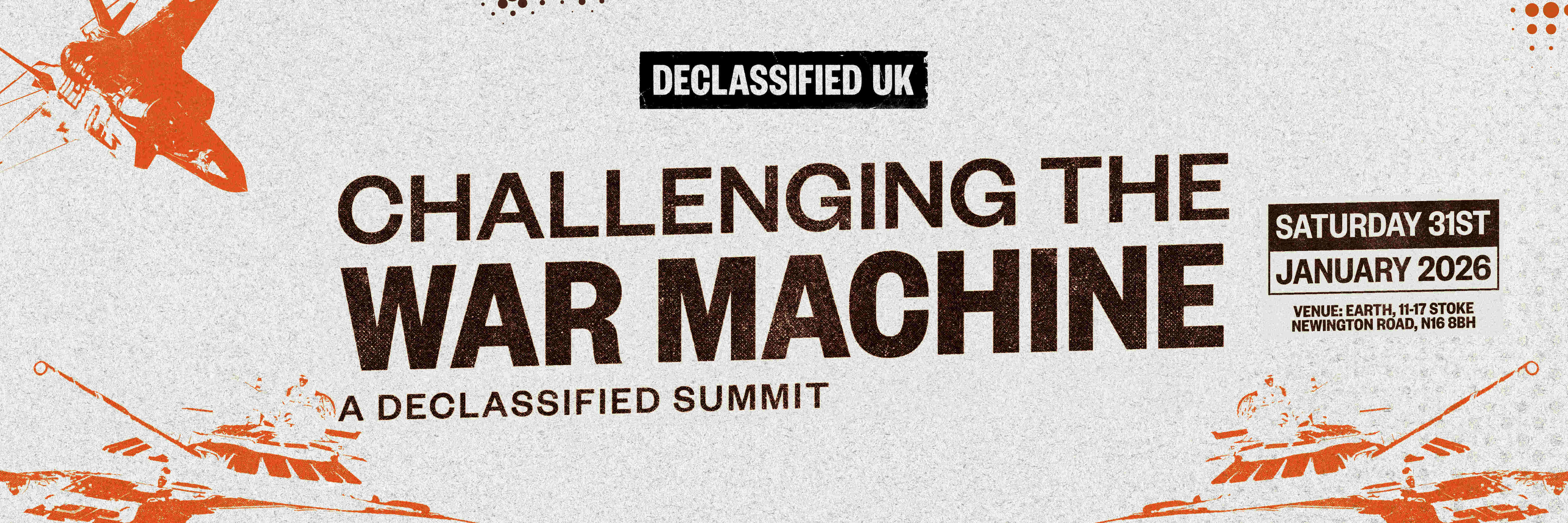
31st January – Challenging the War Machine – a DECLASSIFIED UK SUMMIT



Website of the Week
Now until to February 10, 2026 Radioactive waste storage in France: the debate is finally open! How to participate?
-
Archives
- January 2026 (227)
- December 2025 (358)
- November 2025 (359)
- October 2025 (377)
- September 2025 (258)
- August 2025 (319)
- July 2025 (230)
- June 2025 (348)
- May 2025 (261)
- April 2025 (305)
- March 2025 (319)
- February 2025 (234)
-
Categories
- 1
- 1 NUCLEAR ISSUES
- business and costs
- climate change
- culture and arts
- ENERGY
- environment
- health
- history
- indigenous issues
- Legal
- marketing of nuclear
- media
- opposition to nuclear
- PERSONAL STORIES
- politics
- politics international
- Religion and ethics
- safety
- secrets,lies and civil liberties
- spinbuster
- technology
- Uranium
- wastes
- weapons and war
- Women
- 2 WORLD
- ACTION
- AFRICA
- Atrocities
- AUSTRALIA
- Christina's notes
- Christina's themes
- culture and arts
- Events
- Fuk 2022
- Fuk 2023
- Fukushima 2017
- Fukushima 2018
- fukushima 2019
- Fukushima 2020
- Fukushima 2021
- general
- global warming
- Humour (God we need it)
- Nuclear
- RARE EARTHS
- Reference
- resources – print
- Resources -audiovicual
- Weekly Newsletter
- World
- World Nuclear
- YouTube
-
RSS
Entries RSS
Comments RSS
 nuclear-news