A new window into France’s nuclear history
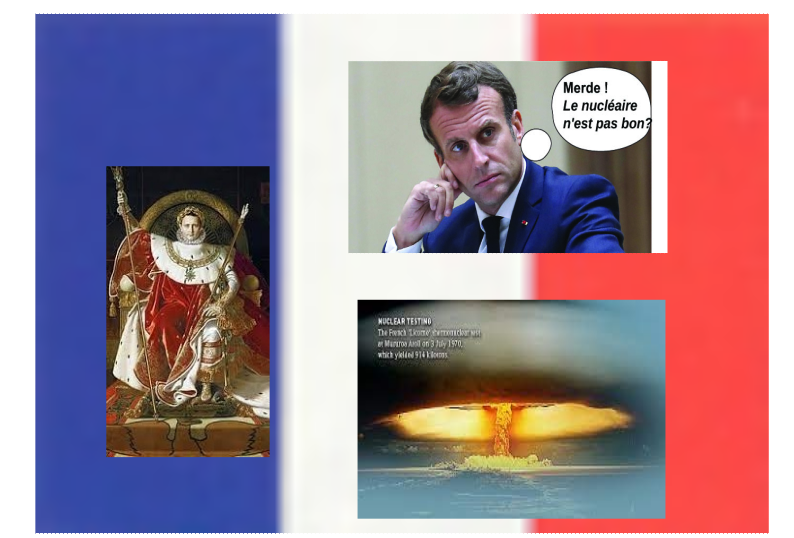
Bulletin of the Atomic Scientists By Austin R. Cooper | September 16, 2022, Access to French nuclear archives has increased dramatically during the past year. Since October 2021, French officials have declassified thousands of documents about the development of French nuclear weapons, an arsenal of roughly 300 warheads today.
This work marks a sea change in France, for decades one of the most difficult nuclear-armed democracies to study. Unlike the United States and the United Kingdom, France does not have Freedom of Information laws, which allow the public to file declassification requests. French archives do consider special access requests (dérogations), but these requests cannot compel a declassification review, which limits their utility in making nuclear weapons documents available for research.
French President Emmanuel Macron, in the wake of prize-nominated journalism and scholarship on the development of French nuclear weapons, launched a significant declassification initiative last year. This process has focused on Polynesia, the semi-autonomous French territory where French forces conducted nearly 200 atmospheric and underground explosions from 1966 to 1996. The scope does not include Algeria, the former French colony where French authorities built and operated their first nuclear test sites between 1960 and 1966, during the Algerian War for Independence (1954–62) and the construction of the postcolonial Algerian state.
New French transparency could help settle debates about environmental contamination and health effects from radiation exposure, especially in Polynesia. French law has promised to compensate victims of French nuclear weapons development who become sick or die from radiation-linked illness but has made only slow progress since 2010. Other nuclear-armed democracies, including the United States and the United Kingdom, have established similar compensation programs.
…………………………. Yet crucial gaps remain in access to French nuclear archives, especially records from the earliest years of the weapons testing program—when it took place in Algeria—and records concerning foreign affairs.
………………………. A report in February 2022 indicated that Macron’s declassification review had withdrawn only 59 documents out of nearly 35,000.
The global stakes. French nuclear history does not only concern France. France became the world’s fourth nuclear weapon state by building test sites and conducting atmospheric and underground explosions in two former French colonies: Algeria and then Polynesia. These blasts drew criticism from Algerian and Polynesian leaders, and from many neighboring countries in Africa and the Pacific.
Before becoming one of the world’s top nonproliferation cops, France served as a global nuclear supplier. During the Cold War arms race, the French government was among those that provided Israel, India, South Africa, Iran, and Iraq with nuclear technologies. Except for possibly Iran, all these states endeavored to build nuclear weapons; so far, only Iraq has failed to do so.
……………………. President Richard Nixon and his National Security Advisor Henry Kissinger secretly reversed US policy and launched unprecedented Franco-American cooperation on weapons design and safety procedures.
………………………………… . The publication in March 2021 of the French-language book Toxique, by the physicist Sébastien Philippe and investigative journalist Tomas Statius, created a media firestorm surrounding French nuclear history.
Toxique showed that French authorities underestimated and overlooked the extent of radioactive contamination—and the health risks—from the atmospheric explosions conducted in Polynesia until 1974. This finding relied on dozens of French documents declassified in 2012–13, following a decade of court battles fought by associations of nuclear test victims and anti-nuclear organizations.
……………………………………………….. Limits to French nuclear transparency. Recent French declassifications indicate real progress, but three shortcomings have become clear.
First, archival documentation of France’s first nuclear explosions in the Algerian Sahara (1960–66) falls outside the Declassification Commission’s mandate. This recent work, as well as the CEA-DAM process, have incidentally declassified a few documents about the two test sites in the Algerian desert. But most of these records remain unavailable for research.
This split in French nuclear history—between Algeria and Polynesia—is artificial. Similar French entities, and often the same French officials, directed the Algerian and Polynesian sites.
The reason for French transparency about the Polynesian sites, but not the Algerian ones, stems from French politics. Polynesia, and its semi-autonomous government, are part of France. Algeria won its independence in a bloody war of decolonization that coincided with the first French nuclear explosions. Algeria remains a touchy subject in France……………………………………………………….
Insights from the archives. French President Macron’s shift in declassification policy opens a new window into the development of French nuclear weapons. Researchers can now look to France for resources to understand the nuclear dimensions of European security during a moment when these dimensions have become all too obvious.
What makes France so important? Now the only nuclear weapon state in the European Union, France’s nuclear history has key quirks. It also has global reach.
In contrast to their British neighbors, French officials endeavored to build their nuclear weapons program as independently of the United States as possible. Franco-American technological cooperation improved during the Cold War, but Paris remained committed to charting its own strategic course. France provides a case study of trying to go it alone.
The French case also demonstrates deep entanglement with French colonial policies in Africa and the Pacific. A similar point holds true for the US use of the Marshall Islands as a nuclear test site and tribal lands for uranium mining, or for UK nuclear testing in Australia. As the only country not merely to plan but actually to conduct nuclear explosions on the African continent, and given the longevity of its nuclear presence in the Pacific, France offers a unique vantage point on broader intersections between the Cold War arms race and decolonization struggles.
French nuclear archives have as much to do with today’s politics as with 20th-century history. Macron’s policy shift demonstrates the impact of executive action and the power of civil society to shape nuclear weapons governance when researchers, journalists, activists, and other stakeholders work together. The French case has unique features—namely the legal status of Polynesia—but it holds broad lessons for nuclear-armed democracies.
Building on recent strides, the French declassification effort can expand in ways that do not threaten nonproliferation goals. Two places to start: documentation of the Algerian test sites and the rich nuclear collections in the Diplomatic Archives. https://thebulletin.org/2022/09/a-new-window-into-frances-nuclear-history/
The Hidden Truth about the War in Ukraine, and about Crimea and Donbass – Jacques Baud
The whole Western narrative about the “annexation” of Crimea is based on a rewriting of history and the obscuring of the 1991 referendum, which did exist and was perfectly valid.
The 1994 Budapest Memorandum remains extensively quoted since February 2022, but the Western narrative simply ignores the 1997 Friendship Treaty which is the reason for the discontent of the Russian-speaking Ukrainian citizens.
The Postil Magazine, Jacques Baud The cultural and historical elements that determine the relations between Russia and Ukraine are important. The two countries have a long, rich, diverse, and eventful history together.
This would be essential if the crisis we are experiencing today were rooted in history. However, it is a product of the present. The war we see today does not come from our great-grandparents, our grandparents or even our parents. It comes from us. We created this crisis. We created every piece and every mechanism. We have only exploited existing dynamics and exploited Ukraine to satisfy an old dream: to try to bring down Russia. Chrystia Freeland’s, Antony Blinken’s, Victoria Nuland’s and Olaf Scholz’s grandfathers had that dream; we realized it.
The way we understand crises determines the way we solve them. Cheating with the facts leads to disaster. This is what is happening in Ukraine. In this case the number of issues is so enormous that we will not be able to discuss them here. Let me just focus on some of them.
Did James Baker make Promises to Limit Eastward Expansion of NATO to Mikhail Gorbachev in 1990?
…………………………………………………………. In February 2022, in the German magazine Der Spiegel, Joshua Shifrinson, an American political analyst, revealed a declassified SECRET document of March 6, 1991, written after a meeting of the political directors of the foreign ministries of the United States, Great Britain, France and Germany. It reports the words of the German representative, Jürgen Chrobog:
We made it clear in the 2+4 negotiations that we would not extend NATO beyond the Elbe. Therefore, we cannot offer NATO membership to Poland and the others.
The representatives of the other countries also accepted the idea of not offering NATO membership to the other Eastern European countries.
So, written record or not, there was a “deal,” simply because a “deal” was inevitable. Now, in international law, a “promise” is a valid unilateral act that must be respected (“promissio est servanda“). Those who deny this today are simply individuals who do not know the value of a given word.
Did Vladimir Putin disregard the Budapest Memorandum (1994)?
In February 2022, at the Munich Security Forum, Volodymyr Zelensky referred to the 1994 Budapest Memorandum and threatened to become a nuclear power again. However, it is unlikely that Ukraine will become a nuclear power again, nor will the nuclear powers allow it to do so. Zelensky and Putin know this. In Fact, Zelensky is not using this memorandum to get nuclear weapons, but to get Crimea back, since the Ukrainians see Russia’s annexation of Crimea as a violation of this treaty. Basically, Zelensky is trying to hold Western countries hostage. To understand that we must go back to events and facts that are opportunistically “forgotten” by our historians.
On 20 January 1991, before the independence of Ukraine, the Crimeans were invited to choose by referendum between two options: to remain with Kiev or to return to the pre-1954 situation and be administered by Moscow. The question asked on the ballot was:
Are you in favor of the restoration of the Autonomous Soviet Socialist Republic of Crimea as a subject of the Soviet Union and a member of the Union Treaty?
This was the first referendum on autonomy in the USSR, and 93.6% of Crimeans agreed to be attached to Moscow. The Autonomous Soviet Socialist Republic of Crimea (ASSR Crimea), abolished in 1945, was thus re-established on 12 February 1991 by the Supreme Soviet of the Ukrainian SSR.
On 17 March, Moscow organized a referendum for the maintenance of the Soviet Union, which would be accepted by Ukraine, thus indirectly validating the decision of the Crimeans. At this stage, Crimea was under the control of Moscow and not Kiev, while Ukraine was not yet independent. As Ukraine organized its own referendum for independence, the participation of the Crimeans remained weak, because they did not feel concerned anymore.
Ukraine became independent six months after Crimea, and after the latter had proclaimed its sovereignty on September 4. On February 26, 1992, the Crimean parliament proclaimed the “Republic of Crimea” with the agreement of the Ukrainian government, which granted it the status of a self-governing republic. On 5 May 1992, Crimea declared its independence and adopted a Constitution. The city of Sevastopol, managed directly by Moscow in the communist system, had a similar situation, having been integrated by Ukraine in 1991, outside of all legality. The following years were marked by a tug of war between Simferopol and Kiev, which wanted to keep Crimea under its control.
In 1994, by signing the Budapest Memorandum, Ukraine surrendered the nuclear weapons of the former USSR that remained on its territory, in exchange for “its security, independence and territorial integrity.” At this stage, Crimea considered that it was—de jure—no longer part of Ukraine and therefore not concerned by this treaty. On its side, the government in Kiev felt strengthened by the memorandum. This is why, on 17 March 1995, it forcibly abolished the Crimean Constitution. It sent its special forces to overthrow Yuri Mechkov, President of Crimea, and de facto annexed the Republic of Crimea, thus triggering popular demonstrations for the attachment of Crimea to Russia. An event hardly reported by the Western media.
Crimea was then governed in an authoritarian manner by presidential decrees from Kiev. This situation led the Crimean Parliament to formulate a new constitution in October 1995, which re-established the Autonomous Republic of Crimea. This new constitution was ratified by the Crimean Parliament on 21 October 1998 and confirmed by the Ukrainian Parliament on 23 December 1998. These events and the concerns of the Russian-speaking minority led to a Treaty of Friendship between Ukraine and Russia on 31 May 1997. In the treaty, Ukraine included the principle of the inviolability of borders, in exchange—and this is very important—for a guarantee of “the protection of the ethnic, cultural, linguistic and religious originality of the national minorities on their territory.”
On 23 February 2014, not only did the new authorities in Kiev emerge from a coup d’état that had definitely no constitutional basis and were not elected; but, by abrogating the 2012 Kivalov-Kolesnichenko law on official languages, they no longer respected this guarantee of the 1997 treaty. The Crimeans therefore took to the streets to demand the “return” to Russia that they had obtained 30 years earlier.
On March 4, during his press conference on the situation in Ukraine a journalist asked Vladimir Putin, “How do you see the future of Crimea? Do you consider the possibility that it joins Russia?” he replied:
No, we do not consider it. In general, I believe that only the residents of a given country who are free to decide and safe can and should determine their future. If this right has been granted to the Albanians in Kosovo, if this has been made possible in many parts of the world, then no one is excluding the right of nations to self-determination, which, as far as I know, is laid down in several UN documents. However, we will in no way provoke such a decision and will not feed such feelings.
On March 6, the Crimean Parliament decided to hold a popular referendum to choose between remaining in Ukraine or requesting the attachment to Moscow. It was after this vote that the Crimean authorities asked Moscow for an attachment to Russia.
With this referendum, Crimea had only recovered the status it had legally acquired just before the independence of Ukraine. This explains why it renewed its request to be attached to Moscow, as in January 1991.
Moreover, the status of force agreement (SOFA) between Ukraine and Russia for the stationing of troops in Crimea and Sevastopol had been renewed in 2010 and to run until 2042. Russia therefore had no specific reason to claim this territory. The population of Crimea, which legitimately felt betrayed by the government of Kiev, seized the opportunity to assert its rights.
On 19 February 2022, Anka Feldhusen, the German ambassador in Kiev, threw a spanner in the works by declaring on the television channel Ukraine 24 that the Budapest Memorandum was not legally binding. Incidentally, this is also the American position, as shown by the statement on the website of the American embassy in Minsk.
The whole Western narrative about the “annexation” of Crimea is based on a rewriting of history and the obscuring of the 1991 referendum, which did exist and was perfectly valid. The 1994 Budapest Memorandum remains extensively quoted since February 2022, but the Western narrative simply ignores the 1997 Friendship Treaty which is the reason for the discontent of the Russian-speaking Ukrainian citizens.
Is the Ukrainian Government Legitimate?
The Russians still see the regime change that occurred in 2014 as illegitimate, as it was not done through constitutional process and without any support from a large part of the Ukrainian population.
The Maidan revolution can be broken down into several sequences, with different actors. Today, those who are driven by hatred of Russia are trying to merge these different sequences into one single “democratic impulse”: A way to validate the crimes committed by Ukraine and its neo-Nazis zealots.
At first, the population of Kiev, disappointed by the government’s decision to postpone the signing of the treaty with the EU, gathered in the streets. Regime change was not in the air. This was a simple expression of discontent.
Contrary to what the West claims, Ukraine was then deeply divided on the issue of rapprochement with Europe. A survey conducted in November 2013 by the Kyiv International Institute of Sociology (KIIS) shows that it was split almost exactly “50/50” between those who favored an agreement with the European Union and those favoring a customs union with Russia. In the south and east of Ukraine, industry was strongly linked to Russia, and workers feared that an agreement excluding Russia would kill their jobs. That is what would eventually happen. In fact, at this stage, the aim was already to try to isolate Russia.
In the Washington Post, Henry Kissinger, Richard Nixon’s National Security Advisor, noted that the European Union “helped turn a negotiation into a crisis.”
What happened later involved ultranationalist and neo-Nazis groups coming from the Western part of the country. Violence erupted and the government withdrew, after signing an agreement with the rioters for new elections. But this was quickly forgotten.
It was nothing less than a coup d’état, led by the United States with the support of the European Union, and carried out without any legal basis, against a government whose election had been qualified by the OSCE as “transparent and honest” and having “offered an impressive demonstration of democracy.” In December 2014, George Friedman, president of the American geopolitical intelligence platform STRATFOR, said in an interview:
Russia defines the event that took place at the beginning of this year [in February 2014] as a coup organized by the US. And as a matter of fact, it was the most blatant [coup] in history.
Unlike European observers, the Atlantic Council, despite being strongly in favor of NATO, was quick to note that the Maidan revolution had been hijacked by certain oligarchs and ultra-nationalists. It noted that the reforms promised by Ukraine had not been carried out and that the Western media stuck to an acritical “black and white” narrative.
A telephone conversation between Victoria Nuland, then Assistant Secretary of State for Europe and Eurasia, and Geoffrey Pyatt, the U.S. ambassador to Kiev, revealed by the BBC, shows that the Americans themselves selected the members of the future Ukrainian government, in defiance of the Ukrainians and the Europeans. This conversation, which became famous thanks to Nuland’s famous “F*** the EU!”
The coup d’état was not unanimously supported by the Ukrainian people, either in substance or in form. It was the work of a minority of ultra-nationalists from western Ukraine (Galicia), who did not represent the whole Ukrainian people. Their first legislative act, on 23 February 2014, was to abrogate the 2012 Kivalov-Kolesnichenko law, which established the Russian language as an official language along with Ukrainian. This is what prompted the Russian-speaking population to start massive protests in the southern part of the country, against authorities they had not elected.
In July 2019, the International Crisis Group (funded by several European countries and the Open Society Foundation), noted:
The conflict in eastern Ukraine began as a popular movement. […]
The protests were organized by local citizens claiming to represent the Russian-speaking majority in the region. They were concerned both about the political and economic consequences of the new government in Kiev and about that government’s later abandoned measures to prevent the official use of the Russian language throughout the country [“Rebels without a Cause: Russia’s Proxies in Eastern Ukraine,” International Crisis Group, Europe Report N° 254, 16 juillet 2019, p. 2].
Western efforts to legitimate this far-right coup in Kiev led to hide the opposition in the southern part of the country. In order to present this revolution as democratic, the real “hand of the West” was cleverly masked by the imaginary “hand of Russia.” This is how the myth of a Russian military intervention was created. Allegations about a Russian military presence were definitely false, an event the chief of the Ukrainian Security service (SBU) confessed in 2015 that there were no Russian units in Donbass.
To make things worse, Ukraine didn’t gain legitimacy through the way it handled the rebellion. In 2014-2015, poorly advised by NATO military, Ukraine waged a war that could only lead to its defeat: it considered the populations of Donbass and Crimea as enemy foreign forces and made no attempt to win the “hearts and minds” of the autonomists. Instead, its strategy has been to punish the people even further. Bank services were stopped, economic relations with the autonomous regions were simply cut, and Crimea didn’t receive drinking water anymore.
This is why there are so many civilian victims in the Donbass, and why the Russian population still stands in majority behind its government today. The 14,000 victims of the conflict tend to be attributed to the “Russian invaders” and the so-called “separatists.” However, according to the United Nations—more than 80% of civilian casualties are the result of Ukrainian shelling. As we can see, the Ukrainian government is massacring its own people with the help, funding and advice of the military of NATO, the countries of the European Union, which defends its values.
In May 2014, the violent repression of protests prompted the population of some areas of the Donetsk and Lugansk regions of Ukraine to hold referendums for Self-Determination in the Donetsk People’s Republic (approved by 89%) and in the Lugansk People’s Republic (approved by 96%). Although Western media keeps calling them referendums of “independence,” they are referendums of “self-determination” or “autonomy” (самостоятельность). Until February 2022, our media consistently talked about “separatists” and “separatist republics.” In reality, as stated in the Minsk Agreement, these self-proclaimed republics didn’t seek “independence,” but an “autonomy” within Ukraine, with the ability to use their own language and their own customs………………………………………. more https://www.thepostil.com/the-hidden-truth-about-the-war-in-ukraine/
The Chinese non-threat
China relies on something called soft power discovered by the Chinese long before the rest of us.
https://johnmenadue.com/the-chinese-non-threat/ Pearls and Irritations, By Gregory Clark, Aug 23, 2022
Our resident non-Chinese speaking, non-Chinese informed but bitterly ‘China is expansionist-aggressive’ commentators in the mainstream media in Australia don’t have,or even want to have, any idea about China.
China is accused of aggressive expansionism, over Taiwan and towards its neighbours in general.
It is a curious charge. Almost all of the 178 nations recognising China have formally recognised that legally Taiwan belongs to China. In the recently proclaimed ‘rules based international order’ such formal recognition by so many nations would seem to have some weight.
Yet Beijing has still done little to claim this promised recognition. On the contrary, it still accepts Taiwan’s control over a number of islands in the South China Sea, including some occupied by the Taiwan military a stone’s throw from China’s coast.
Nor is it only Taiwan that enjoys Beijing’s territorial tolerance.
It has done nothing to follow up on China’s strong historical clam to much of Russia’s Far East. Even at the height of China’s strong tensions with Moscow in the 1960’s and ’70’s it barely moved despite constant invitations to do so by Western hawks.
(Taiwan too had criticised Beijing’s inaction).
Amazingly Beijing has done nothing to try to dominate, let alone attack, the vast areas of a Mongolia with rich resources needed by China and with only 3 million people to defend its 4,600 kilometre with China (Taiwan insists Mongolia is China’s territory and strongly criticises Beijing’s inaction.)
The same is true for Kazakstan, Kyrgyzstan, Tajikistan and Afghanistan, central Asian nations which border China and have at times harboured militants that have attacked into China.(Taiwan again criticises Beijing’s inaction.)
Moving down to Pakistan and India, we find Beijing has tolerated borders (the MacMahon Line and in much of Ladakh) imposed by aggressive19th century UK colonial advances far into China’s then nominally controlled, Tibetan-populated Himalayan territories.
True, there have since been disputes with India which took over from the British the large Tibetan populated areas in northern Assam and Ladakh, and wants more. Only when the Indians under Nehru’s forward policy went too far and moved into Tibet across even the UK arbitrarily imposed MacMahon Line did Beijing finally take action.
Even then, and having taught the Indians a lesson, it retreated to the MacMahon Line (a retreat which Taiwan protested, of course).
(As China desk officer in Canberra at the time I know for a fact that the first dispute in 1962 was due to India trying illegally to seize territory north of the MacMahon Line.The Chinese gave us the maps to prove it. The Indians gave nothing.)
Moving further east we find that Beijing, unlike Taiwan, accepts a border with Myanmar that allows Kokang, a large Mandarin Chinese speaking community, to remain in eastern Myanmar. (Taiwan objects to Beijing’s generosity, of course.)
Beijing did nothing to support the many pro-Beijing, Chinese speakers in Sarawak, fighting a losing battle with British and Australian troops while seeking to prevent their 1960’s forcible incorporation into the artificial construct of Malaysia.
Beijing did nothing to maintain the now disappeared 2,000 year colony of Chinese in western Borneo – the Laifang Republic. And as we know tragically it did nothing to protect the one million Chinese and leftwing Indonesian massacred in 1958. Nor did it try to protect resident Chinese from subsequent brutal Indonesian pogroms there .
And finally we come to the alleged Chinese claims against sone minuscule Japanese claimed islands -the Senkaku Islands – in the east China sea. The claims were in fact made by Taiwan, not China; they are supported by China. The islands have no Japanese name; they were discovered and named by Chinese and British explorers. Geographically they are part of Taiwan and lie on the Chinese continental shelf.
Even the US does not recognise Japanese sovereignty.
One wonders whether our resident non-Chinese speaking, non-Chinese informed but bitterly ‘China is expansionist-aggressive’ commentators in the mainstream media have, or even want to have, any idea of any of these details.
By comparison, while China has been doing little in recent decades, the US was quickly trying to take over by force large territories of France, Mexico, Spain (including the Philippines) and even Canada plus a host of islands belonging to other people in both the Atlantic and the Pacific.
In shameful collusion with the UK the US expelled the population of the Diego Garcia island and used it for the bombing of much of the Middle East.
China’s long acceptance of British and Portuguese colonies on its border (India was far less tolerant), its delay in taking over Taiwan (a right granted by every nation recognising Beijing, including the US and Australia), its toleration of Taiwan still occupying militarily the Offshore Islands etc suggests almost a dislike of military action.
Instead it relies on something called soft power discovered by the Chinese long before the rest of us. Convinced of the attractiveness of its culture it long believed with it can automatically draw people to its side without force of arms.
That was before it came up against us militaristic Westerners, happy to invade China and vandalistically destroy the symbols of that culture.
GREGORY CLARK
Gregory Clark began his career in Australia’s Department of External Affairs, with postings to Hong Kong and Moscow. Resigning in 1964 to protest at Australia’s participation in the Vietnam War he moved to Japan, becoming emeritus president of Tama University in Tokyo and vice-president of the pioneering Akita International University. He continues to live in Japan and has established himself as a commentator/academic. Between 1969-74 he was correspondent for The Australian in Tokyo.
More on http://www.gregoryclark.net
TODAY. Rewriting history in the interest of hating Russia.
Russians are no saints. The Russian army is no saint. I’m sure there’ve been atrocities by Russia, especially in Stalin’s time, and during World War 2, and now , in Ukraine.
BUT – now we are all, especially in the anglophone media, being systematically taught to hate Russia.
Today we learn that Poland is shutting down the Russian exhibition at the Auschwitz-Birkenau memorial and museum. This doesn’t matter – OR DOES IT?
It’s pretty easy to wipe out the history of the Russian soldiers liberating Auschwitz. You see, that happened on January 27 1945, well before the war ended in May. There was very little publicity about the liberation. In later months, as the war was ending liberation of other camps by the British was widely publicised.
In fierce fighting on the outskirts of Auschwitz, 231 Russian soldiers died. In the main camp, and a subsidiary camp, the soldiers found 12000 prisoners alive. One Russian soldier spoke Yiddish to the prisoners, eliciting a response from the terrified prisoners. Russian soldiers worked with Polish Red Cross to help the prisoners – setting up a hospital onsite. Russians first heard the stories from the surviving prisoners.
Denialism of history is a curse that is helping to bring the human species closer to self-annihilation. To add to a current wave of denialism of the holocaust, we now have denialism of the heroic role of many Russians in World War 2, and of their co-operative role with Polish citizens in caring for the sick and emaciated Auschwitz prisoners.
Nuclear weapons will not bring peace or security, only dangers

We can honour the victims of Hiroshima and Nagasaki by supporting the prohibition treaty, says RAE STREET https://morningstaronline.co.uk/article/f/nuclear-weapons-will-not-bring-peace-or1 6 Aug, 22,
THIS is the month when we commemorate the fearful nuclear bombings of the people of Hiroshima and Nagasaki.
Alas, the myth is still put out that the bombs were dropped to end the second world war. That is not true.
By the time the bomb was ready for use, Japan was ready to surrender. As General Dwight D Eisenhower said, Japan was at that very moment seeking some way to surrender with minimum loss of face, and “it wasn’t necessary to hit them with that awful thing.”
Thus, the bomb on Hiroshima was dropped on August 6 before it was publicly stated that the Japanese had surrendered.
The Soviet Union entered the war in Asia on August 9. Later the same day, the US dropped a second bomb on Nagasaki.
We now know the horrors that nuclear bombs inflict. We have heard from the Hibaksha, the survivors. Now instead of heeding the survivors of those bombs, the Hibaksha, that nuclear weapons should be ended, governments across the world have developed more destructive nuclear bombs.
Britain, part of the US Trident submarine system, carries warheads on multiple missiles, with 15 times the power of the bomb used on Hiroshima.
Proponents of nuclear weapons, including the Nato military alliance, claim that they keep the peace and repeatedly talk of nuclear deterrents.
But the US has the largest nuclear arsenal in the world, and it did not stop the attack on the Twin Towers; nor did Trident stop terrorist attacks in Britain.
What is never mentioned is the death and destruction which has been brought about with the development of nuclear weapons, mainly on indigenous peoples.
This starts with the beginning of the cycle with uranium mining where native people in the US, in Canada, in Australia and the Congo, among others, have been forced into mining.
They and their families have suffered serious illness and even death. Above-ground testing has also brought suffering to native peoples.
After the French testing in the Pacific, mothers gave birth to “jellyfish” babies which died within a few hours. In the US above-ground testing meant that many of the “downwinders,” including the Western Shoshone, became seriously ill.
Although above-ground tests have now ended following the Comprehensive Test Ban Treaty, uranium mining has not ceased.
It continues except for Greenland where the Inuit, now in government, have banned uranium mining.
In 2022, with the war in Ukraine, we are now in more danger than ever before of a further use of nuclear weapons. If ever one of these highly destructive current bombs were exploded either by intent or accident, it would be a worldwide catastrophe.
There would be fires and radioactive fallout and fatal illnesses from acute radiation sickness, cancer and genetic damage which can be passed on to offspring.
At the same time, nuclear fireballs would send up enormous quantities of dust high into the atmosphere, blotting out the sun which would lead to nuclear winter.
And the contaminated ground would be unsuitable for food production leading to food shortages. In effect, if people had not died any other way, they would die of hunger.
Yet our current government not only supports the replacement of Trident but in the Integrated Defence Review increased the cap on Britain’s stockpile for 2025 from 180 to 260.
They even changed the scenario for nuclear use to “emerging technologies that could have a comparable impact,” possibly cyber-attacks but maybe some conventional weapons?
Starmer, once more making himself into a Tory by default, said via his shadow defence minister that Trident was “non-negotiable.”
Even the cost should have made him hesitate on this. It is estimated that the cost in public money — our money — will be £205 billion (and rising) to replace Trident.
And that when working people are struggling and across the world people starve; where we also urgently need funding for the transition from fossil fuels.
Nato too still holds a policy of first use of nuclear weapons and through the US, which has always dominated Nato policy, keeps “nuclear sharing,” weapons on the territory of five states: Belgium, Germany, Italy, the Netherlands and Turkey.
Without any public debate, we now know that nuclear bombs and nuclear capable aircraft are to be brought back to Lakenheath in Suffolk.
But the majority world wants nuclear disarmament. In January 2021, the UN-negotiated Treaty on the Prohibition of Nuclear Weapons came into force which now has 138 signatories — but not the Nato nuclear-armed states which were prevented by Nato.
Sixty-six states have now ratified the treaty. Our government and the Labour Party should be supporting the treaty because nuclear weapons will not bring peace or security, only dangers.
That way we would honour the memory of the victims of Hiroshima and Nagasaki. Our politicians should be looking at how to develop “common security,” putting funding and resources into dialogue and negotiation and respecting the security of everyone.
ROBERT PRICE: Kern isn’t any more welcoming of nuclear power than it was a half-century ago
Bakersfield.com, By ROBERT PRICE For The Californian, 9 July 22 Ask most any Californian to describe nuclear energy and you’ll hear adjectives like “unreliable,” “dangerous” and “volatile……….
Nuclear (and even more unlikely, natural gas) could one day receive the same energy designation as wind farms and solar fields.
……………………… Although the EU’s tentative embrace of nuclear energy might turn some heads in the U.S., however, it’s not going to change minds in Kern County.
……………………….. Kern County was one of the first places in the U.S. to unite disparate political factions and rise up against the proliferation of nuclear power.
…………………………….. Opposition to the project coalesced into an unlikely alliance of farmers, doctors and environmentalists, the likes of which the power utilities had never before seen. Could conservatives and liberals get along? In Kern County, at the height of the 1976-78 battle against the DWP, they did.
……………………… It was the first time anywhere in America that citizens had voted down a nuclear power plant. Opposition to nuclear power had moved, as Wellock noted, from the movement’s typical base — “elements of the left wing of the Democratic Party” — to “traditionally pro-nuclear blue-collar constituencies.”
………………… If and when nuclear power ever does make a comeback in California, however, Kern County will not be the place for it. Nuclear plants need water and plenty of it, and Kern County has even less of it than it did in the mid-’70s, when opponents were citing water shortages among their list of concerns……. https://www.bakersfield.com/columnists/robert-price/robert-price-kern-isn-t-any-more-welcoming-of-nuclear-power-than-it-was-a/article_f5b32c48-ffd5-11ec-a605-172bf1ccbf72.html
Atoms and Ashes—lessons from six of the world’s worst nuclear disasters
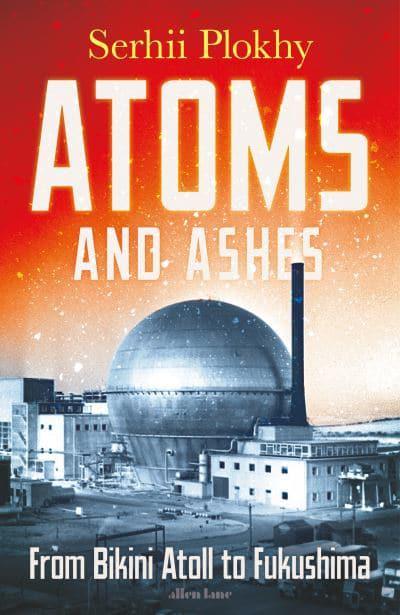
This is a powerful and timely book. At a time when arguments for nuclear power are returning as a way to solve both climate change and the energy crisis, we need to arm ourselves with the arguments. Not only is nuclear power not a solution to the problems we face, the lesson from this book is that it’s inherently dangerous and could have devastating consequences for life on earth.
https://socialistworker.co.uk/long-reads/atoms-to-ashes-lessons-from-six-of-the-wo2 27 June 22, Atoms and Ashes—from Bikini Atoll to Fukushima, the new book by Serhii Plokhy, is a compulsive but terrifying read, writes Amy Leather
Standing in front of Hinkley Point C nuclear power plant, Boris Johnson launched the Tories’ Energy Security Strategy in April. Nuclear energy was central to the plan. Johnson claimed the strategy would deliver “clean, affordable, secure power to the people for generations to come”. He called for 25 percent of our electricity to come from nuclear power by 2050—up from the current 16 percent. That means greatly increasing capacity, with Johnson bragging the first phase of the plan will involve building eight new nuclear reactors.
Reading Atoms and Ashes by Serhii Plokhy in this context is chilling. As Plokhy says at the start, his main purpose is to take a fresh look at the history of nuclear accidents. He looks at why they happened, how bad they were, what we can learn, and assesses if they could ever happen again.
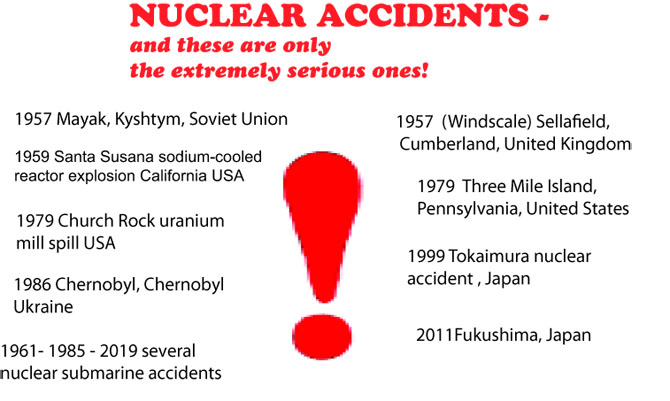
To do this, he examines six of the world’s worst nuclear disasters—although he is very clear these are by no means the only accidents that have occurred. In fact, there have been hundreds of known incidents and probably even more that have been kept secret or covered up.
Plokhy starts with the Castle Bravo nuclear test that took place in March 1954 at Bikini Atoll, Marshall Islands, in the Pacific. A miscalculation of the hydrogen bomb’s radiation yield and wind direction significantly damaged human health and the environment. The book ends with the Fukushima disaster of 2011, when a 43-foot-high tsunami crashed over the Japanese nuclear plant causing three reactors to go into meltdown.
In between these terrible events Plokhy explores the 1957 Kyshtym disaster in Russia’s Ural Mountains. The explosion of a nuclear waste tank released a massive amount of radiation into the atmosphere. He examines the reactor fire at the Windscale works in Cumbria in the same year. And then he looks at the reactor meltdowns at Three Mile Island in the US in 1979 and the 1986 nuclear disaster at Chernobyl in what is now Ukraine.
It confirms in revealing detail what many of us who’ve campaigned against nuclear power already know—that it is neither clean nor safe. And, rather than a legacy of “secure power”, it will leave future generations nuclear waste, contaminated water and land, and the cost of clean ups, decontamination and decommissioning.
The catastrophic explosion at the Chernobyl plant made the entire region uninhabitable, with up to half a million people permanently displaced. A report in September 2005 put the predicted final death toll from radiation induced cancers at 4,000 people. The Union of Concerned Scientists suggests it could be more than six times that. Recent estimates put the number of deaths from the Fukushima disaster at 2,202 with some predicting thousands more extra cancer deaths. Around 150,000 people had to evacuate the region.
Lots of dangerous material is generated from nuclear power. One of the solutions is to bury high level nuclear waste underground. The US government buries its waste from weapons in New Mexico. The land will still be contaminated in 300,000 years’ time. Meanwhile in Japan, the future of over one million tons of contaminated water stored in a thousand tanks on the site of the Fukushima nuclear plant is unresolved. Last year the Japanese government decided to start releasing the water into the ocean—a process that could last decades and cause environmental damage.
Plokhy charts how the race to make atomic and hydrogen bombs drove the development of nuclear power during and just after the Second World War. Nuclear plants were first built to produce the plutonium needed for bombs, not to generate electricity. The first nuclear bombs were dropped by the US on Hiroshima and Nagasaki in Japan in August 1945, with devastating consequences.
It wasn’t until the end of 1953 that the US launched the concept of “atoms for peace”. President Dwight Eisenhower claimed that the nuclear industry could produce “good atoms” for energy. It was an attempt to reassure people after concerns were raised about nuclear energy. He wanted to change public perception in the US in order to win support for more investment in nuclear arms and weapons.
In Britain the first nuclear plant was Windscale, built in the village of Seascale on the Cumbrian coast. Construction began in 1947 and it went operational in 1950. The purpose of the nuclear reactors was to produce the material for a British bomb. Successive prime ministers—Labour and Tory—wanted to boost British nuclear capabilities. In the context of the Cold War’s imperialist competition between the US and Russia and British imperial decline, they sought to prove
Britain’s worth to the US. That meant developing a nuclear bomb as quickly as possible.
From the very beginning this competition between states to develop nuclear weapons meant great secrecy, cutting corners, taking risks and an often-cavalier attitude to safety. It becomes clear as each disaster plays out that—whether it was in the US, Russia or Britain—there was little care about that or the people affected by accidents and tests.
For example, when it came to the nuclear bomb tests in the Marshall Islands, those in charge proceeded despite knowing the risks. The people living on some nearby islands were not even told the tests were happening. The colonial mindset of the US meant the indigenous people of the Marshall Islands were either ignored or moved at will. And once suffering from radiation, they were subject to studies—not to help them recover but to help the industry assess the effects of radiation.
For example, when it came to the nuclear bomb tests in the Marshall Islands, those in charge proceeded despite knowing the risks. The people living on some nearby islands were not even told the tests were happening. The colonial mindset of the US meant the indigenous people of the Marshall Islands were either ignored or moved at will. And once suffering from radiation, they were subject to studies—not to help them recover but to help the industry assess the effects of radiation.
.Competition and secrecy meant that scientists developing and building the new nuclear reactors could not properly learn from each other. For example, those building the Windscale Works in the 1950s only learnt of new developments piecemeal from the US. Often it was too late to incorporate them into the reactor design. Plokhy describes how the scientists and engineers at Windscale didn’t find out about the need for radiation filters to be fitted on the chimneys until after construction had begun. Rather than start again, they were put at the top of the chimneys where they were less effective. Tellingly even this addition was nicknamed “Cockcroft’s Folly” after the man who insisted they had them at all. In fact, these filters helped trap much of the radiation when the reactor fire broke out.
From the start, Russia chose to use outdated and unsafe reactor designs. Safer ones would have taken longer to build and they had no time to spare when racing against the US. The operators and nuclear engineers at Chernobyl had not even been told about the previous accidents with this type of reactor. Similarly, no manager or operator at Three Mile Island had been told of problems with the type of reactor they were using. It had previously caused an accident at another plant.
The pressure to produce plutonium as quickly as possible meant cutting corners with safety. For example, something called “Wigner energy” builds up in the main body of the reactor while the fission reaction is taking place. This needs to be regularly released otherwise it ignites the graphite used to moderate the reaction. This special operation to release the excess energy is called “annealing”. But the procedure at Windscale required stopping the reactor, so reducing operational hours and productivity. Under pressure from the government to produce more bomb fuel the Windscale Technical Committee had decided to reduce the number of anneals. By the time the anneal finally took place the day before the reactor fire in October 1957, it was long overdue.
At the Chernobyl nuclear plant, in order to meet the deadline of December 1983, the fourth reactor had gone operational before a key safety test. It was not until April 1986 that plans were made to carry out this test. It meant shutting down the reactor. This is a very challenging operation and can lead to the reactor becoming unstable. What followed led to two massive blasts that flung off the shield that covered the top of the reactor. Masses of radioactive particles escaped into the atmosphere.
Prior to the disaster at Fukushima a scandal had broken out over the falsification of safety reports by the company—Tokyo Electric Power Company (TEPCO). According to Plokhy, from as early as 1977 “there were at least two hundred cases in which the company had supplied false information about inspections not carried out and issued reports that papered over existing problems”.
Nuclear power stations are often portrayed as calm laboratories where the experts are in charge. Bill Gates, a founder of nuclear innovation company TerraPower, has said that any problems will be solved by “innovation” and the “laws of physics”.
However, the descriptions in the book show the complete opposite of a calm, controlled environment. As Plokhy says, “Hazard is inherent in all nuclear power.” Atomic fission itself is dangerous, and nuclear reactors can be unreliable and unpredictable. The book makes clear how competition, secrecy, lack of communication as well as miscommunication make it extremely unsafe.
Plokhy describes almost minute by minute the trajectory of each disaster. In all of them, there comes a point when the scientists, the operators, the experts simply don’t know what to do to prevent the accident from worsening. In the end, due to the conditions they are operating under, they sometimes make decisions that actually make the situation worse. Or, by solving one problem, another one is created. At Windscale, they simply did not know how to stop the fire. At Chernobyl one issue among many was that they did not know if the radiation would get into the groundwater. And at Three Mile Island, two scientists were having a raging argument about what next steps to take in the midst of the emergency. Meanwhile, in every case, the authorities delayed evacuation plans.
.This is in no way to blame the individuals working at the time or those who had to deal with the accidents. They acted with immense bravery and sacrificed their own health, and even lives, to prevent greater disaster. Plokhy highlights how often the subsequent reports into accidents wrongly blame personnel and not the reactor designs. He illustrates how the conditions they were operating in and the nature of nuclear power led to such problems.
After each major accident, the authorities say they’ve learned the lessons and developed new technology that will prevent anything similar from happening. However, Plokhy highlights that there was – and still is—an inherent safety problem with nuclear reactors being used to generate power. They were never designed for that purpose. The reactors were developed from military prototypes to produce plutonium or to power nuclear submarines.
Many of the new, smaller reactors that have been designed from scratch to produce energy, are still at the computer-simulation stage and years away from construction. Plokhy predicts that the expansion in the number of plants now being proposed will increase the probability of accidents.
Although it is not discussed in the book, it is worth remembering that nuclear power is not carbon neutral. While nuclear fission itself does not release carbon emissions, every other stage of the production process means greenhouse gases are pumped into the atmosphere. More than almost any other form of energy generation nuclear power requires a complex cycle of mining, generation, storage and disposal. And in 2022 there are new risk factors. As Plokhy has written elsewhere, “Warfare, economic collapse, climate change itself—all of these increasingly real risks make nuclear sites potentially perilous places.”
This is a powerful and timely book. At a time when arguments for nuclear power are returning as a way to solve both climate change and the energy crisis, we need to arm ourselves with the arguments. Not only is nuclear power not a solution to the problems we face, the lesson from this book is that it’s inherently dangerous and could have devastating consequences for life on earth.
- Atoms and Ashes—from Bikini Atoll to Fukushima by Serhii Plokhy. £25.00 Available from Bookmarks—the socialist bookshop
The Windscale nuclear accident 1957, and still not cleaned up. – a warning from history
Nuclear power: the warnings from history. The PM wants to keep the lights
on with eight new atomic plants. He’s in denial if he thinks the
catastrophes of the past won’t happen again.
If Johnson is going to use nuclear history to justify his strategy, perhaps he needs to look a little
deeper, because Windscale was also the site of one of the world’s first
serious nuclear accidents. In October 1957, a fire raged for three days in
one of the reactors after changes to increase production.
Through the heroism of staff, and a significant degree of luck, the catastrophe was
contained. But significant radiation was released. Milk from cows within
200 square miles was contaminated. In 1982 officials estimated 260 people
developed cancer and 32 people died as a result. The two first reactors at
Windscale were closed, but the clean-up is still under way today.
Last November the top of the chimney in which the fire blazed was removed as
part of the demolition. The renowned nuclear historian Serhii Plokhy
describes the episode in a forthcoming book and points out: “The existing
nuclear industry is an open-ended liability.” No nuclear power station
has ever been fully decommissioned.
In Atoms and Ashes, Plokhy, 64, a
Ukrainian historian at Harvard, explores the causes and consequences of
Windscale and five other nuclear accidents: at Bikini Atoll in the Pacific
in 1954, Kyshtym in Russia in 1957, Three Mile Island in the US in 1979,
Chernobyl in Ukraine in 1986 and Fukushima in Japan in 2011.While most of
these accidents took place in the formative years of nuclear science,
Plokhy argues they could easily happen again. “Technology was improved as
a result, and every accident contributed to the shaping of subsequent
safety procedures and culture,” he writes.
“And yet nuclear accidents
occur again and again. Many of the political, economic, social, and
cultural factors that led to the accidents of the past are still with us
today, making the nuclear industry vulnerable to repeating old mistakes in
new and unexpected ways.”
Times 9th April 2022
https://www.thetimes.co.uk/article/nuclear-power-latest-warnings-history-chernobyl-ph9q7w80j
Ukraine war – the Nazi factor
Make Nazism Great Again https://www.opednews.com/articles/Make-Nazism-Great-Again-by-Pepe-Escobar-Azov-Battalion_Nazis_War-In-Ukraine-220325-46.html
By Pepe Escobar , 25 Mar 22,
The supreme target is regime change in Russia, Ukraine is just a pawn in the game – or worse, mere cannon fodder.
All eyes are on Mariupol. As of Wednesday night, over 70% of residential areas were under control of Donetsk and Russian forces, while Russian Marines, Donetsk’s 107th batallion and Chechen Spetsnaz, led by the charismatic Adam Delimkhanov, had entered the Azov-Stal plant – the HQ of the neo-Nazi Azov batallion.
Azov was sent a last ultimatum: surrender until midnight – or else, as in a take no prisoners highway to hell.
That implies a major game-changer in the Ukrainian battlefield; Mariupol is finally about to be thoroughly denazified – as the Azov contingent long entrenched in the city and using civilians as human shields were their most hardened fighting force.
There’s no intention whatsoever in Washington to facilitate a peace plan in Ukraine – and that explains Comedian Zelensky’s non-stop stalling tactics. The supreme target is regime change in Russia, and for that Totalen Krieg against Russia and all things Russian is warranted. Ukraine is just a pawn in the game – or worse, mere cannon fodder.
This also means that the 14,000 deaths in Donbass for the past 8 years should be directly attributed to the Exceptionalists. As for Ukrainian neo-Nazis of all stripes, they are as expendable as “moderate rebels” in Syria, be they al-Qaeda or Daesh-linked. Those that may eventually survive can always join the budding CIA-sponsored Neo-Nazi Inc. – the tawdry remix of the 1980s Jihad Inc. in Afghanistan. They will be properly “Kalibrated” city and using civilians as human shields were their most hardened fighting force.
A quick neo-Nazi recap
By now only the brain dead across NATOstan – and there are hordes – are not aware of Maidan in 2014. Yet few know that it was then Ukrainian Minister of Interior Arsen Avakov, a former governor of Kharkov, who gave the green light for a 12,000 paramilitary outfit to materialize out of Sect 82 soccer hooligans who supported Dynamo Kiev. That was the birth of the Azov batallion, in May 2014, led by Andriy Biletsky, a.k.a. the White Fuhrer, and former leader of the neo-nazi gang Patriots of Ukraine.
Together with NATO stay-behind agent Dmitro Yarosh, Biletsky founded Pravy Sektor, financed by Ukrainian mafia godfather and Jewish billionaire Ihor Kolomoysky (later the benefactor of the meta-conversion of Zelensky from mediocre comedian to mediocre President.)
Pravy Sektor happened to be rabidly anti-EU – tell that to Ursula von der Lugen – and politically obsessed with linking Central Europe and the Baltics in a new, tawdry Intermarium. Crucially, Pravy Sektor and other nazi gangs were duly trained by NATO instructors.Biletsky and Yarosh are of course disciples of notorious WWII-era Nazi collaborator Stepan Bandera, for whom pure Ukrainians are proto-Germanic or Scandinavian, and Slavs are untermenschen.
Azov ended up absorbing nearly all neo-Nazi groups in Ukraine and were dispatched to fight against Donbass – with their acolytes making more money than regular soldiers. Biletsky and another neo-Nazi leader, Oleh Petrenko, were elected to the Rada. The White Fuhrer stood on his own. Petrenko decided to support then President Poroshenko. Soon the Azov battalion was incorporated as the Azov Regiment to the Ukrainian National Guard.
They went on a foreign mercenary recruiting drive – with people coming from Western Europe, Scandinavia and even South America.
That was strictly forbidden by the Minsk Agreements guaranteed by France and Germany (and now de facto defunct). Azov set up training camps for teenagers and soon reached 10,000 members. Erik “Blackwater” Prince, in 2020, struck a deal with the Ukrainian military that would enable his renamed outfit, Academi, to supervise Azov.
It was none other than sinister Maidan cookie distributor Vicky “F**k the EU” Nuland who suggested to Zelensky – both of them, by the way, Ukrainian Jews – to appoint avowed Nazi Yarosh as an adviser to the Commander-in-Chief of the Ukrainian Armed Forces, Gen Valerii Zaluzhnyi. The target: organize a blitzkrieg on Donbass and Crimea – the same blitzkrieg that SVR, Russian foreign intel, concluded would be launched on February 22, thus propelling the launch of Operation Z.
All of the above, in fact just a quick recap, shows that in Ukraine there’s no difference whatsoever between white neo-Nazis and brown-colored al-Qaeda/ISIS/Daesh, as much as neo-Nazis are just as “Christian” as takfiri Salafi-jihadis are “Muslim”.
When Putin denounced a “bunch of neo-Nazis” in power in Kiev, the Comedian replied that it was impossible because he was Jewish. Nonsense. Zelensky and his patron Kolomoysky, for all practical purposes, are Zio-Nazis.
Even as branches of the United States government admitted to neo-Nazis entrenched in the Kiev apparatus, the Exceptionalist machine made the daily shelling of Donbass for 8 years simply disappear. These thousands of civilian victims never existed.
U.S. mainstream media even ventured the odd piece or report on Azov and Aidar neo-Nazis. But then a neo-Orwellian narrative was set in stone: there are no Nazis in Ukraine. CIA offshoot NED even started deleting records about training members of Aidar. Recently a crappy news network duly promoted a video of a NATO-trained and weaponized Azov commander – complete with Nazi iconography.
Why “denazification” makes sense
The Banderastan ideology harks back to when this part of Ukraine was in fact controlled by the Austro-Hungarian empire, the Russian empire and Poland. Stepan Bandera was born in Austro-Hungary in 1909, near Ivano-Frankovsk, in the – then autonomous – Kingdom of Galicia.
WWI dismembered European empires into frequently non-viable small entities. In western Ukraine – an imperial intersection – that inevitably led to the proliferation of extremely intolerant ideologies.
Banderastan ideologues profited from the Nazi arrival in 1941 to try to proclaim an independent territory. But Berlin not only blocked it but sent them to concentration camps. In 1944 though the Nazis changed tactics: they liberated the Banderanistas and manipulated them into anti-Russian hate, thus creating a destabilization force in the Ukrainian USSR.
So Nazism is not exactly the same as Banderastan fanatics: they are in fact competing ideologies. What happened since Maidan is that the CIA kept a laser focus on inciting Russian hatred by whatever fringe groups it could instrumentalize. So Ukraine is not a case of
“white nationalism” – to put it mildly – but of anti-Russian Ukrainian nationalism, for all practical purposes manifested via Nazi-style salutes and Nazi-style symbols.
So when Putin and the Russian leadership refer to Ukrainian Nazism, that may not be 100% correct, conceptually, but it strikes a chord with every Russian.
Russians viscerally reject Nazism – considering that virtually every Russian family has at least one ancestor killed during the Great Patriotic War. From the perspective of wartime psychology, it makes total sense to talk of “Ukro-nazism” or, straight to the point, a “denazification” campaign.
How the Anglos loved the Nazis
The United States government openly cheerleading neo-Nazis in Ukraine is hardly a novelty, considering how it supported Hitler alongside England in 1933 for balance of power reasons.
In 1933, Roosevelt lent Hitler one billion gold dollars while England lent him two billion gold dollars. That should be multiplied 200 times to arrive at today’s fiat dollars. The Anglo-Americans wanted to build up Germany as a bulwark against Russia. In 1941 Roosevelt wrote to Hitler that if he invaded Russia the U.S. would side with Russia, and wrote Stalin that if Stalin invaded Germany the U.S. would back Germany. Talk about a graphic illustration of Mackinderesque balance of power.
The Brits had become very concerned with the rise of Russian power under Stalin while observing that Germany was on its knees with 50% unemployment in 1933, if one counted unregistered itinerant Germans.
Even Lloyd George had misgivings about the Versailles Treaty, unbearably weakening Germany after its surrender in WWI. The purpose of WWI, in Lloyd George’s worldview, was to destroy Russia and Germany together. Germany was threatening England with the Kaiser building a fleet to take over the oceans, while the Tsar was too close to India for comfort. For a while Britannia won – and continued to rule the waves.
Then building up Germany to fight Russia became the number one priority – complete with rewriting of History. The uniting of Austrian Germans and Sudetenland Germans with Germany, for instance, was totally approved by the Brits.
But then came the Polish problem. When Germany invaded Poland, France and Britain stood on the sidelines. That placed Germany on the border of Russia, and Germany and Russia divided up Poland. That’s exactly what Britain and France wanted. Britain and France had promised Poland that they would invade Germany from the west while Poland fought Germany from the east.
In the end, the Poles were double-crossed. Churchill even praised Russia for invading Poland. Hitler was advised by MI6 that England and France would not invade Poland – as part of their plan for a German-Russian war. Hitler had been supported financially since the 1920s by MI6 for his favorable words about England in Mein Kampf. MI6 de facto encouraged Hitler to invade Russia.
Fast forward to 2022, and here we go again – as farce, with the Anglo-Americans “encouraging” Germany under feeble Scholz to put itself back together militarily, with 100 billion euros (that the Germans don’t have), and setting up in thesis a revamped European force to later go to war against Russia.
Cue to the Russophobic hysteria in Anglo-American media about the Russia-China strategic partnership. The mortal Anglo-American fear is Mackinder/Mahan/Spykman/Kissinger/Brzezinski all rolled into one: Russia-China as peer competitor twins take over the Eurasian land mass – the Belt and Road Initiative meets the Greater Eurasia Partnership – and thus rule the planet, with the U.S. relegated to inconsequential island status, as much as the previous “Rule Britannia”.
England, France and later the Americans had prevented it when Germany aspired to do the same, controlling Eurasia side by side with Japan, from the English Channel to the Pacific. Now it’s a completely different ball game.
So Ukraine, with its pathetic neo-Nazi gangs, is just an – expendable – pawn in the desperate drive to stop something that is beyond anathema, from Washington’s perspective: a totally peaceful German-Russian-Chinese New Silk Road.
Russophobia, massively imprinted in the West’s DNA, never really went away. Cultivated by the Brits since Catherine the Great – and then with The Great Game. By the French since Napoleon. By the Germans because the Red Army liberated Berlin. By the Americans because Stalin forced to them the mapping of Europe – and then it went on and on and on throughout the Cold War.
We are at just the early stages of the final push by the dying Empire to attempt arresting the flow of History. They are being outsmarted, they are already outgunned by the top military power in the world, and they will be checkmated. Existentially, they are not equipped to kill the Bear – and that hurts. Cosmically.
Understanding the war in Ukraine
Understanding the war in Ukraine, https://independentaustralia.net/article-display/understanding-the-war-in-ukraine,16151 By Vijay Prashad | 14 March 2022 The war between Russia and Ukraine began long before 24 February 2022, the date provided by the Ukrainian Government, NATO and the United States for the beginning of the Russian invasion.
According to Dmitry Kovalevich, a journalist and a member of a now-banned communist organisation in Ukraine, the war actually started in the spring of 2014 and has never stopped since.
He writes to me from the south of Kyiv and recounts an anecdote: “What’s there at the front line?” asks one person. “Our troops are winning as usual!” comes the response. “Who are our troops?” the first person inquires and is told, “We’ll soon see.” In a war, everything is in dispute, even the name of Ukraine’s capital (Kyiv in Ukrainian, and Kiev in Russian, goes the debate online).
Wars are among the most difficult of reporting assignments for a journalist. These days, especially, with the torrent of social media and the belligerence of network news television channels, matters on the ground are hard to sort out. Basic facts about the events taking place during a war are hard to establish, let alone ensuring the correct interpretation of these facts.
Videos of apparent war atrocities that can be found on social media platforms like YouTube are impossible to verify. Often, it becomes clear that much of the content relating to war that can be found on these platforms has either been misidentified or is from other conflicts. Even the BBC, which has taken a very strong pro-Ukrainian and NATO position on this conflict, had to run a story about how so many of the viral claims about Russian atrocities are false.
Among these false claims, which have garnered widespread circulation, is a video circulating on TikTok that wrongly alleges to be that of a Ukrainian girl confronting a Russian soldier, but is instead a video of the then-11-year-old Palestinian Ahed Tamimi confronting an Israeli soldier in 2012. The video continues to circulate on TikTok with the caption, ‘Little girls stand up to Russian soldiers’.
Meanwhile, disputing the date for the beginning of the Russian-Ukrainian war as 24 February, Kovalevich tells me:
“The war in Ukraine didn’t start in February 2022. It began in the spring of 2014 in the Donbas and has not stopped for these eight years.”
Kovalevich is a member of Borotba (Struggle), a communist organisation in Ukraine. Borotba, like other communist and Marxist organisations, was banned by the previous U.S.-backed Ukrainian Government of Petro Poroshenko in 2015 (as part of this ongoing crackdown, two communist youth leaders – Aleksandr Kononovich and Mikhail Kononovich – were arrested by Ukrainian security services on 6 March).
“Most of our comrades had to migrate to Donetsk and Luhansk,” Kovalevich tells me. These are the two eastern provinces of mainly Russian speakers that broke away from “Ukrainian Government control in 2014” and had been under the control of Russian-backed groups.
In February, however, before the Russian invasion of Ukraine, Russian President Vladimir Putin recognised these ‘two breakaway regions in eastern Ukraine as independent,’ making this contentious move the stepping stone for the final military invasion by Russia. Now, Kovalevich says, his comrades “expect to come back from exile and work legally”.
This expectation is based on the assumption that the Ukrainian Government will be forced to get rid of the existing system, which includes Western-trained-and-funded anti-Russian right-wing vigilante and paramilitary agents in the country and will have to reverse many of the Poroshenko-era illiberal and anti-minority (including anti-Russian) laws.
‘I feel nervous’
“I feel quite nervous,” Kovalevich tells me. “[This war] looks very grim and not so much because of the Russians but because of our [Ukrainian] armed gangs that are looting and robbing [the country].” When the Russians intervened, Ukrainian President Volodymyr Zelenskyy handed out weapons to any citizen who wanted to defend the country.
Kovalevich says:
My area was not affected by military actions — only by the terror of [right-wing] nationalist gangs.”
During the first days of the Russian military intervention, Kovalevich took in a Roma family who had fled from the war zone. “My family had a spare room,” Kovalevich tells me. Roma organisations say that there are about 400,000 Roma in Ukraine, most of them living in the western part of Ukraine, in Zakarpatska Oblast (bordering Hungary, Poland, Romania and Slovakia).
Kovalevich says:
“The Roma people in our country are regularly assaulted by [right-wing] nationalists. The nationalists used to attack them [Roma] publicly, burning their encampments, calling it ‘cleansing garbage’. The police didn’t react as our far-right gangs always work in cooperation with either the police or with the security service.”
This Roma family, who was being sheltered by Kovalevich and his family, is on the move toward western Ukraine, where most of the Ukrainian-Roma population lives. “But it is very unsafe to move,” Kovalevich tells me. “There are nationalists [manning these] checkpoints [along] all roads [in Ukraine, and they] may shoot [anyone] who may seem suspicious to them or just rob refugees.”
Minsk agreements
The war in the Donbas region that began in 2014 resulted in two agreements being signed in Belarus in 2014 and 2015, which were named after the capital of Belarus and were called the Minsk agreements. These agreements were aimed at “[ending] the separatist war by Russian speakers in eastern Ukraine”.
The second of these agreements was signed by two leading political figures from Ukraine (Leonid Kuchma, the President of Ukraine from 1994 to 2005) and from Russia (Mikhail Zurabov, the ambassador of the Russian Federation to Ukraine, 2009-2016), respectively. It was overseen by a Swiss diplomat (Leonid Kuchma, who chaired the Independent International Fact-Finding Mission on the Conflict in Georgia, 2008-2009).
This Minsk II agreement was endorsed by the UN Security Council resolution 2022 on 17 February 2015. If the Minsk agreements had been adhered to, Russia and Ukraine would have secured an arrangement that would have been acceptable in the Donbas.
Kovalevich tells me:
“Two Ukrainian governments signed the Minsk agreements but didn’t fulfil [them]. Recently Zelenskyy’s officials openly mocked the agreement, saying they wouldn’t fulfil it (encouraged by the U.S. and the UK, of course). That was a sheer violation of all rules — you can’t sign [the agreements] and then refuse to fulfil [them].”
The language of the Minsk agreements was, as Kovalevich says, “liberal enough for the Government”. The two republics of Donetsk and Luhansk would have remained a part of Ukraine and they would have been afforded some cultural autonomy (this was in the footnote to Article 11 of the 12 February 2015, Minsk II Agreement).
Kovalevich says to me:
“This was unacceptable to our nationalists and [right-wing nationalists]. [They] would like to organise purges and vengeance there [in Donetsk and Luhansk].”
Before the Russian military intervention, the UN High Commissioner for Human Rights found that more than 14,000 people had been killed in the ongoing conflict in Donetsk and Luhansk despite the Minsk agreements. It is this violence that provokes Kovalevich to make his comments about the violence of the ultra-nationalists and the right-wing paramilitary.
“The elected authorities are a cover, masking the real rulers of Ukraine,” Kovalevich says. Ukraine’s President Zelenskyy and his allies in the parliament do not drive the governing process in their country but have “an agenda imposed on them by the far-right armed groups
Peace?
Negotiations are ongoing on the Ukraine-Belarus border between the Russians and the Ukrainians. Kovalevich is, however, not optimistic about a positive outcome from these negotiations. Decisions, he says, are not made by the Ukrainian President alone, but by the right-wing ultra-nationalist paramilitary armed groups and the NATO countries.
As Kovalevich and I were speaking, the Washington Post published a report about plans for a U.S.-backed insurgency in Ukraine; former U.S. Secretary of State Hillary Clinton implied an Afghanistan-style guerrilla war in Ukraine, saying: “We have to keep tightening the screws.”
Kovalevich says:
“This reveals that they [the U.S.] don’t really care about Ukrainians. They want to use this as an opportunity to cause some pain to the Russians.”
These comments by Clinton and others suggest to Kovalevich that the United States wants “to organise chaos between Russia and the Europeans”. Peace in Ukraine, he says, “is a matter of reconciliation between NATO and the new global powers, Russia and China”. Till such a reconciliation is possible and till Europe develops a rational foreign policy, “we will be affected by wars,” says Kovalevich.
Vijay Prashad is an Indian historian, editor and journalist. He is a writing fellow and chief correspondent at Globetrotter. He is the chief editor of LeftWord Books and the director of Tricontinental: Institute for Social Research.
Serbian parliament president: When Hitler entered Ukraine, the U.S. did not declare war — Anti-bellum
B92March 2, 2022 “We have died for the sake of others; they aren’t against Russia, but against Serbia” ==== Also see: Serbia is only free country in Europe, only one not obeying NATO’s orders – official Serbia: West plans to oust Russia from UN, trigger total collapse of existing order ==== Speaker of the National […]
Serbian parliament president: When Hitler entered Ukraine, the U.S. did not declare war — Anti-bellum
Brief summary of Ukraine, background and now
david john, (of http://www.tstga.com) 2 March 22, News Ukraine and News Today, Ukraine is a country in Eastern Europe. The capital and largest city is Kiev. Ukraine is bordered by Russia to the east, Belarus to the north, Poland and Slovakia to the west, Hungary, Romania, and Moldova to the southwest, and the Black Sea and Sea of Azov to the south.
Ukraine is the second-largest country in Europe, after Russia, with a total area of 603,700 square kilometres (233,100 sq mi), making it the largest country entirely within Europe.
The territory of present-day Ukraine has been inhabited since 32,000 BC. During the Middle Ages, the area was a key centre of East Slavic culture, with the powerful state of Kievan Rus’ forming the basis of Ukrainian identity. Following the Partition of Poland in 1772, the western part of Ukraine became a constituent republic of the Russian Empire, while the eastern part remained under the rule of the Ottoman Empire. A 1917 Russian Revolution led to the establishment of the Soviet Ukraine, which later evolved into the modern Ukraine.
Ukraine declared independence on 24 August 1991, following the dissolution of the Soviet Union. The country is a unitary state composed of 24 oblasts (provinces), one autonomous republic (Crimea), and two cities with special status: Kiev, the capital, and Sevastopol, a port city on the Crimean Peninsula.
Ukraine is a member of the United Nations, the Council of Europe, the World Trade Organization, and the Partnership for Peace. It is a founding member of the Community of Independent States (CIS).
A referendum on the future of Crimea was held on 16 March 2014, in which 96.77% of Crimeans voted in favour of joining Russia. This vote was controversial, with the international community refusing to recognize the results. Ukraine considers the vote to be illegitimate and maintains that Crimea is an integral part of its territory.
The ongoing War in Donbass, which started in April 2014, has caused the deaths of over 10,000 people and has left over 1.6 million internally displaced persons.
What You Should REALLY Know About Ukraine

“the United States is standing with missiles on our doorstep.” Putin asked, “How would the Americans react if missiles were placed at the border with Canada or Mexico?”
The US Wants to Expand NATO In addition to integrating Ukraine into the US-dominated economic sphere, Western planners also want to integrate Ukraine militarily. For years, the US has sought the expansion of NATO, an explicitly anti-Russian military alliance. NATO was originally billed as a counterforce to the Warsaw Pact during the Cold War, but after the demise of the Soviet Union, the US promised the new Russia that it would not expand NATO east of Germany. Despite this agreement, the US continued building out its military alliance,growing closer and closer to Russia’s borders and ignoring Russia’s objections.
The West Wants Investor-Friendly Policies in Ukraine The backdrop to the 2014 coup and annexation cannot be understood without looking at the US strategy to open Ukrainian markets to foreign investors and give control of its economy to giant multinational corporations
The US Helped Overthrow Ukraine’s Elected President……. US Officials Were Caught Picking the New Government …
Washington Used Nazis to Help Overthrow the Government The Washington-backed opposition that toppled the government was fueled by far-right and openly Nazi elements like the Right Sector. One far-right group that grew out of the protests was the Azov Battalion, a paramilitary militia of neo-Nazi extremists.
What You Should Really Know About Ukraine https://fair.org/home/what-you-should-really-know-about-ukraine/, BRYCE GREENE 28 Jan 22, As tensions began to rise over Ukraine, US media produced a stream of articles attempting to explain the situation with headlines like “Ukraine Explained” (New York Times, 12/8/21) and “What You Need to Know About Tensions Between Ukraine and Russia” (Washington Post, 11/26/21). Sidebars would have notes that tried to provide context for the current headlines. But to truly understand this crisis, you would need to know much more than what these articles offered.These “explainer” pieces are emblematic of Ukraine coverage in the rest of corporate media, which almost universally gave a pro-Western view of US/Russia relations and the history behind them. Media echoed the point of view of those who believe the US should have an active role in Ukrainian politics and enforce its perspective through military threats.
The official line goes something like this: Russia is challenging NATO and the “international rules-based order” by threatening to invade Ukraine, and the Biden administration needed to deter Russia by providing more security guarantees to the Zelensky government. The official account seizes on Russia’s 2014 annexation of Ukraine’s Crimean peninsula as a starting point for US/Russian relations, and as evidence of Putin’s goals of rebuilding Russia’s long-lost empire.
Russia’s demand that NATO cease its expansion to Russia’s borders is viewed as such an obviously impossible demand that it can only be understood as a pretext to invade Ukraine. Therefore, the US should send weapons and troops to Ukraine, and guarantee its security with military threats to Russia (FAIR.org, 1/15/22).
Continue readingNuclear incidents and meltdowns – far more than we realised

Incidents AND MELTDOWNS AND THERE ARE FAR MORE THAN WE REALISED
FUKUSHIMA
CHERNOBYL SELLAFIELD THE INLAND SANTA SUSANA FIRES SANTA SUSANNA MELTDOWNS. INCIDENTS ANS WILDFIRES AT LOS ALAMOS
WILD FIRES AT HANFORD
THE GREEN RUN
THE NUCLEAR MELTDOWN IN 1969 IN SWITZERLAND
The recent chinese reactor nuclear incident.
INCIDENTS 1957 to 2011
with multiple fatalitIies

September 29, 1957 Mayak, Kyshtym, Soviet Union The Kyshtym disaster was a radiation contamination accident (after a chemical explosion that occurred within a storage tank) at Mayak, a Nuclear fuel reprocessing plant in the Soviet Union.
October 10, 1957 Sellafield, Cumberland, United Kingdom Windscale fire was a fire at the British atomic bomb project (in a plutonium-production-reactor) damaged the core and released an estimated 740 terabecquerels of iodine-131 into the environment. A rudimentary smoke filter constructed over the main outlet chimney successfully prevented a far worse radiation leak.

March – July 1959 , Santa Susana Field Lab , Western San Fernando Valley, USA. At least four of the ten nuclear reactors suffered accidents incl Partial meltdown, 1964, 1969 further accidents
January 3, 1961 Idaho Falls, Idaho, United States Explosion at SL-1 prototype at the National Reactor Testing Station. All 3 operators were killed when a control rod was removed too far.
October 5, 1966 Frenchtown Charter Township, Michigan, United States Meltdown of some fuel elements in the Fermi 1 Reactor at the Enrico Fermi Nuclear Generating Station. Little radiation leakage into the environment
January 21, 1969 Lucens reactor, Vaud, Switzerland On January 21, 1969, it suffered a loss-of-coolant accident, leading to meltdown of one fuel element and radioactive contamination of the cavern, which before was sealed.
December 7, 1975 Greifswald, East Germany Electrical error in Greifswald Nuclear Power Plant causes fire in the main trough that destroys control lines and five main coolant pumps
January 5, 1976 Jaslovské Bohunice, Czechoslovakia Malfunction during fuel replacement. Fuel rod ejected from reactor into the reactor hall by coolant
March 28, 1979 Three Mile Island, Pennsylvania, United States Loss of coolant and partial core meltdown due to operator errors and technical flaws. There is a small release of radioactive gases.
September 15, 1984 Athens, Alabama, United States Safety violations, operator error and design problems force a six-year outage at Browns Ferry Unit 2
March 9, 1985 Athens, Alabama, United States Instrumentation systems malfunction during startup, which led to suspension of operations at all three Browns Ferry
April 11, 1986 Plymouth, Massachusetts, United States Recurring equipment problems force emergency shutdown of Boston Edison’s Pilgrim Nuclear Power
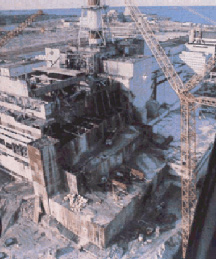
April 26, 1986 Chernobyl, Chernobyl Raion (Now Ivankiv Raion), Kiev Oblast, Ukraininan SSR, Soviet Union A flawed reactor design and inadequate safety procedures led to a power surge that damaged the fuel rods of reactor no. 4 of the Chernobyl power plant. This caused an explosion and meltdown, necessitating the evacuation of 300,000 people and dispersing radioactive material across Europe (see Effects of the Chernobyl disaster).
Around 5% (5200 PBq) of the core was released into the atmosphere and downwind.
May 4, 1986 Hamm-Uentrop, West Germany Experimental THTR-300 reactor releases small amounts of fission products (0.1 GBq Co-60, Cs-137, Pa-233) to surrounding area 0 267
December 9, 1986 Surry, Virginia, United States Feedwater pipe break at Surry Nuclear Power Plant kills 4 workers 4
March 31, 1987 Delta, Pennsylvania, United States Peach Bottom units 2 and 3 shutdown due to cooling malfunctions and unexplained equipment problems 0 400
December 19, 1987 Lycoming, New York, United States Malfunctions force Niagara Mohawk Power Corporation to shut down Nine Mile Point Unit 1 0 150
March 17, 1989 Lusby, Maryland, United States Inspections at Calvert Cliff Units 1 and 2 reveal cracks at pressurized heater sleeves
October 19, 1989 Vandellòs, Spain A fire damaged the cooling system in unit 1 of the Vandellòs nuclear power plant, getting the core close to meltdown. The cooling system was restored before the meltdown but the unit had to be shut down due to the elevated cost of the repair
March 1992 Sosnovyi Bor, Leningrad Oblast, Russia An accident at the Sosnovy Bor nuclear plant leaked radioactive iodine into the air through a ruptured fuel channel.
February 20, 1996 Waterford, Connecticut, United States Leaking valve forces shutdown Millstone Nuclear Power Plant Units 1 and 2, multiple equipment failures found 0 254
September 2, 1996 Crystal River, Florida, United States Balance-of-plant equipment malfunction forces shutdown and extensive repairs at Crystal River
September 30, 1999 Ibaraki Prefecture, Japan Tokaimura nuclear accident killed two workers, and exposed one more to radiation levels above permissible limits.
February 16, 2002 Oak Harbor, Ohio, United States Severe corrosion of reactor vessel head forces 24-month outage of Davis-Besse reactor
April 10, 2003 Paks, Hungary Collapse of fuel rods at Paks Nuclear Power Plant unit 2 during its corrosion cleaning led to leakage of radioactive gases. It remained inactive for 18 months.
August 9, 2004 Fukui Prefecture, Japan Steam explosion at Mihama Nuclear Power Plant kills 4 workers and injures 7
July 25, 2006 Forsmark, Sweden An electrical fault at Forsmark Nuclear Power Plant caused multiple failures in safety systems that had the reactor to cool down
March 11, 2011 3 meltdowns Fukushima, Japan A tsunami flooded and damaged the plant’s 3 active reactors, drowning two workers. Loss of backup electrical power led to overheating, meltdowns, and evacuations.] One man died suddenly while carrying equipment during the clean-up. The plant’s reactors Nr. 4, 5 and 6 were inactive at the time.
September 12, 2011 Marcoule, France One person was killed and four injured, one seriously, in a blast at the Marcoule Nuclear Site. The explosion took place in a furnace used to melt metallic waste.
And this is the tip of the iceberg
Anniversary Of The Night Nuclear Bombs Fell Near Goldsboro
Anniversary Of The Night Nuclear Bombs Fell Near Goldsboro https://www.goldsborodailynews.com/2022/01/24/anniversary-of-the-night-nuclear-bombs-fell-near-goldsboro/January 24, 2022 Ken Conners
It’s the 61st anniversary of the big bang that, fortunately, never happened.
Around midnight on January 24th, 1961, a B-52G aircraft based at Seymour Johnson Air Force Base experienced a fuel leak and broke up in midair over Wayne County.
Five crewmen were able to successfully eject or bail out of the aircraft, but three did not survive the crash.
Two Mark 39 nuclear bombs being carried on the bomber plummeted to the earth, landing with the wreckage in the farmlands of Faro, about 12 miles north of Goldsboro.
Declassified information eventually showed one of the bombs came very close to detonating with 3 of 4 arming mechanisms being tripped in the crash. One of the bombs was recovered while portions of the second sank into a muddy field never to be seen again.
1 This Month

of the week – Shut Down Drone Warfare!


Tell the Ukrainian Government to Drop Prosecution of Peace Activist Yurii Sheliazhenko

Petition to revoke the licensing of the Near Surface Nuclear Disposal Facility (NSDF) at Chalk River. https://www.ourcommons.ca/petitions/en/Petition/Details?Petition=e-7247
To see nuclear-related stories in greater depth and intensity – go to https://nuclearinformation.wordpress.com
-
Archives
- April 2026 (68)
- March 2026 (251)
- February 2026 (268)
- January 2026 (308)
- December 2025 (358)
- November 2025 (359)
- October 2025 (376)
- September 2025 (257)
- August 2025 (319)
- July 2025 (230)
- June 2025 (348)
- May 2025 (261)
-
Categories
- 1
- 1 NUCLEAR ISSUES
- business and costs
- climate change
- culture and arts
- ENERGY
- environment
- health
- history
- indigenous issues
- Legal
- marketing of nuclear
- media
- opposition to nuclear
- PERSONAL STORIES
- politics
- politics international
- Religion and ethics
- safety
- secrets,lies and civil liberties
- spinbuster
- technology
- Uranium
- wastes
- weapons and war
- Women
- 2 WORLD
- ACTION
- AFRICA
- Atrocities
- AUSTRALIA
- Christina's notes
- Christina's themes
- culture and arts
- Events
- Fuk 2022
- Fuk 2023
- Fukushima 2017
- Fukushima 2018
- fukushima 2019
- Fukushima 2020
- Fukushima 2021
- general
- global warming
- Humour (God we need it)
- Nuclear
- RARE EARTHS
- Reference
- resources – print
- Resources -audiovicual
- Weekly Newsletter
- World
- World Nuclear
- YouTube
-
RSS
Entries RSS
Comments RSS
 nuclear-news