Veil of secrecy for families of atomic test veterans
 TO THE WIDOWS AND CHILDREN http://www.atomicvetkin.com/widowschildren.html You too are the victims of an unconscionable, haphazardly executed military plan to deify the atomic bomb.
Because of “secrecy” surrounding the nuclear test program and the veteran’s “oath of secrecy” very little is known by their families about the veterans involvement and experiences. Widows are often unaware of the veteran’s test participation and that the illness that led to their death was the result of ionizing radiation exposure. You may not be aware that your husband or father died in the service of our country and has made the ultimate sacrifice.
This dedication is to the young women, who along with the Atomic Veterans, were denied the right to know of the possible deleterious effects of radiation exposure on their lives and that of their children. They were denied the right to know that their futures held increased possibilities of any or all of the following effects: Continue reading
Hibakusha bear witness to nuclear power’s exploitation of indigenous peoples
the world is still full of hibakusha who can testify to the rippling consequences of radiation exposure on health, family and community.
Nuclear testing hibakusha who have been removed from their home communities have suffered the social breakdowns
They often define themselves in relation to the colonial power that irradiated them, i.e., they are victims of French nuclear testing, of Soviet nuclear testing, of American nuclear testing
 Hibakusha: Hiroshima, Nagasaki and Beyond . Dr Bo Jacobs 11 Aug 12, http://www.dianuke.org/hibakusha-hiroshima-nagasaki-robert-jacobs/ Hundreds of hibakusha gather in Hiroshima today, and in Nagasaki on 9 August. Many more will stay away from such commemorations, preferring to spend these anniversaries in private. Almost all of these hibakusha were children when their families were attacked with nuclear weapons: and it is these grown children who remain to bear witness.
While over 70,000 people were killed in Hiroshima on the day that the US dropped an atomic bomb on the city center in August 1945, even more people became survivors of that attack. Many tens of thousands would die in the coming weeks, months and years, but some would live long and full lives. Their lives would forever be marked by this experience. Many have never shaken the trauma of expecting that they would die, having watched their family and their friends die, having seen an endless horizon full of the dead and dying and the corpses of people and animals burned beyond recognition, and of seeing their homes and city disappear into fire and rubble.
Beyond the epidemiological and psychological affects on the hibakusha, the social impacts were often as devastating. Experiencing discrimination in marriage and employment, many were also plagued by their own worries about whether to have children, and by anxieties that every subsequent cold or flu that they or their children experienced might be the first signs of an impending fatal illness. In a sense the nuclear attacks on Hiroshima and Nagasaki never ended. Continue reading
Discrimination, mental health issues, among Fukushima’s brave clean-up workers
 Doctors: Japan Nuclear Plant Workers Face Stigma By MALCOLM FOSTER Associated Press abc News, TOKYO August 5, 2012 (AP) A growing number of Japanese workers who are risking their health to shut down the crippled Fukushima Dai-ichi nuclear power plant are suffering from depression, anxiety about the future and a loss of motivation, say two doctors who visit them regularly.
But their psychological problems are driven less by fears about developing cancer from radiation exposure and more by something immediate and personal: Discrimination from the very community they tried to protect, says Jun Shigemura, who heads a volunteer team of about ten psychiatrists and psychologists from the National Defense Medical College who meet with Tokyo Electric Power Co. nuclear plant employees. Continue reading
Fukushima children – physical and mental health issues
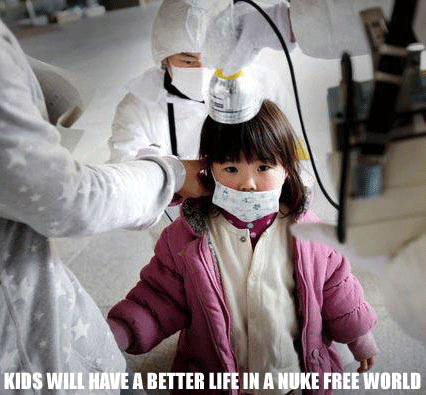 Kids’ safety key worry in Fukushima,Japan Times, Attendees of latest public hearing on energy fear low-level radiation, By NATSUKO FUKUE, 3 Aug 12, FUKUSHIMA — A year and half after the start of the nuclear crisis, many who attended the government’s latest public hearing on energy policy in Fukushima on Wednesday still expressed concern about the impact of radiation on their children……what concerns many parents in Fukushima is their children’s exposure to low levels of radiation…..
A 50-year-old woman living in Koriyama, Fukushima Prefecture, told The Japan Times after the public hearing that she fears young people will be harmed by the radiation, and that discrimination against Fukushima residents will continue.
“I’ve tried to prepare myself mentally for the discrimination my son may face when he looks for a job or when he gets married, just because he was in Fukushima last March,” said the woman, who withheld her name. Continue reading
3.000 of Chernobyl’s most vulnerable children helped to safety and care
 Children of Chernobyl Airlifts 97th Group in Advance of 26th Anniversary http://www.chabad.org/blogs/blog_cdo/aid/1838545/jewish/Children-of-Chernobyl-Airlifts-97th-Group-in-Advance-of-26th-Anniversary.htm, April 25, 2012 By Joshua Runyan One week before the 26th anniversary of the Chernobyl nuclear explosion that rained down fallout across an entire swath of Eastern Europe, Chabad’s Children of Chernobyl brought 26 more children to safety and medical care in Israel, its 97th rescue mission.
“On this significant anniversary, thousands of children every day are still feeling the tragic consequences of the Chernobyl disaster,” said Nancy Spielberg, founding board member of CCOC, in a statement. “They are facing devastating illnesses from radiation contamination –radiation that will be with us for thousands of years. As we’ve seen from the recent Fukushima Daiichi nuclear disaster in Japan, the impact from this kind of radioactivity is as devastating today as it was 26 years ago.”
To date, the Chabad-Lubavitch run organization, which was designed to rescue those most vulnerable from the April 26, 1986 meltdown that left thousands of square kilometers uninhabitable, has helped 2,822 children escape the contaminated living conditions surrounding that portion of Ukraine. Most are brought to a sprawling educational and residential complex in the central Israeli village of Kfar Chabad, where they’re provided  with medical care and social services.
The organization also provides medicine, equipment and other needed items for those who
cannot leave Europe. Spielberg pointed to World Health Organization statistics, which show the rate of thyroid cancer in the contaminated areas surrounding Chernobyl as more than 200 times the world norm.
Belarus’ children – mental, physical, and social effects of Chernobyl nuclear disaster
Figures released by UNICEF in 2010 showed that more than 20% of adolescent children in Belarus suffered from disabilities and chronic illness. Belarus absorbed 70% of Chernobyl’s fallout…..
 VIDEOS http://edition.cnn.com/2012/04/25/world/iyw-chernobyl-children/?hpt=wo_mid 26 years on: helping Chernobyl’s children, By Katie Walmsley, CNN April 25, 2012 Chernobyl refuses to be relegated to the past. Indeed it may still be devastating the lives of millions who continue to live in the fallout zone. Aside from the potential health hazards of living in an area contaminated with radiation, domino socioeconomic effects have caused multiple problems in these regions.
Chernobyl Children International , or CCI, works to help kids in the region whose lives have been impacted by a disaster that happened years before they were born. Many suffer from physical problems such as congenital heart defects. Many kids have chronic illnesses or disabilities, and many live full time in institutions. Continue reading
A window into the very controlled State of North Korea
 (includes video) http://worldnews.msnbc.msn.com/_news/2012/04/24/11365838-north-korea-nuclear-test-ready-soon North Korea nuclear test ready ‘soon’ NBC’s Richard Engel spent two weeks in North Korea and got a rare and revealing look inside this very closed country. World News msnbc, By Reuters 27 April 12 BEIJING – North Korea has almost completed preparations for a third nuclear test, a senior source with close ties to Pyongyang and Beijing told Reuters, which will draw further international condemnation following a failed rocket launch if it goes ahead. Continue reading
Disastrous consequences of an attack on Iran
I think the mischief and misery and unintended consequences of an attack on Iran would be beyond belief.”…..
Ian McEwan: misery of attack on Iran would be beyond belief. Lisa Allardice guardian.co.uk, 25 March 2012 Author says regime is ‘looking very wobbly,’ but that an attack would reunite the country behind its leaders Continue reading
Japanese kids learn about radiation
“Still, there are many children who think nuclear energy is necessary but that’s probably because their parents or relatives have had nuclear-related jobs,”
Third of Fukushima kids got first radiation lessons from disaster: poll Japan Times, 19 March, Kyodo FUKUSHIMA — About a third of the 225 youngsters who were evacuated from around the Fukushima No. 1 nuclear plant last March but still reside in the prefecture say the disaster made them aware of radiation dangers for the first time, a new survey says. Continue reading
Japanese do not trust the government about Fukushima radiation
83% of Fukushima residents and 73% countrywide felt ‘greatly’ or ‘somewhat’ worried about radioactive contamination. More importantly, 70% of people in the three disaster hit prefectures , and 71% people countrywide , felt that government was “hiding” information.
This background of mistrust and deception, coming on top of enormous suffering, haunts the island nation, and especially the 350,000 people, who are living in camps unable to go back home to Fukushima.
 Debris, radiation fear, mistrust still piling up Times of India, Subodh Varma, TNN | Mar 12, It is one year since the Great Eastern Japan Earthquake generated a tsunami that ripped apart the north-eastern sea-coast of Japan leaving over 20,000 people dead and the Fukushima nuclear power plant damaged. The triple disaster is estimated to have caused losses worth $235 billion according to World Bank.
Pictures circulated worldwide by visiting journalists show spectacular scenes of the massive clean up operation launched by the government of Japan. But the reality is numbingly grim. Goshi Honoso , Japan’s environment minister speaking at a routine press conference on February 21, urged local governments to help in cleaning up the debris left behind in Iwate, Miyagi and Fukushima prefectures, the three areas which bore the brunt of the tsunami, reports Kyodo news agency.
Then, he revealed jaw dropping numbers: an estimated 22.53 million tonnes of debris was created by the tsunami . Of this, only 1.18 million tonnes, that is, about 5% has been disposed of.The rest of it is simply bulldozed and piled into giant heaps, some as high as 20 meters high. ….
Plight, and flight, of Fukushima’s farming communities
anti-nuclear activists and parents who are continuing to lobby for better protection standards for children in Fukushima insist they will not be satisfied until the government takes steps to evacuate the entire younger generation to fully safe areas.
More than 100,000 people, mostly younger people, have left Fukushima to escape radiation contamination. ….The mass migration is bound to affect agriculture production
Trust Deficit – Worst Fallout of Fukushima, By Suvendrini Kakuchi TOKYO, Feb 22, 2012 (IPS) “……..The past few months have seen the government scrambling to regain public trust with food grown in Fukushima and the neighbouring areas by scraping away contaminated top soil from local farms. Continue reading
1 This Month

of the week – Shut Down Drone Warfare!


Tell the Ukrainian Government to Drop Prosecution of Peace Activist Yurii Sheliazhenko

Petition to revoke the licensing of the Near Surface Nuclear Disposal Facility (NSDF) at Chalk River. https://www.ourcommons.ca/petitions/en/Petition/Details?Petition=e-7247
To see nuclear-related stories in greater depth and intensity – go to https://nuclearinformation.wordpress.com
-
Archives
- March 2026 (251)
- February 2026 (268)
- January 2026 (308)
- December 2025 (358)
- November 2025 (359)
- October 2025 (376)
- September 2025 (257)
- August 2025 (319)
- July 2025 (230)
- June 2025 (348)
- May 2025 (261)
- April 2025 (305)
-
Categories
- 1
- 1 NUCLEAR ISSUES
- business and costs
- climate change
- culture and arts
- ENERGY
- environment
- health
- history
- indigenous issues
- Legal
- marketing of nuclear
- media
- opposition to nuclear
- PERSONAL STORIES
- politics
- politics international
- Religion and ethics
- safety
- secrets,lies and civil liberties
- spinbuster
- technology
- Uranium
- wastes
- weapons and war
- Women
- 2 WORLD
- ACTION
- AFRICA
- Atrocities
- AUSTRALIA
- Christina's notes
- Christina's themes
- culture and arts
- Events
- Fuk 2022
- Fuk 2023
- Fukushima 2017
- Fukushima 2018
- fukushima 2019
- Fukushima 2020
- Fukushima 2021
- general
- global warming
- Humour (God we need it)
- Nuclear
- RARE EARTHS
- Reference
- resources – print
- Resources -audiovicual
- Weekly Newsletter
- World
- World Nuclear
- YouTube
-
RSS
Entries RSS
Comments RSS
 nuclear-news