Huge radiation health danger for astronauts going to Mars
Curiosity flew to Mars in a spacecraft that had shielding similar to what astronauts would have on the new crew vehicle being developed by NASA. The detector picked up an average of 1.8 millisieverts of radiation per day. A human being on the surface of the Earth receives only about 3 millisieverts of radiation in an entire year.
“The radiation environment in deep space is several hundred times more intense than it is on Earth, and that’s even inside a shielded spacecraft,”
“The radiation exposure on a trip to Mars would — barring a super-huge solar event — not be lethal. The concerns are mostly about cancer induction (a so-called ‘late effect’) and damage to the central nervous system,”

Space radiation would make Mars mission hazardous WP, By Joel Achenbach, May 30 Of all the hazards facing a human mission to Mars — something NASA and countless space buffs would love to see at some point — one of the hardest to solve is the radiation that saturates interplanetary space. New data, gathered by NASA’s Curiosity rover as it traveled to Mars, have confirmed that interplanetary space is a hostile medium and suggest that engineers need to find a way to speed up space travel significantly if they hope to reduce radiation exposure……
The effects of interplanetary radiation on the human body are not well understood. Until now, scientists had limited information about how much radiation penetrates a spacecraft during an interplanetary journey. But the Curiosity rover, which bristles with instruments, carried along a Radiation Assessment Detector, and it measured the incoming radiation during its 253-day trip to Mars, which began in November 2011. Continue reading
Two head CT scans double one’s risk of cancer from radiation
 the risk of having soft-tissue sarcoma will be doubled under an exposure equal to radiation from two CT head scans.
Low levels of medical radiation can cause cancer, HKU study warns http://www.scmp.com/news/hong-kong/article/1250953/low-levels-medical-radiation-can-cause-cancer-hku-study-warns Even low levels emitted by X-rays and CT scans can cause cancer, and people who often get whole-body checks are at risk, HKU study says, 01 June, 2013 Emily Tsang emily.tsang@scmp.com Worries have been raised about the overuse of radiation in medicine after a study shows that even low levels of radiation – such as those emitted by X-rays and CT scans – can cause cancer.
The risk of soft-tissue sarcoma is doubled if a person receives an amount of radiation equivalent to two CT head scans, University of Hong Kong researchers say. This means that people who join a growing
trend of getting frequent whole-body checks including X-rays and scans are putting themselves at risk, the researchers say, adding that authorities should also reconsider the risks of nuclear power.
“The study has highlighted that even low to moderate levels of exposure are enough to cause genetic mutation,” study leader Dino Samartzis said. Continue reading
More radiation exposure when contrast medium is used with CT scans
Radiation dose increased for every organ scanned at CT, particularly in the most vascularized tissues, wrote researchers from the University of Messina in Italy. Average doses rose by one-fifth for the liver, one-third for the spleen and pancreas, and almost three-fourths for the kidneys.
“The results are in agreement with our previous data, confirming an increase in organ radiation dose in contrast-enhanced CT compared with unenhanced CT,” wrote Dr. Ernesto Amato and colleagues (AJR, June 2013, Vol. 200:6, pp. 1288-1293)……
Investigators have also found an increase in the frequency of cellular abnormalities in patients who underwent contrast-enhanced radiographic examinations. But the actual increase in dose for any given scan — which depends on iodine uptake; the shape, volume, and position of the organ; and the emitted x-ray energy spectrum — remains unknown, the authors wrote…….
Confirming dose increases
The results were in line with the group’s previous phantom study, and they confirmed significant radiation dose increases in contrast-enhanced CT versus unenhanced CT, Amato and colleagues wrote. The data showed average dose increases of 19% for the liver, 71% for the kidneys, 33% for the spleen and pancreas, and 41% for the thyroid.
“The kidneys showed the maximum among the average dose [increases] (71%, resulting from an attenuation increment of 139 HU),” the authors wrote.”High renal enhancement is, in fact, due to both their high vascularization because they receive 20% to 25% of the cardiac output and the passage of iodine within the renal tubules. In particular, the level of contrast medium within renal tubules can be up to 50 to 100 times higher than that in the blood because of the mechanisms of tubular concentration and secretion.”
Thyroid tissue showed the second highest dose increase (41%) after contrast injection, based on an HU increase of 87%. Also, the dose increases in the thyroid depended on tissue density on unenhanced CT, the group noted. Denser thyroids showed a lower increase in attenuation and, consequently, lower increases in dose.
Because the liver and spleen are richly vascularized, Hounsfield units increased with contrast by 49 HU and 71 HU, respectively, and average dose increased by 19% and 33%……. http://www.auntminnie.com/index.aspx?sec=ser&sub=def&pag=dis&ItemID=103565
Astronauts going to Mars face a radiation cancer death sentence
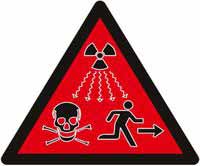 Radiation on trip to Mars near life limit HERALD SUN, AAP MAY 31, 2013 ASTRONAUTS who travel on future missions to Mars would likely be exposed to their lifetime limit of radiation during the trip, not to mention time spent on the Red Planet, scientists say.
The measurements were made aboard the Mars Science Laboratory, an unmanned NASA rover and mobile lab that set off for Mars in 2011 before landing 253 days later in August 2012, said the report in the US journal Science.
“In terms of accumulated dose, it’s like getting a whole-body CT scan once every five or six days,” said Cary Zeitlin, a principal scientist in Southwest Research Institute’s (SwRI) Space Science and Engineering Division.
“Radiation exposure at the level we measured is right at the edge, or possibly over the edge of what is considered acceptable in terms of career exposure limits defined by NASA and other space agencies.”
Zeitlin said more study is needed to determine the actual health risks — including the likelihood of developing cancer — associated with exposure to cosmic radiation before any human trip to Mars can take place.
The US space agency has said it is aiming for the first-ever astronaut mission to Mars some time in the 2030s…….. HTTP://WWW.HERALDSUN.COM.AU/NEWS/BREAKING-NEWS/RADIATION-ON-TRIP-TO-MARS-NEAR-LIFE-LIMIT/STORY-FNI0XQLL-1226654163809
Fukushima’s radioactive contamination spreads in marine life
 Japan Radiation Widely Contaminates Pacific Marine Life http://www.earthweek.com/2013/ew130524/ew130524b.html 24 May 13, Traces of radioactive cesium from Japan’s crippled Fukushima No. 1 nuclear power plant have been found in water and plankton collected
from all 10 points monitored across a vast stretch of the western Pacific.
The isotopes cesium-134 and cesium-137 were found in the tiny plantlike creatures from the coast of Japan’s Hokkaido Island to Guam.
The samples were taken early last year, less than a year after the tsunami that overwhelmed the plant, but the findings were just
announced at a meeting of the Japan Geoscience Union.
Cesium-134 has a half-life of two years while it takes 30 years for cesium-137 to decay by half. Scientists say the isotopes were being dispersed across the Pacific in plankton, and were accumulating up the food chain as the tiny creatures were eaten by larger marine life.
Further studies are being conducted to see how much cesium was building up in fish and possibly marine mammals.
Radiation was flushed into the Pacific after three meltdowns occurred at the Fukushima nuclear plant. More than two years after the March 2011 disaster, plant operators are struggling to contain the 400 tons of radioactive water poured over the melted cores of reactors 1, 2 and 3 to prevent the fuel from melting and burning again.
How much radiation are passengers exposed to during a flight?
The plane truth about flying revealed BY:BY KATE SCHNEIDER, The Australian, May 24, 2013“…….How much radiation are passengers exposed to during a flight?People travelling in aircraft may be exposed to more ionising radiation than they would be exposed to on the ground. That’s because when you’re flying between 7000 and 12,000 metres (the typical cruising altitude of a commercial aircraft), the Earth’s atmosphere provides less protection from cosmic radiation.
To put this into perspective, during a seven-hour flight from New York to London travellers receive about the same dose of radiation as a chest X-ray; and from New York to Tokyo, two chest X-rays, according to the US Federal Aviation Administration.Passengers receive the same dose of radiation as a chest X-ray on a flight from New York to Tokyo. ….. http://www.theaustralian.com.au/travel/news/the-plane-truth-about-flying-revealed/story-e6frg8ro-1226649790296
Radiation exposure is of growing concern in medicine.
 Intermountain Healthcare alerts patients to cumulative radiation exposure The cancer risk from a single CT scan or chest X-ray is low, but radiation exposure is of growing concern in medicine. By Kirsten Stewart The Salt Lake Tribune, 22 May 13, Roughly 25 patients a day are wheeled into Intermountain Medical Center’s “cath lab” for CT scans to look for calcium buildup in their coronary arteries.
Coronary artery scans — the newest addition to radiologists’ growing arsenal of diagnostic tools — can aid doctors in diagnosing heart problems early. But they expose patients to 50 to 150 times the radiation of a chest X-ray, raising their risk for developing cancer later in life. “We want to make sure patients are getting tests only for the right reasons,” said cardiologist Donald Lappe at a new conference Wednesday touting a 9-month-old initiative aimed at ensuring just that.
Since August 2012 Intermountain Heathcare’s 168 clinics and 22 hospitals have been tracking patients’ cumulative radiation exposure from high-dose tests: CT scans, nuclear medicine scans and interventional radiology exams. Later the hospital chain hopes to also track x-rays, mammograms and other screens.
Generally the cancer risk from a single test is low, but radiation exposure is of growing concern in medicine.
The U.S. population’s exposure to ionizing radiation has nearly doubled over the past two decades, largely due to medical tests, according to the U.S. Food and Drug Administration, which requires all hospitals to disclose radiation doses to patients upon request…….http://www.sltrib.com/sltrib/news/56343948-78/radiation-exposure-patients-risk.html.csp
Radiation therapy may be unnecessary for older breast cancer patients
Can Older Early-Stage Breast Cancer Patients Skip Radiation? Medscape Today, Kate Johnson May 22, 2013 There is no benefit in adding radiation to tamoxifen therapy in women aged 70 years or older after lumpectomy for early-stage breast cancer, according to extended, long-term results of the Cancer and Leukemia Group B (CALGB) 9343 trial.
“Irradiation adds no significant benefit in terms of survival, time to distant metastasis, or ultimate breast preservation,” noted author Kevin Hughes, MD, from Harvard Medical School, and colleagues in an article published online ahead of print in theJournal of Clinical Oncology.
Median follow-up for the trial is now 12.6 years, and the 10-year results back up the trial’s previous 5-year data.
As previously reported by Medscape Medical News, those results prompted the National Comprehensive Cancer Network (NCCN) to adjust its treatment guidelines, so that it no longer recommends radiation therapy after lumpectomy in older women with estrogen receptor (ER)–positive early breast cancer who are receiving endocrine therapy.
However, despite this, the authors note that their initial findings had “little impact” on clinical practice, “with the use of irradiation only slightly diminishing in this population.”…. http://www.medscape.com/viewarticle/804584
Safecast’s revolution in radiation data collection
Safecast’s software and devices are all open source, and anyone can use the data. Franken says it’s being used by researchers around the world and even by the government in some Japanese cities.
you can tie specific medical symptoms to radiation levels.”
In Japan, Citizen Radiation-Tracking Project Goes Big Time, PRI’s The World, BY CATHERINE WINTER ⋅ MAY 21, 2013 ⋅ON A SUNNY SPRING MORNING JUST OUTSIDE TOKYO, JOE MOROSS HOOKS A RADIATION DETECTOR OUTSIDE THE BACK WINDOW OF A LITTLE RED CAR. HE LOOKS AT A MAP OF THE AREA ON HIS LAPTOP COMPUTER, TRYING TO FIND A ROUTE HE HASN’T DRIVEN BEFORE, SO HE CAN TAKE NEW RADIATION READINGS.
“We want to cover every street so people who look at our maps can drill down and zoom in and find out what the measurement is right in front of their house,” Moross says.
Moross is taking measurements for Safecast. Since the nuclear accident at Fukushima Daichi two years ago, volunteers like him have been driving around Japan, testing radiation and adding their readings to online maps.
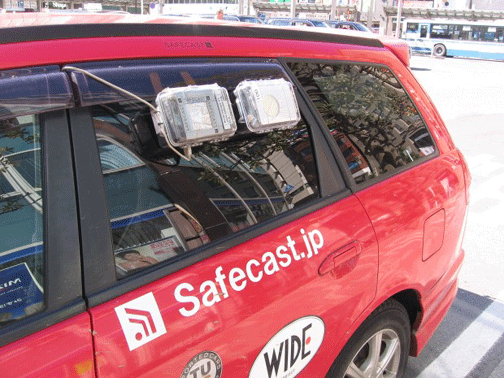
When The World last checked in on Safecast, in May of 2011, the group had just formed and had posted a handful of radiation measurements.
Now, Safecast volunteers have taken close to 10 million separate readings……. Continue reading
System for tracking patients’ medical radiation
New Tracking of a Patient’s Radiation Exposure , WSJ, By LAURA LANDRO, 21 May 13, During a four-week hospital stay, 29-year-old Josh Page had so many CT scans that he lost track, kidding with his doctor about how much radiation he was exposed to—though he admits he had “no clue.” Now, Intermountain Healthcare, where he was treated for an inflammation of the pancreas and underwent surgery in February, is keeping track for him.
The Salt Lake City-based nonprofit group of 22 hospitals and 185 clinics is launching the first major system of its kind to measure and report patients’ cumulative medical radiation exposure from tests that deliver the highest amount of radiation. This includes CT scans, nuclear medicine scans and interventional radiology exams for the heart. In addition to educating doctors and patients about the risks and benefits of medical radiation, Intermountain will allow them to access their exposure data via its electronic health record.
While the benefits of tests and procedures usually outweigh the slightly increased cancer risk from exposure due to radiation, “the risks should be considered before these imaging tests are performed,” says Keith White, medical director of Intermountain’s Imaging Services. This is particularly true for younger patients, who have a higher risk because they live long enough to see long-term effects…… Federal data shows that in 2006, Americans received seven times more radiation exposure than in the 1980s, Continue reading
Fishermen testing fish for radiation, in South Fukushima waters
Fishermen net fish in Fukushima waters to measure radiation levels
http://ajw.asahi.com/article/0311disaster/recovery/AJ201305210005 May 21, 2013 By HIROSHI KAWAI/ Staff Writer
A fishing vessel from Fukushima Prefecture caught fish in waters south
of the crippled Fukushima No. 1 nuclear power plant on May 20 to test
them for levels of radiation contamination, as local fishing
cooperatives hope to soon resume fishing in the area.
The No. 12 Akira Maru belonging to the Iwaki fishermen’s cooperative
trawled plenty of flatfish and other species.
Due to ocean currents, the concentration of radioactive materials has
been found to be higher in waters to the south of the plant, than to
the north.
Of the Akira Maru’s catch, nine species of fish were kept as samples
to measure radiation levels in them. The fishermen tested about 10
kilograms of each type and threw the rest back into the sea.
“It feels hollow to have to throw fish back into the sea, considering
that they could fetch high prices,” Captain Akiyoshi Abe said.
Before the nuclear accident triggered by the Great East Japan
Earthquake and tsunami in March 2011, waters off the prefecture were
known as a good fishing area where more than 100 species could be
caught.
Many local fisheries cooperatives have had to suspend operations since
the nuclear accident.
Japanese authorities ignore radiation levels in Tokyo river eels
 Local governments ignore cesium detection in Tokyo river eels, Asahi Shimbun May 17, 2013 By YUSUKE FUKUI/ Staff Writer Tokyo and Chiba local governments took no action for nearly two months after being informed that radioactive cesium had been detected in eels caught in a boundary river between the two prefectures.
Officials of both governments said no independent study was conducted because the eels were not caught by professional fishermen intending to sell the catch.
The detection of the cesium was also not publicized. On March 9, a 47-year-old self-employed woman caught an eel from the Edogawa river in Tokyo’s Katsushika Ward. Concerned about reports that cesium had accumulated downstream in the river, she sent the eel to Hideo Yamazaki, a professor of environmental analysis at Kinki University in Osaka Prefecture. Using a germanium semiconductor detector, Yamazaki found that the eel had 147.5 becquerels of radioactive cesium per kilogram, higher than the central government standard of 100 becquerels.
Yamazaki reported his finding to the Fisheries Agency in late March because he felt there was a need for an official investigation to back up his finding as well as further studies to look into the effects on other fish.
Although the Fisheries Agency informed both the Tokyo metropolitan and Chiba prefectural governments about the finding, neither had conducted an official study as of May 16.
An official with the Tokyo metropolitan government’s fisheries division said, “Basically, only fish that enter the distribution network is subject to studies. The eel fishing season also does not start until summer.”….. Yamazaki conducted further studies on four eels caught by the same woman in April and May in the Edogawa river. The eels had cesium levels between 97.4 becquerels and 129.6 becquerels per kilogram, with three of the eels having cesium levels exceeding the central government standard….. http://ajw.asahi.com/article/behind_news/social_affairs/AJ201305170079
Fukushima to California – the path of nuclear radiation along Latitude 40
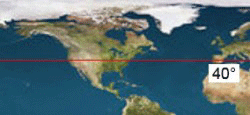 Study: Concentrated Fukushima radioactive plume staying on narrow path toward U.S. — Moving with surface water along 40 N — Same latitude as Northern California(MAP) http://enenews.com/study-concentrated-fukushima-radioactive-plume-staying-along-narrow-path-moving-surface-water-along-40-same-latitude-northern-california-map
Title: Surface pathway of radioactive plume of TEPCO Fukushima NPP1 released 134Cs and 137Cs
Source: Biogeosciences
Authors: M. Aoyama, M. Uematsu, D. Tsumune, and Y. Hamajima
Date: May 7, 2013
[…] The main body of radioactive surface plume of which activity exceeded 10 Bq m−3 travelled along 40° N and reached the International Date Line on March 2012, one year after the accident. A distinct feature of the radioactive plume was that it stayed confined along 40° N when the plume reached the International Date Line. […]
A distinct feature of the radioactive plume was that it stayed confined along 40 N when the plume reached the International Date Line, as stated in Sect. 3.2. The radioactive plume travelled 1800 km (from 160 E to 178 E) for 270 days (9 months) (Fig. 5); therefore, an average zonal speed (u) of the surface radioactive plume was calculated to be about 8 cm s−1 which was consistent with the speed of the reported surface current of 4–16 cm s−1 in the region (Maximenko et al., 2009). […]
We can also assume that the Fukushima radioactive plume moved with surface water […]
Full study here
The Japan Nuclear Crowd Map reveals local radiation levels
ECS researchers at Southampton University develop new tool to provide radiation monitoring in Japan http://www.ecs.soton.ac.uk/news/4237 17 May 13, People living in Japan after the Fukushima nuclear disaster can find out the radiation level in their area thanks a new tool designed by a team of researchers from the ECS research group Agents, Interaction and Complexity Group (AIC). Continue reading
Good news- radiation type scanners replaced by safe “millimetre wave” airport scanners
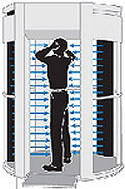 The reporting here didn’t show much knowledge about radiation, more’s the pity. Because this is a good news item. The new “millimetre wave” scanners, (at left) using sound waves, do not pose the radiation danger that did exist in using the “backscatter” method of airport scanning.
A pity that the mainstream media does not seem to bother informig itself, or the public, about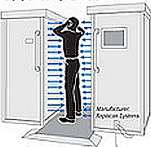 the differences between types of radiation. A great pity, because ionising radiation [as in ‘backscatter’ – at right) is a proven cause of cell damage – leading to mutations, cancer, other diseases, birth deformities, and inherited genetic instability. Christina Macpherson
 Video New Airport Scanners Reduce Radiation Risk, TSA Says KTLA by Micah Ohlman. 17 May 13 “…..The TSA says that the new millimeter-wave scanners can not only catch the bad guys better, but the radiation emitted is well below safety standards.
So what can you expect? Ticket holders still have to “assume the position” like the old backscatter machines.
But the new machines don’t use X-ray, but rather radio-frequency waves that are considered safer….”
1 This Month

of the week – Shut Down Drone Warfare!


Tell the Ukrainian Government to Drop Prosecution of Peace Activist Yurii Sheliazhenko

Petition to revoke the licensing of the Near Surface Nuclear Disposal Facility (NSDF) at Chalk River. https://www.ourcommons.ca/petitions/en/Petition/Details?Petition=e-7247
To see nuclear-related stories in greater depth and intensity – go to https://nuclearinformation.wordpress.com
-
Archives
- April 2026 (114)
- March 2026 (251)
- February 2026 (268)
- January 2026 (308)
- December 2025 (358)
- November 2025 (359)
- October 2025 (376)
- September 2025 (257)
- August 2025 (319)
- July 2025 (230)
- June 2025 (348)
- May 2025 (261)
-
Categories
- 1
- 1 NUCLEAR ISSUES
- business and costs
- climate change
- culture and arts
- ENERGY
- environment
- health
- history
- indigenous issues
- Legal
- marketing of nuclear
- media
- opposition to nuclear
- PERSONAL STORIES
- politics
- politics international
- Religion and ethics
- safety
- secrets,lies and civil liberties
- spinbuster
- technology
- Uranium
- wastes
- weapons and war
- Women
- 2 WORLD
- ACTION
- AFRICA
- Atrocities
- AUSTRALIA
- Christina's notes
- Christina's themes
- culture and arts
- Events
- Fuk 2022
- Fuk 2023
- Fukushima 2017
- Fukushima 2018
- fukushima 2019
- Fukushima 2020
- Fukushima 2021
- general
- global warming
- Humour (God we need it)
- Nuclear
- RARE EARTHS
- Reference
- resources – print
- Resources -audiovicual
- Weekly Newsletter
- World
- World Nuclear
- YouTube
-
RSS
Entries RSS
Comments RSS
 nuclear-news