Health danger from electromagnetic radiation, as well as from ionising radiation
New Studies Show Health Risks from Wireless Tech: Warnings from the BioInitiative Working Group http://www.businesswire.com/news/home/20140411005708/en/Studies-Show-Health-Risks-Wireless-Tech-Warnings April 11, 2014 RENSSELAER, N.Y.–(BUSINESS WIRE)--The BioInitiative Working Group says evidence for health risk from wireless tech is growing stronger and warrants immediate action. The Group released a mid-year update covering new science studies from 2012 to 2014.
New studies intensify medical concerns about malignant brain tumors from cell phone use. “There is a consistent pattern of increased risk for glioma (a malignant brain tumor) and acoustic neuroma with use of mobile and cordless phones,” says Lennart Hardell, MD, PhD at Orebro University, Sweden, according to studies released in 2012 and 2013. “Epidemiological evidence shows that radiofrequency should be classified as a known human carcinogen. The existing FCC/IEEE and ICNIRP public safety limits are not adequate to protect public health.”
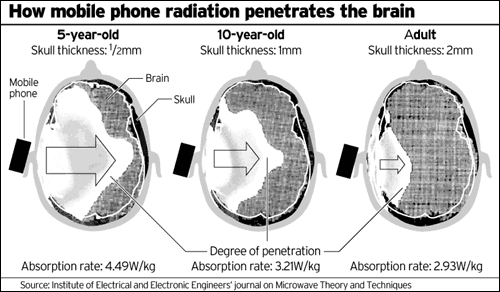
The BioInitiative reports nervous system effects in 68% of studies on radiofrequency radiation (144 of 211 studies) in 2014. This has increased from 63% in 2012 (93 of 150 studies) in 2012. Studies of extremely-low frequency radiation are reported to cause nervous system effects in 90% of the 105 studies available in 2014. Genetic effects (damage to DNA) from radiofrequency radiation is reported in 65% (74 of 114 studies); and 83% (49 of 59 studies) of extremely-low frequency studies.
Mobile wireless devices like phones and tablets are big sources of unnecessary biological stress to the mind and body that can chip away at resilience over time. The Report warns against wireless in schools. Schools should provide internet access without Wi-FI.
“It is essentially an unregulated experiment on childrens’ health and learning. Microwave from wireless tech disrupts thinking – what could be worse for learning? Technology can be used more safely with wired devices that do not produce these biologically-disruptive levels of microwave radiation,” said Cindy Sage, Co-Editor of the BioInitiative Report.
Federal programs like ConnectED and E-Rate are calling for wireless classrooms while ignoring the health evidence. Hyperactivity, concentration problems, anxiety, irritability, disorientation, distracted behavior, sleep disorders, and headaches are reported in clinical studies.
Government reviews on health impacts of wireless radiofrequency radiation from the European Union and Australia continue to be inconclusive largely because they require certainty before issuing warnings. The FCC review of health impacts from wireless technologies is still underway, but has not affected the federal push for wireless classrooms.
Contacts
BioInitiative Working Group
David O. Carpenter, MD
(518) 525-2660
dcarpenter@albany.edu
info@bioinitiative.org
www.bioinitiative.org
The exposure of US sailors to radiation, near Fukushima
 Navy Sailors: Frozen Fukushima steam blanketed ship; Crew suffered massive radiation doses, dozens have cancer — Calls for it to be sunk… still too radioactive; Navy: There’s some contamination, but it’s ok — Tepco: No way US officials would rely on information we were telling to public http://enenews.com/navy-sailors-frozen-fukushima-steam-blanketed-uss-reagan-crew-suffered-massive-radiation-doses-dozens-now-have-cancer-report-calls-for-ship-to-be-sunk-still-too-radioactive-navy-says-contam
AP, Apr 7, 2014: Nearly 80 U.S. sailors are […] alleging [Tepco] lied about the high level of radiation in the area [and] repeatedly said there was no danger to the crew when they were actually being blanketed with radiation that has since led to dozens of cancer cases and a child being born with birth defects [Tepco] said that there was no way the commanders of the aircraft carrier would have relied on the utility […] “It’s wholly implausible… military commanders in charge of thousands of personnel and armed with some of the world’s most sophisticated equipment, relied instead only on the press releases and public statements of a foreign electric utility co.”
Orange County Register, Apr. 6, 2014: Sailors on the flight deck said they felt a warm gust of air, followed by a sudden snow storm: radioactive steam. Freezing in the cold Pacific air. Blanketing their ship. And there they remained for two days, until […] aircrews returning [from] near Sendai identified levels of radioactivity [and] the Navy ordered the carrier to reposition much farther away […] the lawsuit contends, the crew had already suffered massive doses of radiation. […] dozens have developed cancers, at least one has borne a child with birth defects [Their lawsuit is] raising very strange and disturbing questions: Could the Reagan – one of the most advanced nuclear aircraft carriers in the U.S. fleet – really not know that it was being showered with massive doses of radiation? […] Some critics on the ecological front say the Reagan, now stationed in San Diego, is still so radioactive that it needs to be sunk. It floated around the Pacific for many weeks after the Fukushima humanitarian mission ended, as no Pacific Rim country would give it permission to dock. [It’s] slated to move to a new home port this year. In Japan.
Navy spokesman Lt. Greg D. Raelson: “Low levels of radioactive contamination did enter ventilation systems, which have numerous inaccessible areas difficult to perform radiological surveys and decontamination […] there is no indication that any remaining minimal levels of radiation pose any adverse health concern. Radiological controls are in place to survey, control and remove remaining contamination”
U.S. sailors’ lawsuit: “[Those exposed to radioactive releases from Fukushima Daiichi] must now endure a lifetime of radiation poisoning and suffering which could have and should have been avoided” [TEPCO] lied through its teeth, knowing all along the plant was in full-scale meltdown […] “rendered the plaintiffs infirm and poisoned their bodies.”
Low level ionising radiation could be even worse than we thought
In addition to the detection of statistically significant levels of certain illnesses among the liquidator cohort, they have made the argument that, instead of being linear, radiation health effects are “bi-modal” at certain low dose levels i.e. more harmful than the linear model predicts.
 Radiation and the Ronald Reagan, China Matters, 10 April 14, “….. I address the tendency of governments to minimize/mislead/suppress information concerning radiation releases from nuclear accidents and the overall uncertainty pervading their efforts. ….
The biggest minefield in the issue of nuclear accidents is the issue of the health effects of radiation exposure. The international standard for nuclear safety is the “Linear No Threshold” or LNT model, which argues that the negative health impacts of low-level radiation exposure are, well, low. People who give credence to claims of extensive radiation-related illness as a result of nuclear accidents are frequently dismissed as cranks.Interestingly, the only place that is serious about emphasizing the health hazards of radiation is a country very much in the news today, Ukraine. Doing the right thing by Ukrainian citizens after the injustices inflicted by the Soviet Union on the Chernobyl front has been an important part of Ukrainian national identity, and claims of radiation-related illness are given a hearing largely denied to them in the West, Japan, or Russia.

The international pushback against academics trying to make the statistical and biomedical case for extensive Chernobyl-related illnesses has been intense, including the attempt to explain any statistically significant health effects as a combination of “radiophobia” (the debilitating fear occasioned by radiation exposure) and the overall decline in public health in Ukraine following the collapse of the Soviet Union.
In 2005 a symposium conducted by the IAEA, WHO, and UN concluded that only 50 people had died because of radiation exposure from the Chernobyl accident; that’s quite a distance from estimates of critics who think the toll might be as high as 50,000.In response, scientists such as Russia’s Elena Burlakova have carefully monitored the health of the sizable cohort of Chernobyl “liquidators” (the hundreds of thousands of workers who were exposed to high levels of radiation during cleanup at the plant and in the Chernobyl district) and conducted research to attempt to qualify the LNT standard for measuring the health effects of radiation exposure.
In addition to the detection of statistically significant levels of certain illnesses among the liquidator cohort, they have made the argument that, instead of being linear, radiation health effects are “bi-modal” at certain low dose levels i.e. more harmful than the linear model predicts.
Backhanded support for this challenge to the LNT model comes from a school of thought—“radiation hormesis”—now enjoying a certain vogue in the pro-nuclear crowd in Japan, that draws on the experience of inhabitants of Ramsar, a community of the Caspian Sea with high background radiation levels and low cancer rates, to argue that low levels of radiation are beneficial.
Challengers to the LNT model seem to be making some headway—the Bulletin of Atomic Scientists recently devoted a special issue to the subject—but there is considerable resistance to qualifying LNT and thereby admitting the possibility of rethinking and perhaps acknowledging the likelihood of extensive health problems from the release of low-level radiation by a nuclear accident.
Cleanup for a nuclear accident is expensive. In an ironic recapitulation of the uncertainty surrounding the magnitude and destination of Fukushima’s radiation releases, the total cleanup bill has been estimated in a range from $10 billion to $50 billion to $250 billion.
To paraphrase Everett Dirksen, ten billion here, ten billion there, pretty soon you’re talking about real money and the possibility that even rare and occasional nuclear accidents will push up the total cost of nuclear power to unacceptable levels.
Understandably, the nuclear industry and people who have staked their hopes on nuclear power as a greenhouse-gas free alternative to carbon-based electricity generation resist the idea of expanding the accepted definition of significant radiation-related health effects, and with it the cost of any accident.
There is also, perhaps, the temptation to let the radiation illness problem take care of itself i.e. shy away from investigations of radiation sickness that might yield inconvenient or perhaps politically or financially catastrophic conclusions while demographics does its grim work of culling the irradiated herd…… http://chinamatters.blogspot.com.au/2014/04/radiation-and-ronald-reagan.html
After a nuclear catastrophe, radiation victims become “unpersons”
When life becomes a shadow – after nuclear catastrophe, Ecologist Robert Jacobs 8th April 2014 Those caught up in nuclear disasters suffer many times over, writes Robert Jacobs. Ill-health and early death aside, they are also cut off from their former communities, identities and family life, and the victims of social and medical discrimination. Radiation makes people invisible. We know that exposure to radiation can be deleterious to one’s health; can cause sickness or even death when received in high doses.
But it does more. People who have been exposed to radiation, or even those who suspect that they have been exposed to radiation that never experience radiation related illnesses may find that their lives are forever changed – that they have assumed a kind of second class citizenship.
They may find that their relationship to their families, to their communities, to their hometowns, to their traditional diets and even traditional knowledge systems have become broken. They often spend the remainder of their lives wishing that they could go back, that things would become normal.
Unpersons
They slowly realize that they have become expendable and that their government and even their society is no longer invested in their wellbeing.
As a historian of the social and cultural aspects of nuclear technologies I have spent years working in radiation-affected communities around the world.
Many of these people have experienced exposure to radiation from nuclear weapon testing, from nuclear weapon production, from nuclear power plant accidents, from nuclear power production or storage, or, like the people in the community that I live, in Hiroshima, from being subjected to direct nuclear attack.
 For the last five years I have been working with Dr. Mick Broderick of Murdoch University in Perth, Australia on the Global Hibakusha Project. We have been working in radiation-affected communities all around the world. In our research we have found a powerful continuity to the experience of radiation exposure across a broad range of cultures, geographies, and populations.
Fukushima – the victims’ future is all too predictable
About half way between beginning this study and this present moment the nuclear disaster at Fukushima Daiichi happened here in Japan.
One of the most distressing things (among so many) since this crisis began is to hear so many people, often people in positions of political power and influence say that the future for those affected by the nuclear disaster is uncertain.
I wish that it were so, but there is actually a deep historical precedence that suggests that the future for the people of Tohoku is predictable.
In this short article I will outline some continuities to the experiences of radiation-affected people. Most of the following is also true for people who merely suspect that they have been exposed to radiation, even if they never suffer any health effects.
Many have already become a part of the experiences of those affected by the Fukushima disaster. There are, of course, many differences and specificities to each community, but there is also much continuity…….. http://www.theecologist.org/blogs_and_comments/Blogs/2351503/when_life_becomes_a_shadow_after_nuclear_catastrophe.html
Discrimination and the mental effects of being afflicted by ionising radiation
When life becomes a shadow – after nuclear catastrophe, Ecologist Robert Jacobs 8th April 2014 “……Discrimination
People who may have been exposed to radiation usually experience discrimination in their new homes and often become social pariahs. We first saw this dynamic with the hibakushain Hiroshima and Nagasaki.
They found it very difficult to find marriage partners since prospective spouses feared they would have malformed children, found it difficult to find jobs since employers assumed that they would be sick more often, and often become the targets of bullying. It became very common to hide the fact that one’s family had been among those exposed to radiation.
Many people are familiar with the story of Sadako Sasaki who died at the age of twelve after being exposed to radiation from the nuclear attack on Hiroshima ten years earlier.
Sadako folded paper cranes in accordance with a Japanese tradition that someone who folds 1,000 paper cranes is granted a wish. Sadako’s story has become well known and children around the world fold paper cranes when they learn her story, many of which are sent here to Hiroshima.
While Sadako has become a symbol of the innocence of so many hibakusha who were victims of the nuclear attack, her father tried to hide this fact so that his family would not suffer discrimination and was upset that his daughter had become so famously afflicted.
Fukushima victims bullied
Children whose families evacuated from Fukushima prefecture after the triple meltdowns at Fukushima found themselves the victims of bullying at their new schools. Cars with Fukushima license plates were scratched when parked in other prefectures.
Often this is the result of the natural fear of contamination that is associated with people exposed to a poison. In the Marshall Islands those who were evacuated from Rongelap and other atolls that became unlivable after being blanketed with radioactive fallout from the Bravo test in 1954 have had to live as refugees on other peoples atolls for several generations now.
The Marshall Islands have a very small amount of livable land and so being moved to atolls that traditionally belonged to others left them with no access to good soil and good locations for fishing and storing boats. They have had to live by the good graces of their new hosts, and endure being seen as interlopers.Becoming medical subjects – or ‘objects’?
Many people who have been exposed to radiation then become the subjects of medical studies, often with no information about the medical tests to which they are subjected.
For example Hibakusha of the nuclear attacks on Hiroshima and Nagasaki became medical subjects of the Atomic Bomb Casualty Commission during the American occupation of Japan after World War Two.
This study has continued to this day under the now jointly US-Japan operated Radiation Effects Research Foundation. In the early days of the study Japanese hibakusha had no choice about being subjected to the medical exams.
An American military jeep would appear in front of their homes and they had to go in for an examination, whether it was a good time or not. They were not given information about the results of their tests. This has happened in many radiation-affected communities.
In 1966 a US nuclear bomber blew up in midair and its debris fell on the small village of Palomares, Spain. Four H-bombs fell from the plane, one into the sea, and three onto the small village. None exploded but two broke open and contaminated part of the town with plutonium and other radionuclides.
To this day some of the residents of Palomares are taken to Madrid each year for a medical examination as the effects of exposure on their health is tracked.
They have never been given any of the results of the tests nor informed if any illnesses they develop were related to their exposures. They are subjects, not participants in the gathering and assessing of the effects of radiation on their bodies.
There is no doubt that such studies contribute data to our understanding of the health consequences of radiation exposures (the data itself is contentious for reasons that I won’t go into here), however for those from whom the information is gathered, being studied but not informed reduces ones sense of integrity and agency in one’s own health maintenance.
Many Pacific islanders exposed to radiation by the nuclear tests of the US, the UK and France had such experiences where they were examined and then sent off with no access to the results. Many report feeling as if the data had been harvested from them.
Anxieties belittled
Often the first thing that those exposed to radiation are told is that they have nothing to worry about. Their anxieties are belittled.
Radiation is a very abstract and difficult thing to understand. It is imperceptible – tasteless, odorless, invisible – adding to uncertainty that people feel about whether they were exposed, how much they were exposed to, and whether they and their loved one’s will suffer any health effects.
The dismissal of their anxieties by medical and governmental authorities only compounds their anxiety. When other members of their community develop health problems, such as thyroid cancer and other illnesses years later it can cast a pall over their own sense of wellbeing for the rest of their lives.
Every time that they run a fever, every time that they experience pain in their stomachs, nosebleeds, and other common ailments this anxiety rears up and they think – this is it, it’s finally got me. These fears extend to their parents, their children and other loved ones. Every fever that their child runs triggers horrible fears that their child will die.
Sadako was healthy for nine years following her exposure to radiation when she was two years old in Hiroshima. Then suddenly her neck began to swell and she was soon diagnosed with leukemia. This is the nightmare world that the parents of children exposed to radiation experience on a daily basis. Every ailment can rip them apart.
Radiophobia and ‘blaming the victim’ Radiophobia and ‘blaming the victim’
Iit is often the case that who is and isn’t exposed to radiation, especially to internalized alpha emitting particles, is unknown. So large numbers of people near a nuclear detonation, a nuclear production plant, a nuclear power plant accident, a uranium mining location and countless other sources of exposure to radiation worry about their health and the health of their loved ones.
Among this group, some have been exposed and some have not. The uncertainty is part of the trauma. Often, as is currently the case for the people of Northern Japan, all of these people are dismissed as having undue fear of radiation, and are often told that their health problems are the result of their own anxieties. In some cases that may well be true but it is beside the point.
For those who have experienced some radiological catastrophe – who may have been removed from their homes and communities and lost those bonds and support systems, who are uncertain as to whether each flu or stomach ache is the harbinger of the end, and who cannot be certain that contamination from hard to find alpha emitting particles is still possible when their children play in the park – anxiety is the natural response.
Even if it does cause health problems, it is not their fault: forces outside of their control have upended their lives and they now must live a life of uncertainty and often experience discrimination.
Of course they are going to suffer from the anxiety that this situation produces. To blame them for this is to blame the victims in the situation and is a further form of traumatization.
Their lives will be divided in two parts – before, and after
Radiation makes people invisible. It makes them second class citizens who no longer have the expectation of being treated with dignity by their government, by those overseeing nuclear facilities near to them, by the military and nuclear industry engaged in practices that expose people to radiation, and often by their new neighbors when they become refugees.
People exposed to radiation often lose their homes, either through forced removal or through contamination that makes living in them dangerous.
They lose their livelihoods, their diets, their communities, and their traditions. They can lose the knowledge base that connects them to their land and insures their wellbeing.
Radiation can cause health problems and death, and even when it doesn’t it can cause devastating anxiety and uncertainty that can become crippling. Often those exposed to radiation are blamed for all of the problems that follow their exposures.
After a nuclear disaster we count the victims in terms of those who died – but they are only a small fraction of the people who are truly victimized by the event. Countless more suffer the destruction of their communities, their families, and their wellbeing. The devastation that a nuclear disaster truly wreaks is unknowable.
The lives of those exposed to radiation, or those in areas affected by radiation but uncertain about their exposures, will never be the same. As Natalia Manzurova, one of the ‘liquidators’ at Chernobyl said in an interview published two months after the Fukushima triple meltdowns:
“Their lives will be divided into two parts: before and after Fukushima. They’ll worry about their health and their children’s health. The government will probably say there was not that much radiation and that it didn’t harm them. And the government will probably not compensate them for all that they’ve lost. What they lost can’t be calculated.”
Increasing levels of radioactive cesium in Vancouver area
 Radio: “Surprisingly, high concentrations [of Fukushima cesium] found in Vancouver area” since ocean currents slow down — Levels are increasing — “Might be hotspots where radiation concentrates” — “Chances are high for marine life to absorb it… concern about mussels… clams, oysters” (AUDIO) http://enenews.com/radio-surprisingly-high-concentrations-fukushima-cesium-found-vancouver-area-because-movement-ocean-currents-june-last-year-increasing-levels-found-be-hotspots-radiation-concentrate-chances-h?utm_source=feedburner&utm_medium=email&utm_campaign=Feed%3A+ENENews+%28Energy+News%29
RED 93.1FM (Vancouver, BC), “The Filipino Edition”, Mar. 30, 2014:
Joseph Lopez, reporter: In the Vancouver area, as of June last year […] there are increasing levels of cesium-134, the same isotope released from Fukushima. […]
Irene Querubin, host: I hope we’re not slowly dying by that.
At 7:00 in
Lopez: There’s a strong current called the Kuroshio current […] these are highways in the ocean […] it’s one of the strongest water currents […] and this current passes through Fukushima but it is so strong it helps keep the radiation levels in the Fukushima area lower, it blows it away. […] These radioactive isotopes, in a slower speed — because they’re slowing down in these areas like Vancouver […] where the water is not as fast as in the ocean, there’s a chance for the radioactive isotopes to settle down and be in the water and possibly be absorbed by bottom feeders. […] The radioactive isotopes [are] not observed much in Japan, in the Fukushima area, surprisingly […] but the current pulls it away and acts as a boundary because it’s so fast. Once the speed slows down in our area, the chances are high for the marine life to absorb it.
At 11:00 in
Lopez: They’re not doing any testing right now, that’s why the public should be concerned […] We don’t know why they’re not doing it. They should be doing it. […] It is true that the Pacific Ocean will dilute the radiation, but what they found is there might be hotspots where this radiation might be concentrated. And surprisingly the high concentrations have been found in the Vancouver area because in these waters there’s less movement, less speed. […] I’m surprised that Dr. Smith of the Department of Fisheries and Oceans would categorically state that there’s a zero chance of starfish die-off [being related to radioactive contamination]. It’s like saying the Titanic will never sink. […] I would be concerned about mussels as well […] and clams and oysters, because they are filters. […] Remember no  level of radiation is ever safe.Full broadcast available here
Intractible dangers for space travel due to ionising radiation
Mars health risks exceed NASA limits Sky News 3 April 14, Efforts to send humans to Mars would likely expose them to health risks beyond the limits of what NASA currently allows, an independent panel of medical experts said Wednesday.
Therefore, any long-term or deep space missions — which are still decades off — need a special level of ethical scrutiny, said the report by the Institute of Medicine.
‘These types of missions will likely expose crews to levels of known risk that are beyond those allowed by current health standards, as well as to a range of risks that are poorly characterised, uncertain and perhaps unforeseeable,’ said the IOM report.
Currently, astronauts are launched into low-Earth orbit, where they spend three to six months at a time aboard the International Space Station (ISS), but journeys to Mars could take up to 18 months.
NASA has said it aims to send people to the Red Planet by the 2030s and is working on building a heavy duty launcher and spacecraft for this purpose.
Health risks from short-term missions in space can include nausea, weakness and blurred vision, while long-term risks include radiation-induced cancer and the loss of bone mass……..http://www.skynews.com.au/tech/article.aspx?id=963933
Is living next to a nuclear reactor bad for your health?
Donna Gilmore, who runs the critical sanonofresafety.org website, said she understands the limitations of the controversial Diablo study, but that the well-vetted French and German leukemia studies should be all the proof we need.
If the NAS eventually finds the same thing, the question will become: What do we do about it?
Researchers consider: How risky is that radiation? http://www.ocregister.com/articles/nuclear-607540-diablo-health.html 31 March 14, The baby teeth of kids living near the Diablo Canyon nuclear power plant contained radioactive Strontium-90 – which can cause bone cancer and leukemia – at levels nearly one-third higher than in the baby teeth of other California kids, says a controversial study released last week.
The big question is: Did it cause bone cancer and leukemia? Continue reading
How to limit your exposure to electromagnetic radiation
Waves of uncertainty over wi-fi Stuff.co.nz 29 March 14“……..CUT BACK ON YOUR EXPOSURE
MOBILES AND DEVICES
Before buying a cellphone or internet-capable device, check out its SAR (specific absorption rate) rating – though in New Zealand you’ll likely have to go online for this information. The SAR measures how much the device’s emissions are absorbed by the body. Lower ratings indicate lower absorption.
Ensure your mobile has flight mode and use this as often as you can, including overnight, and when carrying it close to your body.
For long computing tasks, select a wired desktop or plugged-in laptop, rather than a wireless tablet.
Avoid holding a laptop or device on your lap or stomach – use a table instead, unless it’s in flight mode.
When you can, choose a text over a call. Keep phone calls to a minimum or use a hands-free kit.
Keep calls to a minimum where reception is bad – when a mobile is far from a cell tower, it has to boost its signal to connect.
Choose a wired mouse and keyboard.
CORDLESS PHONES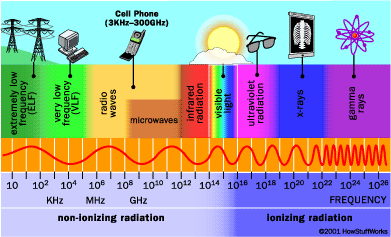
If possible, choose corded devices, or purchase one with speaker-phone capabilities.
Keep the main transmitting base of the cordless phone away from bedrooms and desks.
Keep calls short.
WI-FI
When installing a transmitting unit, ask for it to be put up high, such as on the wall or a shelf, away from bedrooms or where people sit.
Only turn the system on when you’re using it. Make sure the router is turned off overnight, especially.
Choose software on a laptop rather than cloud-computing technology such as Google Docs, if you’re using wi-fi. Typing in a Google Docs word processing means a wi-fi signal is sent with every single keystroke.http://www.stuff.co.nz/dominion-post/news/9882716/Waves-of-uncertainty-over-wi-fi
Be cautious with devices that give off electromagnetic radiation
Waves of uncertainty over wi-fi Stuff.co.nz 29 March 14“……..CUT BACK ON YOUR EXPOSURE
MOBILES AND DEVICES
Before buying a cellphone or internet-capable device, check out its SAR (specific absorption rate) rating – though in New Zealand you’ll likely have to go online for this information. The SAR measures how much the device’s emissions are absorbed by the body. Lower ratings indicate lower absorption.
Ensure your mobile has flight mode and use this as often as you can, including overnight, and when carrying it close to your body.
For long computing tasks, select a wired desktop or plugged-in laptop, rather than a wireless tablet.
Avoid holding a laptop or device on your lap or stomach – use a table instead, unless it’s in flight mode.
When you can, choose a text over a call. Keep phone calls to a minimum or use a hands-free kit.
Keep calls to a minimum where reception is bad – when a mobile is far from a cell tower, it has to boost its signal to connect.
Choose a wired mouse and keyboard.
CORDLESS PHONES
If possible, choose corded devices, or purchase one with speaker-phone capabilities.
Keep the main transmitting base of the cordless phone away from bedrooms and desks.
Keep calls short.
WI-FI
When installing a transmitting unit, ask for it to be put up high, such as on the wall or a shelf, away from bedrooms or where people sit.
Only turn the system on when you’re using it. Make sure the router is turned off overnight, especially.
Choose software on a laptop rather than cloud-computing technology such as Google Docs, if you’re using wi-fi. Typing in a Google Docs word processing means a wi-fi signal is sent with every single keystroke.http://www.stuff.co.nz/dominion-post/news/9882716/Waves-of-uncertainty-over-wi-fi
Why did Canadian government stop testing seafoods for radioactive contamination?
 School Science Project Reveals High Levels Of Fukushima Nuclear Radiation in Grocery Store Seafood Investment Watch By Michael Snyder March 27th, 2014 A Canadian high school student named Bronwyn Delacruz never imagined that her school science project would make headlines all over the world. But that is precisely what has happened. Using a $600 Geiger counter purchased by her father, Delacruz measured seafood bought at local grocery stores for radioactive contamination. What she discovered was absolutely stunning. Much of the seafood, particularly the products that were made in China, tested very high for radiation. So is this being caused by nuclear radiation from Fukushima? Is the seafood that we are eating going to give us cancer and other diseases? The American people deserve the truth, but as you will see below, the U.S. and Canadian governments are not even testing imported seafood for radiation. To say that this is deeply troubling would be a massive understatement.
In fact, what prompted Bronwyn Delacruz to conduct her science project was the fact that the Canadian government stopped testing imported seafood for radiation in 2012…
Alberta high-school student Bronwyn Delacruz loves sushi, but became concerned last summer after learning how little food inspection actually takes place on some of its key ingredients.
The Grade 10 student from Grande Prairie said she was shocked to discover that, in the wake of the 2011 Fukushima nuclear disaster in Japan, the Canadian Food Inspection Agency (CFIA)stopped testing imported foods for radiation in 2012.
And what should be a major red flag for authorities is the fact that the seafood with the highest radiation is coming from China… Armed with a $600 Geiger counter bought by her dad, Delacruz studied a variety of seafoods – particularly seaweeds – as part of an award-winning science project that she will take to a national fair next month.
“Some of the kelp that I found was higher than what the International Atomic Energy Agency sets as radioactive contamination, which is 1,450 counts over a 10-minute period,” she said. “Some of my samples came up as 1,700 or 1,800.”
Delacruz said the samples that “lit up” the most were products from China that she bought in local grocery stores.
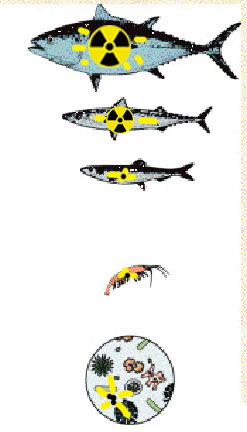
It is inexcusable that the Canadian government is not testing this seafood. It isn’t as if they don’t know that it is radioactive. Back in 2012, the Vancouver Sun reported that cesium-137 was being found in a very high percentage of the fish that Japan was selling to Canada…
• 73 percent of the mackerel
• 91 percent of the halibut
• 92 percent of the sardines
• 93 percent of the tuna and eel
• 94 percent of the cod and anchovies
• 100 percent of the carp, seaweed, shark and monkfish
So why was radiation testing for seafood shut down in Canada in 2012?
Someone out there needs to answer some very hard questions……..http://investmentwatchblog.com/school-science-project-reveals-high-levels-of-fukushima-nuclear-radiation-in-grocery-store-seafood/
Ocean radiation soon to reach USA’s West Coast
Scientists Expect Traces of Ocean Radiation Soon Science Tech By Jeff Barnard
The March 2011 tsunami off Japan flooded the Fukushima Dai-Ichi nuclear plant, causing radiation-contaminated water to spill into the Pacific. Airborne radiation was detected in milk and rainwater in the U.S. soon afterward. Now, scientists are using a network of volunteers to measure radiation at beaches along the U.S. West Coast. Continue reading |
|||

The role of genes in susceptibility to ionising radiation
Genes Determine People’s Susceptibility to Radiation, Prison Planet, Washington’s Blog March 10, 2014
Children are much more vulnerable to radiation than full-grown adults.
And yet standards for “acceptable” levels of radiation exposure are based on the ridiculous assumption that everyone is a healthy man in his 20s … and that radioactive particles ingested into the body cause no more damage than radiation hitting the outside of the body.
Similarly, there is a lot of variation between adults in terms of susceptibility to radiation.
For example, Howard Hughes Medical Institute – the second-best endowed medical research foundation in the world – reported in 2009:
Howard Hughes Medical Institute researchers have identified a group of genes that influence a person’s sensitivity to radiation……..
he most widely-accepted and prestigious publication on radiation – the U.S. National Academy of Science’s 2006 report on Health Risks from Exposure to Low Levels of Ionizing Radiation: BEIR VII Phase 2 – includes an 11-page discussion on genetic vulnerability to radiation, concluding:
At the level of whole populations it is feasible that certain inherited combinations of common low-penetrance genes can result in the presence of subpopulations havingsignificantly different susceptibilities to spontaneous and radiation-associated cancer.
***
The key issue is … the extent to which genetic distortion of the distribution of this risk might lead to underprotection of an appreciable fraction of the population.
While the commonly-accepted, mainstream scientific consensus is that even low levels of radiation can cause cancer and other injury, governments world-wide have reacted to the Fukushima crisis byraising “acceptable” radiation levels. And see this.
http://www.prisonplanet.com/genes-determine-peoples-susceptibility-to-radiation.html
The harsh facts on U.S.S. Reagan’s sailors affected by Fukushima radiation
Is Nuclear Experimentation Fascism? OpEdNews 1/22/2014 By Ethan Indigo Smith (about the author) “…the crew of the U.S.S. Reagan. The U.S.S. Reagan was exposed to radiation after being redirected towards Japan to provide support immediately after the massive Tōhoku earthquake and tsunami off the coast of Japan.
According to an article in the New York Post, Senior Chief Michael Sebourn, a radiation-decontamination officer who tested the aircraft carrier for radiation found that “levels were incredibly dangerous and at one point, the radiation in the air measured 300 times higher than what was considered safe.” The article continues: “The former personal trainer has suffered a series of ailments, starting with severe nosebleeds and headaches and continuing with debilitating weakness” has lost 60 percent of the power in the right side of his body and his limbs have visibly shrunk.” As Senior Chief Michael Sebourn stated, “I’ve had four MRIs, and I’ve been to 20 doctors” No one can figure out what is wrong.” He has since retired from the Navy after 17 years of service.
And he is not alone. According to The Post, “crew members on the aircraft carrier and a half-dozen other support ships are battling cancers, thyroid disease, uterine bleeding and other ailments.” Of the 5,000 sailors on board, at least 70 have contracted some form of radiation sickness, and of those, “at least half” are suffering from some form of cancer,” said lawyer, Paul Garner, who is representing the sailors in a lawsuit against the operators of the Fukushima Daiichi energy plant. “We’re seeing leukemia, testicular cancer and unremitting gynecological bleeding requiring transfusions and other intervention,” said Garner.
In a Voice of Russia report, Mr. Garner elaborated: “it seems that there’s too many people at the same place at the same time without any family background or any reason to believe that they had these issues to now show up with these significant cancers and beyond. So we feel that time will tell in many instances”. especially, because they all had physicals and were all in top health.”
Navy sailor Lindsay Cooper, who was also present on the U.S.S. Reagan, stated that crew members suffered from excruciating diarrhea at the time. “People were s-“-tting themselves in the hallways,” Cooper recalled. “Two weeks after that, my lymph nodes in my neck were swollen. By July, my thyroid shut down.”
When asked about the U.S.S. Reagan’s ability to detect radiation early, sailor Cooper stated “we have a multimillion-dollar radiation-detection system, but” it takes time to be set up and activated”. She went on to describe that after being exposed, “we couldn’t go anywhere. Japan didn’t want us in port, Korea didn’t want us, Guam turned us away. We floated in the water for two and a half months” until Thailand took the stricken sailors in……..http://www.opednews.com/articles/Is-Nuclear-Experimentation-by-Ethan-Indigo-Smith-Fukushima_Nuclear-Cover-up_Nuclear-Meltdown_Nuclear-Waste-140122-627.html
Advice to cardiologists to reduce radiation exposure
Cardiologists urged to reduce inappropriate radiation exposure, Medical Press 8 Jan 14 Cardiologists are being urged to reduce patient radiation exposure in a European Society of Cardiology (ESC) position paper which outlines doses and risks of common cardiology examinations for the first time. The paper is published today in the European Heart Journal.
Lead author, Dr Eugenio Picano, FESC, said: “Cardiologists today, are the true contemporary radiologists. Cardiology accounts for 40% of patient radiology exposure and equals more than 50 chest X-rays per person per year.”
He added: “Unfortunately, radiation risks are not widely known to all cardiologistsand patients and this creates a potential for unwanted damage that will appear as cancers, decades down the line. We need the entire cardiology community to be proactive in minimising the radiological friendly fire in our imaging labs.”
The paper lists doses and risks of the most common cardiology examinations for the first time. Computed tomography (CT), percutaneous coronary intervention (PCI), cardiac electrophysiology and nuclear cardiology deliver a dose equivalent to 750 chest X-rays (with wide variation from 100 to 2,000 chest X-rays) per procedure. These procedures are performed daily in all cardiology in- and out-patient departments, usually more than one procedure per admission. They are used for all forms of cardiac disease, from congenital to heart failure, but more intensively and frequently for ischemic heart disease.
PCI for dilation of coronary artery stenosis totals almost 1 million procedures per year in Europe. The additional lifetime risk of fatal and non-fatal cancer for one PCI ranges from 1 in 1000, to 1 in 100 for a healthy 50 year old man. Risks are 1.38 times higher in women and 4 times higher in children. Children’s higher risk is because their cells divide more quickly and they have more years in which to develop cancer.
Dr Picano said: “Even in the best centres, and even when the income of doctors is not related to number of examinations performed, 30 to 50% of examinations are totally or partially inappropriate according to specialty recommendations. When examinations are appropriate, the dose is often not systematically audited and therefore not optimised, with values which are 2 to 10 times higher than the reference, expected dose.”
The paper aims to reduce the unacceptably high rate of inappropriate examinations and reduce excessive doses in appropriate examinations. Dr Picano said: “In these hard economic times, 50% of the costly and risky advanced imaging examinations we do are for inappropriate indications. Politicians’ top priority should be to audit and cut down on useless and dangerous examinations.”…….http://medicalxpress.com/news/2014-01-cardiologists-urged-inappropriate-exposure.html
1 This Month
19 February – VIRTUAL EVENT-Decision Time: AI and Our Nuclear Arsenal
12:45 p.m. Central / 1:45 p.m. Eastern
To see nuclear-related stories in greater depth and intensity – go to https://nuclearinformation.wordpress.com
-
Archives
- February 2026 (181)
- January 2026 (308)
- December 2025 (358)
- November 2025 (359)
- October 2025 (376)
- September 2025 (258)
- August 2025 (319)
- July 2025 (230)
- June 2025 (348)
- May 2025 (261)
- April 2025 (305)
- March 2025 (319)
-
Categories
- 1
- 1 NUCLEAR ISSUES
- business and costs
- climate change
- culture and arts
- ENERGY
- environment
- health
- history
- indigenous issues
- Legal
- marketing of nuclear
- media
- opposition to nuclear
- PERSONAL STORIES
- politics
- politics international
- Religion and ethics
- safety
- secrets,lies and civil liberties
- spinbuster
- technology
- Uranium
- wastes
- weapons and war
- Women
- 2 WORLD
- ACTION
- AFRICA
- Atrocities
- AUSTRALIA
- Christina's notes
- Christina's themes
- culture and arts
- Events
- Fuk 2022
- Fuk 2023
- Fukushima 2017
- Fukushima 2018
- fukushima 2019
- Fukushima 2020
- Fukushima 2021
- general
- global warming
- Humour (God we need it)
- Nuclear
- RARE EARTHS
- Reference
- resources – print
- Resources -audiovicual
- Weekly Newsletter
- World
- World Nuclear
- YouTube
-
RSS
Entries RSS
Comments RSS
 nuclear-news