Public unaware of massive spikes in radiation as nuclear reactors are re-fuelled
 Scientist: Massive spikes in radioactivity are being hidden from public — Radiation doses around nuclear reactors increase exponentially — It’s a major worry… very, very important — Something must be done (VIDEO) http://enenews.com/scientist-massive-spikes-radioactivity-being-hidden-public-radiation-doses-around-reactors-increase-exponentially-major-worry-very-very-important-video?utm_source=feedburner&utm_medium=email&utm_campaign=Feed%3A+ENENews+%28Energy+News%29
Interview with Dr. Ian Fairlie, Radiation Biologist, Nuclear Hotseat hosted by Libbe HaLevy, Aug 19, 2014 (at 35:30 in): One of the key things I’d like to mention to your listeners is this; Up until 2012, we didn’t really know what happened with emissions from nuclear reactors. The only data that we had was annual data… we didn’t really know the time pattern — now we do. Now we know that the large majority — say two-thirds, three-quarters — of the annual emissions from a reactor occur just once, during one spike.
And that spike occurs when the reactor is opened up to take out the old fuel and to put in fresh fuel. During that time period — about a day, day-and-half — the reactors are depressurized… they open up the valves and the radioactive gases shoot out. It’s during that time that we think that the people down wind are exposed to high levels of radioactivity, i.e. high radiation doses… Instead of having even, little bits of emissions throughout the 365 days, you haveone big, massive spike which happens over a day-and-a-half period. And that happens roughly speaking, once a year…
That’s important — Very, very important — because it results in doses that are at least 20 times higher, maybe even as much as 100 times higher… That’s a major worry… I’ve said to a number of nuclear operators, “Why don’t you do this at night time when people are in bed? Why don’t you do it when it’s really, really windy out — and it’s not raining?” … When it’s very calm it just drifts everywhere and you get big doses — No response… These spikes have been hidden from us ever since the beginning of the nuclear power program … nobody knew about them apart from people who work in the nuclear industry and they keep really quiet about it. I’d like to say to your American listeners, this is very important. You have to go to your regulator and say, “There’s no reason why this is not occurring at US reactors. These data are from German pressurized water reactors… We know that it’s very, very likely the same thing is happening with US reactors.” I hope that at least some of your listeners will pick this up and say, “Whoa, we’ve got to do something here.” >>Full interview available here
Dr. Donald Mosier, Scripps Research Institute’s Dept. of Immunology and city council member in Del Mar near San Onofre nuclear plant, Oct. 19, 2013 (at 27:15 in): The problem with the data is that tritium releases are episodic. They’ll have a release of tritium one day a month, but when they report that to the NRC, they’ll say this is the amount of tritium we’ve released over the year. You have 5 days of release, but you divide that by 365 days, it doesn’t look like so much tritium. But if you’re sitting right next to the plant on the day of the release, it’s quite a bit. There’s some data from Europe that says those spikes are dangerous. There’s no data in the US that you can interpret. >> Watch the community symposium here
Fukushima and Chernobyl’s plants and animals have suffered from radiation
 No, Fukushima Is Not a Wildlife Haven—and Neither Is Chernobyl http://www.citylab.com/tech/2014/08/no-fukushima-is-no-eden-for-animalsand-neither-is-chernobyl/376046/ A slew of new research reveals the deleterious effects of radiation on Fukushima’s ecology. LAURA BLISS @mslaurabliss Aug 14, 2014
Perhaps you’ve encountered the well-publicized idea that Chernobyl, the world’s worst nuclear disaster of 1986, has become a kind of ‘wildlife haven’ as a result of its abandonment by humans.
So what of Fukushima Daiichi, Japan’s nuclear collapse of 2011—might we expect a happy menagerie there, too? Not so much, according to a slew of new papers out in the Journal of Heredity. And you may want to rethink Chernobyl-as-Eden, too.
The findings of the new studies tell of significant population decline across many different species of animals and plants, as well as a range of expressions of genetic damage and cell mutation.
One paper reports that the pale grass blue butterfly, one of Japan’s most common butterfly species, has suffered from significant size reduction, slowed growth, high mortality and abnormal wing patterns both within the Fukushima exclusion zone and among lab-raised offspring of parents collected at the site. Which is to say, radiation-caused genetic mutations were passed down.
 Researchers also found major declines in populations of birds, butterflies, cicadas, and some small mammals, as well as aberrations and albinism in the feathers of certain birds.
Timothy Mousseau, a prominent biologist and lead author of that population study, has also conducted significant research into radiation’s impacts at Chernobyl. He roundly rejects the claim that the area has become an animal haven, arguing that notion was based on anecdotal evidence rather than scientific data. Mousseau’s own work demonstrates radiation has had similar effects on Chernobyl’s ecology as on Fukushima’s.
Further inquiry into all manner of species living at the Chernobyl site could help scientists better predict Fukushima’s biological trajectory, he says. “There is an urgent need for greater investment in basic scientific research of the wild animals and plants of Fukushima,” Mousseau told the Journal of Heredity.
To help the nuclear industry, USA’s EPA to weaken radiation standards
 Green groups say EPA rules would weaken radiation standards The Hill, By Tim Devaney – 08/04/14 Green groups say the Environmental Protection Agency’s plan to weaken radiation standards at nuclear power plants would triple the likelihood of people in surrounding communities developing cancer.
The EPA said earlier this year it is considering new rules that green groups claim would actually weaken radiation standards, increasing public exposure by at least three times from the current level. The agency has not updated the standards since 1977. “The EPA admits that radiation is much more likely to cause cancer than was believed when the rule was originally written,” said Dan Hirsch, president of nuclear watchdog group Committee to Bridge the Gap. “So it’s perplexing that rather than tightening the rule, they’re proposing to weaken it further.”
The Committee to Bridge the Gap is one of about 70 environmental groups that sent EPA Administrator Gina McCarthy a letter over the weekend, asking her to reconsider the new rules as the public comment period closes and the agency enters the final stages of rule-making.
In addition to the environmental groups, more than 6,000 people have written to the EPA opposing the changes to the radiation standard, Hirsch said.
Under the EPA’s current standards, about one in every 500 people who are exposed to radiation develop cancer, but the new rules would increase the risk even more, Hirsch said.
“They’ve given a free pass to radiation,” Hirsch said……….
environmental groups speculate the Obama administration could be trying to replace coal production with nuclear energy, which they say is why the EPA is loosening radiation standards.
Environmental groups, however, express deep concerns about this plan.
“I would not say that nuclear is safer than coal, not at all,” Hirsch said.
“Choosing between coal and nuclear is a form of picking one’s poison, either carbon or plutonium,” he added. “But we believe that shouldn’t be the choice. The choice should be between dangerous pollutants and renewables, which are far safer.”
Renewable energies such as solar, wind and hydropower are all better replacements for coal than nuclear energy, Hirsch said. : http://thehill.com/regulation/214232-green-groups-say-epa-rules-would-weaken-radiation-standards#ixzz39gQFKYxi
Follow us: @thehill on Twitter | TheHill on Facebook
USA’s Nuclear – I mean – Environmental Protection Agency
Officially “Safe” RadiationBy William Boardman OpEd News 8/3/2014 More Radiation Exposure Won’t Hurt You, Says U.S. EPA
“Protection Standards for Nuclear Power Operations” means what?
The Environmental Protection Agency (EPA) of the United States is a full blown oxymoron when it comes to protecting U.S. residents from the danger of increased exposure to ionizing radiation. That’s the kind of radiation that comes from natural sources like Uranium and the sun, as well as unnatural sources like Uranium mines, nuclear weapons, and nuclear power plants (even when they haven’t melted down like Fukushima). The EPA is presently considering allowing everyone in the U.S. to be exposed to higher levels of ionizing radiation.
In 1977, the EPA established levels of radiation exposure “considered safe” for people by federal rule (in bureaucratese, “the regulation at 40 CFR part 190“). In the language of the rule, the 1977 safety standards were: “The standards [that] specify the levels below which normal operations of the uranium fuel cycle are determined to be environmentally acceptable.” In common parlance, this became the level “considered safe,” even though that’s very different from “environmentally acceptable.” “Acceptable by whom? The environment has no vote.
The phrase “considered safe” is key to the issue, since there is no “actually safe” level of radiation exposure. The planet was once naturally radioactive and lifeless. Life emerged only after Earth’s radiation levels decayed to the point where life became possible, in spite of a continuing level of natural “background radiation.” The reality is that there is no “safe” level of radiation exposure.
Is the EPA actually immersed in a protection racket?
The studied ambiguity of the proposal’s title — “Environmental Radiation Protection Standards for Nuclear Power Operations” — goes to the heart of the issue: who or what is really being protected, nuclear power operations?
Quite aware that it is perceived by some as placing the desires of the nuclear power industry above the safety needs of the population, the EPA begins its proposal for changing radiation limits with this defensive and apparently contradictory passage:
This Advance Notice of Proposed Rulemaking is being published to inform stakeholders, including federal and state entities, the nuclear industry, the public and any interested groups, that the Agency is reviewing the existing standards to determine how the regulation at 40 CFR part 190 should be updated and soliciting input on changes (if any) that should be made.
This action is not meant to be construed as an advocacy position either for or against nuclear power.
EPA wants to ensure that environmental protection standards are adequate for the foreseeable future for nuclear fuel cycle facilities. As far as the EPA is concerned, the uranium fuel cycle does not include Uranium mining, despite the serious environmental danger that process entails. Once the environmental and human degradation from Uranium mining has been done, the EPA begins regulating environmental protection from nuclear fuel cycle facilities, beginning with milling and ending with storage or reprocessing facilities for nuclear waste.
According to the agency itself, “EPA’s mission is to protect human health and the
environment. EPA sets limits on the amount of radiation that can be released into the environment.”
Radiation exposure is chronic, cumulative, and unhealthy
Given the pre-existing radiation load on the environment from natural sources, it’s not clear that there is any amount of radiation that can be released into the environment with safety. The EPA pretty much evades that question, since the straight forward answer for human health is: no amount. Besides, the semi-captured protection agency is just as much engaged in protecting economic health for certain industries as it is in protecting human health. This leads it to making formulations that manage to acknowledge human reality without actually supporting it:………
Lower radiation levels provide more environmental protection
Environmental organizations like the Nuclear Information and Resource Service (NIRS) are urging the EPA to lower radiation release standards, to “protect more, not less.” According to NIRS, regulation of nuclear power has a sorry history:……..
In 2005, the National Academy of Sciences addressed “safe” levels of radiation and concluded that there are none in any scientifically meaningful sense.
Humans are exposed to a basic, damaging level of ionizing radiation from multiple sources from gestation till death. This natural background radiation is at a relatively low level, but the risk from radiation is cumulative. Every additional exposure above background radiation adds to the risk. Some of these risks, like radiation treatment to ward off cancer, are widely accepted as reasonable trade-offs. The reasonableness of greater exposure from the nuclear fuel cycle and the uncontrolled growth of nuclear waste is not such an obviously beneficial trade-off. http://www.opednews.com/articles/Officially-Safe-Radiatio-by-William-Boardman-Cancer_Environment_People_Radiation-140803-863.html
Bioaccumulation of Fukushima radiation in global food supply
 Fukushima Radiation Poisoning Global Food Supply (includes videos) http://chemtrailsplanet.net/2014/08/01/forget-mh-17-fukushima-radiation-poisoning-global-food-supply/ Chemtrail Following a major earthquake, a 15-metre tsunami disabled the power supply and cooling of three Fukushima Daiichi reactors, causing a nuclear accident on 11 March 2011. All three cores largely melted in the first three days. — World Nuclear Association
Report by Dr. Bill Deagle reminds us that extinction-level amounts of lethal radiation continues to contaminate the planet.
It has to be considered that the consequences of global panic in response to full public knowledge the horrific Fukushima event are so dire that corporate media outlets have been instructed not to cover it. Instead, we get bizarre reports on MH-370, MH-17, the Ebola virus, Israeli war on Gaza, Impeaching Obama,…on and on.
By not reporting on Fukushima, “authorities” hope to hide the dire consequences of continued radiation leak(s) from the American people and global populations for as long a possible.
By monitoring social media conversations, it’s an easy task for “rulers” to know when the “flash-point” of public awareness will prompt need to apply further media distractions or increase certain elements of the police state without actually declaring outright, “martial law”….as a last resort.
Bio-accumulation of radiation from Fukushima can damage nearly all life on earth.
All along the west coast of North America, sea stars are dying at an alarming rate. There was an “outbreak” of some unknown wasting disease last year and it appears to have come back even worse this summer. — Radiation Rain
One aspect of this out-of-control contamination is in the Pacific’s 30 foot deep layer of surface ocean water where much of the global oxygen supply is generated by plankton. Bio-accumulation in this layer is unknown and no questions are being asked by corporate media “experts”. Dalton’s Law of partial pressures of gases tells us that measured CO2 levels will respond by going up if global oxygen levels go down.
Reports of a massive case of dead star-fish, absence of certain species of fish and dwindling herds of animals up and down the Pacific region of the northern hemisphere are never connected to the consequences of bio-accumulation of radiation sprays from the ongoing Fukushima disaster.
Why?
Follow the money. Media will avoid reporting any news that could be bad for business as usual.
Spraying aerosols over the Pacific to interrupt rainfall is a desperate attempt to mitigate radiation from being washed onto crops in the central valley that provides much of our food commodities . The obvious downside is the failure of normal rainfall and forcing of drought that increases the number of wildfires in the Northwest and the opportunistic privatization of water resources.
Tokyo’s growing nuclear radiation danger
 ‘Tokyo should no longer be inhabited,’ Japanese doctor warns residents regarding radiation http://www.naturalnews.com/046112_radiation_fukushima_tokyo.html 25 July 14 (NaturalNews)In an essay addressed to his colleagues, Japanese doctor Shigeru Mita has explained why he recently moved away from Tokyo to restart his practice in western Japan: He believes that Tokyo is no longer safe to inhabit due to radioactive contamination caused by the March 11, 2011, meltdowns at the Fukushima Daiichi nuclear plant.
The essay, titled “Why did I leave Tokyo?” was published in the newsletter of the Association of Doctors in Kodaira, metropolitan Tokyo.
Soil tests prove contamination
Dr. Mita opens his essay by contextualizing his decision to leave, noting that he had a long history as a doctor in Tokyo.
“I closed the clinic in March 2014, which had served the community of Kodaira for more than 50 years, since my father’s generation, and I have started a new Mita clinic in Okayama-city on April 21,” he wrote.
Dr. Mita notes that, for the past 10 years, he had been working to persuade the municipal government of Tokyo to stock iodine pills to distribute to the population in the case of a nuclear accident. Dr. Mita’s concern had been that an earthquake might trigger a meltdown at the Hamaoka nuclear power plant. All of his requests were rejected, however, under the excuse that there was no reason to expect such an accident.
Prior to 2011, Shinjuku (the region of Tokyo that houses the municipal government) tested at only 0.5-1.5 Bq/kg. Today, levels at nearby Kodaira are at 200-300 Bq/kg.
“Within the 23 districts of Metropolitan Tokyo, contamination in the east part is 1000-4000 Bq/kg and the west part is 300-1000 Bq/kg,” Dr. Mita wrote.
For comparison, Kiev (capital of the Ukraine) has soil tested at 500 Bq/kg (Cs-137 only). Following the Chernobyl accident, West Germany and Italy reported levels of 90-100 Bq/kg, and both experienced measurable health effects on their populations.
Dr. Mita notes that the radiation situation in Tokyo is getting worse, not better, due to urban practices of concentrating solid waste in small areas such as municipal dumps and sewage plants. That is why, he says, radiation levels in Tokyo riverbeds have actually been increasing over the prior two years.
Dr. Mita’s essay also chronicles the many cases he has observed of patients presenting with radiation-induced health problems. He notes that, since 2011, he has observed while blood cell counts declining in children under the age of 10, including in children under one year old. In all of these cases, symptoms typically improve if the children move to western Japan. He has similarly observed persistent respiratory symptoms that improve in patients who move away.
Other patients have shown symptoms including “nosebleed, hair loss, lack of energy, subcutaneous bleeding, visible urinary hemorrhage, skin inflammations, coughs and various other non-specific symptoms.” He also notes high occurrences of rheumatic muscle symptoms similar to those observed following the Chernobyl disaster.
“Ever since 3.11, everybody living in Eastern Japan including Tokyo is a victim, and everybody is involved,” he wrote.
Sources for this article include:
Critical analysis of Fukushima report by the United Nations Scientific Committee on the Effects of Atomic Radiation
Fukushima: Bad and Getting Worse – Global Physicians Issue Scathing Critique of UN Report on Fukushima CounterPunch, by JOHN LaFORGE, 20 July 14
There is broad disagreement over the amounts and effects of radiation exposure due to the triple reactor meltdowns after the 2011 Great East-Japan Earthquake and tsunami. The International Physicians for the Prevention of Nuclear War (IPPNW) joined the controversy June 4, with a 27-page “Critical Analysis of the UNSCEAR Report ‘Levels and effects of radiation exposures due to the nuclear accident after the 2011 Great East-Japan Earthquake and tsunami.’”
IPPNW is the Nobel Peace Prize winning global federation of doctors working for “a healthier, safer and more peaceful world.” The group has adopted a highly critical view of nuclear power because as it says, “A world without nuclear weapons will only be possible if we also phase out nuclear energy.”
UNSCEAR, the United Nations Scientific Committee on the Effects of Atomic Radiation, published its deeply flawed report April 2. Its accompanying press release summed up its findings this way: “No discernible changes in future cancer rates and hereditary diseases are expected due to exposure to radiation as a result of the Fukushima nuclear accident.” The word “discernable” is a crucial disclaimer here.

Cancer, and the inexorable increase in cancer cases in Japan and around the world, is mostly caused by toxic pollution, including radiation exposure according to the National Cancer Institute.[1] But distinguishing a particular cancer case as having been caused by Fukushima rather than by other toxins, or combination of them, may be impossible – leading to UNSCEAR’s deceptive summation. As the IPPNW report says, “A cancer does not carry a label of origin…”
UNSCEAR’s use of the phrase “are expected” is also heavily nuanced. The increase in childhood leukemia cases near Germany’s operating nuclear reactors, compared to elsewhere, was not “expected,” but was proved in 1997. The findings, along with Chernobyl’s lingering consequences, led to the country’s federally mandated reactor phase-out. The plummeting of official childhood mortality rates around five US nuclear reactors after they were shut down was also “unexpected,” but shown by Joe Mangano and the Project on Radiation and Human Health.
The International Physicians’ analysis is severely critical of UNSCEAR’s current report which echoes its 2013 Fukushima review and press release that said, “It is unlikely to be able to attribute any health effects in the future among the general public and the vast majority of workers.”
“No justification for optimistic presumptions”
The IPPNW’s report says flatly, “Publications and current research give no justification for such apparently optimistic presumptions.” UNSCEAR, the physicians complain, “draws mainly on data from the nuclear industry’s publications rather than from independent sources and omits or misinterprets crucial aspects of radiation exposure”, and “does not reveal the true extent of the consequences” of the disaster. As a result, the doctors say the UN report is “over-optimistic and misleading.” The UN’s “systematic underestimations and questionable interpretations,” the physicians warn, “will be used by the nuclear industry to downplay the expected health effects of the catastrophe” and will likely but mistakenly be considered by public authorities as reliable and scientifically sound. Dozens of independent experts report that radiation attributable health effects are highly likely………. http://www.counterpunch.org/2014/07/18/fukushima-bad-and-getting-worse/
United Nations Scientific Committee on the Effects of Atomic Radiation (UNSCEAR) has 10 major flaws
 Fukushima: Bad and Getting Worse – Global Physicians Issue Scathing Critique of UN Report on Fukushima CounterPunch, by JOHN LaFORGE, 20 July 14 Physicians find ten grave failures in UN report
The majority of the IPPNW’s report details 10 major errors, flaws or discrepancies in the UNSCEAR paper and explains study’s omissions, underestimates, inept comparisons, misinterpretations and unwarranted conclusions.
1. The total amount of radioactivity released by the disaster was underestimated by UNSCEAR and its estimate was based on disreputable sources of information. UNSCEAR ignored 3.5 years of nonstop emissions of radioactive materials “that continue unabated,” and only dealt with releases during the first weeks of the disaster. UNSCEAR relied on a study by the Japanese Atomic Energy Agency (JAEA) which, the IPPNW points out, “was severely criticized by the Fukushima Nuclear Accident Independent Investigation Commission … for its collusion with the nuclear industry.” The independent Norwegian Institute for Air Research’s estimate of cesium-137 released (available to UNSCEAR) was four times higher than the JAEA/UNSCEAR figure (37 PBq instead of 9 PBq). Even Tokyo Electric Power Co. itself estimated that iodine-131 releases were over four times higher than what JAEA/UNSCEAR) reported (500 PBq vs. 120 BPq). The UNSCEAR inexplicably chose to ignore large releases of strontium isotopes and 24 other radionuclides when estimating radiation doses to the public. (A PBq or petabecquerel is a quadrillion or 1015 Becquerels. Put another way, a PBq equals 27,000 curies, and one curie makes 37 billion atomic disintegrations per second.)
2. Internal radiation taken up with food and drink “significantly influences the total radiation dose an individual is exposed to,” the doctors note, and their critique warns pointedly, “UNSCEAR uses as its one and only source, the still unpublished database of the International Atomic Energy Association and the Food and Agriculture Organization. The IAEA was founded … to ‘accelerate and enlarge the contribution of atomic energy to peace, health and prosperity throughout the world.’ It therefore has a profound conflict of interest.” Food sample data from the IAEA should not be relied on, “as it discredits the assessment of internal radiation doses and makes the findings vulnerable to claims of manipulation.” As with its radiation release estimates, IAEA/UNSCEAR ignored the presence of strontium in food and water. Internal radiation dose estimates made by the Japanese Ministry for Science and Technology were 20, 40 and even 60 times higher than the highest numbers used in the IAEA/UNSCEAR reports.
3. To gauge radiation doses endured by over 24,000 workers on site at Fukushima, UNSCEAR relied solely on figures from Tokyo Electric Power Co., the severely compromised owners of the destroyed reactors. The IPPNW report dismisses all the conclusions drawn from Tepco, saying, “There is no meaningful control or oversight of the nuclear industry in Japan and data from Tepco has in the past frequently been found to be tampered with and falsified.” Continue reading
Some points of agreement on Fukushima between global physicians and UNSCEAR
Fukushima: Bad and Getting Worse – Global Physicians Issue Scathing Critique of UN Report on Fukushima CounterPunch, by JOHN LaFORGE, 20 July 14 “……..Points of agreement: Fukushima is worse than reported and worsening still
Before detailing the multiple inaccuracies in the UNSCEAR report, the doctors list four major points of agreement. First, UNSCEAR improved on the World Health Organization’s health assessment of the disaster’s on-going radioactive contamination. UNSCEAR also professionally “rejects the use of a threshold for radiation effects of 100 mSv [millisieverts], used by the International Atomic Energy Agency in the past.” Like most health physicists, both groups agree that there is no radiation dose so small that it can’t cause negative health effects. There are exposures allowed by governments, but none of them are safe.
Second, the UN and the physicians agree that areas of Japan that were not evacuated were seriously contaminated with iodine-132, iodine-131 and tellurium-132, the worst reported instance being Iwaki City which had 52 times the annual absorbed dose to infants’ thyroid than from natural background radiation. UNSCEAR also admitted that “people all over Japan” were affected by radioactive fallout (not just in Fukushima Prefecture) through contact with airborne or ingested radioactive materials. And while the UNSCEAR acknowledged that “contaminated rice, beef, seafood, milk, milk powder, green tea, vegetables, fruits and tap water were found all over mainland Japan”, it neglected “estimating doses for Tokyo … which also received a significant fallout both on March 15 and 21, 2011.”
Third, UNSCEAR agrees that the nuclear industry’s and the government’s estimates of the total radioactive contamination of the Pacific Ocean are “far too low.” Still, the IPPNW reports shows, UNSCEAR’s use of totally unreliable assumptions results in a grossly understated final estimate. For example, the UN report ignores all radioactive discharges to the ocean after April 30, 2011, even though roughly 300 tons of highly contaminated water has been pouring into the Pacific every day for 3-and-1/2 years, about 346,500 tons in the first 38 months.
Fourth, the Fukushima catastrophe is understood by both groups as an ongoing disaster, not the singular event portrayed by industry and commercial media. UNSCEAR even warns that ongoing radioactive pollution of the Pacific “may warrant further follow-up of exposures in the coming years,” and “further releases could not be excluded in the future,” from forests and fields during rainy and typhoon seasons –when winds spread long-lived radioactive particles – a and from waste management plans that now include incineration.
As the global doctors say, in their unhappy agreement with UNSCAR, “In the long run, this may lead to an increase in internal exposure in the general population through radioactive isotopes from ground water supplies and the food chain.”……” http://www.counterpunch.org/2014/07/18/fukushima-bad-and-getting-worse/
 Joy Thompson’s excellent explanation and advice on this – see https://nuclear-news.net/2014/07/19/6-issues-for-americas-epa-on-radiation-safety-limits/Is EPA About To Relax Radiation Protections From Nuclear Power? Jeff McMahon Forbes, 19 July 14Both proponents and opponents of nuclear power expect the Environmental Protection Agency in coming months to relax its rules restricting radiation
  emissions from reactors and other nuclear facilities. EPA officials say they have no such intention, but they are willing to reconsider the method they use to limit public exposure—and the public’s level of risk.
“We want you to know EPA is not proposing any changes to the standards at this time,” said Jessica Wieder of EPA’s Office of Radiation. “We’ve issued theANPR just to solicit public input and information early as we evaluate whether the standards need to be changed at all.”
EPA has concerns about several other deficiencies in the current rule, Littleton said, including:
“In addition to finding groundwater contamination in the vicinity of several nuclear power plants, radioactive contaminants including uranium, strontium, and cesium have been found in groundwater in other uranium fuel cycle facilities,” Littleton said. “These environmental problems could linger on long past the operational phase of these facilities.”
Spent Fuel Storage: When the 1977 rule was written, regulators expected used fuel rods to be stored at nuclear plants for no more than 18 months before being transported to reprocessing plants or a long-term waste depository. Now regulators expect fuel rods to continue to accumulate in increasingly crowded conditions at power plants until at least 2050.
“Since these wastes are stored for much longer duration, there’s a possibility that these wastes could contribute to higher public doses,” Littleton said. ”The agency believes that storage is a covered activity, but if we revise it could be prudent to state that the rule is applicable to long-term storage on site.”
Radionuclides: Because regulators in 1977 expected spent fuel to be reprocessed, the rule specifically restricts radionuclides likely to be emitted during reprocessing: krypton-85, iodine-129, plutonium-238 and other alpha emitters. The U.S. no longer considers reprocessing viable for most existing spent fuel…….
Alternative Technologies: The 1977 rule applies only to the uranium fuel cycle, so it does not apply to facilities that use other fuels, like thorium, and it may not be suited to emerging technologies like small modular reactors, Littleton said.
“Do small modular reactors pose unique environmental considerations, or do existing limits adequately address concerns with small modular reactors?”
The EPA is collecting public comments on the proposed rule revision until Aug. 3. The public may submit comments at regulations.gov.

CT scan radiation cancer risk is reduced by Ohio hospital
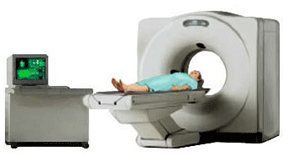 Ohio hospital slashes CT radiation dose — and cancer risk By Brian Casey, AuntMinnie.com staff writer July 16, 2014 — By changing its scanning protocols, an Ohio hospital was able to cut by more than half the number of radiation-induced cancers that would have occurred following CT exams. The finding could alter the debate over the risks of medical radiation, according to a study in the July issue of the Journal of the American College of Radiology.
In the article, a team of researchers led by Michael Rayo, PhD, of Ohio State University described their project to implement new scanning protocols to reduce radiation dose. The group relied on commercially available tools accessible to most U.S. hospitals, such as iterative reconstruction, tube current modulation, and weight-based variable kV.
While taking into account an overall reduction in CT utilization that occurred during the same time period, the researchers calculated that their efforts would lead to a 63% reduction in cancers induced by the CT scans, based on widely accepted data. If the same scenario were repeated widely around the U.S., it could offer a way out of the morass that has engulfed radiology since the radiation dose controversy erupted in 2007 (JACR, July 2014, Vol. 11:7, pp. 703-708).
Rising volume and radiation dose
CT utilization grew steadily in the U.S. from 1998 through 2008, the authors noted. But in 2007, research studies began appearing that raised the specter that thousands of cancers could be caused by medical imaging exams, in particular CT studies. One study postulated that as many as 2% of all cancers in the U.S. could be caused by exposure to CT radiation, while another estimated that some 29,000 cancers could be caused annually by CT use.
The findings have spurred members of the radiology community to find ways to reduce exposure to medical radiation, with two main avenues being pursued: The first includes efforts such as Choosing Wisely, which reduces exposure by eliminating unnecessary imaging exams, while the second involves developing protocols to reduce the radiation dose used in appropriate exams.
Rayo and colleagues decided to study the topic to determine the impact on radiation dose at Ohio State University Wexner Medical Center, a tertiary-care facility in Columbus. They felt that previous research had not addressed the potential effects of dose reduction protocols and utilization declines on cancer risk reduction.
The researchers examined data for both Medicare and non-Medicare patients treated at the hospital on an inpatient basis in the calendar years 2008 to 2012. They examined reimbursement codes for CT scans of four regions: the abdomen and pelvis, head, sinus, and lumbar spine.
To assess the effectiveness of dose reduction strategies, they calculated the average dose-length product (DLP) in 2010 and 2012 (the hospital implemented its dose reduction program in 2011). The group used a sample of patients for each anatomical region and extrapolated the averages to all the patients scanned for that area at the hospital during the study periods.
Finally, the researchers calculated cancer incidence for both the preintervention and postintervention periods based on data from the Biological Effects of Ionizing Radiation (BEIR) VII report. They divided the estimates into three anatomical regions (estimates were not made for sinus CT due to a small sample size of patients).
They found that overall CT volume grew 21% from 2008 to 2010 and fell by 30% from 2010 to 2012, for a net decline of 15% over the study period. Other changes are shown in the table below. [table in original article]………
Finally, the researchers applied BEIR VII data to calculate how many fewer cancers might develop if all patients were scanned at the lower levels. This translated into an estimated decline of induced cancers from 10.1 cases in 2010 to 3.8 cases in 2012, and a drop in resulting mortalities from 5.1 individuals to 1.9 individuals……….http://www.auntminnie.com/index.aspx?sec=ser&sub=def&pag=dis&ItemID=107954
6 issues for America’s EPA on radiation safety limits
EPA Wants My Opinion? Well, Here It Is, Enformable Joieau Website Joy Thompson 18 July 14,
 The Environmental Protection Agency – the overseers of the suspiciously on-again/off-again RadNet monitoring system in the wake of the 2011 mass meltdown/blow-outs at Japan’s Fukushima Daiichi power station – has helpfully extended the public comment period on its proposed “update” to 40CFR.190, “Environmental Radiation Protection Standards for Nuclear Power Operations.”
Citizens now have until August 4th to submit their comments on exposure limits, dose calculations, new fuel cycle technologies and related topics.
Advance Notice of Proposed Rulemaking (ANPR).
The EPA is seeking public comment and information that they may or may not use for planned updates to the old rules for Environmental Radiation Protection issued in 1977, ostensibly to make them easier to understand and implement. Given how often the public is treated to professions of ignorance from the nuclear industry (such as, “we don’t know how to measure beta radiation levels!” when caught disseminating blatantly false data), this could be a good thing. The Nuclear Regulatory Commission [NRC] is responsible for implementing and enforcing the standards established by the EPA, and we have watched with some jaded dismay as NRC has steadily abdicated its responsibilities, entrusting them to the utilities it’s supposed to be regulating. Utilities now enjoy little to no oversight or auditing of their monitoring or records, and requirements for public notification and protection (like evacuation of nearby residents if releases reach certain levels) have been demonstrated pointless because they are routinely ignoredPerhaps if EPA can tweak its rules so that even the NRC can understand them, we could expect much better compliance all around……..
To help interested people who may be confused by the technical gobbledygook that frames the issues in the EPA’s documents, I am listing the issues here, offering an abbreviated look at EPA reasoning in presenting these issues for comment, and supplying my own responses to the questions EPA is posing to the public………
Issue 1: Consideration of a Risk Limit to protect individuals. Should the Agency express its limits for the purpose of this regulation in terms of radiation risk or radiation dose?
My Response to Issue 1:
Because both national and international radiation protection guidelines developed by non-governmental radiation experts such as the ICRP and the National Council on Radiation Protection and Measurements recommend that radiation exposure standards be established in terms of dose to members of the public, the EPA should continue to base its limits on effective dose to members of the public.
Issue 2: Updated Dose Methodology (dosimetry). How should the Agency update the radiation dosimetry methodology incorporated in the standard?
Current limits on exposures to the public during normal operation are 25mr [millirems] whole body, 75mr to the thyroid, and 25mr to any other organ, over a year’s time. There are no effective limits on accident releases, and anyone who followed the disaster at Fukushima in 2011 will understand why. If releases during an accident/event are calculated to deliver a set level of exposure [dose] to any member of the public over the duration of the event, the requirement for evacuation kicks in.
In the end, and given the past record of deception by the industry and its regulators concerning public exposures to radiation, it probably doesn’t matter which methodology is used to calculate and/or estimate doses to the public during a serious accident, so long as requirements for evacuation of the public when a certain set dose level is reached remain in place. That dose level should remain equivalent to the one(s) now in place.
My Response to Issue 2:
If using a more sophisticated method of calculating and estimating doses/harm to the public will make the task of radiation protection easier, there is no reason not to do so. If EPA decides to go to ICRP’s more recent methodology it should use the ICRP methodology that exists at present [60] and not the one ICRP might eventually quantify. Utilities should not be exempted from requirements for evacuation plans and notifications, nor should the allowable doses to the public be raised.
Issue 3: Radionuclide Release Limits. The Agency has established individual limits for release of specific radionuclides of concern. Based on a concept known as collective dose, these standards limit the total discharge of these radionuclides to the environment. The Agency is seeking input on: Should the Agency retain the radionuclide release limits in an updated rule and, if so, what should the Agency use as the basis for any release limits?
The original EPA release limits (Final Environmental Statement, 1976) were based on the assumption that spent fuel reprocessing would be the one area of the total fuel cycle that would release the most radionuclides to the environment. In 2014 we know from long experience with serious accidents, meltdowns and exploding reactor plants that the generation facilities themselves have proven to be the worst offenders. We do not reprocess commercial spent fuel in this country, and haven’t done so since the 1970s. The government reprocessing facilities that do exist are notoriously filthy, as are fabrication facilities working with plutonium to make MOX fuels. Still, in overall environmental contamination, power plants suffering nasty oopses are right up there for consideration. And power plants suffering nasty oopses are not subject to radionuclide release limits because there is no way to stop those releases.
Now, however, we are looking at decommissioning aged and aging nuclear facilities, doing something with the accumulated tonnage of spent fuel waste, and applying release limitations to any/all new technologies that will come with future nuclear energy development (if that happens). Nuclear pollution from these activities must also be considered.
My Response to Issue 3:
EPA should continue to use the existing standards of limiting environmental burden as a guide, calculate and apply equivalent radionuclide standards for individual facilities at any stage of the nuclear fuel cycle. This need not be based on estimated doses to the wider public or to individual members of the public. It does need to be recalculated as necessary whenever weapon/accident releases occur to release very large amounts of radionuclides to the biosphere, with an eye to maintaining a biosphere-wide environmental burden limit for all dangerous long-lived isotopes.
If such an effort ends up reducing the allowable radionuclide releases from any type of nuclear facility at any point along the fuel cycle to a level that cannot be reasonably applied, then those facilities should be closed and decommissioned. Humanity should not be asked to tolerate the nuclear pollution of our planet to the point where everyone’s health and longevity are materially compromised. If that means the end of the nuclear industry itself, then that’s what it means.
Issue 4: Water Resource Protection. How should a revised rule protect water resources?
Ground and surface water are necessary resources for organic life forms and entire ecosystems. EPA says it wishes to prevent water contamination rather than have to clean it up after it’s polluted. This is great. Existing standards don’t impose water-specific standards because nuclear plants do not release what they consider to be significant radionuclides to water sources during normal operation, and any such releases have had far less impact on public health than airborne releases. There are some fluid effluent limits for specific radionuclides.
As the industry’s facilities have aged, however, water pollution issues have come to the fore. Tritium contamination of groundwater, aquifers, rivers and lakes has become more problematic. Unfortunately, there are no technologies in existence that can effectively remove tritium from water. EPA wishes to establish off-site water standards commensurate with the Clean Water Act, which has specific limitations on concentration of carcinogens.
My Response to Issue 4:
The basis of any new EPA ground and/or surface water standards should be the limits specified in the Clean Water Act, diminished by the concentration of pollutants that may already be present in the water source. The dirtier the ground/surface water already is, the less any nuclear facility will be allowed to release. If the allowance goes to zero, the facility must be closed and decommissioned.
Issue 5: Spent Nuclear Fuel and High-Level Radioactive Waste Storage. How, if at all, should a revised rule explicitly address storage of spent nuclear fuel and high-level radioactive waste?……..
. The failure over the past 40 years to develop medium and long term spent fuel storage has turned operating nuclear plants into de facto storage facilities they were never designed to be. Government/industry agencies, commissions, industry think tanks and international bodies can recommend the development of medium and long term storage facilities all they like. Fact is if nobody’s building them, they flat don’t exist and recommendations accomplish exactly zip.
If it ever looks like such facilities may at long last come to be, then the EPA may have a regulatory role in limiting the amount of radioactive substances those facilities can be allowed to release in any form to the environment. …….
My Response to Issue 5:
The same limitations on releases to air and water from nuclear operations should be applied to on-site storage of spent fuel. There should also be a limitation on how much spent fuel can be stored in a single pool, as well as a time limit on how long it can stay there before being dry-casked. The industry should be forced to dry-cask all spent fuel in their pools that has been stored for 2 years or more. Any dry cask storage facilities on-site should have an area radiation limit to protect workers, and should not contribute at all to off-site radiation levels.
Issue 6: New Nuclear Technologies – What new technologies and practices have developed since 40CFR.190 was issued, and how should any revised rule address these advances and changes?……
My Response to Issue 6:
Reality is that there is no pressing need for the EPA to develop separate or differing limits for possible future nuclear technologies that are entirely unlikely to be deployed. If any of them ever are deployed, the existing (or revised) standards should be applicable to any new nuclear technologies. All applications involving nuclear fission should have to abide by the EPA protective regulations throughout the fuel cycle to limit harm to the general public, nuclear workers and the environment.
EPA should definitely develop and apply specific rules for MOX fuels as those are fabricated and used in power reactors. Plutonium is a dangerous radionuclide, as are other high energy alpha and beta emitters that occur during production, enrichment and fuel fabrication. Limits on levels and releases of these elements should be strict, and dutifully enforced.
Comments should be identified by Docket ID No. EPA-HQ-OAR-2013-0689. Comments may be submitted in the following ways:
• www.regulations.gov: follow the on-line instructions.
• Email: a-and-r-docket@epa.gov
• Fax: (202) 566-9744
• Mail: EPA Docket Center, Environmental Radiation Protection Standards for Nuclear Power Operations – Advance Notice of Proposed Rulemaking Docket, Docket ID No. EPA-HQ-OAR-2013-0689, 1200 Pennsylvania Ave. NW., Washington, DC 20460. Please include two copies.
• Hand Delivery: In person or by courier, deliver to: EPA Docket Center, EPA West, Room 3334, 1301 Constitution Ave. NW., Washington, DC 20004. During Docket’s normal hours of operation. Please include two copies. http://enformable.com/2014/07/epa-wants-opinion-well/
Harvard professor warns on the hazards of cumulative low level radiation from Fukuhsima
California Newspaper: Health effects in U.S. from Fukushima radiation? Stanford Professor: “Am I concerned? Yes I am, that’s because I know radiation … there’s increased risk … avoid radiation as much as you can” — UC Berkeley Nuclear Prof: “Everyone is really scared of it … that’s what the big problem is” http://enenews.com/california-paper-fukushima-plume-health-effects-stanford-expert-concerned-because-radiation-pretty-increased-risk-uc-berkeley-nuclear-prof-everyone-really-scared
La Jolla Light (Calif. Newspaper), July 9, 2014: Scientists weigh-in on status of radioactive waters from Fukushima reaching California coast […] the potential health effects cut to the heart of the contemporary scientific debate on the biological consequences of low-level radiation. […] Experts project the radioactivity will be […] two-to-20 times greater than the residual radiation already in the Pacific from the nuclear weapons tests […] Bottom line? So what is the risk of swimming, surfing and splashing about in the low-level radioactive waters?
Dr. Herbert Abrams, Harvard and Stanford University professor of radiology & principal researcher for the National Research Council’s study ‘Biological Effects of Ionizing Radiation’ who testified before Congress about its conclusions: “The underlying premise that has to be considered as you talk about radioactivity, the water and people being exposed to it, is that the effects of radiation are cumulative […] what is the turning point? […] common sense is to avoid radiation as much as you can.” […] With the radiation from Fukushima predicted to [linger here for years] Abrams said the potential dose should not be dismissed as negligible. “Am I concerned? Yes I am. And that’s because I know radiation pretty well […] It shakes up the cell and it goes after the genetic material … The bottom line is that (radiation) is a carcinogenic agent […] there is increased risk. But how do you translate that into an understandable discussion of what’s going to happen to guys on their surfboards? I don’t know.” […] Abrams issues his own warning about those scientists declaring the low-level radiation to be absolutely “safe” […] “Physicists, or at least some of them, are the people in the nuclear industry itself. They play down (the risks) at such low doses, but they never talk about it as being cumulative.”
Prof. Kai Vetter, UC Berkeley Nuclear Engineering Dept.: “People don’t understand nuclear radiation and the impact […] Everyone is really scared of it […] It should not pose any health risk on swimmers, divers, people on the beach. […] The psychological stress and psychological impact which might actually cause health effects, we should never underestimate that […] that’s really what the big problem is, because there’s a lot of fear. There are a lot claims out there to increase the fear. From my perspective, it is completely unjustified and irresponsible to claim all the effects because that will just cause more and more fear in the public, which is probably the biggest impact. […] In a way, we feel as a journalist. We see ourselves really as [doing a] service to the community.”
Dr. Ken Buesseler, Woods Hole Oceanographic Institution: “A lot of people are dismissive of it because it’s so low, and that’s not a good thing to do because radiation can kill […] t doesn’t necessarily mean it’s at harmful levels […] We know it’s out there and we know it’s moving slowly across […] Any additional radioactivity can cause an increase in risk. […] when no one makes measurements, then people will get more worried […] We’re looking for agencies to step up […] we’re not getting any success with places like NOAA or the Department of Energy and that’s too bad. I think they have some responsibility.”
Judicious use of medical radiation
 Radiation risk or timely diagnosis, Kevin MD,com SKEPTICAL SCALPEL, MD | CONDITIONS | JULY 8, 2014 “………..An article in Scientific American puts some of the radiation risk into perspective. It is long, but worth reading as it explains how risk has been calculated, the best guess as to the true level of risk, and what radiologists are doing to lower the radiation exposure associated with CT scanning.
According to that article, “Any one person in the U.S. has a 20 percent chance of dying from cancer [of any type]. Therefore, a single CT scan increases the average patient’s risk of developing a fatal tumor from 20 to 20.05 percent.”
No one ever comments about weighing the potential harms that may have been prevented by a timely CT scan diagnosis against the radiation risk.
CT scans should be ordered judiciously. The area scanned and the amount of radiation should be limited as much as possible.
But if you need a CT scan to help diagnose your problem, go ahead and have it. Bottom line: When it comes to accuracy in diagnosis versus radiation-induced cancer risk, parents overwhelmingly chose the former.
“Skeptical Scalpel” is a surgeon blogs at his self-titled site, Skeptical Scalpel. http://www.kevinmd.com/blog/2014/07/radiation-risk-timely-diagnosis-parents-choose.html
Strange deaths of horses irradiated by Fukushima nuclear catastrophe
Japan Paper: “Horses became weak and died, one by one, from an unknown cause” at farm in Fukushima — Farmer: “There is something seriously wrong going on… This country is going mad, I‘m sure something grave is going to happen” — 14 out of 15 newborn horses died last year (PHOTOS) http://enenews.com/japan-paper-horses-became-weak-and-died-one-by-one-from-an-unknown-cause-at-farm-in-fukushima-farmer-there-is-something-seriously-wrong-going-on-this-country-is-going-mad-i?utm_source=feedburner&utm_medium=email&utm_campaign=Feed%3A+ENENews+%28Energy+News%29
Kyodo News, June 14, 2014: Tadao Mitome feels a duty to continue capturing images of the area to document the effects of the nuclear disaster […] Mitome, 75, published a photo book titled “3/11 Fukushima: Hibaku no Bokujo” (“Stock Farm Exposed to Radiation”), documenting a farm in the village of Iitate and its dying horses. “People should do whatever they are capable of doing,” Mitome said […] Iitate, about 40 km away from the wrecked power plant, [farmer Tokue Hosokawa] defied the central government’s order to evacuate. […] After nearly two years, horses became weak and died, one by one, from an unknown cause. Some horses in Fukushima were also put to death and sent away for autopsies. Mitome said he felt as though the eyes of the killed animals were trying to tell him that they would never let human beings forget about the nuclear disaster. […] “There are things that I must let people in the world know,” he said.
World Network For Saving Children From Radiation, Feb. 27, 2014: Mr. Hosokawa again lost three of his horses this summer. […] “Since then, three more horses have died. This village is reaching its end […] I don’t feel good”, he said.
Evacuee from Iitate: “University of Tohoku dissected the dead horses […] there were apparent abnormal results from the analysis of the blood […] 3 more horses have died here this summer. Hosokawa must be in shock […] I have demanded the Ministry of Environment to inform us of the results. But they keep saying, ‘we don’t know anything yet’ […] why can’t they at least publish the results so far? Surely there must be something wrong if they can’t publish.”
World Network For Saving Children From Radiation: “There is something seriously wrong going on” -Hosokawa […] According to him, horses have fallen ill one by one within these short weeks […] a white miniature horse, had the worst condition. Its skin was badly damaged. The veterinarian doctor who accompanied us saw it and indicated the symptoms of damaged liver […] It had jaundiced eyes. The doctor was wondering why its knees were so wobbly. […] 15 foals have been born since the beginning of this year, but 14 of them died within a month, sometimes within a week. “I have lived with horses since I was a kid, but I have never seen anything like this. It’s not normal. I think radiation is responsible for this”. Hosokawa stresses the effect of radiation as a cause. […] we asked a public health control centre to check the blood of the miniature horse. The results were negative for transmitted diseases or nutrient deficiency. […] We were overwhelmed by Hosokawa’s ghastly expression on his face and stunned with a shock by the grave situation, which was beyond our imagination. “This country is going mad, I‘m sure something grave is going to happen”.
1 This Month

of the week – Shut Down Drone Warfare!


Tell the Ukrainian Government to Drop Prosecution of Peace Activist Yurii Sheliazhenko

Petition to revoke the licensing of the Near Surface Nuclear Disposal Facility (NSDF) at Chalk River. https://www.ourcommons.ca/petitions/en/Petition/Details?Petition=e-7247
To see nuclear-related stories in greater depth and intensity – go to https://nuclearinformation.wordpress.com
-
Archives
- April 2026 (103)
- March 2026 (251)
- February 2026 (268)
- January 2026 (308)
- December 2025 (358)
- November 2025 (359)
- October 2025 (376)
- September 2025 (257)
- August 2025 (319)
- July 2025 (230)
- June 2025 (348)
- May 2025 (261)
-
Categories
- 1
- 1 NUCLEAR ISSUES
- business and costs
- climate change
- culture and arts
- ENERGY
- environment
- health
- history
- indigenous issues
- Legal
- marketing of nuclear
- media
- opposition to nuclear
- PERSONAL STORIES
- politics
- politics international
- Religion and ethics
- safety
- secrets,lies and civil liberties
- spinbuster
- technology
- Uranium
- wastes
- weapons and war
- Women
- 2 WORLD
- ACTION
- AFRICA
- Atrocities
- AUSTRALIA
- Christina's notes
- Christina's themes
- culture and arts
- Events
- Fuk 2022
- Fuk 2023
- Fukushima 2017
- Fukushima 2018
- fukushima 2019
- Fukushima 2020
- Fukushima 2021
- general
- global warming
- Humour (God we need it)
- Nuclear
- RARE EARTHS
- Reference
- resources – print
- Resources -audiovicual
- Weekly Newsletter
- World
- World Nuclear
- YouTube
-
RSS
Entries RSS
Comments RSS
 nuclear-news