Dr. Ernest Sternglass – pioneering researcher into radioactive emissions
Nuclear Shutdown News – October 2015, ObRag, by MICHAEL STEINBERG on NOVEMBER 12, 2015 Nuclear Shutdown News chronicles the decline of the nuclear power industry in the US and beyond, and highlights the efforts of those who are working to create a nuclear free future.
Millstone and Me: 2015…… The Millstone Nuclear Power Plant began operating in 1970. It wasn’t long before its notoriety began too, as its design was similar to Fukushima’s.
During the mid 1970s, the plant’s owner and operator, CT’s Northeast Utilities was running Millstone reactor 1, with defective fuel rods, which resulted in massive releases of radiation into the air and water. The US Nuclear Regulator Commission NRC) knew of these releases, but said they were “within acceptable limits.”
Enter Sternglass Knowledge of these massive releases eventually made their way to Dr. Ernest Sternglass – who had been a nuclear energy proponent who worked for Westinghouse, which was building some of the first US nuclear power plants. One of these was Shippingport in Pennsylvania.
At first Sternglass believed that radioactive emissions from this nuke plant would be too low to harm people. Soon, however, he began to question this. First of all, reported releases from the plant were significantly higher than authorities had predicted.
This led Sternglass to examine vital statistics in populations living near the plant. There he found spikes in cancer rates emerging, as well in other health problems such a infant mortality and birth defects.
When Sternglass reported these findings to his employer, he quickly became persona non gratain the nuclear power industry.
Dr. Sternglass went on to become professor of radiological studies at the University of Pittsburgh School of Medicine.
When Sternglass received the information about the Millstone ‘70s radioactive releases, and examined them, he became alarmed. These turned out to be the highest annual releases from a US nuclear power plant with the exception of Three Mile Island during its partial meltdown in 1979.
As with Shippingport, Sternglass analyzed vital statistics in communities surrounding Millstone. Again he found disturbing rises in death rates and infant mortality, as well all cancers and specific ones like leukemia and thyroid cancer.
Dr, Sternglass went public with his findings, and initially they caused quite a stir around Connecticut and New England. There were calls for further investigations and cries for the permanent shutdown of Millstone.
Dr. Ernest Sternglass continued his pioneering work into the effects of radiation on human health, which he reported in his brilliant book Secret Fallout: From Hiroshima To Three Mile Island. Dr. Sternglass died in 2014.
Instead of shutting down Millstone reactor 1, Northeast Utilities started up 2 more reactors. In the1990s chronic mismanagement and harassment of whistle-blowers landed Millstone on the cover of Time Magazine and forced the permanent closure of reactor one.
All its high level nuclear waste, as well as that of the other 2 units, remains on site, making it a massive nuclear dumpsite as well.
Unit 2 turned 40 this year, meaning it has exceeded the years it was designed to operate. Unit 3 will turn 30 next year.
Cancer rates remain high in the region, Dr, Sternglass helped start the Radiation and Public Health Project, which continues his work and has produced studies showing that people living within 50 miles of nuclear plnt are more likely to develop cancer and that after nuclear plants permanently shut down, cancer rates in populations around them begin to fall.
Sources: Millstone and Me: Sex, Lies, and Radiation in Southeast Connecticut; 1998, Black Rain Press.
Radiation and Public Health Project: www.radiation.org http://obrag.org/?p=100956#.VkTv49IrLGg
Highest cancer rate in Kerala, India, – (where natural radiation is high)
 Highest rate of cancer cases in Kerala: Chief Minister Oommen Chandy
South | Press Trust of India January 27, 2014 THIRUVANANTHAPURAM, KERALA: In a shocking revelation, Kerala Chief Minister Oommen Chandy today informed the state Assembly that the state has the highest number of cancer patients in the country.
Out of every one lakh males, 133 persons suffer from the disease while in the case of females, it is 123 for every one lakh females, he said while replying to a calling attention motion on the necessity to set up a cancer institute in Kochi.
As per statistics, nearly 50 per cent of cancer cases could be cured if the disease was identified in the initial stage itself and treatment started, Chandy said.
On the demand for a Cancer Institute, he said the cabinet had already decided to set up a Cancer Research Institute at the campus of Kochi Medical College hospital, which was taken over by the government from the co-operative sector……http://www.ndtv.com/south/highest-rate-of-cancer-cases-in-kerala-chief-minister-oommen-chandy-549016
World Health Organisation, Dr Alice Stewart, Sr Rosalie Bertell on low Dose Radiation Exposure

 W.H.O. IPHECA report 1995… areas over 5 mSv/year were designated mandatory EVACUATION zones.
http://apps.who.int/iris/bitstream/10665/41801/1/9241561815_eng.pdf
The international standard for external exposure has been 1mSv/year. With the advent of ‘modern medicine’, the use of nuclear chemicals, xrays, dental included, of course…… it is harder for exposure to be limited in this way, but all people should be aware and consider xrays for children especially only when absolutely necessary! Dr. Alice Stewart showed that very low doses for children is far worse and causes cancers in children a few years later! Leukemia being prevalent.
Low Level radiation exposure from Sister Doctor Rosalie Bertell:
“When you are talking about constant low radiation exposure, what you are doing is introducing mistakes into the gene-pool. And those mistakes will eventually turn up by killing that line, that cell line, that species line. The amount of damage determines whether this happens in two generations or in seven generations or 10 generations. So what we are doing by introducing more mistakes into the DNA or the gene pool is we are shortening the number of generations that will be viable on the planet.
We have shortened the number of generations that will follow us. We have shortened that already. So we reduced the viability of living systems on this planet, whether it can recover or not. We don’t have any outside source to get new DNA. So we have the DNA we have, whoever will live on this planet in the future is present right now in the DNA. So if we damage it, we don’t have another place to get it.
There will be no living thing on earth in the future that is not present now in a seed, in a sperm and the ovum of all living plants and animals. So it is all here now. It is not going to come from Mars or somewhere. Living things come from living things. So we carry this very precious seed for the future. And when you damage it you do two things. You produce an organism that is less viable, less harmonized with the environment. At the same time, we are leaving toxic and radioactive waste around. So you are going to have a more hazardous environment and a less capable organism. That is a death syndrome for the species, not only for the individual. It is going to be harder to live. The body will be less able to take stress, and you are increasing the stress at the same time.
We are responsible for what we turn over to the next generation. It is amazing to me because I am the daughter of people that came from Europe, migrated to Canada and the United States for a better life for their children. And it seems that our generation does not care for the future. It is not our heritage. Our heritage was to give something better to our children than what we received. And we seem not to care. I find this very strange, and I think most of our grandparents would turn over in their graves, if they knew what we are doing.”
Dr. Rosalie Bertell 2010 Interview
http://nf2045.blogspot.fr/2014/04/2010-interview-with-rosalie-bertell.html
Fukushima insect study shows there is no safe low level of ionising radiation
 The researchers found that caterpillars that ate radioactive leaves pupated into mutated butterflies that did not live as long, compared with caterpillars that ate non-radioactive leaves. These mutations and increased mortality were seen even in butterflies that consumed only very small doses of radioactive cesium.
Deaths and mutations spike around Fukushima; no safety threshold for radioactive cesium exposure http://theunhivedmind.com/wordpress3/deaths-and-mutations-spike-around-fukushima-no-safety-threshold-for-radioactive-cesium-exposure/October 16, 2015 theunhivedmind Deaths and mutations spike around Fukushima; October 16, 2015 by: David Gutierrez, staff writer
http://www.naturalnews.com/051581_fukushima_radiation_nuclear_power.html
Plants in the area around Fukushima, Japan are widely contaminated with radioactive cesium, which is 
producing mutation and death in local butterflies, according to a study conducted by researchers from the University of the Ryukyus, Okinawa and published in the journal Scientific Reports.
The butterflies were found to experience severe negative effects at all detectable radiation levels, even very low ones.
“We conclude that the risk of ingesting a polluted diet is realistic, at least for this butterfly, and likely for certain other organisms living in the polluted area,” the researchers wrote.
Insects hard hit
The researchers note that although the 2011 meltdown of the Fukushima Daiichi Nuclear Power Plant released “a massive amount of radioactive materials … into the environment,” few studies have looked at the biological effects of this disaster. Researchers have, however, measured elevated radiation levels in the polluted area, and have chronicled the accumulation of radioactive material in both wild and domestic plant and animal life in the region.
Studies have also suggested that insects may be particularly hard-hit by the increased radiation. One study found an increase in morphological abnormalities (physical deformities) in gall-forming aphids. Another found that insect abundance has decreased in the affected region, particularly butterfly abundance. Continue reading
Film ‘The Martian” gets it really wrong about ionising radiation
Here Are The Biggest Health Risks To Humans In Space, Gizmodo MADDIE STONE12 OCTOBER 2015 “…….Radiation And now we get to my One Big Problem with the science of The Martian. OK, we get it: Mark Watney has an extraordinarily sunny disposition and bowels of steel. (Seriously, who can eat protein squares for two years straight and still, you know, fertilize the potatoes?) But nothing can save Watney from the inconvenient truth that Mars has no ozone layer. That means the surface is awash in ultraviolet radiation — the same stuff we use to sterilize hospital clean rooms. And UV loves to rip, shatter, and mutate DNA. As far as we can tell, all life forms are susceptible to its burn.
Giving Mark Watney cancer on Mars probably wouldn’t have made too much sense from a narrative perspective. But radiation is something we worry about on the ISS and it’s certainly something we’ll have to consider if and when we send humans to Mars.
There are a few types of harmful radiation zipping about in outer space. There’s UV, which is several hundred times stronger in orbit than it is beneath Earth’s atmosphere. During Kelly’s year in space, he’s soaking up roughly the same amount of extra radiation (0.16 sieverts) that a regular cigarette smoker does over the course of a year. (For comparison, 1 sievert of radiation is associated with a 5.5 per cent increase in the risk of fatal cancer, and the background daily radiation dose on Earth is on the order of 10 micro-sieverts, or 0.00001 sieverts.)
That’s not great, but it’s also not that bad. The radiation danger gets a lot worse when you leave the protection of Earth’s magnetosphere.
During the trip from Earth to Mars, astronauts will be exposed to other flavours of radiation: namely, high energy subatomic particles from the sun, the Milky Way galaxy and beyond. It’s these solar energetic particles and galactic cosmic rays that we’re most worried about, because they ravage biological tissue very quickly. As an instrument aboard the Curiosity Rover recently revealed, even the shortest round-trip from Earth to Mars could dose our astronauts with 0.66 sieverts of radiation — the equivalent of a whole-body CT scan every five or six days.
Certain materials, including aluminium and polyethylene plastics, can block or slow down radiation, but Shelhamer warns that shielding ourselves could backfire. Slowing down a high-energy cosmic ray could afford it more opportunity to collide with other particles and create dangerous secondary particles. “A particle of galactic radiation might be better off going fast…. if it’s moving slowly, it has the opportunity to create more damage,” he said. “It’s a very tricky situation, and we don’t have a good handle on the extent of the risk and what can we do about it.”
If one thing is clear, it’s that our ability to safely put humans on Mars — no less keep them alive on the radiation-riddled surface — depends very much on whether we can solve this problem.
The Biggest Danger to Humans in Space……“As the Chief Scientist whose job is to oversee this whole thing, the thing that concerns me most is the one danger that we haven’t yet thought of,” Shelhamer said. “What’s the biggest risk? It’s the radiation that causes a mutation in a pathogen when your immune system is compromised, and the medication on board doesn’t work because your metabolism has shifted. It’s the interaction of factors nobody considered.”…..
References
Effects of Prolonged Spaceflight on Human Skeletal Muscle. NASA, 2015.
Gifford, S. Calculated Risk: How Radiation Rules Manned Mars Exploration. Astrobiology Magazine, 2014. http://www.gizmodo.com.au/2015/10/here-are-the-biggest-health-risks-to-humans-in-space/
Don’t be fooled: science shows that low dose ionising radiation harms living organisms
Radiation Impact Studies: Chernobyl and Fukushima, Dissident Voice, by Robert Hunziker / September 23rd, 2015 Some nuclear advocates suggest that wildlife thrives in the highly-radioactive Chernobyl Exclusion Zone, animals like it, and not only that, a little radiation for anybody and everybody is harmless and maybe good, not bad. This
may seem like a senseless argument to tackle were it not for the persistence of positive-plus commentary by nuke lovers. The public domain deserves better, more studied, more crucial answers.
Fortunately, as well as unfortunately, the world has two major real life archetypes of radiation’s impact on the ecosystem: Chernobyl and Fukushima. Chernobyl is a sealed-off 30klm restricted zone for the past 30 years because of high radiation levels, whereas PM Abe’s government in Japan has already started returning people to formerly restricted zones surrounding the ongoing Fukushima nuclear melt-down.
The short answer to the supposition that a “little dab of radiation is A-Okay” may be suggested in the title of a Washington Blog d/d March 12, 2014 in an interview of Dr. Timothy Mousseau, the world-renowned expert on radiation effects on living organisms. The hard answer is included further on in this article.
Dr. Mousseau is former Program Director at the National Science Foundation in Population Biology, Panelist for the National Academy of Sciences’ Panels on Analysis of Cancer Risks in Populations Near Nuclear Facilities and GAO Panel on Health and Environmental Effects from Tritium Leaks at Nuclear Power Plants, and a biology professor – and former Dean of the Graduate School, and Chair of the Graduate Program in Ecology – at the University of South Carolina.
The title of the Washington Blog interview is:
“Chernobyl and Fukushima Studies Show that Radiation Reduces Animal and Plant Numbers, Fertility, Brain Size and Diversity… and Increases Deformities and Abnormalities”
Dr. Mousseau made many trips to Chernobyl and Fukushima, making 896 inventories at Chernobyl and 1,100 biotic inventories in Fukushima. His mission was to test the effects of radiation on plants and animals. The title of his interview (above) handily serves to answer the question of whether radiation is positive for animals and plants. Without itemizing reams and reams of study data, the short answer is: Absolutely not! It is not positive for animals and plants, period.
Moreover, low doses of radiation, aka “radiation hormesis”, is not good for humans, as advocated by certain energy-related outlets. Data supporting their theory is extremely shaky and more to the point, flaky.
Furthermore, according to the Cambridge Philosophical Society’s journalBiological Reviews, including reported results by wide-ranging analyses of 46 peer-reviewed studies published over 40 years, low-level natural background radiation was found to have small, but highly statistically significant, negative effects on DNA and several measures of good health.
Dr. Mousseau, with co-author Anders Møller of the University of Paris-Sud, examined more that 5,000 papers involving background radiation in order to narrow their findings to 46 peer-reviewed studies. These studies examined plants and animals with a large preponderance of human subjects.
The scientists reported significant negative effects in a range of categories, including immunology, physiology, mutation and disease occurrence. The frequency of negative effects was beyond that of random chance.
There is no threshold below which there are no effects of radiation.
With the levels of contamination that we have seen as a result of nuclear power plants, especially in the past, and even as a result of Chernobyl and Fukushima and related accidents, there’s an attempt in the industry to downplay the doses that the populations are getting, because maybe it’s only one or two times beyond what is thought to be the natural background level…. But they’re assuming the natural background levels are fine. And the truth is, if we see effects at these low levels, then we have to be thinking differently about how we develop regulations for exposures, and especially intentional exposures to populations, like the emissions from nuclear power plants…… http://dissidentvoice.org/2015/09/radiation-impact-studies-chernobyl-and-fukushima/
Study shows there is no safe low level of ionising radiation
Radiation Impact Studies: Chernobyl and Fukushima, Dissident Voice, by Robert Hunziker / September 23rd, 2015
“…….A consortium of researchers coordinated by the International Agency for Research on Cancer (IARC) in Lyon, France, examined causes of death in a study of more than 300,000 nuclear-industry workers in France, the United States and the United Kingdom, all of whom wore dosimeter badges.1
The workers received on average just 1.1 millisieverts (mSv) per year above background radiation, which itself is about 2–3 mSv per year from sources such as cosmic rays and radon. The study confirmed that the risk of leukemia does rise proportionately with higher doses, but also showed that this linear relationship is present at extremely low levels of radiation.
The study effectively “scuppers the popular idea that there might be a threshold dose below which radiation is harmless.”
Even so, the significant issue regarding radiation exposure for humans is that it is a “silent destroyer” that takes years and only manifests once damage has occurred; for example, 200 American sailors of the USS Reagan have filed a lawsuit against TEPCO et al because of radiation-related illnesses, like leukemia, only four years after radiation exposure from Fukushima….. http://dissidentvoice.org/2015/09/radiation-impact-studies-chernobyl-and-fukushima/
Astronauts would get cancer from ionising radiation in space
Movie fact check: Could Martian explorer survive radiation?, Genetic Literacy Project,
Clara Moskowitz | October 5, 2015 | Scientific American In the newly released The Martian, a stranded astronaut must figure out how to survive on the Red Planet after being accidentally left behind when the rest of his crew escapes a violent dust storm. Explorer Mark Watney spends many months trying to make water, grow food and send an SOS signal back to Earth. Most of the tools he uses in the film are based on existing or in-development technology.
The one major exception is the radiation-blocking material that allows Watney to spend much of his days outside his habitat, on the surface of a planet that lacks Earth’s atmosphere and is thus bathed in significantly higher levels of damaging radiation.“In the book they have this really thin, light, flexible material that blocks all radiation,” says Andy Weir, author of the book The Martian on which the film was based. “There’s nothing even remotely like that in the real world. That was the magic I gave him so the story would progress. Otherwise Mark would have different kinds of cancer.”…….http://www.geneticliteracyproject.org/2015/10/05/movie-fact-check-martian-explorer-survive-radiation/
On the trip to Mars, astronauts’ brains would experience lethal levels of cosmic radiation.
 An Inconvenient Radiation tucson.com By David Galbraith THE ARIZONA DAILY STAR , 5 Oct 16 Mars waxes large in our current imagination. Matt Damon provides a compelling performance as an astronaut botanist stranded on the Red Planet, in a Ridley Scott film lauded for its scientific accuracy. The future in space shines bright, it seems. But is this really so?……..
Why do we need protection? The most energetic cosmic rays pack a punch of a 56 mile‐per‐hour baseball. Just as a body can be damaged by a baseball, so a cell can be damaged by a cosmic ray. How much damage can it do? Scientists have recently tested this question, exposing mice to amounts of radiation that would be experienced by astronauts during a trip to Mars which has very little atmosphere and minimal protection from cosmic rays. Extensive destruction of the brains of these mice was seen, with drastic deterioration in cognitive tests.
Our astronauts have already described interactions with cosmic rays during brief trips to the moon, reporting random flashes of light, a consequence of the explosive interaction of a cosmic ray with the cells in the retina. During the much longer trip to Mars, and the establishment of a permanent colony there, the brains of the astronauts will experience lethal levels of cosmic radiation.
An alternative, and very simple explanation of Fermi’s paradox, is that the universe is a sterilizing system: cosmic rays prevent access of living organisms, alien or human, to our immediate space neighborhood and beyond. Accepting and coming to terms with this disturbing concept will have far‐ reaching consequences, both practical, political, philosophical, and, perhaps, theological. The only things that remain shining, as we keep looking up, are the inaccessible stars, and my father’s ironic gift, the faint Cerenkov radiation in the night sky formed by cosmic rays. http://tucson.com/news/opinion/column/guest/an-inconvenient-radiation/article_8c30548b-a593-51c9-b9b6-042787fe4f67.html
Don’t fall for nuclear industry propaganda about radiation “hormesis” !
 Cancer, Coverups and Contamination: The Real Cost of Nuclear Energy 27th September 2015 Andreas Toupadakis Ph.D Contributing Writer for Wake Up World “…….many nuclear industry advocates actually maintain that low-dose nuclear radiation is in fact beneficial to human health. Their theory, known as the “Hormesis Effect”, is deliberate industry propaganda. The human body perceives radiation as a threat to its existence, which results in an intense immune response. The short term result of this immune activity can be a short-term improvement of other existing ailments, however the immune system cannot work permanently in such a state of stress, and as environmental exposure continues, human health inevitably deteriorates. This is also the conclusion of the ECRR which concludes that…
“… hormesis may exist, but if it does exist its long-term effects are likely to be harmful… [When exposed to radiation] immune system surveillance is being potentiated in the short term … [however] the existence of radiation-inducible repair means that the repair systems themselves may be open to attack, also by radiation… If cells were induced into a state of high sensitivity for repair replication, then the cell line would undergo a greater rate of replication throughout the period of stress, and… the consequence of the short-term advantage conferred by hormesis is… accumulated DNA damage caused by high numbers of replication-copying processes.”
Over fifty years ago, questions on radiation and toxicity hazards were raised by at least three groups – the the International Commission on Radiological Protection (ICRP), National Council on Radiation Protection (NCRP), and the Federal Radiation Council (FRC). Continue reading

What Are The Public Health and Environmental Impacts of Radiation Exposure?
Cancer, Coverups and Contamination: The Real Cost of Nuclear Energy 27th September 2015 Andreas Toupadakis Ph.D Contributing Writer for Wake Up World
“………Another important factor in the equation of the cost of nuclear power is public health. This factor is downplayed if  not completely ignored in most cost analyses so, while the corporations continue to benefit, the risks of nuclear power generation are passed onto the unaware public. However, informed citizens know that cancer is devastating their families and ask why. Let’s look at some facts about breast cancer, among so many other kinds.
Breast cancer kills 46,000 women in the U.S. alone, each year. It is well known that cancer rates depend on the degree of exposure to carcinogens. But what are the carcinogens that cause cancer?
Physician, author and activist Dr. Janette D. Sherman MD is a practicing physician who specializes in internal medicine and toxicology with an emphasis on chemicals and nuclear radiation that cause illnesses, including cancer and birth defects. In her fully-documented book “Life’s Delicate Balance: The Causes and Prevntion of Breast Cancer” (New York and London: Taylor and Francis, 2000), Dr. Sherman explains an established cause of breast and other cancers: ionizing radiation from x-rays and from nuclear power plant emissions and the radioactive fallout from atomic bomb tests. Dr. Sherman also asks a simple question, which medical and nuclear insiders are otherwise unable to answer;
“How [else] can one explain the doubling, since 1940, of a woman’s likelihood of developing breast cancer, and also increasing in tandem with prostate and childhood cancers?”
How is it known that ionizing radiation in our environment – that is, in air, water, soil and food – plays an important role in causing breast cancer? Because when women from their non-industrial homelands move to nuclear and industrial countries, their breast cancer rate inevitably goes up. In 1984, a study of Mormon families in Utah downwind from the nuclear tests in Nevada reported elevated numbers of breast cancers. Girls who survived the bombing of Hiroshima are also now dying in excessive numbers from breast cancer. There are also a number of ecological studies showing that women living near nuclear power plants suffer from elevated rates of breast cancers.
It is not a secret that all nuclear power plants leak radioactivity routinely into local air and water, and that any exposure to ionizing radiation increases a woman’s danger of breast cancer. Clearly there is an epidemic of cancer that is sweeping the western world, and the only way to prevent the nuclear industry from further contributing to this problem is to end nuclear power permanently. This is also the conclusion of the ECRR 2010 recommendations report
“The Committee concludes that the present cancer epidemic is a consequence of exposures to global atmospheric weapons fallout in the period 1959-63 and that more recent releases of radioisotopes to the environment from the operation of the nuclear fuel cycle will result in significant increases in cancer and other types of ill health.”
But is breast cancer from nuclear power plants the only cost of nuclear power to public health? How about dozens of other illnesses? Studies have clearly linked radiation exposure to increased rates of childhood cancers, thyroid damage, skin complaints, endocrine disruption, pregnancy issues (such as miscarriage) and emotional trauma, which itself negatively impacts the body.
“In 2007, the latest of a long series of childhood leukemia studies was published: this one from the German Childhood Cancer Registry, showing a statistically significant effect on child cancer in those living within 5km of nuclear plants (KiKK 2007). The size of this study, and the affiliation of the authors, made it impossible to conclude that this was anything but proof of a causal relationship between childhood cancer and nuclear plant exposures to radioactive releases…
“The Committee has examined the considerable weight of evidence relating to the existence of childhood cancer clusters near nuclear sites, including evidence from aggregations of nuclear sites in the UK and Germany and has concluded that it is exposure to internal radiation from discharges from the sites which is the cause of the illness.”………http://wakeup-world.com/2015/09/27/cancer-coverups-and-contamination-the-real-cost-of-nuclear-energy/
Radium isotopes in coal ash – from its thorium and uranium content
- Avner Vengosh
- Heileen Hsu-Kim
- Nancy Lauer DURHAM, N.C. — A new Duke University-led study has revealed the presence of radioactive contaminants in coal ash from all three major U.S. coal-producing basins.The study found that levels of radioactivity in the ash were up to five times higher than in normal soil, and up to 10 times higher than in the parent coal itself because of the way combustion concentrates radioactivity.
The finding raises concerns about the environmental and human health risks posed by coal ash, which is currently
 unregulated and is stored in coal-fired power plants’ holding ponds and landfills nationwide.
“Until now, metals and contaminants such as selenium and arsenic have been the major known contaminants of concern in coal ash,” said Avner Vengosh, professor of geochemistry and water quality at Duke’s Nicholas School of the Environment. “This study raises the possibility we should also be looking for radioactive elements, such as radium isotopes and lead-210, and including them in our monitoring efforts.”
- Radium isotopes and lead-210 occur naturally in coal as chemical by-products of its uranium and thorium content. Continue reading

Anti-radiation pills coming in the mail to residents near Pickering nuclear plant
 Residents near Pickering nuclear plant to receive anti-radiation pills by mail http://toronto.ctvnews.ca/residents-near-pickering-nuclear-plant-to-receive-anti-radiation-pills-by-mail-1.2574427 TV Toronto , September 22, 2015 Residents living near the nuclear power plant in Pickering, Ont., will soon start receiving anti-radiation pills in the mail to protect them in the event of a radiation leak at the facility.
Starting in October, anyone living within a 10-kilometre radius of the Pickering Nuclear Plant will receive a pack of potassium iodide (KI) pills that help prevent thyroid cancer caused by exposure to radioactivity.
“It fills up your thyroid with iodine and therefore, if you ever get exposed to radioactive iodine, it can’t get into your thyroid and it prevents thyroid cancer,” said Ken Gorman, Durham region’s director of environmental health. More than 200,000 homes and businesses near the plant will receive kits containing the pills and a brochure explaining how to administer the treatment. Each package contains enough pills for one family.
Until now, potassium iodide pills have been available at local pharmacies to anyone who wanted to stock up. But in October 2014, the Canadian Nuclear Safety Commission ordered that the pill be distributed to all Canadians living or working within 10 kilometres of a nuclear facility.
In the event of a leak at a nuclear plant, residents are asked to evacuate the area as quickly as possible. If this isn’t possible, the provincial emergency authority recommends that people stay indoors and wait for instruction from authorities. With a report from CTV Toronto’s Austin Delaney
Radiation risks to interventional cardiologists
Interventionalists Receive 4.7 Times the Radiation Exposure to Left Side of Head Than Right Side During Invasive Cardiovascular Procedures Published study reveals exposure at 16 times the ambient radiation level WASHINGTON, Sept. 22, 2015 /PRNewswire/ — The results of a research study indicate that interventional cardiologists receive “very high” radiation exposure levels to the left side of the head specifically when performing fluoroscopically guided invasive cardiovascular (CV) procedures. Even with modern imaging equipment and shielding, a significant exposure difference was seen between the two sides of the head. The study was published in JACC: Cardiovascular Interventions, a peer-reviewed journal of the American College of Cardiology. Dr. Ehtisham Mahmud, MD, FACC, FSCAI, chief of Cardiovascular Medicine, director of Sulpizio Cardiovascular Center Medicine and director, Interventional Cardiology at UC San Diego, authored the study.
According to the study, interventionalists received 16 times the ambient radiation level to the left side of the head during an invasive CV procedure. Also, radiation exposure on the left side of the head was 4.7 times higher than exposure on the right side of the head. Interventional cardiologists typically stand anteriorly to the patient, with the left side of their body closest to the patient’s chest and most proximate to the radiation source.
“The implications of this study are significant when considering the subsequent impact ongoing exposure to even low levels of radiation can have on the health of the practitioner over the course of their career,” said Dr. Mahmud………..http://www.prnewswire.com/news-releases/interventionalists-receive-47-times-the-radiation-exposure-to-left-side-of-head-than-right-side-during-invasive-cardiovascular-procedures-300146945.html
Pacific Ocean radioactive isotopes from Atomic Testing compared with from Fukushima nuclear disaster
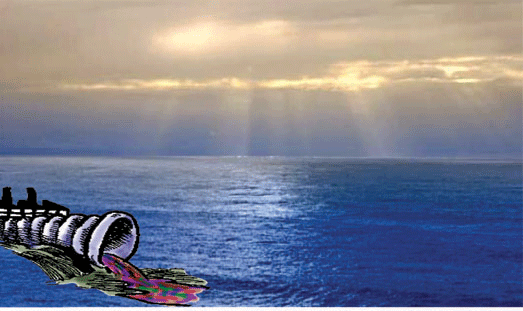 History of Bomb Strontium and Cesium Isotopes in Pacific Compared to Fukushima Sources http://www.dailykos.com/story/2014/01/16/1269942/-History-of-Bomb-Strontium-and-Cesium-Isotopes-in-Pacific-Compared-to-Fukushima-Sources# (EXCELLENT GRAPHS) by MarineChemist
The purpose of this diary is to compare the concentrations of Sr-90 and Cs-137 in the North Pacific Ocean over the last 50 years to the concentrations predicted to arrive on the west coast associated with waters affected by release of radionculides from the Fukushima-Daiichi Nuclear Power Plant. Given present levels that are being measured in the eastern Pacific and barring release rates that significantly exceed past rates in March-April 2011 the impact on marine organisms and the marine environment is going to be very minimal. What follows below the fold is a comparison of the concentrations measured and predicted over much of the Pacific owing to Fukushima to the concentrations that were present in the mid-1960s from the fallout of atmospheric weapons testing that is free from any discussion of safe doses or models of radiation exposure to organisms. Continue reading
1 This Month

of the week – Shut Down Drone Warfare!


Tell the Ukrainian Government to Drop Prosecution of Peace Activist Yurii Sheliazhenko

Petition to revoke the licensing of the Near Surface Nuclear Disposal Facility (NSDF) at Chalk River. https://www.ourcommons.ca/petitions/en/Petition/Details?Petition=e-7247
To see nuclear-related stories in greater depth and intensity – go to https://nuclearinformation.wordpress.com
-
Archives
- April 2026 (103)
- March 2026 (251)
- February 2026 (268)
- January 2026 (308)
- December 2025 (358)
- November 2025 (359)
- October 2025 (376)
- September 2025 (257)
- August 2025 (319)
- July 2025 (230)
- June 2025 (348)
- May 2025 (261)
-
Categories
- 1
- 1 NUCLEAR ISSUES
- business and costs
- climate change
- culture and arts
- ENERGY
- environment
- health
- history
- indigenous issues
- Legal
- marketing of nuclear
- media
- opposition to nuclear
- PERSONAL STORIES
- politics
- politics international
- Religion and ethics
- safety
- secrets,lies and civil liberties
- spinbuster
- technology
- Uranium
- wastes
- weapons and war
- Women
- 2 WORLD
- ACTION
- AFRICA
- Atrocities
- AUSTRALIA
- Christina's notes
- Christina's themes
- culture and arts
- Events
- Fuk 2022
- Fuk 2023
- Fukushima 2017
- Fukushima 2018
- fukushima 2019
- Fukushima 2020
- Fukushima 2021
- general
- global warming
- Humour (God we need it)
- Nuclear
- RARE EARTHS
- Reference
- resources – print
- Resources -audiovicual
- Weekly Newsletter
- World
- World Nuclear
- YouTube
-
RSS
Entries RSS
Comments RSS
 nuclear-news