The next step in do-it-yourself radiation monitoring https://thebulletin.org/2020/04/the-next-step-in-do-it-yourself-radiation-monitoring/#
By Dahyun Kang, April 28, 2020 Watching the HBO drama Chernobyl about the nuclear disaster that occurred in April 1986 gave me a whole new perspective on how destructive radioactive particles can be. One scene depicted local men and women fearfully looking toward the nuclear site, a dim red glow against the night sky. Highly radioactive cesium-137-contaminated dust fell like snow on children running in the streets. Plant workers and firefighters died gruesomely after exposure to acute radiation doses unleashed by the debris that exploded from the nuclear reactor. No one knew what to do because Soviet bureaucrats delayed accident announcements and evacuation orders.
The lack of information about radiation levels meant that people were exposed to radiation for a longer duration than if they had received timely warnings. The Chernobyl drama not only helped me realize the disastrous consequences and hazards of radiation, but also inspired me to create a radiation estimator that could provide estimations of environmental radiation levels in places where there are no stationed detectors.
A focus on Fukushima. To develop my estimator, I focused on the Fukushima region in Japan. I chose this area because of the nuclear disaster there in March 2011, when three nuclear power plant cores melted down and released radionuclides into the atmosphere. The Japanese government chose this region to hold a couple of events that are part of the 2020 Tokyo Summer Olympics and Paralympics, branded as the “Reconstruction Olympics.”
The environmental group Greenpeace has raised concerns about whether people attending these Olympic events—which have now been postponed until 2021—could be exposed to lingering radiation. In a report published last month, Greenpeace claimed measurements taken by a survey team detected radioactive hotspots at the Fukushima Azuma Baseball Stadium near Fukushima City, in the area around the city’s central station, and at the J-Village sports complex where the Olympic torch relay will start. According to Greenpeace, the highest measurement at J-Village on October 26, 2019, was 71 microsieverts per hour close to the ground, a reading more than 1,750 times higher than pre-2011 background levels. The forested mountains covering roughly 70 percent of the Fukushima prefecture cannot be decontaminated and therefore pose a recontamination risk to areas when heavy rainfall or typhoons mobilize radionuclides, which Greenpeace says happened during two intense typhoons in 2019.
Japan’s Shinzo Abe administration plans to host the Olympics baseball and softball games at the Azuma stadium, approximately 80 kilometers from the Fukushima Daiichi nuclear power plant site where the nuclear accident occurred. J-Village, where the torch relay will begin, is located about 20 kilometers south of Fukushima Daiichi.
How I built my radiation estimator. The nonprofit organization Safecast, which collects radiation readings taken by volunteers and makes them publicly available at no charge, provides data for a number of locations worldwide—particularly in Japan, where the monitoring network began as a response to the Fukushima disaster. Using the Safecast website, I collected data from the Fukushima prefecture. With the help of mathematical software called Mathematica, I then developed a mathematical equation that takes the Safecast Fukushima data and provides estimates of radiation values at any other location in Fukushima. With the help of a relative who works as a coding programmer, I also created a Radiation Estimation website that uses the mathematical equation to estimate radiation values, in microsieverts per hour, for any latitude and longitude entered by a user.
For example, if the user enters the latitude and longitude of the Azuma stadium, the equation gives an estimate of 0.103 microsieverts per hour. According to the International Commission on Radiological Protection, anything less than 0.23 microsieverts per hour is considered a safe dose, based on the recommended public dose limit of 1 millisievert per year (1 millisievert is equivalent to 1,000 microsieverts).
Future efforts. Currently, my radiation estimator inevitably contains some degree of uncertainty due to limited available data from the Fukushima prefecture, which covers about 13,700 square kilometers. The estimates would be more precise and could be applied beyond Fukushima if there were more disclosed data available to reference.
What about the radiation levels in my own city and others in the United States? Unfortunately, I was unable to find enough open radiation data available to make a good estimate. The US Environmental Protection Agency runs a nationwide environmental radiation monitoring system, RadNet, which has 140 radiation air monitors spread across 50 states, mostly in the heart of big cities. Although these monitors run 24/7, collecting near-real-time measurements of gamma radiation, the number and locations of the monitors are inadequate to cover all of the United States.
There are 96 US nuclear power reactors in operation. Who can assure the American public that no nuclear catastrophe on the scale of Chernobyl or Fukushima will occur in the United States? It is natural for the public to be worried and to insist that the US government install more radiation monitors near reactors and the surrounding populated areas to protect the public. Information collected by the monitors should also be disclosed to the public.
Once sufficient environmental radiation data are available, my radiation estimator would be applicable in my own city and others in America as well. I hope to raise awareness of environmental radiation and offer people information about what kind of environment they are living in. Since my radiation estimator is only a first step in that direction, I hope that someone with more expertise can build upon my idea to create a more precise tool that provides information about environmental radiation anywhere on the globe.
April 30, 2020
Posted by Christina Macpherson |
radiation, USA |
Leave a comment
 Occupational Radiation Exposure: Serious Risks and Safety Solutions, https://www.diagnosticimaging.com/patient-safety/occupational-radiation-exposure-serious-risks-and-safety-solutions Mina S. Makary, MDNicholas Mannix, BS-April 6, 2020, Patient Safety, DI Executive
While the radiation doses utilized in image-guided procedures are generally considered low, recent studies have demonstrated significant effects of chronic low-dose radiation exposure to the procedural staff. Recent work demonstrated an alarming incidence of brain cancer, higher incidence of skin, thyroid, breast cancers and melanomas, higher incidence of stroke and atherosclerotic disease, increased risk of developing cataracts, decreased memory and verbal fluency, and a higher frequency of chromosomal abnormalities in those who performed fluoroscopically-guided interventional procedures compared to control groups.
The deleterious effects of radiation exposure are not only related to dose thresholds of specific exposures, but they are also a function of the cumulative doses over one’s lifetime exposure. These risks prompt increased awareness and education, improved radiation protection techniques, and further research efforts.
Robust radiation safety and risk reduction approaches are multi-faceted. It goes without saying that the ALRA (as low as reasonably achievable) principle is the cornerstone guiding rule. This means using intermittent fluoroscopy whenever possible, minimizing the pulse rate for standard fluoroscopy, minimizing the frame rate for digital angiography/digital subtraction angiography, collimating and avoiding magnification if feasible, and utilizing the “last image hold” function rather than obtaining new unwarranted images.
Next, capitalizing upon the nature and distribution of scatter radiation, which is the primary source of occupational exposure, further reduces one’s dose. This translates to stepping back as far as possible from the radiation source and angulating the tube towards the operator when oblique views are desired to avoid back scatter. Furthermore, utilizing shielding is the third effective strategy, and this approach includes personal aprons, caps, thyroid shields, eyewear, table shields, mounted side shields, and patient drape shields. Lastly, monitoring of the amount of radiation utilized, staff doses, and patient exposure rates utilizing personal dosimeter and equipment data is key to addressing any significant doses that were delivered.
In addition to protecting the procedural team, good radiation safety habits are good patient care. Minimizing fluoroscopy time and overall dose as reasonably achievable reduces patient exposure. Interestingly, techniques, such as collimation, actually improve image contrast and quality in addition to reducing the dose – an ultimate win-win situation. With the growth of both diagnostic imaging and imaging-guided procedures that require ionizing radiation, patient exposures have significantly increased at an alarming rate over the past three decades, and it is estimated that medical imaging contributed to 48 percent of the public’s radiation exposure in 2006 compared to only 15 percent in the 1980s.
For patients, the most concerning effects are due to direct radiation beam exposure, such as radiation skin burns, but rarer risks may potentially include cataracts and sterility. In addition to the previously discussed occupational radiation reduction techniques, additional approaches to reduce patient dose include using non-ionizing radiation for procedural guidance, such as ultrasound and MRI, as much as possible, maximizing pre-procedural imaging for planning to minimize procedural time, and avoiding unnecessary procedures.
Occupational radiation safety is critical for many reasons. It protects our proceduralists and staff, as well as our patients while also ensuring the patient receives the best care possible. Challenges, such as hardware costs, buy-in of institutional stakeholders, staff training, the heavy weight of shielding, and time to setup do exist, but education and awareness of the significant health risks, the benefits of appropriate protection, good habits, a culture of safety, and research efforts can overcome any barriers. The risks are real. The benefits are real. Radiation safety is both an occupational safety issue, as well as a patient care issue. It is not a luxury, and chronic low-dose radiation does matter. The time is now to prioritize radiation safety in our daily practice.
Mina Makary, M.D., is an interventional radiologist at Ohio State University Wexner Medical Center. He also serves on the Diagnostic Imaging Editorial Board. This article was co-written wth Nicholas Mannix, BS, a medical student at The Ohio State University College of Medicine.
April 21, 2020
Posted by Christina Macpherson |
radiation |
Leave a comment
 Nuclear sandbags too hot to handle, https://www.theaustralian.com.au/world/the-times/nuclear-sandbags-too-hot-to-handle/news-story/87b811443cb8e2881f55e17108872880 By RICHARD LLOYD PARRY, THE TIMES. APRIL 1, 2020
Japanese engineers trying to dismantle the melted reactors at the Fukushima Daiichi nuclear power plant face a new hazard — radioactive sandbags so deadly that standing next to them for a few minutes could be fatal.
The sandbags were intended to make life easier for the teams dealing with the aftermath of the nuclear disaster in 2011 when three reactors melted after a tsunami destroyed their cooling systems. Twenty-six tonnes of the bags were placed in basements beneath two of the reactors to absorb radioactivity from waste water.
They were stuffed with zeolite, minerals that can absorb caesium. Nine years after the disaster, the submerged sandbags have sucked up so much radiation that they now represent a deadly danger themselves.
Samples of zeolite removed from the bags contain caesium, producing huge amounts of radiation, while the sandbags are giving off up to four sieverts of radiation an hour. Fifteen minutes of exposure to this could cause haemorrhaging. After an hour, half of those exposed would eventually die as a result. The maximum lifetime recommended dose of radiation for humans is less than half a sievert.
Tokyo Electric Power Co (Tepco), which operates the plant, had intended to remove the contaminated water by the end of 2020. The complication caused by the sand means it will take three years longer, the latest delay to the decommissioning.
Tepco managers have admitted that the technology needed to finish the job does not exist and they do not have a full idea of how it will be achieved. Their stated goal of decommissioning by 2051 may be impossible, they said.
One of the biggest problems is the 170 tonnes of irradiated water coming out of the plant every day, much of it natural ground water that flows through the earth towards the sea, picking up radiation on the way. Tepco pumps it out and stores it in huge storage tanks, filtered of some, but not all, of its contaminants — 1.17 million tonnes so far. In two years, the storage space will run out.
The government wants to pour the water away, insisting that the diluting effect of the Pacific will render the radiation harmless, but it is opposed by North and South Korea and the local fishing industry, whose reputation has been ruined by the disaster.
April 2, 2020
Posted by Christina Macpherson |
Fukushima continuing, radiation, Reference |
Leave a comment
|
 LANL Plans to Release Twice the Amount of Tritium Allowed http://nuclearactive.org/ March 26th, 2020 The Department of Energy (DOE) and its contractor at Los Alamos National Laboratory (LANL) plan to vent radioactive tritium into the air in an amount twice the federal standard of 10 millirems a year. LANL estimates a possible offsite dose to the public of 20.2 he Department of Energy (DOE) and its contractor at Los Alamos National Laboratory (LANL) plan to vent radioactive tritium into the air in an amount twice the federal standard of 10 millirems a year. LANL estimates a possible offsite dose to the public of 20.2 LANL Plans to Release Twice the Amount of Tritium Allowed http://nuclearactive.org/ March 26th, 2020 The Department of Energy (DOE) and its contractor at Los Alamos National Laboratory (LANL) plan to vent radioactive tritium into the air in an amount twice the federal standard of 10 millirems a year. LANL estimates a possible offsite dose to the public of 20.2 he Department of Energy (DOE) and its contractor at Los Alamos National Laboratory (LANL) plan to vent radioactive tritium into the air in an amount twice the federal standard of 10 millirems a year. LANL estimates a possible offsite dose to the public of 20.2
In 2019, the federal Environmental Protection Agency (EPA) approved a 2018 LANL plan under the Clean Air Act. This month, the New Mexico Environment Department approved the plan under the state’s Hazardous Waste Act because there are lead tools present in the containers. But there are inconsistencies between the two plans.
For instance, the earlier Clean Air Act plan proposed using “getters” to capture a portion of the vented tritium before it is released through an open door in the prefabricated shed. The later plan deleted the use of a “getter bed” and replaced it with an unnamed air emissions control system. Nevertheless, the Hazardous Waste Act plan states the gases will pass through a molecular sieve bed and through a metering value before release. https://permalink.lanl.gov/object/tr?what=info:lanl-repo/eprr/ESHID-603412
New Mexicans are concerned about the proposed venting. Tritium is radioactive hydrogen and is highly mobile moving from air to water and back. It can cross the placenta and affect a developing fetus. The 10 millirem standard is based on a 154-pound, five feet 6 inch, Anglo “reference man,” between the ages of 20 to 30, who consumes a European diet.
Beata Tsosie, a Community Doula and Gardener, from Santa Clara Pueblo, said, “As a Pueblo woman living downwind and downstream from Los Alamos nuclear weapons production, I am very concerned about the lab’s intentions to go forward with releasing radioactive tritium vapor into our air, land, waters, and ecosystems. During mid April is when our land-based community is outdoors for longer periods of time preparing their fields and gardens for planting. What will it mean to also have cumulative exposure when we consume these crops? There are also increased exposures due to active foraging of wild plants, gathering of clays, fishing, hunting, and ceremony.
“Our children are also outdoors for longer periods of time due to the school shutdown for COVID-19, which is scheduled to go on indefinitely. I watch my son playing in his backyard, making his own gardens, running, getting out of breath and breathing deeply the air that I need to know is safe for him to be exposed to. We live 20 minutes away from these planned releases, and now in addition to an already stressful self-quarantine I need to worry about my family being outside enjoying their birthright.
“It is my understanding that in the documents submitted to the EPA and NMED in 2018, there is no inclusion of alternatives to these releases. There should not be a rush to put our communities in harms way when all solutions have not even been discussed. I know that the federal standards for tritium exposure are not protective of land-based people of color, or pregnant families and infants who are more vulnerable to radioactive toxicity. Tritium can cross placental boundaries. These standards of exposure are still based on an obsolete model of an adult, white male of European descent and custom.
There must be an informed public process that prioritizes protecting those most vulnerable. I do not consent to these toxic releases in my ancestral homelands; it is the continuation of nuclear colonialism and violence on Indigenous lands and bodies and a sorrowful history of environmental racism in our sacred Jemez Plateau. I call on all of our Congressional delegation, EPA and NMED directors to put an immediate halt and suspension to these planned tritium releases and increase in LANL production. Our communities deserve reprieve, health, calm, and wellness in these challenging times.”
Given the cumulative health consequences from the proposed venting, organizations and individuals are requesting the Environment Department hold a public comment period and a public hearing.
|
|
March 28, 2020
Posted by Christina Macpherson |
environment, radiation, USA |
Leave a comment
tests for statistical significance have been misused in epidemiological studies on cancers near nuclear facilities. These in the past have often concluded that such effects do not occur or they downplayed any effects which did occur. In fact, copious evidence exists throughout the world – over 60 studies – of raised cancer levels near NPPs.
Most (>75%) of these studies found cancer increases but because they were small, their findings were often dismissed as not statistically significant. In other words, they were chucked in the bin marked “not significant” without further consideration.
Just as people were misled about tobacco smoking in previous decades, perhaps we are being misled about raised cancers near NPPs nowadays.
The Hazards of Tritium, Dr Ian Fairlie, March 13, 2020
Summary
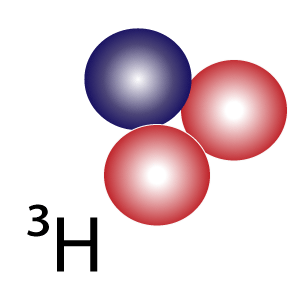
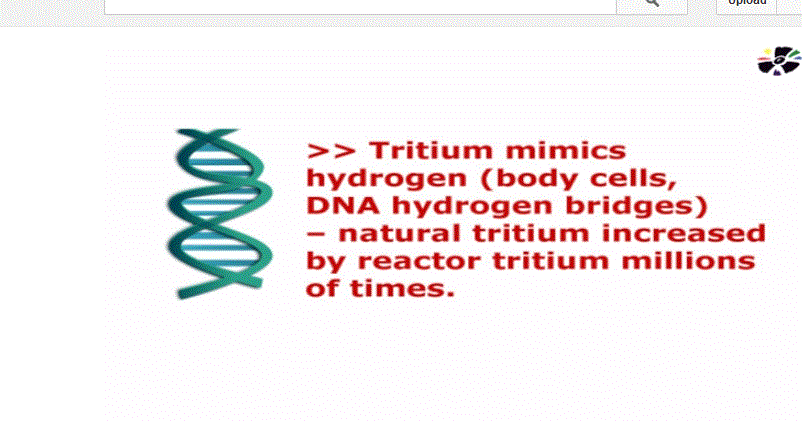
Nuclear facilities emit very large amounts of tritium, 3H, the radioactive isotope of hydrogen. Much evidence from cell/animal studies and radiation biology theory indicates that tritium is more hazardous than gamma rays and most X-rays. However the International Commission on Radiological Protection (ICRP) continues to underestimate tritium’s hazard by recommending a radiation weighting factor (wR) of unity for tritium’s beta particle emissions. Tritium’s exceptionally high molecular exchange rate with hydrogen atoms on adjacent molecules makes it extremely mobile in the environment. This plus the fact that the most common form of tritium is water, ie radioactive water, means that, when tritium is emitted from nuclear facilities, it rapidly contaminates all biota in adjacent areas. Tritium binds with organic matter to form organically bound tritium (OBT) with long residence times in tissues and organs making it more radiotoxic than tritiated water (HTO). Epidemiology studies indicate increases in cancers and congenital malformations near nuclear facilities. It is recommended that nuclear operators and scientists should be properly informed about tritium’s hazards; that tritium’s safety factors should be strengthened; and that a hazard scheme for common radionuclides be established. Continue reading →
March 19, 2020
Posted by Christina Macpherson |
radiation, Reference, secrets,lies and civil liberties, spinbuster |
Leave a comment
 The Hazards of Tritium,https://www.ianfairlie.org/news/the-hazards-of-tritium/ , Dr Ian Fairlie, March 13, 2020 “……….Epidemiological Evidence of Risks Because of methodological limitations, epidemiology studies are a blunt tool for discovering whether adverse effects result from radiation exposures. These limitations include:
- under-ascertainment, …
- strict data requirements….
- confounding factors: the true causes of morbidity or mortality can be uncertain due to confounding factors such as socio-economic status and competing causes of death.
- bias: ……
- poor signal to noise…..
- uncertain doses:……
- wide confidence intervals……
Many epidemiology studies are ecologic studies, that is, quick inexpensive studies which look at health statistics in tables and notate individual data. Their findings are usually regarded as indicative, but not conclusive. If their findings suggest an adverse effect then these should be investigated further by more detailed cohort or case-control studies. The latter match “cases” (i.e. those with an adverse health effect) with randomly-selected similar individuals without an adverse effect, in order to minimise under-ascertainment. However few of these are actually carried out because of their expense and long time-spans. Sometimes they are not carried out for political reasons because findings of increased cancers are not welcome.
A disconcerting finding is that a substantial number of epi studies near NPPs conclude there are no findings of ill health even though positive increases were in fact observed. That is, the researchers were unable to accept the evidence of their own work. It is difficult to comment on this cognitive dissonance (few studies seem to exist on this phenomenon) but it is apparently often due to unacknowledged biases or to group-think re the impossibility for ill-health effects to exist near nuclear facilities. In their conclusions, such authors have discounted their findings using a variety of reasons ………
However there is a serious problem here. If similarly increased health effects had been observed near, say, a lead smelting factory or an asbestos mine, would they be dismissed by referring to these rationales? I rather doubt it. In other words, what is occurring here is that hidden biases in favour of nuclear power are in play. In my view, such conflicts of bias should be declared at the outset just as conflicts of interest are nowadays.
The Abuse of Statistical Significance Tests
Many epi studies of cancer near NPPs have found increased risks but dismissed them as not “statistically significant”. This wording often misleads lay readers into thinking that a reported increase is unimportant or irrelevant. But, in statistics, the adjective “significant” is a specialist word used to convey a narrow meaning, ie that the likelihood of an observation being a fluke is less than 5% (assuming a p = 5% test were used). It does not mean important or relevant.
Also this phrase is usually employed without explaining that the chosen significance level is quite arbitrary. There is no scientific justification for using a 5% level or any other test level: it is merely a matter of convenience. In other words, it is quite possible for results which are “not significant” when a 5% test is applied, could become “significant” when a 10% or other test level were used.
The existence of this practice has historical parallels. In the 1950s, dozens of health studies financed by tobacco companies acted to sow seeds of doubt about the health effects of cigarette smoking for many years.
Continue reading →
March 19, 2020
Posted by Christina Macpherson |
radiation, Reference, secrets,lies and civil liberties, spinbuster |
Leave a comment
Ian Fairlie 13th March 2020, The Nuclear facilities emit very large amounts of tritium, 3H, the radioactive isotope of hydrogen. Much evidence from cell/animal studies and radiation biology theory indicates that tritium is more hazardous than gamma rays and most X-rays.
However the International Commission on Radiological Protection (ICRP) continues to underestimate tritium’s hazard by recommending a radiation weighting factor (wR) of unity for
tritium’s beta particle emissions. Tritium’s exceptionally high molecular exchange rate with hydrogen atoms on adjacent molecules makes it extremely mobile in the environment.
This plus the fact that the most common form of tritium is water, i.e. radioactive water, means that, when tritium is emitted from nuclear facilities, it rapidly contaminates all biota in adjacent areas. Tritium binds with organic matter to form organically bound tritium (OBT) with long residence times in tissues and organs making it more radiotoxic than tritiated water (HTO).
Epidemiology studies indicate increases in cancers and congenital malformations near
nuclear facilities. It is recommended that nuclear operators and scientists should be properly informed about tritium’s hazards; that tritium’s safety factors should be strengthened; and that a hazard scheme for common radionuclides be established.
https://www.ianfairlie.org/news/the-hazards-of-tritium/
March 16, 2020
Posted by Christina Macpherson |
2 WORLD, radiation, Reference |
Leave a comment
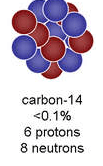
When Linus Pauling accepted the 1962 Nobel Peace Prize for his campaigning against hydrogen bombs, he said that carbon 14 “deserves our special concern” because it “shows the extent to which the earth is being changed by the tests of nuclear weapons.”
If people’s teeth have a very low level of radiocarbon, it means that they were born well before Castle Bravo. [thermonuclear atom bomb test] People born in the early 1960s have high levels of radiocarbon in their molars, which develop early, and lower levels in their wisdom teeth, which grow years later. By matching each tooth in a jaw to the bomb curve, forensic scientists can estimate the age of a skeleton to within one or two years.
Even after childhood, bomb radiocarbon chronicles the history of our body.
 Your Inner H-Bomb Nuclear testing left a signature of radioactive carbon all around the world—in trees and sharks, in oceans and human bodies. Even as that signal disappears, it’s revealing new secrets to scientists. The Atlantic, Story by Carl Zimmer, 2 Mar 20,
 “…… Among the isotopes created by a thermonuclear blast is a rare, radioactive version of carbon, called carbon 14. Castle Bravo and the hydrogen-bomb tests that followed it created vast amounts of carbon 14, which have endured ever since. A little of this carbon 14 made its way into Clark’s body, into his blood, his fat, his gut, and his muscles. Clark carried a signature of the nuclear weapons he tested to his grave.
I can state this with confidence, even though I did not carry out an autopsy on Clark. I know this because the carbon 14 produced by hydrogen bombs spread over the entire world. It worked itself into the atmosphere, the oceans, and practically every living thing. As it spread, it exposed secrets. It can reveal when we were born. It tracks hidden changes to our hearts and brains. It lights up the cryptic channels that join the entire biosphere into a single network of chemical flux. This man-made burst of carbon 14 has been such a revelation that scientists refer to it as “the bomb spike.” Only now is the bomb spike close to disappearing, but as it vanishes, scientists have found a new use for it: to track global warming, the next self-inflicted threat to our survival. …….
Continue reading →
March 3, 2020
Posted by Christina Macpherson |
ANTARCTICA, environment, radiation, Reference, weapons and war |
Leave a comment
|
What happened inside the Georgia Nuclear Aircraft Lab? Finding the facts in the forest with Dr. James Mahaffey Jessica Taylor Dawson News jtaylor@dawsonnews.com Feb. 19, 2020,
Over half a century later, rumors still swirl around Dawson Forest and the mysterious remnants of Dawson County’s past in the Cold War.
Though the Georgia Nuclear Aircraft Facility has been out of commission for nearly 50 years, local residents can still be heard whispering about two-headed deer and oak leaves the size of elephant ears spotted around the nuclear facility’s remains.
For nuclear engineer and author, Dr. James Mahaffey, the task of unraveling the history behind Dawson County’s top-secret nuclear test site and separating facts from the fiction has led to decades of research and hard work. ………
On paper, it seemed feasible as an incredible amount of power could be housed in a very small space, however the findings from the Dawsonville laboratory proved that nuclear aircraft would take more than what was originally thought.
“Any nuclear reactor on this earth has shielding,” Mahaffey explained. “It’s got lead, concrete, steel, you know, heavy things to keep it from killing everybody, but you put it in an airplane and you can’t have concrete and steel and lead. It’s got to be naked.”
Components for nuclear-powered engines were assembled in a facility in Idaho then brought to Dawsonville for testing inside the reactor. In Mahaffey’s research, he discovered that the facility found that rubber tires either melted or turned to rock when exposed to different radiation. Hydraulic fluids turned into a tacky substance akin to chewing gum. Transistors in the radio system were immediately killed by radiation.
The other aspect of the Dawsonville facility was testing the effects of radiation on the environment and living creatures.
“What does flying over a farm with a nuclear aircraft do to the farm? Well, it kills everything on the ground. It kills trees, grass, crops, insects, birds, anything. It might even kill the farmer if he’s out looking at it so what are you going to do about that? And also, what happens when one of these things crashes,” Mahaffey said. “If a jet plane crashes you clean it up and you pay the people for the house that it destroyed and all that, but what if it’s a nuclear aircraft? Nuclear aircraft – when it crashes – it makes a five mile radius area contaminated with long lasting radionuclides and you have to fence it off so nobody can go there. Are you really willing to have that as part of your Air Force operations?”
The effects of radiation were tested through controlled experimentation but also through observation of what Mahaffey describes as “instant taxidermy” of animals caught inside the kill zone around the outside of the operational reactor.
“Any animal like a toad frog that happened to be hopping around on the ground when the reactor was turned on, he died and interestingly it also killed all the bacteria in and around the frog,” Mahaffey said.
“When those [bacteria] die, it doesn’t deteriorate so you have this dead frog that you can put on your mantle and it’ll just stay there.”
According to Mahaffey, the scientists conducted many experiments with animals including releasing rats and studying the effects of radiation on them.
“I heard a rumor that the largest animal they ever irradiated was a mule and the mule died of course, and like a toad frog it would not deteriorate in a normal way,” Mahaffey said.
Billions of dollars were poured into the Nuclear Aircraft Project that GNAL was part of during the 1960s, but funding was cut in the John F. Kennedy administration. The GNAL was closed in pieces and shut its completely in 1971.
The GNAL buildings inside Dawson Forest were dismantled and hauled away. The hot cell building, the only remaining structure still standing, was boarded up with stainless steel to keep intruders from entering the radioactive building. To this day, the building remains radioactive with particulates of Cobalt 60. ……
What makes Dawsonville’s secret nuclear facility stand out from other nuclear facilities for Mahaffey is the very detailed extent to which they dug into the dangers of nuclear fission products.
“An enormous amount of work was done to find out how having this reactor affects the environment. I’ll give them that,” Mahaffey said. “They wanted to find out how groundwater would transport radiation and they dug wells all over the facility, and they would have monitors monitoring what type of radiation, how much radiation and knew how fast radiation could transport in the environment.”
Great care went into studying radiation in the Etowah River including the construction of rafts to track and map the flow of radiation as well as the atmospheric effects of radiation.
“This was all unknown,” Mahaffey said. “You have to build a facility that’ll test it in real ways, not just computer simulations and it has to be somewhere where you’re not potentially going to wipe out a city.” https://www.dawsonnews.com/local/what-happened-inside-georgia-nuclear-aircraft-lab-finding-facts-forest-dr-james-mahaffey/
|
|
February 20, 2020
Posted by Christina Macpherson |
environment, radiation, Reference, secrets,lies and civil liberties, USA |
Leave a comment

 Belsat 12th Feb 2020
, A sensor of the Russian state enterprise Radon, which specializes in handling radioactive waste, has recorded a 60-fold excess of the radiation background at the construction site of the South-East Chord (multi-lane expressway) in Moscow, the Russian service of Radio Liberty reports.
The sensor recorded 18 microsieverts per hour at a maximum permissible
radiation level of 0.3 microsieverts. Residents of the
Moskvorechye-Saburovo district report that this is the seventh time in
three days, but neither Radon nor the MES have taken any action, claiming
that the sensor works in test mode and there are no actual spikes in
radiation.
Earlier, Moscow Mayor Sergei Sobyanin acknowledged the presence
of radioactive waste on the South-Eastern Chord route. The mayor`s office
said that “in the case of the construction of the chord, the city faced a
unique and exceptional problem — radioactive waste, which the Moscow
Polymetal Plant stored in its backyard in the 1950s and 1960s”. At the
same time, the City Hall called the discovered traces of radioactive
contamination “insignificant”.
https://belsat.eu/en/news/excess-radiation-level-recorded-in-moscow/
February 17, 2020
Posted by Christina Macpherson |
environment, radiation, Russia |
Leave a comment
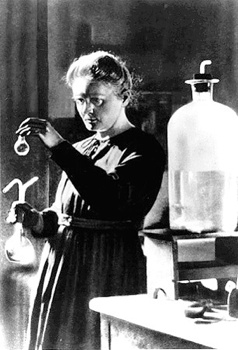
 John Wayne squares off against Jim Hansen, Medium, Albert Bates, 11 Jan 2020 “…….. In 1896, Henri Becquerel discovered that uranium emitted rays that resembled X-rays. Marie Curie suspected that the radiation was not the outcome of some interaction but came from the atom itself. Her work with uranium disproved the conventional wisdom going back to ancient Greece that atoms were indivisible and set up the later discovery of subatomic particles. Curie discovered that thorium, radium, polonium and radioactive bismuth occurred naturally with uranium. Radium was known to glow in the dark, which made it useful for painting the hour and minute hands on watches and clocks. It was later discovered that radium “radiated” more than just neutrons, but also protons and electrons, becoming another unstable element, radon, and that element radiated its subatomic particles to become others, polonium and bismuth, until those eventually became a stable element, lead. Indeed, the radium Curie discovered was the progeny of another unstable element, thorium, which was the progeny of yet another unstable element, uranium.
Madame Curie was a physicist, not a medical doctor, so she did not recognize the health effects of handling uranium, thorium, radium and the other radionuclides. Indeed, she suspected the effects would be beneficial. One of the papers she and her husband published in the late 19th century announced that, when exposed to radium, diseased, tumor-forming cells were destroyed faster than healthy cells (the basis for today’s radio-chemotherapy). She carried test tubes containing radioactive isotopes in her pockets and stored them in her desk drawer. Although her many decades of exposure to radiation caused chronic illnesses (including near-blindness due to cataracts) and ultimately her death, she never acknowledged the inherent health risks. She likely did not recognize the symptoms when she began to feel weak and lose her hair. She died in 1934 from aplastic anemia without ever knowing that she fought the same mortal enemy as those who had painted the hands on watches and clocks, or those who had mined and processed the uranium on which she worked. After her death, and to this day, her papers and effects are too radioactive to be handled and her laboratory is unsafe to enter.also……..https://medium.com/@albertbates/john-wayne-squares-off-against-jim-hansen-42a258b2260d
January 21, 2020
Posted by Christina Macpherson |
PERSONAL STORIES, radiation, Reference |
Leave a comment

Low doses of radiation used in medical imaging lead to mutations in cell cultures, https://www.sciencedaily.com/releases/2020/01/200116141731.htm–
Discovery that radiation creates breaks that allow in foreign DNA must be confirmed in animal studies January 16, 2020 Source: PLOS
- Summary:
- Common medical imaging procedures use low doses of radiation that are believed to be safe. A new study, however, finds that in human cell cultures, these doses create breaks that allow extra bits of DNA to integrate into the chromosome.
-
Common medical imaging procedures use low doses of radiation that are believed to be safe. A new study, however, finds that in human cell cultures, these doses create breaks that allow extra bits of DNA to integrate into the chromosome. Roland Kanaar and Alex Zelensky of Erasmus University Medical Center and Oncode Institute and colleagues report these new findings in a study published 16th January in PLOS Genetics.
Scientists have long known that exposing cells to high doses of ionizing radiation generates mutations by creating double-strand breaks that let in external segments of DNA. These extraneous fragments of DNA can occur in the nucleus, left over from natural processes, such as genomic DNA repair and viral infections. In the new study, researchers investigated whether low doses of ionizing radiation have damaging side effects by irradiating human and mouse cells grown in the lab. When they counted the cells that had taken up foreign DNA, they found that low doses of radiation, in the upper range of common diagnostic procedures, create mutations through inserted DNA even more efficiently than the much larger doses studied previously.
- While the new results in cell cultures are potentially concerning, the study’s authors stress that translating radiation’s effects on lab-grown cell cultures to effects in the body is premature. Future experiments using animal models will be necessary to determine the full effects of low-dose radiation, and whether its use in medical imaging has an impact on patient health. If the same phenomenon does occur inside the body, then doctors may need to take into account levels of extraneous DNA, such those resulting from a long-term viral infection, when assessing a patient’s risk from a procedure that requires radiation.
“Most molecular radiobiological research is focused on high doses of ionizing radiation relevant to cancer treatment, while effects of physiologically relevant doses of radiation on the cell are notoriously difficult to study at the molecular level,” said author Roland Kanaar. “Our discovery that mutagenic insertion of foreign DNA into cell’s genome is remarkably responsive to doses encountered during diagnostic, rather than therapeutic, procedures provides a new simple and sensitive tool to study their consequences and revealed surprising molecular genetic details of how cells cope with natural amounts of DNA damage.”
January 20, 2020
Posted by Christina Macpherson |
2 WORLD, radiation |
1 Comment
How Radiation Can Affect Brain Connections https://www.technologynetworks.com/neuroscience/news/how-radiation-can-affect-brain-connections-328547 Dec 17,| 2019 Original story from University of Rochester Medical Center, One of the potentially life-altering side effects that patients experience after cranial radiotherapy for brain cancer is cognitive impairment. Researchers now believe that they have pinpointed why this occurs and these findings could point the way for new therapies to protect the brain from the damage caused by radiation.
The new study – which appears in the journal Scientific Reports – shows that radiation exposure triggers an immune response in the brain that severs connections between nerve cells. While the immune system’s role in remodeling the complex network of links between neurons is normal in the healthy brain, radiation appears to send the process into overdrive, resulting in damage that could be responsible for the cognitive and memory problems that patients often face after radiotherapy. Continue reading →
|
December 28, 2019
Posted by Christina Macpherson |
radiation, Reference |
Leave a comment
 Nuclear Radiation Hot Spots Found At Starting Point Of Japan’s 2020 Olympic Torch Relay https://www.gizmodo.com.au/2019/12/nuclear-radiation-hot-spots-found-at-starting-point-of-japans-2020-olympic-torch-relay/, George Dvorsky, Dec 5, 2019, High levels of radiation have been detected near Japan’s J-Village, a sports facility and the starting point of the upcoming Olympic torch relay, according to Greenpeace. The discovery was made by surveyors with Greenpeace Japan, which warns that monitoring and decontamination efforts in Fukushima are inadequate.
Radiation levels as high as 71 microsieverts per hour were found on the surface near J-Village in northeastern Japan, according to a Greenpeace press release issued Wednesday. This level of radiation is hundreds of times greater than what’s stipulated in Japan’s decontamination guidelines, prompting Greenpeace Japan to demand that the Japanese government conduct regular radiation monitoring and decontamination of regions affected by the 2011 Fukushima nuclear disaster.
J-Village National Training Centre is in Fukushima prefecture, which is located 20 kilometres from the damaged nuclear power plant. This sports facility will be the starting point of the Tokyo 2020 Olympic Torch Relay, which is scheduled to begin on March 26, 2020. That J-Village was chosen as the starting point for the relay is by design, as the Japanese government is promoting the games as the “reconstruction Olympics.” The Olympics will begin on July 24, 2020 in Tokyo, some 239 kilometres from the damaged reactors.
|
J-Village recently underwent renovations, and the facility was used to host the Argentina team during the Rugby World Cup held just a few weeks ago, according to Reuters. And as the Guardian reports, the facility served as a “logistics hub” for crews working to manage and decommission the damaged reactors.
The readings were made over a two-hour period on October 26 by Greenpeace’s Nuclear Monitoring & Radiation Protection Advisors. High levels of radiation were detected along the boundary of the parking lot and a forest next to J-Village, reports Sankei Shimbun. Readings at ground level were as high as 71 microsieverts, which is 308.7 times more than the nationally accepted 0.23 microsieverts per hour—the standard for decontamination—and 1,775 times the level prior to the Fukushima disaster, according to Greenpeace. Continue reading →
|
December 5, 2019
Posted by Christina Macpherson |
Japan, radiation |
Leave a comment
DOES CHERNOBYL STILL MATTER? Public Books, BY GABRIELLE HECHT , 25 Nov 19, “……. The question is not whether an accident of Chernobyl’s gravity can happen elsewhere, but how to prepare for the consequences when it does.
 That’s one of the questions Kate Brown considers in Manual for Survival. Offering a wealth of new information and analysis, Brown speeds past the reactor explosion. Instead, she focuses on dozens of previously untold stories about how people coped with their newly radioactive lives.
Brown’s protagonists include women who worked at a wool factory fed by contaminated sheep and butchers ordered to grade meat according to radioactivity. Ukraine, we learn, kept serving as the Soviet breadbasket, despite food radiation levels that exceeded norms. The concentrations of radionuclides were biomagnified by receptive organisms and ecologies, such as mushrooms, wild boar, and the Pripyat Marshes. Defying expectations, some foods, over time, have even become more contaminated.
Brown’s descriptions add historical flesh to arguments first developed by Olga Kuchinskaya, in her 2014 book on Belarus’s Chernobyl experience, The Politics of Invisibility: Public Knowledge about Radiation Health Effects after Chernobyl.
Since the first studies of bomb survivors in Hiroshima and Nagasaki, science on the biological effects of radiation exposure has been subject to controversy. Like all scientific work, these early survivor studies had limitations. Exposure estimates were unreliable.
The largest study began data collection five years after the Hiroshima and Nagasaki blasts, so it didn’t include people who died or moved between 1945 and 1950. Another problem lies in the applicability of these studies. Bomb exposures, such as those in Japan, mostly consist of high, external doses from one big blast. Yet postwar exposures have mainly consisted of low doses, delivered steadily over a long period. They often involve internal exposures—such as inhalation of radioactive particles or consumption of irradiated food—which can be deadlier.
Irrespective of their limitations, however, the findings of these survivor studies have served as the basis for establishing regulatory limits for all types of radiation exposures. Critics argue that extrapolating from the Japan data underestimates low-dose effects: If you’ve already decided that the only possible health effects are the ones you’ve already found, surely you’re missing something? Among other limitations, studies of external gamma radiation exposures cannot illuminate the long-term health effects of inhaling radioactive alpha particles.
Brown injects the work of Dr. Angelina Gus’kova into this story. Gus’kova started treating radiation-induced illnesses in the 1950s, while working at the top-secret Mayak plutonium plant (where the radioactive spills from a 1957 accident continue to contaminate people, land, and water). A neurologist, Gus’kova made observations that extended beyond the narrow cancer focus of most Western practitioners who studied the health effects of radiation exposure. Her patients displayed a wide range of symptoms, which Gus’kova and her colleagues dubbed “chronic radiation syndrome.” Not that they neglected cancer: a 40-year study of 1.5 million people who lived near Mayak found significantly higher cancer and death rates than those reported in Hiroshima and Nagasaki.
The Soviet rubric of “chronic radiation syndrome” did not exist in the West. Yet Gus’kova’s findings did align with those of dissident scientists in the US and the UK. Thomas Mancuso, for example, was pushed out of the US Atomic Energy Commission because he refused to give the Hanford plutonium plant a clean bill of health after finding that workers there sustained high rates of cardiovascular disease, immune system damage, and other illnesses.
Alice Stewart, meanwhile, was shunned by the British establishment after her 1956 research showed that x-raying pregnant women increased the risk of cancer and leukemia in their children by 50 percent. Over the years, these and other scientists whose data challenged the findings of American and European nuclear establishments found themselves sidelined and defunded.
In tandem with perestroika, Chernobyl opened communication between Soviet and Western nuclear experts, engendering what Brown calls an “unholy alliance.” In 1990, the International Atomic Energy Agency (IAEA) sent a mission to Belarus and Ukraine to assess radiation damage. Belarusian scientists reported rising rates of many diseases in contaminated areas. Nevertheless, the IAEA team rejected radiation as a possible cause. Such correlations didn’t appear in Western data.
Instead, the IAEA teams used dose estimates provided by distant Moscow colleagues and ignored local Belarusian and Ukrainian descriptions of people’s actual consumption habits, which included significant amounts of contaminated food and milk. The IAEA assessments neglected the internal exposures resulting from this consumption. Yet these assessments now serve as international reference points. “Underestimating Chernobyl damage,” Brown warns, “has left humans unprepared for the next disaster.” …….
Brown is on the right track. Many modes of scientific inquiry aren’t equipped to address our most urgent questions. Clear causal chains are a laboratory ideal. The real world brims with confounding variables. Some scientists studying Chernobyl’s “exclusion zone”—the region officially declared uninhabitable due to contamination—are trying new techniques to grapple with this reality. Tim Mousseau and Anders Møller, for example, collect data on the zone in its ecological entirety, rather than focusing on single organisms. Their findings belie romantic tales of wildlife resurgence (such as the one offered up by a 2011 PBS special on the radioactive wolves of Chernobyl). They too have met resistance. …..
we can refuse to see Chernobyl and its kin as discrete events of limited duration. Brown, for example, treats Chernobyl as an acceleration of planetary-scale contamination that began with the atomic arms race.
Let’s be clear: the contamination continues. After the triple meltdown at Fukushima, scientists found highly radioactive, cesium-rich microparticles in Tokyo, 150 miles south of the accident site. When inhaled, such particles remain in human lungs, where their decay continues to release radioactivity for decades. Contaminants from future accidents will, in turn, accrete on the radioactive residues of their predecessors. https://www.publicbooks.org/does-chernobyl-still-matter/
November 26, 2019
Posted by Christina Macpherson |
2 WORLD, radiation, Reference |
Leave a comment









 nuclear-news