To help future generations, Fukushima mothers have become radiation scientists
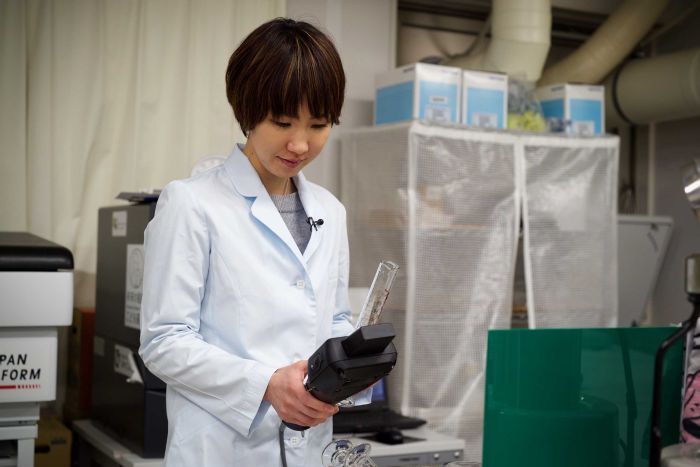
Fukushima mothers record radiation for future generations, Japan Times ,BY YUKA NAKAO, KYODO IWAKI, FUKUSHIMA PREF 10 Apr 20, . – A group of more than 10 mothers set up a citizen-led laboratory to monitor radiation levels in Fukushima communities only months after a massive earthquake and tsunami caused meltdowns at a nuclear power plant in the prefecture nine years ago.Since the foundation of the institute on Nov. 13, 2011, it has been recording and disclosing radiation data on foodstuffs and soil it collected or were brought in by people from different parts of the prefecture, as well as seawater off the Fukushima No. 1 nuclear power plant.
“If the risks of nuclear power had been thoroughly verified by the previous generations, I think the disaster would not have happened,” Kaori Suzuki, 54, an executive of Mothers’ Radiation Lab Fukushima, based in Iwaki, said in a recent interview.
“But since it did occur, what we must do now is record our measurements and changes in the environment so we won’t make the same mistake,” said Suzuki, one of the founding members. “Passing down something that will be useful when major decisions must be made is the only thing we can do.”
The laboratory of 18 staff members, many of them mothers who mostly had no prior experience in measuring radiation, have trained themselves with support from scientists, and they now gauge levels of cesium 134, cesium 137, tritium and strontium 90 with five types of machines.
Samples they have measured include dust in vacuum cleaners, vegetables grown in home gardens, seasonal mushrooms picked in mountains and soil gathered in parks.
They have occasionally detected radiation above safety levels, and reports the lab releases every month on its website have specified which machine is used and other details for each outcome to make their activities as transparent as possible.
Their efforts have made academic contributions as well, with their measuring methods and results published in scientific journals such as Applied Radiation and Isotopes in 2016.
Suzuki said they started the initiative out of desperation to protect their children.
“We had to measure and eat. It was a matter of life and death,” the mother of two said. ….
As time goes by, Tanaka has found that fewer people are discussing radiation effects.
The number of samples brought in by citizens last year was 1,573, up 131 from the year before, but it is showing a decreasing trend overall compared to years before, according to the lab.
“The Olympic Games are coming, and there are fewer media reports on radiation levels than before,” she said.
Officials have dubbed the Tokyo Summer Games the “Reconstruction Olympics,” with the hope of showcasing the country’s recovery from the 2011 catastrophe.
Because of that concept, the starting point of the Japan leg of the torch relay for the Olympics, which were recently put off for a year to the summer of 2021 due to the global coronavirus pandemic, was a soccer training center in Fukushima Prefecture that served as a front-line base in the battle against the nuclear disaster.
Tanaka said logging accurate data and keeping them publicly available are all the more important. “To protect children, having information is essential in deciding what to eat or where to go,” she said, adding that judgments based on correct data will also prevent any discrimination…….
Kimura said she feels that the fears people have toward the new coronavirus are similar to those toward radiation, as they are both invisible.
“Everyone forgets about (radiation) because its effects in 10 or 20 years are uncertain, unlike the new coronavirus that shows pneumonia-like symptoms in a couple of weeks,” she said. “I realized again that people in affected areas like us have been living every day with the same feelings toward the coronavirus pandemic.”
“It’s exhausting,” she said, adding her daughters must have had a hard time as she made them do things differently from their friends, such as wearing masks. “But I felt I was not wrong when my daughter said to me recently, ‘I was being protected by you, mom.’”
In addition to conducting surveys on radiation readings in the environment and food items, the lab in May 2017 opened a clinic with a full-time doctor to provide free medical checkups on internal exposure.
“I think it’s necessary to keep checking children’s health as they grow up, rather than drawing a conclusion saying there won’t be any problem with this level of radiation exposure,” said Misao Fujita, 58, a doctor who is a native of Tochigi Prefecture.
Fujita said the amount of radiation exposure dosage and risks of health damage differ among children even if they live in the same area, depending on such factors as their location and behavior in the days after the nuclear disaster, whether they evacuated and what they eat now.
Those who underwent Fujita’s medical checkups when they were children include a woman who now takes her own child to the clinic, in addition to a number of young decontamination workers.
“The nuclear disaster is something that’s carried on to coming generations. That’s what we have left,” Fujita said. “We must also not forget that about 30,000 people are still unable to return to their hometowns in the prefecture. The disaster isn’t over yet.” https://www.japantimes.co.jp/news/2020/04/10/national/social-issues/fukushima-mothers-record-radiation/#.XpESi_gzbIU
Call to stop construction at Hinkley C nuclear project, due to coronavirus risk
Allan Jeffrey of Stop Hinkley talks to the Extinction Rebellion Radio Show. Rebel Radio 7th April 2020
https://www.mixcloud.com/XR_RebelRadio/rebel-despatches-hinkley-point-07042020/
BBC Points West 8th April 2020, Bus drivers carrying workers to Hinkley Point C construction site are
worried their lives are being put at risk. Every day a fleet of vehicles drops of and picks up hundreds of staff. The bus company says its putting in screens to protect the drivers, but work hasn’t been complete yet.
Bus drivers are calling for construction to stop. For the safety of everybody it makes more sense to close the site down. They are showing no regard for human life and potentially putting everyone in a situation where people
could die. Drivers are expressing their concern on social media and sending pictures which seems to show lack of social distancing. There are concerns too about the movement of workers who come from outside the area.
https://www.bbc.co.uk/iplayer/episode/m000h59p/points-west-late-news-08042020
Gamma radiation found ineffective in sterilizing N95 masks
Gamma radiation found ineffective in sterilizing N95 masks
Nuclear scientists and biomedical researchers team up to investigate whether treatment with gamma radiation could make N95 masks more reusable. MIT News, Leda Zimmerman | Department of Nuclear Science and Engineering, April 10, 2020“………….“The sterilized masks lost two-thirds of their filtering efficiency, essentially turning N95 into N30 masks,” says Cramer. But why the deterioration?
“Our hypothesis is that ionizing radiation of whatever kind likely decharges the electrostatic filtration of the mask,” says Gupta. “The mechanical filtration of gauze can trap some particles, but radiation interferes with the electrostatic filter’s ability to repel or capture particles of 0.3 microns.”……” http://news.mit.edu/2020/gamma-radiation-found-ineffective-in-sterilizing-n95-masks-0410
Refuelling continues at Limerick nuclear plant, but three more workers test positive for Covid19
 More Limerick nuclear plant workers test positive for coronavirus; refueling to continue More Limerick nuclear plant workers test positive for coronavirus; refueling to continue
by Andrew Maykuth, Philadelphia Inquirer, April 8, 2020 Exelon Generation said Wednesday that three nuclear plant workers have now been diagnosed with COVID-19 since it took the Limerick Generating Station out of service for refueling on March 27 — two since Friday — but the giant power plant is still on track to complete its maintenance turnaround early next week.
Of more than 1,000 workers involved with the refueling outage at Limerick’s Unit 1 reactor, 44 were quarantined because they may have come into contact with one of the infected workers or with infected people outside the plant, the company said in a statement Wednesday. About 23 of the quarantined workers show symptoms, said Val Arkoosh, the chair of the Montgomery County Commission. Of the three people who have tested positive since the project began, one was a regular employee and two were contractors, she said. “As the outage winds down, the number of workers onsite will continue to decrease significantly and we will remain overly cautious in our criteria for quarantining, including all workers — symptomatic or not — who have had potential exposure at work or at home,” Exelon said in a statement. The company announced on Friday that one worker had tested positive, and said that two more were flagged this week. The workers were sent home to recover. Since the illness takes several days to incubate before a patient displays symptoms, it’s uncertain if the workers were infected on site or had come into contact with somebody before the outage began. About half the contracted workers are local and half come from out of state; specialists typically move like nomads between plants during the spring and autumn nuclear refueling seasons. Limerick is one of more than 30 reactors nationwide that are scheduled for refueling and maintenance outages this spring, according to the Nuclear Energy Institute. Anti-nuclear activists have protested the influx of so many workers during a public health crisis, and Montgomery County officials have raised concerns about Exelon’s decision to proceed with the refueling…… https://www.inquirer.com/business/limerick-nuclear-plant-refueling-coronavirus-workers-infected-20200408.html |
|
Coronavirus complicates refuelling of nuclear reactors, Fermi 2 has undisclosed number of Covid19 workers
 Coronavirus strikes Fermi 2 nuclear plant during refueling; utility keeps working,TOM HENRY, The Blade, thenry@theblade.
9 Apr 20, NEWPORT, Mich. — An undisclosed number of coronavirus cases have been documented inside Fermi 2 during the nuclear plant’s latest refueling outage.
But owner-operator DTE Energy said it believes it has enough precautions in place now to complete the work and get the plant restarted in the coming weeks.
In a statement, DTE spokesman Stephen R. Tait said the company “can confirm that we have had employees test positive, but are not giving out numbers, locations or names at this time.”
Media reports showed the first worker tested positive about the same time the refueling outage began on March 21. A Detroit television station reported at least two more positive cases were documented within days of that.
DTE won’t say for the record when it expects to complete Fermi 2’s outage.
But many similar operations — which once took six weeks or longer — have been shortened to about a month in recent years. Utilities lose hundreds of thousands of dollars in potential electricity sales each day nuclear plants sit idle.
Nuclear plants are refueled every 18 to 24 months, depending on the type of uranium used in their reactor cores.
Fermi 2, located along western Lake Erie in northern Monroe County’s Frenchtown Township, is one of many nuclear plants across the United States scheduled to be refueled during the spring or fall of 2020, the two seasons when demand for electricity is lowest.
Energy Harbor’s Davis-Besse nuclear plant along the Lake Erie shoreline in rural Ottawa County recently completed its latest refueling.
Both plants are about 30 miles from downtown Toledo.
The coronavirus pandemic has, of course, complicated those efforts this year.
To help keep refuelings on schedule, the U.S. Nuclear Regulatory Commission last month allowed for an exemption from rules which limit the number of consecutive hours workers are allowed to be inside the plant at a time. The agency said in a March 28 letter to the Washington-based Nuclear Energy Institute that it will consider such requests on a case-by-case basis, and that exemptions will be limited to 60 days. …..
In nearly all refuelings, including at those at Fermi 2 and Davis-Besse, hundreds of specialized, out-of-state contractors augment the regular plant workforces, often resulting in 1,000 or more workers assigned to any given site at a time. Work is usually divided into eight-hour shifts, with activity occurring 24 hours a day.
Officials have noted those contractors move throughout the country from job to job, bringing with them the potential of carrying viruses outside of the sites they last worked. …….. https://www.toledoblade.com/business/energy/2020/04/08/coronavirus-strikes-Fermi-2-nuclear-plant-during-refueling-utility-keeps-working-to-get-it-restarted/stories/20200408092
Who has the UK nuclear button while Johnson is ill? No comment
Who has the UK nuclear button while Johnson is ill? No comment, LONDON (Reuters) 7 April, – The British government declined on Tuesday to say who had responsibility for the United Kingdom’s nuclear codes while Prime Minister Boris Johnson is treated in intensive care for COVID-19 complications.
Russia evacuates some employees from Bangladesh nuclear site
Rosatom evacuates some employees from Bangladesh nuclear site, https://www.neimagazine.com/news/newsrosatom-evaucates-some-employees-from-bangladesh-nuclear-site-7864853 8 April 2020 Russia’s state nuclear corporation Rosatom has repatriated 178 employees from the Rooppur nuclear power plant construction site in Bangladesh.Rosatom had to obtain government permission to evacuate its employees. Russia temporarily suspended all international flights on 3 April in an effort to prevent the spread of the coronavirus.
The first 178 employees arrived on a flight from Dhaka, which landed at the Nizhny Novgorod international airport in Russia on Monday.
Almost all of the workers were from Rosatom’s Engineering Division or were subcontractors working at the Rooppur site, where Rosatom is building two VVER-1200 reactors.
Rosatom said passengers on the flight would be tested for Covid-19, and will need to spend two weeks in isolation, under medical supervision.
More than 4000 people are involved in the construction of Rooppur NPP, so the temporary relocation of 178 employees will not affect the project schedule, Rosatom said.
Rosatom said it is taking steps to combat the spread of Covid-19 by monitoring employee temperatures at various locations on-site, issuing masks to workers and increasing disinfection of all office space.
Rooppur 1 is currently scheduled to start operating 2023, followed by Rooppur 2 a year later.
Georgia’s Vogtle nuclear project way over budget, way behind time, and now Coronavirus hits

First coronavirus case reported at Georgia nuclear plant project, William Freebairn Editor, Richard Rubin 6 Apr 20,
- Too early to say if completion delayed: Southern Company
- Additional worker test results pending
Washington — The first coronavirus infection has been confirmed at Georgia Power’s Vogtle nuclear plant construction site, the utility said Monday.There was one confirmed positive test result out of 69 people at the site tested, the company said in a statement. There were 54 negative test results, with 14 results still pending, it added.
Georgia Power and three partners are completing two 1,150-MW nuclear units at Vogtle, near Augusta, with the first new unit scheduled to enter commercial operation in November 2021. The project is the largest industrial construction site
in Georgia, with 9,000 workers, most of them contractors, at the plant, trade union officials have said.
There is a risk the coronavirus pandemic could delay the completion and testing of the two new reactors, although it is too soon to tell for certain, Southern Co., Georgia Power’s parent company, said in a financial filing April 1, before the positive test result.
Construction of the project is about five years behind schedule and has exceeded the initial budget by more than $10 billion as the result of first-of-a-kind design, licensing and construction issues.
The company notified and sent home those who worked with the person who tested positive, Georgia Power said.
“Construction work continues at the site under continuing enhanced protocols designed to reduce worker-to-worker contact and keep areas that workers frequent cleaned and sanitized,” the company said.
In a filing with the Georgia Public Service Commission April 1, Georgia Power officials said the construction site had established an expanded on-site medical clinic and put in place “aggressive” measures to keep workers in the field further apart.
Warship crews—from nuclear aircraft carriers to submarines—are falling victim to COVID-19.

|
Some Nuclear Submarine Crews May Not Even Know About the Pandemic, Meanwhile, ship crews face a menace that has ravaged navies for centuries. Popular Mechanics, BY KYLE MIZOKAMI, MAR 31, 2020,
Warship crews—from aircraft carriers to submarines—are falling victim to COVID-19.
|
|
EDF’s hypocrisy -Hinkley C nuclear construction continued, despite pandemic, as “essential” work

Bridgwater Mercury 4th April 2020 Roy Pumfrey: WHILE EDF has gone halfway by reducing the number of workers on the Hinkley C (HPC) site, the company seems reluctant to shut HPC down completely (‘HPC construction continues’, Mercury, March 24) due to the Coronavirus pandemic.
An EDF statement talked about reducing worker numbers ‘further as work already in progress is completed’, but was not specific about which work was so critical that it couldn’t be terminated now and how much longer it would carry on.
This is in stark contrast to the situation at Flamanville in France (HPC’s sister station) where EDF has stopped all but essential tasks. EDF hides behind the fig leaf of HPC being ‘a project of critical national importance’.
This is simply no longer justified. If it was okay to stop work for three weeks
over Christmas and the New Year, it must be done now when the stakes are
much higher than a holiday. At the same time, EDF promised to take more
effective measures on social distancing. Photographs of workers grouped in
bus queues and using the canteen but clearly less than 2m apart show that
this is all but impossible.
https://www.bridgwatermercury.co.uk/news/18351121.letter-shut-hinkley-c-now/
Workers at Limerick nuclear station in fear of getting coronavirus
Workers ‘terrified’ at Limerick nuclear plant amid coronavirus, The Mercury, By Carl Hessler Jr. chessler@21st-centurymedia.com @MontcoCourtNews on Twitter nnLIMERICK — Contractors working during a refueling project at the Limerick Generating Station are “terrified” they’re working in a “breeding ground” for COVID-19 and expressed concerns about the company’s safety practices during the pandemic.“I’m in a constant state of paranoia. In my opinion, it’s just a complete breeding ground, a cesspool for this,” said one man, who spoke on condition of anonymity to MediaNews Group out of fear of losing his job.
The contractor said supplemental workers began showing up at the plant days before a Unit 1 refueling outage began on March 27. Montgomery County officials have said they were informed that up to 1,400 contractors may have been summoned to work on the project as a coronavirus outbreak was taking shape in the county.
The workers interviewed claimed that social distancing measures of standing at least six feet apart, which have repeatedly been recommended by health officials during the outbreak, were not in place at the plant as they initially reported for their jobs.
From the first day I got there, there were no less than 100 people in the training room being processed. I have pictures from that day of people literally sitting on top of each other, no one enforcing social distancing,” the man said on Friday. “There were computer labs for people to take the tests they need to get into the plant, people sitting at every computer elbow to elbow. So, I’ve been concerned since the minute I walked in there.”
During shift changes, he said, people from both shifts congregated in the break room “standing room only, just packed in there.”
“They did not enforce any social distancing whatsoever until this past Wednesday (April 1) when the news got to the media. That’s when they started enforcing some social distancing,” the man claimed. “Being put at risk like this makes us mad.”…… https://www.pottsmerc.com/news/workers-terrified-at-limerick-nuclear-plant-amid-coronavirus/article_934efb34-76a4-11ea-afbe-17495d88f209.html
Limerick nuclear station worker tests positive for coronavirus
Exelon notified county health officials that a contract worker at the Limerick Generating Station tested positive for the coronavirus on Thursday night. The worker, who is from central Pennsylvania, was last on site on Monday. The areas that the worker used have been decontaminated and plant employees were notified, the company said in a statement.
Two other full-time Limerick workers were diagnosed recently with COVID-19 at the plant, but they have not been on site since March 20, Lacy Dean, director of communications for Exelon Generation, said in a statement.
Cook nuclear station employees prepared to camp at the plant
|
Cook Nuclear Plant ready if critical employees can’t go home, Herald Palladium, By ALEXANDRA NEWMAN HP Staff Writer, Apr 3, 2020, BRIDGMAN — Most people don’t imagine camping in the shadow of a nuclear power plant, but that’s what some workers at Cook Nuclear Plant are preparing to do.
“Being part of the nuclear industry, we have to be prepared for everything,” plant spokesman Bill Downey said. “We have to protect the plant and keep the power running. To do that, we’ve got to have some critical employees that are here and available in a moments notice.” Cook employees with access to travel trailers have toted them over to the parking lot at the plant in case the need should arise for them to be sequestered in place on site during the coronavirus pandemic. “We’re ready should things get bad. If we lose employees or if we get surrounded and the governor comes down that we need to protect the plant,” Downey said. “We have pretty high bar guidelines to follow.” Nuclear plants have pandemic plans in addition to their natural disaster plans.,,,,,,, https://www.heraldpalladium.com/news/cook-nuclear-plant-ready-if-critical-employees-cant-go-home/article_5af88489-29c1-5f8e-9666-035eff63bfbe.html |
|
|
Cordova Exelon nuclear plant has worker with confirmed COVID-19 diagnosis
Cordova Exelon nuclear plant has worker with confirmed COVID-19 diagnosis, Robert Connelly, Apr 3, 2020
KEVIN E. SCHMIDT CORDOVA, Ill. — A worker at Exelon Generation’s Quad-Cities Nuclear Power Plant has a confirmed COVID-19 diagnosis.
That worker is receiving, care and any employees who came into contact with that worker or work where that affected worker is employed have been notified, said Bill Stoermer, spokesman for the Quad-Cities Station……. https://qctimes.com/business/cordova-exelon-nuclear-plant-has-worker-with-confirmed-covid-19-diagnosis/article_d665fe44-6d12-5d26-925f-497afc2e1db7.html
Sailors on nuclear aircraft carrier cheer their captain who put their health above his career
 any information about their nuclear-powered ships to get out. And even when such news does get out, the word “NUCLEAR” is dropped from the media coverage.
The Navy Fired the Captain of the Theodore Roosevelt. See How the Crew Responded. The rousing show of support provided another gripping scene to emerge from the coronavirus pandemic: the rank and file cheering a boss they viewed as putting their safety ahead of his career. By Helene Cooper, Thomas Gibbons-Neff and Eric Schmitt
- April 3, 2020 WASHINGTON — It was a send-off for the ages, with hundreds of sailors aboard the aircraft carrier Theodore Roosevelt cheering Capt. Brett E. Crozier, the commander who sacrificed his naval career by writing a letter to his superiors demanding more help as the novel coronavirus spread through the ship.
- The rousing show of support provided the latest gripping scene to emerge from the coronavirus pandemic: the rank and file shouting their admiration for a boss they viewed as putting their safety ahead of his career.
…….. in removing Captain Crozier from command, senior Navy officials said they were protecting the historic practice that complaints and requests have to go up a formal chain of command. They argued that by sending his concerns to 20 or 30 people in a message that eventually leaked to news organizations, Captain Crozier showed he was no longer fit to lead the fast-moving effort to treat the crew and clean the ship.
1 This Month

of the week – Shut Down Drone Warfare!


Tell the Ukrainian Government to Drop Prosecution of Peace Activist Yurii Sheliazhenko

Petition to revoke the licensing of the Near Surface Nuclear Disposal Facility (NSDF) at Chalk River. https://www.ourcommons.ca/petitions/en/Petition/Details?Petition=e-7247
To see nuclear-related stories in greater depth and intensity – go to https://nuclearinformation.wordpress.com
-
Archives
- April 2026 (114)
- March 2026 (251)
- February 2026 (268)
- January 2026 (308)
- December 2025 (358)
- November 2025 (359)
- October 2025 (376)
- September 2025 (257)
- August 2025 (319)
- July 2025 (230)
- June 2025 (348)
- May 2025 (261)
-
Categories
- 1
- 1 NUCLEAR ISSUES
- business and costs
- climate change
- culture and arts
- ENERGY
- environment
- health
- history
- indigenous issues
- Legal
- marketing of nuclear
- media
- opposition to nuclear
- PERSONAL STORIES
- politics
- politics international
- Religion and ethics
- safety
- secrets,lies and civil liberties
- spinbuster
- technology
- Uranium
- wastes
- weapons and war
- Women
- 2 WORLD
- ACTION
- AFRICA
- Atrocities
- AUSTRALIA
- Christina's notes
- Christina's themes
- culture and arts
- Events
- Fuk 2022
- Fuk 2023
- Fukushima 2017
- Fukushima 2018
- fukushima 2019
- Fukushima 2020
- Fukushima 2021
- general
- global warming
- Humour (God we need it)
- Nuclear
- RARE EARTHS
- Reference
- resources – print
- Resources -audiovicual
- Weekly Newsletter
- World
- World Nuclear
- YouTube
-
RSS
Entries RSS
Comments RSS
 nuclear-news