French Nuclear tests: revelations about a cancer epidemic

|
Nuclear tests: revelations about a cancer epidemic https://www.mediapart.fr/journal/international/090321/essais-nucleaires-revelations-sur-une-epidemie-de-cancers MARCH 9, 2021 BY DISCLOSE
In a confidential report, the Polynesian government acknowledges the existence of a “cluster of thyroid cancers” directly linked to French nuclear tests.On July 2, 1966, in the greatest secrecy, France carried out its first nuclear test in the Polynesian sky. That day, at 5:34 am, Aldebaran, the name given to the bomb, was fired from a barge installed on an azure lagoon, near the Mururoa atoll. A few microseconds after the explosion, a fireball appears. This incandescent mass of several thousand degrees rises in the sky and forms, as it cools, a huge cloud of radioactive dust dispersed by the winds. No less than 46 “atmospheric” tests like this one have been carried out in the space of eight years. Each time, the explosion generated fallout contaminating everything in their path. Starting with the inhabitants of the islands. In total, they were exposed 297 times to intense levels of radioactivity. The general staff have always held to the same line of defense. The atmospheric tests, presented as “clean”, would not have had “consequences for the health” of the Polynesians. For years, the associations defending the victims of the trials have been convinced to the contrary. As for the scientific community, it has tried several times to verify this position through in-depth analyzes of official data, without success. Latest illustrations of this failure: the study published by the National Institute of Health and Medical Research (Inserm) on February 18. At the end of this work commissioned by the Ministry of Defense eight years ago, Inserm considered that the “links between the fallout from atmospheric tests and the occurrence of radiation-induced pathologies” were difficult to establish, due to a lack of data. reliable on the contamination of the archipelagos. Cluster of cancers ” However, a confidential report submitted to the Polynesian government a year earlier, in February 2020, argues the opposite. Disclose has obtained a copy of this never-before-released document. Soberly titled “Health consequences of French nuclear tests in the Pacific”, this eight-page report was written by a French military doctor at the request of the Monitoring Medical Center, an administration created in 2007 by the French and Polynesian governments and responsible for screening radiation-induced diseases. In other words, pathologies linked to repeated exposure to ionizing radiation. According to the author, some 10,000 Polynesians, including 600 children under the age of 15 living in the Gambier Islands, Tureia or even Tahiti have thus received a dose of radioactivity of 5 millisieverts (mSv), that is to say five times more than the minimum threshold (1 mSv) above which exposure is considered dangerous for human health. But the most embarrassing information is on page 5 of the document. For the first time, an official report establishes a direct link between nuclear tests and the extent of the number of cancers in the population. “The presence of a ‘cluster’ of thyroid cancers focused on the islands subjected to fallout during aerial shots, and in particular in the Gambier Islands, leaves little doubt about the role of ionizing radiation, and in particular of thyroid exposure to radioactive iodine, in the occurrence of this excess of cancers, ”says the author. The thyroid, an organ at the base of the neck, is particularly sensitive to ionizing radiation, especially in childhood, when the risk of developing thyroid cancer is greatest. The incidence of thyroid cancer and the link with the atmospheric gunfire campaign were precisely the subject of an Inserm analysis in 2010. According to this study, 153 thyroid cancers were diagnosed between 1985 and 1995 in the population born before 1976 and residing in French Polynesia. As a result, the number of people with thyroid cancer was two to three times higher than in New Zealand and Hawaii. Without being able to establish a direct link with nuclear tests, the college of experts already deplored the lack of available data. Based on data from the time, Disclose and Interprt, in partnership with the Science and Global Security program at Princeton University (United States), reassessed the doses of radioactivity received in the thyroid by the inhabitants of the Gambier, of Tureia and Tahiti during six of the most contaminating nuclear tests. Our estimates show that the doses received would be between two and ten times higher than the estimates established by the French Atomic Energy Commission (CEA) in 2006. How can we explain such a gap between our results and those of the CEA? The answer lies in the details of the calculation options chosen by the scientists at the Atomic Energy Commission. Take the example of Aldebaran, the first test in the open air. The CEA estimated that the population of the Gambier Islands, very exposed to toxic fallout, only drank river water, but no rainwater, which is much more loaded with radioactive particles. Many witnesses met in Polynesia question this assertion. This is the case with Julie Lequesme, 12 years old at the time of the events. “We had only that, rainwater,” says the resident of Taku, a village northeast of Mangareva, the main island of the Gambier archipelago. The same goes for Rikitea, the capital of the island, where “the running water network was not completed until the end of the 1970s”, specifies Jerry Gooding, the former president of the association. , the main organization supporting civilian victims of nuclear tests. Rainwater consumption is also confirmed by at least four official documents we obtained. A study by the Office for Scientific and Technical Research Overseas (Orstom) published in August 1966, one month after the start of the tests, thus notes that some of the islanders only consumed rainwater, in particular in because of their isolation. Same conclusion in a report from the Joint Biological Control Service (SMCB), an army service, dated April 24, 1968. By reintegrating the consumption of rainwater after Aldebaran, our estimates for the exposure of a child aged 1 to 2 at the time are 2.5 times higher than official calculations. Of the six tests we reconstructed, the consumption of rainwater was the main source of exposure to radioactivity for five of them. By choosing not to incorporate this data or by minimizing its importance, the state has therefore knowingly underestimated the extent of the contamination. In the Gambiers, cancer as a legacy According to the Ministry of the Armed Forces, the Gambier Islands have been affected by atmospheric fallout 31 times. In fact, the archipelago was struck by all the tests carried out between 1966 and 1974. Since then, cancer has spread everywhere. From Rikitea to Taku, to the shore of Taravai, the inhabitants are convinced: this plague is directly linked to atomic experiments. By investigating the field and meeting dozens of witnesses, Disclose was able to map the disease in Mangareva, the main Gambier island. Although we have not been able to establish a direct link between the trials and the number of cancers on site, the result is instructive. Yves Salmon developed carcinoma, a radiation-induced cancer of the blood, in 2010. His wife contracted breast cancer. She was recognized as a victim of French nuclear tests. The same goes for his sister. Utinio, Yves Salmon’s neighbor, contracted thyroid cancer in 2001. The man, who still lives near the village of Taku, spent his childhood in the Gambiers. In 2010, the French state finally recognized him as a victim of nuclear tests. Monique, 69, is Utinio’s cousin. She was a thyroid cancer survivor after two years in hospital and received state compensation in August 2011. Monique has six children, four of whom have thyroid cancer. Her two daughters have sought compensation from the Nuclear Test Victims Compensation Committee (Civen) without having received any answers yet. Sylvie (first name has been changed) and her older sister, born in 1972 and 1971, both suffered from breast cancer. “It was when our elders started dying that we really began to wonder,” said the eldest. Their mother died of the same disease in 2009. She was recognized as a victim of nuclear tests, just like Sylvie. This resident of Mangareva now fears for her daughter. Julie Lequesme’s father, an elder from Taku village, died of throat cancer in 1981 after working in Mururoa. “The island doctor told me that based on my father’s X-rays, he was a heavy smoker,” she says. However, my father never touched a cigarette. Her husband, a CEA alumnus, also died of cancer in 2010. In the family of Catherine Serda, a former resident of the small village of Taku, eight people suffered from cancer between the end of the 1970s and the beginning of the 1990s. Their common point: they all lived in Mangareva at the time. tests. If you have any information to give us, you can contact us at enquete@mediapart.fr. If you wish to send documents through a highly secure platform, you can connect to the frenchleaks.fr site |
|
110, 000 people in French Polynesia affected by the radioactive fallout from atomic bomb tests
BBC 9th March 2021, Researchers used declassified French military documents, calculations and testimonies to reconstruct the impact of a number of the tests. They
estimated that around 110,000 people in French Polynesia were affected by
the radioactive fallout. The number represented “almost the entire”
population at the time, the researchers found.
A dangerous and toxic culture of bullying at Britain’s Sellafield nuclear site
BBC 10th March 2021, A “toxic culture” of bullying and harassment at Sellafield could let
serious safety concerns go unreported, whistleblowers have told the BBC. In
a leaked letter, the nuclear site’s group for ethnic minority staff
described “shocking stories” of racial abuse.
Other workers said sexist and homophobic bullying had become routine. Sellafield said it was committed to eradicating unacceptable behaviour from the workplace.
A BBC investigation found: Multiple claims of serious bullying and sexual harassment among its
10,000-strong workforce. Allegations of racial abuse outlined in a leaked
letter to senior management. Concerns about the working culture at the site
and how it could impact nuclear safety.
“When I started working there, it quickly became apparent there was rampant bullying in the organisation,” said Alison McDermott, a senior consultant hired in 2017 to work on
Sellafield’s equality strategy. She said staff interviews and focus groups
revealed serious allegations of sexual harassment at the sprawling site on
the Cumbrian coast.
The radiation danger to astronauts- cancer, heart disease -an ethical problem

“These are all crucial studies to be conducted in order to really understand the risks we’re exposing astronauts to,” says Meerman. “Therefore, we believe we are not there yet and we should debate whether it is safe to expand human space travel significantly
|
Long-distance space travel: addressing the radiation problem https://physicsworld.com/a/long-distance-space-travel-addressing-the-radiation-problem/ 08 Mar 2021 A team of US and Netherlands-based scientists has published a review paper highlighting ways to protect astronauts from the negative cardiovascular health impacts associated with exposure to space radiation during long-distance space travel.Cardiovascular impacts Space radiation is currently regarded as the most limiting factor for long-distance space travel because exposure to it is associated with significant negative effects on the human body. However, data on these effects are currently only available for those members of the Apollo programme that travelled as far as the Moon – too small a number from which to draw any significant conclusions about the effects of the space environment on the human body. In addition, although exposure to space radiation, including galactic cosmic rays and solar “proton storms”, has previously been linked to the development of cancer and neurological problems, data on the consequences of space radiation exposure for the cardiovascular system are lacking. In an effort to address these limitations, researchers based at the University Medical Center (UMC) Utrecht, Leiden University Medical Center, Radboud University and the Technical University Eindhoven in the Netherlands, as well as Stanford University School of Medicine and Rice University in the US, have carried out an exhaustive review of existing evidence to establish what we know about the cardiovascular risks of space radiation. They present their findings in the journal Frontiers in Cardiovascular Medicine.
“You can argue that if NASA, ESA and other space agencies want to expand space travel, both in terms of location – for example, to Mars – and time, astronauts will be exposed to the specific space environment for longer periods of time. However, we currently do not know what the effects of exposure to these space-specific factors are,” says Meerman. “NASA currently sees space radiation as the most limiting factor for long-distance space travel, but the exact short- and long-term effects are not fully understood yet. We are therefore exposing astronauts to extremely uncertain risks. However, research into the effects of space radiation has increased over the past few years and we’re constantly gaining more knowledge on this topic,” she adds. Advanced modelsAccording to Meerman, another important factor in this discussion is the fact that we currently cannot adequately protect astronauts from space radiation. Shielding with radiation-resistant materials is very difficult since exposure levels are far higher than on Earth and the type of radiation is much more penetrating. Pharmacological methods of protecting the cardiovascular system are hampered by the fact that no effective radioprotective compounds have yet been approved. “The most important conclusion is that we actually do not know enough about the exact risks that long-distance space travel pose for the human body. Therefore, in our opinion, we should keep looking for new ways to protect astronauts from the harmful space environment before we expand human space travel,” says Meerman. Moving forward, Meerman stresses that research on the effects of space radiation should incorporate advanced models that provide a more accurate representation of the cardiovascular impacts of space radiation – such as those based on lab-created human cardiac tissue and organ-on-a-chip testing technologies. Studies should also examine the effects of combinatorial exposure to different space radiation particles, as well as combined exposure to space radiation components and other space-specific factors, like microgravity, weightlessness and prolonged hypoxia. “These are all crucial studies to be conducted in order to really understand the risks we’re exposing astronauts to,” says Meerman. “Therefore, we believe we are not there yet and we should debate whether it is safe to expand human space travel significantly.” |
|
Isolated and alone — Beyond Nuclear International
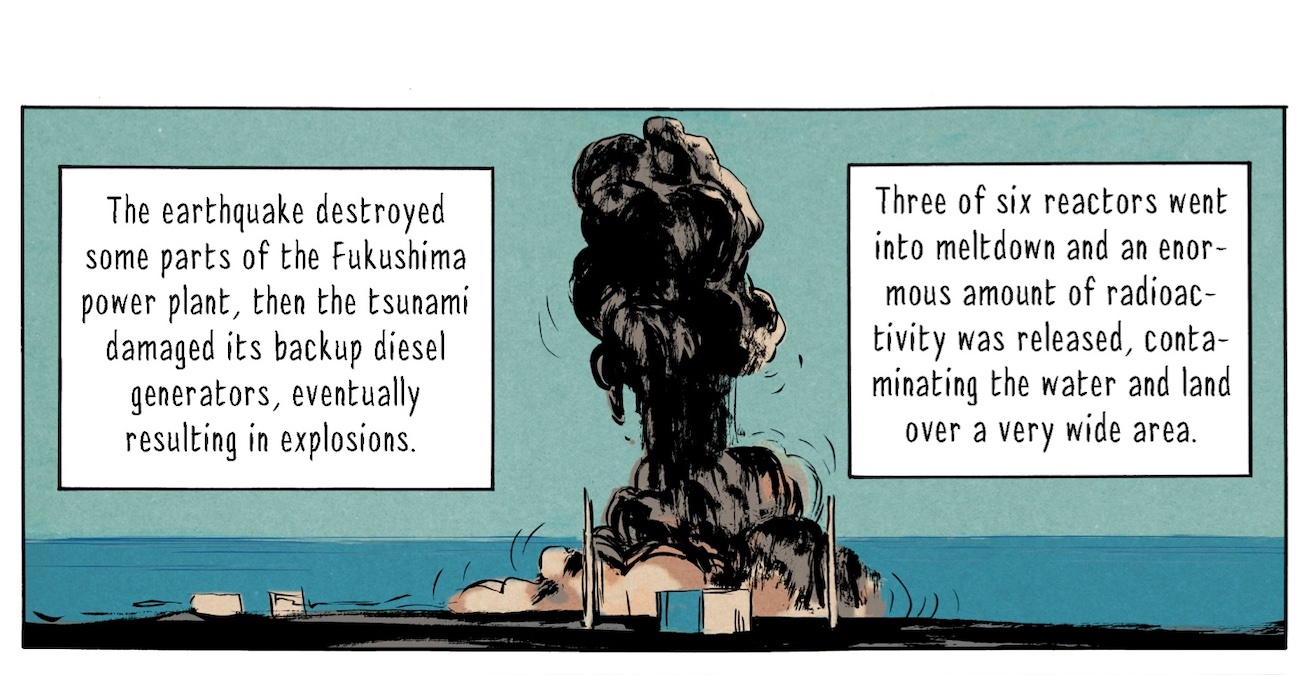
Suguru’s story reveals bullying, ostracization and government whitewash
Isolated and alone — Beyond Nuclear International
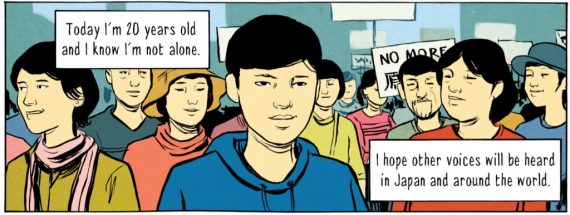
A teenager’s account of the Fukushima ordeal https://wordpress.com/read/feeds/72759838/posts/3219596582 By Linda Pentz Gunter, 7 Mar 21,Ten years after the March 2011 Fukushima nuclear disaster, how has the Japanese government responded and what is it like for the people affected, still struggling to return their lives to some semblance of normality? Here is how things look:
- Manuals are being distributed in schools explaining that radioactivity exists in nature and is therefore not something to be afraid of.
- The government is considering getting rid of radiation monitoring posts as these send the wrong message at a time of “reconstruction”.
- The Oversight Committee for Fukushima Prefecture Health Management Survey is discussing the possibility of stopping thyroid inspections at schools because they stress children out and overburden teachers and staff.
Depression and suicide rates among young people from Fukushima are likely to be triggered by being called “germs” and by being seen as “contaminated”.
- Those who speak out about radiation are more stigmatized today than they were 10 years ago.
- Those who “voluntarily” evacuated, recognizing that the so-called protection standards were not adequate for their region, are often ostracized from their new communities. They are seen as selfish for abandoning their homeland, friends and families “just to save themselves” and are bullied as parasites living on compensation funds, even though the “auto-evacuees” as they are known, received none.
- Those forced to evacuate are also bullied if they do not now return, accused of not trusting the government and its assertions that it is safe to do so.
- The taboo against speaking out for proper radiation protection and for compensation has grown worse as the rescheduled Olympics loom for this summer and Japan is determined to prove to the world it has fixed the radiation problem and beaten Covid-19.
- On March 1, 2021, it took three judges all of 30 seconds to dismiss a case brought by 160 parents and children who lived in Fukushima prefecture at the time of the nuclear accident, and known as the Children’s Trial Against Radiation Exposure. The class action suit sought 100,000 yen per person in damages from the government and the prefecture, due to the psychological stress brought on by the lack of measures to avoid radiation exposure after the accident.
These are some of the realities uncovered by France-based Japanese activist, Kurumi Sugita, as she interviewed those affected and began to compile a graphic short story about her findings, entitled Fukushima 3.11 and illustrated by French artist, Damien Vidal. The booklet is produced by the French NGO, Nos Voisins Lontains 3.11 (Our Distant Neighbors 3.11).
Fukushima 3.11, a long-form cartoon strip, is told in the first person by the youngest of Sugita’s interview subjects, Fukushima evacuee, Suguru Yokota, who was 13 at the time of the nuclear disaster.
Suguru was also one of the plaintiffs in the Children’s Trial, and noted after the devastating dismissal, just days before the Fukushima disaster’s 10th anniversary, that “we cannot give up” and that “the court hasn’t issued a legitimate verdict.”
In 2012, Sugita had traveled to Japan with a research project she helped create, financed by the French National Centre for Scientific Research where she worked, to set up an investigation into Japan’s nuclear victims. A list of 70 interview candidates was put together.
“I met Suguru in 2013 in Sapporo where he was living alone after he moved there from Fukushima,” said Sugita. “I also interviewed his mother and they were interviewed once a year over six years.”
A schoolboy at the time of the accident, the book follows Suguru’s account of his experiences. He encounters the refusal by his uncle to believe the dangers in the early days of the accident, “a typical denial case,” says Sugita, and he is ostracized at school where he is the only pupil to wear a mask.
Suguru’s only respite comes when his mother, who is equally alert to the radiation risks, sends him on a “radiation vacation” to Hokkaido, the first time he encounters peers who share his concerns.
Back at school and feeling isolated and alone, Suguru studies at home instead, eventually leaving the region for a different high school and then college.
The book weaves in essential information about radiation risks, and the clampdowns by the Japanese government, which withdrew support for auto-evacuees claiming, as Suguru relates it, that “these families are not victims. They are responsible for their fate.”
The book was first published in the magazine, TOPO, whose audience is predominantly teenagers and which reports on topics of current interest.
“It appealed to us to address an audience interested in world events, but not exclusively the nuclear issue,” said illustrator Vidal. “We thought our comic strip could be read by all those — and not necessarily just teenagers — who want to understand what the consequences of the nuclear accident were, and how it affected the inhabitants of Fukushima Prefecture.”
The book vividly brings home the psychological and emotional pain suffered by those who chose to recognize the true dangers posed by the Fukushima disaster, as well as the financial hardships and fracturing of families. And it exposes the depths of deliberate denial by authorities, more interested in heightened normalization of radiation exposure in the name of commerce and reputation.
Even as early as October 2011, an announcement is made that “rice produced in Fukushima Prefecture will supply school canteens again.” We see Suguru and his mother watching this news on their television, then the name-calling Suguru faces in school for bringing his own lunch. He is shown in the strip being called a “hikokumin”, which, explains Suguru, “is a really insulting word, used during the Second World War. It refers to people who are not worthy of being Japanese citizens.”
But that stigma has only become worse with time, Sugita says.
These days people are name-called “hoshano”. “Hoshano”(放射能) means radioactivity, but with a different Chinese character(放射脳) it means “radioactive brain – or brain contaminated by the fear of radioactivity”, she explains. And that is the slur in common circulation now.
Nevertheless, the book ends on a hopeful note. “Today,” concludes Suguru on the closing page, “I know I’m not alone. I hope other voices will be heard in Japan and around the world.”
It’s easy to say “never again.” But in order to ensure it, we must all continue to raise our voices, joining Suguru’s and others yearning to be heard.Read the English language version of Fukushima 3.11 on line for free. A version is also available in French. Hard copies (in French only), may be ordered from Nos Voisins Lontains 3.11 for 8€ plus shipping costs.
Nuclear workers plagued by leukaemia, cancers and other illnesses
Some workers developed cancer, leukemia and other illnesses. The same held true for workers at other nuclear facilities across the nation.
The number of potentially eligible workers across the nation is uncertain. Likewise, the number of employees potentially affected at West Valley could be in the thousands when accounting for temporary workers.
“This was particularly troubling if the same workers were hired repeatedly as temporaries and received high doses each time,”
In addition, the exposure of growing numbers of individuals increased the possibility of genetic consequences for the entire population.”
 Cancer plagues West Valley nuke workers https://www.investigativepost.org/2021/03/01/cancer-plagues-west-valley-nuke-workers/
“What we were doing was insane. We were dealing with so much radiation,” he told Investigative Post from his home in New Hampshire.
“I’ve got absolutely no joints left in my knees — my knees are gone, my ankles are gone and my hips are gone,” he said.
“I wonder if it’s from working in that bathtub full of radiation.”
Pyles was one of about 200 full-time employees who operated the former Nuclear Fuel Services reprocessing facility five decades ago in the hamlet of West Valley, where the company partnered with the federal government to recycle used radioactive fuel. Other workers were hired to contain and dispose of the dangerous waste the operation left behind.
Some workers developed cancer, leukemia and other illnesses. The same held true for workers at other nuclear facilities across the nation. As a result, Congress established the Energy Employees Occupational Illness and Compensation Program in 2000.
An Investigative Post review of the program found the government has paid $20.3 million over the last two decades in cases involving at least 59 people who worked at the West Valley site.
In all, individuals have submitted claims involving 280 employees who worked at the bygone reprocessing facility or during the ongoing $3.1 billion taxpayer-funded cleanup. An undetermined number of claims have been denied; the rest are being adjudicated.
Pyles said he was unaware of the program. He isn’t alone.
The Department of Labor’s Office of the Ombudsman has repeatedly criticized outreach efforts in its annual oversight reports. Most of it has been in the form of events held near former sites. Given the passage of time and people’s movement, reaching more eligible workers is a challenge.
The workforce at West Valley involved more than full-timers. About 1,000 temporary laborers were hired by the company in any given year, according to government and media reports from the time.
The use of temporary workers was a common labor practice at the time, but few operations needed to “raise quite so large an army” as Nuclear Fuel Services, according to a Science Magazine report from the era.
The industry had a nickname for them: “sponges.”
They were hired to “absorb radiation to do simple tasks,” according to Dr. Marvin Resnikoff, a radiological waste consultant who co-authored a study of West Valley.
While working at a site like West Valley does not guarantee later illnesses or genetic complications for offspring, each exposure to radiation increases the likelihood of cancer, Resnikoff said.
“It’s what I guess I would call a meat grinder,” he said.
Exposure to radiation
At its groundbreaking in 1963, the Nuclear Fuel Services reprocessing facility was thought to be a harbinger of a coming economic transformation. It closed in less than a decade, however.
Through six years of operation, at least 36 individuals in 13 incidents were exposed to “excessive concentrations” of radioactivity, according to a federal consultant’s report. Nevertheless, government officials at the time reported “no significant improvement in exposure controls or radiological safety conditions.”
The plant opened in the spring of 1966. Used fuel rods, thousands of which are assembled to power a nuclear reactor core, were transported to the plant by rail and truck. Upon arrival, containers were submerged in a 45-foot-deep cooling pool of demineralized water.
The fuel rods were then cut open, chopped up and placed in an acid bath. The solvent separated the used fuel from the reusable uranium and plutonium, which was collected for resale. The radioactive byproduct was pumped into underground tanks for storage.
The plant had handled 630 tons of fuel and produced 660,0000 gallons of liquid waste by 1972, when it was shut down in anticipation of making improvements to increase capacity and meet new regulatory standards.
That’s when Pyles quit.
The former lab supervisor said he was upset at management’s inaction concerning safety issues. Radioactive dust migrated through the ventilation system and accumulated in ducts, federal records said. A single duct was a “primary source of radiation” in the plant on three levels.
Pyles and coworkers absorbed radiation from that duct for five years, he said. They recognized that it posed a danger, but he said management ignored repeated requests to keep the airway flushed.
In response, Pyles said he and his coworkers hammered into the floor quarter-inch sheets of lead, used as temporary shields throughout the plant. When radiation levels went up, another sheet went down, he said. Finally, when the lead was an inch thick, Pyles said there were concerns they’d reached “the load bearing limit of the floor.”
Many unaware of program
Under the terms of its contract with the federal government, Nuclear Fuel Services pulled out of the operation in 1977. Federal and state officials battled over who was responsible for the site, until it was decided by Congressional action five years later.
In 1982, the newly formed U.S. Department of Energy took control of the 200 acres where the reprocessing facility operated. The New York State Energy Research and Development Authority, or NYSERDA, was charged with shutting down the site’s disposal area and stewardship of the 3,345 acres that surround it.
Nationally, the Department of Labor has received claims based on 129,488 former employees and paid $19.1 billion. While substantial, the department’s ombudsman has continually pushed for more resources and outreach efforts.
“While it is clear that those efforts have informed many individuals of the existence of the [program], it is likewise clear that there are still many who are unaware of [the program] and for whom more should be done to address this lack of awareness,” the office said in its most recent report to Congress.
The report cites an email from one frustrated former employee, who learned of the program with his wife by overhearing another couple’s conversation in the lobby of a hotel in Colorado.
“The husband was a former (energy employee),” the email said, concluding: “THIS IS HOW I WAS MADE AWARE OF THIS PROGRAM.”
The number of potentially eligible workers across the nation is uncertain. Likewise, the number of employees potentially affected at West Valley could be in the thousands when accounting for temporary workers. A 1985 report to Congress on workplace reproductive health threats noted 991 temporary workers were hired in West Valley in 1971. It was an “extreme case” of using such labor, the report said.
The 1974 report in Science Magazine said temporary laborers outnumbered operating staff 10 to 1 at times. According to federal records, media reports and interviews, temps were assigned tasks ranging from replacing light bulbs to “burying low-level nuclear waste.”
Records are typically scant for such subcontractor laborers, however. Companies, rather than the government, tended to retain those employment records, many of which no longer exist.
Science Magazine reported that former employees, members of the International Association of Machinists and Aerospace Workers, said “two contractors drew heavily on moonlighters, students and men seasonally employed at area automobile plants.”
A union official told the magazine then that between one-third and one-half of the Nuclear Fuel Services workforce were temporary hires that “could have been described as ‘down-and-out’ men from skid-row areas.”
How educated they were about the hazards of the job is an open question, according to J. Samuel Walker, a historian of the United States Nuclear Regulatory Commission whose published work includes research on nuclear transient workers. Use of the labor practice declined in time as safety concerns grew, Walker wrote in his book, “Permissible Dose.”
“This was particularly troubling if the same workers were hired repeatedly as temporaries and received high doses each time,” Walker said. “In addition, the exposure of growing numbers of individuals increased the possibility of genetic consequences for the entire population.”
Want to know more about the program? Call 716-832-6200 or visit this website.
Fukushima resident still can’t return home 10 years after nuclear disaster
|
Fukushima resident still can’t return home 10 years after nuclear disaster, March 3,
 2021 (Mainichi Japan) FUKUSHIMA — Yasuko Sasaki’s house lies just 30 kilometers away from the Fukushima Daiichi Nuclear Power Station, where a meltdown took place following the 2011 Great East Japan Earthquake and tsunami. On Feb. 1, Sasaki temporarily returned to clean up leaves that had fallen on the grave at the back of the property. 2021 (Mainichi Japan) FUKUSHIMA — Yasuko Sasaki’s house lies just 30 kilometers away from the Fukushima Daiichi Nuclear Power Station, where a meltdown took place following the 2011 Great East Japan Earthquake and tsunami. On Feb. 1, Sasaki temporarily returned to clean up leaves that had fallen on the grave at the back of the property.
Once a month, the 66-year-old visits her house in the Tsushima district in the Fukushima Prefecture town of Namie from the prefectural village of Otama — 50 kilometers away — where she is currently evacuated to. It has been almost 10 years since she became unable to live at her own residence. Due to high radiation levels, Tsushima was designated a “difficult to return” zone, where restrictions for entering are in place, and people are barred from living there. Homes without their owners living in them have been ransacked by wild animals. While Sasaki has been away, wild animals chewed up stuffed turtle and bird specimens kept at her house. She continues to clean her house so that she “can return at any time.”………… The Reconstruction Design Council in response to the Great East Japan Earthquake, an advisory panel to the prime minister, deemed that “recovery from the devastating disaster will not be completed until Fukushima soil recovers.” The government has set up Specified Reconstruction and Revitalization Bases within difficult-to-return zones and is carrying out decontamination work and developing infrastructure so that people can reside in the area once again. It aims to lift evacuation orders for the bases in between 2022 and 2023. However, the areas designated as reconstruction bases are limited. In the Tsushima district, a 153-hectare space surrounding the town hall’s Tsushima branch is designated — just 1.6% of the whole district. Of the 532 households in the district at the time of the disaster, 80% including Sasaki’s house are not included in the reconstruction base area, and there are no prospects for these people to be able to return to their homes. Sasaki said, “Everything’s still the same, even 10 years after the (nuclear) disaster. I wonder for how many more years I’ll have to continue cleaning (my house).” (Japanese original by Rikka Teramachi, Fukushima Bureau, Suyon Kimu, City News Department) https://mainichi.jp/english/articles/20210302/p2a/00m/0na/012000c |
|
|
Dust with French nuclear test residue threatens Turkey
|
Dust with French nuclear test residue threatens Turkey https://www.dailysabah.com/turkey/dust-with-french-nuclear-test-residue-threatens-turkey/news
BY DAILY SABAH WITH AGENCIES, ISTANBUL TURKEY , MAR 03, 2021 France is not the only country to be affected by sandstorms carrying the residues of cesium 137, used in nuclear tests by the country in the 1960s in the Sahara desert. Experts warn the dust, expected to move eastward and make a landing in Turkey soon, may be harmful for the population. Bekir Taşdemir, a nuclear medicine expert from Dicle University, says though it is unclear how much cesium residue there is in the dust sandstorms brought, people need to be cautious. “Possible high rate (of cesium) will necessitate people to stay indoors. They should not breathe the air outside and not open their windows,” Taşdemir warned. French experts had revealed that cesium was found in dust hailing from the Sahara Desert after a sandstorm on Feb. 6 traveled to the Jura Mountains. The same pattern of sandstorms is forecast for Turkey in the coming days. Taşdemir told Demirören News Agency (DHA) on Wednesday that the movement of dust particles, when combined with rainfall, will be more dangerous. “You should take an umbrella or have protective clothing if it is necessary to go out. If it rains, you should rapidly remove your clothes and wash them and take a shower when you return home. If radioactive residues are accumulated on your body or clothes, it poses a risk. There is also the possibility that those residues will settle on fruits and vegetables and you should be careful washing them thoroughly before consumption, in case of such a sandstorm,” he added. Cesium 137, a lethal chemical element, is used in the nuclear industry. When touched with bare hands, it can kill the person within seconds. It was emitted into the atmosphere after the 2011 nuclear plant accident in Fukushima, according to researchers. France had conducted its first nuclear test in the Sahara desert on Feb. 13, 1960. It carried out 17 nuclear explosions in the Algerian part of the Sahara Desert between 1960 and 1966. Eleven of the tests came after the 1962 Evian Accords ended the six-year war of independence and 132 years of French colonial rule. The issue of nuclear tests remains a major bone of contention between France and Algeria which claims the nuclear tests claimed the lives of a large number of people among the local population and damaged the environment. The Sahara dust that has blanketed parts of southern and central Europe last month has caused a short, sharp spike in air pollution across the region according to researchers. |
|
The Trump personality cult is still a threat
CPAC Showed That Trump’s Personality Cult Is Still Alive — and Still a Threat, https://truthout.org/articles/cpac-showed-that-trumps-personality-cult-is-still-alive-and-still-a-threat/?eType=EmailBlastContent&eId=30eb7938-c44f-478d-a80d-5562c3d8b80a, Sasha Abramsky, 1 Mar 21,
In the classic 1950 movie Sunset Boulevard, Gloria Swanson plays the has-been Hollywood diva, Norma Desmond, desperate for adoration, utterly infatuated with the spotlight. One of its most famous lines — “Alright, Mr. DeMille, I’m ready for my close up” — captures the unseemly spectacle of someone far past their sell-by date who refuses to accept their fall from stardom.
“You see,” the has-been actress utters with undistilled terror, “This is my life. It always will be. There’s nothing else. Just us and the camera — and those wonderful people out there in the dark.”
When Donald Trump stepped up to the podium at the CPAC event in Orlando, Florida, this weekend, it was, unsurprisingly, both a ghastly and incredibly tired remake of Sunset Boulevard, a reprise of yesterday’s news, of the former president’s greatest hits, from a man who cannot imagine a world without himself at the center.
During a bizarre CPAC presentation, Trump named all the Republicans who had crossed him and threatened to destroy their careers. He asked his audience — plaintively — whether they missed him yet. He claimed he had won the last election and would, if he so chose, win again in 2024. To this last point, his cult-like audience — which had already paraded through the conference center, in imitation of strong-men idolatrous cults in locales such as North Korea, a golden bust of the disgraced ex-president — responded, on cue, and overwhelming evidence to the contrary notwithstanding, “You won! You won! You won!”
Trump, in gilded retirement at Mar-a-Lago not only refuses to accept that Joe Biden won last year’s election, but he also hasn’t even remotely begun to consider the possibility that the GOP might ever be anything other than a vehicle for the enrichment of the Trump family. He has, these past months, teased the possibility of starting a third party; at the CPAC event, however, he scotched those rumors, instead urging GOP members to donate to political action committees controlled by Trump himself, along with members of his inner circle.
That decision wasn’t exactly a surprise; after all, most of the GOP is still in lockstep with Trumpism, convinced the election was stolen, and, as January 6th fades into the past, more than willing to forgive and forget the ex-president’s incitement to deadly violence. In the past couple weeks, House Minority Leader Kevin McCarthy traveled to Mar-a-Lago to pay an obsequious homage to the man whom, back in January, he had screamed at during a profanity-laden phone call at the height of the Capitol siege. So, too, did GOP whip Steve Scalise, make a kiss-the-ring visit to the exiled president.
Mitch McConnell, who bared just a touch of courage after the Senate impeachment vote by saying on the Senate floor that there was no doubt that Trump was responsible for the events of January 6th, followed up with an astounding public display of gorging himself on humble pie.
That decision wasn’t exactly a surprise; after all, most of the GOP is still in lockstep with Trumpism, convinced the election was stolen, and, as January 6th fades into the past, more than willing to forgive and forget the ex-president’s incitement to deadly violence. In the past couple weeks, House Minority Leader Kevin McCarthy traveled to Mar-a-Lago to pay an obsequious homage to the man whom, back in January, he had screamed at during a profanity-laden phone call at the height of the Capitol siege. So, too, did GOP whip Steve Scalise, make a kiss-the-ring visit to the exiled president.
Mitch McConnell, who bared just a touch of courage after the Senate impeachment vote by saying on the Senate floor that there was no doubt that Trump was responsible for the events of January 6th, followed up with an astounding public display of gorging himself on humble pie.
Meanwhile, state GOP chapters around the country are busily censuring GOP congressmembers and senators who voted to impeach or convict Trump. And GOP-controlled legislatures are pushing through legislation aimed to prevent the sort of non-existent “fraud” that Trump still claims cost him the last election. Of course, since the fraud wasn’t real, what this means in practice is a vast effort to contract the electorate and to make it harder for people of color, the poor and students to cast ballots in coming elections.
The ungodly CPAC display this past four days made two things absolutely clear. The first is that CPAC, and by extension most of the GOP, is nothing more or less than a personality cult; the values that have traditionally animated conservative movements in the U.S. have, now, been entirely subjugated to the allure of Trumpism. The second is that Trump’s financial interests — which are all he really cares about at this point — clearly lie not in putting his own dollars on the line by building up a third party, but in milking the GOP faithful for all he can, as quickly as he can, before his myriad legal woes catch up to him.
Toward the end of Sunset Boulevard, Desmond shoots an ex-lover as he attempts to walk out on her. In a bizarre twist, the dead man then narrates his posthumous understanding of how this will all end. He imagines the headlines that will accompany the announcement of his murder. “Forgotten star, a slayer, aging actress, yesterday’s glamor queen.” Instead, as Desmond is perp-walked down her palace steps, the cameras keep clicking, and the diva remains, even in delusional disgrace, the star of her own show.
Having failed to deal Trump a political death-blow in the Senate during the impeachment trial, the GOP is now stuck with its very own Norma Desmond. Trump is always ready for his close-up, because without the sound of the adoring claque, he is nothing.
Washington State and others want to overturn Trump rule that weakens Hanford nuclear waste rule
|
The state of Washington and other groups are asking the Biden administration to overturn a Trump administration rule that would allow the federal government to potentially clean up the Hanford nuclear reservation to less stringent standards. A letter sent Friday to Jennifer Granholm, just a day after she was confirmed as energy secretary, was signed by leaders of Washington state, the Yakama Nation, the Natural Resources Defense Council, Hanford Challenge and Columbia Riverkeeper. They call the Department of Energy’s decision in 2019 to allow the reclassification of some Hanford site and other radioactive waste “a matter of extraordinary concern.” The new DOE rule, which was adopted to relax the interpretation of what is defined as high level radioactive waste, “lays the groundwork for the Department to abandon significant amounts of radioactive waste in Washington state precipitously close to the Columbia River,” the letter said. It would create a long-term risk of harm to the residents of the Pacific Northwest and the natural resources critical to the region, it said. However, some Tri-Cities area interests have supported the revised interpretation of high level radioactive waste, saying it could save billions of dollars in environmental cleanup money across the nation, making more money available for some of the most pressing environmental cleanup at the Hanford nuclear reservation. ……. DOE’s new policy allows the agency to reclassify radioactive waste if it determines it does not exceed certain radionuclide concentrations for low level waste or does not need to be disposed of in a deep geological repository, such as the one proposed at Yucca Mountain, Nev. Previously, high level waste could be reclassified, but under a more involved process that relies on the Nuclear Regulatory Commission. Hanford watchdogs have said that giving DOE authority to reclassify high level waste could lead to grouting waste inside Hanford’s underground tanks, rather than retrieving the waste and properly treating it for disposal. DOE began building the $17 billion vitrification plant in 2002 to turn some, but not all, of the tank waste into a stable glass form for disposal. Turning some of the excess waste into a concrete-like grout for disposal rather than glassifying it has been proposed. The Washington state Department of Ecology has maintained that any treatment of tank waste must produce a waste form that is “as good as glass” to protect the environment and prevent contaminants from leaching into the soil and reaching groundwater. Those who signed the Friday letter agree that “trying to change Hanford’s high level tank waste to low-level waste through the stroke of a pen is no solution, and this Trump-era rule has to go,” said Tom Carpenter, executive director of Seattle-based Hanford Challenge, which advocates for Hanford workers. The new interpretation of high level waste gives DOE unilateral authority to redefine high level radioactive waste with no opportunity for input, oversight or consent by state regulators or the public, the letter said. “And it fails to hold the Department and the federal government accountable for adequately cleaning up the legacy waste that is left over from the establishment of the United States’ nuclear arsenal,” the letter said. The new interpretation of the definition of nuclear waste conflicts with a Biden administration order that agencies should follow science, improve public health and protect the environment, the letter said. Those signing the letter on behalf of Washington state include Attorney General Bob Ferguson and the director of the Department of Ecology, Laura Watson. ‘Trump-era rule has to go’ https://www.bigcountrynewsconnection.com/news/state/washington/state-wants-biden-to-overturn-trump-rule-on-hanford-nuclear-waste/article_16f7fd90-5857-57ce-a113-b43fa388a7d3.html |
|

What would go into the Chalk River Mound? — Concerned Citizens of Renfrew County and Area

December 2020 Canadian taxpayers are paying a consortium (Canadian National Energy Alliance) contracted by the federal government in 2015, billions of dollars to reduce Canada’s $16 billion nuclear liabilities quickly and cheaply. The consortium is proposing to construct a giant mound for one million tons of radioactive waste beside the Ottawa River upstream of Ottawa-Gatineau. […]
What would go into the Chalk River Mound? — Concerned Citizens of Renfrew County and Area
There is considerable secrecy about what would go into the mound; the information that follows has been derived from the proponent’s final environmental impact statement (EIS) (December 2020) which lists a partial inventory of radionuclides that would go into the gigantic five-to-seven story radioactive mound (aka the “NSDF”). The EIS and supporting documents also contain inventories of non-radioactive hazardous materials that would go into the dump.

Here is what the consortium says it is planning to put into the Chalk River mound (according to the final EIS and supporting documents)
1) Long-lived radioactive materials
Twenty-five out of the 30 radionuclides listed in Table 3.3.1-2: NSDF Reference Inventory and Licensed Inventory are long-lived, with half-lives ranging from four centuries to more than four billion years.
To take just one example, the man-made radionuclide, Neptunium-237, has a half-life of 2 million years such that, after 2 million years have elapsed, half of the material will still be radioactive. At the time of emplacement in the mound, the neptunium-237 will be giving off 17 million ( check, 1.74 x 10 to the 7th) radioactive disintegrations each second, second after second.
The mound would contain 80 tonnes of Uranium and 6.6 tonnes of thorium-232.
2) Four isotopes of plutonium, one of the most deadly radioactive materials known, if inhaled or ingested.
John Gofman MD, PhD, a Manhattan Project scientist and former director of biomedical research at the DOE’s Lawrence Livermore Laboratory, stated that even one-millionth of a gram of plutonium inhaled into the lung, will cause lung cancer within 20 years. Sir Brian Flowers, author of the UK Royal Commission Report on Nuclear Energy and the Environment, wrote that a few thousands of a gram, inhaled into the lungs, will cause death within a few years because of massive fibrosis of the lungs, and that a few millionths of a gram will cause lung cancer with almost 100% certainty.
The four isotopes of plutonium listed in the NSDF reference inventory are Plutonium-239, Plutonium-240, Plutonium-2441 and Plutonium-242. According to Table 3.3.1-2 (NSDF Reference Inventory and Licensed Inventory) from the EIS, The two isotopes 239 and 240 combined will have an activity of 87 billion Bq when they are emplaced in the dump. This means that they will be giving off 87 billion radioactive disintegrations each second, second after second.
3) Fissionable materials
Fissionable materials can be used to make nuclear weapons.
The mound would contain “special fissionable materials” listed in this table (avove) extracted from an EIS supporting document, Waste Acceptance Criteria, Version 4, (November 2020)
4) Large quantities of Cobalt-60
The CNL inventory also includes a very large quantity of cobalt-60 (990 quintillion becquerels), a material that gives off so much strong gamma radiation that lead shielding must be used by workers who handle it in order to avoid dangerous radiation exposures. The International Atomic Energy Agency considers high-activity cobalt-60 sources to be “intermediate-level waste” and specifies that they must be stored underground. Addition of high-activity cobalt-60 sources means that hundreds of tons of lead shielding would be disposed of in the mound.
5) Very Large quantities of tritium
The mound would contain 890 billion becquerels of tritium, a radioactive form of hydrogen. Tritium readily combines with oxygen to form radioactive water. It moves readily through the environment and easily enters all cells of the human body where it can cause damage to cell structures including genetic material such as DNA and RNA.
Because it is part of the water molecule, removal of tritium from water is very difficult and expensive. There are no plans to remove tritium from the mound leachate. Instead the consortium plans to pipe the contaminated water directly into Perch Lake which drains into the Ottawa River.
6) Carbon-14The mound would contain close to two billion becquerels of Carbon-14, an internal emitter that is hazardous in similar ways to tritium. Carbon is a key element in all organic molecules. When it is inhaled or ingested it can become incorporated into all manner of organic molecules and cellular components including genetic material.
7) Many other man-made radionuclides
Radionuclides such as caesium-137, strontium-90, radium, technetium, nickel-59, americium-243 are listed in the partial inventory of materials that would go into the dump. See the partial inventory here: https://concernedcitizens.net/2020/12/17/cnls-partial-inventory-of-radionuclides-that-would-go-into-the-chalk-river-mound/
8) Non-radioactive hazardous materials
Hazardous materials destined for the dump according to the final EIS and Waste Acceptance Criteria include asbestos, PCBs, dioxins, mercury, up to 13 tonnes of arsenic and hundreds of tonnes of lead. (Reference)
9) Large quantities of valuable metals that could attract scavengers
According the the final EIS, the mound would contain 33 tonnes of aluminum, 3,520 tonnes of copper, and 10,000 tonnes of iron. It is well known that scavenging of materials occurs after closure of facilities. Scavengers who would be exposed to high radiation doses as they sought to extract these valuable materials from the dump.
10) Organic Materials
80,339 tonnes of wood and other organic material are destined for the mound. These materials would decompose and cause slumping in the mound, therefore potentially compromising the integrity of the cap.
Most of the radioactive and hazardous material would get into the air and water, some sooner, some later. Some would get into ground and surface water during creation of the mound, such as tritium which is very mobile and cannot be removed by the proposed water treatment plant. Others would get into the air, during construction and could be breathed by workers. Some materials would leach slowly into groundwater. Still others would be released when the mounds deteriorates over time and eventually disintegrates several hundreds of years into the future. For details on the expected disintegration of the mound in a process described as “normal evolution” see this po
The mound would actually get more radioactive over time
See the submission entitled “A Heap of Trouble” by Dr. Gordon Edwards, president of the Canadian Coalition for Nuclear Responsibility for a chilling description of this process. http://www.ccnr.org/Heap_of_Trouble.pdf. Here is a quote from the submission:
The Near Surface Disposal Facility (NSDF) project is presented not as a temporary, interim
storage facility but as a permanent repository that will ultimately be abandoned. We are
dealing with a potentially infinite time horizon. The proponent seeks approval not just for a
few decades, but forever. Such permission has never before been granted for post-fission
radioactive wastes in Canada, nor should it be granted. Long-lived radioactive waste
should not be abandoned, especially not on the surface beside a major body of water.“The facility will remain a significant hazard for in excess of 100,000 years.“
This point was raised by Dr. J.R. Walker, a retired AECL radioactive waste expert in his submission on the draft environmental impact statement. You can read his full submission here: https://www.ceaa.gc.ca/050/documents/p80122/119034E.pdf
This dump would not not meet international safety standards for radioactive waste management.
The dump would not meet provincial standards for hazardous waste disposal.“There is no safe level of exposure to any man-made radioactive material.“
“There is no safe level of exposure to any man-made radioactive material. All discharges, no matter how small, into our air and water can cause cancer and many other diseases as well as genetic damage and birth defects.”
~ Dr. Eric Notebaert, Canadian Association of Physicians for the Environment.
The Children with Cancer UK conference: nuclear power and nuclear weapons are two sides of the same coin
 Low level radiation – a game changer for the nuclear power and weapons industries? Pete Wilkinson, 21 February 2021 https://yorkshirebylines.co.uk/low-level-radiation-a-game-changer-for-the-nuclear-power-and-weapons-industries/
Phil Hallington, head of operations and development, Sellafield. BBC Radio 4, 7/1/15 ‘How to dismantle a nuclear power station’
In order to gain public acceptance of atmospheric bomb testing in Nevada, President Dwight E. Eisenhower declared the policy of the US government to be “keep the public confused”…
(Extracts from ‘The Dangers of Low Level Radiation’, Charles Sutcliffe, Avebury Press, 1987 ISBN 0 566 05482 5)
These two quotations sum up the murky world of deceit, lies and deliberate withholding of information that characterised the race to develop the A and H-bombs in the immediate aftermath of WW2 as former allies became cold war enemies. The greater ‘good’ of possessing weapons of mass destruction to deter an aggressor outweighed the need to inform people of the unknowns surrounding the long-term effects of exposure to radiation. “Keeping the public confused” made it possible to develop those weapons without the encumbrance of protests.
The raw materials for weapons of mass destruction – plutonium and enriched uranium – come from the nuclear reactors developed under the guise of generating electricity ‘too cheap to meter’. The policies of secrecy and obfuscation have likewise haunted the nascent civil nuclear power industry. Nuclear power stations have been essential for producing the materials that have incinerated and liquidised tens of thousands of innocents, and left thousands more with crippling genetic malformations all in the name of defence through the threat of mass murder.
The Windscale Calder Hall reactors, opened by HM the Queen in 1956 and heralded as the first power station to provide nuclear-generated electricity to the UK grid, concealed the true impetus for their construction: to produce plutonium for domestic and American nuclear weapons. Nuclear power and nuclear weapons are two sides of the same coin, despite minister after minister, decade after decade, telling parliament and the public the opposite.
It is thought that around 200,000 people – mostly civilians – died as a result of the two atomic bombs dropped on Japan in 1945. The US sent teams of officials into the fallout zones soon after the attacks to catalogue the effects on people as well as to evaluate their destructive capability. The US authorities developed a measure of radioactivity’s effect on human health which assumed that the greater the exposure to radiation, the greater the effect on the individual, leading to the ‘linear no threshold’ or LNT principle which has underpinned the relationship between dose and risk ever since.
With little concern for detail, the authorities assumed that the LNT model was good for calculating the effects of both whole body exposure as well as internal exposure through nuclear particulate inhalation or ingestion and that the relationship between dose and risk remained constant. But in fact, in case after case of exposure to ionising radiation, the observed effect on health outstrips the theoretical effect LNT would suggest.
Decades of grudging engagement from the authorities with its critics has still not delivered open and transparent examination of the uncertainties around the issue. The government, the nuclear industry itself, the regulators, nuclear industry trades unions, the supply chain companies, cheerleading university research and science departments all support and defend an industry which is well aware of these uncertainties. Yet still we commit to new nuclear build while wringing our hands about the rising cancer rate now affecting every second person in the country.
Particulates of plutonium and uranium, invisible to the naked eye, produce energetic and highly interactive emissions that, while presenting little danger when outside the body, can present a serious internal hazard when inhaled or ingested. They represent a small ‘dose’ but can have a disproportionate effect on health if the body doesn’t manage to rid itself of the particle. The reality is actually ‘small dose, large risk’, the opposite of the LNT principle. It is perhaps no surprise that neither government nor its agencies wish to engage in fact-based debate on the issues: any recognition that critics of LNT have a case would require a fundamental review of nuclear discharges, their safety and the number of people qualifying for compensation.
Nuclear weapons were routinely tested until the practice was banned, sometimes requiring the enforced removal of the inhabitants over whose remote atolls and islands the bombs were tested. Of the 2,000+ tests since the 1950s, more than 200 took place in the atmosphere, releasing unknown quantities of uranium and plutonium. Accidents at nuclear power stations – notably Chernobyl, Fukushima and the accident in 1957 at our own plutonium production plant in Cumbria, then known as Windscale – have also released unknown amounts of plutonium into the environment.
Nuclear power plants routinely discharge small amounts of radioactive material into sea, land and air. Plutonium has been deliberately and routinely discharged into the Irish Sea since the 1950s from the Sellafield nuclear fuel reprocessing plant. These materials circle the earth in the jet stream and wash around our oceans. And the authorities, particularly the Committee on Medical Aspects of Radiation in the Environment (CoMARE), refuse to debate key issues with their critics.
In 1983, a ten-fold excess of childhood leukaemia was identified in the small village of Seascale, a few miles south of Sellafield. At the end of a Yorkshire TV documentary film screened in the November of that year, nuclear bosses refused to concede that the plutonium discharges from the plant to the Irish Sea which were shown to be returning to shore and even turning up in household dust, could possibly have anything to do with the children’s illnesses. In December 1984, Hansard recorded the following speech from Lord Skelmersdale (extract):
“As from next year, discharges of caesium to the sea will be reduced to one-tenth of the maximum released in recent years. The revised authorisation sent to the company in draft will, when implemented, reduce discharges of plutonium and other alpha emitters to 200 curies a year, which is also a very sharp reduction from previous levels.”
In 2008, the German government financed a report known by the acronym KiKK. It showed that children under five years of age living within five kilometres of every German nuclear power station ran a risk of contracting leukaemia that was twice the national average in the country.
Following a Children with Cancer UK international conference in 2018, a modest grant was awarded to the Low Level Radiation Campaign to write a report, compiling the evidence that supported the view that the health effects of exposure to low doses of alpha emitting radioactive materials are woefully underestimated.
The report has been sent to every major government department, to MPs and to regulators. The response has been totally underwhelming. The government is unable even to consider that the industry on which it has relied since the 1940s to provide its plutonium, its nuclear engineers, its nuclear research facilities, much of its electricity and its medical isotopes, might be contributing to disease and death in the population. And it refuses to instruct its publicly funded expert body, CoMARE, to do so on its behalf.
The Children with Cancer UK conference was addressed by one contributor who spoke movingly about the conditions required for a healthy and contented population – a sustainable and peaceful planet. Instead, we have created a soup of chemical, radioactive and other toxic materials casually tossed into the air while we have little or no idea as to their health effects. This, along with the 500,000 cubic metres of nuclear waste, is our legacy to our descendants. How on earth are we going to acknowledge this and begin the process of reconciliation and redress?
Continued use of nuclear energy brings pollution, cancers and birth defects
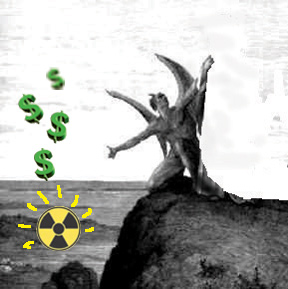
 A growing body of evidence supports a grim reality: that living in radioactively contaminated areas over multiple years results in harmful health impacts, particularly during pregnancy.
This is borne out in a recent study by Anton V. Korsakov, Emilia V. Geger, Dmitry G. Lagerev, Leonid I. Pugach and Timothy A. Mousseau, that shows a higher frequency of birth defects amongst people living in Chernobyl-contaminated areas (as opposed to those living in areas considered uncontaminated) in the Bryansk region of Russia.
Because the industry and governments are pushing to spend more money on new nuclear reactors — or to keep the old ones running longer — they have been forced to come up with a deadly workaround to surmount the strongest argument against nuclear power: its potential for catastrophic accidents.
Even the nuclear industry and the governments willing to do its bidding understand that you cannot really clean up after a nuclear catastrophe. For example, in Japan, where the March 2011 nuclear disaster has left lands radioactively contaminated potentially indefinitely, there is an attempt to mandate that people return to live in these areas by claiming there are no “discernible” health impacts from doing so.
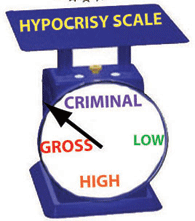 Bodies that are supposed to protect health and regulate the nuclear industry, including the U.S. Environmental Protection Agency, the International Commission on Radiological Protection and Nuclear Regulatory Commission are raising recommended public exposure limits, considering halting evacuations from radiation releases, and encouraging people to live on, and eat from, contaminated land.
The public justification for continued nuclear energy use is, ostensibly, to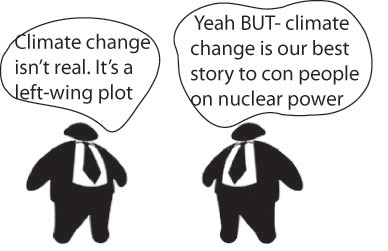 address the climate crisis. The reality is more likely a desperate last-ditch effort by the nuclear industry to remain relevant, while in some countries the nuclear energy agenda remains inextricably linked to nuclear weapon programs.
Forcing people to live on and consume produce grown from radioactively contaminated land is contrary to scientific evidence indicating that these practices harm humans and all animals, especially over the long-term. By the time these health impacts are unearthed, decades later, the false narratives of “harmless low radiation doses” and “no discernible impact” have solidified, covering up the painful reality that should be a touchstone informing our debate over nuclear power.
The recent joint study, whose implementation, says Korsakov, would not have happened without the support and efforts of co-author Mousseau, found that birth defects like polydactyly (having more than five fingers or toes), and multiple congenital malformations (including those that are appearing for the first time — called de novo), were “significantly higher… in newborns in regions with elevated radioactive, chemical and combined contamination.”
Uniquely, Korsakov also examines areas contaminated by both Chernobyl radioactivity and industrial chemicals. Multiple congenital malformations (MCM) were much higher in areas of combined contamination, indicating an additive and potentially synergistic effect between pollutants for these birth defects.
Congenital malformations (CM) are thought to originate in the first trimester of pregnancy and represent a main cause of global disease burden. They are considered “indicators of adverse factors in the environment,” including radioactive pollution, and can afflict numerous organs (heart, brain, lungs, bones, intestines) with physical abnormalities and metabolic disorders. Counted among these are clubfoot, hernias, heart and neural tube defects, cleft palate and lip, and Down syndrome.

CMs are the leading cause of infant mortality in many developed nations, accounting for 20% of U.S. infant deaths. For those living past infancy, the effects can be lifelong. While a number of CMs are obvious early in life, some may not be identified until later, even into adulthood. Countries of low- and middle-income are affected disproportionately.
In the Bryansk region of Russia, birth defects were examined over the 18-year period from 2000-2017. For areas contaminated with radiation alone, dose estimations from Chernobyl radiation (released from the 1986 nuclear catastrophe) ranged from 0.6 mSv to 2.1 mSv per year, while in areas contaminated with radiation and chemicals, dose ranges were 1.2 to 2.0 mSv per year.
As the Bryansk study authors point out, “[n]early all types of hereditary defects can be found at doses as low a [sic] 1–10 mSv indicating that current radiation risk models are inadequate for low dose environments.”
In comparison, Japan and the U.S. maintain that there is little risk to resettling or inhabiting areas contaminated by nuclear catastrophe where estimated doses would range from 5-20 mSv/year. Yet harm was found among Bryansk populations exposed to doses far lower than the much higher ones proclaimed “livable” by nuclear proponents.
One explanation for the disconnect between the expected and actual health effects is an underestimate of the impact of ingesting or inhaling manmade radioactive isotopes, particularly beta emitters, a large source of exposure following radiation releases from nuclear power catastrophes.
A number of these isotopes mimic nutrients that our bodies need such as calcium (radiostrontium) and potassium (radiocesium), so our body doesn’t know to avoid them. Of course, nuclear proponents recognize that economic recovery of polluted places will be difficult without being able to grow, sell and consume food that might be contaminated with isotopes that give off this radiation,.
Korsakov et al. point to yet another explanation for the disconnect — the assumption that dose reconstruction models properly fit all realistic exposures. When experts estimate doses they often do so without adequate knowledge of local culture and habits. Therefore, they fail to capture variations in exposure pathways, creating enormous errors in dose reconstruction. As a starting point, radiation science would be better served by directly measuring contamination levels where people actually live, play, breathe and eat.
But it seems dose models also fail to adequately represent the damage done to fetuses and neonates, not least because damage can be random (stochastic) making it difficult to predict. Stochastic health impacts include cancer and other genetic damage, and may be severe even at low doses. During pregnancy, one hit from radiation could damage or destroy cells meant to form entire organs, making accounting for stochastic impacts during fetal development extremely important — especially as fetal tissue collects some radionuclides in greater amounts than maternal tissue.
Health impacts in the Bryansk region could be a result both of direct radiation exposure during pregnancy and of cumulative impact over a “series of generations (genetic load)” raising the specter of heritability of genetic damage. Past studies have indicated that radiation damage can be heritable — passing from parents to offspring; that living in environments of elevated natural background radiation will increase mutations and disease; that the ability to withstand radiation doses appears to diminish as continually-exposed generations progress; and that doses from catastrophic releases should be accounted for across generations, not just in the generation initially exposed.
These currently sparse, yet growing data, support long-held conclusions that humans do not differ significantly from every other animal and plant — they, too, suffer heritable damage from radiation.
The Korsakov study projects that overall, multiple congenital malformations will increase in the next few years in the contaminated regions. Increases in birth defects are occurring despite access to free in-depth medical exams for pregnant women residing in areas of higher contamination and, if warranted, pregnancy termination. Such access has apparently greatly decreased the number of stilbirths in the region, as did a similar program at the end of the 1990s in Belarus, the country which bore the brunt of radioactive Chernobyl contamination. But even with such programs, overall birth defects have increased in the contaminated areas in Russia.
So not only is it unhealthy to live in radiologically-contaminated areas, attempts at mitigating the effects, particularly those on pregnancy, have limited impact. Encouraging, or worse yet, forcing people to live in contaminated areas and eat contaminated food, is foolishly cruel (particularly to people of reproductive age who may face wrenching decisions about wanted pregnancies) and not in the interest of public health.
Meanwhile, the continued use of nuclear energy that has forced us into this Faustian bargain in the name of mitigating climate change, is both unnecessary and downright harmful.
Covid-19 ”Hell” on UK nuclear submarine

‘HELL’ AT SEA Sailors on Royal Navy nuclear submarine come through ‘patrol from hell’ 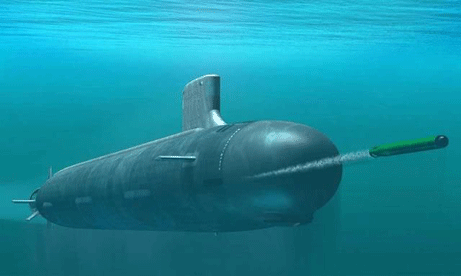 after Covid outbreak at sea, The Sun, Jerome Starkey, 12 Feb 2021,
Dozens on board HMS Vigilant reported sick but, with no access to a test lab, the precise number is not known. They had little chance to escape the bug while working in hot and cramped conditions.
A source said: “Imagine being cooped up underwater and breathing the same air when a killer virus is on the loose. It really was the patrol from hell.”
HMS Vigilant was on patrol as part of the Navy’s continuous at-sea deterrent.
The £3billion sub was the designated “bomber boat” and armed with Trident nukes.
“People sleep in bunks in tiny six-man cabins. They work on top of each other.”…….. https://www.thesun.co.uk/news/14036051/sailors-navy-nuclear-sub-covid-outbreak/
At last, UK government will investigate birth defects amongst children of nuclear test veterans
Mirror 3rd Feb 2021, Thousands of sick children and adults have finally been offered government research into whether their DNA was damaged by Cold War nuclear bomb tests.
An estimated 155,000 descendants of National Servicemen who took part in atomic weapons tests in the 1950s now report 10 times the normal rate birth defects, and are five times more likely to die as infants. Now Veterans Minister Johnny Mercer has promised to consider thorough research into whether they suffer a genetic legacy from Britain’s radiation
experiments.
https://www.mirror.co.uk/news/uk-news/thousands-offered-research-dna-damage-23436272
1 This Month

of the week – Shut Down Drone Warfare!


Tell the Ukrainian Government to Drop Prosecution of Peace Activist Yurii Sheliazhenko

Petition to revoke the licensing of the Near Surface Nuclear Disposal Facility (NSDF) at Chalk River. https://www.ourcommons.ca/petitions/en/Petition/Details?Petition=e-7247
To see nuclear-related stories in greater depth and intensity – go to https://nuclearinformation.wordpress.com
-
Archives
- April 2026 (68)
- March 2026 (251)
- February 2026 (268)
- January 2026 (308)
- December 2025 (358)
- November 2025 (359)
- October 2025 (376)
- September 2025 (257)
- August 2025 (319)
- July 2025 (230)
- June 2025 (348)
- May 2025 (261)
-
Categories
- 1
- 1 NUCLEAR ISSUES
- business and costs
- climate change
- culture and arts
- ENERGY
- environment
- health
- history
- indigenous issues
- Legal
- marketing of nuclear
- media
- opposition to nuclear
- PERSONAL STORIES
- politics
- politics international
- Religion and ethics
- safety
- secrets,lies and civil liberties
- spinbuster
- technology
- Uranium
- wastes
- weapons and war
- Women
- 2 WORLD
- ACTION
- AFRICA
- Atrocities
- AUSTRALIA
- Christina's notes
- Christina's themes
- culture and arts
- Events
- Fuk 2022
- Fuk 2023
- Fukushima 2017
- Fukushima 2018
- fukushima 2019
- Fukushima 2020
- Fukushima 2021
- general
- global warming
- Humour (God we need it)
- Nuclear
- RARE EARTHS
- Reference
- resources – print
- Resources -audiovicual
- Weekly Newsletter
- World
- World Nuclear
- YouTube
-
RSS
Entries RSS
Comments RSS
 nuclear-news