Botswana workers concerned over radiation from full body X-ray scanning
Debswana workers fear radiation exposure, MMegi online, ISAIAH MOREWAGAE, STAFF WRITER, 5 Feb 12, Debswana and its employees might be headed for a showdown after it emerged that the diamond mining company is pressing ahead with plans to introduce Scannex X-ray body search machines at its diamond mines.
Mmegi has learnt that the company’s employees are unhappy with the X-ray full body search machines, as this has not been preceded by relevant research on the impact of radiation exposure on the health of workers and by close consultation with them.The employees, through the Botswana Mine Workers Union (BMWU), expressed concern that they were
not involved in the decision to roll out the project. They insist that the company has reneged on its previous promises to engage in further joint research and close worker consultation.
BMWU deputy secretary-general and spokesperson, Sebataladi Ramoitoi confirmed in an interview with Mmegi that no thorough research related to the possible effects of the machine on people has yet been done.”We met the director of radiation on October 12, because we have learnt that Debswana is going ahead with its decision to apply for licenses from the radiation board. We have been holding meetings with Debswana and they told us that there is no turning back as they are going ahead with their application,” Ramoitoi said…..
http://www.mmegi.bw/index.php?sid=1&aid=298&dir=2012/February/Friday3
Lingering health issues from old uranium mines in South Africa
A compromising health issue Times Live, SIPHO MASONDO | 05 February, Lecturers at a Johannesburg college that is surrounded by three abandoned mine dumps claim that they are getting sick from exposure to uranium. Continue reading
Little regulation of increasing non-medical use of radiation
 Customs and the New York Police Department have deployed unmarked X-ray vans that can drive to a location and look inside vehicles for drugs and explosives.
The FDA has little authority to regulate the use of electronic products emitting radiation. Because security scanners are not classified as medical devices, the agency doesn’t approve them for safety before sale.
the scanners fall under voluntary guidelines set by a nonprofit group made up largely of
manufacturers and agencies that wanted to use the X-ray machines.

 Drive-by X-rays: Security screeners expanding radiation use Michael Grabell, Tucson Sentinel, ProPublica, 2 Feb 12, U.S. law enforcement agencies are exposing people to radiation in more settings and in increasing doses to screen for explosives, weapons and
drugs.
In addition to the controversial airport body scanners, which are now deployed for routine screening, various X-ray devices have proliferated at the border, in prisons and on the streets of New York.
Not only have the machines become more widespread, but some of themexpose people to higher doses of radiation. And agencies have pushed the boundaries of acceptable use by X-raying people covertly, according to government documents and interviews. Continue reading
Public ignorance on what really IS ionising radiation
 Fukushima Update: Why We Should (Still) Be Worried Business Insider, Russ Baker, WhoWhatWhy | Jan. 20, 2012, “……..What Radiation Is A great help to nuclear proponents is the fact that nuclear physics is complicated, and most people don’t understand even its most basic concepts. The blanket term “radiation” is used to describe all manner of radioactive contamination—as if it’s just one thing—when, in fact, there are different kinds, some much more damaging than others. It also matters exactly what is being exposed to radiation—i.e., exposure outside the body or inside it—and how long the exposure goes on.
In a nutshell, radioactive elements, also known as radioisotopes or radionuclides, are unstable atoms. They seek stability by giving off particles and energy—ionizing radiation—until the radioisotope becomes stable. This process occurs within the nucleus of the radioisotope, and the shedding of these particles and energy is commonly referred to as ‘‘nuclear disintegration.’’ Nuclear radiation expert Rosalie Bertell describes the release of energy in each disintegration as ‘‘an explosion on the microscopic level.”
This process is known as the “decay chain,” and during their decay, most radioactive elements morph into yet other radioactive elements on their journey to becoming lighter, stable atoms at the end of the chain. Some of the morphed-into elements are much more dangerous than the original radioisotope, and the decay chain can take a very long time. This is the reason that radioactive contamination can last so long.
To further complicate the issue, different radioisotopes give off different kinds of radiation—alpha, beta, gamma, X ray, or neutron emissions—all of which behave differently. Alpha emitters, such as plutonium and radon, are intensely ionizing but don’t penetrate very far and generally can’t get through the dead layers of cells covering skin. But when they are inhaled from the air or ingested from radiation-contaminated food or water, they emit high-energy particles that can do serious damage to the cells of sensitive internal soft tissues and organs. The lighter, faster-moving beta particles can penetrate far more deeply than alpha particles, though sheets of metal and heavy clothing can block them. Beta particles are also very dangerous when inhaled or ingested. Strontium-90 and tritium, a radioactive form of hydrogen, are both beta emitters. Gamma radiation is a form of electromagnetic energy like X rays, and it passes through clothing and skin straight into the body. A one-inch shield of either lead or iron, or eight inches of concrete are needed to stop gamma rays, examples of which include cobalt-60 and cesium-137—one of the radionuclides of most concern in the Fukushima fallout. Aside from use in medical diagnostics, X rays are also produced in nuclear fission, and their effects are similar to gamma radiation. Neutron emissions are the most penetrating of all types of radiation and require a shield of several feet of water or concrete to contain them.
The behavior of radioisotopes out in the environment also varies depending on what they encounter. They can combine with one another or with stable chemicals to form molecules that may or may not dissolve in water. They can combine with solids, liquids, or gases at ordinary temperature and pressure. They may be able to enter into biochemical reactions, or they may be biologically inert.
In her book No Immediate Danger: Prognosis for a Radioactive Earth, Bertell notes that if they enter the body either through air, food, water, or an open wound, “They may remain near the place of entry into the body or travel in the bloodstream or lymph fluid. They can be incorporated into the tissue or bone. They may remain in the body for minutes or hours or a lifetime.” To illustrate how different radioisotopes behave, she points out that: “Plutonium is biologically and chemically attracted to bone as is the naturally occurring radioactive chemical radium. However, plutonium clumps on the surface of bone, delivering a concentrated dose of alpha radiation to surrounding cells, whereas radium diffuses homogeneously in bone and thus has a lesser localized cell damage effect. This makes plutonium, because of the concentration, much more biologically toxic than a comparable amount of radium.”
Specific health effects from internal radiation exposure correlate with where radioisotopes land in the body. Bertell explains: “For example, radionuclides lodged in the bones can damage bone marrow and cause bone cancers or leukemia, while radionuclides lodged in the lungs can cause respiratory diseases. Generalized whole body exposure to radiation can be expressed as a stress related to a person’s hereditary medical weakness. Individual breakdown usually occurs at our weakest point.” In other words, the impact of radiation exposure also depends very much on each individual’s level of health and genetic make-up…..
http://www.businessinsider.com/fukushima-update-why-we-should-still-be-worried-2012-1
Higher incidence of child leukaemia near nuclear plants
 French nuclear plants double child leukemia – study TVNZ January 12, 2012 Source: Reuters The incidence of leukaemia is twice as high in children living close to French nuclear power plants as in those living elsewhere in the country, a study by French health and nuclear safety experts has found.
But the study, to be published soon in the International Journal of Cancer, fell short of establishing a causal link between the higher incidence of leukaemia, a type of blood cancer, and living near nuclear power plants.. Continue reading
Ionising radiation a valuable medical tool, but only when really warranted
“Ionized radiation is the most studied carcinogen in the world.”
the problem is that sometimes the devices are used when they are not necessary, a situation peculiar to the American medical system. In the United Kingdom and Europe the devices are not used unless the need is warranted by the patient’s medical condition.
On that, everyone seems to agree.
Medical Physicists Say Fear of Diagnostic Radiation Is Overblown Patients should not decline X-ray imaging for medically advised procedures, group says. Jan 11, 2012 Inside Science, By Joel N. Shurkin, ISNS — An association of physicists in the medical field has warned patients not to decline diagnostic radiation procedures because of perceptions that the tests may be
harmful. Continue reading
Infant deaths linked to Fukushima radiation – report ignored by govt and media
[In April 2011] the Environmental Protection Agency (EPA) reported increased levels of radiation in the air, water and milk right across the U.S. that were 100s of times above normal levels.
while deaths were reported across all age categories, infants under the age of one-year old were the demographic hardest hit. The increase in 2010-2011 deaths among infants in the spring was 1.8 percent, compared to a decrease of 8.37 percent in the preceding 14 weeks. Infant deaths were highest “because their tissues are rapidly multiplying, they have undeveloped immune systems, and the doses of radioisotopes are proportionally greater than for adults,”
 this study, which was released publicly on December 19, 2011, was not covered by mainstream media, but mostly watchdog groups and alternative, underground and fringe publications. There has been little reported about the after affects of Fukushima of late.
In an audio news conference, Mangano says the reaction of the nuclear industry and government will likely be a smear campaign to the report’s credibility
14,000 U.S. Deaths Linked to Fukushima Nuclear Meltdown: Infants Hardest Hit,The Province, Tess Zevenbergen January 9, 2012. The first study linking radioactive fallout to 14,000 U.S. deaths as a result of Fukushima’s nuclear meltdown following the 9.0 magnitude earthquake and tsunami that struck the coast of Japan on Friday, March 11th last year has been published in the International Journal of Health Services (IJHS). According to a news release issued over the PR Newswire, the study is the first peer-reviewed study to appear in a medical scientific journal that documents the health hazards associated with the Fukushima nuclear explosion and meltdown catastrophe.
The study, authored by epidemiologist Joseph Mangano MPH MBA and Executive Director of the Radiation and Public Health Project, and Janette Sherman, a toxicologist and adjunct professor at the University of Michigan, states the number of radiation-related deaths linked to the Fukushima disaster is comparable to the number of deaths following the Chernobyl meltdown of 1986. The results of the study were gleaned from looking at U.S. death rates during the period Fukushima occurred, as well as in previous months and years.
“This study of Fukushima health hazards is the first to be published in a scientific journal. It raises concerns, and strongly suggests that health studies continue, to understand the true impact of Fukushima in Japan and around the world. Findings are important to the current debate of whether to build new reactors, and how long to keep aging ones in operation,” stated Mangano. Continue reading
Airport scanner staff to be monitored for radiation
Airport Screeners to be Monitored for Radiation, TSA Says Jan 9, 2012 Rachael Rettner, MyHealthNews The Transportation Security Administration (TSA) is looking to monitor the levels of radiation that its employees are exposed to from X-ray technology, including airport body scanners, a document from the agency says.
In the document, the TSA said it plans to start performing radiation measurements using “personal dosimeters,” which are devices worn on the body that measure a person’s exposure to radiation, at certain airports. Such devices are used by people who work near sources of radiation such as hospital and nuclear power plant employees.
“The measurements will assist the TSA in determining if the Transportation Security Officers (TSO) at selected federalized airports are exposed to ionizing radiation above minimum detectable levels, and whether any measured radiation doses approach or exceed the threshold where personnel dosimetry monitoring is required by [Department of Homeland Security]/TSA policy,” according to the document, which was posted on a government website. http://www.myhealthnewsdaily.com/2091-airport-security-screening-personal-radiation-monitoring.html
Ionising radiation and thyroid cancer
 Vital Signs: Thyroid questions answered. The Daily Progress January 01, 2012 The terrible earthquake in Japan, and the resulting nuclear meltdowns, again have placed thyroid cancer in the news. There is a very close link between radiation exposure and thyroid cancer, and it is likely that Japan will see a sharp increase in aggressive thyroid cancers in the coming years, as was the case in Russia after the Chernobyl disaster in 1986.
Here in the United States, there was an increase in thyroid cancer following the nuclear testing in the 1950s in the Southwest. Though we have ceased such open-air testing, there are still numerous ways to be exposed to radiation, such as by receiving radiation therapy for cancer. And there is also a natural incidence of thyroid cancer unrelated to radiation exposure.
January is Thyroid Awareness Month, so it’s an apt time to discuss the thyroid, thyroid cancer and other thyroid conditions……. There are aggressive forms of thyroid cancer unrelated to radiation exposure, but they are very rare and typically occur in older males…. http://www2.dailyprogress.com/lifestyles/2012/jan/01/vital-signs-thyroid-questions-answered-ar-1575329/
Fukushima hospitals cut services as funds dry up
Fukushima hospitals in financial strife / Services being cut as medical facilities’ losses top 12 billion yen due to nuclear crisis Joji Takagai / Yomiuri Shimbun 31 Dec 11, FUKUSHIMA–-Hospitals in Fukushima Prefecture are facing financial strain–and cutting services–due to the ongoing impact of the crisis at Tokyo Electric Power Co.’s Fukushima No. 1 nuclear power plant. Continue reading
The continuing human cost of Fukushima’s continuing radiation
Enduring the nuclear winter, Irish Times, 26 Dec 11“……..More than 100,000 people have been displaced due to radiation around Fukushima Prefecture, home to the crippled Daiichi nuclear plant. Those who stay keep children indoors for much of the day. Others, such as single mother Kanako Nishitaka from Fukushima City, have fled in an attempt to find normality in a different part of the country.
“My daughter is smaller and closer to the ground, so she absorbed more radiation,” she says. “They found caesium in her body. I was told it was about the same amount as people exposed to nuclear bomb tests. When I told my son we were moving, he cried his eyes out because he
didn’t want to leave his friends.”
Many doubt the immediate area around the plant will ever again be habitable. The Daiichi plant will become an unwanted monument to Japan’s nuclear ambitions for years to come, while the cost of dismantling its reactors and supporting its victims will haunt future
governments…….” http://www.irishtimes.com/newspaper/features/2011/1227/1224309514995.html
New cancer concerns over airport radiation scanners
 the cosmic radiation that infiltrates airliners is absorbed by the whole body and is thus less dangerous than the low-level radiation of the scanners, which permeates only the skin and underlying tissues. In addition ….. blood and male testicles could be endangered.
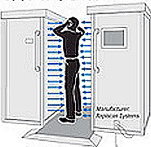 Cancer concerns mount over TSA body scanners, Sun Sentinel By Ken Kaye and Brittany Wallman, December 25, 2011 Because the scanners’ lose dose of radiation penetrates just below skin level, it could imperil the lens of the eye, the thyroid and a woman’s breasts, said Dr. Edward Dauer, head of radiology at Florida Medical Center in Fort Lauderdale.
“I think it’s potentially a real danger to the public,” he said, noting that even a small dose could be risky for people predisposed to cancer. “This is an additional exposure.” Continue reading
MRI scans better and safer than radiation methods for heart checks
 MRI scans ‘are better for heart checks’, experts say, BBC News, 23 Dec 11 Magnetic resonance imaging (MRI) scans should be used to assess patients with suspected heart disease, rather than standard checks, experts say.
A University of Leeds study of 750 people found MRI was better at detecting the condition, and of ruling it out in unaffected patients.
MRI was also non-invasive and did not use radiation, unlike the usual tests. A spokesman for the British Heart Foundation, which backed the study, said MRI should be used more widely…… Patients with suspected angina are currently most likely to have either an angiogram – an invasive test where dye is injected directly into the heart’s arteries
– or a non-invasive imaging test called SPECT.
Angiograms and SPECT tests both involve ionising radiation…… http://www.bbc.co.uk/news/health-16305278
Mothers are turning out to be a threat to the nuclear industry’s future
 The leadership of women in civic movements is also unprecedented. Mothers have been leading the demonstrations, with many of them coming out for the first time to gain sympathy and support for their campaign to prevent exposing children to the dangers of radiation…..
 Mothers Rise Against Nuclear Power , IPS News, By Suvendrini Kakuchi TOKYO, Dec 22, 2011 – Japan’s nuclear power industry, which once ignored opposition, now finds its existence threatened by women angered by official opaqueness on radiation from the Fukushima Daiichi nuclear plant after it was struck by an earthquake- driven tsunami on Mar. 11.
“Mothers are at the forefront of various grassroots movements that are working together to stop the operation of all nuclear plants in Japan from 2012,” Aileen Miyoko Smith, head of Green Action, a non- governmental organisation (NGO) that promotes renewable energy told IPS. Continue reading
Cancer among nuclear workers at Israel’s Dimona nuclear plant
Radiation leaks caused illnesses, Dimona reactor employees say, December 15, 2011 JERUSALEM (JTA) –– Employees at the Dimona nuclear reactor told an Israeli court that they were sickened with cancer and other illnesses due to radioactive leaks.
During a hearing Wednesday in Petach Tikvah District Court, the attorney for 44 employees and their families presented internal memos claiming that the leak of radioactive substances was caused by safety problems.
A former deputy head of Dimona’s Negev Nuclear Research Center safety division also testified that there had been radiation leaks, Haaretz reported. The employees of the Dimona reactor and the Soreq Nuclear Research Center in the mid-1990s who filed suit want to be recognized as victims of work-related accidents. Some of the plaintiffs have died since the suit was filed. The Dimona plant is said to be the source of fuel for Israeli nuclear weapons, though Israel has remained ambiguous about whether it has such weapons. http://www.jta.org/news/article/2011/12/15/3090762/radiation-leaks-caused-illnesses-dimona-reactor-employees-say
1 This Month

22 June – Virtual Event –Climate Change: New Data, New Debate

Monday, June 22, 2026 2:30 p.m. – 3:15 p.m. CT
YouTube. Register here
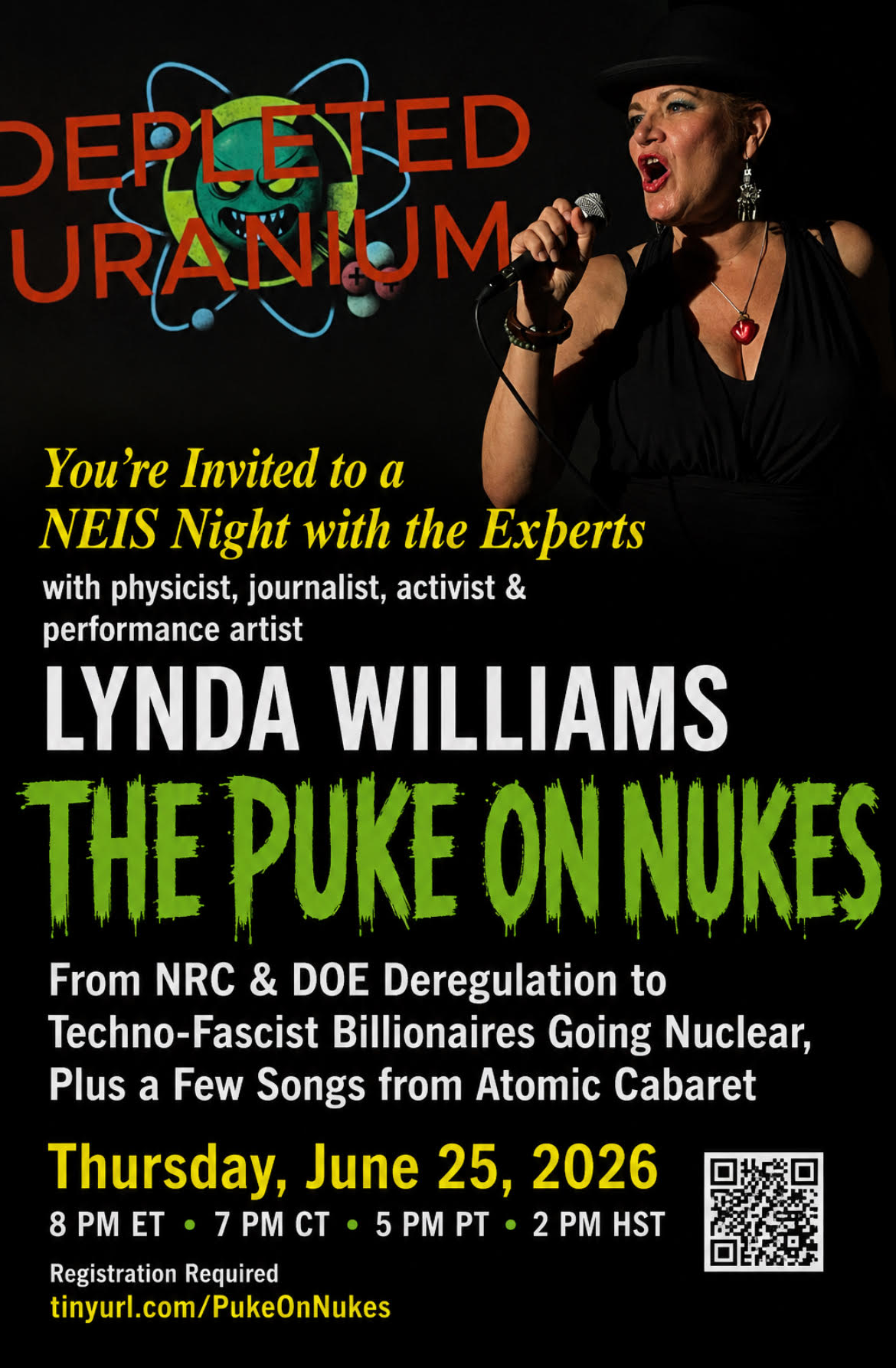
25 June- THE PUKE ON NUKES
Thursday, June 25, 2026
7pm Central Time (8pm ET, 6pm MT, 5pm PT) UTC – 5
From NRC & DOE Deregulation to Techno-Fascist Billionaires Going Nuclear, Plus a Few Songs from Atomic Cabaret REGISTER
26 June – Radiation Trainwreck at the NRC / Join the Protect Better Campaign – https://us02web.zoom.us/meeting/register/4ZlZ5_qLSHGiLSCg8FF6Bg#/registration
1st July – Webinar Waste of Space: The Environmental Harm of Military and Civil Space Activity st July, 7 pm

Report Launch Online: We are seeing an increasing exploitation of space for military and commercial purposes. This must change.

Protect Sazan Island from the Trump family! https://secure.avaaz.org/campaign/en/protect_sazan_island_from_the_trump_family_loc/?bqFCVab&v=174511&cl=22707147157&_checksum=5e9dde668860e8231c33699735e16a1fbf22ab2cb01da50c999fe8732b9775ef&utm_source=email&utm_medium=blast_email&utm_campaign=174511


Cuba Is Not a Failed State – It Is a Besieged State
PETITION: “Global Appeal to Endorse Palestinian Right of Return of Refugees”
To see nuclear-related stories in greater depth and intensity – go to https://nuclearinformation.wordpress.com
-
Archives
- June 2026 (221)
- May 2026 (306)
- April 2026 (356)
- March 2026 (251)
- February 2026 (268)
- January 2026 (308)
- December 2025 (358)
- November 2025 (359)
- October 2025 (376)
- September 2025 (257)
- August 2025 (319)
- July 2025 (230)
-
Categories
- 1
- 1 NUCLEAR ISSUES
- business and costs
- climate change
- culture and arts
- ENERGY
- environment
- health
- history
- indigenous issues
- Legal
- marketing of nuclear
- media
- opposition to nuclear
- PERSONAL STORIES
- politics
- politics international
- Religion and ethics
- safety
- secrets,lies and civil liberties
- spinbuster
- technology
- Uranium
- wastes
- weapons and war
- Women
- 2 WORLD
- ACTION
- AFRICA
- Atrocities
- AUSTRALIA
- Christina's notes
- Christina's themes
- culture and arts
- Events
- Fuk 2022
- Fuk 2023
- Fukushima 2017
- Fukushima 2018
- fukushima 2019
- Fukushima 2020
- Fukushima 2021
- general
- global warming
- Humour (God we need it)
- Nuclear
- RARE EARTHS
- Reference
- resources – print
- Resources -audiovicual
- Weekly Newsletter
- World
- World Nuclear
- YouTube
-
RSS
Entries RSS
Comments RSS
 nuclear-news