Until at least 2026 radioactive plume will continue to flow across Pacific
 assive Radiation Plume from Fukushima Heading Toward American West Coast According to a Scientific Report By David Gutierrez Global Research, September 11, 2014 According to scientific modeling systems used by the European Union, the radioactive ocean plume released by the 2011 Fukushima nuclear disaster is likely to remain a massive clump of radioactivity until it slams into the West Coast of the United States in late 2017. On March 11, 2011, a massive earthquake and tsunami struck Japan, knocking out power and cooling capability to the Fukushima Daiichi nuclear plant. Within three days, multiple meltdowns and reactor explosions had taken place. By March 25, massive amounts of radioactive material were observed leaking directly into the Pacific Ocean.
In 2013, the Nansen Environmental and Remote Sensing Center in Norway used computer models to project the movement and dispersion of this radioactive plume. Although the results of this study have been cited in official Chinese government documents, they have not been widely publicized.
Levels to remain high through at least 2026
The researchers used two separate scenarios to model leakage of radioactivity from the Fukushima plant into the Pacific. The first scenario assumed continuous and constant leakage for 20 days, while the second assumed continuous and constant leakage for one year.
Although delivering differing estimates of total radiation, both models concluded that the pollution would remain in a relatively unified mass and take the same path across the ocean until crashing up against western North America. Both models show the plume colliding with the U.S. West Coast and beginning to spread out starting around late 2017, with a maximum concentration of radiation hitting the coast toward the end of 2018……..http://www.globalresearch.ca/massive-radiation-plume-from-fukushima-heading-toward-american-west-coast-according-to-a-scientific-report/5401006
120,000 Fukushima nuclear evacuees still displaced, 3 years after
Japan’s nuclear watchdog on Wednesday gave the green light for two nuclear reactors at Kyushu Electric Power’s Sendai plant in south-west Japan to restart, but communities are anxious over the safety aspects. The nuclear industry in Japan has been mothballed since the meltdown.
At a temporary housing complex in Fukushima prefecture one resident, Iiko Kanno, said she now spends her days reading, growing vegetables and counting the days until she is reunited with her grandchildren. As with many of her neighbours, Kanno’s family has been torn apart by the nuclear meltdown, which happened in March 2011…….
A survey conducted this year by the prefectural government found that almost half of the households forced to evacuate were living apart, while almost 70% had relatives suffering from physical and mental health problems.
- Of the total, 48.9% of households said family members were living in two or more locations. Of that number, 58.6% said relatives who had once lived together had been scattered across three or more sites.
In the same survey, 67.5% of households said they had relatives who were showing signs of physical or psychological distress. More than half of those afflicted said they had lost interest in activities they once enjoyed or that they had trouble sleeping.
Kanno’s plight is typical of many Fukushima families who lived together in large rural homes before the disaster………
- So far only a few hundred people from two districts on the eastern edge of the evacuation zone have been given permission to return permanently……
- “The nuclear accident turned everything upside down,” she said. “Even if the evacuation order is lifted, no young people or children will go back. We have asked everyone – the village office, decontamination workers, environment ministry bureaucrats – when it will be safe to return. But no one can give us an answer.” http://www.theguardian.com/world/2014/sep/10/fukushima-nuclear-disaster-japan-three-years-families-uprooted
Birth deformities and cancers in Indian villagers near uranium facilities
Independent studies of the health status of people who live near the uranium mines and mills have found both that there are physical deformities occurring at a much higher rate than controlled villages which are having similar population but are a little bit further away from the mines and mills, as well as lung diseases coming in at a much higher rate among those who work in the mines and mills.
Australia to sell uranium to India but at what cost to its people? Australian Broadcasting Corporation Broadcast: 03/09/2014 Reporter: Stephanie March
As Prime Minister Tony Abbott prepares to sign off on a deal to sell Australian uranium to India, critics are warning of the cost to the lives and safety of India’s most vulnerable.
Transcript
CHRIS UHLMANN, PRESENTER: “……. critics say India’s drive towards a nuclear future is coming at a cost – the lives and safety of the country’s most vulnerable.
South Asia correspondent Stephanie March reports.
STEPHANIE MARCH, REPORTER: This lush forest land in eastern India is home to the Adivasi, one of the country’s Indigenous tribes people. Here in the town of the Jaduguda, the Adivasi live simple lives, much the way they have for centuries.
But the locals feel something isn’t right with the world around them.
Mohammad Yusuf is just one child in the village deformed since birth.
MOHAMMAD MOIN (voiceover translation): We didn’t realise that there was anything wrong with him immediately, but four to five months after he was born, we realised that his legs and arms were not functioning properly.
STEPHANIE MARCH: The 14-year-old tries hard to be independent, but his wasted and stiff body makes it hard for him to move.
MOHAMMAD MOIN (voiceover translation): The doctor’s examined him. They said it wasn’t polio. They said that there was some damage that had taken place before he was born. His nerves were damaged or something like that.
STEPHANIE MARCH: A few doors down, Jobarani Acharya’s three-year-old son, Zariyadev (phonetic spelling), struggles to breathe and can’t sit without help. She doesn’t know what’s wrong with him and can’t afford to take him to hospital to find out.
JOBARANI ACHARYA (voiceover translation): I worry about what will happen when he grows older. What can we do for him? How do we cope with this situation?
STEPHANIE MARCH: Jobarani’s neighbour is a young boy named Gunda, born blind and mentally handicapped. In this hamlet of a few dozen houses there are at least three children with obvious physical deformities and locals believe they know the cause.
MOHAMMAD MOIN (voiceover translation): One of my other children, just six days old, died after dark patches erupted on its body all of a sudden. With Yusuf too, it seems that there was some poisoning or radiation that led to a birth defect.
STEPHANIE MARCH: The village where Mohammad Yusuf and Zariyadev were born is less than two kilometres from this tailing pond, attached to a uranium mine run by the Government-owned Uranium Corporation of India Limited, UCIL.
MOHAMMAD MOIN (voiceover translation): We feel that these are due to the affects of uranium. We’ve seen these kinds of incidents not just with humans, but also with the babies born to animals.
GHANSHYAM BIRULLE, JHARKHAND ORG. AGAINST RADIATION (voiceover translation): We cannot see any benefits. We have received only cancer and diseases. UCIL has given us nothing else.
STEPHANIE MARCH: Independent studies on the impact of the mining operation have been scathing. One survey by Indian Doctors for Peace and Development found that children born to families living near the mining operations were almost twice as likely to have congenital deformities than those born in villages 30 kilometres away and that those with deformities were five times more likely to die than those living in non-mining areas.
30-year-old Rapta Sadr has been physically disabled since birth and blames his problems on being born near the tailing ponds.
In addition, cancer rate are 50 per cent higher in the villages near the tailing ponds and people are 20 per cent less likely to reach the average life expectancy for the state.
M.V. RAMANA, NUCLEAR FUTURES LAB, PRINCETON UNI.: Independent studies of the health status of people who live near the uranium mines and mills have found both that there are physical deformities occurring at a much higher rate than controlled villages which are having similar population but are a little bit further away from the mines and mills, as well as lung diseases coming in at a much higher rate among those who work in the mines and mills.
STEPHANIE MARCH: M.V. Ramana is a nuclear physicist based at Princeton University who’s written extensively on the nuclear industry in India. He’s closely studied the situation in Jaduguda.
M.V. RAMANA: As far as I know, UCIL has offered no evidence that is has actually carried out any kind of detailed epidemiological studies. All it has done is make various assertions. These assertions start with denial, saying that there is no such problem, or claiming that these problems have to do with malnutrition – exactly the kind of thing epidemiological studies rule out……http://www.abc.net.au/7.30/content/2014/s4080503.htm
The dream of Karipbek Kuyukov, on UN International Day against Nuclear Tests
I have a dream: A world free of nuclear weapons Aljazeera, Karipbek Kuyukov 28 Aug 2014 China, Egypt, India, Iran, Israel, North Korea, Pakistan and the US are still to sign the Nuclear Test Ban Treaty.
 I was born 100 kilometres from the Semipalatinsk nuclear test site where the Soviet Union exploded more than 600 nuclear devices between 1949 and 1991. They have had terrible physical consequences for the people who lived near them.
Fukushima’s young thyroid cancer sufferers – the tip of the coming cancer iceberg?
 Thyroid cancer diagnosed in 104 young people in Fukushima, Asahi Shimbun August 24, 2014 By YURI OIWA/ Staff Writer The number of young people in Fukushima Prefecture who have been diagnosed with definitive or suspected thyroid gland cancer, a disease often caused by radiation exposure, now totals 104, according to prefectural officials.
The 104 are among 300,000 young people who were aged 18 or under at the time of the 2011 Fukushima nuclear disaster and whose results of thyroid gland tests have been made available as of June 30. They were eligible for the tests administered by the prefectural government.
Of these 104, including 68 women, the number of definitive cases is 57, and one has been diagnosed with a benign tumor. The size of the tumors varies from 5 to 41 millimeters and averages 14 mm.
The average age of those diagnosed was 14.8 when the Great East Japan Earthquake and tsunami triggered the meltdowns at the Fukushima No. 1 nuclear power plant in March 2011……..
The figure can be extrapolated for comparison purposes to an average of more than 30 people per population of 100,000 having definitive or suspected thyroid gland cancer.
The figure is much higher than, for example, the development rate of thyroid cancer of 1.7 people per 100,000 among late teens based on the cancer patients’ registration in Miyagi Prefecture…….http://ajw.asahi.com/article/0311disaster/fukushima/AJ201408240011
Tokyo’s radiation level 0.036 μSv/h before March 2011, now 13μSv/h.
 Radiological Disaster Survey in Tokyo Suburbs: 13μSv/h in Kashiwa, Chiba http://fukushimaemergencywhatcanwedo.blogspot.com.au/2014/08/
 radiological-disaster-survey-in-tokyo_26.html 2014-08-24 osted by dunrenard According to Ministry of Education, Culture, Sports, Science and Technology, the radiation level (gamma ray) in Tokyo was 0.036 μSv/h before 311. And now with the Japan fukushima nuclear
  contamination Tokyo 13μSv/h.


13μSv/h is 388 times more than what the Tokyo government measures at Shinjuku, 176 times more than their measurement in Edogawa-ku.
Here is what the Tokyo government finds at their (concrete and metal) monitoring posts (some of which are conveniently located 23 meters above ground):
http://monitoring.tokyo-eiken.go.jp/en/index.html
Sources:
Radiological Disaster Survey in Tokyo Suburbs: 13μSv/h in Kashiwa, Chiba 2014-08-24
https://www.youtube.com/watch?v=PUAPJc1ZUYU
Radiation back ground level was 0.036 μSv/h in Tokyo before 311
http://fukushima-diary.com/2012/12/radiation-back-ground-level-was-0-036-μsvh-in-tokyo-before-311/
Courtesy of Troy Livingstone and Bruce Brinkman
Compelling evidence that nuclear power stations cause childhood leukaemias
 Nuclear power stations cause childhood leukemia – and here’s the proof http://www.ianfairlie.org/news/childhood-leukemias-near-nuclear-power-stations-new-article/ Ian Fairlie 24 Aug 14
In March 2014, my article on increased rates of childhood leukemias near nuclear power plants (NPPs) was published in the Journal of Environmental Radioactivity (JENR). A previous post discussed the making of the article and its high readership: this post describes its content in layman’s terms.
Before we start, some background is necessary to grasp the new report’s significance. Many readers may be unaware that increased childhood leukemias near NPPs have been a contentious issue for several decades. For example, it was a huge issue in the UK in the 1980s and early 1990s leading to several TV programmes, Government Commissions, Government committees, a major international Conference, Government reports, at least two mammoth court cases and probably over a hundred scientific articles. It was refuelled in 1990 by the publication of the famous Gardner report (Gardner et al, 1990) which found a very large increase (7 fold) in child leukemias near the infamous Sellafield nuclear facility in Cumbria.
The issue seems to have subsided in the UK, but it is still hotly debated in most other European countries, especially Germany.
The core issue is that, world-wide, over 60 epidemiological studies have examined cancer incidences in children near nuclear power plants (NPPs): most (>70%) indicate leukemia increases. I can think of no other area of toxicology (eg asbestos, lead, smoking) with so many studies, and with such clear associations as those between NPPs and child leukemias. Continue reading
Public unaware of massive spikes in radiation as nuclear reactors are re-fuelled
 Scientist: Massive spikes in radioactivity are being hidden from public — Radiation doses around nuclear reactors increase exponentially — It’s a major worry… very, very important — Something must be done (VIDEO) http://enenews.com/scientist-massive-spikes-radioactivity-being-hidden-public-radiation-doses-around-reactors-increase-exponentially-major-worry-very-very-important-video?utm_source=feedburner&utm_medium=email&utm_campaign=Feed%3A+ENENews+%28Energy+News%29
Interview with Dr. Ian Fairlie, Radiation Biologist, Nuclear Hotseat hosted by Libbe HaLevy, Aug 19, 2014 (at 35:30 in): One of the key things I’d like to mention to your listeners is this; Up until 2012, we didn’t really know what happened with emissions from nuclear reactors. The only data that we had was annual data… we didn’t really know the time pattern — now we do. Now we know that the large majority — say two-thirds, three-quarters — of the annual emissions from a reactor occur just once, during one spike.
And that spike occurs when the reactor is opened up to take out the old fuel and to put in fresh fuel. During that time period — about a day, day-and-half — the reactors are depressurized… they open up the valves and the radioactive gases shoot out. It’s during that time that we think that the people down wind are exposed to high levels of radioactivity, i.e. high radiation doses… Instead of having even, little bits of emissions throughout the 365 days, you haveone big, massive spike which happens over a day-and-a-half period. And that happens roughly speaking, once a year…
That’s important — Very, very important — because it results in doses that are at least 20 times higher, maybe even as much as 100 times higher… That’s a major worry… I’ve said to a number of nuclear operators, “Why don’t you do this at night time when people are in bed? Why don’t you do it when it’s really, really windy out — and it’s not raining?” … When it’s very calm it just drifts everywhere and you get big doses — No response… These spikes have been hidden from us ever since the beginning of the nuclear power program … nobody knew about them apart from people who work in the nuclear industry and they keep really quiet about it. I’d like to say to your American listeners, this is very important. You have to go to your regulator and say, “There’s no reason why this is not occurring at US reactors. These data are from German pressurized water reactors… We know that it’s very, very likely the same thing is happening with US reactors.” I hope that at least some of your listeners will pick this up and say, “Whoa, we’ve got to do something here.” >>Full interview available here
Dr. Donald Mosier, Scripps Research Institute’s Dept. of Immunology and city council member in Del Mar near San Onofre nuclear plant, Oct. 19, 2013 (at 27:15 in): The problem with the data is that tritium releases are episodic. They’ll have a release of tritium one day a month, but when they report that to the NRC, they’ll say this is the amount of tritium we’ve released over the year. You have 5 days of release, but you divide that by 365 days, it doesn’t look like so much tritium. But if you’re sitting right next to the plant on the day of the release, it’s quite a bit. There’s some data from Europe that says those spikes are dangerous. There’s no data in the US that you can interpret. >> Watch the community symposium here
Japan thyroid cancer children – crimes against humanity – Tokyo Press Conference
 Tokyo Press Conference: Gov’t is committing crimes against humanity; Fukushima children living in war zone and can’t leave — Childhood cancer developing much faster than Chernobyl; Rate now 14 times higher — Parent: “I’m revealing the reality of what’s going on… it’s only way to get rid of the criminals” (VIDEO) http://enenews.com/tokyo-press-conference-officials-committing-crimes-against-humanity-fukushima-children-living-war-zone-evacuate-childhood-cancer-developing-faster-chernobyl-rate-14-times-higher-parent-im-reveal?utm_source=feedburner&utm_medium=e
Press Conference at The Foreign Correspondents’ Club of Japan, August 18, 2014:
Toshio Yanagihara, attorney representing Fukushima children and their parents
- 5:00 — Thyroid cases after Chernobyl in Belarus — comparing that with the present situation in Fukushima, [here] there’s 14 times [the rate] of children with thyroid cancer.
- 6:00 — Fukushima prefecture’s announced that the massive number of thorough screenings [is the reason why there’s] more numbers of people with cancer — but we found that doubtful. In Fukushima prefecture, the west part of Fukushima compared to those areas that are closer to the nuclear power plant, there are about ¼ or even 1/5 the people who are found with thyroid cancer.
- 7:00 — June 10th of this year, the Fukushima committee in charge of researching thyroid cancer admitted for the first time that the suspicion of malignancy is due to the lymph node metastasis. This is the common thing that was found after the Chernobyl accident.
- 8:00 — In Fukushima right now, we see that the number of the children found with thyroid cancer — and the scale of this catastrophe is ongoing — it is going much faster than it was in the Ukraine after Chernobyl.
- 11:45 — The announcement from the Sendai high court from April 2013 that the Fukushima children’s lives are threatened… this didn’t cause Fukushima or the Japanese government to help provide support.
- 16:15 — We emphasis that the Japanese government is discriminating against the Fukushima children, and in the international [court], we can say this is a crime against humanity. This is Japan’s most important and most criminal human problem that we’re facing right now.
- 17:15 — Fukushima is a war zone, and children have a right to be evacuated to a safer place… In Japan, this present situation is the most harsh child-rearing situation in the world.
- 19:15 — They’re supposed to support and evacuate children from Fukushima during this war zone… It must be argued at the international court that this is a crime against humanity. We would like to take this case to the International Criminal Court, and we’re preparing for that.
Katsumi Hasegawa, parent of two young children who evacuated from Koriyama (60km from Daiichi)
- 22:45 — We currently live in Shizouka prefecture where we evacuated to in August 2011 — my pregnant wife and 5 year-old son… Why did the Japanese government contain us in the no-go zone 20 or 30 km radius, while many foreign countries had told residents within 80 km from Fukushima Daiichi to evacuate?
- 35:00 – I’m a parent of children, and I’m an adult whose living at the time of this accident — this era. I would like to reveal the reality of what is going on. And I would like to do my best, even if I’m starting right now, I would like to do my best. That is my responsibility, and that is the only way to get rid of the criminals — and irresponsibility that we have committed already… Even though raising my voice is hard, I know that there are things that we need to do. Thank you.
- 36:30 — Lucy Birmingham, FCCJ president: Thank you so much. OK… wow.
Indian Uranium Corporation ordered to probe birth deformities near mines
 The health issue came to the attention of the High Court earlier this year after pictures of Jadugora’s deformed children appeared in the Indian press. The court in February ordered Uranium Corp. to produce documents that might shed light on the health issues. The court noted then that children living near the mines in Jadugora are “born with swollen heads, blood disorders and skeletal distortions.”
India Court Orders Uranium Corp. to Probe Deformities Near Mines Bloomberg By Rakteem Katakey and Tom Lasseter Aug 20, 2014 India’s sole uranium mining company is being ordered by a regional court to disclose radiation levels and the presence of any heavy metals in soil and water in a cluster of villages with reports of unusual numbers of deformed and sick children.
The order by the Jharkhand High Court also mandates thatUranium Corp. of India Ltd.explain how it ensures the safety of nearby civilian populations who may be exposed to its 193-acre (78-hectare) radioactive waste dump near the village of Jadugora in eastern India.
The move comes about a month after a Bloomberg News story chronicled the plight of parents living near the Uranium Corp. mines who are seeking answers to what’s sickening and killing so many of their kids. The story also reported that local residents routinely wander the unfenced dump sites and fish and bathe in a river that receives water flowing from the dumps, known as tailings ponds. The Bloomberg article was submitted to the judges of the High Court by Ananda Sen, the lawyer appointed by the court to review the case.
Uranium Corp. has denied its mining operations have anything to do with village health issues. In 2007, a survey of more than 2,100 households by an Indian physicians group found mothers in villages 1.5 miles from the mines reported congenital deformities more than 80 percent higher than the rates just 20 miles (32 kilometers) away, with reported child death rates from such abnormalities more than five times as high.
Independent Experts
Fukushima and Chernobyl’s plants and animals have suffered from radiation
 No, Fukushima Is Not a Wildlife Haven—and Neither Is Chernobyl http://www.citylab.com/tech/2014/08/no-fukushima-is-no-eden-for-animalsand-neither-is-chernobyl/376046/ A slew of new research reveals the deleterious effects of radiation on Fukushima’s ecology. LAURA BLISS @mslaurabliss Aug 14, 2014
Perhaps you’ve encountered the well-publicized idea that Chernobyl, the world’s worst nuclear disaster of 1986, has become a kind of ‘wildlife haven’ as a result of its abandonment by humans.
So what of Fukushima Daiichi, Japan’s nuclear collapse of 2011—might we expect a happy menagerie there, too? Not so much, according to a slew of new papers out in the Journal of Heredity. And you may want to rethink Chernobyl-as-Eden, too.
The findings of the new studies tell of significant population decline across many different species of animals and plants, as well as a range of expressions of genetic damage and cell mutation.
One paper reports that the pale grass blue butterfly, one of Japan’s most common butterfly species, has suffered from significant size reduction, slowed growth, high mortality and abnormal wing patterns both within the Fukushima exclusion zone and among lab-raised offspring of parents collected at the site. Which is to say, radiation-caused genetic mutations were passed down.
 Researchers also found major declines in populations of birds, butterflies, cicadas, and some small mammals, as well as aberrations and albinism in the feathers of certain birds.
Timothy Mousseau, a prominent biologist and lead author of that population study, has also conducted significant research into radiation’s impacts at Chernobyl. He roundly rejects the claim that the area has become an animal haven, arguing that notion was based on anecdotal evidence rather than scientific data. Mousseau’s own work demonstrates radiation has had similar effects on Chernobyl’s ecology as on Fukushima’s.
Further inquiry into all manner of species living at the Chernobyl site could help scientists better predict Fukushima’s biological trajectory, he says. “There is an urgent need for greater investment in basic scientific research of the wild animals and plants of Fukushima,” Mousseau told the Journal of Heredity.
A warning from UK’s National Health Service on the risks of radiation from CT scans
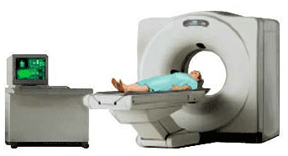 Caution urged over CT scan radiation doses, NHS UK, 15 Aug 14
BBC News reports on a sharp rise in the number of CT scans being performed, exposing people to the potential health risks of radiation.
However, as The Daily Telegraph says, it is not possible to calculate the cancer risk due to exposure to CT scans because there is a lack of data.
These media stories follow the publication of a report by theCommittee on Medical Aspects of Radiation in the Environment (COMARE). COMARE has reviewed trends in the use of CT scans in the UK. The review weighs up the risk-benefit balance of using CT scans, and considers ways to obtain the best quality scan image while minimising the necessary radiation dose.
The COMARE report sets out good practice guidance, encouraging doctors to take a more “proactive approach” to protecting patients and reducing radiation doses.
The committee recommendations cover equipment and procedures already in place, but also note there are dose reduction features available on some of the newer CT scanning machines that should be considered when new equipment is purchased.
What is COMARE and why is it looking at CT scans?….…
only 15% of our radiation exposure comes from medical sources. However, it has still increased from 0.33mSv per person per year in 1997, to 0.4mSv in 2008.
CT scans account for much of this exposure. ……..The report says there has been wider use of CT scans among younger people and children, whose tissues may have greater sensitivity to radiation. They also, of course, have a longer lifespan ahead of them in which potential harmful effects may be observed…..
70% of indications for CT scans recommended by guidance relate to benign (non-harmful) or potentially benign conditions. It says that CT scans are increasingly being used as a standard investigation, replacing other conventional ways of detecting health problems.
There are potential risks related to radiation…….
What does the COMARE report recommend?……..http://www.nhs.uk/news/2014/08August/Pages/caution-urged-over-use-of-ct-scan-radiation-doses.aspx
Uranium mining destroys lives
Yet another example of how mining companies destroy local peoples lives Papua New Guinea Mine Watch 14 Aug 14
“The government and the company don’t give a damn whether the tribal people live or die,” said Ghanshyam Birulee. “The government is treating us as guinea pigs to fulfill its greed for Uranium.”
India uranium mining fuels health crisis
 Radioactive waste generated in three government owned mines spurs health fears in eastern Jharkhand state.
Sanjay Pandey | Al Jazeera “They took away my land,” 35-year-old Agnu Murmu told Al Jazeera, days before he died. “I begged them to give me a small truck… but they gifted me with cancer.”
Murmu, according to social activist Ghanshyam Birulee, was just the latest casualty of radiation pollution in Jadugoda, a tribal heartland in the eastern Indian state of Jharkhand.
His house sits dangerously close to a tailing pond, where the government-run Uranium Corporation of India Limited (UCIL) discharges waste from its mining operations. Murmu’s mother said the family knew nothing about radiation when mining began here about five decades ago.
“Like other unsuspecting parents, I would also allow my children to play near the tailing pond and catch fish from the canal that I know now is contaminated by radiation pollution,” said Rakhi Murmu, 52, with tears spilling down her creased cheeks.
“Uranium mines have ruined our lives. I know they won’t rest till they bury us all in those pits.”
Spontaneous abortions and miscarriages
Radioactive waste generated by three government owned mines – Narwapahar, Bhatin and Jadugoda – has spurred fears of a health crisis in the region.
Residents say they suffer from a number of diseases linked to radiation pollution, including congenital deformities, sterility, spontaneous abortions and cancer – yet mining continues unabated near these Indian villages, without proper security measures in place.
Dumping of radioactive waste by the roadside or near the villages may be putting even more people at risk………
radiation pollution
Several surveys conducted by independent agencies, including Japan’s Kyoto University and India’s Jadavpur University, have confirmed radiation pollution in the air, water and soil in Jadugoda.
Independent nuclear scientist Sanghmitra Gadekar, who conducted a survey on 9,000 villagers living in and around mines, has documented cases of congenital deformities, infertility, cancer, respiratory problems and miscarriages……..
Guinea pigs?
Nitish Priyadarshi, a geologist who has surveyed radioactivity in Jamshedpur and Ranchi, said while uranium particles cannot travel that far, “its sister elements like radon gas, which damages lungs and kidney, can travel to the city and take the already high radioactivity to alarming levels.”…….
whatever the government policy, Jadugoda’s 50,000 tribal residents continue to stand exposed to a danger which the activists say “nobody cares about”.
“The government and the company don’t give a damn whether the tribal people live or die,” said Ghanshyam Birulee. “The government is treating us as guinea pigs to fulfill its greed for Uranium.” http://ramumine.wordpress.com/2014/08/14/yet-another-example-of-how-mining-companies-destroy-local-peoples-lives/
Thyroid cancer in Fukushima children: an inconvenient fact for Japan’s government
Japan Professor: Outbreak of cancer is now underway in Fukushima children; Clear evidence of an epidemic — All of Japan is still being exposed to nuclear radiation — Gov’t Official: It will be ‘disastrous’ if we have to conclude there’s an actual increase in thyroid cancer from Fukushima http://enenews.com/japan-professor-outbreak-cancer-fukushima-children-clear-evidence-epidemic-underway-all-japan-being-exposed-nuclear-radiation-govt-official-will-be-disastrous-conclude-actual-increase-thyroid-ca?utm_source=feedburner&utm_medium=email&utm_campaign=Feed%3A+ENENews+%28Energy+News%29
Excerpts from a report by Dr. Yuri Hiranuma, a physician specializing neuromusculoskeletal medicine, published by Fukushima Voice version 2e, Aug 3, 2014:
[At the July 16, 2014 Expert Meeting Regarding the Status of Health Management of Residents Following the Tokyo Electric Fukushima Daiichi Nuclear Power Plan Accident, held by the Ministry of the Environment]
- Toshihide Tsuda, a physician and an epidemiologist at Okayama University, has just emphatically stated that in certain Fukushima municipalities there was a clear evidence of a thyroid cancer epidemic […] Calling this an “outbreak, occurring only 3.1 to 3.2 years after the accident” […] “outbreak” of thyroid cancers in Fukushima children cannot be explained by the “screening effect,” when the data is analyzed and compared with the national cancer statistics as well as within Fukushima Prefecture against municipalities with the lowest exposure dose. Critical of the commonly accepted notion that health effects do not occur below 100 mSv, Tsuda presented numerous published studies that proved otherwise. […] “This Expert Meeting has not brought up these studies so I must do it” […] Tsuda also said that the Expert Meeting should consider the fact that all age groups including pregnant women were still being exposed to radiation in Fukushima Prefecture. […] Tsuda said, “We are all being exposed to radiation in Japan” […]
- [Committee] Chairman Shigenobu Nagataki, emeritus professor at Nagasaki University, a former chairman of Radiation Effects Research Foundation, and a mentor to infamousShunichi Yamashita [said] “Committee members, please do not hesitate to ask questions. Given what was just stated, it will be disastrous for this committee to have to conclude that there is an actual increase in thyroid cancer (due to the Fukushima accident).” […] if the Expert Meeting were seriously considerate of the disaster victims […] why would it be disastrous for this Expert Meeting to have a conclusion that cases of thyroid cancers might be increasing? […]
Excerpts from an article by Japanese independent media outlet OurPlanet-TV summarizing the July 16 meeting, translated by Dr. Yuri Hiranuma, Aug. 3, 2014:
- Professor Shinzo Kimura [who conducted] field investigations in Chernobyl, reported that currently there are many cases of thyroid cancer […] more than 250 km away from Chernobyl
- Matsumoto City Mayor Sugenoya, who has provided medical care to children with thyroid cancer in Belarus [said] even in areas contaminated with low-level radiation with an annual radiation level below 1 mSv, residents showed a depressed immune function, hematopoietic disorders, and perinatal abnormalities [and] medical personnel are not allowed to refer to the Chernobyl accident.
- Okayama University Professor Tsuda pointed out that there is no end of the number of researchers who say, “No cancer occurrence is expected from radiation exposure dose under 100 mSv,” after the Fukushima accident. Tsuda candidly said researchers should refrain from making such statements. […] As of the end of March 2014 [Nakadori, the central region of Fukushima that is 40-80 km from the Daiichi plant] had the highest detection rate [of thyroid cancer,] as much as 11 times higher than Aizu [western region of Fukushima, over 80 km from the plant]. […] thyroid cancers from municipalities other than Aizu region showed rates which were 15 to 40 times higher [than data from the National Cancer Center]. He sounded an alarm […] “It’s only been 3.1 to 3.2 years but there are so many cases observed in Fukushima. We need to take immediate countermeasures.” […] “They are still exposed to radiation. We can’t wait until the results come out. […] All of us as well as Fukushima residents are being exposed to radiation.”
- During this session, the audience applauded several times when witnesses spoke.
Uranium exposure and skin cancer
 Study may help explain link between uranium exposure and skin cancer http://medicalxpress.com/news/2014-08-link-uranium-exposure-skin-cancer.html After years of delving deep into DNA and researching ways in which metal damage may lead to cancer, a team of researchers is taking a step back to look at the surface where one answer may have been all along. The varying health risks from exposure to natural uranium are well established, but Diane Stearns, professor of biochemistry at Northern Arizona University, and her team have been trying to determine if there is a link between uranium exposure and skin cancer, stating that skin may have been overlooked in the past.
In a recent article published in the Journal of Applied Toxicology, the NAU team shared results from a study that explored photoactivation of uranium as a means to increase its toxicity and ability to damage DNA.
“Our hypothesis is that if uranium is photoactivated by UV radiation it could be more harmful to skin than either exposure alone,” Stearns said.
Through the study, the team found that once uranium was present in the skin, exposure to UV radiation or sunlight could be chemically toxic and lead to cancerous lesions. The team members recommend that future risk assessments regarding cancer caused by uranium exposure include the possibility of photoactivation in skin.
They also propose that photoactivated uranium exposure could be even more harmful in cells that can’t repair the damage on their own. Stearns explained such cases are found in individuals with Xeroderma Pigmentosum or XP, a disease that causes extreme sensitivity to sunlight.
Through research into the XP cell lines, the team discovered regional relevance for the study. The disease is prevalent on the Navajo Nation, a site of historically high levels ofuranium mining and processing in the Southwest. The 2012 documentary Sun Kissed further piqued the researchers’ curiosity. The film cites the incidence of XP in the general population as one in 1 million, yet cases increase significantly to one in 30,000 in the Navajo population.
Stearns believes there may be implications that should be taken into consideration for a population like the Navajo community with carriers of XP mutations and relatively high exposure to uranium and the sun.
“We just want to make people aware that uranium exposure could contribute to skin cancer and could also be exacerbating XP,” Stearns said.
Stearns said as she looks to the future, she hopes to fine-tune her understanding of the photoactivation mechanism and how it is damaging DNA. “We have predicted the link but now we would like to study it step by step to establish an even stronger connection.”
Together with her Navajo students at NAU, she also hopes to determine whether the old uranium mines might explain the increase in cancer and what is being called a sudden emergence of XP on the Navajo Nation.
“I’ve had several Navajo students come to me because they found out I was doing uranium research and they had a relative who died of cancer and always wondered if it was uranium,” Stearns said. “It’s been a really personal way for them to see the value in scientific research because it can directly relate to their community.”
1 This Month
29 Jan. Thursday 7-8 p.m. Webinar – World’s Largest Nuclear Station in Port Hope, ON?
To see nuclear-related stories in greater depth and intensity – go to https://nuclearinformation.wordpress.com/


31st January – Challenging the War Machine – a DECLASSIFIED UK SUMMIT


Website of the Week
Now until to February 10, 2026 Radioactive waste storage in France: the debate is finally open! How to participate?
-
Archives
- January 2026 (288)
- December 2025 (358)
- November 2025 (359)
- October 2025 (376)
- September 2025 (258)
- August 2025 (319)
- July 2025 (230)
- June 2025 (348)
- May 2025 (261)
- April 2025 (305)
- March 2025 (319)
- February 2025 (234)
-
Categories
- 1
- 1 NUCLEAR ISSUES
- business and costs
- climate change
- culture and arts
- ENERGY
- environment
- health
- history
- indigenous issues
- Legal
- marketing of nuclear
- media
- opposition to nuclear
- PERSONAL STORIES
- politics
- politics international
- Religion and ethics
- safety
- secrets,lies and civil liberties
- spinbuster
- technology
- Uranium
- wastes
- weapons and war
- Women
- 2 WORLD
- ACTION
- AFRICA
- Atrocities
- AUSTRALIA
- Christina's notes
- Christina's themes
- culture and arts
- Events
- Fuk 2022
- Fuk 2023
- Fukushima 2017
- Fukushima 2018
- fukushima 2019
- Fukushima 2020
- Fukushima 2021
- general
- global warming
- Humour (God we need it)
- Nuclear
- RARE EARTHS
- Reference
- resources – print
- Resources -audiovicual
- Weekly Newsletter
- World
- World Nuclear
- YouTube
-
RSS
Entries RSS
Comments RSS
 nuclear-news