Radiation hazards in planned uranium mining in the Karoo, South Africa
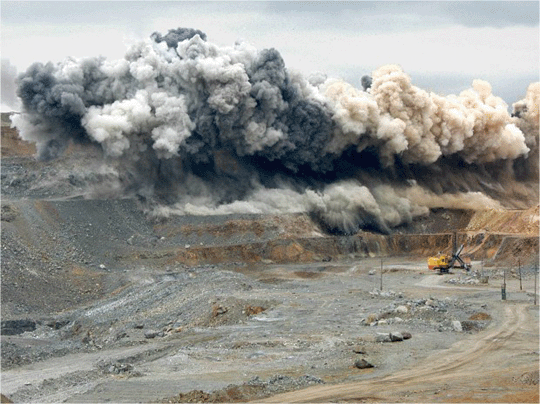 Uranium Mining Threatens the Karoo, Karoo Space, 18 Jan 16 By Dr Stefan Cramer Images sourced by Dr Stefan Cramer “…..According to its documents, Tasman RSA Mines today controls exclusive prospecting rights over more than 750 000 hectares in a circle of nearly 200 kilometres around Beaufort West.
About 32 000 hectares are directly owned under freehold by the company. Local farmers find it hard to resist purchase offers, as farming in this part of the Karoo is particularly difficult due to low rainfall and poor soils.
Unlike in fracking, farms are permanently damaged by uranium opencast mining………
So far the company has not indicated whether they would use ‘in-situ-leaching’, a particularly dangerous but low-cost method. Here, large quantities of leaching agent are injected underground. The uranium is dissolved and recovered in well fields.
The uranium deposits are scattered over large zone of 200 by 300 kilometres which will necessitate trucking of ores over poorly constructed dust roads for hundreds of kilometres to reach the Central Processing Plant.
For this plant, the company has already applied for a water licence to abstract annually 700 million litres of groundwater annually, roughly half of the total water consumption of the Central Karoo Municipality.
It is still unclear what will happen with the contaminated waste water. A discharge of radioactive waste water into the aquatic environment, above or below ground, would be illegal under South Africa’s strict Water Act.
Most probably contaminated slimes will be delivered to large settling ponds, like those around Johannesburg, from which the remaining water will evaporate. This leaves behind a soft and unstable pile of contaminated soil which can be easily mobilised by the strong prevailing winds in the Karoo into large dust dispersal.
Already today, the environment around Beaufort West is contaminated close to the previous mine sites. First field studies by the author show unprotected nuclear wastes with 10 to 20 times the background radiation.
Dust and Radiation – Two Deadly Impacts
The devastating impacts of uranium mining on people, especially the mine workers, and the environment have been well research and documented. Several studies of large number of cases and with exposure over many years (Wismut AG in the former East Germany, theColorado-Plateau in the USA, and Saskatchewan in Canada, have established a particular direct relationship between occupational exposure to uranium and its decay products and lung diseases.
Mining uranium ore in the Karoo will invariably create huge plumes of contaminated dust. Dust clouds are unavoidable during drilling, blasting and transporting.
Dust suppression by spraying water is only partially effective and creates new problems with contaminated slimes, adding to the environmental cost of groundwater abstraction……..http://karoospace.co.za/uranium-mining-threatens-the-karoo/
Nuclear waste dump a danger to water, threat to Nevada’s farming community
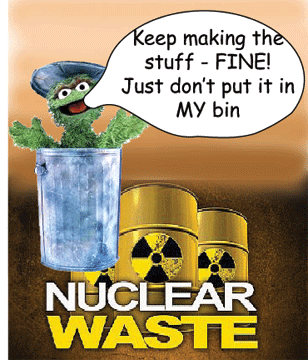 Nevada says national nuclear dump could harm farm community,Naples
Herald, By Associated PressNov 23, 2015 BY KEN RITTER LAS VEGAS (AP) —  Radioactive well-water contamination could threaten some 1,400 people in a rural farming community if federal regulators allow the nation’s deadliest nuclear waste to be buried in the Nevada desert, state officials said in a report issued Friday.
A 53-page document submitted to the U.S. Nuclear Regulatory Commission derides environmental assessments of the proposed Yucca Mountain repository as legally inadequate. It also characterizes the project itself as “an unworkable waste management plan at an unsafe repository site.”
“In the end, there are real people there,” said Robert Halstead, chief of the Nevada Agency for Nuclear Projects and the top state official leading opposition to the project.
“That’s the thing about the way the NRC has approached the whole process,” Halstead said Friday. “Their maps imply there is no population there. They label it as the Amargosa desert.”
George Gholson, chairman of the Timbisha Shoshone Tribe, submitted additional comments Friday accusing commission officials of failing to evaluate effects that building the project would have on tribal members.
“Radioactive contamination of groundwater and springs … affronts the Timbisha’s way of life, is disrespectful to cultural beliefs, and constitutes an environmental justice infringement on the rights of a sovereign nation,” the letter said.
The documents amount to the state staking its legal ground to oppose the Yucca Mountain project. They came on the last day of an environmental study comment period ahead of yet-to-be-scheduled licensing hearings and amid calls from some in Congress to restart the long-mothballed project.
Commission officials didn’t immediately respond to messages seeking comment.
More than three decades of study yielded findings that water seeping through tunnels containing some 77,000 tons of spent nuclear reactor waste could become contaminated and slowly migrate into groundwater west along the normally dry course of the ancient Amargosa River, toward Death Valley in California……..
A federal appeals court breathed new life into the project in 2013 with an order that the Nuclear Regulatory Commission either approve or reject the Energy Department license application.
Officials say a full slate of licensing hearings could take at least three years. http://naplesherald.com/2015/11/23/nevada-says-national-nuclear-dump-could-harm-farm-community/
Call on President Obama to protect precious groundwater from uranium mining in Grand Canyon
Huffington Post, 24 Nov 15, [Good maps] “…….The mining industry’s statement counts on readers to be ignorant
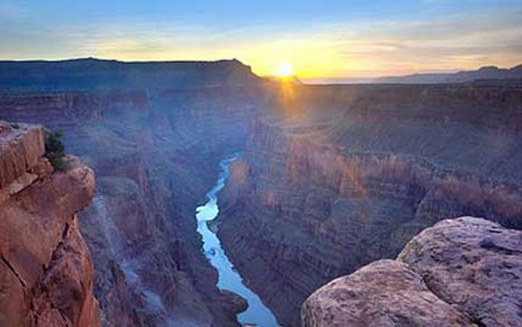 of the fact that federal and state agencies do not require wells to measure water pollution more than a thousand feet underground, where uranium mining threatens aquifers that feed springs deep within the Grand Canyon. No monitoring means contamination is undetected: out of sight, out of mind.
But that’s changing as the U.S. Geological Survey pieces together samples taken from existing wells and places where groundwater flows downward into the Grand Canyon. These show that mining has already polluted 15 springs and five wells within the Grand Canyon’s watershed with toxic levels of uranium.
As I’ve said with regards to oil and gas development, one well contaminated or one person made sick is one too many. The same is true for uranium mining, making the situation around the Grand Canyon a disaster where we can least afford one.
In 2012, this sorry history led my friend and fellow Coloradan, Interior Secretary Ken Salazar, to impose a 20-year ban on new uranium mining in the watersheds that drain directly into the Grand Canyon. His action came in response to thousands of new mining claims filed in the preceding decade. Science and prudence also guided his decision, coupled with the knowledge that nearly $1 billion in annual economic activity is generated by this greatest of earth’s geological treasures.
Need for Permanent Ban on Grand Canyon Uranium Mining
The bill aims to protect 1.7 million acres of historical tribal homeland, including water sources and sacred sites.
Unfortunately, there’s almost no chance that the legislation will gain approval in today’s gridlocked Congress. But the 1906 Antiquities Act gives the president unilateral authority to set aside federal lands as protected national monuments to stop the looting of archaeological sites and for reasons of “historic or scientific interest.”
I’ve long believed we will be judged by the nation we leave to future generations. After all, we don’t inherit the earth from our parents — we borrow it from our children. The president should act now to protect the Grand Canyon from irresponsible development around this national treasure.
The National Mining Association may not be willing to stop digging — literally or figuratively — but the president owes it to us all to help them.
Diablo Canyon nuclear plant – the industry’s last stand in California

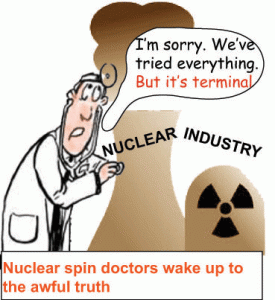 Nuclear power’s last stand in California: Will Diablo Canyon die?, SF Chronicle, By David R. Baker
The first of its two operating licenses from the federal government expires in 2024, the second a year later. Federal regulators are weighing whether to renew those licenses and keep Diablo humming through 2045. PG&E, however, appears to be having second thoughts.
And any extension will involve a fight. The plant sits within a maze of earthquake faults, all of them discovered after construction began in 1968. Seismic safety fears have dogged the nuclear industry in California for more than 50 years, forcing PG&E to abandon plans for one of its first reactors…… Continue reading
Precious Groundwater in Drought Areas Threatened by Uranium Mining
Why Are We Allowing Uranium Miners to Pollute Groundwater in Drought Zones?
 Uranium mining threatens aquifers that could provide the drought-stricken West with emergency water supplies. BRIAN PALMER OCT 16, 2015 Mining uranium, the fuel for nuclear reactors, is a dirty business. Following World War II, mining companies extracted millions of tons of uranium from Navajo tribal lands in the West, contaminating homes and water supplies in the process. It went on for decades, and Navajo miners developed lung cancer at very high rates.
Today, even as the United States nuclear power industry struggles to survive, uranium mining continues. The techniques are more modern, but conservationists say the threat could be just as insidious: polluting water supplies in drought-ridden parts of the country where drinking water is already alarmingly scarce.
New rules proposed by the federal government last year could help reduce the threat—although industry is fighting to weaken them, along with its Republican allies in Congress. And critics say the proposed regulations might not be strong enough anyhow. Ironically, this might all be happening to extract a resource we barely need anymore—at the risk of one that we most certainly do……..
The industry must now work with what geologists call “roll-fronts.” These are relatively thin uranium deposits that formed deep underground over the course of thousands of years. Typically just 10 to 30 feet in height—too small to be harvested by human miners—the roll-fronts can only be extracted by chemical means.
The process used today is called in situ recovery, or ISR, mining. (Opponents use the more chemically descriptive phrase “in situ leaching,” or ISL.) The mining company drills four or five holes, called injection wells, and then pumps down a mix of an oxidizing agent (often hydrogen peroxide or simple oxygen) and water. Pressure from the constant influx of fluid forces the solution to percolate through the uranium-rich layer of Earth toward another hole, called the production well, which carries it up to the surface. At this point, the company reverses the chemical reaction that dissolved the uranium, using a separate chemical to precipitate the metal out of the water. The water, now stripped of most of the uranium, heads back into the well to continue the cycle…….

In reality, ISR mining isn’t so tidy, and the few peer-reviewed studies available suggest that leaching uranium out of rocks contaminates the surrounding groundwater for decades. As Western states deal with increasing levels of drought, that’s a problem…….
Remediation is water- and time-intensive, but does it work? The answer is pretty disturbing: No one knows. There have been only a handful of major studies on the efficacy of the uranium-mining remediation process. Continue reading
Nuclear power station at Bradwell would damage the marine environment

 MP warning over new nuclear power station in Essex East Anglian Daily Times 25 September 2015 Matt Stott An Essex MP has claimed a new nuclear power station at Bradwell would cause “significant damage” to the marine environment. Harwich and North Essex MP Bernard Jenkin expressed concern over the impact the site would have on the region’s fishing industries and ecology.
His intervention comes days after Chancellor George Osborne indicated a £2 billion Government guarantee for Chinese investment in the proposed Hinkley Point C nuclear power plant in Somerset could pave the way for further deals, including a majority Chinese-owned nuclear generation facility at Bradwell.
It is thought the site, next to the former nuclear power station, could be shared with between owners EDF and Chinese firms to build and run a new nuclear plant.
Mr Jenkin said: “There should be no new nuclear at Bradwell, unless the concerns about damage to the estuary and storage of nuclear waste on site can both be unequivocally resolved. “There seems no way that a new nuclear power station would avoid significant damage to the marine environment in the estuary.
“When the Magnox station was decommissioned, there was explosive recovery in the marine environment. I have been informed that a new power station would take six times more flow of water than its predecessor.
“The estuary cannot supply the volume of cooling water without severely damaging the natural life-cycle of organisms in it. This jeopardises the ecology, our local fishing industries and goes against the aim of the Marine Conservation Zone.”
He added: “It is also a significant concern… that high level nuclear waste would have to be secured and stored on the site for some decades after a new facility has reached the end of its operating life, before it can be safely transported.
“This raises questions about how could it be stored safely over such a long period.”………http://www.eadt.co.uk/news/mp_warning_over_new_nuclear_power_station_in_essex_1_4246963
Salem nuclear plant cooling-water affecting the Delaware River
 New round of debate over Salem nuke’s water intake http://enviropoliticsblog.blogspot.com.au/2015/09/new-round-of-debate-over-salem-nukes.html#.Vf9Nq9KqpHw A regional environmental group set the stage Friday for a new round in the decades long battle over Salem nuclear plant cooling-water demands, submitting the most-detailed critique yet of the site’s 3-billion-gallon-per-day draw from the Delaware River. Jeff Montgomery reports for the The News Journal:
Delaware Riverkeeper, a multi-state environmental and conservation group, said New Jersey’s renewal of a federally required permit for the twin reactors’ intakes would be “irresponsible,” based on newly submitted and past economic and ecological studies.
How ionising radiation gets into water
by Gordon Edwards, Ph.D.
(1) When nuclear fuel is used in a nuclear reactor or an atomic bomb, the atoms in the fuel are “split” (or “fissioned”) to produce energy. The fission process is triggered by subatomic particles called neutrons. In a nuclear reactor, when the neutrons are stopped, the fission process also stops. This is called “shutting down the reactor.”
(2) But during the nuclear fission process, hundreds of new varieties of radioactive atoms are created that did not exist before. These unwanted radioactive byproducts accumulate in the irradiated nuclear fuel — and they are, collectively, millions of times more radioactive than the original nuclear fuel.
(3) These newly created radioactive materials are classified as fission products, activation products, and transuranic elements. Fission products — like iodine-131, cesium-137 and strontium-90 — are the broken pieces of atoms that have been split. Activation products— like hydrogen-3 (“tritium”), carbon-14 and cobalt-60 — are the result of non-radioactive atoms being transformed into radioactive atoms after absorbing one or more stray neutrons. Transuranic elements — like plutonium, neptunium, curium and americium — are created by transmutation after a massive uranium atom absorbs one or more neutrons to become an even more massive atom (hence “transuranic,” meaning “beyond uranium”).
(4) Because of these intensely radioactive byproducts, irradiated nuclear fuel continues to generate heat for years after the fission process has stopped. This heat (“decay heat”) is caused by the ongoing atomic disintegration of the nuclear waste materials. No one knows how to slow down or shut off the radioactive disintegration of these atoms, so the decay heat is literally unstoppable. But decay heat does gradually diminish over time, becoming much less intense after about 10 years.
(5) However, in the early years following a reactor shutdown, unless decay heat is continually removed as quickly as it is being produced, the temperature of the irradiated fuel can rise to dangerous levels — and radioactive gases, vapors and particles will be given off into the atmosphere at an unacceptable rate.
(6) The most common way to remove decay heat from irradiated fuel is to continually pour water on it. Tepco is doing this at the rate of about 400 tons a day. That water becomes contaminated with fission products, activation products and transuranic elements. Since these waste materials are radiotoxic and harmful to all living things, the water cannot be released to the environment as long as it is contaminated.
(7) Besides the 400 tons of water used daily by Tepco to cool the melted cores of the three crippled reactors, another 400 tons of ground water is pouring into the damaged reactor buildings every day. This water is also becoming radioactively contaminated, so it too must be stored pending decontamination.
(8) Tepco is using an “Advanced Liquid Processing System” (ALPS) that is able to remove 62 different varieties of radioactive materials from the contaminated water — but the process is slow, removal is seldom 100 percent effective, and some varieties of radioactive materials are not removed at all.
(9) Tritium, for example, cannot be removed. Tritium is radioactive hydrogen, and when tritium atoms combine with oxygen atoms we get radioactive water molecules. No filtration system can remove the tritium from the water, because you can’t filter water from water. Released into the environment, tritium enters freely into all living things.
(10) Nuclear power is the ultimate example of the throwaway society. The irradiated fuel has to be sequestered from the environment of living things forever. The high-quality materials used to construct the core area of a nuclear reactor can never be recycled or reused but must be perpetually stored as radioactive waste. Malfunctioning reactors cannot be completely shut off because the decay heat continues long after shutdown. And efforts to cool a badly crippled reactor that has melted down result in enormous volumes of radioactively contaminated water that must be stored or dumped into the environment. No wonder some have called nuclear power “the unforgiving technology.”…….http://akiomatsumura.com/2013/06/experts-explain-effects-of-radioactive-water-at-fukushima.html
Uranium mining’s threat to Grand Canyon’s groundwater
Claims that uranium mining near the Grand Canyon is safe don’t hold water, Guardian, David Kreamer, 25 Aug 15 Science shows we can’t assume that uranium deposits, when disturbed by mining, can’t leak into groundwater. We should be wary of claims to the contrary It only takes a few Grand Canyon hikes to realize the importance of its springs and other water sources. When refilling a water bottle in the cool depths below multi-colored rock walls, listening to a summer frog symphony at sunset or maybe snapping an icicle from a weeping ledge in winter, it’s clear that the living desert depends on its pockets of water.
That’s why, as a hydrologist and longtime Grand Canyon hiker, boatman and scientist, I am profoundly concerned about continued uranium mining in or near it. It has great potential to irreparably harm Grand Canyon springs and the plants and animals that depend on them.
I am concerned because industry and agency officials are relying on a justification that isn’t supported by past investigations, research or data to promote uranium mining in the Grand Canyon region. Specifically, they claim that mining will have minimal impact on springs, people and ecosystems there.
Instead, the science shows that it is unreasonable to assume that uranium deposits, when disturbed by mining, can’t leak into groundwater. The deposits in the Grand Canyon are typically found in geologic features known as breccia pipes, formed millennia ago when caves in the main groundwater system collapsed, leaving shattered, rock-filled chimneys that extend upwards thousands of feet to the canyon’s rim. These chimneys act as conduits that have allowed groundwater to move vertically through the rock layers over thousands of years. The vertical movement of groundwater combined with low oxygen levels caused the uranium deposits to form over millennia. Inserting a mine shaft into these features disrupts geologic formations, increases the permeability and oxygenation of these vertical pipes and increases the ability of ore deposits to be suddenly dissolved, mobilized and carried with groundwater.
It is unreasonable to assume that elevated concentrations of dissolved uranium cannot be mobilized and will not reach the Grand Canyon’s springs. It is also risky for industry to assume that mining activities, such as the sinking of mining shafts and pumping of groundwater, have no potential to redirect groundwater movement and negatively impact spring flow and associated wildlife habitats……..
Some mining representatives have implied that the cosmetic fix of cleaning up the surface of old mining sites is evidence of zero subsurface pollution. But because groundwater flow can be very slow, the effects of groundwater contamination may take years, decades or even centuries to fully manifest. The lack of clear and consistent groundwater monitoring undercuts industry claims that mining near the Grand Canyon has caused and will cause no harm……….http://www.theguardian.com/commentisfree/2015/aug/25/uranium-mining-grand-canyon-groundwater-contamination
USA government makes rules on ionising radiation in water more lax
EPA raises permissible levels of radiation in drinking water https://thewrongblogg.wordpress.com/2015/08/04/epa-raises-permissible-levels-of-radiation-in-drinking-water/ The White House has given final approval for dramatically raising permissible radioactive levels in drinking water and soil following “radiological incidents,” such as nuclear power-plant accidents and dirty bombs. The final version, slated for Federal Register publication as soon as today, is a win for the nuclear industry which seeks what its proponents call a “new normal” for radiation exposure among the U.S population, according Public Employees for Environmental Responsibility (PEER).
Issued by the Environmental Protection Agency, the radiation guides (called Protective Action Guides or PAGs) allow cleanup many times more lax than anything EPA has ever before accepted. These guides govern evacuations, shelter-in-place orders, food restrictions and other actions following a wide range of “radiological emergencies.” The Obama administration blocked a version of these PAGs from going into effect during its first days in office. The version given approval late last Friday is substantially similar to those proposed under Bush but duck some of the most controversial aspects: Continue reading
US Nuclear plants doing Problem Evaluation Reports on ‘complex and urgent’ situation of water seepage
Gov’t: Erosion is “undermining foundation” of major dam upstream of US nuclear plants — “Extensive network” of seepage paths found — “Water flowing through from multiple sources & multiple directions” — Nuclear plants doing Problem Evaluation Reports on ‘complex and urgent’ situation (VIDEO) http://enenews.com/govt-erosion-undermining-foundation-major-dam-upstream-nuclear-plants-extensive-network-seepage-paths-discovered-water-flowing-multiple-sources-multiple-directions-nuclear-plants-doing-proble?utm_source=feedburner&utm_medium=email&utm_campaign=Feed%3A+ENENews+%28Energy+News%29
TVA’s Boone Dam repair announcement, Jul 30, 2015 (emphasis added):
- 2:30 — The location of this sinkhole and the presence of the sediment… really raised the possibility of a safety concern with the dam… The initial investigation showed that we had internal erosion. A phenomenon called ‘piping’ where voids from water flowing through the dam — more of a stream-like effect — than just seepage. Internal erosion is one of the leading causes of dam failures around the world. So we knew that we had to do something here to protect the safety of the public… particularly downstream risk… Around the clock inspectors [are] keeping surveillance on the dam [and we have] sensors to monitor movements that might occur in the dam itself.
- 4:00 — One of the key findings so far is that water is flowing through the foundation from multiple sources, and in multiple directions. It’s actually seeping through porous rock — rainwater upstream, through porous rock, through the dam…
- 9:15 — There’s still a lot of unknowns as we move into the project.
- 21:30 — There’s only 3 companies in the world that do this kind of remediation.That’s the complexity we’re talking about.
- 24:00 — Reporter: You said that water was coming from multiple sources and moving in multiple directions. To the people who are watching… I would think they would think that seems like an impossible task to do. There are some… in this community who think… that Boone Dam can’t be fixed… Is there a possibility that these solutions that you’re proposing won’t work?
TVA’s Boone Dam Investigation and Analysis Summary: [There is] “internal erosion,” in which voids develop within a dam and/or its foundation because of the action of flowing groundwater… one of the leading causes of dam failures… March of 2015, TVA discovered a well-developed, complex network of groundwater seepage paths coming from sources other than the reservoir… surface runoff flows underneath the dam and is a leading contributor to the observed seepage and sinkhole… Further investigation has confirmed that deterioration of the cutoff trench has occurred as seepage flows continue to undermine the foundation of the embankment dam… If left unaddressed, continued internalerosion may lead to enlargement of the network of voids at which time a large influx of water into the voids could cause rapid acceleration of internal erosion and eventual breaching of the dam. Due to the complex and urgent nature of the situation at Boone Dam, TVA has complemented its own dam safety engineers with nationally recognized experts… In its current state, the dam cannot be relied upon to serve the functions for which it was constructed. In the unlikely event of a dam failure, risks to the public wouldinclude: … loss of critical infrastructure [and] potential loss of life… [We are] engaging local and state emergency management officials… developing specific plans to address potential emergencies and conducting mock exercises to execute those plans. TVA has also initiated efforts to reinforce downstream facilities in a way that will minimize potential risks from an unlikely failure of Boone Dam.
TVA’s Boone Dam Weekly Update, Jun 23, 2015: Our investigation has shown that more water is seeping through the foundation of the dam than would typically be expected. A contributor to the seepage is the high water table from the area just east of the dam. Both sources of seepage and subsequent erosion have created an extensive network of seepage paths beneath the dam… TVA Dam Safety experts [are] working to understand the extent of the seepage and erosion…
Sequoyah Nuclear Plant – NRC Integrated Inspection Report (pdf), Feb 4, 2015: For the five operability evaluations described in the problem evaluation reports (PERs) listed below, the inspectors evaluated the technical adequacy of the evaluations… The inspectors completed five samples [including] PER 952079 – Functional Evaluation of Boone Dam Sinkhole.
Watts Bar Nuclear Plant – NRC Integrated Inspection Report (pdf), Feb 9, 2015: The inspectors reviewed the operability evaluations affecting risk-significant mitigating systems listed below [including] PER 952103 for the discovery of a sinkhole and tailwater sediment at the Boone Dam.
Concern for health, as radiation found in Greene County stream near water supply
Radiation found in Greene County stream near water supply Biologist concerned about residents’ health By Paul Van Osdol, Pittsburgh’s Action News Jul 16, 2015 FREDERICKTOWN, Pa. —Action News Investigates has learned high levels of radiation — up to 60 times higher than the maximum allowed in drinking water — have been found in a stream that feeds into a water treatment plant. VIDEO: Watch Paul Van Osdol’s report
The high levels of radiation were found in a Greene County stream that flows into the Monongahela River. Ultimately, that water ends up in Pittsburgh.
Ken Dufalla of the Izaak Walton League conservation group has been taking samples from 10 Mile Creek for years, frequently finding high levels of total dissolved solids.
“I wouldn’t touch it. As you can see, I try to keep my hands off it all I can because I don’t know what’s in this water,” Dufalla said.
To find out exactly what is in the water, he pressed the state Department of Environmental Protection to do comprehensive testing.
The results showed levels of radium 226 and radium 228 totaling 327 picocuries per liter at one location, and 301 picocuries per liter of radium 226 at another location.
In plain English, that means both samples had 60 times the EPA drinking water standard of 5 picocuries per liter.
“There’s something in here that’s not supposed to be here,” Dufalla said.
Ten Mile Creek feeds into the Mon River near Fredericktown. Less than a mile down river is a water treatment plant, and that is a major concern for regulators and area residents.
John Stolz, a biologist at Duquesne University, says radium can be hazardous.
“The reality is, if it’s getting into the water that is being used as a source of drinking water, then it is a problem,” Stolz said.
One big problem is water authorities cannot easily get rid of radium through the standard filtering process.
Tests by the Tri-County Joint Municipal Authority last year found low levels of radium 228 — just 1 picocurie per liter. But the authority did not test for radium 226, and it did not do any radium testing in 2012 or 2013.
It’s not just drinking water that’s a concern. The Izaak Walton League canceled plans to stock 10 Mile Creek with trout this year after consulting with state officials.
“Do you want to eat fish that has radiation in it? It’s that simple,” Dufalla said………
The DEP is concerned enough that it is also doing additional testing of water, fish and wildlife in the area.
“We’re trying to attack this from every possible angle to see what the extent of the contamination is, if there is extensive contamination, what it’s affecting, and tracking it down,” Poister said.
The DEP is especially interested in finding the source of the radiation. Stolz says the test results offer a clue.
“It’s highly suggestive that it may be due to drilling operations, or at least the wastewater,” Stolz said……… http://www.wtae.com/news/radiation-found-in-greene-county-stream-near-water-supply/34205428
Energy inefficiency and hot water pollution in Entergy’s Pilgrim Nuclear Power Station
OF NUCLEAR INTEREST: Energy efficiency and Pilgrim Nuclear http://cambridge.wickedlocal.com/article/20150612/NEWS/150619852 The inefficiency of Entergy’s Pilgrim Nuclear Power Station is overlooked when it comes to figuring out how we can use our resources in a more economically and environmentally sound manner. By Brian Boyle, William Maurer and Meg Sheehan Cape Cod Bay Watch
Energy efficiency is on everyone’s mind these days. State and federal government programs incentivize homeowners and businesses to become more energy efficient. Yet, the inefficiency of Entergy’s Pilgrim Nuclear Power Station is overlooked when it comes to figuring out how we can use our resources in a more economically and environmentally sound manner.
An investigation into Pilgrim’s efficiency uncovered that about two-thirds (66 percent) of the heat energy produced is dumped into Cape Cod Bay as waste heat.
Pilgrim generates electricity by boiling water using nuclear fission, which creates steam. The steam runs turbines that make electricity. The cooling water Pilgrim needs for condensing the steam back into water comes from Cape Cod Bay: up to 510 million gallons every day. The water from Cape Cod Bay absorbs excess heat during the process of making electricity, and is pumped back into the Bay about 30 degrees Fahrenheit hotter.
Only about one-third (34 percent) of the heat energy produced at Pilgrim is converted into electricity for consumers. At this rate, Pilgrim is about as efficient as a typical coal fired power plant.
Entergy’s wasteful operations are sanctioned under an outdated Clean Water Act permit issued by U.S. Environmental Protection Agency (EPA) and the state. EPA and the state allow Entergy to use an inefficient, outdated “once-through” cooling water system to withdraw cooling water from Cape Cod Bay, instead of requiring a more efficient, updated closed-loop system. Pilgrim has been using this outdated cooling water system since it started operating in 1972. The hot water – or wasted energy – that Entergy dumps into Cape Cod Bay harms marine resources and pollutes our ocean.
Entergy’s use of Cape Cod Bay for cooling water is supposed to be tightly regulated by EPA and the state, to make sure Pilgrim uses the best technologies available that reduce environmental harm. However, since 1972, EPA and the state have not required any updates to Pilgrim’s cooling technology, and have let Entergy’s Clean Water Act permit expire in 1996 – almost two decades ago.
To put Pilgrim’s inefficiency and wastefulness into perspective, here is a comparison. The amount of heat energy Entergy dumps into the Bay each year – about 42 trillion BTUs – is enough to heat 437,800 homes every year with fuel oil. That’s more than four times the number of households on the Cape and Islands, and more than two times the number of households in Plymouth County.
The volume of water Entergy dumps into the Bay each year is more than enough to run a shower in every household on the Cape and Islands every day, all day, all year long. It is also 100 times more than the town of Plymouth’s Water Department pumps to meet the entire town’s municipal and domestic water requirements each year.
Abandon Great Lakes Nuclear Dump Plan – urge Great Lakes Waterkeepers and Waterkeeper Alliance
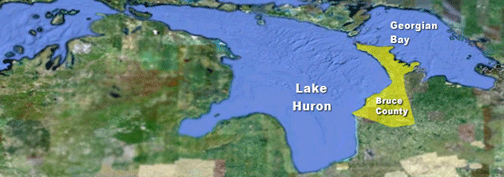 Great Lakes Waterkeepers and Waterkeeper Alliance Urge Canadian Authorities to Ditch the Great Lakes Nuclear Dump http://waterkeeper.org/2015/05/27/great-lakes-waterkeepers-and-waterkeeper-alliance-urge-canadian-authorities-to-ditch-the-great-lakes-nuclear-dump/ May 27 2015 by Maia Raposo Groups Renew Plea to U.S. Secretary of State to Oppose Threat to Drinking Water Supply for 40 Million People
NEW YORK, NY – May 27, 2015 – Environmentalists in the Great Lakes Basin are opposed to a new report from a Canadian Joint Review Panel that has called for the support of the Canadian Minister of the Environment to approve a deep geological repository for nuclear waste in Kincardine, Ontario due to its proximity to drinking water supplies for 40 million people in the United States and Canada. The proposed plan from Ontario Power Generation (OPG) is to store underground radioactive nuclear waste less than one mile from the shores of Lake Huron. Canadian officials are getting closer to approving this hazardous project and could even fast track the authorization of a final license within the next few months.
Under the Binational Great Lakes Water Quality Agreement (amended in 2012), both Canada and the US acknowledge the importance of anticipating, preventing, and responding to threats to the waters of the Great Lakes. Both countries share the responsibility and obligation to protect these shared waters from pollution.
“Great Lakes Waterkeepers and Waterkeeper Alliance oppose this project, which could threaten the drinking water supply of 40 million Americans and Canadians,” said Bob Burns, Detroit Riverkeeper. “We ask the U.S. State Department to stand with the citizens, local and state governments, and other stakeholders in the Great Lakes Basin whose voices have not yet been heard but who are at risk if the deep geological repository fails.”
Last September, the groups wrote to Secretary of State John Kerry and Canadian officials urging them to vote against this nuclear storage facility.
“With the Great Lakes containing 95% of the North America’s supply of fresh surface water, this is one of the worst possible locations for a permanent nuclear waste burial facility,” stated Doug Martz, St. Clair Channelkeeper. “Ontario Power Generation, the project proponent, did not investigate any other sites for this repository, but rather, selected the site based on the willingness of one local community. Furthermore, approval of this facility would set a devastating precedent for allowing other nuclear waste repositories to be located in the Great Lakes Basin.”
Marc Yaggi, executive director of Waterkeeper Alliance added: “The Great Lakes are suffering from failing infrastructure, contamination leaching from historical industrial and nuclear waste sites, ongoing agricultural pollution and invasive species. Intentionally siting a new toxic nuclear waste site in such close proximity to the largest fresh water system in the world would severely imperil the water security of two nations. The time to act is now, and we call again on Secretary Kerry to take action.”
The eight Waterkeeper organizations in the Great Lakes support proposed resolutions in the U.S. House of Representatives and Senate to urge government action to ensure that the Canadian Government does not permanently store nuclear waste underground in the Great Lakes Basin.
Contacts:
Tina Posterli, Waterkeeper Alliance, tposterli@waterkeeper.org, 516.526.9371
Doug Martz, St. Clair Channelkeeper, channelkeeper@wowway.com, 586.764.2443
Bob Burns, Detroit Riverkeeper, rlb315@comcast.net, 734.676.4626
###
Waterkeeper Alliance is a global movement uniting more than 250 Waterkeeper organizations around the world and focusing citizen advocacy on issues that affect our waterways, from pollution to climate change. Waterkeepers patrol and protect more than 2 million square miles of rivers, streams and coastlines in the Americas, Europe, Australia, Asia and Africa. For more information please visit:www.waterkeeper.org
The 8 Waterkeeper organizations in the Great Lakes are: Buffalo Niagara Riverkeeper, Detroit Riverkeeper, Grand Traverse Baykeeper, Lake Erie Waterkeeper, Milwaukee Riverkeeper, St. Clair Channelkeeper, Upper St. Lawrence Riverkeeper and Yellow Dog Riverkeepe
Large amount of radioactive cesium in Fukushima water purification center
 Nearly 6,000 Bq/kg of Cs-134/137 detected from melted slag of water purification center in Fukushima Fukushima Diary, On 4/30/2015, Fukushima prefectural government announced 5,645 Bq/Kg of Cesium-134/137 was detected from melted slag of a water purification center.
The sampling date was 3/12/2015. Because it contains 1,383 Bq/Kg of Cs-134, it is certainly from Fukushima nuclear plant.
The second highest reading of this March was 3,786 Bq/Kg. This water purification center is located in Koriyama city.
Cs-134/137 have been measured from melted slag of this purification center everyday since the beginning of this year…….http://fukushima-diary.com/2015/05/nearly-6000-bqkg-of-cs-134137-detected-from-melted-slag-of-water-purification-center-in-fukushima/
1 This Month

of the week – Shut Down Drone Warfare!


Tell the Ukrainian Government to Drop Prosecution of Peace Activist Yurii Sheliazhenko

Petition to revoke the licensing of the Near Surface Nuclear Disposal Facility (NSDF) at Chalk River. https://www.ourcommons.ca/petitions/en/Petition/Details?Petition=e-7247
To see nuclear-related stories in greater depth and intensity – go to https://nuclearinformation.wordpress.com
-
Archives
- April 2026 (91)
- March 2026 (251)
- February 2026 (268)
- January 2026 (308)
- December 2025 (358)
- November 2025 (359)
- October 2025 (376)
- September 2025 (257)
- August 2025 (319)
- July 2025 (230)
- June 2025 (348)
- May 2025 (261)
-
Categories
- 1
- 1 NUCLEAR ISSUES
- business and costs
- climate change
- culture and arts
- ENERGY
- environment
- health
- history
- indigenous issues
- Legal
- marketing of nuclear
- media
- opposition to nuclear
- PERSONAL STORIES
- politics
- politics international
- Religion and ethics
- safety
- secrets,lies and civil liberties
- spinbuster
- technology
- Uranium
- wastes
- weapons and war
- Women
- 2 WORLD
- ACTION
- AFRICA
- Atrocities
- AUSTRALIA
- Christina's notes
- Christina's themes
- culture and arts
- Events
- Fuk 2022
- Fuk 2023
- Fukushima 2017
- Fukushima 2018
- fukushima 2019
- Fukushima 2020
- Fukushima 2021
- general
- global warming
- Humour (God we need it)
- Nuclear
- RARE EARTHS
- Reference
- resources – print
- Resources -audiovicual
- Weekly Newsletter
- World
- World Nuclear
- YouTube
-
RSS
Entries RSS
Comments RSS
 nuclear-news