Bipartisan House group asks Biden to stop Canada’s Great Lakes nuclear storage plans
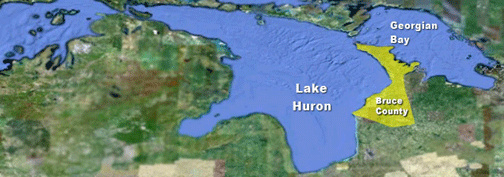
Bipartisan House group asks Biden to stop Canada’s Great Lakes nuclear storage plans, The Hill, BY SHARON UDASIN – 09/17/21 01:20 PM EDTRep. Dan Kildee (D-Mich.) is calling on the Biden administration to stop the Canadian government from storing nuclear waste in the Great Lakes Basin.
The Nuclear Waste Management Organization (NWMO), a nonprofit established by the Canadian government, recently unveiled plans to construct a site that “would permanently store more than 50,000 tons of high-level nuclear waste” in the town of South Bruce, Ontario, Kildee’s office said.
South Bruce, located within the Great Lakes Basin, is about 30 miles east of Lake Huron.
Kildee in a release from his office described high-level nuclear waste as “the most dangerous form of nuclear waste,” and said that if an accident involving such waste occurred in the Great Lakes region, it could take a catastrophic toll on public health in surrounding U.S. and Canadian communities.
“The Great Lakes are central to our way of life, and permanently storing nuclear waste so close to our shared waterways puts our economies and millions of jobs at risk in the fishing, boating and tourism industries,” Kildee said. “People in both the U.S. and Canada depend on the Great Lakes for drinking water, which could be contaminated if there ever was a nuclear waste incident.”
Kildee is offering a bipartisan resolution asking President Biden to work with the Canadian government to stop the plans for the storage. The resolution is co-sponsored by 11 Democrats and nine Republicans from states surrounding the Great Lakes.
“From recreational activities to economic opportunities, the Great Lakes are integral to our daily lives, and a spill of hazardous materials would be devastating to communities across the state,” one of the co-sponsors, Rep. Peter Meijer (R-Mich.), said in a statement. “We must continue to urge our Canadian allies to find an alternative storage site for nuclear waste.”
Tribal Chief Tim Davis, of the Michigan-based Saginaw Chippewa Indian Tribe, added his concerns, noting his community’s ongoing work “to eliminate the continuing threat of nuclear waste being deposited into Mother Earth so close to the largest fresh water repository on Earth.”………. https://thehill.com/policy/equilibrium-sustainability/572764-bipartisan-house-group-asks-biden-to-stop-canadas-great
Where’s the water coming from? In dry East Anglia, EDF has no solution for Sizewell nuclear power’s insatiable thirst.

EDF have announced yet another consultation, running for 3 weeks from 3rd to 27th August, this time it’s …Where’s the water coming from? One would think after nearly a decade of planning and many questions on ‘Where’s the Water coming from?’ EDF would have this sorted but NO.
Northumbrian Water/Essex & Suffolk Water have announced they cannot supply the ever increasing amounts of water needed to build SZC and will need several years to install over 20km of piping from the River Waveney to the site. We all know East Anglia is one of the driest areas in the country and members of TASC have been posing the question for years, see our response to Deadline 2.
As far back as Jan 2017 The Economist published an article on mains water at SZC, it makes for an interesting read, then as far back as 2010 TASC’s own Joan Girling was asking the very same question Where’s the water coming from?’
TASC (accessed) 17th Aug 2021
EDF launch yet another Consultation ~ Respond by 27th August
California’s Pacific Gas and Electric Company (PG and E) settles over nuclear plant’s environmental violations.
California company agrees to 5.9-mln-dollar settlement over nuclear plant’s environmental damage http://www.xinhuanet.com/english/northamerica/2021-06/25/c_1310027301.htm, Xinhua| 2021-06-25 Editor: huaxia LOS ANGELES, — California’s Pacific Gas and Electric Company (PG&E) has agreed recently on a 5.9-million-U.S.-dollar settlement for once-through cooling water discharges from its Diablo Canyon nuclear power plant.
The settlement, reached with the Central Coast Regional Water Quality Control Board, was the result of a thorough Water Board investigation into alleged violations stemming from the plant’s use of water from the Pacific Ocean in its cooling system since 1985 and was officially filed on May 25 with the San Luis Obispo Superior Court.
According to Thursday’s report by Cal Coast News, the nuclear power plant takes in water from sea to condense steam after it passes through two electrical generators in a process called “once-through cooling” and the used water is then released back into the ocean.
Under the power plant’s local permit, public water was allowed to be piped from nearby sea area into the ocean, but environmentalists argued the discharge of water into the ocean harmed marine life.
Ailene Voisin, spokesperson for the Central Coast Regional Water Quality Control Board, estimated the thermal discharge to be about 20 degrees Fahrenheit (11.1 degrees centigrade) above the ambient ocean temperature in that area and that alterations to the nearby ecosystem “are well-documented and well-understood,” yet with “no feasible technological alternatives or modifications.”
Another problem was that the induction system that pumps water from Diablo Canyon into the power plant also sucked up an estimated 1.5 billion fish larvae per year, causing disruptions to the reproductive cycle of local fish.
The Water Board said in a press release on June 18 that the settlement funds received from PG&E would be used for water quality projects that benefit the region. In addition to the settlement, the release indicated that PG&E had also been making yearly payments to mitigate the issues from their overheated discharges.
This is what uranium and radon, do in drinking water
 Dr. Hans Frehly 1 May 2020, People who are exposed to relatively high levels of radionuclides in drinking water for long periods may develop serious health problems, such as cancer, anemia, osteoporosis, cataracts, bone growths, kidney disease, liver disease and impaired immune systems. https://agrilifeextension.tamu.edu/library/water/drinking-water-problems-radionuclides/
 Nuclear lobby attacks Australia’s Nuclear Prohibition laws
Jim Green, Online Opinion, 27 Feb 2020, https://onlineopinion.com.au/view.asp?article=20758&page=0
Nuclear power in Australia is prohibited under the Environmental Protection and Biodiversity Conservation (EPBC) Act 1999. A review of the EPBC Act is underway and there is a strong push from the nuclear industry to remove the bans. However, federal and state laws banning nuclear power have served Australia well and should be retained.
 Too cheap to meter or too expensive to matter? Laws banning nuclear power has saved Australia from the huge costs associated with failed and failing reactor projects in Europe and North America, such as the Westinghouse project in South Carolina that was abandoned after the expenditure of at least A$13.4 billion. The Westinghouse / South Carolina fiasco could so easily have been replicated in any of Australia’s states or territories if not for the legal bans.
There are many other examples of shocking nuclear costs and cost overruns, including:
* The cost of the two reactors under construction in the US state of Georgia has doubled and now stands at A$20.4‒22.6 billion per reactor.
* The cost of the only reactor under construction in France has nearly quadrupled and now stands at A$20.0 billion. It is 10 years behind schedule.
* The cost of the only reactor under construction in Finland has nearly quadrupled and now stands at A$17.7 billion. It is 10 years behind schedule.
* The cost of the four reactors under construction in the United Arab Emirates has increased from A$7.5 billion per reactor to A$10‒12 billion per reactor.
* In the UK, the estimated cost of the only two reactors under construction is A$25.9 billion per reactor. A decade ago, the estimated cost was almost seven times lower. The UK National Audit Office estimates that taxpayer subsidies for the project will amount to A$58 billion, despite earlier government promises that no taxpayer subsidies would be made available.
Nuclear power has clearly priced itself out of the market and will certainly decline over the coming decades. Indeed the nuclear industry is in crisis ‒ as industry insiders and lobbyists freely acknowledge. Westinghouse ‒ the most experienced reactor builder in the world ‒ filed for bankruptcy in 2017 as a result of catastrophic cost overruns on reactor projects. A growing number of countries are phasing out nuclear power, including Germany, Switzerland, Spain, Belgium, Taiwan and South Korea.
Rising power bills: Laws banning nuclear power should be retained because nuclear power could not possibly pass any reasonable economic test. Nuclear power clearly fails the two economic tests set by Prime Minister Scott Morrison. Firstly, nuclear power could not possibly be introduced or maintained without huge taxpayer subsidies. Secondly, nuclear power would undoubtedly result in higher electricity prices.
 Nuclear waste streams: Laws banning nuclear power should be retained because no solution exists to for the safe, long-term management of streams of low-, intermediate- and high-level nuclear wastes. No country has an operating repository for high-level nuclear waste. The United States has a deep underground repository for long-lived intermediate-level waste ‒ the only operating deep underground repository worldwide ‒ but it was closed from 2014‒17 following a chemical explosion in an underground waste barrel. Safety standards and regulatory oversight fell away sharply within the first decade of operation of the U.S. repository ‒ a sobering reminder of the challenge of safely managing dangerous nuclear wastes for tens of thousands of years.
 Too dangerous: The Fukushima and Chernobyl disasters results in the evacuation of over half a million people and economic costs in the hundreds of billions of dollars. In addition to the danger of nuclear reactor meltdowns and fires and chemical explosions, there are other dangers. Doubling nuclear output by the middle of the century would require the construction of 800−900 reactors. These reactors not only become military targets but they would produce over one million tonnes of high-level nuclear waste containing enough plutonium to build over one million nuclear weapons.
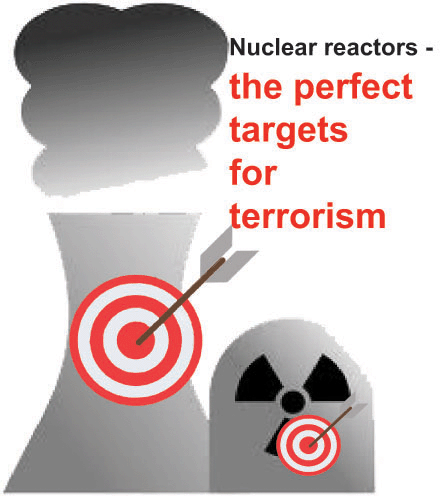 Pre-deployed terrorist targets: Nuclear power plants have been described as pre-deployed terrorist targets and pose a major security threat. This in turn would likely see an increase in policing and security operations and costs and a commensurate impact on civil liberties and public access to information. Other nations in our region may view Australian nuclear aspirations with suspicion and concern given that many aspects of the technology and knowledge-base are the same as those required for nuclear weapons.
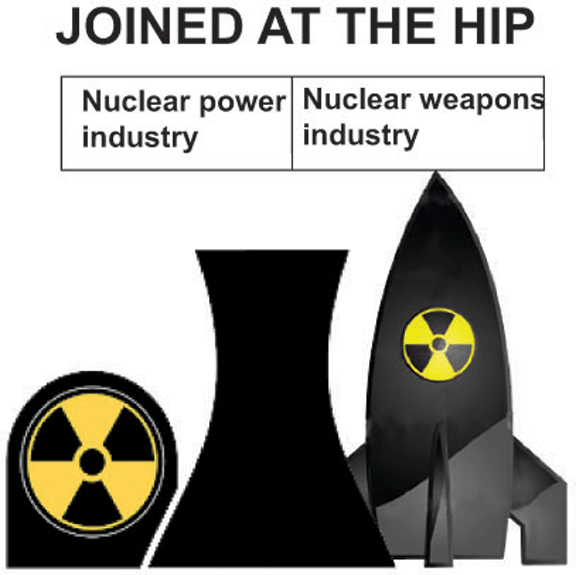 Former US Vice President Al Gore summarised the proliferation problem: “For eight years in the White House, every weapons-proliferation problem we dealt with was connected to a civilian reactor program. And if we ever got to the point where we wanted to use nuclear reactors to back out a lot of coal … then we’d have to put them in so many places we’d run that proliferation risk right off the reasonability scale.”
Too slow: Expanding nuclear power is impractical as a short-term response to climate change. An analysis by Australian economist Prof. John Quiggin concludes that it would be “virtually impossible” to get a nuclear power reactor operating in Australia before 2040. More time would elapse before nuclear power has generated as much as energy as was expended in the construction of the reactor: a University of Sydney report concluded that the energy payback time for nuclear reactors is 6.5‒7 years. Taking into account planning and approvals, construction, and the energy payback time, it would be a quarter of a century or more before nuclear power could even begin to reduce greenhouse emissions in Australia (and then only assuming that nuclear power displaced fossil fuels).
Too thirsty: Nuclear power is extraordinarily thirsty. A single nuclear power reactor consumes 35‒65 million litres of water per day for cooling.
Water consumption of different energy sources (litres / kWh):
* Nuclear 2.5
* Coal 1.9
* Combined Cycle Gas 0.95
* Solar PV 0.11
* Wind 0.004
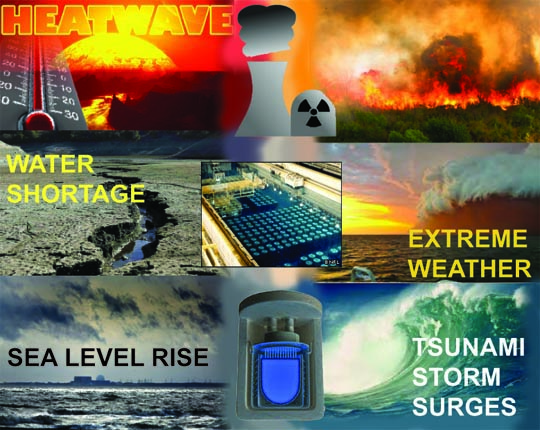
Climate change and nuclear hazards: Nuclear power plants are vulnerable to threats which are being exacerbated by climate change. These include dwindling and warming water sources, sea-level rise, storm damage, drought, and jelly-fish swarms. Nuclear engineer David Lochbaum states. “I’ve heard many nuclear proponents say that nuclear power is part of the solution to global warming. It needs to be reversed: You need to solve global warming for nuclear plants to survive.”
In January 2019, the Climate Council, comprising Australia’s leading climate scientists and other policy experts, issued a policy statement concluding that nuclear power plants “are not appropriate for Australia – and probably never will be”.
By contrast, the REN21 Renewables 2015: Global Status Report states that renewable energy systems “have unique qualities that make them suitable both for reinforcing the resilience of the wider energy infrastructure and for ensuring the provision of energy services under changing climatic conditions.”
 First Nations: Laws banning nuclear power should be retained because the pursuit of a nuclear power industry would almost certainly worsen patterns of disempowerment and dispossession that Australia’s First Nations have experienced ‒ and continue to experience ‒ as a result of nuclear and uranium projects.
To give one example (among many), the National Radioactive Waste Management Act dispossesses and disempowers Traditional Owners in many respects: the nomination of a site for a radioactive waste dump is valid even if Aboriginal owners were not consulted and did not give consent; the Act has sections which nullify State or Territory laws that protect archaeological or heritage values, including those which relate to Indigenous traditions; the Act curtails the application of Commonwealth laws including the Aboriginal and Torres Strait Islander Heritage Protection Act 1984 and the Native Title Act 1993 in the important site-selection stage; and the Native Title Act 1993 is expressly overridden in relation to land acquisition for a radioactive waste dump.
No social license: Laws banning nuclear power should be retained because there is no social license to introduce nuclear power to Australia. Opinion polls find that Australians are overwhelmingly opposed to a nuclear power reactor being built in their local vicinity (10‒28% support, 55‒73% opposition); and opinion polls find that support for renewable energy sources far exceeds support for nuclear power (for example a 2015 IPSOS poll found 72‒87% support for solar and wind power but just 26% support for nuclear power). As the Clean Energy Council noted in its submission to the 2019 federal nuclear inquiry, it would require “a minor miracle” to win community support for nuclear power in Australia.
The pursuit of nuclear power would also require bipartisan political consensus at state and federal levels for several decades. Good luck with that. Currently, there is a bipartisan consensus at the federal level to retain the legal ban. The noisy, ultra-conservative rump of the Coalition is lobbying for nuclear power but their push has been rejected by, amongst others, the federal Liberal Party leadership, the Queensland Liberal-National Party, the SA Liberal government, the Tasmanian Liberal government, the NSW Liberal Premier and environment minister, and even ultra-conservatives such as Nationals Senator Matt Canavan.
 The future is renewable, not radioactive: Laws banning nuclear power should be retained because the introduction of nuclear power would delay and undermine the development of effective, economic energy and climate policies based on renewable energy sources and energy efficiency. A December 2019 report by CSIRO and the Australian Energy Market Operator finds that construction costs for nuclear reactors are 2‒8 times higher than costs for wind or solar. Levelised costs for nuclear are 2‒3 times greater per unit of energy produced compared to wind or solar including either 2 hours of battery storage or 6 hours of pumped hydro energy storage.
Australia can do better than fuel higher carbon emissions and unnecessary radioactive risk. We need to embrace the fastest growing global energy sector and become a driver of clean energy thinking and technology and a world leader in renewable energy technology. We can grow the jobs of the future here today. This will provide a just transition for energy sector workers, their families and communities and the certainty to ensure vibrant regional economies and secure sustainable and skilled jobs into the future. Renewable energy is affordable, low risk, clean and popular. Nuclear is not. Our shared energy future is renewable, not radioactive.
More Information
* Don’t Nuke the Climate Australia, www.dont-nuke-the-climate.org.au
* Climate Council, 2019, ‘Nuclear Power Stations are Not Appropriate for Australia – and Probably Never Will Be’, https://www.climatecouncil.org.au/nuclear-power-stations-are-not-appropriate-for-australia-and-probably-never-will-be/
* WISE Nuclear Monitor, 25 June 2016, ‘Nuclear power: No solution to climate change’, https://www.wiseinternational.org/nuclear-monitor/806/nuclear-power-no-solution-climate-change
Dr. Jim Green is the national nuclear campaigner with Friends of the Earth Australia.
As forests burn around the world, drinking water is at risk
 As forests burn around the world, drinking water is at risk https://www.westhawaiitoday.com/2020/01/31/features/as-forests-burn-around-the-world-drinking-water-is-at-risk/
In Australia’s national capital of Canberra, where a state of emergency was declared on Friday because of an out-of-control forest fire to its south, authorities are hoping a new water treatment plant and other measures will prevent a repeat of water quality problems and disruption that followed deadly wildfires 17 years ago.
|
“The forest area burned in Australia within a single fire season is just staggering,” said Stefan Doerr, a professor at Swansea University in England who studies the effects of forest fires on sediment and ash runoff. “We haven’t seen anything like it in recorded history.” The situation in Australia illustrates a growing global concern: Forests, grasslands and other areas that supply drinking water to hundreds of millions of people are increasingly vulnerable to fire due in large part to hotter, drier weather that has extended fire seasons, and more people moving into those areas, where they can accidentally set fires. More than 60% of the water supply for the world’s 100 largest cities originates in fire-prone watersheds — and countless smaller communities also rely on surface water in vulnerable areas, researchers say. When rain does fall, it can be intense, dumping a lot of water in a short period of time, which can quickly erode denuded slopes and wash huge volumes of ash, sediment and debris into crucial waterways and reservoirs. Besides reducing the amount of water available, the runoff also can introduce pollutants, as well as nutrients that create algae blooms. What’s more, the area that burns each year in many forest ecosystems has increased in recent decades, and that expansion likely will continue through the century because of a warmer climate, experts say. Most of the more than 25,000 square miles that have burned in Victoria and New South Wales have been forest, including rainforests, according to scientists in New South Wales and the Victorian government. Some believe that high temperatures, drought and more frequent fires may make it impossible for some areas to be fully restored. When rain does fall, it can be intense, dumping a lot of water in a short period of time, which can quickly erode denuded slopes and wash huge volumes of ash, sediment and debris into crucial waterways and reservoirs. Besides reducing the amount of water available, the runoff also can introduce pollutants, as well as nutrients that create algae blooms. What’s more, the area that burns each year in many forest ecosystems has increased in recent decades, and that expansion likely will continue through the century because of a warmer climate, experts say. Most of the more than 25,000 square miles that have burned in Victoria and New South Wales have been forest, including rainforests, according to scientists in New South Wales and the Victorian government. Some believe that high temperatures, drought and more frequent fires may make it impossible for some areas to be fully restored. Very hot fires burn organic matter and topsoil needed for trees and other vegetation to regenerate, leaving nothing to absorb water. The heat also can seal and harden the ground, causing water to run off quickly, carrying everything in its path. That in turn can clog streams, killing fish, plants and other aquatic life necessary for high-quality water before it reaches reservoirs. Already, thunderstorms in southeast Australia in recent weeks have caused debris flows and fish kills in some rivers, though fires continue to burn. “You potentially get this feedback cycle,” where vegetation can’t recolonize an area, which intensifies erosion of any remaining soil, said Joel Sankey, research geologist for the U.S. Geological Survey. The role of climate change is often difficult to pin down in specific wildfires, said Gary Sheridan, a researcher at the University of Melbourne. But he said the drying effects of wildfire — combined with hotter weather and less rainfall in much of Australia, even as more rain falls in the northern part of the country — mean that “we should expect more fires.” But climate change has affected areas such as northern Canada and Alaska, where average annual temperatures have risen by almost 4 degrees since the 1960s, compared to about 1 degree farther south. As a result, the forested area burned annually has more than doubled over the past 20 to 30 years, said Doerr, from Swansea University. Although there might be fewer cities and towns in the path of runoff in those areas, problems do occur. In Canada’s Fort McMurray, Alberta, the cost of treating ash-tainted water in its drinking-water system increased dramatically after a 2016 wildfire. In the Western U.S., 65% of all surface water supplies originate in forested watersheds where the risk of wildfires is growing — including in the historically wet Pacific Northwest. By mid-century almost 90% of them will experience an increase — doubling in some — in post-fire sedimentation that could affect drinking water supplies, according to a federally funded 2017 study. “The results are striking and alarming,” said Sankey, the USGS geologist, who helped lead the study. “But a lot of communities are working to address these issues,” he added. “It’s not all doom and gloom because there are a lot of opportunities to reduce risks.” Denver Water, which serves 1.4 million customers, discovered “the high cost of being reactive” after ash and sediment runoff from two large, high-intensity fires, in 1996 and 2002, clogged a reservoir that handles 80% of the water for its 1.4 million customers, said Christina Burri, a watershed scientist for the utility. It spent about $28 million to recover, mostly to dredge 1 million cubic yards of sediment from the reservoir. Since then, the utility has spent tens of millions more to protect the forests, partnering with the U.S. Forest Service and others to protect the watershed and proactively battle future fires, including by clearing some trees and controlling vegetation in populated areas. Utilities also can treat slopes with wood chips and other cover and install barriers to slow ash runoff. They purposely burn vegetation when fire danger is low to get rid of undergrowth. Canberra’s water utility has built in redundancies in case of fire, such as collecting water from three watersheds instead of two, and it can switch among sources if necessary, said Kristy Wilson, a spokeswoman for Icon Water, which operates the system. Water can be withdrawn from eight different levels within the largest dam to ensure the best-quality water, even if there is some sediment, she said. That is paired with simpler measures such as using straw bales, sediment traps and booms with curtains to control silt, and physically removing vegetation around reservoirs and in watersheds to reduce fire fuel, she said. Eventually, some communities might need to switch their water sources because of fires and drought. Perth, on the western coast, has turned to groundwater and systems that treat saltwater because rainfall has decreased significantly since the early 1970s, said Sheridan of University of Melbourne. But, for now, millions of people will continue to drink water that originates in increasingly fire-prone forests. |
|
Japan could decide on fate of radioactive waste water before the Olympics in July

|
Fukushima Water Waste Decision Could Come Before Tokyo Olympics, VOA, 26 Jan 2020, Japanese officials say a decision on how to deal with radioactive water from the Fukushima nuclear plant could come before the Tokyo Olympics begin in July……
TEPCO officials recently guided a Reuters reporter around the plant, which covers about 3.5 million square meters in northeast Japan. The reporter described large cranes being used to break up major parts of the plant’s structure. The reporter also described operations aimed at removing spent fuel from a reactor. Overall, about 4,000 people are taking part in the cleanup effort, Reuters reported. Some Olympic events are set to take place within 60 kilometers of the destroyed plant, Reuters said. One major part of the cleanup has involved treating and storing contaminated water from the area. TEPCO has predicted that Fukushima will run out of all its storage space for water by 2022. A government group studying future storage solutions said last month that it had decided on two main possible solutions. One solution is to treat the water and then control its release into the Pacific Ocean. The other would be to let the water evaporate. Japanese experts say the government may decide on a solution within the next few months. Either process is expected to take years to complete. Joji Hara is a Tokyo-based spokesman for the power company. He told Reuters that TEPCO has already been making preparations to inform the public about any developments related to Fukushima. “The Olympics are coming, so we have to prepare for that, and TEPCO has to disclose all the information – not only to local communities but also to foreign countries and especially to those people coming from abroad,” Hara said….. oji Hara is a Tokyo-based spokesman for the power company. He told Reuters that TEPCO has already been making preparations to inform the public about any developments related to Fukushima. “The Olympics are coming, so we have to prepare for that, and TEPCO has to disclose all the information – not only to local communities but also to foreign countries and especially to those people coming from abroad,” Hara said. The Olympic torch will be carried through a sports center called J-Village. The center served as an operations base for the Fukushima nuclear plant during the first years after the disaster. The torch will then pass through areas near the destroyed power station on its way to Tokyo. Last month, the environmental group Greenpeace said it found radiation “hotspots” at J-Village, about 18 kilometers south of the plant. When Tokyo was chosen for the 2020 Summer Olympics, Prime Minister Shinzo Abe declared that Fukushima was “under control” and would not affect activities related to the Games. https://learningenglish.voanews.com/a/fukushima-water-waste-decision-could-come-before-tokyo-olympics/5254594.html |
|
Water shortages to hit 1.9 billion people as glaciers melt
1.9 billion people at risk from mountain water shortages, study shows https://www.theguardian.com/environment/2019/dec/09/billion-people-risk-water-supply-rising-demand-global-heating-mountain-ecosystem
Rising demand and climate crisis threaten entire mountain ecosystem, say scientists, Jonathan Watts Global environment editor, @jonathanwatts, Tue 10 Dec 2019 A quarter of the world’s population are at risk of water supply problems as mountain glaciers, snow-packs and alpine lakes are run down by global heating and rising demand, according to an international study.
The first inventory of high-altitude sources finds the Indus is the most important and vulnerable “water tower” due to run-off from the Karakoram, Hindu Kush, Ladakh, and Himalayan mountain ranges, which flow downstream to a densely populated and intensively irrigated basin in Pakistan, India, China and Afghanistan.
The authors warn this vast water tower – a term they use to describe the role of water storage and supply that mountain ranges play to sustain environmental and human water demands downstream – is unlikely to sustain growing pressure by the middle of the century when temperatures are projected to rise by 1.9C (35.4F), rainfall to increase by less than 2%, but the population to grow by 50% and generate eight times more GDP.
Strains are apparent elsewhere in the water tower index, which quantifies the volume of water in 78 mountain ranges based on precipitation, snow cover, glacier ice storage, lakes and rivers. This was then compared with the drawdown by communities, industries and farms in the lower reaches of the main river basins.
The study by 32 scientists, which was published in the Nature journal on Monday, confirms Asian river basins face the greatest demands but shows pressures are also rising on other continents.
“It’s not just happening far away in the Himalayas but in Europe and the United States, places not usually thought to be reliant on mountains for people or the economy,” said one of the authors, Bethan Davies, of Royal Holloway University.
“We always knew the Indus was important, but it was surprising how the Rhône and Rhine have risen in importance, along with the Fraser and Columbia.”
The study says 1.9 billion people and half of the world’s biodiversity hotspots could be negatively affected by the decline of natural water towers, which store water in winter and release it slowly over the summer.
This buffering capacity is weakening as glaciers lose mass and snow-melt dynamics are disrupted by temperatures that are rising faster at high altitude than the global average.
“Climate change threatens the entire mountain ecosystem,” the report concludes. “Immediate action is required to safeguard the future of the world’s most important and vulnerable water towers.”
As well as local conservation efforts, the authors say international action to reduce carbon emissions is the best way to safeguard water towers.
Citing recent research by the UN Intergovernmental Panel on Climate Change, Davies said 75% of high-altitude snow and ice would be retained if global warming could be kept within 1.5C. However, 80% would be lost by 2100 if the world continued on a path of business as usual.
Toxic flushing of nuclear poisons into Lake Winnepeg
 Pinawa’s toxic predicament hurts Lake Winnipeg https://www.winnipegfreepress.com/opinion/analysis/pinawas-toxic-predicament-hurts-lake-winnipeg-564698971.html By: Dave Taylor 11/9/2019 Pinawa’s toxic predicament hurts Lake Winnipeg https://www.winnipegfreepress.com/opinion/analysis/pinawas-toxic-predicament-hurts-lake-winnipeg-564698971.html By: Dave Taylor 11/9/2019 How on Earth did humans ever think nature would absorb the nasty poisons we generate?
By now, we should realize that to bury or flush these toxins will not make them simply disappear. Many are insidious and will be back to bite us in the future. Putting a stop to these practices is paramount considering efforts to ameliorate past mistakes is such an onerous proposition, one that is even more demanding when the original polluter and their profits have disappeared.
We persist in flushing sewage into Lake Winnipeg and resist efforts to reduce phosphorus loads all in the name of financial savings. Ironically, there are no savings to be had, just a deferred payment plan. People will pay, it’s just a matter of when. The nuclear facility near Pinawa was built in the 1960s upon this very strategy of flushing wastes into the Winnipeg River and ultimately Lake Winnipeg, and continues to this day. The justification at that time was that they could dilute the radioactivity to levels that met their vague “as low as reasonably achievable” policy. Efforts continue to clean up the mess left behind in trenches, standpipes and bunkers, many of which are in disrepair and lead to the river. The subcontracting consortium that is attempting to deal with defunct sites across the country is Canadian Nuclear Labs (CNL). It is funded by the federal government and is led by SNC-Lavalin, whose lobbying efforts of the federal government are renowned and include bribery and fraud charges, as well as illegal election financing. The off-loading of the site and its problems have significantly altered the original decommissioning plans of 2001 and expedient shortcuts are being slipped by Canada’s nuclear regulator, the Canadian Nuclear Safety Commission, which we are obliged to trust to provide scrutiny of the cleanup and the ever-changing plans. CNL has applied for a 10-year licence and is being paid a king’s ransom ($1 billion annually) to restore the lands messed up by Atomic Energy of Canada at sites across the country. Placing our trust in CNL or the regulatory watchdog, commission, has never been more difficult. Not only are they administered by the same natural resources minister who advocates the expansion of nuclear power in Canada, but they have received a chastising by the International Atomic Energy Agency (IAEA) for what can only be described as a substandard approach to radioactive-waste disposal. The IAEA conducted a review mission in September and concluded the commission should enhance its policies and “should consider better aligning its radiation-protection requirements with IAEA safety standards.” In other words, shape up. At the very least, the federal watchdog should be placed under the environment portfolio so there is no perception of conflict of interest. The challenges for Pinawa are substantial as radioactive waste has been disposed of in decaying installations, some of which have required significant patching for cracks and, in a recent report made available to the public, they have discovered evidence of plutonium in the sewage lagoon not intended to receive radioactive materials. There are also the remains of Whiteshell Reactor No. 1 this consortium plans to seal up with concrete in hopes that the inevitable leaks will be absorbed by the river. Indigenous elders, including Dave Courchene, have taken a collaborative approach to dealing with this toxic predicament, which is upstream from them and entirely related to the concept of “flushing” wastes into a sacred river. Representatives of the Sagkeeng, Hollow Water and Peguis communities held a ceremony at Pinawa in September in hopes of changing the paradigm and promoting a much better solution. Since there is no solution to the problem of nuclear waste, they advocate isolating, containing, repackaging and consistent monitoring of these poisons over hundreds of years, a proposal that CNL is not likely to embrace as it will cut into their profits. Sagkeeng Chief Derrick Henderson stated: “We must be very careful with what we do to our land; we will be here forever and we all have that responsibility and duty.” Until the federal government assumes this duty of stewardship toward the Winnipeg River, “flushing” of radioactive waste will continue. The elders are sending SNC-Lavalin and friends a clear message. If they aren’t willing to adhere to traditional wisdom, keep them on a short leash with a year-to-year licence. Dave Taylor teaches at the University of Winnipeg.
|
|

South Korea’s safety concerns about Fukushima water release
South Korea Nuclear Regulator Wants Information on Radioactive Fukushima Water Release, By Reuters, 20 Nov. SEOUL — Japan’s reluctance to disclose information about the release of radioactive water from its damaged Fukushima nuclear plant is hampering neighboring countries’ efforts to minimize the impact, the head of South Korea’s nuclear safety agency said on Wednesday.
Since the 2011 earthquake and tsunami caused a meltdown at some of the reactors the Fukushima plant, owner Tokyo Electric Power Co (Tepco) has been storing radioactive water in tanks at the site from the cooling pipes used to keep the fuel cores from melting. The utility will run out of space for the water in 2022.
Japan has not yet decided how to deal with the contaminated water, but its environment minister said in September that radioactive water would have to be released from the site into the Pacific Ocean.
“We have been raising Japan’s radioactive water issue to the international community to minimize the impact … but as Japan hasn’t disclosed any specific plan and process we would need more details to run simulations and study,” Uhm Jae-sik, chairman of the Nuclear Safety and Security Commission, told Reuters.
In addition to the Fukushima crisis, safety concerns about nuclear energy have increased in South Korea following a 2012 scandal over the supply of faulty reactors parts with forged documents, prompting a series of shutdowns of nuclear reactors.
South Korea, the world’s fifth-largest user of nuclear power, targets a long-term phase out of atomic power to allay public concerns.
“Regardless of the government’s energy policy change, our primary goal is ensuring the safety of nuclear power,” Uhm said.
South Korea operates 25 nuclear reactors, which generate about a third of the country’s total electricity. Of the 25 reactors, 10 are offline for maintenance, according to the website of Korea Hydro & Nuclear Power.
(Reporting By Jane Chung; Editing by Christian Schmollinger) https://www.nytimes.com/reuters/2019/11/20/world/asia/20reuters-southkorea-nuclear.html
Japan’s METI says it’s safe to dump radioactive water from Fukushima nuclear disaster into ocean
The industry ministry said Monday it would be safe to release water contaminated by the Fukushima nuclear disaster into the ocean, stressing that on an annual basis the amount of radiation measured near the release point would be very small compared to levels to which humans are naturally exposed.
Discharging the water into the Pacific Ocean over the course of a year would amount to between just one-1,600th and one-40,000th of the radiation to which humans are naturally exposed, the Economy, Trade and Industry Ministry, or METI, told a government subcommittee on the issue.
Water used to cool the melted-down cores and groundwater from close to the damaged plant contain some radioactive materials, and are currently being collected and stored in tanks on the plant grounds.
But space is running out fast, and the government is exploring ways to deal with the waste water — which already totals more than 1 million tons with the volume increasing by more than 100 tons every day.
According to an estimate performed by the ministry, annual radiation levels near the release point after a release would be between 0.052 and 0.62 microsievert at sea, and 1.3 microsieverts in the atmosphere, compared with the 2,100 microsieverts that humans come into contact with each year in daily life.
One member of the subcommittee called on the ministry to provide detailed data showing the impact of different conditions such as ocean currents and weather.
Another member requested more information on the amount of radiation that people will be exposed to internally, depending on how much fish and seaweed they consume.
The waste water is currently being treated using an advanced liquid processing system referred to as ALPS, though the system does not remove tritium and has been found to leave small amounts of other radioactive materials.
The tanks storing the water are expected to become full by the summer of 2022, according to Tokyo Electric Power Company Holdings Inc., the operator of the Fukushima No. 1 nuclear power plant.
The plant was damaged by a magnitude 9.0 earthquake and ensuing tsunami on March 11, 2011.
While government officials stress the safety of releasing the waste water, local fishermen are opposed to discharging it into the ocean due to worries that it would cause reputational damage and impact their livelihoods.
South Korea has also expressed concern over the environmental impact.
In September, Japanese and South Korean officials traded barbs over the issue at a meeting of the International Atomic Energy Agency in Vienna.
A nuclear expert from the IAEA said in 2018 that a controlled discharge of such contaminated water “is something which is applied in many nuclear facilities, so it is not something that is new.”
Farmers oppose plan for groundwater to be taken for nuclear power
West Valley farmers fight APS attempt to take water for nuclear , RoseLawGroup Reporter, plant https://roselawgroupreporter.com/2019/11/west-valley-farmers-fight-aps-attempt-to-take-water-for-nuclear-plant/ Posted by Staff / November 6, 2019 By Ryan Randazzo | Arizona Republic Arizona Public Service Co. has applied to pump “poor-quality” groundwater from the West Valley that the company says Buckeye farmers are wasting. But the farmers say the water is neither poor nor wasted.
APS wants to take some of the high-saline water from underground and test whether it is cost effective to use at the Palo Verde Nuclear Generating Station about 50 miles west of Phoenix.
Unlike most nuclear facilities that use river or seawater to cool the reactors, Palo Verde uses treated effluent water.
Right now, it gets all of its water from the 91st Avenue Wastewater Treatment Plant. But the cost of that treated effluent water is going to increase over time, so the plant is seeking alternatives.
“If we don’t get some kind of innovative approach to water, 20 or 30 years down the road, the costs would just be prohibitive,” said Jack Cadogan, senior vice president of site operations at Palo Verde for APS. “We’ve always known we would be looking for innovative, cost-effective solutions for water.”…….
The “water footprint”of solar and wind power is far less than for coal and nuclear
|
Solar, wind power can alleviate water stress https://www.businesstimes.com.sg/energy-commodities/solar-wind-power-can-alleviate-water-stress, MON, OCT 21, 2019 –
SOLAR and wind power could be in for another boost once policy makers begin accounting for the vast volumes of water needed to keep the lights on.
That’s the conclusion of research published this week by the European Union’s Joint Research Centre, which is urging the bloc’s leaders to pay closer attention to the amount of water used by traditional coal, natural gas and nuclear power plants. It takes more than 1,300 litres of water – enough to fill four bathtubs – to generate the electricity each European resident uses each day. “For the EU, to decarbonise and increase the share of renewables of its energy supply, it needs to formulate policies that take the water use of energy sources into account,” wrote water and energy researchers led by Davy Vanham. Solar, wind, geothermal and run-of-river hydropower account for a “small fraction” of water used compared with what is consumed by biofuels and traditional thermal plants, they said. The findings focus attention on the rising competition for water resources among households, industry and agriculture, exacerbated by a string of heatwaves and lower rainfall levels that have prompted shutdowns at power plants across the continent during periods of peak strain. Some of those incidents have been traced back to climate change. The issue has been replicated in the US, India and China, underscoring how policies that touch on water, energy and food supplies tend to have impacts in all three spheres. Coal, oil and nuclear plants account for about 30 per cent of the water needed to produce the electricity that Europeans consume. That compares with a 1.7 per cent share for all renewables combined, including solar, wind, geothermal and hydropower combined. “The choice of which renewables to promote is essential to alleviate water stress and maintain ecosystems and their services,” the peer-reviewed paper said. “Policies on future energy investments therefore need to consider which renewables have low unit water footprints.” Thermal power plants need water to cool reactions and use the steam to turn giant turbines for electricity. Solar panels and wind turbines can turn sunshine and air currents directly into electricity without producing the residual heat. The researchers looked at energy consumption and generation data from the 28 EU nations, overlayed with information on climate change and water resources. They pinpointed areas in France, Poland and Spain where big power plants rely on large volumes of water. “Recent summer droughts and heatwaves, such as in 2003, 2006, 2015 and 2018, which will only become more frequent due to climate change, have already led to water being a limiting resource for energy production throughout the EU,” they wrote. BLOOMBERG |
|
|
Japan nowhere near solving the problem of Fukushima nuclear waste water
Japan briefs diplomats on Fukushima nuclear water concerns, https://abcnews.go.com/Technology/wireStory/japan-briefs-diplomats-fukushima-nuclear-water-concerns-65376017 Japan tried to reassure foreign diplomats Wednesday about safety at the crippled Fukushima nuclear plant amid concerns about massive amounts of treated but radioactive water stored in tanks.
Diplomats from 22 countries and regions attended a briefing at the Foreign Ministry, where Japanese officials stressed the importance of combating rumors about safety at the plant, which was decimated by a 2011 earthquake and tsunami, while pledging transparency.
The plant’s operator, Tokyo Electric Power Co., or TEPCO, said last month that it would run out of storage space for the water in 2022, prompting South Korea to raise safety questions amid tensions with Japan that have intensified over trade and history. South Korea was among those represented at Wednesday’s briefing.
Water must be continuously pumped into the four melted reactors at the plant so the fuel inside can be kept cool, and radioactive water has leaked from the reactors and mixed with groundwater and rainwater since the disaster.
The plant has accumulated more than 1 million tons of water in nearly 1,000 tanks. The water has been treated but still contains some radioactive elements. One, tritium — a relative of radiation-emitting hydrogen — cannot be separated.
Tritium is not unique to Fukushima’s melted reactors and is not harmful in low doses, and water containing it is routinely released from nuclear power plants around the world, including in South Korea, officials say.
The water has been a source of concern, sparking rumors about safety, especially as Japan tries to get countries to lift restrictions on food imports from the Fukushima area ahead of the 2020 Tokyo Olympics. Import restrictions are still in place in 22 countries and regions, including South Korea and China.
“In order to prevent harmful rumors about the Fukushima Dai-ichi plant from being circulated, we believe it is extremely important to provide scientific and accurate information,” Yumiko Hata, a Ministry of Economy, Trade and Industry official in charge of the Fukushima accident response, said at the briefing. “We appreciate your understanding of the situation and continuing support for the decommissioning work at the Fukushima Dai-ichi plant.”
Officials said there were no complaints from the diplomats Wednesday about Japan’s handling of the water.
More than eight years after the accident, Japan has yet to decide what to do with the radioactive water. A government-commissioned panel has picked five options, including the controlled release of the water into the Pacific Ocean.
As disputes between Japan and neighboring South Korea escalated over export controls and colonial-era labor used by Japanese companies, Seoul last month announced plans to step up radiation tests of Japanese food products, and asked about the contaminated water and the possibility of its release into the sea.
Experts say the tanks pose flooding and radiation risks and hamper decontamination efforts at the plant. Nuclear scientists, including members the International Atomic Energy Agency and Japanese Nuclear Regulation Authority, have recommended the water’s controlled release into the sea as the only realistic option scientifically and financially. Local residents oppose this, saying the release would trigger rumors of contamination, which would spell doom for Fukushima’s fishing and agriculture industries.
The panel recently added a sixth option of long-term storage.
Army Corps to test groundwater at nuclear waste dump
https://triblive.com/local/valley-news-dispatch/army-corps-to-test-groundwater-at-nuclear-waste-dump-in-parks-township/ MARY ANN THOMAS | Monday, July 15, 2019 The Army Corps of Engineers will be on site to conduct routine groundwater sampling at the nuclear waste dump along Route 66 in Parks Township from July 22 to 25, and maybe later.
1 This Month

of the week – Shut Down Drone Warfare!


Tell the Ukrainian Government to Drop Prosecution of Peace Activist Yurii Sheliazhenko

Petition to revoke the licensing of the Near Surface Nuclear Disposal Facility (NSDF) at Chalk River. https://www.ourcommons.ca/petitions/en/Petition/Details?Petition=e-7247
To see nuclear-related stories in greater depth and intensity – go to https://nuclearinformation.wordpress.com
-
Archives
- April 2026 (57)
- March 2026 (251)
- February 2026 (268)
- January 2026 (308)
- December 2025 (358)
- November 2025 (359)
- October 2025 (376)
- September 2025 (257)
- August 2025 (319)
- July 2025 (230)
- June 2025 (348)
- May 2025 (261)
-
Categories
- 1
- 1 NUCLEAR ISSUES
- business and costs
- climate change
- culture and arts
- ENERGY
- environment
- health
- history
- indigenous issues
- Legal
- marketing of nuclear
- media
- opposition to nuclear
- PERSONAL STORIES
- politics
- politics international
- Religion and ethics
- safety
- secrets,lies and civil liberties
- spinbuster
- technology
- Uranium
- wastes
- weapons and war
- Women
- 2 WORLD
- ACTION
- AFRICA
- Atrocities
- AUSTRALIA
- Christina's notes
- Christina's themes
- culture and arts
- Events
- Fuk 2022
- Fuk 2023
- Fukushima 2017
- Fukushima 2018
- fukushima 2019
- Fukushima 2020
- Fukushima 2021
- general
- global warming
- Humour (God we need it)
- Nuclear
- RARE EARTHS
- Reference
- resources – print
- Resources -audiovicual
- Weekly Newsletter
- World
- World Nuclear
- YouTube
-
RSS
Entries RSS
Comments RSS
 nuclear-news