In long run, Grand Canyon’s watershed must be saved from uranium mining contamination
the task of elected officials is not to just manage our county’s and city’s assets, but to thoroughly understand the complexities of our evolving human development. This involves managing our environmental resources to the best long-range benefit, and not for short-sighted, misperceived monetary gain.

 Consequences outweigh benefits Kingman Daily Miner, Jack Ehrhardt, 14 Oct 11 Over the past months, stories have reported on how our local elected officials support the lifting of the moratorium on uranium mining in the Northern Arizona area, on the other side of the Grand Canyon. This area that is a watershed to the Grand Canyon is a sensitive area of environmental protection for its capacity to bring vast amounts of water to the storage downstream in Lake Mead and provide clean water to communities in the west. Continue reading
In water-scarce Australia, uranium miner BHP guzzles it for free
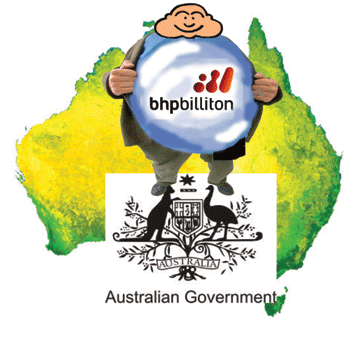 Public resources for private profit: free water for the largest open-pit mine in the world Coober Pedy Regional Times, by: Nectaria Calan, 13 Oct 11 In August mining giant BHP Billiton announced record financial results for the 2011 financial year, recording a total net profit of US$23.95 billion, nearly double its 2010 figure of US$13.01 billion.
AREVA company convicted of radioactive water pollution
 AREVA-SOCATRI was finally convicted of the offense of water pollution, in addition to his conviction for delay in reporting an incident.

 Areva-Socatri convicted of water pollution: an unprecedented legal victory! , September 30, the Court of Appeal of Nîmes condemned AREVA-SOCATRI of water pollution, as a result of the appeal including the Network “Sortir du nucléaire”. This sentence follows the unprecedented radioactive leaks detected on the Tricastin nuclear site in July 2008.
Located between Valence and Avignon, the Tricastin nuclear site includes both treatment plants and four fuel nuclear power reactors in operation. SOCATRI society, located on this site, ensures the maintenance and dismantling of radioactive materials and nuclear waste treatment and industrial companies AREVA Tricastin. Continue reading
Nuclear Regulatory Commission does not protect public from radioactive groundwater leaks
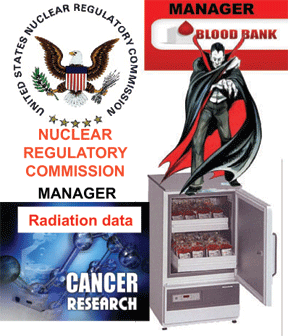 The NRC’s decision on groundwater protection comes four months after an Asbury Park Press investigation documented hundreds of leaks and spills of radioactive water called tritium over the decades at plants, including Oyster Creek in Lacey. The NRC has never issued a fine against any plant.
NRC fails to change groundwater protection rules for nuclear plants, Activist says NRC needs to enforce its rules on radioactive water leaks and spills, Aug. 17, 2011 APP.com, Todd B. Bates:After years of criticisms that they were lax in dealing with radioactive leaks, spills and groundwater contamination at nuclear power plants, federal regulators have decided to let the industry keep policing itself.
The five-member U.S. Nuclear Regulatory Commission agreed to maintain the status quo and not add a tougher level of oversight Continue reading
Nuclear reactors’ impact on America’s fresh water supplies
 Nuclear Information and Resource Service, Michael Mariotte, 12 Aug 11, America’s aging power plants are not only the nation’s largest air polluters, they also withdraw more water than any other source, causing staggering aquatic impacts. And nuclear reactors are the largest water users of them all.
Power plants’ toll on fisheries rivals, and in some cases exceeds, that of the fishing industry. Fortunately, none of this damage is necessary because modern closed-cycle cooling systems recirculate cooling water, reducing withdrawals and fish kills by about 95 percent. Since 1972, Section 316(b) of the federal Clean Water Act has required power plants to use the Best Technology Available (BTA) to minimize the adverse environmental impacts of cooling water intake structures.
In 2001, EPA issued national regulations identifying closed-cycle cooling as BTA for new power plants. But many older reactors, typically although not exclusively those built more than 30 years ago, still rely on antiquated and damaging once-through cooling systems, which withdraw water directly from its source but do not recycle it. Instead the water is thrown back into its source at far higher temperatures than it was when taken in.
For more information on the environmental devastation caused by once-through cooling at nuclear reactors, see Licensed to Kill, a report published by NIRS and other groups in 2001 and available here.
The rule EPA proposed on April 20, 2011 would be a step backward in our collective efforts to safeguard America’s waters. Basically, EPA has chosen the path of least resistance by caving into industry pressure and punting this issue to state agencies–agencies that too often lack the resources and the ability to stand up to industry on this issue. And if the Nuclear Energy Institute gets its way, things will get even worse. What is needed is a clear rule focused on modernizing power plants by stopping the use of once-through cooling.
Urge EPA to stand up for our waters and wildlife. You can submit a comment here urging EPA to adopt a strong standard for modernizing power plant cooling systems in its final rule.
A legal win for Namibia’s groundwater against uranium mining
issue is the question of who has the legal standing to go to court to ask for protection for the environment, which is unable to speak for itself…plan to extract large quantities of water from an underground water source in such a dry, environmentally sensitive and hitherto unspoilt area.
Uranium company loses desert water plan appeal, the Namibian, 20 May 11, By: WERNER MENGES A LEGAL challenge to a Canadian-owned mining company’s plan to use underground water to set up a uranium mine in the Namib Desert south-west of Usakos is heading back to the High Court after an appeal judgement that was given in the Supreme Court yesterday.
An issue that has never before had to be decided by a Namibian court is expected to be at the core Continue reading
Nuclear reactors are the biggest water guzzler
Heat Waves Putting Pressure on Nuclear Power’s Outmoded Cooling Technologies, REUTERS By Lisa Song at SolveClimate, May 4, 2011 “……Climate change studies published in research journals such as Science and the Journal of Climate project longer and more intense heat waves over the next century worldwide, adding constraints to water-intensive power systems.
According to the U.S. Geological Survey, thermoelectric generation in the U.S. from coal, natural gas and nuclear withdraws more freshwater per year than the entire agricultural sector. Overall, nuclear plants consume up to 25 percent more water than fossil fuel plants…..http://www.reuters.com/article/2011/05/04/idUS163919996420110504
Uranium mining threatens Grand Canyon’s water, and itseconomic viability
Polluting the Grand Canyon with uranium mines and radioactive tailings would have a drastic, negative effect on the area’s economic viability.
Uranium mining and Grand Canyon, Salt Lake Tribune, BY WALKER MACKAY 1 May 11, “……..Uranium mining in the Grand Canyon area will have a huge impact on the area’s watershed. The uranium excavation process known as “breccia pipe-type” results in ore and waste rock being piled on the land’s surface, where precipitation and run-off waters can transport it into the Grand Canyon via aquifers, springs, and drainages. There is a real potential for uranium contamination to occur in the creeks, seeps, and other tributaries that supply water to Grand Canyon National Park. Continue reading
Supreme Court upholds State’s rights over water intake at nuclear plant
SJC upholds state’s right to regulate water intake at Pilgrim nuclear – Boston Globe , by Beth Daley, 12 April 11, The state Supreme Judicial Court has upheld Massachusetts’ right to regulate the intake of vast amounts of water by the Pilgrim Nuclear Station and other power plants, which can harm fish and other marine organisms.Power plants use the water to cool equipment then discharge it later — and hotter — into waterways. Environmental studies show the heated water can harm aquatic life. The state and environmentalists have also long argued that the sucking in of water can kill vast amounts of fish larvae, eggs, shellfish, and other aquatic organisms – larger creatures become trapped on screens covering the intake pipes, and smaller ones are sucked into the cooling system. Continue reading
Water shortage halts uranium processing plant in India
Uranium processing plant lying idle for water crisis, IBN Live News, Mar 03,2011 Jamshedpur (Jharkhand), The production in the processing plant of Turamdih uranium mine, one of the mines of Uranium Corporation of India Limited (UCIL), has been suspended due to water shortage, officials said.”The processing plant of Turamdih Mines, on the outskirts of Jamshedpur, has been stopped due to water shortage,” S K Srivastav, General Manager of Processing Plant of UCIL, said.He said the processing plant, which has 3000 ton per day capacity, has been lying idle for the last four days as the water source of Kharkhai river has dried up.About 8000 to 9000 cusec water is needed to run the plant, he said.Srivastav said efforts have been underway to draw water from the nearby areas.He said UCIL has decided to transfer the mine water from Jadugora mine to run the mine for a few days. A study has been carried out in the nearby areas to identify a spot from where water could be drawn, officials said.
St Lawrence River to get radioactive shipment 50 times over international limit
Nuclear shipment angers municipalities By Cheryl Cornacchia, THE GAZETTE February 7, 2011 – City of Montreal officials have joined critics from across Quebec and Ontario in condemning a decision to allow a huge shipment of radioactive waste to travel through the St. Lawrence Seaway……. Continue reading
Radioactive deposits may settle in lake, due to uranium mining
Va. Beach uranium study warns of radioactive lakes, South Hill Enterprise, Virginia/North Carolina News February 6, 2011 The report, “Preliminary Assessment of Potential Impacts of Uranium Mining in Virginia on Drinking Water Sources,” was presented to the Virginia Beach City Council Tuesday afternoon.Wednesday evening, Roanoke River Basin Association (RRBA) members and concerned citizens spoke via tele-conference to share thoughts and put together a game plan, which includes educating the public.According to the study, not only is Virginia Beach’s water supply at risk if uranium mining occurs in Pittsylvania County but the reason for the risk lies with the deposits that will be settling in Kerr Lake (Bugg’s Island Lake)….. Virginia/North Carolina News
Uranium mining’s risk in times of flood
Beach study warns of risk if uranium mine floods By Aaron Applegate, The Virginian-Pilot, February 2, 2011 Massive flooding near a proposed uranium mine in south-central Virginia could temporarily contaminate Virginia Beach’s water supply, a city study released Tuesday found. City officials oppose mining a Pittsylvania County hilltop rich in uranium, fearing a hurricane or tropical storm could destroy landfill-like containers holding radioactive waste and flush contaminants into Lake Gaston, a main source of city water.
The state is exploring lifting a 29-year ban on uranium mining for the Pittsylvania project, about 200 miles from Virginia Beach……Tom Leahy, director of public utilities. said flooding from past hurricanes, including Camille in 1969, show the area is at risk. Beach study warns of risk if uranium mine floods | HamptonRoads.com | PilotOnline.com
36 states to dump nuclear waste close to Texas aquifer?
the landfill is close to a major aquifer that provides water to one-quarter of the country’s irrigated land as well as drinking water to thousands of people.
Commission Lets 36 States Dump Nuke Waste In Texas, NPR, by The Associated Presstext HOUSTON January 4, 2011, Texas commission approved rules on Tuesday that paves the way for 36 states to export low-level radioactive waste to a remote landfill along the Texas-New Mexico border. Continue reading
Naturally occurring radioactivity affecting Houston water
Houston, which continues to depend in part on groundwater for 20 percent of its water, obtains water from wells that drill into underground aquifers surrounded by naturally occurring forms of uranium, radium and other radioactive contaminants…..Multiple toxicologists and radiation experts KHOU spoke with agree with the EPA and Bradford, that any amount of radiation exposure in drinking water increases your risk for cancer.
Draft of federal report finds radiation widespread in Houston water | khou.com by Mark Greenblatt / December 21, 2010 HOUSTON—A draft of a soon-to-be-released federal report shows radiation in Houston’s drinking water is much more widespread than city leaders previously disclosed to the public. Continue reading
1 This Month

of the week – Shut Down Drone Warfare!


Tell the Ukrainian Government to Drop Prosecution of Peace Activist Yurii Sheliazhenko

Petition to revoke the licensing of the Near Surface Nuclear Disposal Facility (NSDF) at Chalk River. https://www.ourcommons.ca/petitions/en/Petition/Details?Petition=e-7247
To see nuclear-related stories in greater depth and intensity – go to https://nuclearinformation.wordpress.com
-
Archives
- April 2026 (91)
- March 2026 (251)
- February 2026 (268)
- January 2026 (308)
- December 2025 (358)
- November 2025 (359)
- October 2025 (376)
- September 2025 (257)
- August 2025 (319)
- July 2025 (230)
- June 2025 (348)
- May 2025 (261)
-
Categories
- 1
- 1 NUCLEAR ISSUES
- business and costs
- climate change
- culture and arts
- ENERGY
- environment
- health
- history
- indigenous issues
- Legal
- marketing of nuclear
- media
- opposition to nuclear
- PERSONAL STORIES
- politics
- politics international
- Religion and ethics
- safety
- secrets,lies and civil liberties
- spinbuster
- technology
- Uranium
- wastes
- weapons and war
- Women
- 2 WORLD
- ACTION
- AFRICA
- Atrocities
- AUSTRALIA
- Christina's notes
- Christina's themes
- culture and arts
- Events
- Fuk 2022
- Fuk 2023
- Fukushima 2017
- Fukushima 2018
- fukushima 2019
- Fukushima 2020
- Fukushima 2021
- general
- global warming
- Humour (God we need it)
- Nuclear
- RARE EARTHS
- Reference
- resources – print
- Resources -audiovicual
- Weekly Newsletter
- World
- World Nuclear
- YouTube
-
RSS
Entries RSS
Comments RSS
 nuclear-news