Radioactive waste from uranium mining poisons water in Jharkhand, India

 Uranium waste contaminates water in Jharkhand , Jun 8, 2013, New Delhi | Agency: DNA Reckless dumping of radioactive waste in Jharkhand is contaminating surface and ground water, putting thousands of locals at risk of developing cancer, according to a report by independent researchers.
The Uranium Corporation of India Limited (UCIL), a subsidiary of the Department of Atomic Energy, supplies uranium (yellow cake) to nuclear power plants in the country. It mines and processes uranium at seven mines in Jharkhand’s Jaduguda area. According to atomic experts, sludge and waste from uranium mines has to be scientifically disposed of as it contains around 85% radioactive substances.
Scientific disposal means creating pits that are covered, protected, cordoned off and made flood-proof. A tailing pond over an area of 30-40 acres must be created for disposal of sludge. These ponds too have to be cordoned off, made flood-proof and ensure that it prevents overflow. The waste decays to produce radium-226, which in turn produces Radon gas, a very powerful cancer-causing agent. For its three new mines i.e. Turamdih, Banduhurang and Mohuldih Uranium Mine, UCIL has one tailing pond at Talsa village, which fails to prevent sludge overflow and is not even fenced.
PT George, director of research institute Intercultural Resources, and independent writer Tarun Kanti Bose, spent six months studying the effects of uranium mining in the areas around the mines. Their report, Paradise Lost, released recently, states that UCIL’s irresponsible dumping in the vicinity of Jaduguda village (in Purbi Singhbhum district) is extremely worrisome as continued exposure to radiation will lead to increased cases of leukaemia and other blood diseases.
Heaps of uranium mining wastes have been abandoned in Dhodanga, Kerwadungri villages and those around Banduhurang open cast mine, according to the report. “The dumping has been going on for the last five years,” said Ghanshyam Birulee, a 45-year-old resident of Jaduguda village. “Despite complaints to UCIL, it has failed to take any action.”
Their report, Paradise Lost, states that UCIL’s irresponsible dumping in the vicinity of Jaduguda village (in Purbi Singhbhum district) is extremely worrisome as continued exposure to radiation will lead to increased cases of leukaemia and other blood diseases…… http://www.dnaindia.com/india/1845207/report-uranium-waste-contaminates-water-in-jharkhand
Tepco now admits that groundwater flowing into Fukushima reactors is radioactive
Fukushima plant operator reverses claim groundwater not contaminated (Reuters) Reporting by Risa Maeda; Writing by Aaron Sheldrick. 4 June 13- Tokyo Electric Power Co said on Tuesday it had detected radioactive caesium in groundwater flowing into its wrecked Fukushima Daiichi plant, reversing an earlier finding that any contamination was negligible.
The announcement is yet another example of Tokyo Electric initially downplaying a problem, only to revise its findings because of faulty procedures. It casts further doubt over its control over the cleanup of the worst nuclear disaster since Chernobyl in 1986.
“Once again, they’ve missed something they should be aware of,” said Atsushi Kasai, a former researcher of radiation protection at the Japan Atomic Energy Research Institute…… The discovery that groundwater is also being contaminated before it enters the damaged reactor buildings compounds the problems for the company known as Tepco. It has been trying to convince local authorities and fishermen that the groundwater has negligible levels of contamination and is safe enough to be dumped into the ocean.
About 400 tonnes of groundwater flow daily into the reactor buildings only to be mixed with highly contaminated water that comes from cooling the melted fuel.That water has to be stored in tanks and pits. Leaks in the latter in recent weeks have prompted it to scramble to build more tanks.
Tepco on May 30 told fishermen that radioactive caesium in the groundwater was at a level that could not be detected.But the results were false as they were skewed by using procedures that failed to take into account the background radiation at the damaged plant, Tepco told Reuters on Tuesday. The findings were earlier reported by local media.
“We’ll have to correct the way we analyse sample data,” said Mayumi Yoshida, a Tepco spokeswoman.The revised results still show the radiation level to be below what Tepco views as the upper limit for releasing groundwater — one becquerel of caesium 137 per litre. A becquerel is a measure of radioactivity.
Follow up analysis showed the groundwater had 0.22 becquerel of caesium-134 per litre and 0.39 becquerel of cesium-137 per litre rather than an undetectable amount, Yoshida said……http://uk.reuters.com/article/2013/06/04/uk-nuclear-japan-tokyo-electric-idUKBRE95309020130604
As Fukushima radioactive water grows, situation hopeless for fishermen
Fukushima fishermen forced to test fish for radiation REUTERS, 31 May 13“….The fishermen of Hisanohama, forced out of work by the disaster, have had no choice but to take the only job available – checking contamination levels in fish just offshore from the destroyed nuclear reactor buildings. ”We used to be so proud of our fish. They were famous across Japan and we made a decent living out of them,” said 80-year-old Yaoita, who survived the tsunami by taking on the waves and sailing the six-person True Prosperity out to sea.”Now the only thing for us is sampling.”…..
The fishermen and Tepco are in dispute over the utility’s plans to dump 100 tons of groundwater a day from the devastated plant into the sea. The complicated clean-up plan for Fukushima could take 30 years or more. Tepco’s challenge is what to do with the contaminated water that has been pooling at the plant at a rate of 400 tons a day – enough to fill an Olympic-size swimming pool in a week.
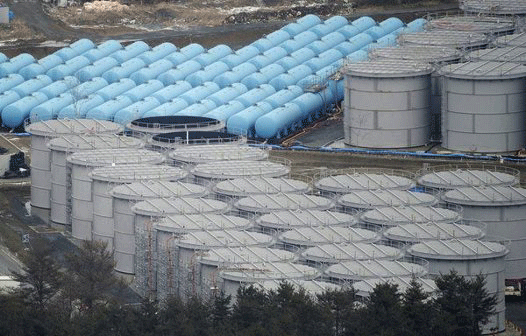
So far it has been racing to build tanks to store the contaminated water on the grounds of the plant, in which all the water is kept at the moment.It has also asked fishermen to support a plan to build a “by-pass” that would dump groundwater into the sea before it becomes contaminated by flowing under the reactor’s wreckage.
“We are staunchly against it,” said Tatsuo Niitsuma, 71, who fishes with Yaoita.
MORE CONTAMINATION, LESS HOPE Representatives from fishing cooperatives met Tepco officials on Thursday to discuss the proposal, with Trade Minister Toshimitsu Motegi to instruct Tepco on what to do, although no final plans were announced. In addition to the “by-pass” Motegi, who also holds the energy portfolio, told Tepco to create “protective walls” in the ground by freezing the soil around the reactors to create an underground barrier to stop groundwater from flowing in and mixing with contaminated water inside the reactor building.
The fishermen, however, worry the “by-pass” plan risks more contamination and delays, possibly ending any hope for the only job they know.
Tepco officials have said it may take as long as four years to fix the problem, but have said they do not need outside help.
The uncertainty and stress have become problems. Many former fishermen live in temporary homes next to people they barely know after losing not only their jobs, but also family members…….. http://www.reuters.com/article/2013/05/31/us-fukushima-fishermen-idUSBRE94U0D620130531
Radioactive groundwater in Santa Susanna could take centuries to clean up
Santa Susana groundwater cleanup could take centuries, official says, VC Star, By Mike Harris, April 18, 2013 The groundwater cleanup at the Santa Susana Field Laboratory, the site of a 1959 partial nuclear meltdown, could take centuries, a state official said Wednesday night.
The soil decontamination will take far less time, a few or more years, but might not be finished by a 2017 deadline, Mark Malinowski of the state Department of Toxic Substances Control told about 100 people during a cleanup update at the Grand Vista Hotel in Simi Valley.
“It’s a very aggressive schedule to get to 2017, and many things have to happen correctly in order to get there,” said Malinowski, the department’s cleanup team manager.
The groundwater cleanup will take “a lot longer … decades, possibly centuries to complete,” Malinowski said. “Groundwater is an extremely difficult thing to clean up. This contamination we’re dealing with did not happen overnight.”……
Boeing owns most of the 2,850-acre site, formerly the Rocketdyne nuclear and rocket engine test facility, in the hills between Simi Valley and the San Fernando Valley. The rest of the site is owned by the federal government and administered by NASA.
During a question-and- answer period, cleanup activists sharply questioned Malinowski’s statement that no significant contamination has been found beyond the site’s boundaries.
“I had to remind him that in 2008, they removed three football fields of contaminated soil off the adjacent Sage Ranch Park property,” William Bowling said. “And then last year, the EPA found radioactivity in a well on the campus owned by the American Jewish University, which also adjoins the site.
“They’re not giving the public the clear picture, which is that there is off-site contamination,” Bowling said. http://www.vcstar.com/news/2013/apr/18/santa-susana-soil-cleanup-may-not-make-2017-deadli/#ixzz2SI1pAhgC
Shortage of water a big threat to nuclear reactors
 Cooling systems for nuclear plants and power plants that burned coal, gas and oil accounted for 41 per cent of fresh water withdrawals and 49 per cent of all water withdrawals.
During the 2003 heat wave in France, which was responsible for more than 10,000 deaths, nuclear plants had to reduce their output, worsening the crisis. The rising temperature of river water meant they could not achieve sufficient cooling and still observe discharge limits
Nuclear and coal-fired power plants with OTC systems are especially vulnerable to droughts and heat waves because they rely on by far the largest volume of water withdrawals.
US energy supplies imperiled by water shortages, The Age May 1, 2013 – John Kemp Water and energy are inextricably linked.Power plants are the largest users of water in the United States, while substantial amounts of energy are needed to supply fresh water to homes, farms and factories and treat waste water prior to safe disposal.
Rising water consumption for hydraulic fracturing and production of biofuels, coupled with severe droughts in Texas in 2011 and across more than 60 per cent of the continental United States in 2012, have propelled that link up the policymakers’ agenda.
The threat to hydroelectric generation is obvious. But in 2007-2009, drought put the water supplies of 24 of the nation’s 104 reactors at nuclear plants at risk. In 2011, more than 3,000 megawatts of thermal generating capacity in Texas also was considered at risk of having to shut down if the drought persisted as reservoir levels plunged.
Texans were asked to conserve water to keep the lights on. The state was only spared blackouts because of high output from wind farms.
On April 25, the Energy and Natural Resources Committee of the US Senate held a hearing to explore the effect of drought on the energy sector and water management, reflecting lawmakers’ fears about the instability created by the tightening links between water and energy supplies. Continue reading
TEPCO on a tightrope in attempt to move tons of radioactive water
Japan nuclear safety plans too lax for crowded, quake-prone nation, say nuclear experts The Star, By: Mari Yamaguchi The Associated Press,Apr 08 2013 TOKYO
“…….TEPCO is moving tons of highly radioactive water from the temporary tanks to two similar ones nearby to minimize the leak. They are among seven underground tanks of different sizes which employ the same design.
TEPCO admitted Sunday it had dismissed earlier signs of water loss as within a margin of error and waited until a spike in radiation levels around the tanks was detected. Critics suspect cash-strapped TEPCO built poorly designed underground pits instead of safer and more manageable steel tanks to save money. TEPCO has also been criticized for delaying replacement of makeshift equipment, raising questions about whether the plant is really under control.
The underground tanks, several times the size of an Olympic swimming pool and similar to an industrial waste dump, are dug directly into the ground and protected by double-layer polyethylene linings inside an outermost clay-based lining, with a felt padding between each layer. Officials suspect there were ruptures in the linings due to the weight of the water.
Contaminated water at the plant, which suffered multiple meltdowns after the 2011 disaster, has escaped into the sea several times during the crisis. Experts suspect a continuous leak into the ocean through an underground water system, citing high levels of contamination in fish caught in waters just off the plant.
The contaminated water in the tanks is part of more than 270,000 tons of water used to cool melted fuel at the plant’s reactors damaged in the disaster. So much water has been used that TEPCO is struggling to find storage space. The water is also kept in hundreds of steel tanks.
NRA commissioner Toyoshi Fuketa told reporters Monday that the water leak poses a more immediate threat to the plant’s water management than to the environment. He questioned TEPCO’s risk evaluation in the tanks’ design process, but acknowledged that regulators have to allow TEPCO to use the remaining underground tanks for now.
“Although we need more long-term plans, we have to tackle the most immediate problem first. TEPCO’s decommissioning process is a tightrope situation to begin with,” he said. http://www.thestar.com/news/world/2013/04/08/japan_nuclear_safety_plans_too_lax_for_crowded_quakeprone_nation_say_nuclear_experts.html
Precious groundwater now threatened by fracking for uranium, too
When it comes to fracking for yellowcake, even more pressing than shaky economics is the obvious potential for environmental contamination. The process is not only extremely water intensive, as is typical of fracking, but it’s also happening at a shallow depth. Unlike the Eagle Ford’s oil and gas reserves, which are miles underground, the in situ uranium mining is taking place at the same level as local groundwater supplies.

Fracking for Yellowcake: The Next Frontier? http://www.huffingtonpost.com/jeffrey-rubin/fracking-for-yellowcake-t_b_2612418.html Jeffrey Rubin 02/04/2013 It works for oil and natural gas, so why not frack for uranium too? After all, America relies on foreign uranium just like it depends on foreign oil.
In the U.S. these days, it seems like you can sell almost anything if you spin it as part of the pursuit of energy independence. Enter Uranium Energy Corp. A junior mining company with Canadian roots, UEC is developing the newest uranium mine in the U.S. And it’s counting on fracking to do it.
Texans, in general, are no strangers to fracking. UEC is operating in the heart of fracking country, south Texas’s Eagle Ford basin, one of the most prolific shale plays in the country. Instead of oil and gas, though, UEC (recently profiled by Forbes Magazine) is fracking for yellowcake.
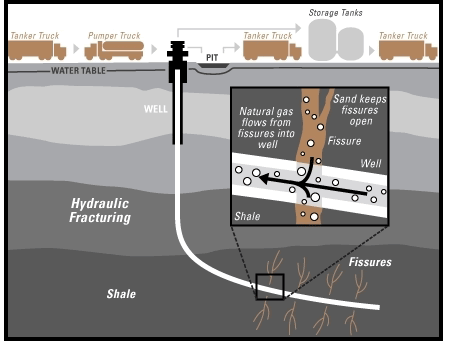
The technology is basically the same. It involves injecting a mixture of highly pressurized water and sand into an underground formation in order to break open fissures in the rock that allow the energy riches within to be extracted. In this case, it’s a slurry of uranium ore that’s then dried and processed into powdery yellowcake, an intermediate product that eventually becomes fuel for nuclear reactors.
Of course, the very idea of fracking for yellowcake begs the question–just because you can do something, should you? The world isn’t exactly running short of uranium. Prices tell you that much. Uranium prices have plunged from more than $90 a ton before the last recession to just more than $40 a ton following the Fukushima disaster. Friendly countries like Canada and Australia are able to ramp up supply, as can less friendly countries like Kazakhstan. Yellowcake is also exported by Niger (part of the reason, according to some, that nuclear-powered France is taking such an interest in neighbouring Mali right now.)
What’s more, the emergence of cheap natural gas from shale plays is making nuclear energy less attractive to U.S. power utilities. Many are considering shuttering some high cost nuclear stations and switching to cheaper natural gas, just as they’ve been doing with a number of coal plants in recent years.
When it comes to fracking for yellowcake, even more pressing than shaky economics is the obvious potential for environmental contamination. The process is not only extremely water intensive, as is typical of fracking, but it’s also happening at a shallow depth. Unlike the Eagle Ford’s oil and gas reserves, which are miles underground, the in situ uranium mining is taking place at the same level as local groundwater supplies.
According to the International Energy Agency, the amount of fresh water used for global energy production will double over the next twenty-five years. Whether it’s Alberta’s oil sands that run on water from the Athabasca River or the countless gallons used to frack underground stores of oil, gas and now even uranium, it’s easy to see why.
Hydraulic Fracking is a source of radiation pollution, too
“We’ve known for a long time that there is radiation coming back in the wastewater”
Among the radioactive material often found in drilling wastes is radium 226, which can cause cancer, anemia and cataracts, according to the federal Agency for Toxic Substances and Disease Registry
DEP backtracks on radiation issue Times online,January 25, 2013 By Rachel Morgan HARRISBURG — For months, the state Department of Environmental Protection denied that radiation in wastewater from natural gas drilling was an issue. On Thursday night, the state announced plans to study the effects of radiation in natural gas drilling wastewater.
After continued questioning by Shale Reporter regarding radioactivity in wastewater, Gov. Tom Corbett’s announcement of a 12-month DEP study of radioactive wastewater was a surprise. The DEP had consistently denied radiation was even an issue……. In the governor’s unexpected announcement Thursday evening, DEP officials said they will begin sampling and analyzing fracking flowback for radioactivity, testing everything from fracking wastewater, drill cuttings, treatment solids and sediments at well pads and wastewater treatment and disposal facilities.
They also plan to analyze radioactivity in pipes, well casings, storage tanks, treatment systems and trucks. http://www.timesonline.com/news/local_news/dep-backtracks-on-radiation-issue/article_9e5853a5-325b-5f9a-83ed-24aea5811db0.html
An Increase in Radiation Monitoring for Fracking, NYT, Jan 25 13 By JON HURDLE Pennsylvania will step up its monitoring of naturally occurring radiation levels in water, rock cuttings and drilling wastes associated with oil and gas development in a yearlong study that will be peer-reviewed, the state’s environmental agency reports.
The study will also assess radiation levels in the pipes, well casings, storage tanks, treatment systems and trucks used by the natural gas industry, which has drilled thousands of wells in the gas-rich Marcellus Shale over the last five years….
Hydraulic fracturing, which involves injecting chemicals and water under enormous pressure into underground shale formations to extract gas or oil, got under way in Pennsylvania in 2008.
In New York, state officials are currently weighing whether to allow the drilling process to begin. The state’s health commissioner is conducting a review of whether the state’s Department of Environmental Conservation has adequately addressed potential impacts on public health. Continue reading
USA’s EPA gave miners more than 1,500 permits to pollute deep aquifers
In a parched world, Mexico City is sending a message: Deep, unknown potential sources of drinking water matter, and the U.S. pollutes them at its peril.
Message from Mexico: The US is Polluting Water it May Someday Need to Drink, World News Curator , January 25, 2013 By OryanWNC. By Abrahm Lustgarten from ProPublica Mexico City plans to draw drinking water from a mile-deep aquifer, according to a report in the Los Angeles Times. The Mexican effort challenges a key tenet of U.S. clean water policy: that water far underground can be intentionally polluted because it will never be used.
U.S. environmental regulators have long assumed that reservoirs located thousands of feet underground will be too expensive to tap. So even as population increases, temperatures rise, and traditional water supplies dry up, American scientists and policy-makers often exempt these deep aquifers from clean water protections and allow energy and mining companies to inject pollutants directly into them.
As ProPublica has reported in an ongoing investigation about America’s management of its underground water, the U.S. Environmental Protection Agency has issued more than 1,500 permits for companies to pollute such aquifers in some of the driest regions. Frequently, the reason was that the water lies too deep to be worth protecting. Continue reading
EPA permits fracking for uranium to go ahead in USA
Goliad skeptics have been fighting UEC’s plans for five years. At Goliad the uranium ore is located just 400 feet deep within the same rock as a groundwater reservoir that ranchers tap for drinking water, both for themselves and their livestock. Water, not oil, is the region’s long-term liquid gold. “We are running out of water; I don’t want mine ruined,” said one rancher who asked not to be named. “When you’re out of water, you’re out of everything.”….
A 2009 study of Texas in situ mines by the U.S. Geological Survey … found no instance in which there wasn’t more selenium and uranium in the water than before mining.
 Energy’s Latest Battleground: Fracking For Uranium This story appears in the February 11, 2013 issue of Forbes. No tour of Uranium Energy Corp.’s processing plant in Hobson, Tex. is complete until CEO Amir Adnani pries the top off a big black steel drum and invites you to peer inside. There, filled nearly to the brim, is an orange-yellow powder that UEC mined out of the South Texas countryside. It’s uranium oxide, U3O8, otherwise known as yellowcake. This is the stuff that atomic bombs and nuclear reactor fuel are made from. The 55-gallon drum weighs about 1,000 pounds and fetches about $50,000 at market. But when Adnani looks in, he says, he sees more than just money. He sees America’s future.
“The U.S. is more reliant upon foreign sources of uranium than on foreign sources of oil,” says Adnani,……
Adnani insists that he can close the yellowcake gap through a technology that is similar to the hydraulic fracturing, or fracking, that has created the South Texas energy boom. Fracking for uranium isn’t vastly different from fracking for natural gas. UEC bores under ranchland into layers of highly porous rock that not only contain uranium ore but also hold precious groundwater. Then it injects oxygenated water down into the sand to dissolve out the uranium. The resulting solution is slurped out with pumps, then processed and dried at the company’s Hobson plant. Continue reading
Radioactive water to be dumped into Pacific Ocean by TEPCO
TEPCO plans to dump water stored at Fukushima Daiichi into  Pacific http://enformable.com/2013/01/tepco-plans-to-dump-water-stored-at-fukushima-daiichi-into-pacific/ TEPCO has announced that it plans to dump contaminated water into the Pacific Ocean after processing it to reduce radioactive materials to legally permissible levels. By “processing”, TEPCO means once-high radioactive content has been reduced considerably, but not completely.
The plant has already released enormous amounts of highly contaminated water directly into the ocean from a plethora of leaks from the reactor buildings. Outside experts are seriously concerned about the contaminated water that is released, and have warned there may well be lasting impact on the environment.
The utility says the operation is necessary due to concerns that they will run out of capacity to store highly contaminated water which continues to accumulate. After the water has passed through the crippled units, it is processed through the SARRY system to remove cesium, but other systems designed to remove other radioactive materials have been overwhelmed by the complexity and concentration of contamination found at Fukushima Daiichi.
TEPCO estimates show that the volume of contaminated water required to be stored on site will likely triple over the next three years.
Questions have been raised if TEPCO would be able to gain the necessary approval from local municipalities and other parties who have raised concerns about plans to dump the water into the ocean.
In December 2011, the utility was forced to scrap a previous plan to dump water into the sea following fierce protests from fishing groups.
Removing uranium from water – Kansas residents willing to pay for this
Kansas communities pay to rid water of uranium, Enquirer Herald, 20 Jan 13, The Associated Press KANSAS CITY, Mo. — Residents across Kansas have safer drinking water thanks to steps their communities have taken to rid the water of harmful elements such as uranium and arsenic. But those residents also are facing considerable hikes in water bills to pay for the improvements.
Lakin residents are paying water rates about 10 times higher than they had before the city began construction on a $6.5 million water treatment plant to eliminate naturally-occurring uranium from the drinking water.
Rates are up about three times in Clay Center, where the city has built a $10-million treatment plant also to deal with uranium, which can occur in some aquifers….. http://www.enquirerherald.com/2013/01/20/2276642/kansas-communities-pay-to-rid.html
South Dakota: precious water endangered by “in-situ” uranium minng
as for water quality, we know from the history of in situ leach
uranium mining that the groundwater will be contaminated. Leaks and
spills are common. Every in situ uranium mine has them. And at the end
of the process — when things have supposedly been “cleaned up” — the
groundwater has always been left polluted with radioactivity and with
things like arsenic, selenium and lead.
FORUM: In situ uranium mining will pollute water
http://rapidcityjournal.com/news/opinion/forum-in-situ-uranium-mining-will-pollute-water/article_ecc53035-6f34-5293-8d5f-08b0e619bee0.html
January 12, 2013 Plans to mine uranium north of Edgemont remain
controversial — and with good reason. The company involved, Powertech
Uranium, is a foreign corporation that has never mined anything. They
want to use 9,000 gallons per minute of our water. And they will leave
the water contaminated with radiation and other things — like every
other “in situ” leach uranium mine in U.S. history.
In situ leach mining involves pumping a solution underground, where it
loosens the uranium from the rock, and then pumping the uranium-filled
solution back to the surface. Continue reading
VIDEO Uranium mining in Virginia, and its risks for North Carolina
Hawood suggested the General Assembly write and pass a strongly-worded
resolution against uranium mining to try and influence Virginia’s
lawmakers in Richmond
 VIDEO Uranium mining in Virginia would affect NC Rivers
http://myfox8.com/2013/01/10/uranium-mining-in-virginia-would-affect-nc-rivers/
January 10, 2013, by Mitch Carr EDEN, NC —
Virginia’s General Assembly is considering lifting a moratorium on
mining uranium that has been in place since 1982, and doing so could
have a dramatic effect on North Carolina’s recreational waterways.
The potential mine is on a farm near Gretna and Chatham in
Pittsylvania County, Virginia. The company attempting to mine the ore
that contains the uranium, Virginia Uranium, Inc., estimates the lode
to be 119 million pounds.
…….., many of the locals don’t support it, and an hour and a half
southwest of Chatham in Eden, NC, the Dan River Basin Association
definitely does not support it.
Tiffany Hawood is the executive director, and she agrees mining
uranium will bring jobs to the area.
“If you’re talking about jobs for cleaning up environmental risks,
then yeah, maybe,” Hawood said.
Hawood believes the mining puts the Dan and Smith Rivers, which run
through Rockingham County and are popular for tubing and canoeing, at
risk.
“I can’t think of one good reason to do this,” Hawood said.
North Carolina would experience the fallout of a mining disaster but
has no authority to stop Virginia from getting rid of the ban.
Hawood suggested the General Assembly write and pass a strongly-worded
resolution against uranium mining to try and influence Virginia’s
lawmakers in Richmond…. http://myfox8.com/2013/01/10/uranium-mining-in-virginia-would-affect-nc-rivers/
Will USA’s EPA continue allow radioactive wastes to be injected into groundwater
The situation at Christensen Ranch underscores the overlaying problem of the sheer number of underground waste and injection wells. According to the UIC Well Inventory of 2011, there are 659,345 injection wells across the nation. Even in water-strapped states like California there exist a staggering 67,302 underground waste wells
former EPA officials are concerned of well leaks and that completely removing pollutants from water is not possible.
EPA Approved Underground Waste Dumping for  Uranium Mine Giant IVN, By Christopher Davis-Garland | 01/04/2013 | ProPublica recently published journalist Abraham Lustgarten’s special project series covering injection wells. The latest story in the series converges on Christensen Ranch in Wyoming where industry giant Uranium One mines for uranium and disposes of its waste in an aquifer with EPA permission.
1 This Month

of the week – Shut Down Drone Warfare!


Tell the Ukrainian Government to Drop Prosecution of Peace Activist Yurii Sheliazhenko

Petition to revoke the licensing of the Near Surface Nuclear Disposal Facility (NSDF) at Chalk River. https://www.ourcommons.ca/petitions/en/Petition/Details?Petition=e-7247
To see nuclear-related stories in greater depth and intensity – go to https://nuclearinformation.wordpress.com
-
Archives
- April 2026 (91)
- March 2026 (251)
- February 2026 (268)
- January 2026 (308)
- December 2025 (358)
- November 2025 (359)
- October 2025 (376)
- September 2025 (257)
- August 2025 (319)
- July 2025 (230)
- June 2025 (348)
- May 2025 (261)
-
Categories
- 1
- 1 NUCLEAR ISSUES
- business and costs
- climate change
- culture and arts
- ENERGY
- environment
- health
- history
- indigenous issues
- Legal
- marketing of nuclear
- media
- opposition to nuclear
- PERSONAL STORIES
- politics
- politics international
- Religion and ethics
- safety
- secrets,lies and civil liberties
- spinbuster
- technology
- Uranium
- wastes
- weapons and war
- Women
- 2 WORLD
- ACTION
- AFRICA
- Atrocities
- AUSTRALIA
- Christina's notes
- Christina's themes
- culture and arts
- Events
- Fuk 2022
- Fuk 2023
- Fukushima 2017
- Fukushima 2018
- fukushima 2019
- Fukushima 2020
- Fukushima 2021
- general
- global warming
- Humour (God we need it)
- Nuclear
- RARE EARTHS
- Reference
- resources – print
- Resources -audiovicual
- Weekly Newsletter
- World
- World Nuclear
- YouTube
-
RSS
Entries RSS
Comments RSS
 nuclear-news