Rdioactive particles detected in soils from Northern Japan
Science Direct (accessed) 11th Sept 2017, Arnie Gundersen & Marco Kaltofen: Radioactively-hot particles detected in dusts and soils from Northern Japan by combination of gamma spectrometry,
autoradiography, and SEM/EDS analysis and implications in radiation risk
assessment. After the March 11, 2011, nuclear reactor meltdowns at
Fukushima Dai-ichi, 180 samples of Japanese particulate matter (dusts and
surface soils) and 235 similar U.S. and Canadian samples were collected and
analyzed sequentially by gamma spectrometry, autoradiography, and scanning
electron microscopy with energy dispersive X-ray analysis.
http://www.sciencedirect.com/science/article/pii/S0048969717317953
Investigation of radiation contaminated Dalgety Beach
Dundee Courier 8th Oct 2017, Radiation remediation work at Dalgety Bay has edged closer with the start
of ground surveys at the contaminated beach. Investigations into ground
conditions began on Monday,before the long-awaited clean-up of dumped
radioactive debris from the Second World War, which is due to begin in
spring 2019.
The Ministry of Defence confirmed this week engineers are now
on site, having secured access. Stephen Ritchie, of the MoD’s Defence
Infrastructure Organisation, said: “Work started on site on Monday on a
ground investigation survey which has been the subject of ongoing
negotiations with the landowner.“That’s likely to take six weeks,
depending on the weather.” Updating south and west Fife councillors on
progress, Mr Ritchie also said it was hoped planning consent would be
issued soon for the remediation works.
https://www.thecourier.co.uk/fp/news/local/fife/504987/surveys-begin-of-radium-contaminated-fife-beach-ahead-of-mod-clean-up/
Satellites reveal global fingerprints of sea-level rise
Geological processes send more meltwater from glaciers and ice sheets to Earth’s mid-latitudes. Rachael Lallensack, As an ice sheet melts, it leaves a unique signature behind. Complex geological processes distribute the meltwater in a distinct pattern, or ‘fingerprint’, that causes seas to rise unevenly around the world. Now, for the first time, researchers have observed what these sea-level fingerprints look like on a global scale.
“No one has put it together for a complete global picture like this before,” says James Davis, a geophysicist at Columbia University in Palisades, New York. The work was published in Geophysical Research Letters on 9 September1.
The concept of sea-level fingerprints has been been factored into models used to predict sea-level rise for several years, says lead researcher Isabella Velicogna, a geophysicist at the University of California, Irvine. And researchers have used tide gauges for just as long to observe the fingerprints in coastal regions. But the global view provided by the latest study adds confidence to projections of future sea-level rise.
As an ice sheet melts, it leaves a unique signature behind. Complex geological processes distribute the meltwater in a distinct pattern, or ‘fingerprint’, that causes seas to rise unevenly around the world. Now, for the first time, researchers have observed what these sea-level fingerprints look like on a global scale.
“No one has put it together for a complete global picture like this before,” says James Davis, a geophysicist at Columbia University in Palisades, New York. The work was published in Geophysical Research Letters on 9 September1.
The concept of sea-level fingerprints has been been factored into models used to predict sea-level rise for several years, says lead researcher Isabella Velicogna, a geophysicist at the University of California, Irvine. And researchers have used tide gauges for just as long to observe the fingerprints in coastal regions. But the global view provided by the latest study adds confidence to projections of future sea-level rise.
Velicogna and co-author Chia-Wei Hsu, also at the University of California, Irvine, used gravity data from NASA’s two Gravity Recovery and Climate Experiment (GRACE) satellites, which measure changes in mass on Earth’s surface. The scientists looked at satellite data from April 2002 to October 2014, and matched it with measurements from pressure stations on the ocean floor. These instruments measure the total mass above them.
Velicogna says that the findings should be used to create a roadmap for better placement of ocean-bottom pressure stations, which in turn can be used to improve calculations of sea-level fingerprints in the future.
“We know sea-level change throughout the world won’t be uniform, and it’s useful for people to know how those changes might show up,” says Mark Tamisiea, a geophysicist at the University of Texas at Austin.
China on alert for radiation seeping from North Korea’s latest nuclear test.
 |
Click here to Reply or Forward
|
A picnic in a uranium town that used to be
“Every house. Every tree. Everything was dug up, shredded and buried in a big hole on top of the hill,” Thompson said. Decades and decades of mining left Uravan contaminated with radioactive chemicals and heavy metals. The EPA declared it a superfund site in the 1980s and ordered the mining company, Umetco, to start clearing away the entire town.
You’d never know the empty picnic area was once a community of about 1000 people. Today, you just see the bottom of a crumbling sandstone river valley
she wants to keep having these annual reunion picnics, where the real star of the show is the desert: an actual yellow cake, with yellow frosting and black radioactive signs on top.
Uravan residents may have lost their town, but not their sense of humor.

Uravan: The Uranium Town That Was http://wyomingpublicmedia.org/post/uravan-uranium-town-was, By DAN BOYCE • SEP 8, 2017 Superfund cleanups are a priority for Scott Pruitt, the administrator of the Environmental Protection Agency. He wants to cut through red tape that has left more than a thousand sites still contaminated with everything from radioactive waste to lead.
He also wants to remove sites that have already been cleaned up from the so-called National Priority List, which has more than 1300 sites. One of those sites is the town of Uravan.
After hours in the dark main room of the Rimrocker Historical Society, Jane Thompson showed off what put this part of Western Colorado on the map. She turned on a geiger counter, which began wildly clicking due to the radioactive yellow rock in a nearby antique jar.
Thompson also helps spearhead an annual picnic some 15 minutes up the road, as she did last weekend. She calls it a reunion picnic at the site of her hometown of Uravan.
“The things that happened here were very important,” Thompson said.
A few dozen people gathered under trees and canopies in the otherwise hot empty field on that late August day. Uravan, a tiny mining company town, provided uranium for nuclear weapons developed during the Manhattan Project.
“Even though the town is gone, we feel like that the history of those people need(s) to be kept,” she said.
Uravan — it is gone. Not just the mill where those yellow rocks were processed into so-called yellowcake uranium ore; everything is gone.
“Every house. Every tree. Everything was dug up, shredded and buried in a big hole on top of the hill,” Thompson said. Decades and decades of mining left Uravan contaminated with radioactive chemicals and heavy metals. The EPA declared it a superfund site in the 1980s and ordered the mining company, Umetco, to start clearing away the entire town.
You’d never know the empty picnic area was once a community of about 1000 people. Today, you just see the bottom of a crumbling sandstone river valley. Larry Cooper, 91, sat in a camping chair, wearing suspenders and breathing with the help of an oxygen tank.
“I didn’t know it was dangerous,” he said. “I didn’t know it would hurt ya.”
He worked in the mills and mines around Uravan, starting in the 1950s. His health suffered.
“I got cancer. I lost half of my lung on the right side,” he said.
Registered Nurse Joanna Godwin said it’s very common for former Uravan workers. She attended the picnic with a non-profit called Nuclear Care Partners. They provide free health care through the Department of Labor for medical issues that can be traced back to the mining of radioactive materials.
“We’ve had people with skin cancers. Pulmonary things are very prevalent. It’s a whole array of things,” she said, referring to conditions in former Uravan employees.
After two decades of cleanup, the EPA declared the remediation of Uravan wrapped up in 2008. But, this empty-field-that-used-to-be-a-town was never taken off the list. The agency says it needs further investigation and study before giving it a clean bill of health.
The Colorado Department of Public Health and Environment recently submitted comments to the EPA, saying the agency’s continued work in Uravan is duplicative, costly and causing delay. That seems to be the kind of thing Administrator Pruitt is looking to streamline.
Still, Jane Thompson doesn’t hold out any hope the Uravan site will ever totally be out of the hands of the federal government.
“Well, I think it will remain forever,” she said.
But, she wants to keep having these annual reunion picnics, where the real star of the show is the desert: an actual yellow cake, with yellow frosting and black radioactive signs on top.
Uravan residents may have lost their town, but not their sense of humor.
As hurricanes rage, USA’s Republicans in Congress Work to Gut Environmental Protections
With a comfortable majority in the House and Trump appointees at the helm of agencies like the Environmental Protection Agency (EPA), House Republicans have been eagerly working to gut environmental regulations and spending on interior programs. As Hurricane Harvey and Irma devastate coastal communities and wildfires rage across the West, these lawmakers are looking increasingly out of touch.
“We have climate change-fueled disasters happening across the country: two major hurricanes … and then, in the West, people are choking on soot from wildfires,” said Anna Aurilio, DC office director of Environment America, in an interview. “And instead of taking action to cut climate pollution — shift us toward clean energy and make our coasts and cities more resilient — the House of Representatives is working on legislation to take us in exactly the opposite direction.”
On Wednesday, a Republican-led House subcommittee held a hearing on the EPA’s Integrated Risk Information System, which conducts health assessments of chemicals and determines what levels of exposure are considered “safe” in air, water, food and soil.
The program’s findings are often used to justify regulatory restrictions that the chemical industry does not like, according to the Natural Resources Defense Council.
Dr. Thomas Burke, a former Houston resident and director of the Risk Science and Public Policy Institute at the John Hopkins Bloomberg School of Public Health, told the committee that the “capacity to evaluate the hazards of toxic chemicals is essential to protecting our public health.”
“This hearing is particularly timely, as Texas and Louisiana work to protect public health, restore safe drinking water and evaluate risks from contaminated floodwaters and chemical releases,” Burke said in his written testimony.
However, two experts with ties to the chemical industry criticized the program, and the committee’s chairman, Rep. Andy Briggs (R-Arizona), offered an amendment to a major appropriations bill for funding the EPA and Interior Department that would eliminate all funding for the Integrated Risk Information System.
The House’s $31 billion interior spending bill would slash the EPA’s budget by $528 million, a considerable cut but not as deep the more than $2 billion in cuts proposed by the White House and ultra-conservative lawmakers, according to reports.
The bill contains a number of riders that infuriate environmentalists, including measures that would block Obama-era standards designed to reduce smog, make oil and gas drilling in the Arctic safer, restrict the amount of climate-warming methane that oil and gas drillers can spew in the atmosphere, and require government agencies to consider the economic and social costs of carbon pollution when writing regulations.
Democrats offered their own amendments to the spending bill, including riders that would prevent the Trump administration from closing regional EPA offices and selling off public lands to private companies.
“There is a threat,” said Rep. Jared Polis (D-Colorado) during floor debate on Friday. “There are members of this body, and there are members of the president’s administration that are seeking to sell off our public lands.”
However, Republicans hold a powerful majority in the House, so amendments that environmentalists support may not survive ongoing budget negotiations. On Thursday, lawmakers voted down a bipartisan rider introduced by lawmakers in New Jersey and Virginia that would have prohibited federal funding for controversial seismic tests needed to initiate offshore oil drilling in the Atlantic Ocean, despite widespread opposition to offshore drilling on the East Coast.
Earthquake study can inform us about nuclear tests
North Korea: What can earthquake science tell us about the nuclear test?, ABC, 4 Sept 17, The Conversation By Neil Wilkins, University of Bristol “……History of forensic seismology The use of what’s called “forensic seismology” to detect and identify nuclear tests dates back almost to the birth of nuclear weapons themselves.
In 1946, the US conducted the first underwater test of a nuclear bomb at Bikini Atoll in the Pacific Ocean.
The shock waves created by the huge explosion were picked up at seismometers all over the world, and scientists realised that seismology could be used to monitor these kinds of tests.
In 1963, at the height of the Cold War, nuclear testing moved underground. The seismic waves from underground tests are more difficult to detect, because the shaking felt over such long distances is very small — only around one-millionth of a centimetre.
A seismic array is better able to pick out the small vibrations from a particular source than a single seismometer, and can also be used to work out with greater accuracy where the waves originally come from.
In 1996, the Comprehensive Test Ban Treaty(CTBT) was opened for signatures, aiming to ban all nuclear explosions.
To enforce this treaty, the Vienna-based CTBT Organisation is establishing an International Monitoring System with over 50 seismic monitoring stations to detect nuclear tests anywhere on Earth.
This system doesn’t just use seismometers.
Infrasound instruments listen for very low frequency sound waves, inaudible to the human ear, generated by potential nuclear explosions in the atmosphere; hydroacoustic instruments listen for sound waves travelling long distances through the oceans generated by underwater explosions, and radionuclide detectors “sniff out” radioactive gases released from a nuclear test site.
What do seismic monitors look for?
Any sort of earthquake or explosion, whether natural or man-made, produces different sorts of shock waves which travel through the Earth and can be detected by seismometers, which can measure very small ground movements…..
Distinguishing between earthquakes and explosions
There are a number of ways to do this. One is to measure the depth at which the earthquake occurred.
Even with modern drilling technology, it is only possible to place a nuclear device a few kilometres below the ground; if an earthquake occurs at a depth of more than 10 kilometres, we can be certain it is not a nuclear explosion.
Studies of the numerous nuclear tests that took place during the Cold War show that explosions generate larger P waves than S waves when compared with earthquakes.
Explosions also generate proportionally smaller Surface waves than P waves.
Seismologists can therefore compare the size of the different types of wave to try to determine whether the waves came from an explosion or a natural earthquake.
For cases like North Korea, which has carried out a sequence of nuclear tests since 2006, we can directly compare the shape of the waves recorded from each test.
As the tests were all conducted at sites within a few kilometres of each other, the waves have a similar shape, differing only in magnitude……http://www.abc.net.au/news/2017-09-04/north-korea-nuclear-test-what-earthquake-science-can-tell-us/8869328
Climate change could be shrinking the world’s fish
 CLIMATE CHANGE MAY SHRINK THE WORLD’S FISH, National Geographic, BY CRAIG WELCH 21 AUGUST 2017, A new study suggests warming sea temperatures could result in smaller fish sizes. Warming temperatures and loss of oxygen in the sea will shrink hundreds of fish species—from tunas and groupers to salmon, thresher sharks, haddock and cod—even more than previously thought, a new study concludes.
Because warmer seas speed up their metabolisms, fish, squid and other water-breathing creatures will need to draw more oxygen from the ocean. At the same time, warming seas are already reducing the availability of oxygen in many parts of the sea.
A pair of University of British Columbia scientists argue that since the bodies of fish grow faster than their gills, these animals eventually will reach a point where they can’t get enough oxygen to sustain normal growth.
“What we found was that the body size of fish decreases by 20 to 30 percent for every 1 degree Celsius increase in water temperature,” says author William Cheung, director of science for the university’s Nippon Foundation—Nereus Program.
These changes, the scientists say, will have a profound impact on many marine food webs, upending predator-prey relationships in ways that are hard to predict.
Lab experiments have shown that it’s always the large species that will become stressed first,” says lead author Daniel Pauly, a professor at the university’s Institute for the Ocean and Fisheries, and principal investigator for the Sea Around Us. “Small species have an advantage, respiration-wise.”
Still, while many scientists applaud the discovery, not all agree that Pauly’s and Cheung’s work supports their dramatic findings. The study was published today in the journal Global Change Biology…….http://www.nationalgeographic.com.au/animals/climate-change-may-shrink-the-worlds-fish.aspx
Scott Pruitt has turned America’s Environment Protection Agency into a nerve-wracking mess
turning the agency into a hollow shell by whacking its budget, overturning rules based on bogus reports and keeping employees in the dark allows Pruitt and his allies to claim publicly that all they are doing is restricting the EPA to its original purpose, not demolishing it.
In fact, the damage that Pruitt is inflicting will take years to repair.
 Scott Pruitt’s EPA Is Crazyland, Clean Technica , August 22nd, 2017 “…..By Meteor Blades Coral Davenport and Eric Lipton at The New York Times report that Pruitt has injected a sense of paranoia at the agency, making career employees feel as if they are the enemy. Those staffers say floors at EPA HQ are frequently locked, and if they wish to see Pruitt, they must have an escort. They are often told to leave their cellphones behind and not to take notes in meetings with him:“Mr. Pruitt, according to the employees, who requested anonymity out of fear of losing their jobs, often makes important phone calls from other offices rather than use the phone in his office, and he is accompanied, even at E.P.A. headquarters, by armed guards, the first head of the agency to ever request round-the-clock security.
“A former Oklahoma attorney general who built his career suing the E.P.A., and whose LinkedIn profile still describes him as ‘a leading advocate against the EPA’s activist agenda,’ Mr. Pruitt has made it clear that he sees his mission to be dismantling the agency’s policies — and even portions of the institution itself.
Among the examples of Pruitt’s moves to undermine the agency’s mission is what was done to the analysis of the Waters of the United States rule put in place during the Obama administration to expand EPA’s oversight of large bodies of water to the streams and rivers that feed them. This attempt to preserve wetlands and clean up polluted tributaries was widely attacked by farmers, real estate developers, and rightist ideologues.
Pruitt was determined to dump the rule. So he ordered a rewrite of a lengthy analysis that had shown that the rule’s economic benefits far outweighed its costs. The EPA’s staffers dutifully complied, and when their report emerged, more than half a billion dollars in benefits from the rule had been erased:
“‘This is a huge change, and they made it over a few days, with almost no record, no documentation,’ Mr. Ruchs said, adding, ‘It wasn’t so much cooking the books, it was throwing out the books.’ […]
“’The mere fact they are telling people not to write things down shows they are trying to keep things hidden,’ said Jeffrey Lubbers, a professor of administrative law at American University.”
The secrecy extends to the most mundane matters. Unlike previous agency administrators, he doesn’t post his schedule and makes it difficult for top staffers to even know where he is traveling on government business……
turning the agency into a hollow shell by whacking its budget, overturning rules based on bogus reports and keeping employees in the dark allows Pruitt and his allies to claim publicly that all they are doing is restricting the EPA to its original purpose, not demolishing it.
In fact, the damage that Pruitt is inflicting will take years to repair. https://cleantechnica.com/2017/08/22/scott-pruitts-epa-crazyland/?utm_source=feedburner&utm_medium=feed&utm_campaign=Feed%3A+IM-cleantechnica+%28CleanTechnica%29
Coral bleaching is happening across the Pacific Ocean
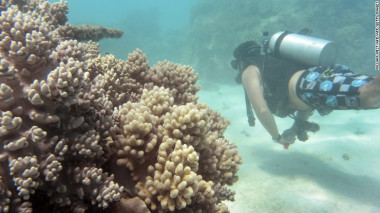 Coral bleaching: Researchers struggle to find anywhere in Pacific Ocean untouched, ABC News, By Nadia Daly,20 Aug 17 Scientists aboard a French research ship say they have been shocked to see the extent of coral bleaching across the Pacific Ocean, just halfway through their two-year voyage around the world.
The vessel Tara has been sailing around the globe for more than a decade to study the effects of climate change on the ocean.
Its current expedition will cross 11 time zones and span 100,000 kilometres from Europe to Asia and back again, and the group claims it is the biggest study of this scale across coral reefs.
The focus is how coral reefs in the Pacific are adapting to climate change, and on a stopover in Sydney, captain Nicolas De La Brosse said the extent of damage is already deeply troubling.
“What we’ve seen in really isolated spots like Samoa for example, even though it’s very far away from [developed] countries with pollution, we struggled to find any coral life,” he said.
Mr De La Brosse said nowhere was immune to the effects of global warming.
“It doesn’t matter where you are in the Pacific, coral is starting to bleach.”
He said data was still being collected and analysed and the final results would be released at the end of 2019……http://www.abc.net.au/news/2017-08-19/researchers-shocked-by-coral-bleaching-in-pacific/8822126
Ready at last for cleaning up Kyrgyzstan’s old uranium sites
Kyrgyzstan one step closer to remediation of uranium legacy sites https://www.timesca.com/index.php/news/18505-kyrgyzstan-one-step-closer-to-remediation-of-uranium-legacy-sites, 18 August 2017BISHKEK (TCA) — The EU welcomes the swift ratification by Kyrgyzstan of an agreement that allows environmental remediation in a number of uranium legacy sites in the country to go ahead, the Delegation of the European Union to the Kyrgyz Republic said on August 18.
All the basic conditions are now in place to start actual remediation work. Support has been provided to the Kyrgyz Government on the matter as part of the EU’s environmental strategy for Central Asia. The importance of these initiatives was once more confirmed in June when the EU discussed the overall progress of this environmental strategy.
The areas concerned are the uranium legacy sites of Min-Kush, Shekaftar and Mailuu-Suu. The EU has funded technical studies and environmental impact assessment. These studies allow remediation work to first start in Min-Kush and Shekaftar.
It is now clear what needs to be done to improve the living conditions in the areas. Remediation work will be implemented through the EBRD managed multilateral Environmental Remediation Account for Central Asia (ERA). The EU is currently the only contributor to the ERA fund with an initial contribution of €16.5 million.
The preparatory work done so far is also supported by a Strategic Master Plan for Environmental Remediation of Uranium Legacy Sites in Central Asia. This plan was prepared under the leadership of the IAEA and it has further strengthened the technical basis on which the activities are to be done.
As a next step, the Kyrgyz Government is asked to set up the necessary structures to manage the projects. Technical assistance will be provided.
The Strategic Master Plan will be signed in September during the IAEA’s General Conference. At the same time in New York a special event will take place to further explain and discuss the progress made following a UN resolution of 2013 calling for international support to mitigate the risks in Central Asia as a result of the uranium legacy.
Radioactive materials unearthed by construction workers at the Flamanville nuclear site
Jersey Evening Post 15th Aug 2017, TRACES of radioactive material have been unearthed by construction workers
at the Flamanville nuclear site – less than 30 miles from Jersey’s
coast.
The incident has been reported to the French nuclear regulator ASN
– the Autorité de Sûreté Nucléaire – and has been classed as a
‘Significant Environmental Event’. Employees were said to have been in
the process of clearing 8,700 tons of non-nuclear waste as part of a larger
project to build a car park, when they came across nearly 100 suits used by
technicians working in zones exposed to nuclear activities. A spokesman for
the plant said that the construction had been stopped following the
incident and that some of the waste had been in the ground since 1989.
http://jerseyeveningpost.com/news/2017/08/15/radioactive-material-unearthed-at-p
The weapons industry is polluting our environment – Potomac River as an example
 How War Pollutes the Potomac River, DAVID SWANSON AND PAT ELDER FOR BUZZFLASH AT TRUTHOUT, 17 AUG 17, The Pentagon’s impact on the river on whose bank it sits is not simply the diffuse impact of global warming and rising oceans contributed to by the U.S. military’s massive oil consumption. The U.S. military also directly poisons the Potomac River in more ways than almost anyone would imagine.
Let’s take a cruise down the Potomac from its source in the mountains of West Virginia to its mouth at the Chesapeake Bay. The journey down this mighty waterway details six EPA Superfund sites created by the Pentagon’s reckless disregard for the fragile ecosystem of the Potomac River watershed.
The U.S. Navy’s Allegany Ballistics Laboratory in Rocket Center, West Virginia, 130 miles north of Washington, is a critical source of contamination in the Potomac River. The on-site disposal of explosive metals and solvent wastes contaminates soil and groundwater with hazardous chemicals. The groundwater and soil along the river are laced with explosives, dioxins, volatile organic compounds, acids, laboratory and industrial wastes, bottom sludge from solvent recovery, metal plating pretreatment sludge, paints, and thinners. The site also has a beryllium landfill. An active burning area is still used for waste disposal, sprinkling chemical dust over the river. It’s not good.
Traveling the river 90 miles further south brings us to Fort Detrick in Frederick, Maryland, the Army’s “proving ground” for the nation’s biological warfare program. Anthrax, Phosgene, and radioactive carbon, sulfur, and phosphorous are buried here. The groundwater is laced with deadly trichloroethylene, a human carcinogen, and tetrachloroethene, suspected of causing tumors in laboratory animals. The Army tested ghastly and heinous agents here, like Bacillus globigii, Serratia marcescens, and Escherichia coli. Although the DOD says it ceased biological weapons testing for offensive purposes in 1971, the claim is like the military’s placement of “defensive” missile systems near an enemy’s border.
Fort Detrick also has a history of dumping high levels of phosphorus into its drain system that ultimately washes into the lower Monocacy River, a tributary of the Potomac. In fact, the Maryland Department of Environment has cited the Army for exceeding allowable permit levels. Too much phosphorus in the water causes algae to grow faster than the Potomac ecosystem can handle. It is deadly. The Army is a leading polluter of the Potomac River watershed……..
The Potomac is far from unique. Sixty-nine percent of U.S. Superfund environmental disaster sites are the result of war preparations.
Preparations for war cost over 10 times the money that actual wars do, and cause at least 10 times the deaths. Routine U.S. military war preparations cause deaths by diverting resources from human needs and directly through massive environmental destruction spread all over the world including in the United States, and including in the Potomac.
So-called foreign intervention in civil wars around the world is, according to comprehensive studies, 100 times more likely — not where there is suffering, not where there is cruelty, not where there is a threat to the world, but where the country at war has large reserves of oil or the intervener has a high demand for oil.
The U.S. military is the top consumer of petroleum around, burning more of it than most entire countries, and burning much of it in routine preparations for more wars. There are military planes that can cause more damage with jet fuel in 10 minutes than you can with gasoline driving your car for a year.
All such calculations omit the environmental destruction done by private weapons makers and by their weapons. The U.S. is the leading exporter of war weapons to the rest of the world.
All such calculations also omit much of the damage and all of the details of the human suffering. The U.S. military burns toxic waste in the open, near its own troops in places like Iraq, near the homes of the people who live in the countries it has invaded, and within the United States in many — often poor and minority — communities such as Colfax, Louisiana, and at Dahlgren on the Potomac.
Much of the damage is essentially permanent, such as the poison of depleted uranium, used in places like Syria and Iraq. But this is true in locations all around the United States as well. Near St. Louis, Missouri, an underground fire is moving ever closer to an underground pile of radioactive waste.
And then there is the Potomac River. It flows south between the Lincoln and Jefferson Memorials in Washington, D.C. on the east, and Arlington, Virginia, on the west, where the Pentagon Lagoon brings the water up to the headquarters of world militarism.
Not only does the home of war making sit near rising waters — rising first and foremost because of the effects of war making, but those particular waters — the waters of the Potomac and of the Chesapeake Bay into which it flows, and the tides of which raise and lower the waters of the Pentagon Lagoon each day — are heavily polluted by war preparations.
This is why we are planning and invite you to join in a kayactivist flotilla to the Pentagon on September 16th. We need to bring the demand of No More Oil for Wars to the doorstep of our leading destroyer of the environment.
David Swanson is an author, activist, journalist, and radio host. He is director of WorldBeyondWar.org and campaign coordinator for RootsAction.org. Swanson’s books include War Is A Lie. He blogs at DavidSwanson.org and WarIsACrime.org. He hosts Talk Nation Radio. He is a 2015, 2016, 2017 Nobel Peace Prize Nominee. Follow him on Twitter: @davidcnswanson and FaceBook. http://truth-out.org/buzzflash/commentary/how-war-pollutes-the-potomac-river
Effects of the nuclear industry – environmental risks in 31 countries
 Town & Country Planning Association (accessed) 17th Aug 2017, Prof Andrew Blowers: In the first of a series of articles on the local and social legacies of nuclear energy, Andrew Blowers looks at where and why
these legacies have come to pass.
The nuclear industry has left its visible and invisible footprint in landscapes of risk encountered in the 31
countries in which nuclear energy has been developed.
In several countries the mark is, as yet, small, related to one or two operating nuclear
reactors. At the other extreme there are those countries with
long-established nuclear industries, some involved in both the civil and
military sectors, where nuclear operations, including electricity
generation, reprocessing and experimental processes, are intermixed with
redundant facilities, nuclear wastes, and radioactive discharges onto land
and into water and emissions into the atmosphere. https://www.tcpa.org.uk/journal
Increase in harmful algal blooms in US freshwaters due to climate change
Climate change projected to significantly increase harmful algal blooms in US freshwaters, Phys Org,
August 15, 2017, Harmful algal blooms known to pose risks to human and environmental health in large freshwater reservoirs and lakes are projected to increase because of climate change, according to a team of researchers led by a Tufts University scientist. The team developed a modeling framework that predicts that the largest increase in cyanobacterial harmful algal blooms (CyanoHABs) would occur in the Northeast region of the United States, but the biggest economic harm would be felt by recreation areas in the Southeast.
The research, which is published in print today in the journal Environmental Science & Technology, is part of larger, ongoing efforts among scientists to quantify and monetize the degree to which climate change will impact and damage various U.S. sectors…….
It has been estimated that lakes and reservoirs serving as drinking water sources for 30 million to 48 million Americans may be contaminated periodically by algal toxins. Researchers cited an example in 2014, when nearly 500,000 residents of Toledo, Ohio, lost access to drinking water after water drawn from Lake Erie revealed the presence of cyanotoxins……..https://phys.org/news/2017-08-climate-significantly-algal-blooms-freshwaters.html
1 This Month



26 September – International Day for the Total Elimination of Nuclear Weapons


PLEASE OPPOSE HR 8255 AND S.3639 – bills would accelerate satellite deployment, with no environmental review or safeguards – https://ncstd5li.quorum.us/campaign/169331/
To see nuclear-related stories in greater depth and intensity – go to https://nuclearinformation.wordpress.com
-
Archives
- September 2026 (257)
- August 2026 (330)
- July 2026 (355)
- June 2026 (287)
- May 2026 (306)
- April 2026 (356)
- March 2026 (251)
- February 2026 (267)
- January 2026 (308)
- December 2025 (358)
- November 2025 (359)
- October 2025 (375)
-
Categories
- 1
- 1 NUCLEAR ISSUES
- business and costs
- climate change
- culture and arts
- ENERGY
- environment
- health
- history
- indigenous issues
- Legal
- marketing of nuclear
- media
- opposition to nuclear
- PERSONAL STORIES
- politics
- politics international
- Religion and ethics
- safety
- secrets,lies and civil liberties
- spinbuster
- technology
- Uranium
- wastes
- weapons and war
- Women
- 2 WORLD
- ACTION
- AFRICA
- Atrocities
- AUSTRALIA
- Christina's notes
- Christina's themes
- culture and arts
- Events
- Fuk 2022
- Fuk 2023
- Fukushima 2017
- Fukushima 2018
- fukushima 2019
- Fukushima 2020
- Fukushima 2021
- general
- global warming
- Humour (God we need it)
- Nuclear
- RARE EARTHS
- Reference
- resources – print
- Resources -audiovicual
- Weekly Newsletter
- World
- World Nuclear
- YouTube
-
RSS
Entries RSS
Comments RSS

