Poisoned water and scarred hills
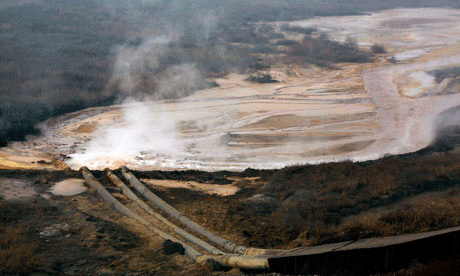
The price of the rare earth metals the world buys from China
By Laura Bicker and the Visual Journalism team: 08/07/2025, https://www.bbc.co.uk/news/resources/idt-66cdf862-5e96-4e6e-90b8-a407b597c8d9
When you stand on the edge of Bayan Obo, all you see is an expanse of scarred grey earth carved into the grasslands of Inner Mongolia in northern China.
Dark dust clouds rise from deep craters where the earth’s crust has been sliced away over decades in search of a modern treasure.
You may not have heard of this town – but life as we know it could grind to a halt without Bayan Obo.
The town gets its name from the district it sits in, which is home to half of the world’s supply of a group of metals known as rare earths. They are key components in nearly everything that we switch on: smartphones, bluetooth speakers, computers, TV screens, even electric vehicles.
And one country, above all others, has leapt ahead in mining them and refining them: China.
This dominance gives Beijing huge leverage – both economically, and politically, such as when it negotiates with US President Donald Trump over tariffs. But China has paid a steep price for it.
To find out more, we travelled to the country’s two main rare earth mining hubs – Bayan Obo in the north and Ganzhou in the province of Jiangxi in the south.
We found man-made lakes full of radioactive sludge and heard claims of polluted water and contaminated soil, which, in the past, have been linked to clusters of cancer and birth defects. These journeys were challenging.
Beijing appears sensitive to criticism of its environmental record. We were pulled over by police, questioned by them and stuck in a three-hour standoff with an unidentified mining boss who refused to let us leave unless we deleted our footage.
Our calls for an interview or a statement have gone unanswered, but the government has published new regulations to try to strengthen its supervision of the industry.
Authorities have been making an effort to clean up these mining sites, scientists told the BBC. Still, China’s mining operations in the north just keep growing.
Machines are constantly on the hunt for rare earths called neodymium and dysprosium that go into making powerful magnets for a variety of modern technology, from electric vehicles to computer hard drives.
To find these rare earths, the machines strip away the topsoil layer-by-layer, kicking up harmful dust, some of which contains high levels of heavy metals and radioactive material.
Satellite images from the last few decades show how the Bayan Obo mine has spread.
The mine sits in the vast, aridness of Inner Mongolia, a nine-hour drive from the capital, Beijing.
There were once more than a thousand mining sites, some of them illegal, dotted throughout this one county. Companies got what they needed from one mine, and then moved to another.
Then in 2012, the Chinese government stepped in to regulate, dramatically reducing the number of mining licences they issued.
But significant damage had been done to the area already. Research going back decades has linked the rare earth mines to deforestation, soil erosion and chemical leaks into rivers and farmland.
Local farmer Huang Xiaocong, whose land is surrounded by four rare earth sites, believes landslides are still being triggered by improper mining practices.
He has also accused the state-owned company of grabbing land illegally. The firm refused to answer the BBC’s questions.
“This problem is way too big for me to solve. It’s something that has to be dealt with at the higher levels of government,” Mr Huang said.
“We ordinary people don’t have the answers… Farmers like us, we’re the vulnerable ones. To put it simply, we were born at a disadvantage. It’s pretty tragic.”
It is rare and often risky in China for villagers to take on huge companies – and even rarer for them to speak to international media. But Mr Huang is determined to be heard and has taken his case to the local Natural Resources Bureau.
Satellite images show the mining ponds surrounding Mr Huang’s village and land. Within a six kilometres wide square, at least four sites are visible.
During our interview with Mr Huang, we were surrounded by men wearing uniforms branded with what appeared to be the logo of the same rare earth company. At least 12 other men used their vehicles to block our car from leaving.
Eventually, someone who identified himself as a local manager of China Rare Earth Jiangxi Company arrived. He confronted Mr Huang and us, and wouldn’t let us leave for nearly three hours, despite our attempts to negotiate and our offers to hear his argument.
Those living around the mines in Bayan Obo and Ganzhou appear to be victims of what used to be China’s “develop first and clean up later” approach to mining, says Professor Julie Klinger, author of Rare Earth Frontiers. That has changed now as they try harder to mitigate the damage, she adds, but the consequences are here to stay.
“I think it’s very difficult to know the true human and environmental cost of that sort of development model,” she told the BBC.
The worst health effects were found in and around the largest tailing pond south of Bayan Obo in the city of Baotou. In the decades leading up to 2010, villagers were diagnosed with bone and joint deformities caused by too much fluoride in the water and acute arsenic toxicity, according to Professor Klinger.
Most of them lived close to the Weikuang Dam, a man-made lake built to dump mining waste in the 1950s. Authorities have since moved villagers away from the site, but the 11km-long tailings pond is still full of grey clay sludge, including radioactive thorium.
Studies suggest this toxic mix could be slowly seeping into the groundwater and moving towards the Yellow River, China’s second-largest, and a key source of drinking water for the north of the country.
As the demand for pocket gadgets, electric vehicles, solar panels, MRI machines and jet engines surges, there is one worrying statistic to contend with – mining just one tonne of rare earth minerals creates some 2,000 tonnes of toxic waste.
China is now trying to rein in the environmental harm its rush for rare earths has caused, while expanding its mining operations abroad. Others, including the United States, are in a hurry to catch up with their own rare earth enterprises.
But scientists warn that no matter where these metals are mined, without the right solutions, landscapes and lives will be put at risk.
And yet, some farmers in Bayan Obo have adjusted to life in the the world’s rare earth capital.
The metals that have scarred their land and poisoned their water have also brought them jobs.
“With the rare earths, there’s money now,” one farmer told us. “The mines pay 5,000 or 6,000 yuan ($837; £615) a month.”
He says he lost money herding horses, among the traditional livelihoods in a region that has long been home to nomadic people. Horses still roam the pastures next to the mines, as diggers continue their search for more rare earths.
“Farming’s fine,” he told us as he planted green onions. “You just grow your crop and sell it – simple as that.”
“Return to Fukushima”

by beyondnuclearinternational, https://beyondnuclearinternational.org/2025/07/06/return-to-fukushima-2/
Cindy Folkers reviews Thomas Bass’s excellent new book that is both a personal journey and a stark warning
Thomas A. Bass’s “Return to Fukushima” is a poignant blend of investigative journalism, environmental critique, and personal reflection that revisits the 2011 Fukushima Daiichi nuclear power disaster. Bass brings poetic prose, incisive analysis, and a deeply ethical lens to a subject often buried under technical jargon and political spin. This book is not just a recounting of catastrophe, but a stark reminder that, even in the face of individual and community resilience, science and policy fall short for those haunted by the permanence of radioactive contamination.
At the heart of the book lies a powerful question: What does it mean to live in a nuclear exclusion zone? Bass uses this inquiry to explore the “slow violence of radiation,” the enduring trauma of environmental contamination, the cultural amnesia that allows such disasters to fade from global consciousness, and the political and corporate machinery that enables this erasure. Rather than focusing on abstract debates, he humanizes the crisis by highlighting the lived experiences of those navigating the radioactive ruins of northeastern Japan. He remarks, “The process [of decontamination] is more about managing people’s perception of radiation than it is a solution.”
Rooting the book in personal and historical context, Bass recalls the surreal normalcy of growing up in a home adorned with photographs of mushroom clouds, reflecting his father’s involvement in fabricating both hydrogen (tritium) bombs and atomic bombs. Starting from this context, Bass links Fukushima to other sites of radioactive trauma—Chernobyl, Hanford, Bikini Atoll—framing them as part of a global pattern of technological arrogance, and recognizing the long-standing connection between civilian energy and military power.
Bass first visited Fukushima in 2018 and returned in 2022. His first trip revealed a superficial recovery, what he calls a “Potemkin” reconstruction aimed at showcasing Japan’s readiness for the Tokyo Olympics. By 2022, however, a more genuine—albeit cautious—resettlement was underway, with some people returning and farms being tentatively revived. Yet, even as the physical infrastructure was repaired, the psychic and ecological wounds lingered. Bass captures this tension with journalistic clarity and literary finesse.
Bass specifically relates his own encounter with radioactivity in a contaminated town in Japan — Namie: “As I get out of the car to photograph the bowling alley with the boat leaned against it, there is a metallic taste in my mouth, a lick of gunmetal.” Such moments remind readers that radiation, while invisible, is palpably real to those living with it daily.
Throughout the book, Bass offers a scathing critique of what he terms nuclear power’s “greenwashing.” Drawing from scientists, environmentalists, and historical evidence, he dissects the industry’s claims that nuclear energy is a safe, carbon-free solution to climate change. His tone is neither hysterical nor ideological; instead, it is sharply analytical and grounded. On the empty rhetoric of clean energy, he wryly notes, “Yes, plutonium is carbon-free. It will also kill you.”
Bass goes further by examining the systemic forces that allow nuclear risk to persist without accountability, laying bare the many attempts at covering over the severity of the ongoing nuclear catastrophe, including official lies about radioisotope content of contaminated water released into the Pacific, official allowable increases in the exposure limit to the public, and government gag orders placed on scientists. He delves into misinformation, regulatory failure, and public relations strategies that obscure the true costs—human and ecological—of nuclear energy.
In one of the book’s most disturbing passages, he highlights the Japanese government’s refusal to acknowledge radiation-related illnesses: “Doctors have left the area because the government refuses to reimburse them when they list radiation sickness as the cause for nose bleeds, spontaneous abortions, and other ailments resulting from ionizing radiation. (The only acceptable diagnoses are ‘radio-phobia,’ nervousness, and stress.)”
However, “Return to Fukushima” is not merely a catalog of policy failures or even a polemic against nuclear energy. It is above all an ethical and human-centered work. The personal stories Bass shares—such as those of the Kobayashis, who collaborate with Chernobyl survivors, or citizen scientists using homemade Geiger counters—bring dignity and agency to people often ignored by mainstream narratives. “‘You measure everything and keep measuring,’ says Takenori Kobayashi… ‘That’s the most important lesson we have learned from Chernobyl.’”
Despite these attempts at self-determination, Bass’s takeaway is a chilling question: “Is this what our future looks like? A daycare center full of radiation maps and equipment for monitoring our contaminated Earth?” The line encapsulates the book’s quiet horror and urgent relevance. As nations look to nuclear power as a climate solution, Bass reminds us that technological fixes without ethical grounding can cause irreversible harm.
“Return to Fukushima” is far more than a chronicle of disaster. It is a searing indictment of technological arrogance, a meditation on environmental justice, and a terrifying look into a future we can still largely avoid. With eloquence, empathy, and unflinching honesty, Thomas A. Bass confronts the radioactive legacy of our times. As Noam Chomsky aptly states, this is a book “so crucial that it bears on the survival of the earth.” Anyone interested in energy policy, environmental ethics, or the future of our planet should read it.
Nuclear waste near nature reserve plan ongoing
Residents and politicians have hit out at plans to allow radioactive waste
to be disposed of at a landfill site near a nature reserve and town. The
site, on Huntsman Drive in Port Clarence, Stockton, run by Augean, already
disposes of a range of hazardous waste but requires permission to deal with
nuclear material.
Tees Valley Mayor Ben Houchen said the plans were wrong
in 2019 when they were first put to the Environment Agency (EA) and were
“still wrong now”. But Augean said risk assessments demonstrated the
proposals “would not harm people in the local area or the environment”. The
EA previously asked for more information about the plan in September 2020
and it has now opened a public consultation, which will close on 4 August.
Lord Houchen said: “We absolutely want new nuclear power and we are working
hard to deliver this – but I will not allow Teesside to be seen as a
dumping ground for the country’s waste. “I will continue to stand firmly
against any plan, and I urge everyone to make their voices heard loud and
clear in this consultation.”
BBC 1st July 2025,
https://www.bbc.co.uk/news/articles/c80pp5vl49yo
Radiation risks from US strikes on Iran’s nuclear sites seen as minimal
Negar Mojtahedi, Iran International, Jun 23, 2025, https://www.iranintl.com/en/202506228904
S airstrikes on Iran’s nuclear facilities are unlikely to cause serious radioactive fallout, nuclear experts told Iran International despite fears of a nuclear disaster.
Their assessments come as Iran threatens retaliation, and the International Atomic Energy Agency (IAEA) holds an emergency meeting on Monday in response to the escalating crisis.
“For most facilities the impact of direct strikes will, to a large extent, most likely be very localized,” said Dr. Kathryn Higley, distinguished professor of nuclear science and engineering at Oregon State University and president of the National Council on Radiation Protection and Measurements told Iran International.
“While enriched uranium is radioactive, it is not terribly so. If the uranium is present and released as hexafluoride, that could also pose a serious but still localized hazard due to the fluorine in the compound being reactive,” she said.
Dr. David Albright, founder of the Institute for Science and International Security, told Iran International that concerns over radiation from a strike on Fordow are overblown when compared with past incidents.
“One way to understand the low radiological risk of bombing Fordow is from a comparison to the underground Natanz enrichment site with over 15,000 centrifuges and many tons of uranium,” he said.
“It was attacked with earth penetrators and there is no off-site radiation risk. Fordow has about 2,700 centrifuges and much less uranium, and is more deeply buried underground. Hard to expect worse than Natanz.”
Albright emphasized that the design and location of Iran’s underground enrichment sites inherently limit the spread of radioactive.
Temporary contamination risks are primarily limited to areas near uranium conversion and enrichment plants, according to Andrea Stricker, a research fellow at the Foundation for Defense of Democracies (FDD).
“Response teams going near the destroyed facilities, for example, would need to wear protective gear temporarily due to risks of inhaling or ingesting aerially dispersed uranium chemical compounds,” said Stricker. “There is not concern for dispersal beyond the immediate plants.”
The US strike on the heavily fortified Fordow facility has likely trapped radioactive material underground, limiting any broader hazard, Stricker said.
Iran’s response: ‘no signs of contamination’
Their comments follow US President Donald Trump’s announcement on Sunday that American forces had struck Iran’s Fordow, Isfahan, and Natanz nuclear sites, which he described as “completely and fully obliterated.”
While Iran confirmed the strikes, it insisted its nuclear program would continue undeterred.
Iran’s National Nuclear Safety System reported that radiation detectors at the affected facilities showed “no signs of contamination” and stated, “There is no danger to the residents living around the aforementioned sites,” according to Iran State media.
The IAEA said it had observed “no increase in off-site radiation levels” and would continue monitoring the situation.
Director General Rafael Grossi announced an emergency meeting of the agency’s 35-member board of governors. In response, Iran’s nuclear chief Mohammad Eslami called for an investigation and accused Grossi of “inaction and complicity.”
Isfahan and Natanz—both previously targeted by Israeli airstrikes—have not shown any evidence of radiation release, according to IAEA monitoring.
Experts say Bushehr not likely to be targeted
Bushehr, Iran’s only operational nuclear power reactor, is not expected to be targeted.
“Israel will not have the Bushehr nuclear power plant on its target list, as striking the reactor would cause a radiological disaster in the region,” Stricker said.
Bushehr is used for civilian energy production, not enrichment. The plutonium it generates is not suitable for nuclear weapons, and spent fuel is required to be returned to Russia.
Still, the plant contains significant quantities of nuclear material, and Grossi has warned that an attack on Bushehr could have the most serious radiological consequences of any site in Iran.
Tehran continues to maintain that its nuclear program is for peaceful purposes, but Trump and Israeli officials argue Iran is moving dangerously close to weapons capability.
“There will either be peace,” Trump said during a national address following the strikes, “or there will be tragedy for Iran.”
What are the nuclear contamination risks from Israel’s attacks on Iran?
By Andrew Macaskill, Federico Maccioni and Pesha Magid, June 21, 2025,
https://www.reuters.com/world/middle-east/what-are-nuclear-contamination-risks-israels-attacks-iran-2025-06-19/
LONDON/DUBAI, June 19 (Reuters) – Israel’s strikes on Iran’s nuclear installations so far pose only limited risks of contamination, experts say. But they warn that any attack on the country’s nuclear power station at Bushehr could cause a nuclear disaster.
Israel says it is determined to destroy Iran’s nuclear capabilities in its military campaign, but that it also wants to avoid any nuclear disaster in a region that is home to tens of millions of people and produces much of the world’s oil.
Fears of catastrophe rippled through the Gulf on Thursday when the Israeli military said it had struck a site in Bushehr on the Gulf coast – home to Iran’s only nuclear power station – only to say later that the announcement was a mistake.
WHAT HAS ISRAEL HIT SO FAR?
Israel has announced attacks on nuclear sites in Natanz, Isfahan, Arak and Tehran itself. Israel says it aims to stop Iran building an atom bomb. Iran denies ever seeking one.
The international nuclear watchdog IAEA has reported damage to the uranium enrichment plant at Natanz, to the nuclear complex at Isfahan, including the Uranium Conversion Facility, and to centrifuge production facilities in Karaj and Tehran.
Israel has also attacked Arak, also known as Khondab.
The IAEA said Israeli military strikes hit the Khondab Heavy Water Research Reactor, which was under construction and had not begun operating, and damaged the nearby plant that makes heavy water. The IAEA said that it was not operational and contained no nuclear material, so there were no radiological effects.
In an update of its assessment on Friday, the IAEA said key buildings at the site were damaged. Heavy-water reactors can be used to produce plutonium which, like enriched uranium, can be used to make an atom bomb.
WHAT RISKS DO THESE STRIKES POSE?
Peter Bryant, a professor at the University of Liverpool in England who specialises in radiation protection science and nuclear energy policy, said he is not too concerned about fallout risks from the strikes so far.
He noted that the Arak site was not operational while the Natanz facility was underground and no release of radiation was reported. “The issue is controlling what has happened inside that facility, but nuclear facilities are designed for that,” he said. “Uranium is only dangerous if it gets physically inhaled or ingested or gets into the body at low enrichments,” he said.
Darya Dolzikova, a senior research fellow at London think tank RUSI, said attacks on facilities at the front end of the nuclear fuel cycle – the stages where uranium is prepared for use in a reactor – pose primarily chemical, not radiological risks.
At enrichment facilities, UF6, or uranium hexafluoride, is the concern. “When UF6 interacts with water vapour in the air, it produces harmful chemicals,” she said.
The extent to which any material is dispersed would depend on factors including the weather, she added. “In low winds, much of the material can be expected to settle in the vicinity of the facility; in high winds, the material will travel farther, but is also likely to disperse more widely.”
The risk of dispersal is lower for underground facilities.
Simon Bennett, who leads the civil safety and security unit at the University of Leicester in the UK, said risks to the environment were minimal if Israel hits subterranean facilities because you are “burying nuclear material in possibly thousands of tonnes of concrete, earth and rock”.
WHAT ABOUT NUCLEAR REACTORS?
The major concern would be a strike on Iran’s nuclear reactor at Bushehr.
Richard Wakeford, Honorary Professor of Epidemiology at the University of Manchester, said that while contamination from attacks on enrichment facilities would be “mainly a chemical problem” for the surrounding areas, extensive damage to large power reactors “is a different story”.
Radioactive elements would be released either through a plume of volatile materials or into the sea, he added.
James Acton, co-director of the Nuclear Policy Program at the Carnegie Endowment for International Peace, said an attack on Bushehr “could cause an absolute radiological catastrophe”, but that attacks on enrichment facilities were “unlikely to cause significant off-site consequences”.
Before uranium goes into a nuclear reactor it is barely radioactive, he said. “The chemical form uranium hexafluoride is toxic … but it actually doesn’t tend to travel large distances and it’s barely radioactive. So far the radiological consequences of Israel’s attacks have been virtually nil,” he added, while stating his opposition to Israel’s campaign.
Bennett of the University of Leicester said it would be “foolhardy for the Israelis to attack” Bushehr because they could pierce the reactor, which would mean releasing radioactive material into the atmosphere.
WHY ARE GULF STATES ESPECIALLY WORRIED?
For Gulf states, the impact of any strike on Bushehr would be worsened by the potential contamination of Gulf waters, jeopardizing a critical source of desalinated potable water.
In the UAE, desalinated water accounts for more than 80% of drinking water, while Bahrain became fully reliant on desalinated water in 2016, with 100% of groundwater reserved for contingency plans, according to authorities.
Qatar is 100% dependent on desalinated water.
In Saudi Arabia, a much larger nation with a greater reserve of natural groundwater, about 50% of the water supply came from desalinated water as of 2023, according to the General Authority for Statistics.
While some Gulf states like Saudi Arabia, Oman and the United Arab Emirates have access to more than one sea to draw water from, countries like Qatar, Bahrain and Kuwait are crowded along the shoreline of the Gulf with no other coastline.
“If a natural disaster, oil spill, or even a targeted attack were to disrupt a desalination plant, hundreds of thousands could lose access to freshwater almost instantly,” said Nidal Hilal, Professor of Engineering and Director of New York University Abu Dhabi’s Water Research Center.
“Coastal desalination plants are especially vulnerable to regional hazards like oil spills and potential nuclear contamination,” he said.
Anxiety grips Gulf Arab states over threat of nuclear contamination and reprisals from Iran
Almost 60 million people in Gulf Arab countries rely on desalinated sea water from the Persian Gulf for drinking, washing and usable water. Regional leaders have warned that contamination from Iran’s Bushehr nuclear power plant, if attacked, could have severe environmental consequences for this critical water source.
“(The water) would be entirely contaminated … No water, no fish, nothing, it has no life,”
By Mostafa Salem, CNN, June 19, 2025, https://edition.cnn.com/2025/06/18/middleeast/gulf-anxiety-iran-strikes-nuclear-contamination-latam-intl
Concern is rising in Gulf Arab states about the possibility of environmental contamination or reprisal attacks if Israel or the United States strikes Iran’s nuclear facilities just across the Persian Gulf.
In Oman, users on messaging apps circulated advice on what to do in the event of a nuclear incident. Residents are instructed to “enter a closed and secure indoor space (preferably windowless), seal all windows and doors tightly, turn off air conditioning and ventilation systems” if the worst were to happen.
In Bahrain, 33 shelters are being prepared for emergencies, and sirens were tested nationwide, the state news agency said Tuesday. Concern about nuclear fallout has also risen over the past week, with news outlets across the Middle East publishing guides on how to deal with radiation leaks.
Elham Fakhro, a Bahraini resident and fellow at the Middle East Initiative at Harvard Kennedy School, said people are “definitely concerned” about the prospect of Israeli and US strikes on Iran’s nuclear facilities.
Iran’s only functional nuclear power plant, in Bushehr, is closer to several US-allied Arab capitals than it is to Tehran.
“Primarily there is fear of environmental contamination, especially in shared waters,” Fakhro said.
She added that other concerns include “the possibility of an Iranian reprisal on US military facilities in the Gulf states, which could impact civilians, and extended airspace closures.”
Despite its improved relationship with Arab neighbors, Iran has implicitly warned that it would target nearby US interests if it were struck by the American military.
Bahrain, for example, hosts the US Naval Forces Central Command, which could be a target.
The Gulf Cooperation Council, an economic and political bloc that comprises Bahrain, Kuwait, Oman, Qatar, Saudi Arabia and the United Arab Emirates, on Monday activated its Kuwait-based Emergency Management Centre, to ensure that all “necessary preventive measures are taken at environmental and radiological levels.”
The UAE’s foreign minister, Sheikh Abdullah bin Zayed, warned “against the risks of reckless and miscalculated actions that could extend beyond the borders” of Iran and Israel. The Qatari foreign ministry spokesperson also warned of “uncalculated” strikes that could affect the waters of Gulf countries.
Almost 60 million people in Gulf Arab countries rely on desalinated sea water from the Persian Gulf for drinking, washing and usable water. Regional leaders have warned that contamination from Iran’s Bushehr nuclear power plant, if attacked, could have severe environmental consequences for this critical water source.
Running out of water ‘in three days’
In March, US journalist Tucker Carlson asked Qatari Prime Minister Mohammed Al Thani what would happen if the Bushehr nuclear plant were “blown up.”
“(The water) would be entirely contaminated … No water, no fish, nothing, it has no life,” Al Thani said.
The Qatari prime minister said at the time that his country previously ran a risk exercise to analyze how a damaged Iranian nuclear power plant could affect them.
“The water we use for our people is from desalination … We don’t have rivers and we don’t have water reserves. Basically, the country would run out of water in three days … That is not only applied for Qatar … this is applied for Kuwait, this is applied for UAE. It’s all of us,” he said. Qatar has since built massive water reservoirs for protection.
US President Donald Trump appears to be warming to the idea of using US military assets to strike Iranian nuclear facilities and souring on the possibility of a diplomatic solution to end the conflict, two officials told CNN on Tuesday.
This represents a shift in Trump’s approach, though the sources said he remains open to a diplomatic solution – if Iran makes concessions.

“I may do it, I may not do it. I mean, nobody knows what I’m going to do,” Trump said Wednesday.
Gulf states, including the UAE, Qatar and Saudi Arabia, are attractive destinations for businesses and foreign expatriates, offering no income tax, high salaries and a stable political environment. People CNN spoke to in Kuwait and the UAE said there isn’t a feeling of panic amongst residents, and trust remains that regional authorities have safe contingency plans.
“I don’t feel worried or concerned, I have an unwavering trust in my safety here,” said an American woman living in Abu Dhabi. “I would, however, feel worried if the US decides to strike (Iran) because of the uncertainty in what happens next.”
Another Egyptian resident of Dubai, who chose to remain anonymous, said she feels “very safe” and “in the right country” but her anxiety is now heightened over the news she’s reading on escalation and war.
“Everyone is stressed out … and it’s becoming very real,” she said. “The situation is not something to be taken lightly and war feels nearby.”
Labour’s nuclear dream has destroyed my home: inside the Sizewell C planning row.

As the Government pledges £14.2 billion for the new power
station on the Suffolk coast, it faces fierce opposition from residents.
Eastbridge, a small Suffolk village two miles inland from the coast,
surrounded by marshland, has looked much the same for centuries.
Over the past year, however, it has been transformed. Huge swathes of the
surrounding countryside have been dug into a strange lunar landscape of
sand and soil to make way for construction associated with Sizewell C,
including a vast accommodation campus for workers on the outskirts of the
village. The scale of the site is only really clear from aerial
photographs, which shows a patchwork of grey, orange and brown where there
once was lush green. And this is just the beginning.
Last week, the Government pledged £14.2 billion for the project at Sizewell, which will
eventually provide low-carbon electricity for six million homes for a
lifespan of 60 years. The only published overall cost for the scheme was
£20 billion in 2020, but it has reportedly now ballooned to over £40
billion. Still a fair price, many argue, for a source of “clean,
homegrown power” – as Ed Miliband says – to future-proof Britain’s
energy security.
Inevitably, however, it has faced fierce opposition from
residents in the surrounding area, with some locals arguing the Government
hasn’t counted the true cost of the lengthy construction period and the
damage to the natural landscape and neighbouring communities.
Alison Downes, the director of Stop Sizewell C, began campaigning against the
project in 2013 on the grounds of the impact on the local area. “In the
early days we were trying to persuade the project to amend its proposal,
including the location of the [accommodation] campus at Eastbridge,” she
says. “It was of grave concern that it was proposed for 3,000 people –
it’s gone down a little bit, but not much.” Then, she says, as she
learnt more about the project, “all these other issues [came] to the
fore.” Downes, a career campaigner, has wisely focused on scrutinising
Sizewell on issues of national, rather than localised, importance.
Stop Sizewell C argues that the project is bad value for money, will be too slow
to address climate change (it will take at least 10-12 years to build,
according to the EDF), and will ultimately load too much risk onto the
taxpayer.
Telegraph 18th June 2025,
https://www.telegraph.co.uk/news/2025/06/18/labours-nuclear-dream-has-destroyed-my-home-inside-the-size/
Sizewell C nuclear’s ecological cost may be far greater than the financial one.
Government commits £14.2bn to Sizewell C nuclear plant
Bird Guides 13th June 2025, https://www.birdguides.com/news/government-commits-14-2bn-to-sizewell-c-nuclear-plant/
The UK Government has pledged £14.2 billion to fund the controversial Sizewell C nuclear power plant in Suffolk, sparking alarm among environmental groups over the project’s potential impact on coastal ecosystems.
Chancellor Rachel Reeves announced the investment at the GMB union’s annual congress this week, calling it the largest state commitment to nuclear power in 50 years.
Construction of the plant, expected to take a decade, aims to power six million homes and contribute to a so-called “golden age of clean energy”. Ministers claim it will enhance energy security by reducing reliance on imported power.
Wildlife at risk
However, conservationists warn that the ecological cost may be far greater than the financial one. Sizewell C is set to be built on the edge of Minsmere RSPB, one of Britain’s most important nature reserves, home to species such as Western Marsh Harrier, Eurasian Bittern and Natterjack Toad. Campaigners argue the construction risks devastating local habitats, endangering wildlife and disrupting delicate wetland ecosystems.
Last year, Suffolk Wildlife Trust and the RSPB called for greater transparency from Sizewell C in relation to its wildlife-compensation schemes, which include EDF’s £5 million purchase of the 67-ha Aldhurst Farm, which has now become ‘Wild Aldhurst’.
Alison Downes of Stop Sizewell C condemned the move, accusing ministers of withholding the true cost of the development, which her group estimates could reach £40 billion. “This project threatens biodiversity and will leave a long-lasting scar on a vital coastal environment,” she said. “It’s an irreversible commitment with unclear benefits and guaranteed environmental harm.”
Pros and cons
Despite reassurances that the project will be funded through a Regulated Asset Base model – adding around £1 a month to household electricity bills over the plant’s 60-year lifespan – critics question whether the benefits outweigh the damage. The plant’s sister project, Hinkley Point C, remains unfinished and significantly over budget.
Energy Secretary Ed Miliband insisted Sizewell C will be “faster and cheaper” by replicating Hinkley’s design. He also highlighted the creation of 10,000 jobs and £330 million in local contracts, framing the investment as a catalyst for economic regeneration.
Yet opponents argue that job creation and energy gains do not justify the environmental cost. The government’s concurrent £2.5-billion investment in fusion energy and a new small modular reactor programme raises further questions about the need for another full-scale nuclear facility.
As ministers push forward, the battle between energy policy and environmental preservation intensifies – leaving the future of Suffolk’s protected coastline hanging in the balance.
Another delay for Sizewell C nuclear despite Government 14bn pledge
ITV News. 10 June 2025
The government has confirmed a £14.2bn investment to build the Sizewell C nuclear plant – but still cannot confirm the project is fully funded.
Ministers claim the reactor – the third to be built on the Suffolk coast – will create 10,000 jobs, 1,500 apprenticeships, and generate enough “clean” energy to power millions of homes.
It will be part of a “golden age of clean energy abundance” which will pave the way for household bills and help tackle the climate crisis, according to Energy Secretary Ed Miliband.
But the government has had to stop short of issuing a “Final Investment Decision”, which can only be given once full investment has been secured.
Opponents insist the government “will come to regret” this latest backing for Sizewell C, claiming the project “will add to consumer bills and is guaranteed to be late and overspent”, comparing it to Hinkley Point C, the nuclear plant under construction in Somerset.
Sizewell, which sits just a few miles south of celebrity hotspot Southwold and borders the former Springwatch base at RSPB Minsmere, was first identified as a potential site for a new plant back in 2009.
The project was granted development consent by the then-Conservative government in July 2022 and Sir Keir Starmer made a further £5.5bn available to the project last August.
Preparatory work has already been started by French energy firm EDF and contracts worth around £330m have already been signed with local companies.
The government said Tuesday’s announcement would end “years of delay and uncertainty”.
“We will not accept the status quo of failing to invest in the future and energy insecurity for our country,” said Mr Miliband.
“We need new nuclear to deliver a golden age of clean energy abundance, because that is the only way to protect family finances, take back control of our energy, and tackle the climate crisis.
“This is the government’s clean energy mission in action – investing in lower bills and good jobs for energy security.”
The joint managing directors of Sizewell C, Julia Pyke and Nigel Cann, said: “Today marks the start of an exciting new chapter for Sizewell C, the UK’s first British-owned nuclear power plant in over 30 years.”But with an estimated cost of at least £20bn – and some experts predicting it could exceed £40bn – EDF continues to seek investors in the project.
The government said it expected to issue a Final Investment Decision in the summer.https://www.itv.com/news/anglia/2025-06-09/another-delay-for-sizewell-c-despite-governments-14bn-pledge
Revealed: three tonnes of uranium legally dumped in protected English estuary in nine years
Expert raises concerns over quantities allowed to be discharged from nuclear fuel factory near Preston
The Environment Agency has allowed a firm to dump three tonnes of uranium into one of England’s most protected sites over the past nine years, it can be revealed, with experts sounding alarm over the potential environmental impact of these discharges.
Documents obtained by the Guardian and the Ends Report through freedom of information requests show that a nuclear fuel factory near Preston discharged large quantities of uranium – legally, under its environmental permit conditions – into the River Ribble between 2015 and 2024. The discharges peaked in 2015 when 703kg of uranium was discharged, according to the documents.
Raw uranium rock mined from all over the world is brought to the Springfields Fuels factory in Lea Town, a small village roughly five miles from Preston, where the rock is treated and purified to create uranium fuel rods.
According to the factory’s website, it has supplied several million fuel elements to reactors in 11 different countries.
The discharge point for the uranium releases is located within the Ribble estuary marine conservation zone – and about 800m upstream of the Ribble estuary, which is one of the most protected sites in the country, classified as a site of special scientific interest, a special protection area (SPA) and a Ramsar site (a wetland designated as being of international importance).
The government’s latest Radioactivity in Food and the Environment report, published in November 2024, notes that in 2023 the total dose of radiation from Springfields Fuels was approximately 4% of the dose limit that is set to protect members of the public from radiation.
However, Dr Ian Fairlile, an independent consultant on radioactivity in the environment, who was a scientific secretary to the UK government’s committee examining radiation risks of internal emitters, said that in terms of radioactivity, the discharges from Springfields Fuels were a “very large amount”.
“I’m concerned at this high level. It’s worrying”, he said, referring specifically to the 2015 discharge.
In a 2009 assessment, the Environment Agency concluded that the total dose rate of radioactivity for the Ribble and Alt estuaries SPA was “significantly in excess” of the agreed threshold of 40 microgray/h, below which regulators have agreed there would be no adverse effect to the integrity of a protected site. The report found the calculated total dose rate for the worst affected organism in the estuary was more than 10 times higher than this threshold, with discharges of radionuclides from the Springfields Fuels site to blame.
As a result, a more detailed assessment was undertaken. In this latter report, it was concluded that based on new permitted discharge limits, which had been lowered due to planned operational changes at Springfields Fuels, the dose rates to wildlife were below the agreed threshold and therefore there was no adverse effect on the integrity of the protected site.
Under the site’s current environmental permit, there is no limit on the weight of uranium discharges, which in itself has raised eyebrows. Instead, the uranium discharge is limited in terms of its radioactivity, with an annual limit of 0.04 terabecquerels. Prior to this, the discharge limit in terms of radioactivity was 0.1 terabecquerels.
A terabecquerel is a unit of radioactivity equal to 1tn becquerels. One becquerel represents a rate of radioactive decay equal to one radioactive decay per second.
Despite this tighter limit having been agreed six years ago, experts have raised concerns over the continued authorised discharges from the site.
Fairlile specifically questioned the Environment Agency’s modelling of how this discharge level could be classified as safe. “This is a very high level. The Environment Agency’s risk modelling might be unreliable. Which would make its discharge limits unsafe”, he said.
The Environment Agency said its processes for assessing impacts to habitats were “robust and follow international best practice, including the use of a tiered assessment approach”.
Dr Patrick Byrne, a reader in hydrology and environmental pollution at Liverpool John Moores University, said the 703kg of uranium discharged in 2015 was an “exceptionally high volume”
Dr Doug Parr, a policy director at Greenpeace UK, said: “Discharges of heavy metals into the environment are never good, especially when those metals are radioactive.”
An Environment Agency spokesperson declined to comment directly, but the regulator said it set “strict environmental permit conditions for all nuclear operators in England, including Springfields Fuels Limited”.
It said these permits were based on “detailed technical assessments and are designed to ensure that any discharges of radioactive substances, including uranium, do not pose an unacceptable risk to people or the environment”.
While the government’s Radioactivity in Food and the Environment report found sources of radiation from Springfield Fuels were approximately 4% of the dose limit to members of the public, it also concluded that radionuclides – specifically isotopes of uranium – were detected downstream in sediment and biota in the Ribble estuary due to discharges from Springfields.
This is not the first time uranium levels in the estuary silt have been noted. Research conducted by the British Geological Survey (BGS) in 2002 detected “anomalously high” concentrations of uranium in a silt sample downstream of the Springfields facility.
The highest level recorded in the BGS report was 60μg/g of uranium in the silt – compared with a background level of 3-4μg/g. The researchers described this as a “significant anomaly”.
The UK is looking to expand its nuclear fuel production capabilities, including at Springfields Fuels. This is in order to increase energy security and reduce reliance on Russian fuel, and to deliver on a target of 24GW of new nuclear capacity by 2050.
A spokesperson from Westinghouse Electric Company UK, the operator of the factory), said: “Springfields is committed to strong environmental stewardship in our Lancashire community. The plant is monitored and regulated by the Environment Agency and operates well within those regulations. For nearly the past 80 years, Springfields has provided high-quality jobs to the local community and the fuel we provide to the UK’s nuclear power plants has avoided billions of tonnes of CO2 from fossil fuels.”
An Environment Agency spokesperson said: “The Environment Agency strictly regulates Springfields Fuels through robust environmental permits that control radioactive discharges, ensuring they pose no unacceptable risk to people or the environment. These permits are based on international best practice and are routinely reviewed, including detailed habitat assessments. Discharge limits have been progressively reduced over time, and monitoring by both the operator and the Environment Agency confirms no cause for concern.
How the ‘evil twin’ of the climate crisis is threatening our oceans

There’s frustration among researchers that falling pH levels in seas
around the globe are not being taken seriously enough, and that until the
buildup of CO2 is addressed, the consequences for marine life will be
devastating.
“At the end of the day, we know CO2 is going up, pH is going
down, and that’s an urgent issue that people are not talking about,”
says Turner. “It’s an overlooked consequence of carbon in our ocean
that governments can no longer afford to overlook in mainstream policy
agendas, and the time to address it is running out.”
Guardian 9th June 2025, https://www.theguardian.com/environment/2025/jun/09/the-scientists-warning-the-world-about-ocean-acidification-evil-twin-of-the-climate-crisis
Cumbrians receive postal call to back nuke dump democracy petition
NFLA 9th June 2025, https://www.change.org/p/massive-mine-shafts-and-nuclear-dump-for-cumbria-coast-tell-cumberland-council-vote-now
Residents of Millom, Seascale and Gosforth have just received a flyer from campaign group Radiation Free Lakeland calling on them to back a petition which asks Cumberland Councillors to host a debate followed by a vote about their engagement with the siting process for a Geological Disposal Facility in West Cumbria.
The GDF would be the eventual repository for Britain’s high-level radioactive waste which would be placed in tunnels beneath the seabed. A site in East Lincolnshire was also under consideration as a possible site. With the withdrawal of Lincolnshire County Council from the process last week, only sites in Mid and South Copeland in West Cumbria remain in contention and then only because Cumberland Council remains engaged in the process.
Bizarrely Cumberland Council only became involved in the process by default. The new authority on replacing Copeland District Council chose to accept unquestionably that Council’s decision to participate in the GDF process, even though the decision to participate had been taken by only four Copeland Councillors. There has never been any debate or vote amongst Cumberland Councillors about whether they should have accepted this obligation or still wish to continue with the process.
The petition calls on Cumberland Council to convene a belated special meeting of the Full Council where Councillors can debate and then vote on whether to continue to remain engaged or remain represented on the Mid and South Copeland GDF Community Partnerships. If Councillors say no, then the process would end, and NWS would withdraw. The NFLAs is happy to support Radiation Free Lakeland in urging all Cumbrians to sign it.
Here are links to the petition:
www.change.org/CumbriaNuclearDump https://www.change.org/p/massive-mine-shafts-and-nuclear-dump-for-cumbria-coast-tell-cumberland-council-vote-now
Today is World Ocean Day – Protect the Lake District Coast and Irish Sea from an Unprecedented Atomic Experiment
On By mariannewildart,
https://mariannewildart.wordpress.com/2025/06/08/today-is-world-ocean-day-protect-the-lake-district-coast-and-irish-sea-from-an-unprecedented-atomic-experiment/
This World Ocean Day Do Something Amazing and Sign and Share the Petition to Protect The Lake District Coast from a Giant Atomic Heat Sink. There are 1,753 signatures – lets make it tens of thousands! This plan is going forward on the say so of just four councillors in Cumberland (the West of Cumbria, UK). The Petition is calling for a FULL debate and FULL vote by the whole Cumberland Council on whether to continue in partnership with the developer Nuclear Waste Services to deliver a “geological disposal facility” aka an up to 50km square, wholly experimental, sub-sea nuclear dump for HOT nuclear wastes. Note the developer NWS is a Government owned limited liability company.
They Dumped 200,000 Radioactive Barrels Into the Atlantic: 35 Years Later, French Scientists Are Going After Them.

For decades, radioactive barrels have sat hidden beneath the Atlantic, untouched and untracked. Now, French scientists are setting out on a mission unlike any before.
Arezki Amiri, May 29, 2025, https://indiandefencereview.com/they-dumped-200000-radioactive-barrels-into-the-atlantic-35-years-later-french-scientists-are-going-after-them/
For decades, they lay untouched and largely forgotten—hundreds of thousands of barrels filled with radioactive waste, scattered across the abyssal plains of the Atlantic Ocean. Now, more than 30 years after the last were submerged, a French scientific mission is preparing to search for them, raising fresh questions about the long-term impact of nuclear dumping at sea.
Decades-Old Barrels, Deep-Sea Mysteries
Between 1946 and 1990, over 200,000 barrels of radioactive waste were deliberately sunk into the Atlantic by various nations, including France. Packed in bitumen or cement, the containers were lowered into what scientists at the time considered to be lifeless zones, thousands of meters below the ocean surface and far from any coastline.
The practice was permitted until 1990, when it was banned under the London Convention following growing awareness of deep-sea ecosystems and the potential environmental risks of radioactive leakage. The barrels were never retrieved, and no comprehensive effort has since been made to assess their state—or their potential impact on marine life.
An Ambitious Mission Beneath 4,000 Meters
This summer, a group of French researchers will head into the Atlantic to do just that. The mission, called Nodssum, is a collaboration involving CNRS, Ifremer, and the French Oceanographic Fleet. Their immediate goal is to map a 6,000-square-kilometer section of the seafloor where a significant number of barrels are believed to be resting.
To locate them, the team will deploy a high-resolution sonar system and the autonomous submersible UlyX, one of the few underwater vehicles capable of operating at depths greater than 4,000 meters. UlyX will scan the ocean bottom, helping to establish the precise location of the containers and assess their current condition.
Questions of Leakage and Contamination
So far, the environmental effects of the submerged barrels remain unknown. As the article notes, “no one knows what impact the dumping of these barrels may have had on deep-sea ecosystems, or whether they still represent a radiological risk.” Part of the challenge lies in the vastness and inaccessibility of the ocean floor where the barrels were dropped.
Once the mapping phase is complete, a second campaign will be launched to collect samples of sediments, seawater, and marine organisms near the barrels. These samples will help determine whether radioactive materials have begun to escape their containers and what effect, if any, that may be having on surrounding ecosystems.
Unknowns Beneath the Surface
The mission represents one of the first large-scale scientific efforts to investigate this Cold War-era dumping ground. While scientists long assumed that the deep sea was barren and isolated, more recent research has shown that it is home to complex ecosystems, many of which remain poorly understood.
The researchers hope that the project will provide new insights into the long-term stability of radioactive waste in deep-sea environments and offer a clearer understanding of how past nuclear policies continue to shape today’s oceans.
Davis-Besse Report Reveals Constant Pollution, Flawed Monitoring, and Unending Nuclear Waste
Ohio Atomic Press, 30 May 2025
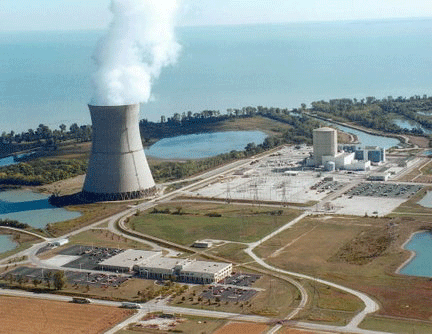
OAK HARBOR, OH – The Davis-Besse Nuclear Power Station’s 2024 Annual Radiological Environmental Operating Report and Radioactive Effluent Release Report, presented as a routine compliance document, is, upon closer inspection, a testament to the inherent contradictions and failures of nuclear power. Far from offering reassurance, a detailed breakdown of its contents reveals a systematic downplaying of risk, consistent operational deficiencies, and an unavoidable legacy of environmental burden.
This analysis dissects the report’s core assertions, exposing the fallacies and highlighting the damning issues that FirstEnergy (now Vistra) attempts to obscure through technical jargon and regulatory compliance claims.
The Fallacy of “Acceptable” Contamination: Routine Radioactive Releases
The report repeatedly emphasizes that radioactive releases are “well below applicable federal regulatory limits.” This is a fundamental fallacy. “Below limits” does not equate to “zero risk” or “no impact.” It merely signifies adherence to arbitrary thresholds set by regulators, thresholds that do not account for the cumulative effects of decades of exposure or the long-term biological impacts of even low-level radiation.
- Continuous Effluents: Davis-Besse admits to the routine discharge of both gaseous and liquid radioactive effluents. Tables 14 (“Gaseous Effluents Summation of All Releases”) and 17 (“Liquid Effluents – Summation of All Releases”) within the report confirm these ongoing releases. The fact that these are planned and continuous highlights that nuclear power is inherently a polluting industry. Every day, radioactive isotopes are deliberately introduced into our air and water, becoming part of the ecosystem and our food chain.
Irreducible Public Dose: Despite claims of minimal impact, the report’s own dose calculations (Tables 21, 22, and 23) confirm that the public does receive a measurable radiation dose from Davis-Besse’s operations. The identification of a critical pathway through a garden just over half a mile from the plant unequivocally demonstrates direct, localized human exposure. To assert that total body doses are “not distinguishable from background” is a deceptive attempt to normalize environmental contamination. Background radiation is not static; it is augmented by every single planned release, contributing to a cumulative burden on local populations.
Operational Failures: A Flawed Monitoring System
The credibility of any environmental report hinges on robust and reliable monitoring. Davis-Besse’s 2024 report exposes a litany of operational failures that directly undermine the accuracy and completeness of its environmental data………………………………………………………………………………………………………………………………………………………………
Damning Legacies: Groundwater Contamination and Unresolved Waste
Beyond the daily operations, the report touches on two long-standing, inherently “damning issues” that underpin the environmental cost of nuclear power: localized contamination and an unresolved waste crisis………………………………………………………………………………………
Conclusion: A Report of Inconvenient Truths
The Davis-Besse Nuclear Power Station’s 2024 environmental report, when subjected to rigorous scrutiny, is not a document of reassurance but rather a catalog of inconvenient truths. It confirms continuous environmental contamination, highlights persistent failures in monitoring and data integrity, and underscores the profound, unresolved challenge of radioactive waste management. For those committed to a truly clean and sustainable energy future, this report serves as a compelling argument against the ongoing fallacy that nuclear power can ever be truly benign………………… https://www.ohioatomicpress.com/nuclear-news/2536207_davis-besse-report-reveals-constant-pollution-flawed-monitoring-and-unending-nuclear-waste?fbclid=IwY2xjawKotsZleHRuA2FlbQIxMQBicmlkETE5N1drbzFkSjRoZXlUOFRXAR7H0k0sGjhgS1_UeBtK8SEEmwdUM4HcqvR03EoYKAtXm8DIiM9FD9ybXiELvA_aem_MWU5pe3_TNSnSMO21fC8OQ
1 This Month

of the week – Shut Down Drone Warfare!


Tell the Ukrainian Government to Drop Prosecution of Peace Activist Yurii Sheliazhenko

Petition to revoke the licensing of the Near Surface Nuclear Disposal Facility (NSDF) at Chalk River. https://www.ourcommons.ca/petitions/en/Petition/Details?Petition=e-7247
To see nuclear-related stories in greater depth and intensity – go to https://nuclearinformation.wordpress.com
-
Archives
- April 2026 (68)
- March 2026 (251)
- February 2026 (268)
- January 2026 (308)
- December 2025 (358)
- November 2025 (359)
- October 2025 (376)
- September 2025 (257)
- August 2025 (319)
- July 2025 (230)
- June 2025 (348)
- May 2025 (261)
-
Categories
- 1
- 1 NUCLEAR ISSUES
- business and costs
- climate change
- culture and arts
- ENERGY
- environment
- health
- history
- indigenous issues
- Legal
- marketing of nuclear
- media
- opposition to nuclear
- PERSONAL STORIES
- politics
- politics international
- Religion and ethics
- safety
- secrets,lies and civil liberties
- spinbuster
- technology
- Uranium
- wastes
- weapons and war
- Women
- 2 WORLD
- ACTION
- AFRICA
- Atrocities
- AUSTRALIA
- Christina's notes
- Christina's themes
- culture and arts
- Events
- Fuk 2022
- Fuk 2023
- Fukushima 2017
- Fukushima 2018
- fukushima 2019
- Fukushima 2020
- Fukushima 2021
- general
- global warming
- Humour (God we need it)
- Nuclear
- RARE EARTHS
- Reference
- resources – print
- Resources -audiovicual
- Weekly Newsletter
- World
- World Nuclear
- YouTube
-
RSS
Entries RSS
Comments RSS
 nuclear-news