The Anthropocene, begun in 16th Century colonialism, slavery -? for repair in 21st Century post-Covid-19 recovery
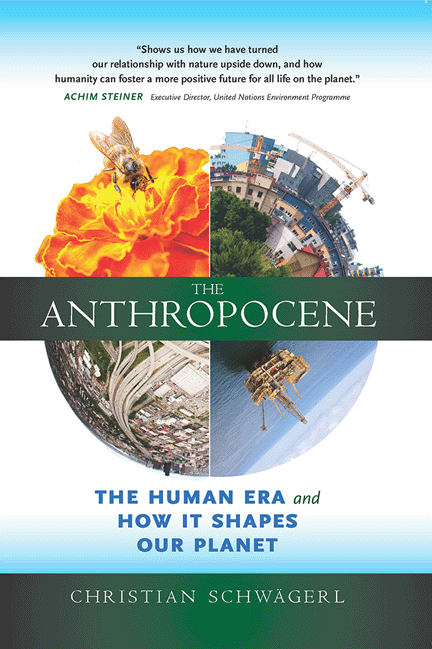
Why the Anthropocene began with European colonisation, mass slavery and the ‘great dying’ of the 16th century, The Conversation, Mark Maslin, Professor of Earth System Science, UCL, Simon Lewis, Professor of Global Change Science at University of Leeds and, UCL June 25, 2020 The toppling of statues at Black Lives Matter protests has powerfully articulated that the roots of modern racism lie in European colonisation and slavery. Racism will be more forcefully opposed once we acknowledge this history and learn from it. Geographers and geologists can help contribute to this new understanding of our past, by defining the new human-dominated period of Earth’s history as beginning with European colonialism.Today our impacts on the environment are immense: humans move more soil, rock and sediment each year than is transported by all other natural processes combined. We may have kicked off the sixth “mass extinction” in Earth’s history, and the global climate is warming so fast we have delayed the next ice age.
We’ve made enough concrete to cover the entire surface of the Earth in a layer two millimetres thick. Enough plastic has been manufactured to clingfilm it as well. We annually produce 4.8 billion tonnes of our top five crops and 4.8 billion livestock animals. There are 1.4 billion motor vehicles, 2 billion personal computers, and more mobile phones than the 7.8 billion people on Earth.
All this suggests humans have become a geological superpower and evidence of our impact will be visible in rocks millions of years from now. This is a new geological epoch that scientists are calling the Anthropocene, combining the words for “human” and “recent-time”. But debate still continues as to when we should define the beginning of this period. When exactly did we leave behind the Holocene – the 10,000 years of stability that allowed farming and complex civilisations to develop – and move into the new epoch?
Five years ago we published evidence that the start of capitalism and European colonisation meet the formal scientific criteria for the start of the Anthropocene.
Our planetary impacts have increased since our earliest ancestors stepped down from the trees, at first by hunting some animal species to extinction. Much later, following the development of farming and agricultural societies, we started to change the climate. Yet Earth only truly became a “human planet” with the emergence of something quite different. This was capitalism, which itself grew out of European expansion in the 15th and 16th century and the era of colonisation and subjugation of indigenous peoples all around the world.
In the Americas, just 100 years after Christopher Columbus first set foot on the Bahamas in 1492, 56 million indigenous Americans were dead, mainly in South and Central America. This was 90% of the population. Most were killed by diseases brought across the Atlantic by Europeans, which had never been seen before in the Americas: measles, smallpox, influenza, the bubonic plague. War, slavery and wave after wave of disease combined to cause this “great dying”, something the world had never seen before, or since.
In North America the population decline was slower but no less dramatic due to slower colonisation by Europeans. US census data suggest the Native American population may have been as low as 250,000 people by 1900 from a pre-Columbus level of 5 million, a 95% decline.
This depopulation left the continents dominated by Europeans, who set up plantations and filled a labour shortage with enslaved workers. In total, more than 12 million people were forced to leave Africa and work for Europeans as slaves. ……….
In addition to the critical task of highlighting and tackling the racism within science, perhaps geologists and geographers can also make a small contribution to the Black Lives Matter movement by unflinchingly compiling the evidence showing that when humans started to exert a huge influence on the Earth’s environment was also the start of the brutal European colonisation of the world.
In her insightful book, A Billion Black Anthropocenes or None, the geography professor Kathryn Yusoff makes it very clear that predominantly white geologists and geographers need to acknowledge that Europeans decimated indigenous and minority populations whenever so-called progress occurred.
Defining the start of the human planet as the period of colonisation, the spread of deadly diseases and transatlantic slavery, means we can face the past and ensure we deal with its toxic legacy. If 1610 marks both a turning point in human relations with the Earth and our treatment of each other, then maybe, just maybe, 2020 could mark the start of a new chapter of equality, environmental justice and stewardship of the only planet in the universe known to harbour any life. It’s a struggle nobody can afford to lose. https://theconversation.com/why-the-anthropocene-began-with-european-colonisation-mass-slavery-and-the-great-dying-of-the-16th-century-140661
Sizewell C nuclear project threatens nationally important landscapes, habitats and species of the Suffolk coast
Half of the Earth’s ice-free land is still free from human impact

|
Half the earth relatively intact from global human influence https://www.eurekalert.org/pub_releases/2020-06/uoc–hte061120.php Study presents clear opportunities to conserve what remains, UNIVERSITY OF CALIFORNIA – DAVIS 14 June 20 Roughly half of Earth’s ice-free land remains without significant human influence, according to a study from a team of international researchers led by the National Geographic Society and the University of California, Davis.The study, published in the journal Global Change Biology, compared four recent global maps of the conversion of natural lands to anthropogenic land uses to reach its conclusions. The more impacted half of Earth’s lands includes cities, croplands, and places intensively ranched or mined. “The encouraging takeaway from this study is that if we act quickly and decisively, there is a slim window in which we can still conserve roughly half of Earth’s land in a relatively intact state,” said lead author Jason Riggio, a postdoctoral scholar at the UC Davis Museum of Wildlife and Fish Biology. The study, published June 5 on World Environment Day, aims to inform the upcoming global Convention on Biological Diversity — the Conference of Parties 15. The historic meeting was scheduled to occur in China this fall but was postponed due to the coronavirus pandemic. Among the meeting’s goals is to establish specific, and higher, targets for land and water protection. Approximately 15 percent of the Earth’s land surface and 10 percent of the oceans are currently protected in some form. However, led by organizations including Nature Needs Half and the Half-Earth Project, there have been bold global calls for governments to commit to protecting 30 percent of the land and water by 2030 and 50 percent by 2050. Intact natural lands across the globe can help purify air and water, recycle nutrients, enhance soil fertility and retention, pollinate plants, and break down waste products. The value of maintaining these vital ecosystem services to the human economy has been placed in the trillions of U.S. dollars annually. CONSERVATION AND COVID-19 The coronavirus pandemic now shaking the globe illustrates the importance of maintaining natural lands to separate animal and human activity. The leading scientific evidence points to the likelihood that SARS-CoV2, the virus that causes the disease COVID-19, is a zoonotic virus that jumped from animals to humans. Ebola, bird flu and SARS are other diseases known to have spilled over into the human population from nonhuman animals. “Human risk to diseases like COVID-19 could be reduced by halting the trade and sale of wildlife, and minimizing human intrusion into wild areas,” said senior author Andrew Jacobson, professor of GIS and conservation at Catawba College in North Carolina. Jacobson said that regional and national land-use planning that identify and appropriately zone locations best suited to urban growth and agriculture could help control the spread of human development. Establishing protections for other landscapes, particularly those currently experiencing low human impacts, would also be beneficial. FROM THE TUNDRA TO THE DESERT Among the largest low-impact areas are broad stretches of boreal forests and tundra across northern Asia and North America and vast deserts like the Sahara in Africa and the Australian Outback. These areas tend to be colder and/or drier and less fit for agriculture. “Though human land uses are increasingly threatening Earth’s remaining natural habitats, especially in warmer and more hospitable areas, nearly half of Earth still remains in areas without large-scale intensive use,” said co-author Erle Ellis, professor of geography at the University of Maryland-Baltimore County. Areas having low human influence do not necessarily exclude people, livestock or sustainable management of resources. A balanced conservation response that addresses land sovereignty and weighs agriculture, settlement or other resource needs with the protection of ecosystem services and biodiversity is essential, the authors note. “Achieving this balance will be necessary if we hope to meet ambitious conservation targets,” said Riggio. “But our study optimistically shows that these targets are still within reach.” |
|
Post-pandemic packages could green up our energy systems for environmental and economic benefit.

message was a grim, possibly self-serving, prediction, that sun, wind and water power would only ever meet four per cent of the country’s needs.
Climate helped by Europe’s fast-growing mini-forests
Fast-growing mini-forests spring up in Europe to aid climate
Miyawaki forests are denser and said to be more biodiverse than other kinds of woods, Guardian, Hannah Lewis, Sat 13 Jun 2020 Tiny, dense forests are springing up around Europe as part of a movement aimed at restoring biodiversity and fighting the climate crisis.
Often sited in schoolyards or alongside roads, the forests can be as small as a tennis court. They are based on the work of the Japanese botanist Akira Miyawaki, who has planted more than 1,000 such forests in Japan, Malaysia and elsewhere.
Advocates for the method say the miniature forests grow 10 times faster and become 30 times denser and 100 times more biodiverse than those planted by conventional methods. This result is achieved by planting saplings close together, three per square metre, using native varieties adapted to local conditions. A wide variety of species – ideally 30 or more – are planted to recreate the layers of a natural forest.
Scientists say such ecosystems are key to meeting climate goals, estimating that natural forests can store 40 times more carbon than single-species plantations. The Miyawaki forests are designed to regenerate land in far less time than the 70-plus years it takes a forest to recover on its own.
“This is a great thing to do,” said Eric Dinerstein, a wildlife scientist who co-authored a recent paper calling for half of the Earth’s surface to be protected or managed for nature conservation to avoid catastrophic climate change. “So this could be another aspect for suburban and urban areas, to create wildlife corridors through contiguous ribbons of mini-forest.”
The mini-forests could attract migratory songbirds, Dinerstein said. “Songbirds are made from caterpillars and adult insects, and even small pockets of forests, if planted with native species, could become a nutritious fast-food fly-in site for hungry birds.”……. https://www.theguardian.com/environment/2020/jun/13/fast-growing-mini-forests-spring-up-in-europe-to-aid-climate
Radioactive cloud over Europe in 2017 came from a civilian nuclear reactor

|
Radioactive cloud over Europe had civilian background https://www.eurekalert.org/pub_releases/2020-06/uom-rco061220.phpIsotope measurements on air filters: researchers investigated undeclared nuclear release / Study in “Nature Communications” 14 June 20
UNIVERSITY OF MÜNSTER A mysterious cloud containing radioactive ruthenium-106, which moved across Europe in autumn 2017, is still bothering Europe’s radiation protection entities. Although the activity concentrations were innocuous, they reached up to 100 times the levels of what had been detected over Europe in the aftermath of the Fukushima accident. Since no government has assumed responsibility so far, a military background could not be ruled out. Researchers at the Leibniz University Hannover and the University of Münster (both Germany) now found out that the cloud did not originate from military sources – but rather from civilian nuclear activities. Hence, the release of ruthenium from a reprocessing plant for nuclear fuels is the most conclusive scenario for explaining the incident in autumn 2017. The study has been published in the journal Nature Communications.
Background: It is impossible to make a clear distinction between civilian and military sources solely based on measurements of radioactive isotopes of ruthenium. For the first time, researchers from the Institute of Radioecology and Radiation Protection at Leibniz University of Hannover and the Institute of Planetology at Münster University succeeded in quantifying stable ruthenium isotopes in air filters that were released with the radioactive ruthenium. Within the scope of the study, the team left conventional scientific paths: “We usually measure ruthenium isotopes to study the formation history of Earth”, says Prof. Thorsten Kleine from the University of Münster, adding that the methods originally developed to address research questions in planetology were instrumental in solving this mystery. The fact that the airborne ruthenium stemming from nuclear activities occurred in minuscule amounts and were diluted with natural stable ruthenium presented a significant challenge. Through the clean chemical separation of ruthenium fractions from air filters and subsequent high-precision measurements via mass spectrometry, the researchers determined the ratio of stable ruthenium from the nuclear source. The ruthenium isotopic ratios found in the filter are consistent with the signature of a civilian source, in particular the signature of spent nuclear fuel from a nuclear power plant. A military background (such as the production of weapons-grade plutonium) can be ruled out. Furthermore, high-precision measurements enabled the researchers to draw further conclusions. “The isotope signature discovered in the air filter exhibits no similarities with nuclear fuels of conventional Western pressurised or boiling water reactors. Instead, it is consistent with the isotope signature of a specific type of Russian pressurised water reactors – the VVER series. Worldwide, approximately 20 reactors of this type of VVER are currently operational”, specifies Professor Georg Steinhauser from Leibniz University Hannover. Original publication: T. Hopp et al. (2020): Non-natural ruthenium isotope ratios of the undeclared 2017 atmospheric release consistent with civilian nuclear activities. Nature Communications; DOI: 10.1038/s41467-020-16316-3 |
|
Our existential threat – our extinction
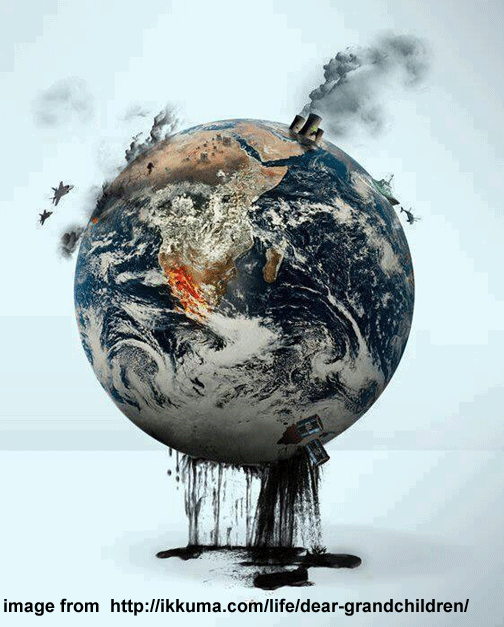 Externalities Are Our Existential Threat, Medium, 10 June 20, It’s the “ex’s” we need to worry about the most. Externalities that create an existential threat. The ultimate threat: Our extinction.
An externality is defined by the Oxford English Dictionary as “a side effect or consequence of an industrial or commercial activity that affects other parties without this being reflected in the cost of the goods or services involved”. Externalities in a global context are the consequence that everyone bears for everyone else’s actions. Externalities result in us all bearing the consequences of living out of synchronization with Nature, but unfortunately in most cases the poor and the vulnerable pay a higher price, disproportionate to their contribution to the cause.
The negative externality consequences of most human economic activity are unaccounted; seemingly off loaded free of charge to the ecosphere. But Nature has a balance sheet — these unaccounted, costs of doing business, that are charged to Nature, are turned into debts. These debts will be settled at a later date and not in a manner of our choosing. The challenge for us is that in many cases the debts are slow to become obvious to everyone, remaining invisible or disguised for a prolonged period. Linking cause and effect is very complex and spans long periods of time, often not directly attributable. It is like a very slow moving train crash — you barely notice it happening but you’ll know when it hits, and then it’s too late. We are all aboard that slow train right now.
In developed countries, we are fortunate to not have to face the poverty, war, famine, diseases that affected humans in the pre-industrial and early industrial times. Capitalism has been an amazing wealth creating and poverty reducing system. Most of us cannot even comprehend how fortunate we are. However, there is a downside to the considerable progress we have made since the industrial revolution; the unintended consequences. Never before were humans able to have an impact on future generations aside from culture or knowledge that was passed on. Today that is different — our actions are determining the fate of billions of people, those currently alive and those not yet born. Unfortunately, we have been brewing trouble……
capitalism can only operate in the best interests of society if it is governed well. It is the good governance part that we have been lacking — unfortunately we have a corrupted, crony capitalism that stems from problems with our democratic system. Quite simply, we seem to be unable to elect leaders who actually care about the long term interests of the people. Our entire political system is deeply corrupted by money — elected officials represent those who contribute to their campaigns, not their constituents, and that’s dominated by the very wealthy, corporations and special interest organizations, not the typical citizen. This is something that needs mainstream understanding as it is the root of all society’s problems and why they are never sensibly addressed.
The common theme is that we have proved ourselves to be incapable of acting in our collective best interests. Together we are all on that metaphorical slow train, steaming towards a cliff edge with no one in the driver’s seat attempting to steer us away from inevitable catastrophe…… Continue reading
Deep concern over environmental cost of planned Sizewell C nuclear station
 East Anglian Daily Times 5th June 2020 Councillor David Blackburn: Deeply concerned over the environmental cost of Sizewell C. I share the ‘deep concerns’ of the National Trust to
the potential environmental costs of the proposed Sizewell C new nuclear
reactor project (EADT, 25th May).
They tally with those made at our recent
Saxmundham seminar from environmental representatives including the
naturalist Simon Barnes, the Suffolk Wildlife Trust and Suffolk Coastal
Friends of the Earth. At that meeting it was made clear that Sizewell C
could have major and long term negative effects on highly sensitive sites
like Minsmere, and as the National Trust notes, Dunwich Heath.
And we know as well that Coronation Wood is to be removed in the interim plans for the
site. The natural environment around Sizewell includes some rare and unique
habitats, and clearly an industrial development on the sheer scale of
Sizewell C can’t possibly be able to mitigate all of these issues.
It should also be noted that, in the past few months, renewable energy has
delivered the bulk of UK electricity needs and it is reported that EDF may
be paid £50 million just to turn Sizewell B off due to a lack of demand.
With longer-term concerns over climate change, coastal erosion and rising
sea levels there is a lethal combination of factors that make it much more
sensible not to develop new nuclear reactors in Suffolk. The concerns of
local environmental groups need to be heeded for this and future
generations so that we can continue to enjoy these beautiful landscapes and
their rare wildlife.
U.S. Nuclear Regulatory Commission will run environmental study BEFORE relicensing South Carolina nuclear fuel plant
After public outcry, feds will conduct extensive study of SC nuclear fuel plant The State BY SAMMY FRETWELL JUNE 05, 2020 , Following state concerns about previously unknown pollution at an atomic fuel plant near Columbia, the U.S. Nuclear Regulatory Commission announced Friday that it will conduct an extensive environmental study of the Westinghouse fuel factory.
Conducting a detailed study is expected to delay by a year any decision on a new license for the plant while the agency looks into problems that have surfaced in recent years.
The plant has polluted groundwater, some of which has only been discovered since 2018, and neighbors have raised concerns about safety and water contamination.
The NRC’s decision marks the first time the agency has ever conducted a full environmental impact statement before deciding if a nuclear fuel fabrication plant should be relicensed, NRC spokesman Roger Hannah said. The plant’s owner, Westinghouse, wants a new 40-year-operating license for the plant, built in 1969.
“In March 2020, the NRC received new data collected by Westinghouse during ongoing site investigations,’’ the agency said in a news release Friday afternoon. “Based on the NRC’s independent evaluation of the new data .
… the NRC decided it could no longer conclude that renewal of the license would result in a finding of no significant impact’’ to the environment.
The Westinghouse plant, which employs more than 1,000 people, is one of only three nuclear fuel factories of its kind in the United States. The plant makes fuel rods for the nation’s atomic energy plants. Plants in North Carolina and Washington state also make nuclear fuel.
Tom Clements, a nuclear safety watchdog in Columbia, said it appears that the NRC listened to concerns by the public and state regulators.
“That is very encouraging to hear,’’ said Clements, who said the full study is needed. “It took a clamor from the public before they would do the right thing. I’m glad they have finally done this.’’
The S.C. Department of Health and Environmental Control called for a full environmental impact statement after finding rising pollution levels in ponds on the site.. …… https://www.thestate.com/news/local/environment/article243310956.html
Back to “normal” or on to “new normal” ? But NORMAL IS the problem!
|
‘Normal Is the Problem’
So is normal’s idiot child, ‘the new normal.’ What we’ve made normal never was natural. Andrew Nikiforuk 30 May 2020 | TheTyee.ca Tyee contributing editor Andrew Nikiforuk’s 2006 book Pandemonium predicted the pandemic we are now …….. Normal has become a pathological state.
After the random normlessness of this pandemic, I don’t want to go back to normal either. Or its idiotic child, “the new normal.” Let’s face facts: our hi-tech, globalized-trade-anything-for-peanuts world run mostly by tyrants isn’t natural. Since 1970, an outpouring of normality has just about destroyed the Earth: It has created an abnormal economic machine, blind to energy spending, that doubled the global population and boosted per capita consumption by 45 per cent. At the same time the so-called value of global economic activity grew by 300 per cent. Meanwhile global trade has exploded like a coronavirus by 900 per cent. To support all this consumption and trade, the extraction of “living materials” from nature has jumped by 200 per cent. Now here’s just a partial list of the cost of all this exponential normality: Humans have appropriated or altered 70 per cent of the world’s lands with mines, roads, industrial farms, cities and airports. We have engineered more than 75 per cent of the world’s longest rivers. We have filled the ocean with plastics and slaughtered coral reefs. Anyone who calls that kind of behaviour normal is crackers. It’s ecological imperialism, and nothing more than a full-scale assault on the dignity of local life. The list goes on, and scientists now think it’s normal to publish papers on “the pervasive human decline of life.” Humans, for example, have destroyed 85 per cent of the wetlands. That’s like eating your kidneys for dinner, and I can’t think of anybody who would consider that normal except Hannibal Lecter. We have eliminated 40 per cent of the world’s original forests. We have extirpated (and there’s a word for these normal times) most of the world’s large mammals. An estimated one million species of animals and plants stand on the brink of extinction. Homo sapiens, another mammal, are on that list, and we pretend that’s normal. As these species disappear, our ever-expanding artificial intelligence probably won’t wave goodbye because replacing the natural with artificial is what normal is all about……. Normal really means big-box living and being a slave to machines. It means you’re so distracted by screens, speed and mobility, you can’t pay attention to what matters. Normal means you don’t have any respect for limits or sacred places. Normal means you think you can simply swap fossil fuels with so-called “clean energy” and protect the norm. But it mostly means you have surrendered your capacity to be human and to love this place. So I don’t want to go back to normal…… Normal really means big-box living and being a slave to machines. It means you’re so distracted by screens, speed and mobility, you can’t pay attention to what matters. Normal means you don’t have any respect for limits or sacred places. Normal means you think you can simply swap fossil fuels with so-called “clean energy” and protect the norm. But it mostly means you have surrendered your capacity to be human and to love this place. So I don’t want to go back to normal……. I don’t want to go back to a world where political parties cultivate men and women obsessed with power and deny the truth. That’s just evil. I don’t want to go back to world where people don’t know their neighbours, or the names of the birds in their trees. I don’t want to go back to a world where billionaires think so little of this Earth that their primary obsession is to escape to Mars. I don’t want to go back to a world where political leaders don’t have the courage to talk about cheap energy, reckless consumption, over-population and climate change in the same sentence. …. I don’t want to go back to an economy where corporations socialize all costs and privatize all gains. That’s robbery and theft. And it must end. I don’t want to go back to a world where governments subsidize bottom trawlers to scrape the floor of the ocean to support globalization… … Normal is the problem, and the normlessness of a pandemic has exposed the fat tail of normal as pathology. And I am not going back to it……..https://thetyee.ca/Culture/2020/05/30/New-Normal-Problem/ |
|
Species are becoming extinct at an accelerating rate
 Sixth mass extinction of wildlife accelerating, scientists warn warn Analysis shows 500 species on brink of extinction – as many as were lost over previous century Damian Carrington Environment editor, 2 Jun 2020 Sixth mass extinction of wildlife accelerating, scientists warn warn Analysis shows 500 species on brink of extinction – as many as were lost over previous century Damian Carrington Environment editor, 2 Jun 2020
The sixth mass extinction of wildlife on Earth is accelerating, according to an analysis by scientists who warn it may be a tipping point for the collapse of civilisation. More than 500 species of land animals were found to be on the brink of extinction and likely to be lost within 20 years. In comparison, the same number were lost over the whole of the last century. Without the human destruction of nature, even this rate of loss would have taken thousands of years, the scientists said. The land vertebrates on the verge of extinction, with fewer than 1,000 individuals left, include the Sumatran rhino, the Clarión wren, the Española giant tortoise and the harlequin frog. Historic data was available for 77 of the species and the scientists found these had lost 94% of their populations. The researchers also warned of a domino effect, with the loss of one species tipping others that depend on it over the edge. “Extinction breeds extinctions,” they said, noting that unlike other environmental problems extinction is irreversible. Humanity relies on biodiversity for its health and wellbeing, scientists said, with the coronavirus pandemic an extreme example of the dangers of ravaging the natural world. Rising human population, destruction of habitats, the wildlife trade, pollution and the climate crisis must all be urgently tackled, they said. “When humanity exterminates other creatures, it is sawing off the limb on which it is sitting, destroying working parts of our own life-support system,” said Prof Paul Ehrlich, of Stanford University in the US, and one of the research team. “The conservation of endangered species should be elevated to a global emergency for governments and institutions, equal to the climate disruption to which it is linked.” “We are facing our final opportunity to ensure that the many services nature provides us do not get irretrievably sabotaged,” said Prof Gerardo Ceballos of the National Autonomous University of Mexico, who led the research. The analysis, published in the journal Proceedings of the National Academy of Sciences, examined data on 29,400 land vertebrate species compiled by the IUCN Red List of Threatened Species and BirdLife International. The researchers identified 515 species with populations below 1,000 and about half of these had fewer than 250 remaining. Most of these mammals, birds, reptiles and amphibians were found in tropical and subtropical regions…….. Prof Georgina Mace, of University College London, said: “Action is important for many reasons, not least of which is that directly and indirectly we rely on the rest of life on Earth for our own health and wellbeing,” she said. “Disrupting nature leads to costly and often hard-to-reverse effects. Covid-19 is an extreme present-day example, but there are many more.” Mark Wright, the director of science at WWF, said: “The numbers in this research are shocking. However, there is still hope. If we stop the land-grabbing and devastating deforestation in countries such as Brazil, we can start to bend the curve in biodiversity loss and climate change. But we need global ambition to do that.” |
|
Sellafield’s radioactive cats
Carlisle News & Star 30th May 2020, Claims that cats from West Cumbria’s nuclear site given out for adoption were found to have plutonium in their system have been challenged by
Sellafield. Radiation Free Lakeland claims samples analysed from two cats
showed plutonium and cesium in the poop of one of them. Marianne Birkby, of
the campaign group, said: “For Sellafield to be handing out cats to the
public is rather at odds with their policy of culling wildlife on site to
contain radioactive contamination.
https://www.newsandstar.co.uk/news/18476222.sellafield-challenges-claim-plutonium-sites-cats/
Wildlife charities unite to oppose Sizewell C nuclear power station
it must not go ahead. The RSPB and Suffolk Wildlife Trust (SWT) say they
have not seen evidence that the £14billion project can be built without
detrimentally impacting internationally and nationally important
landscapes, habitats, animals and plants on the Suffolk coast.
direct loss of nationally important and protected land on Sizewell Belts, a
Site of Special Scientific Interest (SSSI). An area between 10-12 hectares
– or roughly ten football pitches – will be covered in concrete. The
loss of this nationally rare fen habitat would be devastating and
irreplaceable.”
build will bring the Sizewell Estate adjacent to the internationally famous
wildlife haven. It is feared the building work may increase erosion,
upsetting the delicate balance of the reserve. It could affect the water
levels in Minsmere’s ditches, impacting its rare wetland wildlife, which
includes bitterns, water voles, otters and ducks.
https://www.eadt.co.uk/news/swt-rspb-unite-to-oppose-sizewell-c-nuclear-power-station-1-6674364
Opposition to unnecessary, environmentally destructive Sizewell nuclear project
after the Covid-19 lockdown restrictions are lifted. Community leaders
believe people need to be able to attend public meetings and other events
as part of the process for the Sizewell C planning application submitted
yesterday.
earliest – and a final decision on the project late next year. The
leaders of East Suffolk Council and Suffolk County Council have been
supportive of EDF Energy making the Development Consent Order submission
for permission for the project but are continuing to call on the company to
ensure they talk to the two local authorities before triggering the formal
Section 56 process and timescale which includes a period of formal public
engagement.
Energy asking them to delay the Section 56 process given the current
Government guidance on social distancing, social isolation and public
gatherings. We believe all parties must be satisfied that appropriate
public engagement can take place. “We would like EDF Energy to continue
its discussions with both councils so we can work together to find a
suitable solution that works for all our communities.”
Suffolk county councillors calling on them to let their hearts rule their
heads and reject the project, which he claims will “irreparably alter
that unique Suffolk character and nature of this tranquil and welcoming
county, transforming it into just another over-developed, car-dominated,
road-centred, urbanised area of the UK like so many others – bland,
conformist and uniform”.
the national planning inspectorate for permission to build two huge nuclear
reactors on a site which is barely big enough to contain them. It requires
the destruction of the 100 year old Coronation Wood for its overspill
facilities. The construction is designed to house two European Pressurised
Reactors generating 3.2 gigawatts of electricity at full power. The
Sizewell B plant has recently reduced its output by 50% at a reported cost
of £50million due to over-supply. This over-supply is not just a
consequence of the covid-19 pandemic. In 2005, the government made plans to
meet a predicted 15% increase in electricity demand by 2020. In fact,
demand has dropped over those 15 years by 16%, an overestimation of demand
by more than 30%. It is axiomatic that Sizewell C is not needed to ‘keep
the lights on’ nor is it an essential infrastructure project.”
https://www.eadt.co.uk/news/edf-delay-on-sizewell-c-consultation-1-6672349
UK’s National Trust says new Sizewell C nuclear power station poses threat to rare birds
National Trust. A new nuclear power station planned for the Suffolk coast
would threaten rare wildlife on protected heathland, according to the
National Trust.
submitted to the Planning Inspectorate tomorrow, to build twin reactors at
Sizewell in a project that the French state-controlled company says would
supply enough low carbon electricity for six million homes, or 7 per cent
of UK power.
that is one of Britain’s rarest habitats and is home to a breeding
population of endangered stone curlews. It has written to the leaders of
East Suffolk council and Suffolk county council to raise concerns about the
proposed £18 billion plant, which EDF would build with the Chinese nuclear
power company China General Nuclear (CGN). Stop Sizewell C, a local
campaign group, said the power stations “would be an expensive bridge to
nowhere: it will suck vital funds away from the technologies and projects
that are more capable of truly transforming our energy landscape”.
including the actors Bill Nighy and David Morrissey and the painter Maggi
Hambling, called on the government to step in to delay consideration of the
proposal until the coronavirus restrictions were lifted. Mr Nighy, who used
to live in Theberton with his former partner, the actress Diana Quick,
said: “It is beyond belief that EDF is pressing forward during these
terrible and uncertain times with a project so misguided, and which even
the government’s own advisers find deeply concerning.
will not fit to any degree in our new world, and this internationally
famous environment will be desecrated. This is a time to protect our
ecosystems, not shatter them.”
1 This Month
19 February – VIRTUAL EVENT-Decision Time: AI and Our Nuclear Arsenal
12:45 p.m. Central / 1:45 p.m. Eastern
To see nuclear-related stories in greater depth and intensity – go to https://nuclearinformation.wordpress.com
-
Archives
- February 2026 (170)
- January 2026 (308)
- December 2025 (358)
- November 2025 (359)
- October 2025 (376)
- September 2025 (258)
- August 2025 (319)
- July 2025 (230)
- June 2025 (348)
- May 2025 (261)
- April 2025 (305)
- March 2025 (319)
-
Categories
- 1
- 1 NUCLEAR ISSUES
- business and costs
- climate change
- culture and arts
- ENERGY
- environment
- health
- history
- indigenous issues
- Legal
- marketing of nuclear
- media
- opposition to nuclear
- PERSONAL STORIES
- politics
- politics international
- Religion and ethics
- safety
- secrets,lies and civil liberties
- spinbuster
- technology
- Uranium
- wastes
- weapons and war
- Women
- 2 WORLD
- ACTION
- AFRICA
- Atrocities
- AUSTRALIA
- Christina's notes
- Christina's themes
- culture and arts
- Events
- Fuk 2022
- Fuk 2023
- Fukushima 2017
- Fukushima 2018
- fukushima 2019
- Fukushima 2020
- Fukushima 2021
- general
- global warming
- Humour (God we need it)
- Nuclear
- RARE EARTHS
- Reference
- resources – print
- Resources -audiovicual
- Weekly Newsletter
- World
- World Nuclear
- YouTube
-
RSS
Entries RSS
Comments RSS
 nuclear-news