‘It doesn’t make sense’: Marine biologist on Kenya’s proposed nuclear power plant.
Elodie Toto, Mongabay, 29 Aug 2025
- Kenya is considering building a nuclear power plant in Uyombo, a coastal town in Kilifi county. It would be near Mida Creek mangroves, Arabuko Sokoke Forest Reserve and Watamu National Marine Park and Reserve, all recognized for their high biodiversity, including endemic species and coral reefs.
- The plant’s cooling system could raise water temperatures in the area. This could harm marine life, potentially causing further coral bleaching and disrupting plankton and other critical species, which would, in the long run, affect the entire food chain.
- Residents and environmentalists, including marine biologist Peter Musila, have criticized the project and the government for poor communication, lack of public consultation and insufficient information on nuclear waste management.
- Musila argues Kenya does not need nuclear energy given the country’s renewable energy potential, and such a project raises concerns about potential accidents and long-term impacts on ecosystems and local livelihoods.
Kenya is in the process of building its very first nuclear power station. According to forecasts by the Kenya Nuclear Power and Energy Agency (NuPEA), construction is due to start by 2027 and will produce 1,000 MW of power. The town of Uyombo, in Kilifi county on the Kenyan coast, is one of three sites where NuPEA considers building the plant. Very quickly, a cry united the population: “Sitaki Nuclear,” no to nuclear power in Swahili. Demonstrations broke out, followed by a lawsuit filed by citizens, which was later dismissed, and a petition was also circulated online. But the project still seems to be going ahead, much to the dismay of residents and some environmentalists.
Uyombo is located on the edge of the Mida Creek mangrove swamps, a few kilometers from the Arabuko Sokoke Forest Reserve, the largest remaining coastal forest in East Africa, recognized as a biodiversity hotspot due to the concentration of many endemic species and habitat loss. It lies in close proximity to Watamu National Marine Park and Reserve, recognized as a UNESCO Biosphere Reserve because of its coral reefs and the richness of its marine life, including whale sharks (Rhincodon typus) and manta rays (Manta alfredi).
What impact could this project have on this biodiversity? Peter Musila is a marine biologist and program coordinator with the NGO A Rocha Kenya. For the NGO, he monitors the state of the region’s corals and is involved in their restoration. As a coral specialist, he is livid about this nuclear power station project.
Mongabay met him in the town of Watamu.
Mongabay: When you heard that a nuclear power station could be built in Uyombo, what was your first reaction?
Peter Musila: I first heard of this nuclear power plant in 2022. For me, it doesn’t make sense because the area they are trying to put it in is a very pristine area for wildlife, with all sorts of wildlife, even terrestrial wildlife, including birds. Mida Creek is one of the most important areas for birds. It hosts a lot of migratory birds that come here to breed. There’s so much wildlife here.
It’s also an important marine mammal area [like dolphins and whales], and the sharks and rays are here. They use this space for breeding, for nesting. We don’t want a nuclear power plant in our area.
Mongabay: As you said, this is an important marine area. As well as mammals, there are also corals. What state are they in?
Peter Musila: Before the 1990s, the reef was very good. It was very pristine. I did not see it back then, but I wish I did. There were over 200 genera of corals. The major problem that has affected this area, coral-wise, is bleaching. The first time it happened was in 1997. After that, the coral cover declined quite substantially. It was 60% [preserved before 1997] and then it declined to 10% [in 1998]. That was really bad. And then it has been trying to recover. But bleaching is now occurring more often because there was another one in 2005 and then 2007, 2013, 2016 and 2020………………………………………………………………………………………………………………………………………….. Even if it were to be built up to standard, with no corruption, it can still go wrong. That is why other big countries are going against nuclear energy because it’s not the most sustainable energy source. I don’t know why we as Kenyans are even putting that on the table, considering there are all these other technologies that can produce energy more sustainably, more cheaply. I don’t get it.https://news.mongabay.com/2025/08/it-doesnt-make-sense-marine-biologist-on-kenyas-proposed-nuclear-power-plant/
The jellyfish are the symptom
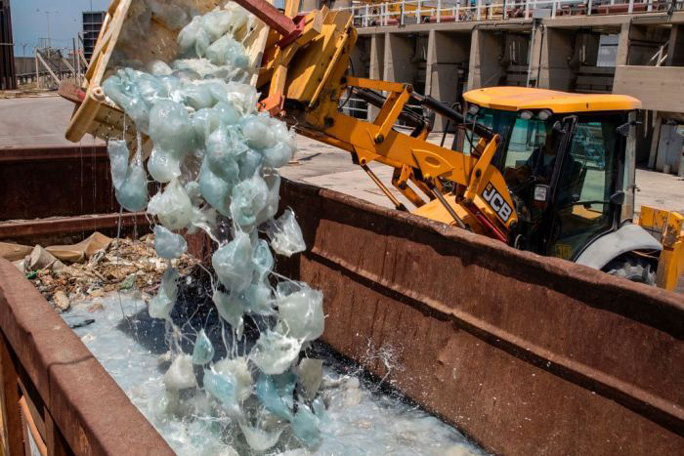
by beyondnuclearinternational, https://beyondnuclearinternational.org/2025/08/24/the-jellyfish-are-the-symptom/
The cure is ending the use of nuclear power, which takes an immense toll on wildlife and the environment, writes Linda Pentz Gunter
A swarm of jellyfish that recently brought four of the six reactors at the Gravelines nuclear power plant in France to a halt, made widespread headlines but, as some reports have noted, this isn’t exactly a new phenomenon. The remaining two reactors were already offline for maintenance.
As the Guardian reported, “The Torness nuclear plant in Scotland, which is also owned by EDF, was forced to shut for a week in 2021 after jellyfish clogged the seaweed filters on its water intake pipes, a decade after jellyfish shut the plant for a week in 2011.”
But Paul Gunter and I first noted the phenomenon back in 2001 when we released our investigative report, Licensed to Kill: How the nuclear power industry destroys endangered marine wildlife and ocean habitat to save money.
We learned then that jellyfish were a hazard at nuclear plants that use the once-through cooling water system — the kind that don’t use cooling towers — as they can impede the rapid flow of intake water, which then reduces the efficiency of the plant. That, in turn, reduces profits.
Swarms of jellyfish, responding to warmer waters caused by climate change, are likely to become an ever greater and more frequent hazard as waters continue to warm due to our inadequate efforts to tackle the climate crisis effectively or in time.
But why are jellyfish a problem for nuclear power plants in the first place?
The once-through cooling system draws cooling water into the plant, usually through an intake pipe and at considerable velocity, in order to first convey heat from the reactor core to the steam turbines and then to remove and dump the surplus heat from the steam circuit.
In drawing in such a high volume of cooling water and at high speed, a considerable amount of sea life is sucked in as well, a process known as entrainment. Jellyfish are by no means the only affected species.
The amount of water drawn in can be immense — as much as a million gallons a minute. Although sea creatures like jellyfish might clog up the intake system, smaller ones such as fish, fingerlings and spawn pass through the system, entrained along with the water. They are then pulverized and discharged, effectively as sediment, usually into the same body of water from which the cooling water was drawn.
The process also warms up the water source into which these hotter waters are discharged, changing the marine ecology. This is what we found at Diablo Cove during our research of marine damage caused by the Diablo Canyon nuclear power plant on the California coast. Black abalone were suffering withering syndrome due to the warmer waters and the indigenous fish species had been replaced by others who preferred the warmer water temperatures.
Along with raising the water temperature, the discharge process, which, like the water intake, happens at speed, can cloud the surrounding water by scouring the sea bed and stirring up further sediment, blocking out sunlight. The bull kelp in Diablo Cove, for example, had effectively been clear-cut due to lack of access to sunlight in order to photosynthesize, and had consequently died off. Bull kelp are an essential contributor to the health and balance of marine ecosystems.
This toll on sea life is why there is such a hue and cry about the two immense 1,630 megawatt EPR reactors being built on the English coast at Hinkley Point C. The potential fish kills there will be enormous — possibly as high as half a million fish killed or harmed per day at the plant. The two reactors will draw in at least 2.7 billion gallons of water a day, the equivalent of three Olympic size swimming pools of water per minute.
But of course EDF, the French government utility building the plant, doesn’t want to spend the extra money putting in a fish deterrent system to minimize the damage. This makes the nuclear power plant a significant predator on already threatened and struggling fish stocks, effectively trawl fishing without a license.
At the St. Lucie nuclear power plant on Florida’s east coast, the barrier nets installed to prevent larger animals such as sea turtles, seals and manatees from being entrained further along the intake canals into the plant, have to be lowered to be cleaned whenever an algae load or influx of jellyfish render them ineffective. When this happens, sea turtles pass over them anyway and drown (or, more accurately, suffocate) in the intake wells and the underwater intrusion detection system.
The sea turtle captures at the St Lucie site can be enormous. In 1995, the plant captured 933 sea turtles, not all of them alive or uninjured. In 2003 that number rose to 944. Capture numbers also exceeded 900 in 2004 and 2005. Most arrive alive, some are dead, and some are injured, most often with damage to the carapace. In our research, we found that any injuries to sea turtles captured at St. Lucie were almost always ascribed to other causes such as earlier boat strikes or shark attacks.
However, what we learned to our amazement when preparing the 2001 report was that in 1989 a human being had also been sucked into the St. Lucie intake pipe while spearfishing. When he popped up in the cooling canal, his wetsuit was shredded and his scuba tanks gored from bouncing off the barnacle-encrusted walls of the pipe. He had been terrified, naturally, and told us there was no way all the animals entrained there could survive the journey.
Nevertheless, St. Lucie is just one example where no meaningful steps have been taken to exclude turtles from entrainment, or even humans, as a second scuba diver was entrained at the plant 17 years after the first.
While the nuclear plant owners are given an annual sea turtle take allowance — the amount of turtles they are permitted to capture dead or alive — by the National Marine Fisheries Service and the Nuclear Regulatory Commission, these agencies invariably adjust the numbers upwards to accommodate the plant’s higher takes, rather than assessing the overall status of the species or demanding mitigation.
Even if an attempt is made to limit the damage, it is half-hearted at best. Once again, the St. Lucie plant exemplifies this failure. At the start of a 2006 consultation with NMFS, the idea of installing a Turtle Excluder Device (TED) was first raised. The process dragged on for 10 years and in 2016, NMFS finally issued a TED requirement. By 2019, 13 years after the idea was first mooted, plant owners Florida Power & Light had failed to deliver a functioning TED. After that, the NRC took no further action.
The recent jellyfish stories are a symptom of our ever worsening climate crisis. But they also remind us that nuclear power plants take a toll on their aquatic environments, one that is usually out of sight and out of mind, but is also contributing to the decline of important marine species. These activities should not be left unregulated and unmitigated.
Linda Pentz Gunter is the international specialist at Beyond Nuclear and writes for and edits Beyond Nuclear International. Any opinions are her own.
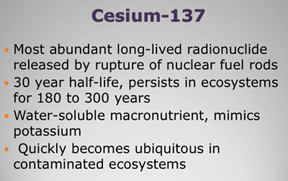
How did cs137, a fission product get into the Indonesian shipping container?
Dennis LENEVEU, 22 Aug 25,
Re: [Nuclear Waste Watch] US FDA guidance on health impacts of cesium exposure.
Indonesia has only research reactors. If the cs137 contamination came from these small reactors what about all the large reactors such as CANDUs that have continual measured stack releases of beta gamma particulate that would contain cs137 that is volatile?
CANDUs emit large amounts of carbon 14 that has been measured at elevated levels in tree rings around Pickering. Cs137 would also be expected to be in tree rings wood. Wood is used as shipping containers and many other uses such as furniture and interior housing lumber and wood.
Both carbon 14 and cs147 are known to off gass. C14 is particularly a problem being a beta emitter that would never be measured. Cs137 is a gamma emitter that is easily measured with a Geiger counter. Carbon 14 off gassing has been documented in the Bruce low and intermediate level waste facility but is not routinely measured.
Huge amounts of carbon 14 has been deposited around reactors for years. Carbon14 accumulates in the biosphere. With a half life of 5730 years it’s all still around gradually building up in the environment. The stack releases allowed for reactors are based on airborne exposure only. The carbon 14 is greatly dispersed in the air but settles out and deposits in the environment. Gradual bioaccumulation is ignored in regulations for emission standards.
LANL Silences Public and Tribal Voices While Pushing Radioactive Tritium Venting

This week’s so-called public meeting about the proposed venting of radioactive tritium into the air from Los Alamos National Laboratory (LANL) showed once again how LANL silences communities while fast-tracking nuclear weapons projects.
In-person attendees were allowed three minutes to speak. Over 100 online participants—including many land-based community members who were not able to travel to the meeting in Los Alamos for health, distance or work reasons—were blindsided to find they were barred from giving verbal comments and limited to submitting just one emailed question. LANL gave no prior notice of this change.
Marissa Naranjo, with Honor Our Pueblo Existence, said, “This is not meaningful participation. It is deliberate exclusion.” https://shuffle.do/projects/honor-our-pueblo-existance-h-o-p-e
The stakes could not be higher. Tritium —used in nuclear weapons development — is a radioactive gas that travels quickly through air, water, soil, and food. It can cause cancer, genetic damage, and health impacts across generations. LANL insists venting is the only safe path forward—but their own “independent” technical review – one of four requirements ordered by the New Mexico Environment Department before it would review LANL’s request – exposed that claim as problematic.
Data centers consume massive amounts of water – companies rarely tell the public exactly how much.

August 19, 2025 , Peyton McCauley and Melissa Scanlan
As demand for artificial intelligence technology boosts construction and proposed construction of data centers around the world, those computers require not just electricity and land, but also a significant amount of water. Data centers use water directly, with cooling water pumped through pipes in and around the computer equipment. They also use water indirectly, through the water required to produce the electricity to power the facility. The amount of water used to produce electricity increases dramatically when the source is fossil fuels compared with solar or wind………………………….
The Great Lakes are an important, binational resource that more than 40 million people depend on for their drinking water and supports a US$6 trillion regional economy. Data centers compete with these existing uses and may deplete local groundwater aquifers.
Our analysis of public records, government documents and sustainability reports compiled by top data center companies has found that technology companies don’t always reveal how much water their data centers use. In a forthcoming Rutgers Computer and Technology Law Journal article, we walk through our methods and findings using these resources to uncover the water demands of data centers.
In general, corporate sustainability reports offered the most access and detail – including that in 2024, one data center in Iowa consumed 1 billion (3.8 billion liters) gallons of water – enough to supply all of Iowa’s residential water for five days.
How do data centers use water?
The servers and routers in data centers work hard and generate a lot of heat. To cool them down, data centers use large amounts of water – in some cases over 25% of local community water supplies. In 2023, Google reported consuming over 6 billion gallons of water (nearly 23 billion liters) to cool all its data centers.
In some data centers, the water is used up in the cooling process. In an evaporative cooling system, pumps push cold water through pipes in the data center. The cold water absorbs the heat produced by the data center servers, turning into steam that is vented out of the facility. This system requires a constant supply of cold water………………………………………………………………………….
Sustainability reports offer a valuable glimpse into data center water use. But because the reports are voluntary, different companies report different statistics in ways that make them hard to combine or compare. Importantly, these disclosures do not consistently include the indirect water consumption from their electricity use, which the Lawrence Berkeley Lab estimated was 12 times greater than the direct use for cooling in 2023. Our estimates highlighting specific water consumption reports are all related to cooling.
Amazon releases annual sustainability reports, but those documents do not disclose how much water the company uses. Microsoft provides data on its water demands for its overall operations, but does not break down water use for its data centers. Meta does that breakdown, but only in a companywide aggregate figure. Google provides individual figures for each data center.
In general, the five companies we analyzed that do disclose water usage show a general trend of increasing direct water use each year. Researchers attribute this trend to data centers.
A closer look at Google and Meta
To take a deeper look, we focused on Google and Meta, as they provide some of the most detailed reports of data center water use.
Data centers make up significant proportions of both companies’ water use. In 2023, Meta consumed 813 million gallons of water globally (3.1 billion liters) – 95% of which, 776 million gallons (2.9 billion liters), was used by data centers…………………………………………………………………………………
Given society’s growing interest in AI, the data center industry will likely continue its rapid expansion. But without a consistent and transparent way to track water consumption over time, the public and government officials will be making decisions about locations, regulations and sustainability without complete information on how these massive companies’ hot and thirsty buildings will affect their communities and their environments.
Walmart recalls possibly radioactive shrimp after public warned not to eat.
BBC 20th Aug 2025
Walmart has recalled some of its shrimp products in the US after radioactive material was detected in a shipment of seafood.
The US Food and Drug Administration (FDA) warned the public not to eat frozen shrimp sold under Walmart’s Great Value label, as it could have been exposed to a dangerous isotope in shipping containers.
One sample of breaded shrimp tested positive for the substance, the FDA said, but this positive sample “did not enter US commerce”.
Consumers in 13 US states where the shrimp products are sold have been advised to throw any recently bought products among three batches……………………………………
The recalled shrimp was sold at Walmart locations in Alabama, Arkansas, Florida, Georgia, Kentucky, Louisiana, Missouri, Mississippi, Ohio, Oklahoma, Pennsylvania, Texas and West Virginia, and shoppers in those states were advised to be cautious.
It came from an Indonesian supplier that has since had a number of shipping containers denied entry to the US, the FDA said.
One shipment tested positive for Caesium-137, the radioactive form of the periodic element Caesium.
The amount contained in the tested shipment held by the FDA was not enough to pose acute harm to consumers, exposure over time could pose an elevated risk of cancer by damaging living cells in the body, said officials from the agency.
Caesium-137 is made through nuclear reactions and is present in trace amounts in soil, food and air worldwide. It is one of the principal sources of radiation around Chernobyl in Ukraine and Fukushima in Japan.
The FDA said no Caesium-137 had been detected in the other products it tested, but cautioned this did not rule out contamination. https://www.bbc.co.uk/news/articles/c5ypg4rgnrno
Rachel Reeves to cut ‘bats and newts’ in boost to developers

Developers would also no longer have to prove that projects would have no impact on protected natural sites, under plans that would abolish the “precautionary principle” enshrined in
European rules.
Chancellor considers making it harder for concerns about nature to stand in
the way of infrastructure projects, in an effort to boost the economy.
Rachel Reeves is preparing to strip back environmental protections in an
effort to boost the economy by speeding up infrastructure projects. The
chancellor is considering reforms that would make it far harder for
concerns about nature to stop development, which she insists is crucial to
restoring growth and improving living standards.
The Treasury has begun
preparing for another planning reform bill and is thinking about tearing up
key parts of European environmental rules that developers say are making it
harder to build key projects. Labour ministers have repeatedly insisted
that their current planning overhaul will not come at the expense of
nature, promising a “win-win” system where developers will pay to
offset environmental damage.
But Reeves is understood to believe that the
government must go significantly further, after expressing frustration that
the interests of “bats and newts” are being allowed to stymie critical
infrastructure. She has tasked officials with looking at much more
contentious reforms, which are likely to provoke a furious backlash from
environmentalists and cause unease for some Labour MPs.
A smaller, UK-only
list of protected species is being planned, which would place less weight
on wildlife — including types of newt — that is rare elsewhere in
Europe but more common in Britain. Developers would also no longer have to
prove that projects would have no impact on protected natural sites, under
plans that would abolish the “precautionary principle” enshrined in
European rules. Instead, a new test would look at risks and benefits of
potential projects. Further curbs to judicial review are also being
considered by Reeves to stop key projects being delayed by legal challenges
from environmentalists.
Times 17th Aug 2025, https://www.thetimes.com/uk/politics/article/rachel-reeves-strip-back-environmental-protections-planning-projects-xjxn02crs
Government faces calls to investigate Faslane nuclear leak.
Revelations of radioactive leaks from Trident’s base were branded “as
shocking as they are unsurprising” today as the government faced calls to
urgently investigate.
Scottish Environmental Protection Agency (SEPA)
documents obtained by The Ferret revealed that the watchdog was aware of
the 2019 discharge of radioactive water from the home of Britain’s
nuclear arsenal at Faslane and Coulport — just 30 miles from Glasgow,
Scotland’s most populous city — into Loch Long, citing the cause as the
Royal Navy’s failure to properly maintain a network of 1,500 pipes.
Scottish CND executive member David Kelly told the Star: “The failures in
pipework at Coulport, and the subsequent release of nucleotides into Loch
Long are as shocking as they are unsurprising. “‘How cheaply can we run
a nuclear arsenal’ seems to be the Ministry of Defence’s (MoD) approach
to this most deadly of facilities. “All mechanical components, as complex
as a nuclear submarine, or as simple as a pipe, are designed for a specific
life.
Morning Star 12th Aug 2025, https://morningstaronline.co.uk/article/government-faces-calls-investigate-faslane-nuclear-leak
A Mob of Alien Creatures Just Took 4 Nuclear Reactors Completely Offline.

They found their way into the filter drums of the pumping station.
By Darren Orf, Aug 15, 2025 , https://www.popularmechanics.com/science/animals/a65775055/jellyfish-nuclear-shutdown/
Here’s what you’ll learn when you read this story:
- A swarm of jellyfish shut down four of six nuclear reactors at the Gravelines power plant near Calais, France.
- The jellyfish found their way into the filter drums of the pumping station, causing a temporary shutdown over the weekend.
- Jellyfish swarms are increasing around the world as warmer oceans provide better spawning conditions and low-oxygen dead zones (caused largely by agricultural runoff) kill off aquatic competition.
Jellyfish are remarkable creatures. They’re twice as old as dinosaurs; they don’t have brains, lungs, or a heart; and they’ve nearly cracked the secret to immortality. But there’s another accolade that they can affix to their already impressive biological resumé—they’re the scourge of nuclear reactors.
This fact was proven this past Sunday, when three of the six reactors at Gravelines power plant near Calais in northern France shut down unexpectedly because a swarm of jellyfish had entered the plant’s cooling system, according to the government-owned utility operator Électricité de France, or EDF. y Monday morning, a fourth reactor also temporarily shut down.
Swarm of jellyfish shuts nuclear power plant in France.
‘Massive and unpredictable’ swarm entered filter drums that pull in water, Gravelines operator EDF says.
Jillian Ambrose Energy correspondent, 11 Aug 25
‘Massive and unpredictable’ swarm entered filter drums that pull in water, Gravelines
operator EDF says.
A swarm of jellyfish has forced the shutdown of one of
the largest nuclear power plants in France after entering the water intake
systems used to cool the coastal reactors. Three reactors at the Gravelines
nuclear power plant in northern France shut down automatically late on
Sunday, according to the French nuclear company EDF, after the filter drums
of the pumping stations became packed with a “massive and
unpredictable” swarm of the marine creatures.
The entire nuclear plant,
capable of powering about 5m homes, was brought offline when a fourth
reactor shut down shortly after the free-swimming invertebrates jammed the
power plant, which had already lost its two other reactors for planned
summer maintenance work. Jellyfish have a long history of derailing the
normal operations of coastal power plants, which tap the ocean for the vast
amounts of cool water needed to keep temperatures in check.
The repeated
problems caused by unexpected jellyfish numbers prompted scientists at the
University of Bristol to develop an “early warning tool” to predict the
sudden, en masse appearance of jellyfish swarms that might disrupt coastal
power plants. The Torness nuclear plant in Scotland, which is also owned by
EDF, was forced to shut for a week in 2021 after jellyfish clogged the
seaweed filters on its water intake pipes, a decade after jellyfish shut
the plant for a week in 2011.
Jellyfish swarms have also closed nuclear and
coal power plants in Sweden, the US, Japan, and even caused a major
blackout in the Phillipines in 1999 that some mistakenly feared was linked
to the Y2K bug or a government coup.
Guardian 11th Aug 2025, https://www.theguardian.com/world/2025/aug/11/swarm-of-jellyfish-shuts-nuclear-power-plant-in-france
Radioactive water ‘leaked into’ loch from Faslane nuclear base
The investigation uncovered SEPA files revealing that the Navy neglected proper maintenance.
Radioactive water ‘leaked into’ loch from Faslane nuclear base. The
investigation uncovered SEPA files revealing that the Navy neglected proper
maintenance. The Guardian, and The Ferret uncovered the release of
radioactive material into Loch Long, Argyll and Bute, following a six-year
fight to access the files, which involved Scotland’s Information
Commissioner.
Daily Record 10th Aug 2025, https://www.dailyrecord.co.uk/news/scottish-news/radioactive-water-leaked-into-loch-35705786
Radiation dangers at “Sea Fest” in Cumbria
Campaigners have sent a letter to Cumbria Wildlife Trust urging them to
inform families of the dangers at “Sea Fest” on 2nd August. Radiation
Free Lakeland have been writing to the wildlife charity for many years and
even taken direct action at the Sand Sculpture events on St Bees Beach
producing their own sand sculpture of “The Scream” and presenting
Cumbria Wildlife Trust with a “Blinky” statue.
The letter asks that
Cumbria Wildlife Trust inform families of the risks of encountering
radioactive particles whilst spending hours digging sand sculptures.
Campaigners point to Sellafield’s own recent Particles in the Environment
Reports which outline alpha and beta rich finds one of which is Cesium-137
with an activity of 1.23 ± 0.25 MBq “the 2nd highest Cs-137 activity
measured in any find since the programme (of monitoring and retrieval)
began”. Also stated by Sellafield: “Alpha-rich particle find rates at
Sellafield beach and Northern Beaches appear higher than those measured in
recent years” as reported in Sellafield Particles in the Environment
Update (1-Jan to 1-April 2025).
Radiation Free Lakeland 1st Aug 2025, https://mariannewildart.wordpress.com/2025/08/01/cumbria-wildlife-trust-sand-castle-event-where-alpha-rich-particle-find-rates-at-sellafield-beach-and-northern-beaches-appear-higher-than-those-measured-in-recent-years/
Plastics, Profits and Power: How petrochemical companies are derailing the Global Plastics Treaty

A report released today by Greenpeace UK reveals how the Global Plastics
Treaty is under threat from some of the world’s largest petrochemical
companies who have been systematically lobbying against cuts to plastic
production while generating massive profits from their growing plastics
business.
The report reveals that since the treaty talks began in November
2022, seven companies alone have produced enough plastic to fill 6.3
million rubbish trucks – equivalent to five and a half trucks every
minute.
The report – ‘Plastics, Profits and Power: How petrochemical
companies are derailing the Global Plastics Treaty’, draws on data
obtained from industry sources. It finds that that since the start of the
treaty process, Dow, ExxonMobil, BASF, Chevron Phillips, Shell, SABIC and
INEOS, have ramped up their plastic production capacity by 1.4 million
tonnes and sent a combined total of 70 lobbyists to negotiations, where
they have also been represented by powerful industry front groups.
Greenpeace 29th July 2025,
https://www.greenpeace.org.uk/resources/plastics-profits-power-report/
Radioactive wasps discovered at South Carolina nuclear facility

By Julian Agnew and Christopher J. Teuton. Jul. 29, 2025 , https://www.wtoc.com/2025/07/28/radioactive-wasps-discovered-south-carolina-nuclear-facility/
AIKEN, SC (WTOC) – A radioactive wasp nest was discovered earlier this month in South Carolina by workers at a nuclear facility, according to a report from the US Department of Energy.
The report states that on July 3, 2025, workers found a wasp nest on a stanchion near a tank at the F-Area tank farm at the Savannah River Site.
When the nest was probed it was discovered to be highly radioactive, according to the DOE’s report. While it does sound like something out of a comic book or horror movie, the report says this is not related to a loss of contamination control at the nuclear facility.
Instead, the wasp nest is considered a victim of “legacy radioactive contamination.”
The nest was sprayed (in order to kill the wasps) and was then bagged as radiological waste.
The report states the ground and surrounding area did not have any contamination.
The Savannah River Site was built in the 1950s near Aiken, South Carolina and covers more than 300 square miles.
During the Cold War, the Savannah River Site produced nuclear material and nuclear weapons components.
It became an EPA Superfund site in 1989, with cleanup and environmental remediation going on ever since.
In recent years, the National Nuclear Security Administration has begun work on a facility there to produce new plutonium cores for American nuclear weapons.
The NNSA plans to build at least 50 new plutonium cores per year in the new facility.
Plastification of our Brains: Cannot be good…
Our Plastic Brains I chat about the recent peer reviewed study that looks at liver, kidney and brain tissues in people that died in 2024 versus 2016. This paper is the first of its kind, and needs to be examined and replicated by experts in brain science, human health, and many other scientists due to the enormous significance of its findings.
Peer reviewed open-source paper: Title: Bioaccumulation of microplastics in decedent human brains Abstract Rising global concentrations of environmental microplastics and nanoplastics (MNPs) drive concerns for human exposure and health outcomes. Complementary methods for the robust detection of tissue MNPs, including pyrolysis gas chromatography–mass spectrometry, attenuated total reflectance–Fourier transform infrared spectroscopy and electron microscopy with energy-dispersive spectroscopy, confirm the presence of MNPs in human kidney, liver and brain. MNPs in these organs primarily consist of polyethylene, with lesser but significant concentrations of other polymers. Brain tissues harbor higher proportions of polyethylene compared to the composition of the plastics in liver or kidney, and electron microscopy verified the nature of the isolated brain MNPs, which present largely as nanoscale shard-like fragments. Plastic concentrations in these decedent tissues were not influenced by age, sex, race/ethnicity or cause of death; the time of death (2016 versus 2024) was a significant factor, with increasing MNP concentrations over time in both liver and brain samples (P = 0.01). Finally, even greater accumulation of MNPs was observed in a cohort of decedent brains with documented dementia diagnosis, with notable deposition in cerebrovascular walls and immune cells. These results highlight a critical need to better understand the routes of exposure, uptake and clearance pathways and potential health consequences of plastics in human tissues, particularly in the brain. Link: https://www.nature.com/articles/s4159… Wikipedia page on Polyethylene plastic: https://en.wikipedia.org/wiki/Polyeth…
Image on size scales: mm, micrometer, nanometer: https://www.researchgate.net/figure/S…
1 This Month

of the week – Shut Down Drone Warfare!


Tell the Ukrainian Government to Drop Prosecution of Peace Activist Yurii Sheliazhenko

Petition to revoke the licensing of the Near Surface Nuclear Disposal Facility (NSDF) at Chalk River. https://www.ourcommons.ca/petitions/en/Petition/Details?Petition=e-7247
To see nuclear-related stories in greater depth and intensity – go to https://nuclearinformation.wordpress.com
-
Archives
- April 2026 (68)
- March 2026 (251)
- February 2026 (268)
- January 2026 (308)
- December 2025 (358)
- November 2025 (359)
- October 2025 (376)
- September 2025 (257)
- August 2025 (319)
- July 2025 (230)
- June 2025 (348)
- May 2025 (261)
-
Categories
- 1
- 1 NUCLEAR ISSUES
- business and costs
- climate change
- culture and arts
- ENERGY
- environment
- health
- history
- indigenous issues
- Legal
- marketing of nuclear
- media
- opposition to nuclear
- PERSONAL STORIES
- politics
- politics international
- Religion and ethics
- safety
- secrets,lies and civil liberties
- spinbuster
- technology
- Uranium
- wastes
- weapons and war
- Women
- 2 WORLD
- ACTION
- AFRICA
- Atrocities
- AUSTRALIA
- Christina's notes
- Christina's themes
- culture and arts
- Events
- Fuk 2022
- Fuk 2023
- Fukushima 2017
- Fukushima 2018
- fukushima 2019
- Fukushima 2020
- Fukushima 2021
- general
- global warming
- Humour (God we need it)
- Nuclear
- RARE EARTHS
- Reference
- resources – print
- Resources -audiovicual
- Weekly Newsletter
- World
- World Nuclear
- YouTube
-
RSS
Entries RSS
Comments RSS
 nuclear-news