With its reprocessing plant in La Hague, France has the highest radioactive discharges at sea in Europe.

With its reprocessing plant in La Hague, France has the highest radioactive discharges at sea in Europe. And these discharges are not decreasing, despite the commitments made in 1998, in Sintra, Portugal, by
the Member States of the OSPAR Convention for the protection of the North-East Atlantic.
But the results of the citizen surveillance ofradioactivity in the environment carried out by ACRO for more than 25years, show that the account is not there: the discharges from the Orano reprocessing plant in La Hague are visible. all along the Channel coast and, in the summer of 2021, they could still be detected as far as the Danish border.
The association therefore urges France to respect its international commitments by significantly reducing its radioactive discharges at sea. It will, for its part, maintain its vigilance.
ACRO 29th Sept 2021
Will Fukushima’s Water Dump Set a Risky Precedent?
Will Fukushima’s Water Dump Set a Risky Precedent? IEEE Spectrum
Questions raised over new norms the disaster’s radioactive wastewater cleanup efforts may foster, RAHUL RAO 24 SEP 2021 Since the Japanese earthquake and tsunami in March 2011, groundwater has been trickling through the damaged facilities at the Fukushima Daiichi nuclear power plant, filtering through the melted cores and fuel rods and becoming irradiated with a whole medley of radioisotopes. Japanese authorities have been pumping that water into a vast array of tanks on-site: currently over a thousand tanks, and adding around one new tank per week.
Now, Japanese authorities are preparing to release that water into the Pacific Ocean. Even though they’re treating and diluting the water first, the plan is meeting with vocal protests. From that opposition and from scientists’ critiques of the process, the ongoing events at Fukushima leave an unprecedented example that other nuclear power facilities can watch and learn from.
The release is slated to start in 2023, and potentially last for decades. This month, observers from the International Atomic Energy Agency have arrived in the country to inspect the process. And efforts are also underway to build an undersea tunnel that will discharge the water a kilometer away from the shore.
Before they do that, they’ll treat the water to cleanse it of radioactive contaminants. According to the authorities’ account of the situation, there’s one major contaminant that their system cannot cleanse: tritium.
It’s actually normal for nuclear power plants to release tritium into the air and water in their normal operations. In fact, pre-disaster, Fukushima Daiichi held boiling-water reactors, the lowest-tritium type of nuclear reactors. The Japanese government’s solution is to dilute the tritium-contaminated water down to comparable levels. That’s part of the reason the discharge will likely last several decades.
“While one can argue whether such release limits are appropriate in general for normally operating facilities, the planned release, if carried out correctly, does not appear to be outside of the norm,” says Edwin Lyman, director of nuclear power safety at the Union of Concerned Scientists.
Even so, the plan has—perhaps expectedly—encountered some rather vocal opposition. Some of the loudest cries have come from within Japan, particularly from the fishing industry. Radiation levels in seafood from that coast are well within safety limits, but fishing cooperatives are concerned the plan is (once again) putting their reputations at stake………….
can the events at Fukushima offer other energy facilities around the world any lessons at all?
For one, they’re a good show of the need for emergency planning. “Every nuclear plant should be required to analyze the potential for such long-term consequences,” says Lyman. “New nuclear plants, if built, should incorporate such evaluations into their siting decisions.”
But there’s other things experts say that facilities could learn. For example, something that hasn’t always been present in the Fukushima matter—working against it—has been transparency.
Authorities at the plant haven’t fully addressed the matter of non-tritium contaminants, according to Ken Buesseler, a marine radiochemist at Woods Hole Oceanographic Institution who has studied radioactivity in the ocean off Fukushima. Some contaminants—like caesium-137 and strontium-90—were present in the initial disaster in 2011. Others—like cobalt-60 and cerium-144—entered the water later.
It isn’t something the authorities have completely ignored. “Japan plans to run the water again through the decontamination process before release, and the dilution will further reduce the concentrations of the remaining isotopes,” says Lyman.
But Buesseler isn’t convinced that it will be enough. “Theoretically, it’s possible to improve the situation a lot,” he says. “In practice, they haven’t done that.” Japanese authorities insist they can do so, but their ability, he says, hasn’t been independently verified and peer-reviewed……….
“I’d hate to see every country that has radioactive waste start dumping waste into the ocean,” he says. “It’s a transboundary issue, in a way. It’s something bigger than Japan, and something different from regular operation. I think they need to be at least open about that, getting international approval.”
Here, Lyman agrees. “This situation is unique and the decision to release the water into the sea should not set a precedent for any other project.”
But even taking all of that into account, some believe that, if anything, this is an example of a time when there simply is no choice but to take drastic action.
“I believe that this action is necessary to avoid potentially worse consequences,” says Lyman. https://spectrum.ieee.org/fukushima-wastewater-cleanup-questions
Chernobyl’s legacy recorded in trees

Exposure to radiation from the 1986 Chernobyl accident had a lasting negative legacy on the area’s trees, a study has suggested. Researchers said the worst effects were recorded in the “first few years” but surviving trees were left vulnerable to environmental stress, such as drought.
They added that young trees appeared to be particularly affected. Writing in the journal Trees, the team said it was the first study to look at the impact at a landscape scale. “Our field results were consistent with previous findings that were based on much smaller sample sizes,” explained co-author Tim Mousseau from the University of South Carolina, US.
“They are also consistent with the many reports of genetic impacts to these trees,” he told BBC News. “Many of the trees show highly abnormal growth forms reflecting the effects of mutations and cell death resulting from radiation exposure.”
BBC 9th Aug 2021
Chernobyl nuclear zone is becoming more radioactive: they don’t know why.
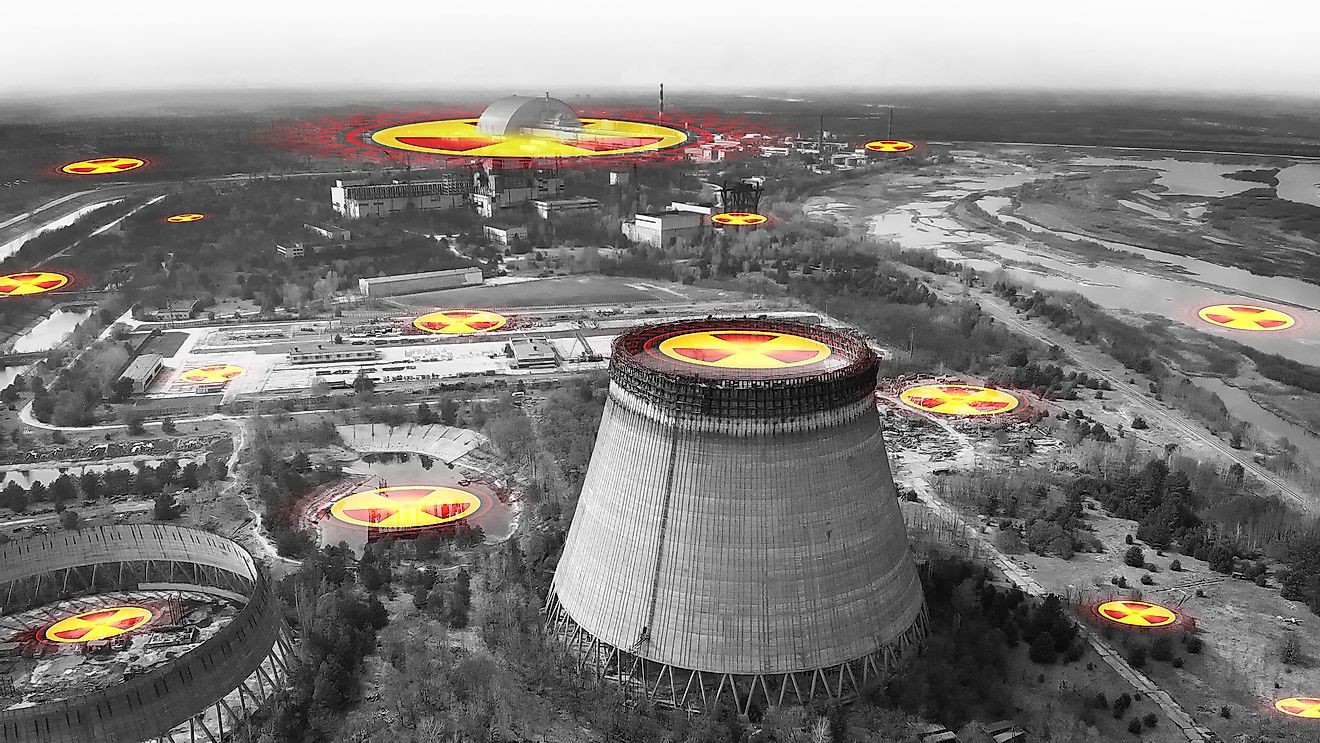
Chernobyl’s Blown Up Reactor 4 Just Woke Up. Scientists don’t understand why. https://historyofyesterday.com/chernobyls-blown-up-reactor-4-just-woke-up-74bedd5fc92d—
Andrei Tapalaga
The nuclear disaster that occurred in 1986 will forever be remembered, but the world will soon have a reminder of the event as the zone for some reason (yet unexplained by scientists)is becoming more radioactive. For those who may not be aware of the incident here is an article to get you up to speed.
“Chernobyl will never be a problem”
Underneath reactor 4 there is still nuclear fuel that is active and which will take around 20,000 years for it to deplete. The uranium is too radioactive for anyone to live in the city and since the incident, the European Union had created a shield around the reactor which should not allow for the radioactive rays to come out.Chernobyl officials presumed any criticality risk would fade when the massive New Safe Confinement (NSC) was slid over the Shelter in November 2016.”
“The €1.5 billion structure was meant to seal off the Shelter so it could be stabilized and eventually dismantled.”
However, many other parts around Chernobyl have also been affected due to prolonged exposure, some more than others, and many of them have not been contained as they were not presenting any major radioactive activity until now. Neil Hyatt, a nuclear chemist from the University of Sheffield had mentioned that there is a possibility for the uranium fuel to reignite on its own.
Hyatt also offered a simple explanation on how this is possible, just like charcoal can reignite in a barbeque, so can nuclear materials that have once been ignited. He as well as a handful of nuclear chemists have mentioned previously the possibility of the uranium from Chernobyl to reignite, but the scientists from Ukraine that are responsible for managing the nuclear activity within the vicinity never really listened, until now.
Scientists from Ukraine have placed many sensors around reactor 4 that constantly monitor the level of radioactivity. Recently those sensors have detected a constant increase in the level of radioactivity. It seems that this radioactivity is coming from an unreachable chamber from underneath reactor 4 that has been blocked since the night of the explosion on the 26th of April, 1986.
What could be causing this?
The experts from Ukraine don’t really understand why this is happening although they do have a hypothesis. Water is used to start the fission process within nuclear materials, this makes the nuclear material release energy that within a nuclear reactor can be maintained under control, but in this instance, the experts are afraid they will not be able to control it.
Another hypothesis is that since reactor 4 has been completely shielded, no water from the rain was able to reach the nuclear fuel. The water from rain may have been what kept the nuclear material under control. With no water, the nuclear fuel may be at risk of overheating, leading to another nuclear disaster.
There may be another reason for this constant increase in radioactivity, what has been mentioned above are only hypotheses, maybe something totally different is occurring under reactor 4 or within the nuclear material left inside. This is something that definitely should ring some alarm bells in order to prepare for the worst sort of situation and hopefully the world’s smartest in the field of nuclear chemistry can come together to identify the problem and come up with a potential solution.
Sources:…………
Scientists still don’t know how far melting in Antarctica will go – or the sea level rise it will unleash
Chen Zhao and Rupert Gladstone
The Antarctic ice sheet is the largest mass of ice in the world, holding around 60% of the world’s fresh water. If it all melted, global average sea levels would rise by 58 metres. But scientists are grappling with exactly how global warming will affect this great ice sheet.
Russia developing more floating nuclear power plants
A Russian plan to build more floating nuclear power plants advanced this
month after two subsidiaries of Rosatom, Russia’s state nuclear
corporation, signed a cooperation agreement to power a remote mining
facility on Siberia’s northeastern tip. The new waterborne facilities
will come on the coattails of the Akademik Lomonosov, the audacious
experiment on floating nuclear power that Rosatom connected to a remote
port in Chukotka in 2019 after spending more than a decade constructing it,
amid objections from environmentalists.
Bellona 17th Sept 2021
Russia advances on plans for new floating nuclear plants
Bipartisan House group asks Biden to stop Canada’s Great Lakes nuclear storage plans
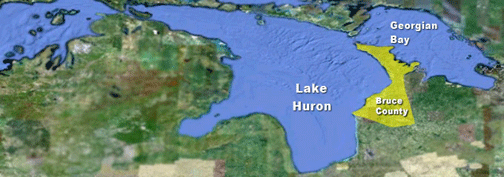
Bipartisan House group asks Biden to stop Canada’s Great Lakes nuclear storage plans, The Hill, BY SHARON UDASIN – 09/17/21 01:20 PM EDTRep. Dan Kildee (D-Mich.) is calling on the Biden administration to stop the Canadian government from storing nuclear waste in the Great Lakes Basin.
The Nuclear Waste Management Organization (NWMO), a nonprofit established by the Canadian government, recently unveiled plans to construct a site that “would permanently store more than 50,000 tons of high-level nuclear waste” in the town of South Bruce, Ontario, Kildee’s office said.
South Bruce, located within the Great Lakes Basin, is about 30 miles east of Lake Huron.
Kildee in a release from his office described high-level nuclear waste as “the most dangerous form of nuclear waste,” and said that if an accident involving such waste occurred in the Great Lakes region, it could take a catastrophic toll on public health in surrounding U.S. and Canadian communities.
“The Great Lakes are central to our way of life, and permanently storing nuclear waste so close to our shared waterways puts our economies and millions of jobs at risk in the fishing, boating and tourism industries,” Kildee said. “People in both the U.S. and Canada depend on the Great Lakes for drinking water, which could be contaminated if there ever was a nuclear waste incident.”
Kildee is offering a bipartisan resolution asking President Biden to work with the Canadian government to stop the plans for the storage. The resolution is co-sponsored by 11 Democrats and nine Republicans from states surrounding the Great Lakes.
“From recreational activities to economic opportunities, the Great Lakes are integral to our daily lives, and a spill of hazardous materials would be devastating to communities across the state,” one of the co-sponsors, Rep. Peter Meijer (R-Mich.), said in a statement. “We must continue to urge our Canadian allies to find an alternative storage site for nuclear waste.”
Tribal Chief Tim Davis, of the Michigan-based Saginaw Chippewa Indian Tribe, added his concerns, noting his community’s ongoing work “to eliminate the continuing threat of nuclear waste being deposited into Mother Earth so close to the largest fresh water repository on Earth.”………. https://thehill.com/policy/equilibrium-sustainability/572764-bipartisan-house-group-asks-biden-to-stop-canadas-great
Nuclear-powered submarines have ‘long history of accidents

Nuclear-powered submarines have ‘long history of accidents’, Adelaide environmentalist warns, ABC By Daniel Keane 17 Sept 21,
The plan to build nuclear-powered submarines in South Australia has alarmed anti-war and environmental campaigners, one of whom says the vessels have a “long history” of involvement in accidents across the globe.
Key points:
- Prime Minister Scott Morrison said the nuclear submarines would be built in Adelaide
- The Greens and other environmental groups say that raises serious public safety concerns
- SA’s former nuclear royal commissioner says the risks can be managed
Prime Minister Scott Morrison unveiled a deal to construct the new fleet of at least eight submarines, declaring a new era of strategic alignment with the United States and United Kingdom, and a new trilateral security partnership called AUKUS.
All Australians benefit from the national interest decisions to protect Australians and to keep Australians safe,” Mr Morrison said.
But Friends of the Earth Australia’s anti-nuclear spokesperson Jim Green said the plan was more likely to compromise public safety than enhance it.
I’m worried about the security and proliferation aspects of this, I’m deeply concerned as an Adelaidean. A city of 1.3 million people is not the place to be building nuclear submarines,” he said.
“North-western Adelaide could be a target in the case of warfare. Of course, that’s a very low risk but if it does happen, the impacts would be catastrophic for Adelaide.
“You should build hazardous facilities away from population centres, partly because of the risk of accidents and partly because of the possibility that a nuclear submarine site could be targeted by adversaries.”
Dr Green said the question of what would become of the spent fuel remained unanswered, and there was “a long history of accidents involving nuclear submarines”.
Many — but not all — of those occurred in submarines built in the former Soviet Union, including the infamous K-19, which was subsequently dubbed “The Widowmaker” and became the subject of a Hollywood film.
After its reactor suffered a loss of coolant, members of the crew — more than 20 of whom died in the next two years — worked in highly radioactive steam to prevent a complete meltdown.
Two US naval nuclear submarines — USS Thresher and USS Scorpion — currently remain sitting at the bottom of the Atlantic Ocean, at depths of more than two kilometres, after sinking during the 1960s.
More than 200 mariners died in the disasters, and neither vessels’ reactors, nor the nuclear weapons on board the Scorpion, have ever been recovered.

Two years ago, 14 Russian naval officers were laid to rest after they were killed in a fire on a nuclear-powered submersible in circumstances that were not fully revealed by the Kremlin.
Dr Green said Australia’s “nuclear power lobby” had “been quick off the mark”, and was already using the Prime Minister’s announcement to push for further involvement with the nuclear fuel cycle, including atomic energy and waste storage.
“The South Australian Nuclear Fuel Cycle [Royal] Commission, in its 2016 report, estimated a cost of $145 billion to construct and operate a nuclear waste repository,” he said.
“No country in the world has got a repository to dispose of high-level nuclear waste, and the only repository in the world to dispose of intermediate-level nuclear waste, which is in the United States, was shut for three years from 2014 to 2017 because of a chemical explosion.”…………….https://www.abc.net.au/news/2021-09-17/nuclear-submarines-prompt-environmental-and-conflict-concern/100470362
Time to rethink Hinkley C nuclear plan – biased research minimises harm to fish
Katie Attwater: In your article last week
https://www.wsfp.co.uk/article.cfm?id=124757&headline=Government%20urged%20to%20reject%20Hinkley%20%E2%80%98fish-killing%20machine%E2%80%99§ionIs=news&searchyear=2021
) EDF disputed the figure of 11 billion fish that will be killed over the
60 year life of Hinkley C. EDF said that an “independent” study had
shown that HPC would have a neglible impact on the Fish Population.
The independent study they refer to was carried out by the commercial arm of
CEFAS, the Centre for Environment, Fisheries and Aquaculture, who are under
contract to EDF to do their research and have been in receipt of
£8.3million pounds from EDF between 2015 and 2018.
The figure of 11 billion fish lives lost over 60 yrs of HPC operation was calculated by **PA
Henderson, expert on fish populations in changing environments, who stated
that he had made a conservative estimate, based on fish deaths at Hinkley A
and B, and the actual number is probably higher.
If we knew in 2013 what we
know now a cooling system using the water of the Severn Estuary and all its
rivers would never have been allowed.
Wildfowl & Wetlands Trust Director of
Conservation James Robinson said: “This is a landmark moment for the
UK’s energy and its environment. The authorities must decide if it’s
worth building a giant plughole to suck millions of sea animals to their
deaths, in one of our most important protected marine areas, in order to
produce electricity?
The obvious answer is that alternatives exist and are
used elsewhere – so if they accept this cheapest and most damaging option,
the UK will be a global environmental embarrassment. We think it’s time
for a rethink.”
West Somerset Free Press (not on the web) 10th Sept 2021
Jane Goodall still has hope for humanity. Here’s why

How a tree, a dog and a chimpanzee taught Jane Goodall to hold on to hope
ABC Radio National / By Karen Tong and Meredith Lake for Soul Search 11 Sept 21,
Throughout her life, acclaimed ethologist Jane Goodall has witnessed an array of environmental destruction, from deforestation to the loss of biodiversity to the catastrophic effects of climate change.
But despite this, Dr Goodall still has hope. Lots of it.
“I saw places that we had utterly destroyed, covered with concrete, but give nature a chance and she’ll reclaim it,” she tells RN’s Soul Search.
“I saw animals on the very brink of extinction, [but] because people care, they’ve been given another chance.”
This outlook has not come easily, and Dr Goodall credits it to a collection of “teachers” in life who have given her lessons of “humanity and hope.”
Five of these most important “teachers” include a reading tree, her first dog and – of course – her beloved chimps…………………
Hope for the future
Dr Goodall is still pushing boundaries as a conservation leader and activist – and she’s still cultivating an extraordinary capacity for curiosity, wonder and hope.
“I can’t wave a magic wand, but I can spend all my effort in trying to get everybody to realise that if we get together, if each one of us does what we can to make a difference every day, we start moving away from the doom and gloom,” she says…… https://www.abc.net.au/news/2021-09-11/jane-goodall-on-humanity-and-hope/100375246
Russia aims to dominate the Arctic, with nuclear ice-breakers
Moscow eyes ‘mastering’ Arctic waters with nuclear icebreaker fleet, Daily Sabah, BY FRENCH PRESS AGENCY – AFP, 8 Sept 21,
ABOARD THE ’50 YEARS OF VICTORY’ TRANSPORTATION SEP 08, 2021 11:24 AM GMT+3 s ice cover in the Arctic recedes with climate change, Russia is hard at work to secure supremacy in the warming region with a fleet of giant nuclear-powered icebreakers.
Moscow sees the development of the Arctic as a historic mission and already has huge projects to exploit its natural resources.
Its next big plan is for year-round use of the Northern Sea Route (NSR), a shipping lane through Arctic waters Russia hopes could rival the Suez Canal.
Here are some key facts about Russia’s plans for the Arctic:
Historic ambitions
As an icebreaker called the “50 Years of Victory” left the port of Murmansk for the North Pole this summer, its captain told an Agence France-Presse (AFP) journalist on board that Russia has a special role to play in the Arctic.
“A third of our territory lies above the Arctic Circle. Our ancestors have long mastered frozen waters. We are continuing this successfully,” Dmitry Lobusov said.
President Vladimir Putin has made the development of the Arctic a strategic priority and state companies such as Gazprom Neft, Norilsk Nickel and Rosneft already have major projects in the Arctic to extract oil, gas and minerals.
“The Arctic region has enormous potential,” Russian Deputy Prime Minister Alexander Novak said earlier this month.
“In terms of resources, we’re talking about 15 billion tons of oil and 100 trillion cubic meters of gas. Enough for tens if not hundreds of years,” he said.
Suez alternative
The NSR links the Pacific to the Atlantic through Russian Arctic waters.
It is not currently navigable year-round without the help of icebreakers, though in summer some specialized classes of ships can pass through.
With the ice cover receding, Moscow is aiming for year-round navigation by 2030…………..
Growing fleet
Rosatom, which already has a fleet of five icebreakers and a container ship, is building four more nuclear-powered vessels within the next five years.,,,,,,,,,,,
Environmental worries
Environmental groups have slammed the race for hydrocarbons and the increased presence of nuclear reactors in the Arctic – an already fragile ecosystem dramatically affected by climate change.
Greenpeace has said that “the incident-ridden history of Russian nuclear icebreakers and submarines” should cause alarm.,,,, https://www.dailysabah.com/business/transportation/moscow-eyes-mastering-arctic-waters-with-nuclear-icebreaker-fleet
Does technology really matter more than the natural landscape?

After we published an article on Beyond Nuclear International about the habitat and ecosystem destruction that would be wrought by the construction of new nuclear power plants on the British coastline, a more serious challenges such as sea-level rise and radioactive contamination.
I understand his sense of urgency. Yet, these don’t seem like either-ors to me.
And I do think that “liking landscapes” is desperately important and their enjoyment a growing deprivation. If we have
never been outside, walked an ancient wood, felt awed by the delicate silvery curl of lichen on a branch, heard the eerie, commanding call of a hawk or the whispered rustlings of a small mammal scurrying through undergrowth to safe cover, why would we strive to save any of it? Who will be left to care, to “like landscapes” and all that fills them? So he
may be right that it sounds like a trivial obsession. But it ought to matter…..
Surely the importance of landscapes and all who live in them must be at least in part why we fight to end the use of nuclear power plants? And also because they will contaminate our world forever; because sea-level rise will subsume them at a terrible price for all of us. And because building, operating and decommissioning them involves making and leaving a pervasive and persistent mess the like of which we have not equalled anywhere else.
At the same time, even if we abandon the energy vices of nuclear power and fossil fuels — an urgent necessity — we recognize that we have not solved our destructive ways. Even renewable energy comes with extractive impacts and environmental justice violations. While we struggle to remediate these, we are all too aware that we have left it far too late. We were Once-lers from the beginning, our greed trumping conservation and efficient use of energy. We didn’t listen to the Lorax or hear the Peregrine’s warning call. Instead, we are in a race against time and our own folly. We are in the time of “UNLESS”.
Beyond Nuclear 5th Sept 2021
Pacific environmentalists call on Japan not to empty radioactive wastewater into the Pacific
This year marks the 76th anniversary of the first use of nuclear weapons
for the purpose of war. As the world solemnly observes the tragic
anniversary of the bombings of Hiroshima and Nagasaki, we wish to highlight
the Pacific’s own and often overlooked nuclear history that followed.
Asguardians of the world’s largest ocean, we emphasise again our continuing
concern for our region and the irreparably damages on our people and the
environment from 318 nuclear weapons tests undertaken by the United States,
United Kingdom and France.
Today, we acknowledge that our region has still not healed from this trauma and that we did not consent. Given this legacy, we call on Japan to not repeat this brutality through its proposed act of
discharging over a million tonnes of radioactive wastewater from Fukushima.
Pasifika Environews 6th Sept 2021
Not Seeing the Contaminated Forest for the Decontaminated Trees in Fukushima — Fukushima 311 Watchdogs

Robert Jacobs Abstract: This article explores how the models of medical risk from radiation established in the aftermath of the nuclear attacks on Hiroshima and Nagasaki are insufficient for understanding the risks faced by people in contaminated environments like Fukushima. These models focus exclusively on levels of external radiation, while the risk faced by people […]
Not Seeing the Contaminated Forest for the Decontaminated Trees in Fukushima — Fukushima 311 Watchdogs
Rocket launches may be damaging the ozone layer
Rocket launches could be affecting our ozone layer, say experts.
Industry experts are calling for more research into how launches affect our atmosphere, Nicole Mortillaro · CBC News · Apr 23, 2021
Industry experts are calling for more research into how launches affect our atmosphere Rocket launches are a breathtaking culmination of human ingenuity as they propel us into the future, but there is a growing concern that not enough research has been done on their effect on the environment.
While some may be worried about potential greenhouse gas emissions that’s not the main issue. Instead, it’s ozone depletion and the potential effects in our upper atmosphere, specifically the stratosphere, along with concerns about toxic fuels.
The problem has flown under the radar, according to Martin Ross, an atmospheric scientist at The Aerospace Corporation, because people still think of rocket launches as rare.
But it’s time to face the fact that we may be entering a boom era, he said.
“One of the arguments that people have used in the past was to say that we don’t really need to pay attention to rockets or to the space industry, or the space industry is small, and it’s always going to be small,” Ross said.
“But I think the developments that we’re seeing the past few years show that … space is entering this very rapid growth phase like aviation saw in the ’20s and ’30s.”
Black soot in the atmosphere
The stratosphere is an important weather driver for Earth’s systems, and that’s where some particles from rocket launches are ending up.
The ozone layer, which helps protect us from the sun’s harmful ultraviolet rays, is also located in the stratosphere. In 1990, the Montreal Protocol was signed into law, banning harmful ozone-depleting substances, such as chlorofluorocarbons (CFCs), used in things like refrigerators and air conditioners, after it was revealed that the ozone layer was being stripped away by these chemicals. While the protocol touched on airlines, there was no mention of the aerospace industry.
But now some industry experts are concerned that with no oversight, we could be in for a problem.
There are different types of rocket propellants. Some, like liquid oxygen and liquid hydrogen, produce mainly water vapour and have little environmental impact. These were used in past shuttle launches and even in the Apollo-era Saturn V vehicles.
Then there are those that produce alumina particles in the stratosphere, such as those in solid rocket boosters, which were also used in past shuttle launches, and are still being used today by some launch companies.
Finally, there are those that deposit black soot in the stratosphere, such as kerosene used in SpaceX’s Falcon 9 and Russia’s Soyuz rockets.
It’s the alumina and black soot that is most concerning to experts.
“The atmosphere is complex,” said Jessica Dallas, a PhD candidate at the Australian Centre for Space Engineering Research, in New South Wales. “We don’t have a complete understanding of atmospheric circulation and how all of the mechanisms in the atmosphere actually work. And so that means that we also don’t have a good idea of what happens when we’re injecting these particles into the stratosphere.”
Dallas, who wrote a comprehensive analysis of research on rocket propellants, said that she’s concerned that there haven’t been studies on how these particles interact in our atmosphere………………………. https://www.cbc.ca/news/science/rocket-launches-environment-1.5995252
1 This Month



26 September – International Day for the Total Elimination of Nuclear Weapons


PLEASE OPPOSE HR 8255 AND S.3639 – bills would accelerate satellite deployment, with no environmental review or safeguards – https://ncstd5li.quorum.us/campaign/169331/
To see nuclear-related stories in greater depth and intensity – go to https://nuclearinformation.wordpress.com
-
Archives
- September 2026 (233)
- August 2026 (330)
- July 2026 (355)
- June 2026 (287)
- May 2026 (306)
- April 2026 (356)
- March 2026 (251)
- February 2026 (267)
- January 2026 (308)
- December 2025 (358)
- November 2025 (359)
- October 2025 (375)
-
Categories
- 1
- 1 NUCLEAR ISSUES
- business and costs
- climate change
- culture and arts
- ENERGY
- environment
- health
- history
- indigenous issues
- Legal
- marketing of nuclear
- media
- opposition to nuclear
- PERSONAL STORIES
- politics
- politics international
- Religion and ethics
- safety
- secrets,lies and civil liberties
- spinbuster
- technology
- Uranium
- wastes
- weapons and war
- Women
- 2 WORLD
- ACTION
- AFRICA
- Atrocities
- AUSTRALIA
- Christina's notes
- Christina's themes
- culture and arts
- Events
- Fuk 2022
- Fuk 2023
- Fukushima 2017
- Fukushima 2018
- fukushima 2019
- Fukushima 2020
- Fukushima 2021
- general
- global warming
- Humour (God we need it)
- Nuclear
- RARE EARTHS
- Reference
- resources – print
- Resources -audiovicual
- Weekly Newsletter
- World
- World Nuclear
- YouTube
-
RSS
Entries RSS
Comments RSS
 nuclear-news