World’s oceans losing their greenness through global heating, study finds.

The world’s oceans are losing their greenness owing to global heating,
according to a study that suggests our planet’s capacity to absorb carbon
dioxide could be weakening. The change in the palette of the seas is caused by a decline of phytoplankton, the tiny marine creatures that are
responsible for nearly half of the biosphere’s productivity. The
findings, which also have alarming implications for oxygen levels and food
chains, are based on a groundbreaking study of daily chlorophyll
concentrations in low- to mid-latitude oceans from 2001 to 2023.
Guardian 17th Oct 2025, https://www.theguardian.com/environment/2025/oct/17/worlds-oceans-losing-their-greenness-through-global-heating-study-finds
Boldness is needed to take on toxicity of nuclear power.
SCOTLAND’S nuclear facilities, civilian and military, are leaking. Is
this an occasional hazard to bear, as we resolutely defend and power
ourselves? Or another indicator of how much independence has to clean up the modernity of Scotland?
This week’s reports of radioactive water
rushing into the Caithness shore at Dounreay – containing Caesium-137, as
well as alpha- and non-alpha-emitting radionuclides – admittedly came
from a clean-up situation, the decommissioning of the plant itself. But the
context makes you shudder. These “accidental” releases – spewing from
some “underground facility” – were deemed a “very small fraction of
our normal discharges via authorised discharge routes”, says Nuclear
Restoration Services (NRS), the firm responsible. (By the way, according to
the Scottish Pollutant Release Inventory – a chilling vista of our
nation’s industrial filth – the “authorised” routes contain
Strontium-90 and tritium, some of the most dangerous by-products of nuclear generation).
Consider also last year’s leaks. They identified “corroded
steelwork in a building being used to store drums of radioactive sodium,
and leaks from low-level radioactive waste pits”, as reported in this
paper. It’s all a demonstration of the sheer toxicity of nuclear power
– as evident in its disassembly, as in its installation. And I can’t
not mention the 585 cracks in the graphic reactor core of the ageing
Torness nuclear plant in East Lothian, reported by The Ferret earlier this
year. This is a tiny bit less than the amount – counted across two
reactors – that compelled the shutdown of Hunterston B in 2022. Much
technocratic reassurance from the French owner-operators EDF about safety, until some projected cessation in the early 2030s.
But I’m not exactly
consoled. Are you? And if we need investigative reporting to unearth leaks
in the notoriously defensive nuclear energy sector, imagine the digging
required to get the same from our nuclear warfare facilities.
The Ferret again triumphed in August after a six-year battle, releasing proof of a 2019 irradiated spill from burst pipes at Royal Navy’s Coulport nuclear bombstore, pouring deep into Loch Long.
The National 11th Oct 2025, https://www.thenational.scot/politics/25535392.boldness-needed-take-toxicity-nuclear-power/
RADIOACTIVE material was accidentally released at Scotland’s Dounreay nuclear.
An investigation was launched in June 2024 after Nuclear Restoration Services
(NRS) – the firm which is responsible for the north Caithness complex’s
clean-up and demolition – informed the Scottish Environmental Protection
Agency (Sepa) of a potential leak of contaminated water. Scotland’s
environmental regulator confirmed that a “small leak” from a carbon bed
filter had occurred. Three different radioactive substances –
alpha-emitting Radionuclides, alpha-emitting Radionuclides and Caesium-137
– were all released, according to the Scottish Pollutant Release
Inventory (SPRI) data. Monitoring from NRS didn’t detect any increase in
radioactivity in groundwater downstream. But Sepa found that the firm had
breached environmental regulations and has ordered it to review its
groundwater monitoring arrangements and “establish the extent of
contamination” which has arisen from the leak.
The National 7th Oct 2025, https://www.thenational.scot/news/25525191.radioactive-water-highland-nuclear-site-leaked-major-breach/
45K gallons of radioactive water to be dumped into Hudson River from Indian Point nuclear plant
Shane Galvin Oct. New York Post, 2, 2025,
Roughly 45,000 gallons of radioactive water from a defunct plant north of New York City will be discharged into the Hudson River after a federal court ruling struck down a state environmental law.
US District Judge Kenneth Karas sided with company Holtec International over New York State in a ruling issued last week that reversed the 2023 “Save The Hudson” law which sought to prevent the company from muddying the Hudson’s waters.
Holtec sued the Empire State last year, arguing that only the federal government had the right to regulate discharge of the Indian Point plant’s nuclear waste, which amounted to the 45,000-gallon sum, The New York Times reported……………………………………..
Indian Point, which sits on the Hudson River about 35 miles north of Manhattan, was closed in 2021 after years of public outcry from the local community over environmental concerns…………………… https://nypost.com/2025/10/02/us-news/45k-gallons-of-radioactive-water-to-be-dumped-into-hudson-river-from-indian-point-nuclear-plant/
Would cockroaches really survive a nuclear apocalypse?

The U.S. TV series “Mythbusters” tested the cockroach survival theory in 2012 when they exposed cockroaches to radioactive material. The roaches survived longer than humans would have, but they all died at extreme levels of radiation.
Phys Org, by Kate Stanton, University of Melbourne, 3 Oct 25
The 2008 film Wall-E depicted Earth as a post-apocalyptic wasteland with nothing on it but the abandoned remnants of human society and a forlorn, trash-compacting robot. The titular robot’s only living company is a surprisingly adorable pet cockroach named Hal, Pixar’s nod to the popular myth that cockroaches will outlive us all.
Despite Hal’s sympathetic portrayal, many people think cockroaches are pretty gross.
But the creepy crawlies do have a reputation for resilience, likely contributing to the belief that they could even survive a nuclear bomb and subsequent radiation exposure.
Media reports have suggested that the cockroach myth stems from rumors that insects thrived in the aftermath of the atomic bombings of Hiroshima and Nagasaki.
But School of Population and Global Health Professor Tilman Ruff, a Nobel Laureate who studies the health and environmental consequences of nuclear explosions, says he has yet to see any documented evidence that there were cockroaches scuttling through the rubble.
“I’ve certainly seen photographs of injured people in Hiroshima that have lots of flies around, and you do imagine some insects would have survived,” Professor Ruff says. “But they still would have been affected, even if they appear more resistant than humans.”
The U.S. TV series “Mythbusters” tested the cockroach survival theory in 2012 when they exposed cockroaches to radioactive material. The roaches survived longer than humans would have, but they all died at extreme levels of radiation.
School of Biosciences Professor Mark Elgar says the results of the Mythbusters test are incomplete because they only looked at how many days the cockroaches lived after exposure. They didn’t look at the cockroaches’ ability to produce viable eggs, thus ensuring the continued survival of the species.
“There is some evidence that they seem quite resilient to gamma rays, although they are not necessarily the most resistant across insects.”
“You could argue,” Professor Elgar adds, “that some ants, particularly those that dig nests deep into the ground, would be more likely to survive an apocalypse than cockroaches.”
Previous tests of insects subjected to radiation found that cockroaches, though six to 15 times more resistant than humans, would still fare worse than the humble fruit fly.
…………………………………………………………………………………………………………………………………………… Professor Elgar questions whether they would be able to thrive without humans and other animals.
“For a while they’ll be able to eat dead bodies and other decaying material but, if everything else has died, eventually there won’t be any food. And they’re not going to make much of a living,” Professor Elgar says.
“The reality is that very little, if anything, will survive a major nuclear catastrophe, so in the longer term, it doesn’t matter really whether you’re a cockroach or not.” https://phys.org/news/2025-10-cockroaches-survive-nuclear-apocalypse.html
Leah McGrath Goodman, Tony Blair and issues on torture (with added radiation)


Published by arclight2011- date 15 Sep 2012 -nuclear-news.net
[…]
Accusations: Despite the mockery of the film Borat, leaked U.S. cables suggest the country was undemocratic and used torture in detention
Other dignitaries at the meeting included former Italian Prime Minister and ex-EU Commission President
Romano Prodi. Mr Mittal’s employees in Kazakhstan have accused him of ‘slave labour’ conditions after a series of coal mining accidents between 2004 and 2007 which led to 91 deaths.
[…]
Last week a senior adviser to the Kazakh president said that Mr Blair had opened an office in the capital.Presidential adviser Yermukhamet Yertysbayev said: ‘A large working group is here and, to my knowledge, it has already opened Tony Blair’s permanent office in Astana.’
It was reported last week that Mr Blair had secured an £8 million deal to clean up the image of Kazakhstan.
[…]
Mr Blair also visited Kazakhstan in 2008, and in 2003 Lord Levy went there to help UK firms win contracts.
[…]
Max Keiser talks to investigative journalist and author, Leah McGrath Goodman about her being banned from the UK for reporting on the Jersey sex and murder scandal. They discuss the $5 billion per square mile in laundered money that means Jersey rises, while Switzerland sinks.
http://www.youtube.com/watch?v=gA_aVZrR5NI&feature=player_detailpage#t=749s
And as well as protecting the guilty child sex/torturers/murderers of the island of Jersey I believe that they are also protecting the tax dodgers from any association.. its just good PR!
FORMER Prime Minister Tony Blair was reportedly involved in helping to keep alive the world’s biggest takeover by Jersey-incorporated commodities trader Glencore of mining company Xstrata.
11/September/2012
[…]
Mr Blair was said to have attended a meeting at Claridge’s Hotel in London towards the end of last week which led to the Qatari Sovereign wealth fund supporting a final revised bid from Glencore for its shareholding. Continue reading
Living with the legacy of France’s nuclear weapons testing
Nina Werkhäuser 26 Sept 25, https://www.dw.com/en/living-with-the-legacy-of-frances-nuclear-weapons-testing/a-74131800
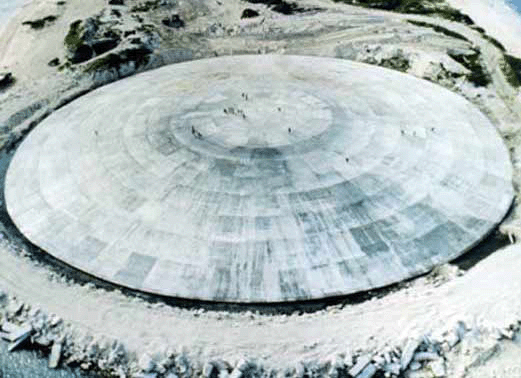
France tested nuclear weapons for 30 years in the Pacific. The people of French Polynesia bore the brunt of the testing.
“For 30 years, we were France’s guinea pigs,” says Hinamoeura Morgant-Cross, a young member of parliament from French Polynesia.
This South Pacific archipelago, a French overseas territory that includes Tahiti and is famed for its white beaches, swaying palms, and turquoise waters, is often romanticized as a paradise.
But beneath the idyllic image lies a painful legacy: decades of nuclear testing and its enduring consequences.
Between 1966 and 1996, the French military detonated 193 nuclear bombs on the remote atolls of Mururoa and Fangataufa. These tests were carried out in Ma’ohi Nui, as the territory is known to its indigenous inhabitants. The first explosion, codenamed Aldebaran, took place on July 2, 1966. It marked the beginning of a long chapter that would leave deep scars on the land and its people.
In 2025, Morgant-Cross journeyed over 15,000 kilometers (more than 9,320 miles) to Berlin to speak at an event in May, hosted by the international medical NGO International Physicians for the Prevention of Nuclear War, or IPPNW. There, she delivered a searing testimony about the long-term consequences of France’s nuclear testing program: disproportionately high cancer rates, children born with deformities and ongoing contamination of the region’s water and soil.
“So they really poisoned the ocean where we found all our food,” says Morgant-Cross who has also addressed the United Nations in New York. “We have been poisoned for the greatness of France, for France to be a state with a nuclear weapon.”
The ‘clean bomb’ myth
The French government at the time knowingly gave false assurances to the islanders about the dangers of the nuclear testing.
Then-President Charles de Gaulle described the French atomic bomb as “green and very clean,” suggesting it was safer or more environmentally friendly than the bombs dropped on Hiroshima and Nagasaki .
Morgant-Cross calls it nothing more than “French propaganda.”
In reality, radioactive clouds drifted across vast parts of the South Pacific and even reached the main island of Tahiti, more than 1,000 kilometers from the test site. Often, residents of nearby islands weren’t informed or evacuated.
No Apology from France
France didn’t cease its nuclear testing program until 1996, following intense domestic and international outcry. Despite the halt, the French government has never formally apologized for the harm caused to its overseas territories.
During a 2021 visit to French Polynesia, President Emmanuel Macron acknowledged France’s role, stating, “The guilt lies in the fact that we conducted these tests.”
“We would not have carried out these experiments in Creuse or Brittany [in mainland France],” he said.
United Nations and various NGOs have observed September 26th as the International Day for the Total Elimination of Nuclear Weapons since 2014. The days is a solemn reminder of the ongoing responsibility borne by nuclear-armed states.
Yet the suffering endured by victims of nuclear testing is in danger of being forgotten. In response, a rising generation from former test sites is refusing to accept the silence of those in power. They are mobilizing across borders, channeling their concern into coordinated action.
Parliamentarian Hinamoeura Morgant-Cross is among those speaking out. While visiting Berlin, she shared her family’s painful legacy: her grandmother was 30 when the nuclear tests began and later developed thyroid cancer as did her mother and aunt.
Morgant-Cross, born in 1988, revealed that both she and her sister also developed cancer, underscoring the generational toll of radioactive exposure.
Cancer can develop generations later
Experts warn that nuclear testing has led to clusters of cancer cases within affected families. Exposure to ionizing radiation can cause genetic mutations, which may be inherited by subsequent generations.
“The insidious nature of ionizing radiation lies in its ability to affect people across generations,” says nuclear weapons expert Jana Baldus of the European Leadership Network (ELN). “It significantly increases the risk of various cancers, particularly lymphoma and leukemia.”
Another consequence of nuclear testing is reproductive harm.
“Women exposed to radiation during the tests have given birth to children with congenital defects and have suffered miscarriages,” Baldus tells DW. “These effects can be passed down through generations, potentially leading to infertility in women.”
For Hinamoeura Morgant-Cross, the multiple cancer diagnoses in her family were a driving force behind her decision to enter politics.
She is now calling on France — the state responsible for the nuclear tests — to provide greater support for her fellow citizens.
“We don’t have the medical care that we should have, that we deserve, because we are 30 years late, in terms of medicines. We don’t have technology like medical scans.” she says. “It really pushed me to go into politics, and to demand that we deserve a better hospital, we deserve better treatment.”
Only a small fraction of those affected have the means to travel to Paris for medical treatment, leaving many without access to adequate care.
Victims face an uphill battle for compensation
In 2010, the French government enacted legislation to provide compensation to victims of nuclear testing. However, each case is assessed individually, and claimants must demonstrate a direct link between their illness and the nuclear tests. That burden of proof is not always easily achieved.
Expert Jana Baldus points out a major hurdle.
“Victims must prove they were physically present at the exact location when the tests occurred — a nearly impossible task decades later.” In addition, compensation is limited to a narrow list of officially recognized illnesses. According to the global coalition ICAN (International Campaign to Abolish Nuclear Weapons), only 417 residents of French Polynesia received compensation between 2010 and July 2024.
For Hinamoeura Morgant-Cross, the fight isn’t only about securing practical support, it’s also about education.
In her homeland, a persistent narrative still portrays the nuclear tests as a so-called clean endeavor that brought prosperity.
“For decades, we had pictures of the nuclear mushroom in all the living rooms of the Tahitian people because we were proud the French decided to choose us,” she recalls. Her mission now is to dismantle what she calls that “colonial mindset” and shed light on the true consequences of the tests.
The future of nuclear testing: risk or rhetoric?
France wasn’t alone in conducting extensive nuclear tests. The Soviet Union, the United States, the United Kingdom and China also carried out large-scale detonations.
In total, more than 2,000 nuclear explosions have taken place. The resulting radioactive fallout not only contaminated the immediate test sites but also contributed to elevated radiation levels across the globe.
Nuclear testing was halted primarily through moratoriums and international negotiations surrounding the Comprehensive Nuclear-Test-Ban Treaty (CTBT).
In recent years, North Korea has been the only country to conduct such tests. Yet amid rising geopolitical tensions, experts warn that a resurgence of nuclear testing remains a real possibility.
Sizewell C taking the axe to two century-old trees
Two century-old oak trees will be felled to make way for a new road
network which will eventually serve a new nuclear power plant in Suffolk.
Managers for Sizewell C will chop down the trees along the B1125 Leiston
Road in Middleton so a new junction can be built. Sizewell C had permission
to cut down seven trees, although residents feared as many as ten could be
chopped down. Steve Mannings, Sizewell C’s head of ecology, said only the
two oak trees nearest the new junction needed to be felled.
BBC 25th Sept 2025, https://www.bbc.co.uk/news/articles/c5y4dqw8vqqo
First of four containers of tritium waste at LANL has been vented
By Alaina Mencinger amencinger@sfnewmexican.com
Sep 16, 2025
The first of four flanged tritium waste containers awaiting removal from Los Alamos National Laboratory has been vented, the New Mexico Environment Department announced Tuesday afternoon.
The container can now be moved for treatment at LANL and then, eventually, to an off-site disposal area.
No internal pressure was found in the first container, according to the National Nuclear Security Administration, suggesting the inner containers in the flanged tritium waste container hadn’t leaked. Air monitoring did not show an increase of tritium beyond background levels, the federal agency wrote…………………………………
This weekend, several groups, including Communities for Clean Water, urged state and federal officials to stay the venting and requested additional guidance on precautionary measures. The New Mexico Environmental Law Center drafted a letter to Gov. Michelle Lujan Grisham on Friday asking the state leader to halt the process.
“This project is the direct result of decades of mismanagement,” Joni Arends of Concerned Citizens for Nuclear Safety stated in a news release ahead of scheduled weekend venting. “Instead of investing in real solutions like filtration or long-term storage until decay, DOE is forcing our communities to accept dangerous shortcuts.” https://www.santafenewmexican.com/news/local_news/first-of-four-containers-of-tritium-waste-at-lanl-has-been-vented/article_4b5cf404-0458-4880-ba3f-7a1c754a500e.html
Key oceans treaty crosses threshold to come into force

A global agreement designed to protect the world’s oceans and reverse
damage to marine life is set to become international law. The High Seas
Treaty received its 60th ratification by Morocco on Friday, meaning that it
will now take effect from January. The deal, which has been two decades in
the making, will pave the way for international waters to be placed into
marine protected areas. Environmentalists heralded the milestone as a
“monumental achievement” and evidence that countries can work together for
environmental protection.
BBC 20th Sept 2025, https://www.bbc.co.uk/news/articles/cq5j87114deo
‘Sizewell C oak tree felling would be devastating’
Campaigners say chopping down century-old oak trees as part of the
Sizewell C nuclear power station build would be “the straw that broke the
horse’s back”. Sizewell C has notified residents in Middleton, Suffolk,
that vegetation on the B1125 at Leiston Road could be cleared between the 6
and 10 October – after permission was granted. But locals fear it will mean
the loss of 10 oaks – each more than 100 years old – to improve the sight
line of the 60mph stretch, which could become part of the Sizewell C Link
Road system. It remains unclear at this stage if all or any of the trees
will be cut down, as project bosses say they will “only ever remove trees
when we absolutely have to”.
BBC 9th Sept 2025, https://www.bbc.co.uk/news/articles/cgknxezy2vno
Is fishmeal from Fukushima-affected fish the source of Indonesian shrimp’s radioactive contamination?

J. P. Unger, 8 Sept 25
It just hit me earlier, while thinking about the recently exposed case of radioactive shrimp being recalled in the US, and in particular why one Indonesian shrimp farming business’s harvests would be contaminated with radioactive Cesium and not those from other Indonesian shrimp farms: it’s probably the feed they used!
Cheap, radioactive fishmeal, perhaps made from fish impacted by contamination from Fukushima, I suspect could well be the source. This is why:
Shrimp farming has traditionally used fishmeal as a high-protein source to feed the shrimp -with fishmeal normally consisting of smaller fish, fishing “by-catch” and fish-processing byproducts, all shredded and ground to a texture like coarse sand or pellets to feed farm animals and aquaculture operations.
As ocean fish populations become increasingly strained and global demand for fish keeps increasing, fishmeal has become increasingly expensive and in shorter supply
Therefore, it’s quite likely that fishmeal from contaminated fisheries -for example, with high levels of radioactive pollution- would be offered at a comparatively low price. That would be quite attractive for a business that’s more concerned with profit margins than with what happens to consumers down the line.
If this was the case, and given that many businesses around the world likely prioritize profit margins over long-term effects in far-removed consumers (or might not even be aware of the contamination of the feed), this case could be the tip of a very worrisome iceberg and open up a big can of worms….
It certainly demands a careful inspection of food imports AND of food “precursors”, in particular imported fishmeal and food from animals raised on it. Also, international cooperation and vigilance, to know who might be selling contaminated fishmeal and where, who has been buying and using it, and what land- or water-farmed meat production it might be affecting.
Unless I hear concerns or suggestions to the contrary, I’ll prepare and send a slightly different articulation of these thoughts to a handful of government officials and media here and in the US who might be interested in investigating, as precautions should probably be ramped up for a variety of food products…
This would not be the first time radioactively contaminated foodstuff circulates at bargain prices… When I was starting as a science and environment journalist in Peru in the 1980’s I wrote about the post-Chernobyl arrival of radioactive powdered milk from Europe (a “generous” 12,000 ton donation from the European Community…), and radioactive meat from Germany (sold at a bargain price!). I received brush-offs, threats and warnings from corrupt government officials profiting from it, as well as ignorance and disinterest among other journalists and the general population, all with other “more immediate concerns” at the time, as the country faced five-digit inflation and the expansion of a brutally violent Maoist insurgency -nobody wanted to hear about yet more dangers then, and everywhere I was met by a frustrating fatalistic denial or avoidance mantra along the lines of “one has to die from something anyway.” Anyways… JPU
Jellyfish cause partial shutdown at French nuclear plant
EDF considered installing a so-called “fish disco” at Hinkley Point C,
the reactor under construction in Somerset, south-west England, to ward off sea life from the site, after protesters criticised the project’s fish protection measures. EDF is now exploring whether it can use new fish deterrent technology involving devices that make very high frequency sounds, having decided against its earlier plan to install underwater loudspeakers.
FT 4th Sept 2025, https://www.ft.com/content/dadaa032-55a3-4c09-9fc5-3bcaf2b90fe4
Why are saltmarshes such effective carbon sinks?
The invisible yet lethal threat of radioactive pollution is an ever-present risk to the Blackwater. Even a small leakage of nuclear material from the decommissioned Bradwell reactor cores or radioactive waste stores could negatively affect the role that the estuary’s marshlands play in trapping carbon, known as carbon sequestration. In short, radioactive leakage may erode the amount of carbon that can be sequestered in future. This risk alone should be enough to deter any further development of new nuclear power at the Bradwell site.
2 September 2025
David Humphreys explains the role of saltmarshes in the struggle against our heating climate in the August 2025 column for Regional Life
The saltmarshes and mudflats of the Blackwater Estuary are an important yet fragile environment rich in birds, flora, invertebrates, fish and oysters. But saltmarshes are also highly effective in storing carbon, thereby acting as carbon sinks with a vital role to play in tackling increases to the global temperature.
Like all forms of plant life, the vegetation that thrives in marshlands absorbs carbon from the atmosphere through photosynthesis to create food for the plants.
Carbon sinks may release their carbon back into the atmosphere in two ways. First, combustion generates carbon dioxide emissions, for example during forest fires. Second, carbon dioxide is realised when living organisms respire. Respiration is how life forms, including plants, obtain energy. If plants are in an oxygen-rich (aerobic) environment they create more carbon dioxide when breathing than if their environment is lacking in oxygen (anaerobic).
Why are saltmarshes such effective carbon sinks?
2 September 2025
David Humphreys explains the role of saltmarshes in the struggle against our heating climate in the August 2025 column for Regional Life
The saltmarshes and mudflats of the Blackwater Estuary are an important yet fragile environment rich in birds, flora, invertebrates, fish and oysters. But saltmarshes are also highly effective in storing carbon, thereby acting as carbon sinks with a vital role to play in tackling increases to the global temperature.

Like all forms of plant life, the vegetation that thrives in marshlands absorbs carbon from the atmosphere through photosynthesis to create food for the plants.
Carbon sinks may release their carbon back into the atmosphere in two ways. First, combustion generates carbon dioxide emissions, for example during forest fires. Second, carbon dioxide is realised when living organisms respire. Respiration is how life forms, including plants, obtain energy. If plants are in an oxygen-rich (aerobic) environment they create more carbon dioxide when breathing than if their environment is lacking in oxygen (anaerobic).
And here’s why saltmarshes are such effective sinks: they are anaerobic, so plants breathe without oxygen. Anaerobic respiration generates less energy than aerobic respiration and produces less carbon dioxide. This enables carbon stocks to build up. Coastal marshlands also receive a constant influx of tide-borne sediment, which buries organic matter in sediment layers, a further factor that enables carbon to accumulate. The result is that coastal marshlands are more effective at carbon storage per hectare than any other ecosystem, including tropical forests.
The Blackwater Estuary forms part of a broader category of carbon sink known as ‘blue carbon’. This is carbon that has been captured and stored by living coastal ecosystems such as saltmarshes, mangrove forests and seagrass beds. Blue carbon ecosystems also provide other environmental services such as protection against sea-level rise and storm surges. Given the global sea-level increases projected for this century, the importance of blue carbon ecosystems cannot be overstated, both for coastal protection and trapping carbon.
The saltmarshes of Essex, then, are a vital asset in the fight against global heating. At the same time, they are threatened by the impacts of climate change, in particular coastal retreat from sea-level rise.
Marshland ecosystems are also at the mercy of pollution, which can reduce their carbon storage capacity. The invisible yet lethal threat of radioactive pollution is an ever-present risk to the Blackwater. Even a small leakage of nuclear material from the decommissioned Bradwell reactor cores or radioactive waste stores could negatively affect the role that the estuary’s marshlands play in trapping carbon, known as carbon sequestration. In short, radioactive leakage may erode the amount of carbon that can be sequestered in future. This risk alone should be enough to deter any further development of new nuclear power at the Bradwell site.
This is a further reason to ‘BANNG the drum’ against new nuclear at Bradwell and to resist further nuclear power construction in the United Kingdom.
David Humphreys is Emeritus Professor of Environmental Policy at the Open University.
Widened recall of radioactively contaminate shrimp
The FDA continues to widened a recall of shrimp packages contaminated with radioactive cesium 137. Various theories abound regarding the exact source of the contamination. As of September 2, the recall encompasses grocery stores, distributors, and wholesalers across many states.
Such a recall comes as no shock to many organizations — including Beyond Nuclear — who, in the wake of the 2011 Fukushima meltdowns, have warned about radioactive contamination of food for over a decade. These groups petitioned FDA (2013), and two appeals are currently being made to lawmakers, to reduce the amount of radioisotopes allowed in U.S. food. The U.S. has one of the highest allowable limits worldwide for radiocesium. https://nislappdc.org/wp-content/uploads/2025/08/FFAN-FINAL-release-on-shrimp-recall-1-4-1.pdf
1 This Month

of the week – Shut Down Drone Warfare!


Tell the Ukrainian Government to Drop Prosecution of Peace Activist Yurii Sheliazhenko

Petition to revoke the licensing of the Near Surface Nuclear Disposal Facility (NSDF) at Chalk River. https://www.ourcommons.ca/petitions/en/Petition/Details?Petition=e-7247
To see nuclear-related stories in greater depth and intensity – go to https://nuclearinformation.wordpress.com
-
Archives
- April 2026 (68)
- March 2026 (251)
- February 2026 (268)
- January 2026 (308)
- December 2025 (358)
- November 2025 (359)
- October 2025 (376)
- September 2025 (257)
- August 2025 (319)
- July 2025 (230)
- June 2025 (348)
- May 2025 (261)
-
Categories
- 1
- 1 NUCLEAR ISSUES
- business and costs
- climate change
- culture and arts
- ENERGY
- environment
- health
- history
- indigenous issues
- Legal
- marketing of nuclear
- media
- opposition to nuclear
- PERSONAL STORIES
- politics
- politics international
- Religion and ethics
- safety
- secrets,lies and civil liberties
- spinbuster
- technology
- Uranium
- wastes
- weapons and war
- Women
- 2 WORLD
- ACTION
- AFRICA
- Atrocities
- AUSTRALIA
- Christina's notes
- Christina's themes
- culture and arts
- Events
- Fuk 2022
- Fuk 2023
- Fukushima 2017
- Fukushima 2018
- fukushima 2019
- Fukushima 2020
- Fukushima 2021
- general
- global warming
- Humour (God we need it)
- Nuclear
- RARE EARTHS
- Reference
- resources – print
- Resources -audiovicual
- Weekly Newsletter
- World
- World Nuclear
- YouTube
-
RSS
Entries RSS
Comments RSS
 nuclear-news