Fish v. electricity: Could Salem nuclear plant be shut down?

Delaware Live KARL BAKER FEBRUARY 16, 2024
A judge in an obscure administrative court in Trenton, N.J., is set to hand down a ruling that could end a challenge to the Salem nuclear plant’s ability to pump billions of gallons of water out of the Delaware River each day.
The case, which strikes at the heart of the mid-Atlantic electricity ecosystem, pits a tenacious environmental group against one of the region’s largest energy companies, and its ultimate resolution could impact electricity prices for Delawareans, the health of birds and fish in the Delaware estuary, and President Joe Biden’s most ambitious energy initiative to date.
In short, it’s the region’s biggest environmental battle that you’ve probably never heard of.
At issue is the way in which the Salem Nuclear Generating Station’s two reactors cool steam created by the heat of nuclear fission. Currently, the plant pumps cold water from the Delaware River through a system of pipes that lead it to the steam, which is then cooled back to a liquid form.
The river water then returns to the estuary, but at far higher temperatures than when it was pumped in.
In all, the process kills large numbers of fish and fish larvae, though the exact amounts are disputed.
In late 2016, the Delaware Riverkeeper Network , an environment group and active critic of heavy industry in the region – petitioned New Jersey to rescind a permit that allows the plant to pump water out of the river.
When filed, the challenge was the latest of more than a decade of petitions, disputes and complaints brought against the Salem facility by the environmental group and its outspoken leader Maya van Rossum, who calls the power plant the largest “predator” in the Delaware estuary.
Van Rossum claims that 3 billion adult fish are killed on average each year by the plant’s cooling operations, plus billions more eggs and larvae. Those include the bay anchovy, a species that has suffered a declining local population even as larger fish, eagles, herons, and even whales rely on it for food.
“The cause of the problem for the fish is that the Salem Nuclear Generating Station is sucking them in, cooking them, ripping them apart, destroying them,” she said.
The New Jersey Department of Environmental Protection, which declined to comment for this story, suggested in their permit issued to Salem that the mortality figures cited by van Rossum and other critics are overstated.
Still, they do not appear to have presented current, counter estimate
During the early 2000s, the U.S. Environmental Protection Agency issued new rules mandating that new large power plants use closed-cycle cooling…………………………………………………………………………………………………………………………. more https://delawarelive.com/fish-v-electricity-could-salem-be-shut-down/
Release of fourth batch of Fukushima treated radioactive water begins

Japan Times, 28 Feb 24
The operator of the crippled Fukushima No. 1 nuclear power plant on Wednesday started releasing a fourth batch of treated radioactive water into the sea, in what will be the last discharge for the fiscal year ending March.
As in previous rounds, Tokyo Electric Power Company Holdings (Tepco) will discharge 7,800 metric tons of treated water over about 17 days, having confirmed that the radioactivity level of the latest batch of water meets the standards set by the government and the utility.
China, which opposes the water release, has banned Japanese seafood imports since the first discharge in late August. The two countries have engaged in informal discussions to resolve the matter, but no substantial progress has been made……………………….. more https://www.japantimes.co.jp/news/2024/02/28/japan/society/fukushima-radioactive-water-fourth-release/
China is ‘unlikely’ to lift import ban on Japanese seafood as dumping continues
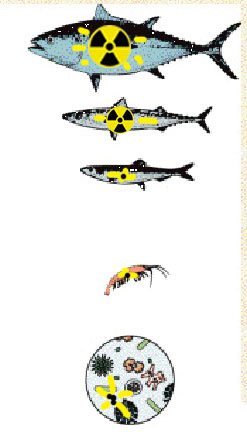
predatory species higher up in the food chain have a greater chance of experiencing bioaccumulation and biomagnification of radioactive substances. As time goes on and more nuclear-contaminated water is discharged, the negative effects will only increase
By GT staff Feb 25, 2024 , https://www.globaltimes.cn/page/202402/1307658.shtml
Half a year after Japan opened Pandora’s box by dumping nuclear-contaminated wastewater from the crippled Fukushima Daiichi nuclear power plant into the ocean, Japanese media are discussing the possibility of bilateral talks for getting China to revoke its import ban on Japanese marine products, in an apparent attempt to test the waters.
In response, Chinese experts told the Global Times on Sunday that, in the short term, it is unlikely that China will revoke the ban as there are currently no conditions for a withdrawal.
Meanwhile, a Kyodo News survey on Friday showed that most Japanese fishery groups have been affected by the discharge, with many feeling the impact through China’s import ban on Japanese seafood.
The survey found that 29 out of 36 respondents among the members of the National Federation of Fisheries Cooperative Associations said they “had felt” or “had somewhat felt” negative effects, including financial damage due to the contaminated water dumping, overwhelmingly due to the subsequent import ban by China.
Chinese Foreign Ministry spokesperson Mao Ning said at a regular press conference that the precautionary measures taken by China and some other countries in response to Japan’s move are aimed at protecting food safety and people’s health.
“These measures are entirely legitimate, reasonable and necessary,” Mao said.
Chang Yen-chiang, director of the Yellow Sea and Bohai Sea Research Institute of Dalian Maritime University, revealed several main factors why China is less likely to revoke the ban in the short run.
There is no halt in the ocean discharge, that is, the Japanese side has not withdrawn from their erroneous actions, he said.
Currently, half a year has passed since the dumping began, meaning that under the influence of ocean currents, the impact of Japan’s nuclear-contaminated water discharge on East Asia may just be starting, and further impacts need to be assessed, Chang said.
In addition, predatory species higher up in the food chain have a greater chance of experiencing bioaccumulation and biomagnification of radioactive substances. As time goes on and more nuclear-contaminated water is discharged, the negative effects will only increase, Chang said. “Under these circumstances, how could the ban be lifted?” the expert asked.
TEPCO – operator of the Daiichi plant – plans to release a total of about 54,600 tons of nuclear-contaminated water on seven occasions in the 2024 fiscal year, more than double the amount of 2023, according to media reports.
Chang called on Japan to consider solving the Fukushima nuclear power plant issue on a fundamental level, such as focusing on research on how to handle the burnt-out nuclear reactors. Otherwise, radioactive substances will continue to be produced endlessly, and the discharge of nuclear contamination could last for over 100 years, making the situation increasingly worse.
Japanese media have reported on a series of scandals concerning leaks occurring during the contaminated water discharge process, which led to soil contamination around the nuclear power plant.
Most recently, 1.5 metric tons of highly radioactive water escaped in early February during valve checks at a treatment machine designed to remove cesium and strontium from the contaminated water, according to TEPCO.
According to Japanese experts studying the soil, the radiation levels in Fukushima soil are much higher compared to other areas.
“We should be more vigilant toward crops and plants grown in this contaminated soil. China should increase radioactive testing of Japanese agricultural products and cosmetics imports,” Chang stated.

China is ‘unlikely’ to lift import ban on Japanese seafood as dumping continues
By GT staff reportersPublished: Feb 25, 2024 09:50 PM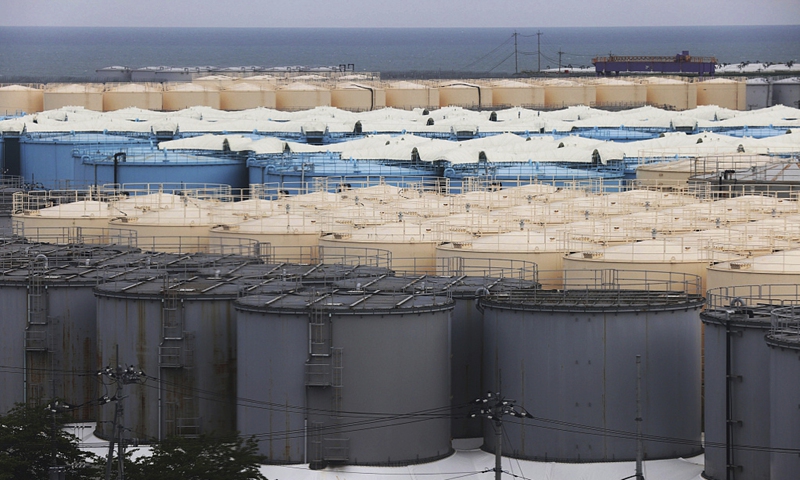
Water tanks near Fukushima Daiichi nuclear power plant in Okuma town of Fukushima prefecture on May 26, 2023 Photo: VCG
Half a year after Japan opened Pandora’s box by dumping nuclear-contaminated wastewater from the crippled Fukushima Daiichi nuclear power plant into the ocean, Japanese media are discussing the possibility of bilateral talks for getting China to revoke its import ban on Japanese marine products, in an apparent attempt to test the waters.
In response, Chinese experts told the Global Times on Sunday that, in the short term, it is unlikely that China will revoke the ban as there are currently no conditions for a withdrawal.
Meanwhile, a Kyodo News survey on Friday showed that most Japanese fishery groups have been affected by the discharge, with many feeling the impact through China’s import ban on Japanese seafood.
The survey found that 29 out of 36 respondents among the members of the National Federation of Fisheries Cooperative Associations said they “had felt” or “had somewhat felt” negative effects, including financial damage due to the contaminated water dumping, overwhelmingly due to the subsequent import ban by China.
Chinese Foreign Ministry spokesperson Mao Ning said at a regular press conference that the precautionary measures taken by China and some other countries in response to Japan’s move are aimed at protecting food safety and people’s health.
“These measures are entirely legitimate, reasonable and necessary,” Mao said.
Chang Yen-chiang, director of the Yellow Sea and Bohai Sea Research Institute of Dalian Maritime University, revealed several main factors why China is less likely to revoke the ban in the short run.
There is no halt in the ocean discharge, that is, the Japanese side has not withdrawn from their erroneous actions, he said.
Currently, half a year has passed since the dumping began, meaning that under the influence of ocean currents, the impact of Japan’s nuclear-contaminated water discharge on East Asia may just be starting, and further impacts need to be assessed, Chang said.
In addition, predatory species higher up in the food chain have a greater chance of experiencing bioaccumulation and biomagnification of radioactive substances. As time goes on and more nuclear-contaminated water is discharged, the negative effects will only increase, Chang said. “Under these circumstances, how could the ban be lifted?” the expert asked.
TEPCO – operator of the Daiichi plant – plans to release a total of about 54,600 tons of nuclear-contaminated water on seven occasions in the 2024 fiscal year, more than double the amount of 2023, according to media reports.
Chang called on Japan to consider solving the Fukushima nuclear power plant issue on a fundamental level, such as focusing on research on how to handle the burnt-out nuclear reactors. Otherwise, radioactive substances will continue to be produced endlessly, and the discharge of nuclear contamination could last for over 100 years, making the situation increasingly worse.
Japanese media have reported on a series of scandals concerning leaks occurring during the contaminated water discharge process, which led to soil contamination around the nuclear power plant.
Most recently, 1.5 metric tons of highly radioactive water escaped in early February during valve checks at a treatment machine designed to remove cesium and strontium from the contaminated water, according to TEPCO.
According to Japanese experts studying the soil, the radiation levels in Fukushima soil are much higher compared to other areas.
“We should be more vigilant toward crops and plants grown in this contaminated soil. China should increase radioactive testing of Japanese agricultural products and cosmetics imports,” Chang stated.
As Japanese industries, including fisheries and cosmetics, have been affected, Japanese media continues to report news about bilateral talks aimed at getting China to revoke its import ban on Japanese marine products, trying to test the reaction from China.
The Asahi Shimbun revealed Friday that nuclear experts from Japan and China started talks in January regarding contaminated water. The report noted that the Chinese side has still shown no signs of ending its import ban.
The Kyodo News reported on Thursday that when Chinese Ambassador to Japan Wu Jianghao met with the leader of the Social Democratic Party, Mizuho Fukushima, in January, China’s import suspension was also discussed, but there were no conditions for lifting the ban at present.
Antarctica sea ice reaches alarming low for third year in a row

The extent of ice floating around the continent has contracted to below 2m sq km for three years in a row, indicating an ‘abrupt critical transition’
Graham Readfearn, 25 Feb 24 https://www.theguardian.com/world/2024/feb/24/antarctica-sea-ice-reaches-alarming-low-for-third-year-in-a-row
For the third year in a row, sea ice coverage around Antarctica has dropped below 2m sq km – a threshold which before 2022 had not been breached since satellite measurements started in 1979.
The latest data from the US National Snow and Ice Data Center confirms the past three years have been the three lowest on record for the amount of sea ice floating around the continent.
Scientists said another exceptionally low year was further evidence of a “regime shift”, with new research indicating the continent’s sea ice has undergone an “abrupt critical transition”.
Antarctica’s sea ice reaches its lowest extent at the height of the continent’s summer in February each year.
On 18 February the five-day average of sea ice cover fell to 1.99m sq km and on 21 February was at 1.98m sq km. The record low was 1.78m sq km, set in February 2023.
Whether the current level represents this year’s minimum won’t be known for another week or two.
Antarctica sea ice reaches alarming low for third year in a row
The extent of ice floating around the continent has contracted to below 2m sq km for three years in a row, indicating an ‘abrupt critical transition’
Graham Readfearn @readfearnSun 25 Feb 2024
For the third year in a row, sea ice coverage around Antarctica has dropped below 2m sq km – a threshold which before 2022 had not been breached since satellite measurements started in 1979.
The latest data from the US National Snow and Ice Data Center confirms the past three years have been the three lowest on record for the amount of sea ice floating around the continent.
Scientists said another exceptionally low year was further evidence of a “regime shift”, with new research indicating the continent’s sea ice has undergone an “abrupt critical transition”.
Antarctica’s sea ice reaches its lowest extent at the height of the continent’s summer in February each year.
On 18 February the five-day average of sea ice cover fell to 1.99m sq km and on 21 February was at 1.98m sq km. The record low was 1.78m sq km, set in February 2023.
Whether the current level represents this year’s minimum won’t be known for another week or two.
“But we’re confident the three lowest years on record will be the last three years,” said Will Hobbs, a sea ice scientist at the University of Tasmania.
Antarctica’s sea ice reaches its peak each September, but last year’s maximum extent was the lowest on record, easily beating the previous record by about 1m sq km. Scientists were shocked at how much less ice regrew last year, falling well outside anything seen before.
Coverage appeared to recover slightly in December as the refreeze progressed, but then fell away again to the current levels.
There are no reliable measurements of how thick Antarctic sea ice is, but Ariaan Purich, a climate scientist specialising in Antarctica and the Southern Ocean at Monash University, said it was possible the ice that did regrow was thinner than usual.
“It seems plausible, and thinner sea ice could melt back more quickly,” she said.
Scientists are still investigating what is causing the decline in sea ice,, but they are concerned global heating could be playing a role – in particular by warming the Southern Ocean that encircles the continent.
Sea ice reflects solar radiation, meaning less ice can lead to more ocean warming.
Walt Meier, senior research scientist at the National Snow and Ice Data Center, said that since most of the ice melts completely each summer “much of the ice is only 1-2 metres [thick]” – and even less near the ice edge.
“With the very low maximum last September, the ice was probably thinner on average in many areas, but it’s hard to say how much of an effect it has had on the rate of melt and the approaching minimum,” he said.
Antarctica’s ecosystems are tied to the sea ice, from the formation of phytoplankton that can remove carbon from the atmosphere to the breeding sites of penguins.
Purich led research last year that said the continent’s sea ice could have undergone a “regime shift” that was probably driven by warming of the subsurface ocean about 100 metres down.
Research led by Hobbs and colleagues at the Australian Antarctic Program Partnership and other institutions has added evidence to support this claim.
In a paper published this month in the Journal of Climate scientists examined changes in the extent of sea ice and where it was forming each year.
Looking at two periods – 1979 to 2006 and 2007 to 2022 – the researchers found the amount of sea ice had become much more variable, or erratic, in the later period.
This change could not be explained by changes in the atmosphere – mostly winds – which have previously dictated most of the year-to-year variability of the ice.
The study concludes an “abrupt critical transition” has occurred in Antarctica, but Hobbs said they could not say why.
“We don’t know what the driver of change is. It could be ocean warming or a change in ocean salinity,” he said. But it was also possible the change was a natural shift.
Scientists have warned the loss of sea ice is just one of several major changes being observed in Antarctica that is likely to have global consequences – in particular, its loss is exposing more of the continent to the ocean, accelerating the loss of ice on the land, which can push up global sea levels.
Scientists have been increasingly vocal in calling for governments to take the Antarctic changes more seriously and have lamented the comparative lack of data from on and around the continent.
Hobbs said: “What we need is sustained measurements of ocean temperature and salinity underneath the sea ice. We need improvements in our climate models. And we need time.”
The Growing Environmental Footprint Of Generative AI

tech companies have been reporting whatever they choose, however they choose, about their AI impact

a great deal remains unrevealed about the millions of gallons of water used to cool computers running AI…… The same is true of carbon.
Undark, BY DAVID BERREBY, 02.20.2024
AI runs on power-hungry equipment that uses millions of gallons of fresh water. Policymakers are weighing the costs.
TWO MONTHS after its release in November 2022, OpenAI’s ChatGPT had 100 million active users, and suddenly tech corporations were racing to offer the public more “generative AI.” Pundits compared the new technology’s impact to the Internet, or electrification, or the Industrial Revolution — or the discovery of fire.
Time will sort hype from reality, but one consequence of the explosion of artificial intelligence is clear: this technology’s environmental footprint is large and growing.
AI use is directly responsible for carbon emissions from non-renewable electricity and for the consumption of millions of gallons of fresh water, and it indirectly boosts impacts from building and maintaining the power-hungry equipment on which AI runs. As tech companies seek to embed high-intensity AI into everything from resume-writing to kidney transplant medicine and from choosing dog food to climate modeling, they cite many ways AI could help reduce humanity’s environmental footprint. But legislators, regulators, activists, and international organizations now want to make sure the benefits aren’t outweighed by AI’s mounting hazards.
“The development of the next generation of AI tools cannot come at the expense of the health of our planet,” Massachusetts Senator Edward Markey said in a Feb. 1 statement in Washington, after he and other senators and representatives introduced a bill that would require the federal government to assess AI’s current environmental footprint and develop a standardized system for reporting future impacts. Similarly, the European Union’s “AI Act,” approved by member states last week, will require “high-risk AI systems” (which include the powerful “foundation models” that power ChatGPT and similar AIs) to report their energy consumption, resource use, and other impacts throughout their systems’ lifecycle. The EU law takes effect next year.
Meanwhile, the International Organization for Standardization, a global network that develops standards for manufacturers, regulators, and others, said it will issue criteria for “sustainable AI” later this year. Those will include standards for measuring energy efficiency, raw material use, transportation, and water consumption, as well as practices for reducing AI impacts throughout its life cycle, from the process of mining materials and making computer components to the electricity consumed by its calculations. The ISO wants to enable AI users to make informed decisions about their AI consumption.
Right now, it’s not possible to tell how your AI request for homework help or a picture of an astronaut riding a horse will affect carbon emissions or freshwater stocks. This is why 2024’s crop of “sustainable AI” proposals describe ways to get more information about AI impacts.
In the absence of standards and regulations, tech companies have been reporting whatever they choose, however they choose, about their AI impact, said Shaolei Ren, an associate professor of electrical and computer engineering at UC Riverside, who has been studying the water costs of computation for the past decade. Working from calculations of annual use of water for cooling systems by Microsoft, Ren estimates that a person who engages in a session of questions and answers with GPT-3 (roughly 10 t0 50 responses) drives the consumption of a half-liter of fresh water. “It will vary by region, and with a bigger AI, it could be more.” But a great deal remains unrevealed about the millions of gallons of water used to cool computers running AI, he said.
“Data scientists today do not have easy or reliable access to measurements of [greenhouse gas impacts from AI], which precludes development of actionable tactics,” a group of 10 prominent researchers on AI impacts wrote in a 2022 conference paper. Since they presented their article, AI applications and users have proliferated, but the public is still in the dark about those data, said Jesse Dodge, a research scientist at the Allen Institute for Artificial Intelligence in Seattle, who was one of the paper’s coauthors.
AI can run on many devices — the simple AI that autocorrects text messages will run on a smartphone. But the kind of AI people most want to use is too big for most personal devices, Dodge said. “The models that are able to write a poem for you, or draft an email, those are very large,” he said. “Size is vital for them to have those capabilities.”
Big AIs need to run immense numbers of calculations very quickly, usually on specialized Graphical Processing Units — processors originally designed for intense computation to render graphics on computer screens. Compared to other chips, GPUs are more energy-efficient for AI, and they’re most efficient when they’re run in large “cloud data centers” — specialized buildings full of computers equipped with those chips. The larger the data center, the more energy efficient it can be. Improvements in AI’s energy efficiency in recent years are partly due to the construction of more “hyperscale data centers,” which contain many more computers and can quickly scale up. Where a typical cloud data center occupies about 100,000 square feet, a hyperscale center can be 1 or even 2 million square feet.
Estimates of the number of cloud data centers worldwide range from around 9,000 to nearly 11,000. More are under construction. The International Energy Agency, or IEA, projects that data centers’ electricity consumption in 2026 will be double that of 2022 — 1,000 terawatts, roughly equivalent to Japan’s current total consumption.
However, as an illustration of one problem with the way AI impacts are measured, that IEA estimate includes all data center activity, which extends beyond AI to many aspects of modern life. Running Amazon’s store interface, serving up Apple TV’s videos, storing millions of people’s emails on Gmail, and “mining” Bitcoin are also performed by data centers. (Other IEA reports exclude crypto operations, but still lump all other data-center activity together.)
Most tech firms that run data centers don’t reveal what percentage of their energy use processes AI. The exception is Google, which says “machine learning” — the basis for humanlike AI — accounts for somewhat less than 15 percent of its data centers’ energy use…………………………………………………………………………………….
If global electricity use can feel a bit abstract, data centers’ water use is a more local and tangible issue — particularly in drought-afflicted areas. To cool delicate electronics in the clean interiors of the data centers, water has to be free of bacteria and impurities that could gunk up the works. In other words, data centers often compete “for the same water people drink, cook, and wash with,” said Ren.
In 2022, Ren said, Google’s data centers consumed about 5 billion gallons (nearly 20 billion liters) of fresh water for cooling. (“Consumptive use” does not include water that’s run through a building and then returned to its source.) According to a recent study by Ren, Google’s data centers used 20 percent more water in 2022 than they did in 2021, and Microsoft’s water use rose by 34 percent in the same period. (Google data centers host its Bard chatbot and other generative AIs; Microsoft servers host ChatGPT as well as its bigger siblings GPT-3 and GPT-4. All three are produced by OpenAI, in which Microsoft is a large investor.)
As more data centers are built or expanded, their neighbors have been troubled to find out how much water they take. For example, in The Dalles, Oregon, where Google runs three data centers and plans two more, the city government filed a lawsuit in 2022 to keep Google’s water use a secret from farmers, environmentalists, and Native American tribes who were concerned about its effects on agriculture and on the region’s animals and plants. The city withdrew its suit early last year. The records it then made public showed that Google’s three extant data centers use more than a quarter of the city’s water supply. And in Chile and Uruguay, protests have erupted over planned Google data centers that would tap into the same reservoirs that supply drinking water……………..more https://undark.org/2024/02/20/ai-environmental-footprint/?utm_source=Undark%3A+News+%26+Updates&utm_campaign=01eaa0c93b-RSS_EMAIL_CAMPAIGN&utm_medium=email&utm_term=0_5cee408d66-185e4e09de-%5BLIST_EMAIL_ID%5D
Environment Agency and Natural England behind Hinkley Point wetland plan, says MP
THE Environment Agency (EA) and Natural England (NE) were both ‘clearly
implicated’ in a plan to turn nearly 1,000 acres of prime West Somerset
farmland into wetland, said local MP Ian Liddell-Grainger. Mr
Liddell-Grainger accused the two agencies of hiding behind a smokescreen
while they promoted a project which had already aroused a lot of anger
among local people.
West Somerset Free Press 21st Feb 2024
Locals campaign to oppose Hinkley Point C’s plans to build a saltmarsh on the Pawlett Hams
LOCALS to a village near Bridgwater have set up a campaign group to oppose
Hinkley Point C’s plans to build a saltmarsh on the Pawlett Hams. The
group, named Protect Pawlett Hams, describes the area of land as ‘a
treasured expanse of 320 hectares of vibrant fresh water wetland and
grazing land’. The saltmarsh, planned by EDF to facilitate the Hinkley
Point C nuclear power station, is currently under public consultation, and
comes as an alternative to a previously proposed acoustic fish deterrent
system, which would reportedly make noise louder than a jumbo jet, 24-hours
per day for the next 60 years.
Bridgwater Mercury 20th Feb 2024
https://www.bridgwatermercury.co.uk/news/24130587.locals-campaign-hinkley-point-c-saltmarsh-plans
Somerset County Gazette 20th Feb 2024
Local environmental group says EDF’s plans for new salt marsh would be
an ‘ecological disaster’.
Burnham-on-sea.com 20th Feb 2024
Hinkley Point C Nuclear could kill 22 BILLION fish in the Severn estuary

the huge cost to our precious natural world has been hidden behind the low-carbon story.
Somerset Apple, 17 Feb 24, Dave Phillips
A POWERFUL grouping of environmentalists, wildlife and fishing organisations have got together to condemn EDF’s plan to backtrack on promises made to install technology to prevent millions of fish and other marine life from being destroyed by the powerful cooling intakes for Hinkley Point C (HPC) nuclear power station that’s currently under construction.
When operational, HPC will suck in an Olympic-sized swimming pool of water every 12 seconds for the next 70 years from the Severn Estuary in an area inhabited by fish. Experts say it could wipe out 22 BILLION fish during its operational lifetime.
The Dillington Vision agreed between EDF, Somerset County Council and the UK Government, set out the vision for HPC which included the commitment to “recognise the value of the natural environment”. The original design of HPC included three measures to protect the marine environment, specifically fish populations, from the impacts of the power station.
This all relates to EDF’s consultation about removing the Acoustic Fish Deterrent (AFD), one of three ways to reduce fish killed at the new power station.
The proposed three methods were designed to work together:
- Low-velocity side entry at the tunnel heads designed to allow fish to swim away and not be sucked into the cooling tunnels.
- Fish recovery and return system.
- Acoustic Fish Deterrent (AFD) using sound that deter fish from swimming too close to the intake pipes in the first place.
In 2019, EDF proposed to remove the Acoustic Fish Deterrent as being difficult to install and maintain. This went to public inquiry with environmental groups (eNGOs) collectively giving evidence to support the Environment Agency (EA) in questioning EDF’s proposal.
In 2021, the UK Secretary of State for the Environment found in favour of the EA that the AFD should remain. EDF is now proposing not to implement the AFD and is instead proposing a package of measures claimed to compensate for the loss of fish in the estuary.
The eNGO group comprises:
- Angling Trust
- Avon Wildlife Trust
- Bristol Channel Federation of Sea Anglers
- Burnham Boat Owners
- Blue Marine Foundation
- Bristol Avon Rivers Trust
- Fish Legal
- Institute of Fisheries Management
- RSPB
- Severn Rivers Trust
- Somerset Wildlife Trust
- Wildlife Trusts Wales
- WWT, the charity for wetlands and wildlifeWhilst the eNGO group accepts that habitat restoration of saltmarsh, oysterbeds, kelp forest and river work could make an important and positive impact on the estuary, there is not enough evidence that it will address the huge losses of fish life that the cooling intakes will cause.
- They say: “Hinkley Point C nuclear power station (HPC) has been promoted as green and renewable because of the need to move away from fossil fuels. However, the huge cost to our precious natural world has been hidden behind the low-carbon story.
“Europe’s largest construction project on the edge of the Severn Estuary will have a significant impact on marine and migratory fish including already vulnerable Atlantic salmon, twaite shad and European eel over its lifetime.
“The impacts of this will be felt widely, affecting Welsh rivers, River Severn, the Bristol Avon, Somerset Levels and across the Celtic Sea. Life in the whole of the Severn Estuary and Bristol Channel could be dramatically affected over the next few decades according to a group of environmental organisations (eNGO’s)……………………………………………………………………………………………..
Objectors are calling for:
- More evidence of the potential impact of the AFD removal to determine the amount of compensation needed, including more consultation with independent groups of experts.
- Agreement on comprehensive long-term monitoring of the impact of the water intakes and the compensatory habitat as it develops throughout the lifetime of the power station.
- A commitment to respond to the results of the evidence gathering and monitoring with additional compensatory habitat, the fitting of fish deterrents on the intakes and/or reduction in intake water volumes as supplementary cooling techniques are more affordable or legislated.
AI, climate change, pandemics and nuclear warfare puts humanity in ‘grave danger’, open letter warns
More than 100 politicians, academics and celebrities urge world leaders to act now against the existential threats facing mankind
Samuel Lovett, DEPUTY EDITOR OF GLOBAL HEALTH SECURITY, 15 February 2024 https://www.telegraph.co.uk/global-health/terror-and-security/ai-climate-change-pandemic-nuclear-warfare-humanity-danger/
Climate change, pandemics, nuclear warfare and artificial intelligence all pose an existential threat to humanity and need to be addressed with “wisdom and urgency”, more than 100 politicians, academics, and celebrities have warned in an open letter.
The signatories, including Annie Lennox, Richard Branson, Gordon Brown and Charles Oppenheimer, whose grandfather developed the atom bomb, said today’s world leaders prioritise “short-term fixes over long-term solutions” and “lack the political will to take decisive action” against the many dangers facing mankind.
“Our world is in grave danger. We face a set of threats that put all humanity at risk. Our leaders are not responding with the wisdom and urgency required,” the letter reads. “We are at a precipice.”
The signatories list four key demands for future-proofing humanity: a global financing plan to ease the transition to clean energy; arms control talks to reduce the risk of nuclear war; an equitable pandemic treaty to prepare for future outbreaks; and international governance for regulating AI to make it “a force for good”.
“The biggest risks facing us cannot be tackled by any country acting alone. Yet when nations work together, these challenges can all be addressed, for the good of us all,” the letter states.
The call for action is led by the Elders, an independent group of global leaders campaigning for peace and human rights founded by Nelson Mandela, and the Future of Life Institute, a non-profit working to develop transformative technologies for the benefit of humanity.
Other signatories of the letter include Ban Ki-moon, the former UN Secretary-General, Sir Malcolm Rifkind, the former UK foreign secretary, Helen Clark, the former prime minister of New Zealand, Mary Robinson, the former president of Ireland, and Amber Valletta, the American model and actress.
The letter also encourages the world’s decision-makers to be “bold” in abandoning their short termism in favour of “long-view leadership”.
“In a year when half the world’s adult population face elections, we urge all those seeking office to take a bold new approach,” it reads.
“We need long-view leadership from decision-makers who understand the urgency of the existential threats we face, and believe in our ability to overcome them.
“Long-view leadership means showing the determination to resolve intractable problems not just manage them, the wisdom to make decisions based on scientific evidence and reason, and the humility to listen to all those affected.”
The letter comes ahead of the Munich Security Conference, where government officials, military leaders and diplomats will meet on Thursday to discuss international security.
Each year, the conference brings together roughly 350 senior figures from more than 70 countries to engage in an intensive debate on current and future security challenges facing humanity.
Commenting on the open letter, Ban Ki-moon said the range of signatories “makes clear our shared concern: we need world leaders who understand the existential threats we face and the urgent need to address them”.
Atlantic Ocean circulation nearing ‘devastating’ tipping point, study finds

Collapse in system of currents that helps regulate global climate would be at such speed that adaptation would be impossible
Jonathan Watts, 12 Feb 24,
https://www.theguardian.com/environment/2024/feb/09/atlantic-ocean-circulation-nearing-devastating-tipping-point-study-finds
The circulation of the Atlantic Ocean is heading towards a tipping point that is “bad news for the climate system and humanity”, a study has found.
The scientists behind the research said they were shocked at the forecast speed of collapse once the point is reached, although they said it was not yet possible to predict how soon that would happen.
Using computer models and past data, the researchers developed an early warning indicator for the breakdown of the Atlantic meridional overturning circulation (Amoc), a vast system of ocean currents that is a key component in global climate regulation.
They found Amoc is already on track towards an abrupt shift, which has not happened for more than 10,000 years and would have dire implications for large parts of the world.
Amoc, which encompasses part of the Gulf Stream and other powerful currents, is a marine conveyer belt that carries heat, carbon and nutrients from the tropics towards the Arctic Circle, where it cools and sinks into the deep ocean. This churning helps to distribute energy around the Earth and modulates the impact of human-caused global heating.
But the system is being eroded by the faster-than-expected melt-off of Greenland’s glaciers and Arctic ice sheets, which pours freshwater into the sea and obstructs the sinking of saltier, warmer water from the south.
Amoc has declined 15% since 1950 and is in its weakest state in more than a millennium, according to previous research that prompted speculation about an approaching collapse.
Until now there has been no consensus about how severe this will be. One study last year, based on changes in sea surface temperatures, suggested the tipping point could happen between 2025 and 2095. However, the UK Met Office said large, rapid changes in Amoc were “very unlikely” in the 21st century.
The new paper, published in Science Advances, has broken new ground by looking for warning signs in the salinity levels at the southern extent of the Atlantic Ocean between Cape Town and Buenos Aires. Simulating changes over a period of 2,000 years on computer models of the global climate, it found a slow decline can lead to a sudden collapse over less than 100 years, with calamitous consequences.
The paper said the results provided a “clear answer” about whether such an abrupt shift was possible: “This is bad news for the climate system and humanity as up till now one could think that Amoc tipping was only a theoretical concept and tipping would disappear as soon as the full climate system, with all its additional feedbacks, was considered.”
It also mapped some of the consequences of Amoc collapse. Sea levels in the Atlantic would rise by a metre in some regions, inundating many coastal cities. The wet and dry seasons in the Amazon would flip, potentially pushing the already weakened rainforest past its own tipping point. Temperatures around the world would fluctuate far more erratically. The southern hemisphere would become warmer. Europe would cool dramatically and have less rainfall. While this might sound appealing compared with the current heating trend, the changes would hit 10 times faster than now, making adaptation almost impossible.
“What surprised us was the rate at which tipping occurs,” said the paper’s lead author, René van Westen, of Utrecht University. “It will be devastating.”
He said there was not yet enough data to say whether this would occur in the next year or in the coming century, but when it happens, the changes are irreversible on human timescales.
In the meantime, the direction of travel is undoubtedly in an alarming direction.
“We are moving towards it. That is kind of scary,” van Westen said. “We need to take climate change much more seriously.”
Canada citizens challenge environmental safety of Canadian Nuclear Safety Commission waste facility near Ottawa River

Pitasanna Shanmugathas | Vermont Law & Graduate School, US, FEBRUARY 9, 2024 https://www.jurist.org/news/2024/02/canada-citizens-challenge-environmental-safety-of-canadian-nuclear-safety-commission-waste-facility-near-ottawa-river/
A group of Canadian citizens launched a legal challenge against the Canadian Nuclear Safety Commission (CNSC) on Thursday over the commission’s recent approval of the construction of a Near Surface Disposal Facility (NSDF) near the Ottawa River. Led by the Concerned Citizens of Renfrew County and Area, Ralliement contre la pollution radioactive, and the Canadian Coalition for Nuclear Responsibility, the challenge encompasses a broad array of environmental and public health concerns surrounding the NSDF’s potential impacts.
At the core of this legal action is an application for judicial review pursuant to section 18 of the Federal Courts Act. The challenge targets the CNSC’s decision, dated January 8, approving Canadian Nuclear Laboratories’ (CNL) application to amend the Nuclear Research and Test Establishment Operating License for the Chalk River Laboratories sites. This amendment would authorize the construction of the NSDF, classified as a Class IB Nuclear Facility—a project not previously sanctioned under the existing license.
Represented by Nicholas Pope, the applicants seek an order to quash the decision to amend the license for NSDF construction.
The NSDF is envisaged as a nuclear waste disposal facility designed to contain up to one million cubic meters of radioactive waste. Its anticipated lifespan comprises several phrases, including a construction phase, operation phase, closure phase, institutional control period, and post-institutional control period. Of potential concern to the applicants is the potential for rainwater infiltration during the operation phase, which could lead to the leaching of radioactive materials into the environment. Moreover, plans to mitigate this risk by discharging treated wastewater into Perch Lake, a tributary of the Ottawa River, have raised further alarm.
To secure the license amendment, CNL underwent a rigorous approval process, which required an environmental assessment under the Canadian Environmental Assessment Act, compliance with the Nuclear Safety and Control Act (NSCA), and consultation with Indigenous communities. However, the applicants raised concerns about the CNL’s fulfillment of these requirements.
Of particular contention is the inclusion of an override section within the Waste Acceptance Criteria documented submitted by CNL. This provision, if implemented, would ostensibly permit the disposal of waste that does not meet the established acceptance criteria, thereby eroding any assurances of stringent waste management standards and rendering the safety case effectively null and void. Moreover, concerns persist regarding the efficacy of waste verification processes to ensure compliance with the acceptance criteria.
Assertions have been made that the CNL failed to adequately consider the environmental impacts of alternative wastewater discharge methods, including the proposed pipeline to Perch Lake.
In a comment to JURIST, Pope asserted:
According to Canadian Nuclear Laboratories, the proponents of the project, even if all goes according to plan and there are no disruptive events, the public will still be subjected to radiation doses that are one and a half times the regulated standard for radioactive material that have been released from regulatory controls. And, if a disruptive event does occur, the public could receive up to fourteen times the legal limit of a radiation dose. So this surface level facility has been designed to only last for 550 years before it erodes and only be under institutional control for 300 years yet the materials they are planning on placing in this mound have half-lives of thousands of years and will remain radioactive for thousands of years—well beyond when it is no longer under governmental control and when the cover has eroded away so the materials will be free to be released into the environment.
The applicants also raised concerns about CNL’s compliance with consultation requirements with Indigenous nations, particularly Kebaowek First Nation, whose traditional territory encompasses the proposed NSDF site.
‘Odd’ Hinkley Point C salt marsh plan has Somerset locals up in arms
Anger at EDF proposals to flood wildlife-rich farmland as ‘compensation’ for killing millions of fish at nuclear site
Steven Morris, Guardian, 3 Feb 24
tanding in a field close to the Somerset coast surrounded by her flock of sheep, Juliet Pankhurst shook her head. “It doesn’t make any sense,” she said. “They want to flood this land that has been farmed for generations. We’ve got great crested newts in the pond over there, water voles in the ditches, hares all over the place. They’ll be lost.”
Her partner, Mark Halliwell, shrugged. “But they’ll get their way – they always do. No matter what scheme they come up with.”
The “they” in question is EDF, the French company building the Hinkley Point C nuclear power station a few miles down the coast from the farm. The scheme is to create a salt marsh on the land as – its word – “compensation” for dropping an innovative plan to stop millions of fish from swimming into the plant’s cooling system and being killed.
“The whole thing sounds a bit odd,” said Pankhurst.
Usually, creating salt marshes – excellent wildlife habitats and carbon stores – is a positive story. This one has been greeted with anger and scepticism in the local area and farther afield.
It takes a bit of unravelling. As part of the Hinkley Point C project, EDF had said it would save millions of fish by installing an “acoustic fish deterrent” (AFD) system. The Bristol Channel and Severn estuary are hugely important habitats for species including salmon and eel.
Under the system, almost 300 underwater “sound projectors” would have boomed noise louder than a jumbo jet into the sea to deter fish from entering the plant’s water intakes, nearly two miles offshore.
But EDF has changed its mind, arguing that installing and maintaining the system would risk the lives of divers working in the fast-flowing, murky water and expressing concerns about the impact of the noise on porpoises, seals, whales.
According to the UK government’s Centre for Environment, Fisheries and Aquaculture Science, between 18 and 46 tonnes of fish will be lost a year if the AFD plan is abandoned.
So as “compensation”, EDF has proposed to create or enhance native oyster beds, kelp forest and seagrass habitat, and, contentiously, create about 313 hectares (773 acres) of new salt marsh along the River Parrett at Pawlett Hams, an area of wildlife-rich grassland managed by about 30 landowners, who face having to sell up and move on.
Scores of people, under the watchful eye of a police community support officer, turned up for a meeting at Pawlett village hall this week as part of EDF’s consultation on the proposal.
Scores of people, under the watchful eye of a police community support officer, turned up for a meeting at Pawlett village hall this week as part of EDF’s consultation on the proposal.
The proposal includes diverting a stretch of the King Charles III England coast path inland. One villager, Rachel Fitton, who walks at Pawlett Hams, was in tears at the prospect of the land being flooded. “It’s so sad for people who love that area,” she said. Her husband, Jason Fitton, said: “It’s insanity, disgraceful. Think of all the hedgerows and wildlife that will be lost.”
The Hampshire company Fish Guidance Systems, which had expected to provide the AFD system, is also unimpressed at EDF’s change of direction, saying it was like building wind turbines that would kill millions of birds and offering to build a nature reserve next door.
FGS says elver migration from the Atlantic is expected to be particularly hard, hit with eels “likely to be sucked into the Hinkley intakes” and only a few making it to the Somerset Levels and other habitats……………………….https://www.theguardian.com/uk-news/2024/feb/02/odd-hinkley-point-c-salt-marsh-plan-has-somerset-locals-up-in-arms—
Uranium remains in Logan County groundwater decades after nuclear facility closed

Nearly five decades after an Oklahoma nuclear facility closed its doors, clean-up efforts still aren’t complete.
KOCO5 News, 1 Feb 24
It was 49 years ago when a nuclear fuel production facility near Crescent, made famous by the movie “Silkwood,” shut down. To this day, records from the Nuclear Regulatory Commission show that radioactive material is still present at the site.
Groundwater remains contaminated by uranium, which was once produced at the facility. Clean-up efforts began after the plant closed in 1975. That work is expected to last until at least 2040 – 65 years after it ceased operations.
We are reviewing proposals for the final groundwater cleanup for the site. So that’s the one piece that’s still under license under the NRC,” said Amy Brittain with the Department of Environmental Equality in 2019.
That was five years ago when KOCO first investigated the contaminants at two Oklahoma facilities once owned by the Kerr McGee Chemical Corporation. Five years after that interview, a plan has yet to be finalized to treat that groundwater contamination near Crescent.
But as decommissioning was still not complete in Logan County, Oklahoma lawmakers discussed the possibility of bringing nuclear energy back to the state……………………….. https://www.koco.com/article/oklahoma-nuclear-plants-kerr-mcgee-crescent-plant-uranium-contamination/46618779
Sellafield nuclear plant: Cancer fears raised by Scottish MP.

By Hamish Morrison The National, 1st Feb 2024
CANCER fears have been raised amid fresh concerns about the level of nuclear waste found in Scottish waters.
As delays and costs mount on Britain’s new flagship nuclear project, SNP MP Allan Dorans has unearthed research showing the environmental impact of atomic energy – and has
raised fears it could cause cancer. Dorans has previously raised concerns
about the Sellafield nuclear waste processing plant in Cumbria, which pumps
waste out into the sea, reaching as far as the Ayrshire coast in his
constituency. While the levels of radiation remain within what the UK
authorities consider safe, Dorans has repeatedly raised fears these
assessments may be underplaying the health risks of exposure to
radioactivity.
Now he has highlighted research from Manchester University
which examined how the sea bed conditions around the Sellafield site
effectively contain radioactive waste which is then distributed around the
coast to Scotland and disturbed by fish, including haddock. Dorans said:
“While most Government advisors insist that this radioactivity only
inches down is safe from transmission into the food chain, the activity of
bottom-feeding species and the disturbance that storms and flooding must
cause in the sediment suggests to me complacency.”
The National 1st Feb 2024
https://www.thenational.scot/news/24091797.sellafield-nuclear-plant-cancer-fears-raised-scottish-mp
The new space race Is Causing New Pollution Problems.

NY Times, Ed Friedman Tue, 30 Jan 2024
The high-altitude chase started over Cape Canaveral on Feb. 17, 2023, when a SpaceX Falcon 9 rocket launched. Thomas Parent, a NASA research pilot, was flying a WB-57 jet when the rocket ascended past the right wing — leaving him mesmerized before he hit the throttle to accelerate.
For roughly an hour, Mr. Parent dove in and out of the plume in the rocket’s wake while Tony Casey, the sensor equipment operator aboard the jet, monitored its 17 scientific instruments. Researchers hoped to use the data to prove they could catch a rocket’s plume and eventually characterize the environmental effects of a space launch.
In the past few years, the number of rocket launches has spiked as commercial companies — especially SpaceX, founded by Elon Musk — and government agencies have lofted thousands of satellites into low-Earth orbit. And it is only the beginning. Satellites could eventually total one million, requiring an even greater number of space launches that could yield escalating levels of emissions.
SpaceX declined to comment about pollution from rockets and satellites. Representatives for Amazon and Eutelsat OneWeb, two other companies working toward satellite mega-constellations, said they are committed to sustainable operations. But scientists worry that more launches will scatter more pollutants in pristine layers of Earth’s atmosphere. And regulators across the globe, who assess some risks of space launches, do not set rules related to pollution.
Image
The exhaust plume from a SpaceX Falcon 9 rocket taking off from Vandenberg Air Force Base in California in 2018,Credit…Matt Hartman/Associated Press
Experts say they do not want to limit the booming space economy. But they fear that the steady march of science will move slower than the new space race — meaning we may understand the consequences of pollution from rockets and spacecraft only when it is too late. Already, studies show that the higher reaches of the atmosphere are laced with metals from spacecraft that disintegrate as they fall back to Earth.
“We are changing the system faster than we can understand those changes,” said Aaron Boley, an astronomer at the University of British Columbia and co-director of the Outer Space Institute. “We never really appreciate our ability to affect the environment. And we do this time and time again.”
……………………………… By the time a rocket curves into orbit, it will have dumped in the middle and upper layers of the atmosphere as much as two-thirds of its exhaust, which scientists predict will rain down and collect in the lower layer of the middle atmosphere, the stratosphere.
The stratosphere is home to the ozone layer, which shields us from the sun’s harmful radiation. But it is extremely sensitive: Even the smallest of changes can have enormous effects on it — and the world below.
………………………….Just how rockets will affect that relatively clear top, the stratosphere, remains uncertain. But scientists are concerned that black carbon, or soot, that is released from current rockets will act like a continuous volcanic eruption, a change that could deplete the ozone layer and affect the Earth below.
……………………………………………… A Race Against the Space Race
As space companies set records for launches and satellites deployed, scientists are starting to quantify the potential effects.
In a paper published in 2022, soot from rockets was shown to be nearly 500 times as efficient at heating the atmosphere as soot released from sources like airplanes closer to the surface. It’s the muddy-barrel effect.
“That means that as we start to grow the space industry and launch more rockets, we’re going to start to see that effect magnify very quickly,” said Eloise Marais, an associate professor in physical geography at University College London and an author of the study.
That said, Dr. Maloney’s team did not quantify how much more radiation exposure could occur.
The exact amounts of soot emitted by different rocket engines used around the globe are also poorly understood. Most launched rockets currently use kerosene fuel, which some experts call “dirty” because it emits carbon dioxide, water vapor and soot directly into the atmosphere. But it might not be the predominant fuel of the future. SpaceX’s future rocket Starship, for example, uses a mix of liquid methane and liquid oxygen propellants.
Still, any hydrocarbon fuel produces some amount of soot. And even “green rockets,” propelled by liquid hydrogen, produce water vapor, which is a greenhouse gas at these dry high altitudes.
“You can’t take what’s green in the troposphere and necessarily think of it being green in the upper atmosphere,” Dr. Boley said. “There is no such thing as a totally neutral propellant. They all have different impacts.”
Smithereens of Satellites
What goes up must come down. Once satellites in low-Earth orbit reach the end of their operational lifetimes, they plunge through the atmosphere and disintegrate, leaving a stream of pollutants in their wake. Although scientists do not yet know how this will influence Earth’s environment, Dr. Ross thinks that it will be the most significant impact from spaceflight.
A study published in October found that the stratosphere is already littered with metals from re-entering spacecraft. It used the same NASA WB-57 jet that chased the SpaceX rocket plume last year, studying the stratosphere over Alaska and much of the continental U.S.
When the researchers began analyzing the data, they saw particles that didn’t belong. Niobium and hafnium, for example, do not occur naturally but are used in rocket boosters. Yet these metals, along with other distinct elements from spacecraft, were embedded within roughly 10 percent of the most common particles in the stratosphere.
The findings validate earlier theoretical work, and Dr. Boley, who was not involved in the study, argues that the percentage will only increase given that humanity is at the beginning of the new satellite race.
Of course, researchers cannot yet say how these metals will affect the stratosphere.
“That’s a big question that we have to answer moving forward, but we can’t presume that it won’t matter,” Dr. Boley said.
…………………………………..scientists argue, satellite operators and rocket companies need regulations. Few are currently in place.
“Space launch falls into a gray area,” said Gavin Schmidt, director of the NASA Goddard Institute for Space Studies, who has been involved in a working group on this research. “It falls between the cracks of all the regulatory authorities.”
The Montreal Protocol, for instance, is a treaty that successfully set limits on chemicals known to harm the ozone layer. But it does not address rocket emissions or satellites.
In the United States, the Environmental Protection Agency is not responsible for analyzing rocket launches. The Federal Communications Commission licenses large constellations of satellites but does not consider their potential harm to the environment. (The Government Accountability Office called for changes to that F.C.C. policy in 2022, but they have yet to occur.) And the Federal Aviation Administration assesses environmental impacts of rocket launches on the ground, but not in the atmosphere or space.
That could put the stratosphere’s future in the hands of Elon Musk, Jeff Bezos and other private space company executives — which is particularly worrying to Dr. Boley, who says the space industry does not want to slow down.
“Unless it immediately affects their bottom line, they’re simply not interested,” he said. “The environmental impact is an inconvenience.”……… https://www.nytimes.com/2024/01/09/science/astronomy-telescopes-satellites-spacex-starlink.html?action=click&module=RelatedLinks&pgtype=Article—
1 This Month

of the week – Shut Down Drone Warfare!


Tell the Ukrainian Government to Drop Prosecution of Peace Activist Yurii Sheliazhenko

Petition to revoke the licensing of the Near Surface Nuclear Disposal Facility (NSDF) at Chalk River. https://www.ourcommons.ca/petitions/en/Petition/Details?Petition=e-7247
To see nuclear-related stories in greater depth and intensity – go to https://nuclearinformation.wordpress.com
-
Archives
- April 2026 (91)
- March 2026 (251)
- February 2026 (268)
- January 2026 (308)
- December 2025 (358)
- November 2025 (359)
- October 2025 (376)
- September 2025 (257)
- August 2025 (319)
- July 2025 (230)
- June 2025 (348)
- May 2025 (261)
-
Categories
- 1
- 1 NUCLEAR ISSUES
- business and costs
- climate change
- culture and arts
- ENERGY
- environment
- health
- history
- indigenous issues
- Legal
- marketing of nuclear
- media
- opposition to nuclear
- PERSONAL STORIES
- politics
- politics international
- Religion and ethics
- safety
- secrets,lies and civil liberties
- spinbuster
- technology
- Uranium
- wastes
- weapons and war
- Women
- 2 WORLD
- ACTION
- AFRICA
- Atrocities
- AUSTRALIA
- Christina's notes
- Christina's themes
- culture and arts
- Events
- Fuk 2022
- Fuk 2023
- Fukushima 2017
- Fukushima 2018
- fukushima 2019
- Fukushima 2020
- Fukushima 2021
- general
- global warming
- Humour (God we need it)
- Nuclear
- RARE EARTHS
- Reference
- resources – print
- Resources -audiovicual
- Weekly Newsletter
- World
- World Nuclear
- YouTube
-
RSS
Entries RSS
Comments RSS
 nuclear-news