South Carolina’s radiation pollution increasing, but no action taken
 Rising radiation at SC nuclear dump prompts cleanup talk but no action The State, 16 Dec 12, By SAMMY FRETWELL – sfretwell@thestate.com COLUMBIA, SC — Radioactive pollution is getting worse on parts of South Carolina’s nuclear-waste dump near Barnwell, but state regulators say cleaning up the contaminated groundwater isn’t in their plan.
Tritium continues to exceed federal safe drinking-water standards in and around the 41-year-old burial ground that has come to symbolize South Carolina’s historic willingness to accept the nation’s garbage. In some spots tritium levels are higher today than they were fiveyears ago…….
Read more here:
http://www.thestate.com/2012/12/16/2557919/rising-radiation-at-sc-nuclear.html#.UM9tJuR9JLs#storylink=cpy
Cesium in mushroom, wild boar – Japan
 25,550 Bq/Kg of cesium from Matsutake mushroom, 10,980 Bq/Kg from wild boar from Minamisoma http://fukushima-diary.com/2012/12/25550-bqkg-of-cesium-from-matsutake-mushroom-10980-bqkg-from-wild-boar-from-minamisoma/ by Mochizuki on December 13th, 2012 ·
Minamisoma city measured cesium from 674 among 1,243 samples for self-consumption.
The test was conducted this October and the result was published on 11/6/2012.
The highest reading was 25,550 Bq/Kg from Matsutake mushroom, the second highest reading was 10,980 Bq/Kg from the meat of a wild boar. Wild boar eats mushroom.
Iori MochizukiUSA’s abandoned uranium mines – need for federal funded cleanup
Congressmen press uranium mine cleanups http://www.krqe.com/dpp/news/politics/congressmen-press-uranium-mine-cleanups 06 Dec 2012, ALBUQUERQUE, N.M. (AP) – Two members of New Mexico’s congressional delegation are pushing for a House vote on legislation that would free up federal funding to clean up abandoned uranium mines.
U.S. Reps. Steve Pearce, R-N.M., and Ben Ray Lujan, D-N.M., say House
approval is needed to get the bill to the president’s desk. Pearce and
Lujan spelled out their request in a letter to House leaders on
Wednesday.
The legislation was introduced by U.S. Sen. Jeff Bingaman, D-N.M. The
Senate has already voted unanimously in favor of the bill.
Under the Abandoned Mine Land program, the federal government collects
revenue from coal companies to fund abandoned mine cleanup. Each state receives a share of the money, but the program currently restricts the
ability of states to use the money for cleaning up
Mutations in animals following Chernobyl nuclear disaster
“The amount of mutations in people and animals grew sharply after the catastrophe,” states the explanation accompanying the display.
Japan Times column on nuclear mutations: Professor seeing ‘increase in negative effects’ from Fukushima since last year — Report of insect with leg growing from head (PHOTO) http://enenews.com/japan-times-column-nuclear-mutations-professor-increase-negative-effects-report-insect-leg-growing-head-photo December 9th, 2012
Title: Chernobyl factored in the fall of a corrupt regime — Fukushima may too
Source: The Japan Times
Author: ROGER PULVERS
Date: Dec. 9, 2012
There are approximately 7,000 exhibits in Kiev’s Ukrainian National Chornobyl Museum. (The location of the nuclear plant that exploded on April 26, 1986 is spelled this way in Ukrainian.) Continue reading
Canadian govt abandoning environmental protection
When yet another omnibus budget bill passed through Parliament this week, it ushered in a new era in Canadian history. The “Navigable Waters Protection Act” no longer protects “Water”. The “Fisheries Act” no longer protects “Fish”. The “Environmental Assessment Act” no longer requires “Environmental Assessments” be done before important decisions are made. If you are looking to federal environmental law and policy to protect Canada’s environment, you’re a dinosaur. A throwback. A relic of the 20th Century.
“No need to worry,” the federal government says, “the provinces will protect you now.”
Everything’s changed, Northumberland View ca Dec 06, 2012 – Krystyn Tully, Waterkeeper.ca Weekly“……. It’s no secret that the Government of Canada’s been undergoing some kind of post-environmentalism re-envisioning exercise. You’ve seen the stories about massive layoffs in federal environmental departments, heard about scientists being “muzzled”, listened to members of parliament debating sweeping changes to federal laws.
The exercise is over. The “new normal” is here.
For the last thirty years, Canada was a rule-of-law kind of country. Our environmental laws spelled out what you can’t do (pollute or block a river, for example). They spelled out how decisions had to be made (major projects were reviewed by independent panels, with input from qualified experts, for example). Those who wanted to develop or dump on the water had to prove to a decision-maker that their actions would not harm other people’s abilities to safely swim, drink, or fish those same waters. With a few notable exceptions, the federal rules were generally the same across Canada.
This is no longer true. Continue reading
Debate over nuclear power plant on the shores of Lake Ontario
 Nuclear power debated: Darlington plant’s critics line up at hearing, Macleans,
by Nick Taylor-Vaisey , December 3, 2012 Hope Fellowship Church. It sits on Bloor Street in Courtice, Ont., a small town east of Oshawa, and it’ll be packed with people for the next few days. That’s because the Canadian Nuclear Safety Commission is holding hearings about the future of the nuclear power plant five kilometres away, nestled against the shores of Lake Ontario. Many don’t much care for the nuclear plant, and they hope to throw a wrench into proposals to keep that plant chugging for years to come. Some are even suggesting Parliament should investigate various elements of nuclear safety. Others support the plant, and intend to tell the commission as much.
What’s on the table, specifically? Ontario Power Generation, the crown corporation that manages the province’s nuclear plants, wants to refurbish the plant, extend its licence until the end of 2014, and renew its waste management facility’s licence, too. The CNSC hearings are part of that application process. The commission received an abnormally high number of interventions, many of which were submitted by individuals, and it was forced delay hearings by several weeks. (By the way, you can request a copy of interventions at the CNSC website. Why they’re not available for download is puzzling.)
Who is opposed? Continue reading
Church rock uranium radiation disaster – never ending tragedy
The Curse of the Yellow Powder, Bacon’s Rebellion, by Rose Jenkins December 2, 2012 Is it possible to restore a landscape damaged by uranium? Ask the Navajo in New Mexico.
This fall, near Teddy Nez’s house on the Navajo reservation near Gallup, N.M., men in earth-moving equipment were scraping away the topsoil, up to three feet deep, which had been contaminated by radioactivity from abandoned uranium mines. In earlier phases of this project, starting in 2007, crews had torn out 100-year-old junipers and piñon pines and had clawed earth away from the remainingtrees, which weakened them, even after replacement soil was trucked in. The machines had flayed hillsides, whose cover of flowering shrubs and fragrant herbs has yet to grow back. “It looks like a B-52 hit it,” Nez told me, recalling an image from his service in Vietnam.
On our way to his house, Nez pointed out a notch in a bank of yellow grassland at the head of an arroyo. That’s where the Church Rock uranium mill tailings dam broke in 1979, releasing over 1,000 tons of radioactive wastes and millions of gallons of highly acidic water into the Puerco River, an intermittent stream that flows toward the Colorado River. The Church Rock dam failure was the largest radioactive release in U.S. history, by volume — larger than the Three Mile Island disaster the same year.
Nez’s house was upstream of the breached dam but the ground around it was contaminated by dust drifting off of the mountainous piles of waste rock from two nearby uranium mines, which have been out of production for almost 30 years. Nez believes that the continuous exposure has made him and his family sick. His whole family suffers from respiratory problems, he says — himself, his five children, and his seven grandchildren.
For years, he and his neighbors fought for a clean-up, he says, but nothing happened. Finally, in 2007, the U.S. Environmental Protection Agency (EPA) informed them that their situation was an emergency. Radiation levels at Nez’s home measured up to ten times higher than normal background levels for the area……
what I saw in Navajo country made me wonder how much you can really clean up after uranium, if contaminants get into the soil, the water, the air, the plants, the animals……http://www.baconsrebellion.com/2012/12/the-curse-of-the-yellow-powder.html
Radioactive material below Louisiana’s giant sinkhole
 Newspaper: Officials concerned about radioactive material below giant Louisiana sinkhole http://enenews.com/newspaper-controversy-over-radioactive-material-stored-below-giant-louisiana-sinkhole November 27th, 2012
Update Here: People need to know if radioactive waste is coming up from the ground in area of giant sinkhole -Legal Expert
Title: Radioactive material handling probed
Author: DAVID J. MITCHELL
Date: November 27, 2012
State officials are investigating how Texas Brine Co. LLC handled naturally occurring radioactive material [NORM] in Assumption Parish — where a large sinkhole was found Aug. 3 — and whether it was illegally disposed of inside the Napoleonville Dome in the mid-1990s. […]
Texas Brine officials, in a statement last week, said they did not put NORM in the caverns […]
The statement contradicts detailed comments from company officials on Aug. 10 that a small amount of NORM was disposed of in the Napoleonville Dome […]
Sonny Cranch, spokesman for Texas Brine, said last week that officials “misspoke” then in their attempt to respond to questions about NORM and that it was never put in the cavern.
Statements by Texas Brine VP Bruce Martin
“We submitted a request to DNR to place this material, this normally occurring radioactive material, that was actually about a little bit less than a cubic yard, to place it back in the well […] We did that work. That material was solid dirt, dirt with some NORM in it, and it was placed in the bottom of the well, and it would be my guess and firm belief that that’s where it sits today.”
The dirt had a radioactivity of 20 to 40 micro-rems per hour
Watch an expert discuss radioactivity around the sinkhole here
Need to remember that coal ash, too, contains radioactive dust
NIRPC committee wants radiation study in The Pines Duneland Community.com November 24, 2012 Lauri Harvey Keagle A Northwestern Indiana Regional Planning Commission Environmental committee wants the Environmental Protection Agency to investigate radiation levels in The Pines after hearing concerns from residents
over coal ash from a facility in their community. Continue reading
Highest ever radiation in wild boar in Iwaki, japan
 33,000 Bq/Kg from wild boar in Iwaki city, “The highest measurement ever” http://fukushima-diary.com/2012/11/33000-bqkg-from-wild-boar-in-iwaki-city-the-highest-measurement-ever/?utm_source=twitterfeed&utm_medium=twitter&utm_campaign=Feed%3A+FukushimaDiary+%28Fukushima+Diary%29
by Mochizuki November 21st, 2012 · On 11/20/2012, Fukushima prefecture announced they measured 33,000 Bq/kg of cesium from wild boar in Iwaki city. It was the highest
measurement ever.
Prefectural government commented they are not sure about the reason.
They measured higher than 100 Bq/Kg from 5 among 16 samples, which were wild boar (Sus scrofa), spot‐billed duck (Anas poecilorhyncha), mallard duck (Anas platyrhynchos) and Japanese deer (Cervus nippon).
Role of Fukushima insects in spreading radiation?
 Are radioactive insects spreading Fukushima contamination from lake bottoms across the land? Scientist: They grow underwater then fly out & die everywhere http://enenews.com/are-radioactive-insects-spreading-cesium-from-lake-bottoms-out-across-the-land-scientist-they-grow-underwater-then-fly-out-and-die-everywhere
November 21st, 2012
Title: Fukushima Update: Radioactive Fish, Conflicts of Interest, and Filtered Vents
Source: ScienceBlogs (A National Geographic partner)
Author: Greg Laden
Date: Nov. 21, 2012
Highly Radioactive Fish Have Been Found…
I have a hypothesis that explains many of these observations. Fish like trout, salmon, and char eat, among other things, insects on the surface, gorging on hatches. A hatch is a large number of insects flying around and spending time over water, or often, just falling into the water, after emerging from a body of water where they spent an aquatic phase. I’ve written before about the role that insects such as dragonflies and lake flies serve the role of moving nutrients from their “final” resting place at the bottom of ponds and lakes, out across the landscape. These animals start off as an egg, and then turn into their adult form underwater, accumulating nutrients …. and cesium? …. as they grow. Then they fly out of the water and die everywhere. Or, are eaten by selected species of fish. From clay-rich lake bottom, where radioactive cesium can accumulate in sufficient density to disqualify bottom feeders from human consumption, to the mouths of trout, salmon and char. I don’t know if the Japanese researchers are thinking about it this way, but I hope it is given some thought.
See also: Japan Times: Time bomb in Tokyo metropolitan area — Experts warn of accumulating Fukushima contamination — Potential disaster at Japan’s 2nd largest lake
Close to Tokyo, an increasingly radioactive lake
Japan Times: Time bomb in Tokyo metropolitan area — Experts warn of accumulating Fukushima contamination http://enenews.com/japan-times-time-bomb-tokyo-metropolitan-area-experts-warn-accumulating-fukushima-contamination
Title: The muddy issue of cesium in a lake
Source: Japan Times
Author: By TOMOKO OTAKE
Date: Nov 18, 2012
Lake Kasumigaura in Ibaraki Prefecture is facing an environmental threat that has essentially turned it into a time bomb ticking away 60 km northeast of Tokyo.
Experts warn that Japan’s second largest lake with a surface area of 220 sq. km is quietly but steadfastly accumulating radioactive cesium […]
[It] is not only rich with fishery resources but whose water is used for irrigation, industrial purposes, and even for consumption as drinking water for 960,000 people in Ibaraki Prefecture. Furthermore, no one knows how and by how much the problem has worsened over the months, except for one obvious thing: it hasn’t gone away. […]
[Atsunobu Hamada, former director of the government-affiliated Ibaraki Freshwater Fisheries Research Institute maintains] that the inevitable solution would be to release Kasumigaura’s cesium into the Pacific Ocean via the Tone River […]
“We have a potential disaster waiting to happen,” [Hiroshi Iijima, director general of the nonprofit organization Asaza Fund in Ushiku, Ibaraki Prefecture] said. “This is a lake in the Tokyo metropolitan area and the second-largest lake in Japan, and we are sitting idly by, letting it get contaminated.”
Katsuhiko Sato, official at the Environment Ministry’s water environment section: The current levels of contamination pose no health risk for the area’s residents, because radiation in the lake and the rivers is shielded by water – (Shielding? See above: “Water is used for irrigation, industrial purposes, and even for consumption as drinking water for 960,000 people in Ibaraki Prefecture”)
Asahi Source: Locations in Chiba came under heavy nuclear fallout; Borders Tokyo — Contamination has potential to affect ecosystems
Cesium levels in mushrooms have risen in several Japanese prefectures
 [Asahi] Cesium levels in mushroom have also risen in various areas compared with last year http://fukushima-diary.com/2012/11/asahi-cesium-levels-in-mushroom-have-also-risen-in-various-areas-compared-with-last-year/
by Mochizuki on November 21st, 2012 ·
<Quote> [Asahi]
・・・
As of Nov. 16, officials said 93 municipalities in 10 prefectures, including Fukushima, had a shipment restriction in place. For five prefectures–Aomori, Saitama, Yamanashi, Nagano and Shizuoka–wild mushrooms constitute the only produce for which a shipment ban is in effect.
Cesium levels have also risen in various areas compared with last year.
According to tests requested by the central government, the highest levels recorded this year were 120 becquerels in Aomori Prefecture, up from only 60 becquerels last year; 2,100 becquerels in Nagano Prefecture (1,320 becquerels last year); and 3,000 becquerels in Tochigi Prefecture (134 becquerels last year).
Yasuyuki Muramatsu, a chemistry professor at Gakushuin University who specializes in radiation effects on ecology, said, “While the detailed mechanism is still unclear, mushrooms can more easily absorb cesium in comparison to plants because they are fungi.” As for why cesium levels are higher this autumn, Muramatsu said, “There is the possibility that radioactive materials that were attached to the trunks and leaves of trees last year were washed away by the rain and entered the soil into which mushrooms extend their fungal filament.”
Muramatsu cautioned that some types of wild mushroom may have high cesium levels next year as well, which will require continued testing.
High radiation levels on orchid island, Taiwan
Japanese professors detect high radiation on island in Taiwan Japan Times, Kyodo TAIPEI, 20 Nov 12, — Two Japanese scholars say they have detected high levels of radiation on Orchid Island, a temporary underground storage site of low-level radioactive nuclear waste off Taiwan’s southeastern coast.TAIPEI — Continue reading
Ocean food chain irreparably damaged by Fukushima radiation
 The ocean, food chain, and Japan’s fishing industry have all been irreparably damaged by the Fukushima crisis, and that damage is still ongoing. The Japanese government and TEPCO’s excuses are only wasting time that should be put towards finding a solution.
TEPCO, Japanese government denying Fukushima radiation reaching ocean
fish http://japandailypress.com/tepco-japanese-government-denying-fukushima-radiation-reaching-ocean-fish-2018691 By Adam Westlake / November 20, 2012 In what must the most dumbfounding state of denial seen in modern times, both the Japanese government and utility Tokyo Electric Power Co. (TEPCO) are disputing the recent study that showed radiation from the Fukushima nuclear plant is leaking into the ocean.
18 months after the March 2011 nuclear disaster, the U.S.’s Woods Hole Oceanographic Institution, a respected research group, reported that 40% of the fish caught off the
coast of Fukushima were still testing positive for radioactive contamination above the government’s safety own limits. Continue reading
1 This Month

of the week – THE ONENESS of HUMANITY
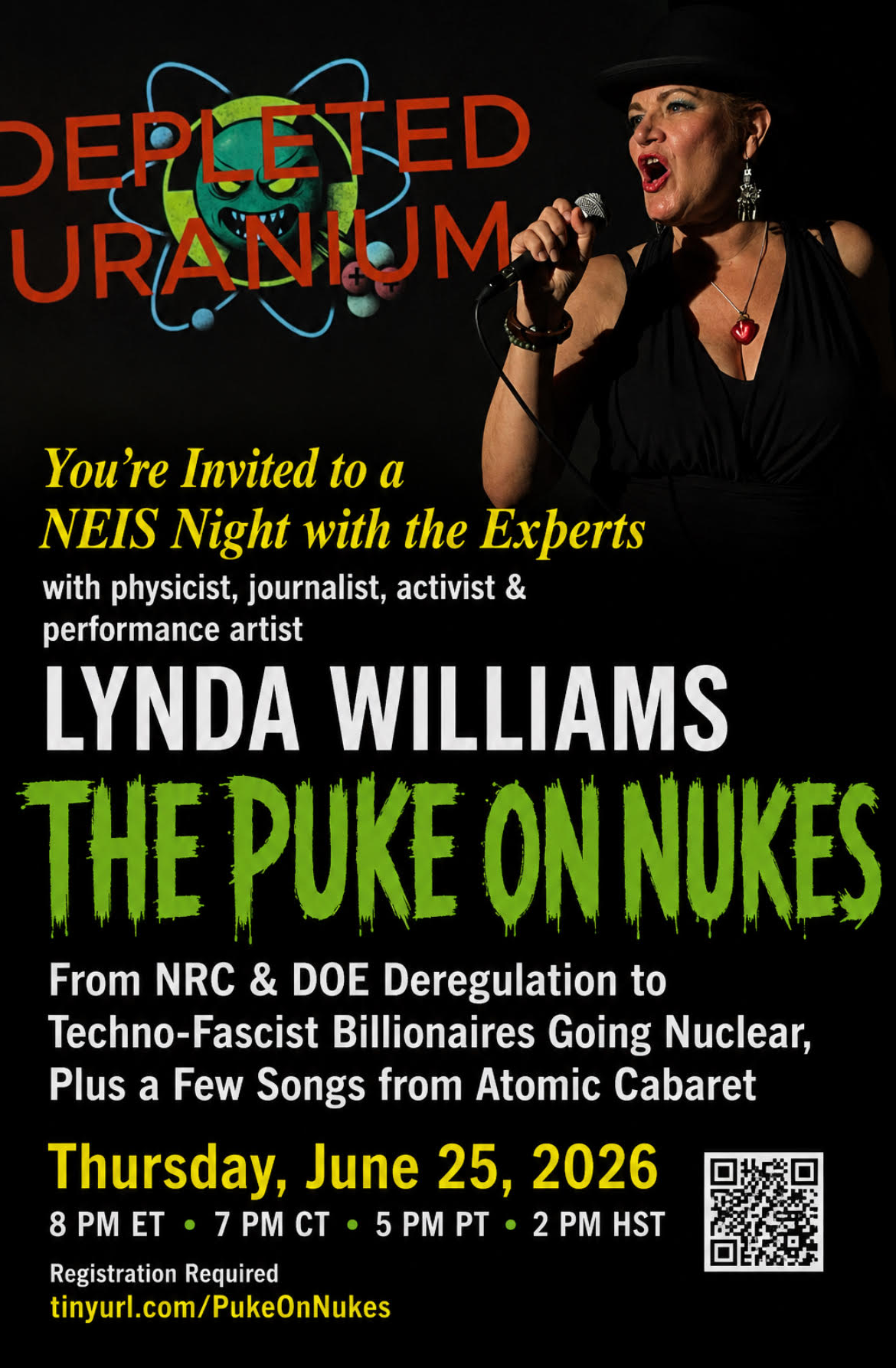
25 June- THE PUKE ON NUKES
Thursday, June 25, 2026
7pm Central Time (8pm ET, 6pm MT, 5pm PT) UTC – 5
From NRC & DOE Deregulation to Techno-Fascist Billionaires Going Nuclear, Plus a Few Songs from Atomic Cabaret REGISTER
26 June – Radiation Trainwreck at the NRC / Join the Protect Better Campaign – https://us02web.zoom.us/meeting/register/4ZlZ5_qLSHGiLSCg8FF6Bg#/registration

1st July – Webinar Waste of Space: The Environmental Harm of Military and Civil Space Activity st July, 7 pm

Report Launch Online: We are seeing an increasing exploitation of space for military and commercial purposes. This must change.

Protect Sazan Island from the Trump family! https://secure.avaaz.org/campaign/en/protect_sazan_island_from_the_trump_family_loc/?bqFCVab&v=174511&cl=22707147157&_checksum=5e9dde668860e8231c33699735e16a1fbf22ab2cb01da50c999fe8732b9775ef&utm_source=email&utm_medium=blast_email&utm_campaign=174511


Cuba Is Not a Failed State – It Is a Besieged State
PETITION: “Global Appeal to Endorse Palestinian Right of Return of Refugees”
To see nuclear-related stories in greater depth and intensity – go to https://nuclearinformation.wordpress.com
-
Archives
- June 2026 (241)
- May 2026 (306)
- April 2026 (356)
- March 2026 (251)
- February 2026 (268)
- January 2026 (308)
- December 2025 (358)
- November 2025 (359)
- October 2025 (376)
- September 2025 (257)
- August 2025 (319)
- July 2025 (230)
-
Categories
- 1
- 1 NUCLEAR ISSUES
- business and costs
- climate change
- culture and arts
- ENERGY
- environment
- health
- history
- indigenous issues
- Legal
- marketing of nuclear
- media
- opposition to nuclear
- PERSONAL STORIES
- politics
- politics international
- Religion and ethics
- safety
- secrets,lies and civil liberties
- spinbuster
- technology
- Uranium
- wastes
- weapons and war
- Women
- 2 WORLD
- ACTION
- AFRICA
- Atrocities
- AUSTRALIA
- Christina's notes
- Christina's themes
- culture and arts
- Events
- Fuk 2022
- Fuk 2023
- Fukushima 2017
- Fukushima 2018
- fukushima 2019
- Fukushima 2020
- Fukushima 2021
- general
- global warming
- Humour (God we need it)
- Nuclear
- RARE EARTHS
- Reference
- resources – print
- Resources -audiovicual
- Weekly Newsletter
- World
- World Nuclear
- YouTube
-
RSS
Entries RSS
Comments RSS
 nuclear-news