American Medical Association (AMA) warns on seafood radiation danger
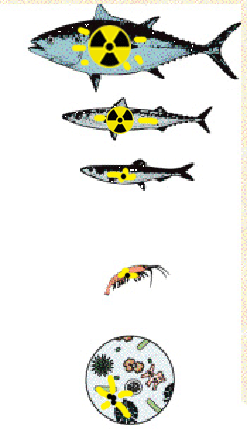 The AMA Responds to Radiation in Seafood, FFAN Urges FDA to Act Now July 24, 2013 by Kim Roberson
Food Safety Group Applauds Recent American Medical Association (AMA)Recommendation to Test U.S. Seafood for Radiation
FFAN urges responsible, transparent testing guidelines and national database for seafood radiation. Wants results to be made public.
Fukushima Fallout Awareness Network (FFAN) today applauded the recent American Medical Association (AMA) resolution that calls on the U.S. government to test all U.S.seafood for radiation and fully report the results to the public. The AMA joins FFAN in demanding the public’s ‘Right to Know’ regarding radiation levels in food. The California Medical Association (CMA) initiated the resolution. Continue reading
Fukushima radiation contaminating the marine food chain
Japan Times: ‘Fears marine life is being poisoned’ by nuclear material flowing from Fukushima — Experts warn of ‘festering radioactive sore’ contaminating food chain — Tepco flip-flop ‘shocking’ http://enenews.com/japan-times-fears-marine-life-is-being-poisoned-by-nuclear-material-flowing-from-fukushima-experts-warn-of-festering-radioactive-sore-contaminating-food-chain-tepco-flip-flop-shocking
Title: Tepco now admits radioactive water entering the sea at Fukushima No.1
Source: AFP-JIJI
Date: July 22, 2013
Fisheries exec shocked by utility’s flip-flop on groundwater’s flow
Fukushima nuclear plant operator Tepco on Monday admitted for the first time that radioactive groundwater is flowing into the sea, fueling fears that marine life is being poisoned. […]
Tetsu Nozaki, chairman of Fukushima Prefectural Federation of Fisheries Co-operative Associations, voiced deep concern.
“It was quite shocking,” he told NHK. “(Tepco’s) explanation is totally different from the one in the past.”
Environmental experts warn that the festering radioactive sore could contaminate the food chain by tainting marine life and ultimately, the humans who eat it. […]
See also: NYT: Fukushima plant leaking for past 2 years? Japan Times: Groundwater is reaching sea — Reuters: Growing alarm, problems mounting — Official: If you have solutions, we’d like to know — WSJ: No ‘immediate’ health threat
All British children have plutonium in their teeth, from Sellafield nuclear plant

 Plutonium from Sellafield in all children’s teeth Antony Barnett, public affairs editor The Guardian 30 November 2003 Government admits plant is the source of contamination but says risk is ‘minute’ Radioactive pollution from the Sellafield nuclear plant in Cumbria has led to children’s teeth across Britain being contaminated with plutonium.
The Government has admitted for the first time that Sellafield ‘is a source of plutonium contamination’ across the country. Public Health Minister Melanie Johnson has revealed that a study funded by the Department of Health discovered that the closer a child lived to Sellafield, the higher the levels of plutonium found in their teeth. Continue reading
Environmental dangers from Australian uranium mine
URANIUM MINING: THE SCARY THINGS I’VE LEARNT.. Social Journalism BY SAFFI KEREZSY 02 JUL 2013 Several news reports quoted that 150,000 litres of contaminated water was being leaked from the mine daily. This figure was from a CSIRO report. So after reading these news stories, I began searching for the original report to discuss in my assignment. I read through pages and pages of CSIRO publications and found nothing. It turns out the report was never released to the public. It was commissioned by ERA.
I then found the Supervising Scientist Annual Reports. That is, the government-appointed scientist which was implemented when Ranger was first approved in order to protect the Kakadu environment. From what I can gather, the main ‘problem’ with the reporting process is that the Supervising Scientist reports often report that despite incidents, it is concluded that ‘no environmental damage has been recorded off the immediate mine site’, or words to that effect.
I also found a quote from the International Union for Conservation of Nature which said that ‘there had been more than 110 pollution incidents and numerous breaches of environmental requirements at the mine’. Obviously there was a lot of debate from various stakeholders, particularly the traditional owners within Kakadu and Greens Senator Scott Ludlam.
After 30 years of open-cut mining at Ranger mine, ERA announced the commencement of underground exploration drilling in December 2012. Unsurprisingly, environmental concerns have again been raised since the announcement of this development…… I do worry about the lack of regulation regarding the environment. If the large-scale contamination mentioned has occurred at Ranger mine within a precious world heritage area, even with an appointed scientific division to monitor the mine activities, then obviously something is not quite right with the system. If we allow such damage to be done to Kakadu, then I don’t see there being much hope for the environment surrounding the other uranium mines located in less significant locations. And for me, that’s a little bit scary.http://socialjournalism.com.au/uranium-mining-the-scary-things-ive-learnt/
UK’s Ministry of Defence under pressure to clean up radiation sites
More pressure on MoD after new report on Dalgety Bay radiation risk The Courier UK By LEEZA CLARK, 23 July 2013 Gordon Brown has called for a swift Ministry of Defence agreement to fund the Dalgety Bay radiation clean-up after the UK Government’s radiation watchdog highlighted imminent health risks.
The Committee on Medical Aspects of Radiation in the Environment has backed the Scottish Environment Protection Agency’s recent report into the long-running saga and has called for remedial action to be taken as soon as possible.
This, he claimed, could set up a head-on clash between the MoD and Sepa, after the ministry refused to back the agency’s report into radiation in the area……. The committee is also so worried about the number of sites where there is radiation contamination that it wants to create a UK-wide list of sites which are known to have been, or thought to be potentially contaminated with radium.
It is the latest twist in the battle to clean up the area contaminated with particles of radioactive radium-226. http://www.thecourier.co.uk/news/local/fife/more-pressure-on-mod-after-new-report-on-dalgety-bay-radiation-risk-1.114331
300,000 tons of radioactive water at Fukushima, and still growing
 As of May 7, the Japan Times reported that TEPCO had installed 290 huge storage talks at Fukushima to hold more than 78 million gallons (290,000 tons) of radioactive water, with another 25 million gallons still uncollected. Fukushima is generating an estimated 100,000-plus gallons (400 tons) of radioactive water every day
TEPCO estimates that groundwater is entering the complex at a rate of at least 54,000 gallons per day.
Fukushima 2013: “Remaining Radioactive Mass”, “Dangerous Leaking Radioactive Water”, All Four Reactors are “Getting Worse” By William Boardman Global Research, July 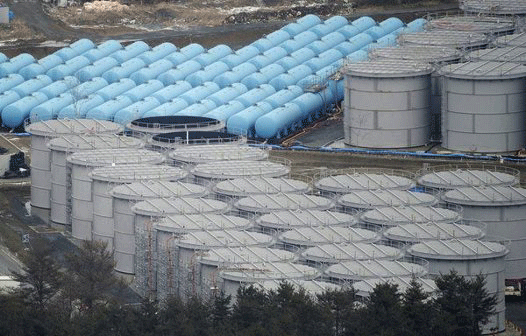 11, 2013 The first thing to know about the danger from the radioactive mass remaining on site in the three reactors that melted down at Fukushima is that nobody knows how much radioactive material there is, nobody knows how much uranium and plutonium it contains, and nobody knows how to make it safe — so no one knows how great the continuing danger is.
In order to prevent nuclear material from being diverted to use in weapons, the International Atomic Energy Agency of the U.N. requires each country to report regularly on the volume of nuclear materials in its nuclear power plants. At Fukushima, this is currently impossible with the cores of the three reactors that melted down.
Diversion of this material to weapons use is not a problem at the moment, since the level of radioactivity is high enough to kill anyone who comes close to it, which is why it hasn’t been moved. On the other hand, it is necessary to move it in order to measure it, and even if it was movable now, the technology to measure it does not yet exist. Continue reading
Radiation the most probable cause of Fukushima’s deformed butterflies
 Japan Biologist: Radioactivite contamination from Fukushima disaster is most reasonable explanation for butterfly deaths and abnormalities — “I think maybe this is a very touchy issue, politically” http://enenews.com/japan-biologist-radioactivity-from-fukushima-is-most-reasonable-explanation-for-butterfly-deaths-and-abnormalities-i-think-maybe-this-is-a-very-touchy-issue-politically
Source: Nature
Author: Ewen Callaway
Date: 16 July 2013 […] Last week […] biologists studying Fukushima and Chernobyl came together at the annual meeting of the Society for Molecular Biology and Evolution in Chicago […]What Fukushima data do exist are sporadic — and contested. […]
[…] Insects collected in May [2011] showed few problems, but their lab-reared offspring had many abnormalities, such as misshapen wings and aberrant eyespots, and many died as pupae (A. Hiyama et al. Sci. Rep. 2, 570; 2012). Among the September-collected butterflies, more than half of the progeny showed such defects.
[…] “You can come up with alternative explanations, but I think the hypothesis that radiation caused death and abnormalities is the most reasonable,” [Joji Otaki, an ecologist at the University of the Ryukyus in Nishihara, Japan] says.
Tim Mousseau, an evolutionary geneticist at the University of South Carolina in Columbia […] is heading to Fukushima this week to begin his third season of field work […] His team saw die-offs in some insects and declining numbers of some bird populations […]
For funding, Otaki says he has had to turn mostly to private foundations. “I think maybe this is a very touchy issue, politically,” he says.[…] The Department of Energy has largely stopped funding its research programme in low-dose exposure, and the National Science Foundation and the National Institutes of Health have awarded few grants […]
See also: Japan Scientists: Truly unusual deformities in Fukushima — Forests may be evolving into different ecosystems — “There’s been a sudden, large change”
FUKISHIMA: RADIOACTIVITY in SEAWATER
Issue 1: The number of radio-nuclides entering the marine environment of the east coast of Japan.
Issue 2: The nature of the radio-nuclides derived from reactor and cooling pond outputs
It’s my conclusion that the official monitoring regime being carried out by TEPCO and other Japanese agencies is inadequate to the task of identifying the potential radiobiological threats to the public.
 An OPEN BRIEFING, Tim Deere-Jones: Marine Radioactivity Consultant, timdj@talktalk.netJuly 2013
I’m a UK based Marine Radioactivity Consultant, Researcher and Campaigner whose been researching the subject since the 1980’s and working (on a freelance, independent basis) as a consultant to NGO’s, Green Groups, Citizens Campaign Groups and UK Local Authorities since the 1980’s.
My field work experience and desk review research have been focussed on the behaviour and fate of man made radioactivity in UK and European marine, coastal and estuarine environments and the pathways by which doses of marine radioactivity may be delivered to maritime, coastal zone and island populations.
In the context of the ongoing contamination of the marine environment following the multiple meltdowns and loss of coolant from the Fukushima site I note the ongoing near-site monitoring of the marine environment (sea water) and of some marine environmental media (principally fish, with some marine algae).
However I am deeply concerned to note that a number of highly relevant issues and phenomena relating to the behaviour and fate of the Fukushima sea discharged radioactivity and its potential for delivering doses to human populations remain un-recorded, under researched and/or completely ignored.
Thus it is evident that the true impacts of the radioactive contamination of the Japanese east coast are not being documented or acted upon.
The short, informal briefing, set out in the following pages, identifies and comments on some of those issues and introduces the outcome of a number of UK observations and studies (principally carried out in one of the planets most radioactive sea areas: the Irish Sea and it’s adjacent waters) in order to provide some supporting background information in support of my concerns relating to the Fukushima case.
N.B. Input of the search term “Tim Deere-Jones: Marine Radioactivity” to most of the popular search engines will upload links to a number of fully referenced, scientific and technical reports and studies, on the behaviour, fate and doses potential of marine discharged radioactive wastes in UK and European waters, that I have authored for a number of clients. Continue reading
Fukushima’s malformed vegetables- is radiation the cause?
 Fukushima Vegetables Have Bizarre Tumor-Like Growths And Deformities: Is Nuclear Meltdown To Blame For Freaky Produce? [PHOTOS] International Science Times, By Philip Ross on July 15, 2013 Photos of what look like malformed vegetables from Fukushima, Japan, have surfaced on Imgur.

Thestrange produce have deformities, bumps and lumps all over them, and look like mutant cabbage patch kids beamed to Earth after having been harvested on an alien planet…… This isn’t the first time the Fukushima nuclear power plant disaster has sparked fears that radiation was causing deformities in nature. In August 2012, researchers in Japan discovered evidence of mutant butterflies.
IScience Times reported that researchers collected 144 specimens of the pale grass blue butterfly, a common species in Japan, two months after the disaster. They found that 12 percent of the butterflies showed signs of mutation and abnormalities, including antennae disfigurement, small wings and a change in color patterns……To see more photos of the Fukushima vegetables, click here. http://www.isciencetimes.com/articles/5641/20130715/fukushima-vegetables-fukushima-disaster-nuclear-meltdown.htm
Cesium 137 leaking from Swiss nuclear plant, into lake
 ‘Radioactivity found in Swiss lake’ near nuclear plant : http://www.foxnews.com/world/2013/07/14/radioactivity-found-in-swiss-lake-near-nuclear-plant/#ixzz2Z9ZJtrGX July 14, 2013GENEVA (AFP) – Scientists have discovered a radioactive substance in sediment under a Swiss lake used for drinking water and situated near a nuclear plant, the Le Matin Dimanche weekly reported Sunday.
While scientists cited in the report stressed there was no danger to human health, the discovery raises concerns about safety practices and a lack of transparency at the Muehleberg nuclear plant in northwestern Switzerland.
The plant is believed to have caused a spike in cesium 137 found in the sediment of Lake Biel and dating back to 2000 through the discharge of contaminated waste water into the Aar river that feeds into the lake, about 20 kilometres (12 miles) downstream, the weekly reported.
Geologists from Geneva University happened upon the spike while working on an unrelated research project in 2010, and chemists in the northern canton of Basel recently verified the findings, it said.
The Muehleberg plant is permitted to discharge water with very low levels of radioactivity subject to strict controls several times a year, according to Le Matin Dimanche.
Politicians and environmentalists however expressed outrage Sunday that the plant and nuclear inspectors had provided no information about the higher levels of cesium 137 released more than a decade ago into a lake that provides 68 percent of the drinking water to the nearby town of Biel.
“No one ever told me that there were abnormally high concentrations in the lake,” Hans Stoekli, who served as Biel mayor from 1990 to 2010, told the paper, insisting that in light of the use of the lake for drinking water “the plant should have alerted us even in the case of minimal risk.”
Environmental group Greenpeace voiced dismay at the news, urging the public prosecutor in the canton of Bern, where Biel and the Muehleberg plant are located, to investigate.
The group, which has long called for the plant’s closure, also questioned in a statement how the Swiss Federal Nuclear Safety Inspectorate could have either missed the higher radioactive levels or decided not to inform decision makers or the public about them.
The Muehleberg plant, which came online in 1972, is 17 kilometres (11 miles) west of the Swiss capital Bern.
In the wake of the 2011 Fukushima disaster in Japan, the Swiss parliament approved a phase-out for the country’s five atomic power plants by 2034.
Japan’s strange and menacing radioactive black substance
I would say they’re much more an ingestion hazard. And that usually tends to target children and agricultural workers. […] A child on average consumes between 100 and 200 milligrams of soil a day because of hand-to-mouth activity. So that’s something to really think about.
Japan’s Black Dust, with Marco Kaltofen http://fairewinds.org/podcast/japans-black-dust-with-marco-kaltofen 12 July 13, This week Fairewinds Energy Education interviewed Marco Kaltofen, a leading scientist who studies radiation as well as specific radioactive isotopes. Marco and Arnie discuss a recent sample that contained highly concentrated radioactive material from Japan’s Fukushima Daiichi nuclear power plant accident. As the sound quality of this recording varies, we have transcribed the podcast so you can read along. Read Marco’s Report: Radiological Analysis of Namie Street Dust http://fairewinds.org/podcast/japans-black-dust-with-marco-kaltofen
Japan’s Radioactive Black Dust – Audio interview with transcript
Japan kids ingesting pieces of Fukushima fuel rods? Expert: Mystery black substance “very likely contains concentrated unburned nuclear fuel” (VIDEO) http://enenews.com/japan-kids-swallowing-pieces-of-fukushima-fuel-rods-expert-mystery-black-substance-very-likely-contains-concentrated-unburned-nuclear-fuel-video
Title: Japan’s Black Dust, with Marco Kaltofen
Source: Fairewinds Energy Education
Date: July 10, 2013
Marco Kaltofen, President at Boston Chemical Data Corp. & Doctoral student researcher at Worcester Polytechnic Institute: […] We kept hearing reports about something unusual, a black dust […] we finally got a very small sample of that […]
What’s different about this material is unlike a lot of the soil and dust samples we’ve gotten, there’s a real uniformity to this stuff. It’s a single substance. Continue reading
American Medical Association wants action on radiation in seafoods

 American Medical Assn. Urges Testing Seafood For Radiation http://www.simplyinfo.org/?p=10663 July 11th, 2013 The American Medical Association has passed a resolution calling for the US to continue to monitor and publicly report radiation contamination in seafood. The original resolution included the language that cited Fukushima as a main reason for the concern and focused on the Pacific ocean. The final resolution broadened it to include all seafood.
The resolution was approved before the recent announcement that Fukushima Daiichi has been continually leaking contamination into the Pacific for the last 2+ years.
The resolution is a good step for public health. The current policy of the FDA does no ongoing seafood testing for radiation. That done soon after the Fukushima disaster was vague, using frozen fish of unknown catch date and fish with an unknown catch location within Japan. The FDA and USDA so far have not publicly released any seafood testing for products hauled places other than Japan. The current US contamination level before the government will intervene is 1200 bq/kg far higher than other countries including Japan.
Global maritime environment threatened by Russia’s floating nuclear plants
 Tow cables snap, Arctic conditions can be unpredictable, ships sink. As the ocean is the common heritage of humanity, perhaps the international community might evince a tad more interest in this project.
Chernobyl At Sea? Russia Building Floating Nuclear Power Plants http://www.zerohedge.com/node/476304 submitted by Tyler Durden 07/11/2013 by John Daly via OilPrice.com,So much for the lessons of Fukushima. Never mind oil spills, the Russian Federation is preparing an energy initiative that, if it has problems, will inject nuclear material into the maritime environment.
Speaking to reporters at the 6th International Naval Show in St. Petersburg, Baltiskii Zavod shipyard general director Aleksandr Voznesenskii said that the Russian Federation’s first floating nuclear power plant “should be operational by 2016.” Continue reading
Fukushima radiation seeps into the ocean
The threat of radioactive substances spreading into the Pacific Ocean has prompted concerns from Japan’s neighbors
Toxic water at Fukushima likely contaminating sea – Japan’s nuclear watchdog RT.com July 10, 2013 Japan’s nuclear watchdog says that highly contaminated radioactive water is likely seeping into the ground from the crippled Fukushima Daiichi nuclear reactors and contaminating the Pacific Ocean.
Shunichi Tanaka, chairman of the Nuclear Regulation Authority (NRA), said the contamination is “strongly suspected” and has been occurring since March 2011, when a massive earthquake and tsunami triggered three meltdowns in the Fukushima plant.
“I think contamination of the sea is continuing to a greater or lesser extent,” Tanaka said. “It was contaminated at the time of the accident, but I think it has been continuing for the last two years. Coming up with countermeasures against all possible scenarios is a top priority.”
The plant operator, Tokyo Electric Power Co. (Tepco), claims that the source of contamination is the pit from which radioactive water is leaking into the sea. However, Tanaka believes that this may be not the only source of contamination. Continue reading
Radioactive cesium levels 90% higher in Fukushima groundwater
 Fukushima Groundwater Shows Record Radiation Levels HUFFINGTON POST, Reuters 07/09/2013 “……SITUATION WORSENS Tokyo Electric Power Co, the operator of the Fukushima station, hit by the March 2011 earthquake and tsunami, said that an observation well between the damaged reactor No. 2 and the sea showed levels of radioactive caesium-134 were 90 times higher on Monday than they had been the previous Friday.
Tokyo Electric, also known as Tepco, said it detected caesium-134 at 9,000 becquerels per litre, 150 times above Japan’s safety standard. A becquerel is a measure of the release of radioactive energy. The reading for caesium-137, with a half life of 30 years, was some 85 times higher than it had been three days earlier.
The latest findings, 25 metres from the sea, come a month after Tepco detected radioactive caesium in groundwater flowing into its wrecked plant far from the sea on elevated ground. The level of caesium found in June was much lower than the amount announced on Tuesday.
The spike, combined with recent discoveries of high levels of radioactive elements like tritium and strontium, suggest that contaminated water is spreading toward the sea side of the plant from the reactors sitting on higher ground…..
1 This Month
26 September – International Day for the Total Elimination of Nuclear Weapons





PLEASE OPPOSE HR 8255 AND S.3639 – bills would accelerate satellite deployment, with no environmental review or safeguards – https://ncstd5li.quorum.us/campaign/169331/
To see nuclear-related stories in greater depth and intensity – go to https://nuclearinformation.wordpress.com
-
Archives
- September 2026 (281)
- August 2026 (330)
- July 2026 (355)
- June 2026 (287)
- May 2026 (306)
- April 2026 (356)
- March 2026 (251)
- February 2026 (267)
- January 2026 (308)
- December 2025 (358)
- November 2025 (359)
- October 2025 (375)
-
Categories
- 1
- 1 NUCLEAR ISSUES
- business and costs
- climate change
- culture and arts
- ENERGY
- environment
- health
- history
- indigenous issues
- Legal
- marketing of nuclear
- media
- opposition to nuclear
- PERSONAL STORIES
- politics
- politics international
- Religion and ethics
- safety
- secrets,lies and civil liberties
- spinbuster
- technology
- Uranium
- wastes
- weapons and war
- Women
- 2 WORLD
- ACTION
- AFRICA
- Atrocities
- AUSTRALIA
- Christina's notes
- Christina's themes
- culture and arts
- Events
- Fuk 2022
- Fuk 2023
- Fukushima 2017
- Fukushima 2018
- fukushima 2019
- Fukushima 2020
- Fukushima 2021
- general
- global warming
- Humour (God we need it)
- Nuclear
- RARE EARTHS
- Reference
- resources – print
- Resources -audiovicual
- Weekly Newsletter
- World
- World Nuclear
- YouTube
-
RSS
Entries RSS
Comments RSS

