Scientists investigate effects of Fukushima radiation on Pacific Ocean animals
 US university testing animals in Pacific for Fukushima radiation — Photos show bodies riddled with tumors, eyes bleeding, covered in lesions — Some are missing testicles, eyeballs — Skin disintegrating, peeling off, turning yellow — Mammals affected by diseases never seen in species (WARNING: Graphic Pics)http://enenews.com/university-testing-animals-pacific-fukushima-radiation-gruesome-photos-show-bodies-riddled-massive-tumors-cysts-bleeding-eyes-covered-lesions-missing-testicles-eyeballs-skin-disintegrating-pe?utm_source=feedburner&utm_medium=email&utm_campaign=Feed%3A+ENENews+%28Energy+News%29
Colorado St. Univ., Apr 13, 2015 (emphasis added): CSU partners with Fukushima University to study radiation effects… Many CSU faculty and researchers are contributing to radiation research in Japan… including Thomas Johnson… professor of health physics, who is testing trace radiation samples in seal populations in thenorthern Pacific Ocean, where radiation from the Fukushima disaster was released.
Alaska Marine Science Symposium presentation, Raphaela Stimmelmayr (Dept. of Wildlife Management, North Slope Borough) & Gay Sheffield (Univ.of Alaska – Fairbanks Marine Advisory Program), 2014:
Incidental Gross Necropsy Findings in Subsistence-Harvested Ice Seals and Walruses
• Reproductive system: adnexal cysts [uterus], uterine and penile melanosis [darkening of skin], cliteromegaly [enlarged clitoris], cryptorchism [testicle(s) absent from scrotum], retained placenta;
• Endocrine system: thyroid cysts, adrenal nodules;
• Musculoskeletal system: synovial cyst [fluid-filled sacs in spine due to degeneration];
• Integumentary system: panniculitis [inflammation of fatty tissue], epidermal molt, skin sloughing;
• Respiratory system: lung tumor, parasitic granulomas [inflammation that forms when immune system is unable to eliminate a substance];
• Digestive system: microdontia [teeth smaller than normal], chronic interstitial pancreatitis [inflammation of pancreas], hepatic cyst [liver], cholestatic jaundice [yellowing of skin caused by thickening of bile or problems in liver], geophagia [eating dirt], and primary diffuse peritoneal tumor [membrane lining abdomen];
• A variety of the observed disease conditions are reported for the first time in ice seals and/or walruses.
• The majority of observed conditions in our material is classified as benign and are mostly inconsequential to the health of the harvested animals.
Large amount of radioactive cesium in Fukushima water purification center
 Nearly 6,000 Bq/kg of Cs-134/137 detected from melted slag of water purification center in Fukushima Fukushima Diary, On 4/30/2015, Fukushima prefectural government announced 5,645 Bq/Kg of Cesium-134/137 was detected from melted slag of a water purification center.
The sampling date was 3/12/2015. Because it contains 1,383 Bq/Kg of Cs-134, it is certainly from Fukushima nuclear plant.
The second highest reading of this March was 3,786 Bq/Kg. This water purification center is located in Koriyama city.
Cs-134/137 have been measured from melted slag of this purification center everyday since the beginning of this year…….http://fukushima-diary.com/2015/05/nearly-6000-bqkg-of-cs-134137-detected-from-melted-slag-of-water-purification-center-in-fukushima/
High levels of radiation in children’s playground – Tokyo park closed
 Tokyo park closed over dangerous radiation Sky News, , 24 April 2015 Extremely high levels of radiation have been discovered in a playground in Tokyo, officials said Friday, fanning fears for the health of children in the area.
Soil underneath a slide at the park in the northwest of the Japanese capital showed radiation readings of up to 480 microsieverts per hour, the local administrative office said.
Anyone directly exposed to this level would absorb in two hours the maximum dose of radiation Japan recommends in a year. “Many children play in the park daily, so the ward office should explain the situation,” Kyodo News quoted a 62-year-old local woman as saying.
The radiation level is over 2000 times that at which the national government requires soil cleaning in areas around the Fukushima Daiichi nuclear plant, where reactors melted down after the March 2011 tsunami…….
The park has been sealed. http://www.skynews.com.au/news/world/asiapacific/2015/04/24/tokyo-park-closed-over-dangerous-radiation.html#sthash.1X8diUzn.dpuf–
Uranium effluent discharged into Malawi river by Australian company Paladin
Malawi: Paladin Starts Discharging Uranium Wastes Into Public Rivers, AllAfrica, By Bishop Witmos Karonga April 23: Few months after Paladin Africa Limited differed with civil society organizations (CSOs) and some chiefs in Karonga over the disposition of uranium wastes into public water, the company has started discharging the effluent into Sere River.

Paladin Africa Limited, a member of the Paladin Energy group of companies, suspended its operations at Kayelekera Mine in the district in May, 2014, due to unstable uranium prices at an international market. The project is now on care and maintenance.
Malawi News Agency (Mana) has established Paladin invited Paramount Chief Kyungu and the District Commissioner (DC) for Karonga, Rosemary Moyo, to a meeting in Lilongwe early April this year (2015),to brief them about the company’s recent decision.
Paladin Africa Acting General Manager in Malawi, Greg Walker, confirmed in a telephone interview that the company, indeed, started releasing the uranium wastes into the public rivers………
Sere River flows into North Rukuru River, then into Lake Malawi.
When asked why the company decided to brief Paramount Chief Kyungu and the Karonga DC about their action in Lilongwe instead of explaining it to the general populace of Karonga, Walker said the company conducted enough meetings with relevant authorities in the district……..
Despite the decision by Paladin to start discharging its effluent into the public water, some people in the district feet it would have been safer if the company had constructed another dam where the wastes would be transferred into.
Chairperson for Karonga District Council, Patrick Kishombe, said in an interview the plan to release the waste water from the storage dam into Sere River is raising fears amongst communities who feel the water is not fully treated and could be a health hazard.
“This, I believe, will lead into many hazards, like killing of fish in Lake Malawi and may also cause skin cancer to some people,” said Kishombe.
Uranium contains gamma rays, particles that cause skin cancer to human kind, according to experts.
In developed nations, mining companies construct a stable tank that stores all the wastes, ready for transportation to recommended disposal sites. ……http://allafrica.com/stories/201504231621.html
Tritium is a major radioactive pollutant from Canada’s CANDU nuclear power reactors.

 Tritium Traffic: Deadly Dividends for Nuclear Industry, Peace Magazine By David H MartinIn February, 1934, the British journal, New Scientist, published an article by Tom Wilkie, “Old Age Can Kill the Bomb.” It was an ingenious solution to the arms control nightmare of verification; controlling not only the number of weapons, but the strategic materials that fuel them — mainly plutonium, enriched uranium and tritium. Wilkie focused on tritium, because it turns into non-radioactive helium at a rate of 5.5 per cent per year. A halt of tritium production would rapidly cripple all nuclear arsenals. Thus, attention was rivetted on Ontario Hydro’s plan to produce about 57 kilograms of tritium by 2006. A one megaton thermonuclear warhead (equivalent to one million tons of TN”) may contain as little as one gram of tritium.
Tritium (H3) (a form of hydrogen that emits beta radiation), is a major radioactive pollutant from Canada’s CANDU nuclear power reactors. Unlike American reactor systems, the CANDU uses heavy water as a moderator and coolant. The moderator and the heavy water coolant slows down the neutron release from the uranium fuel in the reactor so that a chain reaction can take place. The active ingredient in heavy water is deuterium, another form of hydrogen. When the deuterium picks up a neutron, some of it is transformed into tritium. The concentration of tritium in the heavy water increases with the age of the reactor.
The CANDU reactor system produces 2400 times as much tritium as the American light water reactor. Continue reading
Damaging effect of prolonged low level radiation, on birds and animals (?us too)
 “There are so few barn swallows left,” Mousseau added. “We know that there were hundreds in a given area before the disaster, and just a couple of years later we’re only able to find a few dozen left.”
“Both the biodiversity and the abundance are showing dramatic impacts in these areas with higher radiation levels, even as the levels are declining.”
For Fukushima Birds, Things are Getting Worse Even as Radiation Abates, Nature World News, By Brian Stallard follow Brian on Twitter @BS_ButNoBS Apr 17, 2015 The destructive earthquake and tsunami that triggered a catastrophe at Japan’s Fukushima-Daiichi nuclear power plant are now four years behind us, but the effects of that disaster are still being felt today. Now a new study has revealed that even as ecosystems slowly recover, Fukushima’s native bird population is actually dwindling more than ever – and researchers think they know why………
“A growing body of empirical results from studies of birds, monkeys, butterflies, and other insects suggests that some species have been significantly impacted by the radioactive releases related to the Fukushima disaster,” Timothy Mousseau, a lead researcher behind one of many ongoing investigations, announced last August.
He explained that a common theme researchers have noticed is that prolonged exposure to low doses of radiation has a very different effect on organisms compared to sudden high-level exposure, as seen at Chernobyl. This came to be called Fukushima’s “insidious effect” and was expected to abate, with lingering radiation levels, by 2016.
Unfortunately, new research detailed in the Journal of Ornithology shows that birds may be facing trouble for even longer. “The declines have been really dramatic,” study author and biologist Tim Mousseau, of the University of South Carolina, said in a recent statement. Continue reading
Florida nuclear utility allowed to draw water from national park’s source
 FPL nuclear plant to draw water from national park’s source, April 17, 2015 | The water in the canal system that cools the reactors at Florida Power & Light Co.’s nuclear plant on the edge of Biscayne Bay is too hot and too salty as temperatures rise and rainfall is sparse.
Starting June 1, as a temporary fix, the company will be allowed to withdraw up to 100 million gallons of fresh water a day from a nearby drainage canal to keep the Turkey Point nuclear plant’s cooling canal system from going above 104 degrees…..http://www.palmbeachpost.com/news/business/fpl-nuclear-plant-to-draw-water-from-national-park/nkw47/
South Miami’s Underline project threatened by nuclear power expansion
FPL’S NUCLEAR EXPANSION PLAN COULD RUIN THE UNDERLINE. Miami New Times BY JESSICA WEISS APRIL 17, 2015 Biking along a tranquil, green path in South Miami sounds pretty enjoyable. Next to a series of massive, ten-story nuclear power transmission lines? Not so much
That’s a real possibility facing the Underline, a project to transform the underutilized land below Miami’s Metrorail from the Miami River to the Dadeland South Station into a ten-mile urban trail and green space. A design is in the works, and construction is set to begin next year.
But part of the area dedicated to the Underline is also the possible home of new transmission lines for two nuclear reactors being proposed for Turkey Point Nuclear Generating Station by Florida Power & Light. The new reactors would require the construction of massive poles to transmit energy to consumers. And they’d be located on South Dixie Highway from Pinecrest to downtown Miami, within the 125 acres of new green space where the Underline is supposed to run.
“There’s a definite tension between these transmission lines and a beautiful experience on a bike path,” says Meg Daly, the founder of Friends of the Underline…….
Since Daly hatched the idea for the vertical park in 2012, the Underline project has advanced rapidly, receiving funding from the cities of Miami, Coral Gables, and South Miami; the John S. and James L. Knight Foundation; and other groups. In March, Friends of the Underline tapped the codesigner of Manhattan’s popular High Line, James Corner Field Operations, to design the Underline master plan. This week, a series of public meetings are being held to collect public feedback about the design of the space.
“There is so much need in our community for spaces for biking and walking,” Daly says. “Bikes, cars, and pedestrians need to coexist. That is part of a future vision of a walkable, bikeable city.”
Lawmakers, scientists, environmentalists, and citizens have expressed a number of other concerns about expanding nuclear power along Biscayne Bay, including the future impact of sea-level rise, the project’s high costs, and the amount of water used by nuclear power. Miami Mayor Tomás Regalado joined other local leaders this week to blast the project.
But the plan has already passed through local and state levels, and FPL is pursuing a federal license……http://www.miaminewtimes.com/news/fpls-nuclear-expansion-plan-could-ruin-the-underline-7573012
Strange and extreme tissue damage in dead dolphins near Fukushima
Japan Scientist: “I’ve never seen this before” — White lungs found in dolphins that died during mass stranding near Fukushima — Interruption of blood supply leading to death of tissue — Disease has been linked to radiation exposurehttp://enenews.com/dead-dolphins-washed-fukushima-entirely-white-lungs-head-scientist-ive-never-before-interruption-blood-supply-leading-tissue-death-disease-linked-radiation-exposure-large-spike-after-chernoby?utm_source=feedburner&utm_medium=email&utm_campaign=Feed%3A+ENENews+%28Energy+News%29
Asahi Shimbun, Apr 11, 2015 (emphasis added):
- Google Translate: Ibaraki Prefecture… for a large amount of dolphin which was launched on the shore… the National Science Museum… investigated… researchers rushed from national museums and university laboratory, about 30 people were the anatomy of the 17 animals in the field. [According to Yuko Tajima] who led the investigation… “the lungs of most of the 17… was pure white ischemic state, visceral signs of overall clean and disease and infections were observed”… Lungs white state, that has never seen before.
- Systran: The National Science Museum… investigated circumstance and cause etc concerning the mass dolphin which is launched to the seashore of Ibaraki prefecture… the researchers ran from the museum and the university laboratory… approximately 30 people dissected 17… [Yuko Tajima] of the National Science Museum which directed investigation research worker [said] “the most lung 17 was state with true white, but as for the internal organs being clean”… The lung true white as for state, says… have not seen.
Fukushima Diary, Apr 12, 2015: According to National Science Museum, most of the inspected 17 dolphins had their lungs in ischaemia state… The chief of the researching team stated “Most of the lungs looked entirely white”… internal organs were generally clean without any symptoms of disease or infection, but most of the lungs were in ischaemia state. She said “I have never seen such a state”.
Wikipedia: Ischemia is a vascular disease involving an interruption in the arterial blood supply to a tissue, organ, or extremity that, if untreated, can lead to tissue death.
Many reports have been published on the links between ischemia and radiation exposure:
- “It has been shown that the ionizing radiation in small doses under certain conditions can be considered as one of starting mechanisms of… IHD [ischemic heart disease].” –Source
- “Radiation risks on non-cancer effects has been revealed in the [Chernobyl] liquidators… Recently, the statistically significant dose risk of ischemic heart disease… was published.” –Source
- “Incidence of and mortality from ischemic heart disease (IHD) have been studied in a cohort of 12210 workers [at] Mayak nuclear facility… there was statistically significant increasing trend in IHD incidence with total external gamma dose.” –Source
- “Numerous studies have been published concerning non cancer diseases in liquidators… Risk of ischemic heart disease… seems increased.” –Source
- “In 1990 the International Chernobyl Project has been carried out under the aegis of the IAEA… It is known that the international experts who had taken part in the International Chernobyl Project were aware of the report by the Minster of the Ministry of Health Care of Belarus delivered at an informal meeting arranged by the IAEA… The Belorussian Minister reported about… the worsening of the general health state of the affected population… “Among adults in 1988 there was a two- to fourfold increase, in comparison with preceding years, in the number of persons suffering from… ischemic heart diseases” –Source
- “In a study on a Russian cohort of 61,000 Chernobyl emergency workers… a statistically significant risk of ischemic heart disease was observed.” –Source
Radiation has wreaked havoc with Fukushima’s birds
No birdsong in Fukishima: ‘Dramatic’ decline of birds linked to radiation from 2011 disaster
- Researchers find that bird species are continuing to drop in Fukushima
- The barn swallow, for example, dropped from hundreds to dozens
- This is despite radiation levels in the region starting to fall
- And comparing it to Chernobyl could reveal what the future holds
By JONATHAN O’CALLAGHAN FOR MAILONLINE, 16 April 2015
Bird numbers have dramatically declined in Fukushima, research has revealed Scientists analysed 57 species in the region and found that the majority of populations had diminished as a result of the nuclear accident. They found that one breed in particular had plummeted from several hundred before the 2011 disaster to just a few dozen today.
The research, published in the Journal of Ornithology, was carried out by scientists at the University of South Carolina including biologist Dr Tim Mousseau.
They showed that the situation has steadily worsened since the disaster on 11 March 2011………
And while background radiation has declined in the region in recent years, the negative effects of the accident on birds are actually increasing.
‘The relationship between radiation and numbers started off negative the first summer, but the strength of the relationship has actually increased each year,’ Dr Mousseau said.‘So now we see this really striking drop-off in numbers of birds as well as numbers of species of birds.
‘So both the biodiversity and the abundance are showing dramatic impacts in these areas with higher radiation levels, even as the levels are declining.’…….http://www.dailymail.co.uk/sciencetech/article-3041695/No-birdsong-Fukishima-Dramatic-decline-birds-linked-radiation-2011-disaster.html
Scientists detect Fukushima radiation in Canadian waters
Fukushima radiation in Canadian waters, DW 10 Apr 15 Scientists have detected radiation from Japan’s 2011 nuclear disaster off the Canadian coast. Experts disagree as to whether the amount detected constitutes a dangerous level or not. Trace amounts of the radioactive isotopes cesium-134 and cesium-137 have been found in samples that were collected close to Vancouver Island in British Columbia. According to the Integrated Fukushima Ocean Radionuclide Monitoring (InFORM) Network, it was the first time that traces of cesium-134 had been detected off North American coasts.
 As cesium-134 has a two-year half-life, any cesium-134 detected in the ocean today can only have been added recently – making Fukushima the only possible source.
Ken Buesseler, a marine chemist at Woods Hole Oceanographic Institution (WHOI), said in a statement: “Radioactivity can be dangerous, and we should be carefully monitoring the oceans after what is certainly the largest accidental release of radioactive contaminants to the oceans in history.”
He led an initiative that measured 60 sites along the U.S. and Canadian West Coast and Hawaii over the past 15 months for traces of radioactive isotopes from Fukushima. Using computer models, the scientist had already predicted that the traces would reach the coast,……..http://www.dw.de/fukushima-radiation-in-canadian-waters/a-18367257
Arrival of Fukushima’s radioactive isotopes on North American shores
 “BREAKING NEWS – Scientists detect Fukushima radiation on North American shores” — Coastal communities ‘concerned’ — Over 7 Bq/m3 of cesium from dock in Pacific Northwest — Professor: It indicates arrival of other radioactive substances — “Represents potential radiological health risk” (VIDEO) http://enenews.com/top-headline-fukushima-radiation-reached-north-american-shores-7-bqm3-cesium-detected-dock-pacific-northwest-professor-indicator-other-types-radioactive-substances-arrived-represents-potentia
Statesman Journal, Apr 6, 2015: BREAKING NEWS Scientists detect Fukushima radiation on North American shores — Seaborne radiation from Japan’s Fukushima nuclear disaster has reached North America… cesium-134 and cesium-137 in a sample of seawater taken in February from a dock on Vancouver Island… It’s the first time radioactivity from the March 2011 triple meltdown has been identified on West Coast shores [see: April 2011 — California seawater squeezed from kelp sample had 400,000 Bq/m3 of Iodine-131]… sample was taken Feb. 19… It contained 1.5 becquerels per cubic meter (Bq/m3) of cesium-134, the Fukushima fingerprint, and 5 Bq/m3 of cesium-137 [actually 1.4 and 5.8, respectively]… Fukushimaradiation concerns coastal communities… models have predicted that in general, the plume would hit the shore in the north first, then head south toward California… currents can be unpredictable… Woods Hole has received support from the National Science Foundation to analyze about 250 seawater samples that will be collected next month…
CTVNews, Apr 6, 2015: First low-level trace of Fukushima radioactivity detected off B.C. — But the levels are so low they are likely of little concern… Still, researchers say this is the first detectable of radioactivity from Fukushima found in a water sample taken from the U.S. and Canadian West Coast… Ken Buesseler, a marine chemist at WHOI who has been measuring radioactivity in Pacific seawater since 2011, says it’s been important to carefully monitor the oceans, given that the Fukushima disaster saw the largest accidental release of radioactive contaminants to the oceans in history.
Buesseler’s statement: “Even if the levels were twice as high, you could still swim in the ocean for six hours every day for a year and receive a dose more than a thousand times less than a single dental X-ray. While that’s not zero, that’s a very low risk.. We expect more of the sites will show detectable levels… Predicting the spread of radiation becomes more complex the closer it gets.”
CBC Radio, March 2015: Four years after the nuclear disaster in Fukushima, scientists like UVic’s Jay Cullen are still monitoring the Pacific waters near us for radiation. Listen to what he’s found and what he hasn’t… Cullen: “If we see cesium-134 in a water sample or a fish for example we know that that’s been affected by the Fukushima disaster… Not only is cesium a marker for other isotopes that were released… it also represents a potential radiological health risk because if its internalized… it can damage our cells and cause illness. So the risk of illness appearing in individuals relates to the activity, how much of that isotope ends up in their body. Given the nature of this disaster, with most of the isotopes going into the North Pacific Ocean, the most likely way that a human being would be exposed to this radioactivity at this point would be through the consumption of seafood.” >> Full interview here
Watch Woods Hole’s latest projection of Fukushima Cs-137 levels through 2021 here
Japan mulls releasing radiation into air, instead of water – evaporation instead of Pacific ocean drainage
Japan considers evaporation, storage of tritium-laced Fukushima water TOKYO | BY AARON 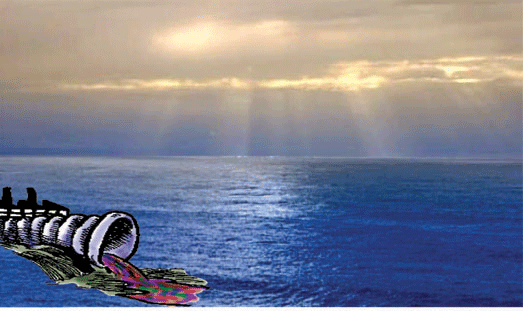 SHELDRICK (Reuters) 8 Apr 15 – Japan is considering evaporating or storing underground tritium-laced water from the wrecked Fukushima nuclear plant as an alternative to releasing it into the ocean, Tokyo Electric Power Co’s chief decommissioning officer told Reuters on Wednesday.
The removal of hundreds of thousands of tonnes of water containing tritium, a relatively harmless radioactive isotope left behind in treated water is one of many issues facing Tokyo Electric as it tries to cleanup the wrecked plant.Tokyo Electric wants to release the tritium laced water to the ocean, a common practice at normally operating nuclear plants around the world, but is struggling to get approval from local fisherman, who are concerned about the impact on consumer confidence and have little faith in the company.
With the release to the ocean stalled, the government task force overseeing the cleanup is looking at letting the water evaporate or storing it underground, chief decommissioning officer Naohiro Masuda, told Reuters at the close of a seminar on decommissioning.
Masuda said he didn’t know when the discussions would be completed and a decision made.
Time and space is running out for Tepco, which has been forced to build hundreds of tanks to hold contaminated and treated water.
The evaporation method was used after the Three Mile Island disaster but the amounts were much smaller, Dale Klein, an outside adviser to Tepco told Reuters last week.
“They have huge volumes of water so they cannot evaporate it like they did at Three Mile Island,” Klein said. “If they did it would likely be evaporated, go out over the ocean, condense and fall back as rainwater. There’s no safety enhancement.”…….http://www.reuters.com/article/2015/04/08/us-japan-fukushima-water-idUSKBN0MZ0WC20150408
Chernobyl’s Radioactive Impact on micro-organisms
11. Chernobyl’s Radioactive Impact on Microbial Biota submitted by damchodronma 6 April 15
Alexey V. Yablokov
 Of the few microorganisms that have been studied, all underwent rapid changes in the areas heavily contaminated by Chernobyl. Organisms such as tuberculosis bacilli; hepatitis, herpes, and tobacco mosaic viruses; cytomegalovirus; and soil micromycetes and bacteria were activated in various ways.
The ultimate long-term consequences for the Chernobyl microbiologic biota may be worse than what we know today. Compared to humans and other mammals, the profound changes that take place among these small live organisms with rapid reproductive turnover do not bode well for the health and survival of other species.
One gram of soil contains some 2,500,000,000 microorganisms (bacteria,microfungi, and protozoa). Up to 3 kg of the mass of an adult human body is made up of bacteria, viruses, and microfungi. In spite of the fact that these represent such important and fundamentally live ecosystems there are only scarce data on the various microbiological consequences of the Chernobyl catastrophe.
Several incidences of increased morbidity owing to certain infectious diseases may be due to increased virulence of microbial populations as a result of Chernobyl irradiation.
read on
pgs 281-83
“Chernobyl: Consequences of the Catastrophe for People and the Environment”
by Alexey Yablokov, Vasily Nesterenko and Alexey Nesterenko
NY Academy of Sciences, Volume 1181, 2009.
5,000 Slavic language studies reviews, over 1,400 cited.
http://www.strahlentelex.de/Yablokov_Chernobyl_book.pdf
Strange and worrying effects of Chernobyl radiation – failure of dead trees to properly decompose
Forests Around Chernobyl Aren’t Decaying Properly It wasn’t just people, animals and trees that were affected by radiation exposure at Chernobyl, but also the decomposers: insects, microbes, and fungi By Rachel Nuwer smithsonian.com March 14, 2014 Nearly 30 years have passed since the Chernobyl plant exploded and caused an unprecedented nuclear disaster. The effects of that catastrophe, however, are still felt today. Although no people live in the extensive exclusion zones around the epicenter, animals and plants still show signs of radiation poisoning.
Birds around Chernobyl have significantly smaller brains that those living in non-radiation poisoned areas; trees there grow slower; and fewer spiders and insects—including bees, butterflies and grasshoppers—live there. Additionally, game animals such as wild boar caught outside of the exclusion zone—including some bagged as far away as Germany—continue to show abnormal and dangerous levels of radiation.

However, there are even more fundamental issues going on in the environment. According to a new study published in Oecologia, decomposers—organisms such as microbes, fungi and some types of insects that drive the process of decay—have also suffered from the contamination. These creatures are responsible for an essential component of any ecosystem: recycling organic matter back into the soil. Issues with such a basic-level process, the authors of the study think, could have compounding effects for the entire ecosystem. Continue reading
1 This Month



26 September – International Day for the Total Elimination of Nuclear Weapons


PLEASE OPPOSE HR 8255 AND S.3639 – bills would accelerate satellite deployment, with no environmental review or safeguards – https://ncstd5li.quorum.us/campaign/169331/
To see nuclear-related stories in greater depth and intensity – go to https://nuclearinformation.wordpress.com
-
Archives
- September 2026 (269)
- August 2026 (330)
- July 2026 (355)
- June 2026 (287)
- May 2026 (306)
- April 2026 (356)
- March 2026 (251)
- February 2026 (267)
- January 2026 (308)
- December 2025 (358)
- November 2025 (359)
- October 2025 (375)
-
Categories
- 1
- 1 NUCLEAR ISSUES
- business and costs
- climate change
- culture and arts
- ENERGY
- environment
- health
- history
- indigenous issues
- Legal
- marketing of nuclear
- media
- opposition to nuclear
- PERSONAL STORIES
- politics
- politics international
- Religion and ethics
- safety
- secrets,lies and civil liberties
- spinbuster
- technology
- Uranium
- wastes
- weapons and war
- Women
- 2 WORLD
- ACTION
- AFRICA
- Atrocities
- AUSTRALIA
- Christina's notes
- Christina's themes
- culture and arts
- Events
- Fuk 2022
- Fuk 2023
- Fukushima 2017
- Fukushima 2018
- fukushima 2019
- Fukushima 2020
- Fukushima 2021
- general
- global warming
- Humour (God we need it)
- Nuclear
- RARE EARTHS
- Reference
- resources – print
- Resources -audiovicual
- Weekly Newsletter
- World
- World Nuclear
- YouTube
-
RSS
Entries RSS
Comments RSS

