Apparently uncontrolled continual leakage of Fukushima radiation into the ocean
 Fukushima’s Catastrophic Aftermath: The Dangers of Worldwide Nuclear Radiation, Global Research, By Stephen Lendman 28 April 13,“……..In early April, around 120 tons of contaminated water leaked from Fukushima’s No. 1′s underground storage tank. It contained an estimated 710 billion becquerels of radioactivity.
Water around the affected tank is highly radioactive. It’s about 800 meters from the Pacific. Government and Tokyo Electric (Tepco) claimed it won’t likely reach it. Numerous previous reports suggest otherwise.
Tepco general manager Masayuki Ono said “(w)e cannot deny the fact that our faith in the underwater tanks is being lost.”
In November 2012, Nature.com headlined “Ocean still suffering from Fukushima fallout,” saying:
“Radioactivity is persisting in the ocean waters close to Japan’s ruined nuclear power plant at Fukushima Daiichi.”
New data show high contamination levels. “The Fukushima disaster caused by far the largest discharge of radioactivity into the ocean ever seen.”
Radiation levels aren’t dropping. “The implications are serious for the fishing industry.”………http://www.globalresearch.ca/fukushimas-catastrophic-aftermath-the-dangers-of-worldwide-nuclear-radiation/5333138
For the Pacific Ocean? – 400 tons daily of Fukushima radioactive water
 Bloomberg: Radioactive water from Fukushima reactors to be dumped in Pacific? “It’s obvious they can’t keep storing it forever”http://enenews.com/bloomberg-tepco-to-dump-radioactive-water-from-fukushima-reactors-into-pacific-its-obvious-they-cant-keep-storing-it-forever
Title:Title: Tepco Faces Decision to Dump Radioactive Water in Pacific Ocean
Source: Bloomberg
Author: Tsuyoshi Inajima
Date: Apr 11, 2013
[Tepco]’s discovery of leaks in water storage pits at the wrecked Fukushima atomic station raises the risk the utility will be forced to dump radioactive water in the Pacific Ocean.
Leaks were found in three of seven pits in the past week, reducing the options for moving contaminated water from basements of reactor buildings. […]
Not Ruled Out
Officials at the utility known as Tepco, including President Naomi Hirose, have said the company will not “easily” release radiated water into the ocean, indicating it’s not ruling out the possibility if it runs out of storage.
“It’s obvious Tepco cannot keep storing water forever as it increases by 400 tons a day,” said Hideyuki Ban, co-director of the antinuclear group Citizens’ Nuclear Information Center. That’s why the company won’t rule out discharge into the sea, Ban said in a telephone interview. […]
See also: Tepco: It’s ‘really impossible’ for us to keep storing liquid from Fukushima reactors — We need to think about discharging it into ocean (VIDEO)
AUDIO Groundwater flows from Fukushima reactors to the ocean
Tecpo shows groundwater flowing from Fukushima reactors into ocean April 2nd, 2013 http://enenews.com/tecpo-shows-groundwater-flowing-from-fukushima-reactors-into-ocean-photo
Title: Progress Status of the Groundwater Bypass Construction
Source: Tokyo Electric Power Company
Date: March 27, 2013
[…] Gradual Reduction of Groundwater
The groundwater level will be gradually reduced with the groundwater bypass put in operation. Careful water level control will be implemented to prevent the accumulated water in the buildings from leaking to the outside while monitoring the groundwater level reduction and its water quality. The sub-drains installed around the buildings will be fully utilized for the monitoring. An observation hole will be newly installed between the Reactor Building and the pump well. […]
See also: Graphic shows ‘direct discharge’ going from Fukushima Daiichi reactors into Pacific — Underground flow of contaminated water also indicated (VIDEO)
Fukushima radiation into ocean: is it killing sea lions?
Unfortunately, the nuclear accident is nowhere near contained. Japanese experts say that Fukushima is currently releasing up to 93 billion becquerels of radioactive cesium into the ocean each day, the reactors have lost containment, and groundwater is flooding into the stricken reactors(delaying clean-up).
And things may get worse for California, instead of better .
Is Fukushima Radiation Causing the Epidemic of Dead and Starving Sea Lions In California? http://www.zerohedge.com/contributed/2013-03-31/fukushima-radiation-causing-epidemic-dead-and-starving-sea-lions-california by George Washington on 03/31/2013 Associated Press reports:
At island rookeries off the Southern California coast, 45 percent of the pups born in June have died, said Sharon Melin, a wildlife biologist for the National Marine Fisheries Service based in Seattle. Normally, less than one-third of the pups would die.It’s gotten so bad in the past two weeks that the National Oceanic and Atmospheric Administration declared an “unusual mortality event.” That will allow more scientists to join the search for the cause, Melin said. Continue reading
Ocean fish to be studied for Fukushima radiation
 L.A. Times: NOAA to start testing wildlife for Fukushima contamination http://enenews.com/l-a-times-noaa-to-start-testing-wildlife-for-fukushima-radiation
February 26th, 2013
Title: Radioactive tuna from Fukushima? Scientists eat it up
Source: Los Angeles Times
Author: Eryn Brown
Date: February 25, 2013
Title: Radioactive tuna from Fukushima? Scientists eat it up
[…] In coming months, the three researchers and colleagues at the National Oceanic and Atmospheric Administration and other institutions plan to analyze hundreds more bluefin tuna, as well as albacore tuna; mahi mahi; ocean sunfish; opa; mako, blue and salmon sharks; loggerhead turtles; and sooty shearwaters, a type of migratory seabird.
They’ll examine samples collected in New Zealand, Hawaii and Alaska as well as in California. They might look through archived specimens for salmon and whales to test. Other research groups may track the contamination to study marine animals too, [Dan Madigan of Stanford University] said.
If scientists find Fukushima radiation in swordfish, for example, it will be the first evidence that the species migrates across the entire Pacific. […]
“Amazing”
They concluded that their tracking method worked, and that Fukushima provided “an unprecedented opportunity” for scientists to use radioactive tracers to follow animal movement. “This was just nature being amazing,” [Nicholas Fisher of Stony Brook University] said.
He imagines pulling together a map of the Pacific crisscrossed by the paths of radiation-toting animals — “an amazing image of transport … all from a little dot” in Japan, Madigan said.
See also: HuffPost: “Radioactive Fish Found In California” — Is it a good thing?
Ocean near Fukushima still getting radiation leakage, blue fin tuna with radiation

“…The answer was yes. (See below for the PDF of the study.) That means, ultimately, that there is still a high level of radiation in the waters near the Fukushima plant most likely because, as marine chemist, Ken Buessler, asserts, the plant is still leaking radiation into the ocean nearly two years later….”
Bluefin Tuna From The Fukushima Nuclear Meltdown Still Have Traces Of Radiation, Forbes, Monte Burke, 20 Feb 13,
Last May I wrote a piece about Bluefin tuna caught off the coast of southern California that carried radiation from the Fukushima,Japan, nuclear plant that was damaged in the March 2011. The fish were caught in August 2011 as they migrated east 6,000 miles from their spawning grounds in Japan in search of prey….
Last week one of the authors of the study from last year, Daniel J. Madigan from Stanford University’s Hopkins Marine Station—along with five other scientists— published a new follow-up study. The main question that this new study wanted to answer: Would the migratory Bluefin tuna show up again a year later off the coast of California carrying radiation from Fukushima? Bluefin Tuna Study http://www.forbes.com/sites/monteburke/2013/02/20/bluefin-tuna-from-the-fukushima-nuclear-meltdown-still-have-traces-of-radiation/
Plutonium in ocean near Fukushima
 Study: Fukushima plutonium in Pacific Ocean from ‘liquid direct releases’? http://enenews.com/study-plutonium-could-be-pacific-ocean-liquid-direct-releases-fukushima
Title: Should we measure plutonium concentrations in marine sediments near Fukushima?
Source: Journal of Radioanalytical and Nuclear Chemistry
Author: R. Periáñez, Kyung-Suk Suh, Byung-Il Min
Date: February 2013
Excerpt
Much less information is available in the case of plutonium isotopes. Trace amounts of Pu isotopes originating from the accident have been identified in soil samples. While it is known that atmospheric releases of Pu were several orders of magnitude lower than that from Chernobyl accident, no information on Pu isotopes in the liquid direct releases to the sea is available. Pu isotopes have been measured in marine sediments outside a 30 km radius circle around Fukushima. Results do not show any contamination due to the accident. Instead Pu isotopes here detected are attributed to global fallout.
However, the situation inside the 30 km zone remains unknown. It could be possible that Pu isotopes entered this coastal area from the direct release of contaminated water in early April 2011. The objective for this work consists of showing, by means of numerical modelling, that, if Pu contamination originating from the accident would be present in sediments of the close area to Fukushima, contamination would not reach areas far from the plant. Contamination would be restricted to the close area because of the low mobility of Pu. Thus, it would not be detected if samples are not collected there. Consequently, further studies on the determination of Pu isotopes in seawater and sediments within the 30 km zone would be required.
Note the objective: “The objective for this work consists of showing […] that, […] Pu contamination […] would not reach areas far from the plant.”
Contamination of seafoods, following nuclear and oil spill disasters
Frankenfish Surface in Japan and the Gulf of Mexico Years following some of the world’s worst environmental disasters, marine life remains contaminated, Energy Digital 25 Jan 13, Two years after the catastrophic Fukushima nuclear plant meltdown in Japan, fish with 2,500 times the legal limit for radiation in seafood are turning up near the plant.
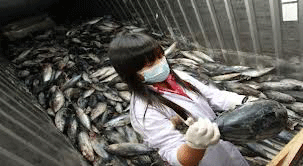 Since the incident, fishing around Fukushima has been banned, along with beef, milk, mushrooms and vegetables produced in surrounding areas. The sale of certain kinds of seafood and produce have resumed, while scientists continue to monitor the spread and impact of radiation from the disaster.
Marine chemist Ken Buesseler, leading the research from the US-based Woods Hole Institution, has warned that Fukushima fish “may be inedible for a decade,” according to the Guardian. They found “elevated levels” of radiation in the marine environment, and cited that 40 percent of the fish caught near the nuclear plant were contaminated with radioactive caesium above government safety limits.
Related Story: Radioactive Japanese Tuna Found off California Coast
Meanwhile, in the US, the debate continues over the safety of seafood from the Gulf of Mexico nearly three years after BP’s offshore rig exploded, dumping some 4.9 million barrels of oil into the ocean. Not to mention the two million gallons of dispersants used to clean up the spill that were up to 52-times more toxic than the oil itself. Read More in Energy Digital’s December/January Issue http://www.energydigital.com/oil_gas/frankenfish-surface-in-japan-and-the-gulf-of-mexico
Radioactive water to be dumped into Pacific Ocean by TEPCO
TEPCO plans to dump water stored at Fukushima Daiichi into  Pacific http://enformable.com/2013/01/tepco-plans-to-dump-water-stored-at-fukushima-daiichi-into-pacific/ TEPCO has announced that it plans to dump contaminated water into the Pacific Ocean after processing it to reduce radioactive materials to legally permissible levels. By “processing”, TEPCO means once-high radioactive content has been reduced considerably, but not completely.
The plant has already released enormous amounts of highly contaminated water directly into the ocean from a plethora of leaks from the reactor buildings. Outside experts are seriously concerned about the contaminated water that is released, and have warned there may well be lasting impact on the environment.
The utility says the operation is necessary due to concerns that they will run out of capacity to store highly contaminated water which continues to accumulate. After the water has passed through the crippled units, it is processed through the SARRY system to remove cesium, but other systems designed to remove other radioactive materials have been overwhelmed by the complexity and concentration of contamination found at Fukushima Daiichi.
TEPCO estimates show that the volume of contaminated water required to be stored on site will likely triple over the next three years.
Questions have been raised if TEPCO would be able to gain the necessary approval from local municipalities and other parties who have raised concerns about plans to dump the water into the ocean.
In December 2011, the utility was forced to scrap a previous plan to dump water into the sea following fierce protests from fishing groups.
Toxic nuclear waste dumps in the Arctic Kara Sea
Russia explores old nuclear waste dumps in Arctic By Laurence Peter BBC News, 24 Jan 13, The toxic legacy of the Cold War lives on in Russia’s Arctic, where the Soviet military dumped many tonnes of radioactive hardware at sea.
For more than a decade, Western governments have been helping Russia to remove nuclear fuel from decommissioned submarines docked in the Kola Peninsula – the region closest to Scandinavia.
But further east lies an intact nuclear submarine at the bottom of the Kara Sea, and its highly enriched uranium fuel is a potential time bomb.
This year the Russian authorities want to see if the K-27 sub can be safely raised, so that the uranium – sealed inside the reactors – can be removed.
They also plan to survey numerous other nuclear dumps in the Kara Sea, where Russia’s energy giant Rosneft and its US partner Exxon Mobil are now exploring for oil and gas.Seismic tests have been done and drilling of exploratory wells is likely to begin next year, so Russia does not want any radiation hazard to overshadow that. Rosneft estimates the offshore fossil fuel reserves to be about 21.5bn tonnes.
‘Strategic imperative’
The Kara Sea region is remote, sparsely populated and bitterly cold, frozen over for much of the year. The hostile climate would make cleaning up a big oil spill hugely challenging, environmentalists say.

Those fears were heightened recently by the Kulluk accident – a Shell oil rig that ran aground in Alaska…….. “In the US the Arctic gets great public scrutiny and it’s highly political, but in Russia there is less public pressure.” Continue reading
Fukushima radiation in seafood chain – record level in rockfish
Record cesium levels measured in Fukushima rockfish, signaling radiation woes in food chain far from over in Japan, Part of: Nuclear meltdown in Japan Less than two months shy of the second anniversary of the devastating triple nuclear meltdown at Japan’s coastal Fukushima Daiichi plant, a fish containing more than 2,500 times Japan’s legal limit for radiation has been caught by the plant’s operator in waters near the wrecked facility. Bellona, Charles Digges, 21/01-201
The ‘murasoi’ fish, similar to a rockfish – indicating an amount of cesium measuring 254,000 Becquerel per kilogram, or 2,540 times Japans limit for radiation in seafood – was caught at a port inside the plant by its owner, Tokyo Electric Power Co. (TEPCO) Friday, according to AFP.
The utility also released a photo of the fish, caught near an unloading point north of the No. 1 through No. 4 reactors. No fishermen operate in the nuclear plant’s port.
Friday’s catch shatters the previous record for wildlife contamination as a result of radioactive contamination, which was was 25,800 Becquerel of cesium per kilogram found in two greenlings caught about 20 kilometers north of the plant in August 2012, the Asashi Shimbun newspaper reported.
Other countries are also increasingly distressed by the amount of irradiated marine life turning up near their coastlines along the Pacific Rim: Over the summer, Russia’s state English language television station RT reported concern over fish caught off its coast near Japan.
In May, a tuna contaminated by low levels of radiation was found near the California coast, Reuters reported……. http://www.bellona.org/articles/articles_2012/fukushima_rockfish
USA – look out for radioactive young bluefin tuna
Bluefin Tuna Off California Coast Tainted With Fukushima Radiation (But Scientists Say It’s Okay To  Eat) laist.com, 5 Jan 13, Scientists ran tests on bluefin tuna off the coast of California and found traces of radiation from last year’s Fukushima nuclear meltdown.
Scientists examined the muscle tissue of 15 Bluefin tuna who were swimming off the shores of San Diego in August 2011 and were stunned to find traces of caesium-134, according to BBC News. That radioactive element can be directly tied to the Fukushima Daiichi nuclear disaster a few months earlier.
Scientists say these fish were likely spawned in Japanese waters and picked up the pollution before heading to feeding grounds in the eastern Pacific ocean. “It’s a lesson to us in how interconnected eco-regions can be, even when they may be separated by thousands of miles,” Nicholas Fisher, a professor of marine sciences at Stony Brook University told BBC News. The study was published in Proceedings of the National Academy of Sciences….. tuna caught in coming months will be monitored for radiation levels, since younger fish might have spent more time in Japanese waters and received higher levels of contamination. http://laist.com/2013/01/05/bluefin_tuna_off_california_tainted.php
Fukushima radiation’s slow journey to USA and China’s coasts
 More Fukushima nuclear pollution to hit U.S. starting in 2015 — Study: Impact strength of Cesium-137 on West Coast to be as high as 4 PERCENT http://enenews.com/report-nuclear-pollution-from-fukushima-to-hit-u-s-in-2015-impact-strength-of-cesium-137-on-west-coast-is-as-high-as-4-percent-due-to-strong-currents
December 20th, 2012 Follow-up to: Ocean Absorbed 79 Percent Of Fukushima Fallout
Source: Science China Earth Sciences
Authors: GuiJun Han, Wei Li, HongLi Fu, XueFeng Zhang, XiDong Wang, XinRong Wu, LianXin Zhang
Date: November 2012 Continue reading
100% of Fukushima white rockfish had cesium levels, November-December
 Cesium measured from 100% of Fukushima white rockfish in November and December http://fukushima-diary.com/2012/12/cesium-measured-from-100-of-fukushima-white-rockfish-in-november-and-december/
by Mochizuki December 17th, 2012
On 9/9/2012, Fukushima Diary reported white rockfish (Shiromebaru) tends to accumulate cesium. http://fukushima-diary.com/2012/09/85-of-fukushima-rockfish-exceeds-safety-limit-in-cesium/
According to Fukushima prefectural government, high level of cesium was measured from 100% (19 of 19) of the samples taken in November and December from offshore Fukushima. 84% (16/19) of them exceeded the government’s safety limit of 100Bq/Kg.
The highest reading was 1,731 Bq/Kg (11/30/2012), the second highest reading was 1,225 Bq/Kg (12/8/2012).
Ocean food chain irreparably damaged by Fukushima radiation
 The ocean, food chain, and Japan’s fishing industry have all been irreparably damaged by the Fukushima crisis, and that damage is still ongoing. The Japanese government and TEPCO’s excuses are only wasting time that should be put towards finding a solution.
TEPCO, Japanese government denying Fukushima radiation reaching ocean
fish http://japandailypress.com/tepco-japanese-government-denying-fukushima-radiation-reaching-ocean-fish-2018691 By Adam Westlake / November 20, 2012 In what must the most dumbfounding state of denial seen in modern times, both the Japanese government and utility Tokyo Electric Power Co. (TEPCO) are disputing the recent study that showed radiation from the Fukushima nuclear plant is leaking into the ocean.
18 months after the March 2011 nuclear disaster, the U.S.’s Woods Hole Oceanographic Institution, a respected research group, reported that 40% of the fish caught off the
coast of Fukushima were still testing positive for radioactive contamination above the government’s safety own limits. Continue reading
1 This Month

of the week – Shut Down Drone Warfare!


Tell the Ukrainian Government to Drop Prosecution of Peace Activist Yurii Sheliazhenko

Petition to revoke the licensing of the Near Surface Nuclear Disposal Facility (NSDF) at Chalk River. https://www.ourcommons.ca/petitions/en/Petition/Details?Petition=e-7247
To see nuclear-related stories in greater depth and intensity – go to https://nuclearinformation.wordpress.com
-
Archives
- March 2026 (237)
- February 2026 (268)
- January 2026 (308)
- December 2025 (358)
- November 2025 (359)
- October 2025 (376)
- September 2025 (257)
- August 2025 (319)
- July 2025 (230)
- June 2025 (348)
- May 2025 (261)
- April 2025 (305)
-
Categories
- 1
- 1 NUCLEAR ISSUES
- business and costs
- climate change
- culture and arts
- ENERGY
- environment
- health
- history
- indigenous issues
- Legal
- marketing of nuclear
- media
- opposition to nuclear
- PERSONAL STORIES
- politics
- politics international
- Religion and ethics
- safety
- secrets,lies and civil liberties
- spinbuster
- technology
- Uranium
- wastes
- weapons and war
- Women
- 2 WORLD
- ACTION
- AFRICA
- Atrocities
- AUSTRALIA
- Christina's notes
- Christina's themes
- culture and arts
- Events
- Fuk 2022
- Fuk 2023
- Fukushima 2017
- Fukushima 2018
- fukushima 2019
- Fukushima 2020
- Fukushima 2021
- general
- global warming
- Humour (God we need it)
- Nuclear
- RARE EARTHS
- Reference
- resources – print
- Resources -audiovicual
- Weekly Newsletter
- World
- World Nuclear
- YouTube
-
RSS
Entries RSS
Comments RSS
 nuclear-news