Fukushima radiation contaminating the marine food chain
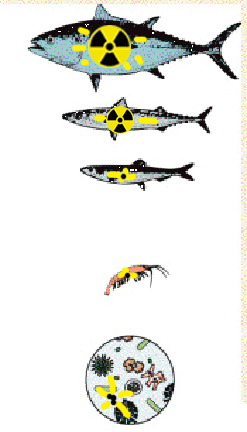 Japan Times: ‘Fears marine life is being poisoned’ by nuclear material flowing from Fukushima — Experts warn of ‘festering radioactive sore’ contaminating food chain — Tepco flip-flop ‘shocking’ http://enenews.com/japan-times-fears-marine-life-is-being-poisoned-by-nuclear-material-flowing-from-fukushima-experts-warn-of-festering-radioactive-sore-contaminating-food-chain-tepco-flip-flop-shocking
Title: Tepco now admits radioactive water entering the sea at Fukushima No.1
Source: AFP-JIJI
Date: July 22, 2013
Fisheries exec shocked by utility’s flip-flop on groundwater’s flow
Fukushima nuclear plant operator Tepco on Monday admitted for the first time that radioactive groundwater is flowing into the sea, fueling fears that marine life is being poisoned. […]
Tetsu Nozaki, chairman of Fukushima Prefectural Federation of Fisheries Co-operative Associations, voiced deep concern.
“It was quite shocking,” he told NHK. “(Tepco’s) explanation is totally different from the one in the past.”
Environmental experts warn that the festering radioactive sore could contaminate the food chain by tainting marine life and ultimately, the humans who eat it. […]
See also: NYT: Fukushima plant leaking for past 2 years? Japan Times: Groundwater is reaching sea — Reuters: Growing alarm, problems mounting — Official: If you have solutions, we’d like to know — WSJ: No ‘immediate’ health threat
FUKISHIMA: RADIOACTIVITY in SEAWATER

Issue 1: The number of radio-nuclides entering the marine environment of the east coast of Japan.
Issue 2: The nature of the radio-nuclides derived from reactor and cooling pond outputs
It’s my conclusion that the official monitoring regime being carried out by TEPCO and other Japanese agencies is inadequate to the task of identifying the potential radiobiological threats to the public.
 An OPEN BRIEFING, Tim Deere-Jones: Marine Radioactivity Consultant, timdj@talktalk.netJuly 2013
I’m a UK based Marine Radioactivity Consultant, Researcher and Campaigner whose been researching the subject since the 1980’s and working (on a freelance, independent basis) as a consultant to NGO’s, Green Groups, Citizens Campaign Groups and UK Local Authorities since the 1980’s.
My field work experience and desk review research have been focussed on the behaviour and fate of man made radioactivity in UK and European marine, coastal and estuarine environments and the pathways by which doses of marine radioactivity may be delivered to maritime, coastal zone and island populations.
In the context of the ongoing contamination of the marine environment following the multiple meltdowns and loss of coolant from the Fukushima site I note the ongoing near-site monitoring of the marine environment (sea water) and of some marine environmental media (principally fish, with some marine algae).
However I am deeply concerned to note that a number of highly relevant issues and phenomena relating to the behaviour and fate of the Fukushima sea discharged radioactivity and its potential for delivering doses to human populations remain un-recorded, under researched and/or completely ignored.
Thus it is evident that the true impacts of the radioactive contamination of the Japanese east coast are not being documented or acted upon.
The short, informal briefing, set out in the following pages, identifies and comments on some of those issues and introduces the outcome of a number of UK observations and studies (principally carried out in one of the planets most radioactive sea areas: the Irish Sea and it’s adjacent waters) in order to provide some supporting background information in support of my concerns relating to the Fukushima case.
N.B. Input of the search term “Tim Deere-Jones: Marine Radioactivity” to most of the popular search engines will upload links to a number of fully referenced, scientific and technical reports and studies, on the behaviour, fate and doses potential of marine discharged radioactive wastes in UK and European waters, that I have authored for a number of clients. Continue reading
American Medical Association wants action on radiation in seafoods

 American Medical Assn. Urges Testing Seafood For Radiation http://www.simplyinfo.org/?p=10663 July 11th, 2013 The American Medical Association has passed a resolution calling for the US to continue to monitor and publicly report radiation contamination in seafood. The original resolution included the language that cited Fukushima as a main reason for the concern and focused on the Pacific ocean. The final resolution broadened it to include all seafood.
The resolution was approved before the recent announcement that Fukushima Daiichi has been continually leaking contamination into the Pacific for the last 2+ years.
The resolution is a good step for public health. The current policy of the FDA does no ongoing seafood testing for radiation. That done soon after the Fukushima disaster was vague, using frozen fish of unknown catch date and fish with an unknown catch location within Japan. The FDA and USDA so far have not publicly released any seafood testing for products hauled places other than Japan. The current US contamination level before the government will intervene is 1200 bq/kg far higher than other countries including Japan.
Global maritime environment threatened by Russia’s floating nuclear plants
 Tow cables snap, Arctic conditions can be unpredictable, ships sink. As the ocean is the common heritage of humanity, perhaps the international community might evince a tad more interest in this project.
Chernobyl At Sea? Russia Building Floating Nuclear Power Plants http://www.zerohedge.com/node/476304 submitted by Tyler Durden 07/11/2013 by John Daly via OilPrice.com,So much for the lessons of Fukushima. Never mind oil spills, the Russian Federation is preparing an energy initiative that, if it has problems, will inject nuclear material into the maritime environment.
Speaking to reporters at the 6th International Naval Show in St. Petersburg, Baltiskii Zavod shipyard general director Aleksandr Voznesenskii said that the Russian Federation’s first floating nuclear power plant “should be operational by 2016.” Continue reading
Fukushima radiation seeps into the ocean
The threat of radioactive substances spreading into the Pacific Ocean has prompted concerns from Japan’s neighbors
Toxic water at Fukushima likely contaminating sea – Japan’s nuclear watchdog RT.com July 10, 2013 Japan’s nuclear watchdog says that highly contaminated radioactive water is likely seeping into the ground from the crippled Fukushima Daiichi nuclear reactors and contaminating the Pacific Ocean.
Shunichi Tanaka, chairman of the Nuclear Regulation Authority (NRA), said the contamination is “strongly suspected” and has been occurring since March 2011, when a massive earthquake and tsunami triggered three meltdowns in the Fukushima plant.
“I think contamination of the sea is continuing to a greater or lesser extent,” Tanaka said. “It was contaminated at the time of the accident, but I think it has been continuing for the last two years. Coming up with countermeasures against all possible scenarios is a top priority.”
The plant operator, Tokyo Electric Power Co. (Tepco), claims that the source of contamination is the pit from which radioactive water is leaking into the sea. However, Tanaka believes that this may be not the only source of contamination. Continue reading
Big rise in radioactive sea-water: groundwater near Fukushima seeping to ocean?
Radioactive material “soars” in ocean near Fukushima plant — Tepco: Contaminated groundwater leaking into Pacific? http://enenews.com/radioactive-material-soars-in-ocean-near-fukushima-plant-tepco-contaminated-groundwater-leaking-into-pacific
Title: Tritium samples in sea near No. 1 soar
Source: Japan Times
Author: Reiji Yoshida
Date: Jun 25, 2013
The density of radioactive tritium in samples of seawater from near the Fukushima No. 1 nuclear plant doubled over 10 days to hit a record 1,100 becquerels per liter, possibly indicating contaminated groundwater is seeping into the Pacific, Tokyo Electric Power Co. said.
The latest sample was taken June 21 from the sea near a water intake point east of the reactor 1 turbine building. […]
Tepco said late Monday it was still analyzing the water for strontium-90 […]
[…] during a news conference Monday in Tokyo, Masayuki Ono, a Tepco executive and spokesman, this time did not deny the possibility of leakage into the sea, while he said Tepco is still trying to determine the cause of the spike.
See also: TV: Groundwater shows massive spike in radioactive material at Fukushima plant — Strontium-90 up over 10,000% in past few months — Tepco apologizes (VIDEO)
Radioactive seawater travels towards USA from Fukushima
Are North Americans Already Succumbing to Radiation From Japan? http://www.complex.com/city-guide/2013/06/are-north-americans-already-succumbing-to-radiation-from-japan
BY JULIAN KIMBLE | JUN 5, 2013 We don’t mean to alarm anyone, but there’s reportedly been an increase in radiation levels in food and water thanks to the Japanese earthquake and tsunami that struck in 2011. In addition, children being born with thyroid issues has also been tied to radiation while both the U.S. and Canada are allowing more of specific toxic substances in food being imported from Japan.

The image above shows radiation on the move from the Fukushima nuclear plant following the horrible events of 2011. That was captured in March 2012, meaning it’s probably covered even more ground over the past year and change.
According to World Truth TV, milk samples taken from across the U.S. show that radiation levels are 2000 percent above the EPA maximums. Milk is also used to represent the entire food supply. Furthermore, the Food and Drug Administration and Environmental Deception Protection Agency have responded by raising the “acceptable levels” of radioactive materials that are found in foods.
So apparently water, dairy products, produce, seafood, and meat are all at risk. Great, just great. Remember that when you go grocery shopping this weekend. [via Jeromie Williams]
As Fukushima radioactive water grows, situation hopeless for fishermen
Fukushima fishermen forced to test fish for radiation REUTERS, 31 May 13“….The fishermen of Hisanohama, forced out of work by the disaster, have had no choice but to take the only job available – checking contamination levels in fish just offshore from the destroyed nuclear reactor buildings. ”We used to be so proud of our fish. They were famous across Japan and we made a decent living out of them,” said 80-year-old Yaoita, who survived the tsunami by taking on the waves and sailing the six-person True Prosperity out to sea.”Now the only thing for us is sampling.”…..
The fishermen and Tepco are in dispute over the utility’s plans to dump 100 tons of groundwater a day from the devastated plant into the sea. The complicated clean-up plan for Fukushima could take 30 years or more. Tepco’s challenge is what to do with the contaminated water that has been pooling at the plant at a rate of 400 tons a day – enough to fill an Olympic-size swimming pool in a week.
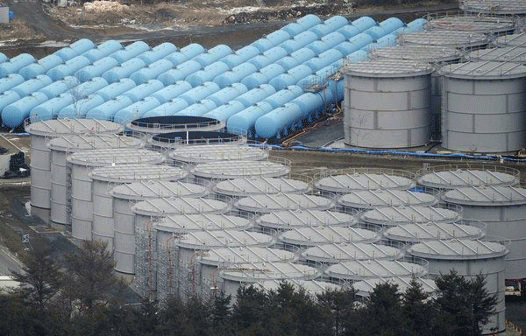
So far it has been racing to build tanks to store the contaminated water on the grounds of the plant, in which all the water is kept at the moment.It has also asked fishermen to support a plan to build a “by-pass” that would dump groundwater into the sea before it becomes contaminated by flowing under the reactor’s wreckage.
“We are staunchly against it,” said Tatsuo Niitsuma, 71, who fishes with Yaoita.
MORE CONTAMINATION, LESS HOPE Representatives from fishing cooperatives met Tepco officials on Thursday to discuss the proposal, with Trade Minister Toshimitsu Motegi to instruct Tepco on what to do, although no final plans were announced. In addition to the “by-pass” Motegi, who also holds the energy portfolio, told Tepco to create “protective walls” in the ground by freezing the soil around the reactors to create an underground barrier to stop groundwater from flowing in and mixing with contaminated water inside the reactor building.
The fishermen, however, worry the “by-pass” plan risks more contamination and delays, possibly ending any hope for the only job they know.
Tepco officials have said it may take as long as four years to fix the problem, but have said they do not need outside help.
The uncertainty and stress have become problems. Many former fishermen live in temporary homes next to people they barely know after losing not only their jobs, but also family members…….. http://www.reuters.com/article/2013/05/31/us-fukushima-fishermen-idUSBRE94U0D620130531
Fukushima’s radioactive contamination spreads in marine life
Japan Radiation Widely Contaminates Pacific Marine Life http://www.earthweek.com/2013/ew130524/ew130524b.html 24 May 13, Traces of radioactive cesium from Japan’s crippled Fukushima No. 1 nuclear power plant have been found in water and plankton collected
from all 10 points monitored across a vast stretch of the western Pacific.
The isotopes cesium-134 and cesium-137 were found in the tiny plantlike creatures from the coast of Japan’s Hokkaido Island to Guam.
The samples were taken early last year, less than a year after the tsunami that overwhelmed the plant, but the findings were just
announced at a meeting of the Japan Geoscience Union.
Cesium-134 has a half-life of two years while it takes 30 years for cesium-137 to decay by half. Scientists say the isotopes were being dispersed across the Pacific in plankton, and were accumulating up the food chain as the tiny creatures were eaten by larger marine life.
Further studies are being conducted to see how much cesium was building up in fish and possibly marine mammals.
Radiation was flushed into the Pacific after three meltdowns occurred at the Fukushima nuclear plant. More than two years after the March 2011 disaster, plant operators are struggling to contain the 400 tons of radioactive water poured over the melted cores of reactors 1, 2 and 3 to prevent the fuel from melting and burning again.
Perpetual water needed to nuclear reactors – will end up in Pacific Ocean
Japan Times: Discharges of Fukushima nuclear material into Pacific “have effectively contaminated the sea” — Melted reactor cores will burn again if water not perpetually poured in — “Tepco proposing some of it be dumped into ocean” http://enenews.com/japan-times-discharges-of-nuclear-material-into-the-pacific-from-fukushima-have-effectively-contaminated-the-sea-melted-reactor-cores-will-burn-again-if-water-not-perpetually-poured-in-t
Title: Fukushima No. 1 can’t keep its head above tainted water
Source: The Japan Times
Author: Reiji Yoshida
Date: May 21, 2013
[…] Tepco must perpetually pour water over the melted cores of reactors 1, 2, and 3 via makeshift systems to prevent the fuel from melting and burning again. […]
Tepco is proposing some of the water be dumped into the sea after processing it to remove most, but not all, radioactive isotopes. […]
Previous discharges into the Pacific have effectively contaminated the sea. Failure to store it means it will probably flood the whole compound and end up in the ocean anyway. […]
Will the processed water pose health or environmental risks?
According to Tepco, the processed water could theoretically be safe […]
Tritium is the exception, however. Tepco says the tritium level in the contaminated water is between 1 million and 5 million becquerels per liter. The legal limit is 60,000. […]
See also: Gundersen: “Liquid releases” of nuclear material into ocean will continue for years and years at Fukushima Daiichi — Already 10 times Chernobyl (VIDEO)
Fishermen testing fish for radiation, in South Fukushima waters
Fishermen net fish in Fukushima waters to measure radiation levels
http://ajw.asahi.com/article/0311disaster/recovery/AJ201305210005 May 21, 2013 By HIROSHI KAWAI/ Staff Writer
A fishing vessel from Fukushima Prefecture caught fish in waters south
of the crippled Fukushima No. 1 nuclear power plant on May 20 to test
them for levels of radiation contamination, as local fishing
cooperatives hope to soon resume fishing in the area.
The No. 12 Akira Maru belonging to the Iwaki fishermen’s cooperative
trawled plenty of flatfish and other species.
Due to ocean currents, the concentration of radioactive materials has
been found to be higher in waters to the south of the plant, than to
the north.
Of the Akira Maru’s catch, nine species of fish were kept as samples
to measure radiation levels in them. The fishermen tested about 10
kilograms of each type and threw the rest back into the sea.
“It feels hollow to have to throw fish back into the sea, considering
that they could fetch high prices,” Captain Akiyoshi Abe said.
Before the nuclear accident triggered by the Great East Japan
Earthquake and tsunami in March 2011, waters off the prefecture were
known as a good fishing area where more than 100 species could be
caught.
Many local fisheries cooperatives have had to suspend operations since
the nuclear accident.
Dumping tons of Fukushima radioactive water into ocean is not illegal?
‘Absurd’: Intentionally dumping Fukushima nuclear material into ocean from land “is not considered dumping” — Allowed under international law? http://enenews.com/absurd-intentionally-dumping-fukushima-nuclear-material-ocean-land-considered-dumping-allowed-international-law
Source: Oceanus
Author: David Pacchioli
Date: May 6, 2013 The Fukushima disaster is without precedent and will have unprecedented impacts on future policies governing the ocean, both Japanese and international.
[…] the Fukushima accident has revealed some key shortcomings in international law, said Kentaro Nishimoto, who teaches law of the sea at Tohoku University. To illustrate, he used an incident that has brought sharp criticism from Japan’s neighbors: the intentional release of radioactive water into the sea.
[…] Nishimoto said, the relevant international laws proved to be nonbinding. In particular, he noted, the London Convention on marine pollution, although it expressly prohibits ocean dumping of radioactive material, limits these restrictions to vessels at sea. Release of materials from land is not considered dumping.
“When I tell this to people outside the field of international law, the reaction I get is, ‘This is absurd,’ ” Nishimoto acknowledged. […]
See also: Bloomberg: Increasing risk that Fukushima radioactive waste being dumped into Pacific Ocean
Dumping of Fukushima radioactive water into Pacific Ocean
Report: Tepco now dumping contaminated water from Fukushima plant into ocean — 200 tons of radioactive groundwater “pumped out” http://enenews.com/report-tepco-begins-dumping-contaminated-water-into-ocean-200-tons-of-radioactive-groundwater-pumped-out
Kyodo News: Tokyo Electric Power Co. plans to discharge some groundwater that has flowed into the premises of the crippled Fukushima Daiichi nuclear power plant […] As a trial, TEPCO has pumped out about 200 tons of groundwater using the wells. Its density of radioactive substances was “the same as rivers in surrounding areas,” according to company officials. […] The utility hopes to hold a meeting with local fishermen Monday to seek approval of the groundwater release […]
SimplyInfo: TEPCO B Begins Dumping Contaminated Water Into The Sea […] TEPCO has begun dumping groundwater pumped out of a set of wells inland from the reactors into the Pacific. TEPCO dumped 200 tons of groundwater yesterday as a test. […]
From Yesterday: Asahi: Tepco to dump groundwater from Fukushima nuclear plant into Pacific Ocean — Trying to “avoid a total collapse” of system for handling radioactive water (PHOTO)
Radioactive waste dumping into the world’s oceans
 Ocean disposal of radioactive waste http://en.wikipedia.org/wiki/Ocean_disposal_of_radioactive_waste#1946-93 April 2013 (Excellent maps)
From 1946 through 1993, thirteen countries (fourteen, if the USSR and Russia are considered separately) used ocean disposal or ocean dumping as a method to dispose of nuclear/radioactive waste. The waste materials included both liquids and solids housed in various containers, as well as reactor vessels, with and without spent or damaged nuclear fuel.[1] Since 1993, ocean disposal has been banned by international treaties. (London Convention (1972), Basel Convention, MARPOL 73/78)
However, according to the United Nations, some companies have been dumping radioactive waste and other hazardous materials into the coastal waters of Somalia, taking advantage of the fact that the country had no functioning government from the early 1990s onwards. This caused health problems for locals in the coastal region and posed a significant danger to Somalia’s fishing industry and local marine life.[2]
“Ocean floor disposal” (or sub-seabed disposal)—a more deliberate method of delivering radioactive waste to the ocean floor and depositing it into the seabed—was studied by the UK and Sweden, but never implemented.[3]…….
United Nations call to save the world’s oceans
 Ban calls for concerted global action to save world’s oceans from pollution, acidification http://www.un.org/apps/news/story.asp?NewsID=44621&Cr=climate+change&Cr1=#.UYW18aJwpLt 11 April 2013 – Secretary-General Ban Ki-moon today called on world leaders to take stronger action to protect the planet’s seas, warning that pollution, unsustainable exploitation, climate change and acidification threaten the very foundations of all life and the global economy.
“We need practical, timely action at the national, regional and global levels to improve the health of the oceans, and to recover and sustain ocean resources,” he told ‘The High Seas, Our Future! Conference’ in a message read out in Paris by United Nations Educational, Scientific and Cultural Organization (UNESCO) Director-General Irina Bokova.
“It is time to take stronger, more pragmatic and more concerted effort to protect our oceans,” he said, stressing that oceans are heating up and their acidification is adversely affecting on marine life, while rising sea levels threaten to re-draw the global map at the expense of hundreds of millions of people, often the most vulnerable.
He highlighted the critical role oceans play “for the health of our planet, for all life, and for the global economy.”
Mr. Ban said he vividly remembered his meeting last year in New York with the crew of the UN-backed Tara Expedition, which travelled 70,000 miles across the Atlantic, Pacific, Antarctic and Indian oceans investigating the effects of global warming on biodiversity and marine life, particularly focusing on marine plankton.
“The Tara team and other civil society organizations are critical to raising global awareness of the importance of oceans and the challenges they face,” he concluded. “If we work together – the United Nations system, governments and businesses, civil society actors and individuals – we can find sustainable ways to support life and protect our planet and our precious oceans.”
1 This Month

of the week – Shut Down Drone Warfare!


Tell the Ukrainian Government to Drop Prosecution of Peace Activist Yurii Sheliazhenko

Petition to revoke the licensing of the Near Surface Nuclear Disposal Facility (NSDF) at Chalk River. https://www.ourcommons.ca/petitions/en/Petition/Details?Petition=e-7247
To see nuclear-related stories in greater depth and intensity – go to https://nuclearinformation.wordpress.com
-
Archives
- March 2026 (237)
- February 2026 (268)
- January 2026 (308)
- December 2025 (358)
- November 2025 (359)
- October 2025 (376)
- September 2025 (257)
- August 2025 (319)
- July 2025 (230)
- June 2025 (348)
- May 2025 (261)
- April 2025 (305)
-
Categories
- 1
- 1 NUCLEAR ISSUES
- business and costs
- climate change
- culture and arts
- ENERGY
- environment
- health
- history
- indigenous issues
- Legal
- marketing of nuclear
- media
- opposition to nuclear
- PERSONAL STORIES
- politics
- politics international
- Religion and ethics
- safety
- secrets,lies and civil liberties
- spinbuster
- technology
- Uranium
- wastes
- weapons and war
- Women
- 2 WORLD
- ACTION
- AFRICA
- Atrocities
- AUSTRALIA
- Christina's notes
- Christina's themes
- culture and arts
- Events
- Fuk 2022
- Fuk 2023
- Fukushima 2017
- Fukushima 2018
- fukushima 2019
- Fukushima 2020
- Fukushima 2021
- general
- global warming
- Humour (God we need it)
- Nuclear
- RARE EARTHS
- Reference
- resources – print
- Resources -audiovicual
- Weekly Newsletter
- World
- World Nuclear
- YouTube
-
RSS
Entries RSS
Comments RSS
 nuclear-news