Fukushima radiation reaching Alaskan coast, but it’s not being measured
 Radiation from Japan nuclear plant arrives on Alaska coast http://www.cbc.ca/news/canada/north/radiation-from-japan-nuclear-plant-arrives-on-alaska-coast-1.2335668 Scientists concerned about lack of monitoring plan CBC News Nov 02, 2013 Scientists at the University of Alaska are concerned about radiation leaking from Japan’s damaged Fukushima nuclear plant, and the lack of a monitoring plan.
Some radiation has arrived in northern Alaska and along the west coast. That’s raised concern over contamination of fish and wildlife. More may be heading toward coastal communities like Haines and Skagway.
Douglas Dasher, a researcher at the University of Alaska Fairbanks, says radiation levels in Alaskan waters could reach Cold War levels.”The levels they are projecting in some of the models are in the ballpark of what they saw in the North Pacific in the 1960s,” he said.
John Kelley, a professor emeritus at the University of Alaska Fairbanks, says he’s not sure contamination will reach dangerous levels for humans but says without better data, who will know? “The data they will need is not only past data but current data, and if no one is sampling anything then we won’t really know it, will we?
“The general concern was, is the food supply safe? And I don’t think anyone can really answer that definitively.” He says much of the monitoring is being done pro bono by universities, NGOs and state organizations.
Greenland Sea has warmed 10 times faster than global ocean
 “We have to keep in mind, that 90 per cent of all this warming that we are generating is accumulated in the ocean.”..
Study to focus on Arctic after Greenland Sea found to have warmed 10 times faster than global ocean ABC News, By Phoebe McDonald Sat 2 Nov 2013,Scientists have revealed plans to examine temperature changes in the Arctic Ocean after a long-term study found the Greenland Sea is warming 10 times faster than the global ocean.
Scientists from Germany’s Alfred Wegener Institute (AWI) analysed temperature data from the Greenland Sea between 1950 and 2010.
Their results show that during the past 30 years water temperatures between two kilometres deep and the ocean floor have risen by 0.3 degrees Celsius.
Dr Raquel Somavilla Cabrillo, AWI scientist and lead author of the study, says researchers are surprised by the results. Continue reading
Mounting radioactive debris reaching West Coast of North America
Those who still say that the Chernobyl disaster was worse than Fukushima may also want to consider that a Woods Hole Oceanographic Institution study conducted in October 2011 concluded that Fukushima had already released up to 100 times more radiation into the environment than Chernobyl at that time. Today, this amount is likely astronomically higher, especially when you take into account all the airborne radioactive plumes that have been detected billowing across the ocean and over U.S. soil.
Radioactive Debris in Pacific Ocean: Fukushima Radiation is Tearing up the West Coast of the US and Canada http://www.globalresearch.ca/radioactive-debris-on-pacific-ocean-fukushima-radiation-is-tearing-up-the-west-coast-of-the-us-and-canada/5355919 By Ethan A. Huff
Global Research, October 28, 2013 As cleanup crews gear themselves up to begin the treacherous task of removing 400 tons of spent fuel from the Fukushima Daiichi Reactor No. 4 in the coming weeks, reports continue to flood in showing that radiation from the stricken plant is still causing major environmental damage all over the world.
Particularly on the West Coast of the U.S., a multitude of strange animal deaths, high radiation readings and other recent anomalies suggest that the Fukushima disaster is far from over. It is simply ludicrous, in other words, for anyone to suggest at this point that these Fukushima woes are dwindling, as fresh evidence suggests that quite the opposite is true. Continue reading
Fukushima radiation alerting world to nuclear radiation danger in oceans
“In terms of the ocean, this is definitely an environmental catastrophe, and it’s still ongoing,”
”though contamination in the most seriously affected areas has been worse than a lot of things that have gone in the past, conscientious testing of seafood can help prevent it from becoming a human health disaster as well.”
“It also shows us that we have to redouble our efforts to fully understand the health consequences of the testing period, because that will help us prepare for the future consequences of Fukushima.”

Christina Macpherson’s websites & blogs
This article has a misleading title. The author does not “downplay” Fukushima radiation hazards. On the contrary, he is pointing out the seriousness of radioactive matter in the oceans, and how this has been ignored in the past
Scientists downplay Fukushima radiation hazards DW 25.10.2013 Julian Ryall, Tokyo Experts agree that the radiation from the Fukushima nuclear plant is an “environmental catastrophe,” but it is only a fraction of the fallout from atmospheric nuclear tests carried out in the 1950s and 1960s, they say…….
Tokyo Electric Power Co. confirmed Tuesday that radioactive cesium had again been detected about one kilometer offshore from the Fukushima nuclear plant, crippled in March 2011 by the Great East Japan Earthquake and the tsunami that it triggered……
People forget that the world we live in already has a lot of cesium-137 in the environment,” Dr. Mitsuo Aoyama, senior scientist in the Oceanography and Geochemistry Department of the Japan Meteorological Research Institute, told DW…….
Dr. Aoyama’s studies show that by 1970, an estimated 290 petabecquerels – an alarming 29 followed by 15 zeroes – of cesium fallout was in the north Pacific ocean from atmospheric weapons tests……
an ongoing study by the Woods Hole Oceanographic Institution, based in Massachusetts, shows that in 1990 the rate in the Black Sea stood at 52 becquerels per cubic meter, at 55 in the Irish Sea – a legacy of problems at Britain’s Sellafield nuclear plant – and at 125 in the Baltic. Continue reading
Radiation Levels Will Concentrate in Pockets at Certain North American West Coast Locations
“Fukushima Is Here”: Nuclear Radiation On the West Coast, from California to Alaska. http://www.globalresearch.ca/fukushima-is-here-nuclear-radiation-on-the-west-coast-from-california-to-alaska/5355851 Excellent graphics. You really need to go to this link to see those.
The ocean will dilute Fukushima radiation By Washington’s Blog Global Research, October 28, 2013
Radiation Levels Will Concentrate in Pockets at Certain West Coast Locations
An ocean current called the North Pacific Gyre is bringing Japanese radiation to the West Coast of North America: While many people assume that the ocean will dilute the Fukushima radiation, a previously-secret 1955 U.S. government report concluded that the ocean may not adequately dilute radiation from nuclear accidents, and there could be “pockets” and “streams” of highly-concentrated radiation.
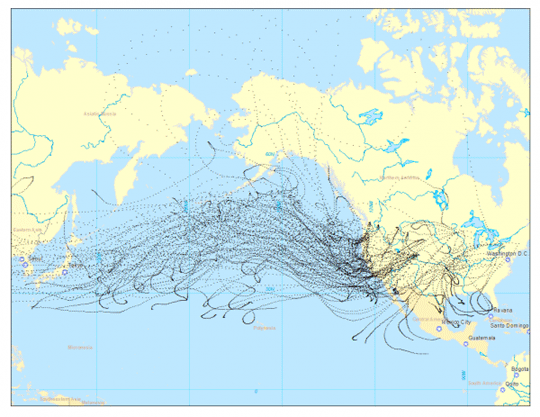
Physicians for Social Responsibility notes: Continue reading
Slowly developing radiation disaster in the Pacific Ocean
Washington Post: It’s an environmental disaster, radioactivity levels in ocean hundreds of times above normal — NHK: Countries around Pacific worried about ongoing Fukushima leaks, gov’t wants testing up to 3,000 km offshore (VIDEO)http://enenews.com/washington-post-its-an-environmental-disaster-radioactivity-levels-hundreds-of-times-above-normal-in-pacific-nhk-countries-worried-about-fukushima-leaks-govt-wants-testing-up-to-3000-km-of
NHK WORLD, Oct. 22, 2013: […] Japan’s effort to clean up what remains of the complex is turning into another kind of disaster. […] 400 tons of toxic groundwater is flowing daily into the Pacific Ocean […] the flow of radioactive water amounts to a slow-burning environmental disaster with implications for Japan’s wildlife and its food chain. […] The coastal Fukushima plant is on an old riverbed […] rainfall from across the region would funnel toward the plant […] Both the government and Tepco say the ocean contamination is confined mostly to a man-made harbor around the plant. But some scientists say that assurance plays down significant long-term concerns about marine life and the food chain. Cesium levels are still hundreds of times the pre-accident norm in areas beyond the harbor, said Ken Buesseler, a senior scientist with the Woods Hole Oceanographic Institution who has monitored waters around the nuclear plant, most recently last month. […] “It’s a serious concern for internal doses. (Radionuclides) are now on the seafloor and could stay in the food chain for years, if not decades.” […]
NHK WORLD, Oct. 21, 2013: [Tepco] has announced plans to monitor offshore radiation around the clock […] many experts have been calling for 24-hour monitoring to allow faster responses to unexpected leaks and provide a clearer idea of how much water has escaped. […] The nuclear regulators have proposed expanding the offshore monitoring from the current 300 kilometers to between 1,000 and 3,000 kilometers. […] the agency will ask the operators of oceangoing vessels to collect data for northern Pacific Rim countries that are worried about radioactive leaks.
NHK Newsline,, Oct. 21, 2013: “Nuclear regulators proposed increasing the distance they’re monitoring from 300 kilometers to up to 3,000 kilometers”
See also: Official Gov’t Documents: Fukushima to endanger NorthPacific marine ecosystem and health of human beings? “Very important to monitor radiation exposure level and assess effects of radioactive substances”
Fukushima nuclear reactors leaking directly into sea?
 Alert: Top Japan nuclear official suggests Fukushima reactors “leaking directly into sea”… not mixing with groundwater and getting diluted — Expert: Contamination flowing from plant will be carried away to North America’s west coast
Jiji Press, http://enenews.com/alert-top-level-japan-official-publicly-suggests-multiple-fukushima-reactors-are-leaking-directly-into-the-sea-its-not-mixing-with-groundwater-and-getting-diluted-expert-contamination-f Oct. 16, 2013: Tepco’s toxic water failures pitiful: NRA[…] Tepco is pumping up groundwater and has injected a water-stopping agent into the ground near the plant’s port in order to curb the flow of radioactive groundwater into the sea. Despite such efforts, the levels of cesium-137 in seawater samples collected between the water intakes for reactors 1 and 2 inside the port rose to around 100 becquerels per liter this month from around 10 becquerels between late June and early July. […] Radioactive water from the damaged reactors “may be leaking directly into the sea instead of mixing with groundwater before making its way into the sea,” [Nuclear Regulation Authority Commissioner Toyoshi] Fuketa said. […]
Vladimir Kovbasyuk, Russian Hydrometeorological Expert, Oct. . 16, 2013: “We analyzed the problems several years ago, when the 2011 earthquake and tornado hit the Fukushima nuclear plant. Radioactive waters will first be carried away to the west coast of North America and only then, on intermingling with other ocean waters, may they return to the Russian coast. Currently, we are measuring radiation levels, and we’ve registered no excess radiation thus far.” […]
It appears Fuketa has provided the answer to the ‘mystery’ discussed on NHK’s ‘Nuclear Watch’ earlier thisyear: Fukushima Mystery? TV: Japan expert says radiation levels in ocean too high to be explained by groundwater flow alone — Must be coming from “other contamination routes” entering Pacific — “Devastating impact” to come? (VIDEO)
Higher radiation levels in sea near Fukushima
 Radiation levels in harbour off Fukushima hit two-year high Australia Network News 10 Oct 2013 Radiation levels in harbour seawater beside one of the damaged Fukushima reactors spiked this week to the highest level in two years.
The operator of the crippled Japanese nuclear plant, TEPCO, says Cesium-134 and Cesium-137 readings on Wednesday jumped 13 times the previous day’s reading.
The readings were taken in the harbour right next to the Fukushima plant, hundreds of meters from the port entrance that connects to the Pacific Ocean.
Radiation from water leaking from the facility is mostly confined to the harbour around the plant, officials have said……http://www.abc.net.au/news/2013-10-10/an-radiation-levels-in-harbour-off-fukushima-hit-two-year-high/5015082
Trade winds and Pacific currents bring Fukushima radiation to North America
Fukushima Radiation Hitting Canada and United States More than Japan http://talesfromthelou.wordpress.com/2013/10/08/fukushima-radiation-hitting-canada-and-united-states-more-than-japan-209/ Oct 8, 2013
ForbiddenKnowledgeTV
Alexandra Bruce
October 5, 2013
Besides the billions of gallons of radioactive water spilling from the abandoned Fukushima Nuclear Energy Plant every day, there is also a steady plume of radio nuclides including Cesium, Cobalt, Uranium and Plutonium, which are steadily being carried across the Pacific via trade winds, with the lion’s share landing (usually, along with the rain) in communities within the US and Canada – and in places beyond, throughout the Northern Hemisphere. Ironically, more fallout is presently occurring in North America than in Japan, the scene of the disaster, due to the trade winds, off the Japanese coast.
It has been calculated that in 1 day, there are 666,733.717599549 bequerels of radiation emitted in every cubic foot of the Pacific, per mile.
There are about 63,800,000 miles in the Pacific Ocean. The average depth is about 2.28 miles. There are 145,464,000 cubic miles in the Pacific Ocean. Cesium-137 has a double decay process 94.6% of the time; first beta rays, then gamma rays.
So each cubic foot of the entire Pacific Ocean will have 218.174056838937 Beta radiation events per day and each cubic foot of the entire Pacific Ocean will have 206.392657769635 Gamma radiation events per day.
34 is the average background radiation of the N. American continent.
The Pacific Ocean will have a “radiation fog” in every cubic foot of water that is 12.47 times HIGHER than the average background radiation count of North American continent.
Sea life will be affected in some manner; perhaps all fish will get cancer. The impact on humanity is a shortage in sea food and no swimming allowed until radiation levels abate to a “safe level”… in about how long???
Cancer causing radiation in fish must be increasing
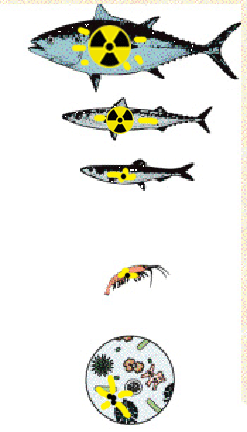 Report raises fresh concerns about radiation levels in Japanese fish Canada AM: Cancer-causing radiation in fish Gordon Edwards of the Canadian Coalition for Nuclear Responsibility discusses the danger, and whether the information will prompt changes. CTVNews.ca Staff
Monday, October 7, 2013
Two and a half years after the Fukushima nuclear plant disaster in Japan, concerns are again being raised about radiation levels in fish caught in the Pacific Ocean.
A report by the Vancouver weekly newspaper, The Georgia Straight, suggests at least 800 people worldwide could develop cancer from eating fish caught in Japan’s waters – and about half of those cases will be fatal.
About 500 of the cancers will occur in Japan, while 75 will be due to Japanese fish exports to other countries, including Canada, the newspaper estimates. It also quotes several nuclear experts who say that estimate is likely conservative and the real toll could be closer to 80,000 cancers.
Gordon Edwards, president of the Canadian Coalition for Nuclear Responsibility, notes that the estimate is based only on the fish that has been eaten up to now.
“People are going to continue to consume these fish and the toll could rise higher,” he told CTV’s Canada AM Monday from Montreal……..
Some fish samples tested to date have had very high levels of radiation: one sea bass sample collected in July, for example, had 1,000 becquerels per kilogram of cesium.While Canadians are exposed to radiation every day from the sun and the environment, Edwards notes that radioactive cesium doesn’t exist in nature at all and it’s not known if there is any safe level.
“The background level is zero. So this is all comes from the Fukushima disaster,” he said of the fish.The Canadian Food Inspection Agency tested fish exports from Japan for several months, but dropped the testing in June 2011, just three months after the disaster.
Edwards says he does not understand why the CFIA is not taking the issue more seriously.”Canadian authorities are really doing us all a disservice by not following and monitoring this much more closely. They’re treating it as though it’s a kind of ho-hum situation, but in fact, it was a major event worldwide,” he said.
“And it should be studied very more carefully because that’s the only way we’re going to learn what the effects of this may be for the future.” http://canadaam.ctvnews.ca/report-raises-fresh-concerns-about-radiation-levels-in-japanese-fish-1.1486514#ixzz2hAEyiUbR
The slow poisoning of our oceans
 We could act radioactive pollution to this” deadly trio”
The oceans are heating, acidifying and choking New Scientist, 04 October 2013 by Fred Pearce We know the oceans are warming. We know they are acidifying. And now, to cap it all, it turns out they are suffocating, too. A new health check on the state of the oceans warns that they will have lost as much as 7 per cent of their oxygen by the end of the century.
The cascade of chemical and biological changes now under way could see coral reefs irreversibly destroyed in 50 to 100 years, with marine ecosystems increasingly taken over by jellyfish and toxic algal blooms.The review is a repeat of a study two years ago by the International Programme on the State of the Ocean (IPSO), a coalition of scientists. It concludes that things have become worse since the first study.
“The health of the oceans is spiralling downwards far more rapidly than we had thought, exposing organisms to intolerable and unpredictable evolutionary pressure,” says Alex Rogers at the University of Oxford, the scientific director of IPSO.
Deadly trio
Rogers describes a “deadly trio” of linked global threats. The first is global warming: surface sea water has been warming almost as fast as the atmosphere. The second is acidification – a result of the water absorbing ever more CO2 from the atmosphere. The third is deoxygenation…….http://www.newscientist.com/article/dn24351-the-oceans-are-heating-acidifying-and-choking.html#.UlByOdJwonE
Fukushima radiation-related deaths from fish in Pacific
Physician on Cancer Estimates: Epidemic of Fukushima radiation-related deaths from fish in Pacific may have started — “Vast implications for human health” — “I eat so much salmon… I’m vulnerable” http://enenews.com/physician-on-cancer-calculations-epidemic-of-fukushima-radiation-related-deaths-from-fish-in-pacific-may-have-started-vast-implications-for-human-health-i-eat-so-much-salmon-im-vulne
Title: Fish data belie Japan’s claims on Fukushima
Source: Georgia Straight (Canada)
Author: Alex Roslin
Date: Oct. 2, 2013
[…] About 800 people worldwide will get cancer from radiation due to Fukushima in fish eaten to date [through mid-July 2013], according to Georgia Straight calculations. The Straight results relied on a widely used cancer-risk formula developed by the U.S. Environmental Protection Agency as well as radiation levels in 33,000 fish tested by the Japanese Fisheries Agency. […]
Two nuclear experts who saw the Straight’s figures said the real cancer toll could be 100 times higher—or 80,000 cancers. […]
Erica Frank, a Vancouver MD, was taken aback when told the Straight’s results. “How can a person do anything but gasp?” she said in a phone interview. “That’s horrible. This is the beginning of a potential epidemic of radiation-related deaths from fish in the Pacific. It has vast implications for human health.”
Frank is a professor of population and public health in UBC’s faculty of medicine […] She said that after Fukushima, she decided to stop eating fish from Asia. She is especially concerned about impacts on B.C. migratory salmon. “I eat so much salmon. I love salmon; I am vulnerable.” […]
Fukushima’s small level of radiation in fish can still cause cancers
the radiation detected can still cause cancer, according to the U.S. Environmental Protection Agency’s cancer-risk formula, a leading international standard for forecasting cancer risks from radiation.
Cancer risk linked to radiation levels in fish species after Fukushima http://www.straight.com/life/497651/cancer-risk-linked-radiation-levels-fish-species-after-fukushima
In July this year, a sea bass caught in Japan had 1,000 becquerels per kilogram of radioactive cesium—10 times Japan’s ceiling of 100 becquerels per kilo in food. It was the second-highest amount found in a sea bass since the disaster occurred. Continue reading
Tepco doesn’t measure radiation accumulated on the bottom of the sea
 Tepco doesn’t measure radiation accumulated on the bottom of the sea http://fukushima-diary.com/2013/09/tepco-doesnt-measure-radiation-accumulated-on-the-bottom-of-the-sea/ by Mochizuki on September 29th, 2013 Following up this article.. Tepco “We don’t see Tokyo bay contamination” [URL]
Regarding the Pacific contamination, Tepco stated they analyze seawater but they take the samples only from the surface of the sea on 9/27/2013.
They commented when they collect seawater samples outside of Fukushima nuclear plant port, the samples are not taken from near the bottom of the sea.
Cesium-134/137 is assumed to be accumulated on the bottom of the sea, but Tepco doesn’t and is not planning to analyze it.
Even inside of the plant port, they collect the seawater samples mostly from the surface of the sea.
Tepco explained the measurement means was not decided by only Tepco, but also with the Fisheries Agency, Fukushima prefectural government and Ministry of Education, Culture, Sports, Science and Technology.
Also, Strontium-90 is water-soluble, so even if they analyze only the surface water, they can detect the marine contamination level.
According to Tepco and Japanese government, they don’t measure high level of radiation in their sampling points of the Pacific.
How concerned should we be about eating fish caught near Fukushima?
 Fukushima Radiation Risks from Eating Fish, Switchboard Matthew McKinzie’s Blog 24 sept 13
“……….CONCLUSIONS
For the foreseeable future, one should avoid eating fish caught near Fukushima. Buesseler says that during his own sampling survey in waters 30 to 600 kilometres from Fukushima in June 2011, three months after the meltdown, the highest levels he found were 3 Bq/liter of cesium-137. This suggests that the consumption of fish caught in these waters would not represent a significant risk to individuals.
There is not a significant radiological risk to individuals associated with consuming fish caught near the West coast of the United States and Hawaii.
Ken Buesseler notes that the north Pacific contains an estimated 100 PBq of cesium-137 from H-bomb testing in the 1960s, so the fallout from Fukushima is adding only a fraction of that. Total discharges from the Sellafield nuclear plant in the UK released 39 PBq over 40 years of operation, according to Buessler. http://switchboard.nrdc.org/blogs/mmckinzie/fukushima_radiation_risks_from.html
1 This Month

of the week – Shut Down Drone Warfare!


Tell the Ukrainian Government to Drop Prosecution of Peace Activist Yurii Sheliazhenko

Petition to revoke the licensing of the Near Surface Nuclear Disposal Facility (NSDF) at Chalk River. https://www.ourcommons.ca/petitions/en/Petition/Details?Petition=e-7247
To see nuclear-related stories in greater depth and intensity – go to https://nuclearinformation.wordpress.com
-
Archives
- March 2026 (237)
- February 2026 (268)
- January 2026 (308)
- December 2025 (358)
- November 2025 (359)
- October 2025 (376)
- September 2025 (257)
- August 2025 (319)
- July 2025 (230)
- June 2025 (348)
- May 2025 (261)
- April 2025 (305)
-
Categories
- 1
- 1 NUCLEAR ISSUES
- business and costs
- climate change
- culture and arts
- ENERGY
- environment
- health
- history
- indigenous issues
- Legal
- marketing of nuclear
- media
- opposition to nuclear
- PERSONAL STORIES
- politics
- politics international
- Religion and ethics
- safety
- secrets,lies and civil liberties
- spinbuster
- technology
- Uranium
- wastes
- weapons and war
- Women
- 2 WORLD
- ACTION
- AFRICA
- Atrocities
- AUSTRALIA
- Christina's notes
- Christina's themes
- culture and arts
- Events
- Fuk 2022
- Fuk 2023
- Fukushima 2017
- Fukushima 2018
- fukushima 2019
- Fukushima 2020
- Fukushima 2021
- general
- global warming
- Humour (God we need it)
- Nuclear
- RARE EARTHS
- Reference
- resources – print
- Resources -audiovicual
- Weekly Newsletter
- World
- World Nuclear
- YouTube
-
RSS
Entries RSS
Comments RSS
 nuclear-news