High level nuclear waste into the ocean: Japanese govt’s latest idea
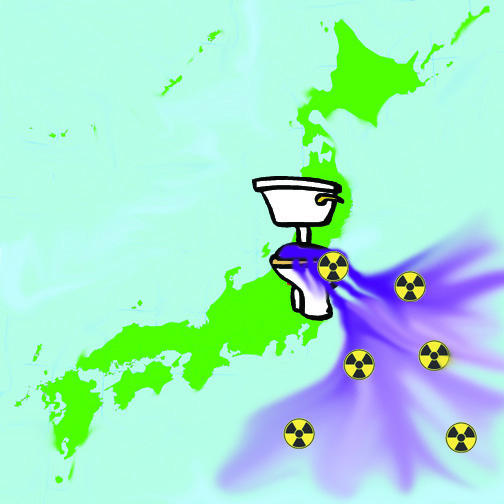 Japan to consider ocean disposal of nuclear waste http://ajw.asahi.com/article/behind_news/social_affairs/AJ201512120027 December 12, 2015 THE ASAHI SHIMBUN
The industry ministry will consider the feasibility of burying high-level radioactive waste from nuclear power plants under the seabed, which a working panel said Dec. 11 could be a “highly appropriate” solution.
In an interim report on disposal methods of highly contaminated materials from spent nuclear fuel, the panel said such waste could be disposed of in adjacent waters within 20 kilometers of the coastline.
It called the disposal method relatively realistic because the circulation of groundwater at sea is not as strong as on land. The panel said the site should be created in adjacent waters so that nuclear waste can easily be transported by ships.
The panel included the under-the-seabed disposal plan in nearby waters as a viable option for the final disposal site.
Based on this proposal, the ministry will set up an expert panel in January to discuss what specific technical challenges lay ahead.
The expert panel will discuss locations of active faults under the seabed and the impact of sea level changes to evaluate the feasibility of the project. It is expected to issue its recommendations by next summer.
While the government has encouraged municipalities to submit candidate sites for nuclear waste disposal, it is being forced to rethink this policy because no local government has come forward to provide a realistic disposal site.
Instead, it will hand-pick the “candidate sites from scientific perspectives” and unilaterally request local governments to comply with its research and inspection efforts.
The dangers of transporting nuclear waste by sea
 Nuclear waste transport risks ,Tor Justad, http://www.shetlandtimes.co.uk/2015/12/08/nuclear-waste-transport-risks-tor-justad “…..I would wish to draw attention to the proposal from the Nuclear Decommissioning Authority to transport nuclear waste by sea from Scrabster to Barrow – a distance of over 400 miles.
This high level nuclear waste/spent fuel emanates from the Dounreay nuclear site and is intended for Sellafield – described as “the most toxic nuclear site in Europe”.
The campaigning group Highlands Against Nuclear Transport (Hant) has been campaigning since 2013 to stop this plan on the grounds that the risk to the environment, fishing, aquaculture and tourism is unacceptable.
Transporting nuclear waste by sea is opposed by environmental groups throughout the world and Hant is of the view that all nuclear waste should remain on the sites where it is produced which is in line with Scottish government policy. Hant provided an input at a Nuclear Free Local Authorities (NFLA) seminar in Lerwick in August 2015 on “Transportation of Dounreay’s nuclear materials by rail or by sea to Sellafield – is it a safe solution for reducing the nuclear legacy in Scotland?” and was pleased to hear from SIC and Kimo representatives at that seminar that they supported Hant’s position.
The need for emergency response vessels stationed around the Northern Isles and Western Isles is important to safeguard these coasts against marine accidents and emergencies of any kind but the need is increased by the proposal to transport nuclear waste.
As is well known, nuclear radiation knows no land or sea boundaries so this issue is of concern to all coastal communities in the Highlands and Islands.
Hant will continue to campaign on this issue and would urge individuals and interested organisations to support this campaign.
North America’s West Coast getting record levels of Fukushima radiation
Record levels of Fukushima radiation detected off West Coast — Massive plume stretches for more than 1,000 miles — Reuters: Contamination is spreading off U.S. shores — Radioactive cesium reaches 11 Bq/m3 at multiple locationshttp://enenews.com/record-levels-fukushima-radiation-detected-west-coast-massive-plume-stretches-1000-miles-cesium-reaches-11-bqm3-multiple-locations-map?utm_source=feedburner&utm_medium=email&utm_campaign=Feed%3A+ENENews+%28Energy+News%29(MAP)
Woods Hole Oceanographic Institution, Dec 3, 2015 (emphasis added): Higher levels of Fukushima cesium detected offshore — Scientists monitoring the spread of radiation in the ocean from the Fukushima nuclear accident report finding an increased number of sites off the US West Coast showing signs of contamination from Fukushima. This includes thehighest detected level to date from a sample collected about 1,600 miles west of San Francisco. The level of radioactive cesium isotopes in the sample, 11 Becquerel’s per cubic meter… is 50 percent higher than other samples collected along the West Coast so far… Working with Japanese colleagues, [Ken Buesseler, a WHOI marine radiochemist] also continues to independently monitor the ongoing leaks from Fukushima Dai-ichi by collecting samples… During his most recent trip this October they collected samples of ocean water, marine organisms, seafloor sediment and groundwater along the coast near the reactors. Buesseler says the levels of radioactivity offFukushima remain elevated – some 10 to 100 times higher than off the US West Coast today, and he is working with colleagues at WHOI to try to determine how much radioactive material is still being released to the ocean each day.
Ken Buesseler, WHOI: “These new data are important for two reasons… the changing values underscore the need to more closely monitor contamination levels across the Pacific. Second, these long-lived radioisotopes will serve as markers for years to come for scientists studying ocean currents and mixing in coastal and offshore waters… [F]inding values that are still elevated off Fukushima confirms that there is continued release from the plant.”
Statesman Journal, Dec 3, 2015: Higher levels of Fukushima radiation detected off West Coast— Higher levels of radiation from Japan’s 2011 Fukushima nuclear accident are showing up in the ocean off the west coast of North America, scientists from the Woods Hole Oceanographic Institution reported today. And an increased number of sampling sites are showing signs of contamination… This year, Buesseler has added about 110 new sample results to 135 already on the project’s web site. They include the highest detected level to date, from a sample collected about 1,600 miles west of San Francisco.
Reuters, Dec 3, 2015: Radiation from Japan nuclear disaster spreads off U.S. shores… andcontamination is increasing at previously identified sites… Tests of hundreds of samples of Pacific Ocean water confirmed that Japan’s Fukushima nuclear power plant continues to leak… The latest readings measured the highest radiation levels outside Japanese waters to date some 1,600 miles (2,574 km) west of San Francisco. The figures also confirm that the spread of radiation to North American waters is not isolated to a handful of locations, but can be detected along a stretch of more than 1,000 miles (1,600 km) offshore.
Dr Ken Buesseler reports cesium-134 from Fukushima in ocean waters off North America shores
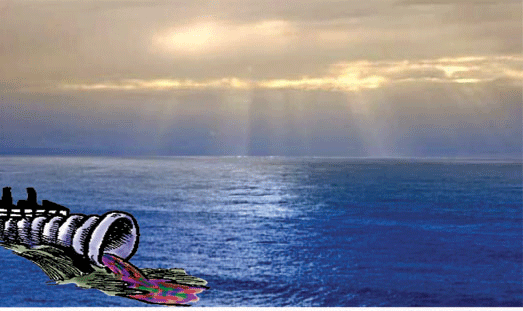 Fukushima radiation detected off North America shores http://www.presstv.ir/Detail/2015/12/04/440253/Fukushima-radiation-Japan-California-North-America-Buesseler Researchers detect higher levels of radiation from Japan’s 2011 Fukushima nuclear disaster off North America’s shores.Ken Buesseler of the Woods Hole Oceanographic Institution said on Thursday recent tests of Pacific Ocean water revealed that the Fukushima nuclear power plant continues contamination of the ocean with radioactive isotopes.
Buesseler said samples taken from several hundred miles off the shores of Oregon, Washington and California as well as Canada’s Vancouver island over the past few months tested positive for cesium-134.
Cesium-137 isotope was also detected at low levels in almost all seawater samples tested by Buesseler and his fellow researchers.
“Despite the fact that the levels of contamination off our shores remain well below government-established safety limits for human health or to marine life, the changing values underscore the need to more closely monitor contamination levels across the Pacific,” said Buesseler.
Last year, Buesseler said Fukushima radiation was detected in samples taken off the coast of northern California. In April, radiation was also identified off Canada’s shores.
The latest figures show that the spread of Fukushima radiation is not limited to certain locations, but can be found along a stretch of 1,000 miles offshore. n March 2011, a massive tsunami triggered by a magnitude-9 quake filled the Fukushima nuclear cooling systems with water, sending some reactors into meltdown and sparking a decades-long cleanup effort by the Japanese government.
Shortly after the accident, radiation was released into the sea, food chain, and air, and now the Fukushima incident is the worst nuclear accident since the 1986 Chernobyl disaster in Ukraine.
“Worst accidental radioactive pollution of Pacific Ocean” hasn’t moved US to test seafood
Nuclear Power: Dead in the Water it Poisoned, CounterPunch, by JOHN LAFORGE NOVEMBER 5, 2015 “………..Radiation exposure and contamination should concern everyone because by all accounts the volume of  radioactive materials discharged to the Pacific Ocean by Fukushima is the single greatest radioactive contamination of the sea ever observed. [27] An estimated 27 “peta-becquerels” (27 million billion becquerels) of cesium-137 had already leaked or been deliberately dumped into the Pacific by October 2011. A becquerel represents one atomic disintegration/second.
Last July, Tokyo Electric Power Co., which owns the Fukushima wreckage, acknowledged that an additional 300 tons-a-day of highly contaminated water is leaking into the Pacific from the six-reactor station — and has been since the beginning of the disaster almost three years ago. The American Medical Association — following the revelation of massive ongoing leaks — called on the US government to “monitor and fully report the radioactivity levels of edible species sold in the United States.”[28]
Yet at present, US seafood is not regularly tested for cesium contamination, in spite of the large numbers of fish and other foods that have been found contaminated by Fukushima isotopes — including blue fin[29] and albacore tuna[30] caught off the US West Coast, grapefruit from Florida, and prunes, almonds, pistachios and oranges from California.[31]
In this context, a coalition of public health and environmental groups petitioned the FDA in early summer demanding a drastic reduction in the amount of radioactive cesium allowed in food. The petition by members of the Fukushima Fallout Awareness Network (FFAN) declared that the arbitrarily high 1,200 becquerels-per-kilogram (Bq/kg) US limit is “ridiculous.” The standard is between 120 times to 24 times weaker than Japan’s.
The petition demands that US foods have no more than 5 Bq/kg of cesium-137 and -134, and that all food be tested and labeled with its cesium content. The FFAN reports that the devastated Fukushima reactors continue to leak more than 10 million becquerels of cesium-134 and cesium-137 per hour into the environment, “with no sign of stopping.” The network said it was “alarmed” at the lack of testing currently in place to meet the threat of radioactive contamination in food. Because cesium-134 has a hazardous life of about 10-20 years, and cesium-137 has a hazardous life of about 300-600 years, the FFAN said, the threat of food contamination “is a long-term issue that deserves immediate attention………”http://www.counterpunch.org/2015/11/05/nuclear-power-dead-in-the-water-it-poisoned/
Southern Ocean fast becoming acidic, with abrupt effects on the marine food chain
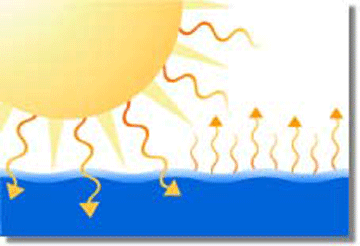 Abrupt changes in food chains predicted as Southern Ocean acidifies fast: study [excellent pictures] http://www.smh.com.au/environment/climate-change/abrupt-changes-in-food-chains-predicted-as-southern-ocean-acidifies-fast-study-20151030-gknd2g.html November 3, 2015 Peter Hannam Environment Editor, The Sydney Morning Herald The Southern Ocean is acidifying at such a rate because of rising carbon dioxide emissions that large regions may be inhospitable for key organisms in the food chain to survive as soon as 2030, new US research has found.
Tiny pteropods, snail-like creatures that play an important role in the food web, will lose their ability to form shells as oceans absorb more of the CO2 from the atmosphere, a process already observed over short periods in areas close to the Antarctic coast.
Ocean acidification is often dubbed the “evil twin” of climate change. As CO2 levels rise, more of it is absorbed by seawater, resulting in a lower pH level and reduced carbonate ion concentration. Marine organisms with skeletons and shells then struggle to develop and maintain their structures.
Using 10 Earth system models and applying a high-emissions scenario, the researchers found the relatively acidic Southern Ocean quickly becomes unsuited for shell-forming creatures such as pteropods, according to a paper published Tuesday in Nature Climate Change.
“What surprised us was really the abruptness at which this under-saturation [of calcium carbonate-based aragonite] occurs in large areas of the Southern Ocean,” Axel Timmermann, a co-author of the study and oceanography professor at the University of Hawaii told Fairfax Media. “It’s actually quite scary.”
Since the Southern Ocean is already close to the threshold for shell-formation, relatively small changes in acidity levels will likely show up there first, Professor Timmermann said: “The background state is already very close to corrosiveness.”
Below a certain pH level, shells of such creatures become more brittle, with implications for fisheries that feed off them since pteropods appear unable to evolve fast enough to cope with the rapidly changing conditions.
“For pteropods it may be very difficult because they can’t run around without a shell,” Professor Timmermann said. “It’s not they dissolve immediately but there’s a much higher energy requirement for them to form the shells.”
Given the sheer scale of the marine creatures involved, “take away this biomass, [and] you have avalanche effects for the rest of the food web”, he said.
As carbon dioxide levels rise, the impacts seen in the Southern Ocean – and its counterpart regions in the northern hemisphere – can be expected to spread closer to the equator.
Scientists anticipate that a halt in the increase in greenhouse gases will take time to have an impact on slowing the warming of the planet. However, a faster response can be expected in the oceans to any slowing in the pace of acidification.
“The corrosiveness of the water is a very strong function of the atmospheric C02 and there is not much of a delay [to any changes]”, Professor Timmermann said.
The paper’s release comes about four weeks before delegates from almost 200 nations are expected to gather in Paris, France to negotiate a new global treaty to curb carbon emissions.
Japan’s coastal population: risks from radiation ignored by govt and IAEA
UK research clearly shows that coastal zone populations are exposed to doses of marine radioactivity under the following set of environmental parameters:
- resident in coastal zones up to at least 200kms downstream of a source of liquid radioactive discharges to sea
- resident in coastal zones adjacent to coastal waters with high suspended sediment loadings
- resident in coastal zones adjacent to extensive fine sediment inter tidal/sub tidal sediment deposits (salt marsh, mud flats etc)
- resident in coastal zones subject to prevailing onshore winds and storm or tidal conditions generating marine aerosols, sea spray and coastal inundation
- resident in coastal zones where such parameters (A to D above) have, elsewhere, been shown to enable/facilitate the penetration of marine radioactivity for across the shoreline and up to 10 miles inland from the coast.

Fukushima: Japanese government and IAEA ignore radiation risks to coastal population http://www.theecologist.org/News/news_analysis/2985454/fukushima_japanese_government_and_iaea_ignore_radiation_risks_to_coastal_population.html Tim Deere-Jones 28th September 2015
Radiation can be carried long distances by marine currents, concentrated in sediments, and carried in sea spray 16km or more inland, writes Tim Deere-Jones. So Fukushima poses a hazard to coastal populations and any who eat produce from their farms. So what are the Japanese Government and IAEA doing? Ignoring the problem, and failing to gather data.
Review of the official Japanese marine monitoring programme reveals that the Japanese government is turning a blind eye to the risks of marine radiation from the stricken Fukushima site.
The strategy it has adopted, with the support of the IAEA, consistently ignores the latest evidence about the way marine radioactivity behaves in inshore marine environments and the potential radiological risks to coastal populations.
This strategy is based on a flawed hypothesis, developed by the nuclear industry through the late 1940s and early 1950s, when both oceanography and the study of the behaviour and fate of radioactivity in marine environments were in their absolute infancy.
As a result, the principal conclusions on the marine impact of the Fukushima event put forward in recent reports from the IAEA, the Government of Japan and it’s relevant agencies, minimise the environmental and public health negatives and emphasise a range of hypothetical ‘positives’.
This is a major flaw because the empirical evidence from ‘non-aligned’ research in the UK is that coastal communities are subjected to highly enriched doses of marine radioactivity through pathways of exposure, and from environmental parameters, which will not be analysed and researched under current Fukushima monitoring plans.
As a result, significant public health impacts of the event will not be documented, nor will important data about the way Fukushima marine radioactivity behaves at the coastline.
Failing to gather the evidence of coastal radiation Continue reading
Nuclear power station at Bradwell would damage the marine environment

 MP warning over new nuclear power station in Essex East Anglian Daily Times 25 September 2015 Matt Stott An Essex MP has claimed a new nuclear power station at Bradwell would cause “significant damage” to the marine environment. Harwich and North Essex MP Bernard Jenkin expressed concern over the impact the site would have on the region’s fishing industries and ecology.
His intervention comes days after Chancellor George Osborne indicated a £2 billion Government guarantee for Chinese investment in the proposed Hinkley Point C nuclear power plant in Somerset could pave the way for further deals, including a majority Chinese-owned nuclear generation facility at Bradwell.
It is thought the site, next to the former nuclear power station, could be shared with between owners EDF and Chinese firms to build and run a new nuclear plant.
Mr Jenkin said: “There should be no new nuclear at Bradwell, unless the concerns about damage to the estuary and storage of nuclear waste on site can both be unequivocally resolved. “There seems no way that a new nuclear power station would avoid significant damage to the marine environment in the estuary.
“When the Magnox station was decommissioned, there was explosive recovery in the marine environment. I have been informed that a new power station would take six times more flow of water than its predecessor.
“The estuary cannot supply the volume of cooling water without severely damaging the natural life-cycle of organisms in it. This jeopardises the ecology, our local fishing industries and goes against the aim of the Marine Conservation Zone.”
He added: “It is also a significant concern… that high level nuclear waste would have to be secured and stored on the site for some decades after a new facility has reached the end of its operating life, before it can be safely transported.
“This raises questions about how could it be stored safely over such a long period.”………http://www.eadt.co.uk/news/mp_warning_over_new_nuclear_power_station_in_essex_1_4246963
Pacific Ocean radioactive isotopes from Atomic Testing compared with from Fukushima nuclear disaster
History of Bomb Strontium and Cesium Isotopes in Pacific Compared to Fukushima Sources http://www.dailykos.com/story/2014/01/16/1269942/-History-of-Bomb-Strontium-and-Cesium-Isotopes-in-Pacific-Compared-to-Fukushima-Sources# (EXCELLENT GRAPHS) by MarineChemistThe purpose of this diary is to compare the concentrations of Sr-90 and Cs-137 in the North Pacific Ocean over the last 50 years to the concentrations predicted to arrive on the west coast associated with waters affected by release of radionculides from the Fukushima-Daiichi Nuclear Power Plant. Given present levels that are being measured in the eastern Pacific and barring release rates that significantly exceed past rates in March-April 2011 the impact on marine organisms and the marine environment is going to be very minimal. What follows below the fold is a comparison of the concentrations measured and predicted over much of the Pacific owing to Fukushima to the concentrations that were present in the mid-1960s from the fallout of atmospheric weapons testing that is free from any discussion of safe doses or models of radiation exposure to organisms. Continue reading
Timothy Mousseau dismisses radiation as cause of giant wolffish
 NO, THIS WOLFFISH IS NOT A FUKUSHIMA RADIATION MUTANT,
As for the idea of giant, mutant Fukushima fish … there is no scientific evidence to support claims that fallout from the Fukushima disaster has, or will, cause this to happen. Even right after the disaster, a swim in nearby waters would have dosed you with just 0.03% of the daily radiation an average Japanese resident receives. And much of that fallout has disappeared because of natural decomposition and decay.
Besides, even in the extremely unlikely event that radiation was the culprit here, we would actually expect to see smaller, not larger, fish. “Very, very few mutations lead to extra-large size,” explains University of South Carolina radiation specialist Dr Timothy Mousseau. “[Instead], they grow less efficiently, they’re less capable of catching food and they tend to not live as long.
All that said, this catch is still an impressive one. Wolffish (family Anarhichadidae) average about three feet in length (110 cm), but can get bigger. What Hirasaka has landed is a very old and very healthy specimen. “If you look hard and long enough there’s always a few that manage to survive long enough to achieve these large sizes,” says Mousseau. http://www.earthtouchnews.com/wtf/mutants-and-freaks/no-this-wolffish-is-not-a-fukushima-radiation-mutant
USA’s secret plans with Japan to dump radioactive trash into oceans
US tried to conspire with Japan to dump nuclear waste into world’s oceans, reveal documents http://www.naturalnews.com/033768_nuclear_waste_oceans.html# (NaturalNews) When nuclear energy production technology first began to emerge in the US in the 1950s, neither scientists nor the US government considered what would be done with nuclear reactors once it was time for them to be put out of commission. And recently-released documents reveal that, in an effort to hastily deal with this problem after the fact, the US government actually tried to conspire with Japan to gain secret approval for dumping decommissioned nuclear reactors into the world’s oceans.
In 1972, the United Nations (UN) had proposed the Convention on the Prevention of Marine Pollution by Dumping of Wastes and Other Matter, also known as the London Convention, to deal with the growing, global pollution problem. The agreement’s provisions sought to specifically regulate the environmental pollution that signing nations could and could not dump into the oceans, which of course included nuclear production materials.
But since a finalized version of the agreement had not yet been fully established, the US government took advantage of the situation by seeking to insert an exemption cause permitting the dumping of decommissioned nuclear reactors into the ocean. And since Japan had also been involved in developing its own nuclear energy program, the US thought it could gain additional support for the exemption clause from its Asian ally.
Though the US made no mention of any long-term plans to utilize the ocean as its nuclear dumping ground during the proposal, it now appears as though the country had every intention of using the ocean as a nuclear disposal facility. And since the London Convention clause still exists to this day, all other signing countries are free to dump their nuclear waste in the ocean as well.
Russia, a signing member of the London Convention, openly admitted back in 1993, for instance, that it dumps nuclear reactors and fuel into the ocean because it allegedly has no other safe way to dispose of such materials (http://www.independent.co.uk/news/world/russ…).
The International Atomic Energy Agency (IAEA), however, claims the US stopped dumping nuclear reactors into the ocean a long time ago. And US officials claim that decommissioned nuclear reactors are today buried in the ground rather than dumped into the ocean: http://www.naturalnews.com/033768_nuclear_waste_oceans.html#ixzz3kvbRF6Bi
Ken Buesseler, Jay Cullen, lead independent research into radiation in the Pacific Ocean

Christina Macpherson’s websites & blogs
Great article. As an anti nuclear activist myself, I think that it is most important that we keep our concerns in proportion. The nuclear industry has so many bad effects, that we don’t ned to exaggerate ones that are not clear. Thankfully, despite government inertia, Buesseler and co are working to establish the facts on the effect if the Fukuhsima disaster on the ocean.
Radiation in the Ocean http://www.huffingtonpost.com/peter-neill/radiation-in-the-ocean_b_8072914.html?ir=Australia Peter Neill Director, World Ocean Observatory The West Coast of the United States seems under siege by negative environmental news: earthquake predictions, oil spills, drought, critically diminished water supply, wildfires, and numerous accounts of unusual coastal events: algae blooms, whale strandings, cancer in seals, collapse of fish stocks, and more.
How to explain? Well, much of this can be attributed to climate factors where rising temperatures have resulted in multiple inter-related consequences: limited glacial melt, increased evaporation, no water, dry land, and the inevitable fire darkening that pristine Pacific air with smoke and ash the length of the coast.
The ocean phenomena may be different. The warming of the ocean surely has an impact on changing growth patterns of marine plants and animals, just as the changing pH or acidity of the ocean has been shown to modify habitat and migrations. But what else?
One argument has been the effect of radiation leaking from the three nuclear power plant reactors shut down by the earthquake and resultant tsunami tidal wave that inundated Fukushima, Japan in 2011, and has been thereafter distributed by ocean currents; indeed there is evidence of a plume of increased concentration of Cesium-134, and other radioactive elements that have been observed at unprecedented levels, spreading out some 5,000 miles into the Pacific toward North and South America. In April of this year, there were headlines declaring that “Fukushima radiation has reached the North American Shore” and concerns were raised, spread through the Internet and press, that this was surely the cause of these otherwise inexplicable anomalous natural events.
There is no Federal agency that funds monitoring of radiation in coastal water, and the present effort, conducted since 2004 by Ken Buesseler, a marine chemist at theWoods Hole Oceanographic Institution, has been underwritten by crowd-funding and the efforts of volunteers taking samples to provide data on cesium isotopes along the west coast of Alaska, the U.S. mainland coast, and Hawaii, the information that has been used to model potential distribution and concentration of any contamination. A comparable effort has been launched in Canada, led by Jay Cullen of the University of Victoria in collaboration with government, academic, and NGO partners.
The radioactivity has been decreased by time, the natural half-life of the isotopes, and by dilution in a very large and deep body of water. In their samples, Buesseler and his “citizen scientists” did detect cesium-137 already in the waters as a result of atmospheric nuclear weapons testing in the 1950s and 60s, and cesium-134 which does not otherwise occur naturally in the ocean and can only be attributed to Fukushima, to serve as a first baseline for subsequent collection, analysis, modeling, and conclusion.
Buesseler channels his research through the Center for Marine and Environmental Radioactivity at the Woods Hole Institute, where he offers a preliminary conclusion that “the amount of cesium-134 reported in these new offshore data is less that 2 Becquerels (a radioactive measure) per cubic meter (the number of decay events per second per 260 gallons of water.) This Fukushima-derived cesium is far below where one might expect any measurable risk to human health or marine life, according to international health agencies. And it is more than 1,000 times lower than acceptable limits in drinking water set by the U.S. Environmental Protection Agency.”
Buesseler continues, “We emphasize that cesium-134 has not been detected YET as it has been detected offshore of North America by Canadian oceanographers… The uncertainty in the predictions by these ocean models only emphasizes the importance of collecting samples from along the shores. Remember too that those models predict interacting levels of both cesium isotopes for the next 2 or 3 years, the highest published prediction is for 20 to 30 Becquerels per cubic meter, or well below what is thought to be of human health and fisheries concerns.”
So, yes, and no. No definitive conclusion, no clear argument that radiation is the cause of those coastal events which distress us so. There is no solace in uncertainty, just as there is no certainty without evidence. The question is immensely important and thanks to Ken Buesseler and all those volunteers alongshore and in research vessels who are working to provide the substance for a real answer.
#Nuclear submarines bring increasing danger to Indo-Pacific region
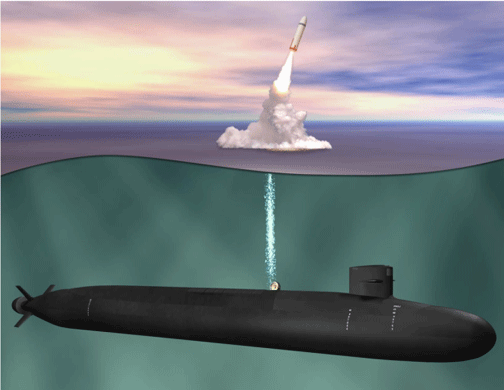 the more submarines you put in the same body of water, the higher the probability they might collide’.
Indo-Pacific nuclear sub threat to rival Cold WarAFR, by John Kerin, 3 Sept 15 The Indian and Pacific Oceans are becoming increasingly crowded with nuclear armed and conventional submarines increasing the risk of collision and nuclear conflict.
The warning is contained in a new Lowy Institute of International Affairs paper to be released on Friday which argues the region faces the greatest threat of a miscalculation involving nuclear armed submarines since the Cold War era.
“The regional contests for influence between the United States and China and China and India do not yet have the existential or ideological ‘life or death character’ of the Cold War,” the paper by Professor Rory Medcalf of the ANU based National Security College and Brendan-Thomas Noone from the Lowy International Security Program says.
“But quite literally below the surface a new and dangerous competition is emerging as China and India in particular start deploying nuclear weapons at sea……….
The paper says during the Cold War there were estimated to have been between 20 and 40 submarine collisions at sea.
“Dangerous submarine incidents can occur even among allies in the post Cold War world, as shown by a potentially disastrous clash between British and French nuclear armed boats in 2009,” the paper says.
“With the number of submarines operating in the Indo Pacific growing, particularly around choke points, the chances are such encounters will increase.
The paper says the risk of triggering a nuclear conflict remains low but could occur as countries such as China and India field long range nuclear weapons aboard their submarines for the first time – but crews lack sufficient experience with training and nuclear doctrine.
“There will likely be a long phase of initial instability as China and India start deploying nuclear submarines without the full command and communications systems and the training and doctrine so vital to a credible and secure deterrent,” the paper says.
“Unless these systems are in place nuclear submarines could be a strategic liability, rather than a stabilising presence, particularly during conflict or crisis situations,” it says……….
The first Australia-India naval exercise will be held later this month and the countries are also expected their first joint airforce exercises.: http://www.afr.com/news/policy/indopacific-nuclear-sub-threat-to-rival-cold-war-20150903-gjerpm#ixzz3kiBWLtw1
Barents Sea – the Arctic’s radioactive legacy of Soviet nuclear weapons testing
“The Barents Sea and the coast of Novaya Zemlya were turned into a dump for solid and liquid radioactive waste. A catastrophic situation has been created. A real threat has emerged, not only to sea mammals but everything in the ocean. The ecological and genetic consequences are unpredictable.”
Novaya Zemlya, an Arctic island twice as big as Switzerland, was cleared of its inhabitants in the 1950s to make way for nuclear weapons testing.
The frigid waters of the White and Barents seas were used as a dump for spent reactors from nuclear submarines and icebreakers.
 At top of the world, the Soviet legacy is pollution, Baltimore Sun April 19, 1992|By Kathy Lally | Kathy Lally,Moscow Bureau ARCHANGEL, Russia — Soviet power has disappeared here, but it has left a fatal legacy.
The march toward communism cost the people of Archangel their pure air, clean water and even the health of their children. This snowy expanse near the Arctic Circle seems fouled beyond all understanding.
The damage was thorough, unrelenting and so insidious that scientists have yet to determine its extent.
The latest victims are thousands of harp seals dying of cancer from the harm the former Soviet Union inflicted upon itself and its unsuspecting people as it moved to industrialization and superpower status. Scientists suspect that these beautiful animals with the large imploring eyes are being killed by years of irresponsible Soviet nuclear testing and dumping.
Once the seals were threatened only by hunters who club the pups to death for their luxurious, snow-white pelts. Now those that survive migrate through water so contaminated that environmentalists imagine it fairly crackles with radioactivity.
Scientists began taking blood and tissue samples from the seals two years ago, after more than a million dead starfish washed up along the White Sea coast.
They are still unsure of what killed the starfish, but the study of the seals has revealed blood pathologies consistent with long-term toxic or radioactive exposure.
“This is a problem so big and serious it goes beyond us,” says Yuri K. Timoshenko, director of the marine mammal laboratory at the Polar Scientific Research Institute here. Continue reading
Persistence of radioactive caesium in ocean floor near Fukushima Daiichi
 Nuclear Accident: Cesium contamination persists in ocean floor near Fukushima Daiichi site http://www.sciencedirect.com/science/article/pii/S0265931X1530031X Journal of Environmental Radioactivity Volume 148, October 2015, Pages 92–110
Highlights
- • The majority of radiocesium is transported in the particulate fraction.
- • The contribution of the dissolved fraction is only relevant in base flows.
- • Significant transfer of particulate-bound radiocesium occurs during heavy rainfall.
- • Radiocesium deposited in floodplains may be remobilized, inducing contamination.
- • Transdisciplinary approach is required to quantify radiocesium transfers.
- Abstract The devastating tsunami triggered by the Great East Japan Earthquake on March 11, 2011 inundated the Fukushima Dai-ichi Nuclear Power Plant (FDNPP) resulting in a loss of cooling and a series of explosions releasing the largest quantity of radioactive material into the atmosphere since the Chernobyl nuclear accident. Although 80% of the radionuclides from this accidental release were transported over the Pacific Ocean, 20% were deposited over Japanese coastal catchments that are subject to frequent typhoons. Among the radioisotopes released during the FDNPP accident, radiocesium (134Cs and137Cs) is considered the most serious current and future health risk for the local population.
- The goal of this review is to synthesize research relevant to the transfer of FDNPP derived radiocesium from hillslopes to the Pacific Ocean. After radiocesium fallout deposition on vegetation and soils, the contamination may remain stored in forest canopies, in vegetative litter on the ground, or in the soil. Once radiocesium contacts soil, it is quickly and almost irreversibly bound to fine soil particles. The kinetic energy of raindrops instigates the displacement of soil particles, and their bound radiocesium, which may be mobilized and transported with overland flow. Soil erosion is one of the main processes transferring particle-bound radiocesium from hillslopes through rivers and streams, and ultimately to the Pacific Ocean. Accordingly this review will summarize results regarding the fundamental processes and dynamics that govern radiocesium transfer from hillslopes to the Pacific Ocean published in the literature within the first four years after the FDNPP accident.The majority of radiocesium is reported to be transported in the particulate fraction, attached to fine particles. The contribution of the dissolved fraction to radiocesium migration is only relevant in base flows and is hypothesized to decline over time. Owing to the hydro-meteorological context of the Fukushima region, the most significant transfer of particulate-bound radiocesium occurs during major rainfall and runoff events (e.g. typhoons and spring snowmelt). There may be radiocesium storage within catchments in forests, floodplains and even within hillslopes that may be remobilized and contaminate downstream areas, even areas that did not receive fallout or may have been decontaminated.
- Overall this review demonstrates that characterizing the different mechanisms and factors driving radiocesium transfer is important. In particular, the review determined that quantifying the remaining catchment radiocesium inventory allows for a relative comparison of radiocesium transfer research from hillslope to catchment scales. Further, owing to the variety of mechanisms and factors, a transdisciplinary approach is required involving geomorphologists, hydrologists, soil and forestry scientists, and mathematical modellers to comprehensively quantify radiocesium transfers and dynamics. Characterizing radiocesium transfers from hillslopes to the Pacific Ocean is necessary for ongoing decontamination and management interventions with the objective of reducing the gamma radiation exposure to the local population.
1 This Month


Tell the Ukrainian Government to Drop Prosecution of Peace Activist Yurii Sheliazhenko

Petition to revoke the licensing of the Near Surface Nuclear Disposal Facility (NSDF) at Chalk River. https://www.ourcommons.ca/petitions/en/Petition/Details?Petition=e-7247


of the week – STOP SMALL MODULAR REACTORS IN CANADA
To see nuclear-related stories in greater depth and intensity – go to https://nuclearinformation.wordpress.com
-
Archives
- March 2026 (212)
- February 2026 (268)
- January 2026 (308)
- December 2025 (358)
- November 2025 (359)
- October 2025 (376)
- September 2025 (258)
- August 2025 (319)
- July 2025 (230)
- June 2025 (348)
- May 2025 (261)
- April 2025 (305)
-
Categories
- 1
- 1 NUCLEAR ISSUES
- business and costs
- climate change
- culture and arts
- ENERGY
- environment
- health
- history
- indigenous issues
- Legal
- marketing of nuclear
- media
- opposition to nuclear
- PERSONAL STORIES
- politics
- politics international
- Religion and ethics
- safety
- secrets,lies and civil liberties
- spinbuster
- technology
- Uranium
- wastes
- weapons and war
- Women
- 2 WORLD
- ACTION
- AFRICA
- Atrocities
- AUSTRALIA
- Christina's notes
- Christina's themes
- culture and arts
- Events
- Fuk 2022
- Fuk 2023
- Fukushima 2017
- Fukushima 2018
- fukushima 2019
- Fukushima 2020
- Fukushima 2021
- general
- global warming
- Humour (God we need it)
- Nuclear
- RARE EARTHS
- Reference
- resources – print
- Resources -audiovicual
- Weekly Newsletter
- World
- World Nuclear
- YouTube
-
RSS
Entries RSS
Comments RSS
 nuclear-news